

ISO 13996:1999
(Main)Protective clothing — Mechanical properties — Determination of resistance to puncture
General Information
- Abstract
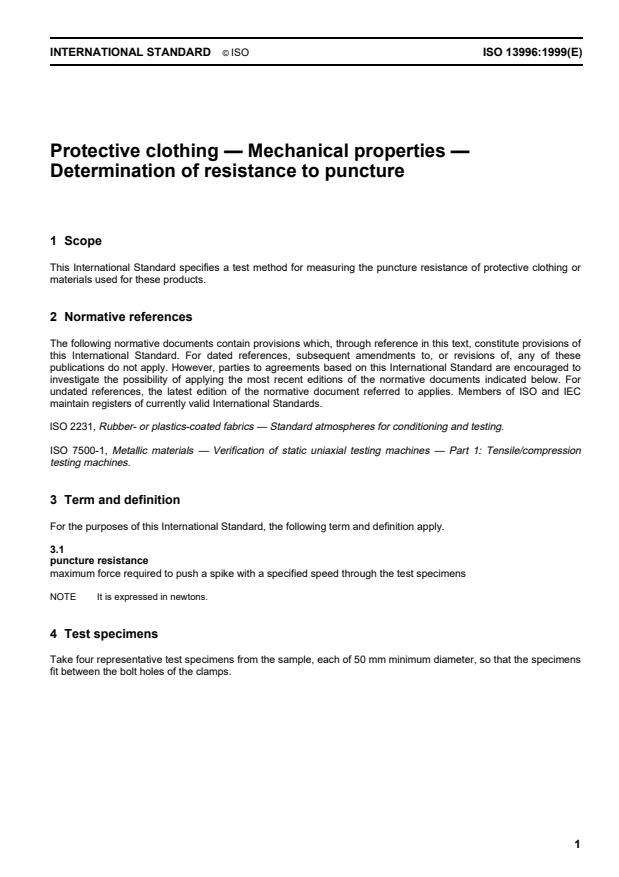
This International Standard specifies a test method for measuring the puncture resistance of protective clothing or materials used for these products.
- Status
- Published
- Publication Date
- 29-Sep-1999
- Technical Committee
- ISO/TC 94/SC 13 - Protective clothing
- Drafting Committee
- ISO/TC 94/SC 13/WG 5 - Protective clothing against mechanical action
- Current Stage
- 9093 - International Standard confirmed
- Start Date
- 06-Jan-2022
- Completion Date
- 29-Aug-2026
Buy Documents
ISO 13996:1999 - Protective clothing — Mechanical properties — Determination of resistance to puncture Released:9/30/1999
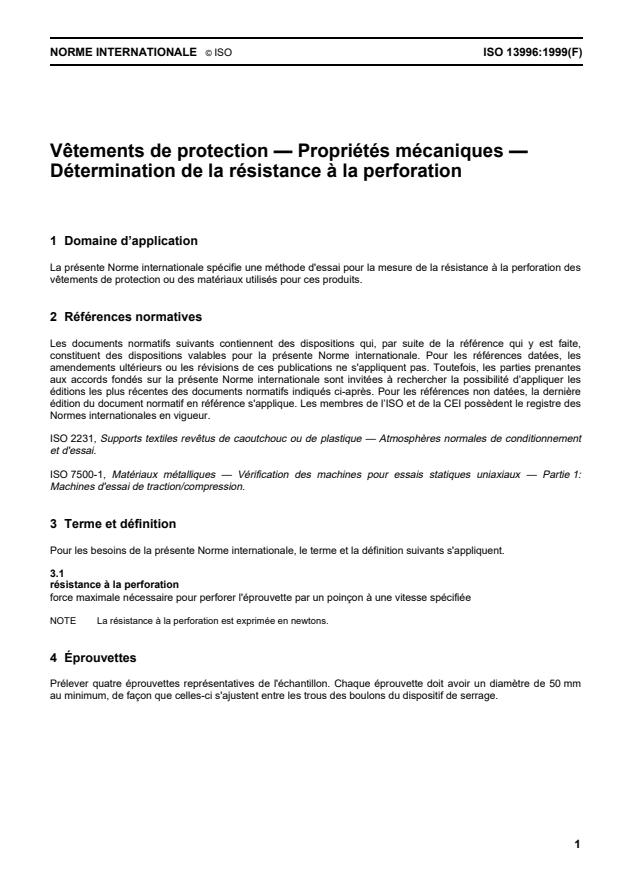
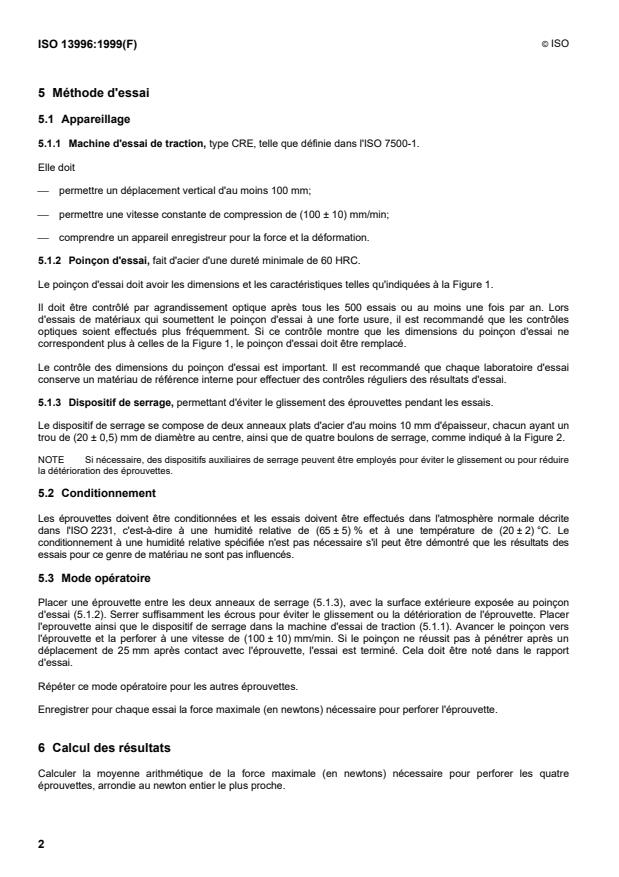
ISO 13996:1999 - Vetements de protection — Propriétés mécaniques — Détermination de la résistance a la perforation Released:9/30/1999
Overview - ISO 13996:1999 and puncture resistance testing
ISO 13996:1999 defines a standardized test method to measure the puncture resistance of protective clothing and the materials used to make these garments. The standard sets out specimen requirements, test apparatus, conditioning, test procedure, result calculation and reporting rules to produce repeatable, comparable measurements expressed in newtons.
Key topics and technical requirements
- Scope: Method for determining resistance to puncture of protective clothing or materials.
- Specimens: Take four representative specimens; each specimen must be at least 50 mm diameter so it fits the clamping device.
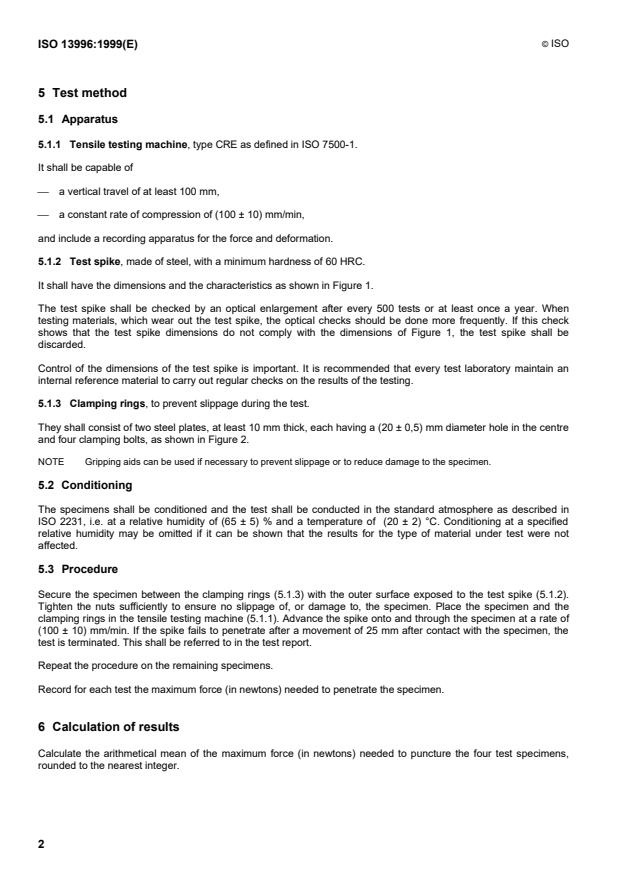
- Test machine: Use a tensile/compression test machine (type CRE) in accordance with ISO 7500-1, with at least 100 mm vertical travel, constant compression speed of (100 ± 10) mm/min, and a force/deformation recorder.
- Puncture probe (punch): Steel probe with minimum hardness 60 HRC; dimensions shown in the standard (Figure 1). Inspect the punch by optical magnification every 500 tests or at least annually; increase frequency for abrasive materials.
- Clamping device: Two flat steel rings (≥10 mm thick) with central hole (20 ± 0.5) mm and four fastening bolts (see Figure 2).
- Conditioning: Specimens conditioned and tested in normal atmosphere per ISO 2231 - typically 20 ± 2 °C and 65 ± 5% RH (unless material is demonstrably insensitive to humidity).
- Procedure: Place specimen outer surface toward the punch; clamp to prevent slippage; advance punch at specified speed. If the punch does not penetrate after 25 mm travel post-contact, record the test as terminated.
- Results: Record maximum force (newtons) for each specimen. Report the arithmetic mean of the four values, rounded to the nearest newton.
- Reporting: Include standard reference (ISO 13996:1999), sample identification, individual specimen results, mean value, and any deviations from the method.
Practical applications and users
ISO 13996:1999 is used to:
- Validate material selection and garment design for PPE (chemical suits, biological protection, industrial wear)
- Support quality control and incoming inspection by manufacturers
- Provide test evidence for certification bodies, regulatory compliance and procurement specifications
- Compare materials during R&D for improved puncture resistance
Typical users: textile and PPE manufacturers, independent testing laboratories, certification bodies, occupational safety professionals, procurement officers.
Related standards
- ISO 2231 - Conditioning atmospheres for rubber/plastics coated fabrics (referenced for conditioning)
- ISO 7500-1 - Verification of testing machines for uniaxial static tests (machine requirements)
Keywords: ISO 13996:1999, puncture resistance, protective clothing, puncture test method, mechanical properties, PPE testing, protective materials.
Relations
- Effective Date
- 25-Aug-2026
Buy Documents
ISO 13996:1999 - Protective clothing — Mechanical properties — Determination of resistance to puncture Released:9/30/1999
ISO 13996:1999 - Vetements de protection — Propriétés mécaniques — Détermination de la résistance a la perforation Released:9/30/1999
Get Certified
Connect with accredited certification bodies for this standard

CIS Institut d.o.o.
Personal Protective Equipment (PPE) certification body. Notified Body NB-2890 for EU Regulation 2016/425 PPE.

Kiwa BDA Testing
Building and construction product certification.
Kmetijski inštitut Slovenije
Agricultural Institute of Slovenia. Soil testing, plant health, agricultural product analysis.
Sponsored listings
Frequently Asked Questions
ISO 13996:1999 is a standard published by the International Organization for Standardization (ISO). Its full title is "Protective clothing — Mechanical properties — Determination of resistance to puncture". This standard covers: This International Standard specifies a test method for measuring the puncture resistance of protective clothing or materials used for these products.
This International Standard specifies a test method for measuring the puncture resistance of protective clothing or materials used for these products.
ISO 13996:1999 is classified under the following ICS (International Classification for Standards) categories: 13.340.10 - Protective clothing. The ICS classification helps identify the subject area and facilitates finding related standards.
ISO 13996:1999 has the following relationships with other standards: It is inter standard links to EN ISO 27065:2017. Understanding these relationships helps ensure you are using the most current and applicable version of the standard.
ISO 13996:1999 is available in PDF format for immediate download after purchase. The document can be added to your cart and obtained through the secure checkout process. Digital delivery ensures instant access to the complete standard document.
Standards Content (Sample)
INTERNATIONAL ISO
STANDARD 13996
First edition
1999-09-15
Protective clothing — Mechanical
properties — Determination of resistance to
puncture
Vêtements de protection — Propriétés mécaniques — Détermination de la
résistance à la perforation
A
Reference number
Foreword
ISO (the International Organization for Standardization) is a worldwide federation of national standards bodies (ISO
member bodies). The work of preparing International Standards is normally carried out through ISO technical
committees. Each member body interested in a subject for which a technical committee has been established has
the right to be represented on that committee. International organizations, governmental and non-governmental, in
liaison with ISO, also take part in the work. ISO collaborates closely with the International Electrotechnical
Commission (IEC) on all matters of electrotechnical standardization.
International Standards are drafted in accordance with the rules given in the ISO/IEC Directives, Part 3.
Draft International Standards adopted by the technical committees are circulated to the member bodies for voting.
Publication as an International Standard requires approval by at least 75 % of the member bodies casting a vote.
International Standard ISO 13996 was prepared by Technical Committee ISO/TC 94, Personal safety — Protective
clothing and equipment, Subcommittee SC 13, Protective clothing.
© ISO 1999
All rights reserved. Unless otherwise specified, no part of this publication may be reproduced or utilized in any form or by any means, electronic
or mechanical, including photocopying and microfilm, without permission in writing from the publisher.
International Organization for Standardization
Case postale 56 • CH-1211 Genève 20 • Switzerland
Internet iso@iso.ch
Printed in Switzerland
ii
INTERNATIONAL STANDARD © ISO ISO 13996:1999(E)
Protective clothing — Mechanical properties —
Determination of resistance to puncture
1 Scope
This International Standard specifies a test method for measuring the puncture resistance of protective clothing or
materials used for these products.
2 Normative references
The following normative documents contain provisions which, through reference in this text, constitute provisions of
this International Standard. For dated references, subsequent amendments to, or revisions of, any of these
publications do not apply. However, parties to agreements based on this International Standard are encouraged to
investigate the possibility of applying the most recent editions of the normative documents indicated below. For
undated references, the latest edition of the normative document referred to applies. Members of ISO and IEC
maintain registers of currently valid International Standards.
lSO 2231,
Rubber- or plastics-coated fabrics — Standard atmospheres for conditioning and testing.
ISO 7500-1, Metallic materials — Verification of static uniaxial testing machines — Part 1: Tensile/compression
testing machines.
3 Term and definition
For the purposes of this International Standard, the following term and definition apply.
3.1
puncture resistance
maximum force required to push a spike with a specified speed through the test specimens
NOTE It is expressed in newtons.
4 Test specimens
Take four representative test specimens from the sample, each of 50 mm minimum diameter, so that the spe
...
NORME ISO
INTERNATIONALE 13996
Première édition
1999-09-15
Vêtements de protection — Propriétés
mécaniques — Détermination de la
résistance à la perforation
Protective clothing — Mechanical properties — Determination of resistance
to puncture
A
Numéro de référence
Avant-propos
L'ISO (Organisation internationale de normalisation) est une fédération mondiale d'organismes nationaux de
normalisation (comités membres de l'ISO). L'élaboration des Normes internationales est en général confiée aux
comités techniques de l'ISO. Chaque comité membre intéressé par une étude a le droit de faire partie du comité
technique créé à cet effet. Les organisations internationales, gouvernementales et non gouvernementales, en
liaison avec l'ISO participent également aux travaux. L'ISO collabore étroitement avec la Commission
électrotechnique internationale (CEI) en ce qui concerne la normalisation électrotechnique.
Les Normes internationales sont rédigées conformément aux règles données dans les Directives ISO/CEI, Partie 3.
Les projets de Normes internationales adoptés par les comités techniques sont soumis aux comités membres pour
vote. Leur publication comme Normes internationales requiert l'approbation de 75 % au moins des comités
membres votants.
La Norme internationale ISO 13996 a été élaborée par le comité technique ISO/TC 94, Sécurité individuelle —
Vêtements et équipements de protection, sous-comité SC 13, Vêtements de protection.
© ISO 1999
Droits de reproduction réservés. Sauf prescription différente, aucune partie de cette publication ne peut être reproduite ni utilisée sous quelque
forme que ce soit et par aucun procédé, électronique ou mécanique, y compris la photocopie et les microfilms, sans l'accord écrit de l'éditeur.
Organisation internationale de normalisation
Case postale 56 • CH-1211 Genève 20 • Suisse
Internet iso@iso.ch
Imprimé en Suisse
ii
NORME INTERNATIONALE © ISO ISO 13996:1999(F)
Vêtements de protection — Propriétés mécaniques —
Détermination de la résistance à la perforation
1 Domaine d’application
La présente Norme internationale spécifie une méthode d'essai pour la mesure de la résistance à la perforation des
vêtements de protection ou des matériaux utilisés pour ces produits.
2 Références normatives
Les documents normatifs suivants contiennent des dispositions qui, par suite de la référence qui y est faite,
constituent des dispositions valables pour la présente Norme internationale. Pour les références datées, les
amendements ultérieurs ou les révisions de ces publications ne s'appliquent pas. Toutefois, les parties prenantes
aux accords fondés sur la présente Norme internationale sont invitées à rechercher la possibilité d’appliquer les
éditions les plus récentes des documents normatifs indiqués ci-après. Pour les références non datées, la dernière
édition du document normatif en référence s'applique. Les membres de l’ISO et de la CEI possèdent le registre des
Normes internationales en vigueur.
ISO 2231, Supports textiles revêtus de caoutchouc ou de plastique — Atmosphères normales de conditionnement
et d'essai.
ISO 7500-1, Matériaux métalliques — Vérification des machines pour essais statiques uniaxiaux — Partie 1:
Machines d'essai de traction/compression.
3 Terme et définition
Pour les besoins de la présente Norme internationale, le terme et la définition suivants s'appliquent.
3.1
résistance à la perforation
force maximale nécessaire pour perforer l'éprouvette par un poinçon à une vitesse spécifiée
NOTE La résistance à la perforation est exprimée en newtons.
4 Éprouvettes
Prélever quatre éprouvettes représentatives de l'échantillon. Chaque éprouvette doit avoir un diamètre de 50 mm
au minimum, de façon que celles-ci s'ajustent entre les trous des boulons du dispositif de serrage.
...