

ISO 15927-5:2004/Amd 1:2011
(Amendment)Hygrothermal performance of buildings — Calculation and presentation of climatic data — Part 5: Data for design heat load for space heating — Amendment 1
General Information
- Abstract
- Status
- Published
- Publication Date
- 07-Nov-2011
- Technical Committee
- ISO/TC 163/SC 2 - Calculation methods
- Drafting Committee
- ISO/TC 163/SC 2 - Calculation methods
- Current Stage
- 6060 - International Standard published
- Start Date
- 08-Nov-2011
- Due Date
- 07-May-2013
- Completion Date
- 07-May-2013
Buy Documents

ISO 15927-5:2004/Amd 1:2011 - Hygrothermal performance of buildings — Calculation and presentation of climatic data — Part 5: Data for design heat load for space heating — Amendment 1 Released:6/7/2012

ISO 15927-5:2004/Amd 1:2011 - Performance hygrothermique des bâtiments — Calcul et présentation des données climatiques — Partie 5: Données pour la charge calorifique de conception pour le chauffage des locaux — Amendement 1 Released:6/7/2012
Overview
ISO 15927-5:2004/Amd 1:2011 is an important amendment to the international standard focusing on the Hygrothermal Performance of Buildings. Specifically, this part deals with the Calculation and Presentation of Climatic Data, essential for determining the Design Heat Load for Space Heating. Developed by ISO Technical Committee ISO/TC 163, this amendment enhances the accuracy and consistency of climatic data used for thermal performance calculations in building design. The revised guidelines ensure thermal engineers, architects, and HVAC professionals have reliable climate data to optimize heating systems, promote energy efficiency, and improve occupant comfort.
Key Topics
Updated Climatic Data Definitions
Clarifications in terms such as "daily maximum temperature" and "daily minimum temperature" ensure data are interpreted consistently using hourly mean values or recorded extremes.Calculation Methods for Heat Load Data
The amendment standardizes how hourly and three-hourly temperature data are averaged for multiple-day periods, improving the reliability of design heat load inputs.Reference to Meteorological Standards
The guidance references the World Meteorological Organization's Guide to Meteorological Instruments and Methods of Observation (WMO No. 8) in its undated form, reflecting the most current methodologies in climate data measurement.Correction and Precision Improvements
Precise terminology corrections, such as replacing “the second day” with “the final day,” tighten methodological clarity when summing or averaging climatic values over time.
Applications
Building Energy Modelling
ISO 15927-5:2004/Amd 1 provides essential climatic input data for simulating heating demands, which is critical for energy performance assessments.HVAC System Design
Engineers use the standardized data and calculation approaches to size heating equipment correctly, ensuring adequate thermal comfort without oversizing.Energy Efficiency Optimization
By applying accurate heat load calculations based on robust climatic data, building designers can minimize energy consumption and reduce operational costs.Climate-Responsive Architecture
The standard supports designing buildings that respond effectively to local climate conditions, influencing material choice and architectural form.Regulatory Compliance and Certification
Conformance with ISO 15927-5 helps demonstrate compliance with regional building codes and international green building certification schemes focusing on thermal performance.
Related Standards
ISO 15927 Series
This standard is part of a series covering hygrothermal building performance, including moisture transfer, ventilation, and overall thermal calculations.World Meteorological Organization (WMO) Guidelines
The amendment relies on WMO No. 8 for meteorological data collection methods, highlighting the intersection of building physics and climatology.ISO 52016
Thermal performance of buildings - Calculation of energy use for space heating and cooling, which builds upon accurate climatic data inputs like those specified in ISO 15927-5.ISO 7726
Instruments and methods for measuring physical quantities related to thermal environments-complementing data collection procedures referenced in ISO 15927-5.
By adhering to ISO 15927-5:2004/Amd 1:2011, professionals involved in building design and thermal performance analysis can ensure the precision and comparability of climatic data used to define heating requirements. This leads to better-informed energy strategies and contributes to sustainable building practices worldwide.
Relations
- Effective Date
- 12-Feb-2026
- Effective Date
- 06-Jun-2022
- Effective Date
- 18-Dec-2021
Buy Documents
ISO 15927-5:2004/Amd 1:2011 - Hygrothermal performance of buildings — Calculation and presentation of climatic data — Part 5: Data for design heat load for space heating — Amendment 1 Released:6/7/2012
ISO 15927-5:2004/Amd 1:2011 - Performance hygrothermique des bâtiments — Calcul et présentation des données climatiques — Partie 5: Données pour la charge calorifique de conception pour le chauffage des locaux — Amendement 1 Released:6/7/2012
Get Certified
Connect with accredited certification bodies for this standard

DIBt (Deutsches Institut für Bautechnik)
German Institute for Building Technology.
DIN CERTCO
DIN Group product certification.

Aboma Certification B.V.
Specialized in construction, metal, and transport sectors.
Sponsored listings
Frequently Asked Questions
ISO 15927-5:2004/Amd 1:2011 is a standard published by the International Organization for Standardization (ISO). Its full title is "Hygrothermal performance of buildings — Calculation and presentation of climatic data — Part 5: Data for design heat load for space heating — Amendment 1". This standard covers: Hygrothermal performance of buildings — Calculation and presentation of climatic data — Part 5: Data for design heat load for space heating — Amendment 1
Hygrothermal performance of buildings — Calculation and presentation of climatic data — Part 5: Data for design heat load for space heating — Amendment 1
ISO 15927-5:2004/Amd 1:2011 is classified under the following ICS (International Classification for Standards) categories: 07.060 - Geology. Meteorology. Hydrology; 91.120.10 - Thermal insulation of buildings. The ICS classification helps identify the subject area and facilitates finding related standards.
ISO 15927-5:2004/Amd 1:2011 has the following relationships with other standards: It is inter standard links to EN ISO 15927-5:2004/A1:2011, ISO 22870:2006, ISO 15927-5:2004. Understanding these relationships helps ensure you are using the most current and applicable version of the standard.
ISO 15927-5:2004/Amd 1:2011 is available in PDF format for immediate download after purchase. The document can be added to your cart and obtained through the secure checkout process. Digital delivery ensures instant access to the complete standard document.
Standards Content (Sample)
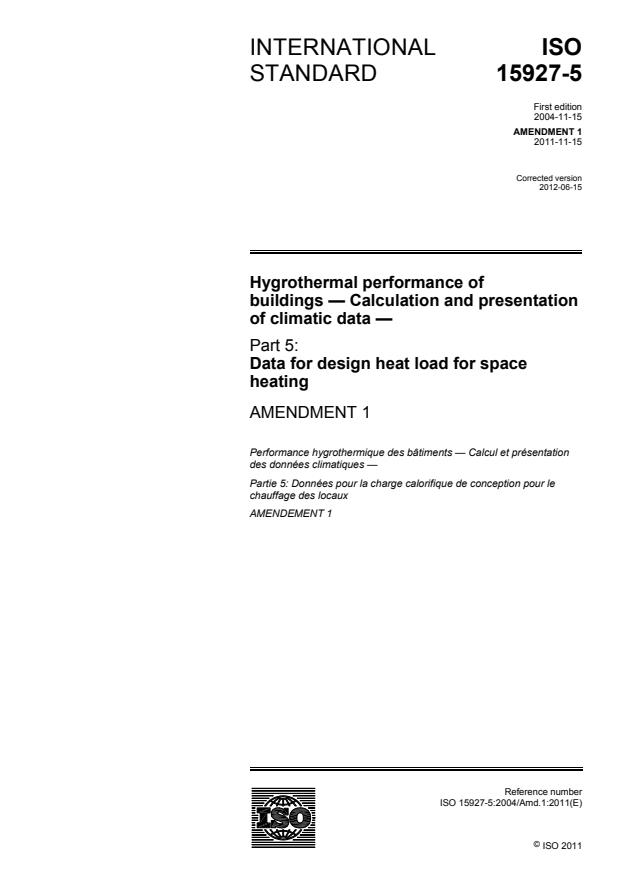
INTERNATIONAL ISO
STANDARD 15927-5
First edition
2004-11-15
AMENDMENT 1
2011-11-15
Corrected version
2012-06-15
Hygrothermal performance of
buildings — Calculation and presentation
of climatic data —
Part 5:
Data for design heat load for space
heating
AMENDMENT 1
Performance hygrothermique des bâtiments — Calcul et présentation
des données climatiques —
Partie 5: Données pour la charge calorifique de conception pour le
chauffage des locaux
AMENDEMENT 1
Reference number
ISO 15927-5:2004/Amd.1:2011(E)
©
ISO 2011
ISO 15927-5:2004/Amd.1:2011(E)
© ISO 2011
All rights reserved. Unless otherwise specified, no part of this publication may be reproduced or utilized in any form or by any means,
electronic or mechanical, including photocopying and microfilm, without permission in writing from either ISO at the address below or
ISO's member body in the country of the requester.
ISO copyright office
Case postale 56 CH-1211 Geneva 20
Tel. + 41 22 749 01 11
Fax + 41 22 749 09 47
E-mail copyright@iso.org
Web www.iso.org
Published in Switzerland
ii © ISO 2011 – All rights reserved
ISO 15927-5:2004/Amd.1:2011(E)
Foreword
ISO (the International Organization for Standardization) is a worldwide federation of national standards bodies
(ISO member bodies). The work of preparing International Standards is normally carried out through ISO
technical committees. Each member body interested in a subject for which a technical committee has been
established has the right to be represented on that committee. International organizations, governmental and
non-governmental, in liaison with ISO, also take part in the work. ISO collaborates closely with the
International Electrotechnical Commission (IEC) on all matters of electrotechnical standardization.
International Standards are drafted in accordance with the rules given in the ISO/IEC Directives, Part 2.
The main task of technical committees is to prepare International Standards. Draft International Standards
adopted by the technical committees are circulated to the member bodies for voting. Publication as an
International Standard requires approval by at least 75 % of the member bodies casting a vote.
Attention is drawn to the possibility that some of the elements of this document may
...
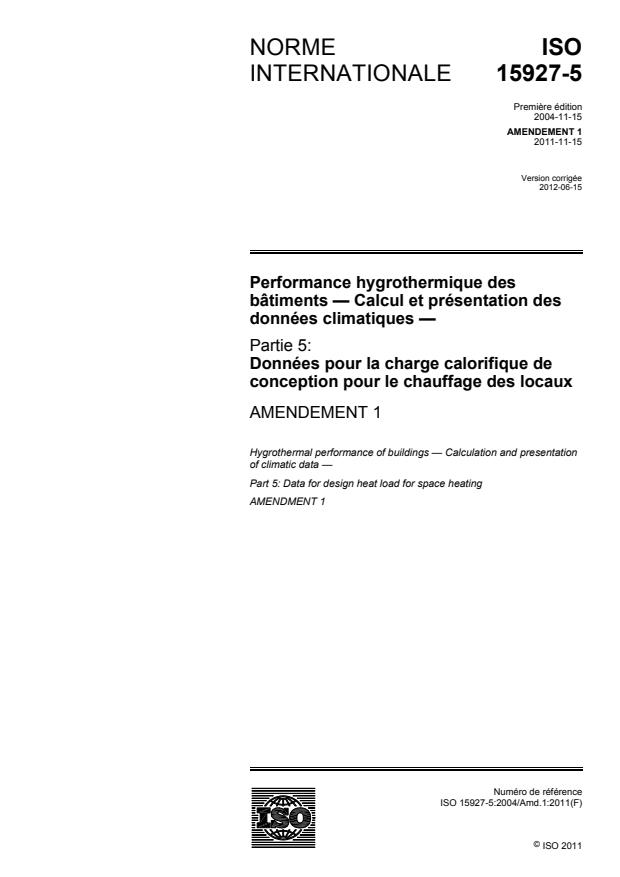
NORME ISO
INTERNATIONALE 15927-5
Première édition
2004-11-15
AMENDEMENT 1
2011-11-15
Version corrigée
2012-06-15
Performance hygrothermique des
bâtiments — Calcul et présentation des
données climatiques —
Partie 5:
Données pour la charge calorifique de
conception pour le chauffage des locaux
AMENDEMENT 1
Hygrothermal performance of buildings — Calculation and presentation
of climatic data —
Part 5: Data for design heat load for space heating
AMENDMENT 1
Numéro de référence
ISO 15927-5:2004/Amd.1:2011(F)
©
ISO 2011
ISO 15927-5:2004/Amd.1:2011(F)
DOCUMENT PROTÉGÉ PAR COPYRIGHT
© ISO 2011
Droits de reproduction réservés. Sauf prescription différente, aucune partie de cette publication ne peut être reproduite ni utilisée sous
quelque forme que ce soit et par aucun procédé, électronique ou mécanique, y compris la photocopie et les microfilms, sans l'accord écrit
de l'ISO à l'adresse ci-après ou du comité membre de l'ISO dans le pays du demandeur.
ISO copyright office
Case postale 56 CH-1211 Geneva 20
Tel. + 41 22 749 01 11
Fax + 41 22 749 09 47
E-mail copyright@iso.org
Web www.iso.org
Publié en Suisse
ii © ISO 2011 – Tous droits réservés
ISO 15927-5:2004/Amd.1:2011(F)
Avant-propos
L'ISO (Organisation internationale de normalisation) est une fédération mondiale d'organismes nationaux de
normalisation (comités membres de l'ISO). L'élaboration des Normes internationales est en général confiée
aux comités techniques de l'ISO. Chaque comité membre intéressé par une étude a le droit de faire partie du
comité technique créé à cet effet. Les organisations internationales, gouvernementales et non
gouvernementales, en liaison avec l'ISO participent également aux travaux. L'ISO collabore étroitement avec
la Commission électrotechnique internationale (CEI) en ce qui concerne la normalisation électrotechnique.
Les Normes internationales sont rédigées conformément aux règles données dans les Directives ISO/CEI,
Partie 2.
La tâche principale des comités techniques est d'élaborer les Normes internationales. Les projets de Normes
internationales adoptés par les comités techniques sont soumis aux comités membres pour vote. Leur
publication comme Normes internationales requiert l'approbation de 75 % au moins des comités membres
votants.
L'attention est appelée sur le fait que certains des éléments du présent document peuvent faire l'objet de
droits de propriété intellectuelle ou de droits analogues. L'ISO ne saurait être tenue pour responsable de ne
p
...