

ISO/TS 50044:2019
(Main)Energy saving projects (EnSPs) — Guidelines for economic and financial evaluation
General Information
- Abstract
This document gives guidelines for how to compare and prioritize energy saving projects (EnSPs) before implementation, using economic and financial evaluation. It includes a common set of principles. This document is applicable to all EnSPs and energy performance improvement actions (EPIAs) that are developed by stakeholders and organizations for improving energy performance, irrespective of the type and size of an organization and its energy use and consumption. The methodology for quantification methods for predicted energy savings and measurement and verification (M&V) of the energy savings are not in the scope of this document. NOTE The methodology for the estimation of the energy savings is critical when determining cost savings. The methodology of the scenario generation (building) for future energy saving measures and actions is not covered by this document. General rules and methodologies within this document can be used either independently or in conjunction with other standards and protocols.
- Status
- Published
- Publication Date
- 03-Nov-2019
- Technical Committee
- ISO/TC 301 - Energy management and energy savings
- Drafting Committee
- ISO/TC 301 - Energy management and energy savings
- Current Stage
- 9060 - Close of review
- Completion Date
- 02-Sep-2029
Buy Documents

ISO/TS 50044:2019 - Energy saving projects (EnSPs) -- Guidelines for economic and financial evaluation

ISO/TS 50044:2019 - Energy saving projects (EnSPs) — Guidelines for economic and financial evaluation/4/2019
Overview
ISO/TS 50044:2019 - Energy saving projects (EnSPs): Guidelines for economic and financial evaluation provides a methodological framework to compare, prioritize and report energy saving projects (EnSPs) using consistent economic and financial evaluation. The Technical Specification is applicable to all EnSPs and energy performance improvement actions (EPIAs), regardless of organization size or sector. It focuses on planning evaluations, identifying costs and benefits, applying economic indicators, assessing uncertainty, and reporting results. Note: methodologies for quantifying predicted energy savings, measurement & verification (M&V) or scenario generation are explicitly outside the scope.
Key topics and requirements
ISO/TS 50044 defines principles and practical steps for economic and financial assessments of EnSPs, including:
- Planning the evaluation: define EnSP description, lifetime, project boundaries and required accuracy.
- Data collection: identify inputs needed for cash-flow and benefit estimation.
- Energy and non‑energy effects: guidance to estimate energy savings (prediction is out of scope), and to quantify non-energy benefits and convert effects to economic value.
- Costs and cash flows: classify costs (variable, fixed, capital) and prepare future cash-flow profiles.
- Economic & financial indicators: recommended indicators include Net Present Value (NPV), Internal Rate of Return (IRR), Payback Period (PP), Life Cycle Cost Analysis (LCCA) and Profitability Index.
- Assessment and analysis: apply sensitivity analysis, uncertainty and risk assessment, and evaluate data quality.
- Decision-making and reporting: provide standardized reporting principles and templates for transparent decision support.
- Annexes: informative annexes (A–F) give step-by-step calculations and worked examples for NPV, IRR, payback and LCCA.
Practical applications and users
ISO/TS 50044 is designed to support:
- Energy managers and sustainability teams prioritizing retrofit or efficiency portfolios.
- Financial analysts and investment committees evaluating returns and life-cycle costs of EnSPs.
- Project developers and ESCOs preparing business cases and comparing alternatives.
- Procurement and facility managers integrating energy performance into decision-making.
- Policy makers, NGOs and auditors who require consistent methods to quantify economic impacts of energy measures.
Use cases include ranking retrofit projects, preparing investment proposals, embedding EnSP appraisal within ISO 50001 energy management processes, and harmonizing evaluation approaches across portfolios.
Related standards
- ISO/TS 50044 complements ISO 50001 (energy management systems) and can be used alongside other M&V standards and protocols. The document itself notes that general rules here can be applied independently or in conjunction with other standards and measurement frameworks.
Keywords: ISO/TS 50044, energy saving projects, EnSPs, economic evaluation, financial evaluation, NPV, IRR, payback, LCCA, energy performance.
Buy Documents
ISO/TS 50044:2019 - Energy saving projects (EnSPs) -- Guidelines for economic and financial evaluation
ISO/TS 50044:2019 - Energy saving projects (EnSPs) — Guidelines for economic and financial evaluation/4/2019
Get Certified
Connect with accredited certification bodies for this standard

DNV
DNV is an independent assurance and risk management provider.

Lloyd's Register
Lloyd's Register is a global professional services organisation specialising in engineering and technology.
DNV Energy Systems
Energy and renewable energy certification.
Sponsored listings
Frequently Asked Questions
ISO/TS 50044:2019 is a technical specification published by the International Organization for Standardization (ISO). Its full title is "Energy saving projects (EnSPs) — Guidelines for economic and financial evaluation". This standard covers: This document gives guidelines for how to compare and prioritize energy saving projects (EnSPs) before implementation, using economic and financial evaluation. It includes a common set of principles. This document is applicable to all EnSPs and energy performance improvement actions (EPIAs) that are developed by stakeholders and organizations for improving energy performance, irrespective of the type and size of an organization and its energy use and consumption. The methodology for quantification methods for predicted energy savings and measurement and verification (M&V) of the energy savings are not in the scope of this document. NOTE The methodology for the estimation of the energy savings is critical when determining cost savings. The methodology of the scenario generation (building) for future energy saving measures and actions is not covered by this document. General rules and methodologies within this document can be used either independently or in conjunction with other standards and protocols.
This document gives guidelines for how to compare and prioritize energy saving projects (EnSPs) before implementation, using economic and financial evaluation. It includes a common set of principles. This document is applicable to all EnSPs and energy performance improvement actions (EPIAs) that are developed by stakeholders and organizations for improving energy performance, irrespective of the type and size of an organization and its energy use and consumption. The methodology for quantification methods for predicted energy savings and measurement and verification (M&V) of the energy savings are not in the scope of this document. NOTE The methodology for the estimation of the energy savings is critical when determining cost savings. The methodology of the scenario generation (building) for future energy saving measures and actions is not covered by this document. General rules and methodologies within this document can be used either independently or in conjunction with other standards and protocols.
ISO/TS 50044:2019 is classified under the following ICS (International Classification for Standards) categories: 27.015 - Energy efficiency. Energy conservation in general. The ICS classification helps identify the subject area and facilitates finding related standards.
ISO/TS 50044:2019 is available in PDF format for immediate download after purchase. The document can be added to your cart and obtained through the secure checkout process. Digital delivery ensures instant access to the complete standard document.
Standards Content (Sample)
TECHNICAL ISO/TS
SPECIFICATION 50044
First edition
2019-11
Energy saving projects (EnSPs) —
Guidelines for economic and financial
evaluation
Projets d'économies d'énergie — Lignes directrices pour l'évaluation
économique et financière
Reference number
©
ISO 2019
© ISO 2019
All rights reserved. Unless otherwise specified, or required in the context of its implementation, no part of this publication may
be reproduced or utilized otherwise in any form or by any means, electronic or mechanical, including photocopying, or posting
on the internet or an intranet, without prior written permission. Permission can be requested from either ISO at the address
below or ISO’s member body in the country of the requester.
ISO copyright office
CP 401 • Ch. de Blandonnet 8
CH-1214 Vernier, Geneva
Phone: +41 22 749 01 11
Fax: +41 22 749 09 47
Email: copyright@iso.org
Website: www.iso.org
Published in Switzerland
ii © ISO 2019 – All rights reserved
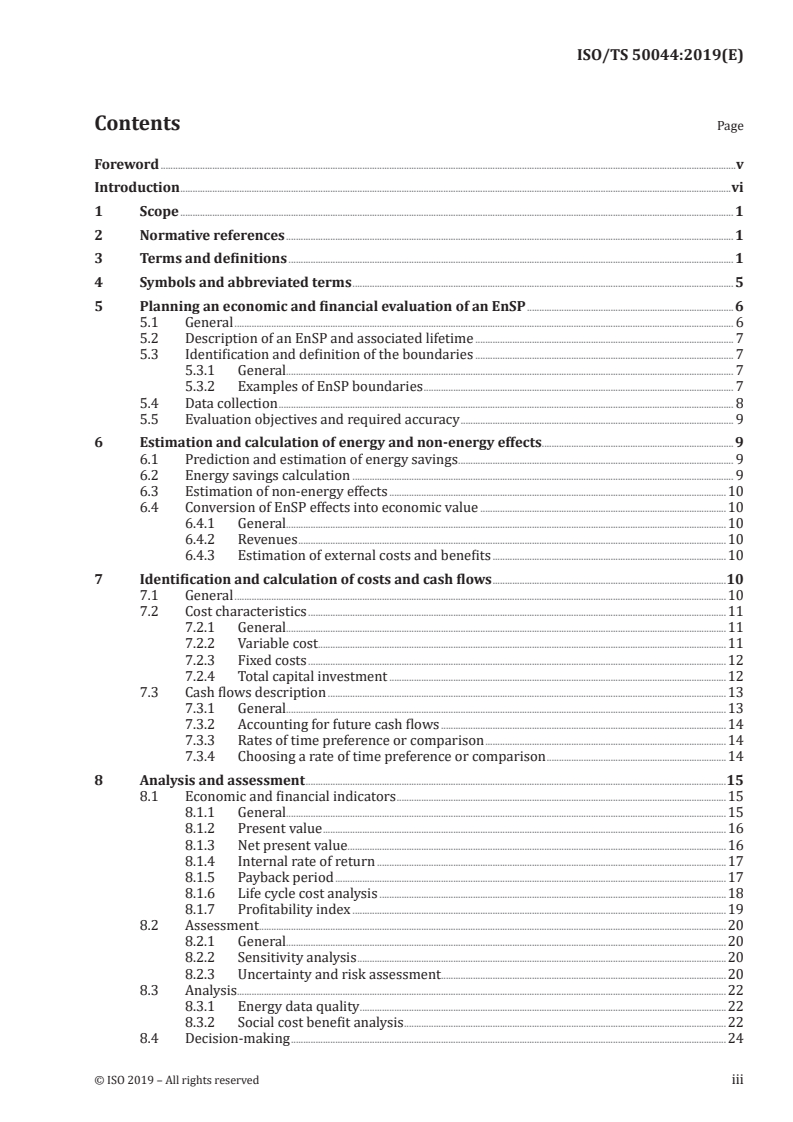
Contents Page
Foreword .v
Introduction .vi
1 Scope . 1
2 Normative references . 1
3 Terms and definitions . 1
4 Symbols and abbreviated terms . 5
5 Planning an economic and financial evaluation of an EnSP . 6
5.1 General . 6
5.2 Description of an EnSP and associated lifetime . 7
5.3 Identification and definition of the boundaries . 7
5.3.1 General. 7
5.3.2 Examples of EnSP boundaries . 7
5.4 Data collection . 8
5.5 Evaluation objectives and required accuracy . 9
6 Estimation and calculation of energy and non-energy effects . 9
6.1 Prediction and estimation of energy savings . 9
6.2 Energy savings calculation . 9
6.3 Estimation of non-energy effects .10
6.4 Conversion of EnSP effects into economic value .10
6.4.1 General.10
6.4.2 Revenues .10
6.4.3 Estimation of external costs and benefits .10
7 Identification and calculation of costs and cash flows .10
7.1 General .10
7.2 Cost characteristics .11
7.2.1 General.11
7.2.2 Variable cost.11
7.2.3 Fixed costs .12
7.2.4 Total capital investment .12
7.3 Cash flows description .13
7.3.1 General.13
7.3.2 Accounting for future cash flows .14
7.3.3 Rates of time preference or comparison .14
7.3.4 Choosing a rate of time preference or comparison .14
8 Analysis and assessment .15
8.1 Economic and financial indicators .15
8.1.1 General.15
8.1.2 Present value .16
8.1.3 Net present value . .16
8.1.4 Internal rate of return .17
8.1.5 Payback period .17
8.1.6 Life cycle cost analysis .18
8.1.7 Profitability index .19
8.2 Assessment .20
8.2.1 General.20
8.2.2 Sensitivity analysis .20
8.2.3 Uncertainty and risk assessment.20
8.3 Analysis.22
8.3.1 Energy data quality . .22
8.3.2 Social cost benefit analysis .22
8.4 Decision-making .24
8.4.1 General.24
8.4.2 Selection of an EnSP based on indicators .24
9 Reporting .25
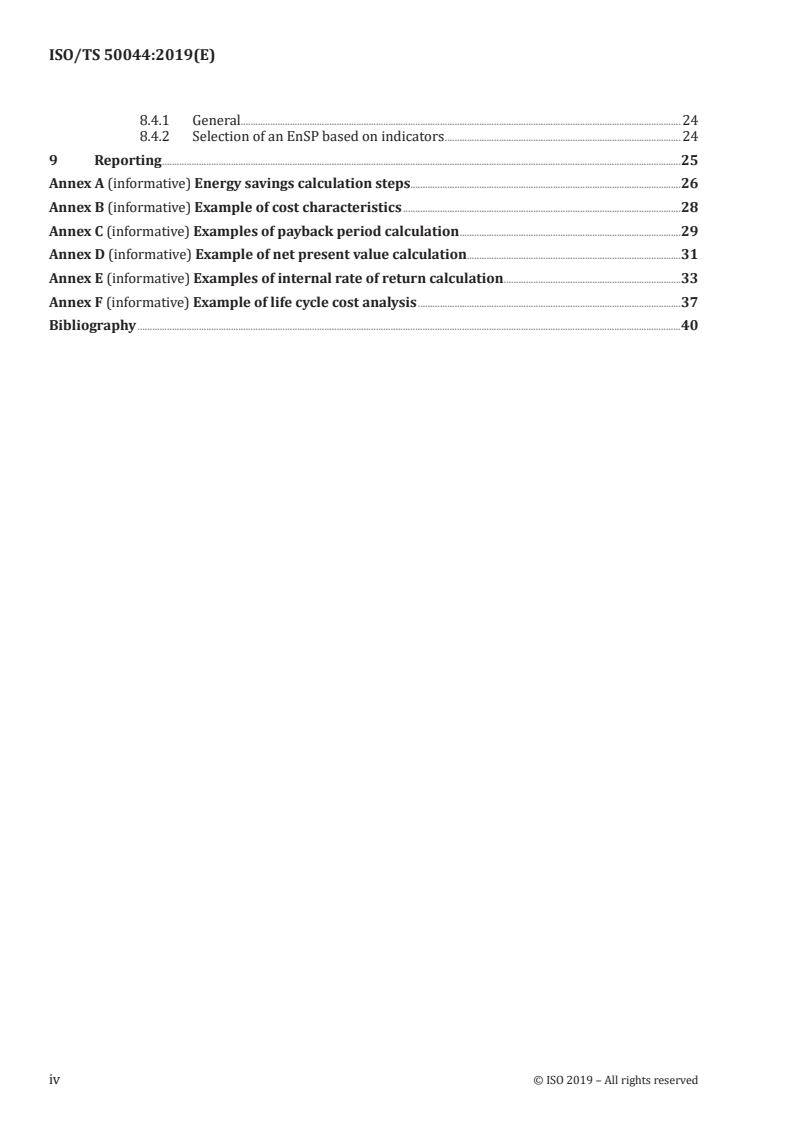
Annex A (informative) Energy savings calculation steps.26
Annex B (informative) Example of cost characteristics .28
Annex C (informative) Examples of payback period calculation .29
Annex D (informative) Example of net present value calculation .31
Annex E (informative) Examples of internal rate of return calculation .33
Annex F (informative) Example of life cycle cost analysis .37
Bibliography .40
iv © ISO 2019 – All rights reserved
Foreword
ISO (the International Organization for Standardization) is a worldwide federation of national standards
bodies (ISO member bodies). The work of preparing International Standards is normally carried out
through ISO technical committees. Each member body interested in a subject for which a technical
committee has been established has the right to be represented on that committee. International
organizations, governmental and non-governmental, in liaison with ISO, also take part in the work.
ISO collaborates closely with the International Electrotechnical Commission (IEC) on all matters of
electrotechnical standardization.
The procedures used to develop this document and those intended for its further maintenance are
described in the ISO/IEC Directives, Part 1. In particular, the different approval criteria needed for the
different types of ISO documents should be noted. This document was drafted in accordance with the
editorial rules of the ISO/IEC Directives, Part 2 (see www .iso .org/ directives).
Attention is drawn to the possibility that some of the elements of this document may be the subject of
patent rights. ISO shall not be held responsible for identifying any or all such patent rights. Details of
any patent rights identified during the development of the document will be in the Introduction and/or
on the ISO list of patent declarations received (see www .iso .org/ patents).
Any trade name used in this document is information given for the convenience of users and does not
constitute an endorsement.
For an explanation of the voluntary nature of standards, the meaning of ISO specific terms and
expressions related to conformity assessment, as well as information about ISO’s adherence to the
World Trade Organization (WTO) principles in the Technical Barriers to Trade (TBT) see www .iso .org/
iso/ foreword .html.
This document was prepared by Technical Committee ISO/TC 301, Energy management and energy
savings.
Any feedback or questions on this document should be directed to the user’s national standards body. A
complete listing of these bodies can be found at www .iso .org/ members .html.
Introduction
A complete assessment of an investment in an energy saving project (EnSP) requires analysis of all
costs and benefits over the lifetime of the investment. This assessment can be used to prioritize the
EnSPs. However, it is important to consider the aim and scope at the outset because this will prescribe
the course to be followed. The basic criterion for evaluating an investment decision in an EnSP is that
the benefits resulting from the EnSP should be greater than the costs incurred within a defined time
period for the return on the investment.
This document provides guidance on a methodological framework for the calculation, evaluation and
reporting of economic status by defining economic indicators to facilitate the selection of energy
performance improvement actions (EPIAs), EnSPs or opportunities. It provides examples and concepts
to demonstrate the financial value of the activities related to energy savings to ensure the business
connection to the organization.
This document is intended to help EnSP investment evaluators to determine an appropriate approach
or type of analysis at an appropriate level of detail and to assist energy savings evaluators in completing
consistent analyses using documented assumptions and reasoning. This document includes analytical
techniques that are commonly required for an economic evaluation of an EnSP.
Where possible, the financial evaluation of an EnSP should follow the approved method of the
organization making the investment, and the detailed approach outlined in this document should be
adjusted based on guidance from the organization.
The aim of an economic and financial evaluation is to provide the information needed to make a
judgement or a decision in relation to EnSPs.
The perspective of analysis is important, as it often dictates the approach to be used. Also, the ultimate
use of the results of an analysis will influence the level of detail required. The decision-making criteria
of the potential investor should also be considered.
This analysis approach provides a significantly better evaluation of the long-term implications of an
investment than methods that focus on first cost or short-term results. In this document, evaluation
methods can be applied to virtually any public or private business sector investment decision as
well as EnSPs decisions. Such decisions include the evaluation of alternative solutions with different
initial costs, operating and maintenance costs, and the evaluation of investments to improve energy
performance.
The process approach and steps used for EnSPs economic and financial evaluation, which are used
throughout this document, are illustrated in Figure 1.
vi © ISO 2019 – All rights reserved
Figure 1 — Economic and financial evaluation approach
This document includes:
a) terms and definitions;
b) the types of costs that should be taken into account for the calculation of the economic and financial
evaluation of EnSPs;
c) the data needed for the determination and calculation of costs related to the EnSP under
consideration;
d) the calculation and assessment of economic and financial indicators (EFIs);
e) a general framework and rules for the economic priorities of EnSPs;
f) the principle of reporting and expression of results for the economic and financial evaluations
of EnSPs.
This document provides indicators for the financial evaluation of all types of EnSPs. Those indicators
include the internal rate of return (IRR), net present value (NPV), payback period (PP) and life cycle
cost analysis (LCCA).
This document can be used by any organization during the important phases of an energy management
system, such as energy review, design, procurement and management review, to prioritize and record
energy performance opportunities accurately, consistent with ISO 50001.
This document also can be used by any stakeholder (e.g. policy makers, decision-makers, organizations,
NGOs) that aims to quantify the cost of EnSPs over a specific period. Annex A provides guidance on
the steps for an energy savings calculation. Annexes B to F provide an overview of the economic and
financial evaluations with practical examples.
viii © ISO 2019 – All rights reserved
TECHNICAL SPECIFICATION ISO/TS 50044:2019(E)
Energy saving projects (EnSPs) — Guidelines for economic
and financial evaluation
1 Scope
This document gives guidelines for how to compare and prioritize energy saving projects (EnSPs)
before implementation, using economic and financial evaluation. It includes a common set of principles.
This document is applicable to all EnSPs and energy performance improvement actions (EPIAs) that are
developed by stakeholders and organizations for improving energy performance, irrespective of the
type and size of an organization and its energy use and consumption.
The methodology for quantification methods for predicted energy savings and measurement and
verification (M&V) of the energy savings are not in the scope of this document.
NOTE The methodology for the estimation of the energy savings is critical when determining cost savings.
The methodology of the scenario generation (building) for future energy saving measures and actions
is not covered by this document.
General rules and methodologies within this document can be used either independently or in
conjunction with other standards and protocols.
2 Normative references
There are no normative references in this document.
3 Terms and definitions
For the purposes of this document, the following terms and definitions apply.
ISO and IEC maintain terminological databases for use in standardization at the following addresses:
— ISO Online browsing platform: available at https:// www .iso .org/ obp
— IEC Electropedia: available at http:// www .electropedia .org/
3.1
annual cost
sum of running costs and periodic costs or replacement costs paid on the year n
Note 1 to entry: The running cost is the money that needs to be spent regularly to run an energy saving project
(3.11) or an energy performance improvement action (3.10), e.g. cost of maintenance, labour costs.
3.2
capital cost
initial construction costs and costs of initial adaptation where these are treated as capital
expenditure (3.3)
[SOURCE: ISO 15686-5:2017, 3.1.2, modified — Note 1 to entry has been deleted.]
3.3
expenditure
money used to purchase, install and commission a capital asset
[SOURCE: ISO 15663-1:2000, 2.1.6, modified — “capital” has been deleted from the term.]
3.4
cash flow
CF
movement of money into (cash inflow) or out of (cash outflow) a business, project (3.24) or financial
product
Note 1 to entry: Cash flow is usually measured for a specified period.
3.5
discount rate
factor or rate reflecting the time value of money that is used to convert cash flows (3.4) occurring at
different times to a common time
[SOURCE: ISO 15686-5:2017, 3.3.1]
3.6
direct cost
expense that can be traced directly to an energy saving project (3.11)
3.7
energy
electricity, fuels, steam, heat, compressed air and other similar media
Note 1 to entry: For the purposes of this document, energy refers to the various forms of energy, including
renewable, which can be purchased, stored, treated, used in an equipment or in a process, and recovered.
[SOURCE: ISO 50001:2018, 3.5.1]
3.8
energy consumption
quantity of energy (3.7) applied
[SOURCE: ISO 50001:2018, 3.5.2]
3.9
energy performance
measurable result(s) related to energy efficiency, energy use and energy consumption (3.8)
[SOURCE: ISO 50001:2018, 3.4.3, modified — Notes 1 and 2 have been deleted.]
3.10
energy performance improvement action
EPIA
action or measure or group of actions or measures implemented or planned within an organization
intended to achieve energy performance (3.9) improvement through technological, managerial,
behavioural, economical, or other changes
[SOURCE: ISO 50015:2014, 3.5, modified — “or operational” has been deleted.]
3.11
energy saving project
EnSP
activity that is intended to contribute to a measurable reduction in energy consumption (3.8)
Note 1 to entry: An EnSP can also be intended to contribute to a reduction in greenhouse gas emissions.
Note 2 to entry: An EnSP includes at least one energy performance improvement action (3.10).
2 © ISO 2019 – All rights reserved
3.12
energy savings
reduction of energy consumption (3.8) following the implementation of an energy performance
improvement action (3.10)
[SOURCE: ISO/IEC 13273-1:2015, 3.3.9]
3.13
hurdle rate
minimum rate of return on a project (3.24) or investment required by a manager or investor
3.14
indirect cost
expense that cannot be traced directly to an energy saving project (3.11)
3.15
inflation
sustained increase in the general price level
Note 1 to entry: Inflation can be measured monthly, quarterly or annually against a known index.
[SOURCE: ISO 15686-5:2017, 3.3.3, modified — “deflation” has been deleted.]
3.16
internal rate of return
IRR
discount rate (3.5) that gives a net present value (3.22) equal to zero
Note 1 to entry: IRR is also known as the discounted cash flow (3.4) rate of return.
Note 2 to entry: In the context of savings and loans, IRR is also known as the economic rate of return.
[SOURCE: ISO 26382:2010, 3.8]
3.17
interactive effect
significant energy (3.7) result occurring beyond the project boundary as a consequence of action(s)
within the project boundary
Note 1 to entry: Correctly identifying and accounting for consequential effects mitigates the risk (3.27) of double
counting when the results of various energy performance improvement actions (3.10) are combined.
Note 2 to entry: The consequential effect is limited to the boundaries of the authority of the management of the
energy-using system.
EXAMPLE Changing the lighting system to be more efficient will have a consequential effect on the HVAC
system. If the measurement boundary is the lighting system only, the consequential effect on the HVAC system
should be described.
[SOURCE: ISO 17741:2016, 3.13, modified — Notes 1 and 2 have been replaced and the example has
been slightly amended.]
3.18
life cycle cost
LCC
discounted cumulative total of all costs incurred by an energy performance improvement action (EPIA)
(3.10) over its life cycle
Note 1 to entry: For an energy saving project (3.11), the discounted life cycle cost is the sum of all discounted costs
of the constituent EPIAs, taking into consideration their respective lifetimes.
[SOURCE: ISO 15663-3:2001, 2.1.9, modified — “an energy performance improvement action” has
replaced “a specified function or item of equipment” and Note 1 to entry has been added.]
3.19
life cycle cost analysis
LCCA
methodology for the systematic economic evaluation of life cycle costs (3.18) over a period of analysis,
as defined in the agreed scope
3.20
maintenance cost
total of necessarily incurred labour, material and other related costs incurred to retain equipment, a
process or its parts in a state in which it can perform its required functions in an energy saving project
(EnSP) (3.11)
Note 1 to entry: Maintenance includes conducting corrective, responsive and preventative maintenance on
EnSPs, or their parts, and includes all associated management, cleaning, servicing, repairing and replacing of
parts, where needed, to allow the EnSP and its parts to be used for its intended purposes.
[SOURCE: ISO 15686-5:2017, 3.1.9, modified — In the definition, “equipment, a process” has replaced “a
building”. In the note, “ENSPs” has replaced “constructed assets” and “repainting” has been deleted.]
3.21
minimum attractive rate of return
MARR
hurdle rate (3.13) for a project (3.24) within an organization
Note 1 to entry: MARR is used to determine the net present value (3.22).
Note 2 to entry: In capital budgeting, the discount rate (3.5) used is known the hurdle rate and is usually equal to
the incremental cost of capital.
3.22
net present value
NPV
sum of the discounted future cash flows (3.4)
Note 1 to entry: NPV converts future cash flows using a given discount rate (3.5).
[SOURCE: ISO 15686-5:2017, 3.2.2, modified — Notes 1 and 2 to entry have replaced the Note 1 to entry.]
3.23
new project
project involving an energy using system that has not been installed or commissioned, such that the
project cannot be considered and treated as a retrofit
[SOURCE: ISO 17741:2016, 3.16, Note 4 to entry]
3.24
project
unique process consisting of a set of coordinated and controlled activities with start and finish dates,
undertaken to achieve an objective conforming to specific requirements including constraints of time,
cost and resources
Note 1 to entry: An individual project may form part of a larger project structure and may consist of two or more
energy performance improvement actions (3.10).
Note 2 to entry: The complexity of the interactions among project activities is not necessarily related to the
project size.
Note 3 to entry: Energy savings (3.12) is the quantitative result as the project activities bring about reduction in
the energy consumption (3.8) of energy-using systems within the project boundary.
Note 4 to entry: Retrofit project is a project conducted on an already existing energy-using system.
4 © ISO 2019 – All rights reserved
[SOURCE: ISO 17741:2016, 3.16, modified — Note 4 to entry has been deleted and Note 5 to entry
renumbered accordingly.]
3.25
payback period
PP
period after which the initial capital invested has been paid back by the accumulated net revenue earned
[SOURCE: ISO 26382:2010, 3.13, modified — Note 1 to entry has been deleted.]
3.26
present value
PV
present worth
value of the project (3.24) cash flow (3.4) excluding the initial investment outlay
[SOURCE: ISO 15663-2:2001, 2.1.2, modified — “present worth” has been added as the admitted term.]
3.27
risk
effect of uncertainty on objectives
Note 1 to entry: An effect is a deviation from the expected. It can be positive, negative or both, and can address,
create or result in opportunities and threats.
Note 2 to entry: Objectives can have different aspects and categories, and can be applied at different levels.
Note 3 to entry: Risk is usually expressed in terms of risk sources, potential events, their consequences and their
likelihood.
[SOURCE: ISO 31000:2018, 3.1]
3.28
sensitivity analysis
test of the outcome of an analysis by altering one or more parameters from initial value(s)
[SOURCE: ISO 15686-5:2017, 3.2.5]
3.29
useful life
estimation of the median number of years of equipment life and accordingly the life of the project (3.24)
4 Symbols and abbreviated terms
For the purposes of this document, the following symbols, abbreviated terms and units apply.
Symbol/term Description Typical unit
A annual investment (fixed and variable) $
n
A uniform annual saving
s
A net cash flow $
t
A annual costs, including variable and fixed annual costs
t,i
$
and working capital cost
C cost (or net proceeds) of disposal $
d
C cost of energy savings $/kWh, $/MJ
e
C initial cost of the system $
i
C cost of maintenance and repair $
m
NOTE For simplicity, the financial unit of currency in this document is shown using a $ symbol.
In practice, it will normally be in the local currency of the country where the EnSP is taking place.
Symbol/term Description Typical unit
cash outflow (at the beginning of and during the pro-
C $
t
ject; this can include an initial investment)
DPP discounted payback period years
E annual energy consumption kWh, MJ
c
E energy price $
p
i interest rate %
IRR internal rate of return %
LCC life cycle cost $
n lifetime of the system years
NPV net present value $
PI profitability index —
PP payback period years
PV present value $
r discount rate %
R cash inflow $
t
SPP simple payback period years
t time years
NOTE For simplicity, the financial unit of currency in this document is shown using a $ symbol.
In practice, it will normally be in the local currency of the country where the EnSP is taking place.
5 Planning an economic and financial evaluation of an EnSP
5.1 General
When planning and describing an EnSP, the costs and cash flows involved should be considered. As for any
other investment, an EnSP should normally show a return on invested capital more than the hurdle rate.
NOTE The organization takes the decision as to whether the project return needs to exceed the hurdle rate.
An EnSP can be done as part of the social licence to operate.
To be able to take a decision about the course of action on the recommendations of an energy audit,
management needs to calculate all the costs associated with the project and determine the potential
returns of the proposal.
This, however, is not quite as simple as it might first appear. Savings from EnSPs often decrease with
time and EnSPs can require more maintenance, with higher associated costs, as they get older.
If an EnSP is self-financed or implemented using borrowed money, the opportunity cost of money or
interest payments will apply. Both inflation and tax will influence the value of any future energy savings
that can be achieved. It is therefore important that the economic and financial evaluation process allows
for all these factors, with the aim of determining which EnSPs should be undertaken and of optimizing
the benefits achieved. Consequently, a number of accounting and financial evaluation techniques have
been developed to help decision-makers.
The detail of the financial evaluation should be proportionate to the size of the investment.
Organizations may consider the level of detailed financial analysis in relation to the magnitude of the
benefits and associated costs.
6 © ISO 2019 – All rights reserved
5.2 Description of an EnSP and associated lifetime
The following elements should be considered when carrying out an economic and financial evaluation
of an EnSP:
— the aim of the evaluation;
— the required accuracy of the evaluation results;
— the availability of data related to energy consumption within the selected boundary;
— the capital budget for the implementation of the EnSP;
— the types of costs related to the EnSP, including non-energy costs;
— the current situation of energy consumption and relevant variables;
— the future situation of energy consumption and costs;
— uncertainty and risks associated with costs and savings from the EnSP;
— EFIs for the evaluation of the EnSP;
— whether a full financial evaluation is justified given the required investment in the project.
5.3 Identification and definition of the boundaries
5.3.1 General
An EnSP boundary should be selected to ensure that interactions and all activities related to an EnSP
are included or calculated as interactive effects.
The EnSP boundary may include the facilities, systems, processes and equipment affected by the EnSP
or EPIA(s) implemented within the project. The EnSP boundary should include measurements or
calculations required to determine the interactive effects of the implementation of the project.
The project boundary can be drawn around an individual EPIA(s) or EnSP, if it is considered that there
will be no interactive effects with other facilities, systems or equipment.
NOTE Examples of boundaries:
a) a university campus;
b) the engineering department within the university;
c) all the lighting systems in the university campus.
5.3.2 Examples of EnSP boundaries
According to the type of action, an EnSP or EPIA can take various forms, including:
a) organizational culture, e.g. changing the behaviour of staff in an organization by training;
b) replacement of old technologies with new technologies or adding a new part to improve the
operation of equipment;
c) application of renewable energy resources, e.g. using a photovoltaic panel to reduce the fuel
consumption of a generating system;
d) use of procured services for improving energy performance, e.g. personnel training, energy audits,
consultants for repairing and maintaining facilities and equipment.
An EnSP can include one or more EPIAs, as shown in Figure 2 and Table 1.
NOTE Installing a water savings toilet system does not save energy within the boundary of an EnSP. It can
save energy outside the boundary depending on how the water is made available within the EnSP boundary.
Figure 2 — Example of EPIAs in an EnSP boundary
Table 1 — Example of EPIAs in an EnSP boundary
Inside or outside EnSP
No. EPIA
boundary?
EPIA 1 Installation of a new packaging machinery Inside
Replacement of motors with variable speed drives (VSDs) on
EPIA 2 Inside
the mixing and kneading machines
Replacement of fluorescent lights with LEDs in the factory and Crosses boundary
EPIA 3
adjacent offices (part inside, part outside)
EPIA 4 Staff training on new machinery Inside
Outside (even though some of the
EPIA 5 Adding PV panels to the warehouse roof electricity generated can be used
inside the factory)
A new heat recovery unit in the wash room (where baking
EPIA 6 Inside
trays and mixing bowls are washed overnight)
EPIA 7 New air conditioning units in the sales department Outside
EPIA 8 Changing the baking ovens from gas to electricity Inside
5.4 Data collection
The collection and quantification of data necessary for the economic and financial evaluation of an
EnSP need a data collection plan that includes sources, collection and measurement methods.
The collection of data for evaluation with enough accuracy depends on availability, reliability and
related costs. In order to ensure the best quality and accuracy possible for the data, according to the
quantification objectives and the resources available, a data collection plan should be defined. The plan
8 © ISO 2019 – All rights reserved
should specify the data necessary to calculate the economic indicators and should state how and at
what frequency the data should be collected and retained.
When data are not available, or the nature of the project is such that data cannot be measured, the
estimation method should be used.
5.5 Evaluation objectives and required accuracy
Before undertaking an economic and financial evaluation, the organization should consider the
required level of accuracy, based on the objective and methods of estimation. In many cases, a rough
(approximate) estimate of the financial analysis may be undertaken or a published benchmark used to
determine whether to undertake a subsequent detailed estimation. This initial estimation may not need
to consider all the relevant variables, but should instead consider only those with the most significant
effects. It may also rely on existing sources of data, such as meter readings, utility energy bills or annual
production volumes.
In some cases, it is possible to use estimations and assumptions that reduce the amount of detail needed
and permit the use of averages rather than detailed annual calculations.
For a final investment decision, more accurate data may need to be collected, e.g. by installing
monitoring equipment, such as energy sub-meters, or by collecting other potentially relevant data, such
as the number of people using a facility or the daily volume of production in an industrial facility.
Accuracy improves over the development stages of an EnSP. EFIs should be recalculated after each stage
to make decisions on moving the EnSP forward.
6 Estimation and calculation of energy and non-energy effects
6.1 Prediction and estimation of energy savings
The first action for estimating energy savings for an EnSP is to select the appropriate savings estimation
approach, considering the appropriate level of precision to conform to policy requirements.
The methodology for predicting energy savings for each type of EnSP or EPIA is given in ISO 50046.
6.2 Energy savings calculation
The calculation of predicted energy savings should be in accordance with ISO 50046. For an example of
detailed calculations, see ISO 50046:2019, Annex E. The following points are important for an economic
evaluation.
Depending on the EnSP complexity, measurement data accuracy level and availability of data, the
calculation should be supported by measured data for baseline and post-installation conditions.
Energy savings calculations for an EnSP or EPIA vary widely in complexity and accuracy because these
projects have not been implemented. To select the appropriate energy savings calculation, several
factors should be considered, including accuracy, sensitivity, uncertainty and data requirements.
The prediction of energy savings should be carried out with levels of accuracy and cost appropriate to
the objectives. Care should be taken since predictions with a higher accuracy involve a higher cost.
Converting from predicted energy savings into reduction energy costs is recommended and can be
calculated by multiplying the energy consumption by the unit energy price for each source of energy.
It should be noted that calculating the reduction of energy consisting of multiple EPIAs requires
compensation for the interactive effects for predicted energy savings.
NOTE 1 For more information on general technical rules for the measurement, calculation and verification of
energy savings in retrofit projects or new projects, see ISO 17741.
NOTE 2 Additional information on the steps for calculating energy savings is provided in Annex A.
6.3 Estimation of non-energy effects
The impact of EnSP measures is routinely calculated in terms of energy, and often emission savings,
but an EnSP can also generate non-energy benefits. These include indirect benefits such as operation
and maintenance savings, climate change mitigation, enterprise productivity, energy prices, increased
occupant comfort or productivity, reduction in downtime, increase in throughput, reduced sensitivity
to the quality of inputs, improved reparability, resilience to floods, temperature extremes, earthquakes,
and power outages. Occasionally EnSPs have adverse effects on other parameters and, if present, these
should also be calculated.
Identifying and quantifying the non-energy benefits of an EnSP in terms of cost reduction, value
generation and risk mitigation, and the inclusion of these into investment assessments, can contribute
significantly to raising the priorities of EnSP investments.
EnSP evaluators should use established methodologies to measure, quantify, verify, monetize and
report non-energy benefits. The non-energy effects of an EPIA or EnSP can be positive (e.g. improved
productivity, air quality, health) or negative (e.g. reduced lifetime, increased maintenance, performance
degradation of non-energy performance). Organizations should assess the positive and negative effects
of the EPIAs and ensure that investments directly identifiable and necessary to realize those impacts
are included in the financial analysis.
6.4 Conversion of EnSP effects into economic value
6.4.1 General
The essence of an economic and financial evaluation is the identification of all expenditures and
revenues over the lifetime of an EnSP, with a view to assessing the ability of an EnSP to achieve financial
sustainability and a satisfactory rate of return. The evaluation is usually done at constant market prices
and in a cash flow statement format. It is the difference between all revenues and expenditures at the
time and place where they are incurred.
6.4.2 Revenues
The cash flow statement sets out the revenues to be derived from an EnSP. These revenues can take
several forms. The easiest to identify are the energy savings and non-energy savings from the EnSP.
Revenue valuation is then simply a matter of estimating the monetary value of these savings and non-
energy savings.
6.4.3 Estimation of external costs and benefits
An economic evaluation of an EnSP typically focuses on measuring the benefits and costs of the EnSP to
the direct users of the infrastructure or asset in question. However, an EnSP can also result in benefits
to or costs borne by other users, usually referred to as “external costs” or “externalities”.
The estimation of external costs and benefits are not part of the financial analysis of an EnSP, but
the imposition of a price (e.g. carbon price) associated with an external cost can be considered in the
sensitivity analysis.
7 Identification and calculation of costs and cash flows
7.1 General
An economic and financial evaluation of an EnSP or EPIA involves three elements:
a) the identification and estimation of costs related to the investment (financial approach);
b) the identification and estimation of all the benefits to be obtained from the investment (economic
approach);
10 © ISO 2019 – All rights reserved
c) a comparison of the expensed costs with the energy savings benefits and non-energy benefits to
determine the appropriateness of the investment (evaluation and analysis).
7.2 Cost characteristics
7.2.1 General
The main objectives of implementing the economic and financial evaluation for an EnSP can be
catego
...
TECHNICAL ISO/TS
SPECIFICATION 50044
First edition
2019-11
Energy saving projects (EnSPs) —
Guidelines for economic and financial
evaluation
Projets d'économies d'énergie — Lignes directrices pour l'évaluation
économique et financière
Reference number
©
ISO 2019
© ISO 2019
All rights reserved. Unless otherwise specified, or required in the context of its implementation, no part of this publication may
be reproduced or utilized otherwise in any form or by any means, electronic or mechanical, including photocopying, or posting
on the internet or an intranet, without prior written permission. Permission can be requested from either ISO at the address
below or ISO’s member body in the country of the requester.
ISO copyright office
CP 401 • Ch. de Blandonnet 8
CH-1214 Vernier, Geneva
Phone: +41 22 749 01 11
Fax: +41 22 749 09 47
Email: copyright@iso.org
Website: www.iso.org
Published in Switzerland
ii © ISO 2019 – All rights reserved
Contents Page
Foreword .v
Introduction .vi
1 Scope . 1
2 Normative references . 1
3 Terms and definitions . 1
4 Symbols and abbreviated terms . 5
5 Planning an economic and financial evaluation of an EnSP . 6
5.1 General . 6
5.2 Description of an EnSP and associated lifetime . 7
5.3 Identification and definition of the boundaries . 7
5.3.1 General. 7
5.3.2 Examples of EnSP boundaries . 7
5.4 Data collection . 8
5.5 Evaluation objectives and required accuracy . 9
6 Estimation and calculation of energy and non-energy effects . 9
6.1 Prediction and estimation of energy savings . 9
6.2 Energy savings calculation . 9
6.3 Estimation of non-energy effects .10
6.4 Conversion of EnSP effects into economic value .10
6.4.1 General.10
6.4.2 Revenues .10
6.4.3 Estimation of external costs and benefits .10
7 Identification and calculation of costs and cash flows .10
7.1 General .10
7.2 Cost characteristics .11
7.2.1 General.11
7.2.2 Variable cost.11
7.2.3 Fixed costs .12
7.2.4 Total capital investment .12
7.3 Cash flows description .13
7.3.1 General.13
7.3.2 Accounting for future cash flows .14
7.3.3 Rates of time preference or comparison .14
7.3.4 Choosing a rate of time preference or comparison .14
8 Analysis and assessment .15
8.1 Economic and financial indicators .15
8.1.1 General.15
8.1.2 Present value .16
8.1.3 Net present value . .16
8.1.4 Internal rate of return .17
8.1.5 Payback period .17
8.1.6 Life cycle cost analysis .18
8.1.7 Profitability index .19
8.2 Assessment .20
8.2.1 General.20
8.2.2 Sensitivity analysis .20
8.2.3 Uncertainty and risk assessment.20
8.3 Analysis.22
8.3.1 Energy data quality . .22
8.3.2 Social cost benefit analysis .22
8.4 Decision-making .24
8.4.1 General.24
8.4.2 Selection of an EnSP based on indicators .24
9 Reporting .25
Annex A (informative) Energy savings calculation steps.26
Annex B (informative) Example of cost characteristics .28
Annex C (informative) Examples of payback period calculation .29
Annex D (informative) Example of net present value calculation .31
Annex E (informative) Examples of internal rate of return calculation .33
Annex F (informative) Example of life cycle cost analysis .37
Bibliography .40
iv © ISO 2019 – All rights reserved
Foreword
ISO (the International Organization for Standardization) is a worldwide federation of national standards
bodies (ISO member bodies). The work of preparing International Standards is normally carried out
through ISO technical committees. Each member body interested in a subject for which a technical
committee has been established has the right to be represented on that committee. International
organizations, governmental and non-governmental, in liaison with ISO, also take part in the work.
ISO collaborates closely with the International Electrotechnical Commission (IEC) on all matters of
electrotechnical standardization.
The procedures used to develop this document and those intended for its further maintenance are
described in the ISO/IEC Directives, Part 1. In particular, the different approval criteria needed for the
different types of ISO documents should be noted. This document was drafted in accordance with the
editorial rules of the ISO/IEC Directives, Part 2 (see www .iso .org/ directives).
Attention is drawn to the possibility that some of the elements of this document may be the subject of
patent rights. ISO shall not be held responsible for identifying any or all such patent rights. Details of
any patent rights identified during the development of the document will be in the Introduction and/or
on the ISO list of patent declarations received (see www .iso .org/ patents).
Any trade name used in this document is information given for the convenience of users and does not
constitute an endorsement.
For an explanation of the voluntary nature of standards, the meaning of ISO specific terms and
expressions related to conformity assessment, as well as information about ISO’s adherence to the
World Trade Organization (WTO) principles in the Technical Barriers to Trade (TBT) see www .iso .org/
iso/ foreword .html.
This document was prepared by Technical Committee ISO/TC 301, Energy management and energy
savings.
Any feedback or questions on this document should be directed to the user’s national standards body. A
complete listing of these bodies can be found at www .iso .org/ members .html.
Introduction
A complete assessment of an investment in an energy saving project (EnSP) requires analysis of all
costs and benefits over the lifetime of the investment. This assessment can be used to prioritize the
EnSPs. However, it is important to consider the aim and scope at the outset because this will prescribe
the course to be followed. The basic criterion for evaluating an investment decision in an EnSP is that
the benefits resulting from the EnSP should be greater than the costs incurred within a defined time
period for the return on the investment.
This document provides guidance on a methodological framework for the calculation, evaluation and
reporting of economic status by defining economic indicators to facilitate the selection of energy
performance improvement actions (EPIAs), EnSPs or opportunities. It provides examples and concepts
to demonstrate the financial value of the activities related to energy savings to ensure the business
connection to the organization.
This document is intended to help EnSP investment evaluators to determine an appropriate approach
or type of analysis at an appropriate level of detail and to assist energy savings evaluators in completing
consistent analyses using documented assumptions and reasoning. This document includes analytical
techniques that are commonly required for an economic evaluation of an EnSP.
Where possible, the financial evaluation of an EnSP should follow the approved method of the
organization making the investment, and the detailed approach outlined in this document should be
adjusted based on guidance from the organization.
The aim of an economic and financial evaluation is to provide the information needed to make a
judgement or a decision in relation to EnSPs.
The perspective of analysis is important, as it often dictates the approach to be used. Also, the ultimate
use of the results of an analysis will influence the level of detail required. The decision-making criteria
of the potential investor should also be considered.
This analysis approach provides a significantly better evaluation of the long-term implications of an
investment than methods that focus on first cost or short-term results. In this document, evaluation
methods can be applied to virtually any public or private business sector investment decision as
well as EnSPs decisions. Such decisions include the evaluation of alternative solutions with different
initial costs, operating and maintenance costs, and the evaluation of investments to improve energy
performance.
The process approach and steps used for EnSPs economic and financial evaluation, which are used
throughout this document, are illustrated in Figure 1.
vi © ISO 2019 – All rights reserved
Figure 1 — Economic and financial evaluation approach
This document includes:
a) terms and definitions;
b) the types of costs that should be taken into account for the calculation of the economic and financial
evaluation of EnSPs;
c) the data needed for the determination and calculation of costs related to the EnSP under
consideration;
d) the calculation and assessment of economic and financial indicators (EFIs);
e) a general framework and rules for the economic priorities of EnSPs;
f) the principle of reporting and expression of results for the economic and financial evaluations
of EnSPs.
This document provides indicators for the financial evaluation of all types of EnSPs. Those indicators
include the internal rate of return (IRR), net present value (NPV), payback period (PP) and life cycle
cost analysis (LCCA).
This document can be used by any organization during the important phases of an energy management
system, such as energy review, design, procurement and management review, to prioritize and record
energy performance opportunities accurately, consistent with ISO 50001.
This document also can be used by any stakeholder (e.g. policy makers, decision-makers, organizations,
NGOs) that aims to quantify the cost of EnSPs over a specific period. Annex A provides guidance on
the steps for an energy savings calculation. Annexes B to F provide an overview of the economic and
financial evaluations with practical examples.
viii © ISO 2019 – All rights reserved
TECHNICAL SPECIFICATION ISO/TS 50044:2019(E)
Energy saving projects (EnSPs) — Guidelines for economic
and financial evaluation
1 Scope
This document gives guidelines for how to compare and prioritize energy saving projects (EnSPs)
before implementation, using economic and financial evaluation. It includes a common set of principles.
This document is applicable to all EnSPs and energy performance improvement actions (EPIAs) that are
developed by stakeholders and organizations for improving energy performance, irrespective of the
type and size of an organization and its energy use and consumption.
The methodology for quantification methods for predicted energy savings and measurement and
verification (M&V) of the energy savings are not in the scope of this document.
NOTE The methodology for the estimation of the energy savings is critical when determining cost savings.
The methodology of the scenario generation (building) for future energy saving measures and actions
is not covered by this document.
General rules and methodologies within this document can be used either independently or in
conjunction with other standards and protocols.
2 Normative references
There are no normative references in this document.
3 Terms and definitions
For the purposes of this document, the following terms and definitions apply.
ISO and IEC maintain terminological databases for use in standardization at the following addresses:
— ISO Online browsing platform: available at https:// www .iso .org/ obp
— IEC Electropedia: available at http:// www .electropedia .org/
3.1
annual cost
sum of running costs and periodic costs or replacement costs paid on the year n
Note 1 to entry: The running cost is the money that needs to be spent regularly to run an energy saving project
(3.11) or an energy performance improvement action (3.10), e.g. cost of maintenance, labour costs.
3.2
capital cost
initial construction costs and costs of initial adaptation where these are treated as capital
expenditure (3.3)
[SOURCE: ISO 15686-5:2017, 3.1.2, modified — Note 1 to entry has been deleted.]
3.3
expenditure
money used to purchase, install and commission a capital asset
[SOURCE: ISO 15663-1:2000, 2.1.6, modified — “capital” has been deleted from the term.]
3.4
cash flow
CF
movement of money into (cash inflow) or out of (cash outflow) a business, project (3.24) or financial
product
Note 1 to entry: Cash flow is usually measured for a specified period.
3.5
discount rate
factor or rate reflecting the time value of money that is used to convert cash flows (3.4) occurring at
different times to a common time
[SOURCE: ISO 15686-5:2017, 3.3.1]
3.6
direct cost
expense that can be traced directly to an energy saving project (3.11)
3.7
energy
electricity, fuels, steam, heat, compressed air and other similar media
Note 1 to entry: For the purposes of this document, energy refers to the various forms of energy, including
renewable, which can be purchased, stored, treated, used in an equipment or in a process, and recovered.
[SOURCE: ISO 50001:2018, 3.5.1]
3.8
energy consumption
quantity of energy (3.7) applied
[SOURCE: ISO 50001:2018, 3.5.2]
3.9
energy performance
measurable result(s) related to energy efficiency, energy use and energy consumption (3.8)
[SOURCE: ISO 50001:2018, 3.4.3, modified — Notes 1 and 2 have been deleted.]
3.10
energy performance improvement action
EPIA
action or measure or group of actions or measures implemented or planned within an organization
intended to achieve energy performance (3.9) improvement through technological, managerial,
behavioural, economical, or other changes
[SOURCE: ISO 50015:2014, 3.5, modified — “or operational” has been deleted.]
3.11
energy saving project
EnSP
activity that is intended to contribute to a measurable reduction in energy consumption (3.8)
Note 1 to entry: An EnSP can also be intended to contribute to a reduction in greenhouse gas emissions.
Note 2 to entry: An EnSP includes at least one energy performance improvement action (3.10).
2 © ISO 2019 – All rights reserved
3.12
energy savings
reduction of energy consumption (3.8) following the implementation of an energy performance
improvement action (3.10)
[SOURCE: ISO/IEC 13273-1:2015, 3.3.9]
3.13
hurdle rate
minimum rate of return on a project (3.24) or investment required by a manager or investor
3.14
indirect cost
expense that cannot be traced directly to an energy saving project (3.11)
3.15
inflation
sustained increase in the general price level
Note 1 to entry: Inflation can be measured monthly, quarterly or annually against a known index.
[SOURCE: ISO 15686-5:2017, 3.3.3, modified — “deflation” has been deleted.]
3.16
internal rate of return
IRR
discount rate (3.5) that gives a net present value (3.22) equal to zero
Note 1 to entry: IRR is also known as the discounted cash flow (3.4) rate of return.
Note 2 to entry: In the context of savings and loans, IRR is also known as the economic rate of return.
[SOURCE: ISO 26382:2010, 3.8]
3.17
interactive effect
significant energy (3.7) result occurring beyond the project boundary as a consequence of action(s)
within the project boundary
Note 1 to entry: Correctly identifying and accounting for consequential effects mitigates the risk (3.27) of double
counting when the results of various energy performance improvement actions (3.10) are combined.
Note 2 to entry: The consequential effect is limited to the boundaries of the authority of the management of the
energy-using system.
EXAMPLE Changing the lighting system to be more efficient will have a consequential effect on the HVAC
system. If the measurement boundary is the lighting system only, the consequential effect on the HVAC system
should be described.
[SOURCE: ISO 17741:2016, 3.13, modified — Notes 1 and 2 have been replaced and the example has
been slightly amended.]
3.18
life cycle cost
LCC
discounted cumulative total of all costs incurred by an energy performance improvement action (EPIA)
(3.10) over its life cycle
Note 1 to entry: For an energy saving project (3.11), the discounted life cycle cost is the sum of all discounted costs
of the constituent EPIAs, taking into consideration their respective lifetimes.
[SOURCE: ISO 15663-3:2001, 2.1.9, modified — “an energy performance improvement action” has
replaced “a specified function or item of equipment” and Note 1 to entry has been added.]
3.19
life cycle cost analysis
LCCA
methodology for the systematic economic evaluation of life cycle costs (3.18) over a period of analysis,
as defined in the agreed scope
3.20
maintenance cost
total of necessarily incurred labour, material and other related costs incurred to retain equipment, a
process or its parts in a state in which it can perform its required functions in an energy saving project
(EnSP) (3.11)
Note 1 to entry: Maintenance includes conducting corrective, responsive and preventative maintenance on
EnSPs, or their parts, and includes all associated management, cleaning, servicing, repairing and replacing of
parts, where needed, to allow the EnSP and its parts to be used for its intended purposes.
[SOURCE: ISO 15686-5:2017, 3.1.9, modified — In the definition, “equipment, a process” has replaced “a
building”. In the note, “ENSPs” has replaced “constructed assets” and “repainting” has been deleted.]
3.21
minimum attractive rate of return
MARR
hurdle rate (3.13) for a project (3.24) within an organization
Note 1 to entry: MARR is used to determine the net present value (3.22).
Note 2 to entry: In capital budgeting, the discount rate (3.5) used is known the hurdle rate and is usually equal to
the incremental cost of capital.
3.22
net present value
NPV
sum of the discounted future cash flows (3.4)
Note 1 to entry: NPV converts future cash flows using a given discount rate (3.5).
[SOURCE: ISO 15686-5:2017, 3.2.2, modified — Notes 1 and 2 to entry have replaced the Note 1 to entry.]
3.23
new project
project involving an energy using system that has not been installed or commissioned, such that the
project cannot be considered and treated as a retrofit
[SOURCE: ISO 17741:2016, 3.16, Note 4 to entry]
3.24
project
unique process consisting of a set of coordinated and controlled activities with start and finish dates,
undertaken to achieve an objective conforming to specific requirements including constraints of time,
cost and resources
Note 1 to entry: An individual project may form part of a larger project structure and may consist of two or more
energy performance improvement actions (3.10).
Note 2 to entry: The complexity of the interactions among project activities is not necessarily related to the
project size.
Note 3 to entry: Energy savings (3.12) is the quantitative result as the project activities bring about reduction in
the energy consumption (3.8) of energy-using systems within the project boundary.
Note 4 to entry: Retrofit project is a project conducted on an already existing energy-using system.
4 © ISO 2019 – All rights reserved
[SOURCE: ISO 17741:2016, 3.16, modified — Note 4 to entry has been deleted and Note 5 to entry
renumbered accordingly.]
3.25
payback period
PP
period after which the initial capital invested has been paid back by the accumulated net revenue earned
[SOURCE: ISO 26382:2010, 3.13, modified — Note 1 to entry has been deleted.]
3.26
present value
PV
present worth
value of the project (3.24) cash flow (3.4) excluding the initial investment outlay
[SOURCE: ISO 15663-2:2001, 2.1.2, modified — “present worth” has been added as the admitted term.]
3.27
risk
effect of uncertainty on objectives
Note 1 to entry: An effect is a deviation from the expected. It can be positive, negative or both, and can address,
create or result in opportunities and threats.
Note 2 to entry: Objectives can have different aspects and categories, and can be applied at different levels.
Note 3 to entry: Risk is usually expressed in terms of risk sources, potential events, their consequences and their
likelihood.
[SOURCE: ISO 31000:2018, 3.1]
3.28
sensitivity analysis
test of the outcome of an analysis by altering one or more parameters from initial value(s)
[SOURCE: ISO 15686-5:2017, 3.2.5]
3.29
useful life
estimation of the median number of years of equipment life and accordingly the life of the project (3.24)
4 Symbols and abbreviated terms
For the purposes of this document, the following symbols, abbreviated terms and units apply.
Symbol/term Description Typical unit
A annual investment (fixed and variable) $
n
A uniform annual saving
s
A net cash flow $
t
A annual costs, including variable and fixed annual costs
t,i
$
and working capital cost
C cost (or net proceeds) of disposal $
d
C cost of energy savings $/kWh, $/MJ
e
C initial cost of the system $
i
C cost of maintenance and repair $
m
NOTE For simplicity, the financial unit of currency in this document is shown using a $ symbol.
In practice, it will normally be in the local currency of the country where the EnSP is taking place.
Symbol/term Description Typical unit
cash outflow (at the beginning of and during the pro-
C $
t
ject; this can include an initial investment)
DPP discounted payback period years
E annual energy consumption kWh, MJ
c
E energy price $
p
i interest rate %
IRR internal rate of return %
LCC life cycle cost $
n lifetime of the system years
NPV net present value $
PI profitability index —
PP payback period years
PV present value $
r discount rate %
R cash inflow $
t
SPP simple payback period years
t time years
NOTE For simplicity, the financial unit of currency in this document is shown using a $ symbol.
In practice, it will normally be in the local currency of the country where the EnSP is taking place.
5 Planning an economic and financial evaluation of an EnSP
5.1 General
When planning and describing an EnSP, the costs and cash flows involved should be considered. As for any
other investment, an EnSP should normally show a return on invested capital more than the hurdle rate.
NOTE The organization takes the decision as to whether the project return needs to exceed the hurdle rate.
An EnSP can be done as part of the social licence to operate.
To be able to take a decision about the course of action on the recommendations of an energy audit,
management needs to calculate all the costs associated with the project and determine the potential
returns of the proposal.
This, however, is not quite as simple as it might first appear. Savings from EnSPs often decrease with
time and EnSPs can require more maintenance, with higher associated costs, as they get older.
If an EnSP is self-financed or implemented using borrowed money, the opportunity cost of money or
interest payments will apply. Both inflation and tax will influence the value of any future energy savings
that can be achieved. It is therefore important that the economic and financial evaluation process allows
for all these factors, with the aim of determining which EnSPs should be undertaken and of optimizing
the benefits achieved. Consequently, a number of accounting and financial evaluation techniques have
been developed to help decision-makers.
The detail of the financial evaluation should be proportionate to the size of the investment.
Organizations may consider the level of detailed financial analysis in relation to the magnitude of the
benefits and associated costs.
6 © ISO 2019 – All rights reserved
5.2 Description of an EnSP and associated lifetime
The following elements should be considered when carrying out an economic and financial evaluation
of an EnSP:
— the aim of the evaluation;
— the required accuracy of the evaluation results;
— the availability of data related to energy consumption within the selected boundary;
— the capital budget for the implementation of the EnSP;
— the types of costs related to the EnSP, including non-energy costs;
— the current situation of energy consumption and relevant variables;
— the future situation of energy consumption and costs;
— uncertainty and risks associated with costs and savings from the EnSP;
— EFIs for the evaluation of the EnSP;
— whether a full financial evaluation is justified given the required investment in the project.
5.3 Identification and definition of the boundaries
5.3.1 General
An EnSP boundary should be selected to ensure that interactions and all activities related to an EnSP
are included or calculated as interactive effects.
The EnSP boundary may include the facilities, systems, processes and equipment affected by the EnSP
or EPIA(s) implemented within the project. The EnSP boundary should include measurements or
calculations required to determine the interactive effects of the implementation of the project.
The project boundary can be drawn around an individual EPIA(s) or EnSP, if it is considered that there
will be no interactive effects with other facilities, systems or equipment.
NOTE Examples of boundaries:
a) a university campus;
b) the engineering department within the university;
c) all the lighting systems in the university campus.
5.3.2 Examples of EnSP boundaries
According to the type of action, an EnSP or EPIA can take various forms, including:
a) organizational culture, e.g. changing the behaviour of staff in an organization by training;
b) replacement of old technologies with new technologies or adding a new part to improve the
operation of equipment;
c) application of renewable energy resources, e.g. using a photovoltaic panel to reduce the fuel
consumption of a generating system;
d) use of procured services for improving energy performance, e.g. personnel training, energy audits,
consultants for repairing and maintaining facilities and equipment.
An EnSP can include one or more EPIAs, as shown in Figure 2 and Table 1.
NOTE Installing a water savings toilet system does not save energy within the boundary of an EnSP. It can
save energy outside the boundary depending on how the water is made available within the EnSP boundary.
Figure 2 — Example of EPIAs in an EnSP boundary
Table 1 — Example of EPIAs in an EnSP boundary
Inside or outside EnSP
No. EPIA
boundary?
EPIA 1 Installation of a new packaging machinery Inside
Replacement of motors with variable speed drives (VSDs) on
EPIA 2 Inside
the mixing and kneading machines
Replacement of fluorescent lights with LEDs in the factory and Crosses boundary
EPIA 3
adjacent offices (part inside, part outside)
EPIA 4 Staff training on new machinery Inside
Outside (even though some of the
EPIA 5 Adding PV panels to the warehouse roof electricity generated can be used
inside the factory)
A new heat recovery unit in the wash room (where baking
EPIA 6 Inside
trays and mixing bowls are washed overnight)
EPIA 7 New air conditioning units in the sales department Outside
EPIA 8 Changing the baking ovens from gas to electricity Inside
5.4 Data collection
The collection and quantification of data necessary for the economic and financial evaluation of an
EnSP need a data collection plan that includes sources, collection and measurement methods.
The collection of data for evaluation with enough accuracy depends on availability, reliability and
related costs. In order to ensure the best quality and accuracy possible for the data, according to the
quantification objectives and the resources available, a data collection plan should be defined. The plan
8 © ISO 2019 – All rights reserved
should specify the data necessary to calculate the economic indicators and should state how and at
what frequency the data should be collected and retained.
When data are not available, or the nature of the project is such that data cannot be measured, the
estimation method should be used.
5.5 Evaluation objectives and required accuracy
Before undertaking an economic and financial evaluation, the organization should consider the
required level of accuracy, based on the objective and methods of estimation. In many cases, a rough
(approximate) estimate of the financial analysis may be undertaken or a published benchmark used to
determine whether to undertake a subsequent detailed estimation. This initial estimation may not need
to consider all the relevant variables, but should instead consider only those with the most significant
effects. It may also rely on existing sources of data, such as meter readings, utility energy bills or annual
production volumes.
In some cases, it is possible to use estimations and assumptions that reduce the amount of detail needed
and permit the use of averages rather than detailed annual calculations.
For a final investment decision, more accurate data may need to be collected, e.g. by installing
monitoring equipment, such as energy sub-meters, or by collecting other potentially relevant data, such
as the number of people using a facility or the daily volume of production in an industrial facility.
Accuracy improves over the development stages of an EnSP. EFIs should be recalculated after each stage
to make decisions on moving the EnSP forward.
6 Estimation and calculation of energy and non-energy effects
6.1 Prediction and estimation of energy savings
The first action for estimating energy savings for an EnSP is to select the appropriate savings estimation
approach, considering the appropriate level of precision to conform to policy requirements.
The methodology for predicting energy savings for each type of EnSP or EPIA is given in ISO 50046.
6.2 Energy savings calculation
The calculation of predicted energy savings should be in accordance with ISO 50046. For an example of
detailed calculations, see ISO 50046:2019, Annex E. The following points are important for an economic
evaluation.
Depending on the EnSP complexity, measurement data accuracy level and availability of data, the
calculation should be supported by measured data for baseline and post-installation conditions.
Energy savings calculations for an EnSP or EPIA vary widely in complexity and accuracy because these
projects have not been implemented. To select the appropriate energy savings calculation, several
factors should be considered, including accuracy, sensitivity, uncertainty and data requirements.
The prediction of energy savings should be carried out with levels of accuracy and cost appropriate to
the objectives. Care should be taken since predictions with a higher accuracy involve a higher cost.
Converting from predicted energy savings into reduction energy costs is recommended and can be
calculated by multiplying the energy consumption by the unit energy price for each source of energy.
It should be noted that calculating the reduction of energy consisting of multiple EPIAs requires
compensation for the interactive effects for predicted energy savings.
NOTE 1 For more information on general technical rules for the measurement, calculation and verification of
energy savings in retrofit projects or new projects, see ISO 17741.
NOTE 2 Additional information on the steps for calculating energy savings is provided in Annex A.
6.3 Estimation of non-energy effects
The impact of EnSP measures is routinely calculated in terms of energy, and often emission savings,
but an EnSP can also generate non-energy benefits. These include indirect benefits such as operation
and maintenance savings, climate change mitigation, enterprise productivity, energy prices, increased
occupant comfort or productivity, reduction in downtime, increase in throughput, reduced sensitivity
to the quality of inputs, improved reparability, resilience to floods, temperature extremes, earthquakes,
and power outages. Occasionally EnSPs have adverse effects on other parameters and, if present, these
should also be calculated.
Identifying and quantifying the non-energy benefits of an EnSP in terms of cost reduction, value
generation and risk mitigation, and the inclusion of these into investment assessments, can contribute
significantly to raising the priorities of EnSP investments.
EnSP evaluators should use established methodologies to measure, quantify, verify, monetize and
report non-energy benefits. The non-energy effects of an EPIA or EnSP can be positive (e.g. improved
productivity, air quality, health) or negative (e.g. reduced lifetime, increased maintenance, performance
degradation of non-energy performance). Organizations should assess the positive and negative effects
of the EPIAs and ensure that investments directly identifiable and necessary to realize those impacts
are included in the financial analysis.
6.4 Conversion of EnSP effects into economic value
6.4.1 General
The essence of an economic and financial evaluation is the identification of all expenditures and
revenues over the lifetime of an EnSP, with a view to assessing the ability of an EnSP to achieve financial
sustainability and a satisfactory rate of return. The evaluation is usually done at constant market prices
and in a cash flow statement format. It is the difference between all revenues and expenditures at the
time and place where they are incurred.
6.4.2 Revenues
The cash flow statement sets out the revenues to be derived from an EnSP. These revenues can take
several forms. The easiest to identify are the energy savings and non-energy savings from the EnSP.
Revenue valuation is then simply a matter of estimating the monetary value of these savings and non-
energy savings.
6.4.3 Estimation of external costs and benefits
An economic evaluation of an EnSP typically focuses on measuring the benefits and costs of the EnSP to
the direct users of the infrastructure or asset in question. However, an EnSP can also result in benefits
to or costs borne by other users, usually referred to as “external costs” or “externalities”.
The estimation of external costs and benefits are not part of the financial analysis of an EnSP, but
the imposition of a price (e.g. carbon price) associated with an external cost can be considered in the
sensitivity analysis.
7 Identification and calculation of costs and cash flows
7.1 General
An economic and financial evaluation of an EnSP or EPIA involves three elements:
a) the identification and estimation of costs related to the investment (financial approach);
b) the identification and estimation of all the benefits to be obtained from the investment (economic
approach);
10 © ISO 2019 – All rights reserved
c) a comparison of the expensed costs with the energy savings benefits and non-energy benefits to
determine the appropriateness of the investment (evaluation and analysis).
7.2 Cost characteristics
7.2.1 General
The main objectives of implementing the economic and financial evaluation for an EnSP can be
catego
...