


ISO 5608:2012
(Main)Turning and copying tool holders and cartridges for indexable inserts - Designation
Turning and copying tool holders and cartridges for indexable inserts - Designation
ISO 5608:2012 establishes a code for the designation of turning and copying tool holders and cartridges with a rectangular shank, having a standardized dimension, f, intended for use with indexable inserts, thus simplifying orders and specifications for such tools.
Porte-plaquette de tournage et de copiage et cartouches pour plaquettes amovibles — Désignation
L'ISO 5608:2012 établit un code pour la désignation des porte-plaquette de tournage et de copiage, et des cartouches à queue rectangulaire, de dimension normalisée, pour utilisation avec des plaquettes amovibles, dans le but de simplifier la rédaction des commandes et des spécifications pour ces outils.
General Information
Relations
Overview
ISO 5608:2012 specifies a standardized designation code for turning and copying tool holders and cartridges with a rectangular shank (standardized dimension f) intended for use with indexable inserts. The standard defines a compact 10‑position code (first nine positions compulsory, tenth optional) to describe holder and cartridge features - simplifying ordering, specification, cataloging and interchangeability of turning tools in manufacturing and procurement.
Key topics and requirements
- Designation code structure: a sequence of up to 10 symbols covering insert holding, insert shape, tool style, normal clearance, hand, tool height, width (or cartridge type), length and insert size. The 10th symbol (optional) indicates special tolerances.
- Compulsory symbols (positions 1–9):
- (1) Insert holding method (e.g., C = top clamping, M = top & hole clamping, P = hole clamping, S = screw clamping).
- (2) Insert shape (letters for shapes such as H, O, S, T, C, D, E, R (round), etc.).
- (3) Tool style (letters indicating cutting edge angle, shank offset and whether for side or end cutting).
- (4) Insert normal clearance (coded angles, e.g., A = 3°, B = 5°, N = 0°).
- (5) Hand of tool (R, L or N).
- (6) Tool height (numeric, shank or cutting edge height in mm; single‑digit values are zero‑prefixed).
- (7) Tool width or cartridge type (numeric width in mm or two‑letter cartridge code beginning with C).
- (8) Tool length (letter code from a defined table, or dash where a single standardized length applies).
- (9) Indexable insert size (numeric designation derived from edge length or diameter, decimals discarded, zero‑prefix if single digit).
- Optional symbol (10): indicates special tolerances / qualified tools (codes such as Q, F, B for qualified faces).
- Manufacturer suffixes: up to three extra characters may be added after a dash for proprietary description (must not conflict with position (10) letters).
- Correlation guidance: Annex A maps ISO 5608 designation elements to the ISO 13399 data model where applicable.
Applications and users
- Practical for tool manufacturers, CNC programmers, procurement teams, toolroom managers, and CAD/CAM data managers who need unambiguous part identification.
- Used to standardize product catalogs, purchase orders, tooling libraries and digital tool databases, improving compatibility of turning tool holders, cartridges, and indexable inserts across suppliers.
- Facilitates interoperability with tool‑data systems that reference ISO 13399.
Related standards
- ISO 5610 (series) - dimensions and styles for rectangular shank tool holders
- ISO 5609 (series) - internal turning (boring bars) designation
- ISO 1832 - designation of indexable inserts
- ISO 13399 - cutting tool data representation and exchange
Keywords: ISO 5608:2012, turning tool holders, cartridges, indexable inserts, designation code, rectangular shank, tool designation, tooling standards.
Frequently Asked Questions
ISO 5608:2012 is a standard published by the International Organization for Standardization (ISO). Its full title is "Turning and copying tool holders and cartridges for indexable inserts - Designation". This standard covers: ISO 5608:2012 establishes a code for the designation of turning and copying tool holders and cartridges with a rectangular shank, having a standardized dimension, f, intended for use with indexable inserts, thus simplifying orders and specifications for such tools.
ISO 5608:2012 establishes a code for the designation of turning and copying tool holders and cartridges with a rectangular shank, having a standardized dimension, f, intended for use with indexable inserts, thus simplifying orders and specifications for such tools.
ISO 5608:2012 is classified under the following ICS (International Classification for Standards) categories: 25.100.10 - Turning tools. The ICS classification helps identify the subject area and facilitates finding related standards.
ISO 5608:2012 has the following relationships with other standards: It is inter standard links to ISO 14903:2017, ISO 5608:1995. Understanding these relationships helps ensure you are using the most current and applicable version of the standard.
You can purchase ISO 5608:2012 directly from iTeh Standards. The document is available in PDF format and is delivered instantly after payment. Add the standard to your cart and complete the secure checkout process. iTeh Standards is an authorized distributor of ISO standards.
Standards Content (Sample)
INTERNATIONAL ISO
STANDARD 5608
Fourth edition
2012-08-15
Turning and copying tool holders and
cartridges for indexable inserts —
Designation
Porte-plaquette de tournage et de copiage et cartouches pour
plaquettes amovibles — Désignation
Reference number
©
ISO 2012
All rights reserved. Unless otherwise specified, no part of this publication may be reproduced or utilized in any form or by any means,
electronic or mechanical, including photocopying and microfilm, without permission in writing from either ISO at the address below or ISO’s
member body in the country of the requester.
ISO copyright office
Case postale 56 • CH-1211 Geneva 20
Tel. + 41 22 749 01 11
Fax + 41 22 749 09 47
E-mail copyright@iso.org
Web www.iso.org
Published in Switzerland
ii © ISO 2012 – All rights reserved
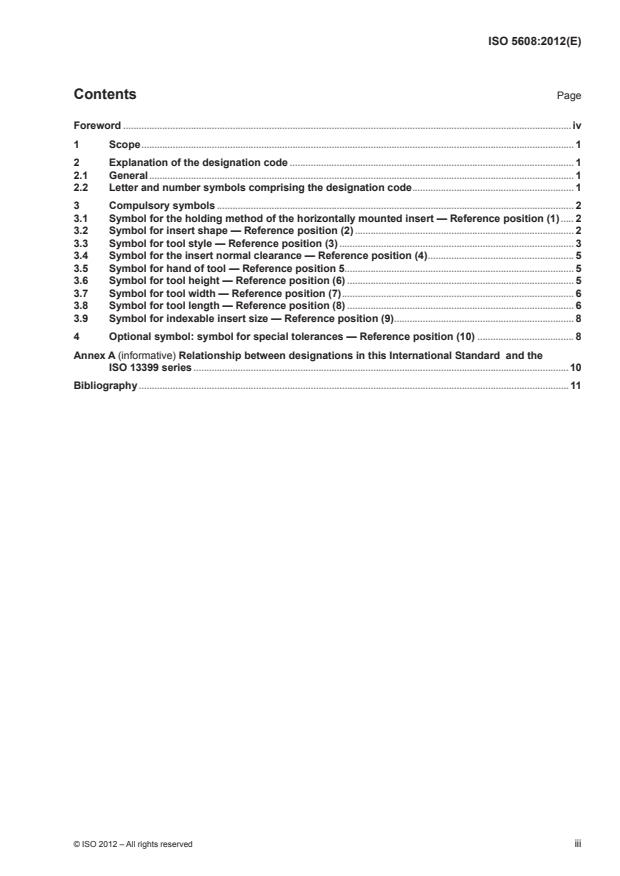
Contents Page
Foreword .iv
1 Scope . 1
2 Explanation of the designation code . 1
2.1 General . 1
2.2 Letter and number symbols comprising the designation code . 1
3 Compulsory symbols . 2
3.1 Symbol for the holding method of the horizontally mounted insert — Reference position (1) . 2
3.2 Symbol for insert shape — Reference position (2) . 2
3.3 Symbol for tool style — Reference position (3) . 3
3.4 Symbol for the insert normal clearance — Reference position (4) . 5
3.5 Symbol for hand of tool — Reference position 5. 5
3.6 Symbol for tool height — Reference position (6) . 5
3.7 Symbol for tool width — Reference position (7) . 6
3.8 Symbol for tool length — Reference position (8) . 6
3.9 Symbol for indexable insert size — Reference position (9) . 8
4 Optional symbol: symbol for special tolerances — Reference position (10) . 8
Annex A (informative) Relationship between designations in this International Standard and the
ISO 13399 series .10
Bibliography . 11
Foreword
ISO (the International Organization for Standardization) is a worldwide federation of national standards bodies
(ISO member bodies). The work of preparing International Standards is normally carried out through ISO
technical committees. Each member body interested in a subject for which a technical committee has been
established has the right to be represented on that committee. International organizations, governmental and
non-governmental, in liaison with ISO, also take part in the work. ISO collaborates closely with the International
Electrotechnical Commission (IEC) on all matters of electrotechnical standardization.
International Standards are drafted in accordance with the rules given in the ISO/IEC Directives, Part 2.
The main task of technical committees is to prepare International Standards. Draft International Standards
adopted by the technical committees are circulated to the member bodies for voting. Publication as an
International Standard requires approval by at least 75 % of the member bodies casting a vote.
Attention is drawn to the possibility that some of the elements of this document may be the subject of patent
rights. ISO shall not be held responsible for identifying any or all such patent rights.
ISO 5608 was prepared by Technical Committee ISO/TC 29, Small tools, Subcommittee SC 9, Tools with
cutting edges made of hard cutting materials.
This fourth edition cancels and replaces the third edition (ISO 5608:1995), which has been technically revised.
iv © ISO 2012 – All rights reserved
INTERNATIONAL STANDARD ISO 5608:2012(E)
Turning and copying tool holders and cartridges for indexable
inserts — Designation
1 Scope
This International Standard establishes a code for the designation of turning and copying tool holders and
cartridges with a rectangular shank, having a standardized dimension, f (see ISO 5610-1, ISO 5610-2,
ISO 5610-3, ISO 5610-4, ISO 5610-5, ISO 5610-6, ISO 5610-7, ISO 5610-8, ISO 5610-9, ISO 5610-10,
ISO 5610-11, ISO 5610-12, ISO 5610-13, ISO 5610-14 and ISO 5610-15 and ISO 5611), intended for use with
indexable inserts, thus simplifying orders and specifications for such tools.
The designation of boring bars (tool holders with cylindrical shank) is given in ISO 5609-1.
2 Explanation of the designation code
2.1 General
The designation code comprises 10 symbols for the designation of dimensions and other characteristics of the
tool and the insert, of which the first nine symbols shall be used in any designation. The last symbol may be
used where necessary.
In addition to the standardized designation [symbols in positions (1) to (10)], a supplementary symbol consisting
of a maximum of three letters and/or numbers may be added by the manufacturer for a better description of
his/her products, on condition that this symbol is separated from the standardized designation by a dash and
that it does not contain letters specified for position (10).
No addition to, or extension of, the code specified in this International Standard shall be made without consulting
and securing the agreement of ISO/TC 29. Rather than adding symbols not provided for in this system, it is
preferable to add to the designation conforming with this International Standard all necessary explanations in
detailed illustrations or specifications.
2.2 Letter and number symbols comprising the designation code
2.2.1 Compulsory letter and/or number symbols
a) (1): letter symbol identifying the method of holding the insert (see 3.1);
b) (2): letter symbol identifying insert shape (see 3.2);
c) (3): letter symbol identifying tool style (see 3.3);
d) (4): letter symbol identifying insert normal clearance (see 3.4);
e) (5): letter symbol identifying hand of tool (see 3.5);
f) (6): number symbol identifying tool height (shank height of tool holders and height of cutting edge) (see 3.6);
g) (7): number symbol identifying tool holder shank width or, for cartridges, the letter C followed by a letter
symbol identifying the cartridge type (see 3.7);
h) (8): letter symbol identifying tool length (see 3.8);
i) (9): letter symbol identifying indexable insert size (see 3.9).
2.2.2 Optional letter symbol
(10): letter symbol indicating special tolerances (see Clause 4):
EXAMPLE
(1) (2) (3) (4) (5) (6) (7) (8) (9) (10)
C T G N R 32 25 M 16 Q
NOTE The codes (2), (4) and (9) are in accordance with ISO 1832.
3 Compulsory symbols
3.1 Symbol for the holding method of the horizontally mounted insert — Reference position (1)
Table 1
Letter symbol Insert holding method
C Top clamping (insert without hole)
M Top and hole clamping (insert with hole)
P Hole clamping (insert with hole)
S Screw clamping through hole (insert with hole)
3.2 Symbol for insert shape — Reference position (2)
Table 2
Letter symbol Insert shape Insert type
H Hexagonal
O Octagonal
P Pentagonal Equilateral and equiangular
S Square
T Triangular
C Rhombic with 80° included angle
D Rhombic with 55° included angle
E Rhombic with 75° included angle
Equilateral and non-equiangular
M Rhombic with 86° included angle
V Rhombic with 35° included angle
W Hexagonal with 80° included angle
L Rectangular Non-equilateral and equiangular
A Parallelogram-shaped with 85° included angle
B Parallelogram-shaped with 82° included angle Non-equilateral and non-equiangular
K Parallelogram-shaped with 55° included angle
R Round Round
NOTE The included angle is always the smaller angle.
2 © ISO 2012 – All rights reserved
3.3 Symbol for tool style — Reference position (3)
Table 3 —
Letter symbol Tool style
90° cutting edge angle, straight shank,
A
for side cutting
75° cutting edge angle, straight shank,
B
for side cutting
90° cutting edge angle, straight shank,
C
for end cutting
45° cutting edge angle, straight shank,
a
D
for side cutting
60° cutting edge angle, straight shank,
E
for side cutting
90° cutting edge angle, offset shank, for
F
end cutting
90° cutting edge angle, offset shank, for
G
side cutting
107,5° cutting edge angle, offset shank,
H
for side cutting
93° cutting edge angle, offset shank, for
J
side cutting
75° cutting edge angle,
...
NORME ISO
INTERNATIONALE 5608
Quatrième édition
2012-08-15
Porte-plaquette de tournage et de
copiage et cartouches pour plaquettes
amovibles — Désignation
Turning and copying tool holders and cartridges for indexable
inserts — Designation
Numéro de référence
©
ISO 2012
DOCUMENT PROTÉGÉ PAR COPYRIGHT
Droits de reproduction réservés. Sauf prescription différente, aucune partie de cette publication ne peut être reproduite ni utilisée sous
quelque forme que ce soit et par aucun procédé, électronique ou mécanique, y compris la photocopie et les microfilms, sans l’accord écrit
de l’ISO à l’adresse ci-après ou du comité membre de l’ISO dans le pays du demandeur.
ISO copyright office
Case postale 56 • CH-1211 Geneva 20
Tel. + 41 22 749 01 11
Fax + 41 22 749 09 47
E-mail copyright@iso.org
Web www.iso.org
Publié en Suisse
ii © ISO 2012 – Tous droits réservés
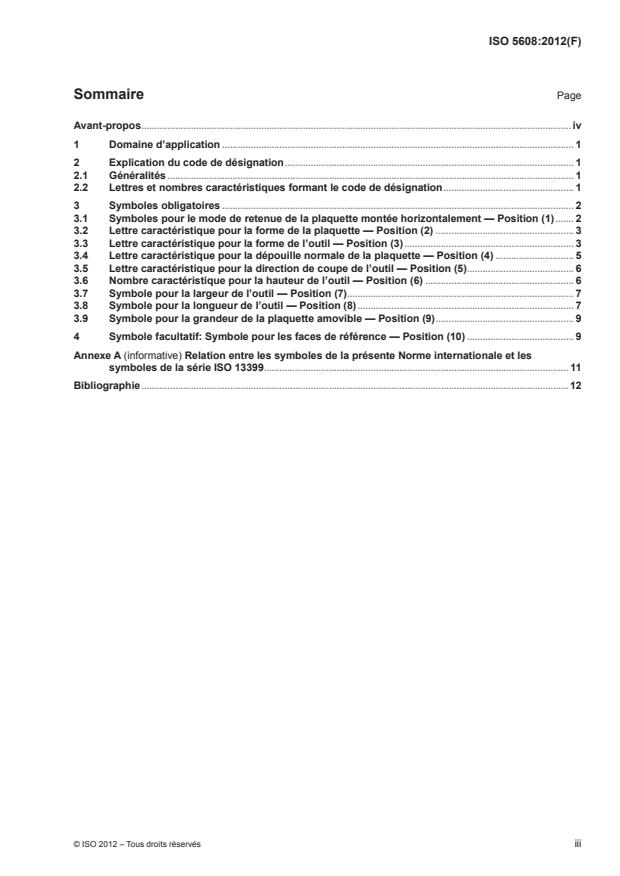
Sommaire Page
Avant-propos .iv
1 Domaine d’application . 1
2 Explication du code de désignation . 1
2.1 Généralités . 1
2.2 Lettres et nombres caractéristiques formant le code de désignation . 1
3 Symboles obligatoires . 2
3.1 Symboles pour le mode de retenue de la plaquette montée horizontalement — Position (1) . 2
3.2 Lettre caractéristique pour la forme de la plaquette — Position (2) . 3
3.3 Lettre caractéristique pour la forme de l’outil — Position (3) . 3
3.4 Lettre caractéristique pour la dépouille normale de la plaquette — Position (4) . 5
3.5 Lettre caractéristique pour la direction de coupe de l’outil — Position (5) . 6
3.6 Nombre caractéristique pour la hauteur de l’outil — Position (6) . 6
3.7 Symbole pour la largeur de l’outil — Position (7) . 7
3.8 Symbole pour la longueur de l’outil — Position (8) . 7
3.9 Symbole pour la grandeur de la plaquette amovible — Position (9) . 9
4 Symbole facultatif: Symbole pour les faces de référence — Position (10) . 9
Annexe A (informative) Relation entre les symboles de la présente Norme internationale et les
symboles de la série ISO 13399 . 11
Bibliographie .12
Avant-propos
L’ISO (Organisation internationale de normalisation) est une fédération mondiale d’organismes nationaux de
normalisation (comités membres de l’ISO). L’élaboration des Normes internationales est en général confiée aux
comités techniques de l’ISO. Chaque comité membre intéressé par une étude a le droit de faire partie du comité
technique créé à cet effet. Les organisations internationales, gouvernementales et non gouvernementales,
en liaison avec l’ISO participent également aux travaux. L’ISO collabore étroitement avec la Commission
électrotechnique internationale (CEI) en ce qui concerne la normalisation électrotechnique.
Les Normes internationales sont rédigées conformément aux règles données dans les Directives ISO/CEI, Partie 2.
La tâche principale des comités techniques est d’élaborer les Normes internationales. Les projets de Normes
internationales adoptés par les comités techniques sont soumis aux comités membres pour vote. Leur publication
comme Normes internationales requiert l’approbation de 75 % au moins des comités membres votants.
L’attention est appelée sur le fait que certains des éléments du présent document peuvent faire l’objet de droits
de propriété intellectuelle ou de droits analogues. L’ISO ne saurait être tenue pour responsable de ne pas avoir
identifié de tels droits de propriété et averti de leur existence.
L’ISO 5608 a été élaborée par le comité technique ISO/TC 29, Petit outillage, sous-comité SC 9, Outils coupants
à arête en matériaux durs de coupe.
Cette quatrième édition annule et remplace la troisième édition (ISO 5608:1995), qui a fait l’objet d’une
révision technique.
iv © ISO 2012 – Tous droits réservés
NORME INTERNATIONALE ISO 5608:2012(F)
Porte-plaquette de tournage et de copiage et cartouches pour
plaquettes amovibles — Désignation
1 Domaine d’application
La présente Norme internationale établit un code pour la désignation des porte-plaquette de tournage et de
copiage, et des cartouches à queue rectangulaire, de dimension normalisée f (voir l’ISO 5610-1, l’ISO 5610-2,
l’ISO 5610-3, l’ISO 5610-4, l’ISO 5610-5, l’ISO 5610-6, l’ISO 5610-7, l’ISO 5610-8, l’ISO 5610-9, l’ISO 5610-10,
l’ISO 5610-11, l’ISO 5610-12, l’ISO 5610-13, l’ISO 5610-14, l’ISO 5610-15 et l’ISO 5611), pour utilisation avec des
plaquettes amovibles, dans le but de simplifier la rédaction des commandes et des spécifications pour ces outils.
La désignation des porte-plaquette d’alésage (porte-plaquette à queue de section ronde) fait l’objet de
l’ISO 5609-1.
2 Explication du code de désignation
2.1 Généralités
Le code de désignation comprend 10 symboles pour la désignation des dimensions et autres caractéristiques
de l’outil et de la plaquette, dont les neufs premiers symboles doivent tous figurer dans toute désignation. Le
dernier symbole peut être utilisé si nécessaire.
En complément à la désignation normalisée [symboles des positions (1) à (10)], un symbole supplémentaire,
composé au maximum de trois lettres et/ou chiffres, peut être ajouté par le fabricant pour une meilleure
description de ses produits, à condition de séparer ce symbole de la désignation normalisée par un tiret et qu’il
soit différent de celui utilisé à la position (10).
Aucun autre supplément ni aucune extension du code spécifié dans la présente Norme internationale ne
devront être effectués sans consultation préalable du comité technique ISO/TC 29 et sans son accord. Plutôt
que d’ajouter des symboles non prévus dans ce système, il est préférable d’adjoindre à la désignation conforme
à la présente Norme internationale toutes les explications nécessaires au moyen d’illustrations détaillées ou
de spécifications.
2.2 Lettres et nombres caractéristiques formant le code de désignation
2.2.1 Lettres et/ou nombres caractéristiques obligatoires
(1): lettre caractéristique pour le mode de retenue de la plaquette (voir 3.1);
(2): lettre caractéristique pour la forme de la plaquette (voir 3.2);
(3): lettre caractéristique pour la forme de l’outil (voir 3.3);
(4): lettre caractéristique pour la dépouille normale de la plaquette (voir 3.4);
(5): lettre caractéristique pour la direction de coupe de l’outil (voir 3.5);
(6): nombre caractéristique pour la hauteur de l’outil (hauteur de queue des porte-plaquette et hauteur de la
pointe de coupe des cartouches) (voir 3.6);
(7): nombre caractéristique pour la largeur de queue des porte-plaquette ou, pour les cartouches, la lettre C
suivie d’une lettre caractéristique pour le type de construction (voir 3.7);
(8): lettre caractéristique pour la longueur de l’outil (voir 3.8);
(9): nombre caractéristique pour la grandeur de la plaquette (voir 3.9).
2.2.2 Lettre caractéristique facultative
(10): lettre caractéristique pour les faces de référence de l’outil (voir Article 4).
EXEMPLE
(1) (2) (3) (4) (5) (6) (7) (8) (9) (10)
C T G N R 32 25 M 16 Q
NOTE Les codes (2), (4) et (9) sont conformes à l’ISO 1832.
3 Symboles obligatoires
3.1 Symboles pour le mode de retenue de la plaquette montée horizontalement — Position (1)
Tableau 1
Lettre
Mode de fixation de la plaquette
caractéristique
C Fixation par bride (plaquette sans trou de fixation)
M Fixation par trou central et bride (plaquette avec trou de fixation)
P Fixation par trou central (plaquette avec trou de fixation)
S Fixation par vis centrale (plaquette avec trou de fixation)
2 © ISO 2012 – Tous droits réservés
3.2 Lettre caractéristique pour la forme de la plaquette — Position (2)
Tableau 2
Lettre
Forme de la plaquette Type de plaquette
caractéristique
H Hexagonale
O Octogonale
P Pentagonale Équilatérale et équiangle
S Carrée
T Triangulaire
C Rhombique avec un angle de pointe de 80°
D Rhombique avec un angle de pointe de 55°
E Rhombique avec un angle de pointe de 75°
Équilatérale mais non équiangle
M Rhombique avec un angle de pointe de 86°
V Rhombique avec un angle de pointe de 35°
W Hexagonale avec un angle de pointe de 80°
L Rectangulaire Non équilatérale mais équiangle
A En forme de parallélogramme avec un angle de pointe de 85°
Non équilatérale et non
B En forme de parallélogramme avec un angle de pointe de 82°
équiangle
K En forme de parallélogramme avec un angle de pointe de 55°
R Ronde Ronde
NOTE L’angle de pointe considéré est le plus petit angle.
3.3 Lettre caractéristique pour la forme de l’outil — Position (3)
Tableau 3 —
Lettre caractéristique Forme de l’outil
Queue droite, arête latérale, angle de
A
direction d’arête de 90°
Queue droite, arête latérale, angle de
B
direction d’arête de 75°
Queue droite, arête en bout, angle de
C
direction d’arête de 90°
Queue droite, arête latérale, angle de
a
D
direction d’arête 45°
Tableau 3 (suite)
Lettre caractéristique Forme de l’outil
Queue droite, arête latérale, angle de
E
direction d’arête de 60°
Queue déportée, arête en bout, angle de
F
direction d’arête de 90°
Queue déportée, arête latérale, angle de
G
direction d’arête de 90°
Queue déportée, arête laté
...
Questions, Comments and Discussion
Ask us and Technical Secretary will try to provide an answer. You can facilitate discussion about the standard in here.
Loading comments...