


ISO/TR 21730:2005
(Main)Health informatics — Use of mobile wireless communication and computing technology in healthcare facilities — Recommendations for the management of unintentional electromagnetic interference with medical devices
Health informatics — Use of mobile wireless communication and computing technology in healthcare facilities — Recommendations for the management of unintentional electromagnetic interference with medical devices
ISO 21730:2005 provides guidance for the deployment, use and management of mobile wireless communication and computing equipment in the healthcare facility in a way that helps mitigate potential hazards due to electromagnetic interference (EMI) with medical devices. The recommendations recognize the different resources, needs, concerns and environments of healthcare organizations around the world and provide detailed management guidelines for healthcare organizations that desire full deployment of mobile wireless communication and computing technology throughout their facility, as well as selective restrictions for healthcare organizations that have decided comprehensive management procedures are not feasible, practical, or desirable at the present time. The recommendations also distinguish between controlled systems used by doctors and staff for healthcare-specific communication and health informatics transport vs. non-controlled (personal) mobile wireless equipment randomly brought into the facility by visitors, patients and the healthcare organization workforce.
Informatique de santé — Utilisation de communications mobiles sans fil et des technologies informatisées dans les structures de soins — Recommandations pour la gestion des interférences électromagnétiques non intentionnelles avec les dispositifs médicaux
General Information
- Status
- Withdrawn
- Publication Date
- 11-Jan-2005
- Withdrawal Date
- 11-Jan-2005
- Technical Committee
- ISO/TC 215 - Health informatics
- Drafting Committee
- ISO/TC 215/WG 2 - Systems and Device Interoperability
- Current Stage
- 9599 - Withdrawal of International Standard
- Start Date
- 09-Feb-2007
- Completion Date
- 14-Feb-2026
Relations
- Effective Date
- 15-Apr-2008
Buy Documents
ISO/TR 21730:2005 - Health informatics -- Use of mobile wireless communication and computing technology in healthcare facilities -- Recommendations for the management of unintentional electromagnetic interference with medical devices
Get Certified
Connect with accredited certification bodies for this standard

BSI Group
BSI (British Standards Institution) is the business standards company that helps organizations make excellence a habit.

NYCE
Mexican standards and certification body.
Sponsored listings
Frequently Asked Questions
ISO/TR 21730:2005 is a technical report published by the International Organization for Standardization (ISO). Its full title is "Health informatics — Use of mobile wireless communication and computing technology in healthcare facilities — Recommendations for the management of unintentional electromagnetic interference with medical devices". This standard covers: ISO 21730:2005 provides guidance for the deployment, use and management of mobile wireless communication and computing equipment in the healthcare facility in a way that helps mitigate potential hazards due to electromagnetic interference (EMI) with medical devices. The recommendations recognize the different resources, needs, concerns and environments of healthcare organizations around the world and provide detailed management guidelines for healthcare organizations that desire full deployment of mobile wireless communication and computing technology throughout their facility, as well as selective restrictions for healthcare organizations that have decided comprehensive management procedures are not feasible, practical, or desirable at the present time. The recommendations also distinguish between controlled systems used by doctors and staff for healthcare-specific communication and health informatics transport vs. non-controlled (personal) mobile wireless equipment randomly brought into the facility by visitors, patients and the healthcare organization workforce.
ISO 21730:2005 provides guidance for the deployment, use and management of mobile wireless communication and computing equipment in the healthcare facility in a way that helps mitigate potential hazards due to electromagnetic interference (EMI) with medical devices. The recommendations recognize the different resources, needs, concerns and environments of healthcare organizations around the world and provide detailed management guidelines for healthcare organizations that desire full deployment of mobile wireless communication and computing technology throughout their facility, as well as selective restrictions for healthcare organizations that have decided comprehensive management procedures are not feasible, practical, or desirable at the present time. The recommendations also distinguish between controlled systems used by doctors and staff for healthcare-specific communication and health informatics transport vs. non-controlled (personal) mobile wireless equipment randomly brought into the facility by visitors, patients and the healthcare organization workforce.
ISO/TR 21730:2005 is classified under the following ICS (International Classification for Standards) categories: 35.240.80 - IT applications in health care technology. The ICS classification helps identify the subject area and facilitates finding related standards.
ISO/TR 21730:2005 has the following relationships with other standards: It is inter standard links to ISO/TR 21730:2007. Understanding these relationships helps ensure you are using the most current and applicable version of the standard.
ISO/TR 21730:2005 is available in PDF format for immediate download after purchase. The document can be added to your cart and obtained through the secure checkout process. Digital delivery ensures instant access to the complete standard document.
Standards Content (Sample)
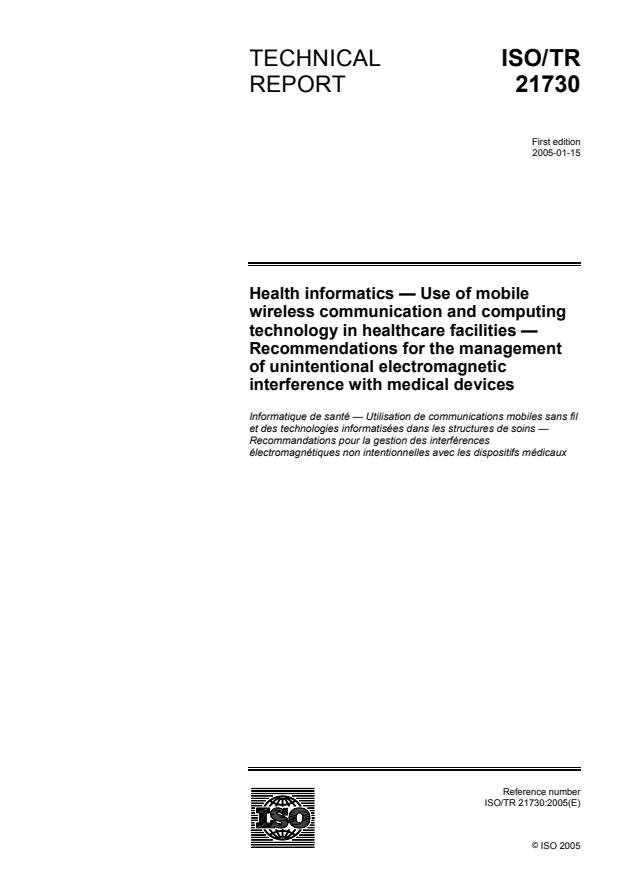
TECHNICAL ISO/TR
REPORT 21730
First edition
2005-01-15
Health informatics — Use of mobile
wireless communication and computing
technology in healthcare facilities —
Recommendations for the management
of unintentional electromagnetic
interference with medical devices
Informatique de santé — Utilisation de communications mobiles sans fil
et des technologies informatisées dans les structures de soins —
Recommandations pour la gestion des interférences
électromagnétiques non intentionnelles avec les dispositifs médicaux
Reference number
©
ISO 2005
PDF disclaimer
This PDF file may contain embedded typefaces. In accordance with Adobe's licensing policy, this file may be printed or viewed but
shall not be edited unless the typefaces which are embedded are licensed to and installed on the computer performing the editing. In
downloading this file, parties accept therein the responsibility of not infringing Adobe's licensing policy. The ISO Central Secretariat
accepts no liability in this area.
Adobe is a trademark of Adobe Systems Incorporated.
Details of the software products used to create this PDF file can be found in the General Info relative to the file; the PDF-creation
parameters were optimized for printing. Every care has been taken to ensure that the file is suitable for use by ISO member bodies. In
the unlikely event that a problem relating to it is found, please inform the Central Secretariat at the address given below.
© ISO 2005
All rights reserved. Unless otherwise specified, no part of this publication may be reproduced or utilized in any form or by any means,
electronic or mechanical, including photocopying and microfilm, without permission in writing from either ISO at the address below or
ISO's member body in the country of the requester.
ISO copyright office
Case postale 56 • CH-1211 Geneva 20
Tel. + 41 22 749 01 11
Fax + 41 22 749 09 47
E-mail copyright@iso.org
Web www.iso.org
Published in Switzerland
ii © ISO 2005 – All rights reserved
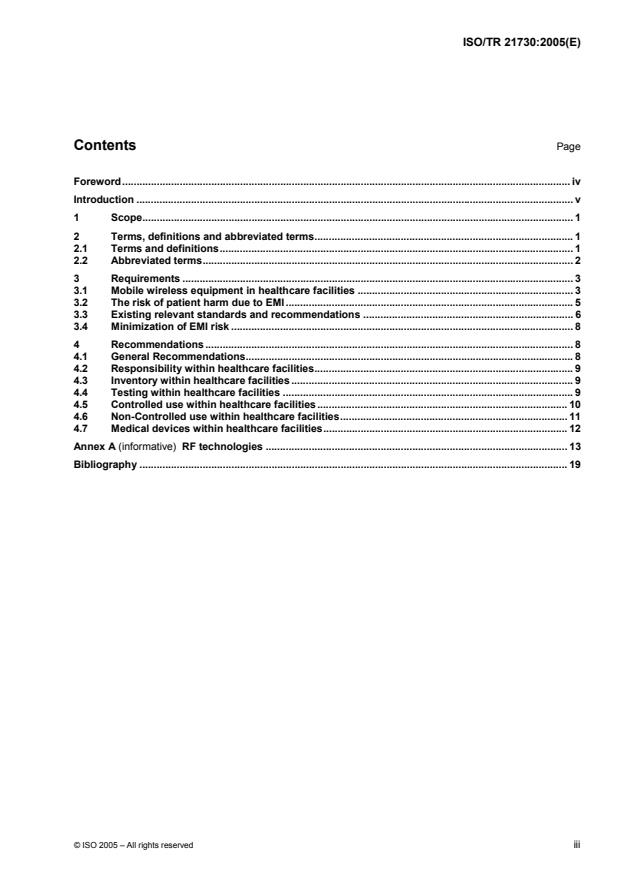
Contents Page
Foreword. iv
Introduction . v
1 Scope. 1
2 Terms, definitions and abbreviated terms. 1
2.1 Terms and definitions. 1
2.2 Abbreviated terms. 2
3 Requirements . 3
3.1 Mobile wireless equipment in healthcare facilities . 3
3.2 The risk of patient harm due to EMI. 5
3.3 Existing relevant standards and recommendations . 6
3.4 Minimization of EMI risk . 8
4 Recommendations . 8
4.1 General Recommendations. 8
4.2 Responsibility within healthcare facilities. 9
4.3 Inventory within healthcare facilities . 9
4.4 Testing within healthcare facilities . 9
4.5 Controlled use within healthcare facilities. 10
4.6 Non-Controlled use within healthcare facilities. 11
4.7 Medical devices within healthcare facilities. 12
Annex A (informative) RF technologies . 13
Bibliography . 19
Foreword
ISO (the International Organization for Standardization) is a worldwide federation of national standards bodies
(ISO member bodies). The work of preparing International Standards is normally carried out through ISO
technical committees. Each member body interested in a subject for which a technical committee has been
established has the right to be represented on that committee. International organizations, governmental and
non-governmental, in liaison with ISO, also take part in the work. ISO collaborates closely with the
International Electrotechnical Commission (IEC) on all matters of electrotechnical standardization.
International Standards are drafted in accordance with the rules given in the ISO/IEC Directives, Part 2.
The main task of technical committees is to prepare International Standards. Draft International Standards
adopted by the technical committees are circulated to the member bodies for voting. Publication as an
International Standard requires approval by at least 75 % of the member bodies casting a vote.
In exceptional circumstances, when a technical committee has collected data of a different kind from that
which is normally published as an International Standard (“state of the art”, for example), it may decide by a
simple majority vote of its participating members to publish a Technical Report. A Technical Report is entirely
informative in nature and does not have to be reviewed until the data it provides are considered to be no
longer valid or useful.
Attention is drawn to the possibility that some of the elements of this document may be the subject of patent
rights. ISO shall not be held responsible for identifying any or all such patent rights.
ISO/TR 21730 was prepared by Technical Committee ISO/TC 215, Health Informatics, Task Force on EMC in
RF mobile communications.
Other international organizations that contributed to the preparation of this Technical Report, mainly in review
and comment of draft text, include, from the UK the MHRA and the IST/35 Mirror Panel, from the US the FDA,
from Australia the Australian Therapeutic Goods Administration, Telstra, and Monash Medical Center, from
Canada Health Canada Medical Devices Bureau, from the Netherlands the Health Council of the Netherlands,
from Finland the National Agency for Medicines, and from Switzerland Swissmedic.
Due to rapidly changing technologies, this report must be regarded as a “living document” and comments for
improvement will therefore be welcomed.
The current Technical Report strongly parallels the AAMI TIR #18, which provides similar recommendations
for wireless equipment in healthcare facilities.
iv © ISO 2005 – All rights reserved
Introduction
There is a growing need in healthcare facilities throughout the world to incorporate new technology to offer
more efficient, cost-effective and higher quality healthcare. In that regard, wireless communication and
computing technologies have the potential to offer significant advancements to healthcare communication and
health informatics exchange. Such wireless technologies include the use of mobile phones, handheld
computers/PDAs, WiFi/802.11.a/b/g local area networks and wireless modems for laptop computers, personal
area networks including 802.15.1 (Bluetooth)/802.15.4 (Zigbee)/802.15.3a (UWB), two-way pagers, radios, etc.
In addition, visitors and patients are also finding use of personal mobile phones and other wireless devices
within healthcare facilities increasingly indispensable, especially in times of crisis.
Currently, no uniform international guideline exists for the appropriate deployment, use, and management of
mobile wireless communication and computing technology within healthcare facilities to mitigate potential
electromagnetic interference (EMI) with sensitive medical devices. Although medical device manufacturers
generally comply with recommended immunity guidelines (10 V/m for life-critical devices as outlined in the
recently approved second edition of the IEC International Standard 60601-1-2), there is no consistent
international regulation enforcing this recommendation. In addition, many mobile wireless transmitters exceed
this field strength threshold when operating at their upper power limits and in close proximity. Finally, there are
a number of older medical devices still in circulation that have not been designed with the above immunity
considerations in mind.
Misinformation regarding mobile wireless systems, electromagnetic interference, and management
procedures has led to a range of inconsistent policies among healthcare organizations. At one extreme,
overly-restrictive policies may act as obstacles to beneficial technology as well as not address the growing
personal communication needs of patients, visitors, and the workforce. At the other extreme, unmanaged use
can place patients at risk. An equally important factor in this issue is that healthcare organizations throughout
the world have a variety of different resources, needs, concerns, and RF environments that may not all be
addressed by implementation of a single prescriptive management strategy. Because of this, a balanced
approach is necessary to ensure that all the benefits of mobile wireless technology can be made available to
healthcare organizations that desire to fully implement comprehensive management procedures, while
sufficient safeguards are offered to organizations where these same comprehensive management procedures
cannot be, or otherwise have not been, fully implemented.
It may not be feasible for healthcare organizations to manage every mobile wireless handset brought into their
facility without certain restrictive limits. The necessary range and extent of restrictive limits within a given
healthcare facility will depend upon the level of management that has been implemented. For mobile wireless
equipment that is randomly brought into the healthcare facility in an uncontrolled manner, policies restricting
use in sensitive areas where life-critical medical devices are in routine operation may be appropriate. Such
restrictive policies might be facilitated by offering numerous and easily accessible alternative areas where the
use of mobile wireless equipment is encouraged. For mobile wireless equipment that is provided to doctors
and staff under more controlled conditions, operation throughout the healthcare facility (even in sensitive
areas) may be achievable with appropriate management. With such management, as outlined in the
recommendations below, it is possible to realize many of the benefits of wireless technology for
healthcare-specific communication and health information access while at the same time sufficiently mitigating
EMI concerns.
Because most mobile wireless communication and computing systems can be effectively managed to mitigate
EMI issues, the choice of technology for a controlled system should be based upon which solution best
addresses the needs of the organization, not on what RF signal types may be inherently more or less prone to
EMI under unmanaged conditions.
TECHNICAL REPORT ISO/TR 21730:2005(E)
Health informatics — Use of mobile wireless communication
and computing technology in healthcare facilities —
Recommendations for the management of unintentional
electromagnetic interference with medical devices
1 Scope
This International Standard provides guidance for the deployment, use and management of mobile wireless
communication and computing equipment in the healthcare facility in a way that helps mitigate potential
hazards due to electromagnetic interference (EMI) with medical devices. The recommendations recognize the
different resources, needs, concerns and environments of healthcare organizations around the world and
provide detailed management guidelines for healthcare organizations that desire full deployment of mobile
wireless communication and computing technology throughout their facility, as well as selective restrictions for
healthcare organizations that have decided comprehensive management procedures are not feasible,
practical, or desirable at the present time. The recommendations also distinguish between controlled systems
used by doctors and staff for healthcare-specific communication and health informatics transport vs.
non-controlled (personal) mobile wireless equipment randomly brought into the facility by visitors, patients,
and the healthcare organization workforce.
2 Terms, definitions and abbreviated terms
2.1 Terms and definitions
For the purposes of this document, the following terms and definitions apply.
2.1.1
hertz
Hz
unit of frequency of electromagnetic energy based upon the emitted wavelength
2.1.2
decibel
dB
a relative ratio, one tenth of the common logarithm of the ratio of relative powers, equal to 0,1 B (bel)
NOTE The ratio in dB is given by dB = 10log (P /P ).
10 1 2
2.1.3
decibel
dBm
decibels as above, but relative to a fixed 1 milliwatt of power
2.2 Abbreviated terms
AAMI Association for the Advancement of Medical Instrumentation
AHA American Hospital Association
AMA American Medical Association
AMPS Advanced Mobile Phone System
ANSI American National Standards Institute
ASHE American Society for Healthcare Engineering
CDMA Code Division Multiple Access
CDRH Center for Devices and Radiological Health, Department within FDA (United States)
CISPR International Special Committee on Radio Interference
COMAR IEEE Committee on Man and Radiation
DECT Digitally Enhanced Cordless Telecommunications
ECG Electrocardiogram
EEG Electroencephalogram
EMC Electromagnetic Compatibility
EMI Electromagnetic Interference
ESD Electrostatic Discharge
FDA Food and Drug Administration (United States)
FOMA Freedom of Mobile Multimedia Access
GPRS General Packet Radio Service
GSM Global System for Mobile
iDEN Integrated Dispatch Enhanced Network
IEC International Electrotechnical Commission
IEEE Institute for Electrical and Electronics Engineers
ISM Industry, Science and Medicine
ITU International Telecommunication Union
IVDs In Vitro Diagnostic Devices
JCAHO Joint Commission on Accreditation of Healthcare Organizations
JTACS Japanese Total Access Communications System
LAN Local Area Network, including 802.11b and 802.11a systems
LMR Land Mobile Radio
MHRA Medicines and Healthcare Products Regulatory Agency (United Kingdom)
NADC North American Digital Cellular
PAN Personal Area Network, including 802.15.1 (Bluetooth), 802.15.4 (Zigbee), 802.15.3a, etc.
PDA Personal Digital Assistant
2 © ISO 2005 – All rights reserved
PDC Personal Digital Cellular
PCS Personal Communications Services
R&TTE Radio and Telecommunications Terminal Equipment
RF Radiofrequency, classically defined as ranging from a few KHz – 300 GHz
Rx Reception, received RF signal
TACS Total Access Communications System
TDMA Time Division Multiple Access
TIR Technical informational Report
Tx Transmission, transmitted RF signal
UMTS Universal Mobile Telecommunications Systems
V/m Volts per metre, a measure of RF electrical field strength
VoIP Voice-over Internet Protocol
WAN Wide Area Network
WAP Wireless Application Protocol
WCDMA Wide band Code Division Multiple Access
WiFi Wireless Fidelity network system
3 Requirements
3.1 Mobile wireless equipment in healthcare facilities
The use of mobile wireless equipment by doctors and healthcare staff for improved healthcare communication
and computing is becoming increasingly common. Visitors and patients are likewise finding the use of
personal mobile phones and wireless devices within healthcare facilities increasingly indispensable, especially
in times of crisis. Such wireless devices might include mobile phones, handheld computers / PDAs,
WiFi / 802.11.a/b/g [1] local area networks and wireless modems for laptop computers, personal area
networks including 802.15.1 (Bluetooth) [2] / 802.15.4 (Zigbee) [3] / 802.15.3a (UWB), two-way pagers, radios,
etc.
Table 1 lists many of the common wireless technologies in use in various healthcare facilities. As can be seen
from Table 1, mobile wireless equipment can transmit on exclusive licensed frequencies, as is the case with
most mobile phones, pagers, and two-way radios, or can operate with many other transmitters on one of the
unlicensed Industry, Science, and Medicine (ISM) bands at 900 MHz and 2,4, 5,2, and 5,8 GHz as is the case
with cordless phones and wireless data network equipment. From a radiofrequency (RF) signal perspective,
mobile wireless transmitters can employ either simple analogue or more complex (and sometimes pulse
modulated) digital technology. In terms of output power, mobile wireless equipment can be segmented into
three broad categories. The first category includes 802.11, 802.15, and most cordless phone-type systems
that transmit constantly at relatively lower power (u 10 milliwatts). A second category consists of two-way
radio and pager systems that transmit at a constant power that is higher by an order of magnitude of more
than 1 to 5 watts. The third category includes dynamically power-controlled equipment that can transmit at
levels from a few milliwatts to 1 to 2 watts based upon the existing network signal strength at that particular
location and time.
An immediate benefit to healthcare that improved mobile wireless communication and computing may provide
is underscored by a U.S. Institute of Medicine (IOM) report estimating that common medical errors, many of
which may be avoided with better communication and computing links, contribute to between 44 000 and
98 000 deaths per year in the United States [4]. A similar percentage was also suggested for the
United Kingdom and Australia. Other potential healthcare benefits that wireless technology might provide
include immediate communication and access to patient information, test results, records and medical
reference at the point-of-care, as well as reduction in cost charging errors, reduction in cost and maintenance
of land-line phone systems, and ultimately facilitation of more home-based monitoring, recovery, and
long-term care.
Concern over potential EMI with medical devices due to RF emissions, however, has prompted many
healthcare organizations around the world to enact broad precautionary policies restricting wireless equipment
throughout their facilities. Other healthcare organizations have implemented policies ranging from selective
restrictions on where mobile wireless equipment can operate to relatively unrestricted and unmanaged use.
While overly restrictive policies may act as obstacles limiting the benefit that wireless technology can bring to
healthcare, unmanaged use may expose patients to potentially significant and unnecessary hazards.
Table 1 — Geographical region of use, transmitted frequency and expected output power for common
wireless technologies used in healthcare facilities
Intended
Type of device Transmitted frequency Maximum transmit power
application
Wireless W-LAN (Local
40 mW [5,15–5,25 GHz]
data Area High Rate Local
802.11a 5,15–5,8 GHz 200 mW [5,25–5,35 GHz]
network Networks — Area Network
800 mW [5,72–5,82 GHz]
devices
WiFi)
typical app's: constant ~10 mW,
2,4-2,462 GHz (North America), but spec allows for:
Medium Rate Local
2,412-2,472 GHz (Europe), 1 W [US]
802.11b
Area Network
2,471-2,497 GHz (Japan) 100 mW [Europe]
10 mW/MHz [Japan]
typical app's: constant ~10 mW,
but spec allows for:
High Rate Local 2,4–2,48 GHz (US, Europe,
1 W [US],
802.11g
Area Network Japan)
100 mW [Europe],
10 mW/MHz [Japan]
2,4-2,48 GHz (North America &
Europe), Powerclass I: 100 mW
W-PAN
Bluetooth / Streaming Data,
2,447-2,473 GHz (Spain), Powerclass II: 2,5-10 mW
(Personal Area
802.15.1 Cable Replacement
Networks)
2,448-2,482 GHz (France), Powerclass III: 1 mW
2,473-2,495 GHz (Japan)
Streaming Video, ~0,6 mW spread over 100's
802.15.3a UWB in 3 to 10 GHz band
Data and Voice of MHz
typical app's: constant ~1 mW,
2,4-2,48 GHz (North America &
but spec allows for:
Sensor Networks,
Europe),
Zigbee / 80
1 W [US],
Low-Latency
2,412-2,472 GHz (Europe),
2.15.4
Data/Control 100 mW [Europe],
2,471-2,497 GHz (Japan)
10 mW/MHz [Japan]
Fixed Broadband
W-MAN Wireless Access
802.16a
2-11 GHz in unlicensed (e.g. 5,8 GHz) and licensed (e.g. 10,5, 25, 26,
(Metropolitan Systems (Video +
(fixed) 31, 38 and 39 GHz) bands
Area Networks)
simultaneous voice
& data)
Mobile
(UNLICENSED &
licensed)
Broadband Wireless
802.16e 2-11 GHz in unlicensed (e.g. 5,8 GHz) and licensed (e.g. 10,5, 25, 26,
(mobile) Access Systems 31, 38 and 39 GHz) bands
(Video +
simultaneous voice
& data)
Mobile (LICENSED)
Broadband Wireless
Access Systems
802.20 licensed bands below 3,5 GHz
(Video +
simultaneous voice
& data)
4 © ISO 2005 – All rights reserved
Table 1 (continued)
Intended
Type of device Transmitted frequency Maximum transmit power
application
Wired Network 802.3 Hard Line Ethernet (hard line)
AMPS 824-849 MHz (US),
NMT 453-458 MHz (Europe),
Mobile 1st Generation WAN Mobile AVG PWR: 0,6-1 watt down to
Analogue
Phones Technologies Communication ~6 mW in steps of -4dB
TACS 890-915 MHz (Europe),
JTACS 832-925 MHz (Japan)
GSM 824-849 & 1850-1910 MHz
(US),
GSM 890-915 & 1710-1785 MHz
(Europe, Asia),
2nd Generation
WAN Mobile AVG PWR: 200-600 mW down to
(Digital) TDMA iDEN 806-824 MHz (US),
Communication 20-2 mW in steps of -1 to -4 dB
Technologies
Tetra 380-400, 410-430, 450-470
& 805-870 MHz (Europe),
PDC 810-826 & 1429-1453 MHz
(Japan)
CDMA 824-849 &
1850-1910 MHz (US),
WAN Mobile AVG PWR: 250 mW to +1 uW in
CDMA
Communication J-CDMA 832-925 MHz (Japan), 1dB steps
K-PCS 1750-1870 MHz (Korea)
3rd Generation
1,92-1,98 MHz (Europe,Asia),
WAN Mobile AVG PWR: 250 mW to u 1 mW
(IMT-2000) UMTS
Communication 1,7-2 GHz (US) in steps of 0,25-1 dB
Technologies
824-849, 1850-1910 MHz &
1,7-2 GHz (US);
WAN Mobile AVG PWR: 250 mW to u 1 mW
CDMA-2000
Communication in steps of 0,25-1 dB
890-915 & 1750-1780 MHz &
1,92-1,98 GHz (Europe, Asia)
2-way WAN Text
152-159, 454-460, 902-928 MHz 1 W (in short bursts)
pagers Messaging
Analogue 27, 40-49, 900 MHz &
2,4, 5,8 GHz (US),
Analogue and Spread Spectrum Spectralink 2,4 GHz (US, AVG PWR: constant 10 mW,
Cordless Phones
Technologies Europe), some units up to 1 W
CT-1 30-41, 72,8-73, 885, 914,
960 MHz & 1,7-1,8 GHz (Europe)
DECT 1880-1900 MHz (Europe),
CT2, CT3 864-868 & AVG PWR: constant 10 mW,
TDMA
944-948 MHz (Europe), PEAK PWR: constant 250 mW
PHS 1895-1918 (Japan)
VoIP / 802.1 LAN Mobile
2,4-2,462 GHz AVG PWR: constant 10 mW
1b Communication
FCC Periodic and continuous
Low-Power Radio
Short Range Devices 15.231, transmissions, 300-900, 2400, AVG PWR: 0,1 to 1 mW
Links
FCC 15.249 5800 MHz
ETSI 300 22 Low-Power Radio Periodic and continuous
AVG PWR: 10 to 25 mW
0-1 Links transmissions, 400 and 800 MHz
JPN ARIB Low-Power Radio Periodic and continuous
AVG PWR: 1 and 10 mW
T-67 Links transmissions, 426-449 MHz
3.2 The risk of patient harm due to EMI
The uncontrolled use of mobile wireless equipment by individuals visiting and working in healthcare facilities
has steadily increased, regardless of existing healthcare organization policy. However, the level of risk for
accidental EMI events from government and other non-profit health agency sources appears to be relatively
small [5]-[7], although underreporting of such events may be substantial. Anecdotal observations of suspected
EMI incidents with ECG and EEG machines, apnea monitors, ventilators and radiant warmers, infusion pumps,
wheelchairs, and other devices have been reported or referred to in a number of publications [5]-[18]. Ad hoc
test studies [19]-[30], [44] have confirmed that interference effects can be precipitated by certain wireless
transmitters in susceptible medical devices, although this generally requires extreme conditions (transmission
at higher power levels, close proximity, for extended periods of time) that may not be common during normal
use. In RF transmitters that operate at constant output power of 100 milliwatts or less, significant interference
effects were not observed [45], [46].
Although medical device manufacturers generally comply with a 10-V/m immunity level against interference
from relevant RF emissions in the design of new life-critical devices, many mobile wireless handsets exceed
the 10-V/m limit when operating at maximal power and in close proximity. In addition, this immunity level is
only recommended in some countries and may be waived with appropriate exemptions. Further, many older
medical devices still in use may not have been constructed to the same immunity level. Despite this
apparently uncommon but potentially serious level of risk due to unmanaged mobile wireless handset use,
most mobile wireless equipment can operate in a fully compatible manner throughout a healthcare facility,
even where potentially sensitive medical devices are used, if comprehensive management procedures are
implemented.
3.3 Existing relevant standards and recommendations
IEC has published a standard (IEC 60601-1-2) [32] recommending that “all life-supporting medical electrical
equipment and systems be immune to field strengths of 10 V/m” and “medical electrical equipment and
systems that are not life-supporting be immune to field strengths of 3 V/m in the frequency range 80 MHz to
2,5 GHz”. This is the collateral to the general safety standard for medical electrical equipment
(IEC 60601-1) [30], based upon basic EMC immunity standards that were developed by IEC Technical
Committee (TC) 77 (EMC). IEC 60601-1-2 also sets limits for emissions and immunity test levels for
electrostatic discharge (ESD), conducted radiofrequency electromagnetic fields, bursts and surges largely
based upon CISPR emissions and TC 77 immunity standards. Although many medical device manufacturers
comply with recommended immunity guidelines, there is no government regulation enforcing these
recommendations in certain parts of the world, including the United States. Further, many older medical
devices still in use in healthcare facilities were not designed or tested to the current immunity levels. Also, the
IEC standard permits medical equipment and systems to meet lower immunity levels, with appropriate
justification [32], and 60601-1-2 Annex AAA states “… it is expected that some PATIENT-COUPLED
EQUIPMENT and SYSTEMS will use as a justification for a lower IMMUNITY COMPLIANCE LEVEL the fact
that some physiological signals can be substantially below those induced by a field strength of 3 V/m”.
The European Community has issued a set of medical device directives to further ensure compliance with
electromagnetic immunity for devices operating in Europe. Directive 93/42/EEC [34] specifies immunity
requirements for external medical devices based upon an EMI risk classification scheme of low, medium, and
high. Article 2(a) of this directive incorporates, as an integral part, or as an accessory: (a) a medical device
within the meaning of Article 1 of Council Directive 93/42/EEC of 14 June 1993 concerning medical
devices (15), or (b) an active implantable medical device within the meaning of Article 1 of Council
Directive 90/385/EEC of 20 June 1990 on the approximation of the laws of the Member States relating to
active implantable medical devices (16), the apparatus shall be governed by this Directive, without prejudice
to the application of Directives 93/42/EEC and 90/385/EEC to medical devices and active implantable medical
devices, respectively. The horizontal (general) directive [35] regarding medical device safety also applies.
Other relevant directives include immunity requirements for active implantable devices [36], in vitro diagnostic
devices (IVDs) [37], and medicinal products [38]. A recent Radio and Telecommunications Terminal
Equipment (R&TTE) Directive [39] now specifies testing protocols and RF immunity levels for radio and
telecommunications terminal equipment within the European Union. Included within the scope of the R&TTE
directive is that if the radio and telecommunications terminal equipment incorporates an external [34] or active
implantable [36] medical device, that apparatus is to be governed by the R&TTE directive. The purpose is to
allow radio and telecommunications terminal equipment manufacturers to follow the same rules for medical
devices but bring their products to the European market faster and more easily. While the additional directives
in Europe do encourage medical devices to meet the IEC standard, many mobile wireless transmitters
operating at full power can exceed the 10 V/m immunity level at distances up to 1 m [10]-[12], [20]-[23].
ANSI has published a rapid, cost-effective, and straightforward ad hoc test protocol [40] that can be
implemented by individual healthcare organizations to assess EMI with medical devices in their inventory that
can be caused by the transmission of specific mobile wireless signals. The protocol not only allows individual
healthcare organizations to rapidly generate information to make more informed policies on wireless
6 © ISO 2005 – All rights reserved
equipment access in their facility, but also provides a consistent protocol allowing comparison of findings
between different test sites.
A TIR published by the AAMI [10] is currently the most useful guideline available to healthcare organizations
in defining EMI in simple terms for non-engineering healthcare facility staff and describing how potentially
significant medical device EMI can occur and how the risk can be managed. The document follows closely
from earlier studies performed by ASHE [15], [16] and provides information on assessing and managing the
RF environment and a model EMC/EMI policy. The summary recommendations of AAMI TIR 18 are currently
listed on the FDA CDRH website [41]. Previously, the FDA CDRH had developed a set of voluntary
guidelines [42] for manufacturers to test respiratory and anaesthesiology devices.
The IEEE Committee on Man and Radiation (COMAR) of the Engineering in Medicine and Biology Society
has published a manuscript stating that EMI of critical life-support equipment due to emissions from mobile
telephones is a valid concern and steps should be taken by medical device manufacturers to “harden” their
devices against increasing environmental RF fields [24], although limited guidance to healthcare organizations
on how to manage the risk is provided.
The AMA identifies the operation of mobile wireless equipment in healthcare facilities as a risk to medical
equipment [4] especially when used in close proximity. Its published paper acknowledges that current clinical
reports of EMI are uncommon and largely anecdotal suggesting that the risk may be small, and that the
variety of communication signal and medical equipment types make EMI difficult to predict. It recommends
obtaining (when possible) newer medical equipment “hardened” to extraneous RF emissions, performing ad
hoc testing per the ANSI/IEEE C63.18 protocol, applying straight-forward management procedures,
maintaining compliance with existing EMC standards, and ongoing vigilance against EMI by the clinical
engineering group and medical staff at the healthcare facility. It does not recommend precautionary banning of
wireless devices, but recommend a general (1 m) separation distance as per the revised ECRI 1999
recommendations [11].
The Oklahoma University EMC Center [43] released a manual in 1998 for healthcare facilities. With regard to
specific recommendations, a significant source of this information was taken (with permission) from Segal [31].
The recommendations promote ad hoc testing and education, and suggest various management procedures
including the establishment of a comprehensive EMC policy, establishment of mobile handset exclusion zones
and EMI reporting procedures, and replacing and/or increasing immunity of medical devices whenever
possible. The manual also suggests maintaining separation distances (up to 6 m for standard radios, 2 m for
common mobile phones, 0,3 m for in-building LAN and cordless phone systems).
Health Canada's Medical Devices Bureau has performed extensive ad hoc testing of RF transmitters including
mobile phones, 802.11b LAN, electronic article surveillance systems, metal detectors, and 802.15.1 bluetooth
transmitters [44]-[46] and reported that while mobile phones and radios may cause interference if their use is
not properly managed, the majority of constant output low power transmitters do not pose significant threats to
medical devices under normal operating conditions. The Medical Devices Bureau also hosted a roundtable
discussion [47] in 1994 to develop recommendations and define a U.S.-Canadian Task Force on
Electromagnetic Compatibility in Health Care, with Dr. Bernard Segal of McGill University acting as
coordinator. Summary recommendations included promotion of the use of wireless technology in healthcare,
coupled with testing and encouraging hospital clinical engineering groups to become proactive in the
characterization and management of potential EMI issues in their facilities. Suggested activities included
management of medical devices, lowering power of RF transmitters, labelling susceptible devices, educating
staff, and upgrading where possible and practical with hardened medical equipment purchases.
The Health Council of the Netherlands [48] recommends a precautionary separation distance of 1,5 m,
although it states that it is “unaware of an actual case in which a mobile phone has led to interference with
sensitive medical equipment” and does not directly advocate comprehensive precautionary bans. The report
states that most healthcare facilities in the Netherlands currently apply blanket bans on wireless
communication devices largely as a precautionary measure.
The MHRA (formerly the MDA) in the United Kingdom recommends the use of GSM and TETRA mobile
phone handsets on healthcare facility premises follow local healthcare facility policy guidelines [49]. It further
recommends that on-site interference due to operation of emergency services radios be treated as secondary
to the risks associated with managing the incident.
The AHA and its affiliated group ASHE published its recommendations in the previously mentioned
documents on the subject [15], [16] and are advocates of managed use in the healthcare facility. JCAHO has
no specific recommendation, but when performing accreditation reviews it does check to see that healthcare
facilities are implementing their own EMC management plan, whatever it may be.
The U.S. Army Center for Health Promotion and Preventative Medicine recommends maintaining new medical
device inventories, EMC education, appropriate signage guidance and EMI reporting, and restricting all
personal wireless equipment in critical care areas [50]. The recommendations also suggest limiting wireless
equipment in ER unless it is critical for medical treatment and separated by more than 3,3 ft from medical
devices.
Although not discussed in detail in this review, medical device EMI can be caused by RF sources other than
mobile wireless equipment, and in particular from other neighbouring medical devices. Emission limits for
industrial, scientific, and medical (ISM) equipment are specified by International Special Committee on Radio
Interference standard CISPR 11 [51]. This standard specifies limits and methods for measuring
electromagnetic emissions from ISM equipment in the frequency range 150 kHz to 18 GHz, as well as
frequencies at which emissions are unlimited. In particular, consideration of radiated emissions is given to
medical devices complying with European Medical Devices or the Active Implantable Medical Devices
directives, and they are therefore not likely candidates for interference with other equipment.
3.4 Minimization of EMI risk
Certainly, one goal of the current recommendation is to urge medical device manufacturers to increase the
electromagnetic immunity levels of their medical devices as the healthcare facility environments they operate
in become increasingly permeated with radiofrequency emissions from a variety of sources. It should be urged
that manufacturers strive to exceed current IEC requirements of 3 and 10 V/m, as these fields can be
exceeded by many types of mobile wireless transmitters operating at the higher transmit power steps and in
close proximity.
An equally important goal of the following recommendation is to provide sufficient guidance to allow
healthcare organizations to achieve the benefits of mobile wireless technology while at the same time
appropriately managing EMI issues to mitigate risk. Controlled systems to be used by healthcare facility staff
may include handsets operating on peer-to-peer (radio), local area (cordless phone, WiFi / 802.11b / LAN
system), or wide area (mobile phone, pager, PDA) networks. The following recommendations provide for the
management of many types of mobile wireless systems, allowing the choice of technology that best addresses
the communication and/or computing needs of the healthcare facility to be implemented through proper testing,
system design & engineering, medical device management, and user guidelines.
In contrast to controlled handsets, a different set of recommendations is necessary to avoid medical device
interference that might be caused by the use of mobile wireless transmitters inside healthcare facilities under
uncontrolled conditions. For example, while it may be entirely possible to implement a management strategy
for a controlled mobile wireless system used by healthcare staff, it may be impractical in many cases to
ensure the same level of management for non-controlled wireless handsets brought into the healthcare facility
by visitors, patients or the workforce. Further, many healthcare organizations may decide that management
procedures for controlled mobile wireless systems are not feasible, practical or desirable. When such is the
case, an approach characterized by certain restrictions for use in sensitive areas, especially those areas with
a high concentration of life-support medical devices in operation, may be appropriate.
4 Recommendations
4.1 General recommendations
Important recommendations are made equally to medical device manufacturers, healthcare facilities, and
wireless equipment manufacturers.
8 © ISO 2005 – All rights reserved
For medical device manufacturers, they should continue to meet and exceed current IEC 60601-1-2 listed
electromagnetic immunity levels in the design of new medical equipment which will increasingly operate in
environments where emissions from RF transmitters are common.
For healthcare facilities, they should manage wireless equipment within their facility in accordance with the
following guidelines, and neither unduly limit the use of otherwise beneficial technology or ignore the potential
for EMI issues.
For wireless equipment manufacturers, they should have full understanding of the potential EMI issues that
can arise in worst case scenarios with medical devices as well as other wireless equipment, and deploy their
equipment and systems appropriately in accordance with the following recommendations.
4.2 Responsibility within healthcare facilities
Within the healthcare facility, clinical/biomedical engineers should be the focal point for EMC, EMI mitigation,
and EMC/EMI education and training. Qualifications are not specified in this document, although consideration
should be given to appropriate education, expertise, and experience of the responsible individuals
4.3 Inventory within healthcare facilities
The medical device inventory within a healthcare facility should be managed to the extent possible and
practical to ensure compatibility with the everincreasing RF environment.
a) In the purchase of new medical devices by healthcare facilities, every effort should be made to ensure the
equipment meets (and exceeds if possible) minimum immunity requirements set out by IEC 60601-1-2.
Older equipment found to be particularly susceptible to EMI from mobile wireless transmitters should be
phased out as is possible and practical within the healthcare facility budget.
b) While permanent modifications to medical devices should not be made by healthcare facilities, certain
simple precautions can be taken to reduce the risk of EMI from mobile wireless transmitters. EMI
susceptibility in all medical devices can be reduced by positioning cables, sensors, and electrical
accessories in such a way as to increase the distance between these components and RF transmitters
operating in the area. Life-critical medical devices or those known or suspected of being susceptible to
EMI can be positioned away from high traffic areas or adjoining rooms where mobile wireless equipment
may be in routine operation.
4.4 Testing within healthcare facilities
Comprehensive ad hoc, on-site testing of all mobile wireless equipment that might be used in the healthcare
facility by staff, visitors, or patients to characterize potential EMI issues with medical devices should be
considered whenever possible. However, exhaustive testing is rarely feasible, and it is understood that testing
of any nature may not always be possible or practical due to budget, time, and personnel constraints of the
healthcare facility. Because of this, the following suggestions are provided:
a) The IEEE / ANSI C63.18 recommended practice is the suggested test protocol for rapid and practical ad
hoc, on-site RF EMI testing.
b) If comprehensive testing of all mobile wireless equipment is not possible, focused testing on higher
powered equipment transmitting at constant output (specifically two-way radios) as well as dynamically
power controlled equipment (specifically mobile phones) is more crucial than testing equipment such as
802.11, 802.15, and cordless phone-type systems that constantly transmit at power levels of
10-100 milliwatts. A description of lower power, higher power, and dynamically controlled wireless
equipment is outlined in more detail in Clause 3 (above).
c) If testing of mobile wireless equipment is not possible, some information may
...
Questions, Comments and Discussion
Ask us and Technical Secretary will try to provide an answer. You can facilitate discussion about the standard in here.
Loading comments...