


ISO/IEC 20543:2019
(Main)Information technology — Security techniques — Test and analysis methods for random bit generators within ISO/IEC 19790 and ISO/IEC 15408
Information technology — Security techniques — Test and analysis methods for random bit generators within ISO/IEC 19790 and ISO/IEC 15408
This document specifies a methodology for the evaluation of non-deterministic or deterministic random bit generators intended to be used for cryptographic applications. The provisions given in this document enable the vendor of an RBG to submit well-defined claims of security to an evaluation authority and shall enable an evaluator or a tester, for instance a validation authority, to evaluate, test, certify or reject these claims. This document is implementation-agnostic. Hence, it offers no specific guidance on design and implementation decisions for random bit generators. However, design and implementation issues influence the evaluation of an RBG in this document, for instance because it requires the use of a stochastic model of the random source and because any such model is supported by technical arguments pertaining to the design of the device at hand. Random bit generators as evaluated in this document aim to output bit strings that appear evenly distributed. Depending on the distribution of random numbers required by the consuming application, however, it is worth noting that additional steps can be necessary (and can well be critical to security) for the consuming application to transform the random bit strings produced by the RBG into random numbers of a distribution suitable to the application requirements. Such subsequent transformations are outside the scope of evaluations performed in this document.
Technologies de l'information — Techniques de sécurité — Méthodes d'essai et d'analyse des générateurs de bits aléatoires dans l'ISO/IEC 19790 et l'ISO/IEC 15408
General Information
- Status
- Published
- Publication Date
- 02-Oct-2019
- Current Stage
- 9093 - International Standard confirmed
- Start Date
- 27-Mar-2025
- Completion Date
- 14-Feb-2026
Overview
ISO/IEC 20543:2019 specifies a methodology for the evaluation, testing and analysis of random bit generators (RBGs) used in cryptographic applications. It is an implementation‑agnostic standard that enables vendors to submit well‑defined security claims about both non‑deterministic (NRBG) and deterministic (DRBG) generators and enables evaluators or validation authorities to verify, certify or reject those claims. The standard focuses on evaluation methodology (stochastic models, entropy assessment, statistical testing) rather than design or implementation guidance. It also clarifies that post‑processing to map bit strings to application‑specific distributions is outside the scope.
Key technical topics and requirements
- Scope and purpose: Methodology for evaluating RBGs within the frameworks of ISO/IEC 19790 and ISO/IEC 15408 (cryptographic module and Common Criteria contexts).
- NRBG vs DRBG: Separate treatment of non‑deterministic and deterministic generators, including modelling of entropy sources and seed requirements.
- Stochastic modelling of entropy sources: Requirement to support a stochastic model with technical arguments based on the device’s design and observed behaviour.
- Entropy analysis: Emphasis on estimating min‑entropy and other entropy measures relative to a realistic attacker model.
- Conformance testing: Vendor documentation, design evidence, entropy justification, and statistical testing to support claims.
- Secrecy properties: Definitions and evaluation considerations for backward secrecy, enhanced backward secrecy, and enhanced forward secrecy (prediction resistance).
- Statistical methodology and test files: Normative annex on statistical methods and informative annex with example test files to support reproducible evaluation.
- Implementation‑agnostic: No prescriptive design rules; the standard requires evidence and arguments linking design to claimed entropy and behaviour.
Practical applications - who uses ISO/IEC 20543:2019
- Cryptographic module vendors preparing RBG security claims for certification.
- Independent test laboratories and validation authorities performing conformity testing and certification (e.g., FIPS/CC testing contexts).
- Security engineers and architects who need to assess or document RBG behaviour, entropy sources, and resistance to prediction.
- Compliance officers and procurement teams evaluating the suitability of cryptographic components for regulated environments.
Related standards
- ISO/IEC 19790 - Security requirements for cryptographic modules (context for RBG evaluation).
- ISO/IEC 15408 - Evaluation criteria (Common Criteria) used alongside this methodology.
- ISO/IEC 18031:2011 - Random bit generation (background and terminology).
- ISO/IEC 17825 and ISO/IEC 24759 - Related testing methodologies referenced for broader cryptographic testing.
ISO/IEC 20543:2019 is essential if you need a rigorous, standards‑aligned method to justify and validate the security of random bit generation in cryptographic systems.
Buy Documents

ISO/IEC 20543:2019 - Information technology -- Security techniques -- Test and analysis methods for random bit generators within ISO/IEC 19790 and ISO/IEC 15408

ISO/IEC 20543:2019 - Information technology — Security techniques — Test and analysis methods for random bit generators within ISO/IEC 19790 and ISO/IEC 15408 Released:10/3/2019
Get Certified
Connect with accredited certification bodies for this standard

BSI Group
BSI (British Standards Institution) is the business standards company that helps organizations make excellence a habit.

Bureau Veritas
Bureau Veritas is a world leader in laboratory testing, inspection and certification services.

DNV
DNV is an independent assurance and risk management provider.
Sponsored listings
Frequently Asked Questions
ISO/IEC 20543:2019 is a standard published by the International Organization for Standardization (ISO). Its full title is "Information technology — Security techniques — Test and analysis methods for random bit generators within ISO/IEC 19790 and ISO/IEC 15408". This standard covers: This document specifies a methodology for the evaluation of non-deterministic or deterministic random bit generators intended to be used for cryptographic applications. The provisions given in this document enable the vendor of an RBG to submit well-defined claims of security to an evaluation authority and shall enable an evaluator or a tester, for instance a validation authority, to evaluate, test, certify or reject these claims. This document is implementation-agnostic. Hence, it offers no specific guidance on design and implementation decisions for random bit generators. However, design and implementation issues influence the evaluation of an RBG in this document, for instance because it requires the use of a stochastic model of the random source and because any such model is supported by technical arguments pertaining to the design of the device at hand. Random bit generators as evaluated in this document aim to output bit strings that appear evenly distributed. Depending on the distribution of random numbers required by the consuming application, however, it is worth noting that additional steps can be necessary (and can well be critical to security) for the consuming application to transform the random bit strings produced by the RBG into random numbers of a distribution suitable to the application requirements. Such subsequent transformations are outside the scope of evaluations performed in this document.
This document specifies a methodology for the evaluation of non-deterministic or deterministic random bit generators intended to be used for cryptographic applications. The provisions given in this document enable the vendor of an RBG to submit well-defined claims of security to an evaluation authority and shall enable an evaluator or a tester, for instance a validation authority, to evaluate, test, certify or reject these claims. This document is implementation-agnostic. Hence, it offers no specific guidance on design and implementation decisions for random bit generators. However, design and implementation issues influence the evaluation of an RBG in this document, for instance because it requires the use of a stochastic model of the random source and because any such model is supported by technical arguments pertaining to the design of the device at hand. Random bit generators as evaluated in this document aim to output bit strings that appear evenly distributed. Depending on the distribution of random numbers required by the consuming application, however, it is worth noting that additional steps can be necessary (and can well be critical to security) for the consuming application to transform the random bit strings produced by the RBG into random numbers of a distribution suitable to the application requirements. Such subsequent transformations are outside the scope of evaluations performed in this document.
ISO/IEC 20543:2019 is classified under the following ICS (International Classification for Standards) categories: 35.030 - IT Security. The ICS classification helps identify the subject area and facilitates finding related standards.
ISO/IEC 20543:2019 is available in PDF format for immediate download after purchase. The document can be added to your cart and obtained through the secure checkout process. Digital delivery ensures instant access to the complete standard document.
Standards Content (Sample)
INTERNATIONAL ISO/IEC
STANDARD 20543
First edition
2019-10
Information technology — Security
techniques — Test and analysis
methods for random bit generators
within ISO/IEC 19790 and ISO/IEC
Technologies de l'information — Techniques de sécurité — Méthodes
d'essai et d'analyse des générateurs de bits aléatoires dans l'ISO/IEC
19790 et l'ISO/IEC 15408
Reference number
©
ISO/IEC 2019
© ISO/IEC 2019
All rights reserved. Unless otherwise specified, or required in the context of its implementation, no part of this publication may
be reproduced or utilized otherwise in any form or by any means, electronic or mechanical, including photocopying, or posting
on the internet or an intranet, without prior written permission. Permission can be requested from either ISO at the address
below or ISO’s member body in the country of the requester.
ISO copyright office
CP 401 • Ch. de Blandonnet 8
CH-1214 Vernier, Geneva
Phone: +41 22 749 01 11
Fax: +41 22 749 09 47
Email: copyright@iso.org
Website: www.iso.org
Published in Switzerland
ii © ISO/IEC 2019 – All rights reserved
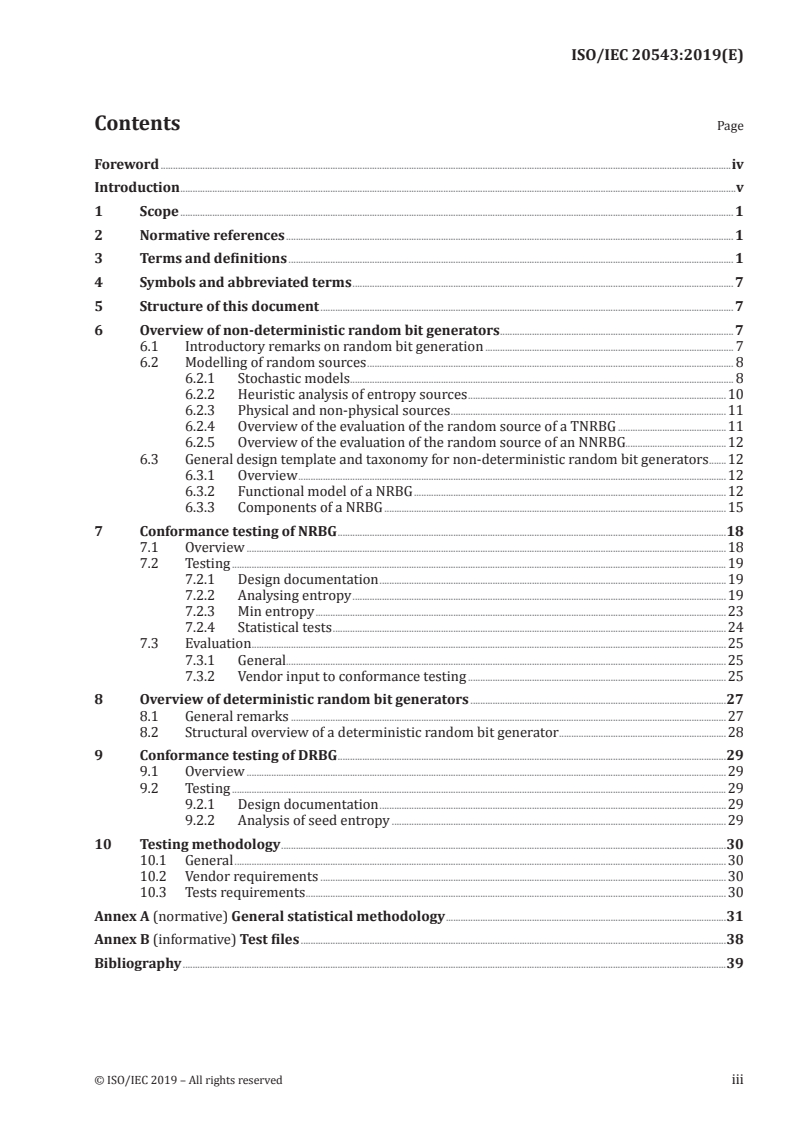
Contents Page
Foreword .iv
Introduction .v
1 Scope . 1
2 Normative references . 1
3 Terms and definitions . 1
4 Symbols and abbreviated terms . 7
5 Structure of this document . 7
6 Overview of non-deterministic random bit generators . 7
6.1 Introductory remarks on random bit generation . 7
6.2 Modelling of random sources . 8
6.2.1 Stochastic models . . 8
6.2.2 Heuristic analysis of entropy sources .10
6.2.3 Physical and non-physical sources .11
6.2.4 Overview of the evaluation of the random source of a TNRBG .11
6.2.5 Overview of the evaluation of the random source of an NNRBG.12
6.3 General design template and taxonomy for non-deterministic random bit generators .12
6.3.1 Overview .12
6.3.2 Functional model of a NRBG .12
6.3.3 Components of a NRBG .15
7 Conformance testing of NRBG .18
7.1 Overview .18
7.2 Testing .19
7.2.1 Design documentation .19
7.2.2 Analysing entropy .19
7.2.3 Min entropy .23
7.2.4 Statistical tests .24
7.3 Evaluation .25
7.3.1 General.25
7.3.2 Vendor input to conformance testing .25
8 Overview of deterministic random bit generators .27
8.1 General remarks .27
8.2 Structural overview of a deterministic random bit generator .28
9 Conformance testing of DRBG .29
9.1 Overview .29
9.2 Testing .29
9.2.1 Design documentation .29
9.2.2 Analysis of seed entropy .29
10 Testing methodology .30
10.1 General .30
10.2 Vendor requirements .30
10.3 Tests requirements .30
Annex A (normative) General statistical methodology .31
Annex B (informative) Test files .38
Bibliography .39
© ISO/IEC 2019 – All rights reserved iii
Foreword
ISO (the International Organization for Standardization) and IEC (the International Electrotechnical
Commission) form the specialized system for worldwide standardization. National bodies that
are members of ISO or IEC participate in the development of International Standards through
technical committees established by the respective organization to deal with particular fields of
technical activity. ISO and IEC technical committees collaborate in fields of mutual interest. Other
international organizations, governmental and non-governmental, in liaison with ISO and IEC, also
take part in the work.
The procedures used to develop this document and those intended for its further maintenance are
described in the ISO/IEC Directives, Part 1. In particular, the different approval criteria needed for
the different types of document should be noted. This document was drafted in accordance with the
editorial rules of the ISO/IEC Directives, Part 2 (see www .iso .org/directives).
Attention is drawn to the possibility that some of the elements of this document may be the subject
of patent rights. ISO and IEC shall not be held responsible for identifying any or all such patent
rights. Details of any patent rights identified during the development of the document will be in the
Introduction and/or on the ISO list of patent declarations received (see www .iso .org/patents) or the IEC
list of patent declarations received (see http: //patents .iec .ch).
Any trade name used in this document is information given for the convenience of users and does not
constitute an endorsement.
For an explanation of the voluntary nature of standards, the meaning of ISO specific terms and
expressions related to conformity assessment, as well as information about ISO's adherence to the
World Trade Organization (WTO) principles in the Technical Barriers to Trade (TBT) see www .iso
.org/iso/foreword .html.
This document was prepared by Joint Technical Committee ISO/IEC JTC 1, Information technology,
Subcommittee SC 27, IT security techniques.
Any feedback or questions on this document should be directed to the user’s national standards body. A
complete listing of these bodies can be found at www .iso .org/members .html.
iv © ISO/IEC 2019 – All rights reserved
Introduction
Cryptographic applications need random numbers for a wide range of tasks. A strong cryptographic
random bit generator that is suitable for general cryptographic applications is expected to provide
output bit strings that cannot be distinguished with any potentially practical computational effort and
any potentially practical sample sizes from bit strings of the same length drawn uniformly at random.
Furthermore, such an RBG is expected to offer enhanced backward secrecy and enhanced forward
secrecy.
© ISO/IEC 2019 – All rights reserved v
INTERNATIONAL STANDARD ISO/IEC 20543:2019(E)
Information technology — Security techniques — Test and
analysis methods for random bit generators within ISO/IEC
19790 and ISO/IEC 15408
1 Scope
This document specifies a methodology for the evaluation of non-deterministic or deterministic
random bit generators intended to be used for cryptographic applications. The provisions given in
this document enable the vendor of an RBG to submit well-defined claims of security to an evaluation
authority and shall enable an evaluator or a tester, for instance a validation authority, to evaluate, test,
certify or reject these claims.
This document is implementation-agnostic. Hence, it offers no specific guidance on design and
implementation decisions for random bit generators. However, design and implementation issues
influence the evaluation of an RBG in this document, for instance because it requires the use of a
stochastic model of the random source and because any such model is supported by technical arguments
pertaining to the design of the device at hand.
Random bit generators as evaluated in this document aim to output bit strings that appear evenly
distributed. Depending on the distribution of random numbers required by the consuming application,
however, it is worth noting that additional steps can be necessary (and can well be critical to security)
for the consuming application to transform the random bit strings produced by the RBG into random
numbers of a distribution suitable to the application requirements. Such subsequent transformations
are outside the scope of evaluations performed in this document.
2 Normative references
The following documents are referred to in the text in such a way that some or all of their content
constitutes requirements of this document. For dated references, only the edition cited applies. For
undated references, the latest edition of the referenced document (including any amendments) applies.
ISO/IEC 15408 (all parts), Information technology — Security techniques — Evaluation criteria for IT
security
ISO/IEC 17825, Information technology — Security techniques — Testing methods for the mitigation of
non-invasive attack classes against cryptographic modules
ISO/IEC 18031:2011, Information technology — Security techniques — Random bit generation
ISO/IEC 19790, Information technology — Security techniques — Security requirements for
cryptographic modules
3 Terms and definitions
For the purposes of this document, the following terms and definitions apply.
ISO and IEC maintain terminological databases for use in standardization at the following addresses:
— ISO Online browsing platform: available at https: //www .iso .org/obp
— IEC Electropedia: available at http: //www .electropedia .org/
© ISO/IEC 2019 – All rights reserved 1
3.1
backward secrecy
assurance that previous RBG output values cannot be determined from knowledge of current or
subsequent output values
3.2
bit stream
continuous output of bits from a device or mechanism
[SOURCE: ISO/IEC 18031:2011, 3.4]
3.3
black box
idealized mechanism that accepts inputs and produces outputs, but is designed such that an observer
cannot see inside the box or determine exactly what is happening inside that box
Note 1 to entry: This term can be contrasted with glass box (3.13).
[SOURCE: ISO/IEC 18031:2011, 3.6]
3.4
conformance-tester
tester
individual assigned to perform test activities in accordance with a given conformance testing standard
and associated testing methodology
EXAMPLE An example of such a standard is ISO/IEC 19790 and the testing methodology specified in
ISO/IEC 24759.
[SOURCE: ISO/IEC 19896-1:2018, 3.2, modified — The term "tester" has been added as an admitted term.]
3.5
deterministic random bit generator
DRBG
random bit generator that produces a random-appearing sequence of bits by applying a deterministic
algorithm to a suitably random initial value called a seed and, possibly, some secondary inputs
Note 1 to entry: Non-deterministic sources can also form part of these secondary inputs.
Note 2 to entry: The security of a deterministic random bit generator rests primarily on the strength of its
cryptographic algorithms and on the randomness contained in the seed value. In a deterministic random bit
generator that is suitable for cryptographic use, at least forward and backward secrecy shall be assured without
invoking secondary inputs to the RBG or reseeding.”
3.6
enhanced backward secrecy
assurance that the knowledge of the current internal state of a random bit generator does not allow an
adversary to derive with practical computational effort knowledge about previous output values
Note 1 to entry: The notion of enhanced backward secrecy is trivial for memoryless RBGs. Therefore, it is only
a useful notion for deterministic and hybrid RBGs, the security of which rests at least in part on cryptographic
properties of the state transition function and the output generation function of the random bit generator.
3.7
enhanced forward secrecy
assurance that knowing the current internal state of the random bit generator does not yield practically
relevant constraints on subsequent (future) output values
Note 1 to entry: Deterministic random bit generators are unable to achieve enhanced forward secrecy. Unlike
forward and backward secrecy as well as enhanced backward secrecy, enhanced forward secrecy rests entirely
on the ability of a continuous reseeding process to supply as much entropy as is required to make the prediction
of future outputs infeasible.
2 © ISO/IEC 2019 – All rights reserved
Note 2 to entry: It is possible for a random bit generator to have enhanced forward secrecy but still expand
entropy, i.e. output a bit-string that can in principle be significantly compressed”. For instance, one can
consider an RBG design with a random source which produces at each invocation a 128 bit random string R
with an estimated 120 bits of min entropy, with a 512 bit internal state S(n), a state transition function giving
S(n+1) := SHA3-512(S(n)||R), and an output generation function applying SHAKE-256 on S(n)||R with up to 1024 bits
of output per invocation.
Note 3 to entry: Another term often found in the literature that is interchangeable with enhanced forward
secrecy is prediction resistance.
3.8
entropy
measure of the expected amount of information contained in a bit string given knowledge of how the bit
string was generated
Note 1 to entry: There are various notions of entropy that play a role in cryptography. Worth mentioning among
them are Shannon entropy, min entropy, collision entropy, guessing entropy, algorithmic entropy and Renyi
entropy (the latter notion containing as special cases among others Shannon entropy, Min entropy and Collision
entropy).
Note 2 to entry: The amount of entropy contained in an unknown bit string is always relative to an observer. RBG
evaluations establish entropy estimates in face of an attacker with detailed knowledge about the entropy source
and also consider her abilities to observe or influence the state of the entropy source.
Note 3 to entry: Irrespective of the chosen kind of entropy, the term “full entropy” always means the same,
namely uniformly distributed and independent random numbers, that is, ideal randomness.
Note 4 to entry: An algorithmic entropy is a logarithm to the base 2 of the length of the shortest encoding in some
given formal language. Its measure is based on the notion of optimal compression. The algorithmic entropy of
a bit-string is dependent on the underlying formal language and even given a well-defined formal language, is
in general incomputable unless the language is very restricted. However, related notions are of relevance in a
cryptographic context. For instance, one can ask how much the sequence of raw random numbers derived from
some physical noise source can be compressed using some fixed computationally efficient compression strategy
that is informed by a precise understanding of the physical noise source and of the process that converts the
output of the noise source into the raw random numbers.
3.9
entropy source
mechanism or device which produces intrinsically unpredictable output
Note 1 to entry: In the context of purely deterministic random bit generators, entropy generation can be
performed just once, and in this case, it is possible for the RBG device not to contain an entropy source. The
source of the entropy used by such an RBG nevertheless needs to be evaluated to the same standards that would
otherwise be required.
Note 2 to entry: In some circumstances, it can be admissible for a deterministic RBG to be seeded with externally
generated entropy instead of containing hardware that produces entropy within its own perimeter. In that case,
the externally generated entropy shall only be available to the RBG instance it is intended for.
3.10
evaluator
individual assigned to perform evaluations in accordance with a given evaluation standard and
associated evaluation methodology
Note 1 to entry: An example of an evaluation standard is ISO/IEC 15408 (all parts) with the associated evaluation
methodology given in ISO/IEC 18045.
[SOURCE: ISO/IEC 19896-1:2018, 3.5]
© ISO/IEC 2019 – All rights reserved 3
3.11
forward secrecy
assurance that the knowledge of subsequent (future) values cannot be determined from current or
previous values
[SOURCE: ISO/IEC 18031:2011, 3.13]
3.12
glass box
idealized mechanism that accepts inputs and produces outputs and is designed such that an observer
can see inside and determine exactly what is going on
Note 1 to entry: This term can be contrasted with black box (3.3).
[SOURCE: ISO/IEC 18367:2016, 3.12]
3.13
health test
online test and total failure test
any mechanism (statistical test or otherwise) which detects at least one of the following two scenarios:
a) a transient or permanent total failure of the entropy source, i.e. a drastic decrease in entropy which
usually manifests itself in a small number of easily detectable symptoms
b) smaller deviations from the normal behaviour of the entropy source, but nevertheless intolerable
which undermine security claims made by the vendor. In contrast to a total failure, it usually
requires a slightly larger sample size until these deviations are reliably detected
3.14
independent and identically distributed
IID
property of a family of random variables stating that they share the same distribution and are mutually
independent
3.15
laboratory
organization with a management system providing evaluation and or testing work in accordance with a
defined set of policies and procedures and utilizing a defined methodology for testing or evaluating the
security functionality of IT products
Note 1 to entry: These organizations are often given alternative names by various approval authorities. For
example, IT Security Evaluation Facility (ITSEF), Common Criteria Testing Laboratory (CCTL), Commercial
Evaluation Facility (CLEF).
[SOURCE: ISO/IEC 19896-1:2018, 3.8]
3.16
min entropy
the min entropy of a finite random variable X is −log2(p_max) where p_max denotes the probability of
the most likely outcome. That is, p_max >=p_x for all x
3.17
guessing entropy
guess work
expected number of guesses an adversary following an optimal guessing strategy needs to submit
[19]
in order to guess the value of x , with X, a random finite variable and x, the value of a realization of X
(i.e. a corresponding random variate)
Note 1 to entry: The formula for the guessing entropy is \sum_i=1^n ip_i where the p_i are ordered p_1 >= p_2 >= .
(that is, the optimal guessing strategy is to guess the most likely outcomes first).
4 © ISO/IEC 2019 – All rights reserved
3.18
non-dedicated non-deterministic random bit generator
NNRBG
non-deterministic random bit generator the security of which is not based on randomness generated by
hardware that was designed explicitly to generate randomness
Note 1 to entry: TNRBG und NNRBG stand for true dedicated NRBG and non-dedicated NRBG, respectively.
3.19
non-deterministic random bit generator
NRBG
random bit generator that continuously samples multiple entropy sources and, if operating correctly,
has an output that is expected to be unpredictable for attackers with unbounded computational
capabilities over short timescales
3.20
perfect forward secrecy
property of a cryptographic protocol whereby an attacker cannot compromise past runs of the protocol
by learning the long-term secrets of the participants
3.21
physical entropy source
entropy source based on the use of a dedicated physical effect (e.g. noisy diode, nuclear decay, etc.)
3.22
noise source
element of a technical system or its environment which produces partially unpredictable output. In this
document, “noise source” and “entropy source” are taken to be entropy sources
3.23
non-physical entropy source
entropy source not based on a dedicated physical system but on unpredictable parts of the environment
or technical components that were not originally designed for random bit generation
Note 1 to entry: Examples can be user input or the collection of various difficult to predict system data (e.g. hard
drive access times, noise from a sensor device, system interrupts) in a standard computer.
3.24
post-processing
part of a random bit generator which processes the output of a random source with the aim of removing
dependencies between random bits or biases. Is often also referred as a conditioning component
3.25
random bit generator
RBG
device or algorithm designed to produce bits that appear statistically independent and unbiased
Note 1 to entry: In case of purely physical random bit generators, the existence of very small entropy defects
can be permitted. Deterministic RBG constructions, on the other hand, shall offer output that is computationally
indistinguishable in practice from ideally distributed data. In addition, it is worth noting that hybrid designs
have advantages over both purely deterministic and purely physical designs by combining the true entropy
guarantees of physical RBGs with the near-ideal output distribution of deterministic RBGs and resilience
properties, for instance with regards to noise source failure.
© ISO/IEC 2019 – All rights reserved 5
3.26
raw random numbers
bit sequence produced internally within a random bit generator by digitization of the random noise
source or detection of unpredictable events within the machine in question, before any post-processing
beyond the digitization has been performed
Note 1 to entry: It should be noted that although the raw random numbers represent an early stage in random
bit generation, they can already contain complicated inherent pseudo-random patterns. For instance, part of the
randomness in hard drive seek times is commonly associated to chaotic turbulent air flow patterns inside the
hard drive; even if one abstracts away all other features of a hard drive, it seems difficult to argue that an RBG
based on this effect does not have significant internal memory. However, sources with large internal memory are
notoriously difficult to properly characterise by statistical tests with realistic sample sizes. The extent to which
pseudorandom patterns are exhibited by a raw random source therefore depends on the design of the entropy
source and shall be considered when analysing it. Generic statistical tests can mistake pseudo-randomness for
actual randomness and thus overestimate the entropy of the raw random numbers. It is for this reason primarily
that it is important to understand the design of the mechanism producing the raw random numbers. This
comprises influences of the digitization mechanisms itself, e.g. resolution and non-linearity of A/D converters or
noise produced by amplification circuits.
3.27
security strength
largest natural number, n, such that a computationally unbounded attacker cannot distinguish with
more than negligible advantage an n-bit value produced by the RBG from an n-bit value drawn uniformly
at random, when given the true prior distribution of internal RBG states
Note 1 to entry: If no such number n exists, the security strength is said to be infinite.
Note 2 to entry: Only hybrid or physical random bit generators can have infinite maximal supported security
strength, as deterministic random bit generators always rely on an initial seed value. It is worth noting, however,
that the output of pure physical random bit generators can often be distinguished from random data in practice if
the design of any conditioning steps that can be performed is known to the attacker.
3.28
Shannon entropy
expected value of −log2(px), where px is the probability of observing the
realization X=x
Note 1 to entry: In other words, for a finite random variable X with range S that the Shannon entropy H(X) is
given by the formula HX()=− xS∈ ⋅⋅px log2()px , where for the purposes of calculating the expected value
∑
one adopts the convention that 0*log2(0) = 0.
3.29
stationarity
property of a stochastic process whereby the joint distribution of subsequent instances of the process
is time-invariant
3.30
stochastic model
partial mathematical description of a random bit generator based on at least a qualitative understanding
of the entropy source which, together with possibly some data gathered empirically for parameter
estimation, allows the derivation of entropy claims
Note 1 to entry: In the context of evaluating random bit generators, it is recommended but not required that the
stochastic model describe the behaviour of the raw random bits. Subsequent post-processing can make it more
difficult to make a convincing case that the stochastic model is in sufficient correspondence with the workings of
the device to be modelled to support the entropy claims to be shown. For instance, a stochastic model applied to
the output random numbers of a deterministic random bit generator will be essentially untestable statistically
insofar as strong cryptographic post-processing can render even very low entropy data indistinguishable from
random noise at realistic sample sizes, at least from the point of view of any adversary lacking a stochastic model
of the raw random numbers.
6 © ISO/IEC 2019 – All rights reserved
3.31
TNRBG
non-deterministic random bit generator the security of which is based on a hardware component that
has been designed explicitly to generate randomness
Note 1 to entry: TNRBG und NNRBG stand for true dedicated NRBG and non-dedicated NRBG, respectively.
3.32
validation authority
entity that will validate the testing results for conformance to ISO/IEC 19790
[SOURCE: ISO/IEC 19790:2012, 3.132, modified — In the definition, “this International Standard” has
been changed to “ISO/IEC 19790”.]
3.33
vendor
entity, group or association that submits the cryptographic module for testing and validation
Note 1 to entry: The vendor has access to all relevant documentation and design evidence regardless if they did
or did not design or develop the cryptographic module.
[SOURCE: ISO/IEC 19790:2012, 3.133]
4 Symbols and abbreviated terms
CCTL Common Criteria Testing Laboratory
CLEF Commercial Evaluation Facility
ITSEF IT Security Evaluation Facility
LFSR Linear Feedback Shift Register
OS Operating System
SHA Secure Hash Algorithm (SHA-256 and SHA3-512 referred to in this document)
5 Structure of this document
This document is divided into five clauses after the current clause: overview of non-deterministic
random bit generators, conformance testing of NRBG, overview of deterministic random bit generator,
conformance testing of DRBG and testing methodology. Each clause focuses on testing and evaluation
activities for random bit generators for a conformance scheme using ISO/IEC 19790 and an evaluation
scheme using the ISO/IEC 15408 series.
6 Overview of non-deterministic random bit generators
6.1 Introductory remarks on random bit generation
The current clause intends to demonstrate the problems of evaluating random bit generators and the
security goals that are to be achieved by looking at the well-known setting of coin-tossing. One side of
the coin is called “a head” (H) and the other is called “a tail” (T). Randomness is generated by tossing
the coin into the air and noting which side is up when it lands.
Flipping a coin multiple times produces an ordered series of coin flip results denoted as a series of H(s)
and T(s). For example, the sequence “HTTHT” (reading left to right) indicates a head followed by a tail,
followed by a tail, followed by a head, followed by a tail. This coin flip sequence can be translated into
© ISO/IEC 2019 – All rights reserved 7
a binary string in a straightforward manner by assigning H to a binary one (“1”) and T to a binary zero
(“0”); the resulting example bit string is “10010”.
The required properties of randomness can be examined using the example of the coin toss experiment
described above. The result of each coin flip, from the point of view of using the output in cryptographic
applications, is:
— unpredictable: Before the flip, it is unknown whether the coin will land showing a head or a tail. This
is, in the case of a coin flip, contingent on not knowing with sufficient precision the initial physical
parameters of the coin flip such as initial speed, height above ground, physical properties of the
ground on which the coin is going to come to rest and rotation rate of the coin. If there is sufficiently
[8]
low relevant entropy in the initial conditions of the flip, then the experiment becomes predictable ;
what entropy is relevant for can only be determined by examining a physical model of the coin
flipping process. But if initial conditions contain sufficient relevant entropy, the result is kept secret,
and if initial conditions are not repeated too closely in a predictable manner on subsequent trials,
it is not possible to determine what the result of flipping the coin was, given knowledge of any
subsequent or previous outcome. The unpredictability after the flip depends also on whether the
adversary can observe the outcome of the coin flip or not. The notion of entropy quantifies the
amount of unpredictability or uncertainty relative to an observer and is discussed more thoroughly
later in this document;
— unbiased: That is, each potential outcome has the same chance of occurring. The extent to which
this is true depends on the same factors as listed above. Being unbiased in this sense means that
each instance of the coin tossing experiment follows a uniform distribution (over the two possible
outcomes H and T) and therefore that the sequence of coin tossing experiments is identically
distributed as each experiment has the same probability distribution; and
— independent: The coin flip is memoryless; whatever happened before the current flip does not
influence it. Whether this is true for a real coin toss experiment depends on whether the randomness
entering the experiment via the initial conditions is memoryless and possibly on whether the coin
itself changes, e.g. due to wear and tear over repeated experimental runs.
Simulating an idealized coin flipping experiment – i.e. a random source emitting a stream of bits
that is unbiased, independent and identically distributed – is what cryptographic applications can
generally aim for. The reason for this is that, while some cryptographic applications can tolerate
significant deviations from ideal randomness (e.g. an AES-256 key is not brute-forceable if its bits are
IID with 60 percent zeroes), others start leaking information even in the presence of small biases (for
instance, secret sharing schemes) or can even get broken when a small amount of information about
[21]
cryptographic secrets leaks (e.g. ECDSA nonces ). Also, the theoretically claimed security level of any
cryptographic mechanism is often only reached if keys are ideally distributed. RBGs to be evaluated in
this document simulate a series of idealized coin flips, even under strong assumptions on the abilities of
any adversaries.
To evaluate whether a random bit generator supplies sufficient randomness, one needs to analyse the
working principles of the device in question to arrive at a stochastic model ideally of the raw random
numbers generated within the device. Based on this stochastic model, statistical tests can then be
selected which enables the evaluator to derive estimates of the entropy contained in the raw random
numbers.
6.2 Modelling of random sources
6.2.1 Stochastic models
6.2.1.1 General
Subclause 6.2 introduces the methods that are to be used in the modelling of random sources for
evaluation in this document and define documentation requirements and evaluator actions related to
that step in the evaluation of a random bit generator wherein it is checked that the stochastic behaviour
of the entropy source is sufficiently well understood to proceed. Therefore, 6.2 does not itself define
8 © ISO/IEC 2019 – All rights reserved
minimum quality standards on the random source. Instead, such quality standards are defined by
requirements imposed on the security claims to be submitted by the vendor. One abstract way to model
a process that generates a random signal is by means of a stochastic model. As per 3.26, a stochastic
model is a partial mathematical description of the system in question as a mathematical random
process. A stochastic model is explicitly or implicitly a claim that the output of some circuit follows a
probability distribution from a certain family of distributions.
The purpose of introducing a stochastic model into the evaluation of a random bit generator is fourfold:
a) Having a stochastic model of a randomness generating component transforms the generally
intractable problem of ascertaining by black box testing whether the output of the device contains
the desired amount of entropy into the possibly tractable problem to determine whether statistical
testing yields results compatible with the hypothesis that the mechanism samples from one of the
distributions covered by the stochastic model. Based on the stochastic model, it is then possible to
test for the amount of entropy generated by the mechanism.
b) The stochastic model contains output distributions that correspond to defective states of the
randomness producing device and statistical testing can then be used to determine that one is in
one of these regimes. This is necessary as without a hypothesis about the behaviour of defective
states, it is practically impossible to test for them.
c) The stochastic model can and shall be supported using technical arguments derived from the
design of the randomness producing device that the stochastic model purports to model. Thereby,
a connection is made between the technical properties of the device under evaluation and the
claimed security properties of the core of the random bit generation mechanism.
d) Examining the stochastic model of an early stage of random bit generation and the supporting
technical rationale allows the evaluator to confirm that technical arguments predict the general
shape of the distribution of random output at a point where this output can still clearly be
distinguished from ideal output. In contrast, many RBG constructions lead to output at the end-
stage of random bit generation which is indistinguishable from ideally distributed output almost
irrespective of the amount of true entropy contained therein.
The stochastic model needs to cover all technically plausible modes of failure or performance
degradation.
For instance, a stochastic model for the output of a randomness producing device can claim that the
output is identically and independently distributed for independent calls to the mechanism in normal
operational mode and zeroes-only in the only technically plausible failure mode. The probability of
spontaneously (without adversarial intervention) entering a mode with performance less than the
security claims for the device may be claimed to be some low value per call to the mechanism.
Usually, a stochastic model encompasses some assertion of stationarity: that under suitable technical
conditions the process in question is modelled by one member of the family of probability distributions
and that over short time scales, the relevant distribution parameters are not expected to change greatly.
A stationarity claim of this type is not in contradiction to the notion that the device can experience
effects of ageing, transient effects during start-up, or that it can fail. In the first case, the change in
distribution parameters is too slow to affect sampling appreciably over short time spans; in the
transient response case, the RBG has presumably not reached its operational state yet and cannot in
fact yet be used; and in case of failure, the output distribution can change drastically, but this happens
with low likelihood and the likelihood of it happening from an operational starting state does not
change significantly with time.
Note that the question whether a process is stationary or not depends in part on the description of the
process that is being used. For instance, a standard random walk is a classic example of a non-stationary
process (the range of values that is being taken gets wider over time), but if the states reached in the
random walk are used as a source of randomness, it can (depending on further processing steps used) be
equivalent to instead consider the step-wise differences as entropy input, which yields an independent
and identically distributed Bernoulli process.
© ISO/IEC 2019 – All rights reserved 9
Sources that are not amenable to being modelled by an underlying stationary process are harder to
characterize than approximately stationary sources, because distribution parameters that a statistical
test can attempt to estimate can in this case change over the course of sampling, shortly thereafter, or
shortly before.
6.2.1.2 Requirements
A claim of (approximate) stationarity shall always be substantiated by technical arguments.
Therefore, in general a stochastic model shall:
— be a partial mathematical description of a stochastic process;
— describe precisely the stage of random bit generation in the device under study that is claimed as
being modelled;
— allow for the efficient derivation of entropy claims for the distribution of the targeted stage of
random bit generation from test data;
— cover technically plausible defective states of the mechanism targeted in the modelling;
— be supported by technical arguments based on the design of the targeted mechanism.
Furthermore, the description of technically plausible defective states of the random source that is
contained in the stochastic model shall allow for the construction of statistical tests (“online health
tests”) that detect efficiently an intolerable deterioration of the quality of the source.
For example, the stochastic model can specify a parametrized statistical distribution and an allowed
region in which the parameters of all devices lie to satisfy the security claims. An online health test can
now apply a tailored statistical test to check whether a device's parameter still lies within that region.
6.2.2 Heuristic analysis of entropy sources
6.2.2.1 General
In some contexts, it can be impossible to constrain the distribution of digitized noise data by a stochastic
model in the above sense. It can be difficult to find strong technical grounds for assuming certain
characteristics of the un
...
INTERNATIONAL ISO/IEC
STANDARD 20543
First edition
2019-10
Information technology — Security
techniques — Test and analysis
methods for random bit generators
within ISO/IEC 19790 and ISO/IEC
Technologies de l'information — Techniques de sécurité — Méthodes
d'essai et d'analyse des générateurs de bits aléatoires dans l'ISO/IEC
19790 et l'ISO/IEC 15408
Reference number
©
ISO/IEC 2019
© ISO/IEC 2019
All rights reserved. Unless otherwise specified, or required in the context of its implementation, no part of this publication may
be reproduced or utilized otherwise in any form or by any means, electronic or mechanical, including photocopying, or posting
on the internet or an intranet, without prior written permission. Permission can be requested from either ISO at the address
below or ISO’s member body in the country of the requester.
ISO copyright office
CP 401 • Ch. de Blandonnet 8
CH-1214 Vernier, Geneva
Phone: +41 22 749 01 11
Fax: +41 22 749 09 47
Email: copyright@iso.org
Website: www.iso.org
Published in Switzerland
ii © ISO/IEC 2019 – All rights reserved
Contents Page
Foreword .iv
Introduction .v
1 Scope . 1
2 Normative references . 1
3 Terms and definitions . 1
4 Symbols and abbreviated terms . 7
5 Structure of this document . 7
6 Overview of non-deterministic random bit generators . 7
6.1 Introductory remarks on random bit generation . 7
6.2 Modelling of random sources . 8
6.2.1 Stochastic models . . 8
6.2.2 Heuristic analysis of entropy sources .10
6.2.3 Physical and non-physical sources .11
6.2.4 Overview of the evaluation of the random source of a TNRBG .11
6.2.5 Overview of the evaluation of the random source of an NNRBG.12
6.3 General design template and taxonomy for non-deterministic random bit generators .12
6.3.1 Overview .12
6.3.2 Functional model of a NRBG .12
6.3.3 Components of a NRBG .15
7 Conformance testing of NRBG .18
7.1 Overview .18
7.2 Testing .19
7.2.1 Design documentation .19
7.2.2 Analysing entropy .19
7.2.3 Min entropy .23
7.2.4 Statistical tests .24
7.3 Evaluation .25
7.3.1 General.25
7.3.2 Vendor input to conformance testing .25
8 Overview of deterministic random bit generators .27
8.1 General remarks .27
8.2 Structural overview of a deterministic random bit generator .28
9 Conformance testing of DRBG .29
9.1 Overview .29
9.2 Testing .29
9.2.1 Design documentation .29
9.2.2 Analysis of seed entropy .29
10 Testing methodology .30
10.1 General .30
10.2 Vendor requirements .30
10.3 Tests requirements .30
Annex A (normative) General statistical methodology .31
Annex B (informative) Test files .38
Bibliography .39
© ISO/IEC 2019 – All rights reserved iii
Foreword
ISO (the International Organization for Standardization) and IEC (the International Electrotechnical
Commission) form the specialized system for worldwide standardization. National bodies that
are members of ISO or IEC participate in the development of International Standards through
technical committees established by the respective organization to deal with particular fields of
technical activity. ISO and IEC technical committees collaborate in fields of mutual interest. Other
international organizations, governmental and non-governmental, in liaison with ISO and IEC, also
take part in the work.
The procedures used to develop this document and those intended for its further maintenance are
described in the ISO/IEC Directives, Part 1. In particular, the different approval criteria needed for
the different types of document should be noted. This document was drafted in accordance with the
editorial rules of the ISO/IEC Directives, Part 2 (see www .iso .org/directives).
Attention is drawn to the possibility that some of the elements of this document may be the subject
of patent rights. ISO and IEC shall not be held responsible for identifying any or all such patent
rights. Details of any patent rights identified during the development of the document will be in the
Introduction and/or on the ISO list of patent declarations received (see www .iso .org/patents) or the IEC
list of patent declarations received (see http: //patents .iec .ch).
Any trade name used in this document is information given for the convenience of users and does not
constitute an endorsement.
For an explanation of the voluntary nature of standards, the meaning of ISO specific terms and
expressions related to conformity assessment, as well as information about ISO's adherence to the
World Trade Organization (WTO) principles in the Technical Barriers to Trade (TBT) see www .iso
.org/iso/foreword .html.
This document was prepared by Joint Technical Committee ISO/IEC JTC 1, Information technology,
Subcommittee SC 27, IT security techniques.
Any feedback or questions on this document should be directed to the user’s national standards body. A
complete listing of these bodies can be found at www .iso .org/members .html.
iv © ISO/IEC 2019 – All rights reserved
Introduction
Cryptographic applications need random numbers for a wide range of tasks. A strong cryptographic
random bit generator that is suitable for general cryptographic applications is expected to provide
output bit strings that cannot be distinguished with any potentially practical computational effort and
any potentially practical sample sizes from bit strings of the same length drawn uniformly at random.
Furthermore, such an RBG is expected to offer enhanced backward secrecy and enhanced forward
secrecy.
© ISO/IEC 2019 – All rights reserved v
INTERNATIONAL STANDARD ISO/IEC 20543:2019(E)
Information technology — Security techniques — Test and
analysis methods for random bit generators within ISO/IEC
19790 and ISO/IEC 15408
1 Scope
This document specifies a methodology for the evaluation of non-deterministic or deterministic
random bit generators intended to be used for cryptographic applications. The provisions given in
this document enable the vendor of an RBG to submit well-defined claims of security to an evaluation
authority and shall enable an evaluator or a tester, for instance a validation authority, to evaluate, test,
certify or reject these claims.
This document is implementation-agnostic. Hence, it offers no specific guidance on design and
implementation decisions for random bit generators. However, design and implementation issues
influence the evaluation of an RBG in this document, for instance because it requires the use of a
stochastic model of the random source and because any such model is supported by technical arguments
pertaining to the design of the device at hand.
Random bit generators as evaluated in this document aim to output bit strings that appear evenly
distributed. Depending on the distribution of random numbers required by the consuming application,
however, it is worth noting that additional steps can be necessary (and can well be critical to security)
for the consuming application to transform the random bit strings produced by the RBG into random
numbers of a distribution suitable to the application requirements. Such subsequent transformations
are outside the scope of evaluations performed in this document.
2 Normative references
The following documents are referred to in the text in such a way that some or all of their content
constitutes requirements of this document. For dated references, only the edition cited applies. For
undated references, the latest edition of the referenced document (including any amendments) applies.
ISO/IEC 15408 (all parts), Information technology — Security techniques — Evaluation criteria for IT
security
ISO/IEC 17825, Information technology — Security techniques — Testing methods for the mitigation of
non-invasive attack classes against cryptographic modules
ISO/IEC 18031:2011, Information technology — Security techniques — Random bit generation
ISO/IEC 19790, Information technology — Security techniques — Security requirements for
cryptographic modules
3 Terms and definitions
For the purposes of this document, the following terms and definitions apply.
ISO and IEC maintain terminological databases for use in standardization at the following addresses:
— ISO Online browsing platform: available at https: //www .iso .org/obp
— IEC Electropedia: available at http: //www .electropedia .org/
© ISO/IEC 2019 – All rights reserved 1
3.1
backward secrecy
assurance that previous RBG output values cannot be determined from knowledge of current or
subsequent output values
3.2
bit stream
continuous output of bits from a device or mechanism
[SOURCE: ISO/IEC 18031:2011, 3.4]
3.3
black box
idealized mechanism that accepts inputs and produces outputs, but is designed such that an observer
cannot see inside the box or determine exactly what is happening inside that box
Note 1 to entry: This term can be contrasted with glass box (3.13).
[SOURCE: ISO/IEC 18031:2011, 3.6]
3.4
conformance-tester
tester
individual assigned to perform test activities in accordance with a given conformance testing standard
and associated testing methodology
EXAMPLE An example of such a standard is ISO/IEC 19790 and the testing methodology specified in
ISO/IEC 24759.
[SOURCE: ISO/IEC 19896-1:2018, 3.2, modified — The term "tester" has been added as an admitted term.]
3.5
deterministic random bit generator
DRBG
random bit generator that produces a random-appearing sequence of bits by applying a deterministic
algorithm to a suitably random initial value called a seed and, possibly, some secondary inputs
Note 1 to entry: Non-deterministic sources can also form part of these secondary inputs.
Note 2 to entry: The security of a deterministic random bit generator rests primarily on the strength of its
cryptographic algorithms and on the randomness contained in the seed value. In a deterministic random bit
generator that is suitable for cryptographic use, at least forward and backward secrecy shall be assured without
invoking secondary inputs to the RBG or reseeding.”
3.6
enhanced backward secrecy
assurance that the knowledge of the current internal state of a random bit generator does not allow an
adversary to derive with practical computational effort knowledge about previous output values
Note 1 to entry: The notion of enhanced backward secrecy is trivial for memoryless RBGs. Therefore, it is only
a useful notion for deterministic and hybrid RBGs, the security of which rests at least in part on cryptographic
properties of the state transition function and the output generation function of the random bit generator.
3.7
enhanced forward secrecy
assurance that knowing the current internal state of the random bit generator does not yield practically
relevant constraints on subsequent (future) output values
Note 1 to entry: Deterministic random bit generators are unable to achieve enhanced forward secrecy. Unlike
forward and backward secrecy as well as enhanced backward secrecy, enhanced forward secrecy rests entirely
on the ability of a continuous reseeding process to supply as much entropy as is required to make the prediction
of future outputs infeasible.
2 © ISO/IEC 2019 – All rights reserved
Note 2 to entry: It is possible for a random bit generator to have enhanced forward secrecy but still expand
entropy, i.e. output a bit-string that can in principle be significantly compressed”. For instance, one can
consider an RBG design with a random source which produces at each invocation a 128 bit random string R
with an estimated 120 bits of min entropy, with a 512 bit internal state S(n), a state transition function giving
S(n+1) := SHA3-512(S(n)||R), and an output generation function applying SHAKE-256 on S(n)||R with up to 1024 bits
of output per invocation.
Note 3 to entry: Another term often found in the literature that is interchangeable with enhanced forward
secrecy is prediction resistance.
3.8
entropy
measure of the expected amount of information contained in a bit string given knowledge of how the bit
string was generated
Note 1 to entry: There are various notions of entropy that play a role in cryptography. Worth mentioning among
them are Shannon entropy, min entropy, collision entropy, guessing entropy, algorithmic entropy and Renyi
entropy (the latter notion containing as special cases among others Shannon entropy, Min entropy and Collision
entropy).
Note 2 to entry: The amount of entropy contained in an unknown bit string is always relative to an observer. RBG
evaluations establish entropy estimates in face of an attacker with detailed knowledge about the entropy source
and also consider her abilities to observe or influence the state of the entropy source.
Note 3 to entry: Irrespective of the chosen kind of entropy, the term “full entropy” always means the same,
namely uniformly distributed and independent random numbers, that is, ideal randomness.
Note 4 to entry: An algorithmic entropy is a logarithm to the base 2 of the length of the shortest encoding in some
given formal language. Its measure is based on the notion of optimal compression. The algorithmic entropy of
a bit-string is dependent on the underlying formal language and even given a well-defined formal language, is
in general incomputable unless the language is very restricted. However, related notions are of relevance in a
cryptographic context. For instance, one can ask how much the sequence of raw random numbers derived from
some physical noise source can be compressed using some fixed computationally efficient compression strategy
that is informed by a precise understanding of the physical noise source and of the process that converts the
output of the noise source into the raw random numbers.
3.9
entropy source
mechanism or device which produces intrinsically unpredictable output
Note 1 to entry: In the context of purely deterministic random bit generators, entropy generation can be
performed just once, and in this case, it is possible for the RBG device not to contain an entropy source. The
source of the entropy used by such an RBG nevertheless needs to be evaluated to the same standards that would
otherwise be required.
Note 2 to entry: In some circumstances, it can be admissible for a deterministic RBG to be seeded with externally
generated entropy instead of containing hardware that produces entropy within its own perimeter. In that case,
the externally generated entropy shall only be available to the RBG instance it is intended for.
3.10
evaluator
individual assigned to perform evaluations in accordance with a given evaluation standard and
associated evaluation methodology
Note 1 to entry: An example of an evaluation standard is ISO/IEC 15408 (all parts) with the associated evaluation
methodology given in ISO/IEC 18045.
[SOURCE: ISO/IEC 19896-1:2018, 3.5]
© ISO/IEC 2019 – All rights reserved 3
3.11
forward secrecy
assurance that the knowledge of subsequent (future) values cannot be determined from current or
previous values
[SOURCE: ISO/IEC 18031:2011, 3.13]
3.12
glass box
idealized mechanism that accepts inputs and produces outputs and is designed such that an observer
can see inside and determine exactly what is going on
Note 1 to entry: This term can be contrasted with black box (3.3).
[SOURCE: ISO/IEC 18367:2016, 3.12]
3.13
health test
online test and total failure test
any mechanism (statistical test or otherwise) which detects at least one of the following two scenarios:
a) a transient or permanent total failure of the entropy source, i.e. a drastic decrease in entropy which
usually manifests itself in a small number of easily detectable symptoms
b) smaller deviations from the normal behaviour of the entropy source, but nevertheless intolerable
which undermine security claims made by the vendor. In contrast to a total failure, it usually
requires a slightly larger sample size until these deviations are reliably detected
3.14
independent and identically distributed
IID
property of a family of random variables stating that they share the same distribution and are mutually
independent
3.15
laboratory
organization with a management system providing evaluation and or testing work in accordance with a
defined set of policies and procedures and utilizing a defined methodology for testing or evaluating the
security functionality of IT products
Note 1 to entry: These organizations are often given alternative names by various approval authorities. For
example, IT Security Evaluation Facility (ITSEF), Common Criteria Testing Laboratory (CCTL), Commercial
Evaluation Facility (CLEF).
[SOURCE: ISO/IEC 19896-1:2018, 3.8]
3.16
min entropy
the min entropy of a finite random variable X is −log2(p_max) where p_max denotes the probability of
the most likely outcome. That is, p_max >=p_x for all x
3.17
guessing entropy
guess work
expected number of guesses an adversary following an optimal guessing strategy needs to submit
[19]
in order to guess the value of x , with X, a random finite variable and x, the value of a realization of X
(i.e. a corresponding random variate)
Note 1 to entry: The formula for the guessing entropy is \sum_i=1^n ip_i where the p_i are ordered p_1 >= p_2 >= .
(that is, the optimal guessing strategy is to guess the most likely outcomes first).
4 © ISO/IEC 2019 – All rights reserved
3.18
non-dedicated non-deterministic random bit generator
NNRBG
non-deterministic random bit generator the security of which is not based on randomness generated by
hardware that was designed explicitly to generate randomness
Note 1 to entry: TNRBG und NNRBG stand for true dedicated NRBG and non-dedicated NRBG, respectively.
3.19
non-deterministic random bit generator
NRBG
random bit generator that continuously samples multiple entropy sources and, if operating correctly,
has an output that is expected to be unpredictable for attackers with unbounded computational
capabilities over short timescales
3.20
perfect forward secrecy
property of a cryptographic protocol whereby an attacker cannot compromise past runs of the protocol
by learning the long-term secrets of the participants
3.21
physical entropy source
entropy source based on the use of a dedicated physical effect (e.g. noisy diode, nuclear decay, etc.)
3.22
noise source
element of a technical system or its environment which produces partially unpredictable output. In this
document, “noise source” and “entropy source” are taken to be entropy sources
3.23
non-physical entropy source
entropy source not based on a dedicated physical system but on unpredictable parts of the environment
or technical components that were not originally designed for random bit generation
Note 1 to entry: Examples can be user input or the collection of various difficult to predict system data (e.g. hard
drive access times, noise from a sensor device, system interrupts) in a standard computer.
3.24
post-processing
part of a random bit generator which processes the output of a random source with the aim of removing
dependencies between random bits or biases. Is often also referred as a conditioning component
3.25
random bit generator
RBG
device or algorithm designed to produce bits that appear statistically independent and unbiased
Note 1 to entry: In case of purely physical random bit generators, the existence of very small entropy defects
can be permitted. Deterministic RBG constructions, on the other hand, shall offer output that is computationally
indistinguishable in practice from ideally distributed data. In addition, it is worth noting that hybrid designs
have advantages over both purely deterministic and purely physical designs by combining the true entropy
guarantees of physical RBGs with the near-ideal output distribution of deterministic RBGs and resilience
properties, for instance with regards to noise source failure.
© ISO/IEC 2019 – All rights reserved 5
3.26
raw random numbers
bit sequence produced internally within a random bit generator by digitization of the random noise
source or detection of unpredictable events within the machine in question, before any post-processing
beyond the digitization has been performed
Note 1 to entry: It should be noted that although the raw random numbers represent an early stage in random
bit generation, they can already contain complicated inherent pseudo-random patterns. For instance, part of the
randomness in hard drive seek times is commonly associated to chaotic turbulent air flow patterns inside the
hard drive; even if one abstracts away all other features of a hard drive, it seems difficult to argue that an RBG
based on this effect does not have significant internal memory. However, sources with large internal memory are
notoriously difficult to properly characterise by statistical tests with realistic sample sizes. The extent to which
pseudorandom patterns are exhibited by a raw random source therefore depends on the design of the entropy
source and shall be considered when analysing it. Generic statistical tests can mistake pseudo-randomness for
actual randomness and thus overestimate the entropy of the raw random numbers. It is for this reason primarily
that it is important to understand the design of the mechanism producing the raw random numbers. This
comprises influences of the digitization mechanisms itself, e.g. resolution and non-linearity of A/D converters or
noise produced by amplification circuits.
3.27
security strength
largest natural number, n, such that a computationally unbounded attacker cannot distinguish with
more than negligible advantage an n-bit value produced by the RBG from an n-bit value drawn uniformly
at random, when given the true prior distribution of internal RBG states
Note 1 to entry: If no such number n exists, the security strength is said to be infinite.
Note 2 to entry: Only hybrid or physical random bit generators can have infinite maximal supported security
strength, as deterministic random bit generators always rely on an initial seed value. It is worth noting, however,
that the output of pure physical random bit generators can often be distinguished from random data in practice if
the design of any conditioning steps that can be performed is known to the attacker.
3.28
Shannon entropy
expected value of −log2(px), where px is the probability of observing the
realization X=x
Note 1 to entry: In other words, for a finite random variable X with range S that the Shannon entropy H(X) is
given by the formula HX()=− xS∈ ⋅⋅px log2()px , where for the purposes of calculating the expected value
∑
one adopts the convention that 0*log2(0) = 0.
3.29
stationarity
property of a stochastic process whereby the joint distribution of subsequent instances of the process
is time-invariant
3.30
stochastic model
partial mathematical description of a random bit generator based on at least a qualitative understanding
of the entropy source which, together with possibly some data gathered empirically for parameter
estimation, allows the derivation of entropy claims
Note 1 to entry: In the context of evaluating random bit generators, it is recommended but not required that the
stochastic model describe the behaviour of the raw random bits. Subsequent post-processing can make it more
difficult to make a convincing case that the stochastic model is in sufficient correspondence with the workings of
the device to be modelled to support the entropy claims to be shown. For instance, a stochastic model applied to
the output random numbers of a deterministic random bit generator will be essentially untestable statistically
insofar as strong cryptographic post-processing can render even very low entropy data indistinguishable from
random noise at realistic sample sizes, at least from the point of view of any adversary lacking a stochastic model
of the raw random numbers.
6 © ISO/IEC 2019 – All rights reserved
3.31
TNRBG
non-deterministic random bit generator the security of which is based on a hardware component that
has been designed explicitly to generate randomness
Note 1 to entry: TNRBG und NNRBG stand for true dedicated NRBG and non-dedicated NRBG, respectively.
3.32
validation authority
entity that will validate the testing results for conformance to ISO/IEC 19790
[SOURCE: ISO/IEC 19790:2012, 3.132, modified — In the definition, “this International Standard” has
been changed to “ISO/IEC 19790”.]
3.33
vendor
entity, group or association that submits the cryptographic module for testing and validation
Note 1 to entry: The vendor has access to all relevant documentation and design evidence regardless if they did
or did not design or develop the cryptographic module.
[SOURCE: ISO/IEC 19790:2012, 3.133]
4 Symbols and abbreviated terms
CCTL Common Criteria Testing Laboratory
CLEF Commercial Evaluation Facility
ITSEF IT Security Evaluation Facility
LFSR Linear Feedback Shift Register
OS Operating System
SHA Secure Hash Algorithm (SHA-256 and SHA3-512 referred to in this document)
5 Structure of this document
This document is divided into five clauses after the current clause: overview of non-deterministic
random bit generators, conformance testing of NRBG, overview of deterministic random bit generator,
conformance testing of DRBG and testing methodology. Each clause focuses on testing and evaluation
activities for random bit generators for a conformance scheme using ISO/IEC 19790 and an evaluation
scheme using the ISO/IEC 15408 series.
6 Overview of non-deterministic random bit generators
6.1 Introductory remarks on random bit generation
The current clause intends to demonstrate the problems of evaluating random bit generators and the
security goals that are to be achieved by looking at the well-known setting of coin-tossing. One side of
the coin is called “a head” (H) and the other is called “a tail” (T). Randomness is generated by tossing
the coin into the air and noting which side is up when it lands.
Flipping a coin multiple times produces an ordered series of coin flip results denoted as a series of H(s)
and T(s). For example, the sequence “HTTHT” (reading left to right) indicates a head followed by a tail,
followed by a tail, followed by a head, followed by a tail. This coin flip sequence can be translated into
© ISO/IEC 2019 – All rights reserved 7
a binary string in a straightforward manner by assigning H to a binary one (“1”) and T to a binary zero
(“0”); the resulting example bit string is “10010”.
The required properties of randomness can be examined using the example of the coin toss experiment
described above. The result of each coin flip, from the point of view of using the output in cryptographic
applications, is:
— unpredictable: Before the flip, it is unknown whether the coin will land showing a head or a tail. This
is, in the case of a coin flip, contingent on not knowing with sufficient precision the initial physical
parameters of the coin flip such as initial speed, height above ground, physical properties of the
ground on which the coin is going to come to rest and rotation rate of the coin. If there is sufficiently
[8]
low relevant entropy in the initial conditions of the flip, then the experiment becomes predictable ;
what entropy is relevant for can only be determined by examining a physical model of the coin
flipping process. But if initial conditions contain sufficient relevant entropy, the result is kept secret,
and if initial conditions are not repeated too closely in a predictable manner on subsequent trials,
it is not possible to determine what the result of flipping the coin was, given knowledge of any
subsequent or previous outcome. The unpredictability after the flip depends also on whether the
adversary can observe the outcome of the coin flip or not. The notion of entropy quantifies the
amount of unpredictability or uncertainty relative to an observer and is discussed more thoroughly
later in this document;
— unbiased: That is, each potential outcome has the same chance of occurring. The extent to which
this is true depends on the same factors as listed above. Being unbiased in this sense means that
each instance of the coin tossing experiment follows a uniform distribution (over the two possible
outcomes H and T) and therefore that the sequence of coin tossing experiments is identically
distributed as each experiment has the same probability distribution; and
— independent: The coin flip is memoryless; whatever happened before the current flip does not
influence it. Whether this is true for a real coin toss experiment depends on whether the randomness
entering the experiment via the initial conditions is memoryless and possibly on whether the coin
itself changes, e.g. due to wear and tear over repeated experimental runs.
Simulating an idealized coin flipping experiment – i.e. a random source emitting a stream of bits
that is unbiased, independent and identically distributed – is what cryptographic applications can
generally aim for. The reason for this is that, while some cryptographic applications can tolerate
significant deviations from ideal randomness (e.g. an AES-256 key is not brute-forceable if its bits are
IID with 60 percent zeroes), others start leaking information even in the presence of small biases (for
instance, secret sharing schemes) or can even get broken when a small amount of information about
[21]
cryptographic secrets leaks (e.g. ECDSA nonces ). Also, the theoretically claimed security level of any
cryptographic mechanism is often only reached if keys are ideally distributed. RBGs to be evaluated in
this document simulate a series of idealized coin flips, even under strong assumptions on the abilities of
any adversaries.
To evaluate whether a random bit generator supplies sufficient randomness, one needs to analyse the
working principles of the device in question to arrive at a stochastic model ideally of the raw random
numbers generated within the device. Based on this stochastic model, statistical tests can then be
selected which enables the evaluator to derive estimates of the entropy contained in the raw random
numbers.
6.2 Modelling of random sources
6.2.1 Stochastic models
6.2.1.1 General
Subclause 6.2 introduces the methods that are to be used in the modelling of random sources for
evaluation in this document and define documentation requirements and evaluator actions related to
that step in the evaluation of a random bit generator wherein it is checked that the stochastic behaviour
of the entropy source is sufficiently well understood to proceed. Therefore, 6.2 does not itself define
8 © ISO/IEC 2019 – All rights reserved
minimum quality standards on the random source. Instead, such quality standards are defined by
requirements imposed on the security claims to be submitted by the vendor. One abstract way to model
a process that generates a random signal is by means of a stochastic model. As per 3.26, a stochastic
model is a partial mathematical description of the system in question as a mathematical random
process. A stochastic model is explicitly or implicitly a claim that the output of some circuit follows a
probability distribution from a certain family of distributions.
The purpose of introducing a stochastic model into the evaluation of a random bit generator is fourfold:
a) Having a stochastic model of a randomness generating component transforms the generally
intractable problem of ascertaining by black box testing whether the output of the device contains
the desired amount of entropy into the possibly tractable problem to determine whether statistical
testing yields results compatible with the hypothesis that the mechanism samples from one of the
distributions covered by the stochastic model. Based on the stochastic model, it is then possible to
test for the amount of entropy generated by the mechanism.
b) The stochastic model contains output distributions that correspond to defective states of the
randomness producing device and statistical testing can then be used to determine that one is in
one of these regimes. This is necessary as without a hypothesis about the behaviour of defective
states, it is practically impossible to test for them.
c) The stochastic model can and shall be supported using technical arguments derived from the
design of the randomness producing device that the stochastic model purports to model. Thereby,
a connection is made between the technical properties of the device under evaluation and the
claimed security properties of the core of the random bit generation mechanism.
d) Examining the stochastic model of an early stage of random bit generation and the supporting
technical rationale allows the evaluator to confirm that technical arguments predict the general
shape of the distribution of random output at a point where this output can still clearly be
distinguished from ideal output. In contrast, many RBG constructions lead to output at the end-
stage of random bit generation which is indistinguishable from ideally distributed output almost
irrespective of the amount of true entropy contained therein.
The stochastic model needs to cover all technically plausible modes of failure or performance
degradation.
For instance, a stochastic model for the output of a randomness producing device can claim that the
output is identically and independently distributed for independent calls to the mechanism in normal
operational mode and zeroes-only in the only technically plausible failure mode. The probability of
spontaneously (without adversarial intervention) entering a mode with performance less than the
security claims for the device may be claimed to be some low value per call to the mechanism.
Usually, a stochastic model encompasses some assertion of stationarity: that under suitable technical
conditions the process in question is modelled by one member of the family of probability distributions
and that over short time scales, the relevant distribution parameters are not expected to change greatly.
A stationarity claim of this type is not in contradiction to the notion that the device can experience
effects of ageing, transient effects during start-up, or that it can fail. In the first case, the change in
distribution parameters is too slow to affect sampling appreciably over short time spans; in the
transient response case, the RBG has presumably not reached its operational state yet and cannot in
fact yet be used; and in case of failure, the output distribution can change drastically, but this happens
with low likelihood and the likelihood of it happening from an operational starting state does not
change significantly with time.
Note that the question whether a process is stationary or not depends in part on the description of the
process that is being used. For instance, a standard random walk is a classic example of a non-stationary
process (the range of values that is being taken gets wider over time), but if the states reached in the
random walk are used as a source of randomness, it can (depending on further processing steps used) be
equivalent to instead consider the step-wise differences as entropy input, which yields an independent
and identically distributed Bernoulli process.
© ISO/IEC 2019 – All rights reserved 9
Sources that are not amenable to being modelled by an underlying stationary process are harder to
characterize than approximately stationary sources, because distribution parameters that a statistical
test can attempt to estimate can in this case change over the course of sampling, shortly thereafter, or
shortly before.
6.2.1.2 Requirements
A claim of (approximate) stationarity shall always be substantiated by technical arguments.
Therefore, in general a stochastic model shall:
— be a partial mathematical description of a stochastic process;
— describe precisely the stage of random bit generation in the device under study that is claimed as
being modelled;
— allow for the efficient derivation of entropy claims for the distribution of the targeted stage of
random bit generation from test data;
— cover technically plausible defective states of the mechanism targeted in the modelling;
— be supported by technical arguments based on the design of the targeted mechanism.
Furthermore, the description of technically plausible defective states of the random source that is
contained in the stochastic model shall allow for the construction of statistical tests (“online health
tests”) that detect efficiently an intolerable deterioration of the quality of the source.
For example, the stochastic model can specify a parametrized statistical distribution and an allowed
region in which the parameters of all devices lie to satisfy the security claims. An online health test can
now apply a tailored statistical test to check whether a device's parameter still lies within that region.
6.2.2 Heuristic analysis of entropy sources
6.2.2.1 General
In some contexts, it can be impossible to constrain the distribution of digitized noise data by a stochastic
model in the above sense. It can be difficult to find strong technical grounds for assuming certain
characteristics of the un
...
Questions, Comments and Discussion
Ask us and Technical Secretary will try to provide an answer. You can facilitate discussion about the standard in here.
Loading comments...