


ISO 18599:2015
(Main)Textile machinery and accessories - Strips for water jet solidification
Textile machinery and accessories - Strips for water jet solidification
ISO 18599:2015 specifies the dimensions and execution of strips for water nozzle solidification including their designation.
Matériel pour l'industrie textile — Bandes pour solidification du jet d'eau
General Information
- Status
- Published
- Publication Date
- 15-Sep-2015
- Current Stage
- 9093 - International Standard confirmed
- Start Date
- 22-Apr-2021
- Completion Date
- 13-Dec-2025
Overview
ISO 18599:2015 specifies the dimensions, execution and designation of strips used for water nozzle solidification in textile machinery. The standard defines symbols, preferred sizes, nozzle geometries and marking rules so that jet strips are manufactured and identified consistently for use in textile equipment.
Key topics and technical requirements
- Scope: Dimensions and execution of jet strips for water nozzle solidification, plus the designation format stamped on the nozzle.
- Strip dimensions: Preferred strip widths include 18 mm and 25.4 mm; thicknesses 0.8 mm and 1.0 mm. Terminating radii are given (9 mm and 12.7 mm) and expansion drilling diameter is 6.5 mm.
- Nozzle sizes and geometry:
- Nozzle diameters (D): 0.07 mm to 0.16 mm (preferred sizes listed).
- Nozzle length ratio (l/D): ratios of 0.8, 1.0, 1.2 and 1.5 are specified.
- The standard includes figures showing single-, double- and triple-row strip layouts (r = 1, 2, 3).
- Row spacing and nozzle pitch:
- Distance between nozzle rows (s_r): 0.6 mm, 0.8 mm, 1.0 mm and 1.2 mm are specified.
- The document provides the method (formula) to calculate the number of nozzles per metre based on nozzle spacing.
- Manufacturing tolerances:
- Straightness and parallelism requirements are specified and illustrated (tolerances are shown in the standard figures).
- Material and hardness:
- Jet strips shall be manufactured from stainless steel with a minimum Vickers hardness (HV) of 140.
- Designation and marking:
- The standard prescribes a designation format (ISO 18599 …) and the order of data to be stamped on the nozzle: nozzle diameter, nozzle distance, distance of nozzle rows, thickness, length of nozzle rows, and overall width.
Applications and who uses ISO 18599
- Textile machinery manufacturers (OEMs) use the standard to design and specify jet-strip components that meet consistent mechanical and dimensional criteria.
- Component suppliers and precision machining shops apply the dimensions, nozzle ratios and hardness requirement to produce compatible strips.
- Procurement and specification engineers reference the designation rules to ensure correct ordering and interchangeability.
- Quality assurance and inspection teams use the straightness/parallelism and hardness limits for acceptance testing.
- Useful wherever controlled water-jet solidification is applied in textile processes that rely on precise nozzle performance.
Related standards
- ISO 18599 was developed by ISO/TC 72 (Textile machinery and accessories). For system-level compatibility and conformity assessment, consult other ISO textile machinery standards and the ISO/IEC Directives referenced by ISO.
Keywords: ISO 18599, jet strips, water nozzle solidification, textile machinery, nozzle diameter, stainless steel, Vickers hardness, nozzle spacing.
Frequently Asked Questions
ISO 18599:2015 is a standard published by the International Organization for Standardization (ISO). Its full title is "Textile machinery and accessories - Strips for water jet solidification". This standard covers: ISO 18599:2015 specifies the dimensions and execution of strips for water nozzle solidification including their designation.
ISO 18599:2015 specifies the dimensions and execution of strips for water nozzle solidification including their designation.
ISO 18599:2015 is classified under the following ICS (International Classification for Standards) categories: 59.120.10 - Spinning, twisting and texturing machines. The ICS classification helps identify the subject area and facilitates finding related standards.
You can purchase ISO 18599:2015 directly from iTeh Standards. The document is available in PDF format and is delivered instantly after payment. Add the standard to your cart and complete the secure checkout process. iTeh Standards is an authorized distributor of ISO standards.
Standards Content (Sample)
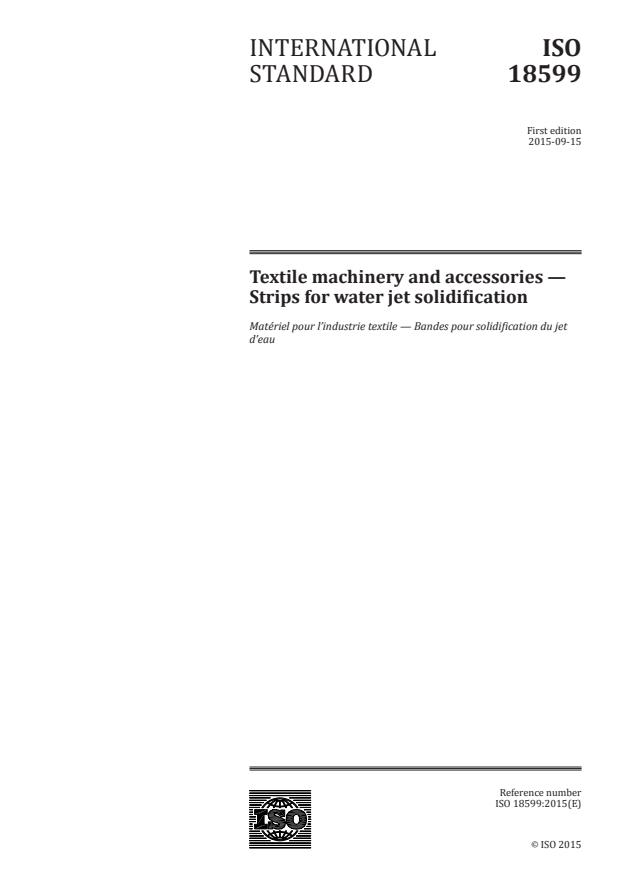
INTERNATIONAL ISO
STANDARD 18599
First edition
2015-09-15
Textile machinery and accessories —
Strips for water jet solidification
Matériel pour l’industrie textile — Bandes pour solidification du jet
d’eau
Reference number
©
ISO 2015
© ISO 2015, Published in Switzerland
All rights reserved. Unless otherwise specified, no part of this publication may be reproduced or utilized otherwise in any form
or by any means, electronic or mechanical, including photocopying, or posting on the internet or an intranet, without prior
written permission. Permission can be requested from either ISO at the address below or ISO’s member body in the country of
the requester.
ISO copyright office
Ch. de Blandonnet 8 • CP 401
CH-1214 Vernier, Geneva, Switzerland
Tel. +41 22 749 01 11
Fax +41 22 749 09 47
copyright@iso.org
www.iso.org
ii © ISO 2015 – All rights reserved
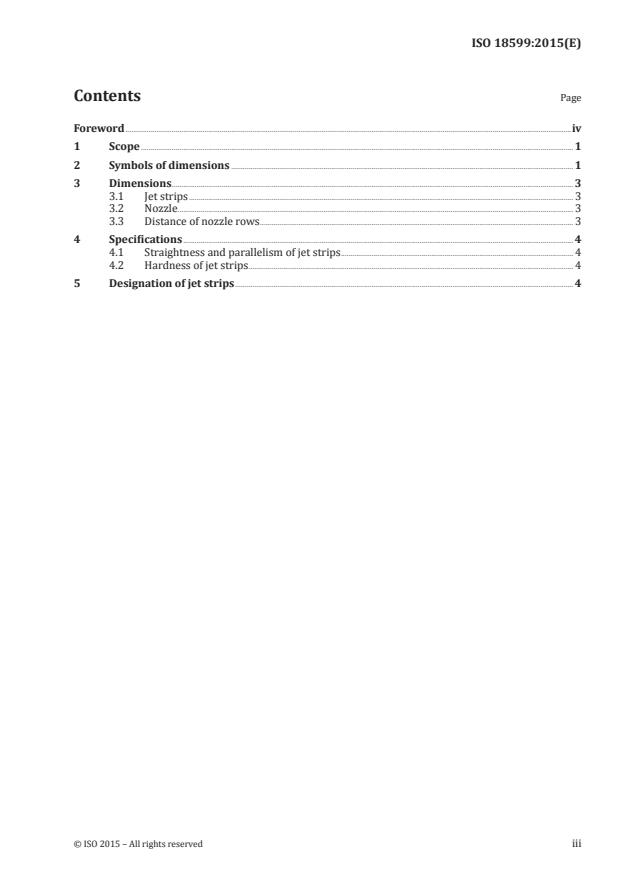
Contents Page
Foreword .iv
1 Scope . 1
2 Symbols of dimensions . 1
3 Dimensions . 3
3.1 Jet strips . 3
3.2 Nozzle. 3
3.3 Distance of nozzle rows . 3
4 Specifications . 4
4.1 Straightness and parallelism of jet strips . 4
4.2 Hardness of jet strips . 4
5 Designation of jet strips . 4
Foreword
ISO (the International Organization for Standardization) is a worldwide federation of national standards
bodies (ISO member bodies). The work of preparing International Standards is normally carried out
through ISO technical committees. Each member body interested in a subject for which a technical
committee has been established has the right to be represented on that committee. International
organizations, governmental and non-governmental, in liaison with ISO, also take part in the work.
ISO collaborates closely with the International Electrotechnical Commission (IEC) on all matters of
electrotechnical standardization.
The procedures used to develop this document and those intended for its further maintenance are
described in the ISO/IEC Directives, Part 1. In particular the different approval criteria needed for the
different types of ISO documents should be noted. This document was drafted in accordance with the
editorial rules of the ISO/IEC Directives, Part 2 (see www.iso.org/directives).
Attention is drawn to the possibility that some of the elements of this document may be the subject of
patent rights. ISO shall not be held responsible for identifying any or all such patent rights. Details
...
Questions, Comments and Discussion
Ask us and Technical Secretary will try to provide an answer. You can facilitate discussion about the standard in here.
Loading comments...