

ISO 8590:1994
(Main)Cinematography — Audio records on 70 mm motion-picture release prints with magnetic stripes — Recorded characteristic
General Information
- Abstract
Specifies the recorded characteristic, i.e. the recorded relative magnetic flux level (in dB) as a function of frequency (in Hz), of audio records on 70 mm motion-picture release prints with magnetic striping when reproduced at the nominal speed of 24 frames per second.
- Status
- Published
- Publication Date
- 13-Jul-1994
- Technical Committee
- ISO/TC 36 - Cinematography
- Drafting Committee
- ISO/TC 36/WG 3 - Audio technology
- Current Stage
- 9093 - International Standard confirmed
- Start Date
- 10-Jul-2023
- Completion Date
- 29-Aug-2026
Overview
ISO 8590:1994 specifies the recorded characteristic for audio on 70 mm motion‑picture release prints that use magnetic stripes. The standard defines the recorded relative magnetic flux level (in dB) as a function of frequency (Hz) for playback at the nominal speed of 24 frames per second, with the reference level set to 0 dB at 1 000 Hz. It provides the characteristic curve, tabulated values and tolerances used to ensure consistent reproduction of multi‑track magnetic audio on 70 mm release prints.
Key topics and technical requirements
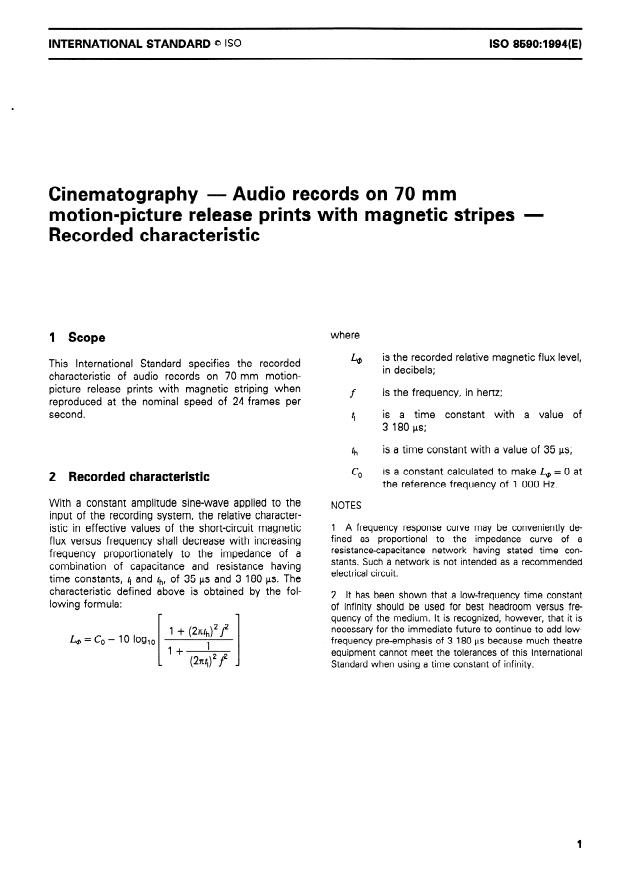
- Recorded characteristic definition: The standard expresses the relative magnetic flux level L* as a function of frequency and includes the mathematical formulation used to derive the characteristic.
- Reference and normalization: Levels are normalized so that Lo = 0 at 1 000 Hz (reference frequency).
- Time‑constant based shaping: The characteristic is obtained using two time constants specified in the document (numeric values shown in the standard) to describe pre‑emphasis/de‑emphasis behavior across frequency.
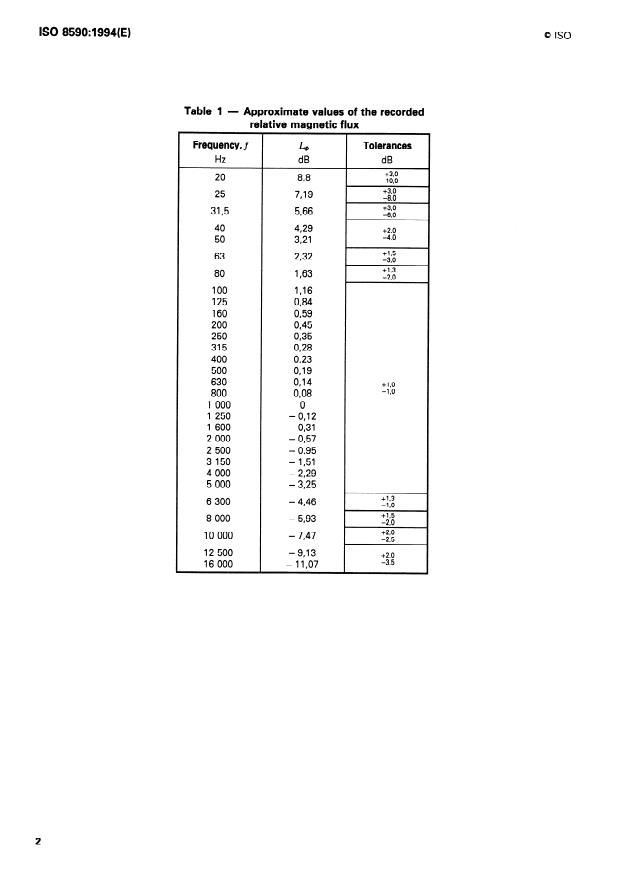
- Frequency vs dB table: Table 1 lists approximate recorded relative magnetic flux values from very low frequencies up to 16 kHz, together with tolerance bands for compliance testing.
- Notes on low‑frequency handling: The standard remarks that an infinite low‑frequency time constant provides better headroom but retains a finite low‑frequency pre‑emphasis value for compatibility with existing theatre equipment.
Applications and who uses it
ISO 8590:1994 is practical for professionals and organizations involved in analogue film sound production, distribution and playback:
- Film sound engineers specifying or evaluating magnetic stripe recordings on 70 mm prints.
- Post‑production facilities preparing release prints or aligning recording equipment to standardized characteristics.
- Film laboratories and duplication houses ensuring print-to-print consistency of magnetic audio levels and frequency response.
- Cinema equipment manufacturers and maintenance technicians calibrating playback heads and equalization to meet expected reproduction curves.
- Archives and restoration specialists checking original 70 mm magnetic tracks against the standard during preservation and transfer.
Related standards and context
- Prepared by ISO/TC 36 (Cinematography); this 1994 second edition supersedes the 1985 edition of the same reference.
- Use alongside other cinematography audio and film handling standards when designing end‑to‑end workflows for 70 mm magnetic audio reproduction.
Keywords: ISO 8590, 70 mm motion‑picture release prints, magnetic stripes, recorded characteristic, magnetic flux level, 24 frames per second, cinematography, audio standard.
Relations
- Effective Date
- 15-Apr-2008
Frequently Asked Questions
ISO 8590:1994 is a standard published by the International Organization for Standardization (ISO). Its full title is "Cinematography — Audio records on 70 mm motion-picture release prints with magnetic stripes — Recorded characteristic". This standard covers: Specifies the recorded characteristic, i.e. the recorded relative magnetic flux level (in dB) as a function of frequency (in Hz), of audio records on 70 mm motion-picture release prints with magnetic striping when reproduced at the nominal speed of 24 frames per second.
Specifies the recorded characteristic, i.e. the recorded relative magnetic flux level (in dB) as a function of frequency (in Hz), of audio records on 70 mm motion-picture release prints with magnetic striping when reproduced at the nominal speed of 24 frames per second.
ISO 8590:1994 is classified under the following ICS (International Classification for Standards) categories: 37.060.20 - Motion picture films. Cartridges. The ICS classification helps identify the subject area and facilitates finding related standards.
ISO 8590:1994 has the following relationships with other standards: It is inter standard links to ISO 8590:1985. Understanding these relationships helps ensure you are using the most current and applicable version of the standard.
ISO 8590:1994 is available in PDF format for immediate download after purchase. The document can be added to your cart and obtained through the secure checkout process. Digital delivery ensures instant access to the complete standard document.
Standards Content (Sample)
INTERNATIONAL
STANDARD
Second edition
1994-08-01
Cinematography - Audio records on
70 mm motion-picture release prints with
magnetic stripes - Recorded
characteristic
- Enregis tremen ts sonores sur copies d ‘exploitation
Cinema tographie
sur film cin6matographique 70 mm 9 pistes magn&iques -
Caractkis tique d ‘enregis tremen t
Reference number
IS0 8590: 1994(E)
IS0 8590: 1994(E)
Foreword
IS0 (the International Organization for Standardization) is a worldwide
federation of national standards bodies (IS0 member bodies). The work
of preparing International Standards is normally carried out through IS0
technical committees. Each member body interested in a subject for
which a technical committee has been established has the right to be
represented on that committee. International organizations, governmental
and non-governmental, in liaison with ISO, also take part in the work. IS0
collaborates closely with the International Electrotechnical Commission
(IEC) on all matters of electrotechnical standardization.
Draft International Standards adopted by the technical committees are
circulated to the member bodies for voting. Publication as an International
Standard requires approval by at least 75 % of the member bodies casting
a vote.
International Standard IS0 8590 was prepared by Technical Committee
lSO/TC 36, Cinematography.
This second edition cancels and replaces the first edition
(IS0 8590:1985), of which it constitutes a technical revision.
63 IS0 1994
All rights reserved. Unless otherwise specified, no part of this publication may be reproduced
or utilized in any form or by any means, electronic or mechanical, including photocopying and
microfilm, without permission in writing from the publisher.
International
Organization for Standardization
Case Postale
56 l CH-121 1 Genbve 20 l Switze rland
Printed in Switzerland
ii
INTERNATIONAL STANDARD * ISO
IS0 8590: 1994(E)
Cinematography - Audio records on 70 mm
motion-picture release prints with magnetic stripes -
Recorded characteristic
where
1 Scope
is the recorded relative magnetic flux level,
This International Standard specifies the recorded
in decibels;
characteristic of audio records on 70 mm motion-
picture release prints with magnetic striping when
is the frequency, in hertz;
f
reproduced at the nominal speed of 24 frames per
second.
is a time constant with a value of
3 180 1s;
is a time constant with a value of 35 ps;
th
is a constant calculated to make Lo = 0 at
CO
2 Recorded characterist
...