

ISO 2143:2017
(Main)Anodizing of aluminium and its alloys — Estimation of loss of absorptive power of anodic oxidation coatings after sealing — Dye-spot test with prior acid treatment
General Information
- Abstract
ISO 2143 specifies a method of estimating the loss of absorptive power of anodic oxidation coatings that have undergone a sealing treatment, by dye absorption after acid pretreatment. The method is suitable for use as a production control method and can be applicable to anodic oxidation coatings which may be subjected to weathering or aggressive environments, or where resistance to staining is important. The method is not applicable to those coatings that a) are formed on alloys containing more than 2 % copper or 4 % silicon, b) are sealed by the dichromate process, c) have been given supplementary processing, e.g. oiling, waxing or lacquering, d) are coloured in deep shades, and e) are less than 3 μm thickness. The method is less appropriate where nickel or cobalt salts, or organic additives, have been added to baths used for hydrothermal sealing.
- Status
- Published
- Publication Date
- 09-Oct-2017
- Technical Committee
- ISO/TC 79/SC 2 - Organic and anodic oxidation coatings on aluminium
- Drafting Committee
- ISO/TC 79/SC 2/WG 15 - Anodic oxidation coatings on aluminium
- Current Stage
- 9093 - International Standard confirmed
- Start Date
- 02-Nov-2023
- Completion Date
- 29-Aug-2026
Buy Documents
ISO 2143:2017 - Anodizing of aluminium and its alloys -- Estimation of loss of absorptive power of anodic oxidation coatings after sealing -- Dye-spot test with prior acid treatment
ISO 2143:2017 - Anodizing of aluminium and its alloys — Estimation of loss of absorptive power of anodic oxidation coatings after sealing — Dye-spot test with prior acid treatment/10/2017
ISO 2143:2017 - Anodisation de l'aluminium et de ses alliages -- Appréciation de la perte du pouvoir absorbant des couches anodiques apres colmatage -- Essai a la goutte de colorant apres traitement acide
ISO 2143:2017 - Anodisation de l'aluminium et de ses alliages — Appréciation de la perte du pouvoir absorbant des couches anodiques après colmatage — Essai à la goutte de colorant après traitement acide/10/2017
Overview
ISO 2143:2017 specifies a standardized dye‑spot test with prior acid treatment to estimate the loss of absorptive power of anodic oxidation (anodizing) coatings on aluminium and its alloys after sealing. The method is intended primarily as a production control and quality‑assessment tool for sealed anodic coatings where resistance to staining, weathering or aggressive environments is important.
Key topics and technical requirements
- Scope and exclusions: Applicable to anodic oxidation coatings except those that
- are on alloys with >2% copper or >4% silicon,
- are sealed by the dichromate process,
- have supplementary treatments (oiling, waxing, lacquering),
- are deeply coloured, or
- are < 3 μm thick. The method is less appropriate when nickel or cobalt salts or organic additives are used in hydrothermal sealing baths.
- Principle: Degreased coated surface is acid‑pretreated, then exposed to a dyestuff; the degree of dye absorption indicates sealing quality and loss of absorptive power.
- Reagents: Two acid options (contain fluoride - hydrofluoric‑acid hazard) and two dye solutions are specified. Examples of dyes: Sanodye Blue 2LW and Sanodal Red B3LW (commercial examples only).
- Procedure (summary):
- Degrease the test area.
- Apply one drop of acid (1 min), rinse and dry.
- Apply one drop of dye (1 min), wash, rub with light abrasive, rinse and dry.
- Optionally perform by immersion for curved or hard‑to‑wet surfaces.
- Evaluation: Staining intensity is assessed against Annex A (scale 0–5) or measured by colorimeter (colour difference). Test report shall reference ISO 2143:2017 and record test conditions, reagents, method (drop or immersion) and results.
Practical applications and users
- Used for production control and routine quality assurance in anodizing plants and finishing lines.
- Useful where resistance to staining, weathering or aggressive environments is a product requirement (architectural façades, transport components, consumer goods, industrial hardware).
- Typical users: quality/control engineers, plating/coatings laboratories, specification writers, and inspection bodies verifying sealing performance of anodic coatings.
Related standards
- ISO 2931 - Assessment of sealed anodic oxidation coatings by admittance measurement.
- ISO 3210 - Assessment of sealed coatings by loss of mass after acid immersion. These complementary tests can be used alongside ISO 2143 for a fuller assessment of sealing quality.
Keywords: ISO 2143:2017, anodizing, anodic oxidation coatings, dye‑spot test, sealing, absorptive power, aluminium, production control, quality control.
Relations
- Effective Date
- 25-Aug-2026
- Effective Date
- 25-Aug-2026
- Effective Date
- 13-Feb-2026
- Effective Date
- 12-Feb-2026
- Effective Date
- 14-Nov-2015
Buy Documents
ISO 2143:2017 - Anodizing of aluminium and its alloys -- Estimation of loss of absorptive power of anodic oxidation coatings after sealing -- Dye-spot test with prior acid treatment
ISO 2143:2017 - Anodizing of aluminium and its alloys — Estimation of loss of absorptive power of anodic oxidation coatings after sealing — Dye-spot test with prior acid treatment/10/2017
ISO 2143:2017 - Anodisation de l'aluminium et de ses alliages -- Appréciation de la perte du pouvoir absorbant des couches anodiques apres colmatage -- Essai a la goutte de colorant apres traitement acide
ISO 2143:2017 - Anodisation de l'aluminium et de ses alliages — Appréciation de la perte du pouvoir absorbant des couches anodiques après colmatage — Essai à la goutte de colorant après traitement acide/10/2017
Get Certified
Connect with accredited certification bodies for this standard

DVS-ZERT GmbH
German welding certification society.
CARES (UK Certification Authority for Reinforcing Steels)
UK certification for reinforcing steels and construction.
EWF/IIW (European/International Welding Federation)
International welding personnel certification.
Sponsored listings
Frequently Asked Questions
ISO 2143:2017 is a standard published by the International Organization for Standardization (ISO). Its full title is "Anodizing of aluminium and its alloys — Estimation of loss of absorptive power of anodic oxidation coatings after sealing — Dye-spot test with prior acid treatment". This standard covers: ISO 2143 specifies a method of estimating the loss of absorptive power of anodic oxidation coatings that have undergone a sealing treatment, by dye absorption after acid pretreatment. The method is suitable for use as a production control method and can be applicable to anodic oxidation coatings which may be subjected to weathering or aggressive environments, or where resistance to staining is important. The method is not applicable to those coatings that a) are formed on alloys containing more than 2 % copper or 4 % silicon, b) are sealed by the dichromate process, c) have been given supplementary processing, e.g. oiling, waxing or lacquering, d) are coloured in deep shades, and e) are less than 3 μm thickness. The method is less appropriate where nickel or cobalt salts, or organic additives, have been added to baths used for hydrothermal sealing.
ISO 2143 specifies a method of estimating the loss of absorptive power of anodic oxidation coatings that have undergone a sealing treatment, by dye absorption after acid pretreatment. The method is suitable for use as a production control method and can be applicable to anodic oxidation coatings which may be subjected to weathering or aggressive environments, or where resistance to staining is important. The method is not applicable to those coatings that a) are formed on alloys containing more than 2 % copper or 4 % silicon, b) are sealed by the dichromate process, c) have been given supplementary processing, e.g. oiling, waxing or lacquering, d) are coloured in deep shades, and e) are less than 3 μm thickness. The method is less appropriate where nickel or cobalt salts, or organic additives, have been added to baths used for hydrothermal sealing.
ISO 2143:2017 is classified under the following ICS (International Classification for Standards) categories: 25.220.20 - Surface treatment. The ICS classification helps identify the subject area and facilitates finding related standards.
ISO 2143:2017 has the following relationships with other standards: It is inter standard links to EN ISO 18771:2020, EN ISO 7599:2018, EN 12206-1:2021, EN ISO 2143:2017, ISO 2143:2010. Understanding these relationships helps ensure you are using the most current and applicable version of the standard.
ISO 2143:2017 is available in PDF format for immediate download after purchase. The document can be added to your cart and obtained through the secure checkout process. Digital delivery ensures instant access to the complete standard document.
Standards Content (Sample)
INTERNATIONAL ISO
STANDARD 2143
Third edition
2017-10
Anodizing of aluminium and its
alloys — Estimation of loss of
absorptive power of anodic oxidation
coatings after sealing — Dye-spot test
with prior acid treatment
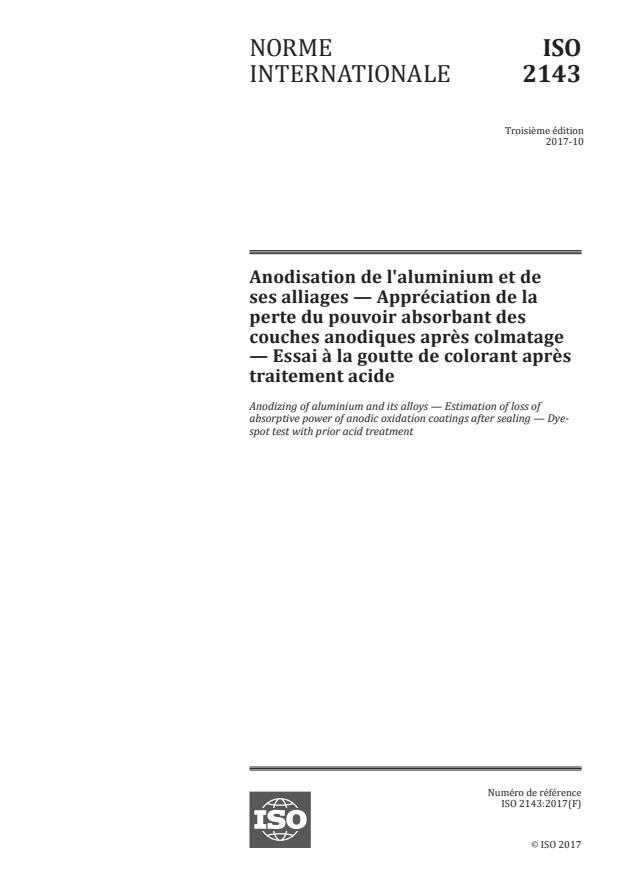
Anodisation de l'aluminium et de ses alliages — Appréciation de la
perte du pouvoir absorbant des couches anodiques après colmatage
— Essai à la goutte de colorant après traitement acide
Reference number
©
ISO 2017
© ISO 2017, Published in Switzerland
All rights reserved. Unless otherwise specified, no part of this publication may be reproduced or utilized otherwise in any form
or by any means, electronic or mechanical, including photocopying, or posting on the internet or an intranet, without prior
written permission. Permission can be requested from either ISO at the address below or ISO’s member body in the country of
the requester.
ISO copyright office
Ch. de Blandonnet 8 • CP 401
CH-1214 Vernier, Geneva, Switzerland
Tel. +41 22 749 01 11
Fax +41 22 749 09 47
copyright@iso.org
www.iso.org
ii © ISO 2017 – All rights reserved
Contents Page
Foreword .iv
Introduction .v
1 Scope . 1
2 Normative references . 1
3 Terms and definitions . 1
4 Principle . 1
5 Reagents . 2
6 Test specimens. 2
7 Procedure. 3
8 Expression of results . 3
9 Test report . 3
Annex A (normative) Interpretation of the results of the dye-spot test . 5
Bibliography . 6
Foreword
ISO (the International Organization for Standardization) is a worldwide federation of national standards
bodies (ISO member bodies). The work of preparing International Standards is normally carried out
through ISO technical committees. Each member body interested in a subject for which a technical
committee has been established has the right to be represented on that committee. International
organizations, governmental and non-governmental, in liaison with ISO, also take part in the work.
ISO collaborates closely with the International Electrotechnical Commission (IEC) on all matters of
electrotechnical standardization.
The procedures used to develop this document and those intended for its further maintenance are
described in the ISO/IEC Directives, Part 1. In particular the different approval criteria needed for the
different types of ISO documents should be noted. This document was drafted in accordance with the
editorial rules of the ISO/IEC Directives, Part 2 (see www.iso.org/directives).
Attention is drawn to the possibility that some of the elements of this document may be the subject of
patent rights. ISO shall not be held responsible for identifying any or all such patent rights. Details of
any patent rights identified during the development of the document will be in the Introduction and/or
on the ISO list of patent declarations received (see www.iso.org/patents).
Any trade name used in this document is information given for the convenience of users and does not
constitute an endorsement.
For an explanation on the voluntary nature of standards, the meaning of ISO specific terms and
expressions related to conformity assessment, as well as information about ISO's adherence to the
World Trade Organization (WTO) principles in the Technical Barriers to Trade (TBT) see the following
URL: www.iso.org/iso/foreword.html.
This document was prepared by Technical Committee ISO/TC 79, Light metals and their alloys,
Subcommittee SC 2, Organic and anodic oxidation coatings on aluminium.
This third edition cancels and replaces the second edition (ISO 2143:2010), which has been technically
revised.
The main changes compared to the previous edition are as follows:
— information on the test specimen has been added;
— the immersion method has been added.
iv © ISO 2017 – All rights reserved
Introduction
The resistance of anodic oxidation coatings to the absorption of dyes gives information on the quality of
sealing, the total resistance indicating whether the quality of sealing is good.
The correlation of the results obtained with those of other tests that can assess sealing quality, such
as that of ISO 2931, can be affected by the presence of certain agents having been added to the sealing
bath. For this reason, the quality is checked from time to time by one of the reference acid-dissolution
methods specified in ISO 3210.
INTERNATIONAL STANDARD ISO 2143:2017(E)
Anodizing of aluminium and its alloys — Estimation of
loss of absorptive power of anodic oxidation coatings after
sealing — Dye-spot test with prior acid treatment
IMPORTANT — The electronic file of this document contains colours which are considered to be
useful for the correct understanding of the document. Users should therefore consider printing
this document using a colour printer.
1 Scope
This document specifies a method of estimating the loss of absorptive power of anodic oxidation
coatings that have undergone a sealing treatment, by dye absorption after acid pretreatment.
The method is suitable for use as a production control method and can be applicable t
...
INTERNATIONAL ISO
STANDARD 2143
Third edition
2017-10
Anodizing of aluminium and its
alloys — Estimation of loss of
absorptive power of anodic oxidation
coatings after sealing — Dye-spot test
with prior acid treatment
Anodisation de l'aluminium et de ses alliages — Appréciation de la
perte du pouvoir absorbant des couches anodiques après colmatage
— Essai à la goutte de colorant après traitement acide
Reference number
©
ISO 2017
© ISO 2017, Published in Switzerland
All rights reserved. Unless otherwise specified, no part of this publication may be reproduced or utilized otherwise in any form
or by any means, electronic or mechanical, including photocopying, or posting on the internet or an intranet, without prior
written permission. Permission can be requested from either ISO at the address below or ISO’s member body in the country of
the requester.
ISO copyright office
Ch. de Blandonnet 8 • CP 401
CH-1214 Vernier, Geneva, Switzerland
Tel. +41 22 749 01 11
Fax +41 22 749 09 47
copyright@iso.org
www.iso.org
ii © ISO 2017 – All rights reserved
Contents Page
Foreword .iv
Introduction .v
1 Scope . 1
2 Normative references . 1
3 Terms and definitions . 1
4 Principle . 1
5 Reagents . 2
6 Test specimens. 2
7 Procedure. 3
8 Expression of results . 3
9 Test report . 3
Annex A (normative) Interpretation of the results of the dye-spot test . 5
Bibliography . 6
Foreword
ISO (the International Organization for Standardization) is a worldwide federation of national standards
bodies (ISO member bodies). The work of preparing International Standards is normally carried out
through ISO technical committees. Each member body interested in a subject for which a technical
committee has been established has the right to be represented on that committee. International
organizations, governmental and non-governmental, in liaison with ISO, also take part in the work.
ISO collaborates closely with the International Electrotechnical Commission (IEC) on all matters of
electrotechnical standardization.
The procedures used to develop this document and those intended for its further maintenance are
described in the ISO/IEC Directives, Part 1. In particular the different approval criteria needed for the
different types of ISO documents should be noted. This document was drafted in accordance with the
editorial rules of the ISO/IEC Directives, Part 2 (see www.iso.org/directives).
Attention is drawn to the possibility that some of the elements of this document may be the subject of
patent rights. ISO shall not be held responsible for identifying any or all such patent rights. Details of
any patent rights identified during the development of the document will be in the Introduction and/or
on the ISO list of patent declarations received (see www.iso.org/patents).
Any trade name used in this document is information given for the convenience of users and does not
constitute an endorsement.
For an explanation on the voluntary nature of standards, the meaning of ISO specific terms and
expressions related to conformity assessment, as well as information about ISO's adherence to the
World Trade Organization (WTO) principles in the Technical Barriers to Trade (TBT) see the following
URL: www.iso.org/iso/foreword.html.
This document was prepared by Technical Committee ISO/TC 79, Light metals and their alloys,
Subcommittee SC 2, Organic and anodic oxidation coatings on aluminium.
This third edition cancels and replaces the second edition (ISO 2143:2010), which has been technically
revised.
The main changes compared to the previous edition are as follows:
— information on the test specimen has been added;
— the immersion method has been added.
iv © ISO 2017 – All rights reserved
Introduction
The resistance of anodic oxidation coatings to the absorption of dyes gives information on the quality of
sealing, the total resistance indicating whether the quality of sealing is good.
The correlation of the results obtained with those of other tests that can assess sealing quality, such
as that of ISO 2931, can be affected by the presence of certain agents having been added to the sealing
bath. For this reason, the quality is checked from time to time by one of the reference acid-dissolution
methods specified in ISO 3210.
INTERNATIONAL STANDARD ISO 2143:2017(E)
Anodizing of aluminium and its alloys — Estimation of
loss of absorptive power of anodic oxidation coatings after
sealing — Dye-spot test with prior acid treatment
IMPORTANT — The electronic file of this document contains colours which are considered to be
useful for the correct understanding of the document. Users should therefore consider printing
this document using a colour printer.
1 Scope
This document specifies a method of estimating the loss of absorptive power of anodic oxidation
coatings that have undergone a sealing treatment, by dye absorption after acid pretreatment.
The method is suitable for use as a production control method and can be applicable t
...
NORME ISO
INTERNATIONALE 2143
Troisième édition
2017-10
Anodisation de l'aluminium et de
ses alliages — Appréciation de la
perte du pouvoir absorbant des
couches anodiques après colmatage
— Essai à la goutte de colorant après
traitement acide
Anodizing of aluminium and its alloys — Estimation of loss of
absorptive power of anodic oxidation coatings after sealing — Dye-
spot test with prior acid treatment
Numéro de référence
©
ISO 2017
DOCUMENT PROTÉGÉ PAR COPYRIGHT
© ISO 2017, Publié en Suisse
Droits de reproduction réservés. Sauf indication contraire, aucune partie de cette publication ne peut être reproduite ni utilisée
sous quelque forme que ce soit et par aucun procédé, électronique ou mécanique, y compris la photocopie, l’affichage sur
l’internet ou sur un Intranet, sans autorisation écrite préalable. Les demandes d’autorisation peuvent être adressées à l’ISO à
l’adresse ci-après ou au comité membre de l’ISO dans le pays du demandeur.
ISO copyright office
Ch. de Blandonnet 8 • CP 401
CH-1214 Vernier, Geneva, Switzerland
Tel. +41 22 749 01 11
Fax +41 22 749 09 47
copyright@iso.org
www.iso.org
ii © ISO 2017 – Tous droits réservés
Sommaire Page
Avant-propos .iv
Introduction .v
1 Domaine d'application . 1
2 Références normatives . 1
3 Termes et définitions . 1
4 Principe . 2
5 Réactifs . 2
6 Éprouvettes . 2
7 Mode opératoire. 3
8 Expression des résultats. 3
9 Rapport d'essai . 3
Annexe A (normative) Interprétation des résultats de l'essai à la goutte de colorant .5
Bibliographie . 6
Avant-propos
L'ISO (Organisation internationale de normalisation) est une fédération mondiale d'organismes
nationaux de normalisation (comités membres de l'ISO). L'élaboration des Normes internationales est
en général confiée aux comités techniques de l'ISO. Chaque comité membre intéressé par une étude
a le droit de faire partie du comité technique créé à cet effet. Les organisations internationales,
gouvernementales et non gouvernementales, en liaison avec l'ISO participent également aux travaux.
L'ISO collabore étroitement avec la Commission électrotechnique internationale (IEC) en ce qui
concerne la normalisation électrotechnique.
Les procédures utilisées pour élaborer le présent document et celles destinées à sa mise à jour sont
décrites dans les Directives ISO/IEC, Partie 1. Il convient, en particulier, de prendre note des différents
critères d'approbation requis pour les différents types de documents ISO. Le présent document a été
rédigé conformément aux règles de rédaction données dans les Directives ISO/IEC, Partie 2 (voir www.
iso.org/directives).
L'attention est attirée sur le fait que certains des éléments du présent document peuvent faire l'objet de
droits de propriété intellectuelle ou de droits analogues. L'ISO ne saurait être tenue pour responsable
de ne pas avoir identifié de tels droits de propriété et averti de leur existence. Les détails concernant
les références aux droits de propriété intellectuelle ou autres droits analogues identifiés lors de
l'élaboration du document sont indiqués dans l'Introduction et/ou dans la liste des déclarations de
brevets reçues par l'ISO (voir www.iso.org/brevets).
Les appellations commerciales éventuellement mentionnées dans le présent document sont données
pour information, par souci de commodité, à l'intention des utilisateurs et ne sauraient constituer un
engagement.
Pour une explication de la nature volontaire des normes, la signification des termes et expressions
spécifiques de l'ISO liés à l'évaluation de la conformité, ou pour toute information au sujet de l'adhésion
de l'ISO aux principes de l’Organisation mondiale du commerce (OMC) concernant les obstacles
techniques au commerce (OTC), voir le lien suivant: www.iso.org/iso/fr/avant-propos.html.
Ce document a été élaboré par le comité technique ISO/TC 79, Métaux légers et leurs alliages,
sous-comité SC 2, Couches organiques et couches d'oxydation anodique sur l'aluminium.
Cette troisième édition annule et remplace la deuxième édition (ISO 2143:2010), qui a fait l’objet d’une
révision technique.
Les principales modifications par rapport à l’édition précédente sont les suivantes:
— ajout d'informations concernant les éprouvettes;
— ajout de la méthode d'immersion.
iv © ISO 2017 – Tous droits réservés
Introduction
La résistance des couches anodiques à l'absorption des colorants est révélatrice de la qualité du
colmatage, la résistance totale indiquant si le colmatage est de bonne qualité.
La présence d'additifs de colmatage peut influer sur la corrélation entre les résultats de cet essai et
ceux obtenus au moyen d'autres essais permettant d'évaluer la qualité du colmatage, par exemple l'essai
décrit dans l'ISO 2931. Par conséquent, la qualité est vérifiée de temps en temps, suivant l'une des
méthodes de référence par attaque à l'acide spécifiées dans l'ISO 3210.
NORME INTERNATIONALE ISO 2143:2017(F)
Anodisation de l'aluminium et de ses alliages —
Appréciation de la perte du pouvoir absorbant des couches
anodiques après colmatage — Essai à la goutte de colorant
après traitement acide
IMPORTANT — Le fichier électronique du présent document contient des couleurs qui sont
jugées utiles pour la bonne compréhension du document. Par conséquent, il est recommandé
aux utilisateurs du présent document de l'imprimer à l'aide d'une imprimante couleurs.
1 Domaine d'application
Le présent document spécifie une méthode permettant d'apprécier la perte de pouvoir absorbant des
couches anodiques ayant subi un traitement de colmatage, par un essai de coloration à la suite d'un
prétraitement à l'acide.
Cette méthode convient au contrôle de production et peut être appliquée aux couches anodiques
susceptibles d'être soumises aux intempéries ou à des milieux agressifs, ou lorsque la résistance aux
taches est importante.
La méthode n'est pas applicable aux couches qui:
a) se forment sur les al
...
NORME ISO
INTERNATIONALE 2143
Troisième édition
2017-10
Anodisation de l'aluminium et de
ses alliages — Appréciation de la
perte du pouvoir absorbant des
couches anodiques après colmatage
— Essai à la goutte de colorant après
traitement acide
Anodizing of aluminium and its alloys — Estimation of loss of
absorptive power of anodic oxidation coatings after sealing — Dye-
spot test with prior acid treatment
Numéro de référence
©
ISO 2017
DOCUMENT PROTÉGÉ PAR COPYRIGHT
© ISO 2017, Publié en Suisse
Droits de reproduction réservés. Sauf indication contraire, aucune partie de cette publication ne peut être reproduite ni utilisée
sous quelque forme que ce soit et par aucun procédé, électronique ou mécanique, y compris la photocopie, l’affichage sur
l’internet ou sur un Intranet, sans autorisation écrite préalable. Les demandes d’autorisation peuvent être adressées à l’ISO à
l’adresse ci-après ou au comité membre de l’ISO dans le pays du demandeur.
ISO copyright office
Ch. de Blandonnet 8 • CP 401
CH-1214 Vernier, Geneva, Switzerland
Tel. +41 22 749 01 11
Fax +41 22 749 09 47
copyright@iso.org
www.iso.org
ii © ISO 2017 – Tous droits réservés
Sommaire Page
Avant-propos .iv
Introduction .v
1 Domaine d'application . 1
2 Références normatives . 1
3 Termes et définitions . 1
4 Principe . 2
5 Réactifs . 2
6 Éprouvettes . 2
7 Mode opératoire. 3
8 Expression des résultats. 3
9 Rapport d'essai . 3
Annexe A (normative) Interprétation des résultats de l'essai à la goutte de colorant .5
Bibliographie . 6
Avant-propos
L'ISO (Organisation internationale de normalisation) est une fédération mondiale d'organismes
nationaux de normalisation (comités membres de l'ISO). L'élaboration des Normes internationales est
en général confiée aux comités techniques de l'ISO. Chaque comité membre intéressé par une étude
a le droit de faire partie du comité technique créé à cet effet. Les organisations internationales,
gouvernementales et non gouvernementales, en liaison avec l'ISO participent également aux travaux.
L'ISO collabore étroitement avec la Commission électrotechnique internationale (IEC) en ce qui
concerne la normalisation électrotechnique.
Les procédures utilisées pour élaborer le présent document et celles destinées à sa mise à jour sont
décrites dans les Directives ISO/IEC, Partie 1. Il convient, en particulier, de prendre note des différents
critères d'approbation requis pour les différents types de documents ISO. Le présent document a été
rédigé conformément aux règles de rédaction données dans les Directives ISO/IEC, Partie 2 (voir www.
iso.org/directives).
L'attention est attirée sur le fait que certains des éléments du présent document peuvent faire l'objet de
droits de propriété intellectuelle ou de droits analogues. L'ISO ne saurait être tenue pour responsable
de ne pas avoir identifié de tels droits de propriété et averti de leur existence. Les détails concernant
les références aux droits de propriété intellectuelle ou autres droits analogues identifiés lors de
l'élaboration du document sont indiqués dans l'Introduction et/ou dans la liste des déclarations de
brevets reçues par l'ISO (voir www.iso.org/brevets).
Les appellations commerciales éventuellement mentionnées dans le présent document sont données
pour information, par souci de commodité, à l'intention des utilisateurs et ne sauraient constituer un
engagement.
Pour une explication de la nature volontaire des normes, la signification des termes et expressions
spécifiques de l'ISO liés à l'évaluation de la conformité, ou pour toute information au sujet de l'adhésion
de l'ISO aux principes de l’Organisation mondiale du commerce (OMC) concernant les obstacles
techniques au commerce (OTC), voir le lien suivant: www.iso.org/iso/fr/avant-propos.html.
Ce document a été élaboré par le comité technique ISO/TC 79, Métaux légers et leurs alliages,
sous-comité SC 2, Couches organiques et couches d'oxydation anodique sur l'aluminium.
Cette troisième édition annule et remplace la deuxième édition (ISO 2143:2010), qui a fait l’objet d’une
révision technique.
Les principales modifications par rapport à l’édition précédente sont les suivantes:
— ajout d'informations concernant les éprouvettes;
— ajout de la méthode d'immersion.
iv © ISO 2017 – Tous droits réservés
Introduction
La résistance des couches anodiques à l'absorption des colorants est révélatrice de la qualité du
colmatage, la résistance totale indiquant si le colmatage est de bonne qualité.
La présence d'additifs de colmatage peut influer sur la corrélation entre les résultats de cet essai et
ceux obtenus au moyen d'autres essais permettant d'évaluer la qualité du colmatage, par exemple l'essai
décrit dans l'ISO 2931. Par conséquent, la qualité est vérifiée de temps en temps, suivant l'une des
méthodes de référence par attaque à l'acide spécifiées dans l'ISO 3210.
NORME INTERNATIONALE ISO 2143:2017(F)
Anodisation de l'aluminium et de ses alliages —
Appréciation de la perte du pouvoir absorbant des couches
anodiques après colmatage — Essai à la goutte de colorant
après traitement acide
IMPORTANT — Le fichier électronique du présent document contient des couleurs qui sont
jugées utiles pour la bonne compréhension du document. Par conséquent, il est recommandé
aux utilisateurs du présent document de l'imprimer à l'aide d'une imprimante couleurs.
1 Domaine d'application
Le présent document spécifie une méthode permettant d'apprécier la perte de pouvoir absorbant des
couches anodiques ayant subi un traitement de colmatage, par un essai de coloration à la suite d'un
prétraitement à l'acide.
Cette méthode convient au contrôle de production et peut être appliquée aux couches anodiques
susceptibles d'être soumises aux intempéries ou à des milieux agressifs, ou lorsque la résistance aux
taches est importante.
La méthode n'est pas applicable aux couches qui:
a) se forment sur les al
...