

ISO 17785-1:2016
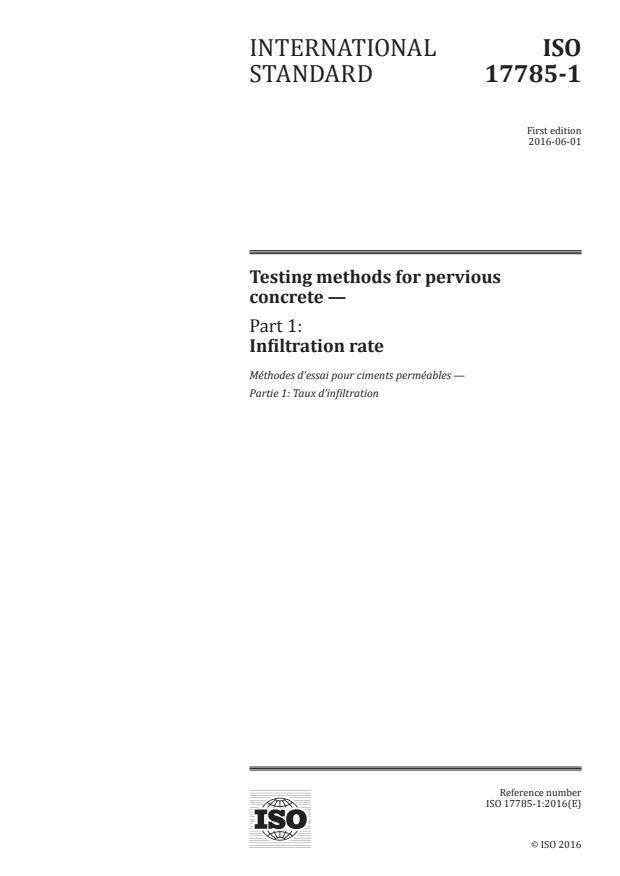
(Main)Testing methods for pervious concrete — Part 1: Infiltration rate
General Information
- Abstract
ISO 17785-1:2016 specifies the procedure for testing the infiltration rate of hardened pervious concrete pavement specimens in the laboratory. It is not a method for measuring the permeability of pervious concrete. The specimens can either be prepared in the laboratory or cored from field placements, but not representing field conditions. This part of ISO 17785 also specifies procedures to make and cure hardened pervious concrete samples in the laboratory.
- Status
- Published
- Publication Date
- 26-May-2016
- Technical Committee
- ISO/TC 71/SC 1 - Test methods for concrete
- Drafting Committee
- ISO/TC 71/SC 1 - Test methods for concrete
- Current Stage
- 9093 - International Standard confirmed
- Start Date
- 18-Nov-2021
- Completion Date
- 29-Aug-2026
Overview
ISO 17785-1:2016 defines a laboratory test method to determine the infiltration rate of hardened pervious concrete specimens. It specifies specimen preparation, curing, apparatus, pre-wetting and timing procedures, and the calculation required to report infiltration rate (k). This part applies to cylindrical specimens prepared in the laboratory or cored from field placements (minimum 100 mm diameter and 100 mm height) and explicitly states it is not a method for measuring permeability of in-place pavements.
Key topics and requirements
- Scope and purpose: Laboratory procedure for measuring infiltration rate of pervious concrete specimens (ISO 17785-1:2016).
- Specimen size: Minimum diameter 100 mm and height 100 mm; cores from field must meet these minima.
- Sampling: Minimum of three similar specimens per test series.
- Specimen preparation:
- Two filling options: single-layer pour (typical vertical porosity) or multi-layer pour (more uniform vertical porosity).
- Immediate covering after consolidation; mould removal after a minimum curing period of seven days.
- Cores: cut full depth of pervious slab when using field specimens.
- Apparatus:
- Cylindrical mould (100 mm), balance (±5 g), coring machine, shrink wrap (three layers), heat gun, funnel (200 ml capacity), water container (~2 000 ml), stopwatch (0.1 s), potable water.
- Pre‑wetting and test procedure:
- Specimens are pre-wetted to represent antecedent precipitation; water head maintained between marks at 15 mm and 25 mm from specimen top.
- For 100 mm specimens the standard indicates 1 000 ml for pre-wetting and 2 000 ml for the timed infiltration test.
- Start timing when test water first contacts the specimen surface; stop when no free surface water remains. Start test within 5 minutes after pre-wetting.
- Calculation:
- Infiltration rate k is calculated as k = W / (A · t), using the measured volume of infiltrated water (W), specimen cross-sectional area (A) and time (t). Report k in mm/s.
- Reporting: Include sample ID, specimen origin (lab-made or field core), preparation and curing details, specimen dimensions and density, age at test, water volume, time and calculated infiltration rate.
Applications and users
ISO 17785-1:2016 is useful for:
- Laboratory testing by materials and pavement testing laboratories
- Civil and pavement engineers evaluating pervious concrete mixes
- Contractors and QA/QC teams verifying mix performance during research, mix development, or acceptance testing
- Academics and researchers studying infiltration performance of pervious concrete
Keywords: pervious concrete, infiltration rate, ISO 17785-1:2016, laboratory testing, specimen preparation, pre-wet, shrink wrap, funnel, coring.
Related standards
- ASTM C1701/C1701M - Standard Test Method for Infiltration Rate of In-Place Pervious Concrete (referenced in the ISO document).
Relations
- Effective Date
- 06-Jun-2022
Get Certified
Connect with accredited certification bodies for this standard

DIBt (Deutsches Institut für Bautechnik)
German Institute for Building Technology.
DIN CERTCO
DIN Group product certification.

Aboma Certification B.V.
Specialized in construction, metal, and transport sectors.
Sponsored listings
Frequently Asked Questions
ISO 17785-1:2016 is a standard published by the International Organization for Standardization (ISO). Its full title is "Testing methods for pervious concrete — Part 1: Infiltration rate". This standard covers: ISO 17785-1:2016 specifies the procedure for testing the infiltration rate of hardened pervious concrete pavement specimens in the laboratory. It is not a method for measuring the permeability of pervious concrete. The specimens can either be prepared in the laboratory or cored from field placements, but not representing field conditions. This part of ISO 17785 also specifies procedures to make and cure hardened pervious concrete samples in the laboratory.
ISO 17785-1:2016 specifies the procedure for testing the infiltration rate of hardened pervious concrete pavement specimens in the laboratory. It is not a method for measuring the permeability of pervious concrete. The specimens can either be prepared in the laboratory or cored from field placements, but not representing field conditions. This part of ISO 17785 also specifies procedures to make and cure hardened pervious concrete samples in the laboratory.
ISO 17785-1:2016 is classified under the following ICS (International Classification for Standards) categories: 91.100.30 - Concrete and concrete products. The ICS classification helps identify the subject area and facilitates finding related standards.
ISO 17785-1:2016 has the following relationships with other standards: It is inter standard links to ISO 19225:2017. Understanding these relationships helps ensure you are using the most current and applicable version of the standard.
ISO 17785-1:2016 is available in PDF format for immediate download after purchase. The document can be added to your cart and obtained through the secure checkout process. Digital delivery ensures instant access to the complete standard document.
Standards Content (Sample)
INTERNATIONAL ISO
STANDARD 17785-1
First edition
2016-06-01
Testing methods for pervious
concrete —
Part 1:
Infiltration rate
Méthodes d’essai pour ciments perméables —
Partie 1: Taux d’infiltration
Reference number
©
ISO 2016
© ISO 2016, Published in Switzerland
All rights reserved. Unless otherwise specified, no part of this publication may be reproduced or utilized otherwise in any form
or by any means, electronic or mechanical, including photocopying, or posting on the internet or an intranet, without prior
written permission. Permission can be requested from either ISO at the address below or ISO’s member body in the country of
the requester.
ISO copyright office
Ch. de Blandonnet 8 • CP 401
CH-1214 Vernier, Geneva, Switzerland
Tel. +41 22 749 01 11
Fax +41 22 749 09 47
copyright@iso.org
www.iso.org
ii © ISO 2016 – All rights reserved
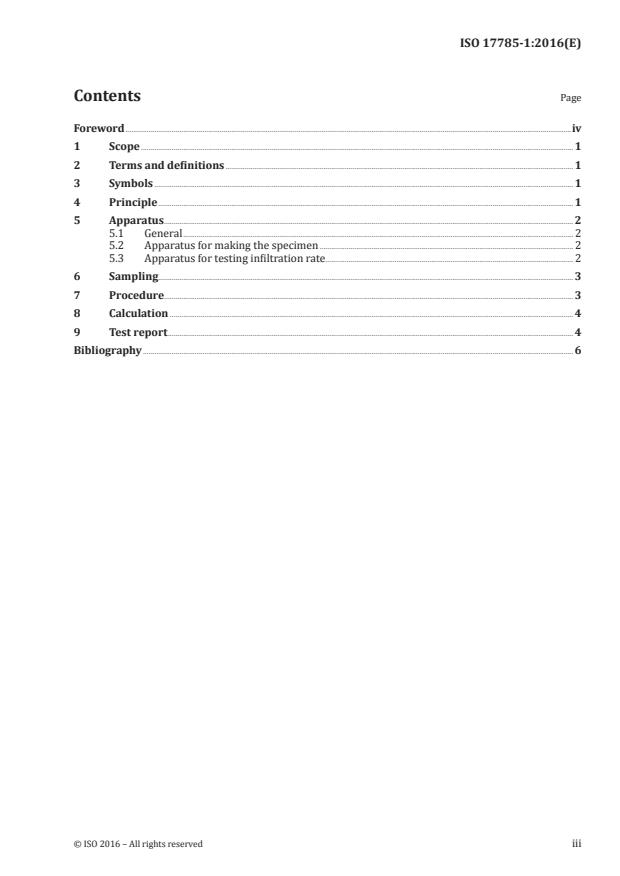
Contents Page
Foreword .iv
1 Scope . 1
2 Terms and definitions . 1
3 Symbols . 1
4 Principle . 1
5 Apparatus . 2
5.1 General . 2
5.2 Apparatus for making the specimen . 2
5.3 Apparatus for testing infiltration rate . 2
6 Sampling . 3
7 Procedure. 3
8 Calculation . 4
9 Test report . 4
Bibliography . 6
Foreword
ISO (the International Organization for Standardization) is a worldwide federation of national standards
bodies (ISO member bodies). The work of preparing International Standards is normally carried out
through ISO technical committees. Each member body interested in a subject for which a technical
committee has been established has the right to be represented on that committee. International
organizations, governmental and non-governmental, in liaison with ISO, also take part in the work.
ISO collaborates closely with the International Electrotechnical Commission (IEC) on all matters of
electrotechnical standardization.
The procedures used to develop this document and those intended for its further maintenance are
described in the ISO/IEC Directives, Part 1. In particular the different approval criteria needed for the
different types of ISO documents should be noted. This document was drafted in accordance with the
editorial rules of the ISO/IEC Directives, Part 2 (see www.iso.org/directives).
Attention is drawn to the possibility that some of the elements of this document may be the subject of
patent rights. ISO shall not be held responsible for identifying any or all such patent rights. Details of
any patent rights identified during the development of the document will be in the Introduction and/or
on the ISO list of patent declarations received (see www.iso.org/patents).
Any trade name used in this document is information given for the convenience of users and does not
constitute an endorsement.
For an explanation on the meaning of ISO specific terms and expressions related to conformity
assessment, as well as information about ISO’s adherence to the WTO principles in the Technical
Barriers to Trade (TBT) see the following URL: Foreword - Supplementary information
The committee responsible for this document is ISO/TC 71, Concrete, reinforced concrete and pre-
stressed concrete, Subcommittee SC 1, Test methods for concrete.
ISO 17785 consists of the following parts, under the general title Testing methods for pervious concrete:
— Part 1: Infiltration rate
iv © ISO 2016 – All rights reserved
INTERNATIONAL STANDARD ISO 17785-1:2016(E)
Testing methods for pervious concrete —
Part 1:
Infiltration rate
1 Scope
This part of ISO 17785 specifies the procedure for testing the infiltration rate of hardened pervious
concrete pavement specimens in the laboratory. It is not a method for measuring the permeability
of pervious concrete. The specimens can either be prepared in the laboratory or cored from field
placements, but not representing field conditions. This part of ISO 17785 also specifies procedures to
make and cure hardened pervious concrete samples in the laboratory.
2 Terms and definitions
For the purposes of this document, the following terms and definitions apply.
2.1
infiltration rate
water flow rate per area per time through pervious concrete
2.2
pervious concrete
concrete which has interconnected voids that allow for water flow through them
Note 1 to entry: Pervious concrete for pavement is usually made with little or no fine aggregate and contains
narrowly graded coarse aggregate typica
...