

ISO 17785-3:2023
(Main)Testing methods for pervious concrete — Part 3: Resistance of surface degradation
General Information
- Abstract
This document specifies a procedure for testing the resistance of surface degradation of pervious concrete specimens in the laboratory. This document also specifies procedures for measuring the mass loss of specimens subjected to combined action of impact and abrasion in a rotating steel drum.
- Status
- Published
- Publication Date
- 17-Sep-2023
- Technical Committee
- ISO/TC 71/SC 1 - Test methods for concrete
- Drafting Committee
- ISO/TC 71/SC 1/WG 3 - Pervious concrete: void content
- Current Stage
- 6060 - International Standard published
- Start Date
- 18-Sep-2023
- Due Date
- 02-Dec-2023
- Completion Date
- 18-Sep-2023
Overview
ISO 17785-3:2023 - Testing methods for pervious concrete - Part 3: Resistance of surface degradation, defines standardized laboratory procedures for evaluating the durability of pervious concrete surfaces. This international standard focuses on assessing resistance to surface degradation caused by a combination of impact and abrasion. By subjecting concrete specimens to controlled mechanical wear in a rotating steel drum, the document ensures reliable measurement of mass loss-a critical indicator of the concrete’s performance and longevity in applications exposed to traffic and environmental stresses.
Key Topics
- Pervious Concrete Testing: Specifies procedures for preparing, curing, and testing pervious concrete samples.
- Surface Degradation Assessment: Details methods for quantifying resistance to abrasion and impact, simulating real-world mechanical stresses found in pavements and similar structures.
- Rotating Steel Drum Method: Describes a laboratory technique where concrete specimens are exposed to repeated revolutions in a steel drum (Los Angeles machine) to induce degradation.
- Mass Loss Calculation: Outlines precise calculations for determining the percentage mass loss after testing, offering a standardized measure for durability.
- Reporting Requirements: Lists critical data to include in test reports, supporting traceability and comparison across different concrete mixtures.
Applications
- Pavement and Road Performance: The test methods provided in ISO 17785-3:2023 are widely used to evaluate pervious concrete intended for sidewalks, parking areas, and low-volume roadways. Resistance to surface degradation is a key quality metric for these applications, directly impacting maintenance cycles and safety.
- Stormwater Management: Pervious concrete allows water infiltration, but ongoing mechanical resistance is needed to ensure these systems remain effective in high-traffic areas. Using standardized methods verifies the long-term viability of pervious installations.
- Material Development and Mixture Evaluation: Concrete producers, civil engineers, and researchers use the procedures to compare different raw materials, mixture proportions, and curing processes for optimizing product durability and compliance with regulatory or project requirements.
- Quality Control in Manufacturing: Routine use of this standard helps manufacturers maintain consistent product quality, build client trust, and meet green infrastructure standards by verifying permeable pavement durability before installation.
Related Standards
- ISO 17785-1 - Testing methods for pervious concrete - Part 1: Infiltration rate: Complements Part 3 by specifying infiltration rate testing methods for assessing permeability.
- ISO 17785-2 - Testing methods for pervious concrete - Part 2: Density and void content: Provides procedures for measuring the density and void space, key characteristics in both strength and permeability.
- ISO 565 - Test sieves - Metal wire cloth, perforated metal plate and electroformed sheet - Nominal sizes of openings: Referenced for sieve requirements during testing.
- ASTM C131/C131M - Resistance to Degradation of Small Size Coarse Aggregate by Abrasion and Impact in the Los Angeles Machine: Basis for using the Los Angeles machine in durability testing.
- ASTM D6926 - Preparation of Bituminous Specimens Using Marshall Apparatus: Referenced for compaction procedures.
- ISO 1920 Series - Multiple parts relevant to general concrete testing, sampling, and specimen preparation.
ISO 17785-3:2023 is an essential resource for quality assurance, compliance, and performance improvement in pervious concrete applications, supporting safe, sustainable, and long-lasting infrastructure.
Get Certified
Connect with accredited certification bodies for this standard

DIBt (Deutsches Institut für Bautechnik)
German Institute for Building Technology.
DIN CERTCO
DIN Group product certification.

Aboma Certification B.V.
Specialized in construction, metal, and transport sectors.
Sponsored listings
Frequently Asked Questions
ISO 17785-3:2023 is a standard published by the International Organization for Standardization (ISO). Its full title is "Testing methods for pervious concrete — Part 3: Resistance of surface degradation". This standard covers: This document specifies a procedure for testing the resistance of surface degradation of pervious concrete specimens in the laboratory. This document also specifies procedures for measuring the mass loss of specimens subjected to combined action of impact and abrasion in a rotating steel drum.
This document specifies a procedure for testing the resistance of surface degradation of pervious concrete specimens in the laboratory. This document also specifies procedures for measuring the mass loss of specimens subjected to combined action of impact and abrasion in a rotating steel drum.
ISO 17785-3:2023 is classified under the following ICS (International Classification for Standards) categories: 91.100.30 - Concrete and concrete products. The ICS classification helps identify the subject area and facilitates finding related standards.
ISO 17785-3:2023 is available in PDF format for immediate download after purchase. The document can be added to your cart and obtained through the secure checkout process. Digital delivery ensures instant access to the complete standard document.
Standards Content (Sample)
INTERNATIONAL ISO
STANDARD 17785-3
First edition
2023-09
Testing methods for pervious
concrete —
Part 3:
Resistance of surface degradation
Méthodes d'essai pour ciments perméables —
Partie 3: Résistance de la dégradation de surface
Reference number
© ISO 2023
All rights reserved. Unless otherwise specified, or required in the context of its implementation, no part of this publication may
be reproduced or utilized otherwise in any form or by any means, electronic or mechanical, including photocopying, or posting on
the internet or an intranet, without prior written permission. Permission can be requested from either ISO at the address below
or ISO’s member body in the country of the requester.
ISO copyright office
CP 401 • Ch. de Blandonnet 8
CH-1214 Vernier, Geneva
Phone: +41 22 749 01 11
Email: copyright@iso.org
Website: www.iso.org
Published in Switzerland
ii
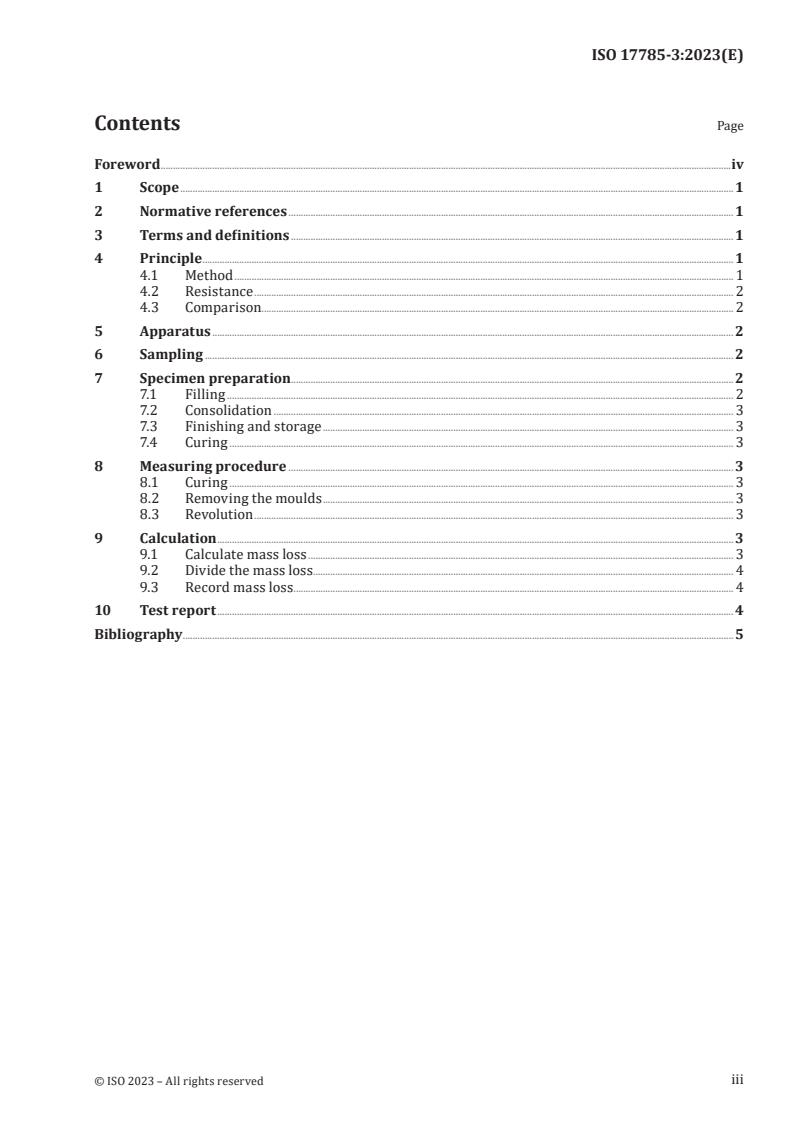
Contents Page
Foreword .iv
1 Scope . 1
2 Normative references . 1
3 Terms and definitions . 1
4 Principle . 1
4.1 Method . 1
4.2 Resistance . 2
4.3 Comparison . . 2
5 Apparatus . 2
6 Sampling . 2
7 Specimen preparation . .2
7.1 Filling . 2
7.2 Consolidation . 3
7.3 Finishing and storage . 3
7.4 Curing . 3
8 Measuring procedure . 3
8.1 Curing . 3
8.2 Removing the moulds . 3
8.3 Revolution . 3
9 Calculation . 3
9.1 Calculate mass loss . 3
9.2 Divide the mass loss . 4
9.3 Record mass loss . . 4
10 Test report . 4
Bibliography . 5
iii
Foreword
ISO (the International Organization for Standardization) is a worldwide federation of national standards
bodies (ISO member bodies). The work of preparing International Standards is normally carried out
through ISO technical committees. Each member body interested in a subject for which a technical
committee has been established has the right to be represented on that committee. International
organizations, governmental and non-governmental, in liaison with ISO, also take part in the work.
ISO collaborates closely with the International Electrotechnical Commission (IEC) on all matters of
electrotechnical standardization.
The procedures used to develop this document and those intended for its further maintenance are
described in the ISO/IEC Directives, Part 1. In particular, the different approval criteria needed for the
different types of ISO documents should be noted. This document was drafted in accordance with the
editorial rules of the ISO/IEC Directives, Part 2 (see www.iso.org/directives).
Attention is drawn to the possibility that some of the elements of this document may be the subject of
patent rights. ISO shall not be held responsible for identifying any or all such patent rights. Details of
any patent rights identified during the development of the document will be in the Introduction and/or
on the ISO list of patent declarations received (see www.iso.org/patents).
Any trade name used in this document is information given for the convenience of users and does not
constitute an endorsement.
For an explanation of the voluntary nature of standards, the meaning of ISO specific terms and
expressions related to conformity assessment, as well as information about ISO's adherence to
the World Trade Organization (WTO) principles in the Technical Barriers to Trade (TBT), see
www.iso.org/iso/foreword.html.
This document was prepared by Technical Committee ISO/TC 71, Concrete, reinforced concrete and pre-
stressed concrete, Subcommittee SC 1, Test methods for concrete.
A list of all parts in the ISO 17785 series can be found on the ISO website.
Any feedback or questions on this document should be directed to the user’s national standards body. A
complete listing of these bodies can be found at www.iso.org/members.html.
iv
INTERNATIONAL STANDARD ISO 17785-3:2023(E)
Testing methods for pervious concrete —
Part 3:
Resistance of surface degradation
1 Scope
This document specifies a pro
...