

ISO 1920-14:2019
(Main)Testing of concrete — Part 14: Setting time of concrete mixtures by resistance to penetration
General Information
- Abstract
This document covers the method for determining the setting time of concrete with slump greater than zero, by testing mortar sieved from the concrete mixture. The initial setting time and the final setting time are the time intervals required for the mortar sieved from the concrete mixture to reach the specified values of penetration resistance after the initial contact of cement and water. The method can be used for determining the effect of variables such as temperature, type and content of cement, concrete mix proportions and admixtures, on the time of setting and hardening characteristics of concrete. This test method is applicable under controlled laboratory conditions, as well as under field conditions.
- Status
- Published
- Publication Date
- 12-Nov-2019
- Technical Committee
- ISO/TC 71/SC 1 - Test methods for concrete
- Drafting Committee
- ISO/TC 71/SC 1 - Test methods for concrete
- Current Stage
- 9093 - International Standard confirmed
- Start Date
- 30-Sep-2025
- Completion Date
- 29-Aug-2026
Overview
ISO 1920-14:2019 specifies a standardized method to determine the setting time of concrete mixtures (slump > 0) by measuring the resistance to penetration of mortar sieved from the fresh concrete. The method defines initial and final setting times based on penetration-resistance thresholds and can be used in both controlled laboratory and field conditions to assess the influence of variables such as temperature, cement type/content, mix proportions and admixtures.
Key topics and technical requirements
- Scope: Applies to mortar obtained by sieving concrete through a 5 mm (or 4.75 mm) sieve; suitable for concrete with slump greater than zero.
- Definitions:
- Initial setting time: elapsed time after water–cement contact until mortar reaches 3.5 N/mm² penetration resistance.
- Final setting time: elapsed time until mortar reaches 27.6 N/mm² penetration resistance.
- Specimen preparation:
- Obtain representative concrete sample; sieve to collect mortar, mix, measure temperature, place in rigid watertight containers.
- Container minimum dimensions: lateral ≥ 150 mm and height ≥ 150 mm; mortar depth ≥ 140 mm.
- Apparatus:
- Penetration resistance apparatus (spring or hydraulic) with accuracy ±10 N; removable needles with bearing areas 645, 323, 161, 65, 32, and 16 mm².
- Needles penetrate to 25 mm depth; typical penetration time ≈ 10 s.
- Storage and environmental control:
- Laboratory: store at 20 °C ± 2 °C (or 27 °C ± 2 °C for tropical countries) and relative humidity >65%, or as required by user/national standards.
- Field: store under ambient, shielded from direct sunlight.
- Test schedule and frequency:
- Normal mixes: first test at 2–3 h post-mixing, then hourly.
- Accelerated: first test at 1–2 h, subsequent tests at 30 min.
- Retarded/low-temperature: first test may be 4–6 h or later.
- Minimum six penetrations per hardening rate test; continue until ≥27.6 N/mm² achieved.
- Data handling:
- Plot penetration resistance (N/mm²) vs elapsed time (min); determine times where 3.5 and 27.6 N/mm² are reached (report to nearest 5 minutes). Log–log regression methods permitted.
Applications and who uses it
- Quality control and research for concrete producers, testing laboratories, materials engineers, and contractors.
- Evaluating effects of cement type, admixtures, temperature and mix adjustments on setting and early hardening.
- Useful for mix design validation, troubleshooting early-age performance, and assessing suitability for formwork removal or finishing operations.
Related standards
- Part of the ISO 1920 series (Testing of concrete). Refer to other ISO 1920 parts and applicable national standards for complementary concrete test methods and local environmental/testing requirements.
Keywords: ISO 1920-14:2019, setting time, penetration resistance, concrete testing, mortar, initial setting time, final setting time, concrete mix, admixtures, concrete laboratory test.
Get Certified
Connect with accredited certification bodies for this standard

DIBt (Deutsches Institut für Bautechnik)
German Institute for Building Technology.
DIN CERTCO
DIN Group product certification.

Aboma Certification B.V.
Specialized in construction, metal, and transport sectors.
Sponsored listings
Frequently Asked Questions
ISO 1920-14:2019 is a standard published by the International Organization for Standardization (ISO). Its full title is "Testing of concrete — Part 14: Setting time of concrete mixtures by resistance to penetration". This standard covers: This document covers the method for determining the setting time of concrete with slump greater than zero, by testing mortar sieved from the concrete mixture. The initial setting time and the final setting time are the time intervals required for the mortar sieved from the concrete mixture to reach the specified values of penetration resistance after the initial contact of cement and water. The method can be used for determining the effect of variables such as temperature, type and content of cement, concrete mix proportions and admixtures, on the time of setting and hardening characteristics of concrete. This test method is applicable under controlled laboratory conditions, as well as under field conditions.
This document covers the method for determining the setting time of concrete with slump greater than zero, by testing mortar sieved from the concrete mixture. The initial setting time and the final setting time are the time intervals required for the mortar sieved from the concrete mixture to reach the specified values of penetration resistance after the initial contact of cement and water. The method can be used for determining the effect of variables such as temperature, type and content of cement, concrete mix proportions and admixtures, on the time of setting and hardening characteristics of concrete. This test method is applicable under controlled laboratory conditions, as well as under field conditions.
ISO 1920-14:2019 is classified under the following ICS (International Classification for Standards) categories: 91.100.30 - Concrete and concrete products. The ICS classification helps identify the subject area and facilitates finding related standards.
ISO 1920-14:2019 is available in PDF format for immediate download after purchase. The document can be added to your cart and obtained through the secure checkout process. Digital delivery ensures instant access to the complete standard document.
Standards Content (Sample)
INTERNATIONAL ISO
STANDARD 1920-14
First edition
2019-11
Testing of concrete —
Part 14:
Setting time of concrete mixtures by
resistance to penetration
Essais du béton —
Partie 14: Temps de prise des mélanges de béton selon l'essai de
résistance à la pénétration
Reference number
©
ISO 2019
© ISO 2019
All rights reserved. Unless otherwise specified, or required in the context of its implementation, no part of this publication may
be reproduced or utilized otherwise in any form or by any means, electronic or mechanical, including photocopying, or posting
on the internet or an intranet, without prior written permission. Permission can be requested from either ISO at the address
below or ISO’s member body in the country of the requester.
ISO copyright office
CP 401 • Ch. de Blandonnet 8
CH-1214 Vernier, Geneva
Phone: +41 22 749 01 11
Fax: +41 22 749 09 47
Email: copyright@iso.org
Website: www.iso.org
Published in Switzerland
ii © ISO 2019 – All rights reserved
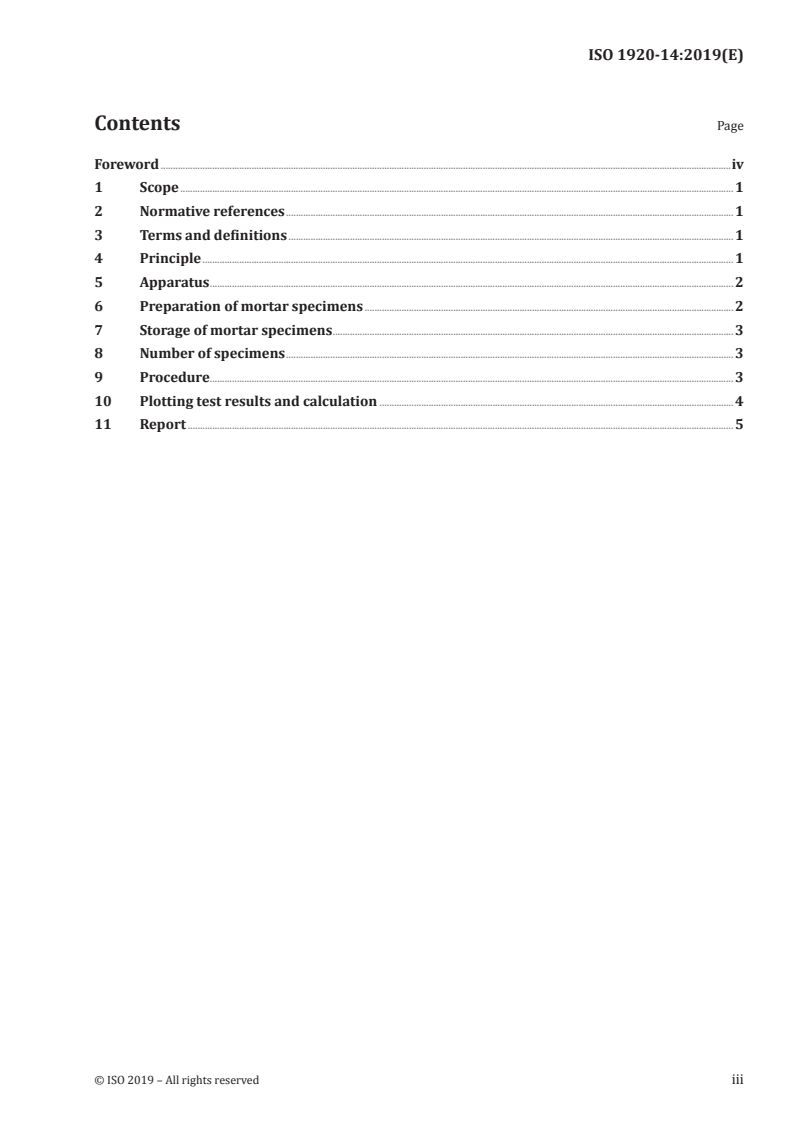
Contents Page
Foreword .iv
1 Scope . 1
2 Normative references . 1
3 Terms and definitions . 1
4 Principle . 1
5 Apparatus . 2
6 Preparation of mortar specimens . 2
7 Storage of mortar specimens . 3
8 Number of specimens . 3
9 Procedure. 3
10 Plotting test results and calculation . 4
11 Report . 5
Foreword
ISO (the International Organization for Standardization) is a worldwide federation of national standards
bodies (ISO member bodies). The work of preparing International Standards is normally carried out
through ISO technical committees. Each member body interested in a subject for which a technical
committee has been established has the right to be represented on that committee. International
organizations, governmental and non-governmental, in liaison with ISO, also take part in the work.
ISO collaborates closely with the International Electrotechnical Commission (IEC) on all matters of
electrotechnical standardization.
The procedures used to develop this document and those intended for its further maintenance are
described in the ISO/IEC Directives, Part 1. In particular, the different approval criteria needed for the
different types of ISO documents should be noted. This document was drafted in accordance with the
editorial rules of the ISO/IEC Directives, Part 2 (see www .iso .org/ directives).
Attention is drawn to the possibility that some of the elements of this document may be the subject of
patent rights. ISO shall not be held responsible for identifying any or all such patent rights. Details of
any patent rights identified during the development of the document will be in the Introduction and/or
on the ISO list of patent declarations received (see www .iso .org/ patents).
Any trade name used in this document is information given for the convenience of users and does not
constitute an endorsement.
For an explanation of the voluntary nature of standards, the meaning of ISO specific terms and
expressions related to conformity assessment, as well as information about ISO's adherence to the
World Trade Organization (WTO) principles in the Technical Barriers to Trade (TBT) see www .iso .org/
iso/ foreword .html.
This document was prepared by Technical Committee ISO/TC 71, Concrete, reinforced concrete and pre-
stressed concrete, Subcommittee SC 1, Test methods for concrete.
Any feedback or questions on this document should be directed to the user’s national standards body. A
complete listing of these bodies can be found at www .iso .org/ members .html.
A list of all parts in the ISO 1920 series can be found on the ISO website.
iv © ISO 2019 – All rights reserved
INTERNATIONAL STANDARD ISO 1920-14:2019(E)
Testing of concrete —
Part 14:
Setting time of concrete mixtures by resistance to
penetration
1 Scope
This document covers the method for determining the setting time of concrete with slump greater
than zero, by testing mortar sieved from the concrete mixture. The initial setting time and the final
setting time are the time intervals required for the mortar sieved from the concrete mixture to reach
the specified values of penetration resistance after the initial contact of cement and water.
The method can be used for determining the effect of variables such as temperature, type and content of
cement, concrete mix proportions and admixtures, on the time of setting and hardening characteristics
of concrete.
This test method is applicable under controlled laboratory conditions, as well as under field conditions.
2 Normative references
There are no normative references in this document.
3 Terms and definitions
For the purposes of this document, the following terms and definitions apply.
ISO and IEC maintain terminological databases for use in standardization at the following addresses:
— ISO Online browsing platform: available at https:// www .iso .org/ obp
— IEC Electropedia: available at http:// www .electropedia .org/
3.1
initial setting time
time elapsed, after the initial contact of cement and water, till the mortar (sieved from the concrete)
acquires a penetration resistance of 3,5 N/mm
3.2
final setting time
time elapsed, after the initial contact of cement and water, till the mortar (sieved from the concrete)
acquires a penetration resistance of 27,6 N/mm
4 Principle
A mortar sample is obtained by sieving a representative sample of fresh concrete. The mortar sample
is placed in a container and stored at a specified ambient temperature. The resistance of the mortar
to penetration by standard needles is measured at regular time intervals. The time of initial and final
setting are determined from a plot of penetration resistance versus elapsed time.
5 Apparatus
5.1 Containers for mortar specimens, rigid, watertight, non-absorptive, free of oil/grease, either
cylindrical or rectangular in cross-section, with minimum lateral dimension 150 mm and height at
least 150 mm.
The container for the mortar specimens from the concrete mixture shall provide enough mortar
surfaces for ten undisturbed readings of penetration resistance in accordance with clear distance
requirements specified in Clause 9.
5.2 Penetration resistance apparatus, of spring reaction type, graduated from 50 N to 600 N in
increments of 10 N or less, or hydraulic reaction-type apparatus with pressure gauge of 700 N to 900 N
capacity, graduated in increments of 10 N or less.
Indications of actual needle loads by these apparatus shall be accurate to 10 N. Removable needles of
2 2 2 2 2 2
645 mm , 323 mm , 161 mm , 65 mm , 32 mm , and 16 mm bearing areas shall be provided. Each
needle shank shall be scribed peripherally at a distance of 25 mm above the bearing face. The length
of the 16 mm needle shall be not more than 90 mm to minimize bending. The apparatus shall be
recalibrated periodically.
NOTE National specifications can also exist regarding cross-sectional area.
5.3 Pipette, or other suitable instrument for drawing o
...
INTERNATIONAL ISO
STANDARD 1920-14
First edition
2019-11
Testing of concrete —
Part 14:
Setting time of concrete mixtures by
resistance to penetration
Essais du béton —
Partie 14: Temps de prise des mélanges de béton selon l'essai de
résistance à la pénétration
Reference number
©
ISO 2019
© ISO 2019
All rights reserved. Unless otherwise specified, or required in the context of its implementation, no part of this publication may
be reproduced or utilized otherwise in any form or by any means, electronic or mechanical, including photocopying, or posting
on the internet or an intranet, without prior written permission. Permission can be requested from either ISO at the address
below or ISO’s member body in the country of the requester.
ISO copyright office
CP 401 • Ch. de Blandonnet 8
CH-1214 Vernier, Geneva
Phone: +41 22 749 01 11
Fax: +41 22 749 09 47
Email: copyright@iso.org
Website: www.iso.org
Published in Switzerland
ii © ISO 2019 – All rights reserved
Contents Page
Foreword .iv
1 Scope . 1
2 Normative references . 1
3 Terms and definitions . 1
4 Principle . 1
5 Apparatus . 2
6 Preparation of mortar specimens . 2
7 Storage of mortar specimens . 3
8 Number of specimens . 3
9 Procedure. 3
10 Plotting test results and calculation . 4
11 Report . 5
Foreword
ISO (the International Organization for Standardization) is a worldwide federation of national standards
bodies (ISO member bodies). The work of preparing International Standards is normally carried out
through ISO technical committees. Each member body interested in a subject for which a technical
committee has been established has the right to be represented on that committee. International
organizations, governmental and non-governmental, in liaison with ISO, also take part in the work.
ISO collaborates closely with the International Electrotechnical Commission (IEC) on all matters of
electrotechnical standardization.
The procedures used to develop this document and those intended for its further maintenance are
described in the ISO/IEC Directives, Part 1. In particular, the different approval criteria needed for the
different types of ISO documents should be noted. This document was drafted in accordance with the
editorial rules of the ISO/IEC Directives, Part 2 (see www .iso .org/ directives).
Attention is drawn to the possibility that some of the elements of this document may be the subject of
patent rights. ISO shall not be held responsible for identifying any or all such patent rights. Details of
any patent rights identified during the development of the document will be in the Introduction and/or
on the ISO list of patent declarations received (see www .iso .org/ patents).
Any trade name used in this document is information given for the convenience of users and does not
constitute an endorsement.
For an explanation of the voluntary nature of standards, the meaning of ISO specific terms and
expressions related to conformity assessment, as well as information about ISO's adherence to the
World Trade Organization (WTO) principles in the Technical Barriers to Trade (TBT) see www .iso .org/
iso/ foreword .html.
This document was prepared by Technical Committee ISO/TC 71, Concrete, reinforced concrete and pre-
stressed concrete, Subcommittee SC 1, Test methods for concrete.
Any feedback or questions on this document should be directed to the user’s national standards body. A
complete listing of these bodies can be found at www .iso .org/ members .html.
A list of all parts in the ISO 1920 series can be found on the ISO website.
iv © ISO 2019 – All rights reserved
INTERNATIONAL STANDARD ISO 1920-14:2019(E)
Testing of concrete —
Part 14:
Setting time of concrete mixtures by resistance to
penetration
1 Scope
This document covers the method for determining the setting time of concrete with slump greater
than zero, by testing mortar sieved from the concrete mixture. The initial setting time and the final
setting time are the time intervals required for the mortar sieved from the concrete mixture to reach
the specified values of penetration resistance after the initial contact of cement and water.
The method can be used for determining the effect of variables such as temperature, type and content of
cement, concrete mix proportions and admixtures, on the time of setting and hardening characteristics
of concrete.
This test method is applicable under controlled laboratory conditions, as well as under field conditions.
2 Normative references
There are no normative references in this document.
3 Terms and definitions
For the purposes of this document, the following terms and definitions apply.
ISO and IEC maintain terminological databases for use in standardization at the following addresses:
— ISO Online browsing platform: available at https:// www .iso .org/ obp
— IEC Electropedia: available at http:// www .electropedia .org/
3.1
initial setting time
time elapsed, after the initial contact of cement and water, till the mortar (sieved from the concrete)
acquires a penetration resistance of 3,5 N/mm
3.2
final setting time
time elapsed, after the initial contact of cement and water, till the mortar (sieved from the concrete)
acquires a penetration resistance of 27,6 N/mm
4 Principle
A mortar sample is obtained by sieving a representative sample of fresh concrete. The mortar sample
is placed in a container and stored at a specified ambient temperature. The resistance of the mortar
to penetration by standard needles is measured at regular time intervals. The time of initial and final
setting are determined from a plot of penetration resistance versus elapsed time.
5 Apparatus
5.1 Containers for mortar specimens, rigid, watertight, non-absorptive, free of oil/grease, either
cylindrical or rectangular in cross-section, with minimum lateral dimension 150 mm and height at
least 150 mm.
The container for the mortar specimens from the concrete mixture shall provide enough mortar
surfaces for ten undisturbed readings of penetration resistance in accordance with clear distance
requirements specified in Clause 9.
5.2 Penetration resistance apparatus, of spring reaction type, graduated from 50 N to 600 N in
increments of 10 N or less, or hydraulic reaction-type apparatus with pressure gauge of 700 N to 900 N
capacity, graduated in increments of 10 N or less.
Indications of actual needle loads by these apparatus shall be accurate to 10 N. Removable needles of
2 2 2 2 2 2
645 mm , 323 mm , 161 mm , 65 mm , 32 mm , and 16 mm bearing areas shall be provided. Each
needle shank shall be scribed peripherally at a distance of 25 mm above the bearing face. The length
of the 16 mm needle shall be not more than 90 mm to minimize bending. The apparatus shall be
recalibrated periodically.
NOTE National specifications can also exist regarding cross-sectional area.
5.3 Pipette, or other suitable instrument for drawing o
...