

ISO 6640:2024
(Main)Measurement of density of water-sediment mixture using radiation transmission method
General Information
- Abstract
This document specifies the radiation transmission method for measurement of density of the water-sediment mixture, suspended or deposited, in water bodies such as streams, canals, harbour basins, dams and reservoirs. The method is based on principles of transmission of X or Gamma rays. This document covers brief description of the operating principle of the method and details of some of the instruments used. This document applies to the measurement of water-sediment mixture density in water bodies using radiation transmission method, particularly gamma and X-ray transmission method. The working principles, applications, advantages and associated instruments are elaborated in this document.
- Status
- Published
- Publication Date
- 02-May-2024
- Technical Committee
- ISO/TC 113/SC 6 - Sediment transport
- Drafting Committee
- ISO/TC 113/SC 6 - Sediment transport
- Current Stage
- 6060 - International Standard published
- Start Date
- 03-May-2024
- Due Date
- 08-Jun-2024
- Completion Date
- 03-May-2024
Overview
ISO 6640:2024 specifies the radiation transmission method for measurement of the density of water‑sediment mixtures (suspended or deposited) in streams, canals, harbour basins, dams and reservoirs. Based on X‑ray and gamma‑ray transmission (and complementary backscattering), the standard describes operating principles, instrument types, calibration procedures and safety considerations for ionizing radiation. Annexes provide instrument prototypes, calibration examples and a case study of vertical profiling.
Key topics and technical requirements
- Measurement principle: density is inferred from attenuation (transmission) or scattering (backscattering) of a collimated beam through a water‑sediment column. Measured radiation intensity is correlated with mixture density using calibrated relationships.
- Radiation types: monoenergetic beams give the simplest theoretical relationship; practical systems often use X‑ray tubes or sealed gamma sources (e.g., Cs‑137). Low‑energy sources (e.g., Am‑241, 60 keV) require careful calibration because of element‑specific absorption.
- Calibration: mandatory site‑specific laboratory calibration using the native sediment. Calibration establishes the count‑rate vs. density curve (often approximately linear for practical setups) and is required before field deployment.
- Sediment properties: influence measurements - particle size, cohesive vs non‑cohesive behavior (Wentworth classification: sand, silt, clay) and composition must be considered during calibration.
- Protection and safety: protection against ionizing radiation is emphasized; operators must follow radiation safety requirements and applicable regulations.
- Instruments and data: details of transmission and backscatter instrument designs, collimation, detectors and data acquisition (boat‑mounted systems for profiles) are covered in informative annexes.
Applications
ISO 6640:2024 supports practical sediment monitoring and operational decision‑making:
- Dredging and navigation: real‑time monitoring of suspended sediment and nautical depth in navigation channels to optimize dredging.
- Reservoir and dam management: quantifying sedimentation rates for reservoir capacity planning, intake management and hydropower operation.
- Channel and harbour maintenance: tracking sediment deposition and transport for maintenance scheduling.
- Research and environmental monitoring: continuous sediment concentration profiling for hydrology and sediment transport studies.
Who should use this standard
- Hydrometrists, environmental and civil engineers
- Dam, reservoir and port authorities
- Dredging contractors and consultants
- Instrument manufacturers and calibration laboratories
- Regulatory bodies overseeing sediment monitoring and radiation safety
Related standards
- ISO 772 (Hydrometry - Vocabulary and symbols)
- ISO 4363 (Measurement of liquid flow - Suspended sediment characteristics)
- ISO 11657 (Suspended sediment - Determination by surrogate techniques)
Keywords: ISO 6640:2024, radiation transmission method, density of water‑sediment mixture, gamma transmission, X‑ray transmission, backscattering, sediment monitoring, hydrometry, calibration, dredging, reservoir management.
Get Certified
Connect with accredited certification bodies for this standard

BSMI (Bureau of Standards, Metrology and Inspection)
Taiwan's standards and inspection authority.
Sponsored listings
Frequently Asked Questions
ISO 6640:2024 is a standard published by the International Organization for Standardization (ISO). Its full title is "Measurement of density of water-sediment mixture using radiation transmission method". This standard covers: This document specifies the radiation transmission method for measurement of density of the water-sediment mixture, suspended or deposited, in water bodies such as streams, canals, harbour basins, dams and reservoirs. The method is based on principles of transmission of X or Gamma rays. This document covers brief description of the operating principle of the method and details of some of the instruments used. This document applies to the measurement of water-sediment mixture density in water bodies using radiation transmission method, particularly gamma and X-ray transmission method. The working principles, applications, advantages and associated instruments are elaborated in this document.
This document specifies the radiation transmission method for measurement of density of the water-sediment mixture, suspended or deposited, in water bodies such as streams, canals, harbour basins, dams and reservoirs. The method is based on principles of transmission of X or Gamma rays. This document covers brief description of the operating principle of the method and details of some of the instruments used. This document applies to the measurement of water-sediment mixture density in water bodies using radiation transmission method, particularly gamma and X-ray transmission method. The working principles, applications, advantages and associated instruments are elaborated in this document.
ISO 6640:2024 is classified under the following ICS (International Classification for Standards) categories: 17.120.20 - Flow in open channels. The ICS classification helps identify the subject area and facilitates finding related standards.
ISO 6640:2024 is available in PDF format for immediate download after purchase. The document can be added to your cart and obtained through the secure checkout process. Digital delivery ensures instant access to the complete standard document.
Standards Content (Sample)
International
Standard
ISO 6640
First edition
Measurement of density of water-
2024-05
sediment mixture using radiation
transmission method
Reference number
© ISO 2024
All rights reserved. Unless otherwise specified, or required in the context of its implementation, no part of this publication may
be reproduced or utilized otherwise in any form or by any means, electronic or mechanical, including photocopying, or posting on
the internet or an intranet, without prior written permission. Permission can be requested from either ISO at the address below
or ISO’s member body in the country of the requester.
ISO copyright office
CP 401 • Ch. de Blandonnet 8
CH-1214 Vernier, Geneva
Phone: +41 22 749 01 11
Email: copyright@iso.org
Website: www.iso.org
Published in Switzerland
ii
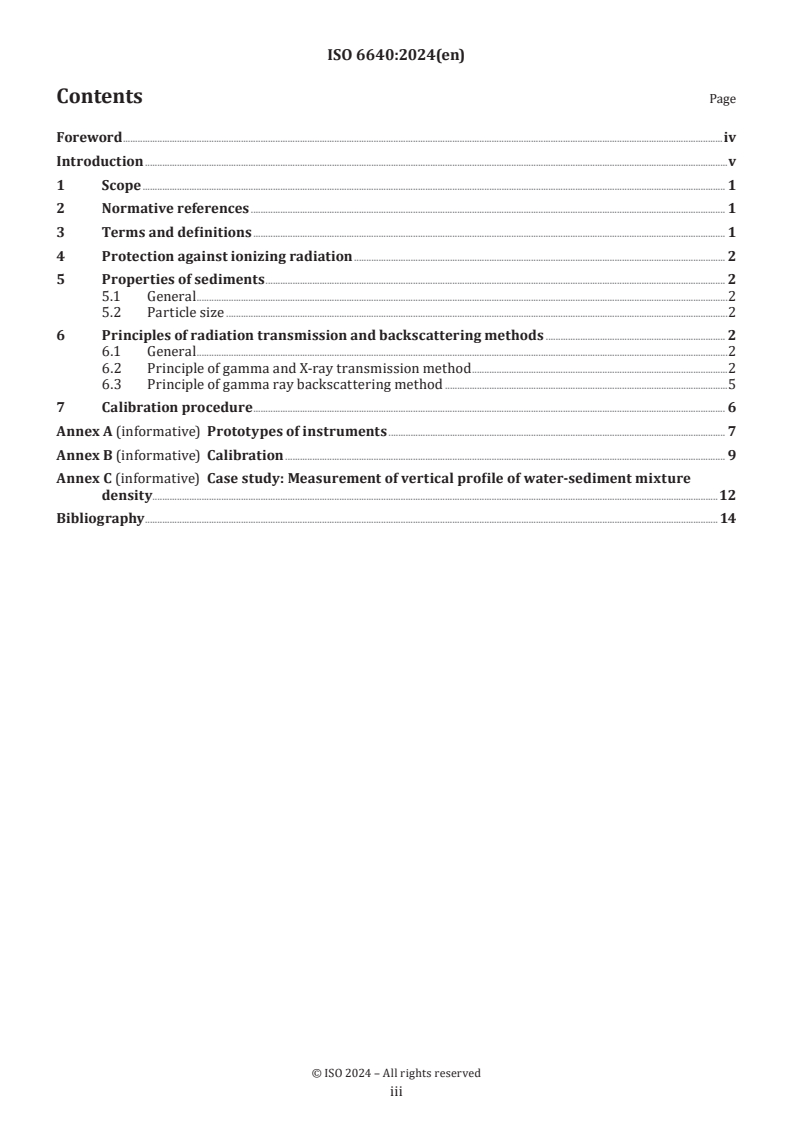
Contents Page
Foreword .iv
Introduction .v
1 Scope . 1
2 Normative references . 1
3 Terms and definitions . 1
4 Protection against ionizing radiation . 2
5 Properties of sediments . 2
5.1 General .2
5.2 Particle size .2
6 Principles of radiation transmission and backscattering methods . 2
6.1 General .2
6.2 Principle of gamma and X-ray transmission method .2
6.3 Principle of gamma ray backscattering method .5
7 Calibration procedure . 6
Annex A (informative) Prototypes of instruments . 7
Annex B (informative) Calibration . 9
Annex C (informative) Case study: Measurement of vertical profile of water-sediment mixture
density.12
Bibliography . 14
iii
Foreword
ISO (the International Organization for Standardization) is a worldwide federation of national standards
bodies (ISO member bodies). The work of preparing International Standards is normally carried out through
ISO technical committees. Each member body interested in a subject for which a technical committee
has been established has the right to be represented on that committee. International organizations,
governmental and non-governmental, in liaison with ISO, also take part in the work. ISO collaborates closely
with the International Electrotechnical Commission (IEC) on all matters of electrotechnical standardization.
The procedures used to develop this document and those intended for its further maintenance are described
in the ISO/IEC Directives, Part 1. In particular, the different approval criteria needed for the different types
of ISO document should be noted. This document was drafted in accordance with the editorial rules of the
ISO/IEC Directives, Part 2 (see www.iso.org/directives).
ISO draws attention to the possibility that the implementation of this document may involve the use of (a)
patent(s). ISO takes no position concerning the evidence, validity or applicability of any claimed patent
rights in respect thereof. As of the date of publication of this document, ISO had not received notice of (a)
patent(s) which may be required to implement this document. However, implementers are cautioned that
this may not represent the latest information, which may be obtained from the patent database available at
www.iso.org/patents. ISO shall not be held responsible for identifying any or all such patent rights.
Any trade name used in this document is information given for the convenience of users and does not
constitute an endorsement.
For an explanation of the voluntary nature of standards, the meaning of ISO specific terms and expressions
related to conformity assessment, as well as information about ISO's adherence to the World Trade
Organization (WTO) principles in the Technical Barriers to Trade (TBT), see www.iso.org/iso/foreword.html.
This document was prepared by Technical Committee ISO/TC 113, Hydrometry, Subcommittee SC 6 Sediment
transport.
Any feedback or questions on this document should be directed to the user’s national standards body. A
complete listing of these bodies can be found at www.iso.org/members.html.
iv
Introduction
Radiation transmission method for measuring the density of water-sediment mixture in water bodies such
as rivers, dams and harbours has been employed for many years. It can continuously measure the suspended
sediment concentrations providing data for optimal operation and better management of dams, reservoirs
and navigation channels. The major applications of the radiation transmission method are:
a) maintenance of navigation channels,
b) optimization of dredging operations,
c) management of dams and reservoirs.
Dams and reservoirs are vital in terms of water supply, irrigation and electricity generation. Large
investments are needed for maintenance and efficient operation of dams and reservoirs. Sustainable
operation of dams and reservoirs requires an in-depth understanding and monitoring of sedimentation rates.
In harbour navigation channels, radiation transmission method is applied to measure nautical depth. The
method supplements the preliminary indications provided by ultrasound devices.
v
International Standard ISO 6640:2024(en)
Measurement of density of water-sediment mixture using
radiation transmission method
1 Scope
This document specifies the radiation transmission method for measurement of density of the water-
sediment mixture, suspended or deposited, in water bodies such as streams, canals, harbour basins, dams
and reservoirs.
The method is based on principles of transmission of X or Gamma rays. This document covers brief
description of the operating principle of the method and details of some of the instruments used.
This document applies to the measurement of water-sediment mixture density in water bodies using
radiation transmission method, particularly gamma and X-ray transmission method. The working principles,
applications, advantages and associated instruments are elaborated in this document.
2 Normative references
The following documents are referred to in the text in such a way that some or all of their content constitutes
requirements of this document. For dated references, only the edition cited applies. For undated references,
the latest edition of the referenced document (including any amendments) applies.
ISO 772, Hydrometry — Vocabulary and symbols
ISO 4363, Measurement of liquid flow in open channels — Methods for measurement of characteristics of
suspended sediment
ISO 11657, Hydrometry — Suspended sediment in streams and canals — Determination of concentration by
surrogate techniques
3 Terms and definitions
For the purposes of this document, the terms and definitions given in ISO 772, ISO 4363, ISO 11657 and the
following apply.
ISO and IEC maintain terminology databases for use in standardization at the following addresses:
— ISO Online browsing platform: available at https:// www .iso .org/ obp
— IEC Electropedia: available at https:// www .electropedia .org/
3.1
radiation transmission method
gamma, X-ray transmission method to measure the density of water-sediment (3.2) mixture in water bodies
3.2
sediment
solid particles derived from rocks, biological materials or chemical precipitants, that are transported by,
suspended in or deposited by flowing water
Note 1 to entry: Sediment usually means inorganic material and consists of clay, silt, sand or gravel.
4 Protection against ionizing radiation
Exposure of any part of the human body to ionizing radiation can be injurious to health.
5 Properties of sediments
5.1 General
Water-sediment mixture density is affected by physical properties of the sediments.
5.2 Particle size
Sediments under study can be classified by their grain size, from clay to sand. The Wentworth’s classification
is one of the most widely used classifications for sediments, as given below:
— sand: particles between 0,063 mm to 2 mm in diameter,
— silt: particles between 0,002 mm to 0,063 mm in diameter,
— clay: particles less than 0,002 mm in diameter.
Sediments can be divided into cohesive and non-cohesive classes. Silt and clay are cohesive while the sand is
non-cohesive. According to the Wentworth classification, fine or pelitic sediments, known as mud, are those
with dimensions lesser than 0,063 mm.
6 Principles of radiation transmission and backscattering methods
6.1 General
Both radiation transmission and backscattering methods can be used for measurement of density of water-
sediment mixture in water bodies. The methods enable measurement of a wide range of densities. The
typical instruments used in these methods are presented in Annex A.
6.2 Principle of gamma and X-ray transmission method
The measurement is based on the attenuation of a collimated beam of gamma or X-rays traversing through
the water-sediment mixture in the direction of a collimated detector mounted on opposite side of the source
(see Figure 1).
Key
1 radiation source
2 collimators
3 radiation detector
4 data acquisition system on a boat
5 water
6 sediment water mixture
x thickness of water column
I intensity of transmitted radiation
SW
Figure 1 — Principle of the gamma and X-ray transmission method
When a monoenergetic beam of radiation impinges on a water column of thickness x cm, the intensity of the
transmitted radiation I (counts/unit time) is given as:
w
-·μ x
w
I=I·e (1)
w 0
where
I is the radiation intensity measured in the air;
-1
µ is the linear attenuation coefficient of water, in cm .
w
In the water-sediment mixture, the intensity of the transmitted radiation, I , is given as:
SW
-·μ x
sw
I=I·e (2)
sw 0
where µ is the linear attenuation coefficient of the water-sediment mixture.
sw
The linear attenuation coefficient, µ , is defined as:
sw
μμ=v +v μ (3)
sw ww ss
where, µ is the linear attenuation coefficient of sediment; v and v are the volume fraction of water and
s w s
sediment in the mixture, respectively. As the sediment concentration is c, (the weight of sediment in 1 cm of
the mixture) the volume fractions are defined as:
c
v= (4)
s
ρ
s
c
v=1-v=1- (5)
ws
ρ
s
where, ρ is the sediment density.
s
Formula (3) can be modified by substituting the volume fractions:
cc c
μμ=+vv μ =−1(μ +=μμ +−μμ ) (6)
sw ww ss w sw sw
ρ ρ ρ
s s s
Formula (2) can be modified by substituting the linear attenuation coefficient, µ :
sw
c c μμ−
sw
−+μ ()μμ− ·x − (μμμ−−)·
...