


ISO 9919:2005
(Main)Medical electrical equipment — Particular requirements for the basic safety and essential performance of pulse oximeter equipment for medical use
Medical electrical equipment — Particular requirements for the basic safety and essential performance of pulse oximeter equipment for medical use
For the purposes of ISO 9919:2005, the Scope given in IEC 60601-1:1988 (Clause 1) applies, except as follows. Amendment (add at the end of 1.1): ISO 9919:2005 specifies particular requirements for the basic safety and essential performance of pulse oximeter equipment intended for use on humans. This includes any part necessary for normal use, e.g. the pulse oximeter monitor, pulse oximeter probe, probe cable extender. These requirements also apply to pulse oximeter equipment, including pulse oximeter monitors, pulse oximeter probes and probe cable extenders, that has been reprocessed. The intended use of pulse oximeter equipment includes, but is not limited to, the estimation of arterial oxygen haemoglobin saturation and pulse rate on patients in healthcare institutions as well as on patients in home care. ISO 9919:2005 is not applicable to pulse oximeter equipment intended for use in laboratory research applications nor to oximeters that requires a blood sample from the patient. ISO 9919:2005 is not applicable to pulse oximeter equipment solely intended for fetal use. ISO 9919:2005 is not applicable to remote or slave (secondary) devices that display SpO2 values that are located outside of the patient environment. The requirements of ISO 9919:2005 which replace or modify requirements of IEC 60601-1:1988 and its Amendments 1 (1991) and 2 (1995) are intended to take precedence over the corresponding general requirements.
Appareils électromédicaux — Règles particulières de sécurité et performances essentielles du matériel utilisé pour les oxymètres de pouls à usage médical
Pour les besoins de l'ISO 9919:2005, le domaine d'application de la CEI 60601-1:1998 (Article 1) s'applique avec les modifications et les ajouts suivants. Amendement (à ajouter à la fin de 1.1): L'ISO 9919:2005 spécifie les exigences particulières de sécurité minimale et de performances essentielles des oxymètres de pouls conçus pour une utilisation chez les êtres humains. Sont inclus tous les éléments de l'appareil nécessaires pour une utilisation normale, tels que le moniteur de l'oxymètre de pouls, le capteur de l'oxymètre de pouls, le câble de raccordement du capteur. Ces exigences s'appliquent de la même manière aux oxymètres de pouls, y compris aux moniteurs d'oxymètre de pouls, aux capteurs d'oxymètre de pouls et aux câbles de raccordement du capteur, qui ont été remis en état. L'usage prévu des oxymètres de pouls inclut notamment, sans toutefois s'y limiter, l'estimation de la saturation en oxygène de l'hémoglobine artérielle et de la fréquence du pouls chez des patients, en établissement de soins ainsi que chez les patients soignés à domicile. L'ISO 9919:2005 ne s'applique pas aux oxymètres de pouls destinés à être utilisés dans le cadre de recherches en laboratoire, de même qu'aux oxymètres nécessitant un échantillon de sang du patient. L'ISO 9919:2005 ne s'applique pas aux oxymètres de pouls destinés à surveiller un fœtus. L'ISO 9919:2005 ne s'applique pas aux dispositifs distants ou esclaves (secondaires) qui affichent les valeurs de la SpO2 et qui sont situés à l'extérieur de l'environnement du patient. Les exigences de l'ISO 9919:2005 qui remplacent ou modifient les exigences de la CEI 60601-1:1998 et ses Amendements 1 (1991) et 2 (1995), sont destinées à avoir la priorité sur les exigences générales correspondantes
General Information
- Status
- Withdrawn
- Publication Date
- 14-Mar-2005
- Withdrawal Date
- 14-Mar-2005
- Current Stage
- 9599 - Withdrawal of International Standard
- Start Date
- 16-Mar-2011
- Completion Date
- 14-Feb-2026
Relations
- Effective Date
- 12-Feb-2026
- Effective Date
- 06-Jun-2022
- Effective Date
- 20-Jun-2008
- Effective Date
- 15-Apr-2008
Buy Documents
ISO 9919:2005 - Medical electrical equipment -- Particular requirements for the basic safety and essential performance of pulse oximeter equipment for medical use
ISO 9919:2005 - Appareils électromédicaux -- Regles particulieres de sécurité et performances essentielles du matériel utilisé pour les oxymetres de pouls a usage médical
Get Certified
Connect with accredited certification bodies for this standard

BSI Group
BSI (British Standards Institution) is the business standards company that helps organizations make excellence a habit.

TÜV Rheinland
TÜV Rheinland is a leading international provider of technical services.

TÜV SÜD
TÜV SÜD is a trusted partner of choice for safety, security and sustainability solutions.
Sponsored listings
Frequently Asked Questions
ISO 9919:2005 is a standard published by the International Organization for Standardization (ISO). Its full title is "Medical electrical equipment — Particular requirements for the basic safety and essential performance of pulse oximeter equipment for medical use". This standard covers: For the purposes of ISO 9919:2005, the Scope given in IEC 60601-1:1988 (Clause 1) applies, except as follows. Amendment (add at the end of 1.1): ISO 9919:2005 specifies particular requirements for the basic safety and essential performance of pulse oximeter equipment intended for use on humans. This includes any part necessary for normal use, e.g. the pulse oximeter monitor, pulse oximeter probe, probe cable extender. These requirements also apply to pulse oximeter equipment, including pulse oximeter monitors, pulse oximeter probes and probe cable extenders, that has been reprocessed. The intended use of pulse oximeter equipment includes, but is not limited to, the estimation of arterial oxygen haemoglobin saturation and pulse rate on patients in healthcare institutions as well as on patients in home care. ISO 9919:2005 is not applicable to pulse oximeter equipment intended for use in laboratory research applications nor to oximeters that requires a blood sample from the patient. ISO 9919:2005 is not applicable to pulse oximeter equipment solely intended for fetal use. ISO 9919:2005 is not applicable to remote or slave (secondary) devices that display SpO2 values that are located outside of the patient environment. The requirements of ISO 9919:2005 which replace or modify requirements of IEC 60601-1:1988 and its Amendments 1 (1991) and 2 (1995) are intended to take precedence over the corresponding general requirements.
For the purposes of ISO 9919:2005, the Scope given in IEC 60601-1:1988 (Clause 1) applies, except as follows. Amendment (add at the end of 1.1): ISO 9919:2005 specifies particular requirements for the basic safety and essential performance of pulse oximeter equipment intended for use on humans. This includes any part necessary for normal use, e.g. the pulse oximeter monitor, pulse oximeter probe, probe cable extender. These requirements also apply to pulse oximeter equipment, including pulse oximeter monitors, pulse oximeter probes and probe cable extenders, that has been reprocessed. The intended use of pulse oximeter equipment includes, but is not limited to, the estimation of arterial oxygen haemoglobin saturation and pulse rate on patients in healthcare institutions as well as on patients in home care. ISO 9919:2005 is not applicable to pulse oximeter equipment intended for use in laboratory research applications nor to oximeters that requires a blood sample from the patient. ISO 9919:2005 is not applicable to pulse oximeter equipment solely intended for fetal use. ISO 9919:2005 is not applicable to remote or slave (secondary) devices that display SpO2 values that are located outside of the patient environment. The requirements of ISO 9919:2005 which replace or modify requirements of IEC 60601-1:1988 and its Amendments 1 (1991) and 2 (1995) are intended to take precedence over the corresponding general requirements.
ISO 9919:2005 is classified under the following ICS (International Classification for Standards) categories: 11.040.10 - Anaesthetic, respiratory and reanimation equipment. The ICS classification helps identify the subject area and facilitates finding related standards.
ISO 9919:2005 has the following relationships with other standards: It is inter standard links to EN ISO 9919:2005, ISO 4210:1989, ISO 80601-2-61:2011, ISO 9919:1992. Understanding these relationships helps ensure you are using the most current and applicable version of the standard.
ISO 9919:2005 is available in PDF format for immediate download after purchase. The document can be added to your cart and obtained through the secure checkout process. Digital delivery ensures instant access to the complete standard document.
Standards Content (Sample)
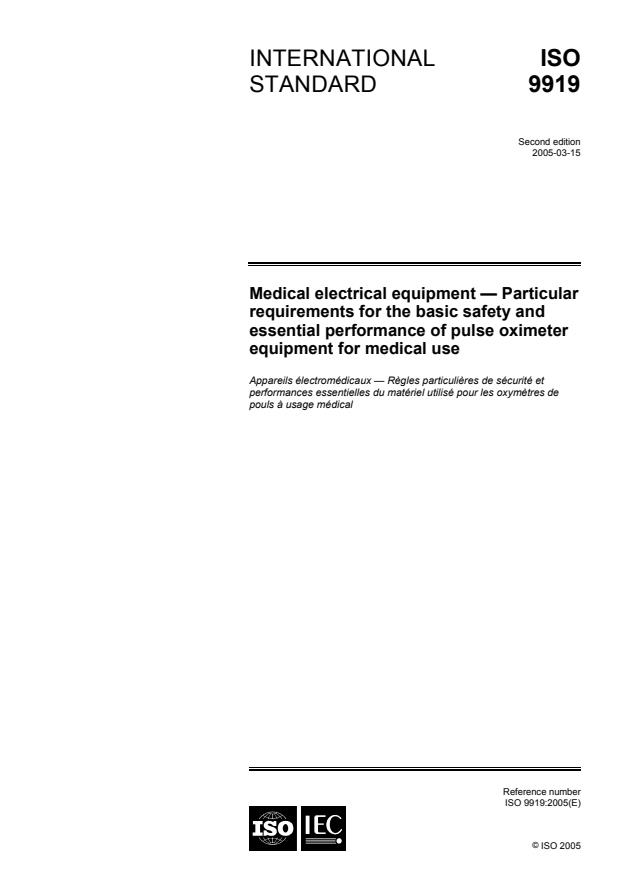
INTERNATIONAL ISO
STANDARD 9919
Second edition
2005-03-15
Medical electrical equipment — Particular
requirements for the basic safety and
essential performance of pulse oximeter
equipment for medical use
Appareils électromédicaux — Règles particulières de sécurité et
performances essentielles du matériel utilisé pour les oxymètres de
pouls à usage médical
Reference number
©
ISO 2005
PDF disclaimer
This PDF file may contain embedded typefaces. In accordance with Adobe's licensing policy, this file may be printed or viewed but
shall not be edited unless the typefaces which are embedded are licensed to and installed on the computer performing the editing. In
downloading this file, parties accept therein the responsibility of not infringing Adobe's licensing policy. The ISO Central Secretariat
accepts no liability in this area.
Adobe is a trademark of Adobe Systems Incorporated.
Details of the software products used to create this PDF file can be found in the General Info relative to the file; the PDF-creation
parameters were optimized for printing. Every care has been taken to ensure that the file is suitable for use by ISO member bodies. In
the unlikely event that a problem relating to it is found, please inform the Central Secretariat at the address given below.
© ISO 2005
All rights reserved. Unless otherwise specified, no part of this publication may be reproduced or utilized in any form or by any means,
electronic or mechanical, including photocopying and microfilm, without permission in writing from either ISO at the address below or
ISO's member body in the country of the requester.
ISO copyright office
Case postale 56 • CH-1211 Geneva 20
Tel. + 41 22 749 01 11
Fax + 41 22 749 09 47
E-mail copyright@iso.org
Web www.iso.org
Published in Switzerland
ii © ISO 2005 – All rights reserved
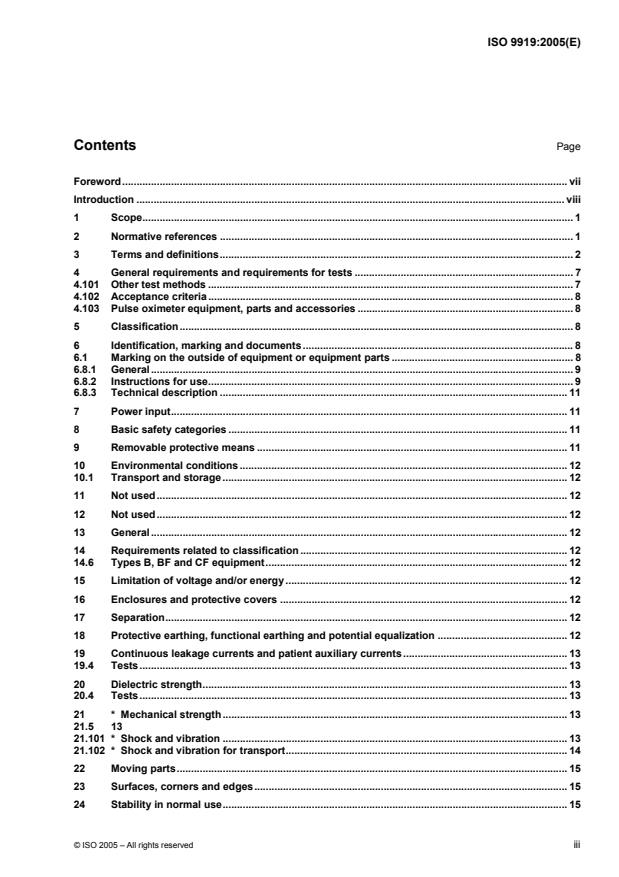
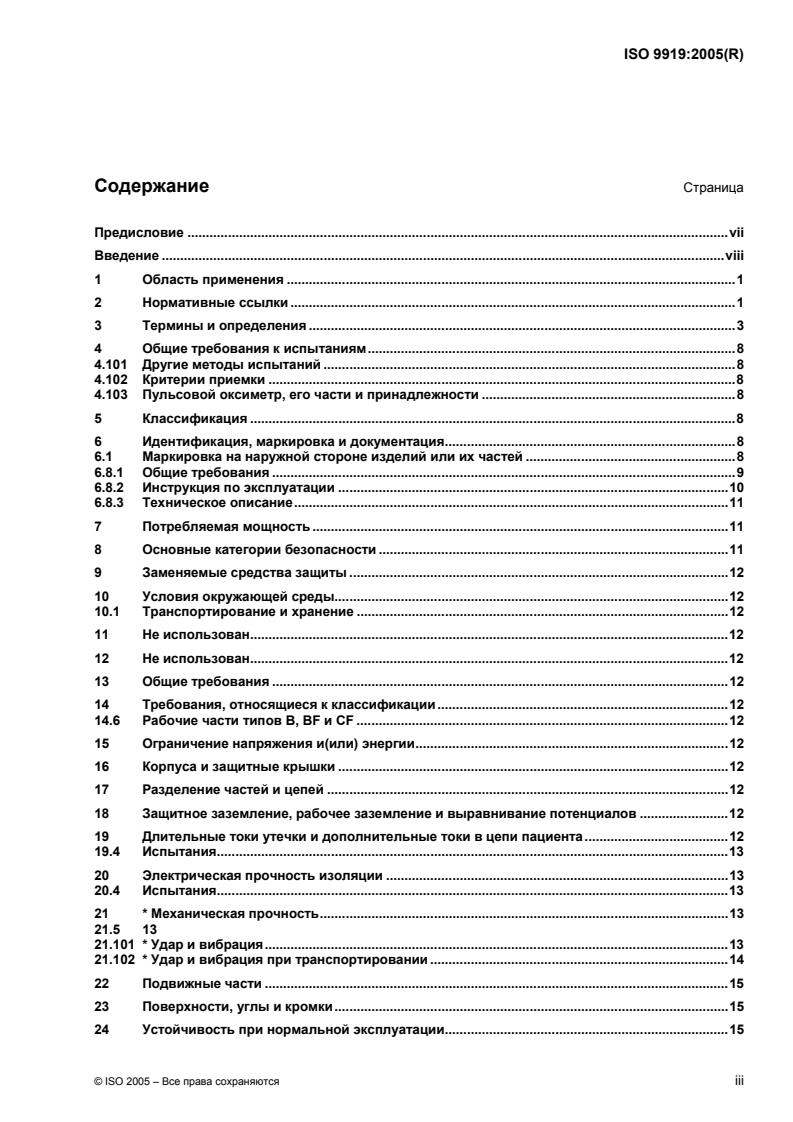
Contents Page
Foreword. vii
Introduction . viii
1 Scope. 1
2 Normative references . 1
3 Terms and definitions. 2
4 General requirements and requirements for tests . 7
4.101 Other test methods . 7
4.102 Acceptance criteria . 8
4.103 Pulse oximeter equipment, parts and accessories . 8
5 Classification. 8
6 Identification, marking and documents. 8
6.1 Marking on the outside of equipment or equipment parts . 8
6.8.1 General. 9
6.8.2 Instructions for use. 9
6.8.3 Technical description . 11
7 Power input. 11
8 Basic safety categories . 11
9 Removable protective means . 11
10 Environmental conditions. 12
10.1 Transport and storage . 12
11 Not used. 12
12 Not used. 12
13 General. 12
14 Requirements related to classification . 12
14.6 Types B, BF and CF equipment. 12
15 Limitation of voltage and/or energy . 12
16 Enclosures and protective covers . 12
17 Separation. 12
18 Protective earthing, functional earthing and potential equalization . 12
19 Continuous leakage currents and patient auxiliary currents . 13
19.4 Tests. 13
20 Dielectric strength. 13
20.4 Tests. 13
21 * Mechanical strength. 13
21.5 13
21.101 * Shock and vibration . 13
21.102 * Shock and vibration for transport. 14
22 Moving parts. 15
23 Surfaces, corners and edges. 15
24 Stability in normal use. 15
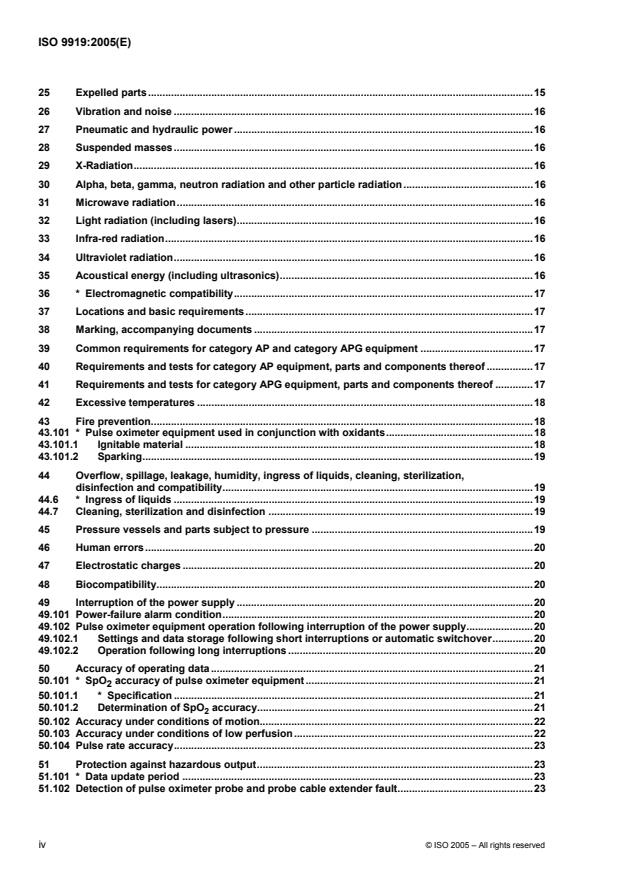
25 Expelled parts.15
26 Vibration and noise .16
27 Pneumatic and hydraulic power .16
28 Suspended masses.16
29 X-Radiation.16
30 Alpha, beta, gamma, neutron radiation and other particle radiation.16
31 Microwave radiation.16
32 Light radiation (including lasers).16
33 Infra-red radiation.16
34 Ultraviolet radiation.16
35 Acoustical energy (including ultrasonics).16
36 * Electromagnetic compatibility.17
37 Locations and basic requirements.17
38 Marking, accompanying documents .17
39 Common requirements for category AP and category APG equipment .17
40 Requirements and tests for category AP equipment, parts and components thereof .17
41 Requirements and tests for category APG equipment, parts and components thereof .17
42 Excessive temperatures .18
43 Fire prevention.18
43.101 * Pulse oximeter equipment used in conjunction with oxidants.18
43.101.1 Ignitable material .18
43.101.2 Sparking.19
44 Overflow, spillage, leakage, humidity, ingress of liquids, cleaning, sterilization,
disinfection and compatibility.19
44.6 * Ingress of liquids .19
44.7 Cleaning, sterilization and disinfection .19
45 Pressure vessels and parts subject to pressure .19
46 Human errors .20
47 Electrostatic charges .20
48 Biocompatibility.20
49 Interruption of the power supply .20
49.101 Power-failure alarm condition.20
49.102 Pulse oximeter equipment operation following interruption of the power supply.20
49.102.1 Settings and data storage following short interruptions or automatic switchover.20
49.102.2 Operation following long interruptions .20
50 Accuracy of operating data .21
50.101 * SpO accuracy of pulse oximeter equipment .21
50.101.1 * Specification .21
50.101.2 Determination of SpO accuracy.21
50.102 Accuracy under conditions of motion.22
50.103 Accuracy under conditions of low perfusion .22
50.104 Pulse rate accuracy.23
51 Protection against hazardous output.23
51.101 * Data update period .23
51.102 Detection of pulse oximeter probe and probe cable extender fault.23
iv © ISO 2005 – All rights reserved
52 Abnormal operation and fault-conditions . 23
53 Environmental tests. 24
54 General. 24
55 Enclosures and covers. 24
56 Components and general assembly .24
57 Mains parts, components and layout. 24
58 Protective earthing — Terminals and connections . 24
59 Construction and layout. 24
101 * Signal inadequacy . 24
102 * Pulse oximeter probes and probe cable extenders . 25
102.1 General. 25
102.2 Labelling. 25
103 Saturation pulse information signal. 25
104 Alarm systems. 25
201.1.2 * Assignment of priority . 25
201.5.4 * Default alarm preset . 26
201.8 Alarm signal inactivation states . 26
201.8.3 Indication and access. 26
105 Appendices of IEC 60601-1:1988. 26
Annex AA (informative) Rationale. 27
Annex BB (informative) Skin temperature at the pulse oximeter probe . 38
Annex CC (informative) Determination of accuracy. 42
Annex DD (informative) Calibration standards. 50
Annex EE (informative) Guideline for evaluating and documenting SpO accuracy in human
subjects. 51
Annex FF (informative) Simulators, calibrators and functional testers for pulse oximeter
equipment . 58
Annex GG (informative) Concepts of equipment response time. 68
Annex HH (informative) Reference to the Essential Principles . 72
Annex II (informative) Environmental aspects. 74
Annex JJ (informative) Index of defined terms. 76
Bibliography . 78
Tables
Table AA.1 — Qualitative assessment of pulse oximeter equipment shock and vibration
environment. 28
Table AA.2 — Allowable maximum temperatures for skin contact with medical electrical
equipment applied parts (adapted from Table 22, IEC/CDV 60601-1:2004) . 30
Table BB.1 — Pulse oximeter probe safe application time and source . 40
Table EE.1 — Example of target plateaus and ranges . 54
Table HH.1 — Correspondence between this International Standard and the Essential Principles. 72
Table II.1 — Environmental aspects addressed by clauses of this International Standard. 75
Figures
Figure CC.1 — Synthesized calibration data (base case) .43
Figure CC.2 — Constant offset has been added to base case .44
Figure CC.3 — Tilt has been added to base case .45
Figure CC.4 — Graphical representation for the definition of local bias (Test sensor SpO as a
function of reference S ) .46
R
Figure CC.5 — Graphical representation for the definition of local bias and mean bias (Test
sensor SpO as a function of reference S ) .46
2 R
Figure EE.1 — Example of desaturation-time profile .54
Figure FF.1 — Sample calibration curve for pulse oximeter equipment .60
Figure FF.2 — Interface of a functional tester that uses a photodiode and LED to interact with a
pulse oximeter probe .61
Figure FF.3 — Interface of a functional tester that uses a dye mixture.62
Figure FF.4 — Interface of a functional tester that uses a liquid crystal modulator.63
Figure FF.5 — Absorbency of blue bandage material (measured in reflection) used in a special
test pulse oximeter probe with great patient-to-patient variability of calibration .65
Figure FF.6 — Calibration of high-variability pulse oximeter probe in controlled desaturation
study on five test subjects .66
Figure FF.6 — Calibration of high-variability pulse oximeter probe in controlled desaturation
study on five test subjects (continued).67
Figure GG.1 — Illustration of fidelity of pulse oximeter equipment performance in tracking
saturation changes.68
Figure GG.2 — Illustration of effect of different averaging times on fidelity .69
Figure GG.3 — Graphic representation of components of alarm system delay.70
Figure GG.4 — Illustration of the effects of different averaging times on a more rapid and noisier
desaturation signal.71
vi © ISO 2005 – All rights reserved
Foreword
ISO (the International Organization for Standardization) is a worldwide federation of national standards bodies
(ISO member bodies). The work of preparing International Standards is normally carried out through ISO
technical committees. Each member body interested in a subject for which a technical committee has been
established has the right to be represented on that committee. International organizations, governmental and
non-governmental, in liaison with ISO, also take part in the work. ISO collaborates closely with the
International Electrotechnical Commission (IEC) on all matters of electrotechnical standardization.
International Standards are drafted in accordance with the rules given in the ISO/IEC Directives, Part 2.
The main task of technical committees is to prepare International Standards. Draft International Standards
adopted by the technical committees are circulated to the member bodies for voting. Publication as an
International Standard requires approval by at least 75 % of the member bodies casting a vote.
Attention is drawn to the possibility that some of the elements of this document may be the subject of patent
rights. ISO shall not be held responsible for identifying any or all such patent rights.
ISO 9919 (IEC 60601-2-54) was prepared jointly by Technical Committee ISO/TC 121, Anaesthetic and
respiratory equipment, Subcommittee SC 3, Lung ventilators and related equipment and Technical Committee
IEC/TC 62, Electrical equipment in medical practice, Subcommittee SC D, Electromedical equipment. The
draft was circulated for voting to the national bodies of both ISO and IEC.
This second edition cancels and replaces the first edition (ISO 9919:1992), which has been technically revised.
Introduction
The approximation of arterial haemoglobin saturation and pulse rate using pulse oximetry is common practice
in many areas of medicine. This International Standard covers basic safety and essential performance
requirements achievable within the limits of existing technology.
Annex AA contains a rationale for some of the requirements. It is included to provide additional insight into the
committee’s reasoning that led to a requirement and identifying the hazards that the requirement addresses.
Annex BB is a literature survey relevant to the determination of the maximum safe temperature of the interface
between a pulse oximeter probe and a patient’s tissue.
Annex CC discusses both the formulae used to evaluate the SpO accuracy of pulse oximeter equipment
measurements, and the names that are assigned to those formulae.
Annex DD presents guidance on when in vitro blood calibration of pulse oximeter equipment is needed.
Annex EE presents a guideline for controlled desaturation study for the calibration of pulse oximeter
equipment.
Annex FF is a tutorial introduction to several kinds of testers used in pulse oximetry.
Annex GG describes concepts of pulse oximeter equipment response time.
This International Standard is a Particular Standard, based on IEC 60601-1:1988, including Amendments 1
(1991) and 2 (1995), hereafter referred to as the General Standard. The General Standard is the basic
standard for the safety of all medical electrical equipment used by or under the supervision of qualified
personnel in the general medical and patient environment; it also contains certain requirements for reliable
operation to ensure safety.
The General Standard has associated Collateral Standards and Particular Standards. The Collateral
Standards include requirements for specific technologies and/or hazards and apply to all applicable equipment,
such as medical systems, EMC, radiation protection in diagnostic X-ray equipment, software, etc. The
Particular Standards apply to specific equipment types, such as medical electron accelerators, high frequency
surgical equipment, hospital beds, etc.
NOTE Definitions of Collateral Standard and Particular Standard can be found in IEC 60601-1:1988, 1.5 and A.2,
respectively.
To facilitate the use of this International Standard, the following drafting conventions have been applied.
The changes to the text of IEC 60601-1:1988, the General Standard, as supplemented by the Collateral
Standards, are specified by the use of the following words.
“Replacement” means that the indicated clause or subclause of the General Standard is replaced
completely by the text of this Particular Standard.
“Addition” means that the relevant text of this Particular Standard is a new element (e.g. subclause, list
element, note, table, figure) additional to the General Standard.
“Amendment” means that existing text of the General Standard is partially modified by deletion and/or
addition as indicated by the text of this Particular Standard.
viii © ISO 2005 – All rights reserved
To avoid confusion with any amendments to the General Standard itself, a particular numbering has been
employed for elements added by this International Standard: clauses, subclauses, tables and figures are
numbered starting from 101; additional list items are lettered aa), bb), etc. and additional annexes are lettered
AA, BB, etc.
In this International Standard, the following print types are used:
requirements, compliance with which can be tested, and definitions: roman type;
notes and examples: smaller roman type;
description of type of document change, and test specifications: italic type;
terms defined in Clause 2 of the General Standard IEC 60601-1:1988 or in this Particular Standard: bold
type.
Throughout this Particular Standard, text for which a rationale is provided in Annex AA is indicated by an
asterisk (*).
INTERNATIONAL STANDARD ISO 9919:2005(E)
Medical electrical equipment — Particular requirements for the
basic safety and essential performance of pulse oximeter
equipment for medical use
1 Scope
IEC 60601-1:1988, Clause 1 applies, except as follows.
Amendment (add at the end of 1.1):
This International Standard specifies particular requirements for the basic safety and essential performance of
pulse oximeter equipment intended for use on humans. This includes any part necessary for normal use,
e.g. the pulse oximeter monitor, pulse oximeter probe, probe cable extender.
These requirements also apply to pulse oximeter equipment, including pulse oximeter monitors, pulse
oximeter probes and probe cable extenders, that has been reprocessed.
The intended use of pulse oximeter equipment includes, but is not limited to, the estimation of arterial
oxygen haemoglobin saturation and pulse rate on patients in healthcare institutions as well as on patients in
home care.
* This International Standard is not applicable to pulse oximeter equipment intended for use in laboratory
research applications nor to oximeters that requires a blood sample from the patient.
This International Standard is not applicable to pulse oximeter equipment solely intended for foetal use.
This International Standard is not applicable to remote or slave (secondary) devices that display SpO values
that are located outside of the patient environment.
The requirements of this International Standard which replace or modify requirements of IEC 60601-1:1988
and its Amendments 1 (1991) and 2 (1995) are intended to take precedence over the corresponding general
requirements.
2 Normative references
The following referenced documents are indispensable for the application of this document. For dated
references, only the edition cited applies. For undated references, the latest edition of the referenced
document (including any amendments) applies.
ISO 7000/IEC 60417:2004, Graphical symbols for use on equipment — Index and synopsis
ISO 14155-1:2003, Clinical investigation of medical devices for human subjects — Part 1: General
requirements
ISO 14155-2:2003, Clinical investigation of medical devices for human subjects — Part 2: Clinical
investigation plans
ISO 14937:2000, Sterilization of health care products — General requirements for characterization of a
sterilizing agent and the development, validation and routine control of a sterilization process for medical
devices
ISO 15223:2000, Medical devices — Symbols to be used with medical device labels, labelling and information
to be supplied
Amendment 1:2002.
Amendment 2:2004.
IEC 60068-2-6:1995, Environmental testing — Part 2-6: Tests — Test Fc. Vibration (sinusoidal)
IEC 60068-2-27:1987, Environmental testing — Part 2-27: Tests — Test Ea and guidance. Shock
IEC 60068-2-32:1975, Environmental testing — Part 2-32: Tests — Test Ed. Free fall
Amendment 1:1982
Amendment 2:1990
IEC 60068-2-64:1993, Environmental testing — Part 2-64: Test methods — Test Fh. Vibration, broad-band
random (digital control) and guidance
IEC 60079-4:1975, Electrical apparatus for explosive gas atmospheres — Part 4: Method of test for ignition
temperature
Amendment 1:1995
IEC 60529:2001, Degrees of protection provided by enclosures (IP code)
1)
IEC 60601-1:1988 , Medical electrical equipment — Part 1: General requirements for safety
Amendment 1:1991
Amendment 2:1995
IEC 60601-1-1:2000, Medical electrical equipment — Part 1-1: General requirements for safety — Collateral
standard: Safety requirements for medical electrical systems
IEC 60601-1-2:2001, Medical electrical equipment — Part 1-2: General requirements for safety — Collateral
standard: Electromagnetic compatibility — Requirements and tests
IEC 60601-1-4:1996, Medical electrical equipment — Part 1-4: General requirements for safety — Collateral
Standard: Programmable electrical medical systems
Amendment 1:1999
IEC 60601-1-6:2004, Medical electrical equipment — Part 1-6: General requirements for safety — Collateral
standard: Usability
IEC 60601-1-8:2003, Medical electrical equipment — Part 1-8: General requirements for safety — Collateral
standard: General requirements, tests and guidance for alarm systems in medical electrical equipment and
medical electrical systems
IEC 60825-1:2001, Safety of laser products — Part 1: Equipment classification, requirements and user's guide
IEC 60825-2:2000, Safety of laser products — Part 2: Safety of optical fibre communication systems (OFCS)
3 Terms and definitions
For the purposes of this International Standard, the terms and definitions given in IEC 60601-1:1988, Clause 2,
as amended by the Collateral Standards, and the following apply.
NOTE For convenience, the sources of all defined terms used in this International Standard are given in Annex JJ.
1) Currently under revision as IEC/CDV 60601-1:2004.
2 © ISO 2005 – All rights reserved
3.1
accuracy
closeness of agreement between a test result and an accepted reference value
NOTE 1 See 50.101.2.2 for the method of calculating the SpO accuracy of pulse oximeter equipment.
NOTE 2 See also discussion in Annex CC.
NOTE 3 Adapted from ISO 3534-1:1993.
3.2
controlled desaturation study
hypoxaemia induced in a human subject performed under laboratory conditions
NOTE This can also be referred to as a controlled hypoxaemia (breathdown) study. See also Annex EE.
3.3
CO-oximeter
multiwavelength, optical blood analyser that measures total haemoglobin concentration and the
concentrations of various haemoglobin derivatives
NOTE The relevant CO-oximetry value is functional saturation of arterial blood, SaO , which pulse oximeter
equipment estimates and reports as SpO .
3.4
data update period
interval in which the pulse oximeter equipment algorithm provides new valid data to the display or the signal
output port
NOTE This definition does not refer to the regular refresh period of the display, which is typically on the order of 1 s,
but rather to the (typically longer) interval defined above.
3.5
declared range
that portion of the displayed range (3.7) of SpO and pulse rate values over which there is specified
accuracy
3.6
demonstration mode
mode in which simulated patient-numbers or patient-waveforms are displayed
NOTE The display in the demonstration mode can be mistaken for real-time patient data if not properly identified.
3.7
displayed range
range of SpO and pulse-rate values that can be displayed by the pulse oximeter equipment
NOTE This range can extend beyond the declared range (3.5).
3.8
fractional oxyhaemoglobin
fractional saturation (obsolete)
FO Hb
oxyhaemoglobin concentration cO Hb divided by the total haemoglobin concentration, ctHb
NOTE 1 This is represented mathematically as:
cO Hb
FO Hb =
ctHb
where
cO Hb is the concentration of oxyhaemoglobin;
ctHB is the concentration of total haemoglobin.
This is sometimes reported as a percentage (multiplying the fraction by 100).
NOTE 2 Fractional oxyhaemoglobin is the term used by the National Committee for Clinical Laboratory Sciences
(NCCLS) for this ratio.
NOTE 3 NCCLS denotes “concentration” by a prefixed letter c, while in the past the convention of square brackets, e.g.
[O Hb], was used.
[5]
NOTE 4 NCCLS uses the following notations:
oxyhaemoglobin (O Hb);
deoxyhaemoglobin (HHb);
carboxyhaemoglobin (COHb);
methaemoglobin (MetHb);
sulfhaemoglobin (SuHb); and
total haemoglobin (tHb).
3.9
functional oxygen saturation
percentage saturation given by the oxyhaemoglobin concentration (cO Hb) divided by the sum of the
oxyhaemoglobin concentration and the deoxyhaemoglobin concentration (cHHb)
NOTE 1 This is represented mathematically as:
100 ⋅ cO Hb
cO Hb + cHHb
[5]
NOTE 2 The NCCLS term for this ratio is haemoglobin oxygen saturation, and its notation is SO .
3.10
functional tester
test device which presents pulse oximeter equipment with a signal having a predictable value of ratio (3.22)
so that the operator can observe the resulting displayed value of SpO , and compare it to the expected value
derived from the manufacturer’s calibration curve for that particular pulse oximeter equipment
NOTE The accuracy of the SpO value given by the pulse oximeter equipment depends in part on whether the
calibration curve of the pulse oximeter monitor properly reflects the optical characteristics of the pulse oximeter probe
and pulse oximeter probe-tissue interaction. Functional testers are not able to confirm the SpO accuracy of the
calibration curve or sufficiently assess the optical characteristics of pulse oximeter probes to determine their proper
calibration. See also FF.4.
3.11
local bias
b
difference between the expectation of the test results (SpO ) and an accepted reference value (SaO )
2 2
NOTE 1 For pulse oximeter equipment, this is, at a given value of the reference oxygen saturation, the difference
between the y-value of the regression line at that coordinate and the y-value of the line of identity, in a plot of SpO versus
S , or given by:
R
b = SpO − S
i 2fit, i R i
where SpO is the value of the curve fitted to the test data at the ith reference oxygen saturation value, S
2fit, i R i
4 © ISO 2005 – All rights reserved
NOTE 2 See also mean bias (3.13) and discussion in Annex CC.
NOTE 3 Adapted from ISO 3534-1:1993.
3.12
manufacturer
natural or legal person with responsibility for the design, the manufacture, the packaging, the reprocessing,
the marking, or the accompanying documents of pulse oximeter equipment, pulse oximeter monitors,
pulse oximeter probes, probe extender cables or the adaptation of those items, regardless of whether
these operations are carried out by that person him/herself or on his/her behalf by a third party
NOTE Adapted from IEC/CDV2 60601-1:2004, definition 3.54.
3.13
mean bias
B
mean difference between the test and reference values, preserving sign
NOTE 1 For pulse oximeters, this is represented mathematically as:
n
SpO − S
()
2Rii
∑
i=1
B =
n
where
n is the number of data pairs in the sample within the range of interest,
SpO is the ith SpO datum;
2i 2
S is the ith reference oxygen saturation value.
Ri
NOTE 2 See also local bias (3.11) and discussion in Annex CC.
NOTE 3 When defined in this way, mean bias is the average of all local bias values, b .
i
3.14
normalized
displayed at constant amplitude, independent of the actual magnitude of the signal being displayed
3.15
operator settings
current state of any pulse oximeter monitor controls, including alarm settings
3.16
precision
closeness of agreement between independent test results obtained under stipulated conditions
NOTE 1 For pulse oximeter equipment, it is expressed as the standard deviation of the residuals, s , represented
res
mathematically as:
n
SpO − SpO
()
22iifit,
∑
i=1
s =
res
n − 2
()
where
n is the number of data pairs in the sample within the range of interest;
(SpO − SpO ) is the difference between the ith SpO datum and the value of the fitted curve corresponding to
2i 2fit, i 2
the ith reference oxygen saturation value, S .
Ri
NOTE 2 See also discussion in Annex CC.
NOTE 3 Adapted from ISO 3534-1:1993.
3.17
probe cable extender
cable that connects pulse oximeter monitor to pulse oximeter probe
NOTE 1 Not every pulse oximeter equipment utilizes a probe cable extender.
NOTE 2 A probe cable extender can be an applied part.
3.18
pulse oximeter equipment
medical electrical equipment for the non-invasive estimation of functional oxygen saturation of arterial
haemoglobin (SpO ) from a light signal interacting with tissue, by using the time-dependent changes in tissue
optical properties that occur with pulsatile blood flow
NOTE 1 Pulse oximeter equipment comprises a pulse oximeter monitor, a probe cable extender, if provided, and
a pulse oximeter probe, which can be combined in a single assembly.
NOTE 2 Light is more technically referred to as electromagnetic radiation (optical radiation). This International
Standard uses the common term.
3.19
pulse oximeter monitor
part of the pulse oximeter equipment that encompasses the electronics, display and user interface,
excluding the pulse oximeter probe and probe cable extender
NOTE The pulse oximeter monitor can consist of multiple pieces of hardware in separate locations, for example, a
telemetry system in which the applied part and primary display are in physically different locations.
3.20
pulse oximeter probe
part of the pulse oximeter equipment that includes the applied part and transducer component
NOTE 1 The terms sensor and transducer have also been used for pulse oximeter probe.
NOTE 2 The pulse oximeter probe typically consists of a cable and a rigid or flexible assembly containing two photo
emitters and a photo detector.
3.21
pulse oximeter probe fault
abnormal condition of the pulse oximeter probe or probe cable extender, that, if not detected, could
compromise patient safety
NOTE Patient safety can be compromised by providing incorrect values, by exposing the patient to high pulse
oximeter probe temperatures or by introducing a risk of electric shock.
6 © ISO 2005 – All rights reserved
3.22
ratio
Modulation Ratio
Ratio of Ratios
R
basic quantity derived by pulse oximeter equipment from time-dependent light intensity measurements
NOTE Pulse oximeter equipment uses an empirical calibration curve to derive SpO from R. See also FF.4.
3.23
* reprocessing
any activity, not specified in the accompanying documents, that renders a used product ready for re-use
NOTE 1 Such activities are often referred to as refinishing, restoring, recycling, refurbishing, repairing or
remanufacturing.
NOTE 2 Such activities can occur in healthcare facilities.
3.24
SaO
fraction of functional haemoglobin in arterial blood that is saturated with oxygen
NOTE 1 See 50.101.2.2 for requirements on acceptable methods of measurement of SaO .
NOTE 2 SaO is functional oxygen saturation in arterial blood (see 3.9).
NOTE 3 This is normally expressed as a percentage (multiplying the fraction by 100).
3.25
SpO
estimate of SaO made by pulse oximeter equipment
NOTE 1 Two-wavelength pulse oximeter equipment cannot compensate for the interference caused by the presence
[56]
of dyshaemoglobins in their estimation of SaO .
NOTE 2 This is normally reported as a percentage (multiplying the fraction by 100).
3.26
total haemoglobin concentration
ctHb
sum of concentrations of all haemoglobin species including, but not limited to, oxyhaemoglobin (cO Hb),
methaemoglobin (cMetHb), deoxyhaemoglobin (cHHb), sulfhaemoglobin (cSuHb) and carboxyhaemoglobin
(cCOHb)
NOTE See also reference [16].
4 General requirements and requirements for tests
IEC 60601-1:1988, Clauses 3 and 4 apply, except as follows.
Addition:
4.101 Other test methods
The manufacturer may use type tests different from those detailed within this International Standard if a
degree of safety
...
NORME ISO
INTERNATIONALE 9919
Deuxième édition
2005-03-15
Appareils électromédicaux — Règles
particulières de sécurité et performances
essentielles du matériel utilisé pour les
oxymètres de pouls à usage médical
Medical electrical equipment — Particular requirements for the basic
safety and essential performance of pulse oximeter equipment for
medical use
Numéro de référence
©
ISO 2005
PDF – Exonération de responsabilité
Le présent fichier PDF peut contenir des polices de caractères intégrées. Conformément aux conditions de licence d'Adobe, ce fichier
peut être imprimé ou visualisé, mais ne doit pas être modifié à moins que l'ordinateur employé à cet effet ne bénéficie d'une licence
autorisant l'utilisation de ces polices et que celles-ci y soient installées. Lors du téléchargement de ce fichier, les parties concernées
acceptent de fait la responsabilité de ne pas enfreindre les conditions de licence d'Adobe. Le Secrétariat central de l'ISO décline toute
responsabilité en la matière.
Adobe est une marque déposée d'Adobe Systems Incorporated.
Les détails relatifs aux produits logiciels utilisés pour la création du présent fichier PDF sont disponibles dans la rubrique General Info
du fichier; les paramètres de création PDF ont été optimisés pour l'impression. Toutes les mesures ont été prises pour garantir
l'exploitation de ce fichier par les comités membres de l'ISO. Dans le cas peu probable où surviendrait un problème d'utilisation,
veuillez en informer le Secrétariat central à l'adresse donnée ci-dessous.
© ISO 2005
Droits de reproduction réservés. Sauf prescription différente, aucune partie de cette publication ne peut être reproduite ni utilisée sous
quelque forme que ce soit et par aucun procédé, électronique ou mécanique, y compris la photocopie et les microfilms, sans l'accord écrit
de l'ISO à l'adresse ci-après ou du comité membre de l'ISO dans le pays du demandeur.
ISO copyright office
Case postale 56 • CH-1211 Geneva 20
Tel. + 41 22 749 01 11
Fax. + 41 22 749 09 47
E-mail copyright@iso.org
Web www.iso.org
Publié en Suisse
ii © ISO 2005 – Tous droits réservés
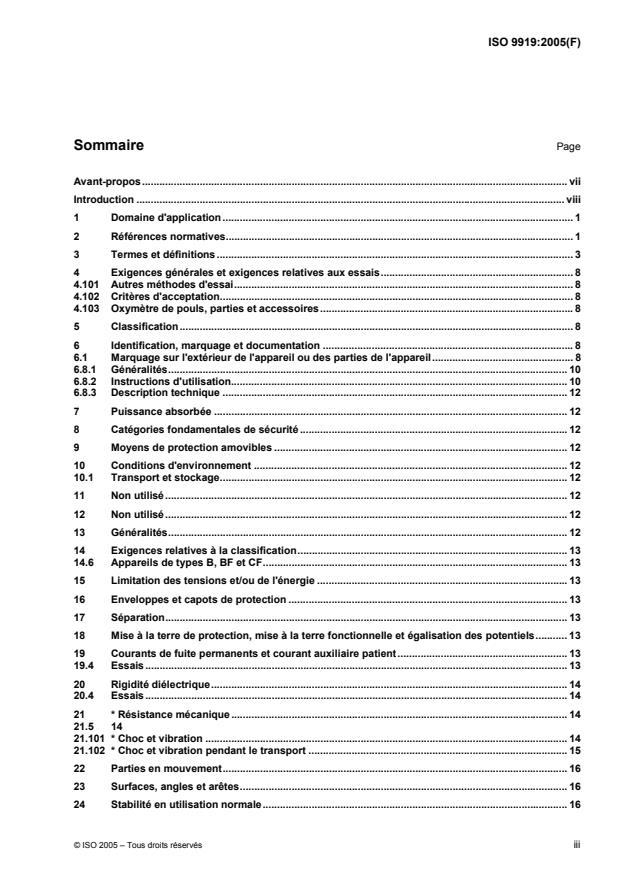
Sommaire Page
Avant-propos. vii
Introduction . viii
1 Domaine d'application. 1
2 Références normatives. 1
3 Termes et définitions . 3
4 Exigences générales et exigences relatives aux essais. 8
4.101 Autres méthodes d'essai. 8
4.102 Critères d'acceptation. 8
4.103 Oxymètre de pouls, parties et accessoires. 8
5 Classification. 8
6 Identification, marquage et documentation .8
6.1 Marquage sur l'extérieur de l'appareil ou des parties de l'appareil. 8
6.8.1 Généralités. 10
6.8.2 Instructions d'utilisation. 10
6.8.3 Description technique . 12
7 Puissance absorbée . 12
8 Catégories fondamentales de sécurité. 12
9 Moyens de protection amovibles . 12
10 Conditions d'environnement . 12
10.1 Transport et stockage. 12
11 Non utilisé. 12
12 Non utilisé. 12
13 Généralités. 12
14 Exigences relatives à la classification. 13
14.6 Appareils de types B, BF et CF. 13
15 Limitation des tensions et/ou de l'énergie . 13
16 Enveloppes et capots de protection . 13
17 Séparation. 13
18 Mise à la terre de protection, mise à la terre fonctionnelle et égalisation des potentiels. 13
19 Courants de fuite permanents et courant auxiliaire patient. 13
19.4 Essais. 13
20 Rigidité diélectrique. 14
20.4 Essais. 14
21 * Résistance mécanique. 14
21.5 14
21.101 * Choc et vibration . 14
21.102 * Choc et vibration pendant le transport . 15
22 Parties en mouvement. 16
23 Surfaces, angles et arêtes. 16
24 Stabilité en utilisation normale. 16
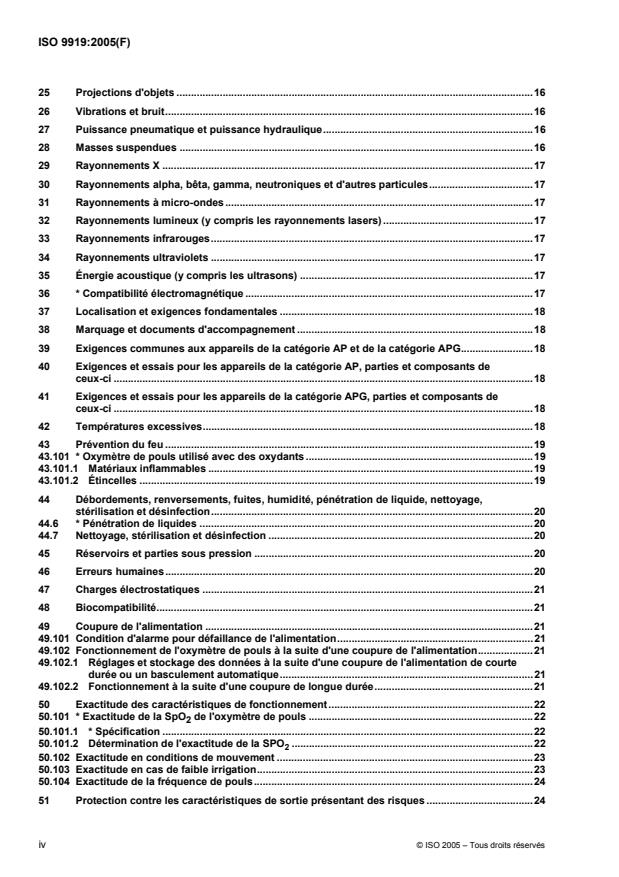
25 Projections d'objets .16
26 Vibrations et bruit.16
27 Puissance pneumatique et puissance hydraulique.16
28 Masses suspendues .16
29 Rayonnements X .17
30 Rayonnements alpha, bêta, gamma, neutroniques et d'autres particules.17
31 Rayonnements à micro-ondes.17
32 Rayonnements lumineux (y compris les rayonnements lasers) .17
33 Rayonnements infrarouges.17
34 Rayonnements ultraviolets .17
35 Énergie acoustique (y compris les ultrasons) .17
36 * Compatibilité électromagnétique .17
37 Localisation et exigences fondamentales .18
38 Marquage et documents d'accompagnement .18
39 Exigences communes aux appareils de la catégorie AP et de la catégorie APG.18
40 Exigences et essais pour les appareils de la catégorie AP, parties et composants de
ceux-ci .18
41 Exigences et essais pour les appareils de la catégorie APG, parties et composants de
ceux-ci .18
42 Températures excessives.18
43 Prévention du feu .19
43.101 * Oxymètre de pouls utilisé avec des oxydants .19
43.101.1 Matériaux inflammables .19
43.101.2 Étincelles .19
44 Débordements, renversements, fuites, humidité, pénétration de liquide, nettoyage,
stérilisation et désinfection.20
44.6 * Pénétration de liquides .20
44.7 Nettoyage, stérilisation et désinfection .20
45 Réservoirs et parties sous pression .20
46 Erreurs humaines.20
47 Charges électrostatiques .21
48 Biocompatibilité.21
49 Coupure de l'alimentation .21
49.101 Condition d'alarme pour défaillance de l'alimentation.21
49.102 Fonctionnement de l'oxymètre de pouls à la suite d'une coupure de l'alimentation.21
49.102.1 Réglages et stockage des données à la suite d'une coupure de l'alimentation de courte
durée ou un basculement automatique.21
49.102.2 Fonctionnement à la suite d'une coupure de longue durée.21
50 Exactitude des caractéristiques de fonctionnement.22
50.101 * Exactitude de la SpO de l'oxymètre de pouls .22
50.101.1 * Spécification .22
50.101.2 Détermination de l'exactitude de la SPO .22
50.102 Exactitude en conditions de mouvement .23
50.103 Exactitude en cas de faible irrigation.23
50.104 Exactitude de la fréquence de pouls.24
51 Protection contre les caractéristiques de sortie présentant des risques .24
iv © ISO 2005 – Tous droits réservés
51.101 * Période de mise à jour des données . 24
51.102 Détection des défauts du capteur de l'oxymètre de pouls et du câble de raccordement du
capteur . 24
52 Fonctionnement anormal et conditions de défaut . 25
53 Essais d'environnement. 25
54 Généralités. 25
55 Enveloppes et capots . 25
56 Composants et ensembles. 25
57 Parties reliées au réseau, composants et montage . 25
58 Mise à la terre de protection — Bornes et raccordements. 25
59 Construction et montage. 25
101 * Invalidité du signal . 26
102 * Capteurs de l'oxymètre de pouls et câbles de raccordement du capteur. 26
102.1 Généralités. 26
102.2 Étiquetage. 26
103 Signal d'information en cas de saturation. 27
201 Systèmes d'alarme. 27
201.1.2 * Attribution de priorité . 27
201.5.4 *Préréglage d'alarme par défaut. 27
201.8 États d'inactivation du signal d'alarme. 27
201.8.3 Indication et accès. 27
105 Appendices de la CEI 60601-1:1988 . 27
Annexe AA (informative) Justifications. 28
Annexe BB (informative) Température de la peau au niveau du capteur de l'oxymètre de pouls. 40
Annexe CC (informative) Détermination de l'exactitude. 44
Annexe DD (informative) Étalons. 54
Annexe EE (informative) Lignes directrices pour l'évaluation et la documentation relative à
l'exactitude de la SpO chez des sujets humains . 55
Annexe FF (informative) Simulateurs, dispositifs d'étalonnage et dispositifs d'essai fonctionnel
utilisés pour les oxymètres de pouls. 63
Annexe GG (informative) Concepts relatifs au temps de réponse du système . 74
Annexe HH (informative) Références aux principes essentiels. 78
Annexe II (informative) Aspects environnementaux. 80
Annexe JJ (informative) Index des termes définis. 82
Bibliographie . 84
Tableaux
Tableau AA.1 — Évaluation qualitative de l'environnement de l'oxymètre de pouls concernant les
chocs et les vibrations . 29
Tableau AA.2 — Températures maximales admissibles pour les parties appliquées d'un appareil
en contact avec la peau (adapté du Tableau 22 de la CEI/CDV 60601-1:2004). 32
Tableau BB.1 — Temps d'application sûr du capteur de l'oxymètre de pouls et source. 42
Tableau EE.1 — Exemple de plateaux et de plages cibles .58
Tableau HH.1 — Correspondances entre la présente Norme internationale et les principes
essentiels .78
Tableau II.1 — Aspects environnementaux traités par les articles de la présente Norme
internationale .81
Figures
Figure CC.1 — Données d'étalonnage synthétisées (référence).46
Figure CC.2 — L'écart constant a été ajouté à la référence.47
Figure CC.3 — Un angle a été ajouté à la référence .48
Figure CC.4 — Représentation graphique de la définition de l'erreur de justesse locale (Valeur de
la SpO du capteur d'essai en fonction de S de référence).49
2 R
Figure CC.5 — Représentation graphique de la définition de l'erreur de justesse locale et de
l'erreur de justesse moyenne (Valeur de la SpO du capteur d'essai en fonction de S de
2 R
référence) .49
Figure EE.1 — Exemple de profil de désaturation par rapport au temps.59
Figure FF.1 — Courbe d'étalonnage de l'échantillon pour l'oxymètre de pouls.65
Figure FF.1 — Interface d'un dispositif d'essai fonctionnel utilisant une photodiode et une diode
électroluminescente (DEL) pour interagir avec un capteur d'oxymètre de pouls.67
Figure FF.3 — Interface d'un dispositif d'essai fonctionnel utilisant un mélange coloré .68
Figure FF.4 — Interface d'un dispositif d'essai fonctionnel utilisant un modulateur à cristaux
liquides .68
Figure FF.5 — Capacité d'absorption d'un matériau de pansement bleu (mesurée par réflexion)
utilisé avec un capteur de l'oxymètre de pouls spécial présentant une grande variabilité
d'étalonnage d'un patient à l'autre .71
Figure FF.6 — Étalonnage d'un capteur de l'oxymètre de pouls présentant une grande variabilité
d'étalonnage lors d'une étude de désaturation contrôlée impliquant cinq sujets d'essai.72
Figure FF.6 — Étalonnage d'un capteur de l'oxymètre de pouls présentant une grande variabilité
d'étalonnage lors d'une étude de désaturation contrôlée impliquant cinq sujets d'essai
(suite).73
Figure GG.1 — Illustration de la fidélité des performances de l'oxymètre de pouls dans le suivi
des modifications de la saturation .75
Figure GG.2 — Illustration de l'influence des différents temps d'intégration sur la fidélité .75
Figure GG.3 — Représentation graphique des facteurs intervenant dans le délai du système
d'alarme .76
Figure GG.4 — Illustration des effets de différents temps d'intégration sur un signal de
désaturation plus bruyant et plus rapide.77
vi © ISO 2005 – Tous droits réservés
Avant-propos
L'ISO (Organisation internationale de normalisation) est une fédération mondiale d'organismes nationaux de
normalisation (comités membres de l'ISO). L'élaboration des Normes internationales est en général confiée
aux comités techniques de l'ISO. Chaque comité membre intéressé par une étude a le droit de faire partie du
comité technique créé à cet effet. Les organisations internationales, gouvernementales et non
gouvernementales, en liaison avec l'ISO participent également aux travaux. L'ISO collabore étroitement avec
la Commission électrotechnique internationale (CEI) en ce qui concerne la normalisation électrotechnique.
Les Normes internationales sont rédigées conformément aux règles données dans les Directives ISO/CEI,
Partie 2.
La tâche principale des comités techniques est d'élaborer les Normes internationales. Les projets de Normes
internationales adoptés par les comités techniques sont soumis aux comités membres pour vote. Leur
publication comme Normes internationales requiert l'approbation de 75 % au moins des comités membres
votants.
L'attention est appelée sur le fait que certains des éléments du présent document peuvent faire l'objet de
droits de propriété intellectuelle ou de droits analogues. L'ISO ne saurait être tenue pour responsable de ne
pas avoir identifié de tels droits de propriété et averti de leur existence.
L'ISO 9919 (CEI 60601-2-54) a été élaborée conjointement par le comité technique ISO/TC 121, Matériel
d'anesthésie et de réanimation respiratoire, sous-comité SC 3, Ventilateurs pulmonaires et équipements
connexes, et le comité technique CEI/TC 62, Matériel électrique à usage médical, sous-comité SC D, Matériel
électromédical. Le projet a été soumis au vote des comités nationaux de l'ISO et de la CEI.
Cette deuxième édition annule et remplace la première édition (ISO 9919:1992), dont elle constitue une
révision technique.
Introduction
La mesure approchée de la saturation de l'hémoglobine artérielle et de la fréquence du pouls par le biais de
l'oxymétrie de pouls est une pratique courante dans de nombreuses spécialités de la médecine. La présente
Norme internationale couvre les exigences essentielles de sécurité et de performance pouvant être atteintes
dans les limites de la technologie existante.
L'Annexe AA contient un justificatif de certaines exigences. Il est inclus de façon à fournir un aperçu
supplémentaire dans le raisonnement suivi au sein du comité et ayant abouti à une exigence, ainsi que
l'identification des risques traités par l'exigence.
L'Annexe BB propose une enquête bibliographique relative à la détermination de la température de sécurité
maximale de l'interface entre le capteur de l'oxymètre de pouls et le tissu du patient.
L'Annexe CC s'intéresse à la fois aux formules mathématiques utilisées pour évaluer l'exactitude de la SpO
des mesurages de l'oxymètre de pouls et aux noms attribués à ces formules.
L'Annexe DD constitue un guide pour les situations dans lesquelles un étalonnage de l'oxymètre de pouls
par une analyse de sang in vitro est nécessaire.
L'Annexe EE propose des lignes directrices pour l'étude de désaturation contrôlée permettant l'étalonnage
de l'oxymètre de pouls.
L'Annexe FF est une introduction didactique à différents types de dispositifs d'essai utilisés dans l'oxymétrie
de pouls.
L'Annexe GG définit les concepts relatifs au temps de réponse de l'oxymètre de pouls.
La présente Norme internationale est une norme particulière basée sur la CEI 60601-1:1988, comportant les
Amendements 1 (1991) et 2 (1995), à laquelle il est fait référence sous l'appellation de norme générale. La
norme générale est la norme de base pour la sécurité de l'ensemble des appareils électromédicaux utilisés
par ou sous la supervision du personnel qualifié dans l'environnement médical général et celui du patient; elle
contient également certaines exigences pour le fonctionnement fiable permettant de garantir la sécurité.
La norme générale est associée à des normes collatérales et à des normes particulières. Les normes
collatérales comportent des exigences relatives à des technologies spécifiques et/ou à des dangers/risques,
et s'appliquent à tout l'équipement applicable, tel que les systèmes médicaux, la CEM, la protection contre les
rayonnements dans les appareils de diagnostic à rayons X, les logiciels, etc. Les normes particulières
s'appliquent aux types d'équipement spécifiques, tels que les accélérateurs d'électrons médicaux, de
l'équipement chirurgical à haute fréquence, des lits d'hôpital, etc.
NOTE Les définitions de norme collatérale et de norme particulière se trouvent en 1.5 et A.2, respectivement, de la
CEI 60601-1:1988.
Pour faciliter l'utilisation de la présente Norme internationale, les conventions de rédaction suivantes ont été
appliquées.
Les changements par rapport au texte de la CEI 60601-1:1988, la norme générale, ajoutés par les normes
collatérales, sont signalés par l'utilisation des mots suivants.
«Remplacement» signifie que l'article ou le paragraphe de la norme générale est remplacé en intégralité
par le texte de la présente norme particulière.
«Ajout» signifie que le texte de la présente norme particulière est un nouvel élément (par exemple
paragraphe, point de liste, note, tableau, figure) venant compléter la norme générale.
viii © ISO 2005 – Tous droits réservés
«Amendement» signifie que le texte existant de la norme générale est en partie modifié par suppression
et/ou addition comme indiqué par le texte de la présente norme particulière.
Pour éviter toute confusion avec tout amendement à la norme générale en elle-même, une numérotation
particulière a été employée pour les éléments ajoutés par la présente Norme internationale: articles,
paragraphes, tableaux et figures sont numérotés en commençant à partir de 101; les points de liste
supplémentaires sont appelés aa), bb), etc. et les annexes supplémentaires sont appelées AA, BB, etc.
Dans la présente Norme internationale, les types de police suivants sont utilisés:
pour les exigences, dont la conformité peut être vérifiée, et pour les définitions: romain;
pour les notes et exemples: romain avec une police plus petite;
pour la description d'un type de changement de document et pour les spécifications d'essai: italique;
pour les termes définis dans l'Article 2 de la norme générale CEI 60601-1:1988, et pour les termes définis
dans la présente norme particulière: gras.
Tout texte de la présente Norme internationale pour lequel il existe une justification dans l'Annexe AA est
signalé par un astérisque (*).
NORME INTERNATIONALE ISO 9919:2005(F)
Appareils électromédicaux — Règles particulières de sécurité
et performances essentielles du matériel utilisé pour les
oxymètres de pouls à usage médical
1 Domaine d'application
L'Article 1 de la CEI 60601-1:1998 s'applique avec les modifications et les ajouts suivants.
Amendement (à ajouter à la fin de 1.1):
La présente Norme internationale spécifie les exigences particulières de sécurité minimale et de
performances essentielles des oxymètres de pouls conçus pour une utilisation chez les êtres humains. Sont
inclus tous les éléments de l'appareil nécessaires pour une utilisation normale, tels que le moniteur de
l'oxymètre de pouls, le capteur de l'oxymètre de pouls, le câble de raccordement du capteur.
Ces exigences s'appliquent de la même manière aux oxymètres de pouls, y compris aux moniteurs
d'oxymètre de pouls, aux capteurs d'oxymètre de pouls et aux câbles de raccordement du capteur, qui
ont été remis en état.
L'usage prévu des oxymètres de pouls inclut notamment, sans toutefois s'y limiter, l'estimation de la
saturation en oxygène de l'hémoglobine artérielle et de la fréquence du pouls chez des patients, en
établissement de soins ainsi que chez les patients soignés à domicile.
* La présente Norme internationale ne s'applique pas aux oxymètres de pouls destinés à être utilisés dans
le cadre de recherches en laboratoire, de même qu'aux oxymètres nécessitant un échantillon de sang du
patient.
La présente Norme internationale ne s'applique pas aux oxymètres de pouls destinés à surveiller un fœtus.
La présente Norme internationale ne s'applique pas aux dispositifs distants ou esclaves (secondaires) qui
affichent les valeurs de la SpO et qui sont situés à l'extérieur de l'environnement du patient.
Les exigences de la présente Norme internationale qui remplacent ou modifient les exigences de la
CEI 60601-1:1998 et ses Amendements 1 (1991) et 2 (1995), sont destinées à avoir la priorité sur les
exigences générales correspondantes.
2 Références normatives
Les documents de référence suivants sont indispensables pour l'application du présent document. Pour les
références datées, seule l'édition citée s'applique. Pour les références non datées, la dernière édition du
document de référence s'applique (y compris les éventuels amendements).
ISO 7000/CEI 60417:2004, Symboles graphiques utilisables sur le matériel — Index et tableau synoptique
ISO 14155-1:2003, Investigation clinique des dispositifs médicaux pour sujets humains — Partie 1: Exigences
générales
ISO 14155-2:2003, Investigation clinique des dispositifs médicaux pour sujets humains — Partie 2: Plans
d'investigation clinique
ISO 14937:2000, Stérilisation des produits de santé — Exigences générales pour la caractérisation d'un agent
stérilisant et pour le développement, la validation et la vérification de routine d'un processus de stérilisation
pour dispositifs médicaux
ISO 15223:2000, Dispositifs médicaux — Symboles à utiliser avec les étiquettes, l'étiquetage et les
informations à fournir relatifs aux dispositifs médicaux
Amendement 1:2002
Amendement 2:2004
CEI 60068-2-6:1995, Essais d'environnement — Partie 2-6: Essais — Essai Fc: Vibrations (sinusoïdales)
CEI 60068-2-27:1987, Essais d'environnement — Partie 2-27: Essais — Essai Ea et guide: Chocs
CEI 60068-2-32:1975, Essais fondamentaux climatiques et de robustesse mécanique — Partie 2-32:
Essais — Essai Ed: Chute libre
Amendement 1:1982
Amendement 2:1990
CEI 60068-2-64:1993, Essais d'environnement — Partie 2-64: Méthodes d'essai — Essai Fh: Vibrations
aléatoires à large bande (asservissement numérique) et guide
CEI 60079-4:1975, Matériel électrique pour atmosphères explosives gazeuses — Partie 4: Méthode d'essai
pour la détermination de la température d'inflammation
Amendement 1:1995
CEI 60529:2001, Degrés de protection procurés par les enveloppes (code IP)
1)
CEI 60601-1:1988 , Appareils électromédicaux — Partie 1: Règles générales de sécurité
Amendement 1:1991
Amendement 2:1995
CEI 60601-1-1:2000, Appareils électromédicaux — Partie 1-1: Règles générales de sécurité — Norme
collatérale: Règles de sécurité pour systèmes électromédicaux
CEI 60601-1-2:2001, Appareils électromédicaux — Partie 1-2: Règles générales de sécurité — Norme
collatérale: Compatibilité électromagnétique — Exigences et essais
CEI 60601-1-4:1996, Appareils électromédicaux — Partie 1-4: Règles générales de sécurité — Norme
collatérale: Systèmes électromédicaux programmables
Amendement 1:1999.
CEI 60601-1-6:2004, Appareils électromédicaux — Partie 1-6: Règles générales de sécurité — Norme
collatérale: Utilisation — Analyse, essai et validation de la compatibilité des facteurs humains
CEI 60601-1-8:2003, Appareils électromédicaux — Partie 1-8: Règles générales de sécurité — Norme
collatérale: Règles générales, essais et guides pour les systèmes d'alarme dans l'équipement électromédical
et les systèmes électromédicaux
CEI 60825-1:2001, Sécurité des appareils à laser — Partie 1: Classification des matériels, exigences et guide
de l'utilisateur
CEI 60825-2:2000, Sécurité des appareils à laser — Partie 2: Sécurité des systèmes de télécommunication
par fibres optiques
1) En cours de révision comme CEI/CDV 60601-1:2004.
2 © ISO 2005 – Tous droits réservés
3 Termes et définitions
Pour les besoins de la présente Norme internationale, les termes et définitions donnés dans l'Article 2 de la
CEI 60601-1:1988, telle qu'amendée par les normes collatérales, ainsi que les suivants s'appliquent.
NOTE Pour des raisons de commodité, les sources de tous les termes définis utilisés dans la présente Norme
internationale sont données dans l'Annexe JJ.
3.1
exactitude
étroitesse de l'accord entre le résultat d'un mesurage et une valeur de référence acceptée
NOTE 1 Pour la méthode de calcul de l'exactitude de la SpO des oxymètres de pouls, voir en 50.101.2.2.
NOTE 2 Voir également l'Annexe CC.
NOTE 3 Adaptée de l'ISO 3534-1:1993.
3.2
étude de désaturation contrôlée
hypoxémie induite chez un sujet humain dans des conditions de laboratoire
NOTE Cette étude peut également être appelée «étude d'hypoxémie (breathdown – par diminution de la teneur en
oxygène) contrôlée». Voir également l'Annexe EE.
3.3
CO-oxymètre
appareil d'analyse optique du sang, à multilongueur d'ondes, qui mesure la concentration en hémoglobine
totale et des différents dérivés de l'hémoglobine
NOTE La valeur pertinente en CO-oxymètrie est la saturation fonctionnelle du sang artériel ou SaO , estimée par
l'oxymètre de pouls et reportée comme SpO .
3.4
période de mise à jour des données
intervalle de temps après lequel l'algorithme de l'oxymètre de pouls fournit de nouvelles données valides à
l'affichage ou en sortie de signal
NOTE Cette définition ne désigne pas le rafraîchissement régulier de l'affichage, qui est généralement de l'ordre de
1 s, mais plutôt l'intervalle de temps (généralement plus long) défini ci-dessus.
3.5
plage déclarée
portion de la plage d'affichage (3.7) de la SpO et de fréquence de pouls dont l'exactitude est spécifiée
3.6
mode démonstration
mode affichant une simulation pour les valeurs ou les formes d'onde des patients
NOTE L'affichage en mode démonstration peut être confondu avec les données du patient affichées en temps réel,
en l'absence d'identification claire.
3.7
plage d'affichage
plage de la valeur de la SpO et de fréquence de pouls pouvant être affichée par l'oxymètre de pouls
NOTE Cette plage peut être étendue au-delà de la plage déclarée (3.5).
3.8
oxyhémoglobine fractionnaire
saturation fractionnaire (précédemment)
FO Hb
concentration en oxyhémoglobine cO Hb divisée par la concentration en hémoglobine totale ctHb
NOTE 1 Ceci est mathématiquement représenté par la formule suivante:
cO Hb
FO Hb =
ctHb
où
cO Hb est la concentration en oxyhémoglobine;
ctHb est la concentration en hémoglobine totale.
Cette valeur est parfois rapportée sous forme de pourcentage (en multipliant la fraction par 100).
NOTE 2 Oxyhémoglobine fractionnaire est le terme utilisé par le NCCLS (National Committee for Clinical Laboratory
Sciences) pour désigner ce rapport.
NOTE 3 Le NCCLS marque la «concentration» par un préfixe c, alors que dans le passé, la convention voulait que des
crochets soient employés, par exemple [O Hb].
[5]
NOTE 4 Le NCCLS utilise les notations suivantes:
oxyhémoglobine (O Hb);
désoxyhémoglobine (HHb);
carboxyhémoglobine (COHb);
méthémoglobine (MetHb);
sulfhémoglobine (SuHb); et
hémoglobine totale (tHb).
3.9
saturation fonctionnelle en oxygène
saturation en pourcentage donnée par la concentration en oxyhémoglobine (cO Hb) divisée par la somme
des concentrations en oxyhémoglobine et en désoxyhémoglobine (cHHb)
NOTE 1 Ceci est mathématiquement représenté par la formule suivante:
100⋅cO Hb
cO Hb + cHHb
[5]
NOTE 2 Le terme NCCLS employé pour ce rapport représente la saturation en oxygène de l'hémoglobine, et il est
noté SO .
3.10
dispositif d'essai fonctionnel
dispositif d'essai dans lequel l'oxymètre de pouls présente un signal dont la valeur du rapport (3.22) est
prévisible, de sorte que l'opérateur puisse observer la valeur de la SpO affichée comme résultat et la
comparer avec la valeur attendue, obtenue à partir de la courbe d'étalonnage du fabricant pour l'oxymètre
de pouls en question
NOTE L'exactitude des oxymètres de pouls concernant la SpO dépend en partie de la manière dont la courbe
d'étalonnage du système reflète les caractéristiques optiques du capteur de l'oxymètre de pouls et de l'interaction entre
le capteur de l'oxymètre de pouls et le tissu. Les dispositifs d'essai fonctionnels ne sont pas en mesure de confirmer
l'exactitude de la courbe d'étalonnage des oxymètres de pouls ou d'évaluer de façon satisfaisante les caractéristiques
optiques du capteur de l'oxymètre de pouls de façon à déterminer son étalonnage adéquat. Voir également FF.4.
4 © ISO 2005 – Tous droits réservés
3.11
erreur de justesse locale
b
différence entre les résultats d'essai (SpO ) attendus et une valeur de référence acceptée (SaO )
2 2
NOTE 1 Pour les oxymètres de pouls, l'erreur est, pour une valeur donnée de saturation en oxygène référence, la
différence entre la valeur y de la ligne de régression pour cette coordonnée et la valeur y de la ligne d'identité, dans un
graphique représentant la SpO et S , ou donnée par la formule suivante:
2 R
b = SpO − S
i 2fit, i Ri
e
où SpO est la valeur de la courbe correspondant aux données de l'essai pour la i valeur de référence, S .
2fit,i Ri
NOTE 2 Voir également erreur de justesse moyenne (3.13) et la discussion de l'Annexe CC.
NOTE 3 Adaptée de l'ISO 3534-1:1993.
3.12
fabricant
personne physique ou morale responsable de la conception, de la fabrication, de l'emballage, du marquage
ou des documents d'accompagnement des oxymètres de pouls, des moniteurs d'oxymètres de pouls,
des capteurs d'oxymètres de pouls, des câbles de raccordement des capteurs ou de l'adaptation de ces
éléments, que ces opérations soient effectuées par cette personne ou pour son compte par un tiers
NOTE Adaptée de la CEI/CDV2 60601-1:2004, définition 3.54.
3.13
erreur de justesse moyenne
B
différence moyenne entre les valeurs d'essai et les valeurs de référence, en conservant le signe
NOTE 1 Pour les oxymètres de pouls, ceci est mathématiquement représenté par la formule suivante:
n
SpO − S
()
2Rii
∑
i=1
B =
n
où
n est le nombre de paires de données de l'échantillon à l'intérieur de la plage d'intérêt;
e
SpO est la i donnée de la SpO ;
2i 2
e
S est la i valeur de référence de la saturation en oxygène.
Ri
NOTE 2 Voir également l'erreur de justesse locale (3.11) et la discussion de l'Annexe CC.
NOTE 3 Dans le cadre de cette définition, l'erreur de justesse moyenne est la moyenne de toutes les valeurs
d'erreurs de justesse locales, b .
i
3.14
normalisé
affiché selon une amplitude constante, indépendante de la magnitude réelle du signal affiché
3.15
réglages de l'opérateur
état actuel des commandes du moniteur de l'oxymètre de pouls, y compris les réglages de l'alarme
3.16
fidélité
étroitesse de l'accord entre des résultats d'essai indépendants obtenus dans des conditions stipulées
NOTE 1 Pour les oxymètres de pouls, elle est exprimée comme l'écart-type résiduel, s , représenté
res
mathématiquement par la formule suivante:
n
SpO − SpO
()
∑ 22iifit,
i=1
s =
res
()n − 2
où
n est le nombre de paires de données de l'échantillon dans la plage d'intérêt;
e
(SpO − SpO ) est la différence entre la i donnée de la SpO et la valeur de la courbe associée correspondant
2i 2fit,i 2
e
à la i valeur de référence de la saturation en oxygène, S .
Ri
NOTE 2 Voir également la discussion de l'Annexe CC.
NOTE 3 Adaptée de l'ISO 3534-1:1993.
3.17
câble de raccordement du capteur
câble qui raccorde le moniteur de l'oxymètre de pouls au capteur de l'oxymètre de pouls
NOTE 1 Les oxymètres de pouls n'utilisent pas tous de câble de raccordement du capteur.
NOTE 2 Un câble de raccordement du capteur peut être une partie appliquée.
3.18
oxymètre de pouls
appareil électromé
...
МЕЖДУНАРОДНЫЙ ISO
СТАНДАРТ 9919
Второе издание
2005-03-15
Изделия медицинские электрические.
Частные требования безопасности и
основные характеристики пульсовых
оксиметров медицинского назначения
Medical electrical equipment — Particular requirements for the basic
safety and essential performance of pulse oximeters equipment for
medical use
Ответственность за подготовку русской версии несёт GOST R
(Российская Федерация) в соответствии со статьёй 18.1 Устава ISO
Ссылочный номер
©
ISO 2005
Отказ от ответственности при работе в PDF
Настоящий файл PDF может содержать интегрированные шрифты. В соответствии с условиями лицензирования, принятыми
фирмой Adobe, этот файл можно распечатать или смотреть на экране, но его нельзя изменить, пока не будет получена
лицензия на интегрированные шрифты и они не будут установлены на компьютере, на котором ведется редактирование. В
случае загрузки настоящего файла заинтересованные стороны принимают на себя ответственность за соблюдение
лицензионных условий фирмы Adobe. Центральный секретариат ISO не несет никакой ответственности в этом отношении.
Adobe - торговый знак фирмы Adobe Systems Incorporated.
Подробности, относящиеся к программным продуктам, использованные для создания настоящего файла PDF, можно найти в
рубрике General Info файла; параметры создания PDF были оптимизированы для печати. Были приняты во внимание все
меры предосторожности с тем, чтобы обеспечить пригодность настоящего файла для использования комитетами-членами
ISO. В редких случаях возникновения проблемы, связанной со сказанным выше, просьба проинформировать Центральный
секретариат по адресу, приведенному ниже.
ДОКУМЕНТ ЗАЩИЩЕН АВТОРСКИМ ПРАВОМ
Все права сохраняются. Если не указано иное, никакую часть настоящей публикации нельзя копировать или использовать в
какой-либо форме или каким-либо электронным или механическим способом, включая фотокопии и микрофильмы, без
предварительного письменного согласия ISO, которое должно быть получено после запроса о разрешении, направленного по
адресу, приведенному ниже, или в комитет-член ISO в стране запрашивающей стороны.
ISO copyright office
Case postale 56 • CH-1211 Geneva 20
Tel. + 41 22 749 01 11
Fax + 41 22 749 09 47
E-mail copyright@iso.org
Web www.iso.org
Опубликовано в Швейцарии
ii © ISO 2005 – Все права сохраняются
Содержание Страница
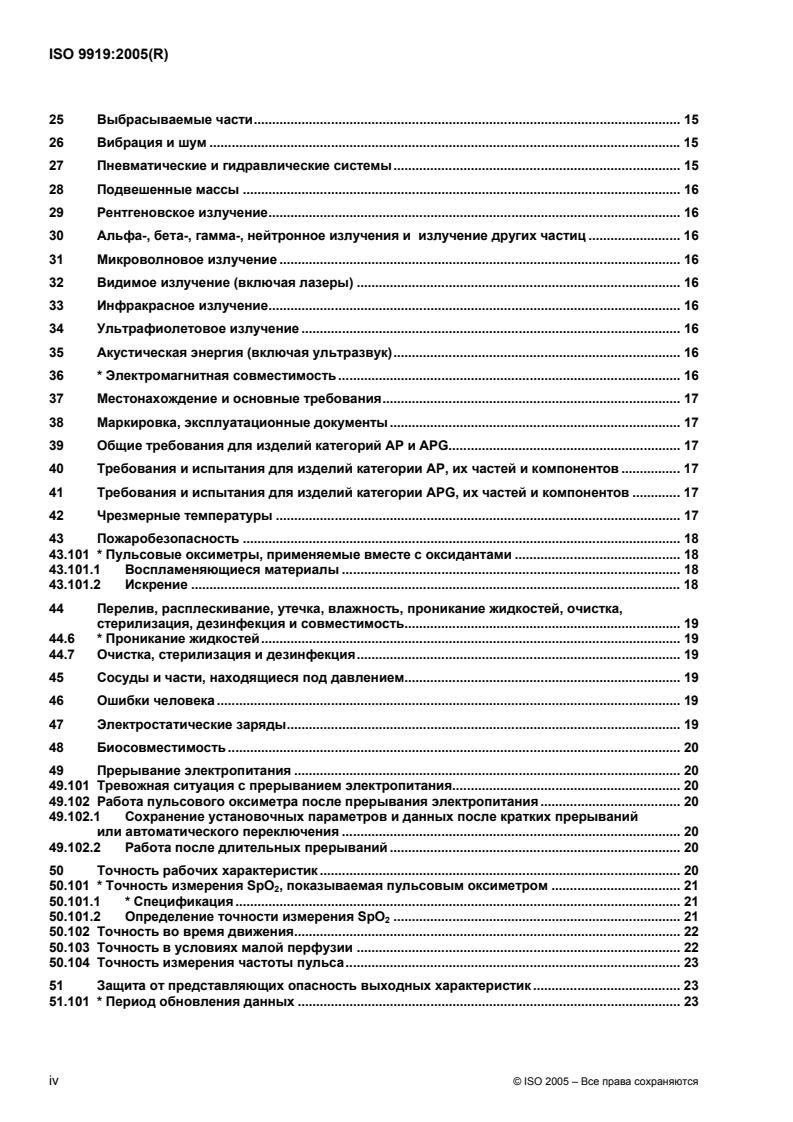
Предисловие .vii
Введение .viii
1 Область применения .1
2 Нормативные ссылки .1
3 Термины и определения .3
4 Общие требования к испытаниям.8
4.101 Другие методы испытаний .8
4.102 Критерии приемки .8
4.103 Пульсовой оксиметр, его части и принадлежности .8
5 Классификация .8
6 Идентификация, маркировка и документация.8
6.1 Маркировка на наружной стороне изделий или их частей .8
6.8.1 Общие требования .9
6.8.2 Инструкция по эксплуатации .10
6.8.3 Техническое описание.11
7 Потребляемая мощность .11
8 Основные категории безопасности .11
9 Заменяемые средства защиты .12
10 Условия окружающей среды.12
10.1 Транспортирование и хранение .12
11 Не использован.12
12 Не использован.12
13 Общие требования .12
14 Требования, относящиеся к классификации .12
14.6 Рабочие части типов B, BF и CF .12
15 Ограничение напряжения и(или) энергии.12
16 Корпуса и защитные крышки .12
17 Разделение частей и цепей .12
18 Защитное заземление, рабочее заземление и выравнивание потенциалов .12
19 Длительные токи утечки и дополнительные токи в цепи пациента.12
19.4 Испытания.13
20 Электрическая прочность изоляции .13
20.4 Испытания.13
21 * Механическая прочность.13
21.5 13
21.101 * Удар и вибрация.13
21.102 * Удар и вибрация при транспортировании .14
22 Подвижные части .15
23 Поверхности, углы и кромки.15
24 Устойчивость при нормальной эксплуатации.15
25 Выбрасываемые части. 15
26 Вибрация и шум .15
27 Пневматические и гидравлические системы. 15
28 Подвешенные массы . 16
29 Рентгеновское излучение. 16
30 Альфа-, бета-, гамма-, нейтронное излучения и излучение других частиц . 16
31 Микроволновое излучение . 16
32 Видимое излучение (включая лазеры) . 16
33 Инфракрасное излучение. 16
34 Ультрафиолетовое излучение . 16
35 Акустическая энергия (включая ультразвук). 16
36 * Электромагнитная совместимость . 16
37 Местонахождение и основные требования. 17
38 Маркировка, эксплуатационные документы. 17
39 Общие требования для изделий категорий АР и АРG. 17
40 Требования и испытания для изделий категории AP, их частей и компонентов . 17
41 Требования и испытания для изделий категории APG, их частей и компонентов . 17
42 Чрезмерные температуры . 17
43 Пожаробезопасность . 18
43.101 * Пульсовые оксиметры, применяемые вместе с оксидантами . 18
43.101.1 Воспламеняющиеся материалы . 18
43.101.2 Искрение . 18
44 Перелив, расплескивание, утечка, влажность, проникание жидкостей, очистка,
стерилизация, дезинфекция и совместимость. 19
44.6 * Проникание жидкостей. 19
44.7 Очистка, стерилизация и дезинфекция. 19
45 Сосуды и части, находящиеся под давлением. 19
46 Ошибки человека . 19
47 Электростатические заряды. 19
48 Биосовместимость . 20
49 Прерывание электропитания . 20
49.101 Тревожная ситуация с прерыванием электропитания. 20
49.102 Работа пульсового оксиметра после прерывания электропитания . 20
49.102.1 Сохранение установочных параметров и данных после кратких прерываний
или автоматического переключения . 20
49.102.2 Работа после длительных прерываний . 20
50 Точность рабочих характеристик . 20
50.101 * Точность измерения SpO , показываемая пульсовым оксиметром . 21
50.101.1 * Спецификация . 21
50.101.2 Определение точности измерения SpO . 21
50.102 Точность во время движения. 22
50.103 Точность в условиях малой перфузии . 22
50.104 Точность измерения частоты пульса. 23
51 Защита от представляющих опасность выходных характеристик . 23
51.101 * Период обновления данных . 23
iv © ISO 2005 – Все права сохраняются
51.102 Обнаружение неисправностей датчика пульсового оксиметра и дефекта
удлинительного кабеля для датчика.23
52 Ненормальная работа и условия единичного нарушения.24
53 Испытания на воздействие внешних факторов.24
54 Общие положения .24
55 Корпуса и крышки.24
56 Компоненты и общая компоновка.24
57 Сетевые части, компоненты и монтаж.24
58 Защитное заземление – зажимы и соединения.24
59 Конструкция и монтаж .24
101 * Несоответствие сигнала.24
102 * Датчик пульсового оксиметра и удлинительные кабели для него .25
102.1 Общие положения .25
102.2 Маркировка .25
103 Пульсовый информационный сигнал насыщения.25
104 Системы сигналов опасности.25
201.1.2 * Определение приоритетов.25
201.5.4 * Предварительная установка сигнала по умолчанию .26
201.8 Cистемы аварийной сигнализации в состоянии инактивации .26
201.8.3 Индикация и доступ .26
105 Приложения IEC 60601-1:1988.26
Приложение AA (информативное) Обоснование .27
Приложение ВВ (информативное) Температура кожи около датчика пульсового оксиметра .38
Приложение СС (информативное) Определение точности.42
Приложение DD (информативное) Стандарты для калибровки .50
Приложение ЕЕ (информативное) Руководящие указания по оценке и документальному
подтверждению точности измерения SpO на людях.51
Приложение FF (информативное) Имитаторы, калибраторы и функциональные тестеры для
пульсового оксиметра.58
Приложение GG (информативное) Понятия, касающиеся времени отклика аппаратуры.68
Приложение НН (информативное) Ссылка на существенные принципы .72
Приложение II (информативное) Экологические аспекты.74
Приложение JJ (информативное) Указатель терминов.76
Библиография.78
Таблицы
Таблица AA.1 — Качественная оценка ударной и вибрационной среды, влияющей на
пульсовой оксиметр .28
Таблица AA.2 — Допустимые максимальные температуры при контакте кожи с рабочими частями
медицинского электрического изделия (из Таблицы 22 IEC/CDV 60601-1:2004).31
Таблица BB.1 — Время и источник безопасного применения датчика пульсового оксиметра .40
Таблица EE.1 — Пример заданных плато и диапазонов .54
Таблица HH.1 — Соответствие между настоящим стандартом и существенными
принципами. 72
Таблица II.1 — Экологические аспекты, рассматриваемые в разделах настоящего
международного стандарта . 75
Рисунки
Рисунок CC.1 — Синтезированные данные для калибровки (основной случай). 43
Рисунок CC.2 — К основному случаю добавлено постоянное смещение. 44
Рисунок CC.3 — К основному случаю добавлен наклон . 45
Рисунок CC.4 — Графическое представление определения локальной систематической
погрешности (Показания SpO испытуемого датчика в зависимости от показаний S
2 R
эталонного прибора). 46
Рисунок CC.5 — Графическое представление определений локальной и средней
систематической погрешности (Показания SpO испытуемого датчика в
зависимости от показаний S эталонного прибора). 46
R
Рисунок EE.1 — Пример графика зависимости десатурации от времени. 54
Рисунок FF.1 — Пример калибровочной кривой для пульсового оксиметра . 60
Рисунок FF.2 — Сопряжение функционального тестера, использующего фотодиод и LED
для взаимодействия с датчиком пульсового оксиметра . 62
Рисунок FF.3 — Сопряжение функционального тестера, использующего смесь красителей. 63
Рисунок FF.4 — Сопряжение функционального тестера, использующего
жидкокристаллический модулятор. 63
Рисунок FF.5 — Спектральная поглощающая способность бандажа синего цвета
(измеренная при отражении), используемого при специальном испытании датчика
пульсового оксиметра с высокой изменчивостью калибровки от пациента к
пациенту . 65
Рисунок FF.6 — Калибровка датчика пульсового оксиметра с высокой изменчивостью при
контролируемом исследовании десатурации на пяти объектах испытаний . 66
Рисунок FF.6 — Калибровка датчика пульсового оксиметра с высокой изменчивостью при
контролируемом исследовании десатурации на пяти объектах испытаний
(продолжение) . 67
Рисунок GG.1 — Иллюстрация точности пульсового оксиметра при прослеживании
изменений насыщения. 68
Рисунок GG.2 — Иллюстрация влияния различных значений времени усреднения на
точность. 69
Рисунок GG.3 — Графическое представление составляющих задержки системы аварийной
сигнализации . 70
Рисунок GG.4 — Иллюстрация влияния различных значений времени усреднения на более
быстрый сигнал о десатурации, сопровождаемый шумами . 71
vi © ISO 2005 – Все права сохраняются
Предисловие
Международная организация по стандартизации (ISO) является всемирной федерацией национальных
организаций по стандартизации (комитетов-членов ISO). Разработка международных стандартов
обычно осуществляется техническими комитетами ISO. Каждый комитет-член, заинтересованный в
деятельности, для которой был создан технический комитет, имеет право быть представленным в этом
комитете. Международные правительственные и неправительственные организации, имеющие связь с
ISO, также принимают участие в работе. ISO работает в тесном сотрудничестве с Международной
электротехнической комиссией (IEC) по всем вопросам стандартизации в области электротехники.
Международные стандарты разрабатываются в соответствии с правилами, приведенными в
Директивах ISO/IEC, Часть 2.
Основная задача технических комитетов состоит в подготовке международных стандартов. Проекты
международных стандартов, одобренные техническими комитетами, рассылаются комитетам-членам
на голосование. Их опубликование в качестве международных стандартов требует одобрения, по
меньшей мере, 75 % комитетов-членов, принимающих участие в голосовании.
Следует иметь в виду, что некоторые элементы настоящего документа могут быть объектом патентных
прав. ISO не должен нести ответственность за идентификацию какого-либо одного или всех патентных
прав.
Международный стандарт ISO 9919 (IEC 60601-2-54) был подготовлен совместно Техническим
комитетом ISO/ТC 121, Оборудование для анестезии и медицинские дыхательные аппараты,
Подкомитетом SC 3, Оборудование для искусственной вентиляции легких и сопутствующее
оборудование и Техническим комитетом IEC/ТC 62, Электрооборудование, применяемое в
медицинской практике, Подкомитетом SC D, Электромедицинское оборудование. Проект был
разослан для голосования национальным организациям по стандартизации ISO и IEC.
Настоящее второе издание отменяет и заменяет первое издание (ISO 9919:1992), которое было
технически пересмотрено.
Введение
Сопоставление степени насыщения гемоглобина артериальной крови и частоты повторения импульса
методом импульсной оксигемометрии стало обычной практикой во многих областях медицины.
Настоящий международный стандарт устанавливает основные требования к безопасности и
существенным характеристикам, которые можно выполнить в рамках имеющейся методики.
Приложение АА содержит обоснование некоторых требований. Оно включено для более глубокой
оценки причин, которые привели к разработке требований и определений опасностей, к которым
предъявляются эти требования.
Приложение ВВ представляет собой информационное исследование, касающееся определения
максимально безопасной температуры границы раздела между датчиком пульсового оксиметра и
тканью пациента.
В приложении СС рассматриваются обе формулы, которые используются для оценки точности
измерения SpO пульсового оксиметра, и названия, присвоенные этим формулам.
Приложение DD содержит руководство о времени проведения калибровки пульсового оксиметра
крови in vitro.
Приложение EE содержит руководящие указания по контролируемому исследованию десатурации
для калибровки пульсового оксиметра.
Приложение FF служит вводным руководством к некоторым видам тестеров, используемых в
пульсовом оксиметре.
Приложение GG дает общее представление о времени отклика пульсового оксиметра.
Настоящий международный стандарт является частным стандартом и разработан на основе стандарта
IEC 60601-1:1988, включая Изменения 1 (1991) и 2 (1995), здесь и далее именуемый как общий
стандарт. Общий стандарт – это основополагающий стандарт на безопасность всего медицинского
электрооборудования, применяемого непосредственно или под наблюдением квалифицированного
персонала в лечебных учреждениях или среде, окружающей пациента; он также содержит ряд
требований к надежной работе, обеспечивающей безопасность.
Общий Стандарт объединил дополняющие стандарты и частные стандарты. Дополняющие стандарты
включают требования к конкретным методам и/или опасностям и применяются ко всему
используемому оборудованию, например, к медицинским системам, методам электромагнитной
совместимости, радиационной защиты в диагностическом рентгеновском оборудовании, к
программным средствам и т.д. Частные стандарты применяются к специальным видам оборудования,
таким как медицинские электронные ускорители, хирургическое оборудование высокой частоты,
больничные кровати и т.д.
ПРИМЕЧАНИЕ Определения дополняющих стандартов и частных стандартов можно найти в стандарте
IEC 60601-1:1988, 1.5 и А.2 соответственно.
Чтобы облегчить применение настоящего международного стандарта на стадии проекта были приняты
следующие условные обозначения.
Изменения к тексту IEC 60601-1:1988, общий стандарт, дополненный дополняющими стандартами,
обозначаются следующими словами.
⎯ “Замена” означает, что указанный раздел или подраздел общего стандарта полностью заменен
текстом настоящего частного станадарта.
viii © ISO 2005 – Все права сохраняются
⎯ “Дополнение” означает, что соответствующий текст настоящего частного станадарта является
новым элементом (напр., подраздел, перечень, примечание, таблица, рисунок), дополняющим
общий стандарт.
⎯ “Изменение” означает, что имеющийся текст настоящего общего стандарта частично изменен
путем отмены и/или дополнения, как указано в тексте частного стандарта.
Чтобы не путать с любыми изменениями к общему стандарту, вводится специальная нумерация
элементов, дополняемых настоящим международным стандартом: разделы, подразделы, таблицы и
рисунки пронумерованы, начиная с цифры 101; дополнительный перечень вопросов обозначен
буквами aa), bb) и т.д., а дополнительные приложения – буквами AA), BB) и т.д.
В настоящем международном стандарте используются следующие типы шрифтов:
⎯ требования, соответствие с которыми должно быть установлено, и определения: прямой шрифт;
⎯ примечания и примеры: прямой шрифт меньшего размера;
⎯ описание вида изменения документа и условия испытаний: курсив;
⎯ термины, определяемые в Разделе 2 общего стандарта IEC 60601-1:1988 или в настоящем
частном стандарте: жирный шрифт.
На протяжении всего данного частного стандарта текст, к которому дается обоснование в Приложении
АА, помечен звездочкой (*).
МЕЖДУНАРОДНЫЙ СТАНДАРТ ISO 9919:2005(R)
Изделия медицинские электрические. Частные требования
безопасности и основные характеристики пульсовых
оксиметров медицинского назначения
1 Область применения
IEC 60601-1:1988, Раздел 1 применим, кроме тех случаев когда.
Изменение (добавить в конце 1.1):
Настоящий международный стандарт устанавливает частные требования безопасности и основные
характеристики пульсовых оксиметров, предназначенных для применения на человеке. Он включает
любую их часть, необходимую для нормальной эксплуатации, например, монитор пульсового
оксиметра, датчик пульсового оксиметра, удлинительный кабель для датчика.
Эти требования также применимы к пульсовым оксиметрам, включая мониторы пульсового
оксиметра, датчики пульсового оксиметра и удлинительные кабели для датчика, которые были
подвергнуты повторной обработке.
Предполагаемое использование пульсового оксиметра включает, но не ограничивается только этим,
оценку влияния насыщенности кислородом гемоглобина артериальной крови и частоты пульса на
пациента в лечебных учреждениях, а также на пациентов, находящихся под домашним уходом.
* Настоящий международный стандарт не распространяется на пульсовые оксиметры,
предназначенные для лабораторных исследований, на оксиметры, для которых требуется взятие
пробы крови у пациента для анализа.
Настоящий международный стандарт не применяют к пульсовым оксиметрам, предназначенным
только для внутриутробного применения.
Настоящий международный стандарт не применяют к дистанционным или управляемым (вторичным)
приборам, которые показывают значение насыщения SpO и расположены вне среды, окружающей
пациента.
Предполагается, что требования настоящего международного стандарта, которые заменяют или
изменяют требования IEC 60601-1:1988 и его Изменения 1 (1991) и 2 (1995), преобладают над
соответствующими общими требованиями.
2 Нормативные ссылки
Следующие ссылочные нормативные документы являются обязательными при применении данного
документа. Для жестких ссылок применяется только указанное издание документа. Для плавающих
ссылок необходимо использовать самое последнее издание нормативного ссылочного документа
(включая любые изменения).
ISO 7000/IEC 60417:2004, Графические символы, наносимые на оборудование. Перечень и сводная
таблица
ISO 14155-1:2003, Испытания клинические медицинских изделий для людей. Часть 1. Общие
требования
ISO 14155-2:2003, Испытания клинические медицинских изделий для людей. Часть 2. Схемы
клинических испытаний
ISO 14937:2000, Стерилизация медицинской продукции. Общие требования для определения
характеристик стерилизующего вещества и для разработки, валидации и текущего контроля
процессов стерилизации медицинских изделий
ISO 15223:2000, Изделия медицинские. Символы, используемые на этикетках и ярлыках медицинских
изделий и предлагаемая информация
Изменение 1:2002.
Изменение 2:2004.
IEC 60068-2-6:1995, Испытания на воздействия внешних факторов. Часть 2: Испытания.
Испытание Fc: Вибрация (синусоидальная)
IEC 60068-2-27:1987, Испытания на воздействия внешних факторов. Часть 2: Испытания.
Испытание Еа и руководство: Удар
IEC 60068-2-32:1975, Испытания на воздействия внешних факторов. Часть 2. Испытания.
Испытание Еd.: Свободное падение
Изменение 1:1982
Изменение 2:1990
IEC 60068-2-64:1993, Испытания на воздействие внешних факторов. Часть 2: Испытания.
Испытание Fh: Широкополосная случайная вибрация (цифровое управление) и руководство
IEC 60079-4:1975, Оборудование электрическое для взрывоопасных газовых сред. Часть 4: Метод
определения температуры воспламенения
Изменение 1:1995
IEC 60529:2001, Степени защиты, обеспечиваемые корпусами (Код IP)
1)
IEC 60601-1:1988 , Электроаппаратура медицинская. Часть 1. Общие требования безопасности
Изменение 1:1991
Изменение 2:1995
IEC 60601-1-1:2000, Электроаппаратура медицинская. Часть 1-1: Общие требования к безопасности.
Дополняющий стандарт: Требования к безопасности медицинских электрических систем
IEC 60601-1-2:2001, Электроаппаратура медицинская. Часть 1-2. Общие требования к
безопасности. Дополняющий стандарт. Электромагнитная совместимость. Требования и
испытания
IEC 60601-1-4:1996, Электроаппаратура медицинская. Часть 1-4. Общие требования к
безопасности. Дополняющий стандарт: Программируемые медицинские электрические системы
Изменение 1:1999
IEC 60601-1-6:2004, Электроаппаратура медицинская. Часть 1-6. Общие требования к
безопасности. Дополняющий стандарт. Возможность использования
IEC 60601-1-8:2003, Электроаппаратура медицинская. Часть 1-8. Общие требования к
безопасности. Дополняющий стандарт. Общие требования, испытания и руководство по
системам тревожной сигнализации в электрической медицинской аппаратуре и системах
IEC 60825-1:2001, Безопасность лазерных устройств. Часть 1. Классификация аппаратуры,
требования и руководство пользователя
IEC 60825-2:2000, Безопасность лазерных устройств. Часть 2. Безопасность волоконно-
оптических систем связи (OFCS)
1) В настоящее время пересматривается под номером IEC/CDV 60601-1:2004.
2 © ISO 2005 – Все права сохраняются
3 Термины и определения
Применительно к настоящему международному стандарту используются термины и определения из
стандарта IEC 60601-1:1988, Раздел 2, измененные в соответствии со Вспомогательными
Стандартами, а также следующие.
ПРИМЕЧАНИЕ Для удобства, источники всех терминов с определениями, которые используются в настоящем
международном стандарте, даны в Приложении JJ.
3.1
точность
accuracy
степень близости результата измерений к принятому опорному значению
ПРИМЕЧАНИЕ 1 Метод расчета точности измерения SpO пульсовым оксиметром см. 50.101. 2.2.
ПРИМЕЧАНИЕ 2 См. также обсуждение в Приложении СС.
ПРИМЕЧАНИЕ 3 См. ISO 3534-1:1993.
3.2
контролируемое исследование десатурации
controlled desaturation study
гипоксемия, вызываемая у человека в лабораторных условиях
ПРИМЕЧАНИЕ Это также можно назвать контролируемым исследованием гипоксемии (угнетение дыхания).
См. также Приложение ЕЕ.
3.3
СО-оксиметр
CO-oximeter
многоволновой оптический анализатор крови, который измеряет общую концентрацию гемоглобина
и концентрации различных производных гемоглобина
ПРИМЕЧАНИЕ Значимым показателем СО-оксиметрии является функциональное насыщение артериальной
крови, SaO , которое оценивает пульсовой оксиметр и сообщает как SpO .
2 2
3.4
период обновления данных
data update period
интервал, в котором алгоритм пульсового оксиметра выдает новые достоверные данные на дисплей
или порт выхода сигнала
ПРИМЕЧАНИЕ Это определение не относится к регулярному периоду обновления изображения на дисплее,
который обычно составляет 1 с, оно скорее относится к (обычно более длительному) интервалу, указанному выше.
3.5
заявленный диапазон
declared range
часть воспроизводимого на дисплее диапазона значений (3.7) SpO и частоты пульса, на которую
распространяется заданная точность
3.6
демонстрационный режим
demonstration mode
режим, при котором на дисплей выводятся номера и формы волны имитаторов пациентов
ПРИМЕЧАНИЕ Изображение на дисплее в демонстрационном режиме может быть принято по ошибке за
данные пациента в реальном режиме времени, если это четко не обозначено.
3.7
диапазон, воспроизводимый на экране дисплея
displayed range
диапазон значений SpO и частоты пульса, который может быть воспроизведен на дисплее
пульсового оксиметра
ПРИМЕЧАНИЕ Этот диапазон может быть расширен за пределы заявленного диапазона (3.5).
3.8
фракционный оксигемоглобин
fractional oxyhaemoglobin
фракционное насыщение (устаревший)
FO Hb
концентрация оксигемоглобина cO Hb, деленная на общую концентрацию гемоглобина, ctHb
ПРИМЕЧАНИЕ 1 Математически выражается как:
cO Hb
FO Hb=
ctHb
где
cO Hb концентрация оксигемоглобина;
ctHB концентрация общего гемоглобина.
Иногда она выражается в процентах (умножением доли на 100).
ПРИМЕЧАНИЕ 2 Фракционный оксигемоглобин – термин, используемый для этого соотношения
Национальным комитетом по клиническим лабораторным исследованиям (NCCLS).
ПРИМЕЧАНИЕ 3 NCCLS обозначает “концентрацию” буквенной приставкой с, тогда как в прошлом для
обозначения применялись квадратные скобки, напр., [O Hb].
ПРИМЕЧАНИЕ 4 NCCLS[5] использует следующие условные обозначения:
⎯ оксигемоглобин (O Hb);
⎯ дезоксигемоглобин (HHb);
⎯ карбоксигемоглобин (СOHb);
⎯ метгемоглобин (MetHb);
⎯ сульфгемоглобин (SuHb); и
⎯ общий гемоглобин (tHb).
3.9
функциональное насыщение кислородом
functional oxygen saturation
насыщение в процентах, полученное от деления концентрации оксигемоглобина (сO Hb) на сумму
концентрации оксигемоглобина и дезоксигемоглобина (cHHb)
ПРИМЕЧАНИЕ 1 Математически выражается следующим образом:
100⋅ cO Hb
cO Hb+ cHHb
[5]
ПРИМЕЧАНИЕ 2 NCCLS использует для этого соотношения термин кислородное насыщение гемоглобина и
обозначает его как SO .
3.10
функциональный тестер
functional tester
контрольный прибор, который представляет собой пульсовой оксиметр с сигналом, выдающим
прогнозируемое значение коэффициента (3.22), чтобы оператор мог видеть результирующее
значение SpO на дисплее и сравнивать его с ожидаемым значением, выведенным из калибровочной
кривой изготовителя для данного конкретного пульсового оксиметра
ПРИМЕЧАНИЕ Точность значения SpO2, выдаваемого пульсовым оксиметром, частично зависит от того,
правильно ли отражает калибровочная кривая монитора пульсового оксиметра оптические характеристики
датчика пульсового оксиметра и взаимодействие датчика и ткани. Функциональные тестеры не способны
подтвердить точность SpO по калибровочной кривой или оценить в полном объеме оптические характеристики
датчиков пульсовых оксиметров, чтобы определить правильность их калибровки. См. также FF.4.
4 © ISO 2005 – Все права сохраняются
3.11
локальная систематическая погрешность
local bias
b
разность между математическим ожиданием результатов измерения (SpO ) и принятым эталонным
значением (SаO )
ПРИМЕЧАНИЕ 1 Для пульсового оксиметра при заданном эталонном значении насыщения кислородом - это
разность между y-значением линии регрессии на этой координате и y-значением линии идентичности,
построенных на графике зависимости SpO от S , или заданная формулой:
2 R
b = SpO − S
i
2fit, I R i
где SpO значение кривой, построенной по экспериментальным точкам, соответствующее i-тому эталонному
2fit, i
значению насыщения кислородом, S
R i
ПРИМЕЧАНИЕ 2 См. также среднюю величину погрешности (3.13) и обсуждение в Приложении СС.
ПРИМЕЧАНИЕ 3 Соответствует ISO 3534-1:1993.
3.12
изготовитель
manufacturer
физическое или юридическое лицо, которое отвечает за конструирование, изготовление, упаковку, повторную
обработку, маркировку или эксплуатационные документы для пульсовых оксиметров, мониторов,
датчиков, удлинителей для датчиков пульсовых оксиметров, а также адаптацию этих частей
независимо от того, выполняется ли эта работа самим лицом или от его имени третьей стороной.
ПРИМЕЧАНИЕ Взято из IEC/CDV2 60601-1:2004, определение 3.54.
3.13
средняя величина систематической погрешности
mean bias
B
Средняя величина разности между измеренным и эталонным значениями, при сохранении знака
ПРИМЕЧАНИЕ 1 Для пульсового оксиметра средняя величина систематической погрешности математически
может быть представлена следующим образом:
n
()SpO − S
∑ 2Rii
i=1
B=
n
где
n число пар данных в пробе в пределах исследуемого диапазона,
SpO i-тая заданная величина SpO ;
2i 2
S i-тое эталонное значение насыщения кислородом.
Ri
ПРИМЕЧАНИЕ 2 См. также локальная систематическая погрешность (3.11) и обсуждение в Приложении СС.
ПРИМЕЧАНИЕ 3 Для этого определения средняя величина систематической погрешности – среднее всех
значений локальной систематической погрешности, b .
i
3.14
нормированное
normalized
значение, воспроизводимое с постоянной амплитудой независимо от фактической величины
отображаемого сигнала
3.15
параметры, устанавливаемые оператором
operator settings
текущее состояние любых средств управления на мониторе, включая установку параметров
сигналов опасности
3.16
прецизионность
precision
степень близости друг к другу независимых результатов измерений, полученных в конкретных
регламентированных условиях
ПРИМЕЧАНИЕ 1 Для пульсовых оксиметров выражается как стандартное отклонение разностей, s ,
res
математически представлена следующим образом:
n
SpO − SpO
()
2ii2fit,
∑
i=1
s =
res
n− 2
()
где
n число пар данных в пробе в пределах исследуемого диапазона;
(SpO − SpO ) разность между i-той заданной величиной SpO и значением кривой, построенной по
2i 2fit, i
экспериментальным точкам, соответствующее i-тому эталонному значению насыщения
кислородом, S .
Ri
ПРИМЕЧАНИЕ 2 См. также обсуждение в Приложении СС.
ПРИМЕЧАНИЕ 3 Соответствует ISO 3534-1:1993.
3.17
кабель удлинительный для датчика
probe cable extender
кабель, который подсоединяет монитор к датчику пульсового оксиметра
ПРИМЕЧАНИЕ 1 Не для каждого пульсового оксиметра используется удлинительный кабель для датчика.
ПРИМЕЧАНИЕ 2 Удлинительный кабель для датчика может представлять собой рабочую часть.
3.18
пульсовой оксиметр
pulse oximeter equipment
медицинское электрическое изделие для оценки функционального насыщения кислородом
артериального гемоглобина (SpO ) неинвазивным методом по взаимодействию светового потока с
тканью, и использующее зависящие от времени изменения оптических характеристик ткани, которые
происходят вследствие пульсирующего потока крови.
ПРИМЕЧАНИЕ 1 Пульсовой оксиметр включает монитор, удлинительный кабель для датчика, если
поставляется, и датчик, который может быть встроен в прибор.
ПРИМЕЧАНИЕ 2 С технической точки зрения свет более известен как электромагнитное излучение (оптическое
излучение). Настоящий международный стандарт использует общий термин.
3.19
монитор пульсового оксиметра
pulse oximeter monitor
часть пульсового оксиметра, которая объединяет электронику, дисплей и интерфейс пользователя,
кроме датчика пульсового оксиметра и удлинителя к нему
ПРИМЕЧАНИЕ Монитор пульсового оксиметра может состоять из нескольких частей аппаратных средств,
расположенных отдельно, например, телеметрической системы, в которой рабочая часть и первичный дисплей
физически находятся в разных местах.
6 © ISO 2005 – Все права сохраняются
3.20
датчик пульсового оксиметра
pulse oximeter probe
часть пульсового оксиметра, которая включает рабочую часть и элемент преобразователя
ПРИМЕЧАНИЕ 1 Термины “сенсор” и “преобразователь” также используются для датчика пульсового
оксиметра.
ПРИМЕЧАНИЕ 2 Датчик пульсового оксиметра обычно включает кабель и жесткий или гибкий узел,
состоящий из двух светоизлучателей и фотодетектора.
3.21
неисправность датчика пульсового оксиметра
pulse oximeter probe fault
ненормальный режим работы датчика или удлинительного кабеля к нему, который, в случае
необнаружения, может подверг
...
Questions, Comments and Discussion
Ask us and Technical Secretary will try to provide an answer. You can facilitate discussion about the standard in here.
Loading comments...