

ISO/IEC TS 19795-9:2019
(Main)Information technology — Biometric performance testing and reporting — Part 9: Testing on mobile devices
General Information
- Abstract
This document provides guidance for performance testing of biometrics when this technology is used on mobile devices with local biometric authentication to improve authentication assurance. This document aims to: — Provide guidance for affordable and cost-efficient testing and reporting methods for performance assessment at a full system level of biometric systems embedded in mobile devices with offline evaluation of false accept rate (FAR) claims. — Define modality-specific considerations of these methods. This document is applicable to: — verification use cases related to secure transactions. This document is not applicable to: — privacy aspects; — secure authentication from mobile device to server; — testing and reporting for presentation attack detection (PAD) mechanisms in mobile devices; — performance testing of biometric sub-systems such as acquisition sub-system or comparison sub-system; — continuous authentication.
- Status
- Published
- Publication Date
- 17-Dec-2019
- Technical Committee
- ISO/IEC JTC 1/SC 37 - Biometrics
- Drafting Committee
- ISO/IEC JTC 1/SC 37/WG 5 - Biometric testing and reporting
- Current Stage
- 9093 - International Standard confirmed
- Start Date
- 06-Sep-2024
- Completion Date
- 29-Aug-2026
Buy Documents

ISO/IEC TS 19795-9:2019 - Information technology — Biometric performance testing and reporting — Part 9: Testing on mobile devices Released:12/18/2019

ISO/IEC TS 19795-9:2019 - Information technology — Biometric performance testing and reporting — Part 9: Testing on mobile devices/18/2019
Overview
ISO/IEC TS 19795-9:2019 provides practical guidance for biometric performance testing and reporting on mobile devices. It focuses on full‑system evaluations of local biometric authentication (e.g., fingerprint, face, voice) intended to improve authentication assurance for verification use cases such as secure transactions. The technical specification emphasizes cost‑efficient, repeatable methods - including offline evaluation of false accept rate (FAR) claims - and sets out modality‑specific considerations for testing sensors and end‑to‑end systems embedded in mobile devices.
Key topics and requirements
- Full‑system evaluation: Guidance for end‑to‑end testing that includes capture sensors, on‑device processing and template/reference handling rather than isolated sub‑systems.
- Offline FAR evaluation: Methods to assess and report False Accept Rate claims in a reproducible, offline testing environment.
- Modality‑specific considerations: Recommendations tailored to different biometric modalities and to whether sensors are embedded (e.g., cameras, microphones) or dedicated (e.g., fingerprint readers).
- Data collection and test design: Procedures for test crew size and characteristics, subject interaction, enrolment methods (including iterative and multi‑session enrolment) and verification workflows.
- Practical constraints and efficiency: Strategies to reduce time and cost (reducing recognition transactions, test conditions and visits) while retaining statistically meaningful results.
- Environmental and ergonomic factors: Guidance on handling uncontrolled mobile capture environments and reporting ambient conditions that affect performance.
- Performance metrics and reporting: Instructions on metrics to measure, optional technology evaluation for lower FAR claims, and structured reporting (including sample report templates).
- Third‑party evaluation: Considerations for independent testing, system specification requirements, and checking vendor self‑attestation and online/offline consistency.
Note: the specification explicitly excludes privacy, server‑side authentication, presentation attack detection (PAD) testing, sub‑system (acquisition/comparison) performance testing and continuous authentication.
Applications and users
ISO/IEC TS 19795-9 is most useful for:
- Mobile device manufacturers and OEMs validating on‑device biometric systems.
- Biometric algorithm and sensor vendors preparing FAR claims.
- Independent test labs and QA teams conducting scenario evaluations.
- Security architects, procurement officers and regulators assessing device suitability for secure transaction verification.
- App developers and service providers designing local biometric authentication workflows.
Related standards
- ISO/IEC 19795‑1 (Principles and framework)
- ISO/IEC 19795‑2 (Testing methodologies)
- ISO/IEC TR 30125 (Mobile biometrics considerations)
- ISO/IEC 2382‑37 (Biometrics vocabulary)
Keywords: ISO/IEC TS 19795-9:2019, biometric performance testing, mobile devices, local biometric authentication, false accept rate, FAR, full‑system evaluation, testing and reporting.
Buy Documents
ISO/IEC TS 19795-9:2019 - Information technology — Biometric performance testing and reporting — Part 9: Testing on mobile devices Released:12/18/2019
ISO/IEC TS 19795-9:2019 - Information technology — Biometric performance testing and reporting — Part 9: Testing on mobile devices/18/2019
Get Certified
Connect with accredited certification bodies for this standard

BSI Group
BSI (British Standards Institution) is the business standards company that helps organizations make excellence a habit.

NYCE
Mexican standards and certification body.
Sponsored listings
Frequently Asked Questions
ISO/IEC TS 19795-9:2019 is a technical specification published by the International Organization for Standardization (ISO). Its full title is "Information technology — Biometric performance testing and reporting — Part 9: Testing on mobile devices". This standard covers: This document provides guidance for performance testing of biometrics when this technology is used on mobile devices with local biometric authentication to improve authentication assurance. This document aims to: — Provide guidance for affordable and cost-efficient testing and reporting methods for performance assessment at a full system level of biometric systems embedded in mobile devices with offline evaluation of false accept rate (FAR) claims. — Define modality-specific considerations of these methods. This document is applicable to: — verification use cases related to secure transactions. This document is not applicable to: — privacy aspects; — secure authentication from mobile device to server; — testing and reporting for presentation attack detection (PAD) mechanisms in mobile devices; — performance testing of biometric sub-systems such as acquisition sub-system or comparison sub-system; — continuous authentication.
This document provides guidance for performance testing of biometrics when this technology is used on mobile devices with local biometric authentication to improve authentication assurance. This document aims to: — Provide guidance for affordable and cost-efficient testing and reporting methods for performance assessment at a full system level of biometric systems embedded in mobile devices with offline evaluation of false accept rate (FAR) claims. — Define modality-specific considerations of these methods. This document is applicable to: — verification use cases related to secure transactions. This document is not applicable to: — privacy aspects; — secure authentication from mobile device to server; — testing and reporting for presentation attack detection (PAD) mechanisms in mobile devices; — performance testing of biometric sub-systems such as acquisition sub-system or comparison sub-system; — continuous authentication.
ISO/IEC TS 19795-9:2019 is classified under the following ICS (International Classification for Standards) categories: 35.240.15 - Identification cards. Chip cards. Biometrics. The ICS classification helps identify the subject area and facilitates finding related standards.
ISO/IEC TS 19795-9:2019 is available in PDF format for immediate download after purchase. The document can be added to your cart and obtained through the secure checkout process. Digital delivery ensures instant access to the complete standard document.
Standards Content (Sample)
TECHNICAL ISO/IEC TS
SPECIFICATION 19795-9
First edition
2019-12
Information technology — Biometric
performance testing and reporting —
Part 9:
Testing on mobile devices
Reference number
©
ISO/IEC 2019
© ISO/IEC 2019
All rights reserved. Unless otherwise specified, or required in the context of its implementation, no part of this publication may
be reproduced or utilized otherwise in any form or by any means, electronic or mechanical, including photocopying, or posting
on the internet or an intranet, without prior written permission. Permission can be requested from either ISO at the address
below or ISO’s member body in the country of the requester.
ISO copyright office
CP 401 • Ch. de Blandonnet 8
CH-1214 Vernier, Geneva
Phone: +41 22 749 01 11
Fax: +41 22 749 09 47
Email: copyright@iso.org
Website: www.iso.org
Published in Switzerland
ii © ISO/IEC 2019 – All rights reserved
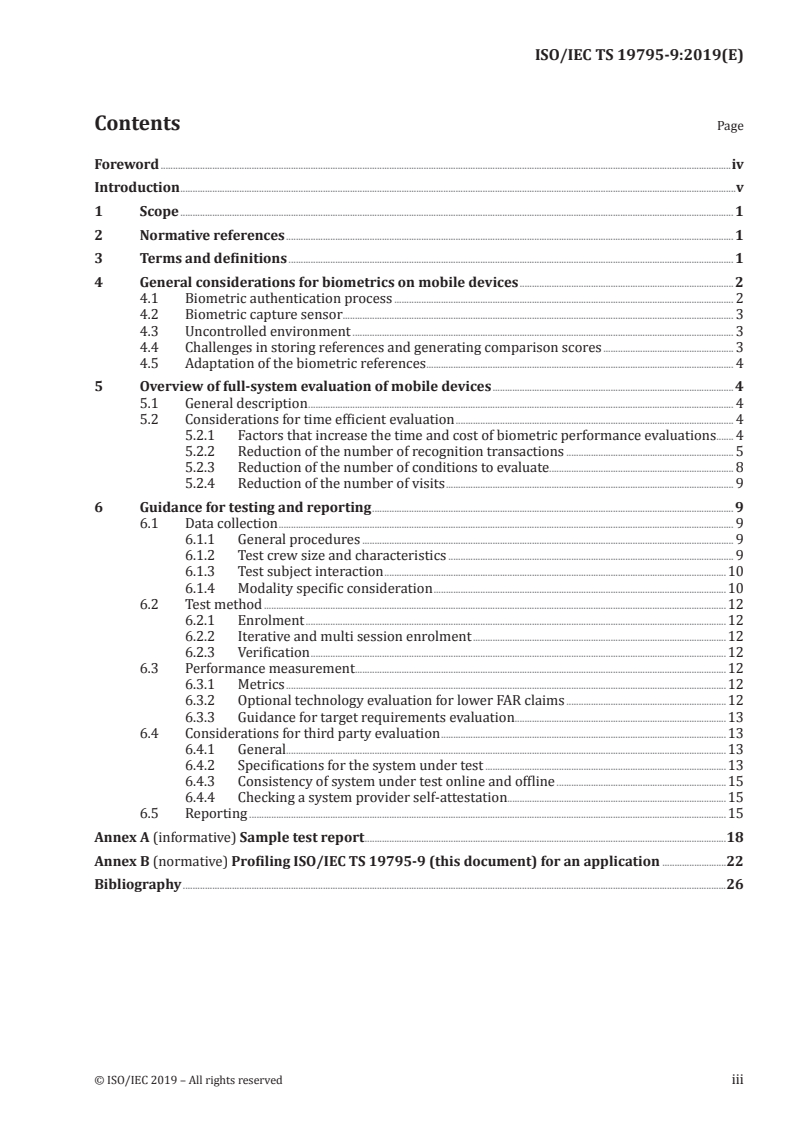
Contents Page
Foreword .iv
Introduction .v
1 Scope . 1
2 Normative references . 1
3 Terms and definitions . 1
4 General considerations for biometrics on mobile devices . 2
4.1 Biometric authentication process . 2
4.2 Biometric capture sensor. 3
4.3 Uncontrolled environment . 3
4.4 Challenges in storing references and generating comparison scores . 3
4.5 Adaptation of the biometric references . 4
5 Overview of full-system evaluation of mobile devices . 4
5.1 General description . 4
5.2 Considerations for time efficient evaluation . 4
5.2.1 Factors that increase the time and cost of biometric performance evaluations . 4
5.2.2 Reduction of the number of recognition transactions . 5
5.2.3 Reduction of the number of conditions to evaluate. 8
5.2.4 Reduction of the number of visits . 9
6 Guidance for testing and reporting . 9
6.1 Data collection . 9
6.1.1 General procedures . 9
6.1.2 Test crew size and characteristics . 9
6.1.3 Test subject interaction .10
6.1.4 Modality specific consideration .10
6.2 Test method .12
6.2.1 Enrolment .12
6.2.2 Iterative and multi session enrolment .12
6.2.3 Verification .12
6.3 Performance measurement.12
6.3.1 Metrics .12
6.3.2 Optional technology evaluation for lower FAR claims .12
6.3.3 Guidance for target requirements evaluation.13
6.4 Considerations for third party evaluation .13
6.4.1 General.13
6.4.2 Specifications for the system under test .13
6.4.3 Consistency of system under test online and offline .15
6.4.4 Checking a system provider self-attestation.15
6.5 Reporting .15
Annex A (informative) Sample test report .18
Annex B (normative) Profiling ISO/IEC TS 19795-9 (this document) for an application .22
Bibliography .26
© ISO/IEC 2019 – All rights reserved iii
Foreword
ISO (the International Organization for Standardization) and IEC (the International Electrotechnical
Commission) form the specialized system for worldwide standardization. National bodies that
are members of ISO or IEC participate in the development of International Standards through
technical committees established by the respective organization to deal with particular fields of
technical activity. ISO and IEC technical committees collaborate in fields of mutual interest. Other
international organizations, governmental and non-governmental, in liaison with ISO and IEC, also
take part in the work.
The procedures used to develop this document and those intended for its further maintenance are
described in the ISO/IEC Directives, Part 1. In particular, the different approval criteria needed for
the different types of document should be noted. This document was drafted in accordance with the
editorial rules of the ISO/IEC Directives, Part 2 (see www .iso .org/ directives).
Attention is drawn to the possibility that some of the elements of this document may be the subject
of patent rights. ISO and IEC shall not be held responsible for identifying any or all such patent
rights. Details of any patent rights identified during the development of the document will be in the
Introduction and/or on the ISO list of patent declarations received (see www .iso .org/ patents) or the IEC
list of patent declarations received (see http:// patents .iec .ch).
Any trade name used in this document is information given for the convenience of users and does not
constitute an endorsement.
For an explanation of the voluntary nature of standards, the meaning of ISO specific terms and
expressions related to conformity assessment, as well as information about ISO's adherence to the
World Trade Organization (WTO) principles in the Technical Barriers to Trade (TBT) see www .iso .org/
iso/ foreword .html.
This document was prepared by Joint Technical Committee ISO/IEC JTC 1, Information technology,
Subcommittee SC 37, Biometrics.
A list of all parts in the ISO/IEC 19795 series can be found on the ISO website.
Any feedback or questions on this document should be directed to the user’s national standards body. A
complete listing of these bodies can be found at www .iso .org/ members .html.
iv © ISO/IEC 2019 – All rights reserved
Introduction
The development of a mass-market in connected mobile devices, e.g. smartphones and tablets, has
allowed users the convenience of accessing remotely a variety of services which previously needed
face-to-face interactions or to have physical access to the service provider’s infrastructure.
For some services, convenience should nevertheless remain secondary to the security needs. These
services include for example remote payment on commercial websites, banking transactions or
certified signing of official documents. To allow these trustful interactions, the need of reliable user
authentication is of paramount importance.
One way to certify the user’s identity is to implement biometric authentication ability in the device.
It is then important to properly evaluate the accuracy of biometric authentication to ensure that
security is strong enough to allow mobile sensible transactions.
Several biometric modalities are widely utilized in consumer-focused mobile devices. Evaluation of
biometric performance for all of these modalities should be consistent and follow the same guidelines,
methodologies and requirements. Nevertheless, some modality specific considerations should also be
addressed when conducting an evaluation. This document provides a general framework usable for all
modalities as well as dedicated recommendations when needed.
ISO/IEC 19795-1 describes three types of biometric performance evaluations: technology, scenario and
[1]
operational evaluations. ISO/IEC TR 30125 recommends scenario evaluation as the most proper type
of evaluation for testing biometric performance on mobile devices.
A scenario evaluation is an “end-to-end” biometrics evaluation in which the full system is tested with
a careful control of the surrounding conditions. However, when applying this type of evaluation to
biometric systems working on mobile devices, testing and reporting methods should consider the
particularities and constraints of these use cases.
© ISO/IEC 2019 – All rights reserved v
TECHNICAL SPECIFICATION ISO/IEC TS 19795-9:2019(E)
Information technology — Biometric performance testing
and reporting —
Part 9:
Testing on mobile devices
1 Scope
This document provides guidance for performance testing of biometrics when this technology is used
on mobile devices with local biometric authentication to improve authentication assurance.
This document aims to:
— Provide guidance for affordable and cost-efficient testing and reporting methods for performance
assessment at a full system level of biometric systems embedded in mobile devices with offline
evaluation of false accept rate (FAR) claims.
— Define modality-specific considerations of these methods.
This document is applicable to:
— verification use cases related to secure transactions.
This document is not applicable to:
— privacy aspects;
— secure authentication from mobile device to server;
— testing and reporting for presentation attack detection (PAD) mechanisms in mobile devices;
— performance testing of biometric sub-systems such as acquisition sub-system or comparison
sub-system;
— continuous authentication.
2 Normative references
The following documents are referred to in the text in such a way that some or all of their content
constitutes requirements of this document. For dated references, only the edition cited applies. For
undated references, the latest edition of the referenced document (including any amendments) applies.
ISO/IEC 2382-37, Information technology — Vocabulary — Part 37: Biometrics
ISO/IEC 19795-1, Information technology — Biometric performance testing and reporting — Part 1:
Principles and framework
ISO/IEC 19795-2, Information technology — Biometric performance testing and reporting — Part 2:
Testing methodologies for technology and scenario evaluation
3 Terms and definitions
For the purposes of this document, the terms and definitions given in ISO/IEC 2382-37, ISO/IEC 19795-1
and the following apply.
© ISO/IEC 2019 – All rights reserved 1
ISO and IEC maintain terminological databases for use in standardization at the following addresses:
— IEC Electropedia: available at http:// www .electropedia .org/
— ISO Online browsing platform: available at http:// www .iso .org/ obp
3.1
mobile device
small, compact, handheld, lightweight computing device, typically having a display screen with digitizer
input and/or a miniature keyboard
EXAMPLE Laptops, tablet PCs, wearable ICT devices, smartphones, USB gadgets.
3.2
authentication assurance
confidence in the authentication process
3.3
gender
classification as male, female or some other category based on social, cultural or behavioural factors
Note 1 to entry: This is determined through self-declaration or self-presentation and may change over time.
Note 2 to entry: Depending on jurisdiction recognition, this may or may not require assessment by a third party.
3.4
time limit
longest time before a biometric system returns a decision on accept or reject, success or failure to enrol,
success or failure to acquire a biometric sample
Note 1 to entry: All decisions returned after time limit are discarded.
Note 2 to entry: Time limit set to 0 means no time limit. All metrics evaluated are reported with the longest time
needed by the biometric system to return decisions.
4 General considerations for biometrics on mobile devices
4.1 Biometric authentication process
Currently there are two types of local authentications that can be executed by mobile devices:
— explicit authentication in which the user is aware that a biometric authentication is going to happen
and presents voluntarily his/her biometric characteristic to the capture device;
— passive authentication in which the user is authenticated without active effort by the user.
NOTE This document does not cover biometric systems where the user is continuously authenticated by the
system in the background.
Therefore, the definition of testing methods and protocols should consider both types of authentications.
In particular, the test plan should consider the following aspects:
— what constitutes the biometric capture process;
— how the user should interact with the mobile device during this process;
— which are the policies to manage failure to acquire (FTA) failures.
2 © ISO/IEC 2019 – All rights reserved
4.2 Biometric capture sensor
Mobile devices may have two kinds of biometric capture sensors:
— Embedded sensors which are the generic sensors of a mobile device (e.g. front and back cameras,
microphone, touchscreen) but that are used for collecting the biometric characteristic during a
biometric authentication.
For some modalities, biometric acquisition may rely on these embedded sensors, which have not
been designed and optimized for this task. Image resolution or uncontrolled image post-processing
may for example impede the accuracy of biometric algorithms designed for more controlled
acquisition.
— Dedicated sensors which are specific sensors for collecting biometric characteristics (i.e. a fingerprint
reader).
Even when dedicated sensors are embedded in the device, they need to be coupled with optimized
software in order to take into account hardware and ergonomics constraints specific to a mobile
use case. These constraints may include, e.g. lower usable area available for fingerprint, closer range
acquisition for face recognition.
A full-system evaluation should be carried out including the biometric capture sensor. Where the same
or equivalent capturing sensor and the same comparison algorithm is used, evaluation results for one
device may be applicable to others.
For this reason, guidelines for the evaluation should include recommendations to decide the most
appropriate sensor to use during the evaluation as well as how to expand test reports to include the
characteristics of the evaluated sensor as well as its situation on the device. These guidelines should be
defined per biometric modality.
4.3 Uncontrolled environment
A full-system evaluation should control the conditions in which testing is going to be carried out. As
described in ISO/IEC TR 30125, one of the major issues of mobile devices is the uncontrolled nature
of the capture environment and the variability over time. To obtain realistic results, biometric
performance should be analysed in numerous conditions. However, it is unfeasible to do it due to time
and budget constraints. Testing conditions should be reduced to measure performance in a limited set
of conditions.
Therefore, recommendations for selecting the most proper testing conditions and how to report it
should be defined for ambient conditions present during the evaluation. Specific recommendations
should be defined per biometric modality.
4.4 Challenges in storing references and generating comparison scores
In most current implementations of biometric authentication on mobile devices, the generation and the
storage of the biometric references and samples are protected from external access. Devices are not
designed to store multiple references and generate comparison scores from the submission of a probe
against these references. Some solution is necessary to the problem of comparing one probe against
multiple references on mobile devices, where typically only one reference is available, and scores
are not accessible. Solutions could include development of test harnesses, of prototype devices, or of
alternative operating modes.
A process for validating results from these alternative operating modes against standard operating
modes will be required.
© ISO/IEC 2019 – All rights reserved 3
4.5 Adaptation of the biometric references
Finally, most biometric solutions implemented in mobile devices are able to adapt the biometric
references over time with the aim to reduce the false rejection rates. To assess the improvement over
time, the evaluation methodology should emulate this process.
5 Overview of full-system evaluation of mobile devices
5.1 General description
An evaluation of a biometric system shall conform to the requirements and best practices described in
ISO/IEC 19795-1. This document considers mobile devices as a “full biometric system”: an end-to-end
biometric system, covering all the steps from biometric sample acquisition and biometric characteristics
extraction to biometric comparison with a biometric reference. A “full biometric system” evaluation
encompasses the testing of all process and subsystems in a realistic scenario. As such, an evaluation
shall additionally conform with the requirements of ISO/IEC 19795-2:2007, Clauses 1 to 5, 7 and 8,
which are relevant for a scenario evaluation of a verification system.
NOTE Some mobile devices allow the enrolment of several users for biometric identification in a small
dataset related to low security features, e.g. device unlocking. This document only considers verification use
cases related to secure transactions, which can vary depending on the risk, policy and/or legislation that applies
to the transaction.
Mobile devices are short lifecycle products, which may have various versions, regular software updates
or hardware specifications changes from one market to another or from one production series to
another. Several devices from various manufacturers may integrate the same biometric sensors and
software provided by a unique biometric system provider. The evaluator shall determine exactly what
is the Target of Evaluation (ToE) and what the evaluation covers.
The evaluation of the ToE may be in-house testing performed by the system manufacturer, or a third-
party evaluation. The third-party may, for example, be a certification body, whose main objective would
be to assess if the ToE meets or exceeds performance requirements relevant for the certification scheme.
EXAMPLE A certification scheme can require that a mobile device has a false reject rate (FRR) below 1 %
and a FAR below 0,01 %. The system provider will claim that its product meets the requirements. The evaluator
will test the mobile device and determine if observed errors rates support the claim.
For most of the currently commercialized mobile devices with biometric capabilities, the biometric
application is a black-box for security and privacy reasons. Biometric samples are stored in a secure
environment and all computations occur in a secure execution environment, with no access to biometric
data or any intermediate results. A third-party evaluation requires that the system provider delivers a
customized version providing access to biometric data or to detailed transaction logs.
5.2 Considerations for time efficient evaluation
5.2.1 Factors that increase the time and cost of biometric performance evaluations
There are different aspects that increase the time and cost of a performance evaluation:
— The minimum error rates to be able to determine with a statistically significant level of confidence.
Depending on the expected error rates and the statistical significance to achieve, the number of
transactions to perform may increase considerably. This fact entails an increase in either the number
of subjects that participate in the evaluation, the number of visits or the number of transactions to
be conducted by test subjects.
— The inability to store large amount of biometric data and to get access to the captured biometric
samples and/or stored biometric references. As mentioned in the Introduction, mobile devices allow
a few biometric references to be saved, and most of the time it is not possible to get access to them
4 © ISO/IEC 2019 – All rights reserved
for an external application due to security reasons. Both circumstances increase the time and the
cost of the evaluation because testing procedures must be carried out online.
— The number of conditions to evaluate. Mobile devices are used in a diversity of situations (i.e. sitting
at a table, standing, walking, or driving) in which the ambient conditions are changing constantly
so there are innumerable scenarios for which biometric performance testing should be analysed.
5.2.2 Reduction of the number of recognition transactions
5.2.2.1 Approaches
The main challenge of a biometric evaluation of a mobile device for the evaluator is to assess that
the observed errors rates, FAR and FRR, support a claimed performance with a sufficient statistical
certainty.
ISO/IEC 19795-1 recommends the use of Rule of 3 or Rule of 30 approaches to assess performance claims.
— Rule of 3 defines the minimum number of transactions required for the estimation of a minimum
error rate at a 95 % confidence level when no errors are obtained during the evaluation.
— Rule of 30 states that to be 90 % confident that the true error rate is within ±30 % of the observed
error rate, there should be at least 30 errors. Based on the predefined error rates and the number of
errors, i.e. 30 errors, it is possible to define the minimum number of transactions.
The target requirement for an error will directly influence the number of independent tests required
to have statistical significance, and thus the size of the test crew, the time spent and the cost of the
evaluation. To reduce the duration and cost of executing a biometric performance evaluation, the
number of recognition transactions can be constrained.
EXAMPLE Evaluating a 0,1 % FAR rate by Rule of 30 requires 30000 independent tests (more precisely, an
observed error rate of 0,1 % would mean the true error rate is between 0,07 % and 0,13 % with 90 % confidence).
For the same 0,1 % FAR rate, Rule of 3 would only require 3000 independent tests, but the claim is only verified
(with 95 % confidence level) if no error is observed, i.e. a test is not conclusive if only one error occurs.
For FAR evaluation, while the independence criteria would require that one test subject is only involved
in one impostor transaction, it is commonly agreed that the statistical loss of computing all possible
cross-comparisons between test subjects is acceptable. This approximation shall be considered relevant
for a mobile device evaluation (i.e. with N test subjects, N*(N-1)/2 impostors tests can be made). Table 1
gives examples of the number of test subjects required for various FAR targets. In general, all possible
cross-comparisons can only be executed offline.
Table 1 — Number of tests required in an evaluation for various FAR targets
following Rule of 3 or Rule of 30
FAR target Rule of 3 Rule of 30
Minimal number of Minimal number of Minimal number of Minimal number of
tests required test subjects tests required test subjects
1 % 300 25 3000 78
0,1 % 3000 78 30000 246
0,01 % 30000 246 300000 776
0,001 % 300000 776 3000000 2450
0,0001 % 3000000 2450 30000000 7747
As noted in 5.1, a third-party evaluation of FAR would quickly be impractical and time consuming if the
evaluator only has access to an unmodified mobile device. The main drawback would be the impossibility
to enrol more than one person on the mobile device at a time, meaning that each verification transaction
must be done separately and that the enrolled person should be changed regularly.
© ISO/IEC 2019 – All rights reserved 5
A mobile device customized for evaluation could address these issues by off-line testing:
— the reference and probe biometric templates acquired on the device can be exported from the
customized mobile device and compared off-line using a dedicated SDK.
— alternatively, the mobile-device manufacturer could provide a dataset and a dedicated SDK for off-
line testing. The evaluator should then assert the relevance of the provided data.
As FRR targets are commonly higher than FAR targets. FRR evaluation is more practicable from a third-
party point of view even without customized hardware or access to off-line testing.
Table 2 — Number of tests required in an evaluation for various FRR targets
following Rule of 3
FRR target 1 % 2 % 3 % 5 %
Number of genuine tests required for 300 150 100 60
Rule of 3
Table 2 gives a few examples of the number of tests required for Rule of 3 approach: as an example, for
1 % FRR target, a test crew of 300 people is sufficient. Nevertheless, as noted earlier, Rule of 3 implies
that no error occurred, therefore an evaluation has a chance of being inconclusive. Using Rule of 30
could avoid the risk of an inconclusive result, but the number of tests required would increase tenfold.
One way to limit the increase of size of the test crew and to achieve affordable and time efficient
evaluations is to allow multiple transactions to be executed by the same test subject. However, this
will decrease test independence and increase statistic uncertainty. To help mitigate the decrease of
independence, one test subject should never proceed to more than five mated transactions.
Table 3 gives examples of the number of test subjects required when one test subject is involved in
more than one transaction for an FRR target of 1 %.
Table 3 — Number of test subjects required to follow Rule of 30 for 1 % FRR target,
when one test subject can be involved in several genuine comparisons
Number of probe transactions per subject 1 3 5
Number of test subjects required 3000 1000 600
Similarly to FAR testing, a customized mobile device, allowing, for example, off-line testing, could make
an FRR evaluation involving multi-transactions more practical.
To increase the independence of transactions, acquisitions should be performed in separated sessions
with a time gap of at least one day between each one:
— For mated comparison trials, transactions should be performed in separate sessions. If genuine
transactions are performed in the same session the measured FRR will be significantly
underestimated. If it is not feasible to perform verification transactions on separate days:
— the test subject shall at least disengage from the device and perform another activity between
transactions,
— the test report shall acknowledge that it is the same day FRR which was measured and is under-
estimating the real FRR of the system.
— For non-mated comparison trials, testing does not need to follow this recommendation.
NOTE 1 While the impact varies depending on modality, same day comparison for genuine transaction will
in particular significantly neglect the impact of ageing on recognition accuracy. Most mobile devices do have
reference adaptation mechanisms to update enrolment regularly and mitigate ageing effects, however the loss of
validity of results for same day comparison is especially relevant for face modality.
6 © ISO/IEC 2019 – All rights reserved
NOTE 2 Carrying out separate sessions increases the duration and the cost of the evaluation and this mainly
affects the FRR rate as it is addressed in 5.2.3.
In addition to Rule of 3 and Rule of 30, bootstrapping (sampling with replacement) is also a method to
determine confidence particularly when a distribution cannot be assumed. Bootstrapping allows the
use of the test data to determine the confidence depending on the test scenario, e.g. number of subjects
and number of attempts (or transactions) per subject.
When attempting to establish whether an error rate is below a threshold, it is appropriate to choose a
one-sided upper bound. In this method, the statistical analysis does not focus on the mean, but rather
whether it is below a specific performance target. For example, see Figure 1 (below). This compares
Rule of 30 with a one-sided upper bound confidence interval using bootstrapping.
Figure 1 — Comparison of Rule of 30 and one-sided bootstrap design
Additionally, depending on the scenario, the number of subjects may be less than required for Rule of 30.
EXAMPLE Simulations of the bootstrapping process were performed using the following settings: 245
Subjects (n), 1 enrolment per subject, 5 verification transactions(m), which resulted in 298900 total impostor
comparisons from N = nm(n−1). Errors were randomly distributed across the 298900 comparisons, 5000
bootstraps created using the method in ISO/IEC 19795-1. When the Upper Bound (UB) of the Confidence Interval
of the bootstrap distribution is set to 0,01 %, the mean FAR is necessarily below 0,01 %. Table 4 below provides
the number of errors associated with 68 %, 80 %, and 95 UB confidence intervals. For example, in this simulation,
the number of errors is 17 out of 298,900 in order to achieve a 95 % upper bound.
Table 4 — Example of Upper Bound (UB) confidence intervals and required number of errors
UB of confidence interval Number of errors to achieve UB
Set to 1:10,000
68 % 27 (out of 298,900)
80 % 23 (out of 298,900)
95 % 17 (out of 298,900)
© ISO/IEC 2019 – All rights reserved 7
5.2.2.2 Impact on the test methods and results
The recommendations of 5.2.2.1 directly affect two key aspects of the evaluation.
— The method to obtain the false accept rate. The calculation of the FAR should be done offline applying
the cross-comparison strategy to achieve the maximum number of transactions. This means that
for the evaluation:
— a prototype which includes the biometric capture sensor and which operates as the biometric
system under test should be created. This prototype should be able to save biometric references
and samples.
— a test harness which works as the biometric system under test and which will be able to compute
offline error rates from the stored information should be developed.
— equivalence tests between online and offline results.
— it is necessary to define what is a conformant transaction and which data should be stored to
replicate a transaction offline.
— the minimum number of test subjects that should compose the test crew should be defined,
especially for those modalities for which is possible to obtain different biometric characteristics
from the same test subject.
— The method to obtain the uncertainty of the metrics. The Rule of 3 assumes that no errors will
happen. But this is not always true. This rule proceeds from the assumption that transactions are
independent and identically distributed. However, biometrics errors are not identically distributed
across the population as well as transactions are not independent as several transactions will
come from the same test subject. As a consequence, errors may happen and it will be necessary to
calculate the uncertainty of the metrics.
To achieve this, ISO/IEC 19795-1 proposes different approaches: parametric and non-parametric. Due
to the assumptions that are made when applying the parametric approaches, it is recommended to use
a non-parametric approach, such as the bootstrapping method for the calculation of the confidence
intervals.
NOTE ISO/IEC 19795-1 describes the bootstrapping method as an estimation method that reduces the
need to make assumptions about the underlying distribution of the observed error rates and the dependencies
between attempts.
If the bootstrapping approach is used, at least 1 000 bootstrapping samples shall be used. 95 % upper
bound should be used for confidence interval.
5.2.3 Reduction of the number of conditions to evaluate
5.2.3.1 Approaches
Another aspect to achieve efficient and affordable evaluations in the case of mobile devices is to limit
the test to calculate biometric performance in specific situations. Otherwise, addressing all possible
combinations of testing conditions, such as the ambient conditions and the position of the mobile device
relatively to the user, would be too complex to test in a cost-efficient evaluation.
Therefore, it is recommended to restrict the test to a scenario that will be easy to generate and control
during the evaluation among test subjects.
NOTE While a biometric system is traditionally deployed in a closed environment where the system manager
can enforce a policy able to optimize the system behaviour, biometric verification with a mobile device implies
that no such policy can be applicable. Depending on the biometric modality used, an unconstrained acquisition
environment can have a limited or severe impact on the overall system performance.
8 © ISO/IEC 2019 – All rights reserved
The conditions suggested for this scenario are indoor conditions, with no noise in which the mobile
device is hand-held by the user.
5.2.3.2 Impact on the results
As performance testing is only calculated for one or a limited number of conditions, the results may
differ from the reality.
These results should be considered as a baseline. For analyzing the influence of ambient conditions
[2]
or the test subject interaction on biometric performance, other standards, e.g. ISO/IEC 29197 and
1)[3]
ISO/IEC 21472 , should be applied.
5.2.4 Reduction of the number of visits
5.2.4.1 Approaches
Another aspect that may contribute to reducing the cost and duration of the evaluation is the limitation
of the number of visits to just one visit. ISO/IEC 19795 addresses to conduct multiple visits for including
effects such as ageing and/or the acquisition conditions on the measurements of performance rates.
5.2.4.2 Impact on the results
However, the impact of this assumption mainly affects the false rejection rate which will be optimistic.
Nevertheless, later evaluations could be carried out increasing the number of visits to analyse the
aforementioned effects.
6 Guidance for testing and reporting
6.1 Data collection
6.1.1 General procedures
The test crew involved in the evaluation shall be familiar with the type of mobile devices used
(i.e. smartphone or tablet). The hypothesis is that the user is willing to use biometrics for secure
transaction using a device they already possess and use daily. The evaluator should determine and shall
report if some training is authorised with the biometric capabilities of the mobile device prior to the
evaluation.
NOTE If the evaluation plans to use Rule of 3 to assess a claimed performance, as discussed in 5.2.2, the risk of
having an inconclusive evaluation caused by a single error can be reduced by allowing a significant training phase.
The test crew shall be informed that they shall make their best effort when using the system and shall
follow any guidance provided by the biometric system as closely as possible (i.e. the test crew shall
never purposefully try to test the limits of the system).
6.1.2 Test crew size and characteristics
Test crew size will be influenced by considerations discussed in 5.2.2 about the number of tests required
to have statistical significance. Depending on the biometric modality evaluated, one single test subject
may provide biometric samples from several instances to be used in mated and inter-individual non-
mated comparisons. For example, for an evaluation of a mobile device using fingerprint technology, one
single person could provide biometric data coming from several fingers. Evaluator shall report if this
possibility was used.
1) To be published. Current stage: 40.20.
© ISO/IEC 2019 – All rights reserved 9
The evaluator shall report test crew size. Age and gender distributions of the test crew shall be reported.
Ethnicity should be reported. If the mobile device has an identified market target, the test crew should
be as representative as possible of this target population.
For gender, there shall be no less than 40 % of male or female and no more than 60 % of male or female in
the test crew. There are no other gender constraints, as long as those on male and female are respected.
6.1.3 Test subject interaction
Evaluation of biometric acquisition on mobile devices shall try to emulate an unsupervised environment
by having limited intervention from the evaluator. The evaluator shall remain in an observer role only
while the test subject interacts with the mobile device; any guidance shall be provided only by the
mobile device, for example through its graphical user interface or audible instructions.
6.1.4 Modality specific consideration
6.1.4.1 Fingerprint
If the biometric system is designed to acquire and verify one fingerprint, one subject may provide
biometric samples coming from several fingers. For non-mated comparison trials, intra-individual
comparisons shall not be included. The number of samples given by one single person should be up to
four different fingers and should be constrained to the index, thumb, or middle fingers from both hands.
If the biometric system is designed to acquire and verify several fingerprints simultaneously (i.e.
through direct-view acquisition using regular camera), one subject may provide biometric samples
coming from the left and right hands. For non-mated comparison trials, intra-individual comparisons
shall not be included.
6.1.4.2 Face
Auxiliary means, such as selfie sticks, should not be utilized when collecting self-made face images.
6.1.4.3 Iris
If the biometric system is designed to acquire and verify one iris, one subject may provide biometric
samples coming from the left and right irises. For non-mated comparison trials, intra-individual
comparisons shall not be included. If the mobile device acquires and verifies both irises, one person
corresponds to one test subject only.
If the mobile device does not have dedicated near infrared (NIR) acquisition module and instead relies
on a regular camera to perform visible wavelength iris acquisition, the subject’s eye colour will have
a considerable impact on performance. The evaluator shall in this case report eye colour distribution.
In cases where the iris-based biometric system generates comparison or capture errors, the evaluator
should examine the occurrence of such errors as a function of eye colour.
6.1.4.4 Voice
If the biometric system is designed to acquire and verify the voice, the following aspects regarding data
collection should be considered:
— The scenario in which biometric data will be collected are not only defined by the environmental
conditions, but also the way in which users interact with the biometric sensor, which is embedded
on the mobile device. There are a variety of positions, such as handheld, or over a table, and
every position may involve different orientations and different distances from the speaker to the
microphone.
Therefore, the conditions in which the ToE is evaluated should describe not only the environmental
conditions such as the type and level of noise but also the position of the phone and its orientation
relative to the speaker.
10 © ISO/IEC 2019 – All rights reserved
— Test subjects characteristics. Specifically, relevant factors such as the native language and accent of
the speaker should be considered as representative factors of the target population.
— The operation mode of the biometric system. In speaker recognition the operation mode of the
system may be classified into text-dependent and text-independent.
In a text-dependent system, users are enrolled by the repetition of the same phrase several times. Then
they just have to say the passphrase to be recognized. This passphrase can be chosen from a predefined
catalogue or created freely by each user.
In a text-independent system, users are not forced to use a particular speech or passphrase. They are
en
...
TECHNICAL ISO/IEC TS
SPECIFICATION 19795-9
First edition
2019-12
Information technology — Biometric
performance testing and reporting —
Part 9:
Testing on mobile devices
Reference number
©
ISO/IEC 2019
© ISO/IEC 2019
All rights reserved. Unless otherwise specified, or required in the context of its implementation, no part of this publication may
be reproduced or utilized otherwise in any form or by any means, electronic or mechanical, including photocopying, or posting
on the internet or an intranet, without prior written permission. Permission can be requested from either ISO at the address
below or ISO’s member body in the country of the requester.
ISO copyright office
CP 401 • Ch. de Blandonnet 8
CH-1214 Vernier, Geneva
Phone: +41 22 749 01 11
Fax: +41 22 749 09 47
Email: copyright@iso.org
Website: www.iso.org
Published in Switzerland
ii © ISO/IEC 2019 – All rights reserved
Contents Page
Foreword .iv
Introduction .v
1 Scope . 1
2 Normative references . 1
3 Terms and definitions . 1
4 General considerations for biometrics on mobile devices . 2
4.1 Biometric authentication process . 2
4.2 Biometric capture sensor. 3
4.3 Uncontrolled environment . 3
4.4 Challenges in storing references and generating comparison scores . 3
4.5 Adaptation of the biometric references . 4
5 Overview of full-system evaluation of mobile devices . 4
5.1 General description . 4
5.2 Considerations for time efficient evaluation . 4
5.2.1 Factors that increase the time and cost of biometric performance evaluations . 4
5.2.2 Reduction of the number of recognition transactions . 5
5.2.3 Reduction of the number of conditions to evaluate. 8
5.2.4 Reduction of the number of visits . 9
6 Guidance for testing and reporting . 9
6.1 Data collection . 9
6.1.1 General procedures . 9
6.1.2 Test crew size and characteristics . 9
6.1.3 Test subject interaction .10
6.1.4 Modality specific consideration .10
6.2 Test method .12
6.2.1 Enrolment .12
6.2.2 Iterative and multi session enrolment .12
6.2.3 Verification .12
6.3 Performance measurement.12
6.3.1 Metrics .12
6.3.2 Optional technology evaluation for lower FAR claims .12
6.3.3 Guidance for target requirements evaluation.13
6.4 Considerations for third party evaluation .13
6.4.1 General.13
6.4.2 Specifications for the system under test .13
6.4.3 Consistency of system under test online and offline .15
6.4.4 Checking a system provider self-attestation.15
6.5 Reporting .15
Annex A (informative) Sample test report .18
Annex B (normative) Profiling ISO/IEC TS 19795-9 (this document) for an application .22
Bibliography .26
© ISO/IEC 2019 – All rights reserved iii
Foreword
ISO (the International Organization for Standardization) and IEC (the International Electrotechnical
Commission) form the specialized system for worldwide standardization. National bodies that
are members of ISO or IEC participate in the development of International Standards through
technical committees established by the respective organization to deal with particular fields of
technical activity. ISO and IEC technical committees collaborate in fields of mutual interest. Other
international organizations, governmental and non-governmental, in liaison with ISO and IEC, also
take part in the work.
The procedures used to develop this document and those intended for its further maintenance are
described in the ISO/IEC Directives, Part 1. In particular, the different approval criteria needed for
the different types of document should be noted. This document was drafted in accordance with the
editorial rules of the ISO/IEC Directives, Part 2 (see www .iso .org/ directives).
Attention is drawn to the possibility that some of the elements of this document may be the subject
of patent rights. ISO and IEC shall not be held responsible for identifying any or all such patent
rights. Details of any patent rights identified during the development of the document will be in the
Introduction and/or on the ISO list of patent declarations received (see www .iso .org/ patents) or the IEC
list of patent declarations received (see http:// patents .iec .ch).
Any trade name used in this document is information given for the convenience of users and does not
constitute an endorsement.
For an explanation of the voluntary nature of standards, the meaning of ISO specific terms and
expressions related to conformity assessment, as well as information about ISO's adherence to the
World Trade Organization (WTO) principles in the Technical Barriers to Trade (TBT) see www .iso .org/
iso/ foreword .html.
This document was prepared by Joint Technical Committee ISO/IEC JTC 1, Information technology,
Subcommittee SC 37, Biometrics.
A list of all parts in the ISO/IEC 19795 series can be found on the ISO website.
Any feedback or questions on this document should be directed to the user’s national standards body. A
complete listing of these bodies can be found at www .iso .org/ members .html.
iv © ISO/IEC 2019 – All rights reserved
Introduction
The development of a mass-market in connected mobile devices, e.g. smartphones and tablets, has
allowed users the convenience of accessing remotely a variety of services which previously needed
face-to-face interactions or to have physical access to the service provider’s infrastructure.
For some services, convenience should nevertheless remain secondary to the security needs. These
services include for example remote payment on commercial websites, banking transactions or
certified signing of official documents. To allow these trustful interactions, the need of reliable user
authentication is of paramount importance.
One way to certify the user’s identity is to implement biometric authentication ability in the device.
It is then important to properly evaluate the accuracy of biometric authentication to ensure that
security is strong enough to allow mobile sensible transactions.
Several biometric modalities are widely utilized in consumer-focused mobile devices. Evaluation of
biometric performance for all of these modalities should be consistent and follow the same guidelines,
methodologies and requirements. Nevertheless, some modality specific considerations should also be
addressed when conducting an evaluation. This document provides a general framework usable for all
modalities as well as dedicated recommendations when needed.
ISO/IEC 19795-1 describes three types of biometric performance evaluations: technology, scenario and
[1]
operational evaluations. ISO/IEC TR 30125 recommends scenario evaluation as the most proper type
of evaluation for testing biometric performance on mobile devices.
A scenario evaluation is an “end-to-end” biometrics evaluation in which the full system is tested with
a careful control of the surrounding conditions. However, when applying this type of evaluation to
biometric systems working on mobile devices, testing and reporting methods should consider the
particularities and constraints of these use cases.
© ISO/IEC 2019 – All rights reserved v
TECHNICAL SPECIFICATION ISO/IEC TS 19795-9:2019(E)
Information technology — Biometric performance testing
and reporting —
Part 9:
Testing on mobile devices
1 Scope
This document provides guidance for performance testing of biometrics when this technology is used
on mobile devices with local biometric authentication to improve authentication assurance.
This document aims to:
— Provide guidance for affordable and cost-efficient testing and reporting methods for performance
assessment at a full system level of biometric systems embedded in mobile devices with offline
evaluation of false accept rate (FAR) claims.
— Define modality-specific considerations of these methods.
This document is applicable to:
— verification use cases related to secure transactions.
This document is not applicable to:
— privacy aspects;
— secure authentication from mobile device to server;
— testing and reporting for presentation attack detection (PAD) mechanisms in mobile devices;
— performance testing of biometric sub-systems such as acquisition sub-system or comparison
sub-system;
— continuous authentication.
2 Normative references
The following documents are referred to in the text in such a way that some or all of their content
constitutes requirements of this document. For dated references, only the edition cited applies. For
undated references, the latest edition of the referenced document (including any amendments) applies.
ISO/IEC 2382-37, Information technology — Vocabulary — Part 37: Biometrics
ISO/IEC 19795-1, Information technology — Biometric performance testing and reporting — Part 1:
Principles and framework
ISO/IEC 19795-2, Information technology — Biometric performance testing and reporting — Part 2:
Testing methodologies for technology and scenario evaluation
3 Terms and definitions
For the purposes of this document, the terms and definitions given in ISO/IEC 2382-37, ISO/IEC 19795-1
and the following apply.
© ISO/IEC 2019 – All rights reserved 1
ISO and IEC maintain terminological databases for use in standardization at the following addresses:
— IEC Electropedia: available at http:// www .electropedia .org/
— ISO Online browsing platform: available at http:// www .iso .org/ obp
3.1
mobile device
small, compact, handheld, lightweight computing device, typically having a display screen with digitizer
input and/or a miniature keyboard
EXAMPLE Laptops, tablet PCs, wearable ICT devices, smartphones, USB gadgets.
3.2
authentication assurance
confidence in the authentication process
3.3
gender
classification as male, female or some other category based on social, cultural or behavioural factors
Note 1 to entry: This is determined through self-declaration or self-presentation and may change over time.
Note 2 to entry: Depending on jurisdiction recognition, this may or may not require assessment by a third party.
3.4
time limit
longest time before a biometric system returns a decision on accept or reject, success or failure to enrol,
success or failure to acquire a biometric sample
Note 1 to entry: All decisions returned after time limit are discarded.
Note 2 to entry: Time limit set to 0 means no time limit. All metrics evaluated are reported with the longest time
needed by the biometric system to return decisions.
4 General considerations for biometrics on mobile devices
4.1 Biometric authentication process
Currently there are two types of local authentications that can be executed by mobile devices:
— explicit authentication in which the user is aware that a biometric authentication is going to happen
and presents voluntarily his/her biometric characteristic to the capture device;
— passive authentication in which the user is authenticated without active effort by the user.
NOTE This document does not cover biometric systems where the user is continuously authenticated by the
system in the background.
Therefore, the definition of testing methods and protocols should consider both types of authentications.
In particular, the test plan should consider the following aspects:
— what constitutes the biometric capture process;
— how the user should interact with the mobile device during this process;
— which are the policies to manage failure to acquire (FTA) failures.
2 © ISO/IEC 2019 – All rights reserved
4.2 Biometric capture sensor
Mobile devices may have two kinds of biometric capture sensors:
— Embedded sensors which are the generic sensors of a mobile device (e.g. front and back cameras,
microphone, touchscreen) but that are used for collecting the biometric characteristic during a
biometric authentication.
For some modalities, biometric acquisition may rely on these embedded sensors, which have not
been designed and optimized for this task. Image resolution or uncontrolled image post-processing
may for example impede the accuracy of biometric algorithms designed for more controlled
acquisition.
— Dedicated sensors which are specific sensors for collecting biometric characteristics (i.e. a fingerprint
reader).
Even when dedicated sensors are embedded in the device, they need to be coupled with optimized
software in order to take into account hardware and ergonomics constraints specific to a mobile
use case. These constraints may include, e.g. lower usable area available for fingerprint, closer range
acquisition for face recognition.
A full-system evaluation should be carried out including the biometric capture sensor. Where the same
or equivalent capturing sensor and the same comparison algorithm is used, evaluation results for one
device may be applicable to others.
For this reason, guidelines for the evaluation should include recommendations to decide the most
appropriate sensor to use during the evaluation as well as how to expand test reports to include the
characteristics of the evaluated sensor as well as its situation on the device. These guidelines should be
defined per biometric modality.
4.3 Uncontrolled environment
A full-system evaluation should control the conditions in which testing is going to be carried out. As
described in ISO/IEC TR 30125, one of the major issues of mobile devices is the uncontrolled nature
of the capture environment and the variability over time. To obtain realistic results, biometric
performance should be analysed in numerous conditions. However, it is unfeasible to do it due to time
and budget constraints. Testing conditions should be reduced to measure performance in a limited set
of conditions.
Therefore, recommendations for selecting the most proper testing conditions and how to report it
should be defined for ambient conditions present during the evaluation. Specific recommendations
should be defined per biometric modality.
4.4 Challenges in storing references and generating comparison scores
In most current implementations of biometric authentication on mobile devices, the generation and the
storage of the biometric references and samples are protected from external access. Devices are not
designed to store multiple references and generate comparison scores from the submission of a probe
against these references. Some solution is necessary to the problem of comparing one probe against
multiple references on mobile devices, where typically only one reference is available, and scores
are not accessible. Solutions could include development of test harnesses, of prototype devices, or of
alternative operating modes.
A process for validating results from these alternative operating modes against standard operating
modes will be required.
© ISO/IEC 2019 – All rights reserved 3
4.5 Adaptation of the biometric references
Finally, most biometric solutions implemented in mobile devices are able to adapt the biometric
references over time with the aim to reduce the false rejection rates. To assess the improvement over
time, the evaluation methodology should emulate this process.
5 Overview of full-system evaluation of mobile devices
5.1 General description
An evaluation of a biometric system shall conform to the requirements and best practices described in
ISO/IEC 19795-1. This document considers mobile devices as a “full biometric system”: an end-to-end
biometric system, covering all the steps from biometric sample acquisition and biometric characteristics
extraction to biometric comparison with a biometric reference. A “full biometric system” evaluation
encompasses the testing of all process and subsystems in a realistic scenario. As such, an evaluation
shall additionally conform with the requirements of ISO/IEC 19795-2:2007, Clauses 1 to 5, 7 and 8,
which are relevant for a scenario evaluation of a verification system.
NOTE Some mobile devices allow the enrolment of several users for biometric identification in a small
dataset related to low security features, e.g. device unlocking. This document only considers verification use
cases related to secure transactions, which can vary depending on the risk, policy and/or legislation that applies
to the transaction.
Mobile devices are short lifecycle products, which may have various versions, regular software updates
or hardware specifications changes from one market to another or from one production series to
another. Several devices from various manufacturers may integrate the same biometric sensors and
software provided by a unique biometric system provider. The evaluator shall determine exactly what
is the Target of Evaluation (ToE) and what the evaluation covers.
The evaluation of the ToE may be in-house testing performed by the system manufacturer, or a third-
party evaluation. The third-party may, for example, be a certification body, whose main objective would
be to assess if the ToE meets or exceeds performance requirements relevant for the certification scheme.
EXAMPLE A certification scheme can require that a mobile device has a false reject rate (FRR) below 1 %
and a FAR below 0,01 %. The system provider will claim that its product meets the requirements. The evaluator
will test the mobile device and determine if observed errors rates support the claim.
For most of the currently commercialized mobile devices with biometric capabilities, the biometric
application is a black-box for security and privacy reasons. Biometric samples are stored in a secure
environment and all computations occur in a secure execution environment, with no access to biometric
data or any intermediate results. A third-party evaluation requires that the system provider delivers a
customized version providing access to biometric data or to detailed transaction logs.
5.2 Considerations for time efficient evaluation
5.2.1 Factors that increase the time and cost of biometric performance evaluations
There are different aspects that increase the time and cost of a performance evaluation:
— The minimum error rates to be able to determine with a statistically significant level of confidence.
Depending on the expected error rates and the statistical significance to achieve, the number of
transactions to perform may increase considerably. This fact entails an increase in either the number
of subjects that participate in the evaluation, the number of visits or the number of transactions to
be conducted by test subjects.
— The inability to store large amount of biometric data and to get access to the captured biometric
samples and/or stored biometric references. As mentioned in the Introduction, mobile devices allow
a few biometric references to be saved, and most of the time it is not possible to get access to them
4 © ISO/IEC 2019 – All rights reserved
for an external application due to security reasons. Both circumstances increase the time and the
cost of the evaluation because testing procedures must be carried out online.
— The number of conditions to evaluate. Mobile devices are used in a diversity of situations (i.e. sitting
at a table, standing, walking, or driving) in which the ambient conditions are changing constantly
so there are innumerable scenarios for which biometric performance testing should be analysed.
5.2.2 Reduction of the number of recognition transactions
5.2.2.1 Approaches
The main challenge of a biometric evaluation of a mobile device for the evaluator is to assess that
the observed errors rates, FAR and FRR, support a claimed performance with a sufficient statistical
certainty.
ISO/IEC 19795-1 recommends the use of Rule of 3 or Rule of 30 approaches to assess performance claims.
— Rule of 3 defines the minimum number of transactions required for the estimation of a minimum
error rate at a 95 % confidence level when no errors are obtained during the evaluation.
— Rule of 30 states that to be 90 % confident that the true error rate is within ±30 % of the observed
error rate, there should be at least 30 errors. Based on the predefined error rates and the number of
errors, i.e. 30 errors, it is possible to define the minimum number of transactions.
The target requirement for an error will directly influence the number of independent tests required
to have statistical significance, and thus the size of the test crew, the time spent and the cost of the
evaluation. To reduce the duration and cost of executing a biometric performance evaluation, the
number of recognition transactions can be constrained.
EXAMPLE Evaluating a 0,1 % FAR rate by Rule of 30 requires 30000 independent tests (more precisely, an
observed error rate of 0,1 % would mean the true error rate is between 0,07 % and 0,13 % with 90 % confidence).
For the same 0,1 % FAR rate, Rule of 3 would only require 3000 independent tests, but the claim is only verified
(with 95 % confidence level) if no error is observed, i.e. a test is not conclusive if only one error occurs.
For FAR evaluation, while the independence criteria would require that one test subject is only involved
in one impostor transaction, it is commonly agreed that the statistical loss of computing all possible
cross-comparisons between test subjects is acceptable. This approximation shall be considered relevant
for a mobile device evaluation (i.e. with N test subjects, N*(N-1)/2 impostors tests can be made). Table 1
gives examples of the number of test subjects required for various FAR targets. In general, all possible
cross-comparisons can only be executed offline.
Table 1 — Number of tests required in an evaluation for various FAR targets
following Rule of 3 or Rule of 30
FAR target Rule of 3 Rule of 30
Minimal number of Minimal number of Minimal number of Minimal number of
tests required test subjects tests required test subjects
1 % 300 25 3000 78
0,1 % 3000 78 30000 246
0,01 % 30000 246 300000 776
0,001 % 300000 776 3000000 2450
0,0001 % 3000000 2450 30000000 7747
As noted in 5.1, a third-party evaluation of FAR would quickly be impractical and time consuming if the
evaluator only has access to an unmodified mobile device. The main drawback would be the impossibility
to enrol more than one person on the mobile device at a time, meaning that each verification transaction
must be done separately and that the enrolled person should be changed regularly.
© ISO/IEC 2019 – All rights reserved 5
A mobile device customized for evaluation could address these issues by off-line testing:
— the reference and probe biometric templates acquired on the device can be exported from the
customized mobile device and compared off-line using a dedicated SDK.
— alternatively, the mobile-device manufacturer could provide a dataset and a dedicated SDK for off-
line testing. The evaluator should then assert the relevance of the provided data.
As FRR targets are commonly higher than FAR targets. FRR evaluation is more practicable from a third-
party point of view even without customized hardware or access to off-line testing.
Table 2 — Number of tests required in an evaluation for various FRR targets
following Rule of 3
FRR target 1 % 2 % 3 % 5 %
Number of genuine tests required for 300 150 100 60
Rule of 3
Table 2 gives a few examples of the number of tests required for Rule of 3 approach: as an example, for
1 % FRR target, a test crew of 300 people is sufficient. Nevertheless, as noted earlier, Rule of 3 implies
that no error occurred, therefore an evaluation has a chance of being inconclusive. Using Rule of 30
could avoid the risk of an inconclusive result, but the number of tests required would increase tenfold.
One way to limit the increase of size of the test crew and to achieve affordable and time efficient
evaluations is to allow multiple transactions to be executed by the same test subject. However, this
will decrease test independence and increase statistic uncertainty. To help mitigate the decrease of
independence, one test subject should never proceed to more than five mated transactions.
Table 3 gives examples of the number of test subjects required when one test subject is involved in
more than one transaction for an FRR target of 1 %.
Table 3 — Number of test subjects required to follow Rule of 30 for 1 % FRR target,
when one test subject can be involved in several genuine comparisons
Number of probe transactions per subject 1 3 5
Number of test subjects required 3000 1000 600
Similarly to FAR testing, a customized mobile device, allowing, for example, off-line testing, could make
an FRR evaluation involving multi-transactions more practical.
To increase the independence of transactions, acquisitions should be performed in separated sessions
with a time gap of at least one day between each one:
— For mated comparison trials, transactions should be performed in separate sessions. If genuine
transactions are performed in the same session the measured FRR will be significantly
underestimated. If it is not feasible to perform verification transactions on separate days:
— the test subject shall at least disengage from the device and perform another activity between
transactions,
— the test report shall acknowledge that it is the same day FRR which was measured and is under-
estimating the real FRR of the system.
— For non-mated comparison trials, testing does not need to follow this recommendation.
NOTE 1 While the impact varies depending on modality, same day comparison for genuine transaction will
in particular significantly neglect the impact of ageing on recognition accuracy. Most mobile devices do have
reference adaptation mechanisms to update enrolment regularly and mitigate ageing effects, however the loss of
validity of results for same day comparison is especially relevant for face modality.
6 © ISO/IEC 2019 – All rights reserved
NOTE 2 Carrying out separate sessions increases the duration and the cost of the evaluation and this mainly
affects the FRR rate as it is addressed in 5.2.3.
In addition to Rule of 3 and Rule of 30, bootstrapping (sampling with replacement) is also a method to
determine confidence particularly when a distribution cannot be assumed. Bootstrapping allows the
use of the test data to determine the confidence depending on the test scenario, e.g. number of subjects
and number of attempts (or transactions) per subject.
When attempting to establish whether an error rate is below a threshold, it is appropriate to choose a
one-sided upper bound. In this method, the statistical analysis does not focus on the mean, but rather
whether it is below a specific performance target. For example, see Figure 1 (below). This compares
Rule of 30 with a one-sided upper bound confidence interval using bootstrapping.
Figure 1 — Comparison of Rule of 30 and one-sided bootstrap design
Additionally, depending on the scenario, the number of subjects may be less than required for Rule of 30.
EXAMPLE Simulations of the bootstrapping process were performed using the following settings: 245
Subjects (n), 1 enrolment per subject, 5 verification transactions(m), which resulted in 298900 total impostor
comparisons from N = nm(n−1). Errors were randomly distributed across the 298900 comparisons, 5000
bootstraps created using the method in ISO/IEC 19795-1. When the Upper Bound (UB) of the Confidence Interval
of the bootstrap distribution is set to 0,01 %, the mean FAR is necessarily below 0,01 %. Table 4 below provides
the number of errors associated with 68 %, 80 %, and 95 UB confidence intervals. For example, in this simulation,
the number of errors is 17 out of 298,900 in order to achieve a 95 % upper bound.
Table 4 — Example of Upper Bound (UB) confidence intervals and required number of errors
UB of confidence interval Number of errors to achieve UB
Set to 1:10,000
68 % 27 (out of 298,900)
80 % 23 (out of 298,900)
95 % 17 (out of 298,900)
© ISO/IEC 2019 – All rights reserved 7
5.2.2.2 Impact on the test methods and results
The recommendations of 5.2.2.1 directly affect two key aspects of the evaluation.
— The method to obtain the false accept rate. The calculation of the FAR should be done offline applying
the cross-comparison strategy to achieve the maximum number of transactions. This means that
for the evaluation:
— a prototype which includes the biometric capture sensor and which operates as the biometric
system under test should be created. This prototype should be able to save biometric references
and samples.
— a test harness which works as the biometric system under test and which will be able to compute
offline error rates from the stored information should be developed.
— equivalence tests between online and offline results.
— it is necessary to define what is a conformant transaction and which data should be stored to
replicate a transaction offline.
— the minimum number of test subjects that should compose the test crew should be defined,
especially for those modalities for which is possible to obtain different biometric characteristics
from the same test subject.
— The method to obtain the uncertainty of the metrics. The Rule of 3 assumes that no errors will
happen. But this is not always true. This rule proceeds from the assumption that transactions are
independent and identically distributed. However, biometrics errors are not identically distributed
across the population as well as transactions are not independent as several transactions will
come from the same test subject. As a consequence, errors may happen and it will be necessary to
calculate the uncertainty of the metrics.
To achieve this, ISO/IEC 19795-1 proposes different approaches: parametric and non-parametric. Due
to the assumptions that are made when applying the parametric approaches, it is recommended to use
a non-parametric approach, such as the bootstrapping method for the calculation of the confidence
intervals.
NOTE ISO/IEC 19795-1 describes the bootstrapping method as an estimation method that reduces the
need to make assumptions about the underlying distribution of the observed error rates and the dependencies
between attempts.
If the bootstrapping approach is used, at least 1 000 bootstrapping samples shall be used. 95 % upper
bound should be used for confidence interval.
5.2.3 Reduction of the number of conditions to evaluate
5.2.3.1 Approaches
Another aspect to achieve efficient and affordable evaluations in the case of mobile devices is to limit
the test to calculate biometric performance in specific situations. Otherwise, addressing all possible
combinations of testing conditions, such as the ambient conditions and the position of the mobile device
relatively to the user, would be too complex to test in a cost-efficient evaluation.
Therefore, it is recommended to restrict the test to a scenario that will be easy to generate and control
during the evaluation among test subjects.
NOTE While a biometric system is traditionally deployed in a closed environment where the system manager
can enforce a policy able to optimize the system behaviour, biometric verification with a mobile device implies
that no such policy can be applicable. Depending on the biometric modality used, an unconstrained acquisition
environment can have a limited or severe impact on the overall system performance.
8 © ISO/IEC 2019 – All rights reserved
The conditions suggested for this scenario are indoor conditions, with no noise in which the mobile
device is hand-held by the user.
5.2.3.2 Impact on the results
As performance testing is only calculated for one or a limited number of conditions, the results may
differ from the reality.
These results should be considered as a baseline. For analyzing the influence of ambient conditions
[2]
or the test subject interaction on biometric performance, other standards, e.g. ISO/IEC 29197 and
1)[3]
ISO/IEC 21472 , should be applied.
5.2.4 Reduction of the number of visits
5.2.4.1 Approaches
Another aspect that may contribute to reducing the cost and duration of the evaluation is the limitation
of the number of visits to just one visit. ISO/IEC 19795 addresses to conduct multiple visits for including
effects such as ageing and/or the acquisition conditions on the measurements of performance rates.
5.2.4.2 Impact on the results
However, the impact of this assumption mainly affects the false rejection rate which will be optimistic.
Nevertheless, later evaluations could be carried out increasing the number of visits to analyse the
aforementioned effects.
6 Guidance for testing and reporting
6.1 Data collection
6.1.1 General procedures
The test crew involved in the evaluation shall be familiar with the type of mobile devices used
(i.e. smartphone or tablet). The hypothesis is that the user is willing to use biometrics for secure
transaction using a device they already possess and use daily. The evaluator should determine and shall
report if some training is authorised with the biometric capabilities of the mobile device prior to the
evaluation.
NOTE If the evaluation plans to use Rule of 3 to assess a claimed performance, as discussed in 5.2.2, the risk of
having an inconclusive evaluation caused by a single error can be reduced by allowing a significant training phase.
The test crew shall be informed that they shall make their best effort when using the system and shall
follow any guidance provided by the biometric system as closely as possible (i.e. the test crew shall
never purposefully try to test the limits of the system).
6.1.2 Test crew size and characteristics
Test crew size will be influenced by considerations discussed in 5.2.2 about the number of tests required
to have statistical significance. Depending on the biometric modality evaluated, one single test subject
may provide biometric samples from several instances to be used in mated and inter-individual non-
mated comparisons. For example, for an evaluation of a mobile device using fingerprint technology, one
single person could provide biometric data coming from several fingers. Evaluator shall report if this
possibility was used.
1) To be published. Current stage: 40.20.
© ISO/IEC 2019 – All rights reserved 9
The evaluator shall report test crew size. Age and gender distributions of the test crew shall be reported.
Ethnicity should be reported. If the mobile device has an identified market target, the test crew should
be as representative as possible of this target population.
For gender, there shall be no less than 40 % of male or female and no more than 60 % of male or female in
the test crew. There are no other gender constraints, as long as those on male and female are respected.
6.1.3 Test subject interaction
Evaluation of biometric acquisition on mobile devices shall try to emulate an unsupervised environment
by having limited intervention from the evaluator. The evaluator shall remain in an observer role only
while the test subject interacts with the mobile device; any guidance shall be provided only by the
mobile device, for example through its graphical user interface or audible instructions.
6.1.4 Modality specific consideration
6.1.4.1 Fingerprint
If the biometric system is designed to acquire and verify one fingerprint, one subject may provide
biometric samples coming from several fingers. For non-mated comparison trials, intra-individual
comparisons shall not be included. The number of samples given by one single person should be up to
four different fingers and should be constrained to the index, thumb, or middle fingers from both hands.
If the biometric system is designed to acquire and verify several fingerprints simultaneously (i.e.
through direct-view acquisition using regular camera), one subject may provide biometric samples
coming from the left and right hands. For non-mated comparison trials, intra-individual comparisons
shall not be included.
6.1.4.2 Face
Auxiliary means, such as selfie sticks, should not be utilized when collecting self-made face images.
6.1.4.3 Iris
If the biometric system is designed to acquire and verify one iris, one subject may provide biometric
samples coming from the left and right irises. For non-mated comparison trials, intra-individual
comparisons shall not be included. If the mobile device acquires and verifies both irises, one person
corresponds to one test subject only.
If the mobile device does not have dedicated near infrared (NIR) acquisition module and instead relies
on a regular camera to perform visible wavelength iris acquisition, the subject’s eye colour will have
a considerable impact on performance. The evaluator shall in this case report eye colour distribution.
In cases where the iris-based biometric system generates comparison or capture errors, the evaluator
should examine the occurrence of such errors as a function of eye colour.
6.1.4.4 Voice
If the biometric system is designed to acquire and verify the voice, the following aspects regarding data
collection should be considered:
— The scenario in which biometric data will be collected are not only defined by the environmental
conditions, but also the way in which users interact with the biometric sensor, which is embedded
on the mobile device. There are a variety of positions, such as handheld, or over a table, and
every position may involve different orientations and different distances from the speaker to the
microphone.
Therefore, the conditions in which the ToE is evaluated should describe not only the environmental
conditions such as the type and level of noise but also the position of the phone and its orientation
relative to the speaker.
10 © ISO/IEC 2019 – All rights reserved
— Test subjects characteristics. Specifically, relevant factors such as the native language and accent of
the speaker should be considered as representative factors of the target population.
— The operation mode of the biometric system. In speaker recognition the operation mode of the
system may be classified into text-dependent and text-independent.
In a text-dependent system, users are enrolled by the repetition of the same phrase several times. Then
they just have to say the passphrase to be recognized. This passphrase can be chosen from a predefined
catalogue or created freely by each user.
In a text-independent system, users are not forced to use a particular speech or passphrase. They are
en
...