

ISO/IEC 9636-3:1991
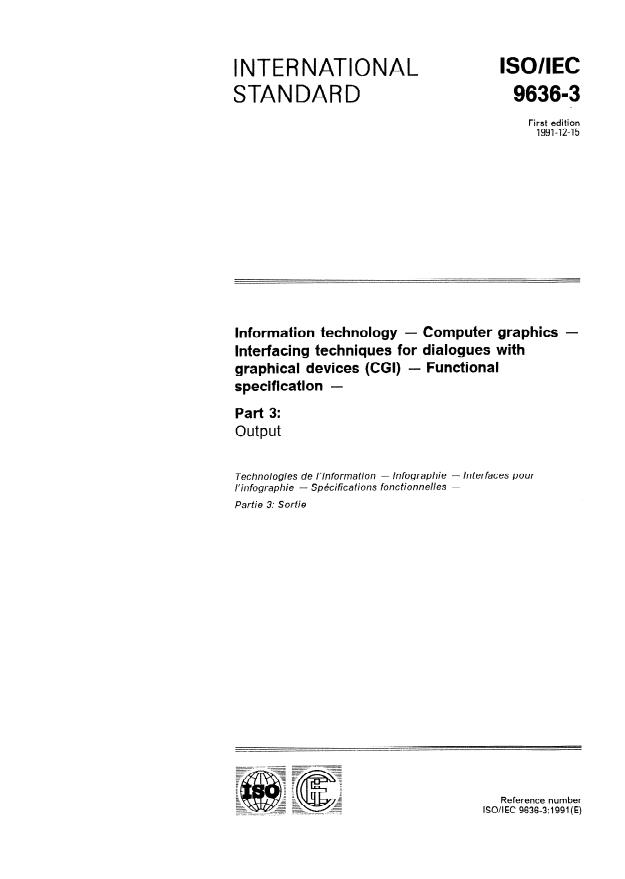
(Main)Information technology — Computer graphics — Interfacing techniques for dialogues with graphical devices (CGI) — Functional specification — Part 3: Output
General Information
- Abstract
Describes those functions of the interface concerned with output primitives and associated attributes and controls for creating graphical pictures. Annexes A and B form an integral part of this standard. Annexes C, D, E, F, G and H are for information only.
- Status
- Published
- Publication Date
- 17-Dec-1991
- Technical Committee
- ISO/IEC JTC 1/SC 24 - Computer graphics, image processing and environmental data representation
- Drafting Committee
- ISO/IEC JTC 1/SC 24/WG 6 - Computer Graphics and Virtual Reality
- Current Stage
- 9093 - International Standard confirmed
- Start Date
- 08-Dec-2021
- Completion Date
- 29-Aug-2026


Overview
ISO/IEC 9636-3:1991 - "Information technology - Computer graphics - Interfacing techniques for dialogues with graphical devices (CGI) - Functional specification - Part 3: Output" is the formal functional specification for the output side of the CGI family. It defines the functions, output primitives, attributes and controls required to create graphical pictures on devices. Annexes A and B are integral; Annexes C–H are informational.
This standard is essential for achieving device-independent graphical output by specifying consistent primitives and state management for lines, markers, text, fills, images and generalized drawing primitives (GDP).
Key topics and technical requirements
- Output primitives and functions: Detailed abstract specifications for primitives such as POLYLINE, POLYGON, POLYMARKER, TEXT, FILL, IMAGE and GDP (Generalized Drawing Primitive).
- Attributes and bundles: Definition and control of attributes including line type/width/colour, marker type/size/colour, text font/height/orientation/colour, fill interior style/pattern/colour, edge attributes.
- Colour models: Direct and indexed colour modes, background-colour handling and colour specification modes.
- Clipping and rendering: Clipping rules for primitives, rendering pipelines, and behavior of closed figures and image primitives under clipping.
- State management: Output states, bundled and individual attribute handling, state lists and description tables; retrieval functions (e.g., text extent).
- Geometry and allowed latitude: Geometric definitions for primitives (arcs, ellipses, circles) and allowed latitude for implementation variations.
- Inter-part interactions: Defined interactions with other CGI parts - control (ISO/IEC 9636-2), segments (ISO/IEC 9636-4), input (ISO/IEC 9636-5) and raster (ISO/IEC 9636-6).
- Normative vs informational annexes: Annexes A and B must be implemented; C–H provide guidance and examples.
Practical applications
- Ensures interoperability between graphics applications and diverse output devices (displays, plotters, printers).
- Provides a stable functional contract for graphics API designers, device driver developers and middleware implementers who need device-independent rendering semantics.
- Useful in sectors that require precise graphical output: CAD/CAM, scientific visualization, technical drawing, plotting, and embedded HMI systems.
- Helps create consistent behavior for text rendering, vector drawing, fills and bitmapped images across platforms.
Who should use this standard
- Graphics library implementers and API designers
- Device manufacturers and driver developers
- Software architects for CAD, GIS, simulation and visualization tools
- Standards engineers and technical writers documenting graphics interfaces
Related standards
- ISO/IEC 9636-1 (overall CGI architecture)
- ISO/IEC 9636-2 (Control)
- ISO/IEC 9636-4 (Segments)
- ISO/IEC 9636-5 (Input)
- ISO/IEC 9636-6 (Raster)
Keywords: ISO/IEC 9636-3, CGI output, computer graphics interface, graphical devices, output primitives, graphics attributes, device-independent graphics.
Get Certified
Connect with accredited certification bodies for this standard

BSI Group
BSI (British Standards Institution) is the business standards company that helps organizations make excellence a habit.

NYCE
Mexican standards and certification body.
Sponsored listings
Frequently Asked Questions
ISO/IEC 9636-3:1991 is a standard published by the International Organization for Standardization (ISO). Its full title is "Information technology — Computer graphics — Interfacing techniques for dialogues with graphical devices (CGI) — Functional specification — Part 3: Output". This standard covers: Describes those functions of the interface concerned with output primitives and associated attributes and controls for creating graphical pictures. Annexes A and B form an integral part of this standard. Annexes C, D, E, F, G and H are for information only.
Describes those functions of the interface concerned with output primitives and associated attributes and controls for creating graphical pictures. Annexes A and B form an integral part of this standard. Annexes C, D, E, F, G and H are for information only.
ISO/IEC 9636-3:1991 is classified under the following ICS (International Classification for Standards) categories: 35.140 - Computer graphics. The ICS classification helps identify the subject area and facilitates finding related standards.
ISO/IEC 9636-3:1991 is available in PDF format for immediate download after purchase. The document can be added to your cart and obtained through the secure checkout process. Digital delivery ensures instant access to the complete standard document.
Standards Content (Sample)
INTERNATIONAL lSO/IEC
STANDARD
9636-3
First edition
1991-12-15
Information technology - Computer graphics -
Interfacing techniques for dialogues with
graphical devices (CGI) - Functional
specification -
Part 3:
output
Technologies de /‘information - infographie - Interfaces pour
Spkifications fonctionnelles -
I’infographie -
Partie 3: Sortie
Reference number
ISO/IEC 9636-3 : 1991 (E)
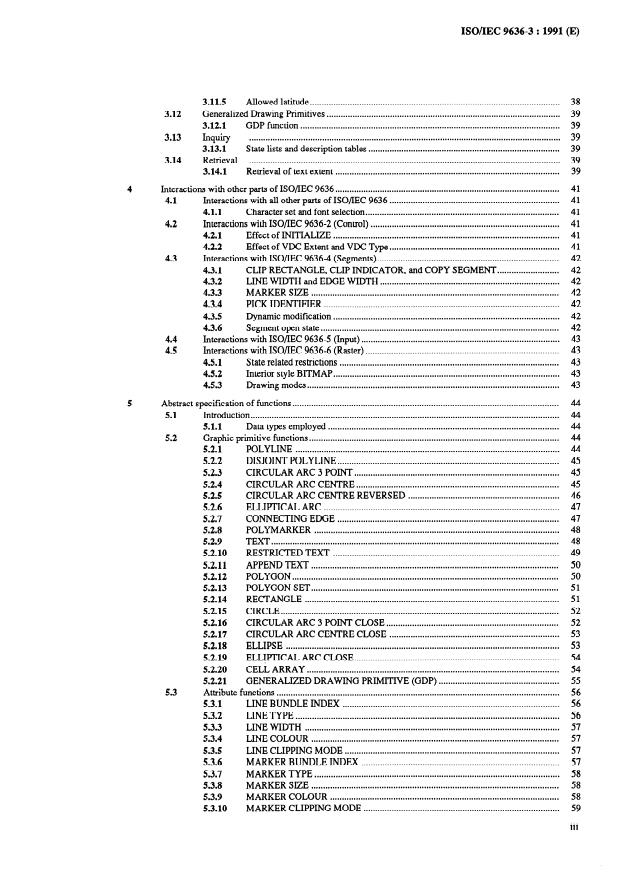
Contents
Vii
Foreword . . . . . . . . . . . . . . . . . . . . . . . . . . . . . . . . . . . . . . . . . . . . . . . . . . . . . . . . . . . . . . . . . . . . . . . . . . . . . . . . . . . . . . . . . . . . . . . . . . . . . . . . . . . . . . . . . . . . . . . . .
. . .
Introduction . . . . . . . . . . . . . . . . . . . . . . . . . . . . . . . . . . . . . . . . . . .~.“.“.~.~.~.~. Vlll
scope . 1
Normative references . 2
Concepts . 3
3.1 Introduction . 3
3.2 General output concepts . 3
Types of graphic primitive functions . 3
3.2.1
................................................................................................ 4
3.2.2 Attributes and controls
3.2.3 Output states .
33 Individual and bundled attribute values .
33.1 Introduction .
............................................................ 6
33.2 Modes of attribute specification and selection
3.4 Colour .
3.4.1 Direct and indexed modes .
3.4.2 Background colour .
35 Graphic objects . 9
35.1 Compound objects . 9
35.2 Global and local attributes . 9
353 Detail of graphic object formation . 9
3.6 Clipping associated with graphic objects . 10
3.6.1 Rendering pipelines for clipping . 11
3.7 Line primitives . 13
3.7.1 Line functions . 13
Line attributes . 13
3.7.2
3.73 Line geometry .
3.7.4 Line clipping .
3.7.5 Allowed latitude . 15
3.8 Marker primitive .
.......................................................................................................... 15
38.1 Marker function
3.8.2 Marker attributes .
........................................................................................................ 16
3.83 Marker geometry
........................................................................................................... 16
3.8.4 Marker clipping
3.9 Text primitives .
3.9.1 Text functions .
3.92 Usage of text functions (compound text) . 17
3.93 Text attributes . 17
............................................................................................................. 19
3.9.4 Text geometry
3.9.5 Text clipping . 27
Text fonts and character sets . 28
3.9.6
3.9.7 Errors in TEXT OPEN state .
3.9.8 Allowed latitude . 28
3.10 Fill primitives . 29
3.10.1 Fill functions . 29
3.10.2 Fill attributes . 29
3.103 Fill geometry . 31
3.10.4 Fill clipping . 32
Closed figures . 33
3.10.5
3.10.6 Allowed latitude .
3.11 Image primitive . 37
3.11.1 Image function . 38
0 ISO/IEC 1991
All rights reserved. No part of this publication may be reproduced or utilized in any form or by
any means, electronic or mechanical, including photocopying and microfilm, without permission
in writing from the publisher.
ISO/IEC Copyright Office l Case postale 56 l CH-1211 Geneve 20 l Switzerland
Printed in Switzerland
ii
ISO/IEC 9636-3 : 1991 (E)
3.11.5 Allowed latitude . . . . . . . . . . . . . . . . . . . . . . . . . . . . . . . . . . . . . . . . . . . . . . . . . . . . . . . . . . . . . . . . . . . . . . . . . . . . . . . . . . . . . . . . . . . . . . . . . . . . . . . . . . 38
3.12 Generalized Drawing Primitives . . . . . . . . . . . . . . . . . . . . . . . . . . . . . . . . . . . . . . . . . . . . . . . . . . . . . . . . . . . . . . . . . . . . . . . . . . . . . . . . . . . . . . . . . . . . . . . . . . . 39
3.12.1 GDP function . . . . . . . . . . . . . . . . . . . . . . . . . . . . . . . . . . . . . . . . . . . . . . . . . . . . . . . . . . . . . . . . . . . . . . . . . . . . . . . . . . . . . . . . . . . . . . . . . . . . . . . . . . . . . .
. . . . . . . . . . . . . .*.*.
3.13 39
~wiry
State lists and description tables . . . . . . . . .*.*.
3.13.1 39
3.14 Retrieval . . . . . . . . . . . . . . . . . . . . . . . . . . . . . . . . . . . . . . . . . . . . . . . . . . . . . . . . . . . . . . . . . . . . . . . . . . . . . . . . . . . . . . . . . . . . . . . . . . . . . . . . . . . . . . . . . . . . . . . . . 39
3.14.1 Retrieval of text extent . . . . . . . . . . . . . . . . . . . . . . . . . . . . . . . . . . . . . . . . . . . . . . . . . . . . . . . . . . . . . . . . . . . . . . . . . . . . . . . . . . . . . . . . . . . . . . . 39
4 Interactions with other parts of ISO/IEC 9636 . 41
4.1 Interactions with all other parts of ISO/IEC 9636 . 41
4.1.1 Character set and font selection . 41
4.2 Interactions with ISO/IEC 9636-2 (Control) . 41
4.2.1 Effect of INITIALIZE . 41
4.2.2 Effect of VDC Extent and VDC Type . 41
4.3 Interactions with ISO/IEC 96364 (Segments) . 42
4.3.1 CLIP RECTANGLE, CLIP INDICATOR, and COPY SEGMENT . 42
4.3.2 LINE WIDTH and EDGE WIDTH . 42
4.3.3 MARKER SIZE . 42
4.3.4 PICK IDENTIFIER . 42
4.3.5 Dynamic modification . 42
4.3.6 Segment open state . 42
4.4 Interactions with ISO/IEC 9636-5 (Input) . 43
4.5 Interactions with ISO/IEC 9636-6 (Raster) . 43
4.5.1 State related restrictions . 43
Interior style BITMAP . 43
4.5.2
Drawing modes . 43
4.53
................................................................................................................. 44
5 Abstract specification of functions
Introduction . 44
5.1
5.1.1 Data types employed . 44
Graphic primitive functions . 44
5.2
POLYLINE . 44
5.2.1
.............................................................................................. 45
5.2.2 DISJOINT POLYLINE
.......................................................................................
5.2.3 CIRCULAR ARC 3 POINT 45
5.2.4 CIRCULAR ARC CENTRE . 45
CIRCULAR ARC CENTRE REVERSED . 46
5.2.5
ELLIPTICAL ARC . 47
5.2.6
.............................................................................................. 47
5.2.7 CONNECTING EDGE
POLYMARKER . 48
5.2.8
5.2.9 TEXT .
................................................................................................
5.2.10 RESTRICTED TEXT 49
APPEND TEXT . 50
5.2.11
5.2.12 POLYGON .
5.2.13 POLYGON SET . 51
5.2.14 RECTANGLE . 51
5.2.15 CIRCLE . 52
5.2.16 CIRCULAR ARC 3 POINT CLOSE . 52
5.2.17 CIRCULAR ARC CENTRE CLOSE . 53
5.2.18 ELLIPSE . 53
5.2.19 ELLIPTICAL ARC CLOSE . 54
5.2.20 CELL ARRAY . 54
GENERALIZED DRAWING PRIMITIVE (GDP) . 55
5.2.21
5.3 Attribute functions . 56
LINE BUNDLE INDEX . 56
5.3.1
................................................................................................................ 56
5.3.2 LINE TYPE
............................................................................................................ 57
5.3.3 LINE WIDTH
5.3.4 LINE COLOUR . 57
5.3.5 LINE CLIPPING MODE . 57
5.3.6 MARKER BUNDLE INDEX . 57
5.3.7 MARKER TYPE . 58
5.3.8 MARKER SIZE . 58
5.3.9 MARKER COLOUR . 58
MARKER CLIPPING MODE . 59
5.3.10
.0.
ISO/lEC 9636-3 : 1991 (E)
...........................................................................................
53.11 TEXT BUNDLE INDEX
.................................................................................................
5.3.12 TEXT FONT INDEX
....................................................................................................
5.3.13 TEXT PRECISION
....................................................................
5.3.14 CHARACTER EXPANSION FACTOR
..........................................................................................
5.3.15 CHARACTER SPACING
.........................................................................................................
53.16 TEXT COLOUR
............................................................................................
53.17 CHARACTER HEIGHT
................................................................................
53.18 CHARACTER ORIENTATION
...............................................................................................................
53.19 TEXT PATH
.................................................................................................
53.20 TEXT ALIGNMENT
.......................................................................................
53.21 CHARACTER SET INDEX
..............................................................
53.22 ALTERNATE CHARACTER SET INDEX
..................................................................
53.23 CHARACTER CODING ANNOUNCER
.............................................................................................
53.24 FILL BUNDLE INDEX
....................................................................................................
53.25 INTERIOR STYLE
...........................................................................................................
53.26 FILL COLOUR
.........................................................................................................
53.27 HATCH INDEX
.....................................................................................................
53.28 PATTERN INDEX
........................................................................................
53.29 FILL REFERENCE POINT
.........................................................................................................
5330 PATTERN SIZE
...........................................................................................
5331 EDGE BUNDLE INDEX
...............................................................................................................
5332 EDGE TYPE
5333 EDGE WIDTH .
5334 EDGE COLOUR .
..........................................................................................
EDGE CLIPPING MODE
EDGE VISIBILITY .
. . . . . . . . . . .*.
5.4 General attribute and output control functions
CLIP INDICATOR .
5.4.1
CLIP RECTANGLE .
5.4.2
..................................................................
LINE WIDTH SPECIFICATION MODE
5.43
................................................................
EDGE WIDTH SPECIFICATION MODE
5.4.4
...............................................................
MARKER SIZE SPECIFICATION MODE
5.45
................................................................................
COLOUR SELECTION MODE
5.4.6
.....................................................................................
COLOUR VALUE EXTENT
5.4.7
.......................................................................................
BACKGROUND COLOUR
5.408
AUXILIARY COLOUR .
5.4.9
.....................................................................................................
5.4.10 TRANSPARENCY
......................................................................................................
5.4.11 COLOUR TABLE
........................................................................................
5.4.12 LINE REPRESENTATION
................................................................................
5.4.13 MARKER REPRESENTATION
......................................................................................
5.4.14 TEXT REPRESENTATION
........................................................................................
5.4.15 FILL REPRESENTATION
......................................................................................
5.4.16 EDGE REPRESENTATION
................................................................
5.4.17 DELETE BUNDLE REPRESENTATION
.......................................................................................
5.4.18 ASPECT SOURCE FLAGS
....................................................................................................
5.4.19 PATTERN TABLE
..................................................................................................
5.4.20 DELETE PATTERN
................................................................................................................
5.4.21 FONT LIST
...........................................................................................
CHARACTER SET LIST
5.4.22
............................................................................
SAVE PRIMITIVE ATTRIBUTES
5.4.23
....................................................................
RESTORE PRIMITIVE ATTRIBUTES
5.4.24
.....................................................
DELETE PRIMITIVE ATTRIBUTE SAVE SET
5.4.25
.........................................................................................................
5.4.26 BEGIN FIGURE
.............................................................................................................
5.4.27 END FIGURE
...........................................................................................................
5.4.28 NEW REGION
55 Retrieval functions .
.................................................................................................
5.5.1 GET TEXT EXTENT
.................................................................................................................................
6 Output inquiry functions
6.1 Introduction .
...................................................................................................
6.1.1 Data types employed
.................................................................................
6.1.2 Validity of returned information
1v
ISO/IEC 9636-3 : 1991 (E)
............................................................................................... 80
Primitive support description table
6.2
INQUIRE PRIMITIVE SUPPORT LEVELS . 80
6.2.1
......................................................................................... 81
6.2.2 LOOKUP GDP SUPPORT
.................................................................................. 81
6.23 INQUIRE GDP ATTRIBUTES
Line description table .
INQUIRE LINE CAPABILITY . 81
6.3.1
INQUIRE LIST OF AVAILABLE LINE TYPES . 81
6.3.2
INQUIRE LIST OF AVAILABLE SCALED LINE WIDTHS . 82
6.3.3
Marker description table . 82
6.4
.........................................................................
6.4.1 INQUIRE MARKER CAPABILITY 82
6.4.2 INQUIRE LIST OF AVAILABLE MARKER TYPES . 82
INQUIRE LIST OF AVAILABLE SCALED MARKER SIZES . 82
6.4.3
....................................................................................................................
Text description table 83
6.5
6.5.1 INQUIRE TEXT CAPABILITY . 83
........................................ 83
6.5.2 INQUIRE LIST OF AVAILABLE CHARACTER SETS
................................................... 83
6.5.3 INQUIRE LIST OF AVAILABLE TEXT FONTS
INQUIRE FONT. CAPABILITIES . 84
6.5.4
........ 84
6.5.5 INQUIRE LIST OF AVAILABLE CHARACTER EXPANSION FACTORS
............................... 84
6.5.6 INQUIRE LIST OF AVAILABLE CHARACTER SPACINGS
INQUIRE LIST OF AVAILABLE CHARACTER HEIGHTS . 85
6.5.7
INQUIRE LIST OF AVAILABLE CHARACTER ORIENTATIONS .
6.5.8
Fill description table . 85
6.6
INQUIRE FILL CAPABILITY . 85
6.6.1
.............................................. 86
6.6.2 INQUIRE LIST OF AVAILABLE HATCH STYLES
6.7 Edge description table .
............................................................................... 86
6.7.1 INQUIRE EDGE CAPABILITY
INQUIRE LIST OF AVAILABLE EDGE TYPES .
6.7.2
INQUIRE LIST OF AVAILABLE SCALED EDGE WIDTHS . 87
6.7.3
................................................................................................... 87
6.8 Output control description table
......................................................................... 87
6.8.1 INQUIRE COLOUR CAPABILITY
....................................................................... 87
6.8.2 INQUIRE CIE CHARACTERISTICS
6.8.3 INQUIRE MAXIMUM NUMBER OF SIMULTANEOUSLY SAVED
.................................................................................................... 87
ATTRIBUTE SETS
6.8.4 INQUIRE ARRAY OF SUPPORTED CHARACTER CODING ANNOUNCERS
6.9 Line attribute state list .
6.9.1 INQUIRE LINE ATTRIBUTES .
........................................................ 88
6.9.2 INQUIRE LIST OF LINE BUNDLE INDICES
6.9.3 INQUIRE LINE REPRESENTATION .
6.10 Marker attribute state list .
........................................................................ 89
6.10.1 INQUIRE MARKER ATTRIBUTES
................................................ 89
6.10.2 INQUIRE LIST OF MARKER BUNDLE INDICES
.............................................................. 89
6.10.3 INQUIRE MARKER REPRESENTATION
6.11 Text attribute state list .
6.11.1 INQUIRE TEXT ATTRIBUTES .
....................................................... 90
6.11.2 INQUIRE LIST OF TEXT BUNDLE INDICES
.................................................................... 90
6.11.3 INQUIRE TEXT REPRESENTATION
Fill attribute state list .
6.12
INQUIRE FILL ATTRIBUTES . 91
6.12.1
....................................................................... 91
6.12.2 INQUIRE PATTERN DIMENSIONS
................................................................................................ 91
6.12.3 INQUIRE PATTERN
................................................................ 92
6.12.4 INQUIRE LIST OF PATTERN INDICES
........................................................ 92
6.12.5 INQUIRE LIST OF FILL BUNDLE INDICES
...................................................................... 92
6.12.6 INQUIRE FILL REPRESENTATION
6.13 Edge attribute state list .
6.13.1 INQUIRE EDGE ATTRIBUTES .
...................................................... 93
6.13.2 INQUIRE LIST OF EDGE BUNDLE INDICES
.................................................................... 93
INQUIRE EDGE REPRESENTATION
6.13.3
............................................................................. 93
General attributes and output control state list
6.14
6.14.1 INQUIRE OUTPUT STATE .
6.14.2 INQUIRE OBJECT CLIPPING .
INQUIRE LIST OF ATTRIBUTE SET NAMES IN USE . 94
6.14.3
..................................................................................... 94
6.14.4 INQUIRE COLOUR STATE
V
ISO/IEC 9636-3 : 1991 (E)
INQUIRE LIST OF COLOUR TABLE ENTRIES .
6.14.5 94
...............................................................................................
6.14.6 INQUIRE FONT LIST 95
INQUIRE CHARACTER SET LIST . 95
6.14.7
LOOKUP ASPECT SOURCE FLAGS . 95
6.14.8
7 .
CGI description tables and state lists 96
7.1 Description tables . 96
7.1.1 Primitive support . . . . . . . . . . . . . . . . . . . . . . . . . . . . . . . . . . . . . . . . . . . . . . . . . . . . . .*. 96
7.102 Attributes . 97
Font characteristics . 100
7.13
............................................................................................................. 100
7.1.4 Output control
7.2 . 101
state lists
.................................................................................................................... 101
7.2.1 Attributes
General attributes and output control . 105
7.2.2
Formal grammar of the functional specification . 106
Output and attribute errors . 131
Guidelines for CGI implementors . 133
Parameterization of circular and elliptical arcs . 137
Use of POLYGON SET and closed figures . 138
Character sets and coding . 142
Colour value extent . 146
Example use of character orientation . 147
vi
ISO/IEC 9636-3 : 1991 (E)
Foreword
IS0 (the International Organization for Standardization) and IEC (the International Electrotechnical Commission) form the
specialized system for worldwide standardization. National bodies that are members of IS0 or IEC participate in the
development of International Standards through technical committees established by the respective organization to deal with
particular fields of technical activity. IS0 and IEC technical committees collaborate in fields of mutual interest. Other
international organizations, governmental and non-governmental, in liaison with IS0 and IEC, also take part in the work.
In the field of information technology, IS0 and IEC have established a joint technical committee, ISO/IEC JTC 1. Draft
International Standards adopted by the joint technical committee are circulated to national bodies for voting. Publication as
an International Standard requires approval by at least 75 % of the national bodies casting a vote.
International Standard ISO/IEC 9636-3 was prepared by Joint Technical Committee ISODEC JTC 1, Information
technology.
ISO/IEC 9636 consists of the following parts, under the general title Information technology - Computer graphics -
Interfacing techniques for dialogues with graphical devices (CGI) - Functional specification:
- Part 1: Overview, profiles, and conformance
- Part 2: Control
-Part 3: Output
-Part 4: Segments
-Part 5: Input and echoing
-Part 6: Raster
Annexes A and B form an integral part of this part of ISO/IEC 9636. Annexes C , D, E, F, G, and H are for information only.
vii
ISO/IEC 9636-3 : 1991 (E)
Introduction
This part of ISO/IEC 9636 describes the functions needed for generating and displaying graphical output.
The functional capability incorporated in this part of ISO/IEC 9636 is concerned with graphic primitives and their associated
attributes, control over the graphic object output pipeline, and the rendering of graphic objects. It should at least be read in
conjunction with the overview in ISO/IEC 9636-1, and the general control functions detailed in ISO/IEC 9636-2.
The functional capability described in this part of ISO/IEC 9636 applies to CGI Virtual Devices of class OUTPUT and
OUTIN.
. . .
Vlll
lSO/IEC 9636-3 : 1991(E)
INTERNATIONAL STANDARD
Information technology - Computer graphics -
Interfacing techniques for dialogues with graphical
devices (CGI) - Functional specification -
Part 3:
output
1 Scope
This part of ISO/IEC 9636 establishes those functions of the Computer Graphics Interface concerned with output primitives
and associated attributes and controls for creating graphical pictures.
This part of ISO/IEC 9636 is part 3 of ISO/IEC 9636, and should be read in conjunction with ISO/IEC 9636-l and
ISO/IEC 9636-2. The relationship of this part of ISO/IEC 9636 to the other parts of ISO/IEC 9636 is described in
ISO/IEC 9636-l and in clause 4.
The functionality described in this part of ISO/IEC 9636 pertains to OUTPUT and OUTIN classes of CGI Virtual Device.
ISO/IEC 9636-3 : 1991 (E)
2 Normative references
The following standards contain provisions which, through reference in this text, constitute provisions of this part of
ISO/IEC 9636. At the time of publication, the editions indicated were valid. All standards are subject to revision, and parties
to agreements based on this part of ISO/IEC 9636 are encouraged to investigate the possibility of applying the most recent
editions of the standards listed below. Members of IEC and IS0 maintain registers of currently valid International Standards.
IS0 646 : 1983 Information processing - IS0 7-bit coded character set for information interchange.
IS0 2022 : 1986 Information processing - IS0 7-bit and 8-bit coded character sets - Code extension techniques.
Metafile for the storage and tranger of picture
IS0 8632-l : 1987 Information processing systems - Computer graphics -
description information (CGM) - Part I: Functional specification.
ISO/IEC 9541-1 : -I) Information technology - Font information interchange - Part 1: Architecture.
ISO/IEC 9541-2 : -I) Information technology - Font ir$ormation interchange -Part 2: Interchange format.
Part 3: Glyph shape representation.
Information technology - Font ir$ormation interchange -
ISO/IEC 9541-3 : -0
Programmer’s Hierarchical Interactive
ISO/IEC 9592-l : 1989 Information processing systems - Computer graphics -
Graphics System (PHIGS) - Part 1: Functional description.
Interfacing techniques for dialogues with graphical
ISOLIEC 9636-l : 1991 Information technology - Computer graphics -
Part 1: Overview, profiles, and conformance.
devices (CGI) - Functional specification -
Interfacing techniques for dialogues with graphical
ISO/IEC 9636-2 : 1991 Information technology - Computer graphics -
devices (CGI) - Functional specification - Part 2: Control.
Inter$acing techniques for dialogues with graphical
ISO/IEC 9636-4 : 1991 Information technology - Computer graphics -
devices (CGI) - Functional specification - Part 4: Segments.
Inteqacing techniques for dialogues with graphical
ISO/IEC 9636-5 : 1991 Information technology - Computer graphics -
devices (CGI) - Functional specification - Part 5: Input and echoing.
Integacing techniques for dialogues with graphical
ISOLIEC 9636-6 : 1991 Information technology - Computer graphics -
devices (CGI) - Functional specification - Part 6: Raster.
ISO/IEC 9637-l : -I) Information technology - Computer graphics - Interfacing techniques for dialogues with graphical
devices (CGI) - Data stream binding - Part I: Character encoding.
Intet-facing techniques for dialogues with graphical
ISOAEC 9637-2 : -I) Information technology - Computer graphics -
devices (.CGI) - Data stream binding - Part 2: Binary encoding.
Procedures for registration of graphical items.
ISWIEC TR 9973 : 1988 Information processing -
l) To be published.
ISO/IEC 9636-3 : 1991 (E)
3 Concepts
3.1 Introduction
This part of ISO/IEC 9636 covers the device-independent graphic object output functionality of the CGI. It covers primitive
functions, attributes, object formation and subsequent processing, and related control and inquiry functionality. This
functionality is divided into the following areas:
- Graphic primitive functions, which describe the geometry of the components of a picture in the CGI.
- Attribute functions, which set modal values in state lists that are used to determine certain properties (including visual
aspects) of these geometric picture components.
- General attribute and output control functions, which specify the modes of operation of certain other functions,
control some aspects of the device’s operation with respect to graphic objects and attribute functions, and which
provide facilities for the construction of compound objects.
- Retrieval function, which returns information useful for the positioning of text objects.
- Output inquiry functions, which provide access to the description tables and state lists concerned with output and
attributes.
General output concepts
3.2
Types of graphic primitive functions
3.2.1
The CGI defines graphic primitive functions for the specification of the geometry of the components of a picture.
These graphic primitive functions, grouped according to primitive type: line, marker, text, fill, and image, are as follows:
Fill functions:
Line func tions:
POLYGON
POLYLINE
POLYGON SET
DISJOINT POLYLINE
RECTANGLE
CIRCULAR ARC 3 POINT
CIRCLE
CIRCULAR ARC CENTRE
CIRCULAR ARC 3 POINT CLOSE
CIRCULAR ARC CENTRE REVERSED
CIRCULAR ARC CENTRE CLOSE
ELLIPTICAL ARC
ELLIPSE
CONNECTING EDGE
ELLIPTICAL ARC CLOSE
Text functions:
I Marker function:
TEXT
~ POLYMARKER
APPEND TEXT
RESTRICTED TEXT
Generalized drawing primitive function:
Image function:
GENERALIZED DRAWING PRIMITIVE (GDP)
i CELL ARRAY
NOTE - GDP does not have an explicit primitive type, but rather an instance of GDP may generate a primitive of one of the
above primitive types depending on the specific GDP identifier.
I
See ISO/IEC 9636.1,5.2.1 for an overall description of graphic primitives in relationship to the CGI Graphic Object Pipeline.
ISO/IEC 9636-3 : 1991 (E)
Concepts General output concepts
3.2.2 Attributes and controls
Primitives have attribute values associated with them as they pass through the Graphic Object Pipeline. Once a set of attribute values
has been associated with a primitive the complete entity is referred to as a graphic object. Some of these attribute values determine
the appearance of primitives when they are rendered as graphic objects. See ISO/IEC %36-l, 5.2.1 for an overview of where
attribute values are associated and used within the Graphic Object Pipeline.
Control functions are also defined in this part of ISO/IEC 9636 and provide control over other operations of the Graphic Object
Pipeline, e.g. colour table. Some of these control functions also set corresponding entries in CGI state lists, but these control values
are not associated with graphic primitives.
3.2.3 Output states
The Output State entry in the General Attributes and Output Control State List applies to the functions defined in this part of ISO/
IEC 9636. The Output State may have only one of the values ACTIVE, TEXT OPEN, or FIGURE OPEN, the normal state being
ACTIVE. It is set to state TEXT OPEN during the construction of a compound text object and to state FIGURE OPEN during the
construction of aclosed figure object. Figure 1 illustrates the output states of this part of ISO/IEC 9636 and indicates which functions
result in a state transition.
State restrictions are defined in Output State TEXT OPEN for all primitive functions which do not contribute to compound text (see
table 2). In particular, in Output State TEXT OPEN, all graphic primitive functions except APPEND TEXT are prohibited.
Similarly, in Output State FIGURE OPEN, primitive functions which do not contribute to the construction of closed figures (i.e.
all but line and fill type primitives) are prohibited (see table 3). In Output State ACTIVE, primitive functions which
...