


ISO 1496-2:1979
(Main)Series 1 freight containers — Specification and testing — Part 2: Thermal containers
Series 1 freight containers — Specification and testing — Part 2: Thermal containers
Conteneurs de la série 1 — Spécifications et essais — Partie 2: Conteneurs à caractéristiques thermiques
General Information
- Status
- Withdrawn
- Publication Date
- 31-Oct-1979
- Withdrawal Date
- 31-Oct-1979
- Technical Committee
- ISO/TC 104 - Freight containers
- Drafting Committee
- ISO/TC 104 - Freight containers
- Current Stage
- 9599 - Withdrawal of International Standard
- Start Date
- 01-Oct-1988
- Completion Date
- 12-Feb-2026
Relations
- Effective Date
- 15-Apr-2008
Get Certified
Connect with accredited certification bodies for this standard

BRCGS (Brand Reputation Compliance Global Standards)
Global food safety and quality standards owner.
Sponsored listings
Frequently Asked Questions
ISO 1496-2:1979 is a standard published by the International Organization for Standardization (ISO). Its full title is "Series 1 freight containers — Specification and testing — Part 2: Thermal containers". This standard covers: Series 1 freight containers — Specification and testing — Part 2: Thermal containers
Series 1 freight containers — Specification and testing — Part 2: Thermal containers
ISO 1496-2:1979 is classified under the following ICS (International Classification for Standards) categories: 55.180.10 - General purpose containers. The ICS classification helps identify the subject area and facilitates finding related standards.
ISO 1496-2:1979 has the following relationships with other standards: It is inter standard links to ISO 1496-2:1988. Understanding these relationships helps ensure you are using the most current and applicable version of the standard.
ISO 1496-2:1979 is available in PDF format for immediate download after purchase. The document can be added to your cart and obtained through the secure checkout process. Digital delivery ensures instant access to the complete standard document.
Standards Content (Sample)
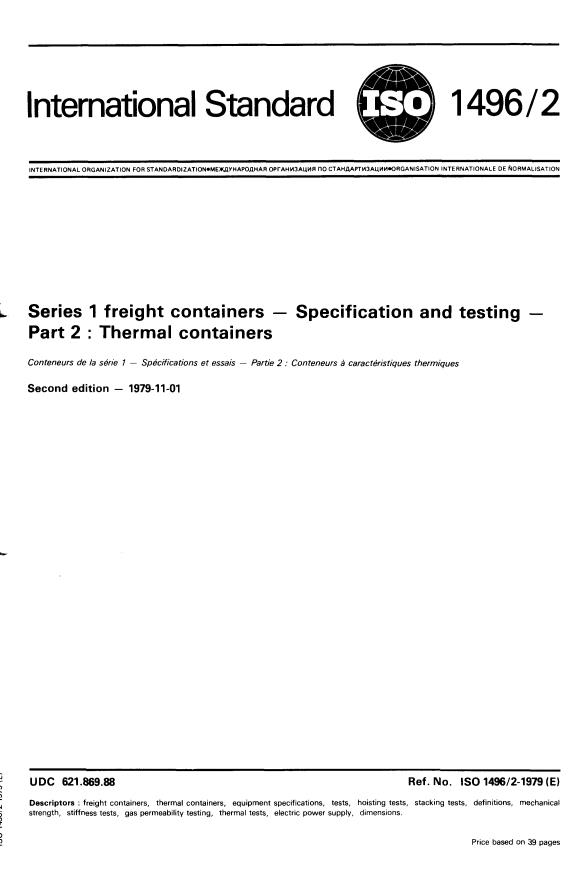
International Standard 149612
~__
INTERNATIONAL ORGANIZATION FOR STANDARDlZATIONOME~YHAPOnHAR OPTAHHJALIHR no CTAHL\APTH3AUHHWRGANlSATlON INTERNATIONALE DE kORMALlSATlON
L Series 1 freight containers - Specification and testing -
Part 2 : Thermal containers
Conteneurs de la série 1 - Spécifications et essais - Partie 2 : Conteneurs à caractéristiques thermiques
Second edition - 1979-11-01
L
e UDC 621.869.88 Ref. No. IS0 1496/2-1979 (E)
P
Descriptors : freight containers, thermal containers, equipment specifications, tests, hoisting tests, stacking tests, definitions, mechanical
strength, stiffness tests, gas permeability testing, thermal tests, electric power supply, dimensions.
!
J
Price based on 39 pages
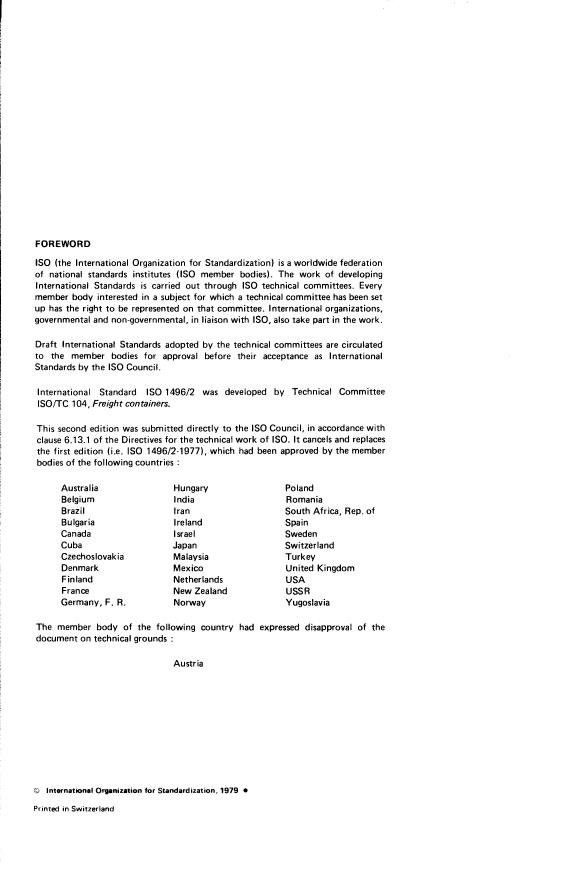
FOREWORD
IS0 (the International Organization for Standardization) is a worldwide federation
(IS0 member bodies). The work of developing
of national standards institutes
International Standards is carried out through IS0 technical committees. Every
member body interested in a subject for which a technical committee has been set
up has the right to be represented on that committee. International organizations,
governmental and non-governmental, in liaison with ISO, also take part in the work.
Draft International Standards adopted by the technical committees are circulated
to the member bodies for approval before their acceptance as International
IS0 Council.
Standards by the
International Standard IS0 1496/2 was developed by Technical Committee
lSO/TC 104, Freight containers.
This second edition was submitted directly to the IS0 Council, in accordance with
clause 6.13.1 of the Directives for the technical work of ISO. It cancels and replaces
the first edition (i.e. IS0 1496/2-1977). which had been approved by the member
bodies of the following countries :
Australia Hungary Poland
Belgium India Romania
Brazil Iran South Africa, Rep. of
Bulgaria Ireland Spain
Canada Israel Sweden
Cuba Japan Switzerland
Czechoslovakia Malaysia Turkey
Denmark Mexico United Kingdom
Finland Nether lands USA
France New Zealand USSR
Germany, F. R. Norway Yugoslavia
The member body of the following country had expressed disapproval of the
document on technical grounds :
Austria
O International Organization for Standardization, 1979
Printed in Switzerland
INTERNATIONAL STANDARD IS0 1496/2-1979 (E)
Series 1 freight containers - Specification and testing -
Part 2 : Thermal containers
c
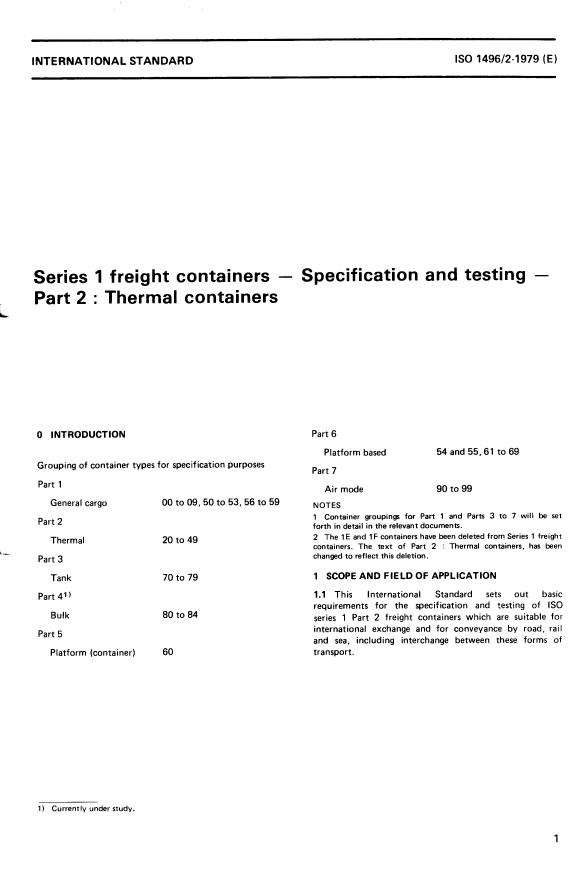
O INTRODUCTION Part 6
Platform based 54 and 55,61 to 69
Grouping of container types for specification purposes
Part 7
Part 1
Air mode 90 to 99
General cargo O0 to 09,50 to 53,56 to 59
NOTES
Container groupings for Part 1 and Parts 3 to 7 will be set
Part 2
forth in detail in the relevant documents.
2 The 1 E and 1 F containers have been deleted from Series 1 freight
Thermal 20 to 49
containers. The text of Part 2 : Thermal containers, has been
1 .
to reflect this deletion.
changed
Part 3
1 SCOPE AND FIELD OF APPLICATION
Tank 70 to 79
1.1 This International Standard sets out basic
Part 41)
requirements for the specification and testing of IS0
Bulk 80 to 84
series 1 Part 2 freight containers which are suitable for
international exchange and for conveyance by road, rail
Part 5
and sea, including interchange between these forms of
Platform (container) 60 transport.
1) Currently under study.
I
IS0 1496/2-1979 (E)
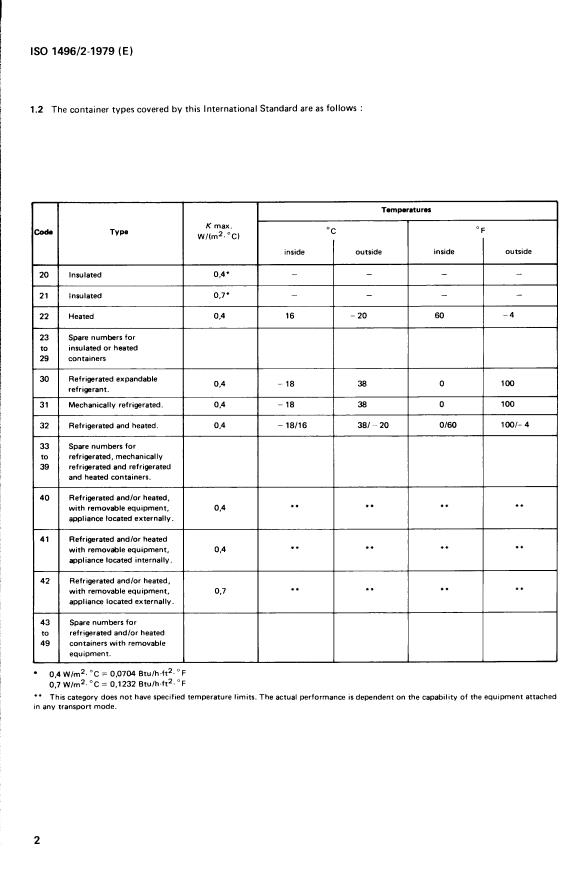
1.2 The container types covered by this International Standard are as follows :
-
Temperatures
K max.
"F
Od. "C
TY w
W/(m2."c)
inside outside
inside outside
-
- - - -
20 Insulated 0.4'
-
- - - -
Insulated 0.7'
-
22 Heated 16 - 20 60 -4
O .4
-
Spare numbers for
insulated or heated
to
29 containers
-
30 Refrigerated expandable
- 18
0.4
refrigerant.
-
31 Mechanically refrigerated. - 18 138 I O I 100
O .4
- ~ ~~
32 Refrigerated and heated. - 18/16 381 - 20 1001- 4
0.4
-
33 Spare numbers for
to refrigerated, mechanically
refrigerated and refrigerated
and heated containers.
-
Refrigerated and lor heated,
tt t' .' 't
with removable equipment,
0.4
appliance located externally.
-
41 Refrigerated and/or heated
t' 'I 'C II
with removable equipment,
0.4
appliance located internally.
-
42 Refrigerated and/or heated,
with removable equipment,
appliance located externally.
-
43 Spare numbers for
to refrigerated and/or heated
49 containers with removable
equipment.
-
0.4 W/m2. "C = 0,0704 Btu/h.ft2." F
0.7 W/m2. "C = 0,1232 Btu/h.ft2, OF
'*
This category does not have specified temperature limits. The actual performance is dependent on the capability of the equipment attached
in any transport mode.
IS0 1496/2-1979 (E)
1.3 The marking requirements for these containers are to 3.7 removable equipment : Refrigerating and/or heating
be in accordance with the principles embodied in IS0 790 appliance which is designed primarily for attaching to or
and IS0 2716 for the marking and identification of series 1 detaching from the container when transferring between
) different modes of transportation.
Containers.’
If containers are fitted for the carriage of hanging cargo, the
3.8 located internally : Totally within the external
load bearing capability of the handling equipment shall be
dimensional envelope of the container as defined in
clearly marked on the inside of the container.
IS0 668.
3.9 located externally : Partially or totally outside the
external dimensional envelope of the container as defined
2 REFERENCES
in IS0 668.
IS0 668, Freight containers - External dimensions and
It is implicit in this definition that an appliance located
ratings.
externally must be removable or retractable to facilitate
transport in certain modes.
IS0 790, Marking of series 1 freight containers. )
Is0 1161, series 1 freight Containers - Corner fittings -
3-10 battens : Members protruding from the inside walls
ha. Specification.
of the container to hold the freight away from the walls to
-
Provide an air Passage. They may be integral with the walls,
Is0 2716, Identification marking code for freight con-
or added during cargo loading.
tainers. 1 )
3.11 bulkhead : A partition providing a plenum chamber
and/or air passage for either return or supply air. It may be
an integral part of the appliance or a separate member.
3 DEFINITIONS
The following definitions apply to thermal freight 3.12 ceiling air duct : A passage or passages located in
proximity to the ceiling to direct air flow.
containers :
3.1 thermal container : Freight container built with 3.13 floor air duct : A passage or passages located beneath
insulating walls, doors, floor and roof which retard the rate
the freight support surface to direct air flow.
of heat transmission between the inside and the outside of
the container.
4 DIMENSIONS AND RATINGS
3.2 insulated container : Thermal container without the
use of devices for cooling and/or heating. 4.1 External dimensions
The overall external dimensions and tolerances of the
3.3 refrigerated container (expendable refrigerant) : Ther-
freight containers covered by this International Standard
k, mai container using a means of cooling such as :
are those established in IS0 668. No part of the container
shall project beyond these overall external dimensions.
- ice, or
dry ice, with or without sublimation control, or 4.2 Internal dimensions
- liquefied gases, with or without evaporation control.
Internal dimensions of containers shall be as large as
possible. They shall be measured from inner faces of
It is implicit in this definition that such a container requires
battens, bulkheads, ceiling air ducts, floor air ducts, etc.,
no external power supply or fuel supply.
where fitted. The minimum internal width shall be
2 200 mm (86 5/8 in) for container types 20, 21, 22, 30,
3.4 mechanically refrigerated container : Thermal con-
32, 40, 41 and 42,
31,
tainer served by refrigerating appliance (mechanical)
compressor unit, absorption unit, etc.).
4.3 Ratings
The value of the rating R, being the maximum operating
3.5 heated container : Thermal container served by heat-
gross weight of the container, are those given in IS0 668.
producing appliance.
R=P+T
3.6 refrigerated and heated container : Thermal container
served by refrigerating appliance (mechanical or expendable
where P is the maximum operating payload and T is the
refrigerant) and heat-producing appliance.
tare weight.
For containers having particular characteristics which prevent the application of the general specification for marking. reference should be
1)
made to IS0 790 A combination and revision of IS0 790 and IS0 2716 is under study by TC 104/WG 3
IS0 1496/2-1979 (E)
5 DESIGN REQUIREMENTS 5.3.2 For the 1D container, the level of the underside of
the base structure is not specified, except insofar as it is
implied in 5.3.3.
5.1 General
All containers shall be capable of fulfilling the following
5.3.3 For series 1 containers under dynamic conditions,
requirements.
or the static equivalent thereof, with the container having
a load uniformly distributed over the floor in such a way
The strength requirements for containers are given in dia-
that the combined weight of the container and test load is
grammatic form in annex A (these requirements are
equal to 1,8 R, no part of the base of the container shall
applicable to all containers except where otherwise stated).
deflect more than 6 mm (1/4 in) below the base plane
They apply to containers as complete units, except as
(bottom faces of the lower corner fittings).
envisaged in 6.1.
The strength requirements for corner fittings (see also 5.2)
5.3.4 The base structure shall be designed to withstand all
are given in IS0 1161.
forces, particularly lateral forces, induced by the cargo in
service. This is particularly important where provisions are
The containers shall be capable of withstanding all the test
made for securement of cargo to the base structure of the
requirements detailed in clause 6.
container.
As the effects of loads encountered under any dynamic
operating condition should only approach, but not exceed,
5.4 End structure
the effects of the corresponding test loads, it is implicit that
the capabilities of containers indicated in annex A and For containers lAA, lA, lBB, lB, 1CC and lC, the
demonstrated by the structural tests described in clause 6 sideways deflection of the top of the container with respect
shall not be exceeded in any mode of operation. to the bottom of the container at the time it is under full
test conditions shall not cause the sum
transverse rigidity
of the changes in length of the two diagonals to exceed
5.2 Corner fittings
60 mm (2 3/8 in).
Series 1 containers lAA, lA, 166, 16, 1CC. 1C and 1D
shall be equipped with top and bottom corner fittings. The
5.5 Side structure
requirements and positioning of the corner fittings are given
in IS0 1161. The upper faces of the top corner fittings shall
For containers lAA, 1A. lBB, 1B. 1CC and 1C. the
protrude above all other parts of the top of the container
longitudinal deflection of the top of the container with
bv a minimum of 6 mm (1 14 in) (see 5.3.3).
respect to the bottom of the container at the time it is
under full longitudinal rigidity test conditions shall not
exceed 25 mm (1 in).
5.3 Base structure
5.6 Walls
5.3.1 All containers equipped with bottom corner fittings
shall be capable of being supported by their bottom corner Where openings are provided in end or side walls, the
ability of these walls to withstand tests Nos. 5 and 6 shall
fittings only.
not be impaired.
Containers lAA, lA, lBB, lB, 1CC and 1C shall also be
capable of being supported on load transferring areas in
5.7 Door opening
their base structures only.
Each container shall be provided with a door opening at
Consequently, these containers shall have end transverse
members and sufficient intermediate load transferring areas least at one end.
(or a flat underside) of sufficient strength to permit vertical
Containers designated 1AA. 1A. lBB, lB, lCC, 1C and 1 D
load transfer. These requirements are specified in annex B.
a door opening as large as possible, preferably
shall have
The maximum load to be transferred at the load transfer
having dimensions equal to those of the internal cross-
zones (shown in figure 23) shall not exceed the value R
section of the containers.
multiplied by a dynamic factor of 2.0.
For containers lAA, lA, lBB, 1B. 1CC and 1C the lower
5.8 Sanitary requirements
faces of the load transferring areas in their bases, including
Attention is drawn to the need for the proper choice of
their end transverse members, shall lie in a plane located :
materials for the container and refrigeratiodheating
appliances to prevent adverse effects on cargoes. Any
relevant national or international requirements should also
be considered.
above the base plane of the containers (bottom faces of The interior surface and the container structure shall be so
lower corner fittings). constructed as to facilitate cleaning and the surface and the
IS0 1496/2-1979 (E)
The water inlet and outlet connections shall be so located
insulation shall not be functionally affected by cleaning
at the machinery end of the container that, to an observer
methods, such as wet steam cleaning and detergents
facing that end, they appear in the lower right-hand
normally used.
quarter.
No pockets shall exist inside the container that cannot be
reached by conventional cleaning methods.
5.14 Air inlets and outlets
Adequate provision should be made to ensure that cleaning
Where series lAA, ICC and 1C containers are designed for
water can drain satisfactorily from the inside of the
ducted air systems and for use with externally located
container.
removable equipment, the air inlet and outlet openings
shall conform to G.l, G.2 and G.3, respectively, of
annex G.
OPTiONA L REQUIREMENTS
NOTE - The requirements of 5.2,5.9 and 5.10 do not preclude the
provision of additional facilities for lifting, either from the top or at
5.9 Fork lift pockets
the bottom of the container.
Fork lift pockets may be provided as optional features for
handling 1CC. 1C and 1D containers in the loaded or
6 TESTING
unloaded condition The dimensional requirements for such
pockets are specified in annex C.
6.1 General
Fork pockets, when provided, shall pass completely
Unless otherwise stated, containers complying with the
through the base structure of the container, so that lifting
design requirements specified in clause 5 shall, in addition,
devices may be inserted from either side.
be capable of withstanding the tests specified in 6.2 to 6.17
It is not necessary for the base of the fork lift pockets to be
inclusive, as applicable.
the full width of the container, but it should be provided in
the vicinity of each end. The refrigeration and/or heating equipment (for example
components, framework, panelling, battens, ductwork,
bulkheads) need not necessarily be in place when the
5.10 Provision for handling at the base by means of
container is tested except where specified for a particular
grappler arms or similar devices
test. But where any of the main parts or frameworks of the
Provision for handling lAA, lA, 166, lB, 1CC. 1C and 1D
refrigeration and/or heating equipment is not in position
containers by means of grappler arms or similar devices may
for any test, the ability of that part or framework to
be provided as optional features. The dimensional
withstand the appropriate proportion of any relevant cargo
requirements for such provisions are specified in annex D.
loading and/or the forces or accelerations to which the
container and equipment may be subjected in the service
5.1 1 Gooseneck tunnels for which it was designed shall be established indepen-
dently. Where parts of the refrigeration and/or heating
Gooseneck tunnels may be provided as optional features
equipment which contribute to the strength or integrity
in containers 1AA and 1A. The dimensional requirements
of the container in service are not in position for testing,
-
are specified in annex E and, in addition, all other parts of
substitute framework and/or panelling may be employed
the base structure shall be as specified in 5.3.
during testing provided such substitute components are
secured in the same manner as the equipment itself and do
NOTES - The requirements of 5.2, 5.9 and 5.10 do not preclude
not provide greater strength than the equipment would
the provision of additional facilities for lifting, either from the top
or at the bottom of the containers.
have provided.
The test for weatherproofness (test No. 13) shall be made
5.12 Drains
after tests Nos. 1 to 12, with the tests No. 14 (airtightness)
and No. 15 (thermal) being made last.
Cargo space drains, if required to operate when carrying
cargo, should be protected by fittings which open
automatically above normal internal operating pressure. If 6.1.1 The symbol R denotes the maximum operating gross
required for cleaning of the interior of the container, they weight of the container and the symbol P denotes the
shall be provided with manual closures. maximum operating payload of the container to be tested,
that is, the tare weight T subtracted from the maximum
Consideration should be given to Customs and health
operating gross weight R :
requ irements.
P= R- T
5.13 Water connections
6.1.2 The test load within the container shall be uniformly
For appliances requiring water connections the inlet and
distributed.
outlet interfaces shall conform to annex F.
Water-cooled appliances should incorporate the possibility 6.1.3 The test loads specified in all of the following tests
are the minimum requirements.
to drain the unit in order to prevent freezing of the water.
IS0 1496/2-1979 (E)
This test shall also be regarded as proving the ability of the
6.1.4 The dimensional requirements to which reference is
floor and base structure to withstand the forces arising
made in the requirements sub-clause after each test are
from acceleration of the payload in lifting operations.
those specified in :
a) the dimensional and design requirement clauses of
6.3.2 Procedure
this International Standard;
The container under test shall have a load uniformly dis-
b) 60668;
tributed over the floor in such a way that the combined
weight of the container and test load is equal to 2 R, and
c) IS0 1161.
it shall be carefully lifted from all four top corners in such
a way that no significant acceleration or deceleration forces
6.2 Test No. 1 - Stacking
are applied.
6.2.1 General
For 1AA. 1A. lBB, 1B. 1CC and 1C containers the lifting
forces shall be applied vertically.
This test shall be carried out to prove the ability of a
container to support five other fully loaded containers of
For the 1 D container, lifting shall be by means of slings, the
the same length and rating under the acceleration
angle of each leg being at 30" from the vertical.
conditions encountered in ships' cell structures, taking into
After lifting, the container shall be suspended for 5 min
account relative eccentricities between containers due to
and then lowered to the ground.
clearance.
6.3.3 Requirements
6.2.2 Procedure
Upon completion of the test the container shall show
The container under test shall be placed on four level pads,
neither permanent deformation which will render it un-
one under each bottom corner fitting or equivalent corner
suitable for use nor abnormality which will render it un-
structure. The pads shall be centralized under the fittings
suitable for use, and the dimensional requirements affecting
and be substantially of the same plan dimensions as the
handling, securing and interchange shall be satisfied.
fittings. The container shall have had a load uniformly
distributed over the floor in such a way that the combined
weight of the container and the test load is equal to 1,8 R.
The container under test shall be subjected to a vertical
force equivalent to a load of 2,25 R on each of the top 6.4 Test No. 3 -Lifting from the bottom corner fittings
R on each pair of end
corner fittings simultaneously or 4.5
fittings in such a manner that the planes of application of
6.4.1 General
the forces and the supports of the container remain
This test shall be carried out to prove the ability of
horizontal and unchanged during the test. The forces shall
containers to withstand being lifted from bottom corner
be applied through a corner fitting or a pad of the same
fittings by means of lifting devices bearing on the bottom
plan area as a corner fitting. Each pad shall be offset in the
corner fittings only and attached to a single transverse
same direction by 25.4 mm (1 in) laterally and 38 mm
central spreader beam, above the container.
(1 i/2 in) longitudinally.
This test shall be carried out on lAA, lA, lBB, lB, lCC,
6.2.3 Requirements
1C and 1 D containers.
Upon completion of the test, the container shall show
6.4.2 Procedure
neither permanent deformation which will render it un-
suitable for use nor abnormality which will render it un-
The container under test shall have a load uniformly
suitable for use, and the dimensional requirements affecting
distributed over the floor in such a way that the combined
handling, securing and interchange shall be satisfied.
weight of container and test load is equal to 2 R, and
it shall be carefully lifted from the side apertures of all four
6.3 Test No. 2 - Lifting from the top corner fittings
bottom corner fittings in such a way that no sigpificant
acceleration or deceleration forces are applied.
6.3.1 General
Lifting forces shall be appiied at :
The test shall be carried out to prove the ability of lAA,
30' to the horizontal for 1AA and 1A containers;
1 A, 1 BB, 1 B, 1 CC and 1 C containers to withstand being
lifted from the top corner fittings with the lifting forces
37" to the horizontal for 1 BB and 1 B containers;
applied vertically, and the ability of the 1D container to
45" to the horizontal for 1CC and 1C containers;
withstand being lifted from the top corner fittings with the
lifting forces applied at any angle between the vertical and
60" to the horizontal for the 1 D container.
30" to the vertical, these being the only recognized
methods of lifting these containers by the top corner
In each case the line of action of the lifting force and the
fittings.
outer face of the corner fitting shall be no farther apart
IS0 1496/2-1979 (E)
than 38 mm (1 1/2 in). The lifting shall be carried out in lA, 166, 16, lCC, IC and 1D containersshall be subjected
such a manner that the lifting devices bear on the bottom to an internal load of 0,4P. The internal load shall be
corner fittings only. uniformly distributed over the wall under test and arranged
to allow free deflection of the wall.
The container shall be suspended for 5 min and then
lowered to the ground.
6.4.3 Requirements 6.6.3 Requirements
Upon completion of the test the container shall show Upon completion of the test the container shall show
neither permanent deformation which will render it un- neither permanent deformation which will render it un-
suitable for use nor abnormality which will render it un- suitable for use nor abnormality which will render it un-
suitable for use, and the dimensional requirements affecting suitable for use, and the dimensional requirements affecting
handling, securing and interchange shall be satisfied. handling, securing and interchange shall be satisfied.
6.7 Test No. 6 - Strength of side walls
6.5 Test No. 4 - Restraint (longitudinal)
i
6.7.1 General
6.5.1 General
This test shall be carried out to prove the ability of con-
This test shall be carried out to prove the ability of
tainers to withstand the forces resulting from ship motions.
containers to withstand longitudinal external restraint
under dynamic conditions of railway operations, which
implies accelerations of 2 g.
6.7.2 Procedure
Each side wall of lAA, IA, IBB, IB, ICC, IC and ID con-
6.5.2 Procedure
tainers (or one only in the case of symmetrical construc-
tion) shall be subjected to an internal uniformly-distributed
The container under test shall have a load uniformly
force of 0.6 P, applied separately and arranged to allow free
distributed over the floor in such a way that the combined
deflection of the side wall and its longitudinal members.
weight of container and test load is equal to R, and it shall
be secured to rigid anchor points through the bottom
apertures of the bottom corner fittings at one end of the
6.7.3 Requirements
conta iner.
Upon completion of the test the container shall show
IAA, IA, 1BB. 16, ICC, IC and ID containers shall be
neither permanent deformation which will render it un-
restrained longitud ina I I y.
suitable for use nor abnormality which will render it un-
suitable for use, and the dimensional requirements affecting
A force equivalent to a load of 2 R shall be applied
handling, securing and interchange shall be satisfied.
horizontally to the container through the bottom apertures
L of the other corner fittings, first towards and then away
from the anchor points.
6.5.3 Requirements
6.8 Test No. 7 - Strength of the roof
Upon completion of the test the container shall show
neither permanent deformation which will render it un-
6.8.1 General
it un-
suitable for use nor abnormality which will render
suitable for use, and the dimensional requirements affecting
a) This test shall be carried out to prove the ability
handling, securing and interchange shall be satisfied.
of the roof of a container to withstand the loads
imposed by persons working on it.
6.6 Test No. 5 - Strength of end walls
b) If the roof is intended to carry a hanging cargo a test
shall be carried out to prove the ability of the container
6.6.1 General
to carry a minimum total hanging load of 1 490 kg/m
(I O00 Ib/ft) of usable inside container length. A vertical
This test shall be carried out to prove the ability of
acceleration of 2 g shall be taken into account.
containers to withstand forces under the dynamic
conditions referred to in 6.5.1.
6.8.2 Procedure
6.6.2 Procedure
a) A load of 300 kg (6601b) shall be uniformly
distributed over an area of 600 mm x300 mm
The container shall have each end tested when one end is
(24 in x 12 in) located at the weakest area of the roof
blind and the other equipped with doors. In case of syrn-
of the container.
metrical construction, one end only need be tested. lAA,
IS0 1496/2-1979 (E)
b) A load of twice the service load or twice 1 490 kg/m 6.10.2 Procedure
(1 O00 Ib/ft), whichever is greater, shall be attached to
The container under test, in tare condition (T), shall be
the roof in a manner simulating normal service loadings,
placed on four level supports, one under each corner fitting,
while the container is supported by its four corner
and shall be restrained against lateral and vertical movement
fittings only.
by means of anchor devices acting through the bottom
apertures of the bottom corner fittings. Lateral restraint
6.8.3 Requirements
shall be provided only at a bottom corner fitting diagonally
opposite to and in the same end frame as a top corner
Upon completion of the test the container shall show
fitting to which force is applied. When testing the two end
neither permanent deformation which will render it un-
frames separately, vertical restraint shall only be applied at
suitable for use nor abnormality which will render it un-
the end frame under test.
suitable for use, and the dimensional requirements affecting
handling, securing and interchange shall be satisfied.
Forces of 150 kN (15 O00 kgf) (15 tf) shall be applied
either separately or simultaneously to each of the top
corner fittings on one side of the container in lines parallel
6.9 Test No. 8 - Floor strength
both to the base and to the planes of the ends of the
container. The forces shall be applied first towards and then
away from the top corner fittings.
6.9.1 General
In the case of a container with identical ends, only one end
This test shall be carried out to prove the ability of a
need be tested. Where an end is not essentially symmetrical
container floor to withstand the concentrated dynamic
about its own vertical centre line, both sides of that end
loads imposed during loading operations by trucks or
shall be tested.
similar devices.
The test applies to lAA, lA, lBB, 1B. lCC, 1C and 1D
containers.
6.1 0.3 Requirements
Upon completion of the test, the container shall show
6.9.2 Procedure
neither permanent deformation which will render it un-
suitable for use nor abnormality which will render it un-
The test shall be performed using a test vehicle equipped
suitable for use, and the dimensional requirements affecting
with tyres, and loaded to 5 460 kg (12 O00 Ib) per axle
handling, securing and interchange shall be satisfied.
[i.e. 2 730 kg (6 O00 Ib) on each of two wheels]. It is to
be so arranged that all points of contact between each
wheel and a flat continuous surface lie within a rectangular
6.1 1 Test No. 10 - Rigidity (longitudinal)
envelope measuring 185 mm (7 114 in) in a direction
parallel to the axle of the wheel, by 100 mm (4 in), and
that each wheel makes physical contact over an area within
6.1 1 .I General
this envelope of not more than 142cm2 (22 in2). The
This test shall be carried out to prove the ability of lAA,
wheel width is to be nominally 180 mm (7 in) and the
1CC and 1C containers to withstand the
wheel centres are to be nominally 760 mm (30 in). The lA, lBB, 1B.
longitudinal racking forces resulting from ship motions.
test vehicle shall be manœuvred over the entire floor
area of the container. The test shall be made with the
container resting on four level supports under its four
6.1 1.2 Procedure
bottom corner fittings with its base structure free to
deflect .
The container under test, in tare condition (TI, shall be
placed on four level supports, one under each corner
fitting, and shall be restrained against longitudinally and
6.9.3 Requirements
vertical movement by means of anchor devices acting
Upon completion of the test the container shall show
through the bottom apertures of the bottom corner fittings.
neither permanent deformation which will render it un-
Longitudinal restraint shall be provided only at a bottom
suitable for use nor abnormality which will render it un-
corner fitting diagonally opposite to and in the same side
suitable for use, and the dimensional requirements affecting
frame as a top corner fitting to which force is applied.
handling, securing and interchange shall be satisfied.
Forces of 75 kN (7 500 kgf) (7,5 tf) shall be applied either
separately or simultaneously to each of the top corner
6.10 Test No. 9 - Rigidity (transverse)
fittings on one end of the container in lines parallel both
to the base of the container and to the planes of the sides
of the container. The forces shall be appiied first towards
6.1 O. 1 General
and then away from the top corner fitting. In the case of a
This test shall be carried out to prove the ability of 1AA.
container with identical sides, only one side need be tested.
lA, lBB, lB, 1CC and 1C containers to withstand the
Where a side is not essentially symmetrical about its own
racking forces resulting from ship motions.
vertical centre line, both ends of that side shall be tested.
IS0 1496/2-1979 (E)
6.13.3 Requirements
6.1 1.3 Requirements
Upon completion of the test, the container shall show
Upon completion of the test the container shall show
neither permanent deformation which will render it un-
neither permanent deformation which will render it un-
suitable for use nor abnormality which will render it
suitable for use nor abnormality which will render it un-
unsuitable for use, and the dimensional requirements
suitable for use, and the dimensional requirements affecting
affecting handling, securing and interchange shall be be
handling, securing and interchange shall be satisfied.
satisfied.
6.12 Test No. 11 - Lifting from fork lift pockets (where
6.14 Test No. 13 -Weatherproofness
fitted)
6.12.1 General 6.14.1 General
The test applies to containers lCC, 1C and 1 D where fitted
This test shall be carried out on door seals, exterior
lift pockets.
with fork gasketed joints and other openings which are fitted with
closing devices.
6.1 2.2 Procedure
6.14.2 Procedure
i
The container under test shall have a load uniformly
A stream of water shall be applied to the area being tested
distributed over the floor in such a way that the combined
a nozzle of 12,5 mm (0.51 in) inside diameter, at a
from
weight of the container and test load is equal to 1,25 R,
pressure of about 1 bar [corresponding to a head of about
and it shall be supported on two horizontal bars, each
10 m (33 ft) of water], on the upstream side of the nozzle.
200 mm (8 in) wide projecting 1 828 f 3 mm (72 f 1/8 in)
The nozzle shall be held at a distance of 1,5 m (5 ft) from
into the fork pocket, measured from the outside face of the
the container under test, and the stream shall be traversed
side of the container. The bars shall be centred within the
at a speed of 1 O0 mm/s (4 ids).
pockets.
Procedures involving the use of several nozzles are
The container shall be supported for 5 min and then acceptable provided that each area being tested is subjected
lowered to the ground. to a water loading not less than that which would be given
by a single nozzle.
6.1 2.3 Requirements
6.14.3 Requirements
Upon completion of the test, the container shall show
Upon completion of the test, the container shall be free
it un-
neither permanent deformation which will render
from penetration of water.
suitable for use nor abnormality which will render it un-
suitable for use, and the dimensional requirements affecting
handling, securing and interchange shall be satisfied.
6.15 Test No. 14 - Airtightness test
k
6.15.1 General
6.13 Test No. 12 - Lifting from the base at grappler arm
positions (where fitted)
This test shall be carried out after all structural tests have
been completed and prior to the thermal test (test No. 15).
The temperatures inside and outside the coritainer shall be
6.13.1 General
stabilized within 3 "C (5,4 OF) of each other and shall both
be within the range of 15 "C to 25 "C (59 OF to 77 OF).
This test shall be carried out on all containers with
provisions for being lifted by grappler arms or similar
devices with lifting positions as detailed in annex D.
6.15.2 Procedure
The container shall be in its normal operating condition and
6.13.2 Procedure
shall be closed in the normal manner. The refrigeration
and/or heating equipment shall be in place, except that,
The container under test shall have a load uniformly
where the container is designed for use with removable
distributed over the floor in such a way that the combined
equipment and the container has closures at the inter-
weight of the container and test load is equal to 1,25 R,
face(s), the equipment shall not be in position and the clos-
and it shall be supported at the four positions where
ures shall be shut. All drain openings shall be closed. An air
provision has been made for the equipment in 6.13.1, over
supply through a metering device and a suitable manometer
an area of 32 mm x 254 mm (1.25 x 10 in), centrally
shall be connected to the container by a leak-proof connec
located at each of the four positions, clear of the safety
tion. The manometer shall not be part of the air supply
lips.
system. The flow-measuring device shall be accurate to
* 3 % of the measured flow rate, and the manometer on
The container shall be supported for 5 min and then
the container shall be accurate to 2 5 %.
lowered to the ground.
IS0 1496/2-1979 (E)
Air shall be admitted to the container to raise the internal Containers that have air leakage rates greater than those
1 mm H,O) (1 f 3/64 in shown in table 2 shall not be rated under this International
pressure to 250? 10Pa (25I
Standard.
H,O) and the air supply regulated to maintain this pressure.
test conditions have been established, the air
Once steady
For those series 1CC and 1C containers covered by the
flow required to maintain this pressure shall be recorded.
exclusion clause in 6.15.2 which, in addition, have air inlet
and outlet openings ias envisaged in 5.14, the maximum
6.1 5.3 Requirements
permitted air leakage rate expressed in standard atmos-
pheric conditions shall be less than 8 m3/h (283 ft3/h).
The air leakage rate, expressed in standard atmospheric
conditions, should be no more than the values given in
table 1 I). If the measured air leakage is equal to or less than
1, the heat transfer results
the values given in table 6.16 Test No. 15 -Thermal test
determined under test No. 15 shall be reported without
correction for air leakage.
6.16.1 General
6.16.1.1 This test shall be carried out to establish the
TABLE 1
coefficient of heat transfer for the container. It shall be
carried out after successful completion of the airtightness
test. It shall be performed with the refrigeration and/or
place, except that, where the con-
heating equipment in
is designed for use with removable equipment and the
tainer
container has closures at the interface(s), the equipment
shall not be in position but the closures shatl be shut.
Air leakage rate
The test shall be performed under steady state
6.16.1.2
conditions using either the internal heating or internal
cooling method. All instruments and devices shall be
If the measured air leakage exceeds these values but is no
selected and calibrated as follows :
more than the values given in table 2, then the measured U
values of test No. 15 shall be increased by the amounts
f 0.5 "C(t 0.9 OF)
Temperature-
given in table 3I).
measuring devices
Power-measuring f 2 % of the quantity measured
system
Flow meter system I3 %
1AA 1BB 1CC 1D
1B
Size of container 1A
lC (loft)
6.16.1.3 The heat leakage shall be expressed by the total
(40ft) (3ûft) (20 ft)
heat transfer rate (U,), which is defined by the formula
m3/h 60 46 32 18
Air leakage rate
ft3lh 2119 1624 1130 636
The coefficient of heat transfer (K) is such that
K = U,/S, expressed in watts per square metre per
TABLE 3
degree Celsius;
where
Size of container
heat transfer rate, expressed in watts
U, is the total
per degree Celsius2);
1.29 0.72
WPC 2.40 1.85
Correction O is the power dissipated or absorbed by the operation
value
of internal heaters and fans or internal cooling units, in
4.58 3.51 2.44 1.37
Btu/(h."F)
watts;
1) Rationale. The air leakage values given in the first table are those amounts which, when related to actual operating conditions of one
millimetre water gauge air pressure in the container, will result in additional heat gain due to air leakage of less than 5 % of the maximum heat
gain allowed for that type of container and based on an outside condition of 38 "C (100°F). 50 % relative humidity and an inside condition of
- 18 "C (O F) When the air leakage exceeds the amounts given in table 1, the correction value given in table 3 compensates for the heat gain
due to air leakage in excess of that quoted in table 1, assumtng that the total air leakage does not exceed that quoted in table 2
1 W/ "C = 0,556 W/ "F = 0,860 kcal/(h 'Ci = 1,895 Btu/(h "F)
2)
IS0 1496/2-1979 (E)
No air temperature used shall cause damage to any material.
8, is the average outside temperature, which shall be
the arithmetic mean of the temperatures recorded at the
No test method used shall result in frost build-up which
end of each test interval (see 6.16.2 9)) and measured
could affect the test results in any way.
100 mm (4 in) from the walls, at least at the following
twelve points, as shown in annex H :
6.16.3 Requirements
a) the eight outside corners of the container;
The overall coefficient of heat transfer K calculated from
b) the centres of the side walls, underside and roof;
the average of the 17 or more sets of readings - see
Bi is the average inside temperature, which shall be the
formula below - taken during the continuous period of not
arithmetic mean of the temperatures recorded at the end
less than 8 h, where U, includes the correction factor from
of each test interval (see 6.16.2g)) and measured
test No. 14 where applicable, shall not exceed the value for
100 mm (4 in) from the walls at least at the following
the class of container under test.
twelve points as shown in annex H :
n
a) the eight outside corners of the container;
b) the centres of the side walls, floor and ceiling;
L 8 is the mean wall temperature; by convention,
e +e
NOTE -Because the above test may be carried out under
e =e.
conditions different from those at which the unit may
2'
operate and because the refrigeration and/or heating
equipment will not be running during the test, care should
S is the mean surface area of the container in square
be taken when using the value of K obtained from this test
metres, which is the geometric mean of the inside
for calculation of oerformance under service conditions.
surface area Si and the outside surface area Se; by
convention,
S=dm
6.17 Test No. 16 - Performance test of thermal
If areas are corrugated, the projected area shall be used.
appliances
6.16.2 Procedure
General
6.17.1
Test data for determining the heat leakage of the container
Where temperature limits are given in 1.2 a test shall be
must be taken for a continuous period of not less than 8 h
performed on the container in its normal operating
during which the following conditions must be satisfied :
condition in accordance with 6.17.2.
a) The test shall be performed with a mean wall
Where no temperature limits are given in 1.2 for the type of
temperature chosen between 20 OC and 32 OC (68 "F
container under test, the ability of the test container and its
and 90 OF) and a temperature difference between inside
refrigeration unit to meet stated operating conditions shall
and outside of not less than 20 OC (36 OF).
c
be demonstrated by test in a manner as close as practicable
b) Maximum difference between the warmest and the
to 6.1 7.2.
coldest inside points at any one time, 3 OC (5.4 OF).
c) Maximum difference between the warmest and
6.1 7.2 Procedure for refrigerated unit
coldest outside points at any one time, 3 "C (5.4 OF).
The container shall be placed in a room or chamber where
d) Maximum difference between any two average inside
is held constant at the outside temperature
the temperature
air temperatures, 8, at different times, 1.5 OC (2.7 OF).
for the type of container under test.
e) Maximum difference between any two average
The refrigeration unit shall be capable of reducing the
outsiae air temperatures, Be at different times, 1,5 "C
temperature of the container to the inside temperature for
(2.7 OF).
that type and then maintaining this temperature for a
period of 8 h. After this time, a heater placed inside the
f) Maximum percentage difference- between the lowest
container shall be turned on, having a capacity of at least
and the highest power dissipation r:-h) - values is not 25 % of the total heat transfer rate (determined from
test No. 15), which is :
to exceed 3 % of the lowest figure.
Heating capacity = 0,25 (K x S) (e outside - 8 inside);
g) Sets of readings shall be recorded at intervals of not
more than 30 min. e outside = outside temperature for the type of con-
tainer from 1.2;
h) All temperature-measuring instruments placed inside
and outside the container shall be protected against 8 inside = inside temperature for the type of container
radiation. from 1.2.
IS0 1496/2-1979 (E)
6.17.3 Requirem
...
Questions, Comments and Discussion
Ask us and Technical Secretary will try to provide an answer. You can facilitate discussion about the standard in here.
Loading comments...