

ISO 22378:2022
(Main)Security and resilience — Authenticity, integrity and trust for products and documents — Guidelines for interoperable object identification and related authentication systems to deter counterfeiting and illicit trade
General Information
- Abstract
This document establishes a framework for identification and authentication systems. It provides recommendations and best practice that include: — management and verification of identifiers; — physical representation of identifiers; — participants’ due diligence; — vetting of all participants within the system; — relationship between the unique identifier (UID) and possible authentication elements related to it; — questions that deal with the identification of the inspector and any authorized access to privileged information about the object; — inspector access history (logs). The model described in this document is intended to determine the common functions of different systems. This document describes processes, functions and functional units of a generic model. It does not specify any specific technical solutions. Object identification systems can incorporate other functions and features such as supply chain traceability, quality traceability, marketing activities and others, but these aspects are out of scope of this document. NOTE This document does not refer to industry-specific requirements such as GS1 Global Trade Item Number (GTIN).
- Status
- Published
- Publication Date
- 07-Dec-2022
- Technical Committee
- ISO/TC 292 - Security and resilience
- Drafting Committee
- ISO/TC 292 - Security and resilience
- Current Stage
- 6060 - International Standard published
- Start Date
- 08-Dec-2022
- Due Date
- 15-Sep-2023
- Completion Date
- 08-Dec-2022
Buy Documents

ISO 22378:2022 - Security and resilience — Authenticity, integrity and trust for products and documents — Guidelines for interoperable object identification and related authentication systems to deter counterfeiting and illicit trade Released:8. 12. 2022
Overview - What ISO 22378:2022 covers
ISO 22378:2022 provides a high-level framework for interoperable object identification and authentication systems designed to deter counterfeiting and illicit trade. It guides organizations on how to make identity information about products and documents accessible and trustworthy for inspectors and other authorized users. The standard defines processes, functions and functional units of a generic model (e.g., unique identifier management, trusted query and verification flows) but does not mandate specific technical solutions.
Key technical topics and requirements
ISO 22378:2022 focuses on practical controls and architecture elements rather than protocols. Key topics include:
- Unique Identifier (UID) management: recommendations for UID generation, assignment, and the relationship between UIDs and authentication elements.
- Physical representation of identifiers: guidance on how identifiers can be materially represented on objects/documents.
- Trusted query and verification functions: routing inspector requests to authoritative services and returning trusted responses (trusted query processing, verification, response formatting).
- Attribute data management: rules for storing, formatting and managing attribute and master data associated with objects.
- Participants’ due diligence and vetting: processes for vetting system participants, defining roles, privileges and access control.
- Inspector identification and access control: recommendations on how to identify inspectors, manage privileged information access, and maintain inspector access history/logs.
- Security and governance principles: availability, one authoritative source, data protection, privacy, regulatory compliance, and mitigation of common frauds (duplicate UIDs, substitution, feature deception, insider attacks).
- Interoperability considerations: how disparate object identification solutions can interoperate to reduce friction for users.
Annexes provide informative material (e.g., digital certificates for inspectors, master data management, illustrative implementation examples).
Practical applications and users
ISO 22378:2022 is applicable wherever robust object identity and authentication are needed to deter counterfeit or illicit products:
- Brand owners, manufacturers and product authentication teams implementing UID-based authentication systems.
- Solution providers designing interoperable verification services and trusted query processing frameworks.
- Regulators, customs and enforcement agencies that rely on authoritative object information for inspections.
- Inspection service providers and labs that must authenticate products or documents and log access.
- Security architects defining governance, vetting and access-control requirements.
Note: traceability uses (supply chain, quality, marketing) can be integrated with object ID systems but are explicitly out of scope for the standard.
Related standards
ISO 22378:2022 is part of a family addressing authenticity, integrity and trust (see ISO 22380, ISO 22381, ISO 22382, ISO 22383, ISO 22384). It specifically complements ISO 22381:2018 on interoperability setup and focuses on the trusted architecture and operational guidelines.
Keywords: ISO 22378:2022, object identification, UID, authentication systems, interoperability, counterfeiting deterrence, trusted verification, inspector access, data management.
Relations
- Effective Date
- 06-Jun-2022
Buy Documents
ISO 22378:2022 - Security and resilience — Authenticity, integrity and trust for products and documents — Guidelines for interoperable object identification and related authentication systems to deter counterfeiting and illicit trade Released:8. 12. 2022
Get Certified
Connect with accredited certification bodies for this standard

CIS Institut d.o.o.
Personal Protective Equipment (PPE) certification body. Notified Body NB-2890 for EU Regulation 2016/425 PPE.

Kiwa BDA Testing
Building and construction product certification.
Kmetijski inštitut Slovenije
Agricultural Institute of Slovenia. Soil testing, plant health, agricultural product analysis.
Sponsored listings
Frequently Asked Questions
ISO 22378:2022 is a standard published by the International Organization for Standardization (ISO). Its full title is "Security and resilience — Authenticity, integrity and trust for products and documents — Guidelines for interoperable object identification and related authentication systems to deter counterfeiting and illicit trade". This standard covers: This document establishes a framework for identification and authentication systems. It provides recommendations and best practice that include: — management and verification of identifiers; — physical representation of identifiers; — participants’ due diligence; — vetting of all participants within the system; — relationship between the unique identifier (UID) and possible authentication elements related to it; — questions that deal with the identification of the inspector and any authorized access to privileged information about the object; — inspector access history (logs). The model described in this document is intended to determine the common functions of different systems. This document describes processes, functions and functional units of a generic model. It does not specify any specific technical solutions. Object identification systems can incorporate other functions and features such as supply chain traceability, quality traceability, marketing activities and others, but these aspects are out of scope of this document. NOTE This document does not refer to industry-specific requirements such as GS1 Global Trade Item Number (GTIN).
This document establishes a framework for identification and authentication systems. It provides recommendations and best practice that include: — management and verification of identifiers; — physical representation of identifiers; — participants’ due diligence; — vetting of all participants within the system; — relationship between the unique identifier (UID) and possible authentication elements related to it; — questions that deal with the identification of the inspector and any authorized access to privileged information about the object; — inspector access history (logs). The model described in this document is intended to determine the common functions of different systems. This document describes processes, functions and functional units of a generic model. It does not specify any specific technical solutions. Object identification systems can incorporate other functions and features such as supply chain traceability, quality traceability, marketing activities and others, but these aspects are out of scope of this document. NOTE This document does not refer to industry-specific requirements such as GS1 Global Trade Item Number (GTIN).
ISO 22378:2022 is classified under the following ICS (International Classification for Standards) categories: 13.310 - Protection against crime. The ICS classification helps identify the subject area and facilitates finding related standards.
ISO 22378:2022 has the following relationships with other standards: It is inter standard links to ISO 16678:2014. Understanding these relationships helps ensure you are using the most current and applicable version of the standard.
ISO 22378:2022 is available in PDF format for immediate download after purchase. The document can be added to your cart and obtained through the secure checkout process. Digital delivery ensures instant access to the complete standard document.
Standards Content (Sample)
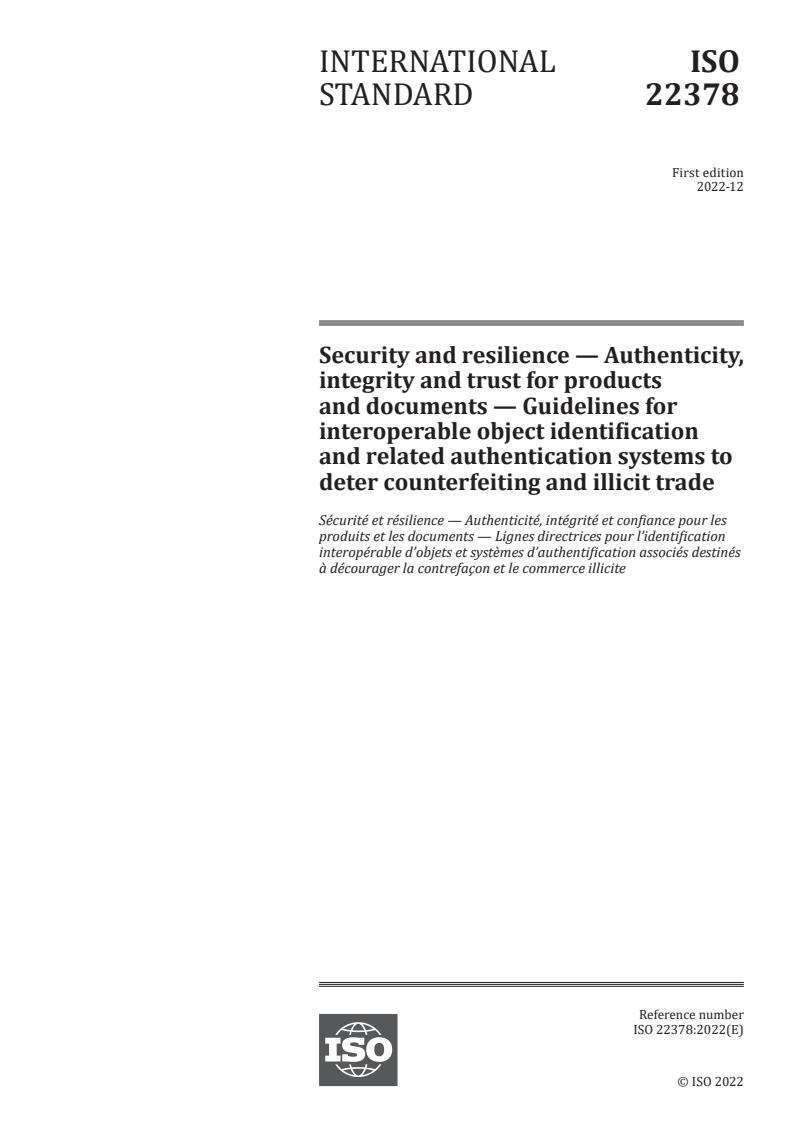
INTERNATIONAL ISO
STANDARD 22378
First edition
2022-12
Security and resilience — Authenticity,
integrity and trust for products
and documents — Guidelines for
interoperable object identification
and related authentication systems to
deter counterfeiting and illicit trade
Sécurité et résilience — Authenticité, intégrité et confiance pour les
produits et les documents — Lignes directrices pour l’identification
interopérable d’objets et systèmes d’authentification associés destinés
à décourager la contrefaçon et le commerce illicite
Reference number
© ISO 2022
All rights reserved. Unless otherwise specified, or required in the context of its implementation, no part of this publication may
be reproduced or utilized otherwise in any form or by any means, electronic or mechanical, including photocopying, or posting on
the internet or an intranet, without prior written permission. Permission can be requested from either ISO at the address below
or ISO’s member body in the country of the requester.
ISO copyright office
CP 401 • Ch. de Blandonnet 8
CH-1214 Vernier, Geneva
Phone: +41 22 749 01 11
Email: copyright@iso.org
Website: www.iso.org
Published in Switzerland
ii
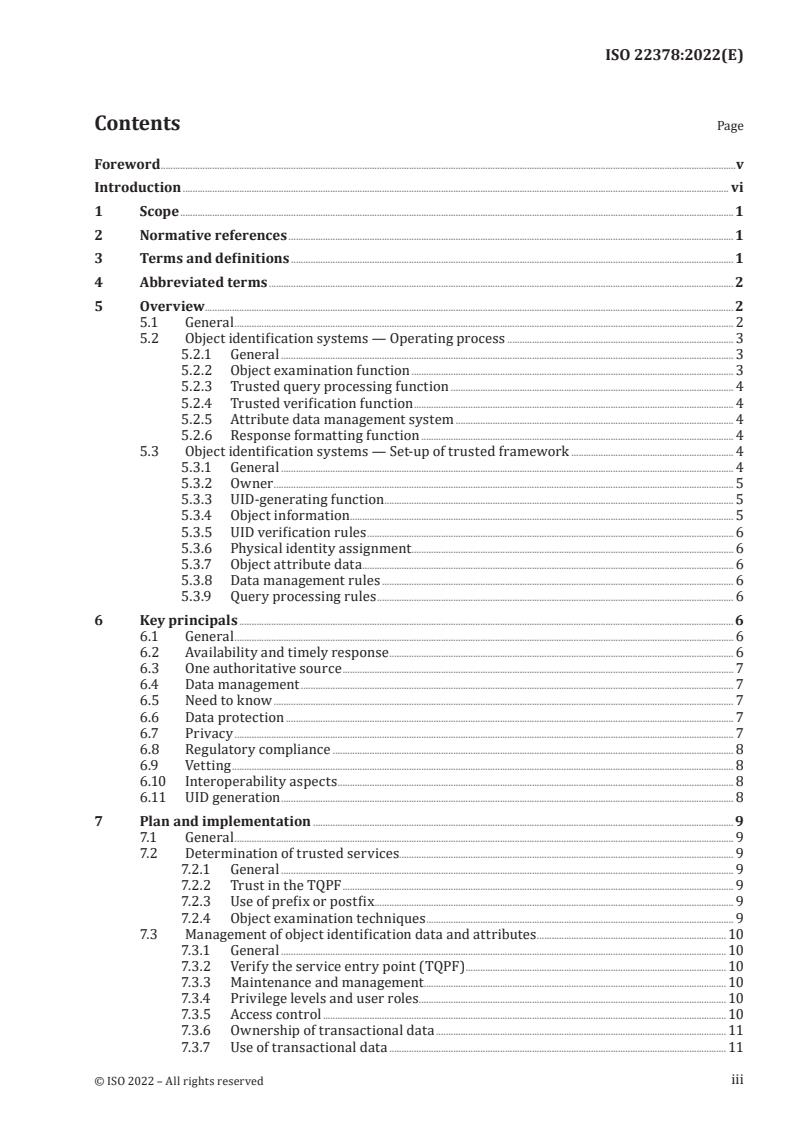
Contents Page
Foreword .v
Introduction . vi
1 Scope . 1
2 Normative references . 1
3 Terms and definitions . 1
4 Abbreviated terms . 2
5 Overview . 2
5.1 General . 2
5.2 Object identification systems — Operating process . 3
5.2.1 General . 3
5.2.2 Object examination function . 3
5.2.3 Trusted query processing function . 4
5.2.4 Trusted verification function . 4
5.2.5 Attribute data management system . 4
5.2.6 Response formatting function . 4
5.3 Object identification systems — Set-up of trusted framework . 4
5.3.1 General . 4
5.3.2 Owner . 5
5.3.3 UID-generating function . . 5
5.3.4 Object information . 5
5.3.5 UID verification rules . 6
5.3.6 Physical identity assignment . 6
5.3.7 Object attribute data . 6
5.3.8 Data management rules . 6
5.3.9 Query processing rules . 6
6 Key principals . 6
6.1 General . 6
6.2 Availability and timely response . 6
6.3 One authoritative source . 7
6.4 Data management . 7
6.5 Need to know . 7
6.6 Data protection . 7
6.7 Privacy . 7
6.8 Regulatory compliance . 8
6.9 Vetting . 8
6.10 Interoperability aspects . . 8
6.11 UID generation . 8
7 Plan and implementation . 9
7.1 General . 9
7.2 Determination of trusted services. 9
7.2.1 General . 9
7.2.2 Trust in the TQPF . 9
7.2.3 Use of prefix or postfix . . 9
7.2.4 Object examination techniques . 9
7.3 Management of object identification data and attributes . 10
7.3.1 General . 10
7.3.2 Verify the service entry point (TQPF) . 10
7.3.3 Maintenance and management . 10
7.3.4 Privilege levels and user roles . 10
7.3.5 Access control . 10
7.3.6 Ownership of transactional data . 11
7.3.7 Use of transactional data . 11
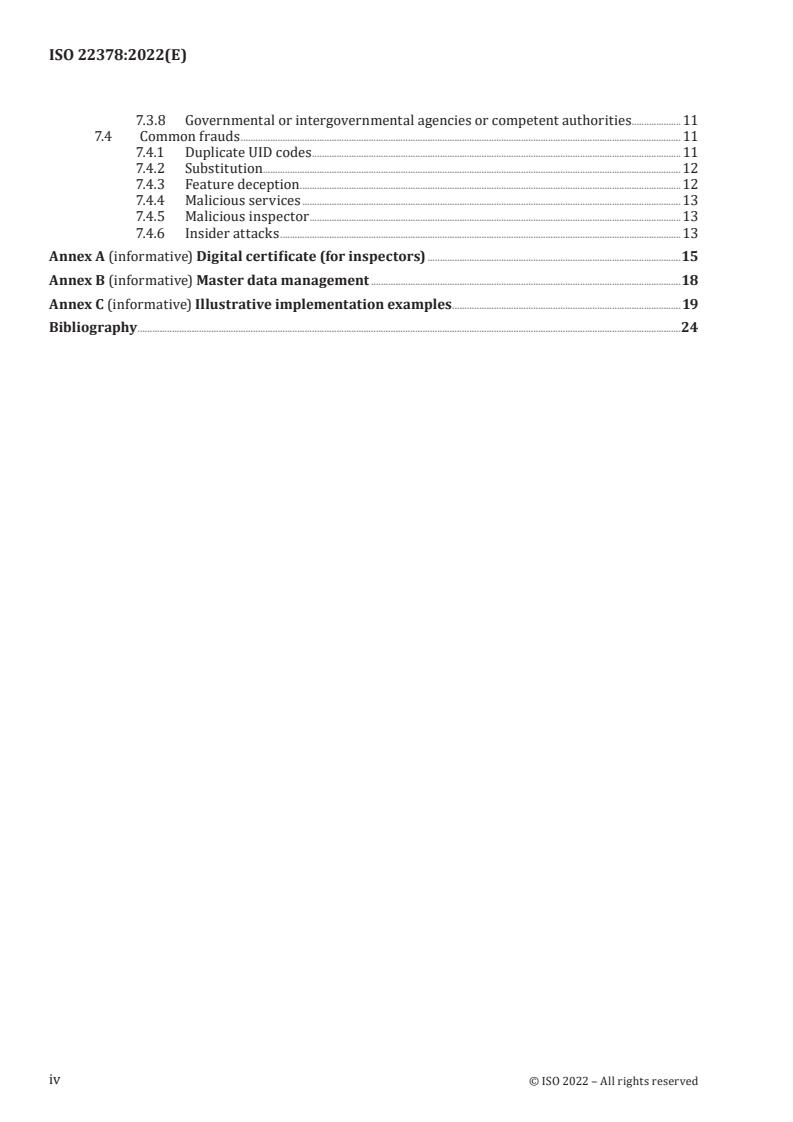
iii
7.3.8 Governmental or intergovernmental agencies or competent authorities . 11
7.4 Common frauds . 11
7.4.1 Duplicate UID codes . 11
7.4.2 Substitution. 12
7.4.3 Feature deception . .12
7.4.4 Malicious services . 13
7.4.5 Malicious inspector .13
7.4.6 Insider attacks .13
Annex A (informative) Digital certificate (for inspectors) .15
Annex B (informative) Master data management .18
Annex C (informative) Illustrative implementation examples .19
Bibliography .24
iv
Foreword
ISO (the International Organization for Standardization) is a worldwide federation of national standards
bodies (ISO member bodies). The work of preparing International Standards is normally carried out
through ISO technical committees. Each member body interested in a subject for which a technical
committee has been established has the right to be represented on that committee. International
organizations, governmental and non-governmental, in liaison with ISO, also take part in the work.
ISO collaborates closely with the International Electrotechnical Commission (IEC) on all matters of
electrotechnical standardization.
The procedures used to develop this document and those intended for its further maintenance are
described in the ISO/IEC Directives, Part 1. In particular, the different approval criteria needed for the
different types of ISO documents should be noted. This document was drafted in accordance with the
editorial rules of the ISO/IEC Directives, Part 2 (see www.iso.org/directives).
Attention is drawn to the possibility that some of the elements of this document may be the subject of
patent rights. ISO shall not be held responsible for identifying any or all such patent rights. Details of
any patent rights identified during the development of the document will be in the Introduction and/or
on the ISO list of patent declarations received (see www.iso.org/patents).
Any trade name used in this document is information given for the convenience of users and does not
constitute an endorsement.
For an explanation of the voluntary nature of standards, the meaning of ISO specific terms and
expressions related to conformity assessment, as well as information about ISO’s adherence to
the World Trade Organization (WTO) principles in the Technical Barriers to Trade (TBT), see
www.iso.org/iso/foreword.html.
This document was prepared by Technical Committee ISO/TC 292, Security and resilience.
This first edition cancels and replaces ISO 16678:2014, which has been technically revised.
The main changes are as follows:
— the title and number have been updated to follow the same structure as all other documents
developed by ISO/TC 292.
Any feedback or questions on this document should be directed to the user’s national standards body. A
complete listing of these bodies can be found at www.iso.org/members.html.
v
Introduction
This document is based on three foundational assumptions:
— detecting counterfeit objects is a complex and often difficult task;
— accurate identity information about the object in question simplifies the counterfeit detection
process;
— accurate identity information is often difficult and hard to find.
The main objective of this document is to simplify access and delivery of accurate identity information
to inspectors when authenticating objects.
To accomplish this objective, the document provides guidance intended to make object identity
information easier to find and use. Identity data and information can be found in many places, including
verification and authentication systems. This document will make it easier for inspectors to access
identity information and granting inspectors access to reliable identity information helps facilitate the
detection of counterfeits.
This document focuses attention on routing requests for object information to the appropriate
authoritative service and then routing responses back to inspectors.
Object identification systems commonly use unique identifiers (UID) to reference or access object
information. UID can be assigned to a class of objects or can be assigned to distinct object. In either case,
the UID can enhance detection of counterfeiting and fraud, although UIDs assigned to single instances
can be more efficient.
This document contains:
— terms and definitions;
— an overview on how object information is used to detect counterfeits;
— principles, concepts and values;
— recommendations on how to improve interoperability of systems capable of providing object
information to inspectors;
— specific examples that illustrate some of the concepts presented.
This document enables reliable and safe object identification to deter the introduction of illegal objects
to the market.
It includes a framework with the objective to increase trust by making object identification solutions
interoperable. For example, the framework describes method and solutions for how to:
— detect some counterfeits without authenticating products;
— evaluate an authentication element;
— formally prove that a remote description of an object can be trusted.
This is document is part of a family of standards which includes ISO 22380, ISO 22381, ISO 22382,
ISO 22383, ISO 22384.
One goal of this document is to describe a framework in which disparate object identification solutions
are interoperable and trust is increased, and therefore will be used more frequently. The framework
should also include solutions which simply detect some counterfeits without authenticating products.
Likewise, the framework should also include a solution which only evaluates an authentication element.
vi
Assuming that the object identification systems themselves can also be counterfeited and copied,
This document establishes a method to formally prove that a remote description of an object can be
trusted. establishes a method to formally prove that a remote description of an object can be trusted.
Consideration is given to prevent interference between different independent implementations of such
systems and to allow an unambiguous unique identification reference to service multiple use-cases and
applications.
The theory supporting the design of the system is that a lack of trust and lack of interoperability
introduces “friction” for users. By reducing this friction, there will be greater awareness and usage, and
therefore greater detection and deterrence of fraud.
This document is complemented by ISO 22381:2018, which guides the establishment and set-up of
interoperability.
vii
INTERNATIONAL STANDARD ISO 22378:2022(E)
Security and resilience — Authenticity, integrity
and trust for products and documents — Guidelines
for interoperable object identification and related
authentication systems to deter counterfeiting and illicit
trade
1 Scope
This document establishes a framework for identification and authentication systems. It provides
recommendations and best practice that include:
— management and verification of identifiers;
— physical representation of identifiers;
— participants’ due diligence;
— vetting of all participants within the system;
— relationship between the unique identifier (UID) and possible authentication elements related to it;
— questions that deal with the identification of the inspector and any authorized access to privileged
information about the object;
— inspector access history (logs).
The model described in this document is intended to determine the common functions of different
systems.
This document describes processes, functions and functional units of a generic model. It does not
specify any specific technical solutions.
Object identification systems can incorporate other functions and features such as supply chain
traceability, quality traceability, marketing activities and others, but these aspects are out of scope of
this document.
NOTE This document does not refer to industry-specific requirements such as GS1 Global Trade Item
Number (GTIN).
2 Normative references
The following documents are referred to in the text in such a way that some or all of their content
constitutes requirements of this document. For dated references, only the edition cited applies. For
undated references, the latest edition of the referenced document (including any amendments) applies.
ISO 22300, Security and resilience — Vocabulary
3 Terms and definitions
For the purposes of this document, the terms and definitions given in ISO 22300 apply.
ISO and IEC maintain terminology databases for use in standardization at the following addresses:
— ISO Online browsing platform: available at https:// www .iso .org/ obp
— IEC Electropedia: available at https:// www .electropedia .org/
4 Abbreviated terms
ADMS attribute data management system
[8]
AI application identifier (see ANSI MH 10.8.2 )
CA Certification Authority
[8]
DI data identifier (see ANSI MH 10.8.2 )
IP Internet Protocol
OEF object examination function
RFF response formatting function
TQPF trusted query processing function
TVF trusted verification function
UID unique identifier
SLA service level agreement
5 Overview
5.1 General
The advantage of interoperability of these systems is to enhance detection of counterfeiting and fraud
by:
— increasing use by specific user groups;
— increasing the number of inspected objects;
— increasing access to the authoritative sources;
— lowering the cost of:
— training;
— equipment;
— development;
— deployment;
— inspection time.
Once interoperability is achieved and these systems are widely deployed, a trusted entity uses an
identifier to make inquiries about an object to guide disposition decisions regarding the object. The
inspector will have credible evidence that the information provided in response to the inquiry is
accurate and trustworthy.
All participants should perform their roles with due diligence considering the following:
— Auditing and vetting of the service providers should be considered to ensure they are acting in good
faith and are not threat agents operating from behind a deceptive “store front”.
— Auditing and vetting of the manufacturers should be considered to ensure they are following
documented processes and feed accurate information into the systems.
— The interested parties with a need-to-know should obtain appropriate credentials to process
inquiries, so that the rights holder can release information in a socially responsible manner.
5.2 Object identification systems — Operating process
5.2.1 General
Object identification systems typically consist of functional units as depicted in the model shown in
Figure 1.
Figure 1 — Object identification model
The model makes no assumptions on specific implementation of the functions.
Multiple instances of a function can exist across the system. Different functions can be combined into a
single service.
Illustrative examples implementing this model are given in Annex C.
5.2.2 Object examination function
The inspector examines an object of interest (such as a material good) to determine if the object has
a UID. If a UID is found, further examination can be required to determine which TQPF(s) are likely to
know of this UID. The function forms a query that can consist of only a UID, a combination of UID with
the inspector’s credentials, or other physical attribute data including intrinsic authentication elements
that can uniquely identify an object such as a digital image. The OEF ends when a query is submitted to
one or more TQPF. When the process is iterated, the OEF can evaluate the response of a previous query.
5.2.3 Trusted query processing function
A TQPF routes information between the other functions according to defined rules. The TQPF can
examine credentials from requesting parties according to defined rules. The TQPF can be distributed
across multiple services.
EXAMPLE 1 A TQPF routes a query formed by an OEF to the appropriate TVF.
EXAMPLE 2 A TQPF combines the verification or authentication response from a TVF with any credentials
from an inspector to form a query into an ADMS.
5.2.4 Trusted verification function
The TVF verifies whether the UID exists within the domain. The TVF should check the credentials of
the requesting TQPF. The TVF should enforce access privileges based on defined rules. It can respond
to the source of the query or through one or more other TQPF. The response would typically include
verification information about the UID (e.g. “is the UID valid or not?”) TVF can also generate alerts to
interested parties. TVF should protect sensitive data from unauthorized access.
The TVF can execute an authenticating procedure or algorithm against the information (data) received.
5.2.5 Attribute data management system
An ADMS is the authoritative source of object master data. There should be only one master data
record for each object attribute. If multiple instances of attribute data records exist, only one should
be “master” and all others “subordinate”. Different object attributes can reside in different databases.
Multiple databases can exist in federated environment.
An ADMS receives a response (via a TQPF) from a TVF. The ADMS verifies credentials of both the
requesting TQPF, TVF and the credentials of the inspector. Access privileges should be based on
credentials and rules. The ADMS responds with data selected corresponding to the request and filtered
by rules. The response can resolve all the inspector’s questions or can include information on how to
proceed. If a response contains further instructions, an inspector decides if further action should be
taken by initiating a new query.
Attributes in an ADMS can include information details on how to authenticate objects or proceed with
further examination.
The ADMS should protect sensitive data from unauthorized access.
5.2.6 Response formatting function
This function converts ADMS responses into a defined format and communicates them to the inspector.
This is the end of the process.
In some cases, the inspection process can be iterated based on the results given by the ADMS or
depending on the architecture of the system.
5.3 Object identification systems — Set-up of trusted framework
5.3.1 General
The identification and authentication system should operate in accordance with the following
definitions, rules, data and data relationships.
Figure 2 shows how the example model can be configured.
Figure 2 — Set-up and configuration
5.3.2 Owner
Owners determine all of the detail on whom, how, where and when access rights to attribute data are
granted. Owners choose the service providers that implement the functional block and provide the
access and business rules to the various providers.
5.3.3 UID-generating function
The UID-generating function should ensure UIDs are unique within the domain the service operates.
UID can be generated following a specific format or function that can include object specific attribute
data.
The function also generates or produces the verification rules that TVF use when considering a specific
UID during a query.
5.3.4 Object information
Object information should be a subset of object attribute data or pointer (reference) to object attribute
data.
5.3.5 UID verification rules
The algorithms and procedures that allow a TVF to determine if a UID is valid within the domain. They
can include algorithms and processes that allow authentication. They can also include a list of generated
UIDs.
5.3.6 Physical identity assignment
In creating the link between a UID and an object, assignment can be accomplished by enrolment of an
intrinsic UID.
5.3.7 Object attribute data
Object attribute data refers to the attributes sufficient to identify an object or class of objects. Owner
can include additional attributes at their discretion.
5.3.8 Data management rules
The policies regarding protection and disclosure of attribute data include, but are not limited to:
— access rights, including:
— requirements to gain privilege to an access level;
— assigns attributes to access levels;
— the protection levels of the attribute data;
— user (inspector) roles;
— standard query responses, including:
— business rules for data disclosure;
— responses to queries in all situation including invalid UID cases ;
— privileged versus unprivileged response.
5.3.9 Query processing rules
The query processing rules enable a function to:
— route a query or response to the appropriate function;
— verify a request is authorized or allowed;
— verify communication is authorized or allowed.
6 Key principals
6.1 General
This clause provides key principles on how to design the identification and authentication system.
6.2 Availability and timely response
The identification and authentication system should be designed so that:
— availability and response times meet the inspector’s expectations;
— response times are long enough to verify credentials.
This may be addressed and specified by a service level agreement (SLA).
6.3 One authoritative source
The identification and authentication system should be designed so that only one authoritative source
corresponds to the object to be identified.
Allowing multiple sources can confuse the inspector. It can also be possible for malicious service
providers to copy the source, manipulate it and publish as one of the authoritative sources to the
inspector.
The identification and authentication system can allow custodian privileges to service providers, but
it should always be clear who the authoritative source is and why custodian copies of the data can be
trusted.
6.4 Data management
The identification and authentication system should be designed so that:
— master data and transactional data are kept up to date;
— all data are managed in line with the expected life cycle of the object;
— it is possible to adapt to future changes in regulatory requirements;
— long-term object identification is driven by maintenance warranty, and investigations needing
authentication.
NOTE Annex B gives further information on key concepts on master data management and transactional
data management.
6.5 Need to know
The identification and authentication system should be designed so that any knowledge about the
following aspects is protected and only shared on a need-to-know basis:
— the presence of the features;
— the nature of the feature;
— the processes and architecture of the system.
6.6 Data protection
The identification and authentication system should be designed so that it uses best practices to protect
data about business critical. This includes designing and organizing the security both technically
and operationally, where appropriate means are taken for protecting confidentiality, integrity and
availability of information that are maintained in the system.
6.7 Privacy
The identification and authentication system should be designed so that any personal identifiable
information (PII) are protected, taking into account local and jurisdictional regulations, as well as
industrial best practices.
6.8 Regulatory compliance
The identification and authentication system may be designed so it can be adapted with respect to
applicable regulatory requirements.
NOTE Applicable regulations can be different in different industries and countries.
6.9 Vetting
The identification and authentication system should be designed so that:
— all participating/involved parties are vetted and credentialed;
— the owner ensures that the implementations of TVF and ADMS are trustworthy, the audit results
and credentials of providers are considered as part of a provider selection process, and credentials
are available and up to date;
— the person who selects the TQPF ensures the implementation is trustworthy and credentials are up
to date;
— the service provider performs background checks on customers requesting contractual use of their
services to deter malicious actors from pretending to be owners.
6.10 Interoperability aspects
Two or more systems or services should support the ability to exchange structured information
(syntactic interoperability), to automatically interpret it (semantic interoperability) and to accurately
use the information.
The identification and authentication system should be designed so that interoperability is achieved by
defining and agreeing on:
— the target user group;
— the minimum information user needs;
— access rights;
— standards for data exchange to follow, including data handling, data ownership, data protection and
usage restrictions, and data interfaces;
— the style sheet, as necessary;
— SLAs.
NOTE 1 This document only covers semantic interoperability. Some syntactic alignment can be necessary for
the routing process.
NOTE 2 ISO 22381 gives further information on the process of how to establish interoperability by organizing
participants involved, planning an architecture, and implementing and operating interoperation.
6.11 UID generation
The identification and authentication system should be designed so that each UID is generated to be
unique within the domain in which the service operates.
7 Plan and implementation
7.1 General
This clause includes the following:
— 7.2 describes how to determine trusted services by TQPF;
— 7.3 focuses on how to manage object identification data and attributes, and describes in particular
what systems have in common;
— 7.4 gives an overview of common frauds, and outlines the advantages and disadvantages of various
implementation approaches to help an interested party choose the most appropriate solution based
upon their situation.
7.2 Determination of trusted services
7.2.1 General
The identification and authentication system should be designed so that the inspector can easily find or
determine which TQPF is involved with an object. The inspector should be able to decide a level of trust
to associate with the involved TQPF.
It is important to make the TQPF easy to find. Anything that makes the correct or authoritative TQPF
more visible should be considered.
7.2.2 Trust in the TQPF
The identification and authentication system should be designed so that the TQPF, which acts as a portal
for inspectors, should be referenced or endorsed by independent and well-known authorities.
Consideration should be given to detect and recover from attacks on the TQPF portals. For example,
malicious agents are known to execute denial of service attacks on portals. Attacks occur in many
forms and countermeasures should be appropriate for the specific attack.
Limiting the number of established services can assist the users with detecting deceptive services and
threat agents. Consolidating users onto only one or just a few TQPFs can allow someone in the group to
recognize and report suspicious actions and behaviours. The sudden appearance of a new service can
draw more scrutiny.
7.2.3 Use of prefix or postfix
The identification and authentication system should be designed so that interoperability can be
improved by using a standardized data identifier (DI) or an application identifier (AI) as a prefix or
postfix to assist the TQPF route the query to the correct TVF.
In the absence of AI, DI or other hints for locating the service, the approach is to examine the object
for trademarked logos or other evidence that identifies the manufacturer of the object. Inspectors can
contact the manufacturer for assistance in locating the TQPF.
7.2.4 Object examination techniques
The identification and authentication system should be designed so that guidance is not needed when
all data and identity elements are present in a system where all the participants are following the
agreements and rules. In non-ideal systems, consideration should be given to how OEFs degrade as
UIDs are lost or destroyed. Redundant and error-correcting elements can improve performance in such
circumstances.
Consideration should be given to how OEFs behave when rules and agreements are violated. Trust and
confidence can erode quickly and defensive behaviours can emerge.
7.3 Management of object identification data and attributes
7.3.1 General
The identification and authentication system should be designed so that an inspector with sufficient
credentials can initiate a query with a TQPF that results in a response from an ADMS. If the access rules
allow it, the ADMS response can contain object identification data or other object attributes.
NOTE Inspectors without credentials such as consumers can find only publicly available or limited
information in the response.
7.3.2 Verify the service entry point (TQPF)
The identification and authentication system should be designed so that interested parties are advised
to carefully consider the possibility that the service entry point can be hosted by malicious agents with
the intent to commit fraud. The interested party should consider a number of questions before trusting
or believing data provided from a service. A few possible example questions are:
— Is the service provider credible?
— Is the object data coming from the trusted source?
Independent audits can resolve concerns regarding the credibility of a service. Credentials that attest to
the audit results can be issued. The service can choose to make these credentials available to interested
parties to improve trust.
Inspectors can request credentials from the services they use and should check that any credentials
provided are current and rooted to a trustworthy authority.
7.3.3 Maintenance and management
The identification and authentication system should be designed so that the owner can ensure that data
are accurate and up to date. For example, if an attribute that describes objects in a class changes, the
corresponding information in the ADMS can need updating.
The owner should ensure that functions enforcing access rights have up-to-date rules and authorized
user information.
7.3.4 Privilege levels and user roles
The identification and authentication system should be designed so that access to confidential object
identification data can be dependent on privilege level. For example, replies containing highly valued
and confidential object data can be routed only to inspectors with very high-level credentials, whereas
replies routed to inspectors without credentials can contain only publicly available information.
There can be as many access privilege levels as the data owner decides to create.
7.3.5 Access control
The identification and authentication system should be designed so that industry practices for granting
access rights are varied for many reasons, such as regulatory mandates, communication network
constraints, equipment cost, etc. A few common access methods include:
— user name and password challenge;
— digital certificates;
— unique Internet Protocol (IP) address access control.
Best practices for access control should be considered. There should be a means to verify an inspector’s
identity and organization affiliation before access to confidential information is granted. Ease-of-use
can be facilitated when single sign-on mechanisms are used. Access control utilizing a digital certificate
should be considered for highly confidential data. An example of digital certificates for inspectors is
given in Annex A.
7.3.6 Ownership of transactional data
The identification and authentication system should be designed so that transaction event data and logs
can be generated as TQPF and TVF systems operate. All affected parties should understand who owns
and manages the transactional data and who has rights to access and use this data. Formal contractual
agreements should be established to prevent misunderstandings.
7.3.7 Use of transactional data
The identification and authentication system should be designed so that UID codes without a related
authentication function cannot be used to determine whether or not an object is genuine. However,
analysis of event logs can detect some systematic attacks and help isolate counterfeit objects.
For example, an event log that contains location information can detect a single object UID claiming to
be in two places at once. In addition, for UID systems that establish an instance-specific code for each
instance of an object, special attention should be given when a code is queried too many times as this
can indicate that counterfeit objects exist.
7.3.8 Governmental or intergovernmental agencies or competent authorities
The identification and authentication system should be designed so that governments or
intergovernmental agencies can establish requirements to ensure the safety of the public. These
requirements can change from country to country or by geographic region. These requirements are
usually monitored or supervised by a competent authority or agency established by governments with
jurisdictional authority over the geographic region. These agencies can be empowered by government
mandates that require access to confidential information about products and any information used
to authenticate products to ensure they are authorized for the destination market and safe for the
consumer.
Owners should be aware of specific regulatory requirements which can require them to provide data
about their products to the above agencies in the markets where their products are distributed or sold.
Similarly, owners should be aware that in some jurisdictions, there can be restrictions on cross-border
access to data and services.
7.4 Common frauds
7.4.1 Duplicate UID codes
The techniques used to detect duplication of UID codes differ between class identifiers and identifiers
intended for use on single instance of the object. When UID codes are copied, re-originated, guessed
or reused, duplicates or “clones” occur across the system. Systems and services should be designed to
detect and report duplicate UID codes. Indications of duplicated UID codes for both types (class and
instance) can include, but are not limited to:
— queries coming from unauthorized locations or unauthorized inspectors;
— the object does not match the description reported by the ADMS.
Indication of duplicated single instance UID code for an object can also include, but are not limited to:
— queries coming from different locations at the same time;
— more queries than expe
...