

ISO 18274:2023
(Main)Welding consumables — Solid wire electrodes, solid strip electrodes, solid wires and solid rods for fusion welding of nickel and nickel alloys — Classification
General Information
- Abstract
This document specifies requirements for classification of solid wire electrodes, solid strip electrodes, solid wires and solid rods for fusion welding of nickel and nickel alloys. The classification of the solid wire electrodes, solid strip electrodes, solid wires and solid rods is based on their chemical composition. It includes those compositions in which the nickel content exceeds that of any other element. The principles of this document can be applied to metal powders for cladding, hard facing and additive manufacturing.
- Status
- Published
- Publication Date
- 27-Apr-2023
- Technical Committee
- ISO/TC 44/SC 3 - Welding consumables
- Drafting Committee
- ISO/TC 44/SC 3 - Welding consumables
- Current Stage
- 6060 - International Standard published
- Start Date
- 28-Apr-2023
- Due Date
- 08-May-2023
- Completion Date
- 28-Apr-2023
Buy Documents
ISO 18274:2023 - Welding consumables — Solid wire electrodes, solid strip electrodes, solid wires and solid rods for fusion welding of nickel and nickel alloys — Classification Released:28. 04. 2023
ISO 18274:2023 - Produits consommables pour le soudage — Fils-électrodes pleins, feuillards pleins, fils pleins et baguettes pleines pour le soudage par fusion du nickel et des alliages de nickel — Classification Released:28. 04. 2023
Overview
ISO 18274:2023 - "Welding consumables - Solid wire electrodes, solid strip electrodes, solid wires and solid rods for fusion welding of nickel and nickel alloys - Classification" - defines a chemical-composition based classification system for nickel-base welding consumables. The standard covers solid wire electrodes, solid strip electrodes, solid wires and solid rods whose nickel content exceeds that of any other element. Its principles can also be applied to metal powders used for cladding, hardfacing and additive manufacturing.
Key topics and technical requirements
- Classification scheme: A two-part symbol:
- product form symbol - S for solid wire/rod/electrode, B for solid strip electrode; and
- chemical symbol - Ni####, a four‑digit numeric code that identifies alloy group and composition (see Table 1).
- Alloy groups (first digit): Numeric indicators identify major alloy families (examples from the standard):
- 1 = nickel‑molybdenum alloys, 2 = no significant alloy addition, 4 = nickel‑copper, 5 = copper + Al/Ti precipitation hardening, 6 = Ni‑Cr with Fe < 25 %, 7 = 6 with Al/Ti hardening, 8 = Ni‑Fe‑Cr with Fe > 25 %, 9 = precipitation‑hardenable alloys.
- Chemical composition rules: Table 1 lists alloy symbols and permitted element ranges (C, Mn, Fe, Si, Cu, Co, Al, Ti, Cr, Nb, Mo, W, others). Notable global limits given in the standard:
- unspecified elements ≤ 0.50 % (mass fraction),
- phosphorus normally ≤ 0.020 % and sulfur ≤ 0.015 % unless stated otherwise,
- up to 1 % of the nickel content may be cobalt (unless otherwise agreed),
- up to 20 % of niobium content can be substituted by tantalum.
- Product variants: Symbols suffixed with “B” indicate more restricted composition ranges (B = narrower tolerances).
- Supporting requirements and clauses: Chemical analysis (Clause 6), mechanical properties of weld metal (Clause 7), rounding, retests, technical delivery conditions and designation (Clauses 8–11) - plus informative annexes on designation, uses and national equivalents (Annexes A–C).
Practical applications and users
ISO 18274:2023 is intended for:
- Welding consumable manufacturers - for product classification, marking and specifications.
- Welding engineers and fabricators - to select appropriate solid electrodes/rods/wires for fusion welding of nickel and nickel alloys.
- Procurement and quality assurance teams - to specify and verify chemical composition and delivery conditions.
- Additive manufacturing, cladding and hardfacing specialists - to adapt the classification principles for metal powders.
- Standards bodies and certifiers - for harmonizing national classifications and testing.
Using ISO 18274 helps ensure consistent material selection, easier supplier communication and traceable classification of nickel welding consumables.
Related standards
Normative references include ISO 544, ISO 14344 and ISO 80000‑1, plus informative Annex C which maps corresponding national classifications and typical weld metal tensile strengths.
Relations
- Referred By
EN 4877-002:2023 - Aerospace series - Filler metals for welding - Part 002: Authorized filler metals - Effective Date
- 25-Aug-2026
- Effective Date
- 12-Feb-2026
- Effective Date
- 06-Jun-2022
- Effective Date
- 09-May-2020
Buy Documents
ISO 18274:2023 - Welding consumables — Solid wire electrodes, solid strip electrodes, solid wires and solid rods for fusion welding of nickel and nickel alloys — Classification Released:28. 04. 2023
ISO 18274:2023 - Produits consommables pour le soudage — Fils-électrodes pleins, feuillards pleins, fils pleins et baguettes pleines pour le soudage par fusion du nickel et des alliages de nickel — Classification Released:28. 04. 2023
Get Certified
Connect with accredited certification bodies for this standard

DVS-ZERT GmbH
German welding certification society.
CARES (UK Certification Authority for Reinforcing Steels)
UK certification for reinforcing steels and construction.
EWF/IIW (European/International Welding Federation)
International welding personnel certification.
Sponsored listings
Frequently Asked Questions
ISO 18274:2023 is a standard published by the International Organization for Standardization (ISO). Its full title is "Welding consumables — Solid wire electrodes, solid strip electrodes, solid wires and solid rods for fusion welding of nickel and nickel alloys — Classification". This standard covers: This document specifies requirements for classification of solid wire electrodes, solid strip electrodes, solid wires and solid rods for fusion welding of nickel and nickel alloys. The classification of the solid wire electrodes, solid strip electrodes, solid wires and solid rods is based on their chemical composition. It includes those compositions in which the nickel content exceeds that of any other element. The principles of this document can be applied to metal powders for cladding, hard facing and additive manufacturing.
This document specifies requirements for classification of solid wire electrodes, solid strip electrodes, solid wires and solid rods for fusion welding of nickel and nickel alloys. The classification of the solid wire electrodes, solid strip electrodes, solid wires and solid rods is based on their chemical composition. It includes those compositions in which the nickel content exceeds that of any other element. The principles of this document can be applied to metal powders for cladding, hard facing and additive manufacturing.
ISO 18274:2023 is classified under the following ICS (International Classification for Standards) categories: 25.160.20 - Welding consumables. The ICS classification helps identify the subject area and facilitates finding related standards.
ISO 18274:2023 has the following relationships with other standards: It is inter standard links to EN 4877-002:2023, EN ISO 18274:2023, ISO/IEC 21000-19:2010/Amd 1:2018, ISO 18274:2010. Understanding these relationships helps ensure you are using the most current and applicable version of the standard.
ISO 18274:2023 is available in PDF format for immediate download after purchase. The document can be added to your cart and obtained through the secure checkout process. Digital delivery ensures instant access to the complete standard document.
Standards Content (Sample)
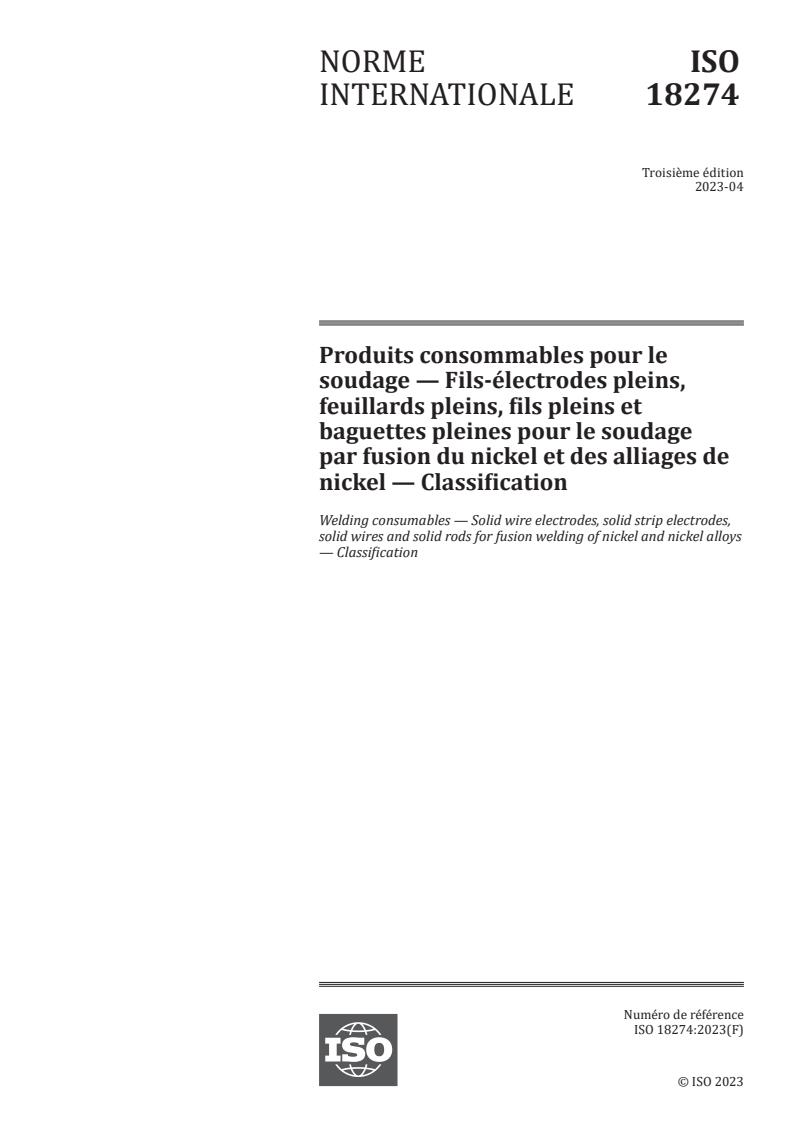
INTERNATIONAL ISO
STANDARD 18274
Third edition
2023-04
Welding consumables — Solid wire
electrodes, solid strip electrodes,
solid wires and solid rods for fusion
welding of nickel and nickel alloys —
Classification
Produits consommables pour le soudage — Fils-électrodes pleins,
feuillards pleins, fils pleins et baguettes pleines pour le soudage par
fusion du nickel et des alliages de nickel — Classification
Reference number
© ISO 2023
All rights reserved. Unless otherwise specified, or required in the context of its implementation, no part of this publication may
be reproduced or utilized otherwise in any form or by any means, electronic or mechanical, including photocopying, or posting on
the internet or an intranet, without prior written permission. Permission can be requested from either ISO at the address below
or ISO’s member body in the country of the requester.
ISO copyright office
CP 401 • Ch. de Blandonnet 8
CH-1214 Vernier, Geneva
Phone: +41 22 749 01 11
Email: copyright@iso.org
Website: www.iso.org
Published in Switzerland
ii
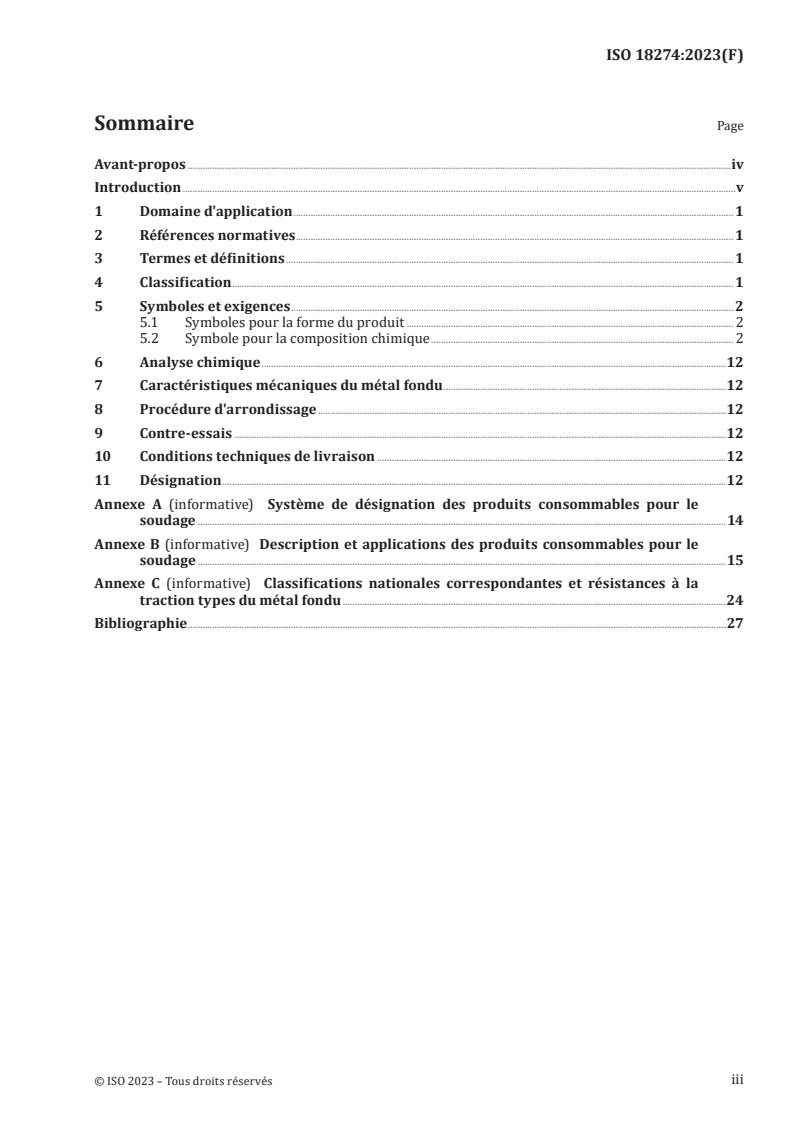
Contents Page
Foreword .iv
Introduction .v
1 S c op e . 1
2 Nor m at i ve r ef er enc e s . 1
3 Terms and definitions . 1
4 Classification . 1
5 S ymbols and requirements . 1
5.1 S ymbols for the product form . 1
5.2 S ymbol for the chemical composition . 2
6 Chem ic al a n a l y s i s . .12
7 M echanical properties of the weld metal .12
8 Roundi n g pro c e dur e .12
9 Re t e s t s .12
10 Technical delivery conditions .12
11 D e sig n at ion .12
Annex A (informative) System for designation of welding consumables .14
Annex B (informative) Description and uses of welding consumables .15
Annex C (informative) Corresponding national classifications and typical weld metal
tensile strengths .23
Bibliography .27
iii
Foreword
ISO (the International Organization for Standardization) is a worldwide federation of national standards
bodies (ISO member bodies). The work of preparing International Standards is normally carried out
through ISO technical committees. Each member body interested in a subject for which a technical
committee has been established has the right to be represented on that committee. International
organizations, governmental and non-governmental, in liaison with ISO, also take part in the work.
ISO collaborates closely with the International Electrotechnical Commission (IEC) on all matters of
electrotechnical standardization.
The procedures used to develop this document and those intended for its further maintenance are
described in the ISO/IEC Directives, Part 1. In particular, the different approval criteria needed for the
different types of ISO documents should be noted. This document was drafted in accordance with the
editorial rules of the ISO/IEC Directives, Part 2 (see www.iso.org/directives).
Attention is drawn to the possibility that some of the elements of this document may be the subject of
patent rights. ISO shall not be held responsible for identifying any or all such patent rights. Details of
any patent rights identified during the development of the document will be in the Introduction and/or
on the ISO list of patent declarations received (see www.iso.org/patents).
Any trade name used in this document is information given for the convenience of users and does not
constitute an endorsement.
For an explanation of the voluntary nature of standards, the meaning of ISO specific terms and
expressions related to conformity assessment, as well as information about ISO's adherence to
the World Trade Organization (WTO) principles in the Technical Barriers to Trade (TBT), see
www.iso.org/iso/foreword.html.
This document was prepared by Technical Committee ISO/TC 44, Welding and allied processes,
Subcommittee SC 3, Welding consumables, in collaboration with the European Committee for
Standardization (CEN) Technical Committee CEN/TC 121, Welding and allied processes, in accordance
with the Agreement on technical cooperation between ISO and CEN (Vienna Agreement).
This third edition cancels and replaces the second edition (ISO 18274:2010), which has been technically
revised.
The main changes are as follows:
— new restricted alloy symbols, commonly used in the USA, added to Table 1 and Table C.1;
— alloy symbols updated in Table 1 and Table C.1;
— a new EXAMPLE 4 added to Clause 11 for a Z classification.
Any feedback or questions on this document should be directed to the user’s national standards
body. A complete listing of these bodies can be found at www.iso.org/members.html. Official
interpretations of ISO/TC 44 documents, where they exist, are available from this page:
https://committee.iso.org/sites/tc44/home/interpretation.html.
iv
Introduction
For nickel welding consumables, there is no unique relationship between the product form, for example:
— solid wire electrode;
— solid strip electrode;
— solid wire;
— solid rod;
and the welding process used, for example:
— gas-shielded metal arc welding;
— gas tungsten arc welding;
— plasma arc welding;
— submerged arc welding;
— strip overlay welding;
— laser welding;
— other welding processes.
Consequently, solid wire electrodes, solid strip electrodes, solid wires or solid rods can be classified
on the basis of any of these product forms and can be used, as appropriate, for more than one of these
processes (see also Annex B).
The International Organization for Standardization (ISO) draws attention to the fact that it is claimed
that compliance with this document may involve the use of a patent.
ISO takes no position concerning the evidence, validity and scope of this patent right.
The holder of this patent right has assured ISO that they are willing to negotiate licences under
reasonable and non-discriminatory terms and conditions with applicants throughout the world. In
this respect, the statement of the holder of this patent right is registered with ISO. Information may be
obtained from the patent database available at www.iso.org/patents.
Attention is drawn to the possibility that some of the elements of this document may be the subject of
patent rights other than those in the patent database. ISO shall not be held responsible for identifying
any or all such patent rights.
v
INTERNATIONAL STANDARD ISO 18274:2023(E)
Welding consumables — Solid wire electrodes, solid strip
electrodes, solid wires and solid rods for fusion welding of
nickel and nickel alloys — Classification
1 S cope
This document specifies requirements for classification of solid wire electrodes, solid strip electrodes,
solid wires and solid rods for fusion welding of nickel and nickel alloys. The classification of the solid
wire electrodes, solid strip electrodes, solid wires and solid rods is based on their chemical composition.
It includes those compositions in which the nickel content exceeds that of any other element.
The principles of this document can be applied to metal powders for cladding, hard facing and additive
manufacturing.
2 Normat ive references
The following documents are referred to in the text in such a way that some or all of their content
constitutes requirements of this document. For dated references, only the edition cited applies. For
undated references, the latest edition of the referenced document (including any amendments) applies.
ISO 544, Welding consumables — Technical delivery conditions for filler materials and fluxes — Type of
product, dimensions, tolerances and markings
ISO 14344, Welding consumables — Procurement of filler materials and fluxes
ISO 80000-1:2022, Quantities and units — Part 1: General
3 Terms and definitions
No terms and definitions are listed in this document.
ISO and IEC maintain terminology databases for use in standardization at the following addresses:
— ISO Online browsing platform: available at https:// www .iso .org/ obp
— IEC Electropedia: available at https:// www .electropedia .org/
4 Classification
The symbol for the classification is divided into two parts:
a) the first part indicates the product form, being solid wire electrode, solid strip electrode, solid wire
or solid rod, see 5.1;
b) the second part gives a numerical symbol indicating the chemical composition of the solid wire
electrode, solid strip electrode, solid wire or solid rod, see Table 1.
5 S ymbols and requirements
5.1 S ymbols for the product form
The symbol for the solid wire electrode, solid wire or solid rod shall be “S”.
The symbol for the solid strip electrode shall be “B”.
NOTE One product form can be used for more than one welding process.
5.2 S ymbol for the chemical composition
The initial symbol “Ni” in Table 1 identifies the welding consumable as a nickel base alloy. The following
four digits indicate the chemical composition of the solid wire electrode, solid strip electrode, solid
wire or solid rod, determined under conditions given in Clause 6. The first digit is an indicator of the
alloy group as follows:
— 1, significant molybdenum addition without significant chromium addition (nickel-molybdenum
alloys);
— 2, no significant alloy addition;
— 4, significant copper addition (nickel-copper alloys);
— 5, significant copper additions with aluminium and titanium for precipitation hardening;
— 6, significant chromium addition, with iron less than 25 % (mass fraction) (nickel-chromium-iron
and nickel-chromium-molybdenum alloys);
— 7, same as 6, but with aluminium and titanium for precipitation hardening;
— 8, significant chromium addition, with iron more than 25 % (mass fraction) (nickel-iron-chromium
alloys);
— 9, an alloy that is precipitation hardenable.
The remaining digits indicate the alloy composition of the welding consumable. The basis of the system
of designation is described in Annex A. A description of common uses of each welding consumable alloy
is given in Annex B.
NOTE 1 In addition, the chemical symbol can be used.
NOTE 2 Corresponding national classifications are shown in Annex C, Table C.1.
Table 1 — Symbols and chemical composition requirements for solid wire electrodes, solid strip electrodes, solid wires and solid rods
a
Alloy symbols Chemical composition, % (mass fraction)
b c d e, f
Numerical Chemical C Mn Fe Si Cu Ni Co Al Ti Cr Nb Mo W Others
Nickel
Ni 2061 NiTi3 0,15 1,0 1,0 0,7 0,25 ≥ 92,0 — 1,5 2,0 — — — — P 0,03
to 3,5
Ni 2061B (NiTi3) 0,15 1,0 1,0 0,7 0,25 ≥ 93,0 — 1,5 2,0 — — — — P 0,03
to 3,5
Nickel-copper
Ni 4060 NiCu30Mn3Ti 0,15 4,0 2,5 1,2 28,0 62,0 to — 1,2 1,5 — 0,3 — — —
to 32,0 69,0 to 3,0
Ni 4061 NiCu30Mn3Nb 0,15 4,0 2,5 1,25 28,0 ≥ 60,0 — 1,0 1,0 — 3,0 — — —
to 32,0
Ni 5504 NiCu25Al3Ti 0,25 1,5 2,0 1,0 ≥ 20,0 63,0 — 2,0 0,3 — — — — P 0,03
to 70,0 to 4,0 to 1,0
Nickel-chromium
Ni 6072 NiCr44Ti 0,01 0,20 0,50 0,20 0,50 ≥ 52,0 — — 0,3 42,0 — — — —
to 0,10 to 1,0 to 46,0
Ni 6073 NiCr38AlNbTi 0,03 0,50 1,0 0,30 0,30 ≥ 63,0 1,0 0,75 0,25 36,0 to 0,25 0,50 — P 0,02
to 1,20 to 0,75 39,0 to 1,00 B 0,003
Zr 0,02
Ni 6076 NiCr20 0,08 1,0 2,00 0,30 0,50 ≥ 75,0 — 0,4 0,15 19,0 — — — P 0,03
to 0,15 to 0,50 to 21,0
Ni 6082 NiCr20Mn3Nb 0,10 2,5 3,0 0,5 0,5 ≥ 67,0 — — 0,7 18,0 2,0 — — P 0,03
to 3,5 to 22,0 to 3,0
a
Single values for all elements are maxima except where the ≥ sign is used.
b
Symbols with B have more restricted chemical compositions than symbols without B. Symbols with B meet the requirements of symbols without B but not vice versa.
c
Up to 1 % (mass fraction) of the nickel content can be cobalt unless otherwise specified. For certain applications, lower cobalt levels can required and should be agreed
between contracting parties.
d
Up to 20 % (mass fraction) of the niobium content can be tantalum.
e
The total of unspecified elements shall not exceed 0,5 % (mass fraction).
f
Phosphorus 0,020 % (mass fraction) maximum and sulfur 0,015 % (mass fraction) maximum unless otherwise stated.
g
Ag ≤ 0,000 5 % (mass fraction), B ≤ 0,020 % (mass fraction), Bi ≤ 0,000 1 % (mass fraction), Pb ≤ 0,002 0 % (mass fraction), Zr ≤ 0,15 % (mass fraction).
h
Consumables for which the chemical composition is not listed shall be symbolized similarly and prefixed by the letters Ni Z. The chemical composition ranges are not specified
and it is possible that two electrodes with the same Z-classification are not interchangeable.
Table 1 (continued)
a
Alloy symbols Chemical composition, % (mass fraction)
b c d e, f
Numerical Chemical C Mn Fe Si Cu Ni Co Al Ti Cr Nb Mo W Others
Ni 6699 NiCr29Al 0,005 0,5 2,5 0,50 0,50 ≥ 60 — 1,9 to 0,60 26,0 to 0,50 — — Zr 0,10
to 0,10 3,0 30,0 N 0,05
S 0,01
B 0,008
Nickel-chromium-iron
Ni 6002 NiCr21Fe18Mo9 0,05 1,0 17,0 1,0 0,5 ≥ 44,0 0,5 — — 20,5 — 8,0 0,2 P 0,04
to 0,15 to 20,0 to 2,5 to 23,0 to 10,0 to 1,0 S 0,03
Ni 6025 NiCr25Fe10AlY 0,15 0,5 8,0 0,5 0,1 ≥ 59,0 1,0 1,8 0,1 24,0 — — — Y 0,05 to
to 0,25 to 11,0 to 2,4 to 0,2 to 26,0 0,12
Zr 0,01 to
0,10
Ni 6030 NiCr30Fe15Mo5W 0,03 1,5 13,0 0,8 1,0 ≥ 36,0 5,0 — — 28,0 0,3 4,0 1,5 P 0,04
to 17,0 to 2,4 to 31,5 to 1,5 to 6,0 to 4,0 S 0,02
Ni 6043 NiCr30Fe9Nb2 0,04 3,0 7,0 0,5 0,30 ≥ 54,0 — 0,50 0,5 28,0 1,0 0,50 — —
to 12,0 to 31,5 to 2,5
Ni 6045 NiCr28Fe23Si3 0,05 1,0 21,0 2,5 0,3 ≥ 40,0 1,0 0,30 — 26,0 — — — P 0,020
to 0,12 to 25,0 to 3,0 to 29,0 S 0,010
Ni 6052 NiCr30Fe9 0,04 1,0 7,0 0,5 0,3 ≥ 54,0 — 1,1 1,0 28,0 0,10 0,5 — Al + Ti < 1,5
to 11,0 to 31,5
Ni 6054 NiCr29Fe9 0,04 1,0 7,0 0,50 0,30 ≥ 51,0 0,12 1,10 1,0 28,0 0,5 0,50 — P 0,02
to 11,0 to 31,5 to 1,0
a
Single values for all elements are maxima except where the ≥ sign is used.
b
Symbols with B have more restricted chemical compositions than symbols without B. Symbols with B meet the requirements of symbols without B but not vice versa.
c
Up to 1 % (mass fraction) of the nickel content can be cobalt unless otherwise specified. For certain applications, lower cobalt levels can required and should be agreed
between contracting parties.
d
Up to 20 % (mass fraction) of the niobium content can be tantalum.
e
The total of unspecified elements shall not exceed 0,5 % (mass fraction).
f
Phosphorus 0,020 % (mass fraction) maximum and sulfur 0,015 % (mass fraction) maximum unless otherwise stated.
g
Ag ≤ 0,000 5 % (mass fraction), B ≤ 0,020 % (mass fraction), Bi ≤ 0,000 1 % (mass fraction), Pb ≤ 0,002 0 % (mass fraction), Zr ≤ 0,15 % (mass fraction).
h
Consumables for which the chemical composition is not listed shall be symbolized similarly and prefixed by the letters Ni Z. The chemical composition ranges are not specified
and it is possible that two electrodes with the same Z-classification are not interchangeable.
Table 1 (continued)
a
Alloy symbols Chemical composition, % (mass fraction)
b c d e, f
Numerical Chemical C Mn Fe Si Cu Ni Co Al Ti Cr Nb Mo W Others
Ni 6054B (NiCr29Fe9) 0,04 1,0 7,0 0,50 0,30 ≥ 51,0 0,12 1,10 1,0 28,0 0,5 0,50 — P 0,02
to 11,0 to 31,5 to 1,0 Al + Ti 1,5
B 0,005
Zr 0,02
Ni 6055 NiCr29Fe5Mo4Nb3 0,03 1,0 14,4 0,50 0,30 52,0 0,10 0,50 0,50 28,5 2,1 3,0 to — P 0,02
to 62,0 to 31,0 to 4,0 5,0 B 0,003
Zr 0,02
Ni 6056 NiCr27Fe2Nb2 0,020 2,5 to 1,0 to 3,0 0,50 0,3 ≥ 61,0 0,10 0,60 0,10 to 26,0 to 2,0 to — — P 0,02
to 3,5 0,40 28,0 2,8
0,055
Ni 6062 NiCr15Fe8Nb 0,08 1,0 6,0 0,3 0,5 ≥ 70,0 — — — 14,0 1,5 — — P 0,03
to 10,0 to 17,0 to 3,0
Ni 6176 NiCr16Fe6 0,05 0,5 5,5 0,5 0,1 ≥ 76,0 0,05 — — 15,0 — — — —
to 7,5 to 17,0
Ni 6601 NiCr23Fe15Al 0,10 1,0 20,0 0,5 1,0 58,0 — 1,0 — 21,0 — — — P 0,03
to 63,0 to 1,7 to 25,0
Ni 6693 NiCr29Fe4Al3 0,15 1,0 2,5 0,5 0,5 ≥ 53,0 — 2,5 1,0 27,0 0,5 — — P 0,03
to 6,0 to 4,0 to 31,0 to 2,5 S 0,01
Ni 6701 NiCr36Fe7Nb 0,35 0,5 to 7,0 0,5 to — 42,0 — — — 33,0 0,8 — — —
to 0,50 2,0 2,0 to 48,0 to 39,0 to 1,8
Ni 6975 NiCr25Fe13Mo6 0,03 1,0 10,0 1,0 0,7 47,0 to — — 0,70 to 23,0 — 5,0 — P 0,03
to 17,0 to 1,2 52,0 1,50 to 26,0 to 7,0 S 0,03
a
Single values for all elements are maxima except where the ≥ sign is used.
b
Symbols with B have more restricted chemical compositions than symbols without B. Symbols with B meet the requirements of symbols without B but not vice versa.
c
Up to 1 % (mass fraction) of the nickel content can be cobalt unless otherwise specified. For certain applications, lower cobalt levels can required and should be agreed
between contracting parties.
d
Up to 20 % (mass fraction) of the niobium content can be tantalum.
e
The total of unspecified elements shall not exceed 0,5 % (mass fraction).
f
Phosphorus 0,020 % (mass fraction) maximum and sulfur 0,015 % (mass fraction) maximum unless otherwise stated.
g
Ag ≤ 0,000 5 % (mass fraction), B ≤ 0,020 % (mass fraction), Bi ≤ 0,000 1 % (mass fraction), Pb ≤ 0,002 0 % (mass fraction), Zr ≤ 0,15 % (mass fraction).
h
Consumables for which the chemical composition is not listed shall be symbolized similarly and prefixed by the letters Ni Z. The chemical composition ranges are not specified
and it is possible that two electrodes with the same Z-classification are not interchangeable.
Table 1 (continued)
a
Alloy symbols Chemical composition, % (mass fraction)
b c d e, f
Numerical Chemical C Mn Fe Si Cu Ni Co Al Ti Cr Nb Mo W Others
Ni 6985 NiCr22Fe20Mo7Cu2 0,01 1,0 18,0 1,0 1,5 ≥ 40,0 5,0 — — 21,0 0,50 6,0 1,5 P 0,04
to 21,0 to 2,5 to 23,5 to 8,0 S 0,03
Ni 7069 NiCr15Fe7Nb 0,08 1,0 5,0 0,50 0,50 ≥ 70,0 — 0,4 2,0 14,0 0,70 — — P 0,03
to 9,0 to 1,0 to 2,7 to 17,0 to 1,20
Ni 7092 NiCr15Ti3Mn 0,08 2,0 8,0 0,3 0,5 ≥ 67,0 — — 2,5 14,0 — — — P 0,03
to 2,7 to 3,5 to 17,0
Ni 7718 NiCr19Fe19Nb5Mo3 0,08 0,3 24,0 0,3 0,3 50,0 — 0,2 0,7 17,0 4,8 2,8 — B 0,006
to 55,0 to 0,8 to 1,1 to 21,0 to 5,5 to 3,3 P 0,015
Ni 8025 NiFe30Cr29Mo 0,02 1,0 30,0 0,5 1,5 35,0 — 0,2 1,0 27,0 — 2,5 — —
to 3,0 to 3,0 to 40,0 to 31,0 to 4,5
Ni 8034 NiFe29Cr27Mo6Cu 0,10 1,0 to 24,5 - 0,10 0,5 to 33,5 to — 0,3 — 26,0 to — 6,0 to — N 0,10 to
4,0 33,5 1,5 35,0 27,0 7,0 0,25
Ni 8065 NiFe30Cr21Mo3 0,05 1,0 ≥ 22,0 0,5 1,5 38,0 — 0,2 0,6 19,5 — 2,5 — P 0,03
to 3,0 to 46,0 to 1,2 to 23,5 to 3,5 S 0,03
Ni 8125 NiFe26Cr25Mo 0,02 1,0 30,0 0,5 1,5 37,0 — 0,2 1,0 23,0 — 3,5 — —
to 3,0 to 3,0 to 42,0 to 27,0 to 7,5
Ni 8827 NiFe30Cr22Mo6 0,015 0,5 to ≥ 22,0 0,2 to 1,60 to 39,0 to 0,5 0,06 to — 21,0 to 0,15 4,5 to — N 0,03;
0,9 0,5 2,30 43,0 0,25 23,0 6,5 B 0,002 to
0,004
S 0,005
Ni 9946 NiCr21Fe15Mo3Nb3 0,005 1,0 28,0 0,5 1,5 to 45,0 to — 0,01 to 0,5 to 19,5 to 2,5 to 3,0 to — P 0,03
to 3,0 55,0 0,70 2,5 23,0 4,5 4,0
0,040
a
Single values for all elements are maxima except where the ≥ sign is used.
b
Symbols with B have more restricted chemical compositions than symbols without B. Symbols with B meet the requirements of symbols without B but not vice versa.
c
Up to 1 % (mass fraction) of the nickel content can be cobalt unless otherwise specified. For certain applications, lower cobalt levels can required and should be agreed
between contracting parties.
d
Up to 20 % (mass fraction) of the niobium content can be tantalum.
e
The total of unspecified elements shall not exceed 0,5 % (mass fraction).
f
Phosphorus 0,020 % (mass fraction) maximum and sulfur 0,015 % (mass fraction) maximum unless otherwise stated.
g
Ag ≤ 0,000 5 % (mass fraction), B ≤ 0,020 % (mass fraction), Bi ≤ 0,000 1 % (mass fraction), Pb ≤ 0,002 0 % (mass fraction), Zr ≤ 0,15 % (mass fraction).
h
Consumables for which the chemical composition is not listed shall be symbolized similarly and prefixed by the letters Ni Z. The chemical composition ranges are not specified
and it is possible that two electrodes with the same Z-classification are not interchangeable.
Table 1 (continued)
a
Alloy symbols Chemical composition, % (mass fraction)
b c d e, f
Numerical Chemical C Mn Fe Si Cu Ni Co Al Ti Cr Nb Mo W Others
Nickel-molybdenum
Ni 1001 NiMo28Fe 0,08 1,0 4,0 1,0 0,5 ≥ 55,0 2,5 — — 1,0 — 26,0 1,0 V 0,20
to 7,0 to 30,0 to 0,40
S 0,03
Ni 1003 NiMo17Cr7 0,04 1,0 5,0 1,0 0,50 ≥ 65,0 0,20 — — 6,0 — 15,0 0,50 V 0,50
to 0,08 to 8,0 to 18,0 S 0,02
Ni 1004 NiMo25Cr5Fe5 0,12 1,0 4,0 1,0 0,5 ≥ 62,0 2,5 — — 4,0 — 23,0 to 1,0 V 0,60
to 7,0 to 6,0 26,0 P 0,04
S 0,03
Ni 1008 NiMo19WCr 0,1 1,0 10,0 0,50 0,50 ≥ 60,0 — — — 0,5 — 18,0 2,0 to P 0,015
to 3,5 to 21,0 4,0
Ni 1009 NiMo20WCu 0,1 1,0 5,0 0,5 0,3 ≥ 65,0 — 1,0 — — — 19,0 2,0 to —
to 1,3 to 22,0 4,0
Ni 1024 NiMo25 0,03 0,80 2,0 0,80 0,50 ≥ 59,0 1,0 0,50 — 7,0 — 24,0 — P 0,030
to 9,0 to B 0,006
26,0
Ni 1062 NiMo24Cr8Fe6 0,01 1,0 5,0 0,1 0,5 ≥ 62,0 — 0,5 — 6,0 — 21,0 — —
to 8,0 to 10,0 to 25,0
Ni 1066 NiMo28 0,02 1,0 2,0 0,1 0,5 ≥ 64,0 1,0 — 0,5 1,0 — 26,0 1,0 P 0,04
to 30,0 S 0,03
a
Single values for all elements are maxima except where the ≥ sign is used.
b
Symbols with B have more restricted chemical compositions than symbols without B. Symbols with B meet the requirements of symbols without B but not vice versa.
c
Up to 1 % (mass fraction) of the nickel content can be cobalt unless otherwise specified. For certain applications, lower cobalt levels can required and should be agreed
between contracting parties.
d
Up to 20 % (mass fraction) of the niobium content can be tantalum.
e
The total of unspecified elements shall not exceed 0,5 % (mass fraction).
f
Phosphorus 0,020 % (mass fraction) maximum and sulfur 0,015 % (mass fraction) maximum unless otherwise stated.
g
Ag ≤ 0,000 5 % (mass fraction), B ≤ 0,020 % (mass fraction), Bi ≤ 0,000 1 % (mass fraction), Pb ≤ 0,002 0 % (mass fraction), Zr ≤ 0,15 % (mass fraction).
h
Consumables for which the chemical composition is not listed shall be symbolized similarly and prefixed by the letters Ni Z. The chemical composition ranges are not specified
and it is possible that two electrodes with the same Z-classification are not interchangeable.
Table 1 (continued)
a
Alloy symbols Chemical composition, % (mass fraction)
b c d e, f
Numerical Chemical C Mn Fe Si Cu Ni Co Al Ti Cr Nb Mo W Others
Ni 1067 NiMo30Cr 0,01 3,0 1,0 0,1 0,2 ≥ 65,0 3,0 0,5 0,2 1,0 0,2 27,0 3,0 V 0,20
to 3,0 to 3,0 to 32,0 P 0,03
Zr 0,10
Ta 0,02
Ni+Mo 94,0
to 98,0
Ni 1069 NiMo28Fe4Cr 0,01 1,0 2,0 0,1 0,5 ≥ 65,0 1,0 0,1 0,3 0,5 0,5 26,0 — —
to 5,0 to 0,5 to 1,5 to 30,0
Ni 1362 NiMo22Cr15 0,010 0,60 1,25 0,08 — ≥ 60,0 — 0,50 — 13,8 to — 21,5 to — P 0,025
15,6 23,0 S 0,010
Nickel-chromium-molybdenum
Ni 6007 NiCr22Fe19Mo6Nb2 0,05 1,0 to 18,0 to 1,0 1,5 to ≥ 36,0 2,5 — — 21,0 to 1,75 to 5,5 to 1,0 P 0,04
2,0 21,0 2,5 23,5 2,50 7,5 S 0,03
Ni 6012 NiCr22Mo9 0,05 1,0 3,0 0,5 0,5 ≥ 58,0 — 0,4 0,4 20,0 1,5 8,0 — —
to 23,0 to 10,0
Ni 6022 NiCr21Mo13Fe4W3 0,01 0,5 2,0 0,08 0,5 ≥ 49,0 2,5 — — 20,0 — 12,5 2,5 V 0,3
to 6,0 to 22,5 to 14,5 to 3,5
Ni 6035 NiCr33Mo8 0,05 0,5 2,0 0,6 0,30 ≥ 49,0 1,00 0,40 0,20 32,25 0,50 7,60 0,60 V 0,20
to to 9,00 P 0,030
34,25
Ni 6057 NiCr30Mo11 0,02 1,0 2,0 1,0 — ≥ 53,0 — — — 29,0 — 10,0 — V 0,4
to 31,0 to 12,0 P 0,04
S 0,03
a
Single values for all elements are maxima except where the ≥ sign is used.
b
Symbols with B have more restricted chemical compositions than symbols without B. Symbols with B meet the requirements of symbols without B but not vice versa.
c
Up to 1 % (mass fraction) of the nickel content can be cobalt unless otherwise specified. For certain applications, lower cobalt levels can required and should be agreed
between contracting parties.
d
Up to 20 % (mass fraction) of the niobium content can be tantalum.
e
The total of unspecified elements shall not exceed 0,5 % (mass fraction).
f
Phosphorus 0,020 % (mass fraction) maximum and sulfur 0,015 % (mass fraction) maximum unless otherwise stated.
g
Ag ≤ 0,000 5 % (mass fraction), B ≤ 0,020 % (mass fraction), Bi ≤ 0,000 1 % (mass fraction), Pb ≤ 0,002 0 % (mass fraction), Zr ≤ 0,15 % (mass fraction).
h
Consumables for which the chemical composition is not listed shall be symbolized similarly and prefixed by the letters Ni Z. The chemical composition ranges are not specified
and it is possible that two electrodes with the same Z-classification are not interchangeable.
Table 1 (continued)
a
Alloy symbols Chemical composition, % (mass fraction)
b c d e, f
Numerical Chemical C Mn Fe Si Cu Ni Co Al Ti Cr Nb Mo W Others
Ni 6058 NiCr21Mo20 0,01 0,5 1,5 0,10 0,50 ≥ 52,0 0,3 0,4 — 20,0 — 18,5 0,3 N 0,02
to 23,0 to 21,0 to 0,15
P 0,015
S 0,010
Ni 6059 NiCr23Mo16 0,01 0,5 1,5 0,1 0,5 ≥ 56,0 0,3 0,1 — 22,0 — 15,0 — —
to 0,4 to 24,0 to 16,5
Ni 6200 NiCr23Mo16Cu2 0,01 0,5 3,0 0,08 1,3 ≥ 52,0 2,0 0,5 — 22,0 — 15,0 — P 0,025
to 1,9 to 24,0 to 17,0
Ni 6205 NiCr25Mo16 0,03 0,5 1,0 0,5 0,2 ≥ 55,0 0,2 0,4 0,4 24,0 — 14,0 0,3 —
to 26,0 to 16,0
Ni 6276 NiCr15Mo16Fe6W4 0,02 1,0 4,0 0,08 0,5 ≥ 50,0 2,5 — — 14,5 — 15,0 3,0 V 0,35
to 7,0 to 16,5 to 17,0 to 4,5 P 0,04
S 0,03
Ni 6452 NiCr20Mo15 0,01 1,0 1,5 0,1 0,5 ≥ 56,0 — — — 19,0 0,4 14,0 — V 0,4
to 21,0 to 16,0
Ni 6455 NiCr16Mo16Ti 0,01 1,0 3,0 0,08 0,5 ≥ 56,0 2,0 — 0,7 14,0 — 14,0 0,5 P 0,04
to 18,0 to 18,0 S 0,03
Ni 6625 NiCr22Mo9Nb 0,1 0,5 5,0 0,5 0,5 ≥ 58,0 — 0,4 0,4 20,0 3,0 8,0 — —
to 23,0 to 4,1 to 10,0
Ni 6625B (NiCr22Mo9Nb) 0,1 0,5 5,0 0,5 0,5 ≥ 58,0 — 0,4 0,4 20,0 3,2 8,0 — —
to 23,0 to 4,1 to 10,0
a
Single values for all elements are maxima except where the ≥ sign is used.
b
Symbols with B have more restricted chemical compositions than symbols without B. Symbols with B meet the requirements of symbols without B but not vice versa.
c
Up to 1 % (mass fraction) of the nickel content can be cobalt unless otherwise specified. For certain applications, lower cobalt levels can required and should be agreed
between contracting parties.
d
Up to 20 % (mass fraction) of the niobium content can be tantalum.
e
The total of unspecified elements shall not exceed 0,5 % (mass fraction).
f
Phosphorus 0,020 % (mass fraction) maximum and sulfur 0,015 % (mass fraction) maximum unless otherwise stated.
g
Ag ≤ 0,000 5 % (mass fraction), B ≤ 0,020 % (mass fraction), Bi ≤ 0,000 1 % (mass fraction), Pb ≤ 0,002 0 % (mass fraction), Zr ≤ 0,15 % (mass fraction).
h
Consumables for which the chemical composition is not listed shall be symbolized similarly and prefixed by the letters Ni Z. The chemical composition ranges are not specified
and it is possible that two electrodes with the same Z-classification are not interchangeable.
Table 1 (continued)
a
Alloy symbols Chemical composition, % (mass fraction)
b c d e, f
Numerical Chemical C Mn Fe Si Cu Ni Co Al Ti Cr Nb Mo W Others
Ni 6650 NiCr20Fe14Mo11WN 0,03 0,5 12,0 0,5 0,3 ≥ 44,0 1,0 0,05 to — 19,0 0,05 9,5 0,5 N 0,05
to 16,0 0,50 to 21,0 to 0,50 to 12,5 to 2,5 to 0,20
S 0,010
V 0,30
Ni 6660 NiCr22Mo10W3 0,03 0,5 2,0 0,5 0,3 ≥ 58,0 0,2 0,4 0,4 21,0 0,2 9,0 2,0 —
to 23,0 to 11,0 to 4,0
Ni 6686 NiCr21Mo16W4 0,01 1,0 5,0 0,08 0,5 ≥ 49,0 — 0,5 0,25 19,0 — 15,0 3,0 S 0,02
to 23,0 to 17,0 to 4,4
Ni 7725 NiCr21Mo8Nb3Ti 0,03 0,3 ≥ 8,0 0,20 — 55,0 — 0,35 1,0 19,0 2,75 7,0 — —
to 59,0 to 1,7 to 22,5 to 4,00 to 9,5
Nickel-chromium-cobalt
Ni 6160 NiCr28Co30Si3 0,02 1,0 3,5 2,4 0,5 ≥ 30,0 27,0 0,40 0,2 26,0 0,3 0,7 0,5 P 0,03
to 0,10 to 3,0 to 32,0 to 0,6 to 29,0
Ni 6617 NiCr22Co12Mo9 0,05 1,0 3,0 1,0 0,5 ≥ 44,0 10,0 0,8 0,6 20,0 — 8,0 — P 0,03
to 0,15 to 15,0 to 1,5 to 24,0 to 10,0
g
Ni 7090 NiCr20Co18Ti3 0,13 1,0 1,5 1,0 0,2 ≥ 50,0 15,0 1,0 2,0 18,0 — — —
to 18,0 to 2,0 to 3,0 to 21,0
Ni 7740 NiCr24Co19 0,01 to 1,0 3,0 1,0 0,50 ≥ 37,0 15,0 to 0,5 to 0,8 to 23,5 to 0,5 to 2,0 — P 0,03
0,06 22,9 2,0 2,5 25,5 2,5
Ni 7208 NiCr19Co10Mo8 0,04 to 0,30 1,5 0,15 0,1 ≥ 53,0 9,0 to 1,38 to 1,90 to 18,5 to 0,3 8,0 to 0,05 P 0,015
0,08 11,0 1,65 2,30 20,5 9,0
a
Single values for all elements are maxima except where the ≥ sign is used.
b
Symbols with B have more restricted chemical compositions than symbols without B. Symbols with B meet the requirements of symbols without B but not vice versa.
c
Up to 1 % (mass fraction) of the nickel content can be cobalt unless otherwise specified. For certain applications, lower cobalt levels can required and should be agreed
between contracting parties.
d
Up to 20 % (mass fraction) of the niobium content can be tantalum.
e
The total of unspecified elements shall not exceed 0,5 % (mass fraction).
f
Phosphorus 0,020 % (mass fraction) maximum and sulfur 0,015 % (mass fraction) maximum unless otherwise stated.
g
Ag ≤ 0,000 5 % (mass fraction), B ≤ 0,020 % (mass fraction), Bi ≤ 0,000 1 % (mass fraction), Pb ≤ 0,002 0 % (mass fraction), Zr ≤ 0,15 % (mass fraction).
h
Consumables for which the chemical composition is not listed shall be symbolized similarly and prefixed by the letters Ni Z. The chemical composition ranges are not specified
and it is possible that two electrodes with the same Z-classification are not interchangeable.
Table 1 (continued)
a
Alloy symbols Chemical composition, % (mass fraction)
b c d e, f
Numerical Chemical C Mn Fe Si Cu Ni Co Al Ti Cr Nb Mo W Others
Ni 7263 NiCr20Co20Mo6Ti2 0,04 0,6 0,7 0,4 0,2 ≥ 47,0 19,0 0,3 1,9 19,0 — 5,6 — Al+Ti 2,4
to 0,08 to 21,0 to 0,6 to 2,4 to 21,0 to 6,1 to 2,8
S 0,007
Ag 0,000 5
B 0,005
Bi 0,000 1
Nickel-chromium-tungsten
Ni 6231 NiCr22W14Mo2 0,05 0,3 3,0 0,25 0,50 ≥ 48,0 5,0 0,2 — 20,0 — 1,0 13,0 P 0,03
to 0,15 to 1,0 to 0,75 to 0,5 to 24,0 to 3,0 to 15,0
Ni 6231B (NiCr22W14Mo2) 0,05 0,3 3,0 0,25 0,50 ≥ 48,0 5,0 0,2 — 20,0 — 1,0 13,0 P 0,03
to 0,15 to 1,0 to 0,75 to 0,5 to 24,0 to 3,0 to 15,0 B 0,003
La 0,050
Ni 6680 NiCr20Mo7W6Nb4 0,03 — 0,50 0,1 — 56,0 to 1,0 0,5 1,2 to 17,0 to 3,0 to 5,0 to 4,0 to P 0,02
65,0 3,0 23,0 5,0 8,0 8,0
Any other agreed composition
h
Ni Z Any other agreed composition with a minimum nickel content greater than the minimum value for any other element
a
Single values for all elements are maxima except where the ≥ sign is used.
b
Symbols with B have more restricted chemical compositions than symbols without B. Symbols with B meet the requirements of symbols without B but not vice versa.
c
Up to 1 % (mass fraction) of the nickel content can be cobalt unless otherwise specified. For certain applications, lower cobalt levels can required and should be agreed
between contracting parties.
d
Up to 20 % (mass fraction) of the niobium content can be tantalum.
e
The total of unspecified elements shall not exceed 0,5 % (mass fraction).
f
Phosphorus 0,020 % (mass fraction) maximum and sulfur 0,015 % (mass fraction) maximum unless otherwise stated.
g
Ag ≤ 0,000 5 % (mass fraction), B ≤ 0,020 % (mass fraction), Bi ≤ 0,000 1 % (mass fraction), Pb ≤ 0,002 0 % (mass fraction), Zr ≤ 0,15 % (mass fraction).
h
Consumables for which the chemical composition is not listed shall be symbolized similarly and prefixed by the letters Ni Z. The chemical composition ranges are not specified
and it is possible that two electrodes with the same Z-classification are not interchangeable.
6 Chemical analysis
Chemical analysis shall be performed on specimens of the product or the stock from which it is made.
Any analytical technique can be used, but in cases of dispute reference shall be made to established
published methods.
NOTE 1 The shielding gas or flux can influence the chemical composition of the all-weld metal compared with
the chemical analysis of the product or stock.
NOTE 2 See Annex B.
7 Mechan ical properties of the weld metal
Mechanical properties of the all-weld metal are not required for classification.
NOTE Information on typical weld metal tensile strengths, where they exist, can be found in Annex C.
8 Rounding procedure
Actual test values obtained shall be subject to ISO 80000-1:2022, B.3, Rule A. If the measured values
are obtained by equipment calibrated in units other than those of this document, the measured values
shall be converted to the units of this document before rounding. If an average value is to be compared
with the requirements of this document, rounding shall be done only after calculating the average. The
rounded results shall fulfil the requirements of the appropriate table for the classification under test.
9 Retests
If any test fails to meet the requirement(s), it shall be repeated twice. The results of both retests shall
meet the requirement. Specimens for the retest may be taken from the sample or from one or two new
samples. For chemical analysis, retests need only be for those specific elements that failed to meet the
requirement. If the results of one or both retests fail to meet the requirement, the material under test
shall be considered as not meeting the requirements of this document for that classification.
In the event that during preparation or after completion of any test it is clearly determined that
prescribed or proper procedures were not followed in preparing the sample(s) or test specimen(s),
or in conducting the tests, the test shall be considered invalid. This determination is made without
regard to whether the test was actually completed or whether the test results met, or failed to meet, the
requirements. The test shall be repeated following the proper prescribed procedures. In these cases,
the requirement for doubling the number of test specimens does not apply.
10 T echnical delivery conditions
Technical delivery conditions shall meet the requirements of ISO 544 and ISO 14344.
11 Designation
The designation of solid wire electrodes, solid strip electrodes, solid wires and solid rods shall follow
the principle given in the following examples.
EXAMPLE 1 A solid wire (S) for gas-shielded metal arc welding having a chemical composition within the
limits for the alloy symbol 6625 (NiCr22Mo9Nb) of Table 1 is designated:
ISO 18274 – S Ni 6625
or alternatively:
ISO 18274 – S Ni 6625 (NiCr22Mo9Nb)
EXAMPLE 2 A solid rod (S) for gas tungsten arc welding is designated:
ISO 18274 – S Ni 6625
or alternatively:
ISO 18274 – S Ni 6625 (NiCr22Mo9Nb)
EXAMPLE 3 A solid strip (B) for submerged arc or electroslag welding is designated:
ISO 18274 – B Ni 6625
or alternatively:
ISO 18274 – B Ni 6625 (NiCr22Mo9Nb)
where:
ISO 18274 is the number of this document;
S or B is the product form (see 5.1);
Ni 6625 is the chemical composition of the welding consumable (see Table 1);
NiCr22Mo9Nb is the optional chemical symbol of the welding consumable (see Table 1).
EXAMPLE 4 A solid wire (S) for tungsten inert gas welding with a nominal chemical composition of 28 % Cr,
2 % Al nickel base that is not listed in Table 1 is designated:
ISO 18274 – S Ni Z (NiCr28Al2)
where:
ISO 18274 is the number of this document;
S is the product form: solid wire electrode, solid wire or solid rod (see 5.1);
Ni Z indicates the chemical composition is not specified (see Table 1).
NiCr28Al2 is the nominal chemical composition limit as agreed between the manufacturer and
the customer (see Table 1).
Annex A
(informative)
System for designation of welding consumables
The system provides for one or two initial alpha designators:
— the first letter representing the type of filler metal;
— the second, the alloy system.
A four-digit numeric designator follows the initial letters.
For a number of alloy welding consumables, the four-digit designator is similar to those assigned by the
unified numbering system (UNS). In this way, the welding consumables are frequently related to the
base metals with which they are often used (see Annex B).
Annex B
(informative)
Description and uses of welding consumables
B.1 General
The following non-exhaustive details are included to provide an indication of the typical application for
which individual classes of consumables are commonly used. More particular information on welding
consumable selection, information and techniques to be applied when using consumables depositing
nickel-base alloys should be sought from the manufacturer.
B.2 Nickel
Ni 2061 and Ni 2061B
Consumables of this classification are used for welding wrought and cast forms of commercially pure
nickel (e.g. UNS N02200 or UNS N02201) and welding the clad side of nickel-clad steel and surfacing of
steel for dissimilar metal welding.
B.3 Nickel-copper
Ni 4060, Ni 4061
Consumables of these classifications are used for welding nickel-copper alloys (e.g. UNS N04400) to
each other, welding the clad side of nickel-copper alloy-clad steel and surfacing of steel.
Ni 5504
Consumables of this classification are used for welding age-hardening nickel-copper alloy (UNS N05500)
to itself using gas tungsten arc welding, gas-shielded metal arc welding, submerged arc welding and
plasma arc welding. The weld metal age-hardens on heat treatment.
B.4 Nickel-chromium
Ni 6072
Consumables of this classification are used for gas-shielded metal arc welding and gas tungsten arc
welding of 50/50 (mass fraction) nickel-chromium alloy, overlaying steel, cladding nickel-chromium
alloy on to nickel-iron-chromium tubing and casting repair. The weld metal is resistant to high-
temperature corrosion, including fuel-ash corrosion in atmospheres containing sulfur and vanadium.
Ni 6073
Consumables of this classification are used for overlay cladding of ferrous materials used in high-
temperature applications and welding of nickel-chromium-iron alloy having UNS number N06690 to
itself and to steels. Welds made with this composition are particularly resistant to high-temperature
oxidation, carburization and sulfidation.
Ni 6076
Consumables of this classification are used for welding nickel-chromium-iron alloys (e.g. UNS N06600,
N06075) to each other, for the clad side of joints in steel clad with nickel-chromium-iron alloy, for
surfacing steel with nickel-chromium-iron weld metal and for joining steel to nickel-base alloys using
gas tungsten arc welding, gas-shielded metal arc welding, submerged arc welding and plasma arc
welding.
Ni 6082
Consumables of this classification are used for welding nickel-chromium alloys (e.g. UNS N06075,
UNS N07080), nickel-chromium-iron alloys (e.g. UNS N06600, UNS N06601) and nickel-iron-chromium
alloys (e.g. UNS N08800 and UNS N08801). They are also used for cladding and for welding dissimilar
metal joints. They may be used for welding nickel steels for cryogenic applications.
Ni 6699
Consumables of this classification are used for welding of matching alloy UNS N06699 and other high-
temperature materials. The weld metal is in particular characterized by high resistance against metal
dusting in chemical or petrochemical applications.
B.5 Nickel-chromium -iron
Ni 6002
Consumables of this classification are used for welding low-carbon nickel-chromium-molybdenum
alloys (especially UNS N06002), for welding the clad side in steel clad with low-carbon nickel-chromium-
molybdenum alloy and for welding low-carbon nickel-chromium-molybdenum alloys to steel and other
nickel-base alloys.
Ni 6025
Consumables of this classification are used for welding nickel-base alloys of similar composition (e.g.
UNS N06025, UNS N06603). Welds exhibit resistance to oxidation, carburization and sulfidation and
are used at temperatures up to 1 200 °C.
Ni 6030
Consumables of this classification are used for welding nickel-chromium-molybdenum alloy (e.g.
UNS N06030) to itself, to steel and to other nickel-base alloys, and for cladding steel with nickel-
chromium-molybdenum weld metal using gas tungsten arc welding, gas-shielded metal arc welding
and plasma arc welding.
Ni 6043
Consumables of this classification are used for producing corrosion-resistant overlays on low-alloy and
stainless steels. They may also be used for welding high-chromium nickel-base alloys (e.g. UNS N06690)
and for dissimilar metal joints.
Ni 6045
Consumables of this classification are used for welding nickel-chromium-iron alloy having UNS number
N06045 to itself, to steel and to other nickel-base alloys.
...
NORME ISO
INTERNATIONALE 18274
Troisième édition
2023-04
Produits consommables pour le
soudage — Fils-électrodes pleins,
feuillards pleins, fils pleins et
baguettes pleines pour le soudage
par fusion du nickel et des alliages de
nickel — Classification
Welding consumables — Solid wire electrodes, solid strip electrodes,
solid wires and solid rods for fusion welding of nickel and nickel alloys
— Classification
Numéro de référence
DOCUMENT PROTÉGÉ PAR COPYRIGHT
© ISO 2023
Tous droits réservés. Sauf prescription différente ou nécessité dans le contexte de sa mise en œuvre, aucune partie de cette
publication ne peut être reproduite ni utilisée sous quelque forme que ce soit et par aucun procédé, électronique ou mécanique,
y compris la photocopie, ou la diffusion sur l’internet ou sur un intranet, sans autorisation écrite préalable. Une autorisation peut
être demandée à l’ISO à l’adresse ci-après ou au comité membre de l’ISO dans le pays du demandeur.
ISO copyright office
Case postale 401 • Ch. de Blandonnet 8
CH-1214 Vernier, Genève
Tél.: +41 22 749 01 11
E-mail: copyright@iso.org
Web: www.iso.org
Publié en Suisse
ii
Sommaire Page
Avant-propos .iv
Introduction .v
1 Domaine d'application .1
2 Références normatives .1
3 Termes et définitions . 1
4 Classification . 1
5 Symboles et exigences . 2
5.1 Symboles pour la forme du produit . 2
5.2 Symbole pour la composition chimique . 2
6 Analyse chimique .12
7 Caractéristiques mécaniques du métal fondu .12
8 Procédure d'arrondissage .12
9 Contre-essais .12
10 Conditions techniques de livraison .12
11 Désignation .12
Annexe A (informative) Système de désignation des produits consommables pour le
soudage .14
Annexe B (informative) Description et applications des produits consommables pour le
soudage .15
Annexe C (informative) Classifications nationales correspondantes et résistances à la
traction types du métal fondu .24
Bibliographie .27
iii
Avant-propos
L'ISO (Organisation internationale de normalisation) est une fédération mondiale d'organismes
nationaux de normalisation (comités membres de l'ISO). L'élaboration des Normes internationales est
en général confiée aux comités techniques de l'ISO. Chaque comité membre intéressé par une étude
a le droit de faire partie du comité technique créé à cet effet. Les organisations internationales,
gouvernementales et non gouvernementales, en liaison avec l'ISO participent également aux travaux.
L'ISO collabore étroitement avec la Commission électrotechnique internationale (IEC) en ce qui
concerne la normalisation électrotechnique.
Les procédures utilisées pour élaborer le présent document et celles destinées à sa mise à jour sont
décrites dans les Directives ISO/IEC, Partie 1. Il convient, en particulier de prendre note des différents
critères d'approbation requis pour les différents types de documents ISO. Le présent document
a été rédigé conformément aux règles de rédaction données dans les Directives ISO/IEC, Partie 2
(voir www.iso.org/directives).
L'attention est attirée sur le fait que certains des éléments du présent document peuvent faire l'objet de
droits de propriété intellectuelle ou de droits analogues. L'ISO ne saurait être tenue pour responsable
de ne pas avoir identifié de tels droits de propriété et averti de leur existence. Les détails concernant
les références aux droits de propriété intellectuelle ou autres droits analogues identifiés lors de
l'élaboration du document sont indiqués dans l'Introduction et/ou dans la liste des déclarations de
brevets reçues par l'ISO (voir www.iso.org/brevets).
Les appellations commerciales éventuellement mentionnées dans le présent document sont données
pour information, par souci de commodité, à l’intention des utilisateurs et ne sauraient constituer un
engagement.
Pour une explication de la nature volontaire des normes, la signification des termes et expressions
spécifiques de l'ISO liés à l'évaluation de la conformité, ou pour toute information au sujet de l'adhésion
de l'ISO aux principes de l’Organisation mondiale du commerce (OMC) concernant les obstacles
techniques au commerce (OTC), voir www.iso.org/avant-propos.
Le présent document a été élaboré par le comité technique ISO/TC 44, Soudage et techniques connexes,
SC 3, Produits consommables pour le soudage, en collaboration avec le comité technique CEN/TC 121,
Soudage et techniques connexes, du Comité européen de normalisation (CEN) conformément à l’Accord
de coopération technique entre l’ISO et le CEN (Accord de Vienne).
Cette troisième édition annule et remplace la deuxième édition (ISO 18274:2010), qui a fait l'objet d'une
révision technique.
Les principales modifications sont les suivantes:
— des nouveaux symboles restreints d'alliage, habituellement utilisés aux USA, ajoutés au Tableau 1 et
au Tableau C.1;
— des symboles d'alliage mis à jour dans le Tableau 1 et le Tableau C.1;
— un nouvel EXEMPLE 4 ajouté à l'Article 11 pour la classification Z.
Il convient que l’utilisateur adresse tout retour d’information ou toute question concernant le
présent document à l’organisme national de normalisation de son pays. Une liste exhaustive desdits
organismes se trouve à l’adresse www.iso.org/fr/members.html. Les interprétations officielles
des documents élaborés par le ISO/TC 44, lorsqu'elles existent, sont disponibles depuis la page:
https://committee.iso.org/sites/tc44/home/interpretation.html.
iv
Introduction
Pour les produits consommables destinés au soudage du nickel, il n'existe pas de relation particulière
entre la forme du produit, par exemple:
— fil-électrode plein;
— feuillard plein;
— fil plein;
— baguette pleine;
et le procédé de soudage utilisé, par exemple:
— soudage à l'arc avec électrode fusible sous protection gazeuse;
— soudage TIG;
— soudage plasma;
— soudage à l'arc sous flux;
— rechargement par soudage avec feuillard;
— soudage laser;
— autres procédés de soudage.
Par conséquent les fils-électrodes pleins, les feuillards pleins, les fils pleins ou les baguettes pleines
peuvent être classifiés d'après une quelconque forme de ces produits et peuvent être utilisés, selon le
cas, dans plusieurs de ces procédés (voir aussi l'Annexe B).
L'Organisation internationale de normalisation (ISO) attire l'attention sur le fait que le respect du
présent document peut impliquer l'utilisation d'un brevet.
L'ISO ne prend aucune position concernant la preuve, la validité et la portée de ce droit de brevet.
Le titulaire de ce droit de brevet a assuré l'ISO qu'il/elle est disposé(e) à négocier des licences dans des
termes et conditions raisonnables et non discriminatoires avec les demandeurs dans le monde entier. À
cet égard, la déclaration du titulaire de ce droit de brevet est enregistrée auprès de l'ISO. Des informations
peuvent être obtenues sur la base de données des brevets disponible sur www.iso.org/brevets.
L'attention est attirée sur la possibilité que certains des éléments du présent document puissent faire
l'objet de droits de brevet autres que ceux identifiés ci-dessus. L'ISO ne doit pas être tenu responsable
de l'identification de tout ou partie de ces droits de brevet.
v
vi
NORME INTERNATIONALE ISO 18274:2023(F)
Produits consommables pour le soudage — Fils-électrodes
pleins, feuillards pleins, fils pleins et baguettes pleines
pour le soudage par fusion du nickel et des alliages de
nickel — Classification
1 Domaine d'application
Le présent document spécifie les exigences de classification des fils-électrodes pleins, feuillards
pleins, fils pleins et baguettes pleines pour le soudage par fusion du nickel et des alliages de nickel. La
classification des fils-électrodes pleins, feuillards pleins, fils pleins et baguettes pleines est basée sur
leur composition chimique. Elle inclut ces compositions dans lesquelles la teneur en nickel dépasse celle
d'un quelconque autre élément.
Les principes du présent document peuvent être appliqués aux poudres métalliques pour le revêtement,
le surfaçage de renfort et la fabrication additive.
2 Références normatives
Les documents suivants sont cités dans le texte de sorte qu’ils constituent, pour tout ou partie de leur
contenu, des exigences du présent document. Pour les références datées, seule l’édition citée s’applique.
Pour les références non datées, la dernière édition du document de référence s'applique (y compris les
éventuels amendements).
ISO 544, Produits consommables pour le soudage — Conditions techniques de livraison des produits
d'apport et des flux — Type de produits, dimensions, tolérances et marquage
ISO 14344, Produits consommables pour le soudage — Approvisionnement en matériaux d'apport et flux
ISO 80000-1:2022, Grandeurs et unités — Partie 1: Généralités
3 Termes et définitions
Aucun terme n’est défini dans le présent document.
L’ISO et l’IEC tiennent à jour des bases de données terminologiques destinées à être utilisées en
normalisation, consultables aux adresses suivantes:
— ISO Online browsing platform: disponible à l’adresse https:// www .iso .org/ obp
— IEC Electropedia: disponible à l’adresse https:// www .electropedia .org/
4 Classification
Le symbole de la classification est divisé en deux parties:
a) la première partie indique la forme du produit, soit fil-électrode plein, feuillard plein, fil plein ou
baguette pleine, voir 5.1;
b) la deuxième partie donne le symbole numérique indiquant la composition chimique du fil-électrode
plein, feuillard plein, fil plein ou baguette pleine, voir Tableau 1.
5 Symboles et exigences
5.1 Symboles pour la forme du produit
Le symbole pour le fil-électrode plein, le fil plein ou la baguette pleine doit être un «S».
Le symbole pour le feuillard plein doit être un «B».
NOTE Une forme de produit peut être utilisée pour plusieurs procédés de soudage.
5.2 Symbole pour la composition chimique
Le symbole initial «Ni» dans le Tableau 1 identifie le produit consommable pour le soudage en tant
qu'alliage à base de nickel. Les quatre chiffres qui suivent indiquent la composition chimique du fil-
électrode plein, feuillard plein, fil plein ou baguette pleine, déterminée dans les conditions données à
l'Article 6. Le premier chiffre est un indicateur du groupe d'alliage, comme suit:
— 1, addition significative de molybdène sans addition significative de chrome (alliages nickel-
molybdène);
— 2, aucune addition significative d'alliage;
— 4, addition significative de cuivre (alliages nickel-cuivre);
— 5, additions significatives de cuivre, avec aluminium et titane pour durcissement structural;
— 6, addition significative de chrome, avec teneur en fer inférieure à 25 % (fraction massique) (alliages
nickel-chrome-fer et nickel-chrome-molybdène);
— 7, identique à 6, mais avec aluminium et titane pour durcissement structural;
— 8, addition significative de chrome, avec teneur en fer supérieure à 25 % (fraction massique) (alliages
nickel-fer-chrome);
— 9, un alliage qui est à durcissement structural.
Les chiffres restants indiquent la composition de l'alliage du produit consommable pour le soudage. Le
principe du système de désignation est décrit à l'Annexe A. Une description des applications typiques de
chaque alliage pour produits consommables pour le soudage est donnée à l'Annexe B.
NOTE 1 Le symbole chimique peut être utilisé en plus.
NOTE 2 Les classifications nationales correspondantes sont indiquées en Annexe C, Tableau C.1.
Tableau 1 — Symboles et exigences de composition chimique des fils-électrodes pleins, feuillards pleins, fils pleins et baguettes pleines
a
Symboles de l'alliage Composition chimique, % (fraction massique)
b c d e, f
Numérique Chimique C Mn Fe Si Cu Ni Co Al Ti Cr Nb Mo W Autres
Nickel
Ni 2061 NiTi3 0,15 1,0 1,0 0,7 0,25 ≥ 92,0 — 1,5 2,0 — — — — P 0,03
à 3,5
Ni 2061B (NiTi3) 0,15 1,0 1,0 0,7 0,25 ≥ 93,0 — 1,5 2,0 — — — — P 0,03
à 3,5
Nickel-cuivre
Ni 4060 NiCu30Mn3Ti 0,15 4,0 2,5 1,2 28,0 62,0 à — 1,2 1,5 — 0,3 — — —
à 32,0 69,0 à 3,0
Ni 4061 NiCu30Mn3Nb 0,15 4,0 2,5 1,25 28,0 ≥ 60,0 — 1,0 1,0 — 3,0 — — —
à 32,0
Ni 5504 NiCu25Al3Ti 0,25 1,5 2,0 1,0 ≥ 20,0 63,0 — 2,0 0,3 — — — — P 0,03
à 70,0 à 4,0 à 1,0
Nickel-chrome
Ni 6072 NiCr44Ti 0,01 0,20 0,50 0,20 0,50 ≥ 52,0 — — 0,3 42,0 — — — —
à 0,10 à 1,0 à 46,0
Ni 6073 NiCr38AlNbTi 0,03 0,50 1,0 0,30 0,30 ≥ 63,0 1,0 0,75 0,25 36,0 à 0,25 0,50 — P 0,02
à 1,20 à 0,75 39,0 à 1,00 B 0,003
Zr 0,02
Ni 6076 NiCr20 0,08 1,0 2,00 0,30 0,50 ≥ 75,0 — 0,4 0,15 19,0 — — — P 0,03
à 0,15 à 0,50 à 21,0
a
Les valeurs individuelles pour tous les éléments sont des valeurs maximales, sauf lorsque le signe ≥ est utilisé.
b
Les symboles avec B ont des compositions chimiques plus restreintes que les symboles sans B. Les symboles avec B satisfont aux exigences des symboles sans B, mais pas vice
versa.
c
Sauf spécification contraire, jusqu'à 1 % (fraction massique) de la teneur en nickel peut être du cobalt. Pour certaines applications, des teneurs en cobalt inférieures peuvent
être exigées et il convient qu'elles soient convenues entre les parties contractantes.
d
Jusqu'à 20 % (fraction massique) de la teneur en niobium peut être du tantale.
e
Le total des éléments non spécifiés ne doit pas dépasser 0,5 % (fraction massique).
f
Sauf spécification contraire, phosphore 0,020 % (fraction massique) maximum et soufre 0,015 % (fraction massique) maximum.
g
Ag ≤ 0,000 5 % (fraction massique), B ≤ 0,020 % (fraction massique), Bi ≤ 0,000 1 % (fraction massique), Pb ≤ 0,002 0 % (fraction massique), Zr ≤ 0,15 % (fraction massique).
h
Les produits consommables dont la composition chimique n'est pas mentionnée doivent être symbolisés de la même manière et préfixés par les lettres Ni Z. Les plages de
composition chimique ne sont pas spécifiées et il est possible que deux électrodes avec la même classification Z ne soient pas interchangeables.
Tableau 1 (suite)
a
Symboles de l'alliage Composition chimique, % (fraction massique)
b c d e, f
Numérique Chimique C Mn Fe Si Cu Ni Co Al Ti Cr Nb Mo W Autres
Ni 6082 NiCr20Mn3Nb 0,10 2,5 3,0 0,5 0,5 ≥ 67,0 — — 0,7 18,0 2,0 — — P 0,03
à 3,5 à 22,0 à 3,0
Ni 6699 NiCr29Al 0,005 0,5 2,5 0,50 0,50 ≥ 60 — 1,9 à 0,60 26,0 à 0,50 — — Zr 0,10
à 0,10 3,0 30,0 N 0,05
S 0,01
B 0,008
Nickel-chrome-fer
Ni 6002 NiCr21Fe18Mo9 0,05 1,0 17,0 1,0 0,5 ≥ 44,0 0,5 — — 20,5 — 8,0 0,2 P 0,04
à 0,15 à 20,0 à 2,5 à 23,0 à 10,0 à 1,0 S 0,03
Ni 6025 NiCr25Fe10AlY 0,15 0,5 8,0 0,5 0,1 ≥ 59,0 1,0 1,8 0,1 24,0 — — — Y 0,05 à
à 0,25 à 11,0 à 2,4 à 0,2 à 26,0 0,12
Zr 0,01 à
0,10
Ni 6030 NiCr30Fe15Mo5W 0,03 1,5 13,0 0,8 1,0 ≥ 36,0 5,0 — — 28,0 0,3 4,0 1,5 P 0,04
à 17,0 à 2,4 à 31,5 à 1,5 à 6,0 à 4,0 S 0,02
Ni 6043 NiCr30Fe9Nb2 0,04 3,0 7,0 0,5 0,30 ≥ 54,0 — 0,50 0,5 28,0 1,0 0,50 — —
à 12,0 à 31,5 à 2,5
Ni 6045 NiCr28Fe23Si3 0,05 1,0 21,0 2,5 0,3 ≥ 40,0 1,0 0,30 — 26,0 — — — P 0,020
à 0,12 à 25,0 à 3,0 à 29,0 S 0,010
Ni 6052 NiCr30Fe9 0,04 1,0 7,0 0,5 0,3 ≥ 54,0 — 1,1 1,0 28,0 0,10 0,5 — Al + Ti < 1,5
à 11,0 à 31,5
a
Les valeurs individuelles pour tous les éléments sont des valeurs maximales, sauf lorsque le signe ≥ est utilisé.
b
Les symboles avec B ont des compositions chimiques plus restreintes que les symboles sans B. Les symboles avec B satisfont aux exigences des symboles sans B, mais pas vice
versa.
c
Sauf spécification contraire, jusqu'à 1 % (fraction massique) de la teneur en nickel peut être du cobalt. Pour certaines applications, des teneurs en cobalt inférieures peuvent
être exigées et il convient qu'elles soient convenues entre les parties contractantes.
d
Jusqu'à 20 % (fraction massique) de la teneur en niobium peut être du tantale.
e
Le total des éléments non spécifiés ne doit pas dépasser 0,5 % (fraction massique).
f
Sauf spécification contraire, phosphore 0,020 % (fraction massique) maximum et soufre 0,015 % (fraction massique) maximum.
g
Ag ≤ 0,000 5 % (fraction massique), B ≤ 0,020 % (fraction massique), Bi ≤ 0,000 1 % (fraction massique), Pb ≤ 0,002 0 % (fraction massique), Zr ≤ 0,15 % (fraction massique).
h
Les produits consommables dont la composition chimique n'est pas mentionnée doivent être symbolisés de la même manière et préfixés par les lettres Ni Z. Les plages de
composition chimique ne sont pas spécifiées et il est possible que deux électrodes avec la même classification Z ne soient pas interchangeables.
Tableau 1 (suite)
a
Symboles de l'alliage Composition chimique, % (fraction massique)
b c d e, f
Numérique Chimique C Mn Fe Si Cu Ni Co Al Ti Cr Nb Mo W Autres
Ni 6054 NiCr29Fe9 0,04 1,0 7,0 0,50 0,30 ≥ 51,0 0,12 1,10 1,0 28,0 0,5 0,50 — P 0,02
à 11,0 à 31,5 à 1,0
Ni 6054B (NiCr29Fe9) 0,04 1,0 7,0 0,50 0,30 ≥ 51,0 0,12 1,10 1,0 28,0 0,5 0,50 — P 0,02
à 11,0 à 31,5 à 1,0 Al + Ti 1,5
B 0,005
Zr 0,02
Ni 6055 NiCr29Fe5Mo4Nb3 0,03 1,0 14,4 0,50 0,30 52,0 0,10 0,50 0,50 28,5 2,1 3,0 à — P 0,02
à 62,0 à 31,0 à 4,0 5,0 B 0,003
Zr 0,02
Ni 6056 NiCr27Fe2Nb2 0,020 2,5 à 1,0 à 3,0 0,50 0,3 ≥ 61,0 0,10 0,60 0,10 à 26,0 à 2,0 à — — P 0,02
à 3,5 0,40 28,0 2,8
0,055
Ni 6062 NiCr15Fe8Nb 0,08 1,0 6,0 0,3 0,5 ≥ 70,0 — — — 14,0 1,5 — — P 0,03
à 10,0 à 17,0 à 3,0
Ni 6176 NiCr16Fe6 0,05 0,5 5,5 0,5 0,1 ≥ 76,0 0,05 — — 15,0 — — — —
à 7,5 à 17,0
Ni 6601 NiCr23Fe15Al 0,10 1,0 20,0 0,5 1,0 58,0 — 1,0 — 21,0 — — — P 0,03
à 63,0 à 1,7 à 25,0
Ni 6693 NiCr29Fe4Al3 0,15 1,0 2,5 0,5 0,5 ≥ 53,0 — 2,5 1,0 27,0 0,5 — — P 0,03
à 6,0 à 4,0 à 31,0 à 2,5 S 0,01
Ni 6701 NiCr36Fe7Nb 0,35 0,5 à 7,0 0,5 à — 42,0 — — — 33,0 0,8 — — —
à 0,50 2,0 2,0 à 48,0 à 39,0 à 1,8
a
Les valeurs individuelles pour tous les éléments sont des valeurs maximales, sauf lorsque le signe ≥ est utilisé.
b
Les symboles avec B ont des compositions chimiques plus restreintes que les symboles sans B. Les symboles avec B satisfont aux exigences des symboles sans B, mais pas vice
versa.
c
Sauf spécification contraire, jusqu'à 1 % (fraction massique) de la teneur en nickel peut être du cobalt. Pour certaines applications, des teneurs en cobalt inférieures peuvent
être exigées et il convient qu'elles soient convenues entre les parties contractantes.
d
Jusqu'à 20 % (fraction massique) de la teneur en niobium peut être du tantale.
e
Le total des éléments non spécifiés ne doit pas dépasser 0,5 % (fraction massique).
f
Sauf spécification contraire, phosphore 0,020 % (fraction massique) maximum et soufre 0,015 % (fraction massique) maximum.
g
Ag ≤ 0,000 5 % (fraction massique), B ≤ 0,020 % (fraction massique), Bi ≤ 0,000 1 % (fraction massique), Pb ≤ 0,002 0 % (fraction massique), Zr ≤ 0,15 % (fraction massique).
h
Les produits consommables dont la composition chimique n'est pas mentionnée doivent être symbolisés de la même manière et préfixés par les lettres Ni Z. Les plages de
composition chimique ne sont pas spécifiées et il est possible que deux électrodes avec la même classification Z ne soient pas interchangeables.
Tableau 1 (suite)
a
Symboles de l'alliage Composition chimique, % (fraction massique)
b c d e, f
Numérique Chimique C Mn Fe Si Cu Ni Co Al Ti Cr Nb Mo W Autres
Ni 6975 NiCr25Fe13Mo6 0,03 1,0 10,0 1,0 0,7 47,0 à — — 0,70 à 23,0 — 5,0 — P 0,03
à 17,0 à 1,2 52,0 1,50 à 26,0 à 7,0 S 0,03
Ni 6985 NiCr22Fe20Mo7Cu2 0,01 1,0 18,0 1,0 1,5 ≥ 40,0 5,0 — — 21,0 0,50 6,0 1,5 P 0,04
à 21,0 à 2,5 à 23,5 à 8,0 S 0,03
Ni 7069 NiCr15Fe7Nb 0,08 1,0 5,0 0,50 0,50 ≥ 70,0 — 0,4 2,0 14,0 0,70 — — P 0,03
à 9,0 à 1,0 à 2,7 à 17,0 à 1,20
Ni 7092 NiCr15Ti3Mn 0,08 2,0 8,0 0,3 0,5 ≥ 67,0 — — 2,5 14,0 — — — P 0,03
à 2,7 à 3,5 à 17,0
Ni 7718 NiCr19Fe19Nb5Mo3 0,08 0,3 24,0 0,3 0,3 50,0 — 0,2 0,7 17,0 4,8 2,8 — B 0,006
à 55,0 à 0,8 à 1,1 à 21,0 à 5,5 à 3,3 P 0,015
Ni 8025 NiFe30Cr29Mo 0,02 1,0 30,0 0,5 1,5 35,0 — 0,2 1,0 27,0 — 2,5 — —
à 3,0 à 3,0 à 40,0 à 31,0 à 4,5
Ni 8034 NiFe29Cr27Mo6Cu 0,10 1,0 à 24,5 - 0,10 0,5 à 33,5 à — 0,3 — 26,0 à — 6,0 à — N 0,10 à
4,0 33,5 1,5 35,0 27,0 7,0 0,25
Ni 8065 NiFe30Cr21Mo3 0,05 1,0 ≥ 22,0 0,5 1,5 38,0 — 0,2 0,6 19,5 — 2,5 — P 0,03
à 3,0 à 46,0 à 1,2 à 23,5 à 3,5 S 0,03
Ni 8125 NiFe26Cr25Mo 0,02 1,0 30,0 0,5 1,5 37,0 — 0,2 1,0 23,0 — 3,5 — —
à 3,0 à 3,0 à 42,0 à 27,0 à 7,5
Ni 8827 NiFe30Cr22Mo6 0,015 0,5 à ≥ 22,0 0,2 à 1,60 à 39,0 à 0,5 0,06 à — 21,0 à 0,15 4,5 à — N 0,03;
0,9 0,5 2,30 43,0 0,25 23,0 6,5 B 0,002 à
0,004
S 0,005
a
Les valeurs individuelles pour tous les éléments sont des valeurs maximales, sauf lorsque le signe ≥ est utilisé.
b
Les symboles avec B ont des compositions chimiques plus restreintes que les symboles sans B. Les symboles avec B satisfont aux exigences des symboles sans B, mais pas vice
versa.
c
Sauf spécification contraire, jusqu'à 1 % (fraction massique) de la teneur en nickel peut être du cobalt. Pour certaines applications, des teneurs en cobalt inférieures peuvent
être exigées et il convient qu'elles soient convenues entre les parties contractantes.
d
Jusqu'à 20 % (fraction massique) de la teneur en niobium peut être du tantale.
e
Le total des éléments non spécifiés ne doit pas dépasser 0,5 % (fraction massique).
f
Sauf spécification contraire, phosphore 0,020 % (fraction massique) maximum et soufre 0,015 % (fraction massique) maximum.
g
Ag ≤ 0,000 5 % (fraction massique), B ≤ 0,020 % (fraction massique), Bi ≤ 0,000 1 % (fraction massique), Pb ≤ 0,002 0 % (fraction massique), Zr ≤ 0,15 % (fraction massique).
h
Les produits consommables dont la composition chimique n'est pas mentionnée doivent être symbolisés de la même manière et préfixés par les lettres Ni Z. Les plages de
composition chimique ne sont pas spécifiées et il est possible que deux électrodes avec la même classification Z ne soient pas interchangeables.
Tableau 1 (suite)
a
Symboles de l'alliage Composition chimique, % (fraction massique)
b c d e, f
Numérique Chimique C Mn Fe Si Cu Ni Co Al Ti Cr Nb Mo W Autres
Ni 9946 NiCr21Fe15Mo3Nb3 0,005 1,0 28,0 0,5 1,5 à 45,0 à — 0,01 à 0,5 à 19,5 à 2,5 à 3,0 à — P 0,03
à 3,0 55,0 0,70 2,5 23,0 4,5 4,0
0,040
Nickel-molybdène
Ni 1001 NiMo28Fe 0,08 1,0 4,0 1,0 0,5 ≥ 55,0 2,5 — — 1,0 — 26,0 1,0 V 0,20
à 7,0 à 30,0 à 0,40
S 0,03
Ni 1003 NiMo17Cr7 0,04 1,0 5,0 1,0 0,50 ≥ 65,0 0,20 — — 6,0 — 15,0 0,50 V 0,50
à 0,08 à 8,0 à 18,0 S 0,02
Ni 1004 NiMo25Cr5Fe5 0,12 1,0 4,0 1,0 0,5 ≥ 62,0 2,5 — — 4,0 — 23,0 à 1,0 V 0,60
à 7,0 à 6,0 26,0 P 0,04
S 0,03
Ni 1008 NiMo19WCr 0,1 1,0 10,0 0,50 0,50 ≥ 60,0 — — — 0,5 — 18,0 2,0 à P 0,015
à 3,5 à 21,0 4,0
Ni 1009 NiMo20WCu 0,1 1,0 5,0 0,5 0,3 ≥ 65,0 — 1,0 — — — 19,0 2,0 à —
à 1,3 à 22,0 4,0
Ni 1024 NiMo25 0,03 0,80 2,0 0,80 0,50 ≥ 59,0 1,0 0,50 — 7,0 — 24,0 — P 0,030
à 9,0 à 26,0 B 0,006
Ni 1062 NiMo24Cr8Fe6 0,01 1,0 5,0 0,1 0,5 ≥ 62,0 — 0,5 — 6,0 — 21,0 — —
à 8,0 à 10,0 à 25,0
Ni 1066 NiMo28 0,02 1,0 2,0 0,1 0,5 ≥ 64,0 1,0 — 0,5 1,0 — 26,0 1,0 P 0,04
à 30,0 S 0,03
a
Les valeurs individuelles pour tous les éléments sont des valeurs maximales, sauf lorsque le signe ≥ est utilisé.
b
Les symboles avec B ont des compositions chimiques plus restreintes que les symboles sans B. Les symboles avec B satisfont aux exigences des symboles sans B, mais pas vice
versa.
c
Sauf spécification contraire, jusqu'à 1 % (fraction massique) de la teneur en nickel peut être du cobalt. Pour certaines applications, des teneurs en cobalt inférieures peuvent
être exigées et il convient qu'elles soient convenues entre les parties contractantes.
d
Jusqu'à 20 % (fraction massique) de la teneur en niobium peut être du tantale.
e
Le total des éléments non spécifiés ne doit pas dépasser 0,5 % (fraction massique).
f
Sauf spécification contraire, phosphore 0,020 % (fraction massique) maximum et soufre 0,015 % (fraction massique) maximum.
g
Ag ≤ 0,000 5 % (fraction massique), B ≤ 0,020 % (fraction massique), Bi ≤ 0,000 1 % (fraction massique), Pb ≤ 0,002 0 % (fraction massique), Zr ≤ 0,15 % (fraction massique).
h
Les produits consommables dont la composition chimique n'est pas mentionnée doivent être symbolisés de la même manière et préfixés par les lettres Ni Z. Les plages de
composition chimique ne sont pas spécifiées et il est possible que deux électrodes avec la même classification Z ne soient pas interchangeables.
Tableau 1 (suite)
a
Symboles de l'alliage Composition chimique, % (fraction massique)
b c d e, f
Numérique Chimique C Mn Fe Si Cu Ni Co Al Ti Cr Nb Mo W Autres
Ni 1067 NiMo30Cr 0,01 3,0 1,0 0,1 0,2 ≥ 65,0 3,0 0,5 0,2 1,0 0,2 27,0 3,0 V 0,20
à 3,0 à 3,0 à 32,0 P 0,03
Zr 0,10
Ta 0,02
Ni+Mo 94,0
à 98,0
Ni 1069 NiMo28Fe4Cr 0,01 1,0 2,0 0,1 0,5 ≥ 65,0 1,0 0,1 0,3 0,5 0,5 26,0 — —
à 5,0 à 0,5 à 1,5 à 30,0
Ni 1362 NiMo22Cr15 0,010 0,60 1,25 0,08 — ≥ 60,0 — 0,50 — 13,8 à — 21,5 à — P 0,025
15,6 23,0 S 0,010
Nickel-chrome-molybdène
Ni 6007 NiCr22Fe19Mo6Nb2 0,05 1,0 à 18,0 à 1,0 1,5 à ≥ 36,0 2,5 — — 21,0 à 1,75 à 5,5 à 1,0 P 0,04
2,0 21,0 2,5 23,5 2,50 7,5 S 0,03
Ni 6012 NiCr22Mo9 0,05 1,0 3,0 0,5 0,5 ≥ 58,0 — 0,4 0,4 20,0 1,5 8,0 — —
à 23,0 à 10,0
Ni 6022 NiCr21Mo13Fe4W3 0,01 0,5 2,0 0,08 0,5 ≥ 49,0 2,5 — — 20,0 — 12,5 2,5 V 0,3
à 6,0 à 22,5 à 14,5 à 3,5
Ni 6035 NiCr33Mo8 0,05 0,5 2,0 0,6 0,30 ≥ 49,0 1,00 0,40 0,20 32,25 0,50 7,60 0,60 V 0,20
à à 9,00 P 0,030
34,25
a
Les valeurs individuelles pour tous les éléments sont des valeurs maximales, sauf lorsque le signe ≥ est utilisé.
b
Les symboles avec B ont des compositions chimiques plus restreintes que les symboles sans B. Les symboles avec B satisfont aux exigences des symboles sans B, mais pas vice
versa.
c
Sauf spécification contraire, jusqu'à 1 % (fraction massique) de la teneur en nickel peut être du cobalt. Pour certaines applications, des teneurs en cobalt inférieures peuvent
être exigées et il convient qu'elles soient convenues entre les parties contractantes.
d
Jusqu'à 20 % (fraction massique) de la teneur en niobium peut être du tantale.
e
Le total des éléments non spécifiés ne doit pas dépasser 0,5 % (fraction massique).
f
Sauf spécification contraire, phosphore 0,020 % (fraction massique) maximum et soufre 0,015 % (fraction massique) maximum.
g
Ag ≤ 0,000 5 % (fraction massique), B ≤ 0,020 % (fraction massique), Bi ≤ 0,000 1 % (fraction massique), Pb ≤ 0,002 0 % (fraction massique), Zr ≤ 0,15 % (fraction massique).
h
Les produits consommables dont la composition chimique n'est pas mentionnée doivent être symbolisés de la même manière et préfixés par les lettres Ni Z. Les plages de
composition chimique ne sont pas spécifiées et il est possible que deux électrodes avec la même classification Z ne soient pas interchangeables.
Tableau 1 (suite)
a
Symboles de l'alliage Composition chimique, % (fraction massique)
b c d e, f
Numérique Chimique C Mn Fe Si Cu Ni Co Al Ti Cr Nb Mo W Autres
Ni 6057 NiCr30Mo11 0,02 1,0 2,0 1,0 — ≥ 53,0 — — — 29,0 — 10,0 — V 0,4
à 31,0 à 12,0 P 0,04
S 0,03
Ni 6058 NiCr21Mo20 0,01 0,5 1,5 0,10 0,50 ≥ 52,0 0,3 0,4 — 20,0 — 18,5 0,3 N 0,02
à 23,0 à 21,0 à 0,15
P 0,015
S 0,010
Ni 6059 NiCr23Mo16 0,01 0,5 1,5 0,1 0,5 ≥ 56,0 0,3 0,1 — 22,0 — 15,0 — —
à 0,4 à 24,0 à 16,5
Ni 6200 NiCr23Mo16Cu2 0,01 0,5 3,0 0,08 1,3 ≥ 52,0 2,0 0,5 — 22,0 — 15,0 — P 0,025
à 1,9 à 24,0 à 17,0
Ni 6205 NiCr25Mo16 0,03 0,5 1,0 0,5 0,2 ≥ 55,0 0,2 0,4 0,4 24,0 — 14,0 0,3 —
à 26,0 à 16,0
Ni 6276 NiCr15Mo16Fe6W4 0,02 1,0 4,0 0,08 0,5 ≥ 50,0 2,5 — — 14,5 — 15,0 3,0 V 0,35
à 7,0 à 16,5 à 17,0 à 4,5 P 0,04
S 0,03
Ni 6452 NiCr20Mo15 0,01 1,0 1,5 0,1 0,5 ≥ 56,0 — — — 19,0 0,4 14,0 — V 0,4
à 21,0 à 16,0
Ni 6455 NiCr16Mo16Ti 0,01 1,0 3,0 0,08 0,5 ≥ 56,0 2,0 — 0,7 14,0 — 14,0 0,5 P 0,04
à 18,0 à 18,0 S 0,03
Ni 6625 NiCr22Mo9Nb 0,1 0,5 5,0 0,5 0,5 ≥ 58,0 — 0,4 0,4 20,0 3,0 8,0 — —
à 23,0 à 4,1 à 10,0
a
Les valeurs individuelles pour tous les éléments sont des valeurs maximales, sauf lorsque le signe ≥ est utilisé.
b
Les symboles avec B ont des compositions chimiques plus restreintes que les symboles sans B. Les symboles avec B satisfont aux exigences des symboles sans B, mais pas vice
versa.
c
Sauf spécification contraire, jusqu'à 1 % (fraction massique) de la teneur en nickel peut être du cobalt. Pour certaines applications, des teneurs en cobalt inférieures peuvent
être exigées et il convient qu'elles soient convenues entre les parties contractantes.
d
Jusqu'à 20 % (fraction massique) de la teneur en niobium peut être du tantale.
e
Le total des éléments non spécifiés ne doit pas dépasser 0,5 % (fraction massique).
f
Sauf spécification contraire, phosphore 0,020 % (fraction massique) maximum et soufre 0,015 % (fraction massique) maximum.
g
Ag ≤ 0,000 5 % (fraction massique), B ≤ 0,020 % (fraction massique), Bi ≤ 0,000 1 % (fraction massique), Pb ≤ 0,002 0 % (fraction massique), Zr ≤ 0,15 % (fraction massique).
h
Les produits consommables dont la composition chimique n'est pas mentionnée doivent être symbolisés de la même manière et préfixés par les lettres Ni Z. Les plages de
composition chimique ne sont pas spécifiées et il est possible que deux électrodes avec la même classification Z ne soient pas interchangeables.
Tableau 1 (suite)
a
Symboles de l'alliage Composition chimique, % (fraction massique)
b c d e, f
Numérique Chimique C Mn Fe Si Cu Ni Co Al Ti Cr Nb Mo W Autres
Ni 6625B (NiCr22Mo9Nb) 0,1 0,5 5,0 0,5 0,5 ≥ 58,0 — 0,4 0,4 20,0 3,2 8,0 — —
à 23,0 à 4,1 à 10,0
Ni 6650 NiCr20Fe14Mo11WN 0,03 0,5 12,0 0,5 0,3 ≥ 44,0 1,0 0,05 à — 19,0 0,05 9,5 0,5 N 0,05
à 16,0 0,50 à 21,0 à 0,50 à 12,5 à 2,5 à 0,20
S 0,010
V 0,30
Ni 6660 NiCr22Mo10W3 0,03 0,5 2,0 0,5 0,3 ≥ 58,0 0,2 0,4 0,4 21,0 0,2 9,0 2,0 —
à 23,0 à 11,0 à 4,0
Ni 6686 NiCr21Mo16W4 0,01 1,0 5,0 0,08 0,5 ≥ 49,0 — 0,5 0,25 19,0 — 15,0 3,0 S 0,02
à 23,0 à 17,0 à 4,4
Ni 7725 NiCr21Mo8Nb3Ti 0,03 0,3 ≥ 8,0 0,20 — 55,0 — 0,35 1,0 19,0 2,75 7,0 — —
à 59,0 à 1,7 à 22,5 à 4,00 à 9,5
Nickel-chrome-cobalt
Ni 6160 NiCr28Co30Si3 0,02 1,0 3,5 2,4 0,5 ≥ 30,0 27,0 0,40 0,2 26,0 0,3 0,7 0,5 P 0,03
à 0,10 à 3,0 à 32,0 à 0,6 à 29,0
Ni 6617 NiCr22Co12Mo9 0,05 1,0 3,0 1,0 0,5 ≥ 44,0 10,0 0,8 0,6 20,0 — 8,0 — P 0,03
à 0,15 à 15,0 à 1,5 à 24,0 à 10,0
Ni 7090 NiCr20Co18Ti3 0,13 1,0 1,5 1,0 0,2 ≥ 50,0 15,0 1,0 2,0 18,0 — — — g
à 18,0 à 2,0 à 3,0 à 21,0
Ni 7740 NiCr24Co19 0,01 à 1,0 3,0 1,0 0,50 ≥ 37,0 15,0 à 0,5 à 0,8 à 23,5 à 0,5 à 2,0 — P 0,03
0,06 22,9 2,0 2,5 25,5 2,5
a
Les valeurs individuelles pour tous les éléments sont des valeurs maximales, sauf lorsque le signe ≥ est utilisé.
b
Les symboles avec B ont des compositions chimiques plus restreintes que les symboles sans B. Les symboles avec B satisfont aux exigences des symboles sans B, mais pas vice
versa.
c
Sauf spécification contraire, jusqu'à 1 % (fraction massique) de la teneur en nickel peut être du cobalt. Pour certaines applications, des teneurs en cobalt inférieures peuvent
être exigées et il convient qu'elles soient convenues entre les parties contractantes.
d
Jusqu'à 20 % (fraction massique) de la teneur en niobium peut être du tantale.
e
Le total des éléments non spécifiés ne doit pas dépasser 0,5 % (fraction massique).
f
Sauf spécification contraire, phosphore 0,020 % (fraction massique) maximum et soufre 0,015 % (fraction massique) maximum.
g
Ag ≤ 0,000 5 % (fraction massique), B ≤ 0,020 % (fraction massique), Bi ≤ 0,000 1 % (fraction massique), Pb ≤ 0,002 0 % (fraction massique), Zr ≤ 0,15 % (fraction massique).
h
Les produits consommables dont la composition chimique n'est pas mentionnée doivent être symbolisés de la même manière et préfixés par les lettres Ni Z. Les plages de
composition chimique ne sont pas spécifiées et il est possible que deux électrodes avec la même classification Z ne soient pas interchangeables.
Tableau 1 (suite)
a
Symboles de l'alliage Composition chimique, % (fraction massique)
b c d e, f
Numérique Chimique C Mn Fe Si Cu Ni Co Al Ti Cr Nb Mo W Autres
Ni 7208 NiCr19Co10Mo8 0,04 à 0,30 1,5 0,15 0,1 ≥ 53,0 9,0 à 1,38 à 1,90 à 18,5 à 0,3 8,0 à 0,05 P 0,015
0,08 11,0 1,65 2,30 20,5 9,0
Ni 7263 NiCr20Co20Mo6Ti2 0,04 0,6 0,7 0,4 0,2 ≥ 47,0 19,0 0,3 1,9 19,0 — 5,6 — Al+Ti 2,4
à 0,08 à 21,0 à 0,6 à 2,4 à 21,0 à 6,1 à 2,8
S 0,007
Ag 0,000 5
B 0,005
Bi 0,000 1
Nickel-chrome-tungstène
Ni 6231 NiCr22W14Mo2 0,05 0,3 3,0 0,25 0,50 ≥ 48,0 5,0 0,2 — 20,0 — 1,0 13,0 P 0,03
à 0,15 à 1,0 à 0,75 à 0,5 à 24,0 à 3,0 à 15,0
Ni 6231B (NiCr22W14Mo2) 0,05 0,3 3,0 0,25 0,50 ≥ 48,0 5,0 0,2 — 20,0 — 1,0 13,0 P 0,03
à 0,15 à 1,0 à 0,75 à 0,5 à 24,0 à 3,0 à 15,0 B 0,003
La 0,050
Ni 6680 NiCr20Mo7W6Nb4 0,03 — 0,50 0,1 — 56,0 à 1,0 0,5 1,2 à 17,0 à 3,0 à 5,0 à 4,0 à P 0,02
65,0 3,0 23,0 5,0 8,0 8,0
Toute autre composition convenue
h
Ni Z Toute autre composition convenue avec une teneur minimale en nickel supérieure à la valeur minimale pour tout autre
élément
a
Les valeurs individuelles pour tous les éléments sont des valeurs maximales, sauf lorsque le signe ≥ est utilisé.
b
Les symboles avec B ont des compositions chimiques plus restreintes que les symboles sans B. Les symboles avec B satisfont aux exigences des symboles sans B, mais pas vice
versa.
c
Sauf spécification contraire, jusqu'à 1 % (fraction massique) de la teneur en nickel peut être du cobalt. Pour certaines applications, des teneurs en cobalt inférieures peuvent
être exigées et il convient qu'elles soient convenues entre les parties contractantes.
d
Jusqu'à 20 % (fraction massique) de la teneur en niobium peut être du tantale.
e
Le total des éléments non spécifiés ne doit pas dépasser 0,5 % (fraction massique).
f
Sauf spécification contraire, phosphore 0,020 % (fraction massique) maximum et soufre 0,015 % (fraction massique) maximum.
g
Ag ≤ 0,000 5 % (fraction massique), B ≤ 0,020 % (fraction massique), Bi ≤ 0,000 1 % (fraction massique), Pb ≤ 0,002 0 % (fraction massique), Zr ≤ 0,15 % (fraction massique).
h
Les produits consommables dont la composition chimique n'est pas mentionnée doivent être symbolisés de la même manière et préfixés par les lettres Ni Z. Les plages de
composition chimique ne sont pas spécifiées et il est possible que deux électrodes avec la même classification Z ne soient pas interchangeables.
6 Analyse chimique
L'analyse chimique doit être effectuée sur des éprouvettes prélevées dans le produit fini ou dans le
matériau d'origine. N'importe quelle méthode d'analyse peut être utilisée, mais en cas de litige, on doit
faire référence à des méthodes publiées et reconnues.
NOTE 1 Le gaz de protection ou le flux peut avoir un effet sur la composition chimique du métal fondu hors
dilution, comparée à l'analyse chimique du produit ou du matériau d'origine.
NOTE 2 Voir l'Annexe B.
7 Caractéristiques mécaniques du métal fondu
Les caractéristiques mécaniques du métal fondu ne font pas partie de la classification.
NOTE Les informations sur les résistances à la traction types du métal fondu, quand elles existent, sont
disponibles dans l'Annexe C.
8 Procédure d'arrondissage
Les valeurs d'essai réelles obtenues doivent être soumises à l'ISO 80000-1:2022, B.3, Règle A. Si les
valeurs mesurées sont obtenues à l'aide d'un équipement étalonné dans des unités autres que celles du
présent document, les valeurs mesurées doivent être converties dans les unités du présent document
avant d'être arrondies. Si une valeur moyenne est à comparer aux exigences du présent document,
l'arrondissage ne doit être effectué qu'après avoir calculé la moyenne. Les résultats arrondis doivent
satisfaire aux exigences du tableau approprié pour la classification soumise à essai.
9 Contre-essais
Si un essai ne satisfait pas au(x) exigence(s), il doit être répété deux fois. Les résultats des deux contre-
essais doivent satisfaire aux exigences. Les éprouvettes destinées aux contre-essais peuvent être
prélevées sur l’échantillon ou sur un ou deux nouveaux échantillons. Pour l'analyse chimique, les contre-
essais ne sont nécessaires que pour les éléments spécifiques n'ayant pas satisfait aux exigences. Si les
résultats de l'un des contre-essais, ou des deux contre-essais, ne satisfont pas aux exigences, le matériau
soumis aux essais doit être considéré comme non conforme aux exigences du présent document pour
cette classification.
Si, pendant la préparation ou après la réalisation d'un essai quelconque, il est clairement déterminé
que les modes opératoires prescrits ou que des modes opératoires adéquats n'ont pas été suivis pour la
préparation de l'échantillon (des échantillons) ou de l'éprouvette (des éprouvettes), ou pour l'exécution
des essais, l'essai doit être considéré comme non valide. Cette détermination est faite peu importe que
l’essai ait été terminé ou non, ou que les résultats d’essai aient satisfait les exigences ou non. L'essai
doit être renouvelé, en suivant les modes opératoires prescrits. Dans ces cas, l'exigence relative au
doublement du nombre d'éprouvettes ne s'applique pas.
10 Conditions techniques de livraison
Les conditions techniques de livraison doivent satisfaire aux exigences de l'ISO 544 et de l'ISO 14344.
11 Désignation
La désignation des fils-électrodes pleins, feuillards pleins, fils pleins et baguettes pleines doit suivre le
principe donné dans les exemples suivants.
EXEMPLE 1 Un fil plein (S) pour soudage à l'arc avec électrode fusible sous protection gazeuse ayant une
composition chimique dans les limites du symbole de l'alliage 6625 (NiCr22Mo9Nb) du Tableau 1, est désigné:
ISO 18274 – S Ni 6625
ou alternativement:
ISO 18274 – S Ni 6625 (NiCr22Mo9Nb)
EXEMPLE 2 Une baguette pleine (S) pour soudage TIG est désignée:
ISO 18274 – S Ni 6625
ou alternativement:
ISO 18274 – S Ni 6625 (NiCr22Mo9Nb)
EXEMPLE 3 Un feuillard plein (B) pour soudage à l'arc sous flux ou soudage sous laitier est désigné:
ISO 18274 – B Ni 6625
ou alternativement:
ISO 18274 – B Ni 6625 (NiCr22Mo9Nb)
où:
ISO 18274 est le numéro du présent document;
S ou B est la forme du produit (voir 5.1);
Ni 6625 est la composition chimique du produit consommable de soudage (voir Tableau 1);
NiCr22Mo9Nb est le symbole chimique facultatif du produit consommable pour le soudage (voir
Tableau 1).
EXEMPLE 4 Un fil plein (S) pour dépôts par soudage TIG avec une composition chimique nominale de 28 % Cr,
2 % Al, base nickel, qui n'est pas listé dans le Tableau 1, est désigné:
ISO 18274 – S Ni Z (NiCr28Al2)
où:
ISO 18274 est le numéro du présent document;
S est la forme du produit: fil-électrode plein, fil plein ou baguette pleine (voir 5.1);
Ni Z indique que la composition chimique n'est pas spécifiée (voir Tableau 1).
NiCr28Al2 est la limite de la composition chimique nominale telle que convenue entre le
fabricant et le client (voir Tableau 1).
Annexe A
(informative)
Système de désignation des produits consommables pour le
soudage
Le système fournit un ou deux indicateurs alphabétiques placés en tête:
— la première lettre décrivant le type de métal d'apport;
— la deuxième, le système d'alliage.
Ces deux premières lettres sont suivies d'un indicateur composé de quatre chiffres.
Pour un certain nombre d'alliages pour produits consommables pour le soudage, cet indicateur composé
de quatre chiffres est similaire à celui attribué par le “unified numbering system” (UNS). De cette façon,
les produits consommables pour le soudage sont fréquemment reliés aux métaux de base avec lesquels
ils sont souvent utilisés (voir l'Annexe B).
Annexe B
(informative)
Description et applications des produits consommables pour le
soudage
B.1 Généralités
Les informations suivantes, non exhaustives, sont incluses pour donner une indication de l'application
type pour laquelle chaque classe de produits consommables est généralement utilisée. Il convient de
rechercher auprès du fabricant des renseignements plu
...