


ISO 10544:2024
(Main)Cold-reduced steel wire for the reinforcement of concrete and the manufacture of welded fabric
Cold-reduced steel wire for the reinforcement of concrete and the manufacture of welded fabric
Fils en acier à béton transformés à froid pour armatures passives et la fabrication des treillis soudés
General Information
- Status
- Published
- Publication Date
- 14-Jan-2024
- Technical Committee
- ISO/TC 17/SC 16 - Steels for the reinforcement and prestressing of concrete
- Current Stage
- 6060 - International Standard published
- Start Date
- 15-Jan-2024
- Due Date
- 20-May-2024
- Completion Date
- 15-Jan-2024
Relations
- Effective Date
- 06-Jun-2022
Overview
ISO 10544:2024 specifies technical requirements for cold-reduced steel wire used for the reinforcement of concrete and for manufacture of welded fabric (wire mesh). The second edition updates the 1992 version and covers wire produced from rod by drawing through dies or rollers (coil form straightened products included). Example steel grades given are CRB500 and CRB540H; other grades may be used by agreement. Wires produced from finished products (plates, rails) are outside the scope.
Key Topics
This standard defines measurable and verifiable requirements to ensure consistent bond, strength and conformity:
- Dimensions, masses and tolerances
- Nominal diameters: 4 mm to 18 mm (recommended diameters listed).
- Mass/length requirements (e.g., 4 mm ≈ 0.099 kg/m; 8 mm ≈ 0.395 kg/m; 12 mm ≈ 0.888 kg/m; 18 mm ≈ 1.998 kg/m).
- Geometry of bond-enhancing surfaces
- Ribbed wire: two or more rows of transverse ribs; minimum specific projected rib area (f_r) specified by diameter (e.g., f_r ≥ 0.036 for 4 mm ≤ d < 5 mm up to 0.056 for 10 mm < d ≤ 18 mm).
- Indented wire: two or more rows of indentations; minimum specific projected indentation area (f_p) values for prestressing wire (e.g., f_p from 0.007 to 0.014 depending on diameter).
- Chemical composition and steel grades
- Chemical composition limits and grade definitions (CRB500, CRB540H) are provided; product and cast analysis are addressed.
- Mechanical properties and testing
- Tensile, bend and rebend properties specified; test methods referenced (ISO 6892-1, ISO 15630-1).
- Details on sampling, test units, conformity evaluation and verification of guaranteed minimum values.
- Designation, marking and traceability
- Requirements for marking on wire and bundles/coils, plus an informative annex on origin identification.
Applications and Users
ISO 10544:2024 is essential for:
- Steel wire manufacturers and mills producing cold-reduced reinforcement wire
- Welded-fabric (mesh) producers and fabricators
- Structural engineers and specification writers who select reinforcement materials
- Construction contractors, procurement teams, and quality/control laboratories responsible for testing and conformity assessment This standard ensures that wire used in reinforced concrete and welded fabric has reliable bond characteristics, dimensional consistency and verified mechanical performance.
Related Standards
- ISO 404 - Steel and steel products: general delivery requirements
- ISO 6892-1 - Tensile testing at room temperature
- ISO 15630-1 - Test methods for reinforcing bars, rods and wire
For full technical details and official implementation, obtain the complete ISO 10544:2024 from ISO or your national standards body.


Get Certified
Connect with accredited certification bodies for this standard

Element Materials Technology
Materials testing and product certification.

Inštitut za kovinske materiale in tehnologije
Institute of Metals and Technology. Materials testing, metallurgical analysis, NDT.
Sponsored listings
Frequently Asked Questions
ISO 10544:2024 is a standard published by the International Organization for Standardization (ISO). Its full title is "Cold-reduced steel wire for the reinforcement of concrete and the manufacture of welded fabric". This standard covers: Cold-reduced steel wire for the reinforcement of concrete and the manufacture of welded fabric
Cold-reduced steel wire for the reinforcement of concrete and the manufacture of welded fabric
ISO 10544:2024 is classified under the following ICS (International Classification for Standards) categories: 77.140.15 - Steels for reinforcement of concrete. The ICS classification helps identify the subject area and facilitates finding related standards.
ISO 10544:2024 has the following relationships with other standards: It is inter standard links to ISO 10544:1992. Understanding these relationships helps ensure you are using the most current and applicable version of the standard.
ISO 10544:2024 is available in PDF format for immediate download after purchase. The document can be added to your cart and obtained through the secure checkout process. Digital delivery ensures instant access to the complete standard document.
Standards Content (Sample)
International
Standard
ISO 10544
Second edition
Cold-reduced steel wire for the
2024-01
reinforcement of concrete and the
manufacture of welded fabric
Fils en acier à béton transformés à froid pour armatures passives
et la fabrication des treillis soudés
Reference number
© ISO 2024
All rights reserved. Unless otherwise specified, or required in the context of its implementation, no part of this publication may
be reproduced or utilized otherwise in any form or by any means, electronic or mechanical, including photocopying, or posting on
the internet or an intranet, without prior written permission. Permission can be requested from either ISO at the address below
or ISO’s member body in the country of the requester.
ISO copyright office
CP 401 • Ch. de Blandonnet 8
CH-1214 Vernier, Geneva
Phone: +41 22 749 01 11
Email: copyright@iso.org
Website: www.iso.org
Published in Switzerland
ii
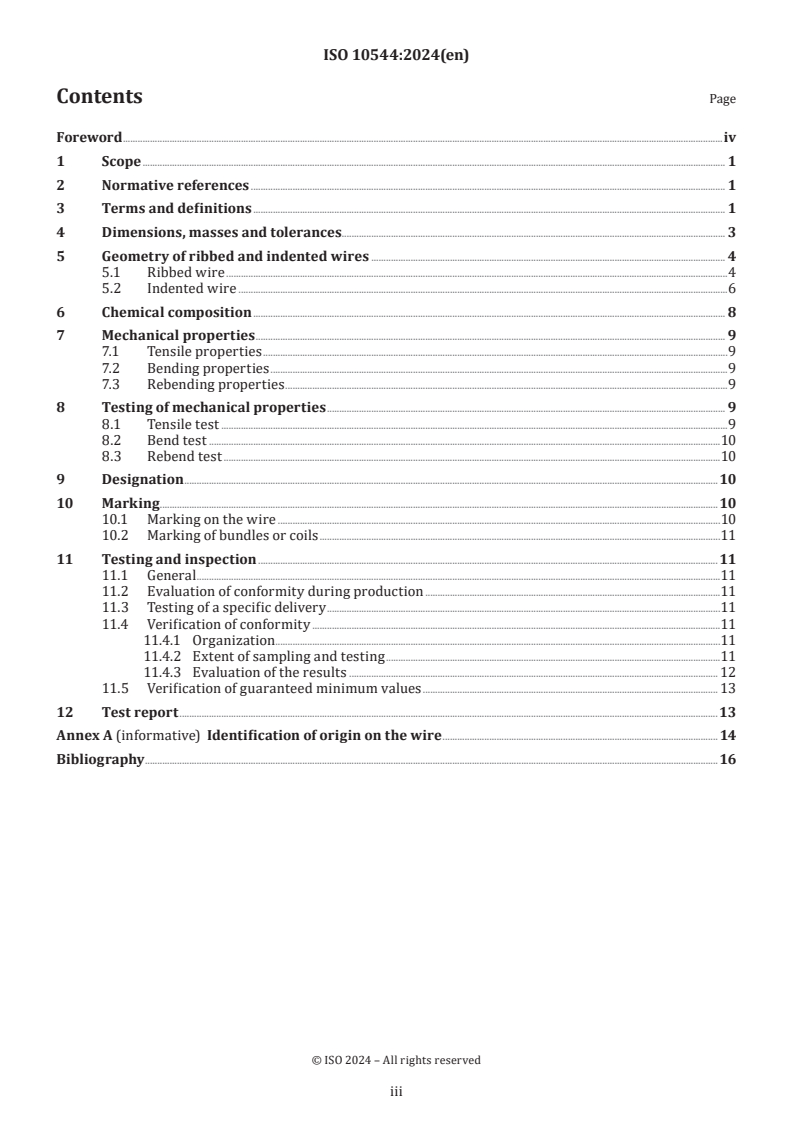
Contents Page
Foreword .iv
1 Scope . 1
2 Normative references . 1
3 Terms and definitions . 1
4 Dimensions, masses and tolerances . . 3
5 Geometry of ribbed and indented wires . 4
5.1 Ribbed wire .4
5.2 Indented wire .6
6 Chemical composition . 8
7 Mechanical properties . 9
7.1 Tensile properties .9
7.2 Bending properties .9
7.3 Rebending properties .9
8 Testing of mechanical properties . 9
8.1 Tensile test .9
8.2 Bend test .10
8.3 Rebend test .10
9 Designation .10
10 Marking . .10
10.1 Marking on the wire .10
10.2 Marking of bundles or coils .11
11 Testing and inspection .11
11.1 General .11
11.2 Evaluation of conformity during production .11
11.3 Testing of a specific delivery .11
11.4 Verification of conformity .11
11.4.1 Organization . . .11
11.4.2 Extent of sampling and testing .11
11.4.3 Evaluation of the results . 12
11.5 Verification of guaranteed minimum values . 13
12 Test report .13
Annex A (informative) Identification of origin on the wire . 14
Bibliography .16
iii
Foreword
ISO (the International Organization for Standardization) is a worldwide federation of national standards
bodies (ISO member bodies). The work of preparing International Standards is normally carried out through
ISO technical committees. Each member body interested in a subject for which a technical committee
has been established has the right to be represented on that committee. International organizations,
governmental and non-governmental, in liaison with ISO, also take part in the work. ISO collaborates closely
with the International Electrotechnical Commission (IEC) on all matters of electrotechnical standardization.
The procedures used to develop this document and those intended for its further maintenance are described
in the ISO/IEC Directives, Part 1. In particular, the different approval criteria needed for the different types
of ISO document should be noted. This document was drafted in accordance with the editorial rules of the
ISO/IEC Directives, Part 2 (see www.iso.org/directives).
ISO draws attention to the possibility that the implementation of this document may involve the use of (a)
patent(s). ISO takes no position concerning the evidence, validity or applicability of any claimed patent
rights in respect thereof. As of the date of publication of this document, ISO had not received notice of (a)
patent(s) which may be required to implement this document. However, implementers are cautioned that
this may not represent the latest information, which may be obtained from the patent database available at
www.iso.org/patents. ISO shall not be held responsible for identifying any or all such patent rights.
Any trade name used in this document is information given for the convenience of users and does not
constitute an endorsement.
For an explanation of the voluntary nature of standards, the meaning of ISO specific terms and expressions
related to conformity assessment, as well as information about ISO's adherence to the World Trade
Organization (WTO) principles in the Technical Barriers to Trade (TBT), see www.iso.org/iso/foreword.html.
This document was prepared by Technical Committee ISO/TC 17, Steel, Subcommittee SC 16, Steels for the
reinforcement and prestressing of concrete.
This second edition cancels and replaces the first edition (ISO 10544:1992), which has been technically
revised.
The main changes are as follows:
— normative references have been revised;
— terms and definitions have been revised;
— diameters have been extended to 18 mm;
— geometry of ribbed and indented wires have been revised;
— steel grade and chemical composition have been revised;
— example of identification of manufacturer on ribbed wire and indented wire have been added.
Any feedback or questions on this document should be directed to the user’s national standards body. A
complete listing of these bodies can be found at www.iso.org/members.html.
iv
International Standard ISO 10544:2024(en)
Cold-reduced steel wire for the reinforcement of concrete and
the manufacture of welded fabric
1 Scope
This document specifies technical requirements for cold-reduced steel wire designed for the reinforcement
of concrete or for use in welded fabric.
Two steel grades, CRB500 and CRB540H are defined as examples. Other grades can be used.
This document is applicable to wire made from rod by working through dies or rollers. The production
process is at the discretion of the manufacturer.
For wire supplied in coil form, this document is applicable to the straightened product.
Wires produced from finished products, such as plates and railway rails, are outside the scope of this
document.
2 Normative references
The following documents are referred to in the text in such a way that some or all of their content constitutes
requirements of this document. For dated references, only the edition cited applies. For undated references,
the latest edition of the referenced document (including any amendments) applies.
ISO 404, Steel and steel products — General technical delivery requirements
ISO 6892-1, Metallic materials — Tensile testing — Part 1: Method of test at room temperature
ISO 15630-1, Steel for the reinforcement and prestressing of concrete — Test methods — Part 1: Reinforcing
bars, rods and wire
3 Terms and definitions
For the purposes of this document, the following terms and definitions apply.
ISO and IEC maintain terminology databases for use in standardization at the following addresses:
— ISO Online browsing platform: available at https:// www .iso .org/ obp
— IEC Electropedia: available at https:// www .electropedia .org/
3.1
cast analysis
chemical analysis of a sample of the molten steel during casting
3.2
characteristic value
value having a prescribed probability of not being attained in a hypothetical unlimited test series
Note 1 to entry: Equivalent to fractile, which is defined in ISO 3534-1:2006.
[SOURCE: ISO 16020:2005, 2.4.10]
3.3
core
part of cross-section of the wire that contains neither ribs nor indentations
3.4
indentation inclination
β
ind
angle between the indentation and the longitudinal axis of the wire
Note 1 to entry: See Figure 3 and Figure 4.
3.5
indentation spacing
c
ind
distance between the centres of two consecutive indentations measured parallel to the axis of the wire
Note 1 to entry: See Figures 3 and 4.
3.6
indented wire
wire whose surface has indentations at regular intervals along the length
3.7
inspection
activities such as measuring, examining, testing, gauging one or more characteristics of a product or service
and comparing these with specified requirements to determine conformity
3.8
nominal cross-sectional area
cross-sectional area equivalent to the area of a circular plain wire of the nominal diameter
3.9
plain wire
smooth surfaced wire without bond enhancing properties
3.10
product analysis
chemical analysis of a sample from a wire
3.11
rib height
ɑ
distance from the highest point of the rib to the surface of the core, measured normal to the axis of the wire
Note 1 to entry: See Figures 1 and 2.
3.12
rib inclination
β
rib
angle between the rib and the longitudinal axis of the wire
Note 1 to entry: See Figures 1 and 2.
3.13
rib spacing
c
rib
distance between the centres of two consecutive transverse ribs measured parallel to the axis of the wire
Note 1 to entry: See Figures 1 and 2.
3.14
ribbed wire
wire whose surface has ribs at regular intervals along the length
3.15
test unit
number of pieces or the tonnage of products to be accepted or rejected together, on the basis of the tests
carried out on sample products in accordance with the requirements of the product standard or order
3.16
specific projected indentation area
ƒ
p
area of the projections of all indentations on a plane perpendicular to the longitudinal axis of the wire,
divided by the wire length and the nominal circumference
Note 1 to entry: See 5.2.
3.17
specific projected rib area
ƒ
r
area of the projections of all ribs on a plane perpendicular to the longitudinal axis of the wire, divided by the
wire length and the nominal circumference
Note 1 to entry: See 5.1.
3.18
transversal indentationless perimeter
∑e
i
sum of the distances along the surface of the core between the transverse indentations of adjacent rows
measured as the projection on a plan perpendicular to the wire axis
Note 1 to entry: See Figures 3 and 4.
3.19
transversal ribless perimeter
∑ƒ
i
sum of the distances along the surface of the core between the transverse ribs of adjacent rows measured as
the projection on a plane perpendicular to the wire axis
Note 1 to entry: See Figures 1 and 2.
3.20
passive reinforcement
reinforcement that does not apply a compressive stress to the concrete
4 Dimensions, masses and tolerances
The nominal diameter of the wire shall be in the range from 4 mm to 18 mm. Recommended nominal
diameters, d, are given in Table 1.
For nominal diameters not listed in Table 1, the mass divided by length shall be 7 850 kg/m x nominal
cross-sectional area.
Tabl
...
Questions, Comments and Discussion
Ask us and Technical Secretary will try to provide an answer. You can facilitate discussion about the standard in here.
Loading comments...