

ISO 14708-1:2014
(Main)Implants for surgery — Active implantable medical devices — Part 1: General requirements for safety, marking and for information to be provided by the manufacturer
General Information
- Abstract
ISO 14708-1:2014 specifies requirements that are generally applicable to active implantable medical devices. The tests that are specified in ISO 14708 are type tests and are to be carried out on samples of an active implantable medical device to show compliance. ISO 14708-1:2014 is applicable not only to active implantable medical devices that are electrically powered but also to those powered by other energy sources (for example by gas pressure or by springs). ISO 14708-1:2014 is also applicable to some non-implantable parts and accessories of the active implantable medical devices.
- Status
- Published
- Publication Date
- 10-Aug-2014
- Technical Committee
- ISO/TC 150/SC 6 - Active implants
- Drafting Committee
- ISO/TC 150/SC 6 - Active implants
- Current Stage
- 9092 - International Standard to be revised
- Start Date
- 12-Dec-2023
- Completion Date
- 29-Aug-2026

Overview
ISO 14708-1:2014 - "Implants for surgery - Active implantable medical devices - Part 1" - defines the general requirements for safety, marking, and manufacturer information for active implantable medical devices (AIMDs). It covers type tests performed on samples to demonstrate compliance and applies to AIMDs powered electrically or by other energy sources (e.g., gas pressure, springs). The Part 1 standard also addresses certain non‑implantable parts and accessories that can affect implant safety or performance.
Key topics and technical requirements
- General safety requirements for AIMD design, construction and performance to reduce risk to patients and users.
- Marking and labeling: required markings on the device, sterile pack, and sales packaging to prevent misuse and ensure traceability.
- Information for the manufacturer: contents of accompanying documentation, instructions for use, sterilization, and storage details.
- Packaging and sterility: requirements for sales and sterile packaging and for single‑use/non‑reusable packaging design.
- Protection against harm: clauses addressing protection from biological effects, mechanical forces, heat, electrical hazards, ionizing and non‑ionizing radiation, electrostatic discharge, atmospheric pressure and temperature changes.
- Electromagnetic and treatment resilience: requirements to protect devices from defibrillator shocks, external electrical fields, electromagnetic non‑ionizing radiation, and other medical interventions.
- Type testing: the tests specified are type tests performed on representative samples to demonstrate compliance with the standard.
- Documentation and usability: guidance on manufacturer documentation, labelling clarity, and information needed for safe clinical use.
Practical applications - who uses it
- Medical device manufacturers - to design, label, package and validate AIMDs and related accessories for safety and regulatory readiness.
- Design and QA engineers - for specifying tests, packaging integrity, sterilization and protection requirements during product development.
- Regulatory and compliance teams / notified bodies - to evaluate conformity for CE marking or other regulatory approvals.
- Clinical engineers and hospital procurement - to interpret device markings, instructions for use and compatibility with clinical environments.
- Risk managers - to integrate ISO 14708-1 requirements with risk management (ISO 14971) and biocompatibility (ISO 10993) processes.
Related standards
- ISO 14708 series (Parts 2–7) for device‑specific requirements (e.g., pacemakers, neurostimulators, infusion pumps, defibrillators, cochlear implants).
- Key normative references cited: IEC 60601-1, IEC 60601-1-2 (EMC), IEC 62304 (software), ISO 14971 (risk management), ISO 10993 (biological evaluation), ISO 11607 (packaging).
ISO 14708-1 is essential for anyone involved in the lifecycle of active implantable medical devices seeking to ensure safety, compliant labeling, robust packaging and documented instructions for use.
Relations
- Effective Date
- 09-Feb-2026
- Effective Date
- 09-Feb-2026
- Effective Date
- 09-Feb-2026
- Effective Date
- 09-Feb-2026
- Effective Date
- 09-Feb-2026
- Effective Date
- 09-Feb-2026
- Effective Date
- 04-Feb-2009
Get Certified
Connect with accredited certification bodies for this standard

BSI Group
BSI (British Standards Institution) is the business standards company that helps organizations make excellence a habit.

TÜV Rheinland
TÜV Rheinland is a leading international provider of technical services.

TÜV SÜD
TÜV SÜD is a trusted partner of choice for safety, security and sustainability solutions.
Sponsored listings
Frequently Asked Questions
ISO 14708-1:2014 is a standard published by the International Organization for Standardization (ISO). Its full title is "Implants for surgery — Active implantable medical devices — Part 1: General requirements for safety, marking and for information to be provided by the manufacturer". This standard covers: ISO 14708-1:2014 specifies requirements that are generally applicable to active implantable medical devices. The tests that are specified in ISO 14708 are type tests and are to be carried out on samples of an active implantable medical device to show compliance. ISO 14708-1:2014 is applicable not only to active implantable medical devices that are electrically powered but also to those powered by other energy sources (for example by gas pressure or by springs). ISO 14708-1:2014 is also applicable to some non-implantable parts and accessories of the active implantable medical devices.
ISO 14708-1:2014 specifies requirements that are generally applicable to active implantable medical devices. The tests that are specified in ISO 14708 are type tests and are to be carried out on samples of an active implantable medical device to show compliance. ISO 14708-1:2014 is applicable not only to active implantable medical devices that are electrically powered but also to those powered by other energy sources (for example by gas pressure or by springs). ISO 14708-1:2014 is also applicable to some non-implantable parts and accessories of the active implantable medical devices.
ISO 14708-1:2014 is classified under the following ICS (International Classification for Standards) categories: 11.040.40 - Implants for surgery, prosthetics and orthotics. The ICS classification helps identify the subject area and facilitates finding related standards.
ISO 14708-1:2014 has the following relationships with other standards: It is inter standard links to EN ISO 14708-6:2022, EN ISO 14708-2:2022, EN ISO 14708-7:2022, EN ISO 14708-5:2022, EN ISO 14708-4:2022, EN ISO 14708-3:2022, ISO 14708-1:2000. Understanding these relationships helps ensure you are using the most current and applicable version of the standard.
ISO 14708-1:2014 is available in PDF format for immediate download after purchase. The document can be added to your cart and obtained through the secure checkout process. Digital delivery ensures instant access to the complete standard document.
Standards Content (Sample)
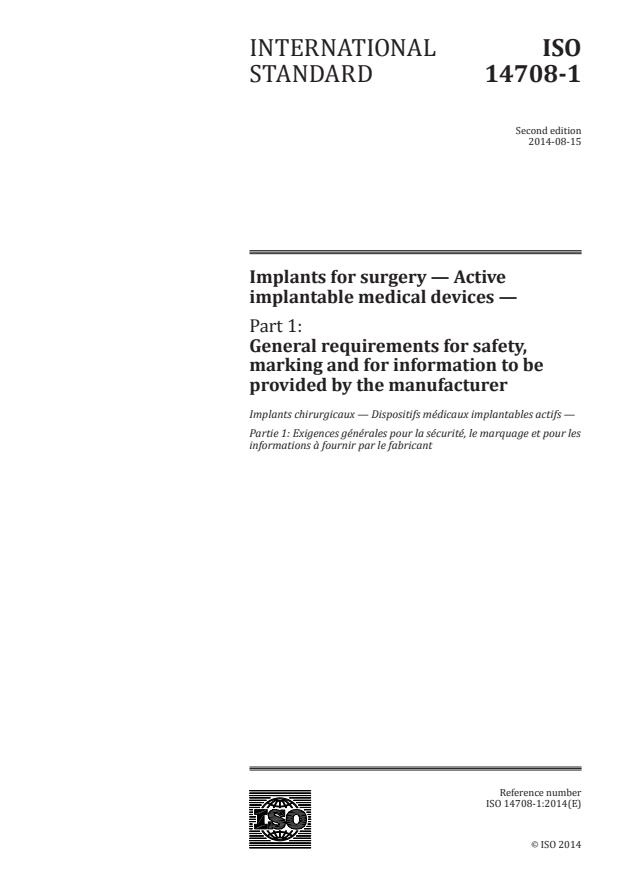
INTERNATIONAL ISO
STANDARD 14708-1
Second edition
2014-08-15
Implants for surgery — Active
implantable medical devices —
Part 1:
General requirements for safety,
marking and for information to be
provided by the manufacturer
Implants chirurgicaux — Dispositifs médicaux implantables actifs —
Partie 1: Exigences générales pour la sécurité, le marquage et pour les
informations à fournir par le fabricant
Reference number
©
ISO 2014
© ISO 2014
All rights reserved. Unless otherwise specified, no part of this publication may be reproduced or utilized otherwise in any form
or by any means, electronic or mechanical, including photocopying, or posting on the internet or an intranet, without prior
written permission. Permission can be requested from either ISO at the address below or ISO’s member body in the country of
the requester.
ISO copyright office
Case postale 56 • CH-1211 Geneva 20
Tel. + 41 22 749 01 11
Fax + 41 22 749 09 47
E-mail copyright@iso.org
Web www.iso.org
Published in Switzerland
ii © ISO 2014 – All rights reserved
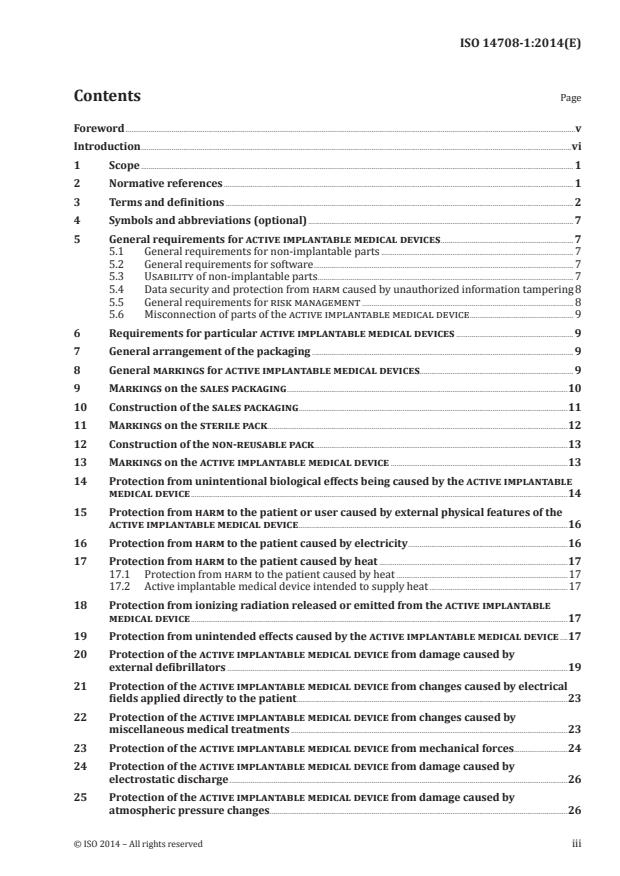
Contents Page
Foreword .v
Introduction .vi
1 Scope . 1
2 Normative references . 1
3 Terms and definitions . 2
4 Symbols and abbreviations (optional) . 7
5 General requirements for active implantable medical devices .7
5.1 General requirements for non-implantable parts . 7
5.2 General requirements for software . 7
5.3 Usability of non-implantable parts . 7
5.4 Data security and protection from harm caused by unauthorized information tampering 8
5.5 General requirements for risk management . 8
5.6 Misconnection of parts of the active implantable medical device . 9
6 Requirements for particular active implantable medical devices .9
7 General arrangement of the packaging . 9
8 General markings for active implantable medical devices. 9
9 Markings on the sales packaging .10
10 Construction of the sales packaging.11
11 Markings on the sterile pack .12
12 Construction of the non-reusable pack.13
13 Markings on the active implantable medical device .13
14 Protection from unintentional biological effects being caused by the active implantable
medical device .14
15 Protection from harm to the patient or user caused by external physical features of the
active implantable medical device .16
16 Protection from harm to the patient caused by electricity .16
17 Protection from harm to the patient caused by heat .17
17.1 Protection from harm to the patient caused by heat .17
17.2 Active implantable medical device intended to supply heat .17
18 Protection from ionizing radiation released or emitted from the active implantable
medical device .17
19 Protection from unintended effects caused by the active implantable medical device .17
20 Protection of the active implantable medical device from damage caused by
external defibrillators .19
21 Protection of the active implantable medical device from changes caused by electrical
fields applied directly to the patient.23
22 Protection of the active implantable medical device from changes caused by
miscellaneous medical treatments .23
23 Protection of the active implantable medical device from mechanical forces.24
24 Protection of the active implantable medical device from damage caused by
electrostatic discharge .26
25 Protection of the active implantable medical device from damage caused by
atmospheric pressure changes .26
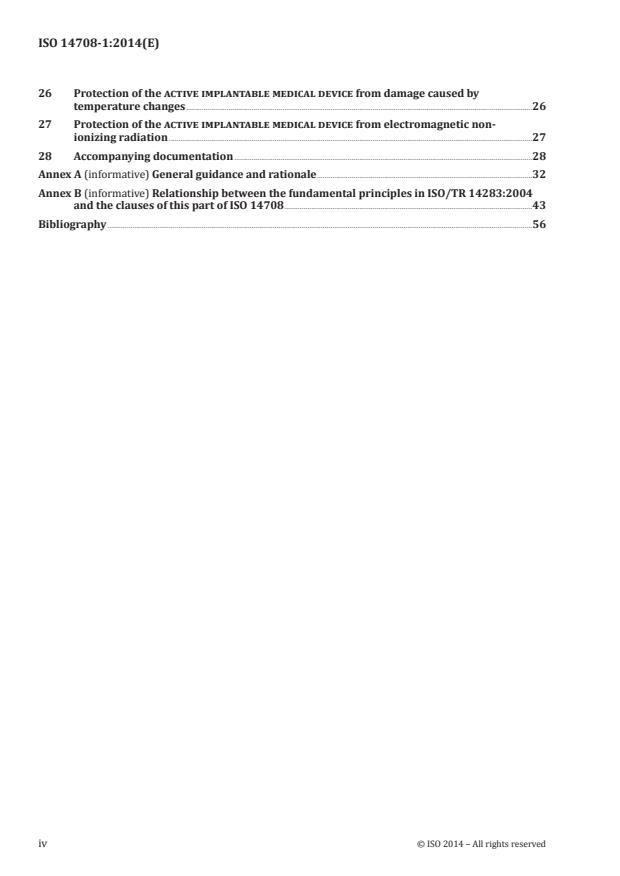
26 Protection of the active implantable medical device from damage caused by
temperature changes .26
27 Protection of the active implantable medical device from electromagnetic non-
ionizing radiation .27
28 Accompanying documentation .28
Annex A (informative) General guidance and rationale .32
Annex B (informative) Relationship between the fundamental principles in ISO/TR 14283:2004
and the clauses of this part of ISO 14708 .43
Bibliography .56
iv © ISO 2014 – All rights reserved
Foreword
ISO (the International Organization for Standardization) is a worldwide federation of national standards
bodies (ISO member bodies). The work of preparing International Standards is normally carried out
through ISO technical committees. Each member body interested in a subject for which a technical
committee has been established has the right to be represented on that committee. International
organizations, governmental and non-governmental, in liaison with ISO, also take part in the work.
ISO collaborates closely with the International Electrotechnical Commission (IEC) on all matters of
electrotechnical standardization.
The procedures used to develop this document and those intended for its further maintenance are
described in the ISO/IEC Directives, Part 1. In particular the different approval criteria needed for the
different types of ISO documents should be noted. This document was drafted in accordance with the
editorial rules of the ISO/IEC Directives, Part 2 (see www.iso.org/directives).
Attention is drawn to the possibility that some of the elements of this document may be the subject of
patent rights. ISO shall not be held responsible for identifying any or all such patent rights. Details of
any patent rights identified during the development of the document will be in the Introduction and/or
on the ISO list of patent declarations received (see www.iso.org/patents).
Any trade name used in this document is information given for the convenience of users and does not
constitute an endorsement.
For an explanation on the meaning of ISO specific terms and expressions related to conformity
assessment, as well as information about ISO’s adherence to the WTO principles in the Technical Barriers
to Trade (TBT) see the following URL: Foreword - Supplementary information
The committee responsible for this document is ISO/TC 150, Implants for surgery, Subcommittee SC 6,
Active implants.
This second edition cancels and replaces the first edition (ISO 14708-1:2000), which has been technically
revised.
ISO 14708 consists of the following parts, under the general title Implants for surgery — Active implantable
medical devices:
— Part 1: General requirements for safety, marking and for information to be provided by the manufacturer
— Part 2: Cardiac pacemakers
— Part 3: Implantable neurostimulators
— Part 4: Implantable infusion pumps
— Part 5: Circulatory support devices
— Part 6: Particular requirements for active implantable medical devices intended to treat tachyarrhythmia
(including implantable defibrillators)
— Part 7: Particular requirements for cochlear implant systems
NOTE The attention of Member Bodies is drawn to the fact that equipment manufacturers and testing
organizations might need a transitional period following publication of a new, amended, or revised ISO publication
in which to make products in accordance with the new requirements and to equip them for conducting new or
revised tests. It is the recommendation of the committee that the content of this publication not be adopted for
mandatory implementation nationally earlier than three years from the date of publication.
Introduction
This part of ISO 14708 specifies general requirements for active implantable medical devices to
provide basic assurance of safety for both patients and users.
To minimize the likelihood of a device being misused, this part of ISO 14708 also details comprehensive
requirements for markings and for other information to be supplied as part of the documentation with
any active implantable medical device.
For particular types of active implantable medical device, the general requirements can be
supplemented or modified by the requirements of other parts of ISO 14708. A requirement of a particular
part of ISO 14708 takes priority over the corresponding requirement of this general part of ISO 14708.
Where particular parts of ISO 14708 exist, this general part of ISO 14708 is not intended to be used alone.
Special care is required when applying this general part of ISO 14708 alone to active implantable
medical devices for which no particular International Standard has yet been published.
vi © ISO 2014 – All rights reserved
INTERNATIONAL STANDARD ISO 14708-1:2014(E)
Implants for surgery — Active implantable medical
devices —
Part 1:
General requirements for safety, marking and for
information to be provided by the manufacturer
1 Scope
This part of ISO 14708 specifies requirements that are generally applicable to active implantable
medical devices.
NOTE 1 For particular types of active implantable medical devices, these general requirements are
supplemented or modified by the requirements of particular parts of ISO 14708.
The tests that are specified in ISO 14708 are type tests and are to be carried out on samples of an active
implantable medical device to show compliance.
This part of ISO 14708 is applicable not only to active implantable medical devices that are electrically
powered but also to those powered by other energy sources (for example by gas pressure or by springs).
This part of ISO 14708 is also applicable to some non-implantable parts and accessories of the active
implantable medical devices.
NOTE 2 The device that is commonly referred to as an active implantable medical device can be a single
device, a combination of devices, or a combination of a device or devices and one or more accessories. Not all of these
parts are required to be either partially or totally implantable, but there is a need to specify some requirements
of non-implantable parts and accessories if they could affect the safety or performance of the implantable device.
NOTE 3 In this part of ISO 14708, terms printed in small capital letters are used as defined in Clause 3. Where a
defined term is used as a qualifier in another term, it is not printed in small capital letters unless the concept thus
qualified is also defined.
NOTE 4 The terminology used in this part of ISO 14708 is intended to be consistent with the terminology of
ISO/TR 14283:2004.
2 Normative references
The following documents, in whole or in part, are normatively referenced in this document and are
indispensable for its application. For dated references, only the edition cited applies. For undated
references, the latest edition of the referenced document (including any amendments) applies.
ISO 8601:2004, Data elements and interchange formats — Information interchange — Representation of
dates and times
ISO 10993-1, Biological evaluation of medical devices — Part 1: Evaluation and testing within a risk
management process
ISO 11607-1, Packaging for terminally sterilized medical devices — Part 1: Requirements for materials,
sterile barrier systems and packaging systems
ISO 14155, Clinical investigation of medical devices for human subjects — Good clinical practice
ISO 14971:2007, Medical devices — Application of risk management to medical devices
IEC 60068-2-14:2009, Environmental testing — Part 2-14: Tests — Test N: Change of temperature
IEC 60068-2-27:2008, Environmental testing — Part 2-27: Tests — Test Ea and guidance: Shock
IEC 60068-2-47:2005, Environmental testing — Part 2-47: Tests — Mounting of specimens for vibration,
impact and similar dynamic tests
IEC 60068-2-64:2008, Environmental testing — Part 2-64: Tests — Test Fh: Vibration, broadband random
and guidance
IEC 60601-1:2005 + A1:2012, Medical electrical equipment — Part 1: General requirements for basic safety
and essential performance
IEC 62304:2006, Medical device software — Software life cycle processes
3 Terms and definitions
For the purposes of this document, the following terms and definitions apply.
3.1
active medical device
medical device relying for its functioning on a source of electrical energy or any source of power other
than that directly generated by the human body or gravity
3.2
active implantable medical device
active medical device which is intended to be totally or partially introduced, surgically or medically,
into the human body or by medical intervention into a natural orifice, and which is intended to remain
after the procedure
Note 1 to entry: For the purposes of this part of ISO 14708, an active implantable medical device can be a single
active medical device, or a system consisting of a set of components and accessories, including software, which
interact to achieve the performance intended by the manufacturer. Not all of these components or accessories
may be required to be partially or totally implanted.
3.3
authorized representative
any natural or legal person who, explicitly designated by the manufacturer, acts and can be addressed
by authorities and bodies instead of the manufacturer with regard to the latter’s obligations
3.4
beginning of service
BOS
point at which an individual active implantable medical device is first released by the manufacturer
as fit for placing on the market
3.5
catheter
flexible tube allowing access to a point within the body at its distal end through a lumen, often for
delivering a substance
Note 1 to entry: A catheter can be combined with a lead.
3.6
correct use
normal use without use error
[SOURCE: IEC 62366:2007, 3.7]
2 © ISO 2014 – All rights reserved
3.7
end of service
EOS
point at which an individual prolonged service period has elapsed and performance to design
specification cannot be assured
3.8
hand held
part of an active implantable medical device intended to be supported by the hand during normal
use
[SOURCE: IEC 60601-1:2005 + A1:2012, 3.37, modified — “Electrical equipment” replaced by “part of an
active implantable medical device”.]
3.9
harm
physical injury or damage to health of people, or damage to property or the environment
[SOURCE: ISO 14971:2007, 2.2]
3.10
hazard
potential source of harm
[SOURCE: ISO 14971:2007, 2.3]
3.11
information security
protection of information and information systems from unauthorized access, use, disclosure, disruption,
modification, or destruction in order to provide confidentiality, integrity, and availability
[SOURCE: FIPS PUB 199]
3.12
label
area bearing a marking, affixed to an active implantable medical device or package but not an
integral part of the active implantable medical device or package
3.13
lead
flexible tube enclosing one or more insulated electrical conductors, intended to transfer electrical
energy along its length
Note 1 to entry: A lead can be combined with a catheter.
3.14
manufacturer
natural or legal person with responsibility for the design, manufacture, packaging, and labelling of an
active implantable medical device before it is placed on the market under his own name, regardless
of whether these operations are carried out by that person himself or on his behalf by a third party
Note 1 to entry: This definition also applies to the natural or legal person who assembles, packages, processes,
fully refurbishes, and/or labels one or more ready-made products and/or assigns to them their intended purpose
as an active implantable medical device with a view to their being placed on the market under his own
name. This definition also applies to the manufacturer of non-implantable parts and accessories of the active
implantable medical device.
3.15
marking
inscription on a device, package, or label
3.16
medical device
instrument, apparatus, appliance, software, material, or other article, whether used alone or in
combination, together with any accessories, including the software intended by its manufacturer to
be used specifically for diagnostic and/or therapeutic purposes and necessary for its proper application,
intended by the manufacturer to be used for human beings for the purpose of
— diagnosis, prevention, monitoring, treatment, or alleviation of disease,
— diagnosis, monitoring, treatment, alleviation of, or compensation for, an injury or handicap,
— investigation, replacement, or modification of the anatomy or of a physiological process, and
— control of conception,
and which does not achieve its principal intended action in or on the human body by pharmacological,
immunological, or metabolic means, but which can be assisted in its function by such means
3.17
medicinal substance
substance or combination of substances presented as having properties for treating or preventing disease
in human beings; or any substance or combination of substances which can be used in or administered
to human beings either with a view to restoring, correcting, or modifying physiological functions by
exerting a pharmacological, immunological, or metabolic action, or to making a medical diagnosis
Note 1 to entry: Based on Article 1 of European Union Directive 2001/83/EC.
3.18
medicinal substance derived from human blood or human plasma
medicinal substance based on blood constituents which are prepared industrially by public or private
establishments, such medicinal substance including, in particular, albumin, coagulating factors, and
immunoglobulins of human origin
3.19
non-reusable pack
single-use pack designed to allow the contents to be sterilized and to maintain that sterility
3.20
normal use
operation, including routine inspection and adjustments by any user, and stand-by, according to the
instructions for use or in accordance with generally accepted practice for those medical devices
provided without instructions for use
Note 1 to entry: Use error can occur in normal use.
Note 2 to entry: Medical devices that can be used safely without instructions for use are exempted from having
instructions for use by some authorities with jurisdiction.
[SOURCE: IEC 60601-1:2005 + A1:2012, 3.71, modified — “Operator” replaced by “user” and “or in
accordance with generally accepted practice for those medical devices provided without instructions
for use” added to the end of the definition.]
3.21
portable
intended to be moved from one location to another
while being carried by one or more persons
[SOURCE: IEC 60601-1:2005 + A1:2012, 3.85, modified — “Transportable equipment” replaced by “part
of an active implantable medical device”.]
4 © ISO 2014 – All rights reserved
3.22
process
set of inter-related or interacting resources and activities which transform inputs into outputs
[SOURCE: ISO 14971:2007, 2.130]
3.23
prolonged service period
PSP
period during which the active implantable medical device continues to function as defined by the
manufacturer beyond the recommended replacement time
3.24
radioactive substance
substance that contains one or more radionuclides, the activity or concentration of which cannot be
disregarded as far as radiation protection is concerned
Note 1 to entry: Based on European Council Directive 96/29/Euratom.
3.25
recommended replacement time
RRT
point at which the power source indicator reaches the value set by the manufacturer of the
active implantable medical device for its recommended replacement
Note 1 to entry: This indicates entry into the prolonged service period.
3.26
residual risk
risk remaining after risk control measures have been taken
[SOURCE: ISO 14971:2007, 2.15]
3.27
risk
combination of the probability of occurrence of harm and the severity of that harm
[SOURCE: ISO 14971:2007, 2.16]
3.28
risk analysis
systematic use of available information to identify hazards and to estimate the risk
Note 1 to entry: Risk analysis includes examination of different sequences of events that can produce hazardous
situations and harm. See Annex E of ISO 14971:2007.
[SOURCE: ISO 14971:2007, 2.17]
3.29
risk assessment
overall process comprising a risk analysis and a risk evaluation
[SOURCE: ISO 14971:2007, 2.18]
3.30
risk control
process in which decisions are made and measures implemented by which risks are reduced to, or
maintained within, specified levels
[SOURCE: ISO 14971:2007, 2.19]
3.31
risk evaluation
process of comparing the estimated risk against given risk criteria to determine the acceptability of
the risk
[SOURCE: ISO 14971:2007, 2.21]
3.32
risk management
systematic application of management policies, procedures, and practices to the tasks of analysing,
evaluating, controlling, and monitoring risk
[SOURCE: ISO 14971:2007, 2.22]
3.33
risk management file
set of records and other documents that are produced by risk management
[SOURCE: ISO 14971:2007, 2.23]
3.34
sales packaging
packaging that protects and identifies the active implantable medical device during storage and
handling by the purchaser
Note 1 to entry: The sales packaging can be enclosed in further packaging, for example, a “shipping package”,
for delivery.
3.35
sealed source
source containing radioactive substances whose structure is such as to prevent, under normal
conditions of use, any dispersion of the radioactive substances into the environment
Note 1 to entry: Based on European Council Directive 96/29/Euratom.
3.36
sterile pack
non-reusable pack in which the contents have been sterilized
3.37
usability
characteristic of the user interface that establishes effectiveness, efficiency, ease of user learning, and
user satisfaction
[SOURCE: IEC 62366:2007, 3.17]
3.38
usability engineering
application of knowledge about human behaviour, abilities, limitations, and other characteristics related
to the design of tools, devices, systems, tasks, jobs, and environments to achieve adequate usability
[SOURCE: IEC 62366:2007, 3.18]
3.39
use error
act or omission of an act that results in a different active implantable medical device response than
intended by the manufacturer or expected by the user
Note 1 to entry: Use error includes slips, lapses, and mistakes.
Note 2 to entry: An unexpected physiological response of the patient is not in itself considered use error.
6 © ISO 2014 – All rights reserved
[SOURCE: IEC 62366:2007, 3.21, modified — “Medical device” replaced by “active implantable
medical device”.]
3.40
validation
confirmation, through the provision of objective evidence, that the requirements for a specific
intended use or application have been fulfilled
[SOURCE: IEC 62366:2007, 3.26]
4 Symbols and abbreviations (optional)
When appropriate, symbols, abbreviated terms, and identification colour may be used in the markings
and accompanying documentation of an active implantable medical device. Symbols, abbreviated
terms, and identification colour shall conform with harmonized International Standards (e.g.
ISO 15223-1). Where no harmonized International Standard exists, the symbols, abbreviated terms, and
identification colour shall be described in the accompanying documentation.
Compliance is checked by inspection.
NOTE Symbols for use with particular active implantable medical devices can be specified in subsequent
parts of ISO 14708.
5 General requirements for active implantable medical devices
5.1 General requirements for non-implantable parts
The non-implantable part of an active implantable medical device which is connected to or
equipped with an electrical power source shall comply with the appropriate requirements of IEC 60601-
1:2005 + A1:2012, as determined in the risk analysis, unless a requirement in that standard is
superseded by a requirement in this part or other parts of ISO 14708.
NOTE Other subclauses in this part of ISO 14708 require compliance with some subclauses of IEC 60601–
1:2005 + A1:2012 even for non-implantable parts that are not electrically powered.
Compliance is checked by assessment of the test report and the risk analysis provided by the
manufacturer.
5.2 General requirements for software
Software of an active implantable medical device or software that falls within the definition of
an active implantable medical device shall be designed according to software life cycle process
activities compliant with IEC 62304:2006 and shall be validated.
Compliance is checked by assessment of the software life cycle process in accordance with
IEC 62304:2006, 1.4 and assessment of the validation report provided by the manufacturer.
5.3 Usability of non-implantable parts
5.3.1 Usability of non-implantable parts of an active implantable medical device connected
to or equipped with an electrical power source
The manufacturer shall address in a usability engineering process the risk of poor usability,
including those associated with identification, marking, and documents.
Compliance is checked by assessment of the manufacturer’s documentation that the acceptance
criteria of the usability validation plan have been met (see IEC 62366:2007, 5.9).
5.3.2 Us ability of non-implantable parts of an active implantable medical device not con-
nected to or equipped with an electrical power source
The non-implantable part of an active implantable medical device shall provide adequate usability
such that the risks resulting from correct use and use errors are acceptable.
Compliance is checked by assessment of the manufacturer’s documentation that the acceptance
criteria of the usability validation plan have been met (see IEC 62366:2007, 5.9).
5.4 Data security and protection from harm caused by unauthorized information tam-
pering
When communication with the implantable part of an active implantable medical device through
wireless communication channels is provided, the manufacturer shall evaluate information security
through the risk management process and apply the appropriate risk control measures to protect
the patient from harm.
Compliance is checked by the inspection of the risk management file.
5.5 General requirements for risk management
5.5.1 Risk management policy
The manufacturer shall define and document a policy for determining acceptable risk and the
acceptability of the residual risk(s) as required in ISO 14971.
Compliance is checked by inspection of the manufacturer’s policy for determining criteria for risk
acceptability.
5.5.2 Risk management file
The manufacturer shall establish and maintain a risk management file complying with those
requirements of ISO 14971 necessary to satisfy the requirements of this part of ISO 14708.
Compliance is checked by confirming the existence of an index containing references or pointers to the
risk management documentation required by this part of ISO 14708.
5.5.3 Risk management plan
The manufacturer shall establish and maintain a risk management plan complying with the relevant
requirements of ISO 14971:2007 except those related to collection and review of production and post-
production information. The risk management plan shall be part of the risk management file.
Compliance is checked by inspection of the risk management plan.
5.5.4 Risk management process
For the purposes of this part of ISO 14708, the risk management process shall include the following
elements:
a) risk analysis;
b) risk evaluation;
c) risk control.
These elements of the risk management process shall be performed in accordance with ISO 14971.
8 © ISO 2014 – All rights reserved
Compliance is checked by confirming that the manufacturer has a risk management policy conforming
to 5.5.1 and has prepared the following for the particular active implantable medical device under
consideration:
— a risk management plan conforming to 5.5.3;
— a risk management file containing the risk management documentation required by this part of
ISO 14708.
5.6 Misconnection of parts of the active implantable medical device
If misconnection presents an unacceptable risk, the design and construction of the active implantable
medical device shall prevent misconnection, unless it is not feasible, in which case appropriate
markings, warnings, and instructions shall be provided.
Compliance is checked by inspection of the risk assessment and, if necessary, by inspection of the
markings, warnings, and instructions.
6 Requirements for particular active implantable medical devices
Requirements for particular active implantable medical devices are not detailed in this part of
ISO 14708, but they can be specified in subsequent parts of ISO 14708.
7 General arrangement of the packaging
7.1 Implantable parts of active implantable medical devices shall be supplied in a non-reusable
pack (see 14.1).
NOTE The non-reusable pack is designed to be sealed yet allow its contents to be sterilized by the
manufacturer.
Compliance is checked by inspection.
7.2 The non-reusable pack shall be enclosed in the sales packaging.
Compliance is checked by inspection.
8 General markings for active implantable medical devices
NOTE Any marking required by this part of ISO 14708, in either figures or letters, can be expressed using
appropriate symbols specified in relevant International Standards, e.g. ISO 15223-1. (See also Clauses 4, 9, 11, and
13.)
8.1 Any warnings required by this part of ISO 14708 shall be prominently displayed.
Compliance is checked by inspection.
8.2 Implanted parts of active implantable medical devices and components of those parts shall be
identified in such a way as to allow any necessary measure to be taken following the discovery of an
unacceptable risk in connection with any implanted part.
Compliance is checked by inspection of the manufacturer’s explanation of the relationship between
the identity of the active implantable medical device and the identities of its component parts.
9 Markings on the sales packaging
NOTE The sales packaging can be required to carry other regulatory markings, such as the CE mark of
conformity and identification of the notified body authorizing the mark.
9.1 If the sales packaging contains any radioactive substance, it shall have markings that state the
type and activity of the radioactive substance.
Compliance is checked by inspection.
9.2 The sales packaging shall bear the name and full address of the manufacturer.
Compliance is checked by inspection.
9.3 The sales packaging shall bear a description of the active implantable medical device (e.g.
cardiac pulse generator), the model designation, and, if applicable, the batch number or the serial number
of the active implantable medical device.
Compliance is checked by inspection.
9.4 The sales packaging of implantable parts of an active implantable medical device shall bear
relevant characteristics for its use.
Compliance is checked by inspection.
9.5 The sales packaging of implantable parts of an active implantable medical device shall bear a
statement that the contents of the package have been sterilized.
Compliance is checked by inspection.
9.6 The sales packaging of implantable parts of an active implantable medical device shall bear the
year and month of manufacture, expressed in numerals as specified by ISO 8601:2004.
Compliance is checked by inspection.
9.7 The sales packaging of implantable parts of an active implantable medical device shall bear
the “use by” date, expressed as year and month, and, if appropriate, day, in numerals as specified in
ISO 8601:2004.
Compliance is checked by inspection.
9.8 The markings on the sales packaging of implantable parts of an active implantable medical
device shall identify the accessories within the packaging or, if there is insufficient space on the sales
packaging, the contents shall be identified within the sales packaging.
Compliance is checked by inspection.
9.9 If the intended use of an implantable part of an active implantable medical device enclosed
within the sales packaging requires that it be connected to another device or accessory not included in
the pack, the sales packaging shall identify the connector types or configurations required.
Compliance is checked by inspection.
9.10 The sales packaging of implantable parts of an active implantable medical device shall carry
a clear description of the intended use of the device, if this is not obvious from the device description as
required by 9.3 and 9.4.
Compliance is checked by inspection.
10 © ISO 2014 – All rights reserved
9.11 The sales packaging shall bear information about any special environmental or handling constraints
(for example, protection from impact, vibration, temperature, pressure, or humidity) necessary to allow
the active implantable medical device to be correctly handled and stored (see Clause 10).
Compliance is checked by inspection.
9.12 The sales packaging shall, if applicable, bear an indication that the active implantable medical
device contains a medicinal substance derived from human blood or human plasma.
Compliance is checked by inspection.
9.13 The sales packaging of an active implantable medical device that is intended for a special
purpose shall bear an indication of the special purpose (e.g. “custom-made device” or “exclusively for
clinical investigations”).
NOTE The specific marking can be the subject of particular national or regional regulation.
Compliance is checked by inspection.
9.14 In cases where the manufacturer is required to designate an authorized representative, the
sales packaging shall bear the name and address of the authorized representative.
This requirement does not apply to products not intended to be placed on the European Market.
Compliance is checked by inspection.
10 Construction of the sales packaging
10.1 The sales packaging of an active implantable medical device shall be constructed to protect the
device and to withstand the dropping (shock), stacking (compression), vibration, and temperature that
can occur during storage or handling as specified by the manufacturer.
Compliance is checked by assessment of records provided by the manufacturer.
10.2 The sales packaging of an active implantable medical device shall be sufficiently protected
against the effects of humidity during storage or handling to prevent visible deterioration of the packaging,
markings, labels, or accompanying documentation.
Test: Humidity preconditioning treatment is performed in a humidity cabinet containing air with a
relative humidity of 93 % ± 3 % where the sales package under test is located. The humidity conditions
at other locations in the chamber may vary by ±6 %. The temperature of the air in the cabinet, at all
places where the sales package can be located, shall be maintained within 2 °C of any convenient value
T in the range of +20 °C to +30 °C. Before being placed in the humidity cabinet, the sales package is
brought to a temperature between T and T + 4 °C, and kept at this temperature for at least 4 h before the
humidity treatment starts.
Keep the sales package in the humidity cabinet for 48 h.
After the treatment, the sales package is removed from the humidity cabinet and inspected.
Compliance is checked by inspection of the packaging, markings, labels, or accompanying
documentation to determine if there is no visible deterioration.
10.3 The markings on the sales packaging of an active implantable medical device shall be indelible.
Test: The package shall be placed so that the markings under test are uppermost and in a horizontal
plane. 10 ml of water shall be dispensed onto the centre of the area. After 1 min, the markings shall be
wiped clear of surface water using a wet, soft cloth.
Compliance is checked by inspection to determine that all markings remain clearly legible. If the
markings are on a label, the adhesive fixing the label shall not have loosened and the label shall not
have become curled at any edge.
10.4 The sales packaging shall ensure association between the active implantable medical device
and the accompanying documentation that defines the purposes and functions of the device and the
conditions qualified and specified for its implantation.
Compliance is checked by inspection.
11 Markings on the sterile pack
11.1 The sterile pack shall bear the name or trade name of the manufacturer, and the address (city
and country) of the manufacturer.
Compliance is checked by inspection.
11.2 The sterile pack shall bear a prominent indication that the contents of the package have been
sterilized and the method of sterilization.
EXAMPLE 1 The method of sterilization along with the word “STERILE” or the sterile symbol: ISO 7000-2499
(see ISO 15223-1:2012, 5.2.1).
EXAMPLE 2 One of the “sterilized using…” symbols: ISO 7000-2501, ISO 7000-2502, or ISO 7000-2503 (see
ISO 15223-1:2012, 5.2.3, 5.2.4, and 5.2.5).
Compliance is checked by inspection.
11.3 The sterile pack of an active implantable medical device that is intended for a special purpose
shall bear an indication of the special purpose as required by 9.13.
Compliance is checked by inspection.
11.4 The sterile pack shall bear the year and month when the packaged device was manufactured, as
required by 9.6.
Compliance is checked by inspection.
11.5 The sterile pack shall bear the “use by” date, as required by 9.7.
Compliance is checked by inspection.
11.6 The sterile pack shall bear a description of the device, as required by 9.3.
Compliance is checked by inspection.
11.7 The markings on the sterile pack shall identify the contents, unless the sterile pack is transparent
and the contents are visible.
Compliance is checked by inspection.
11.8 If the intended use of an active implantable medical device enclosed in a sterile pack requires
that it be connected to other devices or accessories not included in the sterile pack, the sterile pack
shall identify the connector types or configurations, as required by 9.9.
Compliance is checked by inspection.
12 © ISO 2014 – All rights reserved
11.9 The sterile pack shall bear instructions for opening the package.
Compliance is checked by inspection.
12 Construction of the non-reusable pack
12.1 The non-reusable pack shall comply with ISO 11607-1.
Compliance is checked by assessment of records provided by the manufacturer.
12.2 The non-reusable pack shall be designed such that once it has been opened this is readily apparent
and, if it has been opened and resealed, it shall remain thereafter apparent that it has been previously
opened.
Compliance is checked by inspection.
12.3 The markings on the non-reusable pack shall be indelible.
Compliance is checked as described in 10.3.
13 Markings on
...