

ISO/IEC 14496-30:2018
(Main)Information technology — Coding of audio-visual objects — Part 30: Timed text and other visual overlays in ISO base media file format
General Information
- Abstract
This document describes the carriage of some forms of timed text and subtitle streams in files based on ISO/IEC 14496-12 (the ISO base media file format). The documentation of these forms does not preclude other definition of carriage of timed text or subtitles; see, for example, 3GPP Timed Text (3GPP TS 26.245), or the carriage of captioning information embedded in a media stream of another type (see Annex A).
- Status
- Published
- Publication Date
- 06-Nov-2018
- Current Stage
- 9060 - Close of review
- Completion Date
- 04-Jun-2029
Buy Documents
ISO/IEC 14496-30:2018 - Information technology -- Coding of audio-visual objects
ISO/IEC 14496-30:2018 - Information technology — Coding of audio-visual objects — Part 30: Timed text and other visual overlays in ISO base media file format/7/2018
Overview
ISO/IEC 14496-30:2018 defines how timed text (subtitles, captions and other visual overlays) is carried inside files based on the ISO base media file format (ISOBMFF) - the foundation of MP4 (ISO/IEC 14496-14) and Motion JPEG 2000 (ISO/IEC 15444-3). The standard specifies storage, layout and timing behaviour for timed text tracks so they can be used alongside audio/video, delivered by streaming servers (hint tracks), and integrated into MPEG‑4 systems.
Key topics and technical requirements
- Scope: Carriage of specific timed text and subtitle stream forms in ISOBMFF files; does not preclude alternate carriage methods (e.g., 3GPP Timed Text).
- Timed Text Formats: Formal support and mapping rules for TTML (Timed Text Markup Language) and WebVTT (Web Video Text Tracks), including sample entry and sample formats, codec parameters, and conversion (import/export) guidance.
- Layout rules: How track width/height and the track_size_is_aspect_ratio flag determine sizing; use of track header matrix translation values (tx, ty) for positioning; stacking order via the layer field (equivalent to z-index).
- Timing semantics: Delivery of text samples at sample decode time, rendering at composition time with sample duration; treatment of internal timing values embedded in payloads (start/end times, durations) and their relationship to sample composition intervals.
- Track and sample definitions: Track format, sample format and sample entry specifications required for interoperability within ISOBMFF-based players and tools.
- Resources & associations: Language handling, shared resources across samples, and rules for associating timed text tracks with visual tracks.
- Annex A: Informative guidance on captioning embedded in other media stream types.
Applications and who uses it
ISO/IEC 14496-30:2018 is essential for:
- Media player and device manufacturers implementing MP4 playback with native subtitle/caption support.
- Streaming platforms and CDNs packaging subtitles in MP4 containers and using hint tracks for delivery.
- Content creators and post‑production houses authoring TTML/WebVTT-based subtitles to be multiplexed into ISOBMFF files.
- Standards engineers and codec implementers ensuring interoperability of timed text tracks across ecosystems. Practical uses include embedding subtitles/captions in MP4 files, synchronized text overlays for accessibility, and converting between external WebVTT files and in‑file timed text tracks.
Related standards
- ISO/IEC 14496-12 (ISOBMFF)
- TTML 1.0 (W3C)
- WebVTT (W3C)
- 3GPP TS 26.245 (3GPP Timed Text)
Keywords: ISO/IEC 14496-30:2018, timed text, subtitles, ISOBMFF, MP4, TTML, WebVTT, captions, timed text tracks.
Relations
- Effective Date
- 26-Nov-2021
- Effective Date
- 10-Feb-2018
Buy Documents
ISO/IEC 14496-30:2018 - Information technology -- Coding of audio-visual objects
ISO/IEC 14496-30:2018 - Information technology — Coding of audio-visual objects — Part 30: Timed text and other visual overlays in ISO base media file format/7/2018
Get Certified
Connect with accredited certification bodies for this standard

BSI Group
BSI (British Standards Institution) is the business standards company that helps organizations make excellence a habit.

NYCE
Mexican standards and certification body.
Sponsored listings
Frequently Asked Questions
ISO/IEC 14496-30:2018 is a standard published by the International Organization for Standardization (ISO). Its full title is "Information technology — Coding of audio-visual objects — Part 30: Timed text and other visual overlays in ISO base media file format". This standard covers: This document describes the carriage of some forms of timed text and subtitle streams in files based on ISO/IEC 14496-12 (the ISO base media file format). The documentation of these forms does not preclude other definition of carriage of timed text or subtitles; see, for example, 3GPP Timed Text (3GPP TS 26.245), or the carriage of captioning information embedded in a media stream of another type (see Annex A).
This document describes the carriage of some forms of timed text and subtitle streams in files based on ISO/IEC 14496-12 (the ISO base media file format). The documentation of these forms does not preclude other definition of carriage of timed text or subtitles; see, for example, 3GPP Timed Text (3GPP TS 26.245), or the carriage of captioning information embedded in a media stream of another type (see Annex A).
ISO/IEC 14496-30:2018 is classified under the following ICS (International Classification for Standards) categories: 35.040.40 - Coding of audio, video, multimedia and hypermedia information. The ICS classification helps identify the subject area and facilitates finding related standards.
ISO/IEC 14496-30:2018 has the following relationships with other standards: It is inter standard links to ISO/IEC 14496-30:2018/Amd 1:2022, ISO/IEC 14496-30:2014. Understanding these relationships helps ensure you are using the most current and applicable version of the standard.
ISO/IEC 14496-30:2018 is available in PDF format for immediate download after purchase. The document can be added to your cart and obtained through the secure checkout process. Digital delivery ensures instant access to the complete standard document.
Standards Content (Sample)
INTERNATIONAL ISO/IEC
STANDARD 14496-30
Second edition
2018-11
Information technology — Coding of
audio-visual objects —
Part 30:
Timed text and other visual overlays
in ISO base media file format
Technologies de l'information — Codage des objets audiovisuels —
Partie 30: Texte temporisé et autres recouvrements visuels dans le
format ISO de base pour les fichiers médias
Reference number
©
ISO/IEC 2018
© ISO/IEC 2018
All rights reserved. Unless otherwise specified, or required in the context of its implementation, no part of this publication may
be reproduced or utilized otherwise in any form or by any means, electronic or mechanical, including photocopying, or posting
on the internet or an intranet, without prior written permission. Permission can be requested from either ISO at the address
below or ISO’s member body in the country of the requester.
ISO copyright office
CP 401 • Ch. de Blandonnet 8
CH-1214 Vernier, Geneva
Phone: +41 22 749 01 11
Fax: +41 22 749 09 47
Email: copyright@iso.org
Website: www.iso.org
Published in Switzerland
ii © ISO/IEC 2018 – All rights reserved
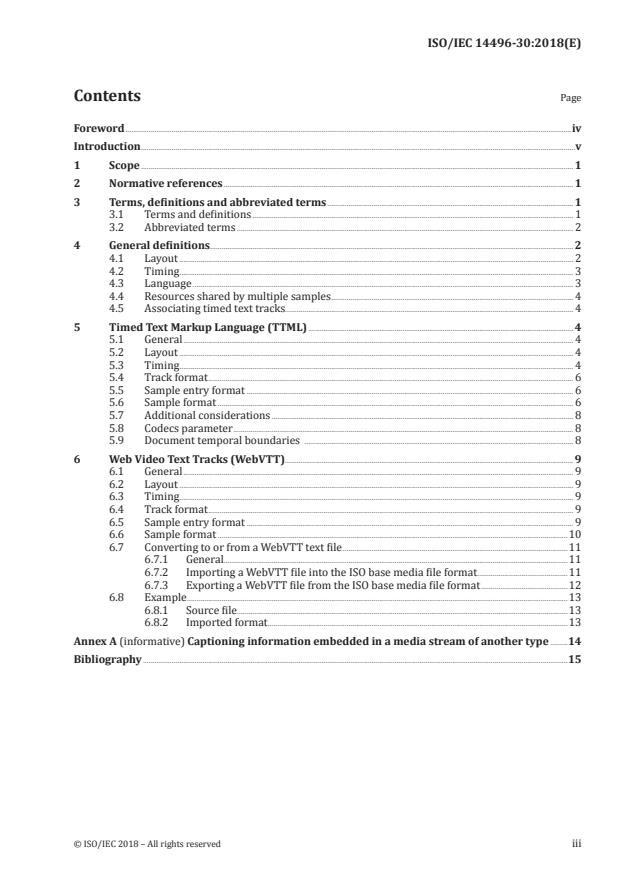
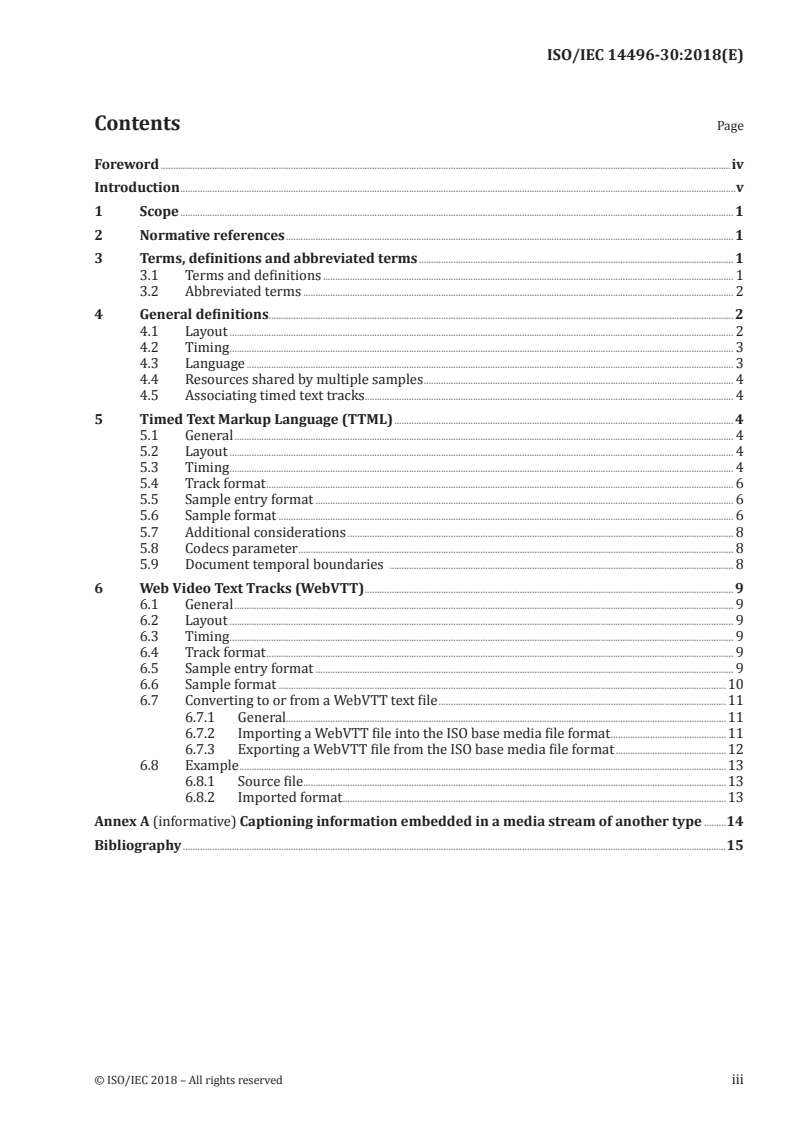
Contents Page
Foreword .iv
Introduction .v
1 Scope . 1
2 Normative references . 1
3 Terms, definitions and abbreviated terms . 1
3.1 Terms and definitions . 1
3.2 Abbreviated terms . 2
4 General definitions . 2
4.1 Layout . 2
4.2 Timing . 3
4.3 Language . 3
4.4 Resources shared by multiple samples . 4
4.5 Associating timed text tracks. 4
5 Timed Text Markup Language (TTML) . 4
5.1 General . 4
5.2 Layout . 4
5.3 Timing . 4
5.4 Track format . 6
5.5 Sample entry format . 6
5.6 Sample format . 6
5.7 Additional considerations . 8
5.8 Codecs parameter . 8
5.9 Document temporal boundaries . 8
6 Web Video Text Tracks (WebVTT) . 9
6.1 General . 9
6.2 Layout . 9
6.3 Timing . 9
6.4 Track format . 9
6.5 Sample entry format . 9
6.6 Sample format .10
6.7 Converting to or from a WebVTT text file .11
6.7.1 General.11
6.7.2 Importing a WebVTT file into the ISO base media file format .11
6.7.3 Exporting a WebVTT file from the ISO base media file format .12
6.8 Example .13
6.8.1 Source file . .13
6.8.2 Imported format .13
Annex A (informative) Captioning information embedded in a media stream of another type .14
Bibliography .15
© ISO/IEC 2018 – All rights reserved iii
Foreword
ISO (the International Organization for Standardization) and IEC (the International Electrotechnical
Commission) form the specialized system for worldwide standardization. National bodies that are
members of ISO or IEC participate in the development of International Standards through technical
committees established by the respective organization to deal with particular fields of technical
activity. ISO and IEC technical committees collaborate in fields of mutual interest. Other international
organizations, governmental and non-governmental, in liaison with ISO and IEC, also take part in the
work. In the field of information technology, ISO and IEC have established a joint technical committee,
ISO/IEC JTC 1.
The procedures used to develop this document and those intended for its further maintenance are
described in the ISO/IEC Directives, Part 1. In particular, the different approval criteria needed for
the different types of document should be noted. This document was drafted in accordance with the
editorial rules of the ISO/IEC Directives, Part 2 (see www .iso .org/directives).
Attention is drawn to the possibility that some of the elements of this document may be the subject
of patent rights. ISO and IEC shall not be held responsible for identifying any or all such patent
rights. Details of any patent rights identified during the development of the document will be in the
Introduction and/or on the ISO list of patent declarations received (see www .iso .org/patents).
Any trade name used in this document is information given for the convenience of users and does not
constitute an endorsement.
For an explanation of the voluntary nature of standards, the meaning of ISO specific terms and
expressions related to conformity assessment, as well as information about ISO's adherence to the
World Trade Organization (WTO) principles in the Technical Barriers to Trade (TBT) see www .iso
.org/iso/foreword .html.
This document was prepared by Technical Committee ISO/IEC JTC 1, Information technology,
Subcommittee SC 29, Coding of audio, picture, multimedia and hypermedia information.
This second edition cancels and replaces the first edition (ISO/IEC 14496-30:2014), which has been
technically revised. It incorporates ISO/IEC 14496-30:2014/Cor.1:2015. The main changes compared to
the previous edition are as follows:
— all Clauses (except Clause 1 and Clause 3) and Annex A have been technically revised.
A list of all parts in the ISO/IEC 14496 series can be found on the ISO website.
Any feedback or questions on this document should be directed to the user’s national standards body. A
complete listing of these bodies can be found at www .iso .org/members .html.
iv © ISO/IEC 2018 – All rights reserved
Introduction
This document defines a storage format based on, and compatible with, the ISO base media file format
(ISO/IEC 14496-12), which is used by the MP4 file format (ISO/IEC 14496-14) and the Motion JPEG 2000
file format (ISO/IEC 15444-3) among others. This document enables timed text and subtitle streams to
— be used in conjunction with other media streams, such as audio or video;
— be used in an MPEG-4 systems environment, if desired;
— be formatted for delivery by a streaming server, using hint tracks; and
— inherit all the use cases and features of the ISO base media file format on which MP4 and MJ2
are based.
© ISO/IEC 2018 – All rights reserved v
INTERNATIONAL STANDARD ISO/IEC 14496-30:2018(E)
Information technology — Coding of audio-visual
objects —
Part 30:
Timed text and other visual overlays in ISO base media
file format
1 Scope
This document describes the carriage of some forms of timed text and subtitle streams in files based
on ISO/IEC 14496-12 (the ISO base media file format). The documentation of these forms does not
preclude other definition of carriage of timed text or subtitles; see, for example, 3GPP Timed Text (3GPP
TS 26.245), or the carriage of captioning information embedded in a media stream of another type (see
Annex A).
2 Normative references
The following documents are referred to in the text in such a way that some or all of their content
constitutes requirements of this document. For dated references, only the edition cited applies. For
undated references, the latest edition of the referenced document (including any amendments) applies.
W3C Recommendation, Timed Text Markup Language 1.0, Second Edition, https: //www .w3
.org/TR/ttml1/
ISO/IEC 14496-12:2015, Information technology — Coding of audio-visual objects — Part 12: ISO base
media file format
W3C Community Group Report, WebVTT, http: //www .w3 .org/2013/07/webvtt .html
3GPP TS 26.245:2017, Transparent end-to-end Packet switched Streaming Service (PSS); Timed text format
IETF RFC 2141, URN Syntax
IETF RFC 3986, Uniform Resource Identifier (URI): Generic Syntax
IETF RFC 6381, MIME Codecs and Profiles
3 Terms, definitions and abbreviated terms
3.1 Terms and definitions
For the purposes of this document, the following terms and definitions apply.
ISO and IEC maintain terminological databases for use in standardization at the following addresses:
— ISO Online browsing platform: available at https: //www .iso .org/obp
— IEC Electropedia: available at http: //www .electropedia .org/
3.1.1
timed text document
file-based representation of textual content, possibly XML, used to produce timed text streams and
possibly representing timed text track samples
© ISO/IEC 2018 – All rights reserved 1
3.1.2
timed text stream
stream of content, which when decoded results in textual content, possibly containing internal timing
values, to be presented at a given presentation time and for a certain duration
3.1.3
subtitle stream
timed text stream potentially also presenting images
3.1.4
internal timing value
value contained in the payload of a timed text stream sample representing a time
EXAMPLE A start time, an end time, or a duration, corresponding to a timed behaviour of a part or the whole
of the sample.
3.1.5
timed text track
ISOBMFF representation of a timed text stream
3.1.6
subtitle track
ISOBMFF representation of a subtitle stream
3.2 Abbreviated terms
TTML Timed Text Markup Language
WebVTT Web Video Text Tracks
ISOBMFF ISO base media file format
4 General definitions
4.1 Layout
This subclause defines common layout behaviour for processing of timed text or subtitle samples.
Unless specified by an embedding environment (e.g. an HTML page), the track header box information
(i.e. width, height) shall be used to size the subtitle or timed text track content with respect to the
associated track(s) as follows:
1) If the flag track_size_is_aspect_ratio is not set, and the track width and height are set
to values different from 0, the size of the timed text track shall be the track width and height.
2) If the flag track_size_is_aspect_ratio is not set, and the track width and height are set
to 0, the size of the timed text track shall match the reference size.
3) If the flag track_size_is_aspect_ratio is set, it indicates that the content of the track was
authored to an aspect ratio equal to the track header width/height. In this case, neither width
nor height shall be 0. The timed text track shall be sized to the maximum size that will fit within
the reference size and should equal its width or height, while preserving the indicated aspect ratio.
If only one track is associated with the timed text track, the reference size is the size of the associated
track. If multiple tracks are associated, the reference size is the size of the composition of tracks as
described by the matrices in the track headers of the associated tracks.
Upon file creation, the width and height of the subtitle or timed text track should be set appropriately
according to the width and height of the associated track(s), as declared in their track header. A
2 © ISO/IEC 2018 – All rights reserved
typical usage is that the timed text or subtitle track has the same width and height as an associated
visual track, and no translation.
If the track it is supposed to overlay is not stored in an ISOBMFF file or if it is stored as a track in a
different ISOBMFF file, the values 0x0 may be used; or the track_size_is_aspect_ratio flag may
be used and the width and height set to the desired aspect ratio.
For some timed text documents, the region as defined by the width, height and track_size_is_
aspect_ratio corresponds to the visual area filled by the rendering of the timed text documents.
When the track width and height attributes are set to a value different from 0 and the track_size_
is_aspect_ratio_flag is not used, additional region positioning using the translation values tx
and ty from the track header matrix, as defined for 3GPP Timed Text tracks, may be used (3GPP TS
26.245:2017, 5.7 defines the text track region using tx, ty, and the track width and height).
NOTE 1 The 3GPP region is not the same as a WebVTT region.
Unless specified by an embedding environment (e.g. an HTML page), visually composed tracks including
video, subtitle, and timed text shall be stacked or layered using the ‘layer’ value in the track header box.
The layer field provides the same functionality as z-index in TTML.
NOTE 2 Timed text and subtitle tracks are normally stacked in front of the associated visual track(s).
4.2 Timing
This subclause defines common timing behaviour for processing of timed text or subtitle samples.
The general processing of timed text or subtitle tracks is that the text content of the sample is delivered
to the decoder at the sample decode time, at the latest. The rendering of the sample happens at the
composition time, taking into account edit lists if any, and for the whole sample duration, without timing
behaviour. However, timed text or subtitle sample data of specific formats may contain internal timing
values. Internal timing values may alter the rendering of the sample during its duration as specified by
the timed text or subtitle format.
NOTE If an internal timing value does not fall in the time interval corresponding to the sample composition
time and sample composition time plus sample duration, the rendering of the sample can be different from
the rendering of the same sample data with a composition time such that the internal timing value lies in the
associated composition interval.
The subclauses defining the storage of specific formats in the ISOBMFF specify how internal timing
values relate to the track time or to the sample decode or composition time (see subclauses 5.3 and 6.3).
For instance, start or end times may be relative to the start of the sample, or the start of the track.
For sections of the track timeline that have no associated subtitles or timed text content, ‘empty’
samples may be used, as defined for each format, or the duration of the preceding sample extended.
Samples with a size of zero are not used.
The timescale field in the media header box should be set appropriately to achieve the desired timing
accuracy. It is recommended to be set to the value of the timescale field in the media header box of
(one of) the associated track(s).
4.3 Language
Timed text tracks should be marked with a suitable language in the media header box, indicating the
audience for whom the track is appropriate. In the case where it is suitable for a single language, the
media header must match that declared language. The value ‘mul’ may be used for a multi-lingual text.
© ISO/IEC 2018 – All rights reserved 3
4.4 Resources shared by multiple samples
Common resources, such as images and fonts that are referred to by URLs, may be stored as items in a
MetaBox as defined by ISO/IEC 14496-12. These items may be addressed by using the item_name as a
relative URL in the timed text sample, as defined by ISO/IEC 14496-12:2015, 8.11.9.
NOTE A derived specification, with its applicable brand, can restrict this use of meta boxes for common items.
Fonts not supplied with the content may be already present on the target system(s), or supplied using
any suitable supported mechanism (e.g. font streaming as defined in ISO/IEC 14496-18).
4.5 Associating timed text tracks
Timed text tracks may be explicitly or implicitly associated with other tracks in the file. They are
explicitly associated with a track when the timed text track uses a track reference of type 'subt'
to that track, as defined in ISO/IEC 14496-12, or to a track in the same alternate group. If no 'subt'
track reference is used, the timed text track is said to be implicitly associated to all tracks in the file.
In particular, if track groups are not used, the timed text track is associated to all tracks in the file.
Association is used to indicate which track(s) a timed text track is intended to overlay and may be used
to determine the desired rendered size when that information is not provided in the track header of the
timed text track, as defined in subclause 4.1. Timed text and subtitle tracks may be associated with any
type of track, including visual tracks (e.g. video tracks, graphics tracks, image tracks) or audio tracks as
determined by some external context.
5 Timed Text Markup Language (TTML)
5.1 General
This subclause describes how documents based on TTML, as defined by the W3C, and derived
specifications (for example SMPTE-TT), are carried in files based on the ISO base media file format.
A TTML Track is a track carrying TTML documents, which can be documents that correspond to a
specification based on TTML.
5.2 Layout
Subclause 4.1 defines the general layout behaviour for timed text and subtitle tracks. In particular,
this means for TTML tracks that the track width and height provide the spatial extent of the root
container, as defined in the TTML Recommendation. Any ‘extent’ attribute declared on the ‘tt’ element
in the contained TTML document shall match the track width and height. If the ‘extent’ attribute is not
declared on the ‘tt’ element in the contained TTML document, the track header width and height may be
set to 0 or to any desired size.
NOTE This is used when the document is authored in a resolution-independent manner (e.g. using percentage
layout).
Alternatively, when a resolution-independent document has been authored to a specific aspect ratio
(whether or not the aspect ratio is explicitly signalled in the document) the track_size_is_
aspect_ratio flag may be used to signal the authored aspect ratio. In this case, the track header
width and height shall be set to values that indicate the authored aspect ratio (e.g. 16 by 9).
5.3 Timing
The top-level internal timing values in the timed text samples based on TTML express times on the
track presentation timeline – that is, the track media time as optionally modified by the edit list. For
example, the begin and end attributes of the element, if used, are relative to the start of the
track, not relative to the start of the sample. This is shown in Figure 1, using W3C TTML syntax.
4 © ISO/IEC 2018 – All rights reserved
In Figure 1, the sample composition time of each of the samples are 0, 30 minutes, and 1 hour, which
correspond to the time at which the decoder will present the TTML content. The first sample, as per
W3C Recommendation, Timed Text Markup Language 1.0, will not display any content in the first
minute or after 2 minutes, and again, per TTML, will remain as such until the next sample is processed.
The second sample contains a document describing the rendering between composition time 0 and
32 minutes. However, since it is provided to the decoder after 30 minutes and since internal timing
values are relative to the
...
INTERNATIONAL ISO/IEC
STANDARD 14496-30
Second edition
2018-11
Information technology — Coding of
audio-visual objects —
Part 30:
Timed text and other visual overlays
in ISO base media file format
Technologies de l'information — Codage des objets audiovisuels —
Partie 30: Texte temporisé et autres recouvrements visuels dans le
format ISO de base pour les fichiers médias
Reference number
©
ISO/IEC 2018
© ISO/IEC 2018
All rights reserved. Unless otherwise specified, or required in the context of its implementation, no part of this publication may
be reproduced or utilized otherwise in any form or by any means, electronic or mechanical, including photocopying, or posting
on the internet or an intranet, without prior written permission. Permission can be requested from either ISO at the address
below or ISO’s member body in the country of the requester.
ISO copyright office
CP 401 • Ch. de Blandonnet 8
CH-1214 Vernier, Geneva
Phone: +41 22 749 01 11
Fax: +41 22 749 09 47
Email: copyright@iso.org
Website: www.iso.org
Published in Switzerland
ii © ISO/IEC 2018 – All rights reserved
Contents Page
Foreword .iv
Introduction .v
1 Scope . 1
2 Normative references . 1
3 Terms, definitions and abbreviated terms . 1
3.1 Terms and definitions . 1
3.2 Abbreviated terms . 2
4 General definitions . 2
4.1 Layout . 2
4.2 Timing . 3
4.3 Language . 3
4.4 Resources shared by multiple samples . 4
4.5 Associating timed text tracks. 4
5 Timed Text Markup Language (TTML) . 4
5.1 General . 4
5.2 Layout . 4
5.3 Timing . 4
5.4 Track format . 6
5.5 Sample entry format . 6
5.6 Sample format . 6
5.7 Additional considerations . 8
5.8 Codecs parameter . 8
5.9 Document temporal boundaries . 8
6 Web Video Text Tracks (WebVTT) . 9
6.1 General . 9
6.2 Layout . 9
6.3 Timing . 9
6.4 Track format . 9
6.5 Sample entry format . 9
6.6 Sample format .10
6.7 Converting to or from a WebVTT text file .11
6.7.1 General.11
6.7.2 Importing a WebVTT file into the ISO base media file format .11
6.7.3 Exporting a WebVTT file from the ISO base media file format .12
6.8 Example .13
6.8.1 Source file . .13
6.8.2 Imported format .13
Annex A (informative) Captioning information embedded in a media stream of another type .14
Bibliography .15
© ISO/IEC 2018 – All rights reserved iii
Foreword
ISO (the International Organization for Standardization) and IEC (the International Electrotechnical
Commission) form the specialized system for worldwide standardization. National bodies that are
members of ISO or IEC participate in the development of International Standards through technical
committees established by the respective organization to deal with particular fields of technical
activity. ISO and IEC technical committees collaborate in fields of mutual interest. Other international
organizations, governmental and non-governmental, in liaison with ISO and IEC, also take part in the
work. In the field of information technology, ISO and IEC have established a joint technical committee,
ISO/IEC JTC 1.
The procedures used to develop this document and those intended for its further maintenance are
described in the ISO/IEC Directives, Part 1. In particular, the different approval criteria needed for
the different types of document should be noted. This document was drafted in accordance with the
editorial rules of the ISO/IEC Directives, Part 2 (see www .iso .org/directives).
Attention is drawn to the possibility that some of the elements of this document may be the subject
of patent rights. ISO and IEC shall not be held responsible for identifying any or all such patent
rights. Details of any patent rights identified during the development of the document will be in the
Introduction and/or on the ISO list of patent declarations received (see www .iso .org/patents).
Any trade name used in this document is information given for the convenience of users and does not
constitute an endorsement.
For an explanation of the voluntary nature of standards, the meaning of ISO specific terms and
expressions related to conformity assessment, as well as information about ISO's adherence to the
World Trade Organization (WTO) principles in the Technical Barriers to Trade (TBT) see www .iso
.org/iso/foreword .html.
This document was prepared by Technical Committee ISO/IEC JTC 1, Information technology,
Subcommittee SC 29, Coding of audio, picture, multimedia and hypermedia information.
This second edition cancels and replaces the first edition (ISO/IEC 14496-30:2014), which has been
technically revised. It incorporates ISO/IEC 14496-30:2014/Cor.1:2015. The main changes compared to
the previous edition are as follows:
— all Clauses (except Clause 1 and Clause 3) and Annex A have been technically revised.
A list of all parts in the ISO/IEC 14496 series can be found on the ISO website.
Any feedback or questions on this document should be directed to the user’s national standards body. A
complete listing of these bodies can be found at www .iso .org/members .html.
iv © ISO/IEC 2018 – All rights reserved
Introduction
This document defines a storage format based on, and compatible with, the ISO base media file format
(ISO/IEC 14496-12), which is used by the MP4 file format (ISO/IEC 14496-14) and the Motion JPEG 2000
file format (ISO/IEC 15444-3) among others. This document enables timed text and subtitle streams to
— be used in conjunction with other media streams, such as audio or video;
— be used in an MPEG-4 systems environment, if desired;
— be formatted for delivery by a streaming server, using hint tracks; and
— inherit all the use cases and features of the ISO base media file format on which MP4 and MJ2
are based.
© ISO/IEC 2018 – All rights reserved v
INTERNATIONAL STANDARD ISO/IEC 14496-30:2018(E)
Information technology — Coding of audio-visual
objects —
Part 30:
Timed text and other visual overlays in ISO base media
file format
1 Scope
This document describes the carriage of some forms of timed text and subtitle streams in files based
on ISO/IEC 14496-12 (the ISO base media file format). The documentation of these forms does not
preclude other definition of carriage of timed text or subtitles; see, for example, 3GPP Timed Text (3GPP
TS 26.245), or the carriage of captioning information embedded in a media stream of another type (see
Annex A).
2 Normative references
The following documents are referred to in the text in such a way that some or all of their content
constitutes requirements of this document. For dated references, only the edition cited applies. For
undated references, the latest edition of the referenced document (including any amendments) applies.
W3C Recommendation, Timed Text Markup Language 1.0, Second Edition, https: //www .w3
.org/TR/ttml1/
ISO/IEC 14496-12:2015, Information technology — Coding of audio-visual objects — Part 12: ISO base
media file format
W3C Community Group Report, WebVTT, http: //www .w3 .org/2013/07/webvtt .html
3GPP TS 26.245:2017, Transparent end-to-end Packet switched Streaming Service (PSS); Timed text format
IETF RFC 2141, URN Syntax
IETF RFC 3986, Uniform Resource Identifier (URI): Generic Syntax
IETF RFC 6381, MIME Codecs and Profiles
3 Terms, definitions and abbreviated terms
3.1 Terms and definitions
For the purposes of this document, the following terms and definitions apply.
ISO and IEC maintain terminological databases for use in standardization at the following addresses:
— ISO Online browsing platform: available at https: //www .iso .org/obp
— IEC Electropedia: available at http: //www .electropedia .org/
3.1.1
timed text document
file-based representation of textual content, possibly XML, used to produce timed text streams and
possibly representing timed text track samples
© ISO/IEC 2018 – All rights reserved 1
3.1.2
timed text stream
stream of content, which when decoded results in textual content, possibly containing internal timing
values, to be presented at a given presentation time and for a certain duration
3.1.3
subtitle stream
timed text stream potentially also presenting images
3.1.4
internal timing value
value contained in the payload of a timed text stream sample representing a time
EXAMPLE A start time, an end time, or a duration, corresponding to a timed behaviour of a part or the whole
of the sample.
3.1.5
timed text track
ISOBMFF representation of a timed text stream
3.1.6
subtitle track
ISOBMFF representation of a subtitle stream
3.2 Abbreviated terms
TTML Timed Text Markup Language
WebVTT Web Video Text Tracks
ISOBMFF ISO base media file format
4 General definitions
4.1 Layout
This subclause defines common layout behaviour for processing of timed text or subtitle samples.
Unless specified by an embedding environment (e.g. an HTML page), the track header box information
(i.e. width, height) shall be used to size the subtitle or timed text track content with respect to the
associated track(s) as follows:
1) If the flag track_size_is_aspect_ratio is not set, and the track width and height are set
to values different from 0, the size of the timed text track shall be the track width and height.
2) If the flag track_size_is_aspect_ratio is not set, and the track width and height are set
to 0, the size of the timed text track shall match the reference size.
3) If the flag track_size_is_aspect_ratio is set, it indicates that the content of the track was
authored to an aspect ratio equal to the track header width/height. In this case, neither width
nor height shall be 0. The timed text track shall be sized to the maximum size that will fit within
the reference size and should equal its width or height, while preserving the indicated aspect ratio.
If only one track is associated with the timed text track, the reference size is the size of the associated
track. If multiple tracks are associated, the reference size is the size of the composition of tracks as
described by the matrices in the track headers of the associated tracks.
Upon file creation, the width and height of the subtitle or timed text track should be set appropriately
according to the width and height of the associated track(s), as declared in their track header. A
2 © ISO/IEC 2018 – All rights reserved
typical usage is that the timed text or subtitle track has the same width and height as an associated
visual track, and no translation.
If the track it is supposed to overlay is not stored in an ISOBMFF file or if it is stored as a track in a
different ISOBMFF file, the values 0x0 may be used; or the track_size_is_aspect_ratio flag may
be used and the width and height set to the desired aspect ratio.
For some timed text documents, the region as defined by the width, height and track_size_is_
aspect_ratio corresponds to the visual area filled by the rendering of the timed text documents.
When the track width and height attributes are set to a value different from 0 and the track_size_
is_aspect_ratio_flag is not used, additional region positioning using the translation values tx
and ty from the track header matrix, as defined for 3GPP Timed Text tracks, may be used (3GPP TS
26.245:2017, 5.7 defines the text track region using tx, ty, and the track width and height).
NOTE 1 The 3GPP region is not the same as a WebVTT region.
Unless specified by an embedding environment (e.g. an HTML page), visually composed tracks including
video, subtitle, and timed text shall be stacked or layered using the ‘layer’ value in the track header box.
The layer field provides the same functionality as z-index in TTML.
NOTE 2 Timed text and subtitle tracks are normally stacked in front of the associated visual track(s).
4.2 Timing
This subclause defines common timing behaviour for processing of timed text or subtitle samples.
The general processing of timed text or subtitle tracks is that the text content of the sample is delivered
to the decoder at the sample decode time, at the latest. The rendering of the sample happens at the
composition time, taking into account edit lists if any, and for the whole sample duration, without timing
behaviour. However, timed text or subtitle sample data of specific formats may contain internal timing
values. Internal timing values may alter the rendering of the sample during its duration as specified by
the timed text or subtitle format.
NOTE If an internal timing value does not fall in the time interval corresponding to the sample composition
time and sample composition time plus sample duration, the rendering of the sample can be different from
the rendering of the same sample data with a composition time such that the internal timing value lies in the
associated composition interval.
The subclauses defining the storage of specific formats in the ISOBMFF specify how internal timing
values relate to the track time or to the sample decode or composition time (see subclauses 5.3 and 6.3).
For instance, start or end times may be relative to the start of the sample, or the start of the track.
For sections of the track timeline that have no associated subtitles or timed text content, ‘empty’
samples may be used, as defined for each format, or the duration of the preceding sample extended.
Samples with a size of zero are not used.
The timescale field in the media header box should be set appropriately to achieve the desired timing
accuracy. It is recommended to be set to the value of the timescale field in the media header box of
(one of) the associated track(s).
4.3 Language
Timed text tracks should be marked with a suitable language in the media header box, indicating the
audience for whom the track is appropriate. In the case where it is suitable for a single language, the
media header must match that declared language. The value ‘mul’ may be used for a multi-lingual text.
© ISO/IEC 2018 – All rights reserved 3
4.4 Resources shared by multiple samples
Common resources, such as images and fonts that are referred to by URLs, may be stored as items in a
MetaBox as defined by ISO/IEC 14496-12. These items may be addressed by using the item_name as a
relative URL in the timed text sample, as defined by ISO/IEC 14496-12:2015, 8.11.9.
NOTE A derived specification, with its applicable brand, can restrict this use of meta boxes for common items.
Fonts not supplied with the content may be already present on the target system(s), or supplied using
any suitable supported mechanism (e.g. font streaming as defined in ISO/IEC 14496-18).
4.5 Associating timed text tracks
Timed text tracks may be explicitly or implicitly associated with other tracks in the file. They are
explicitly associated with a track when the timed text track uses a track reference of type 'subt'
to that track, as defined in ISO/IEC 14496-12, or to a track in the same alternate group. If no 'subt'
track reference is used, the timed text track is said to be implicitly associated to all tracks in the file.
In particular, if track groups are not used, the timed text track is associated to all tracks in the file.
Association is used to indicate which track(s) a timed text track is intended to overlay and may be used
to determine the desired rendered size when that information is not provided in the track header of the
timed text track, as defined in subclause 4.1. Timed text and subtitle tracks may be associated with any
type of track, including visual tracks (e.g. video tracks, graphics tracks, image tracks) or audio tracks as
determined by some external context.
5 Timed Text Markup Language (TTML)
5.1 General
This subclause describes how documents based on TTML, as defined by the W3C, and derived
specifications (for example SMPTE-TT), are carried in files based on the ISO base media file format.
A TTML Track is a track carrying TTML documents, which can be documents that correspond to a
specification based on TTML.
5.2 Layout
Subclause 4.1 defines the general layout behaviour for timed text and subtitle tracks. In particular,
this means for TTML tracks that the track width and height provide the spatial extent of the root
container, as defined in the TTML Recommendation. Any ‘extent’ attribute declared on the ‘tt’ element
in the contained TTML document shall match the track width and height. If the ‘extent’ attribute is not
declared on the ‘tt’ element in the contained TTML document, the track header width and height may be
set to 0 or to any desired size.
NOTE This is used when the document is authored in a resolution-independent manner (e.g. using percentage
layout).
Alternatively, when a resolution-independent document has been authored to a specific aspect ratio
(whether or not the aspect ratio is explicitly signalled in the document) the track_size_is_
aspect_ratio flag may be used to signal the authored aspect ratio. In this case, the track header
width and height shall be set to values that indicate the authored aspect ratio (e.g. 16 by 9).
5.3 Timing
The top-level internal timing values in the timed text samples based on TTML express times on the
track presentation timeline – that is, the track media time as optionally modified by the edit list. For
example, the begin and end attributes of the element, if used, are relative to the start of the
track, not relative to the start of the sample. This is shown in Figure 1, using W3C TTML syntax.
4 © ISO/IEC 2018 – All rights reserved
In Figure 1, the sample composition time of each of the samples are 0, 30 minutes, and 1 hour, which
correspond to the time at which the decoder will present the TTML content. The first sample, as per
W3C Recommendation, Timed Text Markup Language 1.0, will not display any content in the first
minute or after 2 minutes, and again, per TTML, will remain as such until the next sample is processed.
The second sample contains a document describing the rendering between composition time 0 and
32 minutes. However, since it is provided to the decoder after 30 minutes and since internal timing
values are relative to the
...