


ISO/FDIS 11228-3
(Main)Ergonomics — Manual handling — Part 3: Repetitive movements and exertions of the upper limbs
Ergonomics — Manual handling — Part 3: Repetitive movements and exertions of the upper limbs
ISO 11228-3:2006 establishes ergonomic recommendations for repetitive work tasks involving the manual handling of low loads at high frequency. It provides guidance on the identification and assessment of risk factors commonly associated with handling low loads at high frequency, thereby allowing evaluation of the related health risks to the working population. The recommendations apply to the adult working population and are intended to give reasonable protection for nearly all healthy adults. Those recommendations concerning health risks and control measures are mainly based on experimental studies regarding musculoskeletal loading, discomfort/pain and endurance/fatigue related to methods of working. ISO 11228-3:2006 is intended to provide information for all those involved in the design or redesign of work, jobs and products.
Ergonomie — Manutention manuelle — Partie 3: Mouvements répétitifs et efforts des membres supérieurs
L'ISO 11228-3:2006 détermine les recommandations ergonomiques applicables aux tâches répétitives qui impliquent la manipulation de charges faibles à fréquence de répétition élevée. Elle fournit des recommandations concernant l'identification et l'évaluation des facteurs de risques couramment associés à la manipulation de charges faibles à fréquence de répétition élevée, qui permettent ainsi d'apprécier les risques pour la santé de la population active. Les recommandations s'appliquent à la population active adulte et les recommandations fournies sont destinées à assurer une protection suffisante de la quasi totalité des adultes en bonne santé. Ces recommandations concernant les risques pour la santé et les mesures de contrôle reposent principalement sur les études expérimentales portant sur la charge musculosquelettique, la gêne/douleur et l'endurance/fatigue associées aux méthodes de travail. L'ISO 11228-3:2006 est prévue pour fournir des informations destinées à toutes les personnes concernées par la conception initiale ou une nouvelle conception du travail, des tâches et des produits.
General Information
- Status
- Not Published
- Technical Committee
- ISO/TC 159/SC 3 - Anthropometry and biomechanics
- Drafting Committee
- ISO/TC 159/SC 3 - Anthropometry and biomechanics
- Current Stage
- 5020 - FDIS ballot initiated: 2 months. Proof sent to secretariat
- Start Date
- 06-Feb-2026
- Completion Date
- 06-Feb-2026
Relations
- Revises
ISO 11228-3:2007 - Ergonomics — Manual handling — Part 3: Handling of low loads at high frequency - Effective Date
- 06-Jun-2022
Overview
ISO/FDIS 11228-3: Ergonomics – Manual handling – Part 3: Repetitive movements and exertions of the upper limbs is an international standard developed by ISO to establish ergonomic recommendations for repetitive manual tasks involving the upper limbs. This standard focuses on work tasks characterized by high frequency, low load manual handling that can pose health risks, particularly musculoskeletal disorders (MSDs), to the adult working population. ISO/FDIS 11228-3 provides practical guidance to help organizations identify, assess, and minimize the risks associated with repetitive movements and forceful exertions, aiming to ensure the safety and well-being of workers.
Key Topics
Identification of Risk Factors
The standard defines key risk factors common in repetitive upper limb activities, including:- Frequency of actions
- Exposure duration
- Awkward postures and movements
- Force exerted
- Work organization and task design
- Environmental influences like noise, vibration, and lighting
Risk Assessment Procedures
A systematic process is outlined to determine if tasks require further evaluation.- Initial screening using a 'key enter' question:
- Do repetitive handling tasks of the upper limbs total one hour or more per shift?
- If 'Yes', proceed to in-depth risk assessment using quick assessment tools and, where needed, advanced methods.
- Initial screening using a 'key enter' question:
Risk Reduction Strategies
The standard provides recommendations to avoid or mitigate repetitive manual tasks:- Automation or mechanization
- Task variation and job rotation
- Participative ergonomics involving workers
- Organizational measures to redesign work processes
Guidance for Design and Re-Design
Principles are established for use by anyone involved in the design or redesign of work settings, tools, or machinery, with a focus on minimizing upper limb strain and promoting healthy work environments.
Applications
ISO/FDIS 11228-3 is applicable to a wide range of industries where repetitive upper limb motions are common, such as manufacturing, warehousing, assembly lines, packaging, and certain service sectors. This standard offers significant benefits by helping organizations:
Reduce Work-Related Musculoskeletal Disorders
Applying the recommendations can lead to lower incidence of MSDs among employees, enhancing health and productivity.Support Compliance and Duty of Care
Utilizing ISO ergonomic guidelines ensures adherence to internationally recognized best practices and can support compliance with workplace health and safety regulations.Improve Workplace Design
Designers, engineers, occupational health professionals, and safety officers use ISO/FDIS 11228-3 recommendations to:- Evaluate existing workstations and processes
- Guide the ergonomic design of new equipment and workstations
- Implement effective risk assessment and reduction measures
Facilitate Continuous Improvement
The standard’s framework encourages ongoing review and improvement of work tasks, keeping pace with changes in technology and workforce requirements.
Related Standards
Organizations implementing ISO/FDIS 11228-3 are advised to consult related standards to ensure a comprehensive ergonomic approach:
- ISO 6385: Ergonomics principles in the design of work systems
- ISO 11226: Ergonomics – Evaluation of static working postures
- ISO 11228-1: Ergonomics – Manual handling – Part 1: Lifting, lowering and carrying
- ISO 11228-2: Ergonomics – Manual handling – Part 2: Pushing and pulling
- EN ISO 12100: Safety of machinery – General principles for design – Risk assessment and risk reduction
Conclusion
Adopting ISO/FDIS 11228-3 supports effective risk management for repetitive upper limb tasks, fosters healthier and more productive workplaces, and aligns operations with global best practices in occupational ergonomics. Organizations benefit from reduced injury rates, improved staff well-being, and optimized work system design.

ISO/FDIS 11228-3 - Ergonomics — Manual handling — Part 3: Repetitive movements and exertions of the upper limbs Released:23. 01. 2026
REDLINE ISO/FDIS 11228-3 - Ergonomics — Manual handling — Part 3: Repetitive movements and exertions of the upper limbs Released:23. 01. 2026
Get Certified
Connect with accredited certification bodies for this standard

NSF International
Global independent organization facilitating standards development and certification.

CIS Institut d.o.o.
Personal Protective Equipment (PPE) certification body. Notified Body NB-2890 for EU Regulation 2016/425 PPE.

Kiwa BDA Testing
Building and construction product certification.
Sponsored listings
Frequently Asked Questions
ISO/FDIS 11228-3 is a draft published by the International Organization for Standardization (ISO). Its full title is "Ergonomics — Manual handling — Part 3: Repetitive movements and exertions of the upper limbs". This standard covers: ISO 11228-3:2006 establishes ergonomic recommendations for repetitive work tasks involving the manual handling of low loads at high frequency. It provides guidance on the identification and assessment of risk factors commonly associated with handling low loads at high frequency, thereby allowing evaluation of the related health risks to the working population. The recommendations apply to the adult working population and are intended to give reasonable protection for nearly all healthy adults. Those recommendations concerning health risks and control measures are mainly based on experimental studies regarding musculoskeletal loading, discomfort/pain and endurance/fatigue related to methods of working. ISO 11228-3:2006 is intended to provide information for all those involved in the design or redesign of work, jobs and products.
ISO 11228-3:2006 establishes ergonomic recommendations for repetitive work tasks involving the manual handling of low loads at high frequency. It provides guidance on the identification and assessment of risk factors commonly associated with handling low loads at high frequency, thereby allowing evaluation of the related health risks to the working population. The recommendations apply to the adult working population and are intended to give reasonable protection for nearly all healthy adults. Those recommendations concerning health risks and control measures are mainly based on experimental studies regarding musculoskeletal loading, discomfort/pain and endurance/fatigue related to methods of working. ISO 11228-3:2006 is intended to provide information for all those involved in the design or redesign of work, jobs and products.
ISO/FDIS 11228-3 is classified under the following ICS (International Classification for Standards) categories: 13.180 - Ergonomics. The ICS classification helps identify the subject area and facilitates finding related standards.
ISO/FDIS 11228-3 has the following relationships with other standards: It is inter standard links to ISO 11228-3:2007. Understanding these relationships helps ensure you are using the most current and applicable version of the standard.
ISO/FDIS 11228-3 is available in PDF format for immediate download after purchase. The document can be added to your cart and obtained through the secure checkout process. Digital delivery ensures instant access to the complete standard document.
Standards Content (Sample)
FINAL DRAFT
International
Standard
ISO/TC 159/SC 3
Ergonomics — Manual handling —
Secretariat: JISC
Part 3:
Voting begins on:
2026-02-06
Repetitive movements and
exertions of the upper limbs
Voting terminates on:
2026-04-03
RECIPIENTS OF THIS DRAFT ARE INVITED TO SUBMIT,
WITH THEIR COMMENTS, NOTIFICATION OF ANY
RELEVANT PATENT RIGHTS OF WHICH THEY ARE AWARE
AND TO PROVIDE SUPPOR TING DOCUMENTATION.
IN ADDITION TO THEIR EVALUATION AS
BEING ACCEPTABLE FOR INDUSTRIAL, TECHNO-
LOGICAL, COMMERCIAL AND USER PURPOSES, DRAFT
INTERNATIONAL STANDARDS MAY ON OCCASION HAVE
TO BE CONSIDERED IN THE LIGHT OF THEIR POTENTIAL
TO BECOME STAN DARDS TO WHICH REFERENCE MAY BE
MADE IN NATIONAL REGULATIONS.
Reference number
FINAL DRAFT
International
Standard
ISO/TC 159/SC 3
Ergonomics — Manual handling —
Secretariat: JISC
Part 3:
Voting begins on:
Repetitive movements and
exertions of the upper limbs
Voting terminates on:
RECIPIENTS OF THIS DRAFT ARE INVITED TO SUBMIT,
WITH THEIR COMMENTS, NOTIFICATION OF ANY
RELEVANT PATENT RIGHTS OF WHICH THEY ARE AWARE
AND TO PROVIDE SUPPOR TING DOCUMENTATION.
© ISO 2026
IN ADDITION TO THEIR EVALUATION AS
All rights reserved. Unless otherwise specified, or required in the context of its implementation, no part of this publication may
BEING ACCEPTABLE FOR INDUSTRIAL, TECHNO-
LOGICAL, COMMERCIAL AND USER PURPOSES, DRAFT
be reproduced or utilized otherwise in any form or by any means, electronic or mechanical, including photocopying, or posting on
INTERNATIONAL STANDARDS MAY ON OCCASION HAVE
the internet or an intranet, without prior written permission. Permission can be requested from either ISO at the address below
TO BE CONSIDERED IN THE LIGHT OF THEIR POTENTIAL
or ISO’s member body in the country of the requester.
TO BECOME STAN DARDS TO WHICH REFERENCE MAY BE
MADE IN NATIONAL REGULATIONS.
ISO copyright office
CP 401 • Ch. de Blandonnet 8
CH-1214 Vernier, Geneva
Phone: +41 22 749 01 11
Email: copyright@iso.org
Website: www.iso.org
Published in Switzerland Reference number
ii
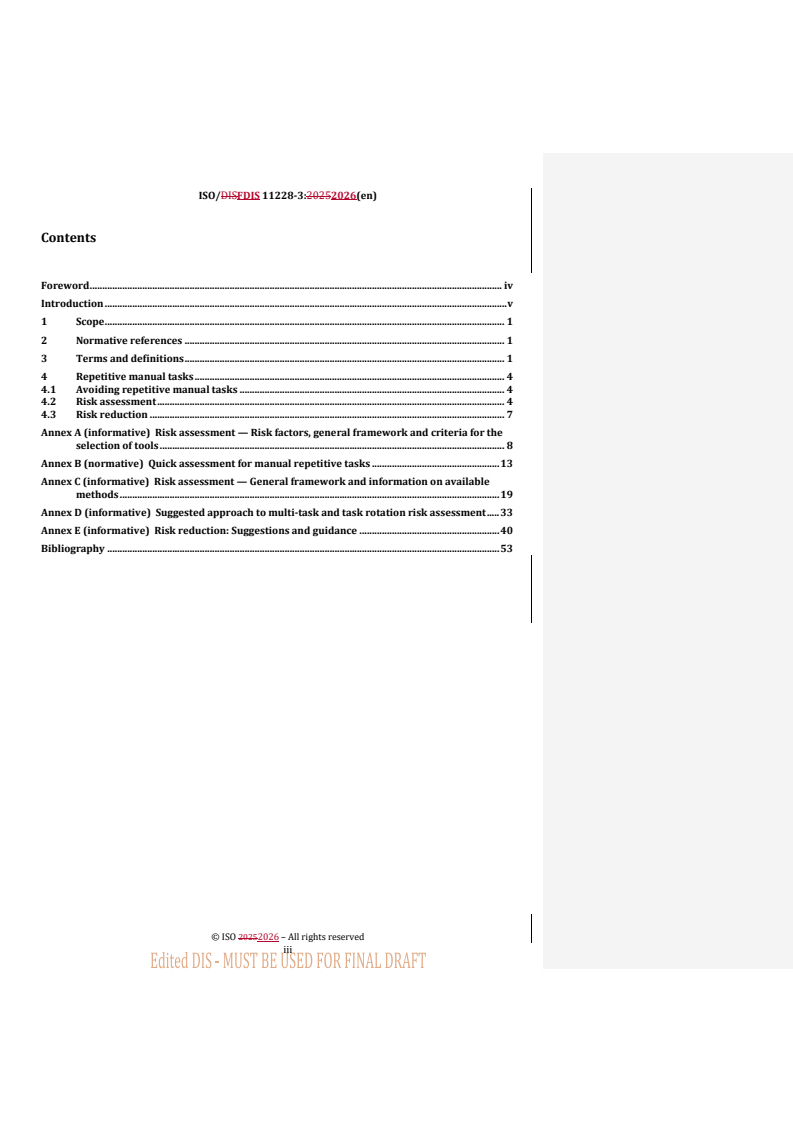
Contents Page
Foreword .iv
Introduction .v
1 Scope . 1
2 Normative references . 1
3 Terms and definitions . 1
4 Repetitive manual tasks . 3
4.1 Avoiding repetitive manual tasks .3
4.2 Risk assessment .4
4.2.1 General .4
4.2.2 Quick assessment .5
4.2.3 Detailed risk assessment .5
4.2.4 Risk assessment validation criteria .5
4.3 Risk reduction .6
Annex A (informative) Risk assessment — Risk factors, general framework and criteria for the
selection of tools. 7
Annex B (normative) Quick assessment for manual repetitive tasks .11
Annex C (informative) Risk assessment — General framework and information on available
methods .15
Annex D (informative) Suggested approach to multi-task and task rotation risk assessment .26
Annex E (informative) Risk reduction: Suggestions and guidance .32
Bibliography .43
iii
Foreword
ISO (the International Organization for Standardization) is a worldwide federation of national standards
bodies (ISO member bodies). The work of preparing International Standards is normally carried out through
ISO technical committees. Each member body interested in a subject for which a technical committee
has been established has the right to be represented on that committee. International organizations,
governmental and non-governmental, in liaison with ISO, also take part in the work. ISO collaborates closely
with the International Electrotechnical Commission (IEC) on all matters of electrotechnical standardization.
The procedures used to develop this document and those intended for its further maintenance are described
in the ISO/IEC Directives, Part 1. In particular, the different approval criteria needed for the different types
of ISO document should be noted. This document was drafted in accordance with the editorial rules of the
ISO/IEC Directives, Part 2 (see www.iso.org/directives).
ISO draws attention to the possibility that the implementation of this document may involve the use of (a)
patent(s). ISO takes no position concerning the evidence, validity or applicability of any claimed patent
rights in respect thereof. As of the date of publication of this document, ISO had not received notice of (a)
patent(s) which may be required to implement this document. However, implementers are cautioned that
this may not represent the latest information, which may be obtained from the patent database available at
www.iso.org/patents. ISO shall not be held responsible for identifying any or all such patent rights.
Any trade name used in this document is information given for the convenience of users and does not
constitute an endorsement.
For an explanation of the voluntary nature of standards, the meaning of ISO specific terms and expressions
related to conformity assessment, as well as information about ISO's adherence to the World Trade
Organization (WTO) principles in the Technical Barriers to Trade (TBT), see www.iso.org/iso/foreword.html.
This document was prepared by Technical Committee ISO/TC 159, Ergonomics, Subcommittee SC 3,
Anthropometry and biomechanics.
This second edition cancels and replaces the first edition (ISO 11228-3:2007), which has been technically
revised.
The main changes are as follows:
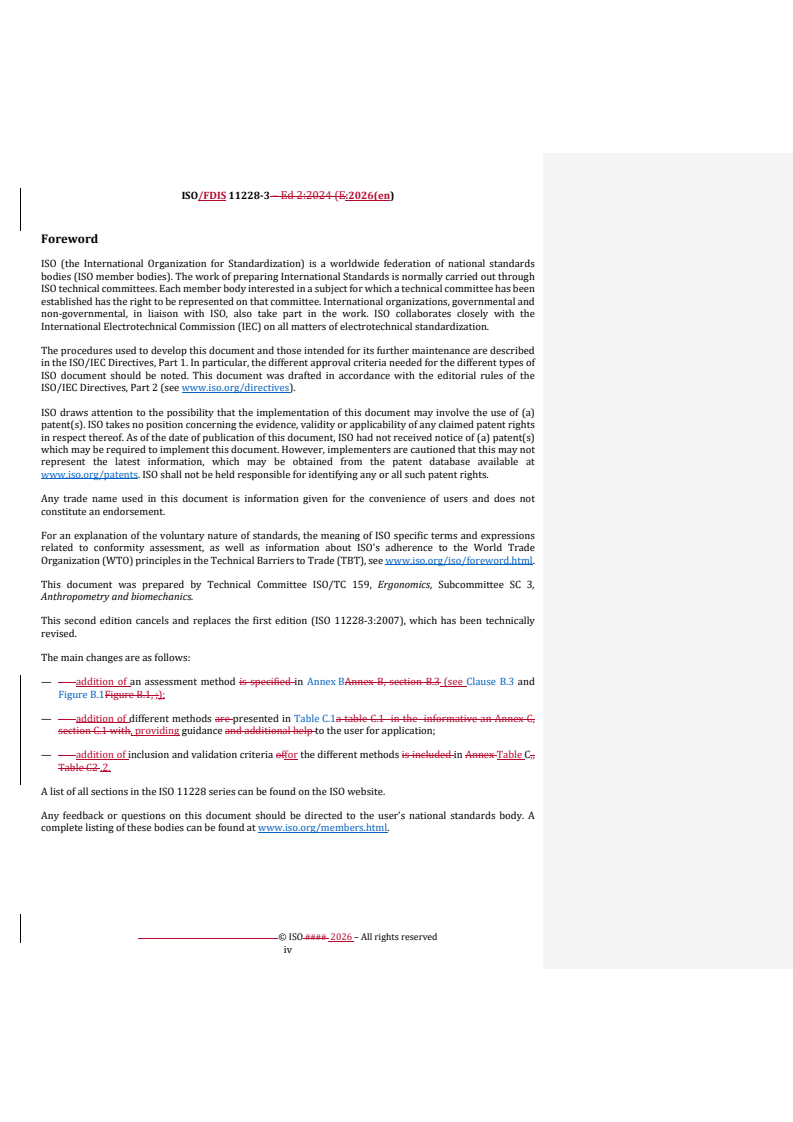
— addition of an assessment method in Annex B (see Clause B.3 and Figure B.1);
— addition of different methods presented in Table C.1, providing guidance to the user for application;
— addition of inclusion and validation criteria for the different methods in Table C.2.
A list of all sections in the ISO 11228 series can be found on the ISO website.
Any feedback or questions on this document should be directed to the user’s national standards body. A
complete listing of these bodies can be found at www.iso.org/members.html.
iv
Introduction
Repetitive movements and forceful exertions of the upper limbs (repetitive work) can cause pain and fatigue,
which can lead to musculoskeletal disorders, and deteriorated posture and movement co-ordination. These
outcomes can increase the risk of errors and can result in hazardous situations and reduced productivity
and quality. Repetitive work, and its consequences, can be prevented through the use of ergonomic design
and organization of work.
Risk factors in repetitive work include the frequency of actions, exposure duration, postures and movement
of body segments, forces associated with the work, work organization, job control, demands on work output
(e.g. quality, task precision), psychosocial factors and level of training or skill. Additional factors can include
environmental factors, such as climate, noise, vibration and illumination.
The recommendations provided by this document are based on current scientific evidence concerning
the physiology, biomechanics and epidemiology of manual work. The knowledge is, however, limited, and
the suggested guidelines are subject to change as evidence emerges. Those recommendations concerning
health risks and control measures are mainly based on research involving in North American and European
populations and how work methods affect musculoskeletal loading, discomfort or pain and endurance or
fatigue. These recommendations can be used for guidance purposes. Countries can generate their own
recommendations based on studies on native populations. For the evaluation of working postures, refer to
ISO 11226.
The changes in this edition of this document include the introduction of a general assessment method, the
presentation of several different risk assessment tools along with inclusion, validation and application
criteria. A set of criteria have been defined regarding the selection and validation status of the tools and
methods presented. The tools are presented in Annex C. This document does not have a mass threshold or
limit. However, if the masses handled are 3 kg or more, the user is directed to also consult ISO 11228-1.
This document is intended to provide information for all those involved in the design or redesign of work,
jobs and products (e.g. machinery).
For more detailed background information on the methods for assessment, a list of secondary references
can be purchased at each National Standards Body.
v
FINAL DRAFT International Standard ISO/FDIS 11228-3:2026(en)
Ergonomics — Manual handling —
Part 3:
Repetitive movements and exertions of the upper limbs
1 Scope
This document specifies requirements and provides recommendations for repetitive work tasks involving
repetitive movements and exertions of the upper extremity. It provides guidance on the identification and
assessment of risk factors commonly associated with repetitive movements and exertions of the upper
limbs, thereby allowing evaluation of the related health risks to the working population.
The recommendations apply to the adult working population and are intended to give reasonable protection
for nearly all healthy adults.
This document does not address the manual handling of objects while using lift-assistive devices such as
exoskeletons and does not address the needs of pregnant women or persons with disabilities.
2 Normative references
The following documents are referred to in the text in such a way that some or all of their content constitutes
requirements of this document. For dated references, only the edition cited applies. For undated references,
the latest edition of the referenced document (including any amendments) applies.
ISO 6385, Ergonomics principles in the design of work systems
ISO 11226, Ergonomics — Evaluation of static working postures
ISO 11228-1, Ergonomics — Manual handling — Part 1: Lifting, lowering and carrying
ISO 11228-2, Ergonomics — Manual handling — Part 2: Pushing and pulling
3 Terms and definitions
For the purposes of this document, the terms and definitions given in ISO 6385, ISO 11226, ISO 11228-1, and
ISO 11228-2 and the following apply.
ISO and IEC maintain terminology databases for use in standardization at the following addresses:
— ISO Online browsing platform: available at https:// www .iso .org/ obp
— IEC Electropedia: available at https:// www .electropedia .org/
3.1
repetitive manual task
task executed by the upper limbs and characterized by repeated, relatively short work cycle times (up to
several minutes) or a task during which the same, or very similar, working actions are repeated for more
than 30 % of the task time
Note 1 to entry: Different tools can define different duration and other operative factors in assessing repetitive manual
tasks.
Note 2 to entry: Manual handling consists of a variety of actions and can require the use of force to manoeuvre,
manipulate, move or restrain an object.
3.2
key enter
type of hazard identification in the form of a specific question in the quick assessment tool for the purpose of
deciding whether further risk evaluation is required
Note 1 to entry: For the purpose of this document, the possible hazard can lead to biomechanical overload of the upper
limbs.
3.3
quick assessment
simple risk evaluation method used to quickly assess the presence of acceptable or critical conditions that
can cause, aggravate, accelerate or exacerbate musculoskeletal injuries
3.4
work cycle
sequence of work actions that are repeated in the same or very similar way to complete a specified work
task
Note 1 to entry: Work cycles are usually defined by industrial engineers when the same sequence of actions must be
repeated on a regular basis in an organized workstation.
3.5
cycle time
total time it takes to complete a single work cycle, from the beginning of a work cycle to the same work cycle
recurring, expressed in seconds or minutes
Note 1 to entry: Time units may be in seconds, minutes, etc.
Note 2 to entry: Cycle time begins from the moment one operator begins a work cycle to the moment that the same
work cycle is repeated.
3.6
work action
elementary manual movements or exertions required to complete the operations within the cycle
EXAMPLE Holding, turning, pushing, cutting.
3.7
frequency of actions
number of actions per unit of time
3.8
force
intensity magnitude of a physical action to execute working actions
3.9
postures and movements
positions and movements of body segment(s) or joint(s) performed to execute the task
3.10
exertions
static or dynamic movements or efforts of body segments to exert force
3.11
recovery time
period, typically of rest, which allows restoration of musculoskeletal function or recovery from fatigue
3.12
risk factors
type of hazard, exposure to which could cause or aggravate work-related musculoskeletal disorders of the
upper limb (UL WMSD)
Note 1 to entry: The main contributing risk factors to UL WMSD are: frequency of actions, exposure duration, postures
and movement of body segments and forces exerted.
Note 2 to entry: Additional risk factors include, but are not limited to: vibration, local pressure, cold environment or
cold surfaces and psychosocial factors.
3.13
work-related musculoskeletal disorder
WMSD
injuries and illnesses of the locomotor apparatus that can be caused by, aggravated, accelerated, or
exacerbated by interaction with known or unknown risk factors in the workplace, and can impair work
capacity
Note 1 to entry: The locomotor apparatus includes tendons, ligaments, joints, cartilage, nerves, vessels and supporting
structures that are involved in locomotion.
3.14
hazard
potential source of harm
3.15
hazard identification
systematic identification of hazards
3.16
risk
combination of the probability of occurrence of harm and the severity of that harm
3.17
risk estimation
defining the likely severity of harm and the probability of its occurrence
3.18
risk analysis
combination of the specification of the limits of the machine, hazard identification and risk estimation
3.19
risk evaluation
procedure based on the risk analysis to determine whether further risk reduction is required
3.20
risk assessment
overall process comprising a risk analysis and a risk evaluation
4 Repetitive manual tasks
4.1 Avoiding repetitive manual tasks
Repetitive manual tasks should be avoided wherever possible. The employer should take appropriate
organizational measures or use the appropriate means — in particular, mechanical equipment — in order to
avoid repetitive manual tasks by workers. Where it cannot be avoided, the employer should take appropriate
organizational measures, use the appropriate means or provide workers with the means to reduce the risk
involved in repetitive manual tasks.
Avoiding or reducing repetitive manual tasks can be achieved through mechanization or automation, work
enlargement, and properly designed job rotation within the framework of a participative ergonomics
approach as described in ISO 6385.
In the case of repetitive movements and exertions of the upper limbs, many tasks can be modified through
the use of robotics or automated production systems. See Annex E for details.
NOTE A participative ergonomics approach signifies the practical involvement of workers, supported by suitable
communication, in planning and managing a significant amount of their work activities, with sufficient knowledge and
ability to influence both processes and outcomes, in order to achieve desirable goals.
4.2 Risk assessment
4.2.1 General
When one or more repetitive handling tasks are present, the degree of risk must be assessed and, where
appropriate, reduced. The recommended steps are outlined in Figure 1:
a) entering the risk assessment by key enter (see B.3 for information on the key enter), or performing a
qualitative hazard identification;
b) assessing the risk using the quick assessment (see Annex B) and performing a risk evaluation using
simple or detailed methods and finally, reducing the risk.
The procedure shown in Figure 1 should be used when carrying out a risk assessment of jobs involving
repetitive movements and exertions of the upper limbs.
Figure 1 — Risk assessment procedure
The first step of the risk assessment procedure is to establish if a repetitive manual task is required to be
further evaluated by means of a specific key enter.
To this end, the following specific key enter is adopted:
[1]
Are there one or more repetitive handling tasks of the upper limbs with a total duration of one hour or
more per shift?
If the answer is Yes then proceed with risk assessment; otherwise ignore this part of ISO 11228.
4.2.2 Quick assessment
A risk assessment (quick assessment) shall be performed when one (or more) repetitive task(s) involving
[1]
the upper limbs is performed for one hour or more in the shift or when a qualitative hazard identification
identifies hazards which can expose individuals to a risk of injury (see A.1). It is intended to analyse a task in
a given workstation.
The quick assessment is provided in Annex B (normative) and involves quickly evaluating the extent of the
risk by asking simple qualitative and quantitative questions. The quick assessment identifies one of three
possible risk conditions.
a) Acceptable: no further actions are required.
b) Critical: the work or process must be immediately redesigned based upon a risk assessment.
c) Not acceptable/not critical: a more detailed analysis is required, and a proper risk assessment must be
carried out using more specific analytical tools for simple or detailed risk evaluation.
When conditions are found to be acceptable or critical, it is not always necessary to conduct a more in-depth
analysis of the exposure level, especially in the case of critical conditions, since risk reduction should be
considered at that point.
In Annex B, a specific part of Figure B.1 lists the conditions that must all be present simultaneously to classify
a repetitive manual handling task as acceptable. A repetitive task which is assessed as being acceptable
using the quick assessment, can also be considered to have been classified as acceptable using the detailed
methods indicated in this document. Conversely, Figure B.1 also lists situations which represent a critical
condition, if any one of them is present. If a task is deemed critical, immediate corrective action (i.e., risk
reduction) is recommended. Further analyses can help to quantify the risk and guide corrective actions.
More in-depth investigations should be undertaken to monitor the potential effectiveness of the corrective
actions.
4.2.3 Detailed risk assessment
If the result of the quick assessment is neither acceptable nor critical, the next step (depending on the
identified condition of the risk) is to perform a more detailed risk assessment. This is particularly helpful in
industrial manufacturing sectors or in selected, non-industrial sectors [e.g., logistics (includes warehousing,
supply chain, transportation), food preparation, industrial cleaning, etc.]. Other reasons for completing a
more detailed risk assessment can be if the risk estimated is still uncertain or where tasks and jobs are
being redesigned. A more detailed risk assessment is required, especially when jobs are composed of two or
more repetitive tasks (multitask job). Annex D provides suggested approaches to use in these circumstances.
A more detailed risk assessment will also allow a better determination of the corrective actions to be
implemented. The methods listed in Annex C and Table C.1 have been identified as providing more detailed
risk assessments. and have met to varying degrees, the validation criteria given in Annex A.
4.2.4 Risk assessment validation criteria
For the purposes of this document, the criteria for selection and the criteria for validation of risk assessment
tools are presented in Annex A. Table C.2 presents which criteria each method meets.
For each method given in Table C.2, an indication of the criteria met is provided.
4.3 Risk reduction
A proper risk assessment is the basis for appropriate choices in risk reduction. Risk reduction can be
achieved by making, improvements to one or most risk factors and should consider the following:
a) the avoidance and limitation of repetitive handling by design of the task, especially for long daily
durations without proper recovery time or at high frequencies;
b) optimal design of the task, workplaces and work organization, also using existing International
Standards and introducing adequate task variation;
c) proper design of the objects, tools and materials handled;
d) proper design of the work environment;
e) individual workers’ capacities and level of skill for the specific task.
See Annex E for more detailed information about risk reduction options.
Annex A
(informative)
Risk assessment — Risk factors, general framework and criteria for
the selection of tools
A.1 Background on work related risk factors
A.1.1 General
Many hazards or work-related risk factors are associated with an increased probability (risk) of UL WMSDs.
Some of them have been defined as main contributing factors (repetition, force, awkward postures and
movements, lack of recovery periods, duration) whilst for additional hazards there is some evidence that
they can contribute to increasing the overall level of risk for UL WMSDs.
In Clause A.1, the main hazards (and risk factors) as identified in the quick assessment (see 4.2.2), as well
as additional hazards to be assessed in a preliminary qualitative assessment are each briefly described.
Clause A.2 provides guidance regarding the evaluation of the overall risk of contracting UL WMSDs.
A.1.2 Repetition
Frequent repetitive movements give rise to a risk of injury that can vary depending on the context of the
movement pattern and the individual. As either the frequency of actions and movements increases or
the cycle time decreases, or both, the risk of injury increases. Extremely repetitive movements should be
avoided within a task or job.
A.1.3 Posture and movement
Work tasks and operations should provide variations to the working posture: both whole-body postures and
movement of specific limbs. In work tasks, extreme ranges of joint movement and prolonged static postures
should be avoided.
A.1.4 Force
Forceful exertions can be harmful. Tasks should involve smooth force exertions, with the avoidance of
sudden or jerky movements or any condition that can present an unanticipated significant increase in force
to the worker. Handling precision (accurate picking and placement), and the type and nature of the grip can
introduce additional muscular activation.
A.1.5 Duration and insufficient recovery
Insufficient time for the body to recover between repetitive movements (i.e., lack of recovery time) increases
the risk of injury. Duration can be broken down into different levels, i.e., work shift duration, job duration,
task duration. The opportunity for recovery or rest may fall within each of these work periods. Refer to
Annex E for more information on duration and recovery.
A.1.6 Object characteristics
Inappropriately designed objects can have characteristics that cause harm (e.g., contact forces, shape,
dimensions, coupling, object temperature). Inappropriately placed handholds can lead to awkward hand or
arm postures. Un-cushioned handholds and flat objects laying on a hard surface increase the difficulty of
grasping the object and augment force requirements. The size and shape of the object being handled and the
nature of the coupling between it and the operator’s hands will determine the grip type and the force that
the operator must exert.
A.1.7 Vibration and impact forces
Exposure to hand or arm vibration, shocks or impacts can lead to a desensitizing of the hand and increase
the force necessary for gripping an object or tool. Prolonged exposure to these types of risk factors has also
been linked to vascular and neurological disorders of the upper limbs.
A.1.8 Environmental conditions (climate, etc.)
Hot and, most of all, cold environments can impose additional hazards. Wet or contaminated surfaces are
likely to inhibit the ability to exert forces and increase the risk of injury. The designer of products shall
consider environmental conditions only within the limits of the foreseeable use of the product.
A.1.9 Work organization
Work organization (e.g., task duration, job duration, recovery time, shift patterns and the type of man-
machine interaction) has an important part to play in the exposure to musculoskeletal risk factors. This
should be structured to facilitate rest periods and avoid the use of similar muscle groups over the duration
of the work shift. Job rotation, job diversification and job enlargement are all methods of structuring the
work to facilitate variation and recovery within the work period.
A.1.10 Psychosocial factors
Psychosocial factors include e.g., job complexity, job demands, and job content. The psychological response
to work and workplace conditions has an important influence on general health and, in particular,
musculoskeletal health. These factors include the design, organization and management of work, the specific
impact of workplace risk factors, such as work content, and the overall social environment (i.e., the context
of work). Many of the effects of these psychosocial factors occur via stress-related processes, which can have
a direct effect on biochemical and physiological responses.
Important aspects of work design include the amount of control an individual has over their work, the level
of work demands, the variety of tasks they are required to perform, and the level of support provided by
managers, supervisors and/or co-workers. Undesirable psychosocial aspects of a job contributing to a risk of
musculoskeletal disorders include the following:
a) workers have little or no control over their work and work methods or organization;
b) tasks require high levels of attention and concentration;
c) workers are unable to make full use of their skills;
d) workers have little or no involvement in decision making;
e) workers are expected to carry out repetitive, monotonous tasks exclusively;
f) work is machine or system-paced;
g) work demands are perceived as excessive;
h) payment systems encourage working too quickly or without breaks;
i) work systems limit opportunities for social interaction;
j) high levels of effort are not balanced by sufficient reward (resources, remuneration, self-esteem, status,
etc.).
A.1.11 Individuals
Individual skills, training, age, gender, health problems and pregnancy are personal characteristics that can
influence performance and should be considered in the risk assessment. Skill and experience are likely to
benefit the individual when performing the task and reduce the risk of injury. Training can increase the level
of skill.
A.2 General framework for risk assessment
The general framework for risk assessment is covered by ISO 12100. In relation to WMSD and ergonomics,
the general model of description and assessment of tasks as mentioned in EN 614-2 must be considered.
When the need for manual repetitive tasks cannot be avoided in a given situation different measures have to
be taken by employers. Designers have the opportunity in the beginning of their product or process design
phase to diminish risks for workers and consumers and users.
According to Reference [15], four main risk factors should be analysed: repetitiveness, forces, awkward
postures and movements, and lack of proper recovery periods. Such factors should be assessed as functions
of time (mainly considering their respective durations). In addition to these factors additional risk factors,
should be considered; these are mechanical factors (e.g. vibrations, localized mechanical compressions),
environmental factors (e.g. exposure to cold) and organizational factors (e.g. pace determined by machinery).
For most of them there is evidence of association with UL-WMSD.
In a risk assessment each identified risk factor should be properly described and classified. This allows, on the
one hand, identification of possible requirements and preliminary preventive interventions for each factor
and, on the other hand, the consideration of all the factors together contributing to the overall exposure.
Classification of the identified risks, into categories or into numerical values facilitates the management of
the results of the risk identification exercise.
Each identified risk factor should be properly described and classified. This allows, on the one hand, the
identification of possible requirements and preliminary preventive interventions for each factor and, on the
other hand, the consideration of all the factors contributing to the overall exposure within a general and
mutually integrated framework. From this viewpoint, numerical or categorical classifications of results can
be useful to make the management of results easier, even if it is important to avoid the feeling of an excessive
objectiveness of methods whose classification criteria can still be empirical.
A.3 Tool selection: basic and risk assessment validation criteria
A.3.1 Introduction
Clause A.3 describes the criteria for inclusion of risk assessment tools for this document and the assessment
of its validity. This is done by applying inclusion criteria and assessment criteria for validity based on
consensus of the experts involved. The user should note the tools were selected and classified according
to the criteria based on the latest published information available at the time that this document was
developed.
The basic criteria listed below in A.3.2 were used to select all of the tools for inclusion in this document.
Tools meeting these criteria, for the purposes of this document, can be described as job assessment or design
tools. Depending upon the tool, they may assess force, repetition, exposure, or other risk factors for a job.
The risk assessment classification criteria indicate which of the tools have shown a relationship between the
output metric of the tool and illness or injury outcomes.
A.3.2 Basic inclusion criteria
The tool is relevant for the assessment, design or re-design or surveillance of new or existing jobs, tasks
or workstations of repetitive manual tasks of the upper limbs in relation to UL-WMSDs in a general adult
working population.
The tool considers, directly or indirectly, the relevant risk factors for UL-WMSDs, including force, posture,
repetition, frequency, recovery periods, movements, duration or derivatives thereof (e.g., duty cycle).
The tool applies to two or more body parts of the upper limbs, i.e., fingers, hands, wrists, arms, elbows and
shoulders.
The basis of the tool should to the largest extent be based on findings from peer-reviewed scientific
literature.
The possible application of the tool is not restricted to a single type of work task or occupation.
The time to perform an assessment using the tool for a skilled user of a single task is acceptable in relation to
task complexity (i.e., 4 hours or less).
The tool can be used by ergonomists and similar experts or non-ergonomists such as managers and safety
representatives.
The tool does not require costly or complex measurement instruments or equipment. Force gauges such as
hand-held dynamometers and similar instruments are not considered as costly measurement instruments,
but force plates and accelerometers and inertial measurement units are examples of such. Smartphone and
smartphone applications are not considered as costly measurement instruments.
While not a criterion for inclusion, it must be noted if the tool includes an explicit procedure for the analysis
of multiple task jobs or rotations between repetitive manual tasks of the upper limbs.
A.3.3 Risk assessment classification criteria
The tool has demonstrated predictive validity in at least one epidemiological study i.e., longitudinal,
prospective or retrospective, or large cross-sectional study where health outcomes are well-defined and
including a control group and analysed in detail for job transfer, task modification and healthy worker effect.
The predictive validity refers to the relation between the tool output metric(s) and UL-WMSDs in an adult
working population and reported in peer-reviewed scientific literature.
The tool has demonstrated concurrent validity in that its output metrics have a high level of agreement
to a previously validated measure or tool that has predictive validity. Concurrent validation may involve
previously compiled data sets, sensor data, etc. from other studies of UL-WMSDs in an adult working
population and reported in peer-reviewed scientific literature. The agreement must indicate a clear
exposure-response relationship of at least low, medium and high exposure level. In assessing concurrent
validity, various measures, as reported, included Spearman’s rho correlation index, the Cohen’s kappa
coefficient of agreement and odds ratios were assessed to determine the level of agreement between
assessment method risk categories. It must be noted by the user that, while correlations of the metrics
between validated tools and compared tools can be high, the classification of the metric ranges into risk
categories (e.g., green-yellow-red/low-medium-high) can be difficult for various reasons.
Depending upon the tool and the application, risk assessment tools may be used in conjunction with other
tools.
Conference papers, or similar, in major conferences is generally regarded as peer-reviewed scientific
literature in this context.
The assessment should involve a sufficiently large, justified and/or statistically determined sample size
involved in several different tasks and workplaces.
Table C.2 presents the basic inclusion and risk assessment classification criteria for the tools selected for
this document.
Annex B
(normative)
Quick assessment for manual repetitive tasks
B.1 Premise and main criteria
This annex reports the operative procedures, the analytical contents and the classification of the outputs of
the quick assessment approach as described synthetically in the main part of this document.
The form that presents the operative procedures is shown in Figure B.1, containing all the questions for
assessing the presence of a surely acceptable and of a surely critical condition.
The form presented here is made up of questions to be answered with a yes or no.
These questions represent predefined work scenarios that can connote, without resorting to the use of
measuring instruments, the critical or acceptable presence of risk conditions from biomechanical overload
of the upper limbs, specifically due to the various risk factors that determine it. Therefore, filling out the
quick assessment form does not require the use of risk assessment models or measuring instruments, nor
does it require a particular knowledge in the ergonomic field.
Therefore, the whole procedure of quick assessment implies that the observer collects the relevant
information, apart from direct observation, by the company staff and interviewing the worker(s) involved in
the task(s) to be evaluated.
It is more useful for users to proceed with illustrating the contents of the quick assessment form in
subsequent steps, following the order in which they were compiled.
This annex provides exposition of the criteria used to choose the contents of the questions in the form (the
predefined work scenarios), albeit exposed concisely and in an easily understandable way even for non-
expert users, while still making use of extensive and specific bibliographic citations. All the criteria used are
derived from ISO/TR 12295, ISO/TR 7015 and ISO/TR 23476.
B.2 Background information for the quick assessment
The first part of the study refers to certain organizational aspects: the name of the company is recorded,
together with the department and the name of the repetitive task(s) performed by the worker or the
homogeneous group of workers. The number of workers is also indicated, with a breakdown by gender (see
Figure B.1, point A).
To complete the form, it is also useful to know some basic organizational data such as the duration of the
shift, the duration of breaks lasting at least 10 minutes, the presence or absence and duration of the canteen
break (see Figure B.1, point B).
Figure B.1 — Assessment operative model for the first repetitive tasks assessment
B.3 Initial identification and preliminary assessment of potential risks
B.3.1 Key enters
Key enters or key questions are designed to assess if there are any basic conditions in a given job, that require
the application of specific standards. In other words, a key enter is used to detect the potential existence
of an occupational hazard (problem), in this case the risk of biomechanical overload for deciding whether
further analyses and assessments are required. In the ISO 11228 series, the key enter strategy is present, for
defining when it is necessary to apply the relevant ISO standards.
The key enter for this document, which focuses on repetitive movements and exertions of the upper limbs, is
the following (see Figure B.1, step 1):
Are there one or more repetitive manual tasks of the upper limbs with a total duration of 1 hour or more per
shift (or also with shorter duration, when relevant level of force is present).
In particular, a task is classified as repetitive when:
a) the task is characterized by repeated work cycles; or
b) the task implies that the same work actions are repeated for more than 30 % of the time.
Based on these definitions, when there are one or more repetitive tasks involving the upper limbs for 1 hour
or more in the shift, the assessment should be pursued further by means of the quick assessment.
The only reason for indicating the presence of a repetitive task, as defined here, is to establish that it must
be assessed. The existence of risk will be established after the next stages of the evaluation (starting from
quick assessment). Conversely, if there are no repetitive tasks, then no further assessments are required.
B.3.2 Quick assessment: general structure
Once the potential risk inducers (absent or present) have been identified using the key enter, it is possible to
quickly assess the presence of acceptable or critical conditions using simple evaluation procedures such as
the quick assessment.
This procedure consists in checking whether or not certain essential assumptions and recommendations
are met, without calculations or equations, and it produces three potential outcomes or scenarios:
a) acceptable (green);
b) critical (purple);
c) neither critical nor acceptable (intermediate): this scenario calls for the use of one of the more detailed
risk assessment methods addressed in this document.
After applying the procedure, if all the acceptability criteria have been met and no critical codes emerge, the
condition is defined as acceptable, and no further assessments are required.
If conditions are critical, since the information has already been collected evidencing the existence of serious
potential risk factors, it is advisable to begin immediate remedial and corrective actions (see the Annex E on
risk reduction).
If conditions are neither critical nor acceptable (as in a large percentage of cases), the detailed risk
assessment procedures and methods must be used, which in turn may determine the presence of acceptable
risk (green), or borderline risk (yellow), or risk that is present and either slight, or medium (red), or intense
(purple).
B.3.3 Quick assessmen
...
ISO/DISFDIS 11228-3:2025(en)
ISO /TC 159/SC 3
Secretariat: JISC
Date: 2025-04-022026-01-23
Ergonomics — Manual handling — —
Part 3:
Repetitive movements and exertions of the upper limbs
FDIS stage
All rights reserved. Unless otherwise specified, or required in the context of its implementation, no part of this publication
may be reproduced or utilized otherwise in any form or by any means, electronic or mechanical, including photocopying,
or posting on the internet or an intranet, without prior written permission. Permission can be requested from either ISO
at the address below or ISO’s member body in the country of the requester.
ISO copyright office
CP 401 • Ch. de Blandonnet 8
CH-1214 Vernier, Geneva
Phone: + 41 22 749 01 11
EmailE-mail: copyright@iso.org
Website: www.iso.org
Published in Switzerland
© ISO #### 2026 – All rights reserved
ii
ISO/DISFDIS 11228-3:20252026(en)
Contents
Foreword . iv
Introduction . v
1 Scope . 1
2 Normative references . 1
3 Terms and definitions . 1
4 Repetitive manual tasks . 4
4.1 Avoiding repetitive manual tasks . 4
4.2 Risk assessment . 4
4.3 Risk reduction . 7
Annex A (informative) Risk assessment — Risk factors, general framework and criteria for the
selection of tools . 8
Annex B (normative) Quick assessment for manual repetitive tasks . 13
Annex C (informative) Risk assessment — General framework and information on available
methods . 19
Annex D (informative) Suggested approach to multi-task and task rotation risk assessment . 33
Annex E (informative) Risk reduction: Suggestions and guidance . 40
Bibliography . 53
iii
Foreword
ISO (the International Organization for Standardization) is a worldwide federation of national standards
bodies (ISO member bodies). The work of preparing International Standards is normally carried out through
ISO technical committees. Each member body interested in a subject for which a technical committee has been
established has the right to be represented on that committee. International organizations, governmental and
non-governmental, in liaison with ISO, also take part in the work. ISO collaborates closely with the
International Electrotechnical Commission (IEC) on all matters of electrotechnical standardization.
The procedures used to develop this document and those intended for its further maintenance are described
in the ISO/IEC Directives, Part 1. In particular, the different approval criteria needed for the different types of
ISO document should be noted. This document was drafted in accordance with the editorial rules of the
ISO/IEC Directives, Part 2 (see www.iso.org/directives).
ISO draws attention to the possibility that the implementation of this document may involve the use of (a)
patent(s). ISO takes no position concerning the evidence, validity or applicability of any claimed patent rights
in respect thereof. As of the date of publication of this document, ISO had not received notice of (a) patent(s)
which may be required to implement this document. However, implementers are cautioned that this may not
represent the latest information, which may be obtained from the patent database available at
www.iso.org/patents. ISO shall not be held responsible for identifying any or all such patent rights.
Any trade name used in this document is information given for the convenience of users and does not
constitute an endorsement.
For an explanation of the voluntary nature of standards, the meaning of ISO specific terms and expressions
related to conformity assessment, as well as information about ISO's adherence to the World Trade
Organization (WTO) principles in the Technical Barriers to Trade (TBT), see www.iso.org/iso/foreword.html.
This document was prepared by Technical Committee ISO/TC 159, Ergonomics, Subcommittee SC 3,
Anthropometry and biomechanics.
This second edition cancels and replaces the first edition (ISO 11228-3:2007), which has been technically
revised.
The main changes are as follows:
— — addition of an assessment method is specified in Annex BAnnex B, section B.3 (see Clause B.3 and
Figure B.1Figure B.1, ;);
— — addition of different methods are presented in Table C.1a table C.1 in the informative an Annex C,
section C.1 with, providing guidance and additional help to the user for application;
— — addition of inclusion and validation criteria offor the different methods is included in Annex Table C,,
Table C2 .2.
A list of all sections in the ISO 11228 series can be found on the ISO website.
Any feedback or questions on this document should be directed to the user’s national standards body. A
complete listing of these bodies can be found at www.iso.org/members.html.
© ISO #### 2026 – All rights reserved
iv
ISO/DISFDIS 11228-3:20252026(en)
Introduction
Repetitive movements and forceful exertions of the upper limbs (repetitive work) can cause pain and fatigue,
which can lead to musculoskeletal disorders, and deteriorated posture and movement co-ordination. These
outcomes can increase the risk of errors and can result in hazardous situations and reduced productivity and
quality. Repetitive work, and its consequences, can be prevented through the use of ergonomic design and
organization of work.
Risk factors in repetitive work include the frequency of actions, exposure duration, postures and movement
of body segments, forces associated with the work, work organization, job control, demands on work output
(e.g. quality, task precision), psychosocial factors and level of training or skill. Additional factors can include
environmental factors, such as climate, noise, vibration and illumination.
The recommendations provided by this document are based on current scientific evidence concerning the
physiology, biomechanics and epidemiology of manual work. The knowledge is, however, limited, and the
suggested guidelines are subject to change as evidence emerges. Those recommendations concerning health
risks and control measures are mainly based on research involving in North American and European
populations and how work methods affect musculoskeletal loading, discomfort/ or pain and endurance/ or
fatigue. These recommendations can be used for guidance purposes. Countries maycan generate their own
recommendations based on studies on native populations. For the evaluation of working postures, refer to ISO
11226.
The changes in this edition of this document include the introduction of a general assessment method, the
presentation of several different risk assessment tools along with inclusion, validation and application criteria.
A set of criteria have been defined regarding the selection and validation status of the tools and methods
presented. The tools are presented in Annex CAnnex C. It should be noted that this. This document does not
have a mass threshold or limit. However, if the masses handled are 3 kg or more, the user is directed to also
consult ISO 11228-1 Ergonomics – Manual handling – Part 1: Lifting, lowering and carrying.
This part of the ISO 11228 seriesdocument is intended to provide information for all those involved in the
design or redesign of work, jobs and products (e.g. machinery).
For more detailed background information on the described methods for assessment , a list of secondary
references can be purchased at each National Standards Body.
v
DRAFT International Standard ISO/DIS 11228-3:2025(en)
Ergonomics — Manual handling —
Part 3:
Repetitive movements and exertions of the upper limbs
1 Scope
This document establishes ergonomicspecifies requirements as well asand provides recommendations for
repetitive work tasks involving repetitive movements and exertions of the upper extremity. It provides
guidance on the identification and assessment of risk factors commonly associated with repetitive movements
and exertions of the upper limbs, thereby allowing evaluation of the related health risks to the working
population.
The recommendations apply to the adult working population and are intended to give reasonable protection
for nearly all healthy adults.
This document does not address the manual handling of objects while using lift-assistive devices such as
exoskeletons and does not address the needs of pregnant women or persons with disabilities.
2 Normative references
The following documents are referred to in the text in such a way that some or all of their content constitutes
requirements of this document. For dated references, only the edition cited applies. For undated references,
the latest edition of the referenced document (including any amendments) applies.
EN 614-2, Safety of machinery - Ergonomic design principles - Part 2: Interactions between the design of
machinery and work tasks
ISO 6385, Ergonomics principles in the design of work systems
ISO 11226, Ergonomics — Evaluation of static working postures
ISO 11228--1, Ergonomics — Manual handling — Part 1: Lifting, lowering and carrying
ISO 11228--2, Ergonomics — Manual handling — Part 2: Pushing and pulling
EN ISO 12100: 2010, Safety of machinery — General principles for design — Risk assessment and risk reduction
EN ISO 14738, Safety of machinery — Anthropometric requirements for the design of workstations at machinery
3 Terms and definitions
For the purposes of this document, the terms and definitions given in ISO 6385, ISO 11226, ISO 11228-1, and
ISO 11228-2, ISO 11226 and the following apply.
ISO and IEC maintain terminology databases for use in standardization at the following addresses:
— — ISO Online browsing platform: available at https://www.iso.org/obp
— — IEC Electropedia: available at https://www.electropedia.org/
3.1 3.1
repetitive manual task
task executed by the upper limbs and characterized by repeated, relatively short work cycle times (up to
several minutes) or a task during which the same, or very similar, working actions are repeated for more than
30 % of the task time
Note 1 to entry: Different tools can define different duration and other operative factors in assessing repetitive manual
tasks.
Note 2 to entry: Manual handling consists of a variety of actions and can require the use of force to manoeuvre,
manipulate, move or restrain an object.
3.2 3.2
key enter
type of hazard identification in the form of a specific question in the quick assessment tool for the purpose of
deciding whether further risk evaluation is required
Note 1 to entry: For the purpose of this document, the possible hazard can lead to biomechanical overload of the upper
limbs.
3.3 3.3
quick assessment
simple risk evaluation method used to quickly assess the presence of acceptable or critical conditions that can
cause, aggravate, accelerate or exacerbate musculoskeletal injuries
3.4 3.4
work cycle
sequence of work actions that are repeated in the same or very similar way to complete a specified work task
Note 1 to entry: Work cycles are usually defined by industrial engineers when the same sequence of actions must be
repeated on a regular basis in an organized workstation.
3.5 3.5
cycle time
total time it takes to complete a single work cycle, from the beginning of a work cycle to the same work cycle
recurring, expressed in seconds or minutes
Note 1 to entry: Time units may be in seconds, minutes, etc.
Note 2 to entry: Cycle time begins from the moment when one operator begins a work cycle to the moment that the
same work cycle is repeated.
3.6 3.6
work action
elementary manual movements or exertions required to complete the operations within the cycle
EXAMPLE Holding, turning, pushing, cutting.
3.7 3.7
frequency of actions
number of actions per unit of time
3.8 3.8
force
intensity magnitude of a physical action to execute working actions
© ISO #### 2026 – All rights reserved
ISO/DISFDIS 11228-3:20252026(en)
3.9 3.9
postures and movements
positions and movements of body segment(s) or joint(s) performed to execute the task
3.10 3.10
exertions
static or dynamic movements or efforts of body segments to exert force, meaning the same as postures and
movements above
3.11 3.11
recovery time
period, typically of rest, which allows restoration of musculoskeletal function or recovery from fatigue
3.12 3.12
risk factors
type of hazard, exposure to which could cause or aggravate work-related musculoskeletal disorders of the
upper limb (UL WMSD)
Note 1 to entry: The main contributing risk factors to UL WMSD are: frequency of actions, exposure duration, postures
and movement of body segments and forces exerted.
Note 2 to entry: additional Additional risk factors include, but are not limited to: vibration, local pressure, cold
environment or cold surfaces and psychosocial factors.
3.13 3.13
work-related musculoskeletal disorder
WMSD
injuries and illnesses of the locomotor apparatus that can be caused by, aggravated, accelerated, or
exacerbated by interaction with known or unknown risk factors in the workplace, and can impair work
capacity
Note 1 to entry: The locomotor apparatus includes tendons, ligaments, joints, cartilage, nerves, vessels and supporting
structures that are involved in locomotion.
3.14 3.14
hazard
a potential source of harm
3.15 3.15
hazard identification
systematic identification of hazards
3.16 3.16
risk
combination of the probability of occurrence of harm and the severity of that harm
3.17 3.17
risk estimation
defining the likely severity of harm and the probability of its occurrence
3.18 3.18
risk analysis
combination of the specification of the limits of the machine, hazard identification and risk estimation
3.19
3.19
risk evaluation
procedure based on the risk analysis to determine whether further risk reduction is required
3.20
3.20
risk assessment
overall process comprising a risk analysis and a risk evaluation
3.21
work element
distinguishable sub-parts within a work cycle, comprising one or several working actions
4 4 Recommendations
4 4.1 Repetitive manual tasks
4.1 Avoiding repetitive manual tasks
Repetitive manual tasks should be avoided wherever possible. The employer should take appropriate
organizational measures or use the appropriate means, — in particular, mechanical equipment, — in order to
avoid repetitive manual tasks by workers. Where it cannot be avoided, the employer should take appropriate
organizational measures, use the appropriate means or provide workers with the means to reduce the risk
involved in repetitive manual tasks.
Avoiding or reducing repetitive manual tasks can be achieved through mechanization or automation, work
enlargement, and properly designed job rotation within the framework of a participative ergonomics
approach peras described in ISO 6385.
In the case of repetitive movements and exertions of the upper limbs, many tasks can be modified through the
use of robotics or automated production systems. See Annex EAnnex E for details.
NOTE A participative ergonomics approach signifies the practical involvement of workers, supported by suitable
communication, in planning and managing a significant amount of their work activities, with sufficient knowledge and
ability to influence both processes and outcomes, in order to achieve desirable goals.
4.2 4.2 Risk assessment
4.2.1 4.2.1 General
When one or more repetitive handling tasks are present, the degree of risk must be assessed, and then, where
appropriate, reduced. The recommended steps are outlined in Figure 1Figure 1::
a) a) entering the risk assessment by key enter (see B.3B.3 for information on the key enter), or
performing a qualitative hazard identification;
b) b) assessing the risk using the quick assessment (see Annex BAnnex B)) and performing a risk
evaluation using simple or detailed methods and finally, reducing the risk.
The procedure shown in Figure 1Figure 1 should be used when carrying out a risk assessment of jobs
involving repetitive movements and exertions of the upper limbs.
© ISO #### 2026 – All rights reserved
ISO/DISFDIS 11228-3:20252026(en)
Figure 1 — Risk assessment procedure
The first step of the risk assessment procedure is to establish if a repetitive manual task is required to be
further evaluated by means of a specific key enter.
To this end, the following specific key enter is adopted:
[1 ]
Are there one or more repetitive handling tasks of the upper limbs with a total duration of one [1] hour or
more per shift?
If the answer is Yes then proceed with risk assessment; otherwise ignore this part of ISO 11228.
4.2.2 4.2.2 Quick assessment
A risk assessment (quick assessment) shall be performed when one (or more) repetitive task(s) involving the
[1 ]
upper limbs is performed for one [1] hour or more in the shift or when a qualitative hazard identification
identifies hazards which can expose individuals to a risk of injury (see A.1A.1). ). It is intended to analyse a
task in a given workstation.
The quick assessment is provided in Annex BAnnex B (normative) and involves quickly evaluating the extent
of the risk by asking simple qualitative and quantitative questions. The quick assessment identifies one of
three possible risk conditions.
a) a) Acceptable: no further actions are required.
b) b) Critical: the work or process must be immediately redesigned based upon a risk assessment.
c) c) Not acceptable/not critical: a more detailed analysis is required, and a proper risk assessment
must be carried out using more specific analytical tools for simple or detailed risk evaluation.
When conditions are found to be acceptable or critical, it is not always necessary to conduct a more in-depth
analysis of the exposure level, especially in the case of critical conditions, since risk reduction should be
considered at that point.
In Annex BAnnex B,, a specific part of Figure B.1Table B.1 lists the conditions that must all be present
simultaneously to classify a repetitive manual handling task as acceptable. A repetitive task which is assessed
as being acceptable using the quick assessment, can also be considered to have been classified as acceptable
using the detailed methods indicated in this document. Conversely, Figure B.1Table B.1 also lists situations
which represent a critical condition, if any one of them is present. If a task is deemed critical, immediate
corrective action (i.e., risk reduction) is recommended. Further analyses can help to quantify the risk and
guide corrective actions. More in-depth investigations should be undertaken to monitor the potential
effectiveness of the corrective actions.
4.2.3 4.2.3 Detailed risk assessment
If the result of the quick assessment is neither acceptable nor critical, the next step (depending on the
identified condition of the risk) is to perform a more detailed risk assessment. This is particularly helpful in
industrial manufacturing sectors or in selected, non-industrial sectors ([e.g., logistics (includes warehousing,
supply chain, transportation), food preparation, industrial cleaning, etc.).]. Other reasons for completing a
more detailed risk assessment can be if the risk estimated is still uncertain or where tasks and jobs are being
redesigned. A more detailed risk assessment is required, especially when jobs are composed of two or more
repetitive tasks (multitask job): Annex D). Annex D provides suggested approaches to use in these
circumstances. A more detailed risk assessment will also allow a better determination of the corrective actions
to be implemented. The methods listed in Annex CAnnex C and Table C.1Table C.1 have been identified as
providing more detailed risk assessments. and have met to varying degrees, the validation criteria given in
Annex AAnnex A.
4.2.4 4.2.4 Risk assessment validation criteria
For the purposes of this standarddocument, the criteria for selection and the criteria for validation of risk
assessment tools are presented in Annex AAnnex A. Table C.2 presents which criteria each method meets.
© ISO #### 2026 – All rights reserved
ISO/DISFDIS 11228-3:20252026(en)
For each method given in Table C.2, an indication of the criteria met is provided.
4.3 4.3 Risk reduction
A proper risk assessment is the basis for appropriate choices in risk reduction. Risk reduction can be achieved
by making, improvements to one or most risk factors and should consider the following:
a) a) the avoidance and limitation of repetitive handling by design of the task, especially for long
daily durations without proper recovery time or at high frequencies;
b) b) optimal design of the task, workplaces and work organization, also using existing International
Standards and introducing adequate task variation;
c) c) proper design of the objects, tools and materials handled;
d) d) proper design of the work environment;
e) e) individual workers’ capacities and level of skill for the specific task.
See Annex EAnnex E for more detailed information about risk reduction options.
Annex A
(informative)
Risk assessment — Risk factors, general framework and criteria for the
selection of tools
A.1 A.1 Background on work related risk factors
A.1.1 A.1.1 General
Many hazards or work-related risk factors are associated with an increased probability (risk) of Upper Limbs
Work related Musculo-Skeletal Disorders (UL WMSDs). Some of them have been defined as main contributing
factors (Repetition, Force, Awkward Posturesrepetition, force, awkward postures and Movements,
Lackmovements, lack of Recoveryrecovery periods, Durationduration) whilst for additional hazards there is
some evidence that they couldcan contribute to increasing the overall level of risk for UL WMSDs.
In Clause A.1clause A.1, the main hazards (and risk factors) as identified in the quick assessment (see 4.2.24.2.2),),
as well as additional hazards to be assessed in a preliminary qualitative assessment are each briefly described.
Clause A.2 A.2 provides guidance regarding the evaluation of the overall risk of contracting UL WMSDs.
A.1.2 A.1.2 Repetition
Frequent repetitive movements give rise to a risk of injury that can vary depending on the context of the
movement pattern and the individual. As either the frequency of actions and movements increases and/or the
cycle time decreases, or both, the risk of injury increases. Extremely repetitive movements should be avoided
within a task or job.
A.1.3 A.1.3 Posture and movement
Work tasks and operations should provide variations to the working posture: both whole-body postures and
movement of specific limbs. In work tasks, extreme ranges of joint movement and prolonged static postures
should be avoided.
A.1.4 A.1.4 Force
Forceful exertions can be harmful. Tasks should involve smooth force exertions, with the avoidance of sudden
or jerky movements or any condition that can present an unanticipated significant increase in force to the
worker. Handling precision (accurate picking and placement), and the type and nature of the grip can
introduce additional muscular activation.
A.1.5 A.1.5 Duration and insufficient recovery
Insufficient time for the body to recover between repetitive movements (i.e., lack of recovery time) increases
the risk of injury. Duration can be broken down into different levels, i.e., work shift duration, job duration, task
duration. The opportunity for recovery or rest may fall within each of these work periods. Refer to
Annex EAnnex E for more information on duration and recovery.
A.1.6 A.1.6 Object characteristics
Inappropriately designed objects can have characteristics that cause harm (e.g., contact forces, shape,
dimensions, coupling, object temperature). Inappropriately placed handholds can lead to awkward hand or
arm postures. Un-cushioned handholds and flat objects laying on a hard surface increase the difficulty of
© ISO #### 2026 – All rights reserved
ISO/DISFDIS 11228-3:20252026(en)
grasping the object and augment force requirements. The size and shape of the object being handled and the
nature of the coupling between it and the operator’s hands will determine the grip type and the force that the
operator must exert.
A.1.7 A.1.7 Vibration and impact forces
Exposure to hand/ or arm vibration, shocks or impacts can lead to a desensitizing of the hand and increase
the force necessary for gripping an object or tool. Prolonged exposure to these types of risk factors has also
been linked to vascular and neurological disorders of the upper limbs.
A.1.8 A.1.8 Environmental conditions (climate, etc.)
Hot and, most of all, cold environments can impose additional hazards. Wet or contaminated surfaces are likely
to inhibit the ability to exert forces and increase the risk of injury. The designer of products shall consider
environmental conditions only within the limits of the foreseeable use of the product.
A.1.9 A.1.9 Work organization
Work organization (e.g., task duration, job duration, recovery time, shift patterns and the type of man-machine
interaction) has an important part to play in the exposure to musculoskeletal risk factors. This should be
structured to facilitate rest periods and avoid the use of similar muscle groups over the duration of the work
shift. Job rotation, job diversification and job enlargement are all methods of structuring the work to facilitate
variation and recovery within the work period.
A.1.10 A.1.10 Psychosocial factors (
4.3.1 Psychosocial factors include e.g., job complexity, job demands, and job content)
Psychological. The psychological response to work and workplace conditions has an important influence on
general health and, in particular, musculoskeletal health. These factors include the design, organization and
management of work, the specific impact of workplace risk factors, such as work content, and the overall social
environment (i.e., the context of work). Many of the effects of these psychosocial factors occur via stress-
related processes, which can have a direct effect on biochemical and physiological responses.
Important aspects of work design include the amount of control an individual has over their work, the level of
work demands, the variety of tasks they isare required to perform, and the level of support provided by
managers, supervisors and/or co-workers. Undesirable psychosocial aspects of a job contributing to a risk of
musculoskeletal disorders include the following:
a) a) workers have little or no control over their work and work methods or organization;
b) b) tasks require high levels of attention and concentration;
c) c) workers are unable to make full use of their skills;
d) d) workers have little or no involvement in decision making;
e) e) workers are expected to carry out repetitive, monotonous tasks exclusively;
f) f) work is machine- or system-paced;
g) g) work demands are perceived as excessive;
h) h) payment systems encourage working too quickly or without breaks;
i) i) work systems limit opportunities for social interaction;
j) j) high levels of effort are not balanced by sufficient reward (resources, remuneration, self-
esteem, status, etc.).
A.1.10A.1.11 A.1.11 Individuals
Individual skills, training, age, gender, health problems and pregnancy are personal characteristics that can
influence performance and should be considered in the risk assessment. Skill and experience are likely to
benefit the individual when performing the task and reduce the risk of injury. Training can increase the level
of skill.
A.2 A.2 General framework for risk assessment
The general framework for risk assessment is covered by ISO 12100. In relation to WMSD and ergonomics it
is important to consider, the general model of description and assessment of tasks as mentioned in EN 614-2
must be considered. When the need for manual repetitive tasks cannot be avoided in a given situation different
measures have to be taken by employers. Designers have the opportunity in the beginning of their product or
process design phase to diminish risks for workers and consumers/ and users.
According to Reference [15 [15],], four main risk factors should be analysed: repetitiveness, forces, awkward
postures and movements, and lack of proper recovery periods. Such factors should be assessed as functions
of time (mainly considering their respective durations). In addition to these factors additional risk factors,
should be considered; these are mechanical factors (e.g. vibrations, localized mechanical compressions),
environmental factors (e.g. exposure to cold) and organizational factors (e.g. pace determined by machinery),
and for). For most of them there is evidence of association with UL-WMSD.
In a risk assessment each identified risk factor should be properly described and classified. This allows, on the
one hand, identification of possible requirements and preliminary preventive interventions for each factor
and, on the other hand, the consideration of all the factors together contributing to the overall exposure.
Classification of the identified risks, into categories or into numerical values facilitates the management of the
results of the risk identification exercise.
Each identified risk factor should be properly described and classified. This allows, on the one hand, the
identification of possible requirements and preliminary preventive interventions for each factor and, on the
other hand, the consideration of all the factors contributing to the overall exposure within a general and
mutually integrated framework. From this viewpoint, numerical or categorical classifications of results
maycan be useful to make the management of results easier, even if it is important to avoid the feeling of an
excessive objectiveness of methods whose classification criteria can still be empirical.
A.3 A.3 Tool selection: basic and risk assessment validation criteria
A.3.1 A.3.1 Introduction
Clause A.3Clause A.3 describes the criteria for inclusion of risk assessment tools for this document and the
assessment of its validity. This is baseddone by applying inclusion criteria and assessment criteria for validity
based on consensus of the experts involved. The user should note the tools were selected and classified
according to the criteria based on the latest published information available at the time that this
standarddocument was developed.
The basic criteria listed below in A.3.2A.3.2 were used to select all of the tools for inclusion in this
standarddocument. Tools meeting these criteria, for the purposes of this standarddocument, can be described
as job assessment or design tools. Depending upon the tool, they may assess, force, repetition, exposure, or
other risk factors for a job.
© ISO #### 2026 – All rights reserved
ISO/DISFDIS 11228-3:20252026(en)
The risk assessment classification criteria indicate which of the tools have shown a relationship between the
output metric of the tool and illness or injury outcomes.
A.3.2 A.3.2 Basic inclusion criteria
The tool is relevant for the assessment, design or re-design or surveillance of new or existing jobs, tasks or
workstations of repetitive manual tasks of the upper limbs in relation to upper-limb work-related
musculoskeletal disorders (UL-WMSDs)UL-WMSDs in a general adult working population.
The tool considers, directly or indirectly, the relevant risk factors for UL-WMSDs, including force, posture,
repetition, frequency, recovery periods, movements, duration or derivatives thereof (e.g., duty cycle).
The tool applies to two or more body parts of the upper limbs, i.e., fingers, hands, wrists, arms, elbows and
shoulders.
The basis of the tool should to the largest extent be based on findings from peer-reviewed scientific literature.
The possible application of the tool is not restricted to a single type of work task or occupation.
The time to perform an assessment using the tool for a skilled user of a single task is acceptable in relation to
task complexity (i.e., 4 hours or less).
The tool can be used by ergonomists and similar experts or non-ergonomists such as managers and safety
representatives.
The tool does not require costly or complex measurement instruments or equipment. Force gauges such as
hand-held dynamometers and similar instruments are not considered as costly measurement instruments,
but force plates and accelerometers and inertial measurement units are examples of such. Smartphone and
smartphone applications are not considered as costly measurement instruments.
While not a criterion for inclusion, it willmust be noted if the tool includes an explicit procedure for the
analysis of multiple task jobs or rotations between repetitive manual tasks of the upper limbs.
A.3.3 A.3.3 Risk assessment classification criteria
The tool has demonstrated predictive validity in at least one epidemiological study i.e., longitudinal,
prospective or retrospective, or large cross-sectional study where health outcomes are well-defined and
including a control group and analysed in detail for job transfer, task modification and healthy worker effect.
The predictive validity refers to the relation between the tool output metric(s) and UL-WMSDs in an adult
working population and reported in peer-reviewed scientific literature.
The tool has demonstrated concurrent validity in that its output metrics hashave a high level of agreement to
a previously validated measure or tool that has predictive validity. Concurrent validation may involve
previously compiled data sets, sensor data, etc. from other studies of UL-WMSDs in an adult working
population and reported in peer-reviewed scientific literature. The agreement needs tomust indicate a clear
exposure- response relationship of at least low, medium and high exposure level. In assessing concurrent
validity, various measures, as reported, included Spearman’s rho correlation index, the Cohen’s kappa
coefficient of agreement and odds ratios were assessed to determine the level of agreement between
assessment method risk categories. It must be noted by the user that, while correlations of the metrics
between validated tools and compared tools maycan be high, the classification of the metric ranges into risk
categories (e.g., green-yellow-red/low-medium-high) maycan be difficult for various reasons.
Depending upon the tool and the application, risk assessment tools may be used in conjunction with other
tools.
Conference paperpapers, or similar, in major conferences is generally regarded as peer-reviewed scientific
literature in this context.
ShouldThe assessment should involve a sufficiently large, justified and/or statistically determined sample size
involved in several different tasks and workplaces.
Table C.2 in Annex C presents the basic inclusion and risk assessment classification criteria for the tools
selected for this standarddocument.
© ISO #### 2026 – All rights reserved
ISO/DISFDIS 11228-3:20252026(en)
Annex B
(normative)
Quick assessment for manual repetitive tasks
B.1 B.1 Premise and main criteria
This annex reports the operative procedures, the analytical contents and the classification of the outputs of
the quick assessment approach as described synthetically in the main part of the standardthis document.
The form that presents the operative procedures is reportedshown in Figure B.1figure B.1,, containing all the
questions for assessing the presence of a surely acceptable and of a surely critical condition.
The form presented here is made up of questions to be answered with a yes or no.
These questions represent predefined work scenarios that can connote, without resorting to the use of
measuring instruments, the critical or acceptable presence of risk conditions from biomechanical overload of
the upper limbs, specifically due to the various risk factors that determine it. Therefore, filling out the quick
assessment form does not require the use of risk assessment models or measuring instruments, nor does it
require a particular knowledge in the ergonomic field.
Therefore, the whole procedure of quick assessment implies that the observer collects the relevant
information, apart from direct observation, by the company staff and interviewing the worker(s) involved in
the task(s) to be evaluated.
It is more useful for users to proceed with illustrating the contents of the quick assessment form in subsequent
steps, following the order in which they were compiled.
This Annex is enriched by theannex provides exposition of the criteria used to choose the contents of the
questions in the form (the predefined work scenarios), albeit exposed concisely and in an easily
understandable way even for non-expert users, while still making use of extensive and specific bibliographic
citations. All the criteria used are derived from ISO /TR 12295, ISO /TR 7015 and ISO /TR 23476.
B.2 B.2 Background information for the quick assessment
The first part of the study refers to certain organizational aspects: the name of the company is recorded,
together with the department and the name of the repetitive task(s) performed by the worker or the
homogeneous group of workers. The number of workers is also indicated, with a breakdown by gender (see
Figure B.1figure B.1,, point A).
To complete the form, it is also useful to know some basic organizational data such as the duration of the shift,
the duration of breaks lasting at least 10 minutes, the presence or absence and duration of the canteen break
(see Figure B.1figure B.1,, point B).
© ISO #### 2026 – All rights reserved
ISO/DISFDIS 11228-3:20252026(en)
Figure B.1 — Quick — Assessment operative model for the first repetitive tasks assessment
© ISO #### 2026 – All rights reserved
ISO/DISFDIS 11228-3:20252026(en)
B.3 B.3 Initial identification and preliminary assessment of potential risks
B.3.1 B.3.1 Key enters
Key enters or key questions are designed to assess if there are any basic conditions in a given job, that bring
torequire the necessity to applyapplication of specific standards. In other words, a key enter is used to detect
the potential existence of an occupational hazard (problem), in this case the risk of biomechanical overload
for deciding whether further analyses and assessments are required. In the ISO 11228 series, the key enter
strategy is present, for defining when it is necessary to apply the relevant ISO standards.
The key enter for this part of ISO 11228-3 devoted todocument, which focuses on repetitive movements and
exertions of the upper limbs, is the following (see Figure B.1figure B.1,, step 1):
Are there one or more repetitive manual tasks of the upper limbs with a total duration of 1 hour or more per
shift (or also with shorter duration, when relevant level of force is present).
In particular, a task is classified as repetitive when:
a) a) the task is characterized by repeated work cycles; or
b) b) the task implies that the same work actions are repeated for more than 30 % of the time.
Based on these definitions, when there are one or more repetitive tasks involving the upper limbs for 1 hour
or more in the shift, the assessment should be pursued further by means of the quick assessment.
It should be noted that theThe only reason for indicating the presence of a repetitive task, as defined here, is
to establish that it must be assessed. The existence of risk will be established after the next stages of the
evaluation (starting from quick assessment). Conversely, if there are no repetitive tasks, then no further
assessments are required.
B.3.2 B. 3.2 Quick assessment: general structure
Once the potential risk inducers (absent or present) have been identified using the key enter, it is possible to
quickly assess the presence of acceptable or critical conditions using simple evaluation procedures such as the
quick assessment.
This procedure consists in checking whether or not certain essential assumptions and recommendations are
met, without calculations or equations, and it produces three potential outcomes or scenarios:
a) a) acceptable (green);
b) b) critical (purple);
c) c) neither critical nor acceptable (intermediate): this scenario calls for the use of one of the more
detailed risk assessment methods addressed in this standarddocument.
After applying the procedure, if all the acceptability criteria have been met and no critical codes emerge, the
condition is defined as acceptable, and no further assessments are required.
If conditions are critical, since the information has already been collected evidencing the existence of serious
potential risk factors, it is advisable to begin immediate remedial and corrective actions (see the
Annex EAnnex E on risk reduction).
If conditions are neither critical nor acceptable (as in a large percentage of cases), it will be necessary to use
the detailed risk assessment procedures and me
...
Questions, Comments and Discussion
Ask us and Technical Secretary will try to provide an answer. You can facilitate discussion about the standard in here.
Loading comments...