


ISO/FDIS 1158
(Main)Plastics — Vinyl chloride homopolymers and copolymers — Determination of chlorine content
Plastics — Vinyl chloride homopolymers and copolymers — Determination of chlorine content
Plastiques — Homopolymères et copolymères de chlorure de vinyle — Dosage du chlore
General Information
- Status
- Not Published
- Technical Committee
- ISO/TC 61/SC 9 - Thermoplastic materials
- Drafting Committee
- ISO/TC 61/SC 9/WG 20 - Poly(vinyl chloride)
- Current Stage
- 5020 - FDIS ballot initiated: 2 months. Proof sent to secretariat
- Start Date
- 08-Dec-2025
- Completion Date
- 08-Dec-2025
Relations
- Effective Date
- 18-Nov-2023
- Effective Date
- 04-Nov-2023
Overview
ISO/FDIS 1158 - Plastics - Vinyl chloride homopolymers and copolymers - Determination of chlorine content is a draft (FDIS) analytical standard from ISO/TC 61/SC 9 for measuring the chlorine content of vinyl chloride homopolymers and copolymers (e.g., PVC) that are free from plasticizers or additives. The document specifies two combustion-based methods followed by titration to quantify chlorine as chloride ions. Note: this is a Final Draft International Standard (FDIS) and may be revised before publication.
Key topics and technical requirements
- Two validated test methods
- Method A: Combustion in a bomb (e.g., Parr bomb) with oxidation using sodium peroxide.
- Method B: Combustion in a flask using gaseous oxygen.
- Analytical principle: Oxidation of a test portion to convert organic chlorine to chloride, followed by potentiometric or volumetric (Volhard) titration of resulting chloride.
- Reagents & solutions: Uses analytical-grade reagents and high-purity water (ISO 3696). Examples given include AgNO3 standard solutions (c = 0.1 or 0.05 mol/L), concentrated nitric acid (~68 %), and a prepared nitric acid solution (c(HNO3) ≈ 125 g/L).
- Apparatus & precision:
- Drying oven, balances with specified accuracy (method A: 0.1 mg; method B: 0.01 mg).
- Titration equipment with silver indicating electrode and appropriate reference electrodes; potentiometric endpoint detection is included.
- Combustion bomb, nickel crucible and safety oven for method A; oxygen-combustion flask with platinum spiral for method B.
- Test plan elements: Test sample preparation, procedure steps, expression of results, precision statements and required content for the test report are all addressed.
- Normative references: Includes ISO 3696 (water for analytical laboratory use) and ISO 6353-1 (reagents for chemical analysis - general test methods).
Applications and who should use it
- Polymer manufacturers and compounders: Quality control of PVC homopolymers and copolymers to verify chlorine content for formulation, compliance and batch release.
- Analytical and contract testing laboratories: Routine or regulatory testing where accurate chlorine quantification is required.
- Regulatory bodies and compliance teams: Verification of raw polymer composition for safety and labeling requirements.
- R&D and materials characterization: Determining chlorine content for new grades, copolymer ratios or degradation studies.
Related standards
- ISO 3696 - Water for analytical laboratory use
- ISO 6353-1 - Reagents for chemical analysis - Part 1: General test methods
- Prepared under ISO/TC 61 (Plastics), SC 9 (Thermoplastic materials)
Keywords: ISO 1158, chlorine content, vinyl chloride homopolymer, PVC, potentiometric titration, combustion method, AgNO3, plastics testing, analytical standard, quality control.
ISO/FDIS 1158 - Plastics — Vinyl chloride homopolymers and copolymers — Determination of chlorine content Released:11/24/2025
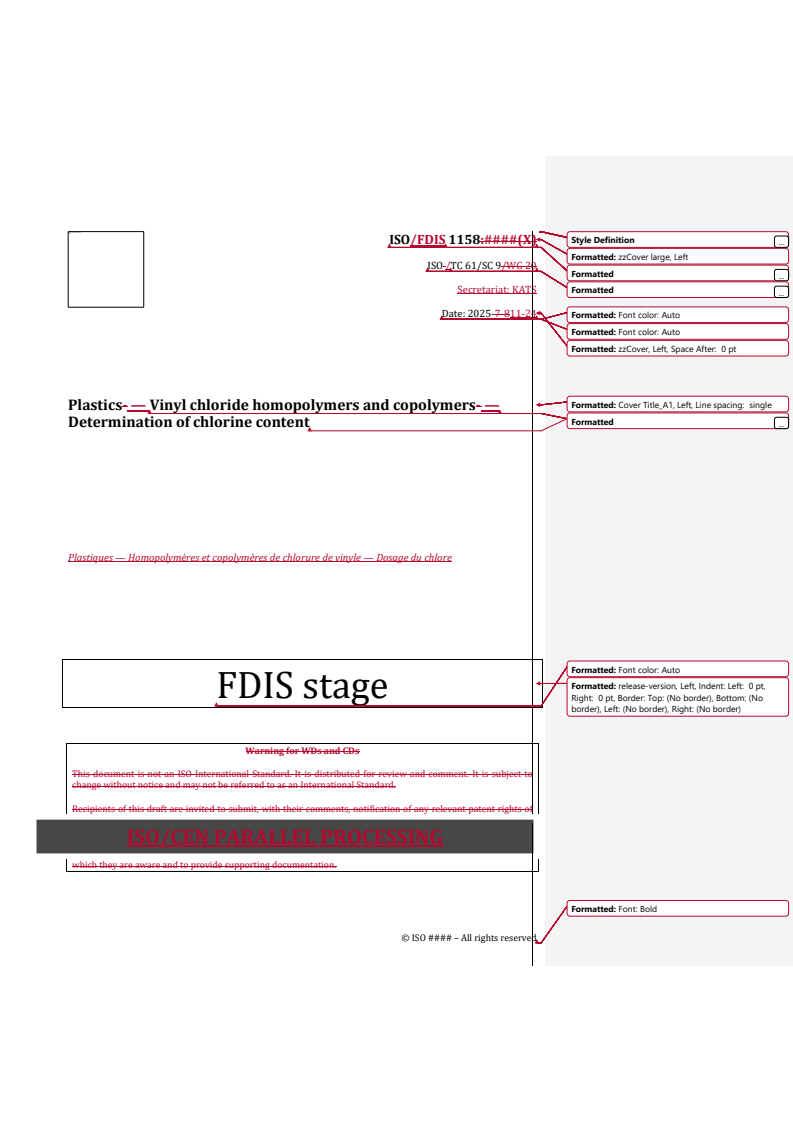
REDLINE ISO/FDIS 1158 - Plastics — Vinyl chloride homopolymers and copolymers — Determination of chlorine content Released:11/24/2025
ISO/FDIS 1158 - Plastiques — Homopolymères et copolymères de chlorure de vinyle — Dosage du chlore Released:6. 01. 2026
Frequently Asked Questions
ISO/FDIS 1158 is a draft published by the International Organization for Standardization (ISO). Its full title is "Plastics — Vinyl chloride homopolymers and copolymers — Determination of chlorine content". This standard covers: Plastics — Vinyl chloride homopolymers and copolymers — Determination of chlorine content
Plastics — Vinyl chloride homopolymers and copolymers — Determination of chlorine content
ISO/FDIS 1158 is classified under the following ICS (International Classification for Standards) categories: 83.080.20 - Thermoplastic materials. The ICS classification helps identify the subject area and facilitates finding related standards.
ISO/FDIS 1158 has the following relationships with other standards: It is inter standard links to ISO 22553-13:2021, ISO 1158:1998. Understanding these relationships helps ensure you are using the most current and applicable version of the standard.
ISO/FDIS 1158 is available in PDF format for immediate download after purchase. The document can be added to your cart and obtained through the secure checkout process. Digital delivery ensures instant access to the complete standard document.
Standards Content (Sample)
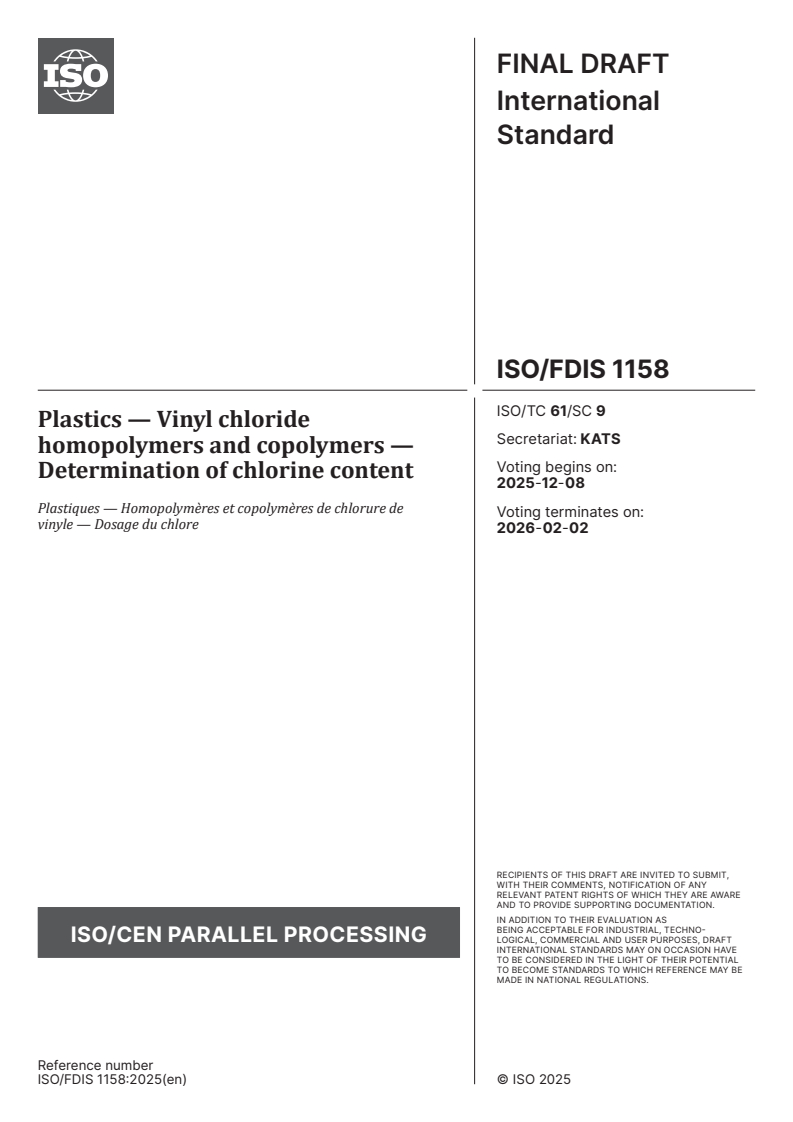
FINAL DRAFT
International
Standard
ISO/TC 61/SC 9
Plastics — Vinyl chloride
Secretariat: KATS
homopolymers and copolymers —
Voting begins on:
Determination of chlorine content
2025-12-08
Plastiques — Homopolymères et copolymères de chlorure de
Voting terminates on:
vinyle — Dosage du chlore
2026-02-02
RECIPIENTS OF THIS DRAFT ARE INVITED TO SUBMIT,
WITH THEIR COMMENTS, NOTIFICATION OF ANY
RELEVANT PATENT RIGHTS OF WHICH THEY ARE AWARE
AND TO PROVIDE SUPPOR TING DOCUMENTATION.
IN ADDITION TO THEIR EVALUATION AS
BEING ACCEPTABLE FOR INDUSTRIAL, TECHNO
ISO/CEN PARALLEL PROCESSING LOGICAL, COMMERCIAL AND USER PURPOSES, DRAFT
INTERNATIONAL STANDARDS MAY ON OCCASION HAVE
TO BE CONSIDERED IN THE LIGHT OF THEIR POTENTIAL
TO BECOME STAN DARDS TO WHICH REFERENCE MAY BE
MADE IN NATIONAL REGULATIONS.
Reference number
FINAL DRAFT
International
Standard
ISO/TC 61/SC 9
Plastics — Vinyl chloride
Secretariat: KATS
homopolymers and copolymers —
Voting begins on:
Determination of chlorine content
Plastiques — Homopolymères et copolymères de chlorure de
Voting terminates on:
vinyle — Dosage du chlore
RECIPIENTS OF THIS DRAFT ARE INVITED TO SUBMIT,
WITH THEIR COMMENTS, NOTIFICATION OF ANY
RELEVANT PATENT RIGHTS OF WHICH THEY ARE AWARE
AND TO PROVIDE SUPPOR TING DOCUMENTATION.
© ISO 2025
IN ADDITION TO THEIR EVALUATION AS
All rights reserved. Unless otherwise specified, or required in the context of its implementation, no part of this publication may
BEING ACCEPTABLE FOR INDUSTRIAL, TECHNO
ISO/CEN PARALLEL PROCESSING
LOGICAL, COMMERCIAL AND USER PURPOSES, DRAFT
be reproduced or utilized otherwise in any form or by any means, electronic or mechanical, including photocopying, or posting on
INTERNATIONAL STANDARDS MAY ON OCCASION HAVE
the internet or an intranet, without prior written permission. Permission can be requested from either ISO at the address below
TO BE CONSIDERED IN THE LIGHT OF THEIR POTENTIAL
or ISO’s member body in the country of the requester.
TO BECOME STAN DARDS TO WHICH REFERENCE MAY BE
MADE IN NATIONAL REGULATIONS.
ISO copyright office
CP 401 • Ch. de Blandonnet 8
CH-1214 Vernier, Geneva
Phone: +41 22 749 01 11
Email: copyright@iso.org
Website: www.iso.org
Published in Switzerland Reference number
ii
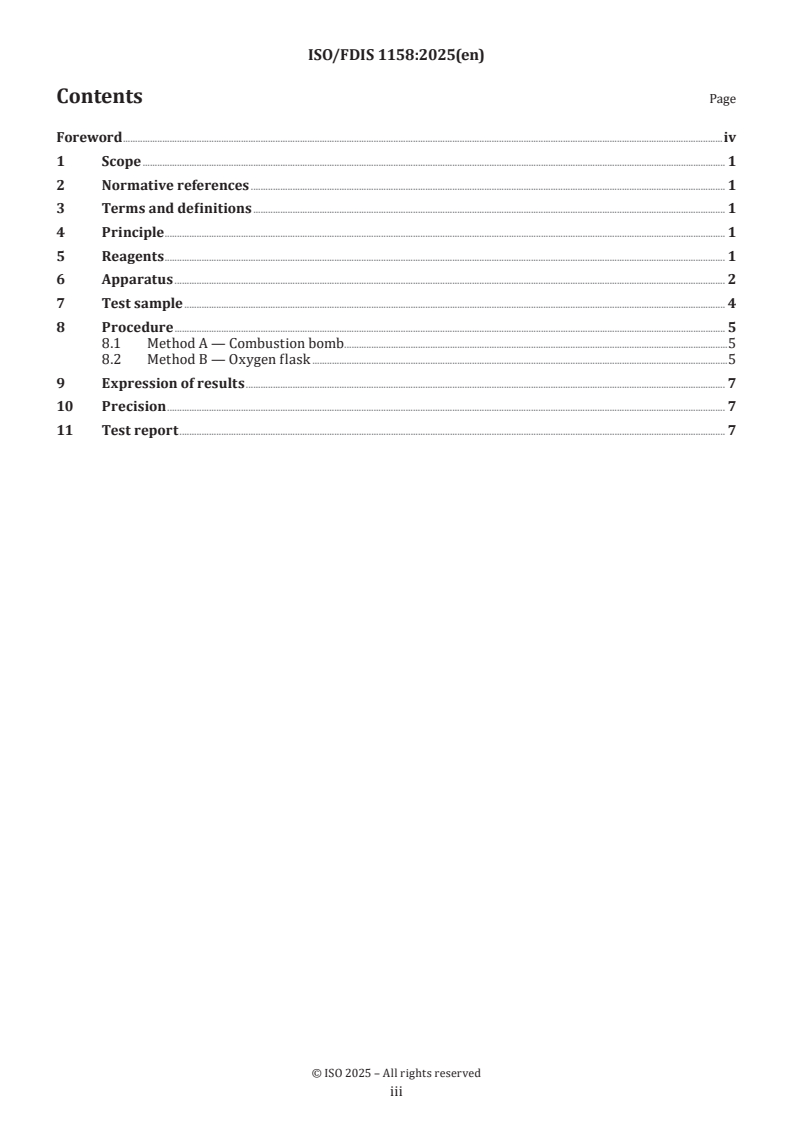
Contents Page
Foreword .iv
1 Scope . 1
2 Normative references . 1
3 Terms and definitions . 1
4 Principle . 1
5 Reagents . 1
6 Apparatus . 2
7 Test sample . 4
8 Procedure . 5
8.1 Method A — Combustion bomb . .5
8.2 Method B — Oxygen flask .5
9 Expression of results . 7
10 Precision . 7
11 Test report . 7
iii
Foreword
ISO (the International Organization for Standardization) is a worldwide federation of national standards
bodies (ISO member bodies). The work of preparing International Standards is normally carried out through
ISO technical committees. Each member body interested in a subject for which a technical committee
has been established has the right to be represented on that committee. International organizations,
governmental and non-governmental, in liaison with ISO, also take part in the work. ISO collaborates closely
with the International Electrotechnical Commission (IEC) on all matters of electrotechnical standardization.
The procedures used to develop this document and those intended for its further maintenance are described
in the ISO/IEC Directives, Part 1. In particular, the different approval criteria needed for the different types
of ISO document should be noted. This document was drafted in accordance with the editorial rules of the
ISO/IEC Directives, Part 2 (see www.iso.org/directives).
ISO draws attention to the possibility that the implementation of this document may involve the use of (a)
patent(s). ISO takes no position concerning the evidence, validity or applicability of any claimed patent
rights in respect thereof. As of the date of publication of this document, ISO had not received notice of (a)
patent(s) which may be required to implement this document. However, implementers are cautioned that
this may not represent the latest information, which may be obtained from the patent database available at
www.iso.org/patents. ISO shall not be held responsible for identifying any or all such patent rights.
Any trade name used in this document is information given for the convenience of users and does not
constitute an endorsement.
For an explanation of the voluntary nature of standards, the meaning of ISO specific terms and expressions
related to conformity assessment, as well as information about ISO's adherence to the World Trade
Organization (WTO) principles in the Technical Barriers to Trade (TBT), see www.iso.org/iso/foreword.html.
This document was prepared by Technical Committee ISO/TC 61, Plastics, Subcommittee SC 9, Thermoplastics
materials, in collaboration with the European Committee for Standardization (CEN) Technical Committee
CEN/TC 249, Plastics, in accordance with the Agreement on technical cooperation between ISO and CEN
(Vienna Agreement).
This fourth edition cancels and replaces the third edition (ISO 1158:1998), which has been technically
revised.
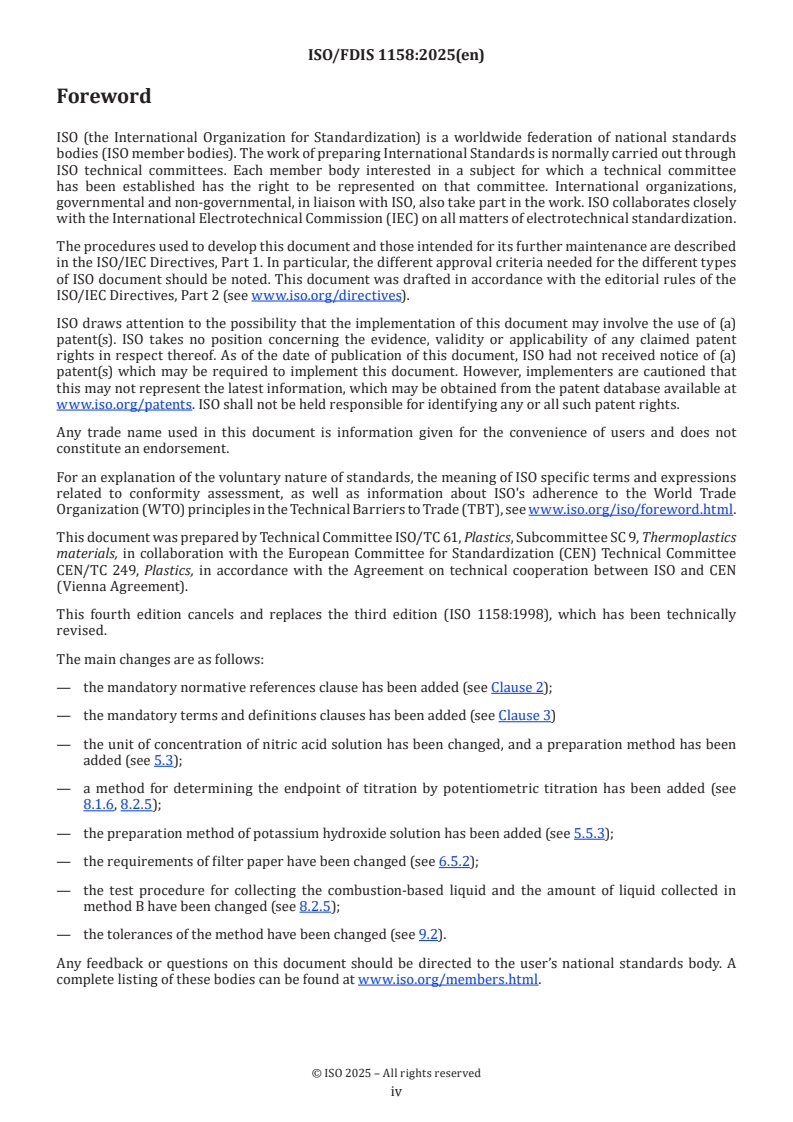
The main changes are as follows:
— the mandatory normative references clause has been added (see Clause 2);
— the mandatory terms and definitions clauses has been added (see Clause 3)
— the unit of concentration of nitric acid solution has been changed, and a preparation method has been
added (see 5.3);
— a method for determining the endpoint of titration by potentiometric titration has been added (see
8.1.6, 8.2.5);
— the preparation method of potassium hydroxide solution has been added (see 5.5.3);
— the requirements of filter paper have been changed (see 6.5.2);
— the test procedure for collecting the combustion-based liquid and the amount of liquid collected in
method B have been changed (see 8.2.5);
— the tolerances of the method have been changed (see 9.2).
Any feedback or questions on this document should be directed to the user’s national standards body. A
complete listing of these bodies can be found at www.iso.org/members.html.
iv
FINAL DRAFT International Standard ISO/FDIS 1158:2025(en)
Plastics — Vinyl chloride homopolymers and copolymers —
Determination of chlorine content
WARNING — All precautions in this document shall be taken to protect operators from risks
presented by both methods.
1 Scope
This document specifies two methods for the determination of the chlorine content of homopolymers and
copolymers of vinyl chloride, free from plasticizers or additives, namely:
— method A (combustion in a bomb);
— method B (combustion in a flask).
2 Normative references
The following documents are referred to in the text in such a way that some or all of their content constitutes
requirements of this document. For dated references, only the edition cited applies. For undated references,
the latest edition of the referenced document (including any amendments) applies.
ISO 3696, Water for analytical laboratory use — Specification and test methods
ISO 6353-1, Reagents for chemical analysis — Part 1: General test methods
3 Terms and definitions
No terms and definitions are listed in this document.
ISO and IEC maintain terminology databases for use in standardization at the following addresses:
— ISO Online browsing platform: available at https:// www
...
The picture can't be displayed.
Style Definition
...
Formatted: zzCover large, Left
ISO /TC 61/SC 9/WG 20
Formatted
...
Secretariat: KATS
Formatted
...
Date: 2025-7-811-24
Formatted: Font color: Auto
Formatted: Font color: Auto
Formatted: zzCover, Left, Space After: 0 pt
Formatted: Cover Title_A1, Left, Line spacing: single
Plastics- — Vinyl chloride homopolymers and copolymers- —
Formatted
Determination of chlorine content .
Plastiques — Homopolymères et copolymères de chlorure de vinyle — Dosage du chlore
Formatted: Font color: Auto
Formatted: release-version, Left, Indent: Left: 0 pt,
FDIS stage
Right: 0 pt, Border: Top: (No border), Bottom: (No
border), Left: (No border), Right: (No border)
Warning for WDs and CDs
This document is not an ISO International Standard. It is distributed for review and comment. It is subject to
change without notice and may not be referred to as an International Standard.
Recipients of this draft are invited to submit, with their comments, notification of any relevant patent rights of
IISOSO/CE/CEN PN PARARAALLLLEEL PL PRROOCCEESSSISINGNG
which they are aware and to provide supporting documentation.
Formatted: Font: Bold
© ISO #### – All rights reserved
ISO #####-#:####(X)
A model manuscript of a draft International Standard (known as “The Rice Model”) is available at
https://www.iso.org/iso/model_document-rice_model.pdf
2 © ISO #### – All rights reserved
Formatted: Font: Bold
© ISO #### – All rights reserved
Formatted: Font: 11 pt, Bold
Formatted: Font: 11 pt, Bold
Formatted: Font: 11 pt, Bold
Formatted: HeaderCentered, Space After: 0 pt, Line
spacing: single
All rights reserved. Unless otherwise specified, or required in the context of its implementation, no part of this publication
may be reproduced or utilized otherwise in any form or by any means, electronic or mechanical, including photocopying, Formatted: Right: 42.55 pt, Bottom: 28.35 pt, Gutter:
or posting on the internet or an intranet, without prior written permission. Permission can be requested from either ISO 0 pt, Header distance from edge: 36 pt, Footer
at the address below or ISO’s member body in the country of the requester. distance from edge: 14.15 pt
Formatted: Font color: Auto
ISO copyright office
Formatted: Indent: Left: 0 pt, Right: 0 pt, Adjust
CP 401 • Ch. de Blandonnet 8
space between Latin and Asian text, Adjust space
CH-1214 Vernier, Geneva
between Asian text and numbers
Phone: + 41 22 749 01 11
EmailE-mail: copyright@iso.org
Formatted: Font color: Auto, French (Switzerland)
Website: www.iso.orgwww.iso.org
Formatted: Font color: Auto, French (Switzerland)
Published in Switzerland
Formatted: Font color: Auto, French (Switzerland)
Formatted: Font color: Auto, English (United Kingdom)
Formatted: Font color: Auto, English (United Kingdom)
Formatted: Font: 10 pt
Formatted: Font: 10 pt
Formatted: Font: 11 pt
Formatted: FooterPageRomanNumber, Space After: 0
pt, Line spacing: single
iv © ISO #### 2025 – All rights reserved
iv
Formatted: Font: 11 pt, Bold
Formatted: Font: 11 pt, Bold
Formatted: HeaderCentered, Left, Space After: 0 pt,
Contents
Line spacing: single
Formatted: Font: 11 pt, Bold
Foreword . vi
1 Scope . 1
2 Normative references . 1
3 Terms and definitions . 1
4 Principle . 1
5 Reagents . 1
6 Apparatus . 2
7 Test sample . 5
8 Procedure . 5
9 Expression of results . 8
10 Precision . 8
11 Test report . 9
This template allows you to work with default MS Word functions and styles. You can use these if you want to
maintain the Table of Contents automatically and apply auto-numbering.
To update the Table of Contents please select it and press "F9".
Foreword . iv
—Added the Normative references(s Added the Terms and definitions ee 2) ; . iv
—Added the Terms and definitions(see 3) . iv
1 Scope . 1
2 Normative references . 1
3 Terms and definitions . 1
4 Principle . 1
5 Reagents . 1
6 Apparatus . 2
7 Test sample . 3
8 Procedure . 3
9 Expression of results . 5
10 Precision . 5
11 Test report . 5
Formatted: Font: 10 pt
Formatted: Font: 10 pt
Formatted: Font: 11 pt
Formatted: FooterPageRomanNumber, Space After: 0
pt, Line spacing: single
© ISO #### 2025 – All rights reserved
v
Formatted: Font: 11 pt, Bold
Formatted: Font: 11 pt, Bold
Formatted: HeaderCentered, Space After: 0 pt, Line
Foreword
spacing: single
Formatted: Font: 11 pt, Bold
ISO (the International Organization for Standardization) is a worldwide federation of national standards
bodies (ISO member bodies). The work of preparing International Standards is normally carried out through
ISO technical committees. Each member body interested in a subject for which a technical committee has been
established has the right to be represented on that committee. International organizations, governmental and
non-governmental, in liaison with ISO, also take part in the work. ISO collaborates closely with the
International Electrotechnical Commission (IEC) on all matters of electrotechnical standardization.
The procedures used to develop this document and those intended for its further maintenance are described
in the ISO/IEC Directives, Part 1. In particular, the different approval criteria needed for the different types of
ISO documentsdocument should be noted. This document was drafted in accordance with the editorial rules
of the ISO/IEC Directives, Part 2 (see www.iso.org/directives 2 (see www.iso.org/directives).
ISO draws attention to the possibility that the implementation of this document may involve the use of (a)
patent(s). ISO takes no position concerning the evidence, validity or applicability of any claimed patent rights
in respect thereof. As of the date of publication of this document, ISO had not received notice of (a) patent(s)
which may be required to implement this document. However, implementers are cautioned that this may not
represent the latest information, which may be obtained from the patent database available at
www.iso.org/patents.www.iso.org/patents. ISO shall not be held responsible for identifying any or all such
patent rights.
Any trade name used in this document is information given for the convenience of users and does not
constitute an endorsement.
For an explanation of the voluntary nature of standards, the meaning of ISO specific terms and expressions
related to conformity assessment, as well as information about ISO's adherence to the World Trade
Organization (WTO) principles in the Technical Barriers to Trade (TBT), see
www.iso.org/iso/foreword.htmlwww.iso.org/iso/foreword.html.
This document was prepared by Technical Committee ISO/TC 61, Plastics, Subcommittee SC 9, Thermoplastics
Materials.materials, in collaboration with the European Committee for Standardization (CEN) Technical
Committee CEN/TC 249, Plastics, in accordance with the Agreement on technical cooperation between ISO
and CEN (Vienna Agreement).
This fourth edition cancels and replaces the third edition (ISO 1158:19881998), which has been technically
revised.
The main changes are as follows:
—Changed the scope of application of the document(see Clause 1);
—Added the Normative references(see Clause 2) ;
—Added the Terms and definitions(see Clause 3)
— —Changed the mandatory normative references clause has been added (see Clause 2);
— the mandatory terms and definitions clauses has been added (see Clause 3)
Formatted: Font: 10 pt
— the unit of concentration of nitric acid solution has been changed, and addeda preparation method(see
5.3); has been added (see 5.3);
Formatted: Font: 10 pt
Formatted: Font: 11 pt
— —Added a method for determining the endpoint of titration by potentiometric titration(see 8.1.6,8.2.5);
Formatted: FooterPageRomanNumber, Space After: 0
has been added (see 8.1.6, 8.2.5);
pt, Line spacing: single
vi © ISO #### 2025 – All rights reserved
vi
Formatted: Font: 11 pt, Bold
Formatted: Font: 11 pt, Bold
Formatted: HeaderCentered, Left, Space After: 0 pt,
— —Thethe preparation method of potassium hydroxide solution has been added (see 5.8);5.5.3);
Line spacing: single
Formatted: Font: 11 pt, Bold
— —Changed the requirements of filter paper (see 6.9);have been changed (see 6.5.2);
— —Changed the test procedure for collecting the combustion-based liquid and the amount of liquid
collected in method B(see 8.2.5); have been changed (see 8.2.5);
— —Changed the tolerances of the method have been changed (see 9.2);9.2).
A list of all parts in the ISO ##### series can be found on the ISO website.
Any feedback or questions on this document should be directed to the user’s national standards body. A
complete listing of these bodies can be found at www.iso.org/members.htmlwww.iso.org/members.html.
Formatted: Font: 10 pt
Formatted: Font: 10 pt
Formatted: Font: 11 pt
Formatted: FooterPageRomanNumber, Space After: 0
pt, Line spacing: single
© ISO #### 2025 – All rights reserved
vii
Formatted: HeaderCentered
Formatted: Font: Bold
Formatted
...
Plastics- — Vinyl chloride homopolymers and copolymers- —
Determination of chlorine content
WARNING— — All precautions in this document shall be taken, particularly those mentioned in the text of
Formatted
...
the present International Standard, to protect operators from risks presented by both methods.
1 Scope
Formatted: Font color: Auto
Formatted: Font color: Auto
This document specifies two methods for the determination of the chlorine content of homopolymers and
Formatted: Body Text
copolymers of vinyl chloride, free from plasticizers or additives, namely:
Formatted: List Continue 1, No bullets or numbering,
— method A( (combustion in a bomb););
Don't keep with next
Formatted
...
— method B( (combustion in a flask).
Formatted: Font color: Auto
2 Normative references
Formatted: Font color: Auto
Formatted: Font color: Auto
The following documents are referred to in the text in such a way that some or all of their content constitutes
Formatted: RefNorm
requirements of this document. For dated references, only the edition cited applies. For undated references,
the latest edition of the referenced document (including any amendments) applies.
Formatted
...
Formatted: Font color: Auto
ISO 3696, Water for analytical laboratory use — Specification and test methods
Formatted: List Continue 1, No bullets or numbering,
ISO 6353--1, Reagents for chemical analysis — Part 1: General test methods
Don't keep with next
Field Code Changed
3 Terms and definitions
Formatted: Hyperlink, No underline, Font color: A
...
PROJET FINAL
Norme
internationale
ISO/TC 61/SC 9
Plastiques — Homopolymères et
Secrétariat: KATS
copolymères de chlorure de vinyle
Début de vote:
— Dosage du chlore
2025-12-08
Plastics — Vinyl chloride homopolymers and copolymers —
Vote clos le:
Determination of chlorine content
2026-02-02
LES DESTINATAIRES DU PRÉSENT PROJET SONT
INVITÉS À PRÉSENTER, AVEC LEURS OBSERVATIONS,
NOTIFICATION DES DROITS DE PROPRIÉTÉ DONT ILS
AURAIENT ÉVENTUELLEMENT CONNAISSANCE ET À
FOURNIR UNE DOCUMENTATION EXPLICATIVE.
OUTRE LE FAIT D’ÊTRE EXAMINÉS POUR
ÉTABLIR S’ILS SONT ACCEPTABLES À DES FINS
INDUSTRIELLES, TECHNOLOGIQUES ET COM-MERCIALES,
AINSI QUE DU POINT DE VUE DES UTILISATEURS, LES
PROJETS DE NORMES
TRAITEMENT PARALLÈLE ISO/CEN
INTERNATIONALES DOIVENT PARFOIS ÊTRE CONSIDÉRÉS
DU POINT DE VUE DE LEUR POSSI BILITÉ DE DEVENIR DES
NORMES POUVANT
SERVIR DE RÉFÉRENCE DANS LA RÉGLEMENTATION
NATIONALE.
Numéro de référence
PROJET FINAL
Norme
internationale
ISO/TC 61/SC 9
Plastiques — Homopolymères et
Secrétariat: KATS
copolymères de chlorure de vinyle
Début de vote:
— Dosage du chlore
2025-12-08
Plastics — Vinyl chloride homopolymers and copolymers —
Vote clos le:
Determination of chlorine content
2026-02-02
LES DESTINATAIRES DU PRÉSENT PROJET SONT
INVITÉS À PRÉSENTER, AVEC LEURS OBSERVATIONS,
NOTIFICATION DES DROITS DE PROPRIÉTÉ DONT ILS
AURAIENT ÉVENTUELLEMENT CONNAISSANCE ET À
FOURNIR UNE DOCUMENTATION EXPLICATIVE.
DOCUMENT PROTÉGÉ PAR COPYRIGHT
OUTRE LE FAIT D’ÊTRE EXAMINÉS POUR
ÉTABLIR S’ILS SONT ACCEPTABLES À DES FINS
© ISO 2025 INDUSTRIELLES, TECHNOLOGIQUES ET COM-MERCIALES,
AINSI QUE DU POINT DE VUE DES UTILISATEURS, LES
Tous droits réservés. Sauf prescription différente ou nécessité dans le contexte de sa mise en œuvre, aucune partie de cette
PROJETS DE NORMES
TRAITEMENT PARALLÈLE ISO/CEN
INTERNATIONALES DOIVENT PARFOIS ÊTRE CONSIDÉRÉS
publication ne peut être reproduite ni utilisée sous quelque forme que ce soit et par aucun procédé, électronique ou mécanique,
DU POINT DE VUE DE LEUR POSSI BILITÉ DE DEVENIR DES
y compris la photocopie, ou la diffusion sur l’internet ou sur un intranet, sans autorisation écrite préalable. Une autorisation peut
NORMES POUVANT
être demandée à l’ISO à l’adresse ci-après ou au comité membre de l’ISO dans le pays du demandeur.
SERVIR DE RÉFÉRENCE DANS LA RÉGLEMENTATION
NATIONALE.
ISO copyright office
Case postale 401 • Ch. de Blandonnet 8
CH-1214 Vernier, Genève
Tél.: +41 22 749 01 11
E-mail: copyright@iso.org
Web: www.iso.org
Publié en Suisse Numéro de référence
ii
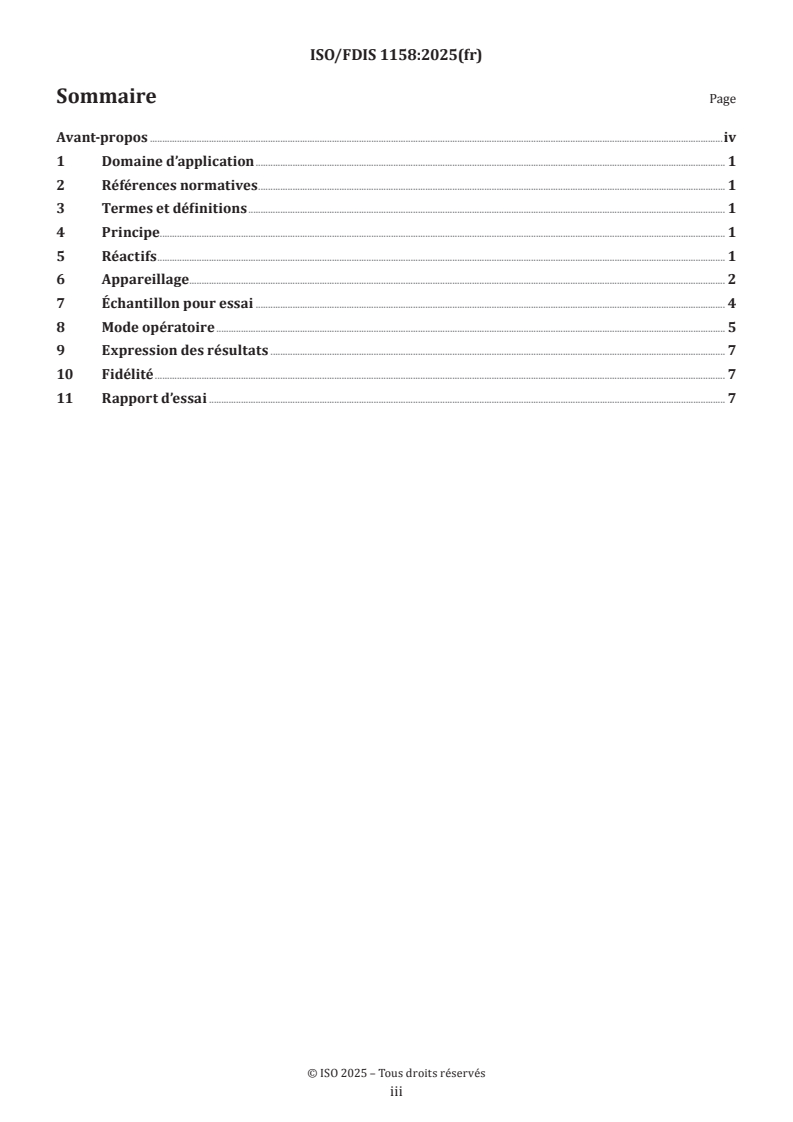
Sommaire Page
Avant-propos .iv
1 Domaine d’application . 1
2 Références normatives . 1
3 Termes et définitions . 1
4 Principe. 1
5 Réactifs . 1
6 Appareillage . 2
7 Échantillon pour essai . 4
8 Mode opératoire . 5
9 Expression des résultats . 7
10 Fidélité . 7
11 Rapport d’essai . 7
iii
Avant-propos
L’ISO (Organisation internationale de normalisation) est une fédération mondiale d’organismes nationaux
de normalisation (comités membres de l’ISO). L’élaboration des Normes internationales est en général
confiée aux comités techniques de l’ISO. Chaque comité membre intéressé par une étude a le droit de faire
partie du comité technique créé à cet effet. Les organisations internationales, gouvernementales et non
gouvernementales, en liaison avec l’ISO participent également aux travaux. L’ISO collabore étroitement avec
la Commission électrotechnique internationale (IEC) en ce qui concerne la normalisation électrotechnique.
Les procédures utilisées pour élaborer le présent document et celles destinées à sa mise à jour sont
décrites dans les Directives ISO/IEC, Partie 1. Il convient, en particulier, de prendre note des différents
critères d’approbation requis pour les différents types de documents ISO. Le présent document a
été rédigé conformément aux règles de rédaction données dans les Directives ISO/IEC, Partie 2 (voir
www.iso.org/directives).
L’ISO attire l’attention sur le fait que la mise en application du présent document peut entraîner l’utilisation
d’un ou de plusieurs brevets. L’ISO ne prend pas position quant à la preuve, à la validité et à l’applicabilité de
tout droit de brevet revendiqué à cet égard. À la date de publication du présent document, l’ISO n’avait pas
reçu notification qu’un ou plusieurs brevets pouvaient être nécessaires à sa mise en application. Toutefois,
il y a lieu d’avertir les responsables de la mise en application du présent document que des informations
plus récentes sont susceptibles de figurer dans la base de données de brevets, disponible à l’adresse
www.iso.org/brevets. L’ISO ne saurait être tenue pour responsable de ne pas avoir identifié tout ou partie de
tels droits de brevet.
Les appellations commerciales éventuellement mentionnées dans le présent document sont données pour
information, par souci de commodité, à l’intention des utilisateurs et ne sauraient constituer un engagement.
Pour une explication de la nature volontaire des normes, la signification des termes et expressions
spécifiques de l’ISO liés à l’évaluation de la conformité, ou pour toute information au sujet de l’adhésion de
l’ISO aux principes de l’Organisation mondiale du commerce (OMC) concernant les obstacles techniques au
commerce (OTC), voir www.iso.org/avant-propos.
Le présent document a été élaboré par le comité technique ISO/TC 61, Plastiques, sous-comité SC 9, Matériaux
thermoplastiques, en collaboration avec le comité technique CEN/TC 249, Plastiques, du Comité européen de
normalisation (CEN), conformément à l’Accord de coopération technique entre l’ISO et le CEN (Accord de
Vienne).
Cette quatrième édition annule et remplace la troisième édition (ISO 1158:1998), qui a fait l’objet d’une
révision technique.
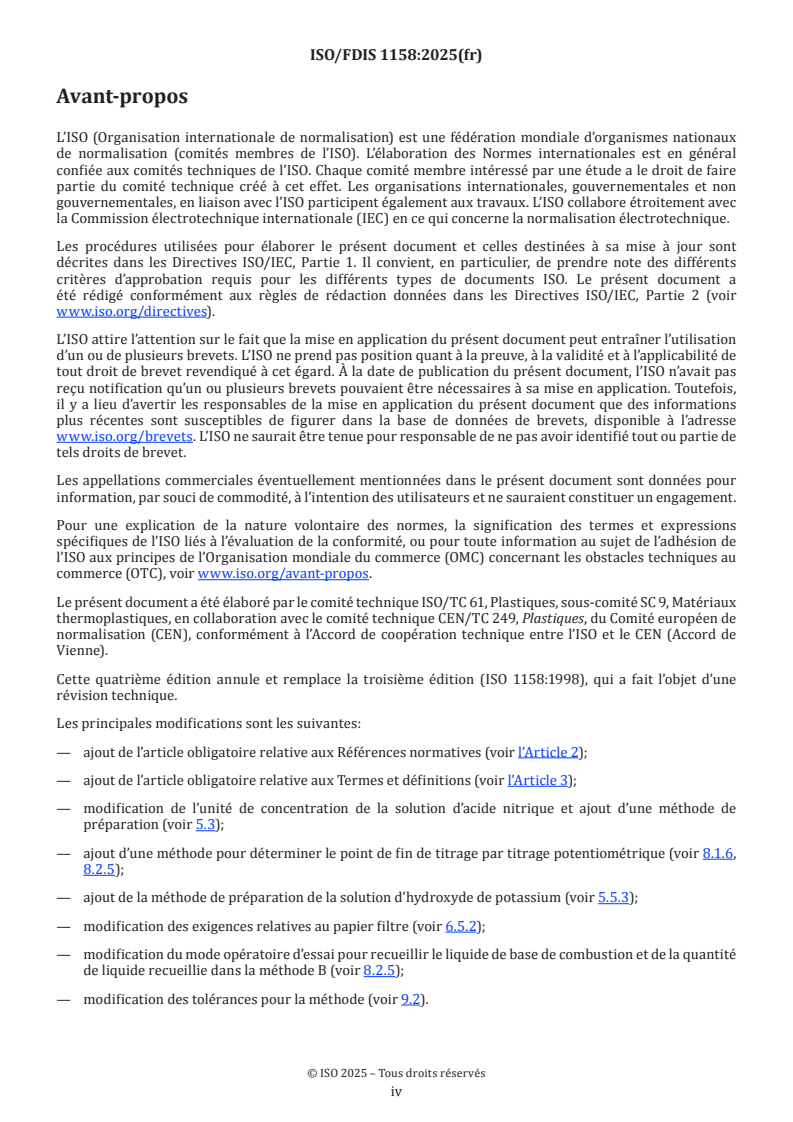
Les principales modifications sont les suivantes:
— ajout de l’article obligatoire relative aux Références normatives (voir l’Article 2);
— ajout de l’article obligatoire relative aux Termes et définitions (voir l’Article 3);
— modification de l’unité de concentration de la solution d’acide nitrique et ajout d’une méthode de
préparation (voir 5.3);
— ajout d’une méthode pour déterminer le point de fin de titrage par titrage potentiométrique (voir 8.1.6,
8.2.5);
— ajout de la méthode de préparation de la solution d’hydroxyde de potassium (voir 5.5.3);
— modification des exigences relatives au papier filtre (voir 6.5.2);
— modification du mode opératoire d’essai pour recueillir le liquide de base de combustion et de la quantité
de liquide recueillie dans la méthode B (voir 8.2.5);
— modification des tolérances pour la méthode (voir 9.2).
iv
Il convient que l’utilisateur adresse tout retour d’information ou toute question concernant le présent
document à l’organisme national de normalisation de son pays. Une liste exhaustive desdits organismes se
trouve à l’adresse www.iso.org/fr/members.html.
v
PROJET FINAL Norme internationale ISO/FDIS 1158:2025(fr)
Plastiques — Homopolymères et copolymères de chlorure de
vinyle — Dosage du chlore
AVERTISSEMENT — Toutes les précautions du présent document doivent être prises pour prémunir
les opérateurs contre les risques présentés par les deux méthodes.
1 Domaine d’application
Le présent document spécifie deux méthodes pour le dosage du chlore dans les homopolymères et les
copolymères de chlorure de vinyle ne contenant ni plastifiants ni additifs, à savoir:
— méthode A (combustion dans une bombe);
— méthode B (combustion dans un ballon).
2 Références normatives
Les documents suivants sont cités dans le texte de sorte qu’ils constituent, pour tout ou partie de leur
contenu, des exigences du présent document. Pour les références datées, seule l’édition citée s’applique. Pour
les références non datées, la dernière édition du document de référence s’applique (y compris les éventuels
amendements).
ISO 3696, Eau pour laboratoire à usage analytique — Spécification et méthodes d'essai
ISO 6353-1, Réactifs pour analyse chimique — Partie 1: Méthodes générales d'essai
3 Termes et définitions
Aucun terme n’est défini dans le présent document.
L’ISO et l’IEC tiennent à jour des bases de données terminologiques destinées à être utilisées en normalisation,
consultables aux adresses suivantes:
— ISO Online browsing platform: disponible à l’adresse https:// www .iso .org/ obp
— IEC Electropedia: disponible à l’adresse https:// www .electropedia .org/
4 Principe
Une prise d’essai est oxydée par le peroxyde de sodium (méthode A) ou par l’oxygène gazeux (méthode B) et
les chlorures résultants sont dosés par titrage potentiométrique ou volumétrique.
5 Réactifs
Au cours de l’analyse, utiliser uniquement des réactifs de qualité analytique comme spécifié dans l’ISO 6353-1
et de l’eau de qualité 3 ou de plus grande pureté comme spécifié dans l’I
...
Questions, Comments and Discussion
Ask us and Technical Secretary will try to provide an answer. You can facilitate discussion about the standard in here.
Loading comments...