

ISO 182-3:2023
(Main)Plastics — Determination of the tendency of compounds and products based on vinyl chloride homopolymers and copolymers to evolve hydrogen chloride and any other acidic products at elevated temperatures — Part 3: Conductometric method
General Information
- Abstract
This document specifies a method for the determination of the thermal stability at elevated temperature of compounds and products based on vinyl chloride homopolymers and copolymers (in the following text abbreviated as PVC) which undergo dehydrochlorination (the evolution of hydrogen chloride). This document is applicable to the characterization of PVC compounds and products, especially with regard to the effectiveness of their heat-stabilizing systems. It is applicable to coloured PVC compounds and products where a discolouration test under the action of heat may be unsatisfactory. This document is applicable to compounded PVC materials and products. It can be applicable to polymers in powder form under appropriate conditions, to be agreed upon between the interested parties. This document does not apply to PVC compounds in the form of dry blends, since such materials can be not sufficiently homogeneous. This document does not apply to PVC compounds and products which evolve other decomposition products, in addition to hydrogen chloride, at elevated temperatures that can affect the conductivity of water when they are absorbed into it. In this case, a method suitable for the determination of chloride ion (Cl−) in the absorbing solution shall be used (see ISO 182-4[2]). This document can also be applied to other plastics materials which can evolve hydrogen chloride or other hydrogen halides when heated under the conditions prescribed by the relevant specifications, or as agreed upon between the interested parties.
- Status
- Withdrawn
- Publication Date
- 05-Dec-2023
- Technical Committee
- ISO/TC 61/SC 9 - Thermoplastic materials
- Drafting Committee
- ISO/TC 61/SC 9 - Thermoplastic materials
- Current Stage
- 9599 - Withdrawal of International Standard
- Start Date
- 22-Oct-2025
- Completion Date
- 29-Aug-2026
Buy Documents
ISO 182-3:2023 - Plastics — Determination of the tendency of compounds and products based on vinyl chloride homopolymers and copolymers to evolve hydrogen chloride and any other acidic products at elevated temperatures — Part 3: Conductometric method Released:6. 12. 2023
ISO 182-3:2023 - Plastiques — Détermination de la tendance des compositions et produits a base d’homopolymeres et de copolymeres du chlorure de vinyle a dégager du chlorure d’hydrogene et éventuellement d’autres produits acides a températures élevées — Partie 3: Méthode conductimétrique Released:6. 12. 2023
Overview
ISO 182-3:2023 - Plastics - Conductometric method - specifies a laboratory test to determine the tendency of PVC (vinyl chloride homopolymers and copolymers) compounds and products to evolve hydrogen chloride (HCl) and other acidic products at elevated temperatures. The method measures thermal stability by absorbing evolved HCl into demineralized water and recording the change in electrical conductivity (conductometric measurement). The standard is intended for characterization of compounded PVC materials and for assessing the effectiveness of heat‑stabilizing systems, especially when colour changes are not a reliable indicator.
Key topics and technical requirements
- Principle: Dehydrochlorination of a prescribed test portion in a nitrogen atmosphere; evolved HCl is absorbed in demineralized water and quantified via conductivity change.
- Stability time (ts): Time until a predetermined conductivity change is reached - a measure of thermal stability.
- Reagents: High‑purity nitrogen (≤ 6 ppm O2, ≤ 0.1 ppm CO2) and demineralized water (conductivity ≤ 5 μS/cm).
- Apparatus: Dehydrochlorination cells (Cell A reusable; Cell B disposable), measurement cell, sintered‑glass disc (ISO 4793 grade P100), heating bath or metal heating block (170–210 °C capability ±0.1 °C), thermometer, flowmeter, conductance meter and electrodes, analytical balance. The 2023 revision explicitly adds alternative heating blocks (metal blocks) as acceptable.
- Scope & limitations: Applicable to compounded PVC (films, sheets, coatings, cables, pellets, plastisols under agreed conditions). Not applicable to dry blends (inhomogeneous) or to materials that evolve other decomposition products that alter water conductivity - in such cases use ion‑specific methods (see ISO 182‑4).
- Test procedure & reporting: Includes sample preparation, gas flow control, temperature control, measurement cell setup, calculation of results, and reporting. Precision data (repeatability, reproducibility) and interlaboratory findings are included.
Practical applications
- Quality control and batch acceptance testing for PVC formulations.
- Evaluation and optimization of heat‑stabilizer systems in PVC compounds.
- R&D screening of new PVC formulations, additives, cables, coatings and extruded products.
- Situations where colour‑based thermal discoloration tests are unsuitable (pigmented or coloured PVC).
- Comparative testing during supplier qualification and failure analysis when thermal degradation is suspected.
Who should use ISO 182-3:2023
- Polymer and PVC compound manufacturers
- Additive and stabilizer suppliers
- Cable, pipe and profile producers using PVC
- Independent testing laboratories and R&D departments
- Regulatory and standards bodies assessing material safety/performance
Related standards
- ISO 182 series (other parts for alternate methods)
- ISO 182-2 (pH‑meter method - comparison given in the standard)
- ISO 182-4 (chloride ion determination when interfering decomposition products are present)
Keywords: ISO 182-3:2023, PVC thermal stability, conductometric method, dehydrochlorination, hydrogen chloride evolution, heat stabilizers, conductivity measurement, PVC testing.
Relations
- Effective Date
- 12-Feb-2026
- Effective Date
- 06-Jun-2022
- Effective Date
- 07-Jan-2025
- Effective Date
- 06-Jun-2022
Buy Documents
ISO 182-3:2023 - Plastics — Determination of the tendency of compounds and products based on vinyl chloride homopolymers and copolymers to evolve hydrogen chloride and any other acidic products at elevated temperatures — Part 3: Conductometric method Released:6. 12. 2023
ISO 182-3:2023 - Plastiques — Détermination de la tendance des compositions et produits a base d’homopolymeres et de copolymeres du chlorure de vinyle a dégager du chlorure d’hydrogene et éventuellement d’autres produits acides a températures élevées — Partie 3: Méthode conductimétrique Released:6. 12. 2023
Get Certified
Connect with accredited certification bodies for this standard

DIN CERTCO
DIN Group product certification.

Smithers Quality Assessments
US management systems and product certification.
Sponsored listings
Frequently Asked Questions
ISO 182-3:2023 is a standard published by the International Organization for Standardization (ISO). Its full title is "Plastics — Determination of the tendency of compounds and products based on vinyl chloride homopolymers and copolymers to evolve hydrogen chloride and any other acidic products at elevated temperatures — Part 3: Conductometric method". This standard covers: This document specifies a method for the determination of the thermal stability at elevated temperature of compounds and products based on vinyl chloride homopolymers and copolymers (in the following text abbreviated as PVC) which undergo dehydrochlorination (the evolution of hydrogen chloride). This document is applicable to the characterization of PVC compounds and products, especially with regard to the effectiveness of their heat-stabilizing systems. It is applicable to coloured PVC compounds and products where a discolouration test under the action of heat may be unsatisfactory. This document is applicable to compounded PVC materials and products. It can be applicable to polymers in powder form under appropriate conditions, to be agreed upon between the interested parties. This document does not apply to PVC compounds in the form of dry blends, since such materials can be not sufficiently homogeneous. This document does not apply to PVC compounds and products which evolve other decomposition products, in addition to hydrogen chloride, at elevated temperatures that can affect the conductivity of water when they are absorbed into it. In this case, a method suitable for the determination of chloride ion (Cl−) in the absorbing solution shall be used (see ISO 182-4[2]). This document can also be applied to other plastics materials which can evolve hydrogen chloride or other hydrogen halides when heated under the conditions prescribed by the relevant specifications, or as agreed upon between the interested parties.
This document specifies a method for the determination of the thermal stability at elevated temperature of compounds and products based on vinyl chloride homopolymers and copolymers (in the following text abbreviated as PVC) which undergo dehydrochlorination (the evolution of hydrogen chloride). This document is applicable to the characterization of PVC compounds and products, especially with regard to the effectiveness of their heat-stabilizing systems. It is applicable to coloured PVC compounds and products where a discolouration test under the action of heat may be unsatisfactory. This document is applicable to compounded PVC materials and products. It can be applicable to polymers in powder form under appropriate conditions, to be agreed upon between the interested parties. This document does not apply to PVC compounds in the form of dry blends, since such materials can be not sufficiently homogeneous. This document does not apply to PVC compounds and products which evolve other decomposition products, in addition to hydrogen chloride, at elevated temperatures that can affect the conductivity of water when they are absorbed into it. In this case, a method suitable for the determination of chloride ion (Cl−) in the absorbing solution shall be used (see ISO 182-4[2]). This document can also be applied to other plastics materials which can evolve hydrogen chloride or other hydrogen halides when heated under the conditions prescribed by the relevant specifications, or as agreed upon between the interested parties.
ISO 182-3:2023 is classified under the following ICS (International Classification for Standards) categories: 83.080.20 - Thermoplastic materials. The ICS classification helps identify the subject area and facilitates finding related standards.
ISO 182-3:2023 has the following relationships with other standards: It is inter standard links to EN ISO 182-3:2023, ISO 6055:2023, ISO 182-3:2025, ISO 182-3:1993. Understanding these relationships helps ensure you are using the most current and applicable version of the standard.
ISO 182-3:2023 is available in PDF format for immediate download after purchase. The document can be added to your cart and obtained through the secure checkout process. Digital delivery ensures instant access to the complete standard document.
Standards Content (Sample)
INTERNATIONAL ISO
STANDARD 182-3
Second edition
2023-12
Plastics — Determination of
the tendency of compounds and
products based on vinyl chloride
homopolymers and copolymers to
evolve hydrogen chloride and any
other acidic products at elevated
temperatures —
Part 3:
Conductometric method
Plastiques — Détermination de la tendance des compositions et
produits à base d’homopolymères et de copolymères du chlorure de
vinyle à dégager du chlorure d’hydrogène et éventuellement d’autres
produits acides à températures élevées —
Partie 3: Méthode conductimétrique
Reference number
© ISO 2023
All rights reserved. Unless otherwise specified, or required in the context of its implementation, no part of this publication may
be reproduced or utilized otherwise in any form or by any means, electronic or mechanical, including photocopying, or posting on
the internet or an intranet, without prior written permission. Permission can be requested from either ISO at the address below
or ISO’s member body in the country of the requester.
ISO copyright office
CP 401 • Ch. de Blandonnet 8
CH-1214 Vernier, Geneva
Phone: +41 22 749 01 11
Email: copyright@iso.org
Website: www.iso.org
Published in Switzerland
ii
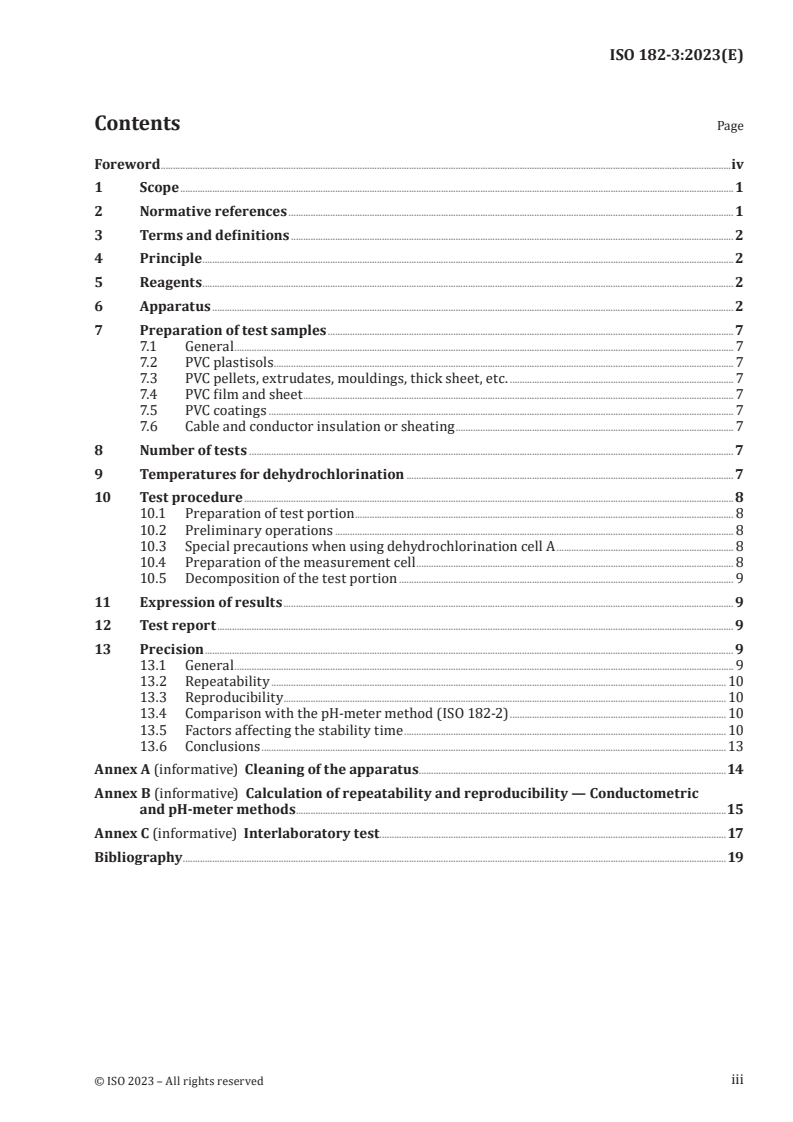
Contents Page
Foreword .iv
1 Scope . 1
2 Normative references . 1
3 Terms and definitions . 2
4 Principle . 2
5 Reagents . 2
6 Apparatus . 2
7 Preparation of test samples .7
7.1 General . 7
7.2 PVC plastisols . . 7
7.3 PVC pellets, extrudates, mouldings, thick sheet, etc. . 7
7.4 PVC film and sheet . 7
7.5 PVC coatings . 7
7.6 Cable and conductor insulation or sheating . 7
8 Number of tests . 7
9 Temperatures for dehydrochlorination . 7
10 Test procedure .8
10.1 Preparation of test portion . 8
10.2 Preliminary operations . 8
10.3 Special precautions when using dehydrochlorination cell A . 8
10.4 Preparation of the measurement cell . 8
10.5 Decomposition of the test portion . 9
11 Expression of results . 9
12 Test report . 9
13 Precision . 9
13.1 General . 9
13.2 Repeatability . 10
13.3 Reproducibility . 10
13.4 Comparison with the pH-meter method (ISO 182-2) . 10
13.5 Factors affecting the stability time . 10
13.6 Conclusions . 13
Annex A (informative) Cleaning of the apparatus .14
Annex B (informative) Calculation of repeatability and reproducibility — Conductometric
and pH-meter methods . .15
Annex C (informative) Interlaboratory test.17
Bibliography .19
iii
Foreword
ISO (the International Organization for Standardization) is a worldwide federation of national standards
bodies (ISO member bodies). The work of preparing International Standards is normally carried out
through ISO technical committees. Each member body interested in a subject for which a technical
committee has been established has the right to be represented on that committee. International
organizations, governmental and non-governmental, in liaison with ISO, also take part in the work.
ISO collaborates closely with the International Electrotechnical Commission (IEC) on all matters of
electrotechnical standardization.
The procedures used to develop this document and those intended for its further maintenance are
described in the ISO/IEC Directives, Part 1. In particular, the different approval criteria needed for the
different types of ISO document should be noted. This document was drafted in accordance with the
editorial rules of the ISO/IEC Directives, Part 2 (see www.iso.org/directives).
ISO draws attention to the possibility that the implementation of this document may involve the use
of (a) patent(s). ISO takes no position concerning the evidence, validity or applicability of any claimed
patent rights in respect thereof. As of the date of publication of this document, ISO had not received
notice of (a) patent(s) which may be required to implement this document. However, implementers are
cautioned that this may not represent the latest information, which may be obtained from the patent
database available at www.iso.org/patents. ISO shall not be held responsible for identifying any or all
such patent rights.
Any trade name used in this document is information given for the convenience of users and does not
constitute an endorsement.
For an explanation of the voluntary nature of standards, the meaning of ISO specific terms and
expressions related to conformity assessment, as well as information about ISO's adherence to
the World Trade Organization (WTO) principles in the Technical Barriers to Trade (TBT), see
www.iso.org/iso/foreword.html.
This document was prepared by Technical Committee ISO/TC 61, Plastics, Subcommittee SC 9,
Thermoplastic materials, in collaboration with the European Committee for Standardization (CEN)
Technical Committee CEN/TC 249, Plastics, in accordance with the Agreement on technical cooperation
between ISO and CEN (Vienna Agreement).
This second edition cancels and replaces the first edition (ISO 182-3:1993), which has been technically
revised.
The main changes are as follows:
— adding the use of alternative heating baths such as metal blocks.
A list of all parts in the ISO 182 series can be found on the ISO website.
Any feedback or questions on this document should be directed to the user’s national standards body. A
complete listing of these bodies can be found at www.iso.org/members.html.
iv
INTERNATIONAL STANDARD ISO 182-3:2023(E)
Plastics — Determination of the tendency of compounds
and products based on vinyl chloride homopolymers and
copolymers to evolve hydrogen chloride and any other
acidic products at elevated temperatures —
Part 3:
Conductometric method
WARNING — The use of this document can involve hazardous materials, operations and
equipment. This document does not purport to address all of the safety problems associated
with its use. It is the responsibility of the user of this document to establish appropriate safety
and health practices and determine the applicability of regulatory limitations prior to use.
1 Scope
1.1 This document specifies a method for the determination of the thermal stability at elevated
temperature of compounds and products based on vinyl chloride homopolymers and copolymers (in
the following text abbreviated as PVC) which undergo dehydrochlorination (the evolution of hydrogen
chloride).
1.2 This document is applicable to the characterization of PVC compounds and products, especially
with regard to the effectiveness of their heat-stabilizing systems.
It is applicable to coloured PVC compounds and products where a discolouration test under the action
of heat may be unsatisfactory.
1.3 This document is applicable to compounded PVC materials and products. It can be applicable
to polymers in powder form under appropriate conditions, to be agreed upon between the interested
parties.
This document does not apply to PVC compounds in the form of dry blends, since such materials can be
not sufficiently homogeneous.
1.4 This document does not apply to PVC compounds and products which evolve other decomposition
products, in addition to hydrogen chloride, at elevated temperatures that can affect the conductivity of
water when they are absorbed into it. In this case, a method suitable for the determination of chloride
− [2]
ion (Cl ) in the absorbing solution shall be used (see ISO 182-4 ).
1.5 This document can also be applied to other plastics materials which can evolve hydrogen chloride
or other hydrogen halides when heated under the conditions prescribed by the relevant specifications,
or as agreed upon between the interested parties.
2 Normative references
The following documents are referred to in the text in such a way that some or all of their content
constitutes requirements of this document. For dated references, only the edition cited applies. For
undated references, the latest edition of the referenced document (including any amendments) applies.
ISO 565, Test sieves — Metal wire cloth, perforated metal plate and electroformed sheet — Nominal sizes
of openings
ISO 4793, Laboratory sintered (fritted) filters — Porosity grading, classification and designation
ISO 6353-2, Reagents for chemical analysis — Part 2: Specifications — First series
3 Terms and definitions
For the purposes of this document, the following terms and definitions apply.
ISO and IEC maintain terminology databases for use in standardization at the following addresses:
— ISO Online browsing platform: available at https:// www .iso .org/ obp
— IEC Electropedia: available at https:// www .electropedia .org/
3.1
stability time
t
s
time, measured by reference to a predetermined change in the conductivity of absorbing demineralized
water, required for a certain amount of hydrogen chloride to be evolved when a prescribed mass of PVC
compound or product is maintained at an elevated temperature under the test conditions specified in
this document
4 Principle
A test portion of the PVC compound or product is maintained at an agreed temperature in a nitrogen gas
stream and the hydrogen chloride evolved is absorbed in a given amount of demineralized water. The
amount of hydrogen chloride evolved is determined in relation to the recorded change in conductivity
of the water.
5 Reagents
During the test, use only reagents of recognized analytical grade in accordance with ISO 6353-2.
5.1 Pure nitrogen, containing less than 6 ppm oxygen and less than 0,1 ppm carbon dioxide by
volume. The purity shall be such that when the gas is passed through demineralized water (see 5.2) for
1 h at a rate of (7,2 ± 0,1) l/h, the conductivity of the water remains unchanged.
The gas shall be dried by passing it through a suitable drying agent, and the flow-rate through the
dehydrochlorination cell adjusted by means of a needle valve and measured using a suitable flowmeter.
5.2 Demineralized water, with a conductivity not higher than 5 µS/cm.
6 Apparatus
The general arrangement of the apparatus is shown in Figure 1.
6.1 Dehydrochlorination cells.
6.1.1 Glass Cell A (re-usable), with shape and dimensions as shown in Figure 2.
A recommended procedure for cleaning the cell is given in Annex A.
6.1.2 Glass Cell B (disposable), with shape and dimensions as shown in Figure 3.
NOTE Other types of cell can be employed if it has been proved that the results obtained are equivalent to
those obtained with one of the cells described in 6.1.1 and 6.1.2.
6.2 Test portion holder, for use with cell A. The test portion is supported on a porous sintered-glass
disc grade P 100 specified in ISO 4793, 10 mm in diameter.
To prevent blocking of the porous disc, it is advisable to place a thin, soft layer of glass wool between it
and the test portion.
A recommended procedure for cleaning the disc support is given in Annex A.
Key
1 N cylinder with pure nitrogen 6 thermometer (resolution 0,1 °C)
2 flowmeter 7 magnetic stirrer (in case using heating oil bath)
3 heating bath/heating block including temperature 8 absorbing solution
controller (resolution 0,1 °C)
4 PVC test portion 9 measuring electrode(s)
5 dehydrochlorination cell (details see Figure 2 and 3) 10 conductance meter
Figure 1 — General arrangement of apparatus
Dimensions in millimetres
Key
1 spurs
2 17 coils
3 sintered-glass disc, 10 mm diameter (removable)
Figure 2 — Cell A (re-usable) for dehydrochlorination of PVC samples
Dimensions in millimetres
Key
1 disposable glass
2 disposable nitrogen inlet tube
3 sample
Figure 3 — Cell B (disposable) for dehydrochlorination of PVC samples
6.3 Glass connection tube, for use with cell A, connecting the dehydrochlorination cell to the
measurement cell and having dimensions as shown in Figure 4. The connection tube is secured to cell A
by two springs fixed to hooks on the ground-glass joints. The tube shall be provided with an insulating
jacket.
Dimensions in millimetres
Key
1, 2 spurs
Figure 4 — Glass tubes for connecting the dehydrochlorination cell to the measurement cell
(use for cell A)
6.4 Heating bath (e.g. oil bath)/Heating block (e.g. metal block) including temperature
controller with a capacity of at le
...
NORME ISO
INTERNATIONALE 182-3
Deuxième édition
2023-12
Plastiques — Détermination de
la tendance des compositions et
produits à base d’homopolymères et
de copolymères du chlorure de vinyle
à dégager du chlorure d’hydrogène
et éventuellement d’autres produits
acides à températures élevées —
Partie 3:
Méthode conductimétrique
Plastics — Determination of the tendency of compounds and
products based on vinyl chloride homopolymers and copolymers to
evolve hydrogen chloride and any other acidic products at elevated
temperatures —
Part 3: Conductometric method
Numéro de référence
DOCUMENT PROTÉGÉ PAR COPYRIGHT
© ISO 2023
Tous droits réservés. Sauf prescription différente ou nécessité dans le contexte de sa mise en œuvre, aucune partie de cette
publication ne peut être reproduite ni utilisée sous quelque forme que ce soit et par aucun procédé, électronique ou mécanique,
y compris la photocopie, ou la diffusion sur l’internet ou sur un intranet, sans autorisation écrite préalable. Une autorisation peut
être demandée à l’ISO à l’adresse ci-après ou au comité membre de l’ISO dans le pays du demandeur.
ISO copyright office
Case postale 401 • Ch. de Blandonnet 8
CH-1214 Vernier, Genève
Tél.: +41 22 749 01 11
E-mail: copyright@iso.org
Web: www.iso.org
Publié en Suisse
ii
Sommaire Page
Avant-propos .iv
1 Domaine d’application . 1
2 Références normatives .2
3 Termes et définitions . 2
4 Principe. 2
5 Réactifs . 2
6 Appareillage . 2
7 Préparation des échantillons pour essai . 7
7.1 Généralités . 7
7.2 Plastisols de PVC . 7
7.3 Granulés de PVC, extrudats, pièces moulées, plaques épaisses, etc. . 7
7.4 Films et feuilles de PVC . 7
7.5 Revêtements de PVC . 7
7.6 Isolation et revêtements de câbles et de conducteurs . 7
8 Nombre d’essais . 7
9 Températures pour la déhydrochloruration . 8
10 Mode opératoire d’essai .8
10.1 Préparation de la prise d’essai. 8
10.2 Opérations préliminaires . 8
10.3 Précautions spéciales lors de l’utilisation de la cellule de déhydrochloruration A . 8
10.4 Préparation de la cellule de mesure . 8
10.5 Décomposition de la prise d’essai . 9
11 Expression des résultats . 9
12 Rapport d’essai . 9
13 Fidélité . 9
13.1 Généralités . 9
13.2 Répétabilité . 10
13.3 Reproductibilité . 10
13.4 Comparaison avec la méthode au pH-mètre (ISO 182-2) . 10
13.5 Facteurs ayant une incidence sur le temps de stabilité . 10
13.6 Conclusions . 13
Annexe A (informative) Nettoyage de l’appareillage .14
Annexe B (informative) Calcul de la répétabilité et de la reproductibilité — Méthode
conductimétrique et méthode au pH-mètre .15
Annexe C (informative) Essai interlaboratoires .17
Bibliographie .19
iii
Avant-propos
L'ISO (Organisation internationale de normalisation) est une fédération mondiale d'organismes
nationaux de normalisation (comités membres de l'ISO). L'élaboration des Normes internationales est
en général confiée aux comités techniques de l'ISO. Chaque comité membre intéressé par une étude
a le droit de faire partie du comité technique créé à cet effet. Les organisations internationales,
gouvernementales et non gouvernementales, en liaison avec l'ISO participent également aux travaux.
L'ISO collabore étroitement avec la Commission électrotechnique internationale (IEC) en ce qui
concerne la normalisation électrotechnique.
Les procédures utilisées pour élaborer le présent document et celles destinées à sa mise à jour sont
décrites dans les Directives ISO/IEC, Partie 1. Il convient, en particulier, de prendre note des différents
critères d'approbation requis pour les différents types de documents ISO. Le présent document a
été rédigé conformément aux règles de rédaction données dans les Directives ISO/IEC, Partie 2 (voir
www.iso.org/directives).
L’ISO attire l’attention sur le fait que la mise en application du présent document peut entraîner
l’utilisation d’un ou de plusieurs brevets. L’ISO ne prend pas position quant à la preuve, à la validité
et à l’applicabilité de tout droit de brevet revendiqué à cet égard. À la date de publication du présent
document, l’ISO n'avait pas reçu notification qu’un ou plusieurs brevets pouvaient être nécessaires à sa
mise en application. Toutefois, il y a lieu d’avertir les responsables de la mise en application du présent
document que des informations plus récentes sont susceptibles de figurer dans la base de données de
brevets, disponible à l'adresse www.iso.org/brevets. L’ISO ne saurait être tenue pour responsable de ne
pas avoir identifié tout ou partie de tels droits de propriété.
Les appellations commerciales éventuellement mentionnées dans le présent document sont données
pour information, par souci de commodité, à l’intention des utilisateurs et ne sauraient constituer un
engagement.
Pour une explication de la nature volontaire des normes, la signification des termes et expressions
spécifiques de l'ISO liés à l'évaluation de la conformité, ou pour toute information au sujet de l'adhésion
de l'ISO aux principes de l’Organisation mondiale du commerce (OMC) concernant les obstacles
techniques au commerce (OTC), voir www.iso.org/avant-propos.
Le présent document a été élaboré par le comité technique ISO/TC 61, Plastiques, sous-comité SC 9,
Matériaux thermoplastiques, en collaboration avec le comité technique CEN/TC 249, Plastiques, du
Comité européen de normalisation (CEN) conformément à l’Accord de coopération technique entre l’ISO
et le CEN (Accord de Vienne).
Cette deuxième édition annule et remplace la première édition (ISO 182-3:1993), qui a fait l’objet d’une
révision technique.
Les principales modifications sont les suivantes:
— ajout de l’utilisation de bains chauffants alternatifs, tels que les blocs métalliques.
Une liste de toutes les parties de la série ISO 182 est disponible sur le site web de l’ISO.
Il convient que l’utilisateur adresse tout retour d’information ou toute question concernant le présent
document à l’organisme national de normalisation de son pays. Une liste exhaustive desdits organismes
se trouve à l’adresse www.iso.org/fr/members.html.
iv
NORME INTERNATIONALE ISO 182-3:2023(F)
Plastiques — Détermination de la tendance des
compositions et produits à base d’homopolymères et de
copolymères du chlorure de vinyle à dégager du chlorure
d’hydrogène et éventuellement d’autres produits acides à
températures élevées —
Partie 3:
Méthode conductimétrique
AVERTISSEMENT — L’utilisation du présent document peut impliquer l’exécution d’opérations
et l’utilisation de matières et d’équipements dangereux. Le présent document n’a pas pour but
de traiter tous les problèmes de sécurité éventuels qui sont liés à son utilisation. Il incombe
à l’utilisateur du présent document de mettre en place des pratiques appropriées en matière
d’hygiène et de sécurité et de déterminer l’applicabilité des limites réglementaires avant de
l’utiliser.
1 Domaine d’application
1.1 Le présent document spécifie une méthode pour la détermination de la stabilité thermique
à températures élevées des compositions et produits à base d’homopolymères et de copolymères du
chlorure de vinyle (PVC dans le texte qui suit), qui sont sujets à une déhydrochloruration (dégagement
de chlorure d’hydrogène).
1.2 Le présent document s’applique à la caractérisation des compositions et produits à base de PVC,
en particulier en ce qui concerne l’efficacité de leurs systèmes de stabilisation à la chaleur.
Il est applicable aux compositions et produits à base de PVC colorés, lorsqu’un essai de décoloration
sous l’action de la chaleur peut être insatisfaisant.
1.3 Le présent document est applicable aux matériaux et produits composés de PVC. Il peut être
applicable aux polymères sous forme de poudres dans des conditions appropriées devant faire l’objet
d’un accord entre les parties intéressées.
Le présent document ne s’applique pas aux compositions de PVC sous forme de mélanges secs, ces
matériaux pouvant ne pas être suffisamment homogénéisés.
1.4 Le présent document ne s’applique pas aux compositions et produits à base de PVC qui dégagent,
à températures élevées, des produits de décomposition en plus du chlorure d’hydrogène pouvant avoir
une incidence sur la conductivité de l’eau lorsqu’ils y sont absorbés. Dans ce cas, une méthode appropriée
−
pour la détermination des ions chlorures (Cl ) dans la solution absorbante doit être employée (voir
[2]
l’ISO 182-4 ).
1.5 Le présent document peut aussi être appliqué à d’autres matériaux plastiques pouvant dégager du
chlorure d’hydrogène ou d’autres halogénures d’hydrogène lorsqu’ils sont chauffés dans des conditions
particulières prescrites dans les spécifications appropriées ou convenues entre les parties intéressées.
2 Références normatives
Les documents suivants sont cités dans le texte de sorte qu’ils constituent, pour tout ou partie de leur
contenu, des exigences du présent document. Pour les références datées, seule l’édition citée s’applique.
Pour les références non datées, la dernière édition du document de référence s'applique (y compris les
éventuels amendements).
ISO 565, Tamis de contrôle — Tissus métalliques, tôles métalliques perforées et feuilles électroformées —
Dimensions nominales des ouvertures
ISO 4793, Filtres frittés de laboratoire — Échelle de porosité — Classification et désignation
ISO 6353-2, Réactifs pour analyse chimique — Partie 2: Spécifications — Première série
3 Termes et définitions
Pour les besoins du présent document, les termes et définitions suivants s’appliquent.
L’ISO et l’IEC tiennent à jour des bases de données terminologiques destinées à être utilisées en
normalisation, consultables aux adresses suivantes:
— ISO Online browsing platform: disponible à l’adresse https:// www .iso .org/ obp
— IEC Electropedia: disponible à l’adresse https:// www .electropedia .org/
3.1
temps de stabilité
t
s
durée, mesurée par référence à une variation prédéterminée de la conductivité d’une solution
absorbante d’eau déminéralisée, nécessaire au dégagement d’une certaine quantité de chlorure
d’hydrogène, lorsqu’une masse prescrite d’une composition ou d’un produit à base de PVC est maintenue
à une température élevée dans les conditions d’essai spécifiées dans le présent document
4 Principe
Une prise d’essai de la composition ou du produit à base de PVC est maintenue à une température
convenue, dans un courant d’azote gazeux, et le chlorure d’hydrogène dégagé est absorbé par un
volume donné d’eau déminéralisée. La quantité de chlorure d’hydrogène dégagée est déterminée par
enregistrement de la variation de la conductivité de l’eau.
5 Réactifs
Au cours de l’essai, utiliser uniquement des réactifs de qualité analytique reconnue selon l’ISO 6353-2.
5.1 Azote pur, contenant moins de 6 ppm d’oxygène et moins de 0,1 ppm de dioxyde de carbone en
volume. La pureté doit être telle qu’après 1 h de barbotage du gaz dans l’eau déminéralisée (voir 5.2), à
un débit de (7,2 ± 0,1) l/h, la conductivité de l’eau reste inchangée.
Le gaz doit être desséché en le faisant passer à travers un agent déshydratant approprié et le débit dans
la cellule de déhydrochloruration doit être réglé par une vanne à pointeau et mesuré au moyen d’un
débitmètre approprié.
5.2 Eau déminéralisée, avec une conductivité non supérieure à 5 µS/cm.
6 Appareillage
La Figure 1 donne une représentation générale de l’appareillage.
6.1 Cellules de déhydrochloruration.
6.1.1 Cellule en verre A (réutilisable), ayant la forme et les dimensions indiquées à la Figure 2.
Un mode opératoire recommandé pour le nettoyage de cette cellule est fourni dans l’Annexe A.
6.1.2 Cellule en verre B (consommable), ayant la forme et les dimensions indiquées à la Figure 3.
NOTE D’autres types de cellules peuvent être employés à condition de démontrer que les résultats obtenus
sont équivalents à ceux obtenus par l’une des cellules décrites en 6.1.1 et 6.1.2.
6.2 Support de la prise d’essai, pour la cellule A. La prise d’essai est posée sur une pastille en verre
fritté poreuse, de porosité P 100 comme spécifié dans l’ISO 4793, de 10 mm de diamètre.
Pour éviter l’encrassement de la pastille poreuse, il est conseillé de placer un tampon de laine de verre
mince et doux entre la prise d’essai et la pastille.
Un mode opératoire recommandé pour le nettoyage de ce support est fourni dans l’Annexe A.
Légende
1 bouteille de N avec azote pur 6 thermomètre (résolution de 0,1 °C)
2 débitmètre 7 agitateur magnétique (en cas d’utilisation
d’un bain d’huile chauffant)
3 bain chauffant/bloc chauffant comprenant 8 solution absorbante
un régulateur thermique (résolution de 0,1 °C)
4 prise d’essai de PVC 9 électrode(s) de mesure
5 cellule de déhydrochloruration 10 conductimètre
(voir les Figures 2 et 3 pour plus de détails)
Figure 1 — Représentation générale de l’appareillage
Dimensions en millimètres
Légende
1 ergot
2 17 spires
3 pastille en verre fritté, de 10 mm de diamètre (amovible)
Figure 2 — Cellule A (réutilisable) pour la déhydrochloruration des échantillons de PVC
Dimensions en millimètres
Légende
1 verre consommable
2 tube d’entrée d’azote consommable
3 échantillon
Figure 3 — Cellule B (consommable) pour la déhydrochloruration des échantillons de PVC
6.3 Tube en verre de raccordement, pour la cellule A, raccordant la cellule de déhydrochloruration
à la cellule de mesure et ayant les dimensions indiquées à la Figure 4. Le tube de raccordement est fixé à
la cellule A par deux ressorts fixés aux ergots sur les joints en verre rodé. Le tube doit être pourvu d’une
chemise isolante.
Dimensions en millimètres
Légende
1, 2 ergots
Figure 4 — Tubes en verre pour raccorder la cellule de déhydrochloruration à la cellule
de mesure (à utiliser pour la cellule A)
6.4 Bain chauffant (par exemple bain d’huile)/bloc chauffant (par exemple bloc métallique)
incluant un régulateur thermique d’une capacité d’au moins 10 l. Le bain/bloc doit être capable de
fonctionner sur la plage de température de 170 °C à 210 °C et de maintenir la température d’essai avec
une précision de ± 0,1 °C.
Le bain/bloc doit être conçu pour que la répartition de la température soit uniforme et il
...