

ISO/IEC 10165-4:1992
(Main)Information technology — Open Systems Interconnection — Structure of management information — Part 4: Guidelines for the definition of managed objects
General Information
- Abstract
Specifies the relationships between the relevant OSI management Recommendations and International Standards and the definition of managed object classes, the appropriate methods to be adopted for the definition of managed object classes, the relationship of managed object class definitions to management protocol and the recommended documentation structure for managed object class definitions. Is applicable to the development of any Recommendation/International Standard which defines management information which is to be transferred or manipulated by means of OSI management protocol and the managed objects to which that information relates.
- Status
- Published
- Publication Date
- 26-Aug-1992
- Technical Committee
- ISO/IEC JTC 1 - Information technology
- Drafting Committee
- ISO/IEC JTC 1 - Information technology
- Current Stage
- 9093 - International Standard confirmed
- Start Date
- 25-Feb-2011
- Completion Date
- 29-Aug-2026
Overview
ISO/IEC 10165-4:1992 (identical to CCITT Recommendation X.722) provides guidelines for the definition of managed objects within the OSI systems management framework. It specifies how managed object classes should be documented and related to other OSI management Recommendations and International Standards. The standard is intended for any Recommendation or International Standard that defines management information to be transferred or manipulated by OSI management protocol (e.g., CMIP/CMIS) and the managed objects that represent that information.
Key Topics
- Scope and purpose: Ensures consistency and reusability of managed object class definitions and reduces duplication across working groups.
- Managed object class structure: Guidance on documenting attributes, attribute groups, operations (actions), notifications, behaviour and parameter definitions using standardized templates.
- Relationship to management protocol: Describes what protocol-related definitions are required so that managed object information can be transferred via CMIS/CMIP and encoded with ASN.1.
- Notational tools: Recommends notations (including ASN.1) and typefaces for expressing abstract syntax and data element structures.
- Inheritance and containment: Rules for inheritance (including multiple inheritance), specialization, and containment so that subclass characteristics and superclass definitions are handled consistently.
- Name binding and consistency rules: Emphasis on relationship integrity, including explicit rules for operations such as Delete - defining when deletion is permitted and how related objects and relationships are affected.
- Documentation structure: Recommended layout and templates for managed object class documentation; Annex A provides examples of guideline use.
Applications
- Standards authors creating or updating managed object definitions for OSI-based systems management.
- Protocol implementers and network equipment vendors mapping management information to CMIP/CMIS and ASN.1 encodings.
- Systems management architects and integration teams ensuring consistent managed object semantics across layers and products.
- Test and conformance teams preparing conformance statements and validation suites for managed object behaviour.
Related Standards
- ISO/IEC 10165-1, -2, -5, -6 (Structure of Management Information multipart)
- ISO/IEC 9595 (CMIS), ISO/IEC 9596 (CMIP)
- ISO/IEC 8824 (ASN.1)
- ISO/IEC 10040 (Systems management overview)
- ISO/IEC 7498-4 (Management framework)
Keywords: ISO/IEC 10165-4:1992, managed object, OSI management, managed object class, CMIP, CMIS, ASN.1, systems management, name binding, inheritance, management information.
Relations
- Effective Date
- 06-Jun-2022
- Effective Date
- 06-Jun-2022
- Effective Date
- 06-Jun-2022
- Effective Date
- 15-Apr-2008
- Effective Date
- 15-Apr-2008
- Effective Date
- 15-Apr-2008
Get Certified
Connect with accredited certification bodies for this standard

BSI Group
BSI (British Standards Institution) is the business standards company that helps organizations make excellence a habit.

NYCE
Mexican standards and certification body.
Sponsored listings
Frequently Asked Questions
ISO/IEC 10165-4:1992 is a standard published by the International Organization for Standardization (ISO). Its full title is "Information technology — Open Systems Interconnection — Structure of management information — Part 4: Guidelines for the definition of managed objects". This standard covers: Specifies the relationships between the relevant OSI management Recommendations and International Standards and the definition of managed object classes, the appropriate methods to be adopted for the definition of managed object classes, the relationship of managed object class definitions to management protocol and the recommended documentation structure for managed object class definitions. Is applicable to the development of any Recommendation/International Standard which defines management information which is to be transferred or manipulated by means of OSI management protocol and the managed objects to which that information relates.
Specifies the relationships between the relevant OSI management Recommendations and International Standards and the definition of managed object classes, the appropriate methods to be adopted for the definition of managed object classes, the relationship of managed object class definitions to management protocol and the recommended documentation structure for managed object class definitions. Is applicable to the development of any Recommendation/International Standard which defines management information which is to be transferred or manipulated by means of OSI management protocol and the managed objects to which that information relates.
ISO/IEC 10165-4:1992 is classified under the following ICS (International Classification for Standards) categories: 35.100.70 - Application layer. The ICS classification helps identify the subject area and facilitates finding related standards.
ISO/IEC 10165-4:1992 has the following relationships with other standards: It is inter standard links to ISO/IEC 10165-4:1992/Amd 2:1998, ISO/IEC 10165-4:1992/Amd 3:1998, ISO/IEC 10165-4:1992/Amd 1:1996; is excused to ISO/IEC 10165-4:1992/Amd 3:1998, ISO/IEC 10165-4:1992/Amd 2:1998, ISO/IEC 10165-4:1992/Amd 1:1996. Understanding these relationships helps ensure you are using the most current and applicable version of the standard.
ISO/IEC 10165-4:1992 is available in PDF format for immediate download after purchase. The document can be added to your cart and obtained through the secure checkout process. Digital delivery ensures instant access to the complete standard document.
Standards Content (Sample)
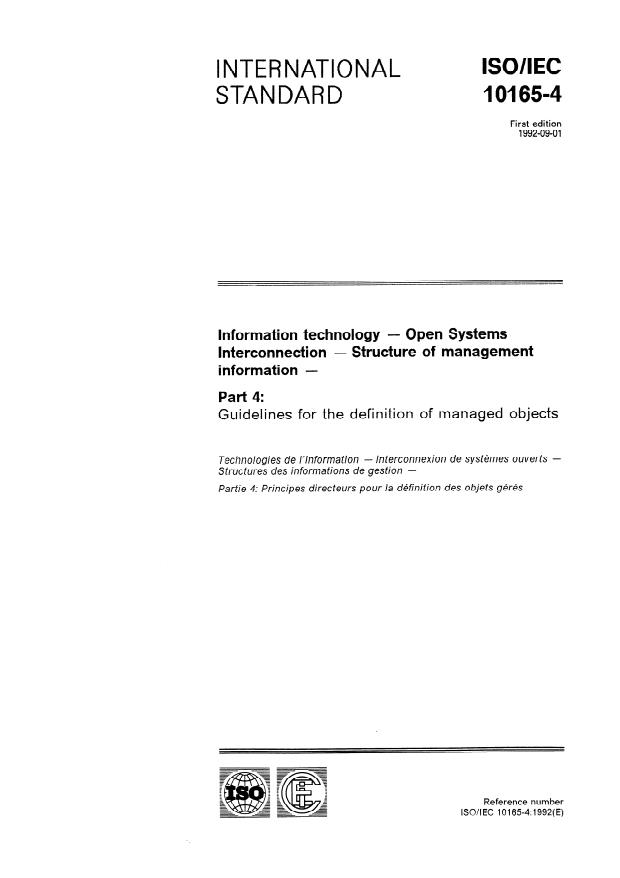
ISOIIEC
INTERNATIONAL
STANDARD
First edition
1992-09-01
Information technology - Open Systems
- Structure of management
Interconnection
information -
Part 4:
Guidelines for the definition of managed objects
- lnterconnexion de systiimes ouverfs -
Technologies de i’informafion
Structures des informations de gestion -
Partie 4: Principes directeurs pour la dMMion des objets g&-h
Reference number
MYI EC 10 165-4: 1992(E)
ISO/IEC 10165-4 : 1992 (E)
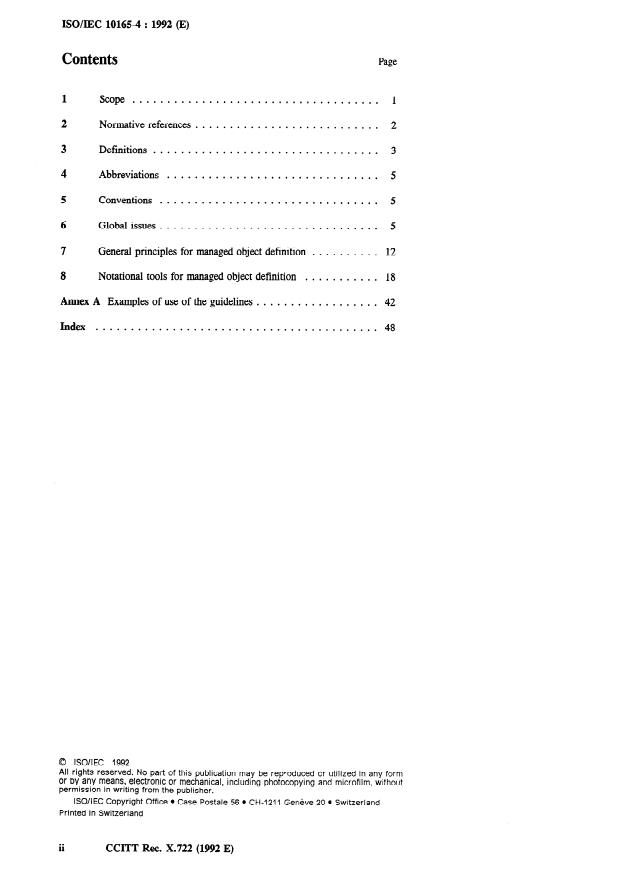
Contents
Page
scope . 1
Normative references . 2
Definitions . . . . . . . . . . . . . . . . . . . . . . . . . . . . . . . . . 3
Abbreviations 5
...............................
Conventions .
Global issues . 5
General principles for managed object definition . 12
Notational tools for managed object definition . 18
Annex A Examples of use of the guidelines 42
..................
Index . 48
0 ISO/lEC 1992
All rights reserved. No part of this publication may be reproduced cr utilized in any form
or by any means, electronic or mechanical, including photocopying and microfilm, without
permission in writing from the publisher.
ISO/lEC Copyright Office l Case Postale 56 l CH-1211 Get-t&e 20 l Switzerland
Printed in Switzerland
ii
CCITT Rec. X.722 (1992 E)
ISO/IEC 101654 : 1992 (E)
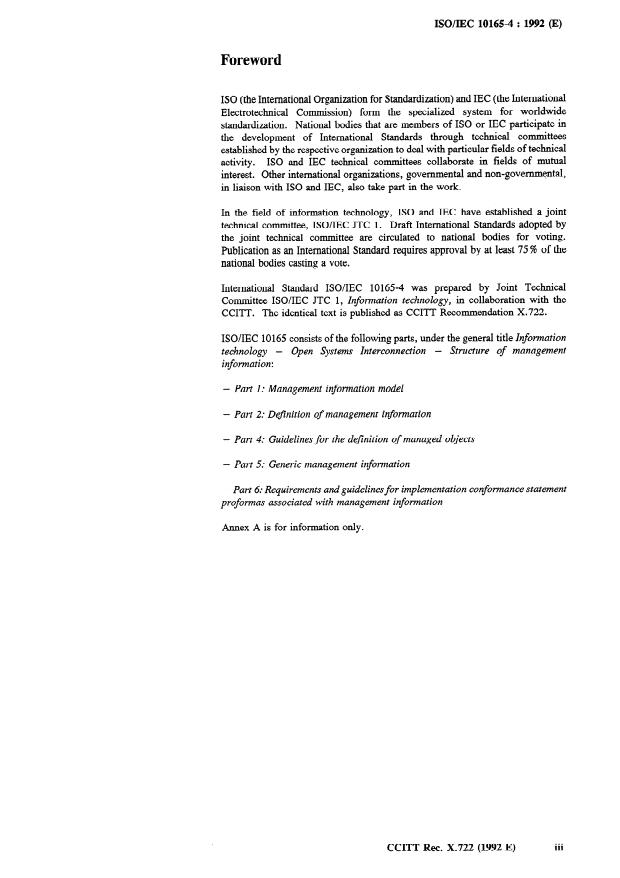
Foreword
IS0 (the International Organization for Standardization) and IEC (the International
Electrotechnical Commission) form the specialized system for worldwide
standardization. National bodies that are members of IS0 or IEC participate in
the development of International Standards through technical committees
established by the respective organization to deal with particular fields of technical
activity. IS0 and IEC technical committees collaborate in fields of mutual
interest. Other international organizations, governmental and non-governmental,
in liaison with IS0 and IEC, also take part in the work.
In the field of information technology, IS0 and IEC have established a joint
technical committee, ISO/IEC JTC 1. Draft International Standards adopted by
the joint technical committee are circulated to national bodies for voting.
Publication as an International Standard requires approval by at least 75 % of the
national bodies casting a vote.
International Standard ISO/IEC 10165-4 was prepared by Joint Technical
Committee ISO/IEC JTC 1, Information technology, in collaboration with the
CCITT. The identical text is published as CCITT I&commendation X.722.
ISO/IEC 10165 consists of the following parts, under the general title Information
technology - Open Systems Interconnection - Structure of management
information:
- Part 1: Management information model
- Part 2: Definition of management information
- Part 4: Guidelines for the definition of managed objects
- Part 5: Generic management information
- Part 6: Requirements and guidelines for implementation conformance statement
proformas associated with management information
Annex A is for information only.
CCITT Rec. X.722 (1992 E) 111 l m*
ISO/lEC 101654 : 1992 (E)
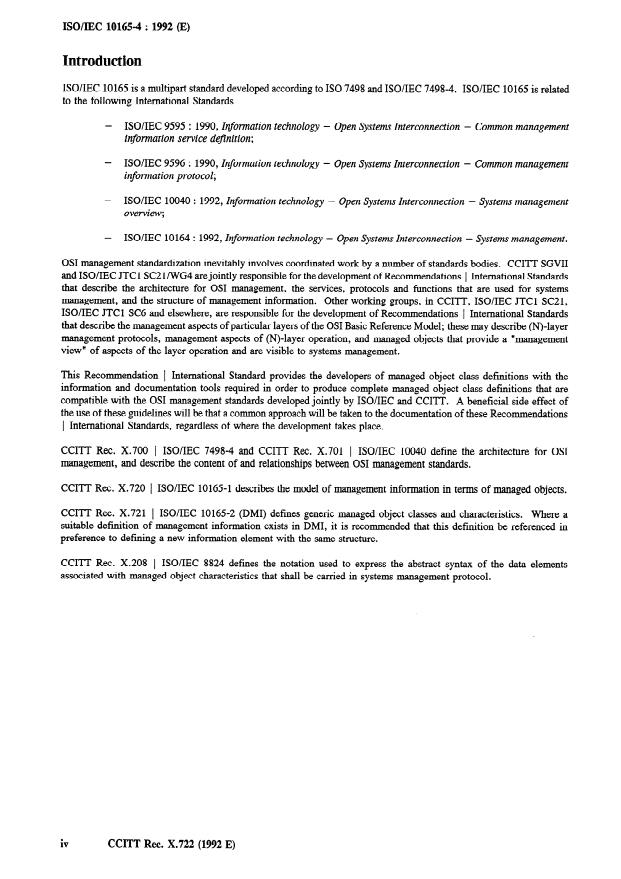
Introduction
ISO/IEC 10165 is a multipart standard developed according to IS0 7498 and ISO/IEC 7498-4. ISO/IEC 10165 is related
to the following International Standards
- ISOIIEC 9595 : 1990, Information technology - Open System Interconnection - Common management
information service definition;
- ISOIIEC 9596 : 1990, Information technology - Open Systems Interconnection - Common management
information protocol;
ISOfIEC 10040 : 1992, Information technology - Open Systems Interconnection - Systems management
-
overview;
- ISO/IEC 10164 : 1992, Information technology - Open Systems Interconnection - Systems management.
OS1 management standardization inevitably involves coordinated work by a number of standards bodies. CCITT SGVII
and ISO/IEC JTC 1 SC2 1 /WG4 are jointly responsible for the development of Recommendations 1 International Standards
that describe the architecture for OS1 management, the services, protocols and functions that are used for systems
management, and the structure of management information. Other working groups, in CCITT, ISO/IEC JTCl SC21,
ISO/IEC JTCl SC6 and elsewhere, are responsible for the development of Recommendations 1 International Standards
that describe the management aspects of particular layers of the OS1 Basic Reference Model; these may describe (N)-layer
management protocols, management aspects of (N)-layer operation, and managed objects that provide a “management
view” of aspects of the layer operation and are visible to systems management.
This Recommendation 1 International Standard provides the developers of managed object class definitions with the
information and documentation tools required in order to produce complete managed object class definitions that are
A beneficial side effect of
compatible with the OS1 management standards developed jointly by ISO/IEC and CCITT.
the use of these guidelines will be that a common approach will be taken to the documentation of these Recommendations
1 International Standards, regardless of where the development takes place.
CCITT Rec. X.700 1 ISO/IEC 7498-4 and CCITT Rec. X.701 I ISO/IEC 10040 define the architecture for OS1
management, and describe the content of and relationships between OS1 management standards.
CCITT Rec. X.720 I ISO/IEC 10165-l describes the model of management information in terms of managed objects.
CCITT Rec. X.721 I ISO/IEC 10165-2 (DMI) defines generic managed object classes and characteristics. Where a
suitable definition of management information exists in DMI, it is recommended that this definition be referenced in
preference to defining a new information element with the same structure.
CCITT Rec. X.208 I ISO/IEC 8824 defines the notation used to express the abstract syntax of the data elements
associated with managed object characteristics that shall be carried in systems management protocol.
iv CCITT Rec. X.722 (1992 E)
ISO/IEC 101654 : 1992 (E)
INTERNATIONAL STANDARD
CCITT RECOlWMENDATION
INFORMATION TECHNOLOGY - OPEN SYSTEMS INTERCONNECTION -
STRUCTURE OF MANAGEMENT INFORMATION :
GUIDELINES FOR THE DEFINITION OF MANAGED OBJECTS
1 Scope
International Standards that
This Recommendation 1 International Standard provides developers of Recommendations and
contain managed object definitions with guidance that will
encourage consistency between managed object definitions;
a)
manner compatible with the OS1 management
ensure the development of such definitions in a
W
Recommendations and International Standards;
reduce duplication of effort in other working groups by identifying commonly useful documentation
Cl
layouts, procedures and definitions.
To this end, this Recommendation 1 International Standard specifies
the relationships between the relevant OS1 management Recommendations and International Standards and
a)
the definition of managed object classes, and how those Recommendations and International Standards
should be used by managed object class definitions;
b) the appropriate methods to be adopted for the definition of managed object classes and their attributes,
notifications, actions and behaviour, including
a summary of aspects that shall be addressed in the definition;
1)
the notational tools that are recommended to be used in the definition;
2)
consistency guidelines that the definition may follow.
3)
the relationship of managed object class definitions to management protocol, and what protocol-related
Cl
definitions are required;
d) the recommended documentation structure for managed object class definitions.
This Recommendation 1 International Standard is applicable to the development of any Recommendation 1 International
Standard which defines
management information which is to be transferred or manipulated by means of OS1 management protocol;
a>
the managed objects to which that information relates.
W
CCITT Rec. X.722 (1992 E) 1
ISO/lEC 101654 : 1992 (E)
This Recommendation 1 International Standard does not specify or imply
any constraints on the development of managed object class definitions in terms of their functionality, the
a)
Recommendations I International Standards to which they relate, or the uses to which they are put in a
particular management environment;
b) guidelines for the deftition of resources; it provides guidelines only for the definition of the managed
objects which provide the management view of resources.
2 Nonnative references
The following CCITT Recommendations and International Standards contain provisions which, through reference in this
text, constitute provisions of this Recommendation I International Standard. At the time of publication, the editions
indicated were valid. All Recommendations and International Standards are subject to revision, and parties to agreements
based on this Recommendation I International Standard are encouraged to investigate the possibility of applying the most
recent edition of the Recommendations and International Standards indicated below. Members of IEC and IS0 maintain
registers of currently valid International Standards. The CCITT Secretariat maintains a list of the currently valid CCITT
Recommendations.
21 l Identical CCITT Recommendations 1 International Standards
- CCITT Recommendation X.6601) I ISO/IEC 9834-l*), Information technology - Open Systems
Interconnection - Procedures for the operation of OSI registration authorities - Part I: General
procedures.
CCITT Recommendation X.701 (1992) I ISO/IEC 10040 : 1992, Information technology - Open Systems
-
Interconnection - Systems management overview.
- CCITT Recommendation X.720 (1992) 1 ISO/IEC 10165-l : 1992, Information technology - Open
Systems Interconnection - Structure of management information : Management information model.
- CCITT Recommendation X.721 (1992) I ISO/IEC 10165-2 : 1992, Information technology - Open
Systems Interconnection - Structure of management information : Definition of management information.
- CCITT Recommendation X. 732 ( 1992) I ISO/IEC 10 164-3 : 1992, Information technology - Open
Systems Interconnection - Systems management : Attributes for representing relationships.
CCITT Recommendation X.733 (1992) I ISO/IEC 10164-4 : 1992, Information technology - Open
-
Systems Interconnection - Systems management : Alarm reporting finction.
22 Paired CCITT Recommendations 1 International Standards equivalent in technical content
l
- CCITT Recommendation X.200 (1988), Reference Model of Open Systems Interconnection for CCITT
Applications.
IS0 7498 : 1984, Information processing systems - Open Systems Interconnection - Basic Reference
Model.
- CCITT Recommendation X.208 (1988), Specicfication of abstract syntax notation one (ASN. I).
ISO/IEC 8824 : 1990, Information technology - Open Systems Interconnection - SpeciJication of Abstract
Syntax Notation One (ASN.1).
- CCITT Recommendation X.501 (1989), The Directory - Models.
t state of draft Recommendation.
‘) Presently a
*) To be published.
CCITT Rec. X.722 (1992 E)
ISO/IEC 101654 : 1992 (E)
ISOIIEC 9594-2 : 1990, Information technology - Open Systems Interconnection - I;he Directory - Part
2: Models.
- CCITT Recommendation X.650 (1992), Naming and Addressing for Open Systems Interconnection (OH)
for CCITT Applications.
Open Systems Interconnection - Basic Reference
IS0 7498-3 : 1989, Information processing systems -
Model - Part 3: Naming and Addressing.
- CCITT Recommendation X. 7001), Management Framework DeJinition for Open Systems Interconnection
(OS) for CCITT Applications.
- Open Systems Interconnection - Basic
ISO/IEC 7498-4 : 1989, Information processing systems
Reference Model - Part 4: Management framework.
- CCITT Recommendation X. 7 10 ( 199 1), Common Management Information Service Definition for CCITT
Applications.
ISOIIEC 9595 : 1990, Information technology - Open Systems Interconnection - Common management
information service deJinition.
- CCITT Recommendation X.7 11 (199 l), Common Management Information Protocol Specification for
CCITT Applications.
ISO/IEC 9596-l : 199 1, Information technology - Open Systems Interconnection - Common management
information protocol - Part I: Specicfication.
Definitions
For the purposes of this Recommendation I International Standard, the following definitions apply.
31 0 Basic reference model definitions
This Recommendation 1 International Standard makes use of the following terms defined in CCITT Rec. X.200 I IS0
7498:
(N)-connection;
a)
b) (N)-entity;
c) (N)-layer;
d) (N)-service-access-point;
open system;
f) systems management.
32 0 Naming ant addressing definitions
This Recommendation International Standard makes use of the following term defined in CCITT Rec. X.650
7498-3:
(N)-selector
Management framework definitions
33 l
This Recommendation 1 International Standard makes use of the following terms defined in CCITT Rec. X.700 I
ISO/IEC 7498-4:
managed object;
a)
(N)-layer operation.
b)
I) Presently at state of draft Recommendation.
CCITT Rec. X.722 (1992 E) 3
ISO/IEC 101654 : 1992 (E)
34 l Systems management overview definitions
This Recommendation I International Standard makes use of the following terms defined in CCITT Rec. X.701 1
ISO/IEC 10040:
agent;
a)
generic definitions;
W
managed object class;
Cl
management information;
manager;
e)
(N)-layer management protocol;
f)
notification;
9)
notification type;
l-9
(systems management) operation;
.
systems management (application) protocol.
J)
35 l Management information model definitions
This Recommendation I International Standard makes use of the following terms defined in CCITT Rec. X.720 1
ISO/IEC 10165-l:
action;
a)
actual class;
W
attribute group;
C>
attribute identifier;
d)
attribute type;
attribute value set;
f)
behaviour;
8)
characteristic;
h)
conditional package;
.
containment;
J)
inheritance;
k)
inheritance hierarchy;
1)
initial value managed object;
m)
instantiation;
n)
mandatory package;
0)
multiple inheritance;
P)
name binding;
4)
package;
r)
parameter;
S)
permitted value set;
relative distinguished name;
U)
required value set;
specialization;
WI
subclass;
JO
subordinate object;
Y)
superclass;
Z)
superior object.
=O
36 l CMIS definitions
This Recommendation I International Standard makes use of the following terms defined in CCITT Rec. X.710 I
ISO/IEC 9595:
attribute;
a)
Common Management Information Services.
W
37 l ASNel definitions
This Recommendation I International Standard makes use of the following terms defined in CCITT Rec. X.208 I
ISO/IEC 8824:
4 CCITT Rec. X.722 (1992 E)
ISO/IEC 101654 : 1992 (E)
object identifier;
a)
sequence type;
W
sequence-of type;
Cl
set type;
d)
set-of type;
e>
subtype;
f)
type;
9)
type reference name;
h)
value reference name.
Additional definitions
38 l
3.8.1 managed object class definition: A set of attribute, operation, notification and behaviour definitions to which
a managed object class name has been allocated documented by the use of a managed object class template
and one or more other templates, of the types defined in this Recommendation I International Standard, which
are directly or indirectly referenced by the managed object class template. The definition of a managed object
class includes all elements of definition inherited from the superclass of the managed object class and all
elements of definition that constitute specialization(s) of the superclass(
template: A standard format for the documentation of name bindings, and managed object class definitions
3.8.2
and their components, such as packages, parameters, attributes, attribute groups, behaviour definitions, actions
or notifications.
3.8.3 directory object class: An object class, as defined in CCITT Rec. X.501 I ISO/IEC 9594-2.
4 Abbreviations
ASN. 1 Abstract Syntax Notation One
CMIP Common Management Information Protocol
CMIS Common Management Information Services
DMI Definition of Management Information
IVMO Initial Value Managed Object
MOCS Managed Object Conformance Statement
(N)-SAP (N)- service-access-point
OS1 Open Systems Interconnection
Protocol Data Unit
PDU
Service Access Point
SAP
Service Data Unit
SDU
Structure of Management Information
SMI
Relative Distinguished Name
RDN
Conventions
Distinctive typefaces are used throughout this Recommendation 1 International Standard where the text makes use of
ASN.l notation or the notational tools defined in clause 8.
No externally defined conventions are used in this Recommendation I International Standard.
6 Global issues
61 l Relationship integrity
c
When defining managed object classes, it is important to consider situations where there are consistency requirements
for example, situations where the behaviour of a managed object is
that will apply to instances of those classes,
constrained by rules that depend not only upon its own state but also upon the state of other managed objects in the
system. Any such constraints must be expressed as behaviour associated with the managed object classes concerned.
CCITT Rec. X.722 (1992 E)
ISO/IEC 101654 : 1992 (E)
A particular case where the definitions associated with the instantiation of a managed object shall explicitly define
consistency rules is that of the Delete operation; for this operation, such consistency rules are specified in name
binding(s) associated with the managed object class. The effect of a Delete operation shall be defined in such a way that
it is clear under what circumstances deletion is permitted, and what the consequences of deletion are.
In particular, the
name binding shall specify whether deletion of an instance of the class is permitted when contained managed objects still
exist, and what rules apply in cases where other (non-containment) relationships exist between the managed object being
deleted and other managed objects, such as those that may exist as a consequence of the presence of relationship
attributes as defined in CCITT Rec. X.732 1 ISO/IEC 10164-3. The consistency rules that are applied for deletion shall
be such that the delete operation cannot result in inconsistent relationships. As these consistency rules are specified as
part of a name binding, the rules that apply to the deletion of a given managed object are established at the time that the
managed object is instantiated.
62 0
Inherited characteristics
The process of inheritance results in the inclusion of all characteristics of the superclass of a managed object class
in the managed object class definition. This rule is applied recursively, terminating at the apex of the inheritance
hierarchy, known as top. A given managed object class therefore includes all characteristics that are part of the deftition
of top, plus all characteristics that are added in the process of defining any subclasses of top that form part of the
managed object class’s inheritance hierarchy.
63 0
Optionality
In general, the provision of options in managed object class definitions is discouraged, on the grounds that interworking
becomes more difficult as the number of options increases. As stated in CCITT Rec. X.720 1 ISO/IEC 10165-1, the
managed object class definition may include conditional packages which are present in an instance of the managed object
class if the specified condition applies. It is the intention that the conditions applied to these packages should relate to
standardized features of the resource to which the managed object class applies, or to optional management functions
supported by the management system.
64 l Registration
The process of defining managed object classes requires the assignment of globally unique identifiers, known as object
identifiers, to various aspects of the managed object class, such as the managed object class name, attribute types, etc.
The values of these identifiers are used in management protocols to uniquely identify aspects of managed objects and their
associated attributes, operations and notifications. It is therefore a necessary precursor to the development of a managed
object class definition that the standards body or organization concerned should identify or establish a suitable registration
mechanism that is capable of issuing object identifier values for its use. CCITT Rec. X.208 1 ISO/IEC 8824 specifies
the structure of the object identifier and the values of the initial arcs; further information on the establishment of
registration mechanisms and registration authorities may be found in CCITT Rec. X.660 1 ISO/IEC 9834-l.
Once an item of management information has been assigned an object identifier value, it is a requirement that any
revision of the deftition of that item shall not alter the semantics of the information. In practice, this means that
editorial changes to registered management information definitions are permissible, but the definitions shall not be
changed in ways that would be visible in protocol.
All object identifier registered in systems management Recommendations International Standards are allocated
under the arc
cjoint-iso-ccitt ms(9))
The allocation of arcs below j’joint-iso-ccitt ms(9)) is defined by this Recommendation I International Standard. The arcs
below Goint-iso-ccitt ms(9)) are allocated on a per-Systems-Management-standard basis, as shown in Table 1.
6 CCITT Rec. X.722 (1992 E)
ISO/IEC 10165-4 : 1992 (E)
Table 1 - Allocation of arcs below fioint-iso-ccitt ms(9))
Arc Standard
smo(0) Systems management overview, CCITT Rec. X.701 1 ISO/IEC 10040
cmip(1) Common management information protocol, CCITT Rec. X.711 1 ISO/IEC
9596-l
function(2) Systems management functions, CCITT Rec. X.7NN 1 ISO/IEC 10164-X,
where X is the part number of the standard in the ISO/IEC numbering
scheme, and X.7NN is the corresponding CCITT Recommendation number.
Structure of management information, CCITT Rec. X.72N 1 ISO/IEC
smi(3)
10165-X, where X is the part number of the standard in the ISO/IEC
numbering scheme, and X.72N is the corresponding CCITT
Recommendation number.
The allocation of arcs below this level is defined in 6.4.1 to 6.4.5. Further arcs required by existing or future systems
management standards will be allocated, as required, by means of amendments to this Recommendation 1 International
Standard.
NOTE - The scheme for the allocation of object identifier values described in this clause and its sub-clauses applies only
to the allocation of object identifier values in the systems management standards developed jointly by ISO/IEC JTCl SCZUWG4 and
CCITT SGVII. It is necessary for other standards bodies or organizations that require to allocate object identifier values in the course
of the development of management standards to establish their own allocation schemes under an appropriate registration authority.
The structure adopted by the systems management standards activity may serve as a useful example of how a suitable allocation scheme
may be established, but the final choice of allocation scheme is the responsibility of the organization concerned. In order to improve
human readability of object identifier values, it is recommended that the name and number form for the representation of object
identifier values, as defined in CCITT Rec. X.208 1 ISO/IEC 8824, be used wherever possible.
6.4.1 Object identifier allocation for systems management overview
NOTE - The systems management overview is responsible for the allocation of these arcs; they are included for information
only.
Below goint-iso-ccitt ms(9) smo(O)), the following arcs are allocated for the registration of application contexts, abstract
syntaxes and ASN. 1 module identifiers, as shown in Table 2.
Table 2 - Allocation of arcs below Goint-iso-ccitt ms(9) smo(O))
Arc Purpose
I I I
applicationContext(0) Allocation of application context identifiers
I I I
Allocation of version identifiers to the negotiation abstract syntax
negotiationAbstractSyntax(1)
I I I
Allocation of ASN. 1 module identifiers
asnlModules(2)
I I I
Below cjoint-iso-ccitt ms(9) smo(0) applicationContext(0)) further arcs are allocated, as specified by CCITT Rec. X.701
I ISO/IEC 10040, for the registration of particular application context identifiers, as shown in Table 3.
Table 3 - Allocation of arcs below Goint-iso-ccitt ms(9) smo(O) appIicationContext(O))
Purpose
Arc
I I I
Identifier of the Systems management application context
systems-management(2)
I I I
CCITT Rec. X.722 (1992 E) 7
ISO/IEC 101654 : 1992 (E)
Below &hGso-ccitt ms(9) smo(0) negotiationAbstractSyntax(1)) further arcs are allocated, as specified by CCITT Rec.
X.701 I ISO/IEC 10040, for the registration of particular versions of the negotiation abstract syntax, as shown in Table
4.
Table 4 - Allocation of arcs below Goint-isoccitt ms(9) smo(0) negotiationAbstractSyntax(1))
Arc Purpose
I
I I
versionl(1) Identifies version 1 of the negotiation abstract syntax
I I I
Below Cjoint-iso-ccitt ms(9) smo(0) asnlModules(2)) further arcs are allocated, as specified by CCITT Rec. X.701 I
ISO/IEC 10040, for the registration of particular ASN. 1 module identifiers, as shown in Table 5.
Table 5 - Allocation of arcs below Cjoint-iso-ccitt ms(9) smo(0) asnlModules(2))
Purpose
Arc
I I I
Allocation of version identifiers to the ASN. 1 module that contains the
negotiationDefinitions(0)
definitions associated with the negotiation abstract syntax
I I
Below fioint-iso-ccitt ms(9) smo(0) asnlModules(2) negotiationDef’initions(0)) further arcs are allocated, as specified by
CCITT Rec. X.701 1 ISO/IEC 10040, for the registration of particular versions of the ASN. 1 module, as shown in Table
6 .
Table 6 - Allocation of arcs below Cjoint-iso-ccitt ms(9) smo(0) asnlModules(2) negotiationDefinitions(0))
Arc Purpose
versionl(1) Identifies Version 1 of the ASN. 1 module that contains the definitions
associated with the negotiation abstract syntax
6.4.2 Object identifier allocation for CMIP
NOTE - CMIP is responsible for the aIIocation of these arcs; they are included for information only. CMIP version 1
is obsolete and has been superseded by version 2. Version 1 was documented in ISO/IEC 9596, for which there is no corresponding
CCITT Recommendation.
Below Qoint-iso-ccitt ms(9) cmip(l)), arcs are allocated for each version of CMIP, as described in 6.4.2.1 and 6.4.2.2.
6.4.2.1 CMIP version 1
Below cjoint-iso-ccitt ms(9) cmip(l)), arcs are allocated for version 1 of CMIP, as shown in Table 7.
Table 7 - Allocation of arcs below uoint-iso-ccitt ms(9) cmip(I)) for CMIP version 1
Arc
Purpose
versionl(1) for CMIP version 1
I I
Below (joint-iso-ccitt ms(9) cmip(1) versionl(l)), arcs are allocated for the purposes described in ISOIIEC 9596, as shown
in Table 8.
8 CCITT Rec. X.722 (1992 E)
ISO/lEC 10165-4 : 1992 (E)
Table 8 - Allocation of arcs below Cjoint-isoccitt ms(9) cmip(1) versionl(1))
Arc
I I
aAssociateUserInfo(1)
I I
aAbortUserInfo(2)
I
I
protocol(3)
I I
abstractSyntax(4)
I I
6.4.2.2 CMIP version 2
Below (joint-iso-ccitt ms(9) cmip(l)), arcs are allocated for version 2 of CMIP, as shown in Table 9.
- Allocation of arcs below Goint-iso-ccitt ms(9) cmip(1)) for CMIP version 2
Table 9
Arc Purpose
modules(O) Allocation of object identifiers for CMIP ASN. 1 modules
I I I
cmip-pci(1) Allocation of object identifiers for CMIP protocol control information
I I I
Below Qoint-iso-ccitt ms(9) cmip(1) modules(O)), arcs are allocated for the purposes described in CCITT Rec. X.711 I
ISO/IEC 9596-l) as shown in Table 10.
Table 10 - Allocation of arcs below Cjoint-iso-ccitt ms(9) cmip(l) modules(O))
Arc
I I
aAssociateUserInfo(1)
I I
aAbortUserInfo(2)
I I
protocol(3)
I
I
Below Cjoint-iso-ccitt ms(9) cmip(1) cmip-pci(l)), arcs are allocated for the purposes described in CCITT Rec. X.71 1 I
ISO/IEC 9596-l) as shown in Table 11.
Table 11 - Allocation of arcs below Cjoint-iso-ccitt ms(9) cmip(1) cmip-pci(1))
Arc
I
I
reserved3(3)
I I
abstractSyntax(4)
I
I
CCITT Rec. X.722 (1992 E) 9
ISO/IEC 10165-4 : 1992 (E)
6.4.3 Object identifier allocation for function standards
Below (joint-iso-ccitt ms(9) function(Q), arcs are allocated to identify each function Recommendation I International
Standard as shown in Table 12.
Table 12 - Allocation of arcs below fioint-iso-ccitt ms(9) function(Z))
Arc Standard
CCITT Rec. X.7NN 1 ISO/IEC 10164-X
PafiX
where X is the part number of the Systems Management Function in the
ISO/IEC numbering scheme, and X.7NN is the corresponding CCITT
Recommendation number.
l
Below Cjoint-iso-ccitt ms(9) function(2) partX(X)], arcs are allocated as shown in Table 13.
Table 13 - Allocation of arcs below Cjoint-iso-ccitt ms(9) function(Z) partX(X))
Arc Purpose
standardSpecifiiExtension(0) Standard-specific extensions to the allocation scheme
functionalUnitPackage(1) Allocation of functional unit package identifiers
Allocation of ASN. 1 module identifiers
asnlModule(2)
I
Allocation of managed object class identifiers
managedObjectClass(3)
package(4) Allocation of package identifiers
parameter@) Allocation of parameter identifiers
nameBinding(6) Allocation of name binding identifiers
Allocation of attribute identifiers
attribute(7)
attributeGroup(8) Allocation of attribute group identifiers
action(g) Allocation of action types
notification(l0) Allocation of notification types
Within each function Recommendation I International Standard, further arcs may be allocated below this level (e.g., to
allocate particular attribute identifiers), as required by the function Recommendation I International Standard.
6.4.4 Object identifier allocation for SMI standards
Below cjoint-iso-ccitt ms(9) smi(3)), arcs are allocated to identify each SMI Recommendation I International Standard as
shown in Table 14.
Table 14 - Allocation of arcs below cjoint-iso-ccitt ms(9) smi(3))
Arc Standard
CCITT Rec. X.72N 1 ISO/IEC 10165-X
pafiX
where X is the part number of the standard in the ISO/IEC numbering
scheme, and X.72N is the corresponding CCITT Recommendation number.
10 CCITT Rec. X.722 (1992 E)
ISO/IEC 101654 : 1992 (E)
Below (joint&o-c&t ms(9) smi(3) partX(IQ), arcs are allocated as shown in Table 15.
Table 15 - Allocation of arcs below Cjoint-iso-ccitt ms(9) smi(3) partX(X))
Arc Purpose
I ~~
standardSpecificExtension(0) Standard-specific extensions to the allocation scheme
asnlModule(2) Allocation of ASN. 1 module identifiers
Allocation of managed object class identifiers
managedObjectClass(3)
package(4) Allocation of package identifiers
parameter@ Allocation of parameter identifiers
I I I
nameBinding(6) Allocation of name binding identifiers
I
Allocation of attribute identifiers
attribute(7)
I I I
Allocation of attribute group identifiers
attributeGroup(8)
I I I
Allocation of action types
I I
Allocation of notification types
notification(l0)
I I I
Within each Recommendation 1 International Standard, further arcs may be allocated below this level (e.g., to allocate
particular attribute identifiers), as required by that Recommendation 1 International Standard.
6.4.5 Object identifier allocation for actual class
The object identifier value
fjoint-iso-ccitt ms(9) smi(3) part4(4) managedObjectClass(3) actualClass(42))
is allocated by this Recommendation 1 International Standard to convey the semantics of actual class as defined in CCITT
Rec. X.720 1 ISO/IEC 10165-l. When used to specify the base managed object class in a CMIS operation service
request, this object identifier value indicates that the recipient of the systems management operation shall respond as a
member of its actual class.
65 l Conformance
CCITT Rec. X. 70 1 I ISO/IEC 10040 specifies general conformance related requirements for management information
standards.
Complexity of managed object definitions
66 l
In any case,
Through the modelling process, complexity in the managed object definitions should be minimized.
management operations should be no more complex than the corresponding properties of the OS1 entity involved.
67 l Managed object creation and deletion
Creation and deletion of managed object instances may occur in the following ways:
-
Create and delete
managed objects may be created and deleted by management protocol interactions.
operations are defined for this purpose, with associated semantics;
-
managed objects may be created and deleted as a result of the operation of the resource to which they
An
relate, typically a protocol machine. Create and delete operations would not be defined in this case.
example is the representation for management purposes of connections;
CCITT Rec. X.722 (1992 E) 11
ISO/lEC 101654 : 1992 (E)
- managed objects may be created and deleted by other means. Create and Delete operations are not defined
for them. An example is a managed object which is always created automatically when a piece of
equipment is initialized, and which cannot be deleted through management.
The choice among these three methods for managed object creation may differ from the choice for managed object
deletion.
In some cases, there may be only one means by which a managed object of a particular class may be created or deleted;
in other cases, there may be the possibility to create or delete managed objects of a particular class by means of more
than one of these mechanisms.
6e7el Initial value managed objects
When a managed object is created, it may be desirable to provide the capability to allocate default values to be used on
creation which are themselves subject to modification by management operation. This may be achieved by the
specification of an Initial Value Managed Object (IVMO), whose attributes are modifiable by management operation,
and which is capable of providing default values for corresponding attributes on the creation of instances of another
managed object class.
When a new managed object is created using an IVMO, the values of attributes in the IVMO are used as initial values
of corresponding attributes in the new managed object. The managed object class definition may specify how the IVMO
is selected. The specification of the IVMO shall define the circumstances in which it provides the initial values, how
it provides the initial values, and to which attributes the initial values it provides are applicable.
When management operations are used to modify the attributes of an IVMO, attributes of managed objects previously
created using that IVMO are not affected. Similarly, management operations performed upon the attributes of managed
objects created using an IVMO do not affect the attributes of the IVMO.
6.7.2 Sources of initial attribute values
Initial attribute values for managed objects, used at creation time, are obtained from a number of sources, as defined in
CCITT Rec. X.720 1 ISO/IEC 101654. When an attribute represents a specific value that must be consistent with an
underlying resource, this value forms the mandatory initial value used at creation time.
7 General principles for managed object dermition
The general principles described here are intended for the guidance of managed object definers, and to promote
consistency between managed object definitions; for this reason, managed object definers are encouraged to apply the
guidance offered wherever it is applicable.
71 l Commonality
Managed object definers should strive to identify and use as a basis
-
common managed object classes, defined in CCITT Recommendations I International Standards;
-
common managed object classes and other properties as defined in CCITT Rec. X.721 I ISO/IEC 10165-
2.
Managed object definers should also strive to consider and re-use definitions originating in other groups in order to
increase commonality of definitions. This objective may be met by development of models of things to be managed that
are common to a number of groups of managed object definers.
72 What to manage
l
The definition of managed object classes and their components should fulfil clearly justified requirements related to
particular management objectives.
Such requirements are likely to include the management of peer protocol aspects of
the operation of a layer or sub-layer and perceived problems not specifically reported by the underlying service provider
across the service boundary (e.g., Quality Of Service provided by underlying service not meeting acceptable levels).
It is important to retain justification for each management objective during the development of the management
12 CCITT Rec. X.722 (1992 E)
ISO/IEC 101654 : 1992 (E)
Comments should be used to explain how each component of a management information
information definitions.
definition, (e.g., managed object classes, attributes, operations, notifications, etc.) relates to this justification.
Things of interest to management should be recorded via the managed objects that represent the resources where the
things happen. That is, if a managed object has been defined representing a particular resource (for example, a
connection), then information concerning that resource should be reflected through the corresponding managed object(s)
and not elsewhere.
73 l Structuring
A number of techniques are available for representing structure in managed objects, to reflect groupings of data or
functionality. Each of these techniques has advantages and disadvantages; the choice of the most appropriate technique(s)
for a particular specification requirement depends on a number of criteria, as described below.
The structuring techniques described in CCITT Rec. X.720 I ISO/IEC 10165-l include
-
attribute groups;
-
subclasses (specialization);
-
multiple inheritance;
-
contained managed objects;
- packages.
Groupings of attributes, operations and notifications may be defined which are present or absent based on a standardized
condition, such as the choice of particular options in a base standard. Such groupings of functionality are either present
or absent as a whole. Groupings of functionality may arise as a consequence of option selection in the layer
Recommendation 1 International Standard for the resource (e.g., provision of Transport Class 4), leading to additional
management requirements or capability, or as a consequence of support for a defined management function (e.g.,
accounting). These groupings of functionality are defined using the conditional package techniques provided by the
managed object class template.
One important criterion in the choice of structuring techniques is the static or dynamic presence of the grouping. If the
presence of the grouping is fixed at specification time, then the use of attribute groups, subclasses, multiple inheritance,
or contained managed objects may be appropriate. If the presence is fixed at implementation, installation or instantiation
time, then the use of contained managed objects or conditional packages may be appropriate. If the presence of the
grouping can change through the life of the containing/encapsulating managed objects, then the use of contained managed
objects that are dynamically created and deleted may be appropriate.
Another criterion is whether there are multiple instances of the grouping within the managed object. Where this is the
case, the use of contained managed objects is appropriate; otherwise, any of the five structuring techniques may be
appropriate.
74 Managed objects
l
7.4.1 Instantiation of superclasses
Managed object classes that are never instantiated may be defined to provide a common base from which to specialize
subclasses; for example, a generic virtual circuit managed object class may be defined, of which permanent and switched
virtual circuits could be subclasses.
In some cases, particularly where subclasses are defined order to revise a standard, there superclasses of which
instances may be created.
CCITT Rec. X.722 (1992 E)
ISO/IEC 101654 : 1992 (E)
7.4.2 Unrestricted superclasses
The rules for inheritance limit the ways in which the required value sets and permitted value sets of attributes of a
managed object class can be modified when defining a subclass of that class. In the same way, the rules limit the ability
to add parameters to actions and notifications. These limitations ensure that the subclass is compatible with the
superclass.
For this reason, when defining a managed object class that is expected to be a superclass of subsequent managed object
classes, it is useful to make provision for these kinds of extension. Although not all extensions can be anticipated and
provided for, the following techniques allow for a wide variety of extensions while maintaining compatibility:
define the syntax (type) of each attribute to include all values which might reasonably fit within the
semantics of the attribute , even if some of those values are not immediately required or desired;
- provide extension capabilities in each action and notification definition;
- define an “unrestricted superclass” that includes these elements, without further restrictions, as the basis
for defining more restricted subclasses. For attributes, this means an empty required value set and a
permitted value set equal to the attribute syntax;
- define specific subclasses of this unrestricted superclass, which place the required restrictions on attributes,
actions and notifications.
actions and
The managed object definer may choose to provide extension capabilities in only some of the attributes,
notifications of an unrestricted superclass.
75 l Attributes
Attribute value sets
7.5.1
In some cases, options in the base Recommendation 1 International Standard permit the value set of an attribute to vary
A typical example of this would be where the base Recommendation 1
in accordance with implementation choices.
International Standard permits a wide range of packet sizes, but a conformant implementation of the Recommendation
1 International Standard may support a more limited range. Where this situation exists, the attribute behaviour definition
shall identify what the possibilities are.
It may be necessary to define null values as permitted values in the value set of an attribute, or, in the case of attributes
of an IVMO, it may be necessary to define attribute values to which particular semantics are attached, such as “create
managed object with null as the value of the corresponding attribute” or “ignore this attribute as a source of an initial
value”. Techniques for defining such values include defming the abstract syntax as a choice type, where one choice
defines the normal value set of the attribute and other choices define values to which particular semantics are attached.
Definition of the permitted value set of an attribute may be achieved in a number of ways, including
-
defining the attribute value set statically, as part of the defmition of the managed object class;
defining a second attribute, whose value indicates the value set that the attribute may contain.
The former technique minimizes the number of attribute definitions associated with a managed object class; however,
if a number of variants of the attribute are required, the latter technique avoids the necessity to define multiple subclasses
to handle each possible value set variant.
7.5.2 Attribute types
Structured attributes, where the sequence type, sequence-of type or set type is used as the base type in attribute syntax
definition, should only be used where it is not
...