

ISO/TS 16727:2013
(Main)Soil quality — Determination of mercury — Cold vapour atomic fluorescence spectrometry (CVAFS)
General Information
- Abstract
ISO/TS 16727:2013 specifies a method for the determination of mercury in aqua regia or nitric acid digests of sludge, treated biowaste and soil, obtained according to ISO 11466 or ISO 16729 using cold vapour atomic fluorescence spectrometry. The lower working range limit is 0,003 mg/kg (dry matter).
- Status
- Published
- Publication Date
- 27-Aug-2013
- Technical Committee
- ISO/TC 190/SC 3 - Chemical and physical characterization
- Drafting Committee
- ISO/TC 190/SC 3/WG 1 - Inorganic analysis
- Current Stage
- 9093 - International Standard confirmed
- Start Date
- 16-Feb-2024
- Completion Date
- 29-Aug-2026
Overview
ISO/TS 16727:2013 specifies a laboratory procedure for the determination of mercury in sludge, treated biowaste and soil using cold vapour atomic fluorescence spectrometry (CVAFS / CV-AFS). The method applies to mercury measured in aqua regia or nitric acid digests prepared according to ISO 11466 or ISO 16729. The stated lower working range limit is 0.003 mg/kg (dry matter). The technique relies on chemical reduction of Hg to elemental vapor, carrier gas transport into an atomic fluorescence spectrometer and quantification via a calibration curve.
Key topics and technical requirements
- Sample matrices: Digests from soil, sludge and treated biowaste (ISO 11466 / ISO 16729).
- Detection method: Cold vapour atomic fluorescence spectrometry (Hg excitation around 254 nm; photomultiplier detection).
- Reduction reagents: Tin(II)-chloride recommended; sodium borohydride may be used but can introduce additional interferences.
- Carrier gas and gas purity: Argon or nitrogen; argon preferred for higher sensitivity; argon ≥ 99.99% recommended.
- Calibration and quantitation: Use mercury standard solutions to prepare a multi-point calibration covering the measurement range; blank and test-blank procedures are required.
- Working range examples: Direct determination for ~0.1–10 µg/L in digest (equivalent to ~0.003–0.3 µg/g for a 3.0 g sample); sensitivity may be increased by amalgamation or automated flow systems.
- Interferences: Water vapour/aerosols (quenching), noble metals (gold, silver-amalgamation), anions that complex Hg (sulfide, iodide, bromide); recommended mitigation includes drying carrier gas and choice of reducing agent.
- Apparatus: Clean laboratory glassware, atomic fluorescence spectrometer with Hg lamp and 254 nm filter, cold-vapour generator (batch or automated FIA/flow injection), optional automated sample introduction for ultra-trace sensitivity.
Applications and users
- Environmental laboratories performing soil quality assessments, contamination surveys and regulatory compliance testing for mercury.
- Waste and sludge testing facilities evaluating mercury in treated biowaste or sludges destined for land application or disposal.
- Research labs conducting trace/ultra-trace mercury analyses in digested environmental samples.
- Quality managers and technical staff responsible for method validation, instrument setup, calibration and interference control.
Related standards
- ISO 11466 - Extraction of trace elements soluble in aqua regia
- ISO 16729 - Digestion of nitric acid soluble fractions of elements
- ISO 11465 - Determination of dry matter and water content
- ISO 3696 - Water for analytical laboratory use
Keywords: ISO/TS 16727:2013, cold vapour atomic fluorescence spectrometry, CVAFS, mercury determination, soil quality, aqua regia digest, nitric acid digest, tin(II)-chloride, flow injection analysis.
Get Certified
Connect with accredited certification bodies for this standard

CIS Institut d.o.o.
Personal Protective Equipment (PPE) certification body. Notified Body NB-2890 for EU Regulation 2016/425 PPE.

Kiwa BDA Testing
Building and construction product certification.
Kmetijski inštitut Slovenije
Agricultural Institute of Slovenia. Soil testing, plant health, agricultural product analysis.
Sponsored listings
Frequently Asked Questions
ISO/TS 16727:2013 is a technical specification published by the International Organization for Standardization (ISO). Its full title is "Soil quality — Determination of mercury — Cold vapour atomic fluorescence spectrometry (CVAFS)". This standard covers: ISO/TS 16727:2013 specifies a method for the determination of mercury in aqua regia or nitric acid digests of sludge, treated biowaste and soil, obtained according to ISO 11466 or ISO 16729 using cold vapour atomic fluorescence spectrometry. The lower working range limit is 0,003 mg/kg (dry matter).
ISO/TS 16727:2013 specifies a method for the determination of mercury in aqua regia or nitric acid digests of sludge, treated biowaste and soil, obtained according to ISO 11466 or ISO 16729 using cold vapour atomic fluorescence spectrometry. The lower working range limit is 0,003 mg/kg (dry matter).
ISO/TS 16727:2013 is classified under the following ICS (International Classification for Standards) categories: 13.080.10 - Chemical characteristics of soils. The ICS classification helps identify the subject area and facilitates finding related standards.
ISO/TS 16727:2013 is available in PDF format for immediate download after purchase. The document can be added to your cart and obtained through the secure checkout process. Digital delivery ensures instant access to the complete standard document.
Standards Content (Sample)
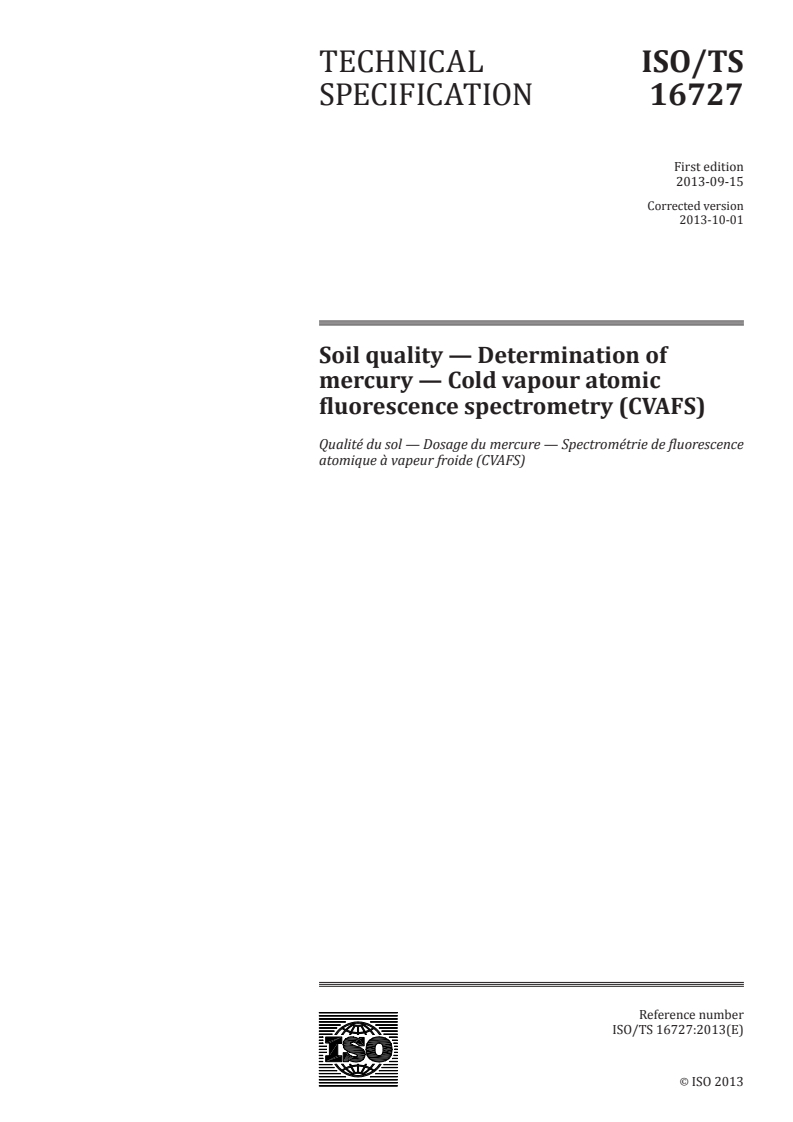
TECHNICAL ISO/TS
SPECIFICATION 16727
First edition
2013-09-15
Corrected version
2013-10-01
Soil quality — Determination of
mercury — Cold vapour atomic
fluorescence spectrometry (CVAFS)
Qualité du sol — Dosage du mercure — Spectrométrie de fluorescence
atomique à vapeur froide (CVAFS)
Reference number
©
ISO 2013
© ISO 2013
All rights reserved. Unless otherwise specified, no part of this publication may be reproduced or utilized otherwise in any form
or by any means, electronic or mechanical, including photocopying, or posting on the internet or an intranet, without prior
written permission. Permission can be requested from either ISO at the address below or ISO’s member body in the country of
the requester.
ISO copyright office
Case postale 56 • CH-1211 Geneva 20
Tel. + 41 22 749 01 11
Fax + 41 22 749 09 47
E-mail copyright@iso.org
Web www.iso.org
Published in Switzerland
ii © ISO 2013 – All rights reserved
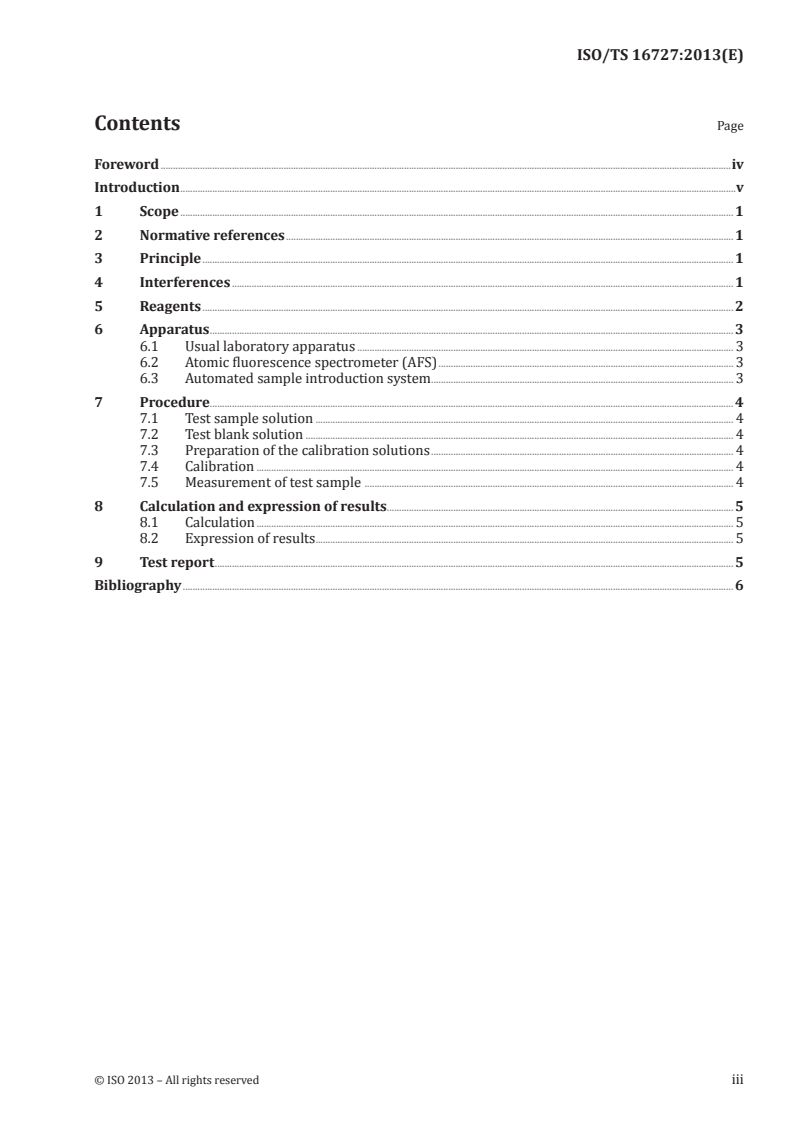
Contents Page
Foreword .iv
Introduction .v
1 Scope . 1
2 Normative references . 1
3 Principle . 1
4 Interferences . 1
5 Reagents . 2
6 Apparatus . 3
6.1 Usual laboratory apparatus . 3
6.2 Atomic fluorescence spectrometer (AFS) . 3
6.3 Automated sample introduction system . 3
7 Procedure. 4
7.1 Test sample solution . 4
7.2 Test blank solution . 4
7.3 Preparation of the calibration solutions . 4
7.4 Calibration . 4
7.5 Measurement of test sample . 4
8 Calculation and expression of results . 5
8.1 Calculation . 5
8.2 Expression of results . 5
9 Test report . 5
Bibliography . 6
Foreword
ISO (the International Organization for Standardization) is a worldwide federation of national standards
bodies (ISO member bodies). The work of preparing International Standards is normally carried out
through ISO technical committees. Each member body interested in a subject for which a technical
committee has been established has the right to be represented on that committee. International
organizations, governmental and non-governmental, in liaison with ISO, also take part in the work.
ISO collaborates closely with the International Electrotechnical Commission (IEC) on all matters of
electrotechnical standardization.
The procedures used to develop this document and those intended for its further maintenance are
described in the ISO/IEC Directives, Part 1. In particular the different approval criteria needed for the
different types of ISO documents should be noted. This document was drafted in accordance with the
editorial rules of the ISO/IEC Directives, Part 2 (see www.iso.org/directives).
Attention is drawn to the possibility that some of the elements of this document may be the subject of
patent rights. ISO shall not be held responsible for identifying any or all such patent rights. Details of
any patent rights identified during the development of the document will be in the Introduction and/or
on the ISO list of patent declarations received (see www.iso.org/patents).
Any trade name used in this document is information given for the convenience of users and does not
constitute an endorsement.
For an explanation on the meaning of ISO specific terms and expressions related to conformity
assessment, as well as information about ISO’s adherence to the WTO principles in the Technical Barriers
to Trade (TBT) see the following URL: Foreword - Supplementary information
The committee responsible for this document is ISO/TC 190, Soil quality, Subcommittee SC 3, Chemical
methods and soil characteristics.
In this corrected version, the status of the document was amended to Technical Specification on the
cover page. In addition, the page headings were changed to ISO/TS 16727:2013(E).
iv © ISO 2013 – All rights reserved
Introduction
ISO/TS 16727 is based upon CEN/TS 16175-2, Sludge, treated biowaste and soil — Determination of
mercury — Part 2: Cold vapour atomic fluorescence spectrometry (CV-AFS), which was developed by
CEN/TC 400, Project Committee — Horizontal standards in the fields of sludge, biowaste and soil.
TECHNICAL SPECIFICATION ISO/TS 16727:2013(E)
Soil quality — Determination of mercury — Cold vapour
atomic fluorescence spectrometry (CVAFS)
WARNING — Persons using this Technical Specification should be familiar with usual laboratory
practice. This Technical Specification does not purport to address all of the safety problems, if
any, associated with its use. It is the responsibility of the user to establish appropriate safety and
health practices and to ensure compliance with any national regulatory conditions.
IMPORTANT — It is absolutely essential that tests conducted according to this Technical
Specification be carried out by suitably trained staff.
1 Scope
This Technical Specification specifies a method for the determination of mercury in aqua regia or nitric
acid digests of sludge, treated biowaste and soil, obtained according to ISO 11466 or ISO 16729 using cold
vapour atomic fluorescence spectrometry. The lower working range limit is 0,003 mg/kg (dry matter).
2 Normative references
The following documents, in whole or in part, are normatively referenced in this document and are
indispensable for its application. For dated references, only the edition cited applies. For undated
references, the latest edition of the referenced document (including any amendments) applies.
ISO 11465, Soil quality — Determination of dry matter and water content on a mass basis — Gravimetric method
ISO 11466, Soil quality — Extraction of trace elements soluble in aqua regia
ISO 16729, Soil quality — Digestion of nitric acid soluble fractions of elements
ISO 3696, Water for analytical laboratory use — Specification and test methods
3 Principle
Monovalent and divalent mercury is reduced to the elemental form by tin(II)-chloride solution or sodium
borohydride in acid medium. Elemental mercury is stripped off from the solution in a closed system,
by means of a stream of argon or nitrogen. The mercury vapour is injected into the cell of an atomic
fluorescence spectrometer where the mercury atoms are excited by radiation of a specific wavelength,
usually about 254 nm. The intensity of the fluorescence radiation is a function of mercury concentration.
The concentrations are calculated using a calibration curve.
NOTE The matrix of the solution analysed is dominated by the acids used in the digestion step. Tin(II)-chloride
as a reduction substance is recommended in this Technical Specification, because sodium borohydride reduces
many elements commonly found in soil, sludge and waste extract solutions, to the elemental state, which may
cause matrix problems under particular circumstances. However, it is still possible to use sodium borohydride as
reduction agent. The concentration range 0,1 µg/l to 10 µg/l in the digested solution, corresponding to 0,003 µg/g
to 0,3 µg/g of mercury, when a 3,0 g of sample has been digested, can be determin
...