


ISO/IEC 9594-5:1998
(Main)Information technology — Open Systems Interconnection — The Directory: Protocol specifications — Part 5:
Information technology — Open Systems Interconnection — The Directory: Protocol specifications — Part 5:
Technologies de l'information — Interconnexion de systèmes ouverts (OSI) — L'annuaire: Spécification du protocole — Partie 5:
General Information
- Status
- Withdrawn
- Publication Date
- 14-Dec-1998
- Withdrawal Date
- 14-Dec-1998
- Drafting Committee
- ISO/IEC JTC 1/SC 6/WG 7 - Network, transport and future network
- Current Stage
- 9599 - Withdrawal of International Standard
- Start Date
- 21-May-2007
- Completion Date
- 12-Feb-2026
Relations
- Effective Date
- 06-Jun-2022
- Effective Date
- 06-Jun-2022
- Effective Date
- 15-Apr-2008
- Effective Date
- 15-Apr-2008
- Effective Date
- 15-Apr-2008
- Effective Date
- 15-Apr-2008
ISO/IEC 9594-5:1998 - Information technology -- Open Systems Interconnection -- The Directory: Protocol specifications
ISO/IEC 9594-5:1998 - Technologies de l'information -- Interconnexion de systemes ouverts (OSI) -- L'annuaire: Spécification du protocole
Get Certified
Connect with accredited certification bodies for this standard

BSI Group
BSI (British Standards Institution) is the business standards company that helps organizations make excellence a habit.

NYCE
Mexican standards and certification body.
Sponsored listings
Frequently Asked Questions
ISO/IEC 9594-5:1998 is a standard published by the International Organization for Standardization (ISO). Its full title is "Information technology — Open Systems Interconnection — The Directory: Protocol specifications — Part 5:". This standard covers: Information technology — Open Systems Interconnection — The Directory: Protocol specifications — Part 5:
Information technology — Open Systems Interconnection — The Directory: Protocol specifications — Part 5:
ISO/IEC 9594-5:1998 is classified under the following ICS (International Classification for Standards) categories: 35.100.70 - Application layer. The ICS classification helps identify the subject area and facilitates finding related standards.
ISO/IEC 9594-5:1998 has the following relationships with other standards: It is inter standard links to ISO/IEC 9594-5:1998/Cor 2:2002, ISO/IEC 9594-5:1998/Cor 1:2002, ISO/IEC 9594-5:1995, ISO/IEC 9594-5:2001; is excused to ISO/IEC 9594-5:1998/Cor 2:2002, ISO/IEC 9594-5:1998/Cor 1:2002. Understanding these relationships helps ensure you are using the most current and applicable version of the standard.
ISO/IEC 9594-5:1998 is available in PDF format for immediate download after purchase. The document can be added to your cart and obtained through the secure checkout process. Digital delivery ensures instant access to the complete standard document.
Standards Content (Sample)
INTERNATIONAL ISO/IEC
STANDARD 9594-5
Third edition
1998-12-15
Information technology — Open Systems
Interconnection — The Directory: Protocol
specifications
Technologies de l'information — Interconnexion de systèmes ouverts
(OSI) — L'Annuaire: Spécifications du protocole
Reference number
©
ISO/IEC 1998
PDF disclaimer
This PDF file may contain embedded typefaces. In accordance with Adobe's licensing policy, this file may be printed or viewed but shall not
be edited unless the typefaces which are embedded are licensed to and installed on the computer performing the editing. In downloading this
file, parties accept therein the responsibility of not infringing Adobe's licensing policy. The ISO Central Secretariat accepts no liability in this
area.
Adobe is a trademark of Adobe Systems Incorporated.
Details of the software products used to create this PDF file can be found in the General Info relative to the file; the PDF-creation parameters
were optimized for printing. Every care has been taken to ensure that the file is suitable for use by ISO member bodies. In the unlikely event
that a problem relating to it is found, please inform the Central Secretariat at the address given below.
© ISO/IEC 1998
All rights reserved. Unless otherwise specified, no part of this publication may be reproduced or utilized in any form or by any means, electronic
or mechanical, including photocopying and microfilm, without permission in writing from either ISO at the address below or ISO's member body
in the country of the requester.
ISO copyright office
Case postale 56 � CH-1211 Geneva 20
Tel. + 41 22 749 01 11
Fax + 41 22 749 09 47
E-mail copyright@iso.ch
Web www.iso.ch
Published by ISO in 2000
Printed in Switzerland
ii © ISO/IEC 1998 – All rights reserved
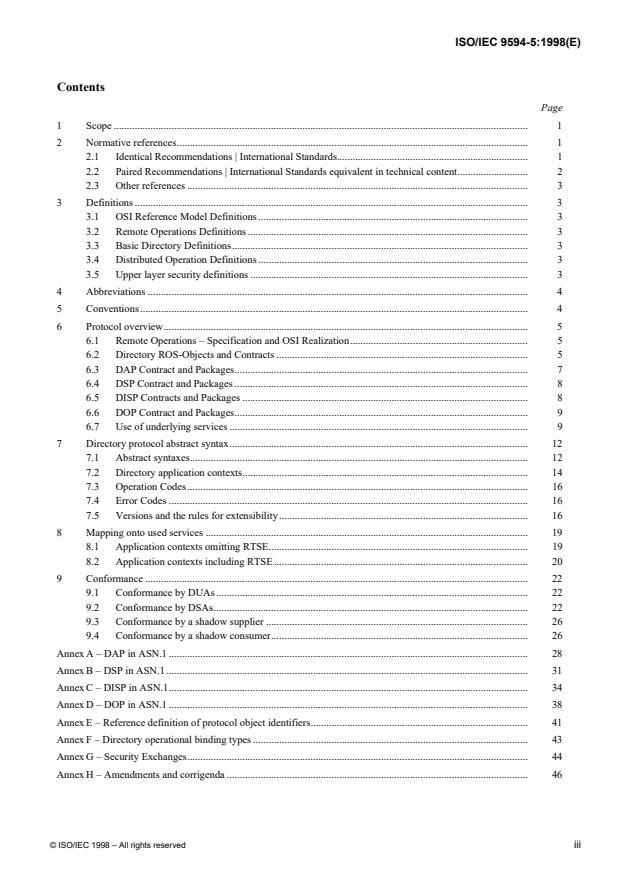
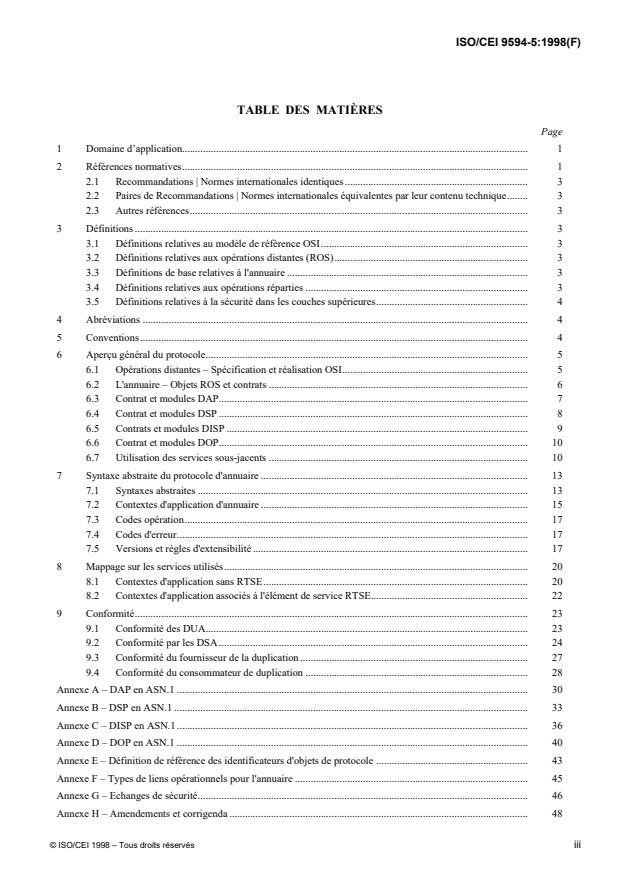
Contents
Page
1 Scope . 1
2 Normative references. 1
2.1 Identical Recommendations | International Standards. 1
2.2 Paired Recommendations | International Standards equivalent in technical content. 2
2.3 Other references . 3
3 Definitions . 3
3.1 OSI Reference Model Definitions. 3
3.2 Remote Operations Definitions . 3
3.3 Basic Directory Definitions. 3
3.4 Distributed Operation Definitions . 3
3.5 Upper layer security definitions . 3
4 Abbreviations . 4
5 Conventions. 4
6 Protocol overview. 5
6.1 Remote Operations – Specification and OSI Realization. 5
6.2 Directory ROS-Objects and Contracts . 5
6.3 DAP Contract and Packages. 7
6.4 DSP Contract and Packages . 8
6.5 DISP Contracts and Packages . 8
6.6 DOP Contract and Packages. 9
6.7 Use of underlying services . 9
7 Directory protocol abstract syntax. 12
7.1 Abstract syntaxes. 12
7.2 Directory application contexts. 14
7.3 Operation Codes. 16
7.4 Error Codes . 16
7.5 Versions and the rules for extensibility . 16
8 Mapping onto used services . 19
8.1 Application contexts omitting RTSE. 19
8.2 Application contexts including RTSE . 20
9 Conformance . 22
9.1 Conformance by DUAs. 22
9.2 Conformance by DSAs. 22
9.3 Conformance by a shadow supplier . 26
9.4 Conformance by a shadow consumer. 26
Annex A – DAP in ASN.1 . 28
Annex B – DSP in ASN.1 . 31
Annex C – DISP in ASN.1. 34
Annex D – DOP in ASN.1 . 38
Annex E – Reference definition of protocol object identifiers. 41
Annex F – Directory operational binding types . 43
Annex G – Security Exchanges. 44
Annex H – Amendments and corrigenda . 46
© ISO/IEC 1998 – All rights reserved iii
Foreword
ISO (the International Organization for Standardization) and IEC (the International Electrotechnical Commission)
form the specialized system for worldwide standardization. National bodies that are members of ISO or IEC
participate in the development of International Standards through technical committees established by the
respective organization to deal with particular fields of technical activity. ISO and IEC technical committees
collaborate in fields of mutual interest. Other international organizations, governmental and non-governmental, in
liaison with ISO and IEC, also take part in the work.
International Standards are drafted in accordance with the rules given in the ISO/IEC Directives, Part 3.
In the field of information technology, ISO and IEC have established a joint technical committee, ISO/IEC JTC 1.
Draft International Standards adopted by the joint technical committee are circulated to national bodies for voting.
Publication as an International Standard requires approval by at least 75 % of the national bodies casting a vote.
Attention is drawn to the possibility that some of the elements of this part of ISO/IEC 9594 may be the subject of
patent rights. ISO and IEC shall not be held responsible for identifying any or all such patent rights.
International Standard ISO/IEC 9594-5 was prepared by Joint Technical Committee ISO/IEC JTC 1, Information
technology, Subcommittee SC 6, Telecommunications and information exchange between systems,in
collaboration with ITU-T. The identical text is published as ITU-T Recommendation X.519.
This third edition cancels and replaces the second edition (ISO/IEC 9594-5:1995), of which it constitutes a minor
revision.
ISO/IEC 9594 consists of the following parts, under the general title Information technology — Open Systems
Interconnection — The Directory :
� Part 1: Overview of concepts, models and services
� Part 2: Models
� Part 3: Abstract service definition
� Part 4: Procedures for distributed operation
� Part 5: Protocol specifications
� Part 6: Selected attribute types
� Part 7: Selected object classes
� Part 8: Authentication framework
� Part 9: Replication
� Part 10: Use of systems management for administration of the Directory
Annexes A to G form a normative part of this part of ISO/IEC 9594. Annex H is for information only.
iv © ISO/IEC 1998 – All rights reserved
Introduction
This Recommendation | International Standard, together with the other Recommendations | International
Standards, has been produced to facilitate the interconnection of information processing systems to provide
directory services. A set of such systems, together with the directory information which they hold, can be
viewed as an integrated whole, called the Directory. The information held by the Directory, collectively
known as the Directory Information Base (DIB), is typically used to facilitate communication between, with
or about objects such as application entities, people, terminals and distribution lists.
The Directory plays a significant role in Open Systems Interconnection, whose aim is to allow, with a minimum of
technical agreement outside of the interconnection standards themselves, the interconnection of information processing
systems:
– from different manufacturers;
– under different managements;
– of different levels of complexity; and
– of different ages.
This Recommendation | International Standard specifies the application service elements and application contexts for
two protocols - the Directory Access Protocol (DAP) and the Directory System Protocol (DSP). The DAP provides for
access to the Directory to retrieve or modify Directory information. The DSP provides for the chaining of requests to
retrieve or modify Directory information to other parts of the distributed Directory System where the information may be
held.
In addition this Recommendation | International Standard specifies the application service elements and application
contexts for the Directory Information Shadowing Protocol (DISP) and the Directory Operational Binding Management
Protocol (DOP). The DISP provides for the shadowing of information held in one DSA to another DSA. The DOP
provides for the establishment, modification and termination of bindings between pairs of DSAs for the administration
of relationships between the DSAs (such as for shadowing or hierarchical relationships).
This third edition technically revises and enhances, but does not replace, the second edition of this Recommendation |
International Standard. Implementations may still claim conformance to the second edition. However, at some point, the
second edition will not be supported (i.e. reported defects will no longer be resolved). It is recommended that
implementations conform to this third edition as soon as possible.
This third edition specifies version 1 and version 2 of the Directory protocols.
The first and second editions also specified version 1. Most of the services and protocols specified in this edition are
designed to function under version 1. When version 1 has been negotiated differences between the services and between
the protocols defined in the three editions are accommodated using the rules of extensibility defined in this edition of
ITU-T Rec. X.519 | ISO/IEC 9594-5. However, some enhanced services and protocols, e.g. signed errors, will not
function unless all Directory entities involved in the operation have negotiated version 2.
Implementors should note that a defect resolution process exists and that corrections may be applied to this part of this
International Standard in the form of technical corrigenda. The identical corrections will be applied to this
Recommendation in the form of Corrigenda and/or an Implementor’s Guide. A list of approved technical corrigenda for
this part of this International Standard can be obtained from the subcommittee secretariat. Published technical corrigenda
are available from your national standards organization. The ITU-T Corrigenda and Implementor’s Guides may be
obtained from the ITU Web site.
Annex A, which is an integral part of this Recommendation | International Standard, provides the ASN.1 module for the
directory access protocol.
Annex B, which is an integral part of this Recommendation | International Standard, provides the ASN.1 module for the
directory system protocol.
Annex C, which is an integral part of this Recommendation | International Standard, provides the ASN.1 module for the
directory information shadowing protocol.
Annex D, which is an integral part of this Recommendation | International Standard, provides the ASN.1 module for the
directory operational binding management protocol.
© ISO/IEC 1998 – All rights reserved v
Annex E, which is an integral part of this Recommendation | International Standard, provides the ASN.1 module which
contains all the ASN.1 object identifiers assigned in this Recommendation | International Standard.
Annex F, which is an integral part of this Recommendation | International Standard, provides the ASN.1 module which
contains all the ASN.1 object identifiers assigned to identify operational binding types in this series of
Recommendations | International Standards.
Annex G, which is an integral part of this Recommendation | International Standard, provides the ASN.1 module for the
security exchanges.
Annex H, which is not an integral part of this Recommendation | International Standard, lists the amendments and defect
reports that have been incorporated to form this edition of this Recommendation | International Standard.
vi © ISO/IEC 1998 – All rights reserved
ISO/IEC 9594-5 : 1998 (E)
INTERNATIONAL STANDARD
ISO/IEC 9594-5 : 1998 (E)
ITU-T Rec. X.519 (1997 E)
ITU-T RECOMMENDATION
INFORMATION TECHNOLOGY – OPEN SYSTEMS INTERCONNECTION –
THE DIRECTORY: PROTOCOL SPECIFICATIONS
1 Scope
This Recommendation | International Standard specifies the Directory Access Protocol, the Directory System Protocol,
the Directory Information Shadowing Protocol, and the Directory Operational Binding Management Protocol fulfilling
the abstract services specified in ITU-T Rec. X.511 | ISO/IEC 9594-3, ITU-T Rec. X.518 | ISO/IEC 9594-4, and
ITU-T Rec. X.525 | ISO/IEC 9594-9.
2 Normative references
The following Recommendations and International Standards contain provisions which, through reference in this text,
constitute provisions of this Recommendation | International Standard. At the time of publication, the editions indicated
were valid. All Recommendations and Standards are subject to revision, and parties to agreements based on this
Recommendation | International Standard are encouraged to investigate the possibility of applying the most recent
edition of the Recommendations and Standards listed below. Members of IEC and ISO maintain registers of currently
valid International Standards. The Telecommunication Standardization Bureau of the ITU maintains a list of currently
valid ITU-T Recommendations.
2.1 Identical Recommendations | International Standards
– ITU-T Recommendation X.200 (1994) | ISO/IEC 7498-1:1994, Information technology – Open Systems
Interconnection – Basic Reference Model: The Basic Model.
– ITU-T Recommendation X.213 (1995) | ISO/IEC 8348:1996, Information technology – Open Systems
Interconnection – Network service definition.
– ITU-T Recommendation X.214 (1995) | ISO/IEC 8072:1996, Information technology – Open Systems
Interconnection – Transport service definition.
– ITU-T Recommendation X.215 (1995) | ISO/IEC 8326:1996, Information technology – Open Systems
Interconnection – Session service definition.
– ITU-T Recommendation X.216 (1994) | ISO/IEC 8822:1994, Information technology – Open Systems
Interconnection – Presentation service definition.
– ITU-T Recommendation X.217 (1995) | ISO/IEC 8649:1996, Information technology – Open Systems
Interconnection – Service definition for the Association Control Service Element.
– ITU-T Recommendation X.227 (1995) | ISO/IEC 8650-1:1996, Information technology – Open Systems
Interconnection – Connection-oriented protocol for the Association Control Service Element: Protocol
specification.
– ITU-T Recommendation X.500 (1997) | ISO/IEC 9594-1:1998, Information technology – Open Systems
Interconnection – The Directory: Overview of concepts, models and services.
– ITU-T Recommendation X.501 (1997) | ISO/IEC 9594-2:1998, Information technology – Open Systems
Interconnection – The Directory: Models.
– ITU-T Recommendation X.509 (1997) | ISO/IEC 9594-8:1998, Information technology – Open Systems
Interconnection – The Directory: Authentication framework.
– ITU-T Recommendation X.511 (1997) | ISO/IEC 9594-3:1998, Information technology – Open Systems
Interconnection – The Directory: Abstract service definition.
ITU-T Rec. X.519 (1997 E) 1
ISO/IEC 9594-5 : 1998 (E)
– ITU-T Recommendation X.518 (1997) | ISO/IEC 9594-4:1998, Information technology – Open Systems
Interconnection – The Directory: Procedures for distributed operation.
– ITU-T Recommendation X.520 (1997) | ISO/IEC 9594-6:1998, Information technology – Open Systems
Interconnection – The Directory: Selected attribute types.
– ITU-T Recommendation X.521 (1997) | ISO/IEC 9594-7:1998, Information technology – Open Systems
Interconnection – The Directory: Selected object classes.
– ITU-T Recommendation X.525 (1997) | ISO/IEC 9594-9:1998, Information technology – Open Systems
Interconnection – The Directory: Replication.
– ITU-T Recommendation X.530 (1997) | ISO/IEC 9594-10:1998, Information technology – Open Systems
Interconnection – The Directory: Use of systems management for administration of the Directory.
– ITU-T Recommendation X.680 (1997) | ISO/IEC 8824-1:1998, Information technology – Abstract Syntax
Notation One (ASN.1): Specification of basic notation.
– ITU-T Recommendation X.681 (1997) | ISO/IEC 8824-2:1998, Information technology – Abstract Syntax
Notation One (ASN.1): Information object specification.
– ITU-T Recommendation X.682 (1997) | ISO/IEC 8824-3:1998, Information technology – Abstract Syntax
Notation One (ASN.1): Constraint specification.
– ITU-T Recommendation X.683 (1997) | ISO/IEC 8824-4:1998, Information technology – Abstract Syntax
Notation One (ASN.1): Parametrization of ASN.1 specifications.
– ITU-T Recommendation X.690 (1997) | ISO/IEC 8825-1:1998, Information technology – ASN.1 encoding
rules: Specification of Basic Encoding Rules (BER), Canonical Encoding Rules (CER) and Distinguished
Encoding Rules (DER).
– ITU Recommendation X.803 (1994) | ISO/IEC 10745:1995, Information technology – Open Systems
Interconnection – Upper layers security model.
– ITU Recommendation X.830 (1995) | ISO/IEC 11586-1:1996, Information technology – Open Systems
Interconnection – Generic upper layers security: Overview, models and notation.
– ITU Recommendation X.831 (1995) | ISO/IEC 11586-2:1996, Information technology – Open Systems
Interconnection – Generic upper layers security: Security Exchange Service Element (SESE) service
definition.
– ITU Recommendation X.832 (1995) | ISO/IEC 11586-3:1996, Information technology – Open Systems
Interconnection – Generic upper layers security: Security Exchange Service Element (SESE) protocol
specification.
– ITU Recommendation X.833 (1995) | ISO/IEC 11586-4:1996, Information technology – Open Systems
Interconnection – Generic upper layers security: Protecting transfer syntax specification.
– ITU-T Recommendation X.880 (1994) | ISO/IEC 13712-1:1995, Information technology – Remote
Operations: Concepts, model and notation plus Technical Corrigendum 1 (1996).
– ITU-T Recommendation X.880 (1994)/Amd.1 (1995) | ISO/IEC 13712-1:1995/Amd.1:1996, Information
technology – Remote Operations: Concepts, model and notation – Amendment 1: Built-in operations.
– ITU-T Recommendation X.881 (1994) | ISO/IEC 13712-2:1995, Information technology – Remote
Operations: OSI realizations – Remote Operations Service Element (ROSE) service definition.
– ITU-T Recommendation X.881 (1994)/Amd.1 (1995) | ISO/IEC 13712-2:1995/Amd.1:1996, Information
technology – Remote Operations: OSI realizations – Remote Operations Service Element (ROSE) service
definition – Amendment 1: Mapping to A-UNIT-DATA and built-in operations.
– ITU-T Recommendation X.882 (1994) | ISO/IEC 13712-3:1995, Information technology – Remote
Operations: OSI realizations – Remote Operations Service Element (ROSE) protocol specification plus
Technical Corrigendum 1 (1996).
– ITU-T Recommendation X.882 (1994)/Amd.1 (1995) | ISO/IEC 13712-3:1995/Amd.1:1996, Information
technology – Remote Operations: OSI realizations – Remote Operations Service Element (ROSE)
protocol specification – Amendment 1: Mapping to A-UNIT-DATA and built-in operations.
2.2 Paired Recommendations | International Standards equivalent in technical content
– ITU-T Recommendation X.218 (1993) Reliable Transfer: Model and Service Definition.
ISO/IEC 9066-1:1989, Information processing systems – Text communication – Reliable Transfer –
Part 1: Model and service definition.
2 ITU-T Rec. X.519 (1997 E)
ISO/IEC 9594-5 : 1998 (E)
2.3 Other references
– ITU-T Recommendation E.164 (1997), The international public telecommunication numbering plan.
– ITU-T Recommendation X.121 (1996), International numbering plan for public data networks.
– RFC 2025 (1996), The Simple Public-Key GSS-API Mechanism (SPKM).
3 Definitions
For the purposes of this Recommendation | International Standard, the following definitions apply:
3.1 OSI Reference Model Definitions
The following terms are defined in ITU-T Rec. X.200 | ISO/IEC 7498-1:
a) abstract-syntax;
b) application-context;
c) application-entity;
d) application process;
e) application-protocol-control-information;
f) application-protocol-data-unit;
g) application-service-element.
3.2 Remote Operations Definitions
The following terms are defined in ITU-T Rec. X.880 | ISO/IEC 13712-1:
a) connection package;
b) contract, association contract;
c) error;
d) operation;
e) operation package;
f) ROS-object.
3.3 Basic Directory Definitions
The following terms are defined in ITU-T Rec. X.501 | ISO/IEC 9594-2:
a) the Directory;
b) (Directory) user;
c) Directory System Agent (DSA);
d) Directory User Agent (DUA).
3.4 Distributed Operation Definitions
The following terms are defined in ITU-T Rec. X.518 | ISO/IEC 9594-4:
a) chaining;
b) referral.
3.5 Upper layer security definitions
The following terms are used as defined in ITU-T Rec. X.803 | ISO/IEC 10745:
a) security association;
b) security transformation;
c) security exchange;
d) security exchange item.
ITU-T Rec. X.519 (1997 E) 3
ISO/IEC 9594-5 : 1998 (E)
The following terms are used as defined in ITU-T Rec. X.830 | ISO/IEC 11586-1:
a) protecting transfer syntax;
b) protection mapping.
4 Abbreviations
For the purposes of this Recommendation | International Standard, the following abbreviations apply:
AC Application Context[COMP/RM1]
ACSE Association Control Service Element[COMP/RM2]
AE Application Entity
APCI Application Protocol Control Information
APDU Application Protocol Data Unit
ASE Application Service Element
DAP Directory Access Protocol
DISP Directory Information Shadowing Protocol
DOP Directory Operational Binding Management Protocol
DSA Directory System Agent
DSP Directory System Protocol
DUA Directory User Agent
GULS Generic Upper Layers Security
ROS Remote Operations Service
ROSE Remote Operations Service Element
RTSE Reliable Transfer Service Element
SESE Security Exchange Service Element
5 Conventions
With minor exceptions this Directory Specification has been prepared according to the "Presentation of ITU-T | ISO/IEC
common text" guidelines in the Guide for ITU-T and ISO/IEC JTC 1 Cooperation.
The term "Directory Specification" (as in "this Directory Specification") shall be taken to mean ITU-T Rec. X.519 |
ISO/IEC 9594-5. The term "Directory Specifications" shall be taken to mean the X.500-series Recommendations and all
parts of ISO/IEC 9594.
This Directory Specification uses the term "1988 edition systems" to refer to systems conforming to the first (1988)
edition of the Directory Specifications, i.e. the 1988 edition of the series of CCITT X.500 Recommendations and the
ISO/IEC 9594:1990 edition. This Directory Specification uses the term "1993 edition systems" to refer to systems
conforming to the second (1993) edition of the Directory Specifications, i.e. the 1993 edition of the series of ITU-T
X.500 Recommendations and the ISO/IEC 9594:1995 edition. Systems conforming to this third edition of the Directory
Specifications are referred to as "1997 edition systems".
This Directory Specification presents ASN.1 notation in the bold Helvetica typeface. When ASN.1 types and values are
referenced in normal text, they are differentiated from normal text by presenting them in the bold Helvetica typeface.
The names of procedures, typically referenced when specifying the semantics of processing, are differentiated from
normal text by displaying them in bold Times. Access control permissions are presented in italicized Times.
If the items in a list are numbered (as opposed to using "–" or letters), then the items shall be considered steps in a
procedure.
This Directory Specification defines directory operations using the Remote Operation notation defined in ITU-T
Rec. X.880 | ISO/IEC 13712-1.
4 ITU-T Rec. X.519 (1997 E)
ISO/IEC 9594-5 : 1998 (E)
6 Protocol overview
6.1 Remote Operations – Specification and OSI Realization
ITU-T Rec. X.880 | ISO/IEC 13712-1 defines several information object classes that are useful in the specification of
ROS-based application protocols such as the various Directory protocols defined in this Directory Specification. A
number of these classes are used in this and subsequent clauses. The specification techniques provided in
ITU-T Rec. X.880 | ISO/IEC 13712-1 are used to define a generic protocol between objects. When realized as an OSI
application layer protocol, the concepts of ITU-T Rec. X.880 | ISO/IEC 13712-1 are mapped to OSI concepts in ITU-T
Rec. X.881 | ISO/IEC 13712-2 and ITU-T Rec. X.882 | ISO/IEC 13712-3.
The ROS-OBJECT-CLASS class is used to define a set of common capabilities of a set of ROS-objects in terms of the
(association) contracts they support as initiators and/or responders. When realized using the communication services of
OSI, a ROS-object maps to an application process and a contract to an application context. In these Directory
Specifications the term abstract service is used to refer to a ROS association contract and OSI application layer protocol
to refer to the realization of a contract between two open systems using OSI communication services.
The OPERATION-PACKAGE class is used to define a set of operations which may be invoked by a ROS-object
assuming the role of "consumer", the operations which may be invoked by a ROS-object assuming the role of "supplier",
and the operations which may be invoked by both ROS-objects. When using the communication services of OSI, an
operation package is realized as an application service element (ASE).
The CONNECTION-PACKAGE class is used to define the bind and unbind operations used to establish and release an
association. When realized using the communication services of OSI, a connection package is realized as the procedures
that use the services of the Association Control Service Element.
The CONTRACT class is used to define an association contract in terms of a connection package and one or more
operation packages. When specifying the contract, the packages in which the association initiator assumes the role of
consumer, the association responder assumes the role of consumer, and either may assume the role of consumer are
identified. When using the communication services of OSI, a contract is realized as an application context.
The APPLICATION-CONTEXT class is used to define the static aspects of an application context. These include the
contract that is realized via the application context, the OSI service that establishes and releases the association, the OSI
service that provides information transfer for the interactions of the contract, and the abstract syntaxes used.
The ABSTRACT-SYNTAX class, which is built in to ASN.1, is used to define and assign an object identifier to an ASN.1
type whose values comprise an abstract syntax.
The OSI application layer protocols defined in the Directory Specifications, the DAP, DSP, DISP and DOP, are
protocols to provide communication between a pair of application processes. In the OSI environment this is represented
as communication between a pair of Application-Entities (AEs) using the presentation service. The function of an AE is
provided by a set of Application-Service-Elements (ASEs). The interaction between AEs is described in terms of their
use of the services provided by the ASEs. All the services provided by the Directory ASEs are contained in a single AE.
The Remote Operations Service Element (ROSE) supports the request/reply paradigm of the operation. The Directory
ASEs provide the mapping function of the abstract-syntax notation of the directory operation packages onto the services
provided by the ROSE.
The Association Control Service Element (ACSE) supports the establishment and release of an application-association
between a pair of AEs. Associations between a DUA and a DSA may be established only by the DUA. Only the initiator
of an established association can release it.
Optionally, the Reliable Transfer Service Element (RTSE) may be used to reliably transfer the Application Protocol Data
Units (APDUs) of the DISP.
Optionally, the Security Exchange Service Element (SESE) may be used to convey credentials for authentication and to
establish a security association.
6.2 Directory ROS-Objects and Contracts
ITU-T Rec. X.511 | ISO/IEC 9594-3 defines the abstract service between a DUA and the Directory which provides an
access point to support a user accessing Directory services.
ITU-T Rec. X.519 (1997 E) 5
ISO/IEC 9594-5 : 1998 (E)
The dua class of ROS-object describes a DUA, being an instance of this class, as the initiator of the contract
dapContract. This contract is referred to in these Directory Specifications as the Directory Abstract Service. It is
specified as a ROS-based information object in 6.3.
dua ROS-OBJECT-CLASS ::= {
INITIATES { dapContract }
ID id-rosObject-dua }
The directory class of ROS-object describes the provider of the Directory Abstract Service. This provider is the
responder of the dapContract.
directory ROS-OBJECT-CLASS ::= {
RESPONDS { dapContract }
ID id-rosObject-directory }
The Directory is further modelled, as depicted in Figure 1, as being represented to a DUA by a DSA which supports the
particular access point concerned. ITU-T Rec. X.518 | ISO/IEC 9594-4 defines the interactions between a pair of DSAs
within the Directory to support user requests which are chained.
Access Point
The
Directory
Directory
DUA
DSA DSA
user
TISO3010-94/D01
Figure 1 – Directory Interactions
FIGURE 1/X.519.[D01]
The directory object is therefore manifested as a set interacting DSAs. Each DSA comprising the directory is an
instance of the dap-dsa class. A dap-dsa object assumes the role of responder in the dapContract.
dap-dsa ROS-OBJECT-CLASS ::= {
RESPONDS { dapContract }
ID id-rosObject-dapDSA }
In addition to interacting with DUAs, DSAs interact with one another to achieve various objectives. In what follows, a
number of contracts and ROS-objects expressing how DSAs participate in these contracts are defined. Any real DSA
may instantiate one or more of these DSA ROS-objects.
The interactions between DSAs generally required to provide the Directory Abstract Service in the presence of a
distributed DIB are defined as a dspContract. A DSA that participates in this contract is defined as a ROS-object of
class dsp-dsa. The contract is referred to in these Directory Specifications as the DSA Abstract Service. It is specified
as a ROS-based information object in 6.4.
dsp-dsa ROS-OBJECT-CLASS ::= {
BOTH { dspContract }
ID id-rosObject-dspDSA }
The Shadow Abstract Service specifies the shadowing of information between a shadow supplier and a shadow
consumer DSA. This service is manifested in two forms and therefore is defined as two distinct contracts. They are
specified as a ROS-based information objects in 6.5.
The shadowConsumerContract expresses the form of the service in which the shadow consumer, a ROS-object of class
initiating-consumer-dsa, initiates the contract. A ROS-object of class responding-supplier-dsa, responds in this
contract.
initiating-consumer-dsa ROS-OBJECT-CLASS ::= {
INITIATES { shadowConsumerContract }
ID id-rosObject-initiatingConsumerDSA }
6 ITU-T Rec. X.519 (1997 E)
ISO/IEC 9594-5 : 1998 (E)
responding-supplier-dsa ROS-OBJECT-CLASS ::= {
RESPONDS { shadowConsumerContract }
ID id-rosObject-respondingSupplierDSA }
The shadowSupplierContract expresses the form of the service in which the shadow supplier, a ROS-object of class
initiating-supplier-dsa, initiates the contract. A ROS-object of class responding-consumer-dsa, responds in this
contract.
initiating-supplier-dsa ROS-OBJECT-CLASS ::= {
INITIATES { shadowSupplierContract }
ID id-rosObject-initiatingSupplierDSA }
responding-consumer-dsa ROS-OBJECT-CLASS ::= {
RESPONDS { shadowSupplierContract }
ID id-rosObject-respondingConsumerDSA }
The interactions between two DSAs to manage a set of operational bindings are defined as a dopContract.
dop-dsa ROS-OBJECT-CLASS ::= {
BOTH { dopContract }
ID id-rosObject-dopDSA }
A DSA that participates in this contract is defined as a ROS-object of class dop-dsa. This contract is specified as a
ROS-based information object in 6.6.
6.3 DAP Contract and Packages
The dapContract is defined as an information object of class CONTRACT.
dapContract CONTRACT ::= {
CONNECTION dapConnectionPackage
INITIATOR CONSUMER OF { readPackage | searchPackage | modifyPackage }
ID id-contract-dap }
When a DUA and DSA from different open systems interact, this association contract may be realized as an OSI
application layer protocol, referred to in these Directory Specifications as the Directory Access Protocol (DAP). The
definition of this protocol in terms of an OSI application context is provided in 7.2 of this Directory Specification.
The dapContract is composed of a connection package, dapConnectionPackage, and three operation packages,
readPackage, searchPackage and modifyPackage.
The connection package, dapConnectionPackage, is defined as an information object of class CONNECTION-
PACKAGE. The bind and unbind operations of this connection package, directoryBind and directoryUnbind, are
defined in ITU-T Rec. X.511 | ISO/IEC 9594-3.
dapConnectionPackage CONNECTION-PACKAGE ::= {
BIND directoryBind
UNBIND directoryUnbind
ID id-package-dapConnection }
The operation packages, readPackage, searchPackage and modifyPackage, are defined as information objects of class
OPERATION-PACKAGE. The operations of these operation packages are defined in ITU-T Rec. X.511 |
ISO/IEC 9594-3.
readPackage OPERATION-PACKAGE ::= {
CONSUMER INVOKES { read | compare | abandon }
ID id-package-read }
searchPackage OPERATION-PACKAGE ::= {
CONSUMER INVOKES { list | search }
ID id-package-search }
modifyPackage OPERATION-PACKAGE ::= {
CONSUMER INVOKES { addEntry | removeEntry | modifyEntry | modifyDN }
ID id-package-modify }
NOTE – These packages, when realized as ASEs, are used for the construction of application contexts defined in this
Specification They are not intended to allow for claims of conformance to individual, or other combinations of, ASEs.
Since the DUA is the initiator of the dapContract, it assumes the role of consumer of the operation packages of the
contract. This means that only the DUA can invoke operations in this contract and its OSI realization.
ITU-T Rec. X.519 (1997 E) 7
ISO/IEC 9594-5 : 1998 (E)
6.4 DSP Contract and Packages
The dspContract is defined as an information object of class CONTRACT.
dspContract CONTRACT ::= {
CONNECTION dspConnectionPackage
OPERATIONS OF { chainedReadPackage | chainedSearchPackage | chainedModifyPackage }
ID id-contract-dsp }
When a pair of DSAs from different open systems interact, this association contract is realized as an OSI application
layer protocol, referred to in these Directory Specifications as the Directory System Protocol (DSP). The definition of
this protocol in terms of an OSI application context is provided in 7.2.
The dspContract is composed of a connection package, dspConnectionPackage, and three operation packages,
chainedReadPackage, chainedSearchPackage and chainedModifyPackage.
The connection package, dspConnectionPackage, is defined as an information object of class CONNECTION-
PACKAGE. It is identical to the connection package, dapConnectionPackage.
dspConnectionPackage CONNECTION-PACKAGE ::= {
BIND dSABind
UNBIND dSAUnbind
ID id-package-dspConnection }
The operation packages, chainedReadPackage, chainedSearchPackage and chainedModifyPackage, are defined as
information objects of class OPERATION-PACKAGE. The operations of these operation packages are defined in ITU-T
Rec. X.518 | ISO/IEC 9594-4.
chainedReadPackage OPERATION-PACKAGE ::= {
OPERATIONS { chainedRead | chainedCompare | chainedAbandon }
ID id-package-chainedRead }
chainedSearchPackage OPERATION-PACKAGE ::= {
OPERATIONS { chainedList | chainedSearch }
ID id-package-chainedSearch }
chainedModifyPackage OPERATION-PACKAGE ::= {
OPERATIONS { chainedAddEntry | chainedRemoveEntry |
chainedModifyEntry | chainedModifyDN }
ID id-package-chainedModify }
NOTE – These packages, when realized as ASEs, are used for the construction of application contexts defined in this
Specification They are not intended to allow for claims of conformance to individual, or other combinations of, ASEs.
In the dspContract either DSA may assume the role of initiator and either the initiating or responding DSA may invoke
the operations of the contract.
6.5 DISP Contracts and Packages
The shadowConsumerContract and shadowSupplierContract are defined as information objects of class
CONTRACT.
shadowConsumerContract CONTRACT ::= {
CONNECTION dispConnectionPackage
INITIATOR CONSUMER OF { shadowConsumerPackage }
ID id-contract-shadowConsumer }
shadowSupplierContract CONTRACT ::= {
CONNECTION dispConnectionPackage
RESPONDER CONSUMER OF { shadowSupplierPackage }
ID id-contract-shadowSupplier }
NOTE – The term consumer and supplier are employed in the notation for the CONTRACT and OPERATION-PACKAGE classes
are used to designate two roles. These roles correspond to the two terms shadow consumer and shadow supplier, respectively,
used in ITU-T Rec. X.525 | ISO/IEC 9594-9.
The OSI realizations of the two forms of the Shadow Abstract Service, referred to collectively as the Directory
Information Shadowing Protocol (DISP), are defined in terms of several OSI application contexts, provided in 7.2.
The shadowConsumerContract and shadowSupplierContract are composed of a common connection package,
dispConnectionPackage, and one operation package, either shadowConsumerPackage in the first case or
shadowSupplierPackage in the second.
8 ITU-T Rec. X.519 (1997 E)
ISO/IEC 9594-5 : 1998 (E)
The connection package, dispConnectionPackage, is defined as an information object of class CONNECTION-
PACKAGE. It is identical to the connection package, dapConnectionPackage.
dispConnectionPackage CONNECTION-PACKAGE ::= {
BIND dSAShadowBind
UNBIND dSAShadowUnbind
ID id-package-dispConnection }
The operation packages, shadowConsumerPackage and shadowSupplierPackage, are defined as information objects
of class OPERATION-PACKAGE. The operations of these operation packages are defined in ITU-T Rec. X.525 |
ISO/IEC 9594-9.
shadowConsumerPackage OPERATION-PACKAGE ::= {
CONSUMER INVOKES { requestShadowUpdate }
SUPPLIER INVOKES { updateShadow }
ID id-package-shadowConsumer }
shadowSupplierPackage OPERATION-PACKAGE ::= {
SUPPLIER INVOKES { coordinateShadowUpdate |
updateShadow }
ID id-package-shadowSupplier }
Since the shadow consumer is the initiator of the shadowConsumerContract, it assumes the role of consumer of the
shadowConsumerPackage. This means that the shadow consumer invokes the requestShadowUpdate operation and
that the shadow supplier invokes the updateShadow operation.
Since the shadow supplier is the initiator of the shadowSupplierContract, it assumes the role of supplier of the
shadowSupplierPackage. This means that the shadow supplier invokes the operations of the contract.
6.6 DOP Contract and Packages
The dopContract is defined as an information object of class CONTRACT.
dopContract CONTRACT ::= {
CONNECTION dopConnectionPackage
OPERATIONS OF { dopPackage }
ID id-contract-dop }
When a pair of DSAs from different open systems interact, this association contract is realized as an OSI application
layer protocol, referred to in these Directory Specifications as the Directory Operational Binding Management Protocol
(DOP). The definition of this protocol in terms of an OSI application context is provided in 7.2.
The connection package, dopConnectionPackage, is defined as an information object of class CONNECTION-
PACKAGE. It is identical to the connection package, dapConnectionPackage.
dopConnectionPackage CONNECTION-PACKAGE ::= {
BIND dSAOperationalBindingManagementBind
UNBIND dSAOperationalBindingManagementUnbind
ID id-package-dopConnection }
The operation package, dopPackage, is defined as information objects of class OPERATION-PACKAGE. The
operations of these operation packages are defined in ITU-T Rec. X.501 | ISO/IEC 9594-2.
dopPackage OPERATION-PACKAGE ::= {
CONSUMER INVOKES { establishOperationalBinding |
modifyOperationalBinding |
terminateOperationalB
...
NORME ISO/CEI
INTERNATIONALE 9594-5
Troisième édition
1998-12-15
Technologies de l'information —
Interconnexion de systèmes ouverts
(OSI) — L'annuaire: Spécification
du protocole
Information technology — Open Systems Interconnection —
The Directory: Protocol specifications
Numéro de référence
ISO/CEI 9594-5:1998(F)
©
ISO/CEI 1998
ISO/CEI 9594-5:1998(F)
PDF – Exonération de responsabilité
Le présent fichier PDF peut contenir des polices de caractères intégrées. Conformément aux conditions de licence d'Adobe, ce fichier peut
être imprimé ou visualisé, mais ne doit pas être modifiéà moins que l'ordinateur employéà cet effet ne bénéficie d'une licence autorisant
l'utilisation de ces polices et que celles-ci y soient installées. Lors du téléchargement de ce fichier, les parties concernées acceptent de fait la
responsabilité de ne pas enfreindre les conditions de licence d'Adobe. Le Secrétariat central de l'ISO décline toute responsabilité en la
matière.
Adobe est une marque déposée d'Adobe Systems Incorporated.
Les détails relatifs aux produits logiciels utilisés pour la créationduprésent fichier PDF sont disponibles dans la rubrique General Info du
fichier; les paramètres de création PDF ont été optimisés pour l'impression. Toutes les mesures ont été prises pour garantir l'exploitation de
ce fichier par les comités membres de l'ISO. Dans le cas peu probable où surviendrait un problème d'utilisation, veuillez en informer le
Secrétariat central à l'adresse donnée ci-dessous.
© ISO/CEI 1998
Droits de reproduction réservés. Sauf prescription différente, aucune partie de cette publication ne peut être reproduite ni utilisée sous quelque
forme que ce soit et par aucun procédé, électronique ou mécanique, y compris la photocopie et les microfilms, sans l'accord écrit de l’ISO à
l’adresse ci-aprèsouducomité membre de l’ISO dans le pays du demandeur.
ISO copyright office
Case postale 56 � CH-1211 Geneva 20
Tel. + 41 22 749 01 11
Fax. + 41 22 749 09 47
E-mail copyright@iso.ch
Web www.iso.ch
Publiée par l'ISO en 2000
Version française parue en 2001
Imprimé en Suisse
ii © ISO/CEI 1998 – Tous droits réservés
ISO/CEI 9594-5:1998(F)
TABLE DES MATIÈRES
Page
1 Domaine d’application. 1
2 Références normatives. 1
2.1 Recommandations | Normes internationales identiques . 3
2.2 Paires de Recommandations | Normes internationales équivalentes par leur contenu technique. 3
2.3 Autres références. 3
3 Définitions . 3
3.1 Définitions relatives au modèle de référence OSI . 3
3.2 Définitions relatives aux opérations distantes (ROS). 3
3.3 Définitions de base relatives à l'annuaire . 3
3.4 Définitions relatives aux opérations réparties . 3
3.5 Définitions relatives à la sécurité dans les couches supérieures. 4
4 Abréviations . 4
5 Conventions. 4
6 Aperçu général du protocole. 5
6.1 Opérations distantes – Spécification et réalisation OSI. 5
6.2 L'annuaire – Objets ROS et contrats . 6
6.3 Contrat et modules DAP. 7
6.4 Contrat et modules DSP . 8
6.5 Contrats et modules DISP . 9
6.6 Contrat et modules DOP. 10
6.7 Utilisation des services sous-jacents . 10
7 Syntaxe abstraite du protocole d'annuaire . 13
7.1 Syntaxes abstraites . 13
7.2 Contextes d'application d'annuaire . 15
7.3 Codes opération. 17
7.4 Codes d'erreur. 17
7.5 Versions et règles d'extensibilité . 17
8 Mappage sur les services utilisés. 20
8.1 Contextes d'application sans RTSE. 20
8.2 Contextes d'application associés à l'élément de service RTSE. 22
9 Conformité. 23
9.1 Conformité des DUA. 23
9.2 Conformité par les DSA. 24
9.3 Conformité du fournisseur de la duplication . 27
9.4 Conformité du consommateur de duplication . 28
Annexe A – DAP en ASN.1 . 30
Annexe B – DSP en ASN.1 . 33
Annexe C – DISP en ASN.1. 36
Annexe D – DOP en ASN.1 . 40
Annexe E – Définition de référence des identificateurs d'objets de protocole . 43
Annexe F – Types de liens opérationnels pour l'annuaire . 45
Annexe G – Echanges de sécurité. 46
Annexe H – Amendements et corrigenda . 48
© ISO/CEI 1998 – Tous droits réservés iii
ISO/CEI 9594-5:1998(F)
Avant-propos
L'ISO (Organisation internationale de normalisation) et la CEI (Commission électrotechnique internationale)
forment le système spécialisé de la normalisation mondiale. Les organismes nationaux membres de l'ISO ou de la
CEI participent au développement de Normes internationales par l'intermédiaire des comités techniques créés par
l'organisation concernée afin de s'occuper des domaines particuliers de l'activité technique. Les comités
techniques de l'ISO et de la CEI collaborent dans des domaines d'intérêt commun. D'autres organisations
internationales, gouvernementales et non gouvernementales, en liaison avec l'ISO et la CEI participent également
aux travaux.
Les Normes internationales sont rédigées conformément aux règles données dans les Directives ISO/CEI, Partie 3.
Dans le domaine des technologies de l'information, l'ISO et la CEI ont créé un comité technique mixte,
l'ISO/CEI JTC 1. Les projets de Normes internationales adoptéspar le comité technique mixte sont soumis aux
organismes nationaux pour vote. Leur publication comme Normes internationales requiert l'approbation de 75 % au
moins des organismes nationaux votants.
L’attention est appelée sur le fait que certains des éléments delaprésente partie de l’ISO/CEI 9594 peuvent faire
l’objet de droits de propriété intellectuelle ou de droits analogues. L’ISO et la CEI ne sauraient être tenues pour
responsables de ne pas avoir identifié de tels droits de propriété et averti de leur existence.
La Norme internationale ISO/CEI 9594-5 a étéélaboréepar le comité technique mixte ISO/CEI JTC 1,
Technologies de l'information, sous-comité SC 6, Téléinformatique, en collaboration avec l'UIT-T. Le texte
identique est publié en tant que Recommandation UIT-T X.519.
Cette troisième édition annule et remplace la deuxième édition (ISO/CEI 9594-5:1995), qui a fait l'objet d'une
révision mineure.
L'ISO/CEI 9594 comprend les parties suivantes, présentées sous le titre général Technologies de l'information —
Interconnexion de systèmes ouverts (OSI) — L'annuaire:
� Partie 1: Aperçugénéral des concepts, modèles et services
� Partie 2: Les modèles
� Partie 3: Définition du service abstrait
� Partie 4: Procédures pour le fonctionnement réparti
� Partie 5: Spécification du protocole
� Partie 6: Types d'attributs sélectionnés
� Partie 7: Classes d'objets sélectionnées
� Partie 8: Cadre d'authentification
� Partie 9: Duplication
� Partie 10: Utilisation de la gestion-systèmes pour l'administration de l'annuaire
Les annexes A à G constituent un élément normatif de la présente partie de l'ISO/CEI 9594. L'annexe H est
donnée uniquement à titre d'information.
iv © ISO/CEI 1998 – Tous droits réservés
ISO/CEI 9594-5:1998(F)
Introduction
La présente Recommandation | Norme internationale a été élaborée, ainsi que les autres Recommandations | Normes
internationales, pour faciliter l'interconnexion des systèmes de traitement de l'information et permettre ainsi d'assurer des
services d'annuaire. L'ensemble de tous ces systèmes, avec les informations d'annuaire qu'ils détiennent, peut être
considéré comme un tout intégré, appelé annuaire. Les informations de l'annuaire, appelées collectivement base
d'informations d'annuaire (DIB), sont généralement utilisées pour faciliter la communication entre, avec ou à propos
d'objets tels que des entités d'application, des personnes, des terminaux et des listes de distribution.
L'annuaire joue un rôle important dans l'interconnexion des systèmes ouverts dont le but est de permettre, moyennant un
minimum d'accords techniques en dehors des normes d'interconnexion proprement dites, l'interconnexion des systèmes
de traitement de l'information:
– provenant de divers fabricants;
– gérés différemment;
– de niveaux de complexité différents;
– de générations différentes.
La présente Recommandation | Norme internationale spécifie les éléments des services d'application et les contextes
d'application pour deux protocoles – le protocole d'accès à l'annuaire (DAP) et le protocole du système d'annuaire (DSP).
Le DAP assure l'accès à l'annuaire pour rechercher ou modifier l'information qu'il contient. Le DSP assure le chaînage
des demandes de recherche ou de modification d'information d'annuaire avec d'autres parties du système d'annuaire
réparti où peut se trouver l'information.
En outre, la présente Recommandation | Norme internationale spécifie les éléments des services d'application et les
contextes d'application pour le protocole de duplication des informations de l'annuaire (DISP) et pour le protocole de
gestion des liens opérationnels pour l'annuaire (DOP). Le DISP permet la duplication d'informations miroirs détenues
par un DSA dans un autre DSA. Le DOP permet l'établissement, la modification et la terminaison de liens entre deux
DSA pour l'administration des relations entre les DSA (telles que des relations hiérarchiques de duplication).
Cette troisième édition révise techniquement et améliore, mais ne remplace pas, la deuxième édition de la présente
Recommandation | Norme internationale. Les implémentations peuvent encore revendiquer la conformité à la deuxième
édition mais celle-ci finira par ne plus être prise en compte (c'est-à-dire que les erreurs signalées ne seront plus
corrigées). Il est recommandé que les implémentations se conforment, dès que possible, à la présente troisième édition.
Cette troisième édition spécifie les versions 1 et 2 des protocoles de l'annuaire.
Les première et deuxième éditions spécifiaient aussi la version 1. La plupart des services et des protocoles spécifiés dans
la présente édition sont conçus pour fonctionner selon la version 1. Lors de la négociation de celle-ci, on a traité les
différences entre les services et entre les protocoles définis dans les trois éditions, en utilisant les règles d'extensibilité
définies dans l'édition actuelle de la Rec. UIT-T X.519 | ISO/CEI 9594-5. Certains services et protocoles améliorés, par
exemple les erreurs signées, ne fonctionneront cependant pas avant que toutes les entités d'annuaire mises en jeu dans
l'exploitation aient négocié la version 2.
Les réalisateurs voudront bien noter qu'un processus de résolution des erreurs existe et que des corrections pourront être
apportées à la présente partie de la Norme internationale sous la forme de corrigenda techniques. Les mêmes corrections
seront apportées à la présente Recommandation sous la forme de corrigenda et/ou d'un Guide du réalisateur. Le
Secrétariat du sous-comité peut fournir une liste des corrigenda techniques approuvés pour cette partie de la Norme
internationale. Les corrigenda techniques publiés peuvent être obtenus auprès de votre organisation nationale de
normalisation. Les corrigenda UIT-T et les Guides du réalisateur peuvent être obtenus par consultation du site Web de
l'UIT.
L'Annexe A, qui fait partie intégrante de la présente Recommandation | Norme internationale, donne le module ASN.1
associé au protocole d'accès à l'annuaire.
L'Annexe B, qui fait partie intégrante de la présente Recommandation | Norme internationale, donne le module ASN.1
associé au protocole de système d'annuaire.
L'Annexe C, qui fait partie intégrante de la présente Recommandation | Norme internationale, donne le module ASN.1
associé au protocole de duplication d'informations miroirs.
L'Annexe D, qui fait partie intégrante de la présente Recommandation | Norme internationale, donne le module ASN.1
associé au protocole de gestion des liens opérationnels d'annuaire.
© ISO/CEI 1998 – Tous droits réservés v
ISO/CEI 9594-5:1998(F)
L'Annexe E, qui fait partie intégrante de la présente Recommandation | Norme internationale, donne le module ASN.1
qui contient tous les identificateurs d'objet assignés dans la présente Recommandation | Norme internationale.
L'Annexe F, qui fait partie intégrante de la présente Recommandation | Norme internationale, donne le module ASN.1
qui contient tous les identificateurs d'objet assignés à l'identification des types de liens opérationnels dans la présente
série de Recommandations | Normes internationales.
L'Annexe G, qui fait partie intégrante de la présente Recommandation | Norme internationale, donne le module ASN.1
pour les échanges de sécurisation.
L'Annexe H, qui ne fait pas partie intégrante de la présente Recommandation | Norme internationale, donne la liste des
modifications et des erreurs qui ont été signalées et dont on a tenu compte dans la présente version de la présente
Recommandation | Norme internationale.
vi © ISO/CEI 1998 – Tous droits réservés
ISO/CEI 9594-5 : 1998 (F)
NORME INTERNATIONALE
ISO/CEI 9594-5 : 1998 (F)
Rec. UIT-T X.519 (1997 F)
RECOMMANDATION UIT-T
TECHNOLOGIES DE L'INFORMATION – INTERCONNEXION DES
SYSTÈMES OUVERTS – L'ANNUAIRE: SPÉCIFICATION DU PROTOCOLE
1 Domaine d'application
La présente Recommandation | Norme internationale spécifie le protocole d'accès à l'annuaire, le protocole de système
d'annuaire, le protocole de duplication des informations de l'annuaire et le protocole de gestion des liens opérationnels
pour l'annuaire, répondant aux services abstraits spécifiés dans les Rec. UIT-T X.511 | ISO/CEI 9594-3,
Rec. UIT-T X.518 | ISO/CEI 9594-4 et Rec. UIT-T X.525 | ISO/CEI 9594-9.
2 Références normatives
Les Recommandations et Normes internationales suivantes contiennent des dispositions qui, par suite de la référence qui
y est faite, constituent des dispositions valables pour la présente Recommandation | Norme internationale. Au moment de
la publication, les éditions indiquées étaient en vigueur. Toutes Recommandations et Normes sont sujettes à révision et
les parties prenantes aux accords fondés sur la présente Recommandation | Norme internationale sont invitées à
rechercher la possibilité d'appliquer les éditions les plus récentes des Recommandations et Normes indiquées ci-après.
Les membres de la CEI et de l'ISO possèdent le registre des Normes internationales en vigueur. Le Bureau de la
normalisation des télécommunications de l'UIT tient à jour une liste des Recommandations de l'UIT-T en vigueur.
2.1 Recommandations | Normes internationales identiques
– Recommandation UIT-T X.200 (1994) | ISO/CEI 7498-1:1994, Technologies de l'information –
Interconnexion des systèmes ouverts – Modèle de référence de base: Le modèle de référence de base.
– Recommandation UIT-T X.213 (1995) | ISO/CEI 8348:1996, Technologies de l'information –
Interconnexion des systèmes ouverts – Définition du service de réseau.
– Recommandation UIT-T X.214 (1995) | ISO/CEI 8072:1996, Technologies de l'information –
Interconnexion des systèmes ouverts – Définition du service de transport.
– Recommandation UIT-T X.215 (1995) | ISO/CEI 8326:1996, Technologies de l'information –
Interconnexion des systèmes ouverts – Définition du service de session.
– Recommandation UIT-T X.216 (1994) | ISO/CEI 8822:1994, Technologies de l'information –
Interconnexion des systèmes ouverts – Définition du service de présentation.
– Recommandation UIT-T X.217 (1995) | ISO/CEI 8649:1996, Technologies de l'information –
Interconnexion des systèmes ouverts – Définition du service applicable à l'élément de service de contrôle
d'association.
– Recommandation UIT-T X.227 (1995) | ISO/CEI 8650-1:1996, Technologies de l'information –
Interconnexion des systèmes ouverts – Protocole en mode connexion applicable à l'élément de service de
contrôle d'association: Spécification du protocole.
– Recommandation UIT-T X.500 (1997) | ISO/CEI 9594-1:1998, Technologies de l'information –
Interconnexion des systèmes ouverts – L'annuaire: vue d'ensemble des concepts, modèles et services.
– Recommandation UIT-T X.501 (1997) | ISO/CEI 9594-2:1998, Technologies de l'information –
Interconnexion des systèmes ouverts – L'annuaire: les modèles.
– Recommandation UIT-T X.509 (1997) | ISO/CEI 9594-8:1998, Technologies de l'information –
Interconnexion des systèmes ouverts – L'annuaire: cadre d'authentification.
– Recommandation UIT-T X.511 (1997) | ISO/CEI 9594-3:1998, Technologies de l'information –
Interconnexion des systèmes ouverts – L'annuaire: définition du service abstrait.
– Recommandation UIT-T X.518 (1997) | ISO/CEI 9594-4:1998, Technologies de l'information –
Interconnexion des systèmes ouverts – L'annuaire: procédures pour le fonctionnement réparti.
Rec. UIT-T X.519 (1997 F) 1
ISO/CEI 9594-5 : 1998 (F)
– Recommandation UIT-T X.520 (1997) | ISO/CEI 9594-6:1998, Technologies de l'information –
Interconnexion des systèmes ouverts – L'annuaire: types d'attributs sélectionnés.
– Recommandation UIT-T X.521 (1997) | ISO/CEI 9594-7:1998, Technologies de l'information –
Interconnexion des systèmes ouverts – L'annuaire: classes d'objets sélectionnées.
– Recommandation UIT-T X.525 (1997) | ISO/CEI 9594-9:1998, Technologies de l'information –
Interconnexion des systèmes ouverts – L'annuaire: duplication.
– Recommandation UIT-T X.530 (1997) | ISO/CEI 9594-10:1998, Technologies de l'information –
Interconnexion des systèmes ouverts – L'annuaire: utilisation de la gestion de systèmes pour
l'administration de l'annuaire.
– Recommandation UIT-T X.680 (1997) | ISO/CEI 8824-1:1998, Technologies de l'information – Notation
de syntaxe abstraite numéro un: spécification de la notation de base.
– Recommandation UIT-T X.681 (1997) | ISO/CEI 8824-2:1998, Technologies de l'information – Notation
de syntaxe abstraite numéro un: spécification des objets informationnels.
– Recommandation UIT-T X.682 (1997) | ISO/CEI 8824-3:1998, Technologies de l'information – Notation
de syntaxe abstraite numéro un: spécification des contraintes.
– Recommandation UIT-T X.683 (1997) | ISO/CEI 8824-4:1998, Technologies de l'information – Notation
de syntaxe abstraite numéro un: paramétrage des spécifications de la notation de syntaxe abstraite
numéro 1.
– Recommandation UIT-T X.690 (1997) | ISO/CEI 8825-1:1998, Technologies de l'information – Règles
de codage ASN.1: spécification des règles de codage de base, des règles de codage canoniques et des
règles de codage distinctives.
– Recommandation UIT-T X.803 (1994) | ISO/CEI 10745:1995, Technologies de l’information –
Interconnexion des systèmes ouverts – Modèle de sécurité pour les couches supérieures.
– Recommandation UIT-T X.830 (1995) | ISO/CEI 11586-1:1996, Technologies de l’information –
Interconnexion des systèmes ouverts – Sécurité générique des couches supérieures: Aperçu général,
modèles et notation.
– Recommandation UIT-T X.831 (1995) | ISO/CEI 11586-2:1996, Technologies de l’information –
Interconnexion des systèmes ouverts – Sécurité générique des couches supérieures: Définition du service
assuré par l'élément de service d'échanges pour la sécurité.
– Recommandation UIT-T X.832 (1995) | ISO/CEI 11586-3:1996, Technologies de l’information –
Interconnexion des systèmes ouverts – Sécurité générique des couches supérieures: Spécification des
protocoles d'élément de service d'échange de sécurité.
– Recommandation UIT-T X.833 (1995) | ISO/CEI 11586-4:1996, Technologies de l’information –
Interconnexion des systèmes ouverts – Sécurité générique des couches supérieures: Spécification de la
syntaxe de protection du transfert.
– Recommandation UIT-T X.880 (1994) | ISO/CEI 13712-1:1995, Technologies de l'information –
Opérations distantes: Concepts, modèle et notation plus Corrigendum technique 1 (1996).
– Recommandation UIT-T X.880 (1994)/Amd.1 (1995) | ISO/CEI 13712-1:1995/Amd.1:1996, Techno-
logies de l'information – Opérations distantes: Concepts, modèle et notation – Amendement 1: Opéra-
tions intégrées.
– Recommandation UIT-T X.881 (1994) | ISO/CEI 13712-2:1995, Technologies de l'information –
Opérations distantes: Réalisations OSI – Définition du service de l'élément de service d'opérations
distantes.
– Recommandation UIT-T X.881 (1994)/Amd.1 (1995) | ISO/CEI 13712-2:1995/Amd.1:1996, Techno-
logies de l'information – Opérations distantes: Réalisations OSI – Définition du service de l'élément de
service d'opérations distantes – Amendement 1: Mappage sur A-UNIT-DATA et opérations intégrées.
– Recommandation UIT-T X.882 (1994) | ISO/CEI 13712-3:1995, Technologies de l’information –
Opérations distantes: Réalisations OSI – Spécification du protocole de l'élément de service d'opérations
distantes.
– Recommandation UIT-T X.882 (1994)/Amd.1 (1995) | ISO/CEI 13712-3:1995/Amd.1:1996, Techno-
logies de l'information – Opérations distantes: Réalisations OSI – Spécification du protocole de l'élément
de service d'opérations distantes – Amendement 1: Mappage sur A-UNIT-DATA et opérations intégrées.
2 Rec. UIT-T X.519 (1997 F)
ISO/CEI 9594-5 : 1998 (F)
2.2 Paires de Recommandations | Normes internationales équivalentes par leur contenu technique
– Recommandation UIT-T X.218 (1993), Transfert fiable: modèle et définition du service.
ISO/CEI 9066-1:1989, Systèmes de traitement de l'information – Communication de texte – Transfert
fiable – Partie 1: Modèle et définition du service.
2.3 Autres références
– Recommandation UIT-T E.164 (1997), Plan de numérotage des télécommunications publiques
internationales.
– Recommandation UIT-T X.121 (1996), Plan de numérotage international pour les réseaux publics pour
données.
– RFC 2025 (1996), The Simple Public-Key GSS-API Mechanism (SPKM).
3 Définitions
Pour les besoins de la présente Recommandation | Norme internationale, les définitions suivantes s'appliquent.
3.1 Définitions relatives au modèle de référence OSI
Les termes suivants sont définis dans la Rec. UIT-T X.200 | ISO/CEI 7498-1:
a) syntaxe abstraite;
b) contexte d’application;
c) entité d'application;
d) processus d'application;
e) information de commande de protocole d'application;
f) unité de données protocolaire d'application;
g) élément de protocole d'application.
3.2 Définitions relatives aux opérations distantes (ROS)
Les termes suivants sont définis dans la Rec. UIT-T X.880 | ISO/CEI 13712-1:
a) module connexion;
b) contrat, contrat d’association;
c) erreur;
d) opération;
e) module opération;
f) objet ROS.
3.3 Définitions de base relatives à l'annuaire
Les termes suivants sont définis dans la Rec. UIT-T X.501 | ISO/CEI 9594-2:
a) l’annuaire;
b) utilisateur (de l’annuaire);
c) agent de système d'annuaire (DSA);
d) agent d'utilisateur d'annuaire (DUA).
3.4 Définitions relatives aux opérations réparties
Les termes suivants sont définis dans la Rec. UIT-T X.518 | ISO/CEI 9594-4:
a) chaînage;
b) renvoi de référence.
Rec. UIT-T X.519 (1997 F) 3
ISO/CEI 9594-5 : 1998 (F)
3.5 Définitions relatives à la sécurité dans les couches supérieures
Les termes suivants sont définis dans la Rec. UIT-T X.803 | ISO/CEI 10745:
a) association de sécurité;
b) transformation de sécurité;
c) échange de sécurité;
d) article d'échange de sécurité.
Les termes suivants sont définis dans la Rec. UIT-T X.830 | ISO/CEI 11586-1:
a) syntaxe de transfert de protection;
b) mappage de protection.
4 Abréviations
Pour les besoins de la présente Recommandation | Norme internationale, les abréviations suivantes sont utilisées:
AC Contexte d'application (application context)
ACSE Elément de service de contrôle d'association (association control service element)
AE Entité d'application (application entity)
APCI Information de commande de protocole d'application (application protocol control information)
APDU Unité de données protocolaire d'application (application protocol data unit)
ASE Elément de service d'application (application service element)
DAP Protocole d'accès à l'annuaire (directory access protocol)
DISP Protocole de duplication des informations de l'annuaire (directory information shadowing protocol)
DOP Protocole de gestion des liens opérationnels pour l'annuaire (directory operational binding
management protocol)
DSA Agent de système d'annuaire (directory system agent)
DSP Protocole du système d'annuaire (directory system protocol)
DUA Agent utilisateur d'annuaire (directory user agent)
GULS Sécurité générique des couches supérieures (generic upper layers security)
ROS Service d'opérations distantes (remote operations service)
ROSE Elément de service d'opérations distantes (remote operations service element)
RTSE Elément de service de transfert fiable (reliable transfer service element)
SESE Elément de service d'échange de sécurité (security exchange service element)
5 Conventions
A quelques exceptions mineures près, la présente Spécification d'annuaire a été élaborée conformément aux directives
concernant la "présentation des textes communs UIT-T | ISO/CEI", qui figurent dans le Guide relatif à la coopération
entre l'UIT-T et l'ISO/CEI JTC 1.
Le terme "Spécification d'annuaire" (comme dans "la présente Spécification d'annuaire") s'entend selon l'acception de la
présente Recommandation | Norme internationale. Le terme "Spécifications d'annuaire" s'entend selon l'acception de
toutes les Recommandations de la série X.500 | ISO/CEI 9594.
La présente Spécification d'annuaire utilise le terme "systèmes de l'édition 1988" pour désigner les systèmes conformes à
la première édition (1988) des Spécifications d'annuaire, c'est-à-dire à l'édition 1988 des Recommandations de la
série X.500 du CCITT et de l'ISO/CEI 9594:1990. La présente Spécification d'annuaire utilise le terme "systèmes de
l'édition 1993" pour désigner les systèmes conformes à la deuxième édition (1993) des Spécifications d'annuaire,
c'est-à-dire à l'édition 1993 des Recommandations UIT-T de la série X.500 et de l'ISO/CEI 9594:1995. Les systèmes
conformes à la présente troisième édition des Spécifications d'annuaire sont désignés par le terme "systèmes de l'édition
1997".
4 Rec. UIT-T X.519 (1997 F)
ISO/CEI 9594-5 : 1998 (F)
Cette Spécification d'annuaire présente la notation ASN.1 en caractères gras de la police Helvetica. Lorsque des types et
des valeurs ASN.1 sont cités dans le texte normal, ils en sont différenciés par leur présentation en caractères gras
Helvetica. Les noms des procédures, normalement cités lors de la spécification des sémantèmes de traitement, sont
différenciés du texte normal par une présentation en caractères gras de la police Times. Les autorisations de contrôle
d'accès sont présentées en caractères italiques de la police Times.
Si, dans une liste, les points sont numérotés (au lieu d'utiliser des tirets ou des lettres), ils sont considerés comme des
étapes d'une procédure.
La présente Spécification d'annuaire définit des opérations d'annuaire au moyen de la notation des opérations distantes
définie dans la Rec. UIT-T X.880 | ISO/CEI 13712-1.
6 Aperçu général du protocole
6.1 Opérations distantes – Spécification et réalisation OSI
La Rec. UIT-T X.880 | ISO/CEI 13712-1 définit plusieurs classes d'objets informationnels qui sont utilisées pour
spécifier les protocoles d'application de type ROS comme les divers protocoles d'annuaire définis dans la présente
Spécification d'annuaire. Certaines classes sont utilisées dans le présent article et les articles suivants. Les techniques de
spécification de la Rec. UIT-T X.880 | ISO/CEI 13712-1 sont utilisées pour définir un protocole générique entre objets.
Lorsqu'ils sont réalisés sous forme d'un protocole d'application en couches OSI, les concepts énoncés dans la
Rec. UIT-T X.880 | ISO/CEI 13712-1 sont mappés en concepts OSI figurant dans les Rec. UIT-T X.881 |
ISO/CEI 13712-2 et Rec. UIT-T X.882 | ISO/CEI 13712-3.
La classe ROS-OBJECT-CLASS sert à définir un ensemble de capacités communes d'un ensemble d'objets ROS en
termes de contrats (d'association) qui les engagent en qualité d'initiateur ou de preneur. Lorsqu'il est réalisé au moyen
des services de communication de l'OSI, un objet ROS correspond à un processus d'application et un contrat correspond
à un contexte d'application. Dans ces Spécifications d'annuaire, le terme service abstrait sert à désigner un contrat
d'association ROS et le terme protocole de la couche Application OSI la réalisation d'un contrat entre deux systèmes
ouverts utilisant les services de communication OSI.
La classe OPERATION-PACKAGE sert à définir à la fois un ensemble d'opérations qui peut être invoqué par un objet
ROS jouant le rôle de "consommateur", les opérations qui peuvent être invoquées par un objet ROS jouant le rôle de
"fournisseur", et enfin les opérations qui peuvent être invoquées par les deux objets ROS. Lorsqu'il utilise les services de
communication de l'OSI, un module opération est réalisé sous la forme d'un élément du service application (ASE).
La classe CONNECTION-PACKAGE sert à définir les opérations d'établissement de liens et de suppression des liens
utilisés pour établir et libérer une association. Lorsqu'il utilise les services de communication de l'OSI, un module
connexion est réalisé sous la forme d'un élément de service de contrôle d'association (ACSE).
La classe CONTRACT sert à définir un contrat d'association en termes de module connexion et d'un ou plusieurs
modules opération. Lors de la spécification du contrat, les modules dans lesquels l'initiateur d'association joue le rôle de
consommateur, le preneur d'association le rôle de consommateur, et l'un ou l'autre peuvent assurer le rôle de
consommateur, sont identifiés. Lorsqu'il utilise les services de communication de l'OSI, un contrat est exécuté sous la
forme d'un contexte d'application.
La classe APPLICATION-CONTEXT sert à définir les aspects statiques d'un contexte d'application. Ces aspects
comportent le contrat qui est exécuté via le contexte d'application, le service OSI qui établit et libère l'association, le
service OSI qui fournit les informations de transfert pour les interactions du contrat, et la syntaxe abstraite utilisée.
La classe ABSTRACT-SYNTAX construite en ASN.1 sert à définir et à affecter un identificateur d'objet à un type ASN.1
dont les valeurs comportent une syntaxe abstraite.
Les protocoles de la couche Application de l'OSI définis dans les Spécifications d'annuaire, à savoir le DAP, le DSP, le
DISP et le DOP sont chargés d'assurer une communication entre deux processus d'application. Dans le cas de
l'environnement OSI, la communication s'effectue entre deux entités d'application (AE) utilisant le service de
présentation. La fonction d'une AE est assurée par un ensemble d'éléments de service d'application (ASE). L'interaction
entre AE est décrite en fonction de leur utilisation des services assurés par les ASE. Tous les services assurés par les
ASE d'annuaire sont contenus dans un seul élément d'association AE.
Rec. UIT-T X.519 (1997 F) 5
ISO/CEI 9594-5 : 1998 (F)
L'élément de service d'opérations distantes (ROSE) prend en charge le paradigme de demande/réponse de l'opération.
Les ASE d'annuaire assurent la fonction de mappage de la syntaxe abstraite du service abstrait d'annuaire avec les
services fournis par l'élément de service ROSE.
L'élément de service de contrôle d'association (ACSE) assure l'établissement et la libération d'une association
d'application entre deux entités d'application. Les associations entre un DUA et un DSA peuvent être établies
uniquement par le DUA. Seul l'initiateur d'une association établie peut la libérer.
L'élément de service de transfert fiable (RTSE) peut être utilisé, à titre facultatif, pour transférer de manière fiable les
unités de données de protocole d'application (APDU) du protocole DISP.
L'élément de service d'échange de sécurité (SESE) peut être utilisé, à titre facultatif, pour transférer des justificatifs
d'identité aux fins d'authentification et pour établir une association de sécurité.
6.2 L'annuaire – Objets ROS et contrats
La Rec. UIT-T X.511 | ISO/CEI 9594-3 définit le service abstrait entre un DUA et l'annuaire qui fournit un point d'accès
permettant de prendre en charge un utilisateur accédant aux services d'annuaire.
La classe dua d'un objet ROS décrit un DUA, étant une instance de cette classe, comme l'initiateur du contrat
dapContract. Ce contrat est appelé dans les présentes Spécifications d'annuaire service abstrait d'annuaire. Il est spécifié
au 6.3 sous la forme d'un objet d'information de type ROS.
dua ROS-OBJECT-CLASS ::= {
INITIATES { dapContract }
ID id-rosObject-dua }
La classe directory d'un objet ROS décrit le fournisseur du service abstrait d'annuaire. Ce fournisseur est le preneur du
contrat dapContract.
directory ROS-OBJECT-CLASS ::= {
RESPONDS { dapContract }
ID id-rosObject-directory }
L'annuaire est modélisé de façon plus détaillée comme décrit à la Figure 1 où il est représenté pour un DUA par un DSA
qui a en charge le point d'accès concerné. La Rec. UIT-T X.518 | ISO/CEI 9594-4 définit les interactions entre deux
DSA dans l'annuaire permettant de prendre en charge les demandes chaînées émanant de l'utilisateur.
Point d'accès
Utilisateur annuaire
DUA DSA DSA
de
l'annuaire
TISO3010-94/d01
Figure 1 – Interactions d'annuaire
FIGURE 1/X.519.[D01]
L’objet directory se matérialise donc sous la forme d'un ensemble de DSA en interaction. Chaque DSA appartenant à
l'objet directory est une instance de la classe dap-dsa. Un objet dap-dsa joue le rôle de preneur dans le contrat
dapContract.
dap-dsa ROS-OBJECT-CLASS ::= {
RESPONDS { dapContract }
ID id-rosObject-dapDSA }
6 Rec. UIT-T X.519 (1997 F)
ISO/CEI 9594-5 : 1998 (F)
Outre leur interaction avec les DUA, les DSA interagissent entre eux pour atteindre divers objectifs. Cela se traduit par
un certain nombre de contrats et d'objets ROS qui expriment comment les DSA qui participent au contrat sont définis.
Tout DSA réel peut instancier un ou plusieurs objets ROS.
Les interactions entre DSA qui nécessitent en général la fourniture du service abstrait d'annuaire en présence d'une base
DIB répartie sont définies sous la forme d'un contrat dspContract. Un DSA qui participe au contrat est défini sous la
forme d'un objet ROS de la classe dsp-dsa. Le contrat est appelé dans les présentes Spécifications d'annuaire service
abstrait d'annuaire. Il est spécifié sous la forme d'objets d'information de type ROS au 6.4.
dsp-dsa ROS-OBJECT-CLASS ::= {
BOTH { dspContract }
ID id-rosObject-dspDSA }
Le service abstrait de copie miroir spécifie la copie miroir d'information entre un fournisseur d'informations miroirs et un
DSA consommateur d'informations miroirs. Ce service se matérialise sous deux formes et est donc défini comme deux
contrats distincts. Ils sont définis sous la forme d'objet d'information ROS au 6.5.
Le contrat shadowConsumerContract désigne la forme du service dans lequel le consommateur d'informations miroirs,
objet ROS de la classe initiating-consumer-dsa, propose le contrat. Un objet ROS de la classe responding-supplier-
dsa, est le preneur de ce contrat.
initiating-consumer-dsa ROS-OBJECT-CLASS ::= {
INITIATES { shadowConsumerContract }
ID id-rosObject-initiatingConsumerDSA }
responding-supplier-dsa ROS-OBJECT-CLASS ::= {
RESPONDS { shadowConsumerContract }
ID id-rosObject-respondingSupplierDSA }
Le contrat shadowSupplierContract désigne la forme du service dans lequel le fournisseur d'informations miroirs, objet
ROS de la classe initiating-supplier-dsa, propose le contrat. Un objet ROS de la classe responding-consumer-dsa, est
le preneur de ce contrat.
initiating-supplier-dsa ROS-OBJECT-CLASS ::= {
INITIATES { shadowSupplierContract }
ID id-rosObject-initiatingSupplierDSA }
responding-consumer-dsa ROS-OBJECT-CLASS ::= {
RESPONDS { shadowSupplierContract }
ID id-rosObject-respondingConsumerDSA }
Les interactions entre deux DSA pour gérer un ensemble de liens opérationnels sont définies sous la forme d'un contrat
dopContract.
dop-dsa ROS-OBJECT-CLASS ::= {
BOTH { dopContract }
ID id-rosObject-dopDSA }
Un DSA qui participe à ce contrat est défini sous la forme d'un objet ROS de la classe dop-dsa. Ce contrat est spécifié
sous la forme d'un objet d'information de type ROS au 6.6.
6.3 Contrat et modules DAP
Le contrat dapContract est défini comme objet d'information de la classe CONTRACT.
dapContract CONTRACT ::= {
CONNECTION dapConnectionPackage
INITIATOR CONSUMER OF { readPackage | searchPackage | modifyPackage }
ID id-contract-dap }
Lorsqu'il y a interaction entre un DUA et un DSA relevant de systèmes ouverts différents, ce contrat d'association peut
être exécuté sous la forme d'un protocole de la couche Application de l'OSI, désigné dans les présentes Spécifications
d'annuaire par le terme protocole d'accès à l'annuaire (DAP). La définition de ce protocole en termes de contexte
d'application OSI est donnée au 7.2 de la présente Spécification d'annuaire.
Rec. UIT-T X.519 (1997 F) 7
ISO/CEI 9594-5 : 1998 (F)
Le contrat dapContract se compose d’un module connexion, le dapConnectionPackage, et de trois modules
d'opération, readPackage, searchPackage et modifyPackage.
Le module connexion, dapConnectionPackage, est défini comme un objet d'information de la classe CONNECTION-
PACKAGE. Les opérations d'établissement et de suppression des liens de ce module connexion, directoryBind et
directoryUnbind sont définies dans la Rec. UIT-T X.511 | ISO/CEI 9594-3.
dapConnectionPackage CONNECTION-PACKAGE ::= {
BIND directoryBind
UNBIND directoryUnbind
ID id-package-dapConnection }
Les modules opération readPackage, searchPackage et modifyPackage sont définis comme des objets d'information
de la classe OPERATION-PACKAGE. Les opérations de ces modules opération sont définies dans la Rec. UIT-T X.511 |
ISO/CEI 9594-3.
readPackage OPERATION-PACKAGE ::= {
CONSUMER INVOKES { read | compare | abandon }
ID id-package-read }
searchPackage OPERATION-PACKAGE ::= {
CONSUMER INVOKES { list | search }
ID id-package-search }
modifyPackage OPERATION-PACKAGE ::= {
CONSUMER INVOKES { addEntry | removeEntry | modifyEntry | modifyDN }
ID id-package-modify }
NOTE – Ces modules, réalisés sous la forme d'ASE, sont utilisés pour l'élaboration des contextes d'application définis dans la
présente Spécification. Ils ne sont pas prévus pour les déclarations de conformité pour les personnes ou autres combinaisons
d'ASE.
Comme l’agent DUA est l’initiateur du contrat dapContract, il joue le rôle du consommateur des modules opération du
contrat. Cela signifie que seul l'agent DUA peut invoquer les opérations dans ce contrat et sa réalisation OSI.
6.4 Contrat et modules DSP
Le contrat dspContract est défini comme un objet d'information de la classe CONTRACT.
dspContract CONTRACT ::= {
CONNECTION dspConnectionPackage
OPERATIONS OF { chainedReadPackage | chainedSearchPackage | chainedModifyPackage }
ID id-contract-dsp }
Lorsque deux DSA de deux systèmes ouverts différents interagissent, le contrat d'association est exécuté sous la forme
d'un protocole de la couche Application de l'OSI, appelé dans les présentes Spécifications d'annuaire protocole du
système d'annuaire (DSP). La définition de ce protocole en termes de contextes d'application OSI est donnée au 7.2.
Le contrat dspContract se compose d'un module connexion, le dspConnectionPackage, et de trois modules
opérations: chainedReadPackage, chainedSearchPackage et chainedModifyPackage.
Le module connexion, dspConnectionPackage, est défini comme objet d'information de la classe CONNECTION-
PACKAGE. Il est identique au module connexion dapConnectionPackage.
dspConnectionPackage CONNECTION-PACKAGE ::= {
BIND dSABind
UNBIND dSAUnbind
ID id-package-dspConnection }
Les modules opération chainedReadPackage, chainedSearchPackage et chainedModifyPackage sont définis comme
des objets d'information de la classe OPERATION-PACKAGE. Les opérations de ces modules opération sont définies
dans la Rec. UIT-T X.518 | ISO/CEI 9594-4.
chainedReadPackage OPERATION-PACKAGE ::= {
OPERATIONS { chainedRead | chainedCompare | chainedAbandon }
ID id-package-chainedRead }
8 Rec. UIT-T X.519 (1997 F)
ISO/CEI 9594-5 : 1998 (F)
chain
...
Questions, Comments and Discussion
Ask us and Technical Secretary will try to provide an answer. You can facilitate discussion about the standard in here.
Loading comments...