


ISO/DTS 23818-3
(Main)Assessment of conformity of plastics piping systems for the rehabilitation of existing pipelines - Part 3: Unplasticised poly(vinyl chloride) (PVC-U) material
Assessment of conformity of plastics piping systems for the rehabilitation of existing pipelines - Part 3: Unplasticised poly(vinyl chloride) (PVC-U) material
This document provides a scheme for the assessment of conformity of PVC-U products and assemblies for the rehabilitation of existing pipelines, in accordance with ISO 11300-1, and intended to be included in the manufacturer’s quality plan as part of the quality management system and for the establishment of certification procedures. NOTE In order to help the reader, summary tables of overall scheme requirements are provided in Annex C.
Évaluation de la conformité des systèmes de canalisations en plastique destinés à la réhabilitation des réseaux existants — Partie 3: Matériau poly(chlorure de vinyle) non-plastifié (PVC-U)
General Information
- Status
- Not Published
- Technical Committee
- ISO/TC 138/SC 8 - Rehabilitation of pipeline systems
- Drafting Committee
- ISO/TC 138/SC 8 - Rehabilitation of pipeline systems
- Current Stage
- 5020 - FDIS ballot initiated: 2 months. Proof sent to secretariat
- Start Date
- 05-Nov-2025
- Completion Date
- 05-Nov-2025
Relations
- Consolidates
ISO 7293:2021 - Forestry machinery - Portable chain-saws - Engine performance and fuel consumption - Effective Date
- 23-Mar-2024
- Effective Date
- 29-Oct-2022
Overview
ISO/DTS 23818-3 provides a conformity assessment scheme for plastics piping systems used in the rehabilitation of existing pipelines where the material is unplasticized poly(vinyl chloride) (PVC‑U). Intended to be used alongside ISO 11300‑3, this Technical Specification defines how manufacturers should include conformity assessment in their quality management systems and how certification procedures can be established. Note: as a DTS (Draft Technical Specification) this document is distributed for review and is not a finalized ISO International Standard.
Key topics and requirements
- Scope and purpose: A scheme for assessing conformity of PVC‑U pipes, fittings, joints and assemblies for rehabilitation of underground, non‑pressure drains and sewers.
- Testing and inspection framework: Specifies types of tests used for conformity assessment, including type testing (TT), batch release tests (BRT), process verification tests (PVT) and audit tests (AT), plus record‑keeping requirements.
- Grouping and sampling: Guidance on grouping products (size groups, fitting groups) to optimize testing and sampling strategies without compromising assessment integrity.
- Normative references: Links to related standards that define material and test methods (for example ISO 4435, ISO 1043‑1, ISO 1628‑2 and EN 1401‑1).
- Annexes:
- Annex A (normative): Test procedures specific to non‑pressure drains and sewers.
- Annex B (normative): Rules for classification when introducing a new system (N), design change (D), material change (M) or product range extension (E).
- Annex C (informative): Summary tables of scheme requirements for quick reference.
- Documentation and certification: Guidance for integrating conformity assessment into the manufacturer’s quality plan and supporting certification body procedures.
Applications and who uses it
ISO/DTS 23818-3 is aimed at organizations involved in trenchless rehabilitation and close‑fit lining solutions for underground drainage and sewer networks. Typical users include:
- Manufacturers of PVC‑U pipes, fittings and lining assemblies
- Quality managers responsible for product conformity and certification plans
- Certification and conformity‑assessment bodies
- Municipal asset owners, engineering consultants and contractors specifying or installing rehabilitation systems
- Testing laboratories performing type and audit tests
Practical applications cover specification, production control, on‑site verification (post‑installation characteristics) and establishing certification evidence for pipeline rehabilitation products.
Related standards
- ISO 11300‑3 (system requirements for rehabilitation using PVC‑U)
- ISO/TS 23818‑1, ‑2, ‑4 (conformity assessment for other materials)
- ISO 4435, ISO 1043‑1, ISO 1628‑2, EN 1401‑1
Keywords: ISO/DTS 23818-3, PVC‑U, assessment of conformity, plastics piping systems, rehabilitation of pipelines, non‑pressure drains and sewers, type testing, batch release, process verification, certification.
ISO/DTS 23818-3 - Assessment of conformity of plastics piping systems for the rehabilitation of existing pipelines — Part 3: Unplasticised poly(vinyl chloride) (PVC-U) material Released:22. 10. 2025
REDLINE ISO/DTS 23818-3 - Assessment of conformity of plastics piping systems for the rehabilitation of existing pipelines — Part 3: Unplasticised poly(vinyl chloride) (PVC-U) material Released:22. 10. 2025
Frequently Asked Questions
ISO/DTS 23818-3 is a draft published by the International Organization for Standardization (ISO). Its full title is "Assessment of conformity of plastics piping systems for the rehabilitation of existing pipelines - Part 3: Unplasticised poly(vinyl chloride) (PVC-U) material". This standard covers: This document provides a scheme for the assessment of conformity of PVC-U products and assemblies for the rehabilitation of existing pipelines, in accordance with ISO 11300-1, and intended to be included in the manufacturer’s quality plan as part of the quality management system and for the establishment of certification procedures. NOTE In order to help the reader, summary tables of overall scheme requirements are provided in Annex C.
This document provides a scheme for the assessment of conformity of PVC-U products and assemblies for the rehabilitation of existing pipelines, in accordance with ISO 11300-1, and intended to be included in the manufacturer’s quality plan as part of the quality management system and for the establishment of certification procedures. NOTE In order to help the reader, summary tables of overall scheme requirements are provided in Annex C.
ISO/DTS 23818-3 is classified under the following ICS (International Classification for Standards) categories: 23.040.20 - Plastics pipes. The ICS classification helps identify the subject area and facilitates finding related standards.
ISO/DTS 23818-3 has the following relationships with other standards: It is inter standard links to ISO 7293:2021, ISO/TS 23818-3:2021. Understanding these relationships helps ensure you are using the most current and applicable version of the standard.
ISO/DTS 23818-3 is available in PDF format for immediate download after purchase. The document can be added to your cart and obtained through the secure checkout process. Digital delivery ensures instant access to the complete standard document.
Standards Content (Sample)
FINAL DRAFT
Technical
Specification
ISO/TC 138/SC 8
Assessment of conformity of
Secretariat: JISC
plastics piping systems for
Voting begins on:
the rehabilitation of existing
2025-11-05
pipelines —
Voting terminates on:
2026-01-28
Part 3:
Unplasticised poly(vinyl chloride)
(PVC-U) material
Évaluation de la conformité des systèmes de canalisations en
plastique destinés à la réhabilitation des réseaux existants —
Partie 3: Matériau poly(chlorure de vinyle) non-plastifié (PVC-U)
RECIPIENTS OF THIS DRAFT ARE INVITED TO SUBMIT,
WITH THEIR COMMENTS, NOTIFICATION OF ANY
RELEVANT PATENT RIGHTS OF WHICH THEY ARE AWARE
AND TO PROVIDE SUPPOR TING DOCUMENTATION.
IN ADDITION TO THEIR EVALUATION AS
BEING ACCEPTABLE FOR INDUSTRIAL, TECHNO-
ISO/CEN PARALLEL PROCESSING LOGICAL, COMMERCIAL AND USER PURPOSES, DRAFT
INTERNATIONAL STANDARDS MAY ON OCCASION HAVE
TO BE CONSIDERED IN THE LIGHT OF THEIR POTENTIAL
TO BECOME STAN DARDS TO WHICH REFERENCE MAY BE
MADE IN NATIONAL REGULATIONS.
Reference number
FINAL DRAFT
Technical
Specification
ISO/TC 138/SC 8
Assessment of conformity of
Secretariat: JISC
plastics piping systems for
Voting begins on:
the rehabilitation of existing
pipelines —
Voting terminates on:
Part 3:
Unplasticised poly(vinyl chloride)
(PVC-U) material
Évaluation de la conformité des systèmes de canalisations en
plastique destinés à la réhabilitation des réseaux existants —
Partie 3: Matériau poly(chlorure de vinyle) non-plastifié (PVC-U)
RECIPIENTS OF THIS DRAFT ARE INVITED TO SUBMIT,
WITH THEIR COMMENTS, NOTIFICATION OF ANY
RELEVANT PATENT RIGHTS OF WHICH THEY ARE AWARE
AND TO PROVIDE SUPPOR TING DOCUMENTATION.
© ISO 2025
IN ADDITION TO THEIR EVALUATION AS
All rights reserved. Unless otherwise specified, or required in the context of its implementation, no part of this publication may
BEING ACCEPTABLE FOR INDUSTRIAL, TECHNO-
ISO/CEN PARALLEL PROCESSING
LOGICAL, COMMERCIAL AND USER PURPOSES, DRAFT
be reproduced or utilized otherwise in any form or by any means, electronic or mechanical, including photocopying, or posting on
INTERNATIONAL STANDARDS MAY ON OCCASION HAVE
the internet or an intranet, without prior written permission. Permission can be requested from either ISO at the address below
TO BE CONSIDERED IN THE LIGHT OF THEIR POTENTIAL
or ISO’s member body in the country of the requester.
TO BECOME STAN DARDS TO WHICH REFERENCE MAY BE
MADE IN NATIONAL REGULATIONS.
ISO copyright office
CP 401 • Ch. de Blandonnet 8
CH-1214 Vernier, Geneva
Phone: +41 22 749 01 11
Email: copyright@iso.org
Website: www.iso.org
Published in Switzerland Reference number
ii
Contents Page
Foreword .iv
Introduction .v
1 Scope . 1
2 Normative references . 1
3 Terms and definitions . 1
3.1 Assessment of conformity .2
3.2 Rehabilitation, general .5
4 Abbreviated terms . 6
5 General . 6
6 Testing and inspection . 6
6.1 Grouping .6
6.1.1 General .6
6.1.2 Size groups .6
6.1.3 Fitting groups .7
6.2 Type testing .7
6.3 Batch release tests .7
6.4 Process verification tests .8
6.5 Audit tests .8
6.6 Indirect tests .8
6.7 Test records .8
Annex A (normative) Test procedures for plastics piping systems for the rehabilitation of
networks for underground non-pressure drains and sewers . 9
Annex B (normative) Specification of new system (N), change in design (D), change in material
(M) and extension of the product range (E) . 14
Annex C (informative) Summary tables of scheme requirements .16
Bibliography . 17
iii
Foreword
ISO (the International Organization for Standardization) is a worldwide federation of national standards
bodies (ISO member bodies). The work of preparing International Standards is normally carried out through
ISO technical committees. Each member body interested in a subject for which a technical committee
has been established has the right to be represented on that committee. International organizations,
governmental and non-governmental, in liaison with ISO, also take part in the work. ISO collaborates closely
with the International Electrotechnical Commission (IEC) on all matters of electrotechnical standardization.
The procedures used to develop this document and those intended for its further maintenance are described
in the ISO/IEC Directives, Part 1. In particular, the different approval criteria needed for the different types
of ISO document should be noted. This document was drafted in accordance with the editorial rules of the
ISO/IEC Directives, Part 2 (see www.iso.org/directives).
ISO draws attention to the possibility that the implementation of this document may involve the use of (a)
patent(s). ISO takes no position concerning the evidence, validity or applicability of any claimed patent
rights in respect thereof. As of the date of publication of this document, ISO had not received notice of (a)
patent(s) which may be required to implement this document. However, implementers are cautioned that
this may not represent the latest information, which may be obtained from the patent database available at
www.iso.org/patents. ISO shall not be held responsible for identifying any or all such patent rights.
Any trade name used in this document is information given for the convenience of users and does not
constitute an endorsement.
For an explanation of the voluntary nature of standards, the meaning of ISO specific terms and expressions
related to conformity assessment, as well as information about ISO's adherence to the World Trade
Organization (WTO) principles in the Technical Barriers to Trade (TBT), see www.iso.org/iso/foreword.html.
This document was prepared by ISO/TC 138 Plastics pipes, fittings and valves for the transport of fluids,
Subcommittee SC 8, Rehabilitation of pipeline systems, in collaboration with the European Committee for
Standardization (CEN) Technical Committee CEN/TC 155, Plastics piping systems and ducting systems, in
accordance with the Agreement on technical cooperation between ISO and CEN (Vienna Agreement).
This second edition cancels and replaces the first edition (ISO/TS 23818-3:2021), which has been technically
revised.
The main changes are as follows:
— the document has been amended following the merging and renumbering of International Standards
concerning piping systems, referred to in this document;
— in Clause 3, seven definitions have been removed by reference to ISO 11295;
— lining with spirally-wound pipes has been excluded and has been incorporated in ISO/TS 23818-4.
A list of all parts in the ISO/TS 23818 series can be found on the ISO website.
Any feedback or questions on this document should be directed to the user’s national standards body. A
complete listing of these bodies can be found at www.iso.org/members.html.
iv
Introduction
International Standards dealing with the following applications are either available or in preparation for
pipeline rehabilitation:
— ISO 11300: Piping systems for rehabilitation of underground drains, sewers and water supply networks;
— ISO 11301: Piping systems for rehabilitation of underground gas supply networks.
These International Standards are distinguished from those for conventionally installed plastics piping
systems by the requirement to verify certain characteristics in the as-installed condition, after site
processing. This is in addition to specifying requirements for plastics piping system components as
manufactured.
For the assessment of conformity, five technical specifications for pipe systems of distinctive materials are
applicable:
— ISO/TS 23818-1;
— ISO/TS 23818-2;
— ISO/TS 23818-3 (this document);
— ISO/TS 23818-4.
These technical specifications cover the International Standards concerning piping systems, as presented in
Table 1.
Table 1 — Structure of technical specifications for assessment of conformity
Application
Drains, sewers
Technical
Material Technique
and Gas supply
Specification
water supply networks
networks
Lining with continuous pipes and close fit pipes trenchless
ISO/TS 23818-1 PE replacement using pipe bursting, pipe extraction, horizontal ISO 11300-1 ISO 11301-1
drilling and impact moling
Thermoset com-
ISO/TS 23818-2 Lining with cured-in-place pipes (CIPP) ISO 11300-2 n/a
posite
ISO/TS 23818-3 PVC-U Lining with close-fit pipes ISO 11300-3 n/a
Thermoplastic Lining with spirally wound pipes and rigidly anchored plastic
a
ISO/TS 23818-4 ISO 11300-4 n/a
composite liners (RAPL)
b b b
— PA-U — n/a —
a
In preparation
b
Under development (as ISO/TS 23818-5)
The format of the four technical specifications is in line with technical specifications for assessment of
conformity to other system standards, apart from presenting the detailed requirements for inspection
and testing in two annexes, for non-pressure applications and pressure applications (where applicable),
respectively.
For this document, covering only non-pressure applications, the format is schematically represented in
Figure 1.
v
Figure 1 — Format of the technical specifications for conformity assessment
Figures 2 and 3 are intended to provide general information on the concept of testing and organization
of those tests used for the purpose of the assessment of conformity. For each type of test, i.e. type testing
(TT), batch release test (BRT), process verification test (PVT), and audit test (AT), this document details the
applicable characteristics to be assessed as well as the frequency and sampling of testing.
A typical scheme for the assessment of conformity of PVC-U pipes, fittings, joints or assemblies by
manufacturers is given in Figure 2.
Figure 2 — Typical scheme for the assessment of conformity by a manufacturer
A typical scheme for the assessment of conformity of PVC-U pipes, fittings, joints or assemblies by
manufacturers, including certification, is given in Figure 3.
vi
Figure 3 — Typical scheme for the assessment of conformity by a manufacturer, including
certification
vii
FINAL DRAFT Technical Specification ISO/DTS 23818-3:2025(en)
Assessment of conformity of plastics piping systems for the
rehabilitation of existing pipelines —
Part 3:
Unplasticised poly(vinyl chloride) (PVC-U) material
1 Scope
This document provides a scheme for the assessment of conformity of PVC-U products and assemblies for
the rehabilitation of existing pipelines, in accordance with ISO 11300-3, and intended to be included in
the manufacturer’s quality plan as part of the quality management system and for the establishment of
certification procedures.
2 Normative references
The following documents are referred to in the text in such a way that some or all of their content constitutes
requirements of this document. For dated references, only the edition cited applies. For undated references,
the latest edition of the referenced document (including any amendments) applies.
ISO 1628-2, Plastics — Determination of the viscosity of polymers in dilute solution using capillary viscometers
— Part 2: Poly(vinyl chloride) resins
ISO 4435:2003, Plastics piping systems for non-pressure underground drainage and sewerage — Unplasticized
poly(vinyl chloride) (PVC-U)
ISO 11295, Plastics piping systems used for the rehabilitation of pipelines — Classification and overview of
strategic, tactical and operational activities
ISO 11300-3, Piping systems for rehabilitation of underground drains, sewers and water supply networks —
Part 3: Polyethylene (PE) material
EN 1401-1, Plastics piping systems for non-pressure underground drainage and sewerage – Unplasticized
poly(vinyl chloride) (PVC-U) – Part 1: Specifications for pipes, fittings and the system
3 Terms and definitions
For the purposes of this document, the terms and definitions given in ISO 11295, ISO 11300-3 and the
following apply.
ISO and IEC maintain terminological databases for use in standardization at the following addresses:
— ISO Online browsing platform: available at https:// www .iso .org/ obp
— IEC Electropedia: available at https:// www .electropedia .org/
3.1 Assessment of conformity
3.1.1
certification body
impartial body, governmental or non-governmental, possessing the necessary competence and responsibility
to carry out certification of conformity according to given rules of procedure and management
Note 1 to entry: A certification body should preferably operate in accordance with ISO/IEC 17021-1 or ISO/IEC 17065.
[SOURCE: ISO/TS 23818-1:2025, 3.1.1]
3.1.2
inspection body
body that performs inspection
Note 1 to entry: A body can be an organization, or part of an organization.
Note 2 to entry: An inspection body should preferably operate in accordance with ISO/IEC 17020 or ISO/IEC 17021-1.
[SOURCE: ISO/IEC 17020:2012, 3.5, modified — Note 2 to entry added.]
3.1.3
testing laboratory
laboratory which measures, tests, calibrates or otherwise determines the characteristics of the performance
of materials (3.1.13) and products
Note 1 to entry: In the context of this document, the materials and products can be subjected to type testing (3.1.6),
batch release test (3.1.7), process verification test (3.1.8), audit test (3.1.10), and witness test (3.1.12), as applicable.
Note 2 to entry: A testing laboratory should preferably operate in accordance with ISO/IEC 17025.
[SOURCE: ISO/TS 23818-1:2025, 3.1.3]
3.1.4
quality management system
management system to direct and control an organization with regard to quality
Note 1 to entry: Requirements for quality management systems are given in ISO 9001.
[SOURCE: ISO 9000:2015, 3.5.4, modified — Note 1 to entry added.]
3.1.5
quality plan
document setting out the specific quality practices, resources and sequence of activities relevant to a
particular product or range of products
[SOURCE: ISO/TS 23818-1:2025, 3.1.5]
3.1.6
type testing
TT
testing performed to prove that the material (3.1.13), pipe, joint (3.1.21) or assembly (3.1.22) is capable of
conforming to the requirements given in the relevant standard
Note 1 to entry: The type test results should remain valid until there is a change in the material or product or assembly
provided that the process verification tests (3.1.8) are performed regularly.
[SOURCE: ISO/TS 23818-1:2025, 3.1.6]
3.1.7
batch release test
BRT
test performed by or on behalf of the manufacturer on a batch of PVC-U products, which has to be
satisfactorily completed before the batch can be released
Note 1 to entry: A batch can either be a material batch (3.1.14) or a product batch (3.1.16).
[SOURCE: ISO/TS 23818-1:2025, 3.1.7, modified — "PE" changed to "PVC-U".]
3.1.8
process verification test
PVT
test performed by or on behalf of the manufacturer on PVC-U products at specific intervals to confirm that
the process continues to be capable of producing products which conform to the requirements given in the
relevant standard
Note 1 to entry: Such tests are not required to release batches of products and are carried out as a measure of process
control.
[SOURCE: ISO/TS 23818-1:2025, 3.1.8, modified — "PE" changed to "PVC-U"]
3.1.9
process verification test at the “I” stage
PVT-I
test performed by or on behalf of the manufacturer or installer at specific intervals during the installation
process to confirm that the process as specified in the installation manual continues to be capable of
producing installed products which conform to the requirements given in the relevant standard
Note 1 to entry: Such tests are not required to release batches of products and are carried out as a measure of process
control.
[SOURCE: ISO/TS 23818-1:2025, 3.1.9]
3.1.10
audit test
AT
test performed by a test laboratory on behalf of an inspection body (3.1.2) or certification body (3.1.1) to
confirm that the product, continues to conform to the requirements given in the relevant standard
[SOURCE: ISO/TS 23818-1:2025, 3.1.10]
3.1.11
indirect test
IT
test performed by or on behalf of the manufacturer, different from that specified test for that particular
characteristic, having previously verified its correlation with the specified test
[SOURCE: ISO/TS 23818-1:2025, 3.1.11]
3.1.12
witness test
WT
test accepted by an inspection body (3.1.2) or a certification body (3.1.1) for type testing (3.1.6) and/or audit
test (3.1.10), which is carried out by or on behalf of the manufacturer and supervised by a representative of
the inspection or certification body, competent in testing
[SOURCE: ISO/TS 23818-1:2025, 3.1.12]
3.1.13
material
generic term for compositions grouped by families, expressed by generic names, e.g. polypropylene, stainless
steel, brass or EPDM
Note 1 to entry: Definition from European Commission, Directorate-General for Enterprise and Industry, Sub-group
on Product Testing Procedures (EC, DG ENT and IND, SG PTP).
[SOURCE: ISO/TS 23818-1:2025, 3.1.13]
3.1.14
material batch
clearly identified quantity of a given homogeneous compound manufactured under uniform conditions and
defined and identified by the compound manufacturer
[SOURCE: ISO/TS 23818-1:2025, 3.1.14]
3.1.15
product
pipe, fitting, or valve of a clearly identified type intended to be a part of a piping system which the
manufacturer puts on the market
[SOURCE: ISO/TS 23818-1:2025, 3.1.15]
3.1.16
product batch
clearly identified collection of products, manufactured consecutively or continuously under the same
conditions, using the same compound conforming to the same specification
Note 1 to entry: The production batch is defined and identified by the product manufacturer.
[SOURCE: ISO/TS 23818-1:2025, 3.1.16]
3.1.17
lot
clearly identifiable sub-division of a batch for inspection purposes
[SOURCE: ISO/TS 23818-1:2025, 3.1.17]
3.1.18
sample
one or more products drawn from the same production batch or lot (3.1.17), selected at random without
regard to their quality
Note 1 to entry: The number of products in the sample is the sample size.
[SOURCE: ISO/TS 23818-1:2025, 3.1.18]
3.1.19
group
collection of similar products from which samples (3.1.18) are selected for testing purposes
[SOURCE: ISO/TS 23818-1:2025, 3.1.19]
3.1.20
component
product manufactured out of a specific composition compound brought to the market as part of another
product or as a spare part.
Note 1 to entry: For drinking water application, components may be considered as products and be individually
approved (e.g. O-ring, gasket) or they are tested as integral part of a finished product (e.g. in a valve).
[SOURCE: ISO/TS 23818-1:2025, 3.1.20]
3.1.21
joint
connection between two products
[SOURCE: ISO/TS 23818-1:2025, 3.1.21]
3.1.22
assembly
product that can be dismantled into a set of components (3.1.20)
EXAMPLE A test piece consisting of various products.
[SOURCE: ISO/TS 23818-1:2025, 3.1.22]
3.1.23
cavity
space within a mould to be filled to form the moulded product
[SOURCE: ISO/TS 23818-1:2025, 3.1.25, modified — Example deleted]
3.2 Rehabilitation, general
3.2.1
characteristic
property, dimension or other feature of a material (3.1.13) or component (3.1.20)
[SOURCE: ISO/TS 23818-1:2025, 3.2.1]
3.2.2
“M” stage
stage as manufactured, i.e. before any subsequent site processing of components (3.1.20) associated with the
particular renovation technique
[SOURCE: ISO/TS 23818-1:2025, 3.2.2]
3.2.3
“I” stage
stage as installed, i.e. in final configuration after any site processing of components (3.1.20) associated with
the particular renovation technique
[SOURCE: IS
...
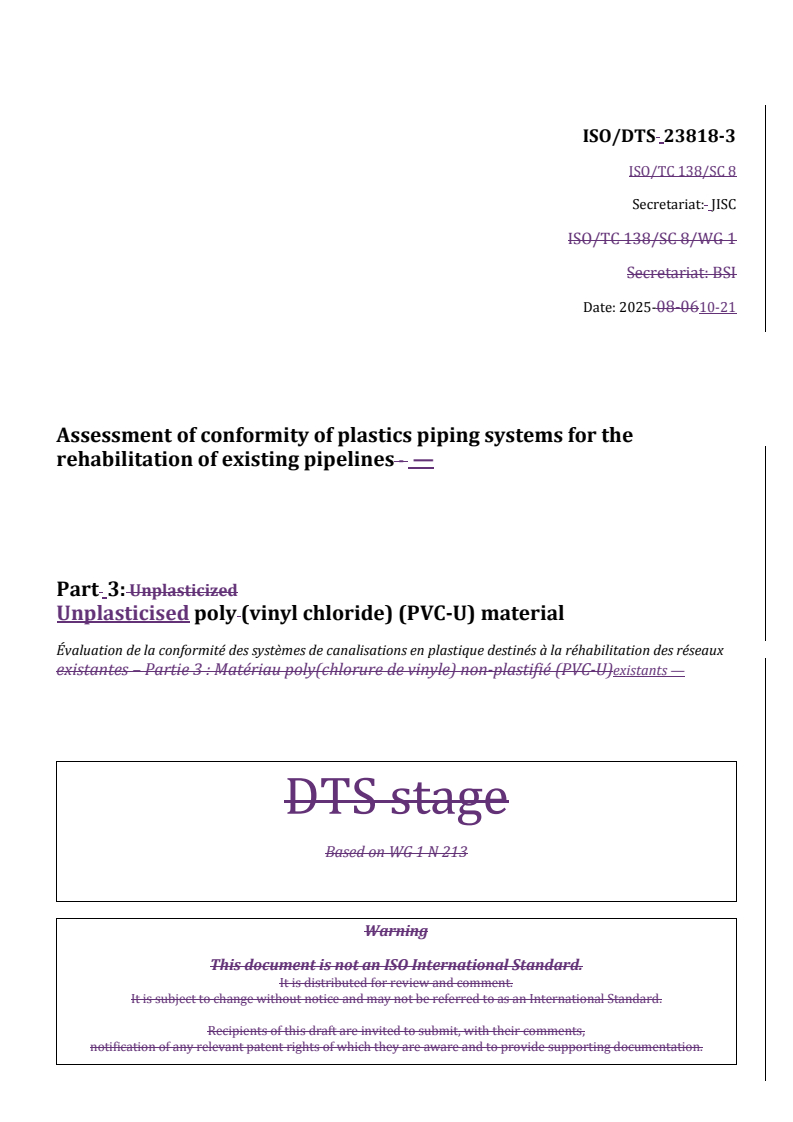
ISO/DTS 23818-3
ISO/TC 138/SC 8
Secretariat: JISC
ISO/TC 138/SC 8/WG 1
Secretariat: BSI
Date: 2025-08-0610-21
Assessment of conformity of plastics piping systems for the
rehabilitation of existing pipelines - —
Part 3: Unplasticized
Unplasticised poly (vinyl chloride) (PVC-U) material
Évaluation de la conformité des systèmes de canalisations en plastique destinés à la réhabilitation des réseaux
existantes – Partie 3 : Matériau poly(chlorure de vinyle) non-plastifié (PVC-U)existants —
DTS stage
Based on WG 1 N 213
Warning
This document is not an ISO International Standard.
It is distributed for review and comment.
It is subject to change without notice and may not be referred to as an International Standard.
Recipients of this draft are invited to submit, with their comments,
notification of any relevant patent rights of which they are aware and to provide supporting documentation.
ISO #####-#:####(X)
Partie 3: Matériau poly(chlorure de vinyle) non-plastifié (PVC-U)
2 © ISO #### – All rights reserved
All rights reserved. Unless otherwise specified, or required in the context of its implementation, no part of this publication
may be reproduced or utilized otherwise in any form or by any means, electronic or mechanical, including photocopying,
or posting on the internet or an intranet, without prior written permission. Permission can be requested from either ISO
at the address below or ISO’s member body in the country of the requester.
ISO copyright office
CP 401 • Ch. de Blandonnet 8
CH-1214 Vernier, Geneva
Phone: + 41 22 749 01 11
Fax: +41 22 749 09 47
EmailE-mail: copyright@iso.org
Website: www.iso.orgwww.iso.org
Published in Switzerland
iii
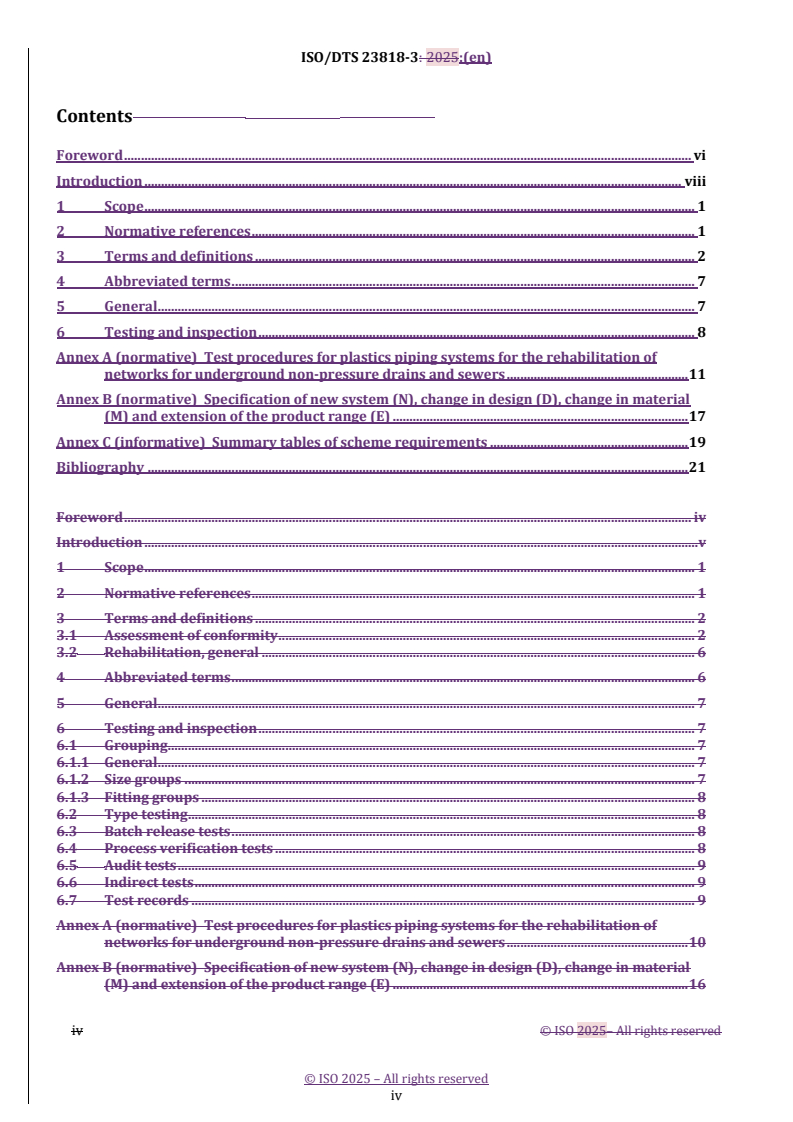
Contents
Foreword . vi
Introduction . viii
1 Scope . 1
2 Normative references . 1
3 Terms and definitions . 2
4 Abbreviated terms . 7
5 General . 7
6 Testing and inspection . 8
Annex A (normative) Test procedures for plastics piping systems for the rehabilitation of
networks for underground non-pressure drains and sewers . 11
Annex B (normative) Specification of new system (N), change in design (D), change in material
(M) and extension of the product range (E) . 17
Annex C (informative) Summary tables of scheme requirements . 19
Bibliography . 21
Foreword . iv
Introduction . v
1 Scope . 1
2 Normative references . 1
3 Terms and definitions . 2
3.1 Assessment of conformity . 2
3.2 Rehabilitation, general . 6
4 Abbreviated terms . 6
5 General . 7
6 Testing and inspection . 7
6.1 Grouping . 7
6.1.1 General . 7
6.1.2 Size groups . 7
6.1.3 Fitting groups . 8
6.2 Type testing . 8
6.3 Batch release tests . 8
6.4 Process verification tests . 8
6.5 Audit tests . 9
6.6 Indirect tests . 9
6.7 Test records . 9
Annex A (normative) Test procedures for plastics piping systems for the rehabilitation of
networks for underground non-pressure drains and sewers . 10
Annex B (normative) Specification of new system (N), change in design (D), change in material
(M) and extension of the product range (E) . 16
iv © ISO 2025– All rights reserved
iv
Annex C (informative) Summary tables of scheme requirements . 18
Bibliography . 20
v
Foreword
ISO (the International Organization for Standardization) is a worldwide federation of national standards
bodies (ISO member bodies). The work of preparing International Standards is normally carried out through
ISO technical committees. Each member body interested in a subject for which a technical committee has been
established has the right to be represented on that committee. International organizations, governmental and
non-governmental, in liaison with ISO, also take part in the work. ISO collaborates closely with the
International Electrotechnical Commission (IEC) on all matters of electrotechnical standardization.
The procedures used to develop this document and those intended for its further maintenance are described
in the ISO/IEC Directives, Part 1. In particular, the different approval criteria needed for the different types of
ISO documentsdocument should be noted. This document was drafted in accordance with the editorial rules
of the ISO/IEC Directives, Part 2 (see www.iso.org/directives).
Attention is drawnISO draws attention to the possibility that some of the elementsimplementation of this
document may beinvolve the subjectuse of (a) patent(s). ISO takes no position concerning the evidence,
validity or applicability of any claimed patent rights. in respect thereof. As of the date of publication of this
document, ISO had not received notice of (a) patent(s) which may be required to implement this document.
However, implementers are cautioned that this may not represent the latest information, which may be
obtained from the patent database available at www.iso.org/patents. ISO shall not be held responsible for
identifying any or all such patent rights. Details of any patent rights identified during the development of the
document will be in the Introduction and/or on the ISO list of patent declarations received (see
www.iso.org/patents).
Any trade name used in this document is information given for the convenience of users and does not
constitute an endorsement.
For an explanation of the voluntary nature of standards, the meaning of ISO specific terms and expressions
related to conformity assessment, as well as information about ISO's adherence to the World Trade
Organization (WTO) principles in the Technical Barriers to Trade (TBT), see
www.iso.org/iso/foreword.htmlwww.iso.org/iso/foreword.html.
This document was prepared by ISO/TC 138 Plastics pipes, fittings and valves for the transport of fluids,
Subcommittee SC 8, Rehabilitation of pipeline systems, in collaboration with the European Committee for
Standardization (CEN) Technical Committee CEN/TC 155, Plastics piping systems and ducting systems, in
accordance with the Agreement on technical cooperation between ISO and CEN (Vienna Agreement).
This second edition cancels and replaces the first edition (ISO/TS 23818-3:2021), which has been amended
following the merging and renumbering of the system standards, referred to in this standard. technically
revised.
There are no technicalThe main changes compared to are as follows:
— the first edition, apart from 7document has been amended following the merging and renumbering of
International Standards concerning piping systems, referred to in this document;
— in 3, seven definitions which arehave been removed by reference to ISO 11295 ;
— Compared to the first edition, lining with spirally-wound pipes is nowhas been excluded and the respective
content ishas been incorporated in ISO/TS 23818-4.
A list of all parts in the ISO/TS 23818 series can be found on the ISO website.
vi © ISO 2025– All rights reserved
vi
Any feedback or questions on this document should be directed to the user’s national standards body. A
complete listing of these bodies can be found at www.iso.org/members.html.
vii
Introduction
System standardsInternational Standards dealing with the following applications are either available or in
preparation for pipeline rehabilitation:
— — ISO 11300: Piping systems for rehabilitation of underground drains, sewers and water supply networks;
— — ISO 11301: Piping systems for rehabilitation of underground gas supply networks.
These system standardsInternational Standards are distinguished from those for conventionally installed
plastics piping systems by the requirement to verify certain characteristics in the as-installed condition, after
site processing. This is in addition to specifying requirements for plastics piping system components as
manufactured.
For the assessment of conformity, five Technical Specificationstechnical specifications for pipe systems of
distinctive materials are applicable:
— ISO/TS 23818-1 (this document), Assessment of conformity of plastics piping systems for the
rehabilitation of existing pipelines — Part 1: Polyethylene (PE) material;
— ISO/TS 23818-2, Assessment of conformity of plastics piping systems for the rehabilitation of existing
pipelines — Part 2: Thermoset composite materials;
— ISO/TS 23818-3, Assessment of conformity of plastics piping systems for the rehabilitation of existing
pipelines — Part 3: Unplasticized poly(vinyl chloride) (PVC-U) material;
— ISO/TS 23818-4, ) Assessment of conformity of plastics piping systems for the rehabilitation of existing
pipelines — Part 4: Thermoplastic composite materials;
— ISO/TS 23818-1;
— ISO/TS 23818-2;
— ISO/TS 23818-3 (this document);
— ISO/TS 23818-4.
These Technical Specificationstechnical specifications cover the system standardsInternational Standards
concerning piping systems, as presented in Table 1.0.
In preparation
viii © ISO 2025– All rights reserved
viii
Table 1 — Structure of Technical Specifications for assessment of conformity
Table 1 — Structure of technical specifications for assessment of conformity
Application
Drains, sewers
Technical
Material Technique
and Gas supply
Specification
water supply networks
networks
LINING WITH CONTINUOUS PIPES AND CLOSE-FIT PIPES
TRENCHLESS REPLACEMENT USING PIPE BURSTING, PIPE
EXTRACTION, HORIZONTAL DRILLING AND IMPACT
ISO/TS 23818-1 PE ISO 11300-1 ISO 11301-1
MOLINGLining with continuous pipes and close fit pipes
trenchless replacement using pipe bursting, pipe extraction,
horizontal drilling and impact moling
Thermoset LINING WITH CURED-IN-PLACE PIPESLining with cured-in-
ISO/TS 23818-2 ISO 11300-2 n/a
composite place pipes (CIPP)
ISO/TS 23818-3 PVC-U LINING WITH CLOSE-FIT PIPES Lining with close-fit pipes ISO 11300-3 n/a
LINING WITH SPIRALLY WOUND PIPES AND RIGIDLY
Thermoplastic
a
ISO/TS 23818-44 ANCHORED PLASTIC LINERS (RAPL)Lining with spirally ISO 11300-4 n/a
composite
wound pipes and rigidly anchored plastic liners (RAPL)
b b b
— PA-U — n/a —
a In preparation
b Under development (as Part ISO/TS 23818-5)
The format of the four Technical Specificationstechnical specifications is in line with Technical
Specificationstechnical specifications for assessment of conformity to other system standards, apart from
presenting the detailed requirements for Inspectioninspection and Testingtesting in two annexes, for non-
pressure applications and pressure applications (where applicable)), respectively.
For this document, covering only non-pressure applications, the format is schematically represented in
Figure 1.0.
ix
Figure 1 — Format of the Technical Specificationstechnical specifications for conformity assessment
Figures 2 and 30 and 0 are intended to provide general information on the concept of testing and organization
of those tests used for the purpose of the assessment of conformity. For each type of test, i.e. type testing (TT),
batch release test (BRT), process verification test (PVT), and audit test (AT), this document details the
applicable characteristics to be assessed as well as the frequency and sampling of testing.
A typical scheme for the assessment of conformity of PVC-U pipes, fittings, joints or assemblies by
manufacturers is given in Figure 2.0.
x © ISO 2025– All rights reserved
x
Figure
Figure 2 — Typical scheme for the assessment of conformity by a manufacturer
A typical scheme for the assessment of conformity of PVC-U pipes, fittings, joints or assemblies by
manufacturers, including certification, is given in Figure 3.0.
xi
Figure
Figure 3 — Typical scheme for the assessment of conformity by a manufacturer, including
certification
xii © ISO 2025– All rights reserved
xii
TECHNICAL SPECIFICATION ISO/DTS 23818-3: 2025
Assessment of Conformityconformity of plastics piping systems for the
rehabilitation of existing pipelines - —
Part 3: Unplasticized
Unplasticised poly (vinyl chloride) (PVC-U) material
1 Scope
This document provides a scheme for the assessment of conformity of PVC-U products and assemblies for the
rehabilitation of existing pipelines, in accordance with ISO 11300-3, and intended to be included in the
manufacturer’s quality plan as part of the quality management system and for the establishment of
certification procedures.
NOTE In order to help the reader, summary tables of overall scheme requirements are provided in Annex C.
2 Normative references
The following documents are referred to in the text in such a way that some or all of their content constitutes
requirements of this document. For dated references, only the edition cited applies. For undated references,
the latest edition of the referenced document (including any amendments) applies.
ISO 1043-1, Plastics — Symbols and abbreviated terms — Part 1: Basic polymers and their special characteristics
ISO 1628--2, Plastics — Determination of the viscosity of polymers in dilute solution using capillary viscometers
— Part 2: Poly(vinyl chloride) resins
ISO 4435:2003, Plastics piping systems for non-pressure underground drainage and sewerage — Unplasticized
poly(vinyl chloride) (PVC-U)
ISO 11295, Plastics piping systems used for the rehabilitation of pipelines — Classification and overview of
strategic, tactical and operational activities
ISO 11300-3, Piping systems for rehabilitation of underground drains, sewers and water supply networks —
Part 3: Polyethylene (PE) material
EN 1401--1, Plastics piping systems for non-pressure underground drainage and sewerage – Unplasticized
poly(vinyl chloride) (PVC-U) – Part 1: Specifications for pipes, fittings and the system
3 Terms and definitions
For the purposes of this document, the terms and definitions given in ISO 11295, ISO 11300-3 and the
following apply.
ISO and IEC maintain terminological databases for use in standardization at the following addresses:
— — ISO Online browsing platform: available at https://www.iso.org/obphttps://www.iso.org/obp
— — IEC Electropedia: available at http://www.electropedia.org/https://www.electropedia.org/
3.1 Assessment of conformity
3.1.1 3.1.1
certification body
impartial body, governmental or non-governmental, possessing the necessary competence and responsibility
to carry out certification of conformity according to given rules of procedure and management
[6]
Note 1 to entry: A certification body should preferably operate in accordance with ISO/IEC 17021-1 or ISO/IEC
[8]
17065 .
[SOURCE: ISO/TS 23818-1:2025, 3.1.1]
3.1.2 3.1.2
inspection body
body that performs inspection
Note 1 to entry: A body can be an organization, or part of an organization.
[5]
Note 2 to entry: An inspection body should preferably operate in accordance with ISO/IEC 17020 or ISO/IEC 17021-
1.
[SOURCE: ISO/IEC 17020:2012, 3.5, modified — Note 2 to entry added.]
3.1.3 3.1.3
testing laboratory
laboratory which measures, tests, calibrates or otherwise determines the characteristics of the performance
of materials (3.1.13)(Error! Reference source not found.) and products
Note 1 to entry: In the context of this document, the materials and products can be subjected to type testing
(3.1.6),(Error! Reference source not found.), batch release test (3.1.7),(Error! Reference source not found.), process
verification test (3.1.8),(Error! Reference source not found.), audit test (3.1.10),(Error! Reference source not found.),
and witness test (3.1.12),(Error! Reference source not found.), as applicable.
Note 2 to entry: A testing laboratory should preferably operate in accordance with ISO/IEC 17025.
[SOURCE: ISO/TS 23818-1:2025, 3.1.3]
3.1.4 3.1.4
quality management system
management system to direct and control an organization with regard to quality
[3]
Note 1 to entry: Requirements for quality management systems are given in ISO 9001 .
2 © ISO 2025– All rights reserved
[SOURCE: ISO 9000:2015, 3.5.4, modified — Note 1 to entry added.]
3.1.5 3.1.5
quality plan
document setting out the specific quality practices, resources and sequence of activities relevant to a
particular product or range of products
[SOURCE: ISO/TS 23818-1:2025, 3.1.5]
3.1.6 3.1.6
type testing
TT
testing performed to prove that the material (3.1.13),(Error! Reference source not found.), pipe, joint
(3.1.21)(Error! Reference source not found.) or assembly (3.1.22)(Error! Reference source not found.) is
capable of conforming to the requirements given in the relevant standard
Note 1 to entry: The type test results should remain valid until there is a change in the material or product or assembly
provided that the process verification tests (3.1.8)(Error! Reference source not found.) are performed regularly.
[SOURCE: ISO/TS 23818-1:2025, 3.1.6]
3.1.7 3.1.7
batch release test
BRT
test performed by or on behalf of the manufacturer on a batch of PVC-U products, which has to be satisfactorily
completed before the batch can be released
Note 1 to entry: A batch can either be a material batch (3.1.14)(Error! Reference source not found.) or a product
batch (3.1.16).(Error! Reference source not found.).
[SOURCE: ISO/TS 23818-1:2025, 3.1.7, modified — "PE" changed to "PVC-U".]
3.1.8 3.1.8
process verification test
PVT
test performed by or on behalf of the manufacturer on PVC-U products at specific intervals to confirm that the
process continues to be capable of producing products which conform to the requirements given in the
relevant standard
Note 1 to entry: Such tests are not required to release batches of products and are carried out as a measure of process
control.
[SOURCE: ISO/TS 23818-1:2025, 3.1.8, modified — "PE" changed to "PVC-U"]
3.1.9 3.1.9
process verification test at the “I” stage
PVT-I
test performed by or on behalf of the manufacturer or installer at specific intervals during the installation
process to confirm that the process as specified in the installation manual continues to be capable of producing
installed products which conform to the requirements given in the relevant standard
Note 1 to entry: Such tests are not required to release batches of products and are carried out as a measure of process
control.
[SOURCE: ISO/TS 23818-1:2025, 3.1.9]
3.1.10 3.1.10
audit test
AT
test performed by a test laboratory on behalf of an inspection body (3.1.2)(Error! Reference source not
found.) or certification body (3.1.1)(Error! Reference source not found.) to confirm that the product,
continues to conform to the requirements given in the relevant standard
[SOURCE: ISO/TS 23818-1:2025, 3.1.10]
3.1.11 3.1.11
indirect test
IT
test performed by or on behalf of the manufacturer, different from that specified test for that particular
characteristic, having previously verified its correlation with the specified test
[SOURCE: ISO/TS 23818-1:2025, 3.1.11]
3.1.12 3.1.12
witness test
WT
test accepted by an inspection body (3.1.2)(Error! Reference source not found.) or a certification body
(3.1.1)(Error! Reference source not found.) for type testing (3.1.6)(Error! Reference source not found.)
and/or audit test (3.1.10),(Error! Reference source not found.), which is carried out by or on behalf of the
manufacturer and supervised by a representative of the inspection or certification body, competent in testing
[SOURCE: ISO/TS 23818-1:2025, 3.1.12]
3.1.13 3.1.13
material
generic term for compositions grouped by families, expressed by generic names, e.g. polypropylene, stainless
steel, brass or EPDM
Note 1 to entry: Definition from European Commission, Directorate-General for Enterprise and Industry, Sub-group on
Product Testing Procedures (EC, DG ENT and IND, SG PTP).
[SOURCE: ISO/TS 23818-1:2025, 3.1.13]
3.1.14 3.1.14
material batch
clearly identified quantity of a given homogeneous compound manufactured under uniform conditions and
defined and identified by the compound manufacturer
[SOURCE: ISO/TS 23818-1:2025, 3.1.14]
3.1.15 3.1.15
product
pipe, fitting, or valve of a clearly identified type intended to be a part of a piping system which the
manufacturer puts on the market
[SOURCE: ISO/TS 23818-1:2025, 3.1.15]
4 © ISO 2025– All rights reserved
3.1.16 3.1.16
product batch
clearly identified collection of products, manufactured consecutively or continuously under the same
conditions, using the same compound conforming to the same specification
Note 1 to entry: The production batch is defined and identified by the product manufacturer.
[SOURCE: ISO/TS 23818-1:2025, 3.1.16]
3.1.17 3.1.17
lot
clearly identifiable sub-division of a batch for inspection purposes
[SOURCE: ISO/TS 23818-1:2025, 3.1.17]
3.1.18 3.1.18
sample
one or more products drawn from the same production batch or lot (3.1.17),(Error! Reference source not
found.), selected at random without regard to their quality
Note 1 to entry: The number of products in the sample is the sample size.
[SOURCE: ISO/TS 23818-1:2025, 3.1.18]
3.1.19 3.1.19
group
collection of similar products from which samples (3.1.18)(Error! Reference source not found.) are selected
for testing purposes
[SOURCE: ISO/TS 23818-1:2025, 3.1.19]
3.1.20 3.1.20
component
product manufactured out of a specific composition compound brought to the market as part of another
product or as a spare part.
Note 1 to entry: For drinking water application, components may be considered as products and be individually
approved (e.g. O-ring, gasket) or they are tested as integral part of a finished product (e.g. in a valve).
[SOURCE: ISO/TS 23818-1:2025, 3.1.20]
3.1.21 3.1.21
joint
connection between two products
[SOURCE: ISO/TS 23818-1:2025, 3.1.21]
3.1.22 3.1.22
assembly
product that can be dismantled into a set of components (3.1.20)(Error! Reference source not found.)
EXAMPLE A test piece consisting of various products.
[SOURCE: ISO/TS 23818-1:2025, 3.1.22]
3.1.23 3.1.23
cavity
space within a mould to be filled to form the moulded product
[SOU
...
Questions, Comments and Discussion
Ask us and Technical Secretary will try to provide an answer. You can facilitate discussion about the standard in here.
Loading comments...