


ISO 16609:2004
(Main)Banking — Requirements for message authentication using symmetric techniques
Banking — Requirements for message authentication using symmetric techniques
ISO 16609:2004 specifies procedures, independent of the transmission process, for protecting the integrity of transmitted banking messages and for verifying that a message has originated from an authorized source. It also specifies a method by which block ciphers can be approved for use in the authentication of banking messages. In addition, because of the necessity for both members in a communicating pair to use the same means for data representation, it defines some methods for data representation. A list of block ciphers approved for the calculation of a message authentication code (MAC), as well as the method to be used to approve additional block ciphers, is also provided. The authentication methods it defines are applicable to messages formatted and transmitted both as coded character sets and as binary data. ISO 16609:2004 is designed for use with symmetric algorithms where both sender and receiver use the same key. It does not specify methods for establishing the shared key, nor does it provide for encipherment for the protection of messages against unauthorized disclosure. Its application will not protect the user against internal fraud by sender or receiver, or forgery of a MAC by the receiver.
Banque — Exigences pour authentification des messages utilisant des techniques symétriques
General Information
- Status
- Withdrawn
- Publication Date
- 26-Feb-2004
- Withdrawal Date
- 26-Feb-2004
- Technical Committee
- ISO/TC 68/SC 2 - Financial Services, security
- Drafting Committee
- ISO/TC 68/SC 2 - Financial Services, security
- Current Stage
- 9599 - Withdrawal of International Standard
- Start Date
- 09-Mar-2012
- Completion Date
- 12-Feb-2026
Relations
- Effective Date
- 06-Jun-2022
- Effective Date
- 16-Oct-2025
- Effective Date
- 13-Sep-2009
- Effective Date
- 15-Apr-2008
- Effective Date
- 15-Apr-2008
- Effective Date
- 15-Apr-2008
- Effective Date
- 15-Apr-2008
Get Certified
Connect with accredited certification bodies for this standard

BSI Group
BSI (British Standards Institution) is the business standards company that helps organizations make excellence a habit.

NYCE
Mexican standards and certification body.
Sponsored listings
Frequently Asked Questions
ISO 16609:2004 is a standard published by the International Organization for Standardization (ISO). Its full title is "Banking — Requirements for message authentication using symmetric techniques". This standard covers: ISO 16609:2004 specifies procedures, independent of the transmission process, for protecting the integrity of transmitted banking messages and for verifying that a message has originated from an authorized source. It also specifies a method by which block ciphers can be approved for use in the authentication of banking messages. In addition, because of the necessity for both members in a communicating pair to use the same means for data representation, it defines some methods for data representation. A list of block ciphers approved for the calculation of a message authentication code (MAC), as well as the method to be used to approve additional block ciphers, is also provided. The authentication methods it defines are applicable to messages formatted and transmitted both as coded character sets and as binary data. ISO 16609:2004 is designed for use with symmetric algorithms where both sender and receiver use the same key. It does not specify methods for establishing the shared key, nor does it provide for encipherment for the protection of messages against unauthorized disclosure. Its application will not protect the user against internal fraud by sender or receiver, or forgery of a MAC by the receiver.
ISO 16609:2004 specifies procedures, independent of the transmission process, for protecting the integrity of transmitted banking messages and for verifying that a message has originated from an authorized source. It also specifies a method by which block ciphers can be approved for use in the authentication of banking messages. In addition, because of the necessity for both members in a communicating pair to use the same means for data representation, it defines some methods for data representation. A list of block ciphers approved for the calculation of a message authentication code (MAC), as well as the method to be used to approve additional block ciphers, is also provided. The authentication methods it defines are applicable to messages formatted and transmitted both as coded character sets and as binary data. ISO 16609:2004 is designed for use with symmetric algorithms where both sender and receiver use the same key. It does not specify methods for establishing the shared key, nor does it provide for encipherment for the protection of messages against unauthorized disclosure. Its application will not protect the user against internal fraud by sender or receiver, or forgery of a MAC by the receiver.
ISO 16609:2004 is classified under the following ICS (International Classification for Standards) categories: 35.240.40 - IT applications in banking. The ICS classification helps identify the subject area and facilitates finding related standards.
ISO 16609:2004 has the following relationships with other standards: It is inter standard links to ISO 25178-601:2010, ISO 8730:1990/Cor 1:1999, ISO 16609:2012, ISO 8731-2:1992, ISO 9807:1991, ISO 8730:1990, ISO 8731-1:1987. Understanding these relationships helps ensure you are using the most current and applicable version of the standard.
ISO 16609:2004 is available in PDF format for immediate download after purchase. The document can be added to your cart and obtained through the secure checkout process. Digital delivery ensures instant access to the complete standard document.
Standards Content (Sample)
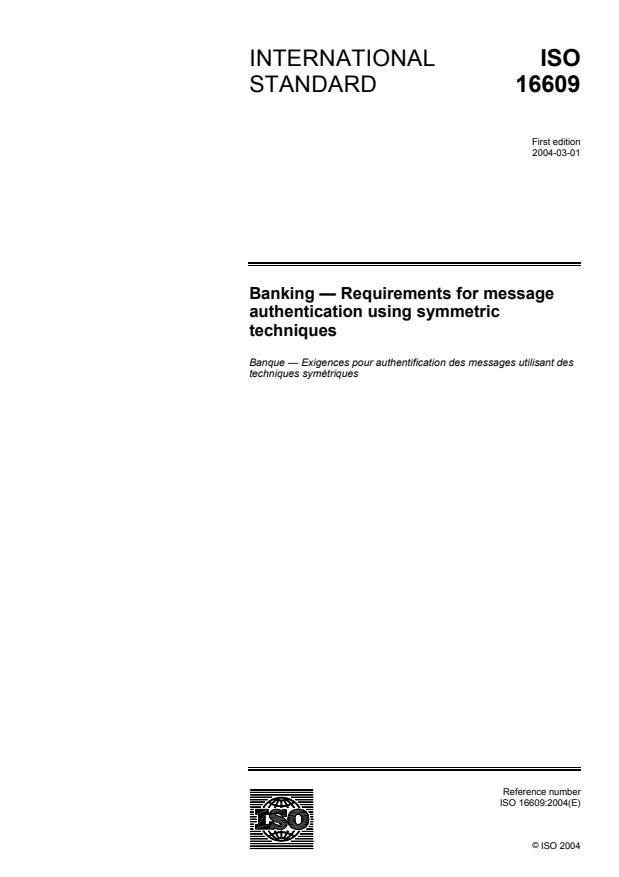
INTERNATIONAL ISO
STANDARD 16609
First edition
2004-03-01
Banking — Requirements for message
authentication using symmetric
techniques
Banque — Exigences pour authentification des messages utilisant des
techniques symétriques
Reference number
©
ISO 2004
PDF disclaimer
This PDF file may contain embedded typefaces. In accordance with Adobe's licensing policy, this file may be printed or viewed but
shall not be edited unless the typefaces which are embedded are licensed to and installed on the computer performing the editing. In
downloading this file, parties accept therein the responsibility of not infringing Adobe's licensing policy. The ISO Central Secretariat
accepts no liability in this area.
Adobe is a trademark of Adobe Systems Incorporated.
Details of the software products used to create this PDF file can be found in the General Info relative to the file; the PDF-creation
parameters were optimized for printing. Every care has been taken to ensure that the file is suitable for use by ISO member bodies. In
the unlikely event that a problem relating to it is found, please inform the Central Secretariat at the address given below.
© ISO 2004
All rights reserved. Unless otherwise specified, no part of this publication may be reproduced or utilized in any form or by any means,
electronic or mechanical, including photocopying and microfilm, without permission in writing from either ISO at the address below or
ISO's member body in the country of the requester.
ISO copyright office
Case postale 56 • CH-1211 Geneva 20
Tel. + 41 22 749 01 11
Fax + 41 22 749 09 47
E-mail copyright@iso.org
Web www.iso.org
Published in Switzerland
ii © ISO 2004 – All rights reserved
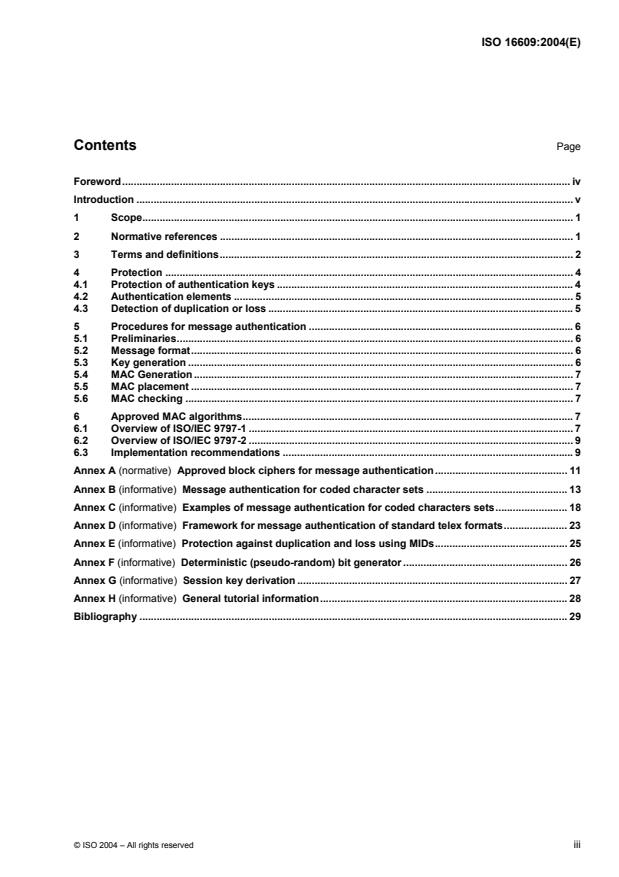
Contents Page
Foreword. iv
Introduction . v
1 Scope. 1
2 Normative references . 1
3 Terms and definitions. 2
4 Protection . 4
4.1 Protection of authentication keys . 4
4.2 Authentication elements . 5
4.3 Detection of duplication or loss . 5
5 Procedures for message authentication . 6
5.1 Preliminaries. 6
5.2 Message format. 6
5.3 Key generation . 6
5.4 MAC Generation . 7
5.5 MAC placement . 7
5.6 MAC checking . 7
6 Approved MAC algorithms. 7
6.1 Overview of ISO/IEC 9797-1 . 7
6.2 Overview of ISO/IEC 9797-2 . 9
6.3 Implementation recommendations . 9
Annex A (normative) Approved block ciphers for message authentication . 11
Annex B (informative) Message authentication for coded character sets . 13
Annex C (informative) Examples of message authentication for coded characters sets. 18
Annex D (informative) Framework for message authentication of standard telex formats. 23
Annex E (informative) Protection against duplication and loss using MIDs. 25
Annex F (informative) Deterministic (pseudo-random) bit generator . 26
Annex G (informative) Session key derivation . 27
Annex H (informative) General tutorial information. 28
Bibliography . 29
Foreword
ISO (the International Organization for Standardization) is a worldwide federation of national standards bodies
(ISO member bodies). The work of preparing International Standards is normally carried out through ISO
technical committees. Each member body interested in a subject for which a technical committee has been
established has the right to be represented on that committee. International organizations, governmental and
non-governmental, in liaison with ISO, also take part in the work. ISO collaborates closely with the
International Electrotechnical Commission (IEC) on all matters of electrotechnical standardization.
International Standards are drafted in accordance with the rules given in the ISO/IEC Directives, Part 2.
The main task of technical committees is to prepare International Standards. Draft International Standards
adopted by the technical committees are circulated to the member bodies for voting. Publication as an
International Standard requires approval by at least 75 % of the member bodies casting a vote.
Attention is drawn to the possibility that some of the elements of this document may be the subject of patent
rights. ISO shall not be held responsible for identifying any or all such patent rights.
ISO 16609 was prepared by Technical Committee ISO/TC 68, Banking, securities and other financial services,
Subcommittee SC 6, Retail financial services.
This first edition of ISO 16609 cancels and replaces ISO 8730:1990, ISO 8731-1:1987, ISO 8731-2:1992 and
ISO 9807:1991, of which it constitutes a technical revision.
iv © ISO 2004 – All rights reserved
Introduction
A MAC (message authentication code) is a data field used to verify the authenticity of a message, generated
by the sender of the message and transmitted together with it. The MAC enables an intended recipient to
detect if the message has been altered and, if so, whether such an alteration arises by accident or with intent
to defraud.
This International Standard has been prepared so that institutions involved in banking activities wishing to
implement message authentication can do so in a secure manner and in a way that facilitates interoperability
between separate implementations.
The requirements of this International Standard are compatible with those in the editions of ISO 8730 and
ISO 9807 it replaces.
INTERNATIONAL STANDARD ISO 16609:2004(E)
Banking — Requirements for message authentication using
symmetric techniques
1 Scope
This International Standard specifies procedures, independent of the transmission process, for protecting the
integrity of transmitted banking messages and for verifying that a message has originated from an authorized
source. It also specifies a method by which block ciphers can be approved for use in the authentication of
banking messages. In addition, because of the necessity for both members in a communicating pair to use the
same means for data representation, it defines some methods for data representation. A list of block ciphers
approved for the calculation of a message authentication code (MAC), as well as the method to be used to
approve additional block ciphers, is also provided. The authentication methods it defines are applicable to
messages formatted and transmitted both as coded character sets and as binary data.
This International Standard is designed for use with symmetric algorithms where both sender and receiver use
the same key. It does not specify methods for establishing the shared key, nor does it provide for
encipherment for the protection of messages against unauthorized disclosure. Its application will not protect
the user against internal fraud by sender or receiver, or forgery of a MAC by the receiver.
2 Normative references
The following referenced documents are indispensable for the application of this document. For dated
references, only the edition cited applies. For undated references, the latest edition of the referenced
document (including any amendments) applies.
ISO 7746:1998, Banking — Telex formats for inter-bank messages
ISO 8583:1993, Financial transaction card originated messages — Interchange message specifications
ISO 8601:2000, Data elements and interchange formats — Information interchange — Representation of
dates and times
ISO 8732:1988, Banking — Key management (wholesale)
ISO/IEC 9797-1:1999, Information technology — Security techniques — Message Authentication Codes
(MACs) — Part 1: Mechanisms using a block cipher
ISO/IEC 9797-2:2002, Information technology — Security techniques — Message Authentication Codes
(MACs) — Part 2: Mechanisms using a hash-function
ISO/IEC 10116:1997, Information technology — Security techniques — Modes of operation for an n-bit block
cipher
ISO/IEC 10118-3:1998, Information technology — Security techniques — Hash-functions — Part 3: Dedicated
hash-functions
ISO 11568-1:1994, Banking — Key management (retail) — Part 1: Introduction to key management
ISO 11568-2:1994, Banking — Key management (retail) — Part 2: Key management techniques for
symmetric ciphers
ISO 11568-3:1994, Banking — Key management (retail) — Part 3: Key life cycle for symmetric ciphers
ISO 13491 (all parts) Banking — Secure cryptographic devices (retail)
ANSI X3.92:1981, American National Standard for Information Systems — Data encryption algorithm
ANSI X9.52:1998, American National Standard for Financial Services — Triple data encryption algorithm,
modes of operation
3 Terms and definitions
For the purposes of this document, the following terms and definitions apply.
3.1
algorithm
specified mathematical process for computation or set of rules which, if followed, will give a prescribed result
3.2
authentication
process used between a sender and a receiver to ensure data integrity and provide data origin authentication
3.3
authentication algorithm
algorithm used, together with an authentication key and one or more authentication elements, for
authentication
3.4
authentication element
message element that is to be protected by authentication
3.5
authentication key
cryptographic key used for authentication
3.6
beneficiary [party]
ultimate party (can be more than one) to be credited or paid as a result of a transfer
3.7
block cipher
algorithm for computing a function which maps a fixed length string of bits and a secret key to another string of
bits with the same fixed length
3.8
bias
condition where, during the generation of random or pseudo-random numbers, the occurrence of some
numbers is more likely than others
3.9
cryptoperiod
defined period of time during which a specific cryptographic key is authorized for use, or during which time the
cryptographic keys in a given system may remain in effect
2 © ISO 2004 – All rights reserved
3.10
cryptanalysis
art and science of breaking ciphertext
3.11
data integrity
property defining data that has not been altered or destroyed in an unauthorized manner
3.12
date MAC computed
DMC
date on which the sender computed the message authentication code (MAC)
NOTE The DMC can be used to synchronize the authentication process through selection of the proper key.
3.13
data origin authentication
corroboration that the source of data received is as claimed
3.14
decipherment
decryption
reversal of a corresponding encipherment
3.15
delimiter
group of characters used to delineate the beginning and end of a data field or fields
3.16
encipherment
encryption
(reversible) transformation of data by a cryptographic algorithm to produce ciphertext (i.e. to hide the
information content of the data)
3.17
hexadecimal digit
single character in the range 0 to 9, A to F (upper case), representing a four-bit string
3.18
identifier for authentication key
IDA
field that identifies the key to be used in authenticating the message
3.19
message authentication code
MAC
string of bits that is the output of a MAC algorithm
3.20
MAC algorithm
cryptographic check function
algorithm for computing a function, which maps strings of bits and a secret key to fixed length strings of bits
NOTE 1 It must satisfy the following two properties:
for any key and any input string, the function can be computed efficiently;
for any fixed key, and given no prior knowledge of the key, it is computationally infeasible to compute the function
value on any new input string, even given knowledge of the set of input strings and corresponding function values,
where the value of the ith input string may have been chosen after observing the value of the first i to 1 function
values.
NOTE 2 Computational feasibility depends on the user’s specific security requirements and environment.
3.21
message element
contiguous group of characters designated for a specific purpose
3.22
message identifier
MID
systems trace audit number (superseded)
field used uniquely to identify a financial message or transaction (e.g. sending bank’s transaction reference)
within a given context (e.g. DMC).
NOTE In ISO 8583, the MID was referred to as the systems trace audit number (STAN), which it supersedes.
3.23
message text
information conveyed or transmitted between sender and receiver, excluding header and trailer information
used for transmission purposes
3.24
nonce
number used once
3.25
receiver
party intended to receive the message
3.26
sender
party responsible for, and authorized to, send a message
3.27
value date
date on which funds are to be at the disposal of the beneficiary
4 Protection
IMPORTANT — Integrity protection applies only to the selected authentication elements. Other parts
of the message can be subject to undetected alterations. It is important that users ensure the integrity
of the presentation of the data.
4.1 Protection of authentication keys
Authentication keys are secret cryptographic keys that have been previously established by the sender and
receiver and which are used by the authentication algorithm. Such keys shall be deterministically or pseudo-
randomly generated (see Annex F and Annex G). Any key used for authentication shall be protected against
disclosure to unauthorized parties. Use of the authentication keys shall be restricted to the sending and
receiving parties (or their authorized agents) and only used for authentication. Keys shall be managed in
accordance with ISO 11568 or ISO 8732.
Authentication keys can best be protected if the MAC is computed by a secure cryptographic device, the keys
are in plaintext only within such a device and the device is compliant with ISO 13491.
4 © ISO 2004 – All rights reserved
4.2 Authentication elements
The MAC calculation shall include those message elements, as agreed between sender and receiver, which
require protection against fraudulent alteration. All such message elements should be included in the MAC
calculation.
Subject to bilateral agreement, the MAC calculation may also cover data elements not transmitted in the
message (e.g. padding bits or data computable by both parties from information already shared).
The choice of data to be included in the MAC will depend on the specific application. The following elements
shall be included in the calculation of the MAC whenever they appear in the message:
a) transaction amount;
b) currency;
c) identifier for authentication key (IDA);
d) identification of parties to be credited and debited;
e) identification of beneficiary party;
f) value date;
g) message identifier;
h) date and time;
i) indication as to the disposition of the transaction.
4.3 Detection of duplication or loss
A mechanism shall be implemented to detect duplication or loss. Without recourse to further message
exchanges, the recipient may only detect the replay of a previous transaction if able to identify transactions
uniquely, and shall then check that such unique identifying information has not already occurred. Furthermore,
in order to detect loss, transactions shall be identifiable as being in a sequence. Both conditions are thus
achieved by involving in the MAC computation some elements (i.e., message elements or key elements) that
are unique to the transaction and that relate it uniquely to the previous transaction. This shall be achieved in
one of the following ways.
a) Include in the MAC calculation a unique transaction reference that does not repeat within the lifetime of
the system.
EXAMPLE The reference will include sender ID, recipient ID, key ID, transaction number and date.
b) Include in the MAC calculation a message identifier (MID), a value that does not repeat before either
the change of date, i.e. date MAC computed (DMC), or
the expiration of the cryptoperiod of the key used for authentication,
whichever occurs first: i.e. there shall not be more than one message with the same date and the same
message identifier that uses the same key.
The MID may consist of a unique sending bank’s transaction reference number in a fixed format message
as a message identifier. A method of protection is described in Annex E. The MID may either contain the
DMC or be a separate field.
c) Use a unique key per transaction where either
the key of one transaction is derived from that of the previous transaction (see, for instance,
ISO 11568-2 and Annex G), or
the key is derived using a unique transaction reference (see Annex G).
d) Combine the above techniques.
5 Procedures for message authentication
5.1 Preliminaries
Implementers shall conduct a risk assessment of the application to determine the data to be protected (see
Clause 4), the required key length and MAC algorithm, and shall agree upon the following:
a block cipher (if MAC algorithm chosen from ISO/IEC 9797-1);
a hash-function (if MAC algorithm chosen from ISO/IEC 9797-2);
a padding method (if MAC algorithm chosen from ISO/IEC 9797-1);
the length in bits of the MAC;
the key change frequency (this should take into consideration the current state of the art of cryptanalysis);
a common key derivation method (if required by the MAC algorithm).
Approved block ciphers are given in Annex A.
The correspondents shall also exchange a secret authentication key.
Financial service applications should use a key with a length of less than 112 bits only with caution, and with a
full understanding of underlying risk management and assessment (see ISO 13491). The
ISO/IEC 9797-1:1999-specified MAC Algorithms 1 and 3 (see Clause 6) are recommended for applications
requiring 112-bit MAC algorithm keys.
The sender shall calculate a MAC using the selected data elements. This MAC shall be appended to the text
of the transmitted message such that it is identifiable by the receiver. The receiver shall repeat the
computation, using the same authentication method as defined in this clause. The message authenticates if
the received and computed reference MACs are identical.
Implementers should also consider the performance characteristics given in 6.3.
5.2 Message format
The sender shall format and code the message by a method agreed with the recipient.
5.3 Key generation
Subject to agreement with the receiving party, the sender of a message may generate a new key with which to
compute the MAC. The derivation of such a key may involve transaction and message-dependent data.
Annex F and Annex G provide some examples of key generation and derivation.
6 © ISO 2004 – All rights reserved
5.4 MAC Generation
The sender of a message shall generate a MAC by processing in an agreed order (e.g. the sequence in which
they appear in the message) those authentication elements of the transmitted message that are to be
protected by an approved authentication algorithm (see Clause 6). The algorithm shall be activated by means
of an authentication key, which is a secret between the two correspondents. This process creates the MAC,
which shall then be included with the original message text.
5.5 MAC placement
The MAC shall be either
a) placed in the message, in an additional field specified for the transport of the MAC, or
b) appended to the data portion of the message, if there is no specified MAC field.
Where the field allocated has a length, for transport, greater than the MAC length, the MAC shall be
positioned by left justifying it within the field.
5.6 MAC checking
On receipt of the message, the receiver shall compute a reference MAC using the authentication elements, an
identical authentication key and an identical algorithm. Authenticity of the content of the authentication
elements and the message source shall be considered to have been confirmed when the receiver’s computed
reference MAC agrees with that received with the message text.
A received MAC (and its delimiters) shall not be included in the algorithm computation.
The process of generating the MAC is sensitive to the sequence in which the authentication elements are
processed (i.e., a change in the sequence of authentication elements after the MAC is generated will result in
a failure to authenticate).
6 Approved MAC algorithms
6.1 Overview of ISO/IEC 9797-1
6.1.1 Algorithms 1 to 6
The MAC algorithm shall be one of those specified in ISO/IEC 9797. The present clause offers an
interpretation of the characteristics of those algorithms and a mapping between them and the algorithms of the
superseded ISO 8731 and ISO 9807.
ISO/IEC 9797-1 specifies six MAC algorithms that use a secret key and an n-bit block cipher to calculate an
m-bit MAC, and which are based upon the cipher block chaining (CBC) mode of operation of a block cipher.
NOTE 1 The security analysis given in ISO/IEC 9797-1:1999, Annex B, provides implementation recommendations for
protecting against forgery and key recovery attacks.
NOTE 2 The modes of operation of an n-bit block cipher are standardized in ISO/IEC 10116.
MAC Algorithm 1 is a simple CBC-MAC using a single key.
MAC Algorithm 2 is a variant on Algorithm 1, with an additional final transformation using a second key.
MAC Algorithm 3 is a variant on Algorithm 1, ending with two additional transformations, the penultimate
transformation uses a second key and the final transformation uses the first key.
MAC Algorithm 4 is a variant on Algorithm 2, with an additional initial transformation using the second key.
MAC Algorithm 5 uses two parallel instances of Algorithm 1, and combines the two results with a bit-wise
exclusive-or operation, while using a single-length MAC algorithm key.
MAC Algorithm 6 uses two parallel instances of Algorithm 4, and combines the two results with a bit-wise
exclusive-or operation, while doubling the MAC algorithm key length.
The strength of the MAC mechanism is dependent on the length (in bits) and secrecy of the key, on the block
length (in bits) n and strength of the block cipher, on the length (in bits) m of the MAC, and on the specific
algorithm.
6.1.2 Relationship to previous standards
This subclause provides a summary of the relationship between the algorithms specified in ISO/IEC 9797 and
other, previous standards which are now superseded.
Table 1 — ISO 9797-1 — Relationship to previous standards
Standard ISO 9797 algorithm Block cipher Block size Padding MAC
n method size m
IS 8731-1 [ANSI X9.9] 1 DEA (ANSI X3.92: 1981) 64 1 32
IS 9807 [ANSI X9.19] 1 or 3 DEA (ANSI X3.92: 1981) 64 1 32
6.1.3 Minimum key lengths
MAC mechanisms should use keys providing at least 112 bits (in case of a shorter key length, see the related
recommendation of 5.1).
6.1.4 Recommended mechanisms
This subclause provides a summary of the recommended implementations of ISO/IEC 9797-1 mechanisms.
Although ISO/IEC 9797-1 specifies six MAC algorithms, this International Standard recommends two of these
for the financial services industry:
Algorithm 1 using T-DEA
Algorithm 3 using DEA
8 © ISO 2004 – All rights reserved
Table 2 — Recommended mechanisms
ISO 9797 algorithm Block cipher Block size Key length MAC size
n m
1 T-DEA (ANSI X9.52:1998) 64 112 32 u m u 64
3 DEA (ANSI X3.92:1981) 64 112 32 u m u 64
The security analysis in ISO 9797-1:1999, Annex B, provides implementation recommendations for protecting against forgery and key
recovery attacks.
If Algorithm 1 is used, then steps should be taken to prevent xor forgery attacks as described in ISO 9797-1:1999, Annex B. An
adequate precaution is to use Padding Method 3.
If Algorithm 3 is used, then the number of MACs generated using the same key should be restricted. In order not to restrict the lifetime
of the MAC-generating device, the use of session keys is recommended (see Annex G).
Trivial Forgery: If Padding Method 1 is used, then an adversary can typically add or delete a number of trailing '0' bits of the data string
without changing the MAC. This implies that Padding Method 1 should only be used in environments where the length of the data
string is known to the parties beforehand, or where data strings with a different number of trailing '0' bits have the same semantics.
6.2 Overview of ISO/IEC 9797-2
ISO/IEC 9797-2 specifies three MAC algorithms that use a secret key and a hash-function (or its round-
function) with an n-bit result to calculate an m-bit MAC. The hash-functions are chosen from those specified in
ISO/IEC 10118-3 (commonly known as SHA-1, RIPEMD-160 and RIPEMD-128).
The strength of the message authentication mechanism is dependent on the length (in bits) and secrecy of the
key, on the length (in bits) n of the hash-function and its strength, on the length (in bits) m of the MAC, and on
the specific algorithm.
Hash Algorithm 1, the first algorithm specified in ISO/IEC 9797-2, is commonly known as MDx-MAC. It
calls the complete hash-function once, but makes a small modification to the round-function by adding a
key to the additive constants in the round-function.
Hash Algorithm 2, the second algorithm specified in ISO/IEC 9797-2, is commonly known as HMAC. It
calls the complete hash-function twice.
Hash Algorithm 3, the third algorithm specified in ISO/IEC 9797-2, is a variant of MDx-MAC that takes as
input only short strings (at most 256 bits). It offers a higher performance for applications that work with
short input strings only.
6.3 Implementation recommendations
One simple criterion for choosing between mechanisms based on ISO/IEC 9797-1 algorithms and
mechanisms based on ISO/IEC 9797-2 algorithms is the availability of an implementation of the block cipher
or hash function. Other criteria will determine the precise choice of parameters. For instance, when DEA is
used as the block cipher then the following distinctions can be made:
ISO/IEC 9797-1 mechanisms will often be slower than ISO/IEC 9797-2 mechanisms, especially in
software;
ISO/IEC 9797-1 mechanisms require less memory than ISO/IEC 9797-2 mechanisms;
ISO/IEC 9797-2 mechanisms can provide longer MACs (up to 160 bits);
the secret keys used with Algorithms 1 and 2 of ISO/IEC 9797-1 are shorter than those used with
ISO/IEC 9797-2 algorithms. (Algorithm 1 with a single 56-bit DEA does not comply).
Tables 3 and 4 indicate the relative performance characteristics, respectively, of ISO/IEC 9797-1 algorithms
using DEA or T-DEA as the underlying block cipher and ISO/IEC 9797-2 mechanisms using either
SHA-1/RIPEMD-160 or RIPEDMD-128 as the underlying hash-function.
If Algorithm 1 is used with T-DEA as the underlying block cipher (instead of DEA) then the number of DEA
computations is tripled.
A security comparison of all the MAC algorithms is provided in Annexes B of ISO/IEC 9797-1 and
ISO/IEC 9797-1
Table 3 — ISO 9797-1 — Relative performance using the DEA
Number of round functions/block cipher
ISO 9797-1 a
evaluations for message size:
Block cipher MAC size Key length
algorithm
8 bytes 64 bytes 1 kB
1 DEA u 64 56 1 to 2 8 to 9 128 to 129
1 T-DEA 112 or 168 1 to 2 8 to 9 128 to 129
u 64
2 DEA u 64 112 2 to 3 9 to 10 129 to 130
3 DEA u 64 112 3 to 4 10 to 11 130 to 131
4 DEA u 64 112 4 to 5 10 to 11 130 to 131
5 DEA u 64 56 2 to 4 16 to 18 256 to 258
6 DEA u 64 112 8 to 10 20 to 22 260 to 262
a
The range of values in these three columns depends on the padding method used.
Table 4 — ISO 9797-2 — Relative performance
Number of round function evaluations for
ISO 9797-2 Hash-
unpadded message size:
MAC size Key Length
algorithm function
8 bytes 64 bytes 1kB
1 SHA-1, or u 160 u 128 8 9 24
RIPEMD-160
1 RIPEMD-128 u 128 u 128 8 9 24
2 SHA-1, or u 160 160.512 4 5 20
RIPEMD-160
2 RIPEMD-128 u 128 128.512 4 5 20
3 7 n/a n/a
SHA-1, or u 80 u 128
RIPEMD-160
3 RIPEMD-128 u 64 u 128 7 n/a n/a
NOTE 1 Algorithms 1 and 3 pre-computation can save 6 hash computations for a fixed key.
NOTE 2 Algorithm 3 the length of message is restricted to at most 32 bytes.
10 © ISO 2004 – All rights reserved
Annex A
(normative)
Approved block ciphers for message authentication
A.1 Introduction
ISO/IEC 9797-1 specifies six MAC algorithms based on block ciphers. It does not specify the block cipher
itself. The purpose of this annex is to specify, either directly or through reference, the block ciphers approved
by ISO/IEC 9797-1. It also defines the procedures by which block ciphers should be added to this list.
A.2 Approved block cipher: DEA
DEA is published as ANSI X3.92-1981. It is a 64-bit block cipher using a key with 56 effective bits.
A.3 Approved block cipher: T-DEA
T-DEA is published in ANSI X9.52. It is a 64-bit block cipher using a key with 112 or 168 effective bits.
A.4 Procedure for review of alternative block ciphers
A.4.1 Origination
An alternative authentication algorithm proposed for incorporation in this ISO 16609 shall be submitted by, or
with the approval of, a national standards body, to the Secretariat of ISO/TC 68.
A.4.2 Justification of proposal
The originator shall justify a proposal by describing
a) the purpose the proposal is designed to serve,
b) how this purpose is better achieved by the proposal than algorithms already specified by this International
Standard,
c) additional merits not described elsewhere, and
d) experience in use of the new algorithm.
A.4.3 Documentation
The proposed algorithm shall be completely documented when submitted for consideration. The
documentation shall include
a) a full description of the algorithm proposed,
b) a clear acknowledgement that the algorithm satisfies, or is compatible with, all the requirements
contained in this International Standard,
c) a logic flow diagram showing the processing steps used to compute the MAC,
d) a definition and explanation of any new terms, factors, or variables introduced,
e) authentication key requirements, usage, and handling,
f) a step-by-step computation example illustrating the computation of the MAC using the standard example
message (see Annex C), and
g) detailed information on any prior testing to which the proposed algorithm has been subjected, particularly
concerning its security, reliability and stability, and including an outline of the testing procedures used, the
results of the tests, and the identity of the agency or group performing the tests and certifying the results
— i.e. sufficient information shall be provided to enable an independent agency to conduct the same tests
and to compare the results achieved.
A.4.4 Public disclosure
Any algorithm submitted for consideration shall be free from security classification. If copyright patent
application has been made on the algorithm, it shall be assessed in accordance with IEC/ISO procedures. All
documentation of the algorithm shall be considered public information available to any individual, organization
or agency for review and testing.
A.4.5 Examination of proposals
Each new proposal shall be examined by ISO and a report on it prepared within 180 days of receipt (see
A.4.6). The report shall state whether the proposal is adequately documented, if it has been properly tested
and certified already, and if the proposed algorithm satisfies the conditions and requirements of the
International Standard. The examination may also recommend submission of the proposal for public review
(A.4.6).
A.4.6 Public review
When the report recommends that public review is necessary, proposals considered suitable for acceptance
shall be forwarded (with the consent of the originator) to selected agencies and institutions with an
international reputation in this field. These agencies and institutions will be requested to examine and report
on the proposals within 90 days of receipt.
NOTE This period of public review could extend the 180 days allowed for preparation of the report on the proposal
(see A.4.5).
A.4.7 Appeal procedure
Originators whose proposals are rejected (see A.4.5) may ask the Secretariat of lSO/TC 68 to have the
proposals subjected to public review (see A.4.6), if this has not already been done. If, following submission of
the public review reports, rejection is still recommended, the originator may request the TC 68 Secretariat to
circulate the proposal, together with copies of all relevant reports on it, for ballot by the P-members of the
technical committee whose ruling in the matter by a simple majority of those voting shall be final.
A.4.8 Incorporation of new authentication algorithms
New algorithms for authentication recommended for acceptance, together with relevant reports on them, shall
be circulated for letter ballot as proposed amendments to ISO 16609.
A.4.9 Maintenance
An algorithm approved by the method described in this International Standard shall be reviewed by lSO/TC 68
at intervals of not greater than five years.
12 © ISO 2004 – All rights reserved
Annex B
(informative)
Message authentication for coded character sets
B.1 Format options
This annex offers five options for the coding of data to be authenticated:
binary data (see B.3);
coded characters (see B.4) entire message text, no editing;
coded characters (see B.5) extracted message elements, no editing;
coded characters (see B.6) entire message text, editing;
coded characters (see B.7) extracted message elements, editing.
Option 1 is designed for the authentication of a binary string of data.
Options 2 and 3 are designed for the authentication of data in coded character sets whenever the
transmission medium provides character set transparency [e.g. systems and networks designed in
accordance with the open systems interconnection (OSI) model].
Options 4 and 5 are designed for the authentication of data in a restricted coded character set for use
whenever the transmission medium is not transparent to the character set being used (e.g. baudot, telex, and
store and forward services such as those provided by many international record carriers).
Choice of the format option is the responsibility of the correspondents and will be subject to bilateral
agreement.
As noted in ISO 9797-1:1999, Annex B, it is important to protect against xor forgery attacks when using
Algorithm 1 with Padding Method 1 (or 2). This might be achieved, for instance, by the recipient knowing the
length of the message or the number of delimited fields in the message.
B.2 Code character sets (as used in Options 2 to 5)
B.2.1 Defined message element formats
B.2.1.1 General
The field formats for DMC, IDA, MAC and MID are represented in the form specified in this International
Standard. Formats of other message elements are not specified.
The field formats are verified as part of the authentication process. If an authentication option that employs
editing is used, then the field formats will be verified prior to editing. If a formatting error occurs, the message
will fail to authenticate. The following field formats are defined.
B.2.1.2 DMC
The date on which the sending institution originates the message is expressed in accordance with ISO 8601
as century, year, month, day (preferably compacted, i.e., CCYYMMDD)
EXAMPLE 19851101 for 1 November 1985.
B.2.1.3 IDA
This field is the identifier of the key for authentication, according to the requirements for key identifiers
specified in ISO 8732;
B.2.1.4 MAC
The MAC is expressed as hexadecimal digits of up to four groups of four characters, each group separated by
a space (hhhhbhhhhbhhhhbhhhh).
EXAMPLE 5A6Fb09C3bCD86b1FA4.
B.2.1.5 MID
The message identifier is expressed as one to sixteen printable characters (AAAAAAAAAAAAAAAA).
Permitted characters are 0 to 9, A to Z (upper case), space (b), comma (,), full stop (.), solidus (/) asterisk (*)
and hyphen (-).
EXAMPLE FN-BC/2.5.
B.2.2 Implicit field delimiters
Implicit delimitation of an authentication element may be achieved if its position in the message is fixed or
unambiguously identified by standardized format rules. Field names, numbers, or identifying field tags, where
specified by the wire service as implicit delimiters, are processed for authentication.
B.2.3 Explicit field delimiters
B.2.3.1 General
Explicit delimiters may be used to identify the beginning and end of message elements, including the MAC.
They may be used in all coded character set options. The following explicit delimiters are specified.
B.2.3.2 DMC
QD- and -DQ
EXAMPLE QD-YYMMDD-DQ.
B.2.3.3 IDA
QK- and -KQ
EXAMPLE QK-1 357BANKATOBANKB-KQ.
B.2.3.4 MAC
QM- and -MQ
EXAMPLE QM-hhhhbhhhh-MQ.
14 © ISO 2004 – All rights reserved
B.2.3.5 MID
QX- and -XQ
EXAMPLE QX-aaaaaaaaaaaa-XQ.
B.2.3.6 Other message elements
QT- and –TQ.
EXAMPLE QT-text-TQ
The “text” delimited In QT-text-TQ may be of any length allowed by the wire service.
B.2.4 Use of delimiters
Beginning and ending delimiters, when present, occur in complementary pairs without intervening explicit
delimiters.
NOTE If this condition is not satisfied, the message will fail to authenticate.
The message may contain any number of delimited “text” fields; however, the DMC, MID, IDA, and MAC fields
do not appear more than once each in a message.
The hyphen (-) appears in all explicit delimiters.
B.2.5 Character representation
All characters of authentication elements input to the algorithm are represented as 8-bit characters comprising
the 7-bit code according to ISO 646 (excluding national character assignments) preceded by a zero (e.g. 0, b7,
b6, . b1). Where this necessitates a code translation, the translation is for internal computational purposes
only. If the message is transformed into a different character set, the inverse transformation must be applied
before beginning the authentication process.
B.2.6 Header and trailer information
Header and trailer message information added (e.g., by a network) for transmission purposes is omitted — i.e.
it is not part of the message text nor is it included in the algorithm calculation.
B.3 Option 1: Binary data
The authentication algorithm is applied to the entire message text, or to parts of the message text, by
agreement between sender and receiver.
B.4 Option 2: Coded characters; entire message; no editing
Where message processing is automated and the precise content of the body of the message does not
change between sender and receiver, the algorithm can be applied to the entire message.
The MAC is computed over the entire message text (see example in Annex C).
B.5 Option 3: Coded characters; extracted message elements; no editing
Where authentication of the entire message is impractical, the authentication algorithm is applied only to the
selected message elements.
A MAC is computed on the extracted elements, taken in the order in which they appear (see example in
Annex C).
Message elements to be authenticated are extracted according to the following rules.
a) Delete all characters other than the message elements and their corresponding delimiters.
b) Insert a single space after each implicitly delimited message element.
B.6 Option 4: Coded characters; entire message; editing
The MAC is computed on the message text following editing according to the following rules (see example in
Annex C), which apply, in the sequence shown, on all message elements — implicitly and explicitly delimited
— before processing by the authentication algorithm.
a) Each carriage return and each line feed is replaced by a single space.
b) Lower case alphabetic characters (a to z) are translated to upper case (A to Z).
c) Any characters other than the letters A to Z, digits 0 to 9, space, comma (,), full stop (.), solidus (/),
asterisk (*), open and closed parentheses, and hyphen (-) are deleted; thus end-of-text, and other
formatting and control characters, are deleted.
d) All leading spaces are deleted.
e) Each sequence of consecutive spaces (internal and trailing) are replaced by a single space.
B.7 Option 5: Coded characters; extracted message elements; editing
This option is used in the same way as Option 3.
Message elements are extracted following the rules given for Option 3.
The editing rules specified fo
...
Questions, Comments and Discussion
Ask us and Technical Secretary will try to provide an answer. You can facilitate discussion about the standard in here.
Loading comments...