


ISO 27427:2010
(Main)Anaesthetic and respiratory equipment — Nebulizing systems and components
Anaesthetic and respiratory equipment — Nebulizing systems and components
ISO 27427:2010 specifies requirements for the safety, performance and testing for general purpose nebulizing systems intended for continuous or breath-actuated delivery of liquids, in an aerosol form, to humans through the respiratory system. ISO 27427:2010 includes gas-powered nebulizers which can be powered by, for example, compressors, pipeline systems, cylinders, etc., and electrically-powered nebulizers [e.g. spinning disc, ultrasonic, vibrating mesh (active and passive) and capillary devices] or manually-powered nebulizers. ISO 27427:2010 does not apply to devices intended for nasal deposition. ISO 27427:2010 does not apply to devices intended solely to provide humidification or hydration by providing water in aerosol form. ISO 27427:2010 does not apply to drug-specific nebulizers (e.g. metered dose inhalers, metered liquid inhalers, dry powder inhalers and their components).
Matériel d'anesthésie et de réanimation respiratoire — Systèmes de nébulisation et ses composants
General Information
- Status
- Withdrawn
- Publication Date
- 02-Mar-2010
- Withdrawal Date
- 02-Mar-2010
- Technical Committee
- ISO/TC 121/SC 2 - Airways and related equipment
- Drafting Committee
- ISO/TC 121/SC 2 - Airways and related equipment
- Current Stage
- 9599 - Withdrawal of International Standard
- Start Date
- 11-Dec-2013
- Completion Date
- 12-Feb-2026
Relations
- Effective Date
- 12-Mar-2011
- Effective Date
- 24-Oct-2009


Get Certified
Connect with accredited certification bodies for this standard

BSI Group
BSI (British Standards Institution) is the business standards company that helps organizations make excellence a habit.

TÜV Rheinland
TÜV Rheinland is a leading international provider of technical services.

TÜV SÜD
TÜV SÜD is a trusted partner of choice for safety, security and sustainability solutions.
Sponsored listings
Frequently Asked Questions
ISO 27427:2010 is a standard published by the International Organization for Standardization (ISO). Its full title is "Anaesthetic and respiratory equipment — Nebulizing systems and components". This standard covers: ISO 27427:2010 specifies requirements for the safety, performance and testing for general purpose nebulizing systems intended for continuous or breath-actuated delivery of liquids, in an aerosol form, to humans through the respiratory system. ISO 27427:2010 includes gas-powered nebulizers which can be powered by, for example, compressors, pipeline systems, cylinders, etc., and electrically-powered nebulizers [e.g. spinning disc, ultrasonic, vibrating mesh (active and passive) and capillary devices] or manually-powered nebulizers. ISO 27427:2010 does not apply to devices intended for nasal deposition. ISO 27427:2010 does not apply to devices intended solely to provide humidification or hydration by providing water in aerosol form. ISO 27427:2010 does not apply to drug-specific nebulizers (e.g. metered dose inhalers, metered liquid inhalers, dry powder inhalers and their components).
ISO 27427:2010 specifies requirements for the safety, performance and testing for general purpose nebulizing systems intended for continuous or breath-actuated delivery of liquids, in an aerosol form, to humans through the respiratory system. ISO 27427:2010 includes gas-powered nebulizers which can be powered by, for example, compressors, pipeline systems, cylinders, etc., and electrically-powered nebulizers [e.g. spinning disc, ultrasonic, vibrating mesh (active and passive) and capillary devices] or manually-powered nebulizers. ISO 27427:2010 does not apply to devices intended for nasal deposition. ISO 27427:2010 does not apply to devices intended solely to provide humidification or hydration by providing water in aerosol form. ISO 27427:2010 does not apply to drug-specific nebulizers (e.g. metered dose inhalers, metered liquid inhalers, dry powder inhalers and their components).
ISO 27427:2010 is classified under the following ICS (International Classification for Standards) categories: 11.040.10 - Anaesthetic, respiratory and reanimation equipment. The ICS classification helps identify the subject area and facilitates finding related standards.
ISO 27427:2010 has the following relationships with other standards: It is inter standard links to ISO 27427:2013, ISO 27427:2009. Understanding these relationships helps ensure you are using the most current and applicable version of the standard.
ISO 27427:2010 is available in PDF format for immediate download after purchase. The document can be added to your cart and obtained through the secure checkout process. Digital delivery ensures instant access to the complete standard document.
Standards Content (Sample)
INTERNATIONAL ISO
STANDARD 27427
Second edition
2010-03-15
Anaesthetic and respiratory equipment —
Nebulizing systems and components
Matériel d'anesthésie et de réanimation respiratoire — Systèmes de
nébulisation et ses composants
Reference number
©
ISO 2010
PDF disclaimer
This PDF file may contain embedded typefaces. In accordance with Adobe's licensing policy, this file may be printed or viewed but
shall not be edited unless the typefaces which are embedded are licensed to and installed on the computer performing the editing. In
downloading this file, parties accept therein the responsibility of not infringing Adobe's licensing policy. The ISO Central Secretariat
accepts no liability in this area.
Adobe is a trademark of Adobe Systems Incorporated.
Details of the software products used to create this PDF file can be found in the General Info relative to the file; the PDF-creation
parameters were optimized for printing. Every care has been taken to ensure that the file is suitable for use by ISO member bodies. In
the unlikely event that a problem relating to it is found, please inform the Central Secretariat at the address given below.
© ISO 2010
All rights reserved. Unless otherwise specified, no part of this publication may be reproduced or utilized in any form or by any means,
electronic or mechanical, including photocopying and microfilm, without permission in writing from either ISO at the address below or
ISO's member body in the country of the requester.
ISO copyright office
Case postale 56 • CH-1211 Geneva 20
Tel. + 41 22 749 01 11
Fax + 41 22 749 09 47
E-mail copyright@iso.org
Web www.iso.org
Published in Switzerland
ii © ISO 2010 – All rights reserved
Contents Page
Foreword .iv
Introduction.v
1 *Scope.1
2 Normative references.1
3 Terms and definitions .3
4 General requirements and requirements for test.4
4.1 Risk management.4
4.2 *Test methods and alternatives .4
4.3 Electrical safety .5
4.4 Mechanical safety.5
4.5 Pneumatic safety .5
4.6 Protection against inadvertent adjustments .5
4.7 Protection against infection .5
4.8 Usability.5
5 Marking and instructions for use.6
5.1 Marking.6
5.2 Symbols.7
5.3 Instructions for use .7
6 Construction requirements .9
6.1 Materials .9
6.2 Connectors.10
6.3 Rotary controls .13
7 Cleaning, sterilization and disinfection.13
8 Biocompatibility.13
Annex A (informative) Rationale.14
Annex B (normative) Diameters of respirable fraction particles .16
Annex C (normative) Test methods for aerosol output and aerosol output rate.17
Annex D (normative) Test methods for particle sizing .21
Annex E (informative) Test apparatus for leak test .27
Annex F (informative) Hazard identification for risk assessment.28
Annex G (informative) Taxonomy of general purpose nebulizers .35
Annex H (informative) Environmental aspects .37
Annex AA (informative) Conformance to essential principles.38
Bibliography.42
Foreword
ISO (the International Organization for Standardization) is a worldwide federation of national standards bodies
(ISO member bodies). The work of preparing International Standards is normally carried out through ISO
technical committees. Each member body interested in a subject for which a technical committee has been
established has the right to be represented on that committee. International organizations, governmental and
non-governmental, in liaison with ISO, also take part in the work. ISO collaborates closely with the
International Electrotechnical Commission (IEC) on all matters of electrotechnical standardization.
International Standards are drafted in accordance with the rules given in the ISO/IEC Directives, Part 2.
The main task of technical committees is to prepare International Standards. Draft International Standards
adopted by the technical committees are circulated to the member bodies for voting. Publication as an
International Standard requires approval by at least 75 % of the member bodies casting a vote.
Attention is drawn to the possibility that some of the elements of this document may be the subject of patent
rights. ISO shall not be held responsible for identifying any or all such patent rights.
ISO 27427 was prepared by Technical Committee ISO/TC 121, Anaesthetic and respiratory equipment,
Subcommittee SC 2, Airways and related equipment.
This second edition cancels and replaces the first edition (ISO 27427:2009), of which it constitutes a minor
revision.
The following changes were made:
⎯ a new subclause 4.1.2 (Clinical evaluation) was added;
⎯ a new subclause 4.8 (Usability) was added and, as a result, two new references were added in Clause 2;
⎯ 5.1.2 a) was updated;
⎯ a new item 5.1.2 d) was added and the subsequent items were renumbered;
⎯ in 5.1.2, a new item (o) was added;
⎯ in 5.3.2, two new items (u and v) were added;
⎯ a note was added to 6.1.2.
In addition, several minor editorial changes were made.
iv © ISO 2010 – All rights reserved
Introduction
Nebulizers are widely used to deliver drugs, in an aerosol form, to humans through the respiratory system.
These drugs may be in the form of a solution, suspension or emulsion. Aerosol inhalation is the preferred
route of administration of some drugs. Some drugs are intended for treatment of systemic disease and other
drugs are intended to treat respiratory diseases. To achieve the intended treatment, aerosol particles may
need to be deposited in specific parts of the respiratory tract. Different size particles tend to deposit in different
parts of the respiratory system; therefore, the performance profile and the intended use of the nebulizer must
be defined by the manufacturer and specified in the accompanying documentation. Nebulizers are also used
for diagnostic purposes using radioisotopes, and for lung challenge tests and the delivery of vaccines.
This International Standard is based on the European Standard EN 13544-1:2007. This International Standard
was developed to cover “general purpose” nebulizers. It was specifically written to ensure that the results of
the various tests declared by the manufacturer were meaningful to the users and buyers of nebulizers.
The objectives of this International Standard are to ensure:
⎯ the suitability of the nebulizers for the intended use as disclosed by the manufacturer;
⎯ safety, particularly for electrically-powered nebulizers;
⎯ compatibility between the materials of the components and the dispensed liquid;
⎯ biocompatibility of the materials of the components that come into contact with the human body.
Important changes were made to the original EN standard in recognition of the advances in test devices such
as lasers and low-flow impactors that allow manufacturers to use different test methods, provided these
alternate methods are validated against the methods specified in this International Standard.
Terms defined in this document are set in bold type.
Throughout this International Standard, text for which a rationale is provided in Annex A is indicated by an
asterisk (*).
INTERNATIONAL STANDARD ISO 27427:2010(E)
Anaesthetic and respiratory equipment — Nebulizing systems
and components
1 *Scope
This International Standard specifies requirements for the safety, performance and testing for general purpose
nebulizing systems intended for continuous or breath-actuated delivery of liquids, in an aerosol form, to
humans through the respiratory system.
This International Standard includes gas-powered nebulizers which can be powered by, for example,
compressors, pipeline systems, cylinders, etc., and electrically-powered nebulizers [e.g. spinning disc,
ultrasonic, vibrating mesh (active and passive) and capillary devices] or manually-powered nebulizers.
*This International Standard does not apply to devices intended for nasal deposition.
This International Standard does not apply to devices intended solely to provide humidification or hydration by
providing water in aerosol form.
*This International Standard does not apply to drug-specific nebulizers (e.g. metered dose inhalers, metered
liquid inhalers, dry powder inhalers and their components).
2 Normative references
The following referenced documents are indispensable for the application of this document. For dated
references, only the edition cited applies. For undated references, the latest edition of the referenced
document (including any amendments) applies.
ISO 594-1, Conical fittings with a 6 % (Luer) taper for syringes, needles and certain other medical
equipment — Part 1: General requirements
ISO 594-2, Conical fittings with 6 % (Luer) taper for syringes, needles and certain other medical equipment —
Part 2: Lock fittings
ISO 5356-1, Anaesthetic and respiratory equipment — Conical connectors — Part 1: Cones and sockets
ISO 5356-2, Anaesthetic and respiratory equipment — Conical connectors — Part 2: Screw-threaded
weight-bearing connectors
ISO 5359, Low-pressure hose assemblies for use with medical gases
ISO 5361-1, Tracheal tubes — Part 1: General requirements
ISO 7000, Graphical symbols for use on equipment — Index and synopsis
ISO 7396-1, Medical gas pipeline systems — Part 1: Pipeline systems for compressed medical gases and
vacuum
ISO 9170-1, Terminal units for medical gas pipeline systems — Part 1: Terminal units for use with
compressed medical gases and vacuum
ISO 9276-2, Representation of results of particle size analysis — Part 2: Calculation of average particle
sizes/diameters and moments from particle size distributions
ISO 10524-1, Pressure regulators for use with medical gases — Part 1: Pressure regulators and pressure
regulators with flow-metering devices
ISO 10524-3, Pressure regulators for use with medical gases — Part 3: Pressure regulators integrated with
cylinder valves
ISO 10524-4, Pressure regulators for use with medical gases — Part 4: Low-pressure regulators
ISO 10993-1, Biological evaluation of medical devices — Part 1: Evaluation and testing within a risk
management process
ISO 11135-1, Sterilization of health care products — Ethylene oxide — Part 1: Requirements for development,
validation and routine control of a sterilization process for medical devices
ISO 11137-1, Sterilization of health care products — Radiation — Part 1: Requirements for development,
validation and routine control of a sterilization process for medical devices
ISO 11137-2, Sterilization of health care products — Radiation — Part 2: Establishing the sterilization dose
ISO 11137-3, Sterilization of health care products — Radiation — Part 3: Guidance on dosimetric aspects
ISO 14971:2007, Medical devices — Application of risk management to medical devices
ISO 15001, Anaesthetic and respiratory equipment — Compatibility with oxygen
ISO 15002, Flow-metering devices for connection to terminal units of medical gas pipeline systems
ISO 15223, Medical devices — Symbols to be used with medical device labels, labelling and information to be
supplied
ISO 17665-1, Sterilization of health care products — Moist heat — Part 1: Requirements for the development,
validation and routine control of a sterilization process for medical devices
ISO 23328-1, Breathing system filters for anaesthetic and respiratory use — Part 1: Salt test method to
assess filtration performance
IEC 60601-1:2005, Medical electrical equipment — Part 1: General requirements for basic safety and
essential performance
IEC 60601-1-2, Medical electrical equipment — Part 1-2: General requirements for basic safety and essential
performance — Collateral standard: Electromagnetic compatibility — Requirements and tests
IEC 60601-1-6, Medical electrical equipment — Part 1-6: General requirements for basic safety and essential
performance — Collateral standard: Usability
IEC 62366, Medical devices — Application of usability engineering to medical devices
EN 556-1, Sterilization of medical devices — Requirements for medical devices to be designated
“STERILE” — Part 1: Requirements for terminally sterilized medical devices
ENV 737-6, Medical gas pipeline systems — Part 6: Dimensions and allocation of probes for terminal units for
compressed medical gases and vacuum
EN 13544-2, Respiratory therapy equipment — Part 2: Tubing and connectors
CGA V-5-2005, Diameter Index Safety System — Noninterchangeable Low Pressure Connections for Medical
Gas Applications
2 © ISO 2010 – All rights reserved
3 Terms and definitions
For the purposes of this document, the following terms and definitions apply.
3.1
aerosol
suspension of particles in gas
NOTE 1 Particles can be liquid or solid.
NOTE 2 The gas can be the driving gas or ambient air.
3.2
aerosol output
amount of aerosol delivered to the patient by the nebulizing system for the given fill volume
3.3
aerosol output rate
amount of aerosol delivered to the patient by the nebulizing system per unit of time
3.4
breath-actuated nebulizing system
nebulizer triggered by a respiratory parameter
NOTE Examples of this classification are to be found in Annex G.
3.5
continuous nebulizing system
nebulizer in which aerosol is delivered continuously over multiple inhalation/exhalation breathing cycles or
over long periods
3.6
electrically-powered nebulizer
nebulizer that operates by means of electrical power
NOTE Electrically-powered nebulizer includes ultrasonic, vibrating mesh and capillary-type devices
3.7
gas-powered nebulizer
nebulizer in which the aerosol is generated by compressed gas
3.8
liquid container
part of the nebulizer that contains the liquid for nebulization
3.9
manually-powered nebulizer
nebulizer that operates by means of human power
3.10
mass median aerodynamic diameter
MMAD
maximum particle size at which 50 % of the aerosol output is delivered to the respiratory tract
3.11
maximum fill volume
maximum volume of liquid, expressed in millilitres, in the liquid container when the nebulizer is filled to its
maximum filling level
3.12
nebulizer
device that converts a liquid to an aerosol of a controlled particulate size range
3.13
nebulizing system
device, including the nebulizer and all other components, required to make the aerosol available for
inhalation
3.14
respirable fraction
amount of drug (in micrograms) contained in particles with sizes less than 5 µm
3.15
respirable range
aerosol particle sizes from 0,5 µm to 5,0 µm
3.16
validation
confirmation through the provision of objective evidence that the requirements for a specific intended use or
application have been fulfilled
NOTE 1 The term “validated” is used to designate the corresponding status.
NOTE 2 The use conditions for validation can be real or simulated.
4 General requirements and requirements for test
4.1 Risk management
4.1.1 General
Nebulizing systems and nebulizers shall, when transported, stored, installed, operated in normal use and
maintained according to the instructions of the manufacturer, cause no safety hazard which could be
reasonably foreseen using risk management procedures in accordance with ISO 14971 and which is
connected with their intended application, in normal and in single fault condition.
NOTE A situation in which a fault is not detected is considered a normal condition. Fault conditions/hazardous
situations might remain undetected over a period of time and, as a consequence, might lead to an unacceptable risk. In
that case, a subsequent detected fault condition needs to be considered as a single fault condition. Specific risk control
measures need to be determined within the risk management process to deal with such situations.
4.1.2 Clinical evaluation
If applicable, a clinical evaluation shall be performed and documented in the risk management file.
Check compliance by inspection of the risk management file.
4.2 *Test methods and alternatives
4.2.1 Test methods for aerosol output, aerosol output rate and particle sizing
The type-test methods for aerosol output, aerosol output rate and particle sizing are specified in Annexes C
and D.
4 © ISO 2010 – All rights reserved
4.2.2 Alternative test methods
The manufacturer may use type-test methods for aerosol output, aerosol output rate and particle sizing
different from those specified in Annexes C and D.
Alternative test methods shall be validated against the test methods in Annexes C and D to demonstrate
equivalency.
Demonstration of equivalency shall be included in the technical documentation of the manufacturer.
Evidence shall be provided upon request, e.g. to regulatory authorities.
4.3 Electrical safety
A nebulizing system that utilizes electrical power shall meet the requirements given in IEC 60601-1, in
addition to the requirements given in this International Standard.
Check compliance by application of the tests of IEC 60601-1.
4.4 Mechanical safety
Nebulizing systems shall comply with Clause 9 of IEC 60601-1:2005.
Check compliance by inspection.
4.5 Pneumatic safety
If it is declared by the manufacturer that a nebulizer is intended to be connected directly to a pipeline system
complying with ISO 7396-1 or a pressure regulator complying with ISO 10524-1 or ISO 10524-3, the
nebulizer shall meet the requirements of this International Standard for a pneumatic power supply having a
range of 280 kPa (2,8 bar) to 600 kPa (6 bar) and shall not cause a safety hazard under single fault conditions
of the medical gas supply, i.e. up to 1 MPa (10 bar) inlet pressure.
4.6 Protection against inadvertent adjustments
Means of protection against inadvertent adjustment of controls which can create a hazardous output shall be
provided.
NOTE Mechanical control techniques, such as locks, shielding, friction-loading and detents, are considered suitable.
Pressure-sensitive finger pads, capacitive finger switches and microprocessor-oriented “soft” controls or a specific
sequence of key or switch operations are also considered suitable.
Check compliance by visual inspection following the instructions for use.
4.7 Protection against infection
All parts of the nebulizing system subject to contamination by exhaled gases and intended to be reused by
different patients shall be disinfectable or sterilizable.
4.8 Usability
The manufacturer shall address, in a usability engineering process, the risk resulting from poor usability
according to IEC 60601-1-6 and IEC 62366.
Check compliance by inspection of the usability engineering file.
5 Marking and instructions for use
5.1 Marking
5.1.1 General
a) All flow-direction-sensitive components, breathing attachments or parts (e.g. facemask or mouthpiece
one-way valve, etc.) shall be either clearly and durably marked with an arrow showing the direction of gas
flow if operator-detachable, manufactured to prevent incorrect assembly or permanently attached.
b) If gas-specific, the inlet and outlet shall be identified by clear and durable marking.
5.1.2 Marking of devices, labels and packaging
Devices, labels and/or packaging shall contain the following:
a) the name or trademark and address of the manufacturer; for devices imported into the European Union,
the following applies: the name and address of the person responsible and of the authorized
representative of the manufacturer established within the European Community shall be provided with the
device or with the accompanying document;
b) device identification and content information;
c) an indication that the device is sterile, if appropriate;
d) for single-use devices, the manufacturer shall disclose the risks associated with reusing in the instructions
for use or upon request;
NOTE The manufacturer's attention is drawn to the regulatory provision requiring that the indication of single use
must be consistent across the Community.
e) device packaging and/or labelling to differentiate between the same or similar products, both sterile and
non-sterile, placed on the market by the same manufacturer;
f) the batch code, if appropriate;
g) the expiry date, if the device is sensitive to storage or shelf-life;
h) an indication that the device is for single use, if appropriate;
i) any special storage and/or handling conditions;
j) any warning and/or precaution to take, e.g. compatibility with the use of oxygen mixtures and compatibility
between oxygen and administered drugs;
k) the year of manufacture, except for those covered by f);
l) the recommended method(s) of cleaning and disinfection or sterilization, if appropriate;
m) for packages containing parts made of antistatic or conductive material, the word “ANTISTATIC” or
“CONDUCTIVE”, if appropriate;
n) the liquid container of the nebulizer shall be marked at the maximum fill volume level; this shall be
defined in the instruction for use [see 5.3.2 a) i)];
o) if phthalates are incorporated in parts of the medical devices coming directly or indirectly into contact with
the patient, the device shall be labelled accordingly. If such devices are used for the treatment of children
or of pregnant or nursing women, the residual risk has to be identified and stated in the instructions for
use.
6 © ISO 2010 – All rights reserved
5.1.3 Marking of controls and instruments
a) Gas supply pressures shall be displayed in kilopascals.
b) Pressures in breathing systems shall be displayed in pascals ×100.
c) Flows shall be displayed in litres per minute.
d) If supplied, air entrainment/oxygen dilution valves shall be marked in % O (oxygen).
5.2 Symbols
ISO 7000, ISO 15223 and Clause 6.4 of IEC 60601-1:2005 apply.
5.3 Instructions for use
5.3.1 *General
Nebulizers, nebulizing systems and parts thereof shall be accompanied by instructions for use which shall
include the information given in 5.3.2.
5.3.2 Disclosures
a) The purpose and the intended use of the device and parts thereof, including the power and/or control
devices.
b) The types of liquid (e.g. solution and/or suspension and/or emulsion) the device is designed to nebulize.
c) The distribution of particles, in terms of mass, within each of the following size ranges: % > 5 µm, % 2 µm
to 5 µm, % < 2 µm.
d) The mass median aerodynamic diameter (MMAD) as derived from the particle size distribution curve
(see Figure D.2).
e) The respirable fraction performance of the nebulizer.
f) The aerosol output and aerosol output rate at the maximum fill volume under test conditions defined
in C.1.1. In addition, for gas-powered nebulizers, the aerosol output and aerosol output rate at the
minimum and maximum driving gas flows with the corresponding pressures under test conditions defined
in C.1 and C.2.
g) Disclosure of the residual volume (in millilitres), when tested in accordance with the test method
described in Annex C.
h) For a breath-actuated nebulizer, the method and relevant sensitivity.
i) A statement that using a solution, suspension or emulsion different from that recommended by the
manufacturer, in particular for a suspension and/or high-viscosity solution, may alter the particle size
distribution curve, the mass median aerodynamic diameter, aerosol output and/or aerosol output
rate, which may be different from those disclosed by the manufacturer.
j) The recommended maximum fill volume.
k) The maximum A-weighted sound pressure level, as derived from the test method in 9.6.2.1 of
IEC 60601-1:2005.
l) If hand-held, an indication of the spatial orientation (e.g. vertical, horizontal, inverted) at which the
nebulizer continues to function as intended.
m) Whether the nebulizer is suitable for use in anaesthetic breathing systems or lung ventilator breathing
systems.
n) If applicable, the maximum temperature above ambient reached in the nebulizing chamber in all operating
conditions.
o) Interdependence of controls, if applicable.
p) The pressure and flow characteristics of any gas power outlet under the worst-case conditions stated by
the manufacturer.
q) The specified range of flows required from any gas source, if applicable.
r) A statement of the composition and dryness specification for all gases to be supplied to the nebulizer, if
relevant.
s) Details of non-return valves and pressure-relief valves and their characteristics, if fitted.
t) The lifetime of the reusable parts.
u) If the device is used in the treatment of children or pregnant or nursing women, the residual risk of using
phthalates incorporated into the devices that come directly or indirectly into contact with the patient has to
be identified and stated in the instructions for use.
v) The instructions for use shall contain the date of issue or the latest revision.
Check compliance by inspection.
5.3.3 Materials compatibility
a) A statement that the materials used for the components may not be compatible with solutions,
suspensions or emulsions different from those recommended by the manufacturer, in particular for
suspensions and high-viscosity solutions.
b) A warning that oxygen or oxygen mixtures (O > 23 %) should not be used as driving gas, if applicable.
5.3.4 Driving gas supply
a) The recommended driving gas.
b) The minimum and maximum recommended driving gas pressures and flows.
5.3.5 Cleaning, disinfection and sterilization
The instructions for use shall contain information on the following:
a) Methods of cleaning, disinfection and/or sterilization prior to use.
b) The number of cycles of cleaning, disinfection and/or sterilizations the nebulizing system will withstand.
5.3.6 Dismantling and reassembling
The manufacturer shall recommend the following:
a) Procedures for reassembly, if applicable.
b) A functional test of operation to be carried out after reassembly and before use.
8 © ISO 2010 – All rights reserved
5.3.7 Monitoring, alarm and protection devices
The instructions for use shall contain:
a) a description of the methods of verifying alarm functions;
b) details of any pressure-relief valves fitted.
5.3.8 Electromagnetic compatibility
If applicable, the instructions for use shall include a warning statement to the effect that the functioning of this
nebulizer may be affected by electromagnetic interference exceeding the levels specified in IEC 60601-1-2.
5.3.9 Device disposal
The instructions for use shall include information about any precautions to be taken if there is a specific
unusual risk associated with the disposal of a device.
5.3.10 Parts not integral to the nebulizing system
The instructions for use shall include:
a) a list of the parts that are not integral parts of the system and are necessary for correct use;
b) a statement that these parts shall comply with the relevant requirements of this International Standard.
6 Construction requirements
6.1 Materials
6.1.1 Materials for construction shall be compatible with the manufacturer's recommended gas(es) or gas
mixture(s) and, if applicable, in compliance with ISO 15001.
While intended to be used with drugs and cleaning agents, materials should be chosen to minimize risks due
to toxicity.
6.1.2 Nebulizer components that come into contact with cleaning agents, sterilants, medical gases and
medicaments recommended by the manufacturer shall not degrade, affect performance or present a hazard
for the nebulizer's intended use.
NOTE Attention is drawn to substances which are carcinogenic, mutagenic or toxic to reproduction. See also 5.3.2.
6.1.3 The recommended cleaning agents shall not affect the performance of the nebulizer.
6.1.4 Components that come into contact with the aerosol or the liquid to be nebulized shall not have any
lasting visible damage from the recommended cleaning or sterilizing agents.
Check compliance by inspection.
6.2 Connectors
6.2.1 Driving gas inlet connectors
The driving gas inlet connector of a nebulizing system shall be compatible with the gas delivery system to
which it is intended to be connected and shall be one of the following (see Figure 1):
a) the nut and nipple of a non-interchangeable screw-threaded (NIST) connector complying with ISO 5359;
b) the nut and nipple of a DISS connector complying with ISO 5359 (CGA V-5-2005 diameter index safety
system non-interchangeable connectors for medical gas applications);
c) a probe complying with ISO 9170-1, ENV 737-6 or the relevant national standard;
d) a threaded connector complying with EN 13544-2;
e) a nipple complying with EN 13544-2.
6.2.2 Nebulizer breathing system connectors
a) If conical, these shall be 8,5 mm, 15 mm, or 22 mm size connectors complying with ISO 5356-1 or
ISO 5356-2.
b) If proprietary, these shall not engage with conical connectors complying with ISO 5356-1 or ISO 5356-2
unless they comply with the engagement, disengagement and leakage requirements of ISO 5356-1 or
ISO 5356-2.
10 © ISO 2010 – All rights reserved
Key
1 terminal unit complying with ISO 9170-1 (on a pressure regulator or on an MGPS)
2 probe or DISS or NIST – ISO 9170-1, ENV 737-6, ISO 5359
3 threaded connector – EN 13544-2
4 nipple – EN 13544-2
5 hose – EN 13544-2
6 flowmeter – ISO 15002
7 nebulizer
8 pressure regulator – ISO 10524-4
9 compressor
a
To the patient.
Figure 1 — Examples of driving gas inlet connectors for nebulizer systems
Key
1 ISO conical connectors – ISO 5356-1
2 aerosol mask, vented
3 tracheal tube connector – ISO 5361-1
4 mouthpiece
5 nebulizer
6 tee piece
7 ventilator breathing circuit
8 ventilator
a
To the patient.
Figure 2 — Examples of breathing system connectors for nebulizer systems
6.2.3 Nebulizer outlet connector
The outlet connector of the nebulizer shall be one of the following.
a) If intended to be connected to a breathing system or breathing tube, it shall be a 22 mm connector
complying with ISO 5356-1.
b) Proprietary nebulizer connectors shall not be compatible with conical connectors complying with
ISO 5356-1 or Luer connectors complying with ISO 594-1 and ISO 594-2.
12 © ISO 2010 – All rights reserved
6.2.4 Flow-direction-sensitive connectors
Any flow-direction-sensitive, operator-detachable component shall be designed so that it cannot be fitted in
such a way as to present a hazard to the patient.
6.2.5 Small-bore nebulizer connector
Any small-bore connector of the nebulizing system shall not be compatible with 6 % conical (Luer)
connectors as defined in ISO 594-1 and ISO 594-2.
6.3 Rotary controls
The manufacturer should ensure consistency regarding direction of movement of rotary controls of the
equipment.
7 Cleaning, sterilization and disinfection
a) If provided sterile, the nebulizing system and components shall have been sterilized using an
appropriate, validated method described in: ISO 11135-1, ISO 11137-1, ISO 11137-2, ISO 11137-3,
ISO 17665-1, EN 556-1.
b) Evidence about the method(s) to ensure the intended level of cleanliness of the nebulizing system
components during production and supply shall be given by the manufacturer upon request.
c) Nebulizing systems and components intended for reuse shall be constructed so as to enable
dismantling for cleaning and disinfection or sterilization.
d) The relevant performance tests such as aerosol output, aerosol output rate and particle size testing
shall be repeated after the given number of cleaning and/or sterilization cycles to validate the nebulizer
performance.
8 Biocompatibility
a) Parts of the nebulizing system intended to come into contact with biological tissues, cells, body fluids or
breathing gases shall be assessed and documented according to the guidance and principles given in
ISO 10993-1.
b) All parts of the nebulizer shall be designed and manufactured to minimize health risks due to substances
leached from the device during use.
c) Nebulizing systems shall be free of volatile organic compounds and particulate matter throughout the
operating life of the equipment.
d) Nebulizing systems shall comply with volatile organic compounds and particulate matter testing, if
required by regional or national competent authorities.
Check compliance by inspection of the relevant validation reports. Subclause 11.7 of IEC 60601-1:2005
applies.
Annex A
(informative)
Rationale
General
This annex provides a concise rationale for the important requirements of this International Standard and is
intended for use for those who are familiar with the subject of this International Standard but who have not
participated in its development. An understanding of the reasons for the main requirements is considered
essential for its proper application. Furthermore, as clinical practices and technologies change, it is believed
that a rationale for the present requirements will facilitate any revisions of this International Standard
necessitated by those developments.
The clauses in this annex have been so numbered to correspond to the clauses in this International Standard
to which they refer. The numbering is, therefore, not consecutive.
A.1 Scope
The essence of this International Standard is to describe the characteristics and requirements of a general
purpose nebulizer that can be used with a variety of medicinal substances. It is expected that the selection of
the nebulizer be based on the requirements and characteristics developed in this International Standard and
declared in the manufacturer's instructions for use.
Nasal deposition devices are also excluded, as they are not considered general purpose nebulizers.
There may be times when a device falls under the scope of either ISO 27427 or ISO 20072. The committee
envisions that the intended use of the product and the risk assessment of the device will derive which
standard the manufacturer chooses to qualify the device.
A.4.2 Test methods and alternatives
Various methods are in use for presenting the particle size distribution of nebulizers (see Annex B).
A.5.3.1 General
The respirable fraction, as defined in 3.14, is an important parameter because, along with the aerosol
output, it gives a single physical characteristic that allows the comparison of the performance of nebulizing
systems.
A.C.2.2 Test principles
A treatment session using a nebulizer requires the patient to breathe in and out of the nebulizer for a
duration of between approximately 5 min and 15 min (depending on the medication used) while the nebulizer
is running. During this time, the nebulizer is continuously producing aerosol. When the patient inhales
aerosol, it is taken up in the lungs. However, when the patient exhales, some aerosol is driven out of the
nebulizer and lost. Thus, only a certain fraction of aerosol produced by the nebulizer can be taken up by the
patient. The test described in this section collects the amount of aerosol exiting at the nebulizer mouthpiece
while the nebulizer is subjected to a simulated breathing pattern.
14 © ISO 2010 – All rights reserved
A.C.2.3 Test equipment
A sine pump is used when determining aerosol output from a nebulizer in order to reasonably estimate the
mass of aerosolized active pharmaceutical ingredient provided at the exit of the nebulizer system under
simulated conditions of breathing.
A.C.2.4 g) Test method
Measurements of mass (weight) rather than volume alone correct for evaporative losses.
A.D.2 Test principle
A continuous suction pump is used for nebulized aerosol size testing as impactors for performing these
measurements operate at a constant “inhalation” flow rate in order to reasonably estimate aerosol size.
Annex B
(normative)
Diameters of respirable fraction particles
In general, it is considered that aerosol particles with an aerodynamic diameter of
⎯ > 5 µm will result in deposition in the upper airways,
⎯ 2 µm to 5 µm will result in deposition in the lower airway, and
⎯ 0,5 µm to 2 µm will result in deposition in the alveoli.
Aerosol particle sizing can be defined in terms of Mass Median Aerodynamic Diameter (MMAD) and
Geometric Standard Deviation (GSD). These values can be interpolated from the cumulative particle size
distribution curve as follows.
MMAD – Note the particle size at which the line crosses the 50 % mark.
GSD – This should be calculated only if the particle size distribution curve is reasonably straight between
10 % and 90 %, showing that the aerosol is log-normally distributed. Where a straight line is a good fit to the
data, the calculation of GSD is performed by noting the particle size X at which the line crosses the 84,13 %
mark and the particle size Y at which the line crosses the 15,87 % mark.
0,5
Then the GSD = (X/Y) .
Methods of deriving information from data that are based on interpolation from a graph are inevitably subject
to some degree of approximation.
Rigorous mathematical methods of analysis are described in ISO 9276-2. These methods are readily
performed by computer, including the generation of the particle size distribution graph.
16 © ISO 2010 – All rights reserved
Annex C
(normative)
Test methods for aerosol output and aerosol output rate
C.1 Aerosol output
C.1.1 Test conditions and test equipment
The ambient conditions shall be:
⎯ temperature: (23 ± 2) °C;
⎯ relative humidity: 45 % to 75 %;
⎯ pressure: from 86,0 kPa to 106,0 kPa.
For the test equipment, please refer to C.2.3.
C.1.2 Test principle
The nebulizer under test is connected to the same equipment as in C.2.3, filled with albuterol 1 % (10 mg/ml)
(M/V), which is equivalent to albuterol sulfate 1,2 % (M/V) and operated until nebulization ceases. A
quantitative chemical analysis is then applied and the output is expressed as millilitres of albuterol 1 % (M/V).
C.1.3 Test equipment
For the test equipment, please refer to C.2.3.
C.1.4 Test method
Use the test method described in C.2.4, but continue until nebulization ceases. If necessary, interrupt the test
and replace the filter before saturation occurs.
The aerosol output shall be taken:
⎯ for gas-powered nebulizers 1 min after the beginning of sputtering, or
⎯ for electronic nebulizers at the end of the operation.
C.1.5 Test results
The test results shall include:
⎯ for gas-powered nebulizers, the test gas employed;
⎯ the fill volumes and flow rates used;
⎯ the aerosol output expressed as millilitres of albuterol 1 % (M/V) solution.
C.2 Aerosol output rate
C.2.1 Test conditions
Ambient conditions as given in C.1.1.
C.2.2 *Test principles
The nebulizer is filled with a solution of known concentration of albuterol, connected to a sine pump (to
simulate respiratory flow) and operated for a known time, during which the aerosol is collected on a filter. The
amount of albuterol on the filter is then quantified by chemical analysis.
This figure, divided by the time of the test, provides the aerosol output rate.
C.2.3 Test equipment
The test equipment (see the schematic diagram given in Figure C.1) shall comprise:
⎯ a filter holder;
⎯ a sine pump, which creates a cycle of: frequency, f, = 15 breaths/min; I/E ratio = 1/1; tidal volume
(V ) = 500 ml measured at t
...
МЕЖДУНАРОДНЫЙ ISO
СТАНДАРТ 27427
Второе издание
2010-03-15
Оборудование для анестезии и
искусственного дыхания.
Распыляющие системы и компоненты
Anaesthetic and respiratory equipment — Nebulizing systems and
components
Ответственность за подготовку русской версии несёт GOST R
(Российская Федерация) в соответствии со статьёй 18.1 Устава ISO
Ссылочный номер
©
ISO 2010
Отказ от ответственности при работе в PDF
Настоящий файл PDF может содержать интегрированные шрифты. В соответствии с условиями лицензирования, принятыми
фирмой Adobe, этот файл можно распечатать или смотреть на экране, но его нельзя изменить, пока не будет получена
лицензия на интегрированные шрифты и они не будут установлены на компьютере, на котором ведется редактирование. В
случае загрузки настоящего файла заинтересованные стороны принимают на себя ответственность за соблюдение
лицензионных условий фирмы Adobe. Центральный секретариат ISO не несет никакой ответственности в этом отношении.
Adobe - торговый знак фирмы Adobe Systems Incorporated.
Подробности, относящиеся к программным продуктам, использованные для создания настоящего файла PDF, можно найти в
рубрике General Info файла; параметры создания PDF были оптимизированы для печати. Были приняты во внимание все
меры предосторожности с тем, чтобы обеспечить пригодность настоящего файла для использования комитетами-членами
ISO. В редких случаях возникновения проблемы, связанной со сказанным выше, просьба проинформировать Центральный
секретариат по адресу, приведенному ниже.
ДОКУМЕНТ ЗАЩИЩЕН АВТОРСКИМ ПРАВОМ
Все права сохраняются. Если не указано иное, никакую часть настоящей публикации нельзя копировать или использовать в
какой-либо форме или каким-либо электронным или механическим способом, включая фотокопии и микрофильмы, без
предварительного письменного согласия ISO по адресу ниже или представительства ISO в соответствующей стране.
Бюро авторского права ISO
Почтовый ящик 56 • CH-1211 Женева 20
Тел. + 41 22 749 01 11
Факс + 41 22 749 09 47
E-mail copyright@iso.org
Web www.iso.org
Опубликовано в Швейцарии
ii © ISO 2010 – Все права сохраняются
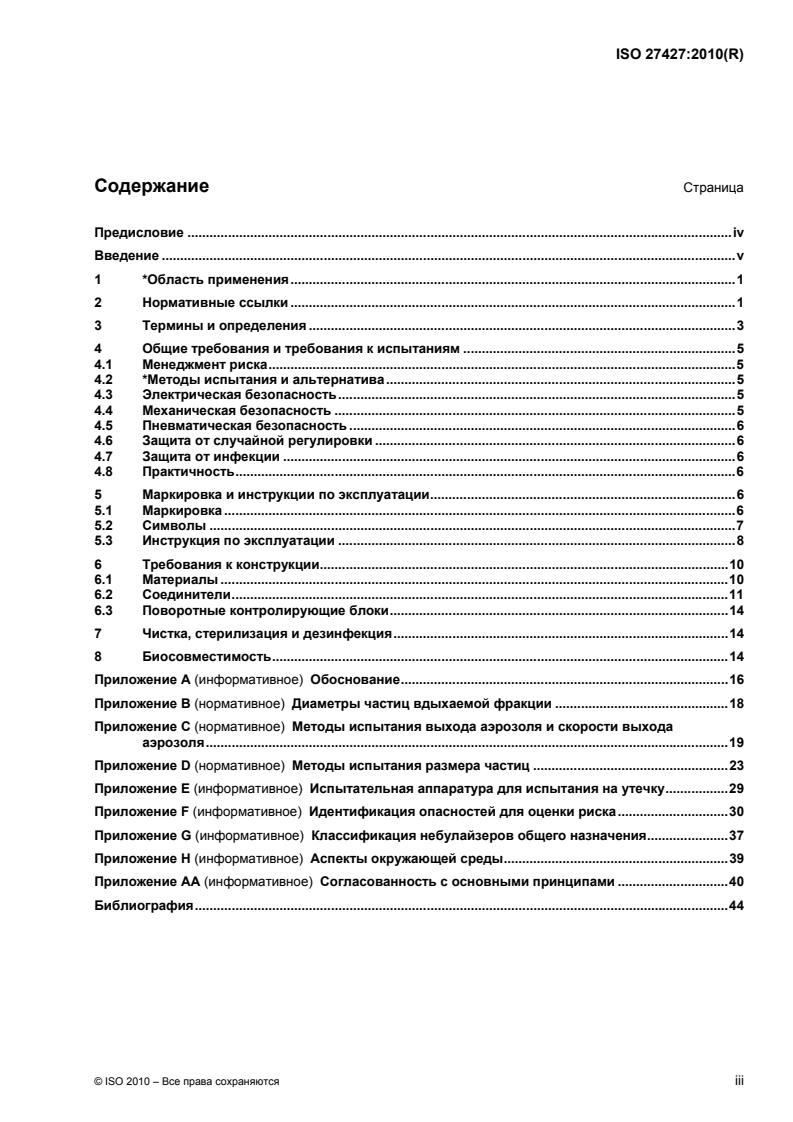
Содержание Страница
Предисловие .iv
Введение .v
1 *Область применения.1
2 Нормативные ссылки .1
3 Термины и определения .3
4 Общие требования и требования к испытаниям .5
4.1 Менеджмент риска.5
4.2 *Методы испытания и альтернатива.5
4.3 Электрическая безопасность.5
4.4 Механическая безопасность .5
4.5 Пневматическая безопасность .6
4.6 Защита от случайной регулировки .6
4.7 Защита от инфекции .6
4.8 Практичность.6
5 Маркировка и инструкции по эксплуатации.6
5.1 Маркировка .6
5.2 Символы .7
5.3 Инструкция по эксплуатации .8
6 Требования к конструкции.10
6.1 Материалы .10
6.2 Соединители.11
6.3 Поворотные контролирующие блоки.14
7 Чистка, стерилизация и дезинфекция.14
8 Биосовместимость.14
Приложение A (информативное) Обоснование.16
Приложение B (нормативное) Диаметры частиц вдыхаемой фракции .18
Приложение C (нормативное) Методы испытания выхода аэрозоля и скорости выхода
аэрозоля.19
Приложение D (нормативное) Методы испытания размера частиц .23
Приложение E (информативное) Испытательная аппаратура для испытания на утечку.29
Приложение F (информативное) Идентификация опасностей для оценки риска.30
Приложение G (информативное) Классификация небулайзеров общего назначения.37
Приложение H (информативное) Аспекты окружающей среды.39
Приложение AA (информативное) Согласованность с основными принципами .40
Библиография.44
Предисловие
Международная организация по стандартизации (ISO) является всемирной федерацией национальных
организаций по стандартизации (комитетов-членов ISO). Разработка международных стандартов
обычно осуществляется техническими комитетами ISO. Каждый комитет-член, заинтересованный в
деятельности, для которой был создан технический комитет, имеет право быть представленным в этом
комитете. Международные правительственные и неправительственные организации, имеющие связи с
ISO, также принимают участие в работах. Что касается стандартизации в области электротехники, то
ISO работает в тесном сотрудничестве с Международной электротехнической комиссией (IEC).
Проекты международных стандартов разрабатываются в соответствии с правилами Директив ISO/IEC,
Часть 2.
Основная задача технических комитетов заключается в подготовке международных стандартов.
Проекты международных стандартов, принятые техническими комитетами, рассылаются комитетам-
членам на голосование. Их опубликование в качестве международных стандартов требует одобрения
не менее 75 % комитетов-членов, принимающих участие в голосовании.
Следует иметь в виду, что некоторые элементы настоящего международного стандарта могут быть
объектом патентных прав. ISO не может нести ответственность за идентификацию какого-либо одного
или всех патентных прав.
ISO 27427 был подготовлен Техническим комитетом ISO/TC 121, Оборудование для анестезии и
искусственного дыхания, Подкомитетом SC 2, Воздушные каналы и связанное оборудование.
Настоящее второе издание отменяет и заменяет первое издание (ISO 27427:2009), от которого его
отличает незначительный пересмотр.
Были внесены следующие изменения:
⎯ был добавлен новый подраздел 4.1.2 (Клиническая оценка);
⎯ был добавлен новый подраздел 4.8 (Практичность) и, как результат были добавлены две ссылки в
Разделе 2;
⎯ 5.1.2 a) был усовершенствован;
⎯ был добавлен новый пункт 5.1.2 d) и последующие пункты были перенумерованы;
⎯ в 5.1.2, был добавлен новый пункт (o);
⎯ в 5.3.2, было добавлено два новых пункта (u и v);
⎯ было добавлено примечание к 6.1.2.
Кроме того, было сделано несколько незначительных редакторских правок.
iv © ISO 2010 – Все права сохраняются
Введение
Небулайзеры широко используются для доставки лекарств, в виде аэрозолей, человеку через
дыхательную систему. Эти лекарства могут быть в виде растворов, суспензий или эмульсий. Вдыхание
аэрозолей является предпочтительным путем введения таких лекарств. Некоторые лекарства
предназначены для лечения системных заболеваний, а другие лекарства предназначены для лечения
респираторных заболеваний. Для достижения предполагаемого эффекта от лечения может быть
необходимо, чтобы частицы аэрозоля осаждались на определенных частях дыхательного тракта. Для
частиц различного размера характерно осаждение в различных частях дыхательной системы;
следовательно, профиль рабочих характеристик и предполагаемое использование небулайзера
должны определяться производителем и отображаться в сопроводительной документации.
Небулайзеры также используются в диагностических целях с использованием радиоизотопов и для
испытания легочного ответа и доставки вакцин.
Данный международный стандарт основан на Европейском стандарте EN 13544-1:2007. Данный
международный стандарт разработан, чтобы покрывать небулайзеры “общего назначения”. Это было
специально отмечено, чтобы обеспечить, что результаты различных испытаний, заявленные
производителем понятны пользователям и покупателям небулайзеров.
Целями данного международного стандарта является обеспечение:
⎯ соответствия небулайзеров предполагаемому использованию, заявленному производителем;
⎯ безопасности, особенно небулайзеров с электрическим приводом;
⎯ совместимости между материалами компонентов и распыляемой жидкостью;
⎯ биосовместимости материалов компонентов, контактирующих с телом человека.
Были сделаны важные изменения оригинального EN стандарта для учета развития испытательных
устройств, таких как лазеры и импакторов низкого потока, которые позволяют производителям
использовать различные методы испытания, обеспечив, что альтернативные методы испытания
валидны относительно методов, определенных в данном международном стандарте.
Термины, определенные в данном международном стандарте, выделены жирным шрифтом.
На протяжении данного международного стандарта, текст, для которого приведено обоснование в
Приложении А, отмечен звездочкой (*).
МЕЖДУНАРОДНЫЙ СТАНДАРТ ISO 27427:2010(R)
Оборудование для анестезии и искусственного дыхания.
Распыляющие системы и компоненты
1 *Область применения
В данном международном стандарте определены требования к безопасности, рабочим
характеристикам и испытаниям распыляющих систем общего назначения, предназначенных для
непрерывной или запускаемой дыханием доставки жидкостей, в виде аэрозолей, человеку через
дыхательную систему.
Данный международный стандарт включает газоприводные небулайзеры, которые могут
приводиться в действие, например, компрессорами, трубопроводной системой, цилиндрами и т.д. и
небулайзеры с электрическим приводом [например, с вращающимся диском, ультразвуковые,
вибрационные решетки (активные и пассивные) и капиллярные устройства] или небулайзеры,
управляемые вручную.
*Данный международный стандарт не применяется к устройствам, предназначенным для назального
введения.
Данный международный стандарт не применяется к устройствам, предназначенным только для
обеспечения увлажнения или гидратации путем обеспечения воды в виде аэрозоля.
* Данный международный стандарт не применяется небулайзерам для определенных лекарств
(например, ингаляторы с устройствами дозирования, ингаляторы, отмеряющие жидкости, ингаляторы
для сухих порошков и их компоненты).
2 Нормативные ссылки
Ссылка на следующие документы обязательна при использовании данного документа. Для жестких
ссылок применяются только указанное по тексту издание. Для плавающих ссылок необходимо
использовать самое последнее издание нормативного ссылочного документа (включая любые
изменения).
ISO 594-1, Конические соединители с 6 % конусностью (Люэр) для шприцев, игл и некоторого
другого медицинского оборудования. Часть 1. Общие требования
ISO 594-2, Конические соединители с 6 % конусностью (Люэр) для шприцев, игл и некоторого
другого медицинского оборудования. Часть 2. Фиксирующие приспособления
ISO 5356-1, Оборудование для анестезии и искусственного дыхания. Конические соединители.
Часть 1. Диффузоры и муфты
ISO 5356-2, Оборудование для анестезии и искусственного дыхания. Конические соединители.
Часть 2. Резьбовые соединители, рассчитанные на большую нагрузку
ISO 5359, Шланговые соединители низкого давления для использования с медицинскими газами
ISO 5361-1, Трахеальные трубки. Часть 1. Общие требования
ISO 7000, Графические символы, используемые на оборудовании. Перечень и аннотация
ISO 7396-1, Медицинские газопроводы. Часть 1. Трубопроводы для сжатых медицинских газов и
вакуума
ISO 9170-1, Оконечные устройства для медицинских газопроводов. Часть 1. Оконечные устройства
для использования со сжатыми медицинскими газами и вакуумом
ISO 9276-2, Представление результатов анализа размера частиц. Часть 2. Вычисление среднего
размера/диаметра частиц и моментов распределения размера частиц
ISO 10524-1, Регуляторы давления для систем подачи медицинских газов. Часть 1. Регуляторы
давления и регуляторы давления с расходомерными устройствами
ISO 10524-3, Регуляторы давления для использования с медицинскими газами. Часть 3. Регуляторы
давления, сопряженные с клапанами баллона
ISO 10524-4, Регуляторы давления для использования с медицинскими газами. Часть 4. Регуляторы
низкого давления
ISO 10993-1, Биологическая оценка медицинских изделий. Часть 1. Оценка и испытания в рамках
процесса менеджмента риска
ISO 11135-1, Стерилизация медицинской продукции. Этилен оксид. Часть 1. Требования к
разработке, валидации и текущему контролю процесса стерилизации медицинских изделий
ISO 11137-1, Стерилизация медицинских изделий. Радиация. Часть 1. Требования к разработке,
валидации и текущему контролю процесса стерилизации медицинских изделий
ISO 11137-2, Стерилизация медицинских изделий. Радиация. Часть 2. Установление дозы радиации
ISO 11137-3, Стерилизация медицинских изделий. Радиация. Часть 3. Руководство по вопросам
дозиметрии
ISO 14971:2007, Медицинские изделия. Применение менеджмента риска к медицинским изделиям
ISO 15001, Оборудование для анестезии и искусственного дыхания. Совместимость с кислородом
ISO 15002, Расходомеры для подсоединения к оконечным устройствам медицинских газопроводных
систем
ISO 15223, Медицинские устройства. Символы, используемые на ярлыках медицинских устройств,
при маркировке и в предоставляемой информации
ISO 17665-1, Стерилизация медицинских изделий. Влажный жар. Часть 1. Требования к разработке,
валидации и текущему контролю процесса стерилизации медицинских изделий
ISO 23328-1, Фильтры дыхательных систем для использования при анестезии и в дыхательной
терапии. Часть 1. Солевой метод испытания для определения рабочих характеристик
фильтрации
IEC 60601-1:2005, Электрическое медицинское оборудование. Часть 1. Основные требования
безопасности и необходимых рабочих характеристик
IEC 60601-1-2, Медицинское электрооборудование. Часть 1-2. Общие требования к основам
безопасности и основным рабочим характеристикам. Дополняющий стандарт. Электромагнитная
совместимость. Требования и испытания
IEC 60601-1-6, Медицинское электрооборудование. Часть 1-6. Общие требования к основам
безопасности и основным рабочим характеристикам. Дополняющий стандарт. Практичность
2 © ISO 2010 – Все права сохраняются
IEC 62366, Медицинские устройства. Применение практичной инженерии к медицинским
устройствам
EN 556-1, Стерилизация медицинских изделий. Требования к медицинским изделиям определенных
"СТЕРИЛЬНО". Часть 1. Требования к абсолютно стерильным медицинским изделиям
ENV 737-6, Медицинские газопроводы. Часть 6. Размеры и расположение датчиков для оконечных
устройств для сжатых медицинских газов и вакуума
EN 13544-2, Оборудование для дыхательной терапии. Часть 2. Трубки и соединители
CGA V-5-2005, Каталог диаметров как система безопасности. Невзаимозаменяемые соединители
низкого давления для применения с медицинскими газами
3 Термины и определения
В рамках данного документа применяются следующие термины и определения.
3.1
аэрозоль
aerosol
суспензия частиц в газе
ПРИМЕЧАНИЕ 1 Частицы могут быть жидкими или твердыми.
ПРИМЕЧАНИЕ 2 Газ может быть газом для управления или внешний воздух.
3.2
выход аэрозоля
aerosol output
количество аэрозоля, доставляемое пациенту распыляющей системой для данного объема
заполнения
3.3
скорость выхода аэрозоля
aerosol output rate
количество аэрозоля, доставляемое пациенту распыляющей системой в единицу времени
3.4
распыляющая система, запускаемая дыханием
breath-actuated nebulizing system
небулайзер, запускаемый параметрами дыхания
ПРИМЕЧАНИЕ Примеры этой классификации можно найти в Приложении G.
3.5
непрерывная распыляющая система
continuous nebulizing system
небулайзер, в котором аэрозоль доставляется непрерывно в течение нескольких дыхательных
циклов вдоха/выдоха или в течение длительных периодов
3.6
небулайзер с электроприводом
electrically-powered nebulizer
небулайзер, который работает за счет электрической энергии
ПРИМЕЧАНИЕ Небулайзеры с электроприводом включают ультразвуковые устройства, устройства с
вибрирующей решеткой и устройства капиллярного типа.
3.7
газоприводные небулайзер
gas-powered nebulizer
небулайзер, в котором аэрозоль производится за счет сжатого газа
3.8
контейнер для жидкости
liquid container
часть небулайзера, которая содержит жидкость для распыления
3.9
небулайзер, управляемые вручную
manually-powered nebulizer
небулайзер, который работает за счет энергии человека
3.10
массовый средний аэродинамический диаметр
mass median aerodynamic diameter
MMAD
максимальный размер частиц, при котором 50 % выхода аэрозоля доставляется в дыхательный тракт
3.11
максимальный объем заполнения
maximum fill volume
максимальный объем жидкости, выраженный в миллилитрах, в контейнере для жидкости, когда
небулайзер заполнен до своего максимального уровня заполнения
3.12
небулайзер
nebulizer
устройство, которое преобразует жидкость в аэрозоль с контролируемым диапазоном размера частиц
3.13
распыляющая система
nebulizing system
устройство, включающее небулайзер и все другие компоненты, необходимое для того, чтобы сделать
аэрозоль доступным для ингаляции
3.14
вдыхаемая фракция
respirable fraction
количество лекарства (в микрограммах), содержащееся в частицах с размером менее 5 мкм
3.15
вдыхаемый диапазон
respirable range
размеры частиц аэрозоля от 0,5 мкм до 5,0 мкм
3.16
валидация
validation
подтверждение путем предоставления объективных доказательств того, что требования для
специального предполагаемого использования или применения выполняются
ПРИМЕЧАНИЕ 1 Термин “валидированный” применяется для обозначения соответствующего статуса.
ПРИМЕЧАНИЕ 2 Использование условий для валидации может быть реальным или моделированным.
4 © ISO 2010 – Все права сохраняются
4 Общие требования и требования к испытаниям
4.1 Менеджмент риска
4.1.1 Общие положения
Распыляющие системы и небулайзеры не должны при транспортировке, хранении, установке,
работе при нормальных условиях и обслуживании в соответствии с инструкциями производителя
вызывать опасности безопасности, которые можно реально ожидать, используя процедуры
менеджмента риска в соответствии с ISO 14971 и которые связаны с их предполагаемым применением
при нормальных условиях и условиях единичного отказа.
ПРИМЕЧАНИЕ Ситуация, при которой сбой не обнаруживается, считается нормальными условиями. Условия
отказа/опасные ситуации могут оставаться не обнаруженными в течение продолжительного периода времени и,
как следствие, могут приводить к неприемлемым рискам. В данном случае, последующее определенное условие
отказа необходимо рассматривать как условие единичного отказа. В рамках процесса менеджмента риска должны
быть определены специальные меры контроля риска для учета подобных ситуаций.
4.1.2 Клиническая оценка
Если применимо, должна проводиться и фиксироваться в файле менеджмента риска клиническая
оценка.
Проверьте соответствие инспекцией файла менеджмента риска.
4.2 *Методы испытания и альтернатива
4.2.1 Методы испытания выхода аэрозоля, скорости выхода аэрозоля и размера частиц
Типичные методы испытания выхода аэрозоля, скорости выхода аэрозоля и размера частиц
определены в Приложениях C и D.
4.2.2 Альтернативные методы испытания
Производители могут использовать типовые методы испытания для выхода аэрозоля, скорости
выхода аэрозоля и размера частиц, отличные от определенных в Приложениях C и D.
Альтернативные методы испытания должны быть валидированы относительно методов испытания из
Приложений C и D, чтобы продемонстрировать эквивалентность.
Демонстрация эквивалентности должна быть включена в техническую документацию производителя.
Доказательства должны предоставляться по требованию, например, контролирующим органам.
4.3 Электрическая безопасность
Распыляющие системы, использующие электроэнергию должны соответствовать требованиям,
приведенным в IEC 60601-1 в дополнение к требованиям, приведенным в данном международном
стандарте.
Проверьте соответствие применением испытаний IEC 60601-1.
4.4 Механическая безопасность
Распыляющие системы должны соответствовать Разделу 9 IEC 60601-1:2005.
Проверьте соответствие инспекцией.
4.5 Пневматическая безопасность
Если производителем заявлено, что небулайзер предназначен для подсоединения непосредственно к
трубопроводной системе, соответствующей ISO 7396-1, или регулятору давления, соответствующему
ISO 10524-1 или ISO 10524-3, небулайзер должен удовлетворять требованиям данного
международного стандарта к питанию пневматической энергией в диапазоне от 280 кПа (2,8 бар) до
600 кПа (6 бар) и не должны вызывать опасности безопасности при условиях единичного отказа
поставки медицинских газов, т.е. до уровня входного давления в 1 МПа (10 бар).
4.6 Защита от случайной регулировки
Должны быть предусмотрены средства защиты от случайной регулировки контролирующих блоков,
которая может привести к опасному выходу.
ПРИМЕЧАНИЕ Механические средства контроля, такие как фиксаторы, экраны, фрикционные крепления и
стопоры, считаются подходящими. Клавиши для пальцев, чувствительные к давлению, емкостные переключатели
для пальцев и ориентированные на микропроцессоры “мягкие” контроллеры или определенные
последовательности работы ключей или переключателей также считаются подходящими.
Проверьте соответствие визуальной инспекцией инструкции по эксплуатации.
4.7 Защита от инфекции
Все части распыляющей системы, подвергающиеся загрязнению выдыхаемыми газами и
предназначенными для повторного использования различными пациентами, должны иметь
возможность подвергаться дезинфекции или стерилизации.
4.8 Практичность
Производители должны учитывать в процессе разработки с учетом практичности риски, возникающие
из-за низкой практичности, в соответствии с IEC 60601-1-6 и IEC 62366.
Проверьте соответствие инспекцией файла разработки с учетом практичности.
5 Маркировка и инструкции по эксплуатации
5.1 Маркировка
5.1.1 Общие положения
a) Все компоненты, дыхательные крепления или части, чувствительные к направлению потока
(например, обратный клапан лицевой маски или загубника и т.д.) должны быть либо четко и
устойчиво маркированы стрелкой, показывающей направление потока газа, если они являются
отсоединяемыми оператором, или разработаны так, чтобы предотвращать некорректное
подсоединение, или быть постоянно подсоединенными.
b) Если они являются газоспецифичными, входы и выходы должны идентифицироваться четкой и
устойчивой маркировкой.
5.1.2 Маркировка устройств, этикеток и упаковки
Устройство, этикетки и/или упаковка должны содержать следующее:
a) наименование или торговое наименование и адрес производителя; для устройств, импортируемых
в Европейский Союз, применяется следующее: наименование и адрес ответственного лица и
полномочного представителя производителя, установленного в Европейском Союзе, должны быть
приведены на устройстве или в сопроводительной документации;
6 © ISO 2010 – Все права сохраняются
b) идентификацию устройства и информацию о содержимом;
c) индикацию того, что устройство стерильно, если применимо;
d) для одноразовых изделий производитель должен определять риски, связанные с повторным
использованием, в инструкции по эксплуатации или по требованию;
ПРИМЕЧАНИЕ Производителю следует обратить внимание на нормативные нормы, требующие, чтобы
индикация одноразового использования была соответствующей на всей территории Европейского союза.
e) изделие упаковывается и/или этикетируется таким образом, чтобы различать одни и те же или
сходные продукты, как стерильные, так и не стерильные, помещенные на рынок одним и тем же
производителем;
f) код партии, если применяется;
g) дату истечения срока хранения, если изделие чувствительно к хранению, или срок годности;
h) индикацию того, что устройство предназначено для одноразового использования, если
применимо;
i) любые специальные условия хранения и/или обслуживания;
j) любые предупреждения и/или меры предосторожности, которые необходимо принять, например,
совместимость с использованием кислородных смесей и совместимость между кислородом и
вводимыми лекарствами;
k) год производства, за исключением случаев, покрываемых f);
l) рекомендуемый метод(ы) чистки и дезинфекции или стерилизации, если применимо;
m) для упаковок, содержащих части, выполненные из антистатических или проводящих материалов,
слово “АНТИСТАТИЧЕСКИЙ” или “ПРОВОДЯЩИЙ”, если применимо;
n) контейнер для жидкости небулайзера должен маркироваться уровнем максимального объема
заполнения; он должен быть определен в инструкции по эксплуатации [см. 5.3.2 a) i)];
o) если в части медицинских изделий, вступающих в прямой или непрямой контакт с пациентом,
включены фталаты, устройство должно быть соответствующим образом этикетировано. Если
такое устройство используется для лечения детей или беременных или кормящих мам, должен
быть определен и зафиксирован в инструкции по эксплуатации остаточный риск.
5.1.3 Маркировка блоков контроля и инструментов
a) Давление подачи газа должно отображаться в килопаскалях.
b) Давление в дыхательной системе должно отображаться в паскалях ×100.
c) Потоки должны отображаться в литрах в минуту.
d) Если предусмотрены, клапаны разведения внешнего воздуха/кислорода должны маркироваться
в % O (кислорода).
5.2 Символы
Применяются ISO 7000, ISO 15223 и Раздел 6.4 IEC 60601-1:2005.
5.3 Инструкция по эксплуатации
5.3.1 * Общие положения
Небулайзеры, распыляющие системы и их части должны сопровождаться инструкцией по
эксплуатации, которая должна включать информацию, приведенную в 5.3.2.
5.3.2 Данные
a) Назначение и предполагаемое использование устройства и его частей, включая питающие и/или
контролирующие устройства.
b) Типы жидкости (например, растворы и/или суспензии и/или эмульсия), для распыления которых
разработано устройство.
c) Распределение частиц, в терминах массы, в пределах каждого из следующих диапазонов
размеров: % > 5 мкм, % от 2 мкм до 5 мкм, % < 2 мкм.
d) Массовый средний аэродинамический диаметр (mass median aerodynamic diameter, MMAD),
полученный на основании кривой распределения размера частиц (см. Рисунок D.2).
e) Дыхательную фракцию рабочих характеристик небулайзера.
f) Выход аэрозоля и скорость выхода аэрозоля при максимальном объеме заполнения при
испытательных условиях, определенных в C.1.1. Кроме того, для газоприводных небулайзеров
выход аэрозоля и скорость выхода аэрозоля при минимальном и максимальном потоке
управляющего газа с соответствующими давлениями при испытательных условиях, определенных
в C.1 и C.2.
g) Показания остаточного объема (в миллилитрах) при испытании в соответствии с методами
испытания, описанными в Приложении C.
h) Для небулайзеров, запускаемых дыханием, метод и соответствующую чувствительность.
i) Утверждение, что использование растворов, суспензий или эмульсий, отличных от рекомендуемых
производителем, в особенности суспензий и/или растворов с высокой вязкостью, может изменить
кривую распределения размеров частиц, массовый средний аэродинамический диаметр,
выход аэрозоля и/или скорость выхода аэрозоля, которые могут отличаться от заявленных
производителем.
j) Рекомендуемый максимальный объем заполнения.
k) Максимальный A-взвешенный уровень звукового давления, полученный на основании метода
испытания 9.6.2.1 IEC 60601-1:2005.
l) Для портативного небулайзера, индикация пространственной ориентации (например,
вертикальная, горизонтальная, перевернутая), при которой он продолжает функционировать, как
предусмотрено.
m) Подходит ли небулайзер для использования в анестезирующих дыхательных системах или
системах искусственной вентиляции легких.
n) Если применимо, максимальное превышение температуры в распыляющей камере по сравнению с
окружающей средой при всех рабочих условиях.
o) Взаимосвязь контролирующих блоков, если применимо.
8 © ISO 2010 – Все права сохраняются
p) Характеристики давления и потока питающих выходов любых газов при наихудших условиях,
определенных производителем.
q) Определенный диапазон потоков, требуемый от любого источника газа, если применимо.
r) Утверждение спецификации на состав и чистоту всех газов, подаваемых в небулайзер, если
применимо.
s) Чертежи невозвратных клапанов и клапанов сброса давления и их характеристики, если
подключены.
t) Срок годности частей многократного использования.
u) Если устройство используется в лечении детей или беременных или кормящих женщин, должен
быть определен и зафиксирован в инструкции по эксплуатации остаточный риск от использования
фталатов, включенных в устройство, вступающее в прямой или непрямой контакт с пациентом.
v) Инструкция по эксплуатации должна содержать дату утверждения или последнего пересмотра.
Проверьте соответствие инспекцией.
5.3.3 Совместимость материалов
a) Утверждение, что материалы, используемые для компонентов, могут быть несовместимы с
растворами, суспензиями или эмульсиями, отличными от рекомендованных производителем, в
особенности для суспензии и/или растворы с высокой вязкостью.
b) Предупреждение, что кислород и смеси кислорода (O > 23 %) не должны использоваться в
качестве управляющего газа, если применимо.
5.3.4 Подача управляющего газа
a) Рекомендуемый управляющий газ.
b) Минимальные и максимальные давления и скорости потока рекомендуемых управляющих газов.
5.3.5 Чистка, дезинфекция и стерилизация
Инструкция по эксплуатации должна содержать информацию о следующем:
a) Методы чистки, дезинфекции и/или стерилизации перед использованием.
b) Число циклов чистки, дезинфекции и/или стерилизации, которое выдержит распыляющая система.
5.3.6 Разборка и повторная сборка
Производитель должен рекомендовать следующее:
a) Процедуры повторной сборки, если применимо.
b) Функциональные испытания работы, проводимые после повторной сборки перед использованием.
5.3.7 Мониторинг, сигнализация и защитные устройства
Инструкция по эксплуатации должна включать:
a) описание методов проверки работы сигнализации;
b) описание любых установленных клапанов сброса давления.
5.3.8 Электромагнитная совместимость
Если применимо, инструкция по эксплуатации должна включать предупреждение о том, что на
функционирование данного небулайзера могут влиять электромагнитные помехи, превышающие
уровень, определенный в IEC 60601-1-2.
5.3.9 Утилизация устройства
Инструкция по эксплуатации должна включать информацию о любых мерах предосторожности,
применяемых, если существует особый необычный риск, связанный с утилизацией устройства.
5.3.10 Части, не составляющие единое целое с распыляющей системой
Инструкция по эксплуатации должна включать:
a) список частей, не составляющих единое целое с системой и требующих корректного
использования;
b) утверждение, что эти части должны соответствовать соответствующим требованиям данного
международного стандарта.
6 Требования к конструкции
6.1 Материалы
6.1.1 Материалы для конструкции должны быть совместимы с газом(газами) или смесью(смесями)
газов, рекомендованных производителем, и, если применимо, соответствовать ISO 15001.
Если материалы предназначены для использования с лекарствами и чистящими веществами, они
должны быть выбраны таким образом, чтобы минимизировать риски, связанные с токсичностью.
6.1.2 Компоненты небулайзера, вступающие в контакт с чистящими веществами, стерилизующими
веществами, медицинскими газами и медикаментами, рекомендуемыми производителем, не должны
разлагаться, влиять на рабочие характеристики или представлять опасность для предполагаемого
использования небулайзера.
ПРИМЕЧАНИЕ Следует обратить внимание на вещества, которые канцерогенны, мутагены или токсичны для
репродуктивных функций. См. также 5.3.2.
6.1.3 Рекомендованные чистящие вещества не должны влиять на рабочие характеристики
небулайзера.
6.1.4 Компоненты, контактирующие с аэрозолем или жидкостью для распыления, не должны иметь
любых постоянных видимых повреждений от рекомендованных чистящих и стерилизующих агентов.
Проверьте соответствие инспекцией.
10 © ISO 2010 – Все права сохраняются
6.2 Соединители
6.2.1 Входные соединители управляющих газов
Входные соединители управляющих газов распыляющей системы должны быть совместимы с
системой доставки газа, к которой предполагается их подсоединение, и должны быть одними из
следующих (см. Рисунок 1):
a) гайка и ниппель невзаимозаменяемого резьбового (non-interchangeable screw-threaded, NIST)
соединителя, соответствующего ISO 5359;
b) гайка и ниппель DISS соединителя, соответствующего ISO 5359 (CGA V-5-2005 список диаметров
невзаимозаменяемых соединителей для применения с медицинскими газами как система
безопасности);
c) штырь, соответствующий ISO 9170-1, ENV 737-6 или соответствующему национальному
стандарту;
d) резьбовой соединитель, соответствующий EN 13544-2;
e) ниппель, соответствующий EN 13544-2.
6.2.2 Соединители дыхательной системы небулайзера
a) Если конические, то это должны быть соединители размера 8,5 мм, 15 мм, или 22 мм,
соответствующие ISO 5356-1 или ISO 5356-2.
b) Если специальные, то они не должны образовывать соединение с коническими соединителями,
соответствующими ISO 5356-1 или ISO 5356-2, если они не соответствуют требованиям к
соединению, отсоединению и утечке ISO 5356-1 или ISO 5356-2.
Обозначение
1 конечное устройство, соответствующее ISO 9170-1 (на регуляторе давления или на MGPS)
2 штырь или DISS или NIST – ISO 9170-1, ENV 737-6, ISO 5359
3 резьбовое соединение – EN 13544-2
4 ниппель – EN 13544-2
5 шланг – EN 13544-2
6 флоуметр – ISO 15002
7 небулайзер
8 регулятор давления – ISO 10524-4
9 компрессор
a
К пациенту.
Рисунок 1 — Примеры входных соединителей управляющих газов для распыляющих систем
12 © ISO 2010 – Все права сохраняются
Обозначение
1 ISO конический соединитель – ISO 5356-1
2 аэрозольная маска, вентилируемая
3 соединитель трахеальной трубки – ISO 5361-1
4 загубник
5 небулайзер
6 тройник
7 вентиляционная дыхательная цепь
8 вентилятор
a
К пациенту.
Рисунок 2 — Примеры соединителей дыхательной системы для распыляющих систем
6.2.3 Выходной соединителей небулайзера
Выходной соединителей небулайзера должен быть одним из следующих.
a) Если предназначен для подсоединения к дыхательной системе или дыхательной трубке, это
должен быть 22 мм соединитель, соответствующий ISO 5356-1.
b) Специальные соединители небулайзера должны быть несовместимы с коническими
соединителями, соответствующими ISO 5356-1 или Люэр соединителями, соответствующими
ISO 594-1 и ISO 594-2.
6.2.4 Соединители, чувствительные к направлению потока
Любые компоненты, чувствительные к направлению потока, отсоединяемые оператором, должны быть
разработаны так, чтобы их было невозможно подсоединить таким образом, чтобы представлять
опасность для пациента.
6.2.5 Соединители небулайзера малого диаметра
Любые соединители распыляющих систем малого диметра должны быть не совместимы с 6 %
коническими (Люэр) соединителями, определенными в ISO 594-1 и ISO 594-2.
6.3 Поворотные контролирующие блоки
Производитель должен обеспечить согласованность направления перемещения поворотных
контролирующих блоков оборудования.
7 Чистка, стерилизация и дезинфекция
a) Если поставляются стерильными, распыляющая система и компоненты должны быть
стерилизованы, используя соответствующие валидированные методы, описанные в: ISO 11135-1,
ISO 11137-1, ISO 11137-2, ISO 11137-3, ISO 17665-1, EN 556-1.
b) Доказательства того, что метод(ы) обеспечивает предполагаемый уровень чистоты компонентов
распыляющей системы во время производства и поставки, должны предоставляться
производителем по требованию.
c) Распыляющие системы и компоненты, предназначенные для многократного использования,
должны быть сконструированы так, чтобы позволить разборку для чистки и дезинфекции или
стерилизации.
d) Соответствующие испытания рабочих характеристик, такие как испытания выхода аэрозоля,
скорости выхода аэрозоля и размера частиц должны повторяться после заданного числа циклов
чистки и/или стерилизации для валидации рабочих характеристик небулайзера.
8 Биосовместимость
a) Части распыляющей системы, предназначенные для вступления в контакт с биологическими
тканями, клетками, жидкостями тела или вдыхаемыми газами должны быть оценены и
документированы в соответствии с руководством и принципами, данными в ISO 10993-1.
14 © ISO 2010 – Все права сохраняются
b) Все части небулайзера должны быть разработаны и производиться так, чтобы минимизировать
риски здоровью из-за веществ, вымываемых из устройства во время использования.
c) Распыляющие системы должны быть свободны от летучих органических соединений и твердых
частиц на протяжении срока службы оборудования.
d) Распыляющие системы должны соответствовать испытаниям на летучие органические
соединения и твердые частицы, если это требуется региональными или национальными
компетентными органами.
Проверьте соответствие инспекцией соответствующих отчетов о валидации. Применяется
подраздел 11.7 IEC 60601-1:2005.
Приложение A
(информативное)
Обоснование
Общие положения
Данное приложение представляет краткое обоснование важных требований данного международного
стандарта и предназначено для использования теми, кто знаком с предметом данного международного
стандарта, но не принимал участие в его разработке. Считается, что понимание причин, лежащих в
основе данных требований, будет важным для их правильного применения. Более того, поскольку
клиническая практика и техника изменяются, считается, что обоснование существующих требований
облегчит любой пересмотр данного международного стандарта, вызванный этими развитиями.
Разделы в данном приложении нумерованы таким образом, чтобы соответствовать разделам данного
международного стандарта, на которые они ссылаются. Следовательно, нумерация не является
последовательной.
A.1 Область применения
Отличительной особенностью данного международного стандарта является то, что в нем описываются
характеристики и требования к небулайзерам общего назначения, которые могут использоваться с
различными медицинскими веществами. Ожидается, что выбор небулайзера будет основываться на
требованиях и характеристиках, разработанных в данном международном стандарте и заявленных в
инструкции производителя по эксплуатации.
Устройства для назального введения также исключены, так как они не считаются небулайзерами
общего назначения.
Могут быть ситуации, когда устройство попадает под область применения либо ISO 27427, либо
ISO 20072. Комитет решил, что предполагаемое использование продукта и оценка риска устройства
определит, какой стандарт выбрать производителю для оценки устройства.
A.4.2 Методы испытания и альтернатива
Используются различные методы для представления распределения размера частиц небулайзеров
(см. Приложение B).
A.5.3.1 Общие положения
Вдыхаемая фракция, как определено в 3.14, является важным параметром, т.к. совместно с
выходом аэрозоля она дает единую физическую характеристику, которая позволяет сравнивать
рабочие характеристики распыляющих систем.
A.C.2.2 Принципы испытания
Сеанс лечения, используя небулайзер, требует, чтобы пациент вдыхал и выдыхал через небулайзер
в течение времени между примерно 5 мин и 15 мин (в зависимости от используемого медикамента)
пока работает небулайзер. Во время этого времени небулайзер непрерывно производит аэрозоль.
Когда пациент вдыхает аэрозоль, он поглощается легкими. Тем не менее, когда пациент выдыхает,
часть аэрозоля вытесняется из небулайзера и теряется. Следовательно, только некоторая часть
аэрозоля, произведенного небулайзером, может быть поглощена пациентом. Испытание, описанное
16 © ISO 2010 – Все права сохраняются
в данной части, определяет количество аэрозоля, вышедшего через загубник небулайзера, в то
время как небулайзер подвергается моделированным дыхательным циклам.
A.C.2.3 Оборудование для испытания
Синусоидальный насос используется при определении выхода аэрозоля из небулайзера для того,
чтобы разумно оценить массу аэрозольных активных фармацевтических ингредиентов, подаваемых на
выход распыляющей системы при моделированных дыхательных условиях.
A.C.2.4 g) Метод испытания
Измерение массы (веса), а не одного объема корректирует потери на испарение.
A.D.2 Принцип испытания
Непрерывный откачивающий насос используется для испытания размера распыленного аэрозоля для
выполнения этих измерений при постоянной скорости потока “вдоха” для того, чтобы разумно оценить
размер аэрозоля.
Приложение B
(нормативное)
Диаметры частиц вдыхаемой фракции
В общем, считается, что частицы аэрозоля с аэродинамическим диаметром
⎯ > 5 мкм приводят к осаждению в ве
...
Questions, Comments and Discussion
Ask us and Technical Secretary will try to provide an answer. You can facilitate discussion about the standard in here.
Loading comments...