

ISO/TS 21526:2019
(Main)Health informatics — Metadata repository requirements (MetaRep)
General Information
- Abstract
This document describes requirements for collections of metadata about data elements and their containing models and datasets in a healthcare environment. The collection can serve as a repository or as dictionary describing a set of items in use in a particular domain, organisation or product for reference, or it can additionally serve as a registry, supporting the development and communication of standard items to an audience with shared goals. This document specifies standard refinements that account for the detailed governance and administration requirements that are particular to healthcare data. It focuses on the description of data that is persisted in healthcare systems rather than the specification of messages between these systems. It describes necessary extensions to the ISO/IEC 11179 series and to other International Standards on metadata originating from ISO/IEC JTC 1/SC 32 to address the wider variety of value domain types found in healthcare. Where appropriate, it also suggest restrictions/simplifications to the ISO/IEC 11179 series that promote wider adoption without compromising interoperability between metadata registries and opportunities for the development of tooling that consumes metadata for the generation or the parameterization of code.
- Status
- Published
- Publication Date
- 14-Oct-2019
- Technical Committee
- ISO/TC 215 - Health informatics
- Drafting Committee
- ISO/TC 215/WG 3 - Semantic content
- Current Stage
- 9092 - International Standard to be revised
- Start Date
- 30-Nov-2023
- Completion Date
- 29-Aug-2026
Buy Documents

ISO/TS 21526:2019 - Health informatics — Metadata repository requirements (MetaRep) Released:10/15/2019

ISO/TS 21526:2019 - Health informatics — Metadata repository requirements (MetaRep)/15/2019
Overview - ISO/TS 21526:2019 (MetaRep)
ISO/TS 21526:2019, "Health informatics - Metadata repository requirements (MetaRep)," defines requirements for collections of metadata about data elements, models and datasets in healthcare environments. The Technical Specification focuses on metadata that describes persisted healthcare data (not message specifications) and prescribes governance, administration and content models to support consistent metadata registries or dictionaries. It provides healthcare-specific refinements and sensible restrictions to promote adoption while preserving interoperability between metadata registries and enabling tooling for code generation and metadata-driven applications.
Key topics and technical requirements
- Metadata framework and governance: Specifies a framework for managing registry content, administration, registration authorities and registration status to ensure controlled evolution of metadata.
- Basic data types: Defines common primitive/value types used in healthcare metadata (e.g., BLOB, Boolean, Date, Datetime, Integer, Phone_Number, Postal_Address, String) for consistent value domains.
- Common facilities: Covers reusable constructs such as Concept, Concept_System, Classification, Namespace, Scoped_Identifier, Semantic_Relation, Contact, Reference_Document and Naming_Convention to support metadata organization and discovery.
- Data element description: Defines Data_Element, Data_Element_Concept, Conceptual_Domain, Value_Domain, Permissible_Value, Datatype, Unit_of_Measure and Derivation_Rule - enabling explicit, machine-readable definitions of clinical and administrative data items.
- Data model description: Includes Information_Model, Entity_Type, Attribute, Relationship, Diagram and Constraints to represent structure and relationships of persisted datasets.
- XML schema and mapping: Addresses XML_Schema features and MDR_Mapping to support export/import and mapping between registries and systems.
- Healthcare-specific refinements: Extends ISO/IEC 11179 and other ISO/IEC JTC 1/SC 32 metadata standards to handle the broader variety of healthcare value domain types and governance needs while suggesting simplifications to encourage wider adoption.
Practical applications and who uses it
ISO/TS 21526:2019 is used to:
- Build and operate metadata repositories (MDRs) and clinical data dictionaries for EHRs, registries and research datasets.
- Ensure semantic interoperability across hospitals, health information exchanges, public health reporting and clinical research by standardizing data element definitions and value domains.
- Support data governance and stewardship workflows (registration, versioning, authority, classification).
- Drive tooling and automation: enable code generation, validation rules, import/export mappings and configuration of clinical applications from metadata. Primary users include health informaticians, metadata managers, EHR vendors, data architects, implementers, standards bodies, clinical researchers and health IT product teams.
Related standards
- ISO/IEC 11179 series - metadata registries (MDR) (refined by ISO/TS 21526 for healthcare)
- ISO/IEC JTC 1/SC 32 standards on metadata and data elements
Keywords: ISO/TS 21526:2019, MetaRep, metadata repository, health informatics, metadata registry, ISO/IEC 11179, data element, value domain, semantic interoperability, EHR, data governance.
Buy Documents
ISO/TS 21526:2019 - Health informatics — Metadata repository requirements (MetaRep) Released:10/15/2019
ISO/TS 21526:2019 - Health informatics — Metadata repository requirements (MetaRep)/15/2019
Get Certified
Connect with accredited certification bodies for this standard

BSI Group
BSI (British Standards Institution) is the business standards company that helps organizations make excellence a habit.

NYCE
Mexican standards and certification body.
Sponsored listings
Frequently Asked Questions
ISO/TS 21526:2019 is a technical specification published by the International Organization for Standardization (ISO). Its full title is "Health informatics — Metadata repository requirements (MetaRep)". This standard covers: This document describes requirements for collections of metadata about data elements and their containing models and datasets in a healthcare environment. The collection can serve as a repository or as dictionary describing a set of items in use in a particular domain, organisation or product for reference, or it can additionally serve as a registry, supporting the development and communication of standard items to an audience with shared goals. This document specifies standard refinements that account for the detailed governance and administration requirements that are particular to healthcare data. It focuses on the description of data that is persisted in healthcare systems rather than the specification of messages between these systems. It describes necessary extensions to the ISO/IEC 11179 series and to other International Standards on metadata originating from ISO/IEC JTC 1/SC 32 to address the wider variety of value domain types found in healthcare. Where appropriate, it also suggest restrictions/simplifications to the ISO/IEC 11179 series that promote wider adoption without compromising interoperability between metadata registries and opportunities for the development of tooling that consumes metadata for the generation or the parameterization of code.
This document describes requirements for collections of metadata about data elements and their containing models and datasets in a healthcare environment. The collection can serve as a repository or as dictionary describing a set of items in use in a particular domain, organisation or product for reference, or it can additionally serve as a registry, supporting the development and communication of standard items to an audience with shared goals. This document specifies standard refinements that account for the detailed governance and administration requirements that are particular to healthcare data. It focuses on the description of data that is persisted in healthcare systems rather than the specification of messages between these systems. It describes necessary extensions to the ISO/IEC 11179 series and to other International Standards on metadata originating from ISO/IEC JTC 1/SC 32 to address the wider variety of value domain types found in healthcare. Where appropriate, it also suggest restrictions/simplifications to the ISO/IEC 11179 series that promote wider adoption without compromising interoperability between metadata registries and opportunities for the development of tooling that consumes metadata for the generation or the parameterization of code.
ISO/TS 21526:2019 is classified under the following ICS (International Classification for Standards) categories: 35.240.80 - IT applications in health care technology. The ICS classification helps identify the subject area and facilitates finding related standards.
ISO/TS 21526:2019 is available in PDF format for immediate download after purchase. The document can be added to your cart and obtained through the secure checkout process. Digital delivery ensures instant access to the complete standard document.
Standards Content (Sample)
TECHNICAL ISO/TS
SPECIFICATION 21526
First edition
2019-10
Health informatics — Metadata
repository requirements (MetaRep)
Informatique de santé — Exigences relatives aux référentiels de
métadonnées (MetaRep)
Reference number
©
ISO 2019
© ISO 2019
All rights reserved. Unless otherwise specified, or required in the context of its implementation, no part of this publication may
be reproduced or utilized otherwise in any form or by any means, electronic or mechanical, including photocopying, or posting
on the internet or an intranet, without prior written permission. Permission can be requested from either ISO at the address
below or ISO’s member body in the country of the requester.
ISO copyright office
CP 401 • Ch. de Blandonnet 8
CH-1214 Vernier, Geneva
Phone: +41 22 749 01 11
Fax: +41 22 749 09 47
Email: copyright@iso.org
Website: www.iso.org
Published in Switzerland
ii © ISO 2019 – All rights reserved
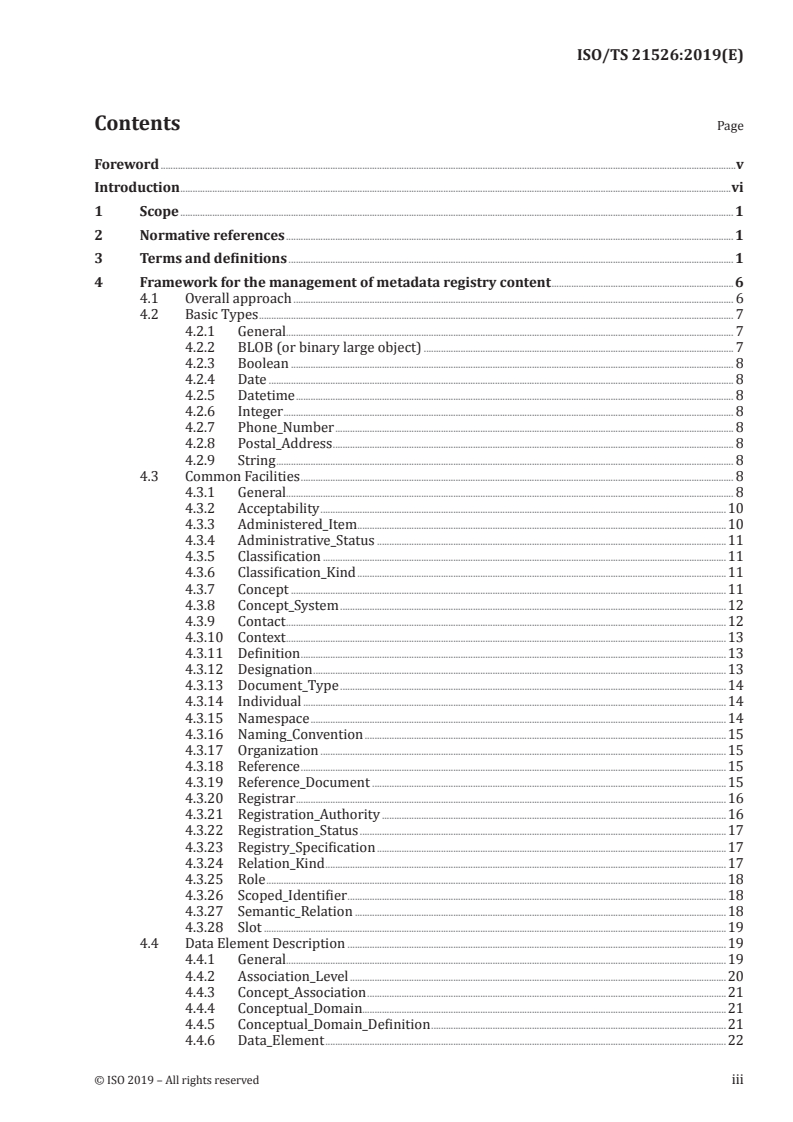
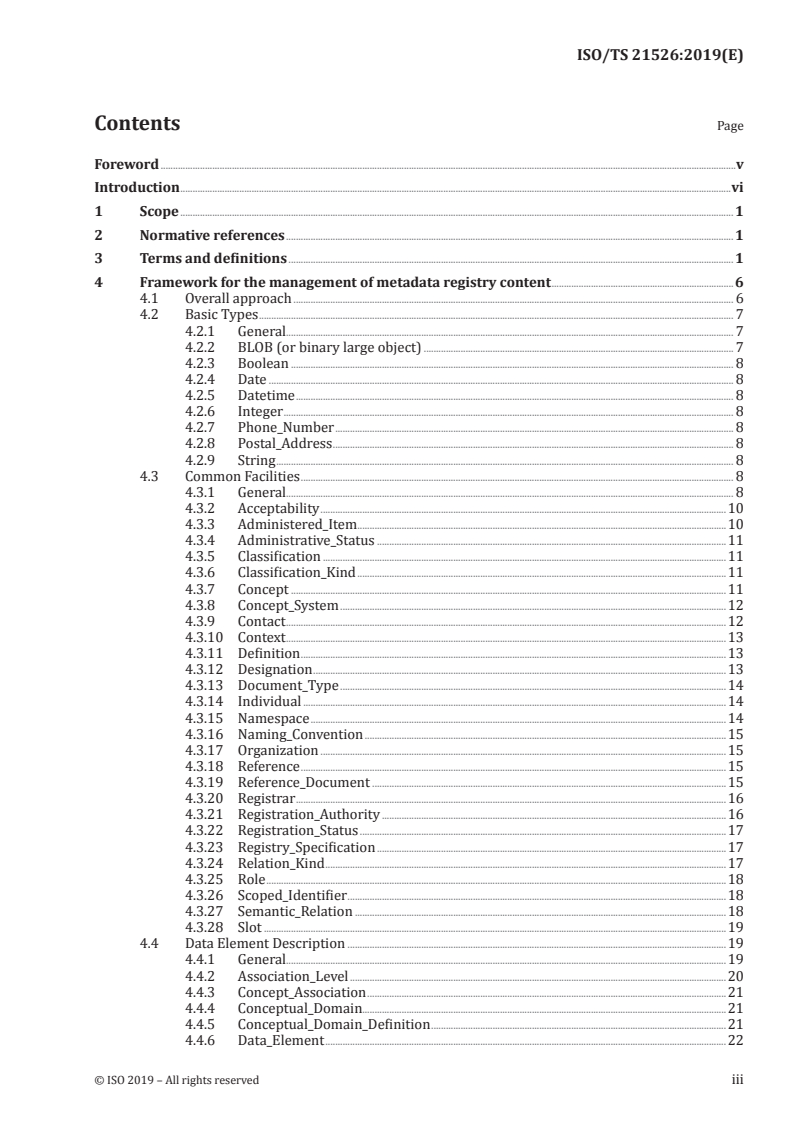
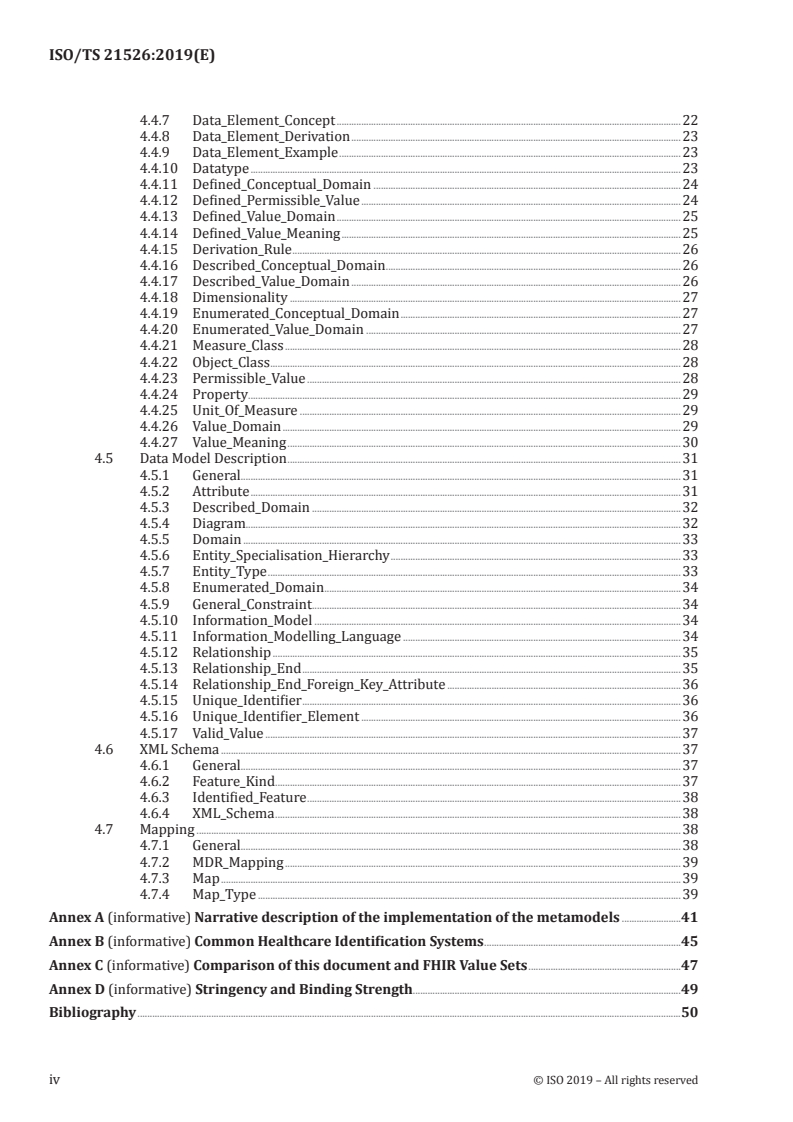
Contents Page
Foreword .v
Introduction .vi
1 Scope . 1
2 Normative references . 1
3 Terms and definitions . 1
4 Framework for the management of metadata registry content . 6
4.1 Overall approach . 6
4.2 Basic Types . 7
4.2.1 General. 7
4.2.2 BLOB (or binary large object) . 7
4.2.3 Boolean . 8
4.2.4 Date . 8
4.2.5 Datetime . 8
4.2.6 Integer . 8
4.2.7 Phone_Number . 8
4.2.8 Postal_Address . 8
4.2.9 String . 8
4.3 Common Facilities . 8
4.3.1 General. 8
4.3.2 Acceptability .10
4.3.3 Administered_Item . .10
4.3.4 Administrative_Status .11
4.3.5 Classification .11
4.3.6 Classification_Kind .11
4.3.7 Concept .11
4.3.8 Concept_System .12
4.3.9 Contact .12
4.3.10 Context .13
4.3.11 Definition .13
4.3.12 Designation .13
4.3.13 Document_Type .14
4.3.14 Individual .14
4.3.15 Namespace .14
4.3.16 Naming_Convention .15
4.3.17 Organization .15
4.3.18 Reference .15
4.3.19 Reference_Document .15
4.3.20 Registrar .16
4.3.21 Registration_Authority .16
4.3.22 Registration_Status .17
4.3.23 Registry_Specification .17
4.3.24 Relation_Kind .17
4.3.25 Role .18
4.3.26 Scoped_Identifier .18
4.3.27 Semantic_Relation .18
4.3.28 Slot .19
4.4 Data Element Description .19
4.4.1 General.19
4.4.2 Association_Level .20
4.4.3 Concept_Association .21
4.4.4 Conceptual_Domain.21
4.4.5 Conceptual_Domain_Definition .21
4.4.6 Data_Element .22
4.4.7 Data_Element_Concept .22
4.4.8 Data_Element_Derivation .23
4.4.9 Data_Element_Example .23
4.4.10 Datatype .23
4.4.11 Defined_Conceptual_Domain .24
4.4.12 Defined_Permissible_Value .24
4.4.13 Defined_Value_Domain .25
4.4.14 Defined_Value_Meaning .25
4.4.15 Derivation_Rule .26
4.4.16 Described_Conceptual_Domain .26
4.4.17 Described_Value_Domain .26
4.4.18 Dimensionality .27
4.4.19 Enumerated_Conceptual_Domain .27
4.4.20 Enumerated_Value_Domain .27
4.4.21 Measure_Class .28
4.4.22 Object_Class .28
4.4.23 Permissible_Value .28
4.4.24 Property . . .29
4.4.25 Unit_Of_Measure .29
4.4.26 Value_Domain .29
4.4.27 Value_Meaning .30
4.5 Data Model Description .31
4.5.1 General.31
4.5.2 Attribute .31
4.5.3 Described_Domain .32
4.5.4 Diagram.32
4.5.5 Domain .33
4.5.6 Entity_Specialisation_Hierarchy .33
4.5.7 Entity_Type .33
4.5.8 Enumerated_Domain .34
4.5.9 General_Constraint . .34
4.5.10 Information_Model .34
4.5.11 Information_Modelling_Language .34
4.5.12 Relationship .35
4.5.13 Relationship_End .35
4.5.14 Relationship_End_Foreign_Key_Attribute .36
4.5.15 Unique_Identifier .36
4.5.16 Unique_Identifier_Element .36
4.5.17 Valid_Value .37
4.6 XML Schema .37
4.6.1 General.37
4.6.2 Feature_Kind . .37
4.6.3 Identified_Feature .38
4.6.4 XML_Schema .38
4.7 Mapping .38
4.7.1 General.38
4.7.2 MDR_Mapping .39
4.7.3 Map .39
4.7.4 Map_Type .39
Annex A (informative) Narrative description of the implementation of the metamodels .41
Annex B (informative) Common Healthcare Identification Systems .45
Annex C (informative) Comparison of this document and FHIR Value Sets .47
Annex D (informative) Stringency and Binding Strength.49
Bibliography .50
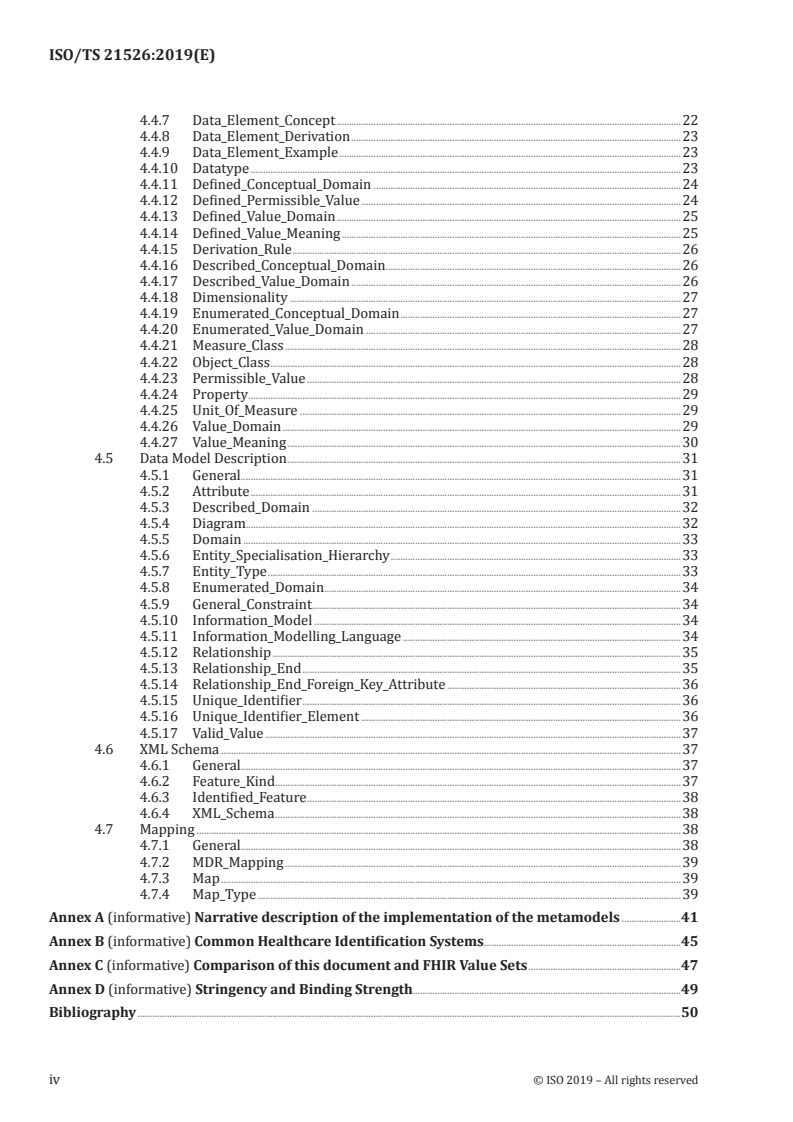
iv © ISO 2019 – All rights reserved
Foreword
ISO (the International Organization for Standardization) is a worldwide federation of national standards
bodies (ISO member bodies). The work of preparing International Standards is normally carried out
through ISO technical committees. Each member body interested in a subject for which a technical
committee has been established has the right to be represented on that committee. International
organizations, governmental and non-governmental, in liaison with ISO, also take part in the work.
ISO collaborates closely with the International Electrotechnical Commission (IEC) on all matters of
electrotechnical standardization.
The procedures used to develop this document and those intended for its further maintenance are
described in the ISO/IEC Directives, Part 1. In particular, the different approval criteria needed for the
different types of ISO documents should be noted. This document was drafted in accordance with the
editorial rules of the ISO/IEC Directives, Part 2 (see www .iso .org/ directives).
Attention is drawn to the possibility that some of the elements of this document may be the subject of
patent rights. ISO shall not be held responsible for identifying any or all such patent rights. Details of
any patent rights identified during the development of the document will be in the Introduction and/or
on the ISO list of patent declarations received (see www .iso .org/ patents).
Any trade name used in this document is information given for the convenience of users and does not
constitute an endorsement.
For an explanation of the voluntary nature of standards, the meaning of ISO specific terms and
expressions related to conformity assessment, as well as information about ISO's adherence to the
World Trade Organization (WTO) principles in the Technical Barriers to Trade (TBT), see www .iso .org/
iso/ foreword .html.
This document was prepared by Technical Committee ISO/TC 215, Health informatics.
Any feedback or questions on this document should be directed to the user’s national standards body. A
complete listing of these bodies can be found at www .iso .org/ members .html.
Introduction
This document is intended to be an extension to and a clarification of the ISO/IEC 11179 series.
Healthcare has a fundamental requirement for describing the meaning, provenance and governance of
data, and for setting standards for how that data is stored and communicated. Unsurprisingly, it uses
metadata registries and repositories extensively for a wide range of purposes supporting care delivery,
reporting and research. However, these registries are only partially interoperable, with consequences
to cost of ownership and utility that lead to under-use, particularly where simple, read-only repositories
are required. There is also considerable unmet need resulting from the community’s focus on message-
based interoperability at the expense of the description of the meaning of the data in the systems
that are the source of that data, and how that data maps to the meaning of the large quantities of data
communicated between providers and national bodies in tables or simple XML.
Data in healthcare systems should persist in content and meaning across organizations and time for a
wide variety of uses including patient care, patient safety, service management, service improvement,
public health and healthcare research. The sharing and adoption of record or message designs offer
immediate and tangible benefits to these ends, entailing organizations to adopt common standards for
the exchange of the specifications of records and messages in terms of the representation and definition
of individual elements of data; the inter-relationships of those elements in data models and where sets
of data that accord to those models can be found together with any contextual information about those
data sets that is required for their understanding and appropriate reuse.
Settings where metadata collections are assembled include individual clinics and hospitals,
organizations managing a portfolio of clinical studies, organizations providing cloud applications in
support of healthcare and regional and national bodies who commission standard reports and datasets
in pursuit of policy objectives. The intent is to support an ecosystem of interoperable registries and
repositories which facilitate both the development and implementation of content standards – and thus
interoperable content – and the publication of interoperable metadata about the kinds of data available
in both care and research.
This document includes a review of existing components of ISO/IEC 11179-3, i.e. Metadata Registry
(MDRMetamodel), and ISO/IEC 19763-12 Metamodel for Information Models (MFIInformationModel)
to specify where variations from or additions to the requirements of these standards are required
for specific healthcare use cases. Registries conforming to this document are also likely to reference
1)
of ISO/IEC 11179-7 Metamodel for dataset registration (MDRDatasets) and ISO/IEC TS 19763-13
Metamodel for forms registration (MFIForms), however it is less clear that simplifications or extensions
to either are necessary in the healthcare or healthcare research setting and thus the original documents
should be used as is.
MDRMetamodel provides a comprehensive model for an international metadata registry addressing
several large communities with overlapping concerns, and the conformance statements in the 2013
edition are framed in this context. Equally MFIInformationModel is designed to represent models
represented in many ways from purely conceptual entity relationship diagrams through to a concrete
relational database instance. A metadata registry/repository aimed at a less diverse community
such as healthcare or directed at the needs of a smaller organisation might not require the complete
implementation of ISO/IEC 11179-3 and ISO/IEC 19763-12, so it is important that any restriction or
simplification is shared to preserve registry interoperability.
1) Under preparation. Stage at the time of publication: ISO/IEC/PRF 11179-7:2019.
vi © ISO 2019 – All rights reserved
TECHNICAL SPECIFICATION ISO/TS 21526:2019(E)
Health informatics — Metadata repository requirements
(MetaRep)
1 Scope
This document describes requirements for collections of metadata about data elements and their
containing models and datasets in a healthcare environment. The collection can serve as a repository
or as dictionary describing a set of items in use in a particular domain, organisation or product for
reference, or it can additionally serve as a registry, supporting the development and communication of
standard items to an audience with shared goals.
This document specifies standard refinements that account for the detailed governance and
administration requirements that are particular to healthcare data. It focuses on the description of
data that is persisted in healthcare systems rather than the specification of messages between these
systems. It describes necessary extensions to the ISO/IEC 11179 series and to other International
Standards on metadata originating from ISO/IEC JTC 1/SC 32 to address the wider variety of value
domain types found in healthcare. Where appropriate, it also suggest restrictions/simplifications to
the ISO/IEC 11179 series that promote wider adoption without compromising interoperability between
metadata registries and opportunities for the development of tooling that consumes metadata for the
generation or the parameterization of code.
2 Normative references
There are no normative references in this document.
3 Terms and definitions
For the purposes of this document, the following terms and definitions apply.
ISO and IEC maintain terminological databases for use in standardization at the following addresses:
— ISO Online browsing platform: available at https:// www .iso .org/ obp
— IEC Electropedia: available at http:// www .electropedia .org/
3.1
acceptability rating
scale of acceptability
3.2
administered item
registered item for which administrative information (3.3) is recorded
3.3
administrative information
information about the administration of an item in a metadata registry (3.33)
EXAMPLE Creation date, last change date, origin, change description, explanatory comment.
3.4
administration record
collection of administrative information (3.3) for an administered item (3.2)
3.5
administrative status
designation of the status in the administrative process of a registration authority (3.42) for handling
registration (3.41) requests
Note 1 to entry: The values and associated meanings of “administrative status” are determined by each
registration authority.
3.6
attribute
characteristic (3.12) of an object or entity
3.7
assertion
sentence or proposition in logic which is asserted (or assumed) to be true
3.8
attribute instance
specific instance of an attribute (3.6)
Note 1 to entry: Adapted from ISO 2382-17:1993 to distinguish an instance of an attribute from its value.
[SOURCE: ISO/IEC 11179-3:2013, 3.2.7]
3.9
binding
mapping from one framework or specification to another, enabling data (3.20) and/or commands to be
passed between them
3.10
boolean
mathematical datatype (3.23) associated with two-valued logic
[SOURCE: ISO/IEC 11179-3:2013, 3.2.12]
3.11
cardinality
number of elements in a set
3.12
characteristic
abstraction of a property (3.39) of an object or of a set of objects
Note 1 to entry: Characteristics are used for describing concepts.
[SOURCE: ISO/IEC 11179-3:2013, 3.2.14]
3.13
class
description of a set of objects that share the same attributes (3.6), operations, methods, relationships
(3.44), and semantics
3.14
classification scheme
descriptive information for an arrangement or division of objects into groups based on characteristics
(3.12), which the objects have in common
3.15
concept
unit of knowledge created by a unique combination of characteristics (3.12)
[SOURCE: ISO/IEC 11179-3:2013, 3.2.18]
2 © ISO 2019 – All rights reserved
3.16
concept system
set of concepts (3.15) structured according to the relations among them
[SOURCE: ISO/IEC 11179-3:2013, 3.2.19]
3.17
conceptual domain
CD
concept (3.15) that expresses its description or valid instance meanings
Note 1 to entry: The value meanings may either be enumerated or expressed via a description.
[SOURCE: ISO/IEC 11179-3:2013, 3.2.21]
3.18
contact
instance of a role of an individual or organization (3.37) (or organization part or organization person)
to or from whom an information item(s), a material object(s) and/or person(s) can be sent in a specified
context (3.19)
3.19
context
circumstance, purpose, and perspective under which an object is defined or used
3.20
data
re-interpretable representation of facts, concepts (3.15), or instructions in a formalized manner suitable
for communication, interpretation, or processing
Note 1 to entry: Data can be processed by human or automatic means.
[SOURCE: ISO/IEC 11179-3:2013, 3.2.27]
3.21
data element
DE
unit of data (3.20) for which the definition (3.28), identification, representation and permissible values
(3.38) are specified by means of a set of attributes (3.6)
3.22
data element concept
DEC
concept (3.15) that can be represented in the form of a data element (3.21), described independently of
any particular representation
3.23
datatype
set of distinct values (3.46), characterized by properties of those values and by operations on those values
[SOURCE: ISO/IEC 11179-3:2013, 3.1.9]
3.24
dimensionality
expression of measurement without units
Note 1 to entry: A quantity is a value with an associated unit of measure. 32º Fahrenheit, 0º Celsius, $100 USD,
and 10 reams (of paper) are quantities. Equivalence between two units of measure is determined by the existence
of a quantity preserving one-to-one correspondence between values measured in one unit of measure and values
measured in the other unit of measure, independent of context, and where characterizing operations are the same.
Equivalent units of measure in this sense have the same dimensionality. The equivalence defined here forms an
equivalence relation on the set of all units of measure. Each equivalence class corresponds to a dimensionality.
The units of measure "temperature" in degrees Fahrenheit" and "temperature in degrees Celsius" have the same
dimensionality, because for each value measured in degrees Fahrenheit there is a value measured in degrees
Celsius with the same quantity, and vice-versa. The same operations may be performed on quantities in each unit
of measure. Quantity preserving one-to-one correspondences are the well-known equations Cº = (5/9)*(Fº − 32)
and Fº = (9/5)*(Cº) + 32.
3.25
enumerated conceptual domain
conceptual domain that is specified by a list of all its value meanings (3.48)
3.26
enumerated value domain
value domain (3.47) that is specified by a list of all its permissible values (3.38)
3.27
data element value
value out of a set of permissible values (3.38) pertaining to a data element (3.21)
3.28
definition
representation of a concept (3.15) by a descriptive statement which serves to differentiate it from
related concepts
[SOURCE: ISO/IEC 11179-3:2013, 3.2.29]
3.29
identifier
sequence of characters, capable of uniquely identifying that with which it is
associated, within a specified context (3.19)
Note 1 to entry: A name should not be used as an identifier because it is not linguistically neutral.
3.30
metadata
data that defines and describes other data (3.20)
[SOURCE: ISO/IEC 11179-3:2013, 3.2.74]
3.31
metadata item
instance of a metadata object (3.32)
3.32
metadata object
object type defined by a metamodel
3.33
metadata registry
MDR
information system for registering metadata (3.30)
[SOURCE: ISO/IEC 11179-3:2013, 3.2.78]
4 © ISO 2019 – All rights reserved
3.34
name
primary means of identification of objects and concepts (3.15) for humans
3.35
object class
set of ideas, abstractions, or things in the real world that are identified with explicit boundaries and
meaning and whose properties and behaviour follow the same rules
3.36
ontology
a conceptualisation of a domain
3.37
organization
unique framework of authority within which a person or persons act, or are designated
to act, towards some purpose
[SOURCE: ISO/TS 21089:2018, 3.97]
3.38
permissible value
expression of a value meaning (3.48) allowed in a specific value domain (3.47)
3.39
property
characteristic (3.12) common to all members of an object class (3.35)
3.40
registrar
representative of a registration authority (3.42)
3.41
registration
relationship (3.44) between an administered item (3.2) and the registration authority (3.42)
3.42
registration authority
RA
organization (3.37) responsible for maintaining a register
3.43
registration status
designation of the status in the registration (3.41) life-cycle of an administered item (3.2)
3.44
relationship
connection among model elements
3.45
unit of measure
actual units in which the associated values (3.46) are measured
Note 1 to entry: The dimensionality of the associated conceptual domain shall be appropriate for the specified
unit of measure.
3.46
value
data (3.20) value (3.46)
3.47
value domain
value set
set of permissible values (3.38)
Note 1 to entry: The value domain provides representation but has no implication as to what data element
concept the values may be associated with nor what the values mean.
Note 2 to entry: The permissible values may either be enumerated or expressed via a description.
[SOURCE: ISO/IEC 11179-3:2013, 3.2.140 — modified, "value set" was added as a preferred term.]
Note 3 to entry: ‘Value set’ is Health Level 7 (HL7) terminology for value domain, as defined in Reference [13].
3.48
value meaning
meaning or semantic content of a value (3.46)
4 Framework for the management of metadata registry content
4.1 Overall approach
The ISO/IEC JTC 1/SC 32 International Standards portfolio on metadata provides a modular approach
to the registration of metadata about a wide variety of models and the management of that registry.
MDRMetamodel consists of two distinct components: common facilities defining metadata about
content – metadata objects – with attributes for identification, naming, definition, classification,
conceptualisation, administration and registration; and those defining content models for some of the
metadata objects to be registered – concept systems, value lists and data elements. These common
facilities are reused in MFIInformationModel for the registration of information models, MDRDatasets
for datasets and MFIForms for form designs. A conceptual representation of the relationship between
the components and standards is presented in Figure 1 where dependencies between standards are
indicated by vertical layering. MDRMetamodel, MFIInformationModel, MDRDatasets and MFIForms
cover a wide range of usecases, not all of which are necessary for application to healthcare.
The approach taken in this document is to distil minimal requirements from the portfolio that shall
be met by compliant registries, present these as a consistent, unified metamodel, and then extend
these minimal requirements for the specific requirements in healthcare. While the UML class diagram
representation of the models is retained, a minimal subset of the UML is used in the presentation of the
models, and the modelling style has been altered to facilitate translation into relational or document
(XML/JSON) implementation. Nevertheless all models contained within this document are iso-semantic
with those in the source standards, and registries compliant with this this document will additionally
be able to claim basic compliance with MDRMetamodel, MFIInformationModel, MDRDatasets and
MFIForms.
6 © ISO 2019 – All rights reserved
Figure 1 — Relationships between ISO/IEC JTC 1/SC 32 International Standards on metadata
The models in MDRMetamodel, MFIInformationModel, MDRDatasets and MFIForms are conceptual
– there is no requirement that the specified model structures should be faithfully implemented in
the actual schema of the registry/repository itself, nor any requirement to adopt either a relational,
hierarchical or graph approach in their implementation, even though the literal interpretation of
MDRMetamodel is most easily realised in a graph database. Relational implementations might
implement separate schemas for administrative and semantic functions, provided the relevant
administration record is linked to a class that is specified as a kind of administered item.
It is also worth noting that the basic data types described in MDRMetamodel, MFIInformationModel,
MDRDatasets and MFIForms are those required for the implementation of the standard itself, not of
the content of the registry/repository – MDRMetamodel has facilities for declaring specific datatypes
of interest to a particular registry/repository’s users, including those that are specific to healthcare
information systems.
From this point on, registry and repository are used interchangeably unless specific reference is made.
Implementers of simple repositories can choose not to implement those parts of the administrative
elements of the common facilities which includes support the content creation lifecycle.
The Metamodel presented here is split into six sections: basic types; common facilities; data description;
model description; schema registration; mapping, each of which are described below in textual form
with illustrative, non-normative diagrams.
For a detailed discussion of how MDRMetamodel, MDRInformationModel have been restricted and
extended in the derivation of this document, see Annex A.
4.2 Basic Types
4.2.1 General
Basic types contain foundational datatypes used in the metamodels described in this document.
4.2.2 BLOB (or binary large object)
A large block of binary data, typically an image or video file, that might have to be handled in a special way.
4.2.3 Boolean
A mathematical datatype associated with two-valued logic (see ISO/IEC 11404:2007, 8.1.1).
NOTE The notation and semantics for boolean are as described in ISO/IEC 11404.
4.2.4 Date
A datatype whose values are points in time to the resolution: year, month, and day (see
ISO/IEC 11404:2007, 8.1.6).
4.2.5 Datetime
A datatype whose values are points in time to the resolution: year, month, day, hour, minute, second,
and optionally fractions of seconds (see ISO/IEC 11404:2007, 8.1.6).
4.2.6 Integer
A mathematical datatype comprising the exact integral values (see ISO/IEC 11404:2007, 8.1.7).
NOTE Both the notation and semantics of the Integer datatype is as specified in ISO/IEC 11404:2007, 8.1.7.
4.2.7 Phone_Number
A phone number uniquely identifies a telephone line within a telephone network. The data structure of
the Phone_Number data element shall conform to ITU-T E 164.
4.2.8 Postal_Address
A postal address enables the unambiguous determination of an actual or potential delivery point,
usually combined with the specification of an addressee and/or a mailee.
4.2.9 String
A datatype comprising of a serial sequence of characters, bytes, integers, etc. See ISO 12639:2004, 4.1.11.
4.3 Common Facilities
4.3.1 General
Common facilities (see Figure 2) provides the model for an Administered Item, a registered item for
which administrative information is recorded. Administered items are significant metadata entries
that are individually identified, named, defined, classified, described by reference documents and have
status with respect to registration and administration managed within the registry. Requirements for
common facilities are derived from MFIMetamodel, but apply to all kinds of metadata item described in
this document.
8 © ISO 2019 – All rights reserved
Figure 2 — Common facilities
4.3.2 Acceptability
Acceptability models a scale of acceptability ratings comprised of: preferred, admitted, deprecated,
obsolete and superseded. This enumeration is used as a datatype for the attributes Designation.
acceptability and Definition.acceptability.
Enumeration Meaning
preferred The designation or definition is promoted as the standard way of referring to the
administered item in the referenced context
admitted The designation or definition may be used as an alternative in relation to the administered item
in the referenced context
deprecated The designation or definition was once preferred or admitted in the referenced context, but is no
longer so
obsolete The designation or definition should not be used in the referenced context
superseded The designation or definition has been replaced within the referenced context
4.3.3 Administered_Item
Administered_Item is a class, each
...
TECHNICAL ISO/TS
SPECIFICATION 21526
First edition
2019-10
Health informatics — Metadata
repository requirements (MetaRep)
Informatique de santé — Exigences relatives aux référentiels de
métadonnées (MetaRep)
Reference number
©
ISO 2019
© ISO 2019
All rights reserved. Unless otherwise specified, or required in the context of its implementation, no part of this publication may
be reproduced or utilized otherwise in any form or by any means, electronic or mechanical, including photocopying, or posting
on the internet or an intranet, without prior written permission. Permission can be requested from either ISO at the address
below or ISO’s member body in the country of the requester.
ISO copyright office
CP 401 • Ch. de Blandonnet 8
CH-1214 Vernier, Geneva
Phone: +41 22 749 01 11
Fax: +41 22 749 09 47
Email: copyright@iso.org
Website: www.iso.org
Published in Switzerland
ii © ISO 2019 – All rights reserved
Contents Page
Foreword .v
Introduction .vi
1 Scope . 1
2 Normative references . 1
3 Terms and definitions . 1
4 Framework for the management of metadata registry content . 6
4.1 Overall approach . 6
4.2 Basic Types . 7
4.2.1 General. 7
4.2.2 BLOB (or binary large object) . 7
4.2.3 Boolean . 8
4.2.4 Date . 8
4.2.5 Datetime . 8
4.2.6 Integer . 8
4.2.7 Phone_Number . 8
4.2.8 Postal_Address . 8
4.2.9 String . 8
4.3 Common Facilities . 8
4.3.1 General. 8
4.3.2 Acceptability .10
4.3.3 Administered_Item . .10
4.3.4 Administrative_Status .11
4.3.5 Classification .11
4.3.6 Classification_Kind .11
4.3.7 Concept .11
4.3.8 Concept_System .12
4.3.9 Contact .12
4.3.10 Context .13
4.3.11 Definition .13
4.3.12 Designation .13
4.3.13 Document_Type .14
4.3.14 Individual .14
4.3.15 Namespace .14
4.3.16 Naming_Convention .15
4.3.17 Organization .15
4.3.18 Reference .15
4.3.19 Reference_Document .15
4.3.20 Registrar .16
4.3.21 Registration_Authority .16
4.3.22 Registration_Status .17
4.3.23 Registry_Specification .17
4.3.24 Relation_Kind .17
4.3.25 Role .18
4.3.26 Scoped_Identifier .18
4.3.27 Semantic_Relation .18
4.3.28 Slot .19
4.4 Data Element Description .19
4.4.1 General.19
4.4.2 Association_Level .20
4.4.3 Concept_Association .21
4.4.4 Conceptual_Domain.21
4.4.5 Conceptual_Domain_Definition .21
4.4.6 Data_Element .22
4.4.7 Data_Element_Concept .22
4.4.8 Data_Element_Derivation .23
4.4.9 Data_Element_Example .23
4.4.10 Datatype .23
4.4.11 Defined_Conceptual_Domain .24
4.4.12 Defined_Permissible_Value .24
4.4.13 Defined_Value_Domain .25
4.4.14 Defined_Value_Meaning .25
4.4.15 Derivation_Rule .26
4.4.16 Described_Conceptual_Domain .26
4.4.17 Described_Value_Domain .26
4.4.18 Dimensionality .27
4.4.19 Enumerated_Conceptual_Domain .27
4.4.20 Enumerated_Value_Domain .27
4.4.21 Measure_Class .28
4.4.22 Object_Class .28
4.4.23 Permissible_Value .28
4.4.24 Property . . .29
4.4.25 Unit_Of_Measure .29
4.4.26 Value_Domain .29
4.4.27 Value_Meaning .30
4.5 Data Model Description .31
4.5.1 General.31
4.5.2 Attribute .31
4.5.3 Described_Domain .32
4.5.4 Diagram.32
4.5.5 Domain .33
4.5.6 Entity_Specialisation_Hierarchy .33
4.5.7 Entity_Type .33
4.5.8 Enumerated_Domain .34
4.5.9 General_Constraint . .34
4.5.10 Information_Model .34
4.5.11 Information_Modelling_Language .34
4.5.12 Relationship .35
4.5.13 Relationship_End .35
4.5.14 Relationship_End_Foreign_Key_Attribute .36
4.5.15 Unique_Identifier .36
4.5.16 Unique_Identifier_Element .36
4.5.17 Valid_Value .37
4.6 XML Schema .37
4.6.1 General.37
4.6.2 Feature_Kind . .37
4.6.3 Identified_Feature .38
4.6.4 XML_Schema .38
4.7 Mapping .38
4.7.1 General.38
4.7.2 MDR_Mapping .39
4.7.3 Map .39
4.7.4 Map_Type .39
Annex A (informative) Narrative description of the implementation of the metamodels .41
Annex B (informative) Common Healthcare Identification Systems .45
Annex C (informative) Comparison of this document and FHIR Value Sets .47
Annex D (informative) Stringency and Binding Strength.49
Bibliography .50
iv © ISO 2019 – All rights reserved
Foreword
ISO (the International Organization for Standardization) is a worldwide federation of national standards
bodies (ISO member bodies). The work of preparing International Standards is normally carried out
through ISO technical committees. Each member body interested in a subject for which a technical
committee has been established has the right to be represented on that committee. International
organizations, governmental and non-governmental, in liaison with ISO, also take part in the work.
ISO collaborates closely with the International Electrotechnical Commission (IEC) on all matters of
electrotechnical standardization.
The procedures used to develop this document and those intended for its further maintenance are
described in the ISO/IEC Directives, Part 1. In particular, the different approval criteria needed for the
different types of ISO documents should be noted. This document was drafted in accordance with the
editorial rules of the ISO/IEC Directives, Part 2 (see www .iso .org/ directives).
Attention is drawn to the possibility that some of the elements of this document may be the subject of
patent rights. ISO shall not be held responsible for identifying any or all such patent rights. Details of
any patent rights identified during the development of the document will be in the Introduction and/or
on the ISO list of patent declarations received (see www .iso .org/ patents).
Any trade name used in this document is information given for the convenience of users and does not
constitute an endorsement.
For an explanation of the voluntary nature of standards, the meaning of ISO specific terms and
expressions related to conformity assessment, as well as information about ISO's adherence to the
World Trade Organization (WTO) principles in the Technical Barriers to Trade (TBT), see www .iso .org/
iso/ foreword .html.
This document was prepared by Technical Committee ISO/TC 215, Health informatics.
Any feedback or questions on this document should be directed to the user’s national standards body. A
complete listing of these bodies can be found at www .iso .org/ members .html.
Introduction
This document is intended to be an extension to and a clarification of the ISO/IEC 11179 series.
Healthcare has a fundamental requirement for describing the meaning, provenance and governance of
data, and for setting standards for how that data is stored and communicated. Unsurprisingly, it uses
metadata registries and repositories extensively for a wide range of purposes supporting care delivery,
reporting and research. However, these registries are only partially interoperable, with consequences
to cost of ownership and utility that lead to under-use, particularly where simple, read-only repositories
are required. There is also considerable unmet need resulting from the community’s focus on message-
based interoperability at the expense of the description of the meaning of the data in the systems
that are the source of that data, and how that data maps to the meaning of the large quantities of data
communicated between providers and national bodies in tables or simple XML.
Data in healthcare systems should persist in content and meaning across organizations and time for a
wide variety of uses including patient care, patient safety, service management, service improvement,
public health and healthcare research. The sharing and adoption of record or message designs offer
immediate and tangible benefits to these ends, entailing organizations to adopt common standards for
the exchange of the specifications of records and messages in terms of the representation and definition
of individual elements of data; the inter-relationships of those elements in data models and where sets
of data that accord to those models can be found together with any contextual information about those
data sets that is required for their understanding and appropriate reuse.
Settings where metadata collections are assembled include individual clinics and hospitals,
organizations managing a portfolio of clinical studies, organizations providing cloud applications in
support of healthcare and regional and national bodies who commission standard reports and datasets
in pursuit of policy objectives. The intent is to support an ecosystem of interoperable registries and
repositories which facilitate both the development and implementation of content standards – and thus
interoperable content – and the publication of interoperable metadata about the kinds of data available
in both care and research.
This document includes a review of existing components of ISO/IEC 11179-3, i.e. Metadata Registry
(MDRMetamodel), and ISO/IEC 19763-12 Metamodel for Information Models (MFIInformationModel)
to specify where variations from or additions to the requirements of these standards are required
for specific healthcare use cases. Registries conforming to this document are also likely to reference
1)
of ISO/IEC 11179-7 Metamodel for dataset registration (MDRDatasets) and ISO/IEC TS 19763-13
Metamodel for forms registration (MFIForms), however it is less clear that simplifications or extensions
to either are necessary in the healthcare or healthcare research setting and thus the original documents
should be used as is.
MDRMetamodel provides a comprehensive model for an international metadata registry addressing
several large communities with overlapping concerns, and the conformance statements in the 2013
edition are framed in this context. Equally MFIInformationModel is designed to represent models
represented in many ways from purely conceptual entity relationship diagrams through to a concrete
relational database instance. A metadata registry/repository aimed at a less diverse community
such as healthcare or directed at the needs of a smaller organisation might not require the complete
implementation of ISO/IEC 11179-3 and ISO/IEC 19763-12, so it is important that any restriction or
simplification is shared to preserve registry interoperability.
1) Under preparation. Stage at the time of publication: ISO/IEC/PRF 11179-7:2019.
vi © ISO 2019 – All rights reserved
TECHNICAL SPECIFICATION ISO/TS 21526:2019(E)
Health informatics — Metadata repository requirements
(MetaRep)
1 Scope
This document describes requirements for collections of metadata about data elements and their
containing models and datasets in a healthcare environment. The collection can serve as a repository
or as dictionary describing a set of items in use in a particular domain, organisation or product for
reference, or it can additionally serve as a registry, supporting the development and communication of
standard items to an audience with shared goals.
This document specifies standard refinements that account for the detailed governance and
administration requirements that are particular to healthcare data. It focuses on the description of
data that is persisted in healthcare systems rather than the specification of messages between these
systems. It describes necessary extensions to the ISO/IEC 11179 series and to other International
Standards on metadata originating from ISO/IEC JTC 1/SC 32 to address the wider variety of value
domain types found in healthcare. Where appropriate, it also suggest restrictions/simplifications to
the ISO/IEC 11179 series that promote wider adoption without compromising interoperability between
metadata registries and opportunities for the development of tooling that consumes metadata for the
generation or the parameterization of code.
2 Normative references
There are no normative references in this document.
3 Terms and definitions
For the purposes of this document, the following terms and definitions apply.
ISO and IEC maintain terminological databases for use in standardization at the following addresses:
— ISO Online browsing platform: available at https:// www .iso .org/ obp
— IEC Electropedia: available at http:// www .electropedia .org/
3.1
acceptability rating
scale of acceptability
3.2
administered item
registered item for which administrative information (3.3) is recorded
3.3
administrative information
information about the administration of an item in a metadata registry (3.33)
EXAMPLE Creation date, last change date, origin, change description, explanatory comment.
3.4
administration record
collection of administrative information (3.3) for an administered item (3.2)
3.5
administrative status
designation of the status in the administrative process of a registration authority (3.42) for handling
registration (3.41) requests
Note 1 to entry: The values and associated meanings of “administrative status” are determined by each
registration authority.
3.6
attribute
characteristic (3.12) of an object or entity
3.7
assertion
sentence or proposition in logic which is asserted (or assumed) to be true
3.8
attribute instance
specific instance of an attribute (3.6)
Note 1 to entry: Adapted from ISO 2382-17:1993 to distinguish an instance of an attribute from its value.
[SOURCE: ISO/IEC 11179-3:2013, 3.2.7]
3.9
binding
mapping from one framework or specification to another, enabling data (3.20) and/or commands to be
passed between them
3.10
boolean
mathematical datatype (3.23) associated with two-valued logic
[SOURCE: ISO/IEC 11179-3:2013, 3.2.12]
3.11
cardinality
number of elements in a set
3.12
characteristic
abstraction of a property (3.39) of an object or of a set of objects
Note 1 to entry: Characteristics are used for describing concepts.
[SOURCE: ISO/IEC 11179-3:2013, 3.2.14]
3.13
class
description of a set of objects that share the same attributes (3.6), operations, methods, relationships
(3.44), and semantics
3.14
classification scheme
descriptive information for an arrangement or division of objects into groups based on characteristics
(3.12), which the objects have in common
3.15
concept
unit of knowledge created by a unique combination of characteristics (3.12)
[SOURCE: ISO/IEC 11179-3:2013, 3.2.18]
2 © ISO 2019 – All rights reserved
3.16
concept system
set of concepts (3.15) structured according to the relations among them
[SOURCE: ISO/IEC 11179-3:2013, 3.2.19]
3.17
conceptual domain
CD
concept (3.15) that expresses its description or valid instance meanings
Note 1 to entry: The value meanings may either be enumerated or expressed via a description.
[SOURCE: ISO/IEC 11179-3:2013, 3.2.21]
3.18
contact
instance of a role of an individual or organization (3.37) (or organization part or organization person)
to or from whom an information item(s), a material object(s) and/or person(s) can be sent in a specified
context (3.19)
3.19
context
circumstance, purpose, and perspective under which an object is defined or used
3.20
data
re-interpretable representation of facts, concepts (3.15), or instructions in a formalized manner suitable
for communication, interpretation, or processing
Note 1 to entry: Data can be processed by human or automatic means.
[SOURCE: ISO/IEC 11179-3:2013, 3.2.27]
3.21
data element
DE
unit of data (3.20) for which the definition (3.28), identification, representation and permissible values
(3.38) are specified by means of a set of attributes (3.6)
3.22
data element concept
DEC
concept (3.15) that can be represented in the form of a data element (3.21), described independently of
any particular representation
3.23
datatype
set of distinct values (3.46), characterized by properties of those values and by operations on those values
[SOURCE: ISO/IEC 11179-3:2013, 3.1.9]
3.24
dimensionality
expression of measurement without units
Note 1 to entry: A quantity is a value with an associated unit of measure. 32º Fahrenheit, 0º Celsius, $100 USD,
and 10 reams (of paper) are quantities. Equivalence between two units of measure is determined by the existence
of a quantity preserving one-to-one correspondence between values measured in one unit of measure and values
measured in the other unit of measure, independent of context, and where characterizing operations are the same.
Equivalent units of measure in this sense have the same dimensionality. The equivalence defined here forms an
equivalence relation on the set of all units of measure. Each equivalence class corresponds to a dimensionality.
The units of measure "temperature" in degrees Fahrenheit" and "temperature in degrees Celsius" have the same
dimensionality, because for each value measured in degrees Fahrenheit there is a value measured in degrees
Celsius with the same quantity, and vice-versa. The same operations may be performed on quantities in each unit
of measure. Quantity preserving one-to-one correspondences are the well-known equations Cº = (5/9)*(Fº − 32)
and Fº = (9/5)*(Cº) + 32.
3.25
enumerated conceptual domain
conceptual domain that is specified by a list of all its value meanings (3.48)
3.26
enumerated value domain
value domain (3.47) that is specified by a list of all its permissible values (3.38)
3.27
data element value
value out of a set of permissible values (3.38) pertaining to a data element (3.21)
3.28
definition
representation of a concept (3.15) by a descriptive statement which serves to differentiate it from
related concepts
[SOURCE: ISO/IEC 11179-3:2013, 3.2.29]
3.29
identifier
sequence of characters, capable of uniquely identifying that with which it is
associated, within a specified context (3.19)
Note 1 to entry: A name should not be used as an identifier because it is not linguistically neutral.
3.30
metadata
data that defines and describes other data (3.20)
[SOURCE: ISO/IEC 11179-3:2013, 3.2.74]
3.31
metadata item
instance of a metadata object (3.32)
3.32
metadata object
object type defined by a metamodel
3.33
metadata registry
MDR
information system for registering metadata (3.30)
[SOURCE: ISO/IEC 11179-3:2013, 3.2.78]
4 © ISO 2019 – All rights reserved
3.34
name
primary means of identification of objects and concepts (3.15) for humans
3.35
object class
set of ideas, abstractions, or things in the real world that are identified with explicit boundaries and
meaning and whose properties and behaviour follow the same rules
3.36
ontology
a conceptualisation of a domain
3.37
organization
unique framework of authority within which a person or persons act, or are designated
to act, towards some purpose
[SOURCE: ISO/TS 21089:2018, 3.97]
3.38
permissible value
expression of a value meaning (3.48) allowed in a specific value domain (3.47)
3.39
property
characteristic (3.12) common to all members of an object class (3.35)
3.40
registrar
representative of a registration authority (3.42)
3.41
registration
relationship (3.44) between an administered item (3.2) and the registration authority (3.42)
3.42
registration authority
RA
organization (3.37) responsible for maintaining a register
3.43
registration status
designation of the status in the registration (3.41) life-cycle of an administered item (3.2)
3.44
relationship
connection among model elements
3.45
unit of measure
actual units in which the associated values (3.46) are measured
Note 1 to entry: The dimensionality of the associated conceptual domain shall be appropriate for the specified
unit of measure.
3.46
value
data (3.20) value (3.46)
3.47
value domain
value set
set of permissible values (3.38)
Note 1 to entry: The value domain provides representation but has no implication as to what data element
concept the values may be associated with nor what the values mean.
Note 2 to entry: The permissible values may either be enumerated or expressed via a description.
[SOURCE: ISO/IEC 11179-3:2013, 3.2.140 — modified, "value set" was added as a preferred term.]
Note 3 to entry: ‘Value set’ is Health Level 7 (HL7) terminology for value domain, as defined in Reference [13].
3.48
value meaning
meaning or semantic content of a value (3.46)
4 Framework for the management of metadata registry content
4.1 Overall approach
The ISO/IEC JTC 1/SC 32 International Standards portfolio on metadata provides a modular approach
to the registration of metadata about a wide variety of models and the management of that registry.
MDRMetamodel consists of two distinct components: common facilities defining metadata about
content – metadata objects – with attributes for identification, naming, definition, classification,
conceptualisation, administration and registration; and those defining content models for some of the
metadata objects to be registered – concept systems, value lists and data elements. These common
facilities are reused in MFIInformationModel for the registration of information models, MDRDatasets
for datasets and MFIForms for form designs. A conceptual representation of the relationship between
the components and standards is presented in Figure 1 where dependencies between standards are
indicated by vertical layering. MDRMetamodel, MFIInformationModel, MDRDatasets and MFIForms
cover a wide range of usecases, not all of which are necessary for application to healthcare.
The approach taken in this document is to distil minimal requirements from the portfolio that shall
be met by compliant registries, present these as a consistent, unified metamodel, and then extend
these minimal requirements for the specific requirements in healthcare. While the UML class diagram
representation of the models is retained, a minimal subset of the UML is used in the presentation of the
models, and the modelling style has been altered to facilitate translation into relational or document
(XML/JSON) implementation. Nevertheless all models contained within this document are iso-semantic
with those in the source standards, and registries compliant with this this document will additionally
be able to claim basic compliance with MDRMetamodel, MFIInformationModel, MDRDatasets and
MFIForms.
6 © ISO 2019 – All rights reserved
Figure 1 — Relationships between ISO/IEC JTC 1/SC 32 International Standards on metadata
The models in MDRMetamodel, MFIInformationModel, MDRDatasets and MFIForms are conceptual
– there is no requirement that the specified model structures should be faithfully implemented in
the actual schema of the registry/repository itself, nor any requirement to adopt either a relational,
hierarchical or graph approach in their implementation, even though the literal interpretation of
MDRMetamodel is most easily realised in a graph database. Relational implementations might
implement separate schemas for administrative and semantic functions, provided the relevant
administration record is linked to a class that is specified as a kind of administered item.
It is also worth noting that the basic data types described in MDRMetamodel, MFIInformationModel,
MDRDatasets and MFIForms are those required for the implementation of the standard itself, not of
the content of the registry/repository – MDRMetamodel has facilities for declaring specific datatypes
of interest to a particular registry/repository’s users, including those that are specific to healthcare
information systems.
From this point on, registry and repository are used interchangeably unless specific reference is made.
Implementers of simple repositories can choose not to implement those parts of the administrative
elements of the common facilities which includes support the content creation lifecycle.
The Metamodel presented here is split into six sections: basic types; common facilities; data description;
model description; schema registration; mapping, each of which are described below in textual form
with illustrative, non-normative diagrams.
For a detailed discussion of how MDRMetamodel, MDRInformationModel have been restricted and
extended in the derivation of this document, see Annex A.
4.2 Basic Types
4.2.1 General
Basic types contain foundational datatypes used in the metamodels described in this document.
4.2.2 BLOB (or binary large object)
A large block of binary data, typically an image or video file, that might have to be handled in a special way.
4.2.3 Boolean
A mathematical datatype associated with two-valued logic (see ISO/IEC 11404:2007, 8.1.1).
NOTE The notation and semantics for boolean are as described in ISO/IEC 11404.
4.2.4 Date
A datatype whose values are points in time to the resolution: year, month, and day (see
ISO/IEC 11404:2007, 8.1.6).
4.2.5 Datetime
A datatype whose values are points in time to the resolution: year, month, day, hour, minute, second,
and optionally fractions of seconds (see ISO/IEC 11404:2007, 8.1.6).
4.2.6 Integer
A mathematical datatype comprising the exact integral values (see ISO/IEC 11404:2007, 8.1.7).
NOTE Both the notation and semantics of the Integer datatype is as specified in ISO/IEC 11404:2007, 8.1.7.
4.2.7 Phone_Number
A phone number uniquely identifies a telephone line within a telephone network. The data structure of
the Phone_Number data element shall conform to ITU-T E 164.
4.2.8 Postal_Address
A postal address enables the unambiguous determination of an actual or potential delivery point,
usually combined with the specification of an addressee and/or a mailee.
4.2.9 String
A datatype comprising of a serial sequence of characters, bytes, integers, etc. See ISO 12639:2004, 4.1.11.
4.3 Common Facilities
4.3.1 General
Common facilities (see Figure 2) provides the model for an Administered Item, a registered item for
which administrative information is recorded. Administered items are significant metadata entries
that are individually identified, named, defined, classified, described by reference documents and have
status with respect to registration and administration managed within the registry. Requirements for
common facilities are derived from MFIMetamodel, but apply to all kinds of metadata item described in
this document.
8 © ISO 2019 – All rights reserved
Figure 2 — Common facilities
4.3.2 Acceptability
Acceptability models a scale of acceptability ratings comprised of: preferred, admitted, deprecated,
obsolete and superseded. This enumeration is used as a datatype for the attributes Designation.
acceptability and Definition.acceptability.
Enumeration Meaning
preferred The designation or definition is promoted as the standard way of referring to the
administered item in the referenced context
admitted The designation or definition may be used as an alternative in relation to the administered item
in the referenced context
deprecated The designation or definition was once preferred or admitted in the referenced context, but is no
longer so
obsolete The designation or definition should not be used in the referenced context
superseded The designation or definition has been replaced within the referenced context
4.3.3 Administered_Item
Administered_Item is a class, each
...