


ISO 10993-12:2012
(Main)Biological evaluation of medical devices — Part 12: Sample preparation and reference materials
Biological evaluation of medical devices — Part 12: Sample preparation and reference materials
ISO 10993-12:2012 specifies requirements and gives guidance on the procedures to be followed in the preparation of samples and the selection of reference materials for medical device testing in biological systems in accordance with one or more parts of ISO 10993. Specifically, ISO 10993-12:2012 addresses the following: test sample selection; selection of representative portions from a device; test sample preparation; experimental controls; selection of, and requirements for, reference materials; preparation of extracts. ISO 10993-12:2012 is not applicable to live cells, but can be relevant to the material or device components of combination products containing live cells.
Évaluation biologique des dispositifs médicaux — Partie 12: Préparation des échantillons et matériaux de référence
General Information
- Status
- Withdrawn
- Publication Date
- 28-Jun-2012
- Withdrawal Date
- 28-Jun-2012
- Technical Committee
- ISO/TC 194 - Biological and clinical evaluation of medical devices
- Drafting Committee
- ISO/TC 194/WG 12 - Sample preparation and reference materials
- Current Stage
- 9599 - Withdrawal of International Standard
- Start Date
- 20-Jan-2021
- Completion Date
- 12-Feb-2026
Relations
- Effective Date
- 09-Feb-2026
- Effective Date
- 09-Feb-2026
- Effective Date
- 09-Feb-2026
- Effective Date
- 09-Feb-2026
- Effective Date
- 09-Feb-2026
- Effective Date
- 09-Feb-2026
- Effective Date
- 09-Feb-2026
- Effective Date
- 09-Feb-2026
- Effective Date
- 09-Feb-2026
- Effective Date
- 09-Feb-2026
- Effective Date
- 09-Feb-2026
- Effective Date
- 12-Feb-2026
- Effective Date
- 28-Apr-2018
- Effective Date
- 10-Jan-2009


Get Certified
Connect with accredited certification bodies for this standard

BSI Group
BSI (British Standards Institution) is the business standards company that helps organizations make excellence a habit.

TÜV Rheinland
TÜV Rheinland is a leading international provider of technical services.

TÜV SÜD
TÜV SÜD is a trusted partner of choice for safety, security and sustainability solutions.
Sponsored listings
Frequently Asked Questions
ISO 10993-12:2012 is a standard published by the International Organization for Standardization (ISO). Its full title is "Biological evaluation of medical devices — Part 12: Sample preparation and reference materials". This standard covers: ISO 10993-12:2012 specifies requirements and gives guidance on the procedures to be followed in the preparation of samples and the selection of reference materials for medical device testing in biological systems in accordance with one or more parts of ISO 10993. Specifically, ISO 10993-12:2012 addresses the following: test sample selection; selection of representative portions from a device; test sample preparation; experimental controls; selection of, and requirements for, reference materials; preparation of extracts. ISO 10993-12:2012 is not applicable to live cells, but can be relevant to the material or device components of combination products containing live cells.
ISO 10993-12:2012 specifies requirements and gives guidance on the procedures to be followed in the preparation of samples and the selection of reference materials for medical device testing in biological systems in accordance with one or more parts of ISO 10993. Specifically, ISO 10993-12:2012 addresses the following: test sample selection; selection of representative portions from a device; test sample preparation; experimental controls; selection of, and requirements for, reference materials; preparation of extracts. ISO 10993-12:2012 is not applicable to live cells, but can be relevant to the material or device components of combination products containing live cells.
ISO 10993-12:2012 is classified under the following ICS (International Classification for Standards) categories: 11.100.20 - Biological evaluation of medical devices. The ICS classification helps identify the subject area and facilitates finding related standards.
ISO 10993-12:2012 has the following relationships with other standards: It is inter standard links to EN ISO 3826-4:2015, EN ISO 10993-4:2017, EN ISO 10993-3:2014, EN ISO 10993-6:2016, EN ISO 25539-2:2020, EN ISO 18562-4:2020, EN ISO 11979-6:2014, EN ISO 7198:2017, EN ISO 10993-1:2020, EN ISO 3826-1:2013, EN ISO 7405:2018, EN ISO 10993-12:2012, ISO 10993-12:2021, ISO 10993-12:2007. Understanding these relationships helps ensure you are using the most current and applicable version of the standard.
ISO 10993-12:2012 is available in PDF format for immediate download after purchase. The document can be added to your cart and obtained through the secure checkout process. Digital delivery ensures instant access to the complete standard document.
Standards Content (Sample)
INTERNATIONAL ISO
STANDARD 10993-12
Fourth edition
2012-07-01
Biological evaluation of medical devices —
Part 12:
Sample preparation and reference materials
Évaluation biologique des dispositifs médicaux —
Partie 12: Préparation des échantillons et matériaux de référence
Reference number
©
ISO 2012
All rights reserved. Unless otherwise specified, no part of this publication may be reproduced or utilized in any form or by any means,
electronic or mechanical, including photocopying and microfilm, without permission in writing from either ISO at the address below or ISO’s
member body in the country of the requester.
ISO copyright office
Case postale 56 • CH-1211 Geneva 20
Tel. + 41 22 749 01 11
Fax + 41 22 749 09 47
E-mail copyright@iso.org
Web www.iso.org
Published in Switzerland
ii © ISO 2012 – All rights reserved
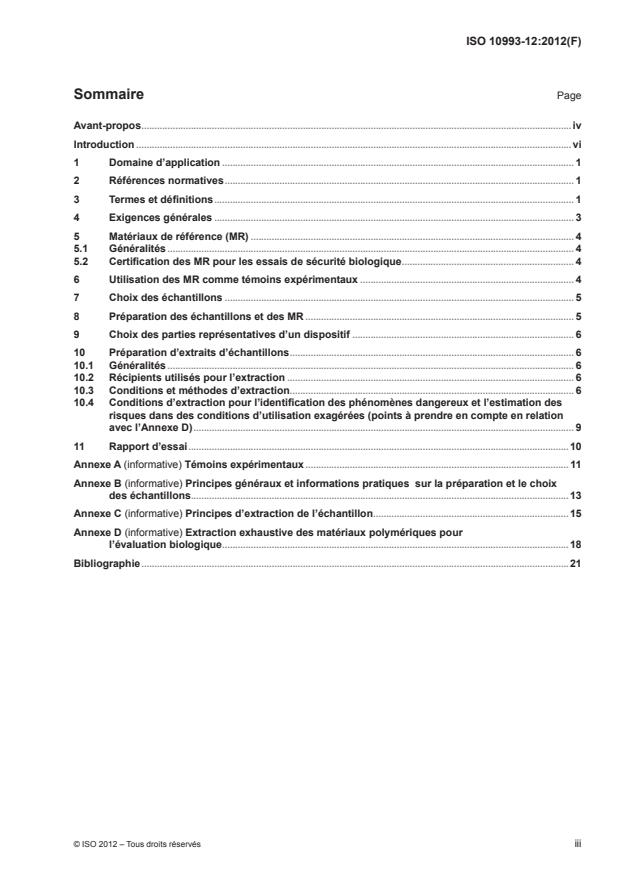
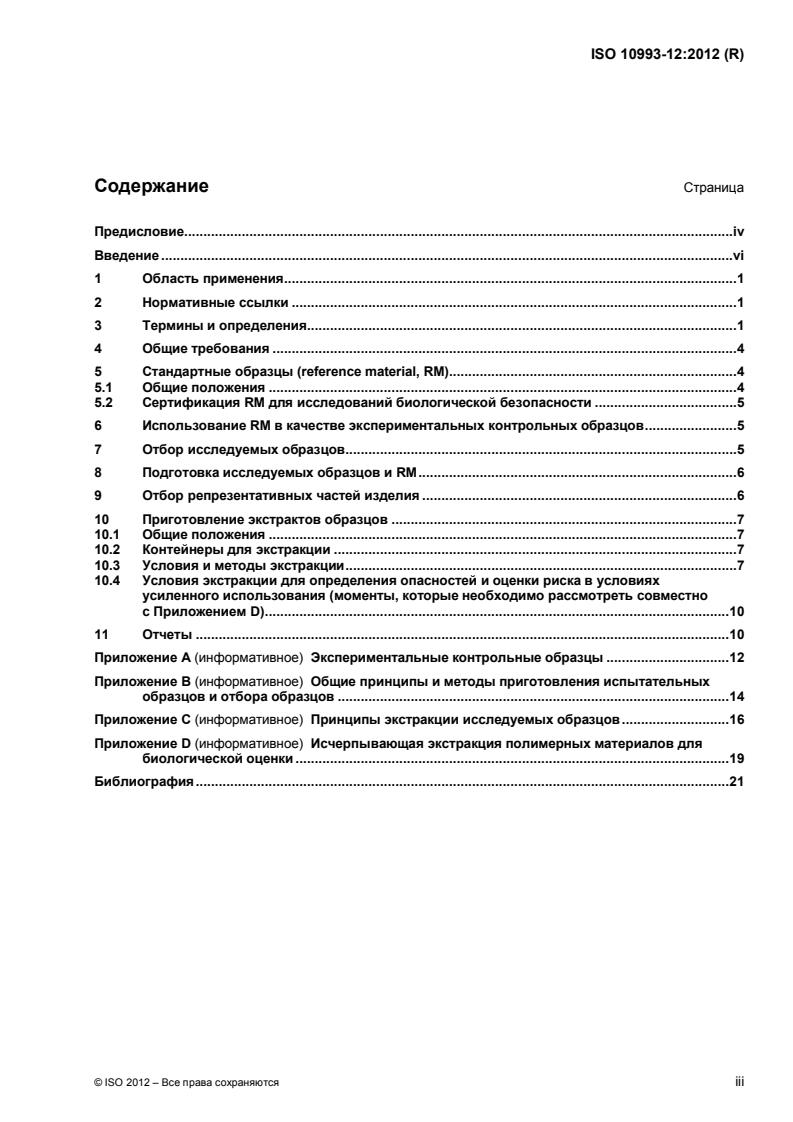
Contents Page
Foreword .iv
Introduction . v
1 Scope . 1
2 Normative references . 1
3 Terms and definitions . 1
4 General requirements . 3
5 Reference materials (RMs) . 4
5.1 General . 4
5.2 Certification of RMs for biological safety testing . 4
6 Use of RMs as experimental controls . 4
7 Test sample selection . 5
8 Test sample and RM preparation . 5
9 Selection of representative portions from a device . 5
10 Preparation of extracts of samples . 6
10.1 General . 6
10.2 Containers for extraction . 6
10.3 Extraction conditions and methods . 6
10.4 Extraction conditions for hazard identification and risk estimation in the exaggerated-use
condition (points to consider in relation to Annex D) . 9
11 Records . 9
Annex A (informative) Experimental controls .10
Annex B (informative) General principles on, and practices of, test sample preparation and
sample selection .12
Annex C (informative) Principles of test sample extraction.14
Annex D (informative) Exhaustive extraction of polymeric materials for biological evaluation .17
Bibliography .19
Foreword
ISO (the International Organization for Standardization) is a worldwide federation of national standards bodies
(ISO member bodies). The work of preparing International Standards is normally carried out through ISO
technical committees. Each member body interested in a subject for which a technical committee has been
established has the right to be represented on that committee. International organizations, governmental and
non-governmental, in liaison with ISO, also take part in the work. ISO collaborates closely with the International
Electrotechnical Commission (IEC) on all matters of electrotechnical standardization.
International Standards are drafted in accordance with the rules given in the ISO/IEC Directives, Part 2.
The main task of technical committees is to prepare International Standards. Draft International Standards
adopted by the technical committees are circulated to the member bodies for voting. Publication as an
International Standard requires approval by at least 75 % of the member bodies casting a vote.
Attention is drawn to the possibility that some of the elements of this document may be the subject of patent
rights. ISO shall not be held responsible for identifying any or all such patent rights.
ISO 10993-12 was prepared by Technical Committee ISO/TC 194, Biological evaluation of medical devices.
This fourth edition cancels and replaces the third edition (ISO 10993-12:2007), which has been technically revised.
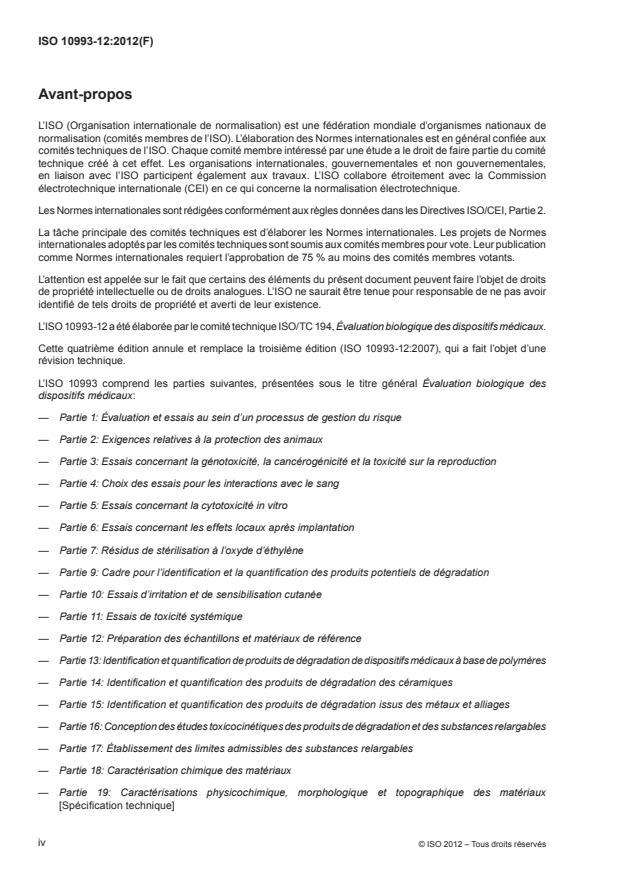
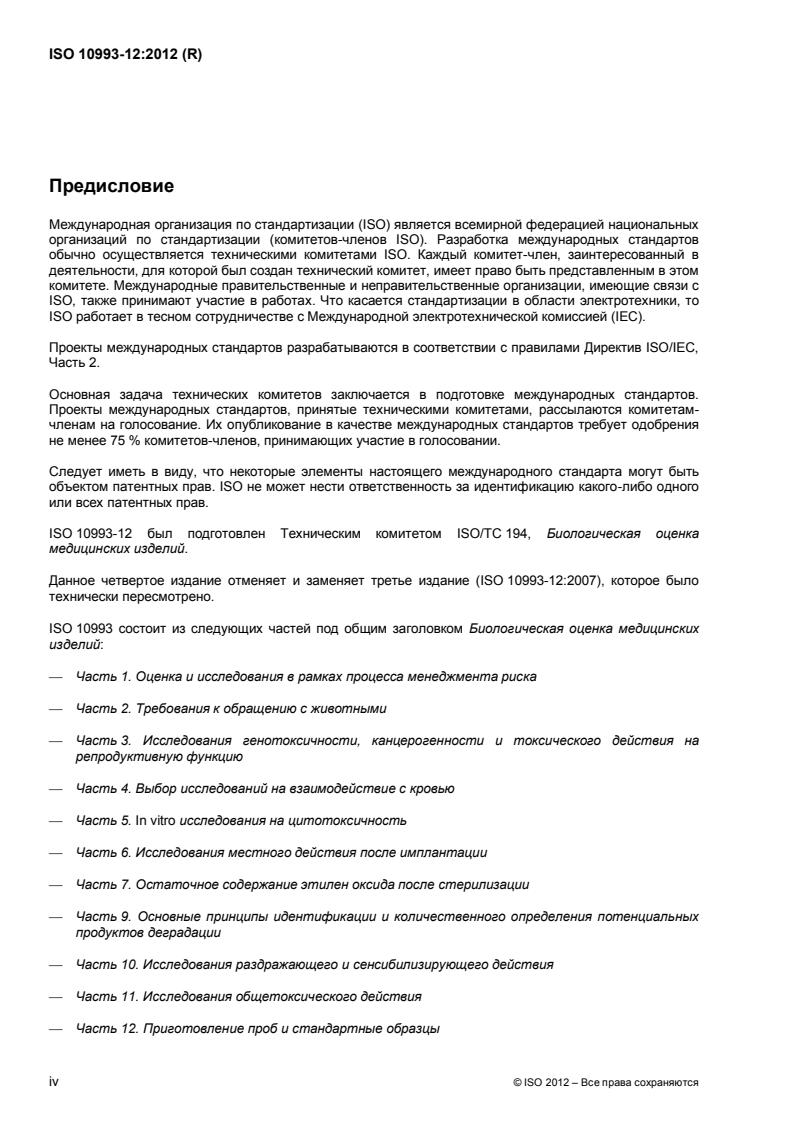
ISO 10993 consists of the following parts, under the general title Biological evaluation of medical devices:
— Part 1: Evaluation and testing within a risk management process
— Part 2: Animal welfare requirements
— Part 3: Tests for genotoxicity, carcinogenicity and reproductive toxicity
— Part 4: Selection of tests for interactions with blood
— Part 5: Tests for in vitro cytotoxicity
— Part 6: Tests for local effects after implantation
— Part 7: Ethylene oxide sterilization residuals
— Part 9: Framework for identification and quantification of potential degradation products
— Part 10: Tests for irritation and skin sensitization
— Part 11: Tests for systemic toxicity
— Part 12: Sample preparation and reference materials
— Part 13: Identification and quantification of degradation products from polymeric medical devices
— Part 14: Identification and quantification of degradation products from ceramics
— Part 15: Identification and quantification of degradation products from metals and alloys
— Part 16: Toxicokinetic study design for degradation products and leachables
— Part 17: Establishment of allowable limits for leachable substances
— Part 18: Chemical characterization of materials
— Part 19: Physico-chemical, morphological and topographical characterization of materials [Technical
Specification]
— Part 20: Principles and methods for immunotoxicology testing of medical devices [Technical Specification]
iv © ISO 2012 – All rights reserved
Introduction
This part of ISO 10993 specifies methods of sample preparation and provides requirements and guidance for
the selection of reference materials for the biological evaluation of medical devices.
It is important that sample preparation methods be appropriate for both the biological evaluation methods
and the materials being evaluated. Each biological test method requires the selection of materials, extraction
solvents and conditions.
This part of ISO 10993 is based on existing national and international specifications, regulations and standards
wherever possible. It is periodically reviewed and revised.
INTERNATIONAL STANDARD ISO 10993-12:2012(E)
1 Scope
This part of ISO 10993 specifies requirements and gives guidance on the procedures to be followed in the
preparation of samples and the selection of reference materials for medical device testing in biological systems
in accordance with one or more parts of ISO 10993. Specifically, this part of ISO 10993 addresses the following:
— test sample selection;
— selection of representative portions from a device;
— test sample preparation;
— experimental controls;
— selection of, and requirements, for reference materials;
— preparation of extracts.
This part of ISO 10993 is not applicable to live cells, but can be relevant to the material or device components
of combination products containing live cells.
2 Normative references
The following referenced documents are indispensable for the application of this document. For dated
references, only the edition cited applies. For undated references, the latest edition of the referenced document
(including any amendments) applies.
ISO 10993 (all parts), Biological evaluation of medical devices
ISO 14971, Medical devices — Application of risk management to medical devices
3 Terms and definitions
For the purposes of this document, the following terms and definitions apply.
3.1
accelerated extraction
extraction that provides a measure of the leachable or extractable materials of the device or material, using
conditions that shorten the time for leaching of the substances into the extraction vehicle but do not result in a
chemical change of the substances being extracted
EXAMPLE Elevated temperature, agitation, changing of the extraction vehicle.
3.2
blank
extraction vehicle not containing the test material, which is retained in a vessel identical to that holding the test
sample and subjected to conditions identical to the ones the test sample is subjected to during its extraction
NOTE The purpose of the blank is to evaluate possible confounding effects due to the extraction vessel, extraction
vehicle and extraction process.
3.3
CRM
certified reference material
reference material, accompanied by a certificate, one or more of whose property values are certified by a
procedure which establishes its traceability to an accurate realization of the unit in which the property values are
expressed, and for which each certified value is accompanied by an uncertainty at a stated level of confidence
[ISO Guide 30:1992, definition 2.2]
3.4
exaggerated extraction
extraction that is intended to result in a greater amount of a chemical constituent being released as compared
to the amount generated under the simulated conditions of use
NOTE It is important to ensure that the exaggerated extraction does not result in a chemical change of the material.
3.5
exhaustive extraction
extraction conducted until the amount of extractable material in a subsequent extraction is less than 10 % by
gravimetric analysis of that detected in the initial extraction
NOTE As it is not possible to demonstrate the exhaustive nature of residual recovery, the definition of exhaustive
extraction adopted is as above. See also Annex C.
3.6
experimental control
substance with well-characterized responses, which is used in a specific test system to assist in evaluating if
the test system has responded in a reproducible and appropriate manner
3.7
extract
liquid that results from extraction of the test sample or control
3.8
extractables
substances that can be released from a medical device or material using extraction solvents and/or extraction
conditions that are expected to be at least as aggressive as the conditions of clinical use
3.9
homogeneous
property of a material and its relationship to a biological endpoint, meaning that it is of uniform structure or
composition, thereby consistently rendering, or not, a specific biological response
NOTE A reference material is said to be homogeneous if the biological response to a specific test is found to lie within
the specified uncertainty limits of the test, irrespective of the batch or lot of material from which the test sample is extracted.
3.10
leachables
substances that can be released from a medical device or material during clinical use
3.11
negative control
any well-characterized material and/or substance, which, when tested by a specific procedure, demonstrates
the suitability of the procedure to yield a reproducible, appropriately negative, non-reactive or minimal response
in the test system
NOTE In practice, negative controls are reference materials but can include blanks and extraction vehicles/solvents.
3.12
positive control
any well-characterized material and/or substance, which, when evaluated by a specific test method, demonstrates
the suitability of the test system to yield a reproducible, appropriately positive or reactive response in the test system
2 © ISO 2012 – All rights reserved
3.13
RM
reference material
material with one or more property values that are sufficiently reproducible and well established to enable use
of the material or substance for the calibration of an apparatus, the assessment of a measurement method, or
for the assignment of values to materials
NOTE 1 Adapted from ISO Guide 30:1992, definition 2.1.
NOTE 2 For the purpose of this part of ISO 10993, an RM is any well-characterized material or substance, which,
when tested by the procedure described, demonstrates the suitability of the procedure to yield a reproducible, predictable
response. The response may be negative or positive.
3.14
simulated-use extraction
extraction conducted to demonstrate compliance with the requirements of this part of ISO 10993 by evaluating
leachable material levels available to the patient or user from devices during the routine use of a device, using
an extraction method that simulates product use
NOTE The burden of validation on the analytical laboratory is to demonstrate that the simulated-use extraction is
carried out under conditions that provide the greatest challenge to the intended use. Product-use simulation is carried
out assuming the device is assigned to the most stringent category possible for the duration of exposure and takes into
consideration both the tissue(s) exposed and the temperature of exposure.
3.15
stability
ability of a material, when stored under specified conditions, to maintain a specific stated biological response,
within specified limits, for a specific period of time
NOTE Adapted from ISO Guide 30:1992, definition 2.7.
3.16
test sample
medical device, component or material (or a representative sample thereof, manufactured and processed by
equivalent methods), or an extract or portion thereof that is subjected to biological or chemical testing or evaluation
4 General requirements
4.1 When identifying hazards and estimating risk in relation to medical devices, hazards that arise from
changes in the manufacturing process, or insufficient control of the manufacturing process, shall be considered
in the design and preparation of test samples, as described in ISO 14971. Particular attention shall be given to
residues, e.g. trace elements and cleaning and disinfection agents, of manufacturing processes.
4.2 ISO 10993 describes many different biological assay systems. Therefore, the individual parts shall be
consulted to ascertain whether these are appropriate for specific test systems.
4.3 Experimental controls shall be used in biological evaluations carried out in order to validate a test
procedure and/or to compare the results between materials. Depending on the biological test, negative controls,
blanks and/or positive controls shall be used, depending on what is appropriate to the test.
NOTE The same type of control can be applicable to different tests and may allow cross-reference to other established
materials and test methods. Additional guidance on the selection of experimental controls is given in Annex A. Use of
positive controls for in vivo testing might be affected by animal welfare regulations.
5 Reference materials (RMs)
5.1 General
RMs are established by individual laboratories. The extent of chemical, physical and biological characterization
is determined by the individual laboratory. Commercially available articles may be used as RM.
NOTE 1 See also ISO Guide 35.
CRMs are selected for their high purity, critical characteristics, suitability for the intended purpose and general
availability. The critical chemical, physical and biological characteristics shall be determined by collaborative
testing in three or more laboratories, and made available to the investigator by the distributor.
NOTE 2 It is desirable for users to obtain a commitment from suppliers of RMs or CRMs stating that these materials
will be available to the user for at least five years. A second but less desirable option is for the source of the RM or CRM to
publish an “open formulation” for the material, i.e. publication of the source materials and details of the processing needed
to ensure uniform batches of the RM.
5.2 Certification of RMs for biological safety testing
5.2.1 Qualification of an RM is a procedure that establishes the numerical or qualitative value of the biological
response of the material under specified test conditions, ensuring reproducibility of the response within and/or
between laboratories. The range of biological responses associated with the material shall be established
through laboratory tests.
NOTE See also ISO Guide 34.
5.2.2 Suppliers of RMs shall certify the materials. The supplier determines the extent of chemical and physical
characterization that is performed. The individual laboratories that use the RM shall identify the biological
characterization necessary to qualify a RM for a specific test or procedure. Commercially available materials
may be used as RM, provided they are certified and qualified.
5.2.3 Certification of a RM is a procedure that establishes the numerical or qualitative value of the biological
response of the material under the specified test conditions. This process serves to validate the testing of the
material for that particular response and results in the issuance of a certificate. The biological response of the
material shall be established through interlaboratory tests.
6 Use of RMs as experimental controls
6.1 RMs or CRMs shall be used in biological tests as control materials to demonstrate the suitability of a
procedure to yield a reproducible response, i.e. positive and/or negative. Any material used in this way shall
be characterized with each biological test procedure for which the use of the material is desired. A material
characterized and then certified for one reference test method or response, e.g. delayed-type hypersensitivity,
shall not be used as an RM for another, e.g. cytotoxicity, without additional validation.
NOTE The use of an RM will facilitate the comparability of the response between laboratories and help assess
reproducibility of the test performance within individual laboratories. For comparison of the biological response, it is
desirable to use RMs having a range of responses, e.g. minimum, intermediate or severe.
6.2 RMs used as experimental controls shall meet the established quality assurance procedures of the
manufacturer and test laboratory. They shall be identified in relation to source, manufacturer, grade and type.
RMs are processed as described in Clause 8.
6.3 When RMs are used as experimental controls, they shall be in the same material class as the test sample,
i.e. polymer, ceramic, metal, colloid, etc. However, pure chemicals may be used as experimental controls for
mechanistically-based test procedures, e.g. genotoxicity and immune delayed-type hypersensitivity assays.
4 © ISO 2012 – All rights reserved
7 Test sample selection
7.1 Testing shall be performed on the final product, representative samples from the final product, materials
processed in the same manner as the final product (see ISO 10993-1), or on appropriate extracts of any of
these. The choice of test sample shall be justified.
NOTE In the case of materials that cure in situ, different test samples representative of the cured material versus the
uncured state of the material might be needed.
7.2 The same test sample selection procedure applies when an extract is required.
8 Test sample and RM preparation
8.1 Test samples and RMs shall be handled with care to prevent contamination. Any residue from the
manufacturing processes shall be considered integral to the device, device portion or component.
NOTE For additional guidance on preparation, see Annex B.
a) Test samples from sterilized devices and RMs shall be handled aseptically, if appropriate to the test procedure.
b) Test samples from a device which is normally supplied non-sterile, but requires sterilization prior to use,
shall be sterilized by the method recommended by the manufacturer and handled aseptically, if appropriate
to the test procedure.
c) If test samples are cleaned prior to sterilization, the influence of the cleaning process and cleaning agent
shall be considered in the selection and handling of the test sample.
8.2 Test samples from devices not required to be sterile in use shall be used as supplied and handled
aseptically throughout the test sample preparation. If sterile test samples are required for a test procedure,
e.g. for cytotoxicity testing, the effect of the sterilization or resterilization process on the test sample and RM
shall be considered.
8.3 When test samples and RMs need to be cut into pieces, as described in 10.3.3, the influence of previously
unexposed surfaces, e.g. lumens or cut surfaces, shall be considered. Tools used for cutting medical devices
into representative portions for testing shall be cleaned between uses to prevent contamination.
9 Selection of representative portions from a device
9.1 If a device cannot be tested as a whole, each individual material in the final product shall be represented
proportionally in the test sample.
a) The test sample of devices with surface coatings shall include both coating material and the substrate,
even if the substrate has no tissue contact.
b) The test sample shall include a representative portion of the joint and/or seal if adhesives, radio-frequency
(RF) seals or solvent seals are used in the manufacture of a portion of the device which comes into contact
with patients.
9.2 Composite materials shall be tested as finished materials.
9.3 When different materials are present in a single device, the potential for synergies and interactions shall
be considered in the choice of test sample.
9.4 The test sample shall be chosen to maximize the exposure of the test system to the components of a
device that are known to have potential for a biological response.
10 Preparation of extracts of samples
10.1 General
If extracts of the device are required for a test procedure, the extraction vehicles and conditions of extraction
used shall be appropriate to the nature and use of the final product and to the purpose of the test, e.g. hazard
identification, risk estimation or risk assessment. The physico-chemical properties of the device materials,
leachable substances or residues shall be considered when choosing the extraction conditions.
NOTE For additional guidance on the extraction of samples, see Annex C.
10.2 Containers for extraction
10.2.1 The extraction shall be performed in clean, chemically inert, closed containers with minimum dead space.
10.2.2 To ensure that the extraction vessels do not adulterate the extract of the test sample, the extraction
vessels shall be:
a) borosilicate glass tubes with caps having an inert liner, e.g. polytetrafluoroethylene;
b) other inert extraction vessels, as required for specific materials and/or extraction procedures.
10.3 Extraction conditions and methods
10.3.1 Extraction conditions are based on common practice and are justified on the basis of providing a
standardized approach that is, in many ways, an appropriate exaggeration of product use. Extraction shall be
conducted under one of the following conditions (see also C.5):
a) (37 ± 1) °C for (72 ± 2) h;
b) (50 ± 2) °C for (72 ± 2) h;
c) (70 ± 2) °C for (24 ± 2) h;
d) (121 ± 2) °C for (1 ± 0,1) h.
NOTE Extraction at (37 ± 1) °C for (24 ± 2) h in tissue culture media is acceptable for cytotoxicity testing. For medical
devices which are in short-term contact with intact skin or mucosa and which are not implanted, extraction times of less
than 24 h, but not less than 4 h, are acceptable (see ISO 10993-5). Extraction temperatures greater than (37 ± 1) °C can
adversely impact chemistry and/or stability of the serum and other constituents in the culture medium.
The extraction conditions described above, which have been used to provide a measure of the hazard potential
for risk estimation of the device or material, are based on historical precedent. Other conditions that simulate
the leachables occurring during clinical use, or that provide an adequate measure of the hazard potential, may
be used but shall be described and justified.
Extraction is a complex process influenced by time, temperature, surface-area-to-volume ratio, the extraction
1)
vehicle and the phase equilibrium of the material. The effects of higher temperatures or other conditions on
extraction kinetics and the identity of the extraction vehicle(s) should be considered carefully if accelerated or
exaggerated extraction is used.
1) The phase equilibrium of a material during extraction controls the relative amounts of amorphous and crystalline phases
present. For the amorphous phase, the glass transition temperature, T , dictates the polymer chain mobility and the diffusion
g
rate in the phase. Usually, at temperatures higher than T , the diffusion rate is considerably higher compared with that below
g
T . The diffusion rate is lowest in the crystalline phase. The extraction conditions should not alter the phase equilibrium of
g
the material. Phase alteration can affect the amount and type of extractables.
6 © ISO 2012 – All rights reserved
For example, two possibilities exist when elevated temperatures are used:
— the energy of the increased temperature may cause increased cross-linking and/or polymerization of the
polymer and, therefore, decrease the amount of free monomer that is available to migrate from the polymer;
— the increased temperature could cause degradation products to form that are not typically found in the
finished device under conditions of use.
10.3.2 For materials that dissolve or resorb under conditions of use, follow the extraction conditions described in
10.3.1. Perform extraction using the appropriate extraction vehicle and time/temperature conditions to simulate
exaggerated exposure wherever possible. Complete dissolution may be appropriate.
10.3.3 The standard surface area can be used to determine the volume of extraction vehicle needed. This area
includes the combined area of both sides of the sample and excludes indeterminate surface irregularities. When
the surface area cannot be determined due to configuration of the sample, a mass/volume of extracting fluid
shall be used. See Table 1.
Other surface-area-to-volume extraction ratios, e.g. those related to evaluation of porous materials, can be
used if they simulate the conditions during clinical use or result in a measure of the hazard potential.
Materials shall be cut into small pieces before extraction to enhance submersion in the extract media, except
when otherwise inappropriate (see 10.3.4). For example, for polymers, pieces approximately 10 mm × 50 mm
or 5 mm × 25 mm are appropriate.
Table 1 — Standard surface areas and extract liquid volumes
Thickness Extraction ratio
(surface area or mass/volume)
Examples of forms of materials
mm ±10 %
˂0,5 6 cm /ml Film, sheet, tubing wall
0,5 to 1,0 3 cm /ml Tubing wall, slab, small moulded items
>1,0 3 cm /ml Larger moulded items
>1,0 1,25 cm /ml Elastomeric closures
Powder, pellets, foam,
Irregularly shaped solid devices 0,2 g/ml
non-absorbent moulded items
Irregularly shaped porous devices
0,1 g/ml Membranes, textiles
(low-density materials)
NOTE While there are no standardized methods available at present for testing absorbents and hydrocolloids, a suggested
protocol is as follows:
— determine the volume of extraction vehicle that each 0,1 g or 1,0 cm of material absorbs;
— then, in performing the material extraction, add this additional volume to each 0,1 g or 1,0 cm in an extraction mixture.
10.3.4 Elastomers, coated materials, composites, laminates, etc. shall be tested intact whenever possible
because of potential differences in extraction characteristics between the intact and cut surfaces.
NOTE As a result of manufacturing processes, many elastomers might have surface properties that are different from
those of the bulk material.
10.3.5 Extraction using both polar and non-polar extraction vehicles shall be performed. The following are
examples of extraction vehicles:
a) polar extraction vehicle: water, physiological saline, culture media without serum;
b) non-polar extraction vehicle: freshly refined vegetable oil (e.g. cottonseed or sesame oil) of the quality
defined in various pharmacopoeias;
c) additional extraction vehicles: ethanol/water, ethanol/saline, polyethylene glycol 400 (diluted to a
physiological osmotic pressure), dimethyl-sulfoxide and culture media with serum.
NOTE 1 Other extraction vehicles appropriate to the nature and use of the device or to the methods for hazard
identification may also be used if their effects on the material and the biological system are known (see Annex D).
NOTE 2 The use of a culture medium with serum is preferred for extraction in testing for cytotoxicity because of its
ability to support cellular growth as well as extract both polar and non-polar substances.
10.3.6 Extractions shall be performed with agitation or circulation. When extraction under static conditions is
considered to be appropriate, the method shall be justified, specified and reported.
10.3.7 Liquid extracts shall, if possible, be used immediately after preparation to prevent sorption on to the
extraction container or other changes in composition. If an extract is stored for longer than 24 hours, then the
stability and homogeneity of the extract under the storage conditions shall be verified.
10.3.8 Extract pH shall not be adjusted unless a rationale is provided.
10.3.9 The extract shall not routinely be processed by filtration, centrifugation or other methods to remove
suspended particulates. However, if such processing is necessary, the rationale shall be documented.
10.3.10 For hazard identification of polymeric devices, exhaustive extraction conditions shall be considered.
The extraction vehicle and conditions of extraction shall be selected on the basis of physico-chemical properties
of the material and/or predicted low-molecular-weight chemicals that might be extracted.
...
NORME ISO
INTERNATIONALE 10993-12
Quatrième édition
2012-07-01
Évaluation biologique des dispositifs
médicaux —
Partie 12:
Préparation des échantillons et
matériaux de référence
Biological evaluation of medical devices —
Part 12: Sample preparation and reference materials
Numéro de référence
©
ISO 2012
DOCUMENT PROTÉGÉ PAR COPYRIGHT
Droits de reproduction réservés. Sauf prescription différente, aucune partie de cette publication ne peut être reproduite ni utilisée sous
quelque forme que ce soit et par aucun procédé, électronique ou mécanique, y compris la photocopie et les microfilms, sans l’accord écrit
de l’ISO à l’adresse ci-après ou du comité membre de l’ISO dans le pays du demandeur.
ISO copyright office
Case postale 56 • CH-1211 Geneva 20
Tel. + 41 22 749 01 11
Fax + 41 22 749 09 47
E-mail copyright@iso.org
Web www.iso.org
Publié en Suisse
ii © ISO 2012 – Tous droits réservés
Sommaire Page
Avant-propos .iv
Introduction .vi
1 Domaine d’application . 1
2 Références normatives . 1
3 Termes et définitions . 1
4 Exigences générales . 3
5 Matériaux de référence (MR) . 4
5.1 Généralités . 4
5.2 Certification des MR pour les essais de sécurité biologique . 4
6 Utilisation des MR comme témoins expérimentaux . 4
7 Choix des échantillons . 5
8 Préparation des échantillons et des MR . 5
9 Choix des parties représentatives d’un dispositif . 6
10 Préparation d’extraits d’échantillons . 6
10.1 Généralités . 6
10.2 Récipients utilisés pour l’extraction . 6
10.3 Conditions et méthodes d’extraction . 6
10.4 Conditions d’extraction pour l’identification des phénomènes dangereux et l’estimation des
risques dans des conditions d’utilisation exagérées (points à prendre en compte en relation
avec l’Annexe D) . 9
11 Rapport d’essai .10
Annexe A (informative) Témoins expérimentaux . 11
Annexe B (informative) Principes généraux et informations pratiques sur la préparation et le choix
des échantillons .13
Annexe C (informative) Principes d’extraction de l’échantillon .15
Annexe D (informative) Extraction exhaustive des matériaux polymériques pour
l’évaluation biologique .18
Bibliographie .21
Avant-propos
L’ISO (Organisation internationale de normalisation) est une fédération mondiale d’organismes nationaux de
normalisation (comités membres de l’ISO). L’élaboration des Normes internationales est en général confiée aux
comités techniques de l’ISO. Chaque comité membre intéressé par une étude a le droit de faire partie du comité
technique créé à cet effet. Les organisations internationales, gouvernementales et non gouvernementales,
en liaison avec l’ISO participent également aux travaux. L’ISO collabore étroitement avec la Commission
électrotechnique internationale (CEI) en ce qui concerne la normalisation électrotechnique.
Les Normes internationales sont rédigées conformément aux règles données dans les Directives ISO/CEI, Partie 2.
La tâche principale des comités techniques est d’élaborer les Normes internationales. Les projets de Normes
internationales adoptés par les comités techniques sont soumis aux comités membres pour vote. Leur publication
comme Normes internationales requiert l’approbation de 75 % au moins des comités membres votants.
L’attention est appelée sur le fait que certains des éléments du présent document peuvent faire l’objet de droits
de propriété intellectuelle ou de droits analogues. L’ISO ne saurait être tenue pour responsable de ne pas avoir
identifié de tels droits de propriété et averti de leur existence.
L’ISO 10993-12 a été élaborée par le comité technique ISO/TC 194, Évaluation biologique des dispositifs médicaux.
Cette quatrième édition annule et remplace la troisième édition (ISO 10993-12:2007), qui a fait l’objet d’une
révision technique.
L’ISO 10993 comprend les parties suivantes, présentées sous le titre général Évaluation biologique des
dispositifs médicaux:
— Partie 1: Évaluation et essais au sein d’un processus de gestion du risque
— Partie 2: Exigences relatives à la protection des animaux
— Partie 3: Essais concernant la génotoxicité, la cancérogénicité et la toxicité sur la reproduction
— Partie 4: Choix des essais pour les interactions avec le sang
— Partie 5: Essais concernant la cytotoxicité in vitro
— Partie 6: Essais concernant les effets locaux après implantation
— Partie 7: Résidus de stérilisation à l’oxyde d’éthylène
— Partie 9: Cadre pour l’identification et la quantification des produits potentiels de dégradation
— Partie 10: Essais d’irritation et de sensibilisation cutanée
— Partie 11: Essais de toxicité systémique
— Partie 12: Préparation des échantillons et matériaux de référence
— Partie 13: Identification et quantification de produits de dégradation de dispositifs médicaux à base de polymères
— Partie 14: Identification et quantification des produits de dégradation des céramiques
— Partie 15: Identification et quantification des produits de dégradation issus des métaux et alliages
— Partie 16: Conception des études toxicocinétiques des produits de dégradation et des substances relargables
— Partie 17: Établissement des limites admissibles des substances relargables
— Partie 18: Caractérisation chimique des matériaux
— Partie 19: Caractérisations physicochimique, morphologique et topographique des matériaux
[Spécification technique]
iv © ISO 2012 – Tous droits réservés
— Partie 20: Principes et méthodes relatifs aux essais d’immunotoxicologie des dispositifs médicaux
[Spécification technique]
Introduction
La présente partie de l’ISO 10993 spécifie des méthodes de préparation des échantillons et fournit des
exigences et des lignes directrices pour le choix des matériaux de référence dans le cadre d’une évaluation
biologique des dispositifs médicaux.
Il est important que les méthodes de préparation d’échantillons tiennent compte à la fois des méthodes
d’évaluation biologique et des matériaux à évaluer. Chaque essai biologique exige une sélection de matériaux,
de solvants et de conditions d’extraction.
La présente partie de l’ISO 10993 se fonde, dans la mesure du possible, sur les spécifications, les
réglementations et les normes existant au niveau national et international. Elle est régulièrement revue et
soumise à des révisions.
vi © ISO 2012 – Tous droits réservés
NORME INTERNATIONALE ISO 10993-12:2012(F)
Évaluation biologique des dispositifs médicaux —
Partie 12:
Préparation des échantillons et matériaux de référence
1 Domaine d’application
La présente partie de l’ISO 10993 spécifie les exigences et fournit des recommandations sur les modes
opératoires à suivre pour la préparation des échantillons et le choix des matériaux de référence dans le cadre
d’essais relatifs aux dispositifs médicaux dans des systèmes biologiques, conformément à une ou à plusieurs
parties de l’ISO 10993. La présente partie traite spécifiquement les points suivants:
— le choix des échantillons;
— le choix des parties représentatives d’un dispositif;
— la préparation des échantillons;
— les témoins expérimentaux;
— le choix des matériaux de référence et les exigences qui s’y rapportent;
— la préparation des extraits.
La présente partie de l’ISO 10993 n’est pas applicable aux cellules vivantes, mais peut s’appliquer aux
matériaux ou aux composants des dispositifs de produits combinés contenant des cellules vivantes.
2 Références normatives
Les documents de référence suivants sont indispensables pour l’application du présent document. Pour les
références datées, seule l’édition citée s’applique. Pour les références non datées, la dernière édition du
document de référence s’applique (y compris les éventuels amendements).
ISO 10993 (toutes les parties), Évaluation biologique des dispositifs médicaux
ISO 14971, Dispositifs médicaux — Application de la gestion des risques aux dispositifs médicaux
3 Termes et définitions
Pour les besoins du présent document, les termes et définitions suivants s’appliquent.
3.1
extraction accélérée
extraction qui fournit une mesure des matériaux relargables ou extractibles du dispositif ou du matériau,
utilisant des conditions qui raccourcissent le temps de relargage des substances vers le solvant d’extraction,
mais qui ne doit pas provoquer de modification chimique des substances extraites
EXEMPLE Température élevée, agitation, utilisation d’un solvant d’extraction différent.
3.2
blanc
solvant d’extraction ne contenant pas le matériau d’essai, retenu dans un récipient identique à celui dans lequel
l’échantillon est maintenu, et soumis à des conditions identiques à celles auxquelles l’échantillon est soumis
pendant l’extraction
NOTE Le but du blanc est d’évaluer les interférences possibles liées au récipient d’extraction, au solvant d’extraction
et au processus d’extraction.
3.3
matériau de référence certifié
MRC
matériau de référence, accompagné d’un certificat, dont une ou plusieurs valeur(s) de la (des) propriété(s)
est (sont) certifiée(s) par une procédure qui établit son raccordement à une réalisation exacte de l’unité dans
laquelle les valeurs de propriété sont exprimées, et pour laquelle chaque valeur certifiée est accompagnée
d’une incertitude à un niveau de confiance indiqué
[ISO Guide 30:1992, définition 2.2]
3.4
extraction exagérée
extraction destinée à aboutir à la libération de quantités de composants chimiques plus importantes que celles
générées dans des conditions simulées
NOTE Il est important de s’assurer que l’extraction exagérée ne provoque pas une modification chimique du matériau.
3.5
extraction exhaustive
extraction réalisée pour que la quantité de matériau extractible retrouvée dans une extraction ultérieure
représente moins de 10 % de celle détectée par analyse gravimétrique lors de l’extraction initiale
NOTE Comme il n’est pas possible de démontrer la nature exhaustive de la récupération des résidus, la définition de
l’extraction exhaustive est celle adoptée ci-dessus. Voir également l’Annexe C.
3.6
témoin expérimental
substance possédant des réponses bien caractérisées, utilisée au cours d’un essai spécifique afin d’évaluer si
le dispositif d’essai a répondu de manière reproductible et adéquate
3.7
extrait
liquide résultant de l’extraction de l’échantillon ou du témoin soumis à essai
3.8
extractibles
substances qui peuvent être libérées d’un dispositif médical ou d’un matériau utilisant des solvants d’extraction et/ou
des conditions d’extraction qui sont supposés être au moins aussi agressifs que les conditions d’utilisation clinique
3.9
homogène
propriété d’un matériau de structure et de composition uniformes, telles qu’il induise ou non une réponse
biologique spécifique de façon consistante
NOTE Un matériau de référence est dit homogène si la réponse biologique à un essai spécifique se trouve être dans
les limites d’incertitude spécifiées de l’essai, indépendamment du lot de matériau dont l’échantillon est extrait.
3.10
relargables
substances qui peuvent être libérées d’un dispositif médical ou d’un matériau pendant l’utilisation clinique
2 © ISO 2012 – Tous droits réservés
3.11
témoin négatif
matériau et/ou substance bien caractérisés qui, lors d’essais réalisés selon un mode opératoire spécifique,
démontrent l’aptitude du mode opératoire à fournir une réponse négative reproductible, non réactive ou
minimale lors de l’expérimentation
NOTE En pratique, les témoins négatifs sont des matériaux de référence qui peuvent inclure les blancs et les
véhicules/solvants d’extraction.
3.12
témoin positif
matériau et/ou substance bien caractérisés qui, lors d’essais réalisés selon un mode opératoire spécifique,
démontrent l’aptitude du système à fournir une réponse positive reproductible ou réactive lors de l’expérimentation
3.13
matériau de référence
MR
matériau ou substance dont une ou plusieurs valeur(s) de la (des) propriété(s) est (sont) suffisamment
homogène(s) et bien définie(s) pour permettre son utilisation en vue de l’étalonnage d’un appareil, l’évaluation
d’une méthode de mesure ou l’attribution de valeurs aux matériaux
NOTE 1 Adapté de l’ISO Guide 30:1992, définition 2.1.
NOTE 2 Pour les besoins de la présente partie de l’ISO 10993, est considéré(e) comme matériau de référence tout
matériau ou toute substance qui, lors d’essais réalisés selon le mode opératoire décrit, démontre l’aptitude du mode
opératoire à fournir une réponse prévisible et reproductible. La réponse peut être négative ou positive.
3.14
extraction avec simulation d’utilisation
extraction réalisée pour démontrer la conformité aux exigences de la présente partie de l’ISO 10993 par
évaluation des taux de matériau relargable acceptables pour le patient ou l’utilisateur, lors d’une utilisation de
routine d’un dispositif, par une méthode d’extraction qui simule l’utilisation du produit
NOTE La charge de validation incombant au laboratoire d’analyse est destinée à démontrer que la simulation
d’extraction est effectuée dans des conditions créant la plus grande sollicitation par rapport à l’utilisation prévue. Il
convient de procéder à la simulation d’utilisation du produit en supposant que le dispositif est affecté à la catégorie la
plus rigoureuse pendant la durée d’exposition et qu’il faut prendre en considération tant le ou les tissus exposés que la
température d’exposition.
3.15
stabilité
capacité d’un matériau, lorsqu’il est entreposé dans des conditions spécifiées, à conserver une capacité à induire
une réponse biologique spécifiquement définie, dans des limites spécifiées, pour une période de temps spécifiée
NOTE Adapté de l’ISO Guide 30:1992, définition 2.7.
3.16
échantillon d’essai
dispositif médical, composant ou matériau (ou échantillon représentatif de celui-ci, fabriqué et traité par des méthodes
équivalentes) ou extrait ou partie de celui-ci, soumis à des essais ou à une évaluation biologiques ou chimiques
4 Exigences générales
4.1 Lors de l’identification des phénomènes dangereux et de l’estimation des risques liés aux dispositifs
médicaux, les phénomènes dangereux dus aux modifications du processus de fabrication ou à un contrôle
insuffisant de ce dernier doivent être pris en compte lors de la conception et de la préparation des échantillons
d’essai, tels que décrits dans l’ISO 14971. Une attention particulière doit être accordée aux résidus de ces
processus de fabrication, par exemple aux éléments traces et aux agents de désinfection et de nettoyage.
4.2 En raison du nombre de systèmes biologiques expérimentaux différents décrits dans l’ISO 10993, il
convient que les normes particulières s’y rapportant soient consultées pour s’assurer de leur pertinence pour
un système expérimental donné.
4.3 Les témoins expérimentaux doivent être utilisés lors d’évaluations biologiques pour valider un mode
opératoire d’essai et/ou pour comparer les résultats entre matériaux. Selon les essais biologiques utilisés, des
témoins négatifs et/ou positifs, ainsi que des blancs, doivent être utilisés.
NOTE Un même type de témoin peut être applicable à différents essais et permettre une référence croisée à
d’autres matériaux et méthodes d’essai établis. Des lignes directrices supplémentaires relatives au choix des témoins
expérimentaux sont données dans l’Annexe A. L’utilisation de témoins positifs pour les essais in vivo peut être affectée par
la réglementations concernant la protection des animaux.
5 Matériaux de référence (MR)
5.1 Généralités
Les MR sont établis par des laboratoires individuels. Le laboratoire individuel détermine l’étendue des
caractérisations chimique, physique et biologique. Des articles disponibles dans le commerce peuvent être
utilisés comme MR.
NOTE 1 Voir également l’ISO Guide 35.
Le choix des MRC se fait en fonction de leur extrême pureté, de leurs caractéristiques critiques, de leur aptitude
à l’emploi prévu et, en général, de leur disponibilité. Les caractéristiques critiques chimiques, physiques et
biologiques doivent être déterminées à l’aide d’essais interlaboratoires réalisés dans au moins trois laboratoires
et mises à la disposition du conducteur des essais par le distributeur.
NOTE 2 Il est souhaitable que les fournisseurs s’engagent à mettre à disposition des utilisateurs les MR et les MRC
pendant au moins cinq ans. Il peut être également souhaitable que la source du MR ou du MRC publie une «formulation
ouverte» du matériau, c’est-à-dire qu’elle publie la source des matériaux et les détails du processus nécessaire pour
garantir l’uniformité des lots de MR.
5.2 Certification des MR pour les essais de sécurité biologique
5.2.1 La qualification d’un MR consiste en un mode opératoire permettant d’établir la valeur qualitative ou
numérique de la réponse biologique du matériau soumis à des conditions d’essai spécifiées, garantissant ainsi
la reproductibilité de la réponse intralaboratoire et/ou interlaboratoires. La gamme de réponses biologiques
associées au matériau doit être établie à l’aide d’essais interlaboratoires.
NOTE Voir également l’ISO Guide 34.
5.2.2 Les fournisseurs de MR doivent certifier les matériaux. Le fournisseur détermine l’étendue des
caractérisations physique et chimique effectuées. Les laboratoires individuels qui utilisent les MR doivent
identifier la caractérisation biologique nécessaire pour qualifier un MR destiné à être utilisé pour un essai ou un
mode opératoire spécifique. Il est possible d’utiliser des articles disponibles dans le commerce comme MR à
condition qu’ils soient certifiés et qualifiés.
5.2.3 La certification d’un MR est un mode opératoire qui permet d’établir la valeur qualitative ou numérique
de la réponse biologique du matériau soumis à des conditions d’essai spécifiées. Ce processus sert à valider
l’évaluation du matériau pour cette réponse particulière et aboutit à la délivrance d’un certificat. La réponse
biologique du matériau doit être établie à l’aide d’essais interlaboratoires.
6 Utilisation des MR comme témoins expérimentaux
6.1 Les MR ou les MRC doivent être utilisés lors d’essais biologiques comme matériaux de contrôle afin
de démontrer l’aptitude d’un mode opératoire à fournir une réponse reproductible, par exemple positive et/ou
4 © ISO 2012 – Tous droits réservés
négative. Tout matériau utilisé à cette fin doit être caractérisé à l’aide de chaque mode opératoire d’essai
biologique pour lequel le matériau est souhaité. Un matériau caractérisé, puis certifié, pour une réponse ou une
méthode d’essai de référence, par exemple pour la réaction d’hypersensibilité retardée, ne doit pas être utilisé
comme MR pour une autre méthode, par exemple pour la cytotoxicité, sans une validation supplémentaire.
NOTE L’utilisation d’un MR rendra plus aisée la comparaison entre les réponses obtenues dans les laboratoires et
contribuera à évaluer la reproductibilité de la performance de l’essai au niveau de chaque laboratoire. Pour comparer
la réponse biologique, il est souhaitable d’utiliser des MR présentant une gamme de réponses, par exemple minimales,
intermédiaires ou élevées.
6.2 Les MR utilisés comme témoins expérimentaux doivent être conformes aux systèmes d’assurance qualité
du fabricant et du laboratoire d’essai. Ils doivent être identifiés quant à leur source, leur fabricant, leur qualité et
leur type. Les MR sont préparés comme décrit à l’Article 8.
6.3 Lorsque les MR sont utilisés comme témoins expérimentaux, ils doivent appartenir à la même classe de
matériau que l’échantillon, c’est-à-dire polymères, céramiques, métaux, colloïdes, etc. Toutefois, des produits
chimiques purs peuvent être utilisés comme témoins expérimentaux lors de protocoles mécanistiques, comme
la génotoxicité et les essais de réaction d’hypersensibilité à immunité retardée.
7 Choix des échantillons
7.1 L’essai doit être réalisé sur le produit fini ou sur des échantillons représentatifs des produits finis ou
encore sur des matériaux préparés comme le produit fini (voir l’ISO 10993-1) ou sur des extraits appropriés de
l’un de ces éléments. Le choix de l’échantillon doit être justifié.
NOTE Dans le cas de matériaux qui réticulent in situ, différents échantillons représentatifs du matériau réticulé par
rapport au matériau non réticulé pourraient être nécessaires.
7.2 Le même mode opératoire pour le choix d’échantillons d’essai s’applique lorsqu’un extrait est requis.
8 Préparation des échantillons et des MR
8.1 Les échantillons et les MR doivent être manipulés avec précaution de manière à éviter toute contamination.
Tout résidu provenant du processus de fabrication doit être considéré comme faisant partie intégrante du
dispositif, de la partie de dispositif ou du composant.
NOTE Pour des recommandations supplémentaires concernant la préparation, voir l’Annexe B.
a) Les échantillons prélevés sur des dispositifs stérilisés et des MR doivent être manipulés de manière
aseptique lorsque le mode opératoire d’essai le permet.
b) Les échantillons prélevés sur des dispositifs qui sont habituellement fournis non stérilisés, mais qui
demandent une stérilisation avant utilisation, doivent être stérilisés par la méthode recommandée par le
fabricant et manipulés de manière aseptique lorsque le mode opératoire d’essai le permet.
c) Si les échantillons sont nettoyés avant d’être stérilisés, l’influence du processus de nettoyage et de l’agent
nettoyant doit être prise en compte lors de la sélection et de la manipulation de l’échantillon.
8.2 Les échantillons prélevés sur des dispositifs non requis pour être stériles à l’utilisation doivent être
utilisés tels qu’ils ont été fournis et manipulés dans des conditions aseptiques tout au long de la préparation de
l’échantillon. Lorsque des échantillons stérilisés sont exigés pour le mode opératoire d’essai, l’influence de la
stérilisation ou du procédé de restérilisation sur l’échantillon et les MR doit être prise en compte.
8.3 Lorsque les échantillons et les MR ont besoin d’être coupés en plusieurs morceaux comme décrit en
10.3.3, l’influence des surfaces qui auparavant n’étaient pas exposées, par exemple les lumières ou des
surfaces incisées, doit être prise en compte. Les outils utilisés pour couper les dispositifs médicaux en parties
représentatives doivent être nettoyés après chaque utilisation afin d’éviter toute contamination.
9 Choix des parties représentatives d’un dispositif
9.1 Si un dispositif ne peut pas être soumis à essai en tant que dispositif complet, chaque matériau individuel
présent dans le produit fini doit être représenté de manière proportionnelle dans l’échantillon d’essai.
a) L’échantillon d’essai de dispositifs ayant des revêtements de surface doit comprendre à la fois le matériau
de revêtement et le substrat, même si le substrat n’entre pas en contact avec les tissus.
b) L’échantillon d’essai doit comprendre une partie représentative du joint et/ou du système assurant
l’étanchéité dans les cas où des adhésifs, des scellements par radiofréquence ou des scellements par
solvants sont utilisés lors de la fabrication d’une partie du dispositif qui est en contact avec les patients.
9.2 Les matériaux composites doivent être soumis à essai en tant que matériaux finis.
9.3 Lorsqu’un dispositif est composé de plusieurs matériaux, la possibilité de synergie ou d’interactions entre
ces matériaux doit être prise en compte lors du choix de l’échantillon.
9.4 L’échantillon à évaluer doit être choisi de façon à maximiser le contact des composants avec le dispositif
expérimental, dès lors que les composants d’un dispositif médical sont connus pour leur aptitude potentielle à
donner une réponse biologique.
10 Préparation d’extraits d’échantillons
10.1 Généralités
Lorsque des extraits de dispositif sont requis pour un mode opératoire d’essai, les solvants d’extraction et les
conditions d’extraction doivent être adaptés à la nature et à l’utilisation du produit fini ainsi qu’à l’objectif de
l’essai, soit l’identification des phénomènes dangereux, l’estimation des risques ou l’évaluation des risques.
Lors du choix des conditions d’extraction, il faut tenir compte des propriétés physico-chimiques des matériaux
du dispositif, des substances relargables ou des résidus.
NOTE Pour des recommandations supplémentaires sur l’extraction des échantillons, voir l’Annexe C.
10.2 Récipients utilisés pour l’extraction
10.2.1 L’extraction doit être réalisée dans des récipients propres, fermés, chimiquement inertes et dotés d’un
espace minimal de tête libre.
10.2.2 Pour s’assurer que les récipients d’extraction ne dénaturent pas les extraits d’échantillons, il faut utiliser
a) des tubes en verre borosilicaté munis d’un bouchon possédant un joint inerte, par exemple du
poly(tétrafluoroéthylène), et
b) d’autres récipients d’extraction à base de matériau inerte requis pour des matériaux et/ou des protocoles
d’extraction spécifiques.
10.3 Conditions et méthodes d’extraction
10.3.1 Les conditions d’extraction sont fondées sur des pratiques courantes et justifiées au motif de fournir une
approche normalisée qui représente, à plusieurs égards, une exagération appropriée de l’utilisation du produit.
L’extraction doit être réalisée dans l’une des conditions suivantes (voir aussi C.5):
a) (37 ± 1) °C pendant (72 ± 2) h;
b) (50 ± 2) °C pendant (72 ± 2) h;
6 © ISO 2012 – Tous droits réservés
c) (70 ± 2) °C pendant (24 ± 2) h;
d) (121 ± 2) °C pendant (1 ± 0,1) h.
NOTE L’extraction à (37 ± 1) °C pendant (24 ± 2) h dans un milieu de culture tissulaire est acceptable pour les essais
de cytotoxicité. Pour des dispositifs médicaux qui sont en contact de courte durée avec une peau intacte ou une muqueuse
et qui ne sont pas implantés, on peut accepter des durées d’extraction inférieures à 24 h mais pas inférieures à 4 h (voir
l’ISO 10993-5). Les températures d’extraction supérieures à (37 ± 1) °C peuvent avoir un impact chimique négatif et/ou
une stabilité du sérum et d’autres constituants dans le milieu de culture.
Les conditions d’extraction décrites ci-dessus, qui ont été utilisées pour permettre de mesurer le potentiel
de risque à des fins d’estimation des risques que représente le dispositif ou le matériau, se fondent sur des
antécédents historiques. D’autres conditions simulant les relargables se produisant pendant l’utilisation clinique
ou permettant un mesurage adéquat du potentiel de risque peuvent être utilisées; elles doivent alors être
décrites et justifiées.
L’extraction est un processus complexe influencé par le temps, la température, le rapport aire/volume, le solvant
1)
d’extraction et la phase d’équilibre du matériau. En cas d’extraction accélérée ou exagérée, il convient de
tenir compte scrupuleusement de l’effet de températures plus élevées ou d’autres conditions sur la cinétique
de l’extraction, ainsi que de la nature du solvant d’extraction.
Par exemple, lorsque des températures élevées sont utilisées, il existe deux possibilités:
— l’énergie apportée par l’augmentation de la température peut provoquer une réticulation accrue du
polymère et/ou une polymérisation et, par conséquent, une baisse de la quantité de monomères libres
pouvant migrer du polymère;
— la hausse de température peut provoquer la formation de produits de dégradation que l’on ne trouve pas
normalement dans les dispositifs finis dans les conditions d’utilisation.
10.3.2 Pour les matériaux qui se dissolvent ou se résorbent dans les conditions d’utilisation, suivre les
conditions d’extraction décrites en 10.3.1. Réaliser l’extraction en utilisant le solvant d’extraction approprié et
les conditions de temps/température permettant de simuler une exposition exagérée quand cela est possible. Il
se peut que la dissolution complète soit appropriée.
10.3.3 L’aire normale peut être utilisée pour déterminer le volume requis du solvant d’extraction. Les aires
normales comprennent la combinaison des surfaces des deux côtés de l’échantillon et excluent les irrégularités
de surface non déterminées. Lorsque l’aire ne peut pas être déterminée en raison de la configuration de
l’échantillon, utiliser un rapport poids/volume du liquide d’extraction. Voir Tableau 1.
D’autres rapports d’extraction aire/volume, par exemple liés à l’évaluation de matériaux poreux, peuvent être
utilisés, à condition qu’ils reproduisent les conditions constatées en usage clinique ou qu’ils permettent de
mesurer le potentiel de risque.
Avant l’extraction, les matériaux doivent être coupés en petits morceaux pour améliorer la submersion dans le
liquide d’extraction, à moins que cela ne soit pas approprié (voir 10.3.4). Par exemple, pour les polymères, des
morceaux d’environ 10 mm × 50 mm ou 5 mm × 25 mm sont appropriés.
1) La phase d’équilibre d’un matériau solide au cours de l’extraction régit la proportion de phases amorphe et cristalline
du matériau. Pour la phase amorphe, la température de transition vitreuse, T , affecte la mobilité de la chaîne de polymère
g
et le taux de diffusion dans la phase. Aux températures supérieures à T , le taux de diffusion est habituellement largement
g
supérieur à celui constaté au-dessous de ces températures. Le taux de diffusion est plus faible dans la phase cristalline. Il
convient que les conditions d’extraction n’altèrent pas la phase d’équilibre du matériau. L’altération de phase peut affecter
la quantité et le type des substances extractibles.
Tableau 1 — Aires normales et volumes de liquide d’extraction
Épaisseur Rapport d’extraction
(aire ou poids/volume)
Exemples de formes de matériaux
mm ±10 %
<0,5 6 cm /ml Film, feuille, paroi de tube
Paroi de tube, plaque,
0,5 à 1,0 3 cm /ml
petits articles moulés
>1,0 3 cm /ml Articles moulés plus grands
>1,0 1,25 cm /ml Fermetures en élastomère
Dispositifs solides Poudre, pastilles, mousse,
0,2 g/ml
de forme irrégulière articles moulés non absorbants
Dispositifs poreux
de forme irrégulière 0,1 g/ml Membranes, textiles
(matériaux de basse densité)
NOTE En l’absence de méthodes normalisées pour les essais portant sur les absorbants et les hydrocolloïdes, le protocole
suivant est suggéré:
— déterminer le volume du solvant d’extraction absorbé par 0,1 g ou 1,0 cm de matériau;
— ensuite, au cours de l’extraction du matériau, ajouter ce volume supplémentaire par 0,1 g ou 1,0 cm dans le mélange d’extraction.
10.3.4 Dans la mesure du possible, soumettre à essai les élastomères, les matériaux revêtus, les matériaux
composites, les stratifiés, etc. alors qu’ils sont intacts, à cause des différences potentielles de caractéristiques
d’extraction entre les surfaces coupées et les surfaces intactes.
NOTE À la suite des processus de fabrication, de nombreux élastomères peuvent présenter des propriétés de
surface différentes de celles du matériau en vrac.
10.3.5 Effectuer l’extraction en utilisant à la fois des solvants d’extraction polaires et non polaires. Des exemples
de solvants d’extraction sont donnés ci-après:
a) solvant d’extraction polaire: eau, solution saline physiologique, milieux de culture liquides sans sérum;
b) solvant d’extraction non polaire: huile végétale fraîchement raffinée (par exemple huile de graine de coton
ou de sésame) présentant une qualité définie dans de nombreuses pharmacopées;
c) autres solvants d’extraction: éthanol/eau, éthanol/solution saline physiologique, polyéthylène-glycol 400
(dilué à une pression osmotique physiologique), diméthylsulfoxyde et milieu de culture liquide avec sérum.
NOTE 1 D’autres solvants d’extraction adaptés à la nature et à l’utilisation du dispositif ou aux méthodes d’identification
des phénomènes dangereux peuvent également être utilisés si leurs effets sur le matériau et le système biologique sont
connus (voir Annexe D).
NOTE 2 L’utilisation d’un milieu de culture avec du sérum est préférable pour l’essai d’extraction de la cytotoxicité à
cause de son aptitude à supporter la croissance cellulaire et à extraire des substances polaires et non polaires.
10.3.6 Les extractions doivent être réalisées sous agitation ou circulation. Lorsqu’une extraction dans des
conditions statiques est considérée comme appropriée, la méthode doit être justifiée, spécifiée et documentée
dans un rapport.
10.3.7 Les extraits liquides doivent, dans la mesure du possible, être utilisés immédiatement après leur
préparation afin d’empêcher leur adsorption dans le récipient d’extraction ou d’autres changements de leur
composition. Lorsqu’un extrait est conservé plus de 24 h, il faut vérifier sa stabilité et son homogénéité dans les
conditions de stockage.
10.3.8 Le pH de l’extrait ne doit pas être ajusté à moins qu’une justification ne soit fournie.
8 © ISO 2012 – Tous droits réservés
10.3.9 Normalement, l’extrait ne doit pas être soumis à une filtration, à une centrifugation ou à toute autre
méthode destinée à éliminer les particules en suspension. Toutefois, si un tel traitement s’avère nécessaire, sa
justification doit être consignée.
10.3.10 Pour l’identification des phénomènes dangereux des dispositifs à base de polymères, des conditions
d’extraction exhaustives doivent être envisagées. Le solvant d’extraction et les conditions d’extraction doivent
être choisis en se fondant sur les propriétés physico-chimiques du matériau et/ou sur la nature prévisible des
composés chimiques de faible poids moléculaire qui pourraient être extraits.
10.3.11 Pour les matériaux ou les dispositifs qui ne sont pas conçus pour se dissoudre ou se résorber dans
les conditions d’utilisation, aucun solvant utilisé lors de l’extraction d’un matériau ou d’un dispositif à base de
polymères ne doit provoquer la solubilisation des constituants du polymère. Seul un léger assouplissement
du matériau polymérique doit se produire en présence d’un solvant volatil (par exemple moins de 10 % de
dissolution). Le solvant doit être éliminé (avant son utilisation dans un essai biologique) afin d’éviter que des
traces résiduelles n’affectent défavorablement l’essai biologique (par exemple dénaturation des protéines ou
irritation cutanée). Pour les matériaux ou les dispositifs conçus pour se dissoudre ou se résorber dans les
conditions d’utilisation, voir 10.3.12.
10.3.12 Pour les matériaux en solution et solubles, les méthodes d’extraction classiques utilisées pour les
matériaux insolubles peuvent ne pas convenir. Il convient de tenir compte des recommandations suivantes en
plus des informations fournies dans le Tableau 1.
a) Il convient de tenir compte de facteurs tels que la compatibilité du système d’essai, la voie d’administration
et l’ampleur de la dissolution ou de la dégradation lors de la préparation finale en vue des essais. Utiliser
un solvant et des conditions appropriés pour simuler une exposition exagérée quand cela est possible. Un
essai préliminaire peut aider à déterminer les conditions appropriées.
b) Si le matériau se dissout complètement dans un solvant ou un diluant qui est compatible avec le matériau et
le système d’essai, la solution obtenue peut être évaluée comme étant pure, à condition que les propriétés
de la solution soient également compatibles avec le système d’essai, par exemple pH, osmolarité,
concentrations de soluté.
c) Si le matériau est une solution aqueuse et qu’il est utilisé sous cette forme, il doit être soumis à essai
directement et non extrait, à condition que les propriétés de la solution soient compatibles avec le système
d’essai [voir aussi a) et b)].
d) Les lignes directrices de l’OCDE pour les essais de produits chimiques ou des normes d’essai de produits
chimiques similaires peuvent être utilisées comme recommandations pour déterminer les concentrations
maximales des substances d’essais utilisées pour des méthodes d’essais spécifiques.
10.3.13 Lorsque des liquides circulent dans le dispositif dans les conditions normales d’utilisation, par exemple
dans le cas de dispositifs extra-corporels, l’extraction par recirculation peut être employée. Si possible, une ou
plusieurs des conditions doivent être exagérées, par exemple la température, la durée, le volume ou le débit.
Les raisons motivant le choix du type d’extraction doivent être consignées.
10.4 Conditions d’extraction pour l’identification des phénomènes dangereux et l’estimation
des risques dans des conditions d’utilisation exagérées (points à prendre en compte en rela-
tion avec l’Annexe D)
10.4.1 Les phénomènes dangereux dus aux modifications du processus de fabrication ou à un contrôle
insuffisant de ce dernier doivent être pris en compte lors de la conception et de la préparation des échantillons
pour l’essai et lors de la préparation des extraits de ces dispositifs, conformément à l’ISO 14971. Une attention
particulière doit être accordée aux résidus de ces processus de fabrication, par exemple éléments traces et
agents de désinfection et de nettoyage.
10.4.2 Lorsqu’il est démontré que le potentiel toxique se situe dans les limites acceptables pour un produit
soumis à une extraction exagérée et/ou à une extraction exhaustive, il n’est pas utile de lui faire subir en plus
une extraction dans des conditions simulées.
10.4.3 Dans le cas de produits qui polymérisent in situ, les échantillons à évaluer doivent représenter les
conditions d’utilisation clinique prévues, afin de fournir des informations sur la toxicité potentielle des composants
réactifs du polymère pendant le processus de réticulation. Les extraits préparés à différents moments, le cas
échéant, doivent être fondés sur la cinétique de polymérisation après le mélange des composants, y compris
un extrait préparé au moment prévu de réticulation. La réalisation d’essais sur le matériau après la réticulation
doit être justifiée.
Lorsque des extraits sont utilisés dans des méthodes d’essai permettant d’évaluer les matériaux qui réticulent
in situ, le début de l’extraction doit commencer au niveau de réticulation auquel le matériau sera utilisé in situ.
Pour les méthodes d’essai qui utilisent ces matériaux directement, comme c’est le cas, par exemple, des
essais de cytotoxicité par contact direct ou sur milieu agar, des essais d’implantation, de certains essais de
génotoxicité et en hémolyse de contact direct, le matériau doit être utilisé dans le mode opératoire d’essai
comme en usage clinique, avec réticulation in situ.
NOTE Il pourrait être approprié de modifier le système de libération clinique de manière que la taille ou le poids
donné du matériau soit délivré en vue de l’essai.
11 Rapport d’essai
La documentation se rapportant à l’échantillon et à sa préparation doit comprendre au moins, mais sans s’y limiter:
a) le type et, si ces informations sont connues, la composition du matériau et la source du matériau, du
dispositif, de la partie du dispositif ou du composant;
NOTE Une description écrite, un dessin, une photographie ou toute autre méthode de représentation peut
remplir la présente exigence, en partie ou dans sa totalité.
b) le numéro de lot, le cas échéant;
c) la description des processus de traitement, de nettoyage ou de stérilisation, le cas échéant;
d) les techniques d’extraction, s’il y a lieu, y compris la documentation relative au solvant d’extraction, aux
rapports d’extraction, aux conditions d’extraction, aux moyens d’agitation, ainsi que tout écart par rapport
aux conditions spécifiées dans la présente partie de l’ISO 10993, telles que la filtration de l’extrait ou les
milieux d’extraction.
10 © ISO 2012 – Tous droits réservés
Annexe A
(informative)
Témoins expérimentaux
A.1 Les matériaux répertoriés dans les paragraphes suivants peuvent satisfaire aux critères d’un témoin
expérimental approprié lors d’essais choisis. Il est de la responsabilité du conducteur des essais de faire les
choix appropriés (voir Tableau A.1).
Tableau A.1 — Exemples de RM et de témoins disponibles
a a
Essai Témoin positif Témoin négatif MR
PVC-org. Sn PE
SPU-ZDEC Silicone
Implantation
Latex de caoutchouc
Alumine
naturel
Acier inoxydable
PVC-org. Sn PE
SPU-ZDEC
SPU-ZBEC
Cytotoxicité
Latex de caoutchouc
naturel
Polyuréthane
PVC 7506
Compatibilité sanguine
PUR 2541
NOTE Les informations fournies sur les MR et les témoins ne concernent que les essais de l’ISO 10993 ne faisant pas appel à des
MR ou à des témoins spécifiques.
a
Les abréviations utilisées dans le présent tableau font référence à des matériaux spécifiques, disponibles auprès de sources
désignées en A.2 et en A.3.
2)3)4)5) 6)
A.2 Le polyéthylène haute densité , le polyéthylène basse
...
МЕЖДУНАРОДНЫЙ ISO
СТАНДАРТ 10993-12
Четвертое издание
2012-07-01
Биологическая оценка медицинских
изделий.
Часть 12.
Приготовление проб и стандартные
образцы
Biological evaluation of medical devices — Part 12:
Sample preparation and reference materials
Ответственность за подготовку русской версии несѐт GOST R
(Российская Федерация) в соответствии со статьѐй 18.1 Устава ISO
Ссылочный номер
©
ISO 2012
Отказ от ответственности при работе в PDF
Настоящий файл PDF может содержать интегрированные шрифты. В соответствии с условиями лицензирования, принятыми
фирмой Adobe, этот файл можно распечатать или смотреть на экране, но его нельзя изменить, пока не будет получена
лицензия на интегрированные шрифты и они не будут установлены на компьютере, на котором ведется редактирование. В
случае загрузки настоящего файла заинтересованные стороны принимают на себя ответственность за соблюдение
лицензионных условий фирмы Adobe. Центральный секретариат ISO не несет никакой ответственности в этом отношении.
Adobe - торговый знак фирмы Adobe Systems Incorporated.
Подробности, относящиеся к программным продуктам, использованные для создания настоящего файла PDF, можно найти в
рубрике General Info файла; параметры создания PDF были оптимизированы для печати. Были приняты во внимание все
меры предосторожности с тем, чтобы обеспечить пригодность настоящего файла для использования комитетами-членами
ISO. В редких случаях возникновения проблемы, связанной со сказанным выше, просьба проинформировать Центральный
секретариат по адресу, приведенному ниже.
ДОКУМЕНТ ЗАЩИЩЕН АВТОРСКИМ ПРАВОМ
Все права сохраняются. Если не указано иное, никакую часть настоящей публикации нельзя копировать или использовать в
какой-либо форме или каким-либо электронным или механическим способом, включая фотокопии и микрофильмы, без
предварительного письменного согласия ISO по адресу ниже или представительства ISO в соответствующей стране.
Бюро авторского права ISO
Почтовый ящик 56 CH-1211 Женева 20
Тел. + 41 22 749 01 11
Факс + 41 22 749 09 47
E-mail copyright@iso.org
Web www.iso.org
Опубликовано в Швейцарии
ii © ISO 2012 – Все права сохраняются
Содержание Страница
Предисловие .iv
Введение .vi
1 Область применения .1
2 Нормативные ссылки .1
3 Термины и определения .1
4 Общие требования .4
5 Стандартные образцы (reference material, RM) .4
5.1 Общие положения .4
5.2 Сертификация RM для исследований биологической безопасности .5
6 Использование RM в качестве экспериментальных контрольных образцов .5
7 Отбор исследуемых образцов .5
8 Подготовка исследуемых образцов и RM .6
9 Отбор репрезентативных частей изделия .6
10 Приготовление экстрактов образцов .7
10.1 Общие положения .7
10.2 Контейнеры для экстракции .7
10.3 Условия и методы экстракции .7
10.4 Условия экстракции для определения опасностей и оценки риска в условиях
усиленного использования (моменты, которые необходимо рассмотреть совместно
с Приложением D) . 10
11 Отчеты . 10
Приложение A (информативное) Экспериментальные контрольные образцы . 12
Приложение B (информативное) Общие принципы и методы приготовления испытательных
образцов и отбора образцов . 14
Приложение C (информативное) Принципы экстракции исследуемых образцов . 16
Приложение D (информативное) Исчерпывающая экстракция полимерных материалов для
биологической оценки . 19
Библиография . 21
Предисловие
Международная организация по стандартизации (ISO) является всемирной федерацией национальных
организаций по стандартизации (комитетов-членов ISO). Разработка международных стандартов
обычно осуществляется техническими комитетами ISO. Каждый комитет-член, заинтересованный в
деятельности, для которой был создан технический комитет, имеет право быть представленным в этом
комитете. Международные правительственные и неправительственные организации, имеющие связи с
ISO, также принимают участие в работах. Что касается стандартизации в области электротехники, то
ISO работает в тесном сотрудничестве с Международной электротехнической комиссией (IEC).
Проекты международных стандартов разрабатываются в соответствии с правилами Директив ISO/IEC,
Часть 2.
Основная задача технических комитетов заключается в подготовке международных стандартов.
Проекты международных стандартов, принятые техническими комитетами, рассылаются комитетам-
членам на голосование. Их опубликование в качестве международных стандартов требует одобрения
не менее 75 % комитетов-членов, принимающих участие в голосовании.
Следует иметь в виду, что некоторые элементы настоящего международного стандарта могут быть
объектом патентных прав. ISO не может нести ответственность за идентификацию какого-либо одного
или всех патентных прав.
ISO 10993-12 был подготовлен Техническим комитетом ISO/TC 194, Биологическая оценка
медицинских изделий.
Данное четвертое издание отменяет и заменяет третье издание (ISO 10993-12:2007), которое было
технически пересмотрено.
ISO 10993 состоит из следующих частей под общим заголовком Биологическая оценка медицинских
изделий:
— Часть 1. Оценка и исследования в рамках процесса менеджмента риска
— Часть 2. Требования к обращению с животными
— Часть 3. Исследования генотоксичности, канцерогенности и токсического действия на
репродуктивную функцию
— Часть 4. Выбор исследований на взаимодействие с кровью
— Часть 5. In vitro исследования на цитотоксичность
— Часть 6. Исследования местного действия после имплантации
— Часть 7. Остаточное содержание этилен оксида после стерилизации
— Часть 9. Основные принципы идентификации и количественного определения потенциальных
продуктов деградации
— Часть 10. Исследования раздражающего и сенсибилизирующего действия
— Часть 11. Исследования общетоксического действия
— Часть 12. Приготовление проб и стандартные образцы
iv © ISO 2012 – Все права сохраняются
— Часть 13. Идентификация и количественное определение продуктов деградации полимерных
медицинских изделий
— Часть 14. Идентификация и количественное определение продуктов деградации изделий из
керамики
— Часть 15. Идентификация и количественное определение продуктов деградации изделий из
металлов и сплавов
— Часть 16. Схема исследования токсикокинетики продуктов деградации и вымывания
— Часть 17. Установление пороговых значений для вымываемых веществ
— Часть 18. Исследование химических свойств материалов
— Часть 19. Исследование физико-химических, морфологических и топографических свойств
материалов [Техническое описание]
— Часть 20. Принципы и методы исследования иммунотоксического действия медицинских
изделий [Техническое описание]
Введение
В данной части ISO 10993 определены методы приготовления проб и приведены требования и
руководства по отбору стандартных образцов для биологической оценки медицинских изделий.
Важно, чтобы методы приготовления проб соответствовали как методам биологической оценки, так и
оцениваемым материалам. Каждый метод биологического исследования требует определенного
выбора материалов, экстракционных растворов и условий.
Данная часть ISO 10993 основывается на существующих национальных и международных
спецификациях, нормативных документах и стандартах в той мере, в которой это возможно. Она
периодически пересматривается и перерабатывается.
vi © ISO 2012 – Все права сохраняются
МЕЖДУНАРОДНЫЙ СТАНДАРТ ISO 10993-12:2012 (R)
Биологическая оценка медицинских изделий.
Часть 1.
Приготовление проб и стандартные образцы
1 Область применения
В данной части ISO 10993 определены требования и приведены руководства по процедурам, которым
необходимо следовать при приготовлении проб и выборе стандартных образцов для исследования
медицинских изделий в биологических системах в соответствии с одной или более частей ISO 10993. В
данной части ISO 10993 специально рассмотрено следующее:
— отбор проб;
— отбор характерных частей устройства;
— приготовление проб;
— экспериментальный контроль;
— отбор или требования к стандартным образцам;
— приготовление экстрактов.
Данная часть ISO 10993 не применима к живым клеткам, но может быть применима к материалам или
компонентам устройства комбинированных продуктов, содержащих живые клетки.
2 Нормативные ссылки
Ссылка на следующие документы обязательна при использовании данного документа. Для жестких
ссылок применяются только указанное по тексту издание. Для плавающих ссылок необходимо
использовать самое последнее издание нормативного ссылочного документа (включая любые
изменения).
ISO 10993 (все части), Биологическая оценка медицинских изделий
ISO 14971, Медицинские изделия. Применение менеджмента риска к медицинским изделиям
3 Термины и определения
В рамках данного документа применяются следующие термины и определения.
3.1
ускоренная экстракция
accelerated extraction
экстракция, которая обеспечивает определение выщелачиваемых или экстрагируемых материалов
устройства или материала, используя условия, которые уменьшают время вымывания веществ в
экстракционную среду, но не приводят к химическим изменениям вымываемых веществ
ПРИМЕР Повышение температуры, перемешивание, изменение экстракционной среды.
3.2
контрольный раствор
blank
экстракционная среда, не содержащая исследуемый материал, которая вводится в емкость,
идентичную емкости, содержащей исследуемый образец, и подвергается воздействию условий,
идентичных условиям, которым подвергается исследуемый образец во время экстракции
ПРИМЕЧАНИЕ Контрольный раствор предназначен для оценки возможных погрешностей, связанных с
емкостью для экстракции, экстракционной средой и процессом экстракции.
3.3
сертифицированный стандартный образец
CRM
certified reference material
стандартный образец, снабженный сертификатом, одно или более свойств которого сертифицировано
с помощью процедур, которые определяют точность его реализации в единицах, в которых
выражаются соответствующие значения и для которых каждое сертифицированное значение
сопровождается неопределенностью с установленным уровнем доверия
[ISO Guide 30:1992, определение 2.2]
3.4
усиленная экстракция
exaggerated extraction
экстракция, предназначенная для получения большего количества выделяемого химического
компонента по сравнению с количеством, получаемым при моделируемых условиях использования
ПРИМЕЧАНИЕ Важно обеспечивать, чтобы усиленная экстракция не приводила к химическим изменениям
образца.
3.5
исчерпывающая экстракция
exhaustive extraction
экстракция, проводимая до того момента, когда количество вымываемого материала при последующей
экстракции составляет менее 10% от количества, обнаруженного при первоначальной экстракции,
определенного с помощью гравиметрического анализа
ПРИМЕЧАНИЕ Так как невозможно продемонстрировать исчерпывающий характер выделения остаточных
веществ, определение исчерпывающей экстракции адоптировано так, как приведено выше. См. также
Приложение С.
3.6
экспериментальный контрольный образец
experimental control
образец вещества с хорошо изученными реакциями, которое используется в определенной
испытательной системе для помощи в оценке реакций испытательной системы на предмет
воспроизводимости и соответствия
3.7
экстракт
extract
жидкость, получаемая в процессе экстракции исследуемого или контрольного образца
3.8
экстрагируемые вещества
extractables
вещества, которые могут быть выделены из медицинского изделия или материала, используя
растворы для экстракции и/или условия для экстракции, которые являются, как ожидается, по крайней
мере, столь же агрессивными, как условия клинического использования
2 © ISO 2012 – Все права сохраняются
3.9
гомогенность
homogeneous
свойство материала и его взаимоотношение с биологической конечной точкой, при которых его
однородная структура или состав позволяют последовательно вызывать или последовательно не
вызывать конкретный биологический ответ
ПРИМЕЧАНИЕ Стандартный образец называют гомогенным, если биологический ответ на конкретное
испытание находится в рамках обозначенных пределов неопределенности испытания, вне зависимости от партии
или серии материала, из которого выделен исследуемый образец.
3.10
вымываемые вещества
leachables
вещества, которые могут быть выделены из медицинского изделия или материала во время
клинического использования
3.11
отрицательный контрольный образец
negative control
любой достаточно описанный образец материала и/или вещества, который при исследовании по
описанной методике показывает пригодность этой методики для получения воспроизводимого,
соответствующего отрицательного, нечувствительного или минимального ответа в испытательной
системе
ПРИМЕЧАНИЕ На практике в качестве отрицательного контрольного образца используют стандартные
образцы, но также возможно применение контрольных сред/растворов и сред/растворов для экстракции.
3.12
положительный контрольный образец
positive control
любой достаточно описанный образец материала и/или вещества, который при исследовании по
описанной методике показывает пригодность этой методики для получения воспроизводимого,
соответствующего положительного или чувствительного ответа в испытательной системе
3.13
стандартный образец
RM
reference material
материал с одним или более значением характеристики, которое является достаточно
воспроизводимым и хорошо определенным для того, чтобы обеспечить использование материала или
вещества для калибровки аппаратуры, оценки метода измерения или определения значений
материалов
ПРИМЕЧАНИЕ 1 Адаптировано из ISO Guide 30:1992, определение 2.1.
ПРИМЕЧАНИЕ 2 В рамках данной части ISO 10993, RM – это любой хорошо описанный материал или вещество,
которое при испытании согласно описанным процедурам демонстрирует пригодность процедур для обеспечения
воспроизводимого предсказуемого ответа. Ответ может быть отрицательным или положительным.
3.14
экстракция, моделирующая использование
simulated-use extraction
экстракция, проводимая для демонстрации соответствия требованиям данной части ISO 10993 с помощью
оценки уровня вымываемых материалов, воздействующих на пациента или пользователя при рутинном
использовании устройства, используя метод экстракции, моделирующий использование продукта
ПРИМЕЧАНИЕ Задачей валидации аналитической лаборатории является демонстрация того, что экстракция,
моделирующая использование, проводится при условиях, обеспечивающих наибольшую нагрузку в рамках
предполагаемого использования. Моделирование использования продукта проводится с учетом того, что продукту
присваивается наиболее строгая возможная категория по длительности воздействия, а также принимаются во
внимание задействованные ткани и температура воздействия.
3.15
стабильность
stability
способность материала поддерживать конкретный установленный биологический ответ в рамках
обозначенных пределов при хранении при обозначенных условиях в течение определенного периода
времени
ПРИМЕЧАНИЕ Адаптировано из ISO Guide 30:1992, определение 2.7.
3.16
исследуемый образец
test sample
медицинское изделие, компонент или материал (или их характерный образец, произведенный и
обработанный эквивалентными методами) или экстракт или его часть, которые подвергаются
биологическому или химическому исследованию или оценке
4 Общие требования
4.1 При определении опасностей и оценке риска применительно к медицинским изделиям,
опасности, возникающие в результате изменений в процессе производства или недостаточного
контроля производственного процесса, должны быть учтены при разработке и приготовлении
испытываемых образцов, как описано в ISO 14971. Особое внимание следует уделять остаточным
веществам, получаемым в рамках производственных процессов, например, следам элементов и
чистящим и дезинфицирующим веществам.
4.2 В ISO 10993 описано много различных систем биологической оценки. Следовательно,
необходимо сверяться с конкретными частями для определения пригодности данных рекомендаций
для конкретных испытательных систем.
4.3 При биологической оценке, проводимой для валидации испытательных процедур и/или
сравнения результатов для различных материалов, должны использоваться экспериментальные
контрольные образцы. В зависимости от того, что применимо для используемых биологических
исследований, должны использоваться отрицательный контрольный образец, контрольный раствор
и/или положительный контрольный образец.
ПРИМЕЧАНИЕ Один и тот же тип контрольного образца может быть применим для различных исследований и
может допускать перекрестные ссылки на другие установленные материалы и методы исследования.
Дополнительное руководство по выбору экспериментального контрольного образца приведено в Приложении A.
Использование положительных контрольных образцов для исследований in vivo может зависеть от нормативных
документов, касающихся благополучия животных.
5 Стандартные образцы (reference material, RM)
5.1 Общие положения
RM устанавливаются конкретными лабораториями. Степень подробности описания химических,
физических и биологических характеристик определяется конкретными лабораториями. В качестве RM
могут использоваться коммерчески доступные изделия.
ПРИМЕЧАНИЕ 1 См. также ISO Guide 35.
CRM выбираются по степени чистоты, критическим характеристикам, пригодности для
предполагаемого использования и общей доступности. Критические химические, физические и
биологические характеристики должны определяться с помощью совместных испытаний в трех или
более лабораториях и предоставляться исследователю дистрибьютором.
4 © ISO 2012 – Все права сохраняются
ПРИМЕЧАНИЕ 2 Желательно, чтобы пользователи получали подтверждение от поставщиков RM или CRM, что
эти материалы будут доступны пользователю, по крайней мере, 5 лет. Вторым, но не менее важным свойством
для источников RM или CRM является публикация в ―доступных источниках‖, т.е. публикация с указанием
исходных материалов и деталей обработки, необходимых для получения одинаковых партий RM.
5.2 Сертификация RM для исследований биологической безопасности
5.2.1 Квалификация RM – это процедура, которая устанавливает численное или количественное
значение биологического ответа материала при определенных условиях испытания, обеспечивая
воспроизводимость ответа, как в лабораторных, так и в межлабораторных условиях. Диапазон
биологических ответов, связанных с материалом, должен быть установлен путем лабораторных
исследований.
ПРИМЕЧАНИЕ См. также ISO Guide 34.
5.2.2 Поставщики RM должны сертифицировать материалы. Поставщик определяет объем описания
химических и физических характеристик. Отдельные лаборатории, использующие RM, должны
определять биологические характеристики, необходимые для утверждения RM для определенного
испытания или процедуры. В качестве RM могут использоваться коммерчески доступные материалы,
если они сертифицированы и признаны пригодными для испытаний.
5.2.3 Сертификация RM – это процедура, которая устанавливает качественное или количественное
значение биологического ответа материала при определенных условиях испытания. Этот процесс
служит для валидации испытания материала на конкретный ответ и приводит к выдаче сертификата.
Биологический ответ на материал должен быть установлен путем межлабораторных исследований.
6 Использование RM в качестве экспериментальных контрольных образцов
6.1 RM или CRM должны использоваться при биологических исследованиях как контрольные
образцы для демонстрации пригодности процедуры для получения воспроизводимого результата,
положительного и/или отрицательного. Любой материал, используемый таким образом, должен
описываться для каждой процедуры биологического испытания, для которой планируется
использование материала. Материал, описанный и затем сертифицированный для одного
контрольного метода исследования или ответа, например гиперчувствительности замедленного типа,
не должен использоваться как RM для другого, например цитотоксичности, без дополнительной
валидации.
ПРИМЕЧАНИЕ Использование RM облегчает сравнение результатов в разных лабораториях и помогает при оценке
воспроизводимости результатов испытания в отдельных лабораториях. Для сравнения биологического ответа желательно
использовать RM с определенным диапазоном ответных реакций, например минимальная, средняя или сильная.
6.2 RM, используемые в качестве экспериментальных контрольных образцов, должны
удовлетворять установленным требованиям к качеству, гарантируемому процедурами производителя
и испытательной лаборатории. Они должны сопровождаться сведениями об источнике, производителе,
степени чистоты и типе. RM обрабатываются, как описано в Разделе 8.
6.3 Если RM используются в качестве экспериментальных контрольных образцов, они должны быт
материалами того же класса, что и исследуемый образец, т.е. полимер, керамика, металл, коллоид и
т.д. Тем не менее, в качестве экспериментальных контрольных образцов для процедур испытаний,
основанных на механистическом действии, например, проб на генотоксичность и на иммунную
гиперчувствительность замедленного типа, могут использоваться чистые химические вещества.
7 Отбор исследуемых образцов
7.1 Исследования должны проводиться на конечном продукте, характерных образцах конечного продукта,
материалах, обработанных также, как и конечный продукт (см. ISO 10993-1), или соответствующих экстрактах
вышеперечисленного. Выбор исследуемого образца должен быть обоснован.
ПРИМЕЧАНИЕ В случае материалов, отверждаемых in situ, могут потребоваться различные исследуемые
образцы, представляющие отвержденный материал для сравнения с неотвержденным состоянием материала.
7.2 Аналогичные процедуры отбора испытательных образцов проводятся, если необходим экстракт.
8 Подготовка исследуемых образцов и RM
8.1 Исследуемые образцы и RM должны подвергаться бережному обращению для предотвращения
загрязнения. Любые остаточные после процесса производства вещества следует считать
неотъемлемой частью изделия, его части или компонента.
ПРИМЕЧАНИЕ Дополнительное руководство по приготовлению приведено в Приложении B.
a) Исследуемые образцы из стерилизованных изделий и RM должны обрабатываться в асептических
условиях, если это соответствует процедуре испытаний.
b) Исследуемые образцы из изделий, которые в нормальных условиях поставляются нестерильными,
но требуют стерилизации перед использованием, должны стерилизоваться с использованием
методов, рекомендованных производителем, и обрабатываться в асептических условиях, если это
соответствует процедуре испытаний.
c) Если исследуемые образцы подвергаются чистке перед стерилизацией, влияние процесса чистки
и чистящего вещества должно учитываться при отборе и работе с испытательным образцом.
8.2 Исследуемые образцы изделий, не требующие стерилизации при использовании, должны
использоваться в том виде, как они поставляются, и обрабатываться в асептических условиях во
время подготовки исследуемых образцов. Если для испытательных процедур требуется стерильные
испытательные образцы, например, для исследований на цитотоксичность, необходимо учитывать
влияние процессов стерилизации или повторной стерилизации на исследуемые образцы и RM.
8.3 Если для исследуемых образцов и RM требуется разрезать их на части, как описано в 10.3.3,
следует учитывать влияние поверхностей, не подвергавшихся ранее обработке, например просветов
или поверхностей среза. Инструменты, используемые для разрезания медицинских изделий на
характерные части для исследования, должны подвергаться чистке между использованием для
предотвращения загрязнения.
9 Отбор репрезентативных частей изделия
9.1 Если изделие не может быть исследовано целиком, каждый отдельный материал конечного
продукта должен быть пропорционально представлен в исследуемом образце.
a) Исследуемые образцы изделий с поверхностями среза должны включать как материал покрытия,
так и основу, даже если основа не контактирует с тканями.
b) Исследуемые образцы должны включать характерные части соединений и/или изоляции, если при
производстве части изделия, вступающей в контакт с пациентами, используются клеящие
материалы, радиочастотная (radio-frequency, RF) изоляция или растворители.
9.2 Составные материалы должны испытываться как конечные материалы.
9.3 Если в состав изделия входят различные материалы, при выборе исследуемого образца
необходимо учитывать вероятность явления синергизма и других взаимодействий.
9.4 Исследуемый образец должен быть выбран так, чтобы испытательная система оказывала
максимальное влияние на компоненты изделия с известной потенциальной биологической активностью.
6 © ISO 2012 – Все права сохраняются
10 Приготовление экстрактов образцов
10.1 Общие положения
Если исследование требует применения экстрактов изделия, используемые емкости для экстракции и
условия экстракции должны соответствовать свойствам и назначению конечного продукта и цели
исследований, например, идентификация опасностей, оценка риска и анализ риска. При выборе
условий экстракции необходимо учитывать физико-химические свойства материала изделия,
вымываемых веществ или остаточных веществ.
ПРИМЕЧАНИЕ Дополнительное руководство по экстракции образцов приведено в Приложении C.
10.2 Контейнеры для экстракции
10.2.1 Экстракция должна проводиться в чистых, химически инертных, закрытых контейнерах с
минимальным свободным пространством.
10.2.2 Для обеспечения того, что емкости для экстракции не загрязняют экстракт исследуемого
образца, емкости для экстракции должны представлять собой:
a) пробирки из боросиликатного стекла с крышками и инертными вставками, например, из
политетрафторэтилена;
b) другие инертные емкости для экстракции, необходимые для конкретных материалов и/или
процедур экстракции.
10.3 Условия и методы экстракции
10.3.1 Условия экстракции основываются на существующей практике и обоснованы предоставлением
стандартного подхода, который во многом является приемлемым преувеличением использования
изделия. Экстракцию следует проводить при одних из следующих условий (см. также C.5):
a) (37 ± 1) °C в течение (72 ± 2) ч;
b) (50 ± 2) °C в течение (72 ± 2) ч;
c) (70 ± 2) °C в течение (24 ± 2) ч;
d) (121 ± 2) °C в течение (1 ± 0,1) ч.
ПРИМЕЧАНИЕ Для исследования цитотоксичности допустима экстракция при (37 ± 1) °C в течение (24 ± 2) ч в
среде для выращивания тканей. Для медицинских изделий, которые вступают в кратковременный контакт с
неповрежденной кожей или слизистыми оболочками и которые не подлежат имплантации, допустимо время
экстракции менее 24 ч, но не менее 4 ч (см. ISO 10993-5). Температуры экстракции более (37 ± 1) °C могут
негативно влиять на химический состав и/или стабильность сыворотки и других составляющих питательной среды.
Условия экстракции, описанные выше, используемые для определения вероятности опасностей при
оценке рисков для изделия или материала, основаны на предшествующем опыте. Могут
использоваться другие условия, которые моделируют вымывание, возникающее во время
клинического использования, или которые обеспечивают адекватное определение вероятности
возникновения опасности, однако они должны быть описаны и обоснованы.
Экстракция – это сложный процесс, на который влияет время, температура, соотношение площади поверхности к
объему, емкость для экстракции и фазовое равновесие материала. Влияние повышенных температур или других
Фазовое равновесие материала во время экстракции определяет относительное содержание аморфной и кристаллической фаз. Для
аморфной фазы температура стеклования, T , определяет подвижность полимерной цепи и скорость диффузии в данной фазе.
g
Обычно скорость диффузии при температуре выше T значительно выше скорости диффузии при температуре ниже T . В
g g
кристаллическую фазу скорость диффузии наименьшая. Условия экстракции не должны изменять фазового равновесия материала.
Изменение фазового равновесия может повлечь за собой изменение количества и структуры экстрагируемых веществ.
условий на кинетику экстракции и идентичность сред для экстракции должно тщательно учитываться при
использовании ускоренной или усиленной экстракции.
Например, существует два варианта развития событий при использовании повышенных температур:
— энергия повышенной температуры может вызвать увеличенное образование поперечных связей
и/или полимеризацию полимеров и, следовательно, снижение количества свободных мономеров,
которые доступны для миграции из полимера;
— повышенная температура может вызвать образование продуктов деградации, которые обычно не
присутствуют в конечном продукте в условиях клинического использования
10.3.2 Для материалов, растворяющихся или поглощающихся в условиях клинического использования,
необходимо следовать условиям экстракции, описанным в 10.3.1. По возможности, экстракцию проводят с
использованием соответствующей среды для экстракции и временных/температурных условий, моделирующих
усиленное воздействие. Может быть необходимо полное растворение.
10.3.3 Для определения необходимого объема среды для экстракции можно использовать
стандартную площадь поверхности. Такая площадь включает общую площадь обеих сторон образца и
исключает неопределенные неровности поверхности. Если конфигурация образца не позволяет
определить площадь поверхности, необходимо использовать соотношение масса/объем
экстрагирующей жидкости. См. Таблицу 1.
Возможно использование других соотношений площади поверхности и среды для экстракции,
например, связанных с оценкой пористых материалов, если они моделируют условия клинического
использования или дают оценку потенциальной опасности.
Материалы перед экстракцией необходимо разрезать на мелкие части для улучшения погружения в
экстрагирующую среду, кроме тех случаев, когда это неприемлемо (например, см. 10.3.4). Например,
для полимеров приемлемы части размерами примерно 10 мм 50 мм или 5 мм 25 м.
Таблица 1 — Стандартные площади поверхности и объемы экстрагирующей жидкости
Соотношение при экстракции
Толщина
(площадь поверхности или
Примеры форм материалов
масса/объем)
мм
±10 %
˂0,5 6 см /мл Пленка, листы, стенки трубок
Стенки трубок, пластины, небольшие
от 0,5 до 1,0 3 см /мл
литые изделия
>1,0 3 см /мл Более крупные литые изделия
>1,0 1,25 см /мл Эластомерные покрытия
Твердые изделия Порошки, гранулы, пена,
0,2 г/мл
неправильной формы не абсорбирующие литые изделия
Пористые изделия неправильной формы
0,1 г/мл Мембраны, ткани
(материалы малой плотности)
ПРИМЕЧАНИЕ Т.к. в настоящее время нет стандартизованных методов исследования абсорбентов и гидроколлоидов,
предлагается следующий протокол:
— определяют объем среды экстракции, которую абсорбируют каждые 0,1 г или 1,0 см материала;
— затем, при проведении экстракции материала, добавляют этот дополнительный объем на каждые 0,1 г или 1,0 см в смесь для экстракции.
10.3.4 Эластомеры, материалы с покрытием, композитные материалы, слоистые материалы и т.д.
необходимо исследовать, по возможности, в неповрежденном виде из-за потенциальных различий
характеристик экстракции неповрежденных и поврежденных поверхностей.
ПРИМЕЧАНИЕ В результате производственных процессов свойства поверхности многих эластомеров могут
отличаться от свойств основного материала.
8 © ISO 2012 – Все права сохраняются
10.3.5 Экстракция должна проводиться, используя как полярные, так и неполярные экстрагирующие
среды. Примерами экстрагирующих сред являются:
a) полярная экстрагирующая среда: вода, физиологический раствор, питательная среда без
сыворотки;
b) неполярная экстрагирующая среда: свежее рафинированное растительное масло (например,
хлопковое или кунжутное) качества, определенного в различных фармакопеях;
c) дополнительные экстрагирующие среды: этанол/вода, этанол/физиологический раствор,
полиэтиленгликоль 400 (разбавленный до физиологического осмотического давления),
диметилсульфоксид, питательная среда с сывороткой.
ПРИМЕЧАНИЕ 1 Возможно использовать другие экстрагирующие среды, соответствующие свойствам и
использованию изделия или методам определения опасности, при наличии сведений об их действии на материал
и биологические системы (см. Приложение D).
ПРИМЕЧАНИЕ 2 При исследовании на цитотоксичность для экстракции предпочтительно использовать
питательную среду с сывороткой, т.к. она способна поддерживать рост клеток, а также полярных и неполярных
веществ.
10.3.6 Экстракция должна проводиться с использованием взбалтывания или перемешивания. Если
предполагается, что применима экстракция в статичных условиях, метод должен быть обоснован,
определен и документально зафиксирован.
10.3.7 Жидкие экстракты следует, по возможности, использовать сразу после приготовления для
предотвращения поглощения в сосудах для экстракции или других изменений состава. Если экстракт
хранится более 24 ч, стабильность и гомогенность экстракта в условиях хранения должны быть
проверены.
10.3.8 Не следует корректировать значение pH экстракта без должного обоснования.
10.3.9 Рутинно экстракт не следует обрабатывать фильтрацией, центрифугированием или другими
методами для устранения взвешенных частиц. Тем не менее, если такая обработка необходима,
обоснование этого должно быть документально зафиксировано.
10.3.10 Для определения опасностей для полимерных устройств необходимо рассматривать условия
усиленной экстракции. Экстрагирующая среда и условия экстракции должны выбираться на основании
физико-химических свойств материала и/или предсказании возможности экстракции
низкомолекулярных химических соединений.
10.3.11 Для материалов или изделий, которые не должны растворяться или поглощаться в условиях
клинического использования, любые растворители, используемые для экстракции полимерных
материалов или изделий, не должны вызывать нарушения состава полимера. При использовании
летучих растворителей допустимо не более чем легкое смягчение полимерного материала
(т.е. разрушение менее чем 10 %). Растворитель необходимо удалять (перед использованием для
биооценки) в такой степени, чтобы избежать неблагоприятного влияния любых остаточных веществ на
биологическую оценку (например, денатурации белков или раздражения кожи). Для информации по
материалам или изделиям, которые, как ожидается, растворяются или поглощаются поглощаться в
условиях клинического использования см. 10.3.12.
10.3.12 Для растворов и растворимых материалов могут быть неприменимы стандартные методы
экстракции, используемые для нерастворимых материалов. В дополнение к информации,
содержащейся в Таблице 1 необходимо учитывать следующее руководство.
a) При окончательной подготовке исследования необходимо учитывать такие факторы как
совместимость испытательной системы, способ проведения и степень растворения или
разрушения. Используйте соответствующие среды и условия для моделирования повышенного
воздействия, если возможно. Предварительные испытания могут помочь в определении
соответствующих условий.
b) Если материал полностью растворяется в среде или растворителе, совместимом с материалом и
испытательной системой, можно точно оценить полученный раствор, если обеспечено, что
свойства раствора также совместимы с испытательной системой, например, по pH, осмолярности
и концентрации растворенного вещества.
c) Если материал представляет собой водный раствор и используется в таком виде, он должен
испытываться в исходном виде и не подвергаться экстракции, если обеспечено, что свойства
раствора также совместимы с испытательной системой [см. также выше a) и b)].
d) В качестве руководства по определению максимальной концентрации исследуемых веществ,
используемого в определенных методах испытания, можно использовать OECD Руководство по
испытанию химических веществ.
10.3.13 В случаях, когда в обычных условиях клинического использования жидкости циркулируют через
изделие, например, в экстракорпоральных изделиях, возможна экстракция путем рециркуляции. При
возможности необходимо увеличить одно или более условие, например, температуру, время, объем,
скорость потока. Обоснование выбора экстракции должно быть отражено документально.
10.4 Условия экстракции для определения опасностей и оценки риска в условиях
усиленного использования (моменты, которые необходимо рассмотреть совместно с
Приложением D)
10.4.1 При моделировании и приготовлении образцов для исследования и приготовлении экстрактов
из этих изделий необходимо учитывать опасность, возникающую вследствие изменений в
производственном процессе или недостаточного контроля производственного процесса, в
соответствии с ISO 14971. Особое внимание следует уделять остаточным веществам после этих
производственных процессов, например, элементам, присутствующим в малом количестве, чистящим
и дезинфицирующим веществам.
10.4.2 Если потенциальная токсичность продуктов, исследуемых с помощью усиленной и/или
исчерпывающей экстракции, находится в пределах требований, отсутствует необходимость
дальнейшего исследования изделия посредством экстракции, имитирующей обычное использование.
10.4.3 Для продуктов, полимеризующихся in situ, исследуемые образцы должны представлять
предполагаемые клинические условия применения для получения информации о потенциальной
токсичности активных компонентов полимера в процессе отвердевания. Если применимо,
приготовления исследуемых экстрактов в разное время, должно основываться на кинетике
полимеризации после смешивания компонентов, включая экстракты, приготовленные в ожидаемое
время отвердевания. Исследование материала после отвердевания должно быть обосновано.
При использовании экстрактов в методах исследования для оценки материалов, отвердевающих in situ,
начало экстракции должно происходить с того момента отвердевания, когда материал помещен in situ.
При методах исследования, использующих эти материалы напрямую, например, метод прямого
контакта или определения цитотоксичности на слое агара, имплантация, некоторые исследования на
генотоксичность, а также гемолиз в прямом контакте, материал должен применяться, как при
клиническом использовании, с отвердеванием in situ в испытательной системе.
ПРИМЕЧАНИЕ Для предоставления к исследованию материала определенного размера или массы может
потребоваться изменение клинической системы доставки.
11 Отчеты
Документация на образцы и их подготовку должна включать, но не ограничиваться:
a) тип и, если известен, состав материала, источник материала, изделия, части или компонента
изделия;
10 © ISO 2012 – Все права сохраняются
ПРИМЕЧАНИЕ Это требование полностью или частично может быть выполнено посредством письменного
описания, рисунков, фотографий или других методов.
b) если применимо, номер партии или серии;
c) описание процесса производства, очистки или стерилизации, если применимо;
d) метод экстракции, если применимо, включая документацию на экстрагирующую среду, скорость
экстракции, условия экстракции, средства перемешивания, а также любые отклонения от условий
определенных в данной части ISO 10993, такие как фильтрация экстракта или экстрагирующей
среды.
Приложение A
(информативное)
Экспериментальные контрольные образцы
A.1 Материалы, перечисленные в следующих параграфах, могут соответствовать критериям к
соответствующим экспериментальным контрольным образцам в выбранных исследованиях. За
корректный выбор несет ответственность исследователь (см. таблицу A.1).
Таблица A.1 — Примеры доступных RM и контрольных образцов
Положительный Отрицательный
a
Исследование RM
a
контрольный образец контрольный образец
PVC-org. Sn PE
SPU-ZDEC Силикон
Имплантация
Натуральный латекс Окись алюминия
Нержавеющая сталь
PVC-org. Sn PE
SPU-ZDEC
Цитотоксичность SPU-ZBEC
Натуральный латекс
Полиуретан
PVC 7506
Совместимость с кровью
PUR 2541
ПРИМЕЧАНИЕ Информация по RM и контрольным образцам предоставлена только для тех исследований ISO 10993, для
которых не требуются специальные RM или контрольные образцы.
a
Сокращения в данной таблице относятся к конкретным материалам, доступным в источниках, обозначенных в A.2 и A.3.
12 © ISO 2012 – Все права сохраняются
A.2 Материалами, которые могут использоваться в качестве отрицательных контрольных образцов
2 3 4 5 6
или RM являются, например, полиэтилен высокой плотности полиэтилен низкой плотности ,
78 9 10 11
полидиметилсилоксан (без кремнезема) , поливинилхлорид , полиэфируретан , полипропилен ,
керамические стержни из окиси алюминия, нержавеющая сталь и технически чистый (commercially pure,
cp) титановый сплав.
A.3 Материалами, которые могут использоваться в качестве положительных контрольных образцов
являются, например, поливинилхлорид, содержащий оловоорганические добавки , сегментированный
13 14 15
полиуретановый стержень или пленки , содержащие диэтилдитиокарбамат цинка (segmented
13) 14)
polyurethane rod or films containing zinc diethyldithiocarbamate, SPU-ZDEC) или
дибутилдитиокарбамат цинка (segmented polyurethane rod or films containing zinc dibutyldithiocarbamate,
15)
SPU-ZDBC) , латексы определенного состава, растворы солей цинка и медь. Веществами,
используемыми
...
Questions, Comments and Discussion
Ask us and Technical Secretary will try to provide an answer. You can facilitate discussion about the standard in here.
Loading comments...