


ISO 1438:1975
(Main)Liquid flow measurement in open channels using thin-plate weirs and Venturi flumes
Liquid flow measurement in open channels using thin-plate weirs and Venturi flumes
Mesure de débit des liquides dans les canaux découverts au moyen de déversoirs en mince paroi et canaux Venturi
General Information
- Status
- Withdrawn
- Publication Date
- 30-Jun-1975
- Withdrawal Date
- 30-Jun-1975
- Technical Committee
- ISO/TC 113 - Hydrometry
- Drafting Committee
- ISO/TC 113 - Hydrometry
- Current Stage
- 9599 - Withdrawal of International Standard
- Start Date
- 01-Jun-1991
- Completion Date
- 12-Feb-2026
Relations
- Effective Date
- 15-Apr-2008
ISO 1438:1975 - Liquid flow measurement in open channels using thin-plate weirs and Venturi flumes
ISO 1438:1975 - Liquid flow measurement in open channels using thin-plate weirs and Venturi flumes Released:7/1/1975
Get Certified
Connect with accredited certification bodies for this standard

BSMI (Bureau of Standards, Metrology and Inspection)
Taiwan's standards and inspection authority.
Sponsored listings
Frequently Asked Questions
ISO 1438:1975 is a standard published by the International Organization for Standardization (ISO). Its full title is "Liquid flow measurement in open channels using thin-plate weirs and Venturi flumes". This standard covers: Liquid flow measurement in open channels using thin-plate weirs and Venturi flumes
Liquid flow measurement in open channels using thin-plate weirs and Venturi flumes
ISO 1438:1975 is classified under the following ICS (International Classification for Standards) categories: 17.120.20 - Flow in open channels. The ICS classification helps identify the subject area and facilitates finding related standards.
ISO 1438:1975 has the following relationships with other standards: It is inter standard links to ISO 1438-1:1980. Understanding these relationships helps ensure you are using the most current and applicable version of the standard.
ISO 1438:1975 is available in PDF format for immediate download after purchase. The document can be added to your cart and obtained through the secure checkout process. Digital delivery ensures instant access to the complete standard document.
Standards Content (Sample)
~~
@ 1438
INTERNATIONAL STANDARD
‘*Xe
INTERNATIONAL ORGANIZATION FOR STANDAROIZATION .UEXAYH9POLIHAJI OPiAHM3AUIIiI no CTAHAAPTMJAUMM .ORGANISATION INTERNATIONALE DE NORMALISATION
“I
Liquid flow measurement in open channels using thin-plate
weirs and venturi flumes
Mesure de débit des liquides dans les canaux découverts au moyen dP déversoirs en mince paroi et de canaux venturi
First edition - 1975-07-01
U
-
UDC 532.57 : 627.133 Ref. No. IS0 1438-1975 (E)
LD
PI
m
F
al Descriptors : open channel flow, flow measurement, venturi tubes, weirs, errors, formulas (mathematics)
M .
Tt
c
Price based on 36 pages
FOREWORD
IS0 (the International Organization for Standardization) is a worldwide federation
of national standards institutes (IS0 Member Bodies). The work of developing
International Standards is carried out through IS0 Technical Committees. Every
Member Body interested in a subject for which a Technical Committee has been set
up has the right to be represented on that Committee. International organizations,
governmental and non-governmental, in liaison with ISO, also take part in the work.
Draft International Standards adopted by the Technical Committees are circulated
to the Member Bodies for approval before their acceptance as International
Standards bv the IS0 Council.
IS0 1438 was drawn up by Technical Committee
International Standard
ISO/TC 113, Measurement of liquid flow in open channels, and circulated to the
Member Bodies in June 1968.
It has been approved by the Member Bodies of the following countries :
India New Zealand Switzerland
Iran Peru Thai land
Israel Romania Turkey
Italy South Africa, Rep. of United Kingdom
Japan Spain U.S.A.
Netherlands Sweden
The Member Bodies of the following countries expressed disapproval of the
document on technical grounds :
Belgium
France
O International Organization for Standardization, 1975 0
Printed in Switzerland
II
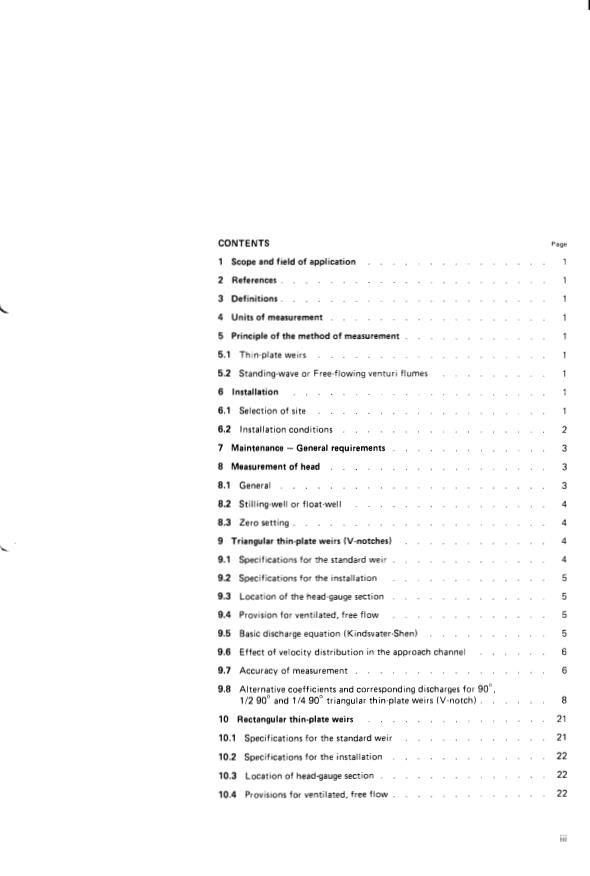
CONTENTS Page
1 Scope and field of application . 1
2 References . 1
3 Definitions. . 1
k
4 Units of measurement . 1
5 Principle of the method of measurement . 1
5.1 Thin-plate weirs . 1
5.2 Standing-wave or Free-flowing venturi flumes . 1
6 Installation . 1
6.1 Selection of site .
.. 1
6.2 Installation conditions . 2
7 Maintenance - General requirements . 3
8 Measurement of head . 3
8.1 General . 3
8.2 Stilling-well or float-well . 4
8.3 Zero setting . 4
9 Triangular thin-plate weirs (V-notches) . 4
9.1 Specifications for the standard weir . 4
9.2 Specifications for the installation . 5
9.3 Location of the head-gauge section . 5
9.4 Provision for ventilated, free flow . 5
9.5 Basic discharge equation (Kindsvater-Shen) . 5
9.6 Effect of velocity distribution in the approach channel . 6
9.7 Accuracy of measurement . 6
9.8 Alternative coefficients and corresponding discharges for 90".
1/2 90" and 1/4 90" triangular thin-plate weirs (V-notch) .
10 Rectangular thin-plate weirs . 21
10.1 Specifications for the standard weir . 21
10.2 Specifications for the installation . 22
10.3 Location of head-gauge section . 22
10.4 Provisions for ventilated, free flow . 22
...
III
Page
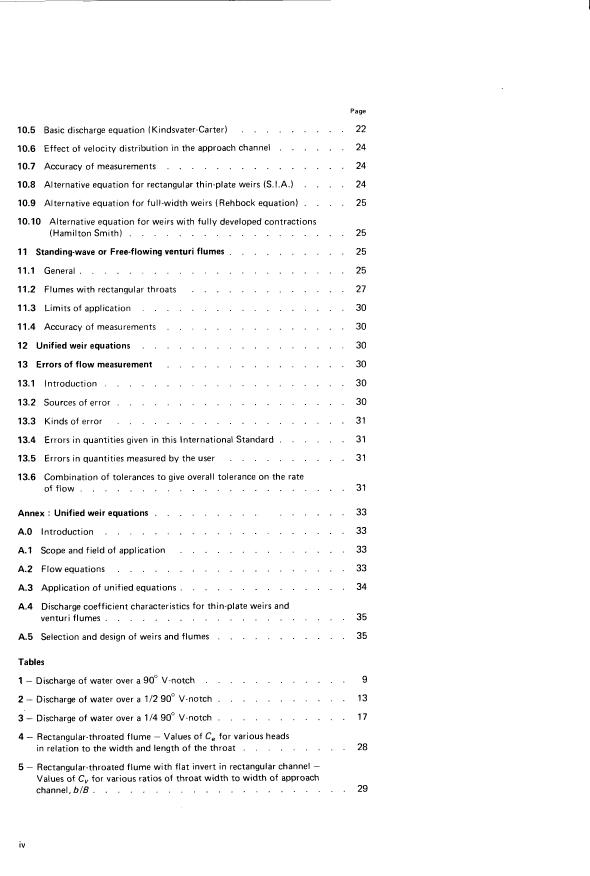
10.5 Basic discharge equation (Kindsvater-Carter) . 22
10.6 Effect of velocity distribution in the approach channel . 24
10.7 Accuracy of measurements . 24
10.8 Alternative equation for rectangular thin-plate weirs (S.I.A.) . 24
10.9 Alternative equation for full-width weirs (Rehbock equation) . 25
10.10 Alternative equation for weirs with fully developed contractions
(Hamilton Smith) . 25
11 Standing-wave or Free-flowing venturi flumes . 25
11.1 General . 25
11.2 Flumes with rectangular throats . 27
11.3 Limits of application . 30
11.4 Accuracy of measurements . 30
12 Unified weir equations . 30
13 Errors of flow measurement . 30
13.1 Introduction . 30
13.2 Sources of error . 30
13.3 Kindsof error . 31
13.4 Errors in quantities given in this International Standard . 31
13.5 Errors in quantities measured by the user . 31
13.6 Combination of tolerances to give overall tolerance on the rate
offlow . 31
Annex : Unified weir equations . . 33
A.0 Introduction . 33
A.l Scope and field of application . 33
A.2 Flow equations . 33
A.3 Application of unified equations . 34
A.4 Discharge coefficient characteristics for thin-plate weirs and
venturi flumes . 35
A.5 Selection and design of weirs and flumes . 35
Tables
1 . Discharge of water over a 90" V-notch . 9
2 . Discharge of water over a 1/2 90" V-notch .
3 . Discharge of water over a 1/4 90" V-notch . , . 17
4 . Rectangular-throated flume . Values of Ce for various heads
......... 28
in relation to the width and length of the throat
5 . Rectangular-throated flume with flat invert in rectangular channel .
Values of C, for various ratios of throat width to width of approach
channel. b/B . 29
iv
Page
6 . Rectangular-throated flume with raised invert (hump) in
rectangular channel . Values of C, in relation to the ratio blB.
the height of the humpp and the measured depth h in the
approachchannel . 29
7 . Velocity-of-approach coefficients . 34
8 . Discharge coefficients Ce for thin-plate weirs
(equation 45)) . , . 35
9 . Area ratios derived from specific Froude numbers related to the
upstream section of thin-plate weirs and venturi flumes . 36
Figures
1 . Example of a regular velocity profile in the approach channel . 2
'c .
2 . Triangular thin-plate weir, V-notch . 4
............ 6
3 . Coefficient of discharge Ce (a = 90")
........ 7
4 . Coefficient of discharge Ce related to notch angle
............. 7
5 . Value of kh related to notch angle
6 . Rectangular thin-plate-weir . 21
7 . Coefficient of discharge Ce . 23
8 . Value of kb related to b/B . 23
9 . Diagram showing geometrical dimensions of rectangular-throated flume
in rectangular channel . . 26
V
INTERNATIONAL STANDARD IS0 1438-1975 (E)
Liquid flow measurement in open channels using thin-plate
weirs and venturi flumes
1 SCOPE AND FIELD OF APPLICATION
b is the width of the opening;
This International Standard specifies methods for the h is the measured head over the weir
measurement of liquid flow in open channels using
case of triangular thin-plate weirs, for the sake of
In the
rectangular thin-plate weirs, triangular thin-plate weirs
convenience b is replaced in terms of h and the tangent of
(V-notch) and venturi flumes. The flow conditions
the angle of the apex.
L'
considered are limited to steady flows which are uniquely
dependent on the upstream head. Thus, submerged flows,
5.2 Standing-wave or Free-flowing venturi flumes
which depend on downstream as well as upstream water
levels, are not considered herein.
The discharge is measured by building a streamlined
structure to form a contraction and observing only the
upstream head and then employing a functional
2 REFERENCES
relationship between the rate of flow and the upstream
ISOIR 541, Measurement of fluid flow by means of orifice
head, since under the conditions in which critical flow
plates and nozzles.
occurs at the throat, the discharge depends only on the
upstream head.
IS0 748, Liquid flow measurement in open channels -
Velocity-area methods.
IS0 772, Liquid flow measurement in open
6 INSTALLATION
channels -Vocabulary and symbols.
6.1 Selection of site
3 DEFINITIONS
A preliminary survey shall be made of the physical and
hydraulic features of the proposed site, to check that it
For the purposes of this International Standard, the
conforms (or may be made to conform) to the
definitions given in IS0 772 apply.
requirements necessary for measurement by weirs or
'L
flumes.
4 UNITS OF MEASUREMENT
Particular attention shall be paid to the following features
The units of measurement used in this International
in selecting the site :
Standard are seconds and metres (feet).
a) availability of an adequate length of channel of
regular cross-section;
5 PRINCIPLE OF THE METHOD OF MEASUREMENT
b ) the e xis t i ng ve I oc i t y dis t r i bu t i on ;
Thin-plate weirs
5.1
c) the avoidance of a steep channel, if possible;
The discharge is measured by interposing a thin-plate weir
d) the effects of any increased upstream water levels
with an opening and observing the head over the weir and
due to the measuring structure;
employing a known unique functional relationship between
the rate of flow and the head over the weir. e) the conditions downstream including such influences
as tides, confluences with other streams, sluice-gates,
The original basic discharge equation is attributable to
mill-dams and other controlling features which might
Poleni and may be expressed in the form :
cause drowning;
0 = Cbh3/2
f) the impermeability of the ground on which the
structure is to be founded, and the necessity for piling,
where
grouting or other sealing-in river installations;
0 is the discharge;
9) the necessity for flood-banks to confine the
C is the coefficient of discharge; maximum discharge to the channel;
IS0 1438-1975 (E)
to checking the distribution after the installation of the
h) the stability of the banks, and the necessity for
weir or flume, and to improving it if necessary.
trimming and/or revetment in natural channels;
i) the clearance of rocks or boulders from the bed of Several methods are available for obtaining a more precise
indication of irregular velocity distribution : velocity-rods,
the approach channels;
floats or concentrations of dye can be used in small
j) effect of wind, which can have a considerable effect
channels, the latter being useful in checking conditions at
on the flow over a river, weir or flume, especially when
the bottom of the channel. A complete and quantitative
these are wide and the head is small and when the
assessment of velocity distribution may be made by means
prevailing wind is in a transverse direction.
of a current-meter. Complete information about the use of
current-meters is given in IS0 748.
site does not possess the characteristics necessary for
If the
satisfactory measurement, the site shall be rejected unless
suitable improvements are practicable.
6.2 Installation conditions
If an inspection of the stream shows that the existing
velocity distribution is regular (see figure 1 for typical
6.2.1 General
regular open-channel velocity distribution), then it may be
assumed that the velocity distribution will remain
The complete measuring installation consists of an
satisfactory after the construction of the weir or flume.
approach channel, a measuring structure and a downstream
channel. The conditions of each of these three components
If the existing velocity distribution is irregular and no other
affect the overall accuracy of the measurements.
site for a gauge is feasible, due consideration shall be given
Velocity profile obtained in 360 crn (12 ft) wide channel
Actual width = 358.75 crn (1 1 ft 11 1/2 in)
Depth of water = 74 crn (29.6 in1
75 (30)
70 (28)
60 (24)
50 (201
-
C
- .-
E
40 (16)
B
Y-
O
.% 30 (12)
D
20 (8)
10 (4)
O
30 (1) 60 (2) 90 (3) 120 (4) 150 (5) 180 (6) 210 (7) 240 (8) 270 (9) 300 (10) 330 (11) 360 (12)
Width of channel, cm (ft)
FIGURE 1 - Example of a regular velocity profile in the approach channel
IS0 1438-1975 (E)
Installation requirements include such features as finish of If a standing wave occurs within this distance, the approach
the weir or flume, cross-sectional shape of channel, channel conditions and/or gauging device shall be modified if
roughness, influence of control devices upstream or measurement errors are to be avoided.
downstream of the gauging structure.
6.2.3 Measuring structure
The distribution and direction of velocity have an
important influence on the performance of a weir or flume,
The structure shall be rigid and watertight and capable of
these being determined by the features mentioned above.
withstanding flood flow conditions without distortion or
fracture. It shall be at right angles to the direction of flow
Once an installation has been designed, the user shall
and shall conform to the dimensions given in the relevant
prevent any change being made which could affect the
clauses.
discharge characteristics.
NOTE - In the case of a thin-plate weir, the wall on which it is built
6.2.2 Approach channel
shall be free from projections, and its upstream face shall not
On all installations the flow in the approach channel shall protrude beyond the face of the weir On the downstream side, the
structure shall be such that it does not interfere with the aeration of
be smooth and free from disturbance and shall have a
the nappe.
velocity distribution as normal as possible over the
cross-sectional area. This can usually be verified by
6.2.4 Downstream of the structure
inspection or measurement. In the case of natural streams
L.
or rivers this can only be attained by having a long straight
The channel downstream of the structure is usually of no
approach channel free from projections either at the side or
importance as such, provided that the weir or flume has
on the bottom. Unless otherwise specified in the
been so designed that it cannot become drowned under the
appropriate clauses, the following general requirements
operating conditions.
shall be complied with.
The altered flow conditions due to the construction of the
The altered flow-conditions due to the construction of the
weir or flume might have the effect of building up shoals of
weir or flume might have the effect of building up shoals of
debris immediately downstream of the structure, which in
debris upstream of the structure, which in time might affect
time might raise the water level sufficiently to drown the
the flow conditions. The likely consequential changes in the
weir or flume. Any accumulation of debris downstream of
water level shall be taken into account in the design of the
the structure shall therefore be removed.
gauging stations.
In an artificial channel the cross-section shall be uniform
7 MAINTENANCE -GENERAL REQUIREMENTS
and the channel shall be straight for a length equal to at
least 10 times its width, if the width of the weir or flume Maintenance of the measuring structure and the approach
throat is equal to or greater than half the width of the channel is important to secure accurate continuous
channel. The length of the channel can be reduced if the
measurements.
width of the weir or flume throat is less than half the width
is essential that the approach channels to both weirs and
It
of the channel.
flumes be kept clean and free from silt and vegetation as far
In a natural stream or river the cross-section shall be
as practicable for at least the distance specified in 6.2.2.
‘O,
reasonably uniform and the channel shall be straight for a
The float-well, and the entry from the approach channel
length as required for an artificial channel.
shall also be kept clean and free from deposits.
If the entry to the approach channel is through a bend or if
The throat and the curved entry to a flume shall be kept
the flow is discharged into the channel through a conduit or
clean and free from algal growths.
smaller cross-section, or at an angle, then a longer length of
The weir structure shall be kept clean and free from
straight approach channel may be required to achieve an
clinging debris and care shall be taken in the process of
even velocity distribution.
cleaning to avoid damage to the weir crest. Thin-plate weirs
In an artificial channel where there is no debris or matter
shall be examined periodically for damage.
carried in suspension, suitable flow conditions can often be
provided by suitably placed baffles formed by vertical laths,
8 MEASUREMENT OF HEAD
but there shall be no baffle nearer to the point of
measurement than 10 times the maximum head to be
measured.
8.1 General
Under certain conditions, a standing wave may occur The head upstream of the measuring structure may be
measured by a hook-gauge, point-gauge or staff-gauge where
upstream of the gauging device, for example, if the
spot measurements are required, or by a float-operated
approach channel is steep. Provided this wave is at a
recording-gauge where a continuous record is required. The
distance of not less than 30 times the maximum head
location of the head measurement station is dealt with in
upstream, flow measurement will be feasible, subject to
9.3, 10.3 and 11.1.5, and in many cases it is preferable to
confirmation that a regular velocity distribution exists at
measure heads in a separate stilling-well to reduce the
the gauging station. (See 11.1.4 e) for exception in case of
effects of surface irregularities.
venturi flumes.)
IS0 1438-1975 (E)
float-well arrangement may include an intermediate
The discharges given by the working equation are
chamber between the stilling-well and the approach channel
volumetric figures, and the liquid density does not affect
of similar proportions to the stilling-well to enable silt and
the volumetric discharge for a given head provided the
other solids to settle out.
operative head is gauged in liquid of identical density. If
the gauging is carried out in a separate well, a correction for
the difference in density may be necessary if the 8.3 Zero setting
temperature in the well is significantly different from that
A means of checking the zero setting of the head-measuring
of the flowing liquid. However, it is assumed herein that the
device shall be provided consisting of a pointer with its
densities are equal.
points set exactly level with the sill of the weir or the invert
of the flume throat and fixed permanently in the approach
8.2 Stilling-well or float-well
channel or alternatively in the stilling-well or float-well
where provided.
Where provided, the stilling-well shall be vertical and have a
minimum margin of 60 cm (2 ft) over the maximum water
A zero check based on the level of the water when the flow
level estimated to be recorded in the well.
ceases is liable to serious errors from surface tension effects
and shall not be used.
It shall be connected to the river by an inlet pipe or slot,
large enough to permit the water in the well to follow the
As the size of the weir or flume and the head on it reduces,
rise and fall of head without significant delay.
small errors in construction and in the zero setting and
reading of the head measuring device become of greater
The connecting pipe or slot shall, however, be as small as
importance.
possible consistent with ease of maintenance, or shall
alternatively be fitted with a constriction, to damp out
oscillations due to short amplitude wave. This will be
9 TRIANGULAR THIN-PLATE WEIRS (V-NOTCHES)
necessary for example, if the chart of the recorder canot be
read to within k 6 mm (0.02ft).
9.1 Specifications for the standard weir
The well and the connecting pipe or slot shall be watertight.
Within the range of conditions for which the available
Where provided for the accomodation of the float of a level
experimental data are competent, the triangular thin-plate
recorder, the well shall be of adequate diameter and depth
weir (V-notch) is one of the most precise flow-measuring
to accommodate the float.
devices. It is inexpensive and simple to construct and
The well shall also be deep enough to accommodate any silt install. A standard triangular thin-plate weir (V-notch) is
-
which may enter, without the float grounding. The shown in figure 2.
FIGURE 2 - Triangular thin-plate weir, V-notch
IS0 1438-1975 (E)
The standard weir shall consist of a symmetrical, V-shaped tailwater level shall be IOW enough not to interfere with the
notch in a vertical, thin-plate. The line which bisects the ventilation or free discharge of the jet.
angle of the notch shall be vertical and equidistant from the
NOTE - Free (unsubmerged) flow IS defined here as flow which is
sides of the approach channel. The weir plate shall be
independent of variations In tailwater level. It IS recommended that
smooth and plane, especially on the upstream side, and it
the tailwater level should be at least 0.1 m (0.3 ft) below the lowest
shall be perpendicular to the sides as well as the bottom of
point of the notch.
the channel.
NOTE - In this International Standard a "smooth" surface shall be
eauivalent in surface finish to that of rolled sheet metal.
9.5 Basic discharge equation (Kindsvater-Shen)
The crest surfaces shall be plane surfaces of width
The basic equation of discharge for the triangular thin-plate
(measured perpendicular to the upstream face of the plate)
is the equation of Kindsvater-Shen.
weir, (V-notch)
between 1 and 2 mm (0.04 and 0.08 in), which shall form a
sharp right-angled edge at their intersection with the
upstream face of the weir plate. These surfaces shall be
machined (or filed) perpendicular to the upstream face; the
edges shall be free from burrs and scratches, and untouched
where
by abrasive cloth or paper. The downstream edges of the
weir shall be chamfered if the weir plate is thicker than the
O is the discharge volume rate in cubic metres per
allowable crest width. The surface of the chamfer shall
second (cubic feet per second);
make an angle of not less than 45O with the crest surface.
The weir plate IS usually made of metal, preferably of that
Ce is the coefficient of discharge (non-dimensional);
kind of metal which can resist erosion and corrosion.
is the acceleration of free fall in metres per second
g
squared (feet per second squared);
9.2 Specifications for the installation (Y is the angle included between the sides of the notch
(radians or degrees);
In addition to the requirements specified in clause 6, the
following conditions shall be satisfied :
he is the effective piezometric head referred to the
vertex of the notch in metres (feet).
The weir shall be located in a straight, smooth,
For water at ordinary temperatures, i.e. 5 to 30 "C (40 to
horizontal (level-bottomed), rectangular channel. As an
exception, when the effective opening of the weir is so 85 OF) the coefficient of discharge, Ce, has been
small in comparison with the upstream channel that the determined by experiment as a function of three variables,
approach velocity is negligible, the shape of the channel
is not of significance. The channel upstream from the
weir, described hereinafter as the standard approach
channel, shall be of sufficient length to develop the
normal (uniform flow) velocity distribution for all
where
discharges, or it shall be so arranged and equipped with
baffles and screens as to simulate the normal velocity
h is the measured head in metres (feet);
distribution and normal turbulence in the approach
p is the apex height in metres (feet);
channel (see 6.2.2).
B is the width of the upstream channel in metres (feet).
The effective head, be in equation (l), is defined by the
9.3 Location of the head-gauge section
equation
Piezometers or a point-gauge station for the measurement
of the head on the weir shall be located a sufficient distance
he = h + kh . . . (3)
upstream from the weir to avoid the region of surface
draw-down. On the other hand, they shall be close enough
where kh is an experimentally determined quantity in
to the weir for the energy loss between the section of
metres (feet) which compensates for the influence of
measurement and the weir to be negligible. It is
surface tension and viscosity.
recommended that the head-measurement section be
located at a distance equal to three to four times the
maximum head (3h,,, to 4h,,,) upstream from the weir.
9.5.1 Evaluation of ce and kh
Experimentally determined values of the coefficients
9.4 Provision for ventilated, free flow
required to describe the flow of water over a full practical
Provisions for ventilation of the discharging jet shall ensure range of values of hlp and p/B are available for only one
value of (Y i.e. 90".
that the pressure on the nappe surface is atmospheric. The
IS0 1438-1975 (E)
it is recommended that a constant value of kh = 0.85 mm Practical limitations on the magnitude of h are related to
(0.002 8 ft) be used with the values of Ce shown in the "clinging nappe" phenomenon which characterizes low
figure 3. heads. To ensure a freely discharging stable nappe, a
minimum value of h = 0.06 m (0.2 ft) is recommended for
Triangular thin-plate weirs (V-notches) covering a range of
notch angles between 20" to 100". It is recommended that
values of (Y from IO" to 120" have been studied by a large
p be limited to values greater than 0,l m (0.3 ft).
number of investigators. However, the range of values of
plB and hlp covered by the available data is quite limited.
The conditions covered by virtually all of the experimental
9.6 Effect of velocity distribution in the approach channel
data available for triangular thin-plate weirs (V-notches)
covering a range of values of ai from IO" to 120" (except
The specifications for the standard installation include the
those for ai = 90") are within limits in which Ce is a
requirement that the velocity in the channel upstream from
function of CY alone. For such weirs, which can be described
the weir be such as to simulate the normal velocity
as "fully contracted", the available experimental data give
distribution in a smooth, horizontal, rectangular channel.
the values of Ce shown in figure4. The corresponding
When the velocity distribution in the approach channel
values of kh are shown in figure 5. In both figures, the
differs considerably from the normal, the discharge
curves are shown with dashed lines for values of CY less than
character istics are altered. Consequently, flow
20" or greater than looo. Within the range CY = 20" to IOO",
measurements made with non-standard weir installations
coefficients are recommended for standard flow
are subject to error.
measurements. Outside this range the coefficients are not
well defined.
In the range of conditions represented by figure 4, the
influence of approach channel velocity distribution may be
9.5.2 Practical limitations on h/p, p/B, h and p considered to be negligible.
Practical limitations on hip and piB are related to the
observation that head-measurement difficulties and errors
9.7 Accuracy of measurement
result from surges and waves which occur in the approach
channel when the velocity of approach is large in
The relative accuracy of flow measurements made with a
comparison with the depth of flow. The available
standard triangular thin-plate weir (V-notch) depends on
experimental data are not adequate to establish the limiting
the accuracy of the head measurement, the notch-angle
values of hlp and plB which are associated with this
measurement, and on the accuracy of the coefficients as
condition. The range of values of hlp and plB represented
they apply to the weir in use.
by the curves in figure3 (for ai = 90" only) is a full,
practical range.
With reasonable care and skill in the construction and
installation of a standard weir, the error in the coefficient
NOTE - Limitations on h/p corresponding to smaller values of p/B
of discharge can be expected to be of the order of 1 ,O %.
have not been established, but it is assumed that the maximum
permissible value of h/p increases as p/B decreases. Limitations on
The method by which the error in the coefficients is to be
h/p shall be determined on the basis of the flow characteristics and
combined with other sources of error is explained in
related conditions which influence the accuracy of head
clause 13 which deals with the estimation of errors.
measurement.
0.62
0,6 1
0.60
0,59
0,58
0.57
O 0,2 0,4 0,6 0.8 1,0 1.2 1,4 1,6 1,8 2.0
Value of hlp
FIGURE 3 - Coefficient of discharge Ce (a = 90")
IS0 1438-1975 (E)
0,61
1 1
NOTE - The influence of h/p and p/B is neglected in this figure,
The influence for a 90" V-notch only is indicated in figure 3.
+
O)
>m 0.58
0.57
0.56
O 20 40 60 80 1 O0 120
Value of notch angle ((U), degrees
FIGURE 4 - Coefficient of discharge Ce related to notch angle
E
E3
&
-Y
r
O
al
-
T2
O 20 40 60 80 1 O0
Value of notch angle (a), degrees
FIGURE 5 - Value of kh related to notch angle
IS0 1438-1975 (E)
In general, calibration experiments have been carried out on 90" notch
112 0 = Ce -fi h5/2
. (5)
model structures of small dimensions and when transferred
to larger structures there may be small changes in the
discharge coefficients due to scale effect.
II4 90" notch Q=Ce-fih5/2 . . . (6)
The coefficient values are given in tables 1, 2 and 3 together
9.8 Alternative coefficients and corresponding discharges
with the corresponding discharge values.
for go", 1/2 90" and 114 90" triangular thin-plate weirs
NOTE - The values for Ce and O given in tables 1, 2 and 3 are
(V-notch)
h, and therefore do
based on the actual values of measured head,
not require a correction in h, Ce or O.
Three sizes of triangular thin-plate weir (V-notch) are
The general installation conditions shall comply with 9.1 to
recommended :
9.4. The following practical limitations on h, p, hlp, B and
hlB are to be observed in the application of the alternative
a) The 90" notch in which the dimension across the top
coefficient and discharge values given in tables 1, 2 and 3 :
is twice the vertical depth [tg (d2) = 11.
a) h shall not be less than 0,05 m (2 in) or more than
b) The 1/2 90" notch (a = 53" 8') in which the
0.38 m (15 in);
dimension at the top is equal to the vertical depth
[tg (a/2) = 0,5].
b) p shall exceed 0,45 m (I .5 ft);
c) The 1/4 90" notch (a = 28" 4') in which the c) h/p shall be less than or equal to 0,4;
dimension across the top is equal to half the vertical
d) B shall exceed 1.2 m (4.0 ft);
depth [tg (a/2) = 0.251.
e) h/B shall be less than or equal to 0,20.
If the bed and walls of the approach channel are remote
With reasonable skill and care in the construction and
from the notch, the channel boundaries have no significant
installation of a standard triangular weir (V-notch), the
influence on the contraction of the nappe, which may then
tables for the coefficients are expected to have an accuracy
be said to be fully contracted. As an alternative to the
of 1 ,O %.
equation given in 9.5 and the associated coefficients given
in figures 4 and 5, the following equations may be used :
The method by which the error in the coefficient is to be
combined with the other sources of error is explained in
90" notch
clause 13 which deals with the estimation of errors.
-
IS0 1438-1975 (E)
TABLE 1 - Discharge of water over a 90 V-notch
a) METRIC UNITS
0 - 2,362 5 Ce h5/2
ig 9,806 6 rn/s2)
*
Head Coefficient Discharge
Head Coefficient
Discharge
h
0 h
ce Q
ce
m
rn3h x 10 m
rn3/s x 10
0,060
0,603 2 0,012 57 0,120
0,588 5
0,069 35
O .O6 1
0,602 8 0,013 O9 0,121
0,588 3 0,070 79
0,062
0,602 3 0,013 62
0,122 0.588 2
0,072 24
0,063 0,601 9 0,014 17
0,123 0.588 1
0,073 72
O ,064
0,601 5 0,014 73
0,124 0,588 O
0.075 22
0,065 0,601 2 0.01 5 30
0,125 0,588 O
0,076 73
0,066 0,600 8 0.01 5 88
0,126 0.587 9
0.078 27
0,067 0,600 5 0.01 6 48
0,127 0,587 8
0.079 82
0,068 0,600 1 0.01 7 1 O
0.1 28 0.587 7
0,081 39
0.069 0,599 8 0,017 72
0,129 0.587 6
0.082 98
0,070 0,599 4 0.018 36
0,130 0.587 6
0.084 58
O ,O7 1 0,599 O 0,019 O1
0,131 0,587 5
0,086 21
0,072 0,598 7 0,019 67
0,132 0,587 4
0,087 85
0,073 0,598 3 0,020 35
0,133 0,587 3
0,089 51
0,074 0,598 O 0,021 05
0,134 0,587 2
0,091 19
0,075 0,597 8 0,021 76
0,135 0.587 2
0,092 89
0,076 0,597 5 0,022 48
0,136 0.587 1
0,094 61
0,077 0,597 3 0,023 22
0,137 0.587 O 0,096 34
0,078
0,597 O 0,023 97
0,138 0,586 9 0.098 10
0,079 0,596 7
0,024 73 0,139
0.586 9 0,099 87
0,080 0,596 4
0,025 51 0,140
0,586 8 0,101 67
0,081 0,596 1
0,026 30 0,141
0.586 7 0.1 03 48
0,082 0,595 8
0,027 10 0,142 0,586 7
0.1 05 32
0.083 0,595 5
0,027 92 0,143
0,586 6 0.107 17
O ,084
0,595 3 0,028 76 0,144 0,586 6
0,109 04
0,085 0,595 O
0,029 61 0.145
0,586 5 0.1 1 O 93
0.086 0,594 8
0,030 48 0,146 0,586 4
0.1 12 84
0.087 0,594 5 0,031 36
0,147 0,586 3
0.1 14 76
0.088 0,594 2 0,032 25
0.148 0.586 2
0.1 16 71
0.089 0,594 O 0,033 16
0,149 0,586 2
0.1 18 67
0,090 0,593 7
0,034 O9 0.1 50 0.586 1
0,120 66
O ,O9 1 0,593 5 0,035 03
0,151 0.586 1
0.1 22 67
0,092 0,593 3
0,035 98 0.1 52 0,586 O
0,124 71
0,093 0,593 1
0,036 96 0,153
0,586 O 0.1 26 76
0,094 0,592 9
0,037 95 0,154
0,585 9 0.1 28 83
0,095 0,592 7
0,038 95 0,155
0,585 9 0.1 30 93
0,096 0,592 5
0,039 97 0,156
0,585 9 0.1 33 04
O ,O9 7 0,592 3
0,041 O1 0,157
0,585 8 0,135 17
0.098 1
0,592 0,042 06 0.1 58
0,585 8 0.1 37 32
O ,099 0,591 9
0,043 12 0,159
0.585 7 0.1 39 50
0,100
0,591 7 0,044 20 0,160
0,585 7 0,141 69
0,101
0,591 4 0,045 30
0,161 0.585 7 0,143 91
0,102 0,591 2 0,046 41 0,162
0,585 6 0,146 14
0,103 0,591 O 0,047 54
0,163 0.585 6 0,148 40
0,104
0,590 8 0,048 69 0,164
0,585 5 0.1 50 67
0,105 0,590 6 0,049 85
0,165 0,585 5 0,152 97
0,106
0,590 4 0,051 03 0,166
0,585 5 0,155 29
0,107 2
0,590 0,052 22 0,167
0.585 4 0.1 57 63
0.108 0,590 1
0,053 44 0,168
0,585 4 0,159 99
0,109 0.589 9 0,054 67
0,169 0,585 3
0,162 37
0,110 0,589 8 0,055 92
0.1 70 0,585 3 0,164 77
0.1 11 0,589 7 0.057 19
0,171 0.585 3 0,167 19
0,112
0,589 6 0,058 47
0.1 72 0,585 2 0,169 64
0,113
0,589 4 0,059 77 0,173
0,585 2 0,172 10
0,114 0,589 2 0,061 O8 0,174
0.585 1 0.1 74 59
0,115 0,589 1 0,062 42 0,175
0,585 1 0.1 77 O9
0,116 0.589 O
0,063 77 0.1 76 0,585 1
0.1 79 63
0,117
0.588 9 0,065 14 0.177 0,585 1
0,182 19
0.1 18
0.588 8 0,066 53 0,178 0.585 1
0.1 84 78
0.1 19 0,588 6 0,067 93
0.585 1
0,179 0.1 87 38
E!
IS0 1438.1975 (E)
Head
h
U,l>iC II 'AG t
0 , 'I 8 ' :, ',>,.I 0
, LI?,.: I,
O ,I 8 :/
0 18.:
0,184
0,18?
0.1xt;
0.1F'
.,,j i
I' :
, '3
II,'<,
[I ,19 5:
0 199
C,5>:4 '1
0.200 IJ.4 /O U0
0,2Li: O.il84 9 11.480 6'3
0,707 0 485 2)
0,584 8
(!,48!! "1
O ,703 (1,584 r'
0,584 F
O ,704 0.494 si-;
9,584 d 0,499 LH
L1.58.l 3 'J.504 WJ
fi584 8 I, 50
0.20E !1,'184 Fi (J.5 1
(J y.84 i:
0.209 'J.51
0,2 10 0.584 Y ,) 5LJJ I /
0.21 1 0,584 8 0,528 O:'
0,212 (i.584 ii (1 532 9 I
0.11 3 9.584 ,i 1J.537 81
0.214 (i 5,811 : 0 547 763
0.21 5 !).584 7 3.54 7 I.'
0,216 0.584 I U 584 I> 0.552 I2
0.71 I 0,584 (1 584 (, 0.55/ 14
0.5ti.l (>
0,218 0,584 7 ii.562 82
0,219 0,584 7 0 2 7(1 0.584 7
0,720 0,584 I 0,280 0,504 /
0.221 0,584 I U.28 I 0.584 i
0,277 0,584 ? 0.584 I
0,223 0,584 i 0.584 I
0,274 0.584 ? 0,584 7 0.593 J5
0,725 0.584 6 û.285 0,584 7 0.59)': 99
0,226 0,5811 ii 0,286 0.584 7 0,604 25
0,584 6 0.287 0.584 ? 0.609 55
0,227
0.278 11,584 6 0.288 0,584 I 0,614 87
0,584 Ci 0.289 0.584 7 0,620 23
0,229
0,230 0,584 ti 0 ,290 0,584 7 0,625 60
0.23.i 0.584 6 0.291 0.584 7 0,631 Gi
0,232 0.584 6 0.292 0,584 7 0.636 45
0,041 95
0,233 0,584 t3 0.293 0,584 i
0.584 8 1i.647 48
0,734 0,584 6 0.294
0,653 O3
0,235 0,584 6 0.295 0.584 3
O.Li84 8 0.658 58
0,236 0.584 6
$3 584 (i 0 664 li,
0,237
(J 534 6 0,669 IF
0,238
0.675 39
0.239 0.584 6
-
IS0 1438-1975 (E)
TABLE 1 (cononued)
Head
Coefficient Discharge Head Coefficient Discharge
h Q h
ce
rn rn3/s x io m
m3is Y 10
0,300 0,584 8 0,681 06 0,350 0,585 2 1,001 92
0,351
0,301 0,584 8 0,686 75 0,585 2 1,009 12
0,302 0,584 8 0,692 46 0,352 0,585 2 1 .O1 6 33
0,303 0,584 8 0,698 21 0,353 0,585 2 1,023 56
0,304 0,584 8 0,703 98 0,354 0,585 2 1,030 82
0,305 0,584 8 0,709 80 0,355 0,585 2 1,038 12
0,306 0,584 8 0,715 68 0,356 0,585 2 1,045 45
0,307 0,584 9 0,721 59 0.357 0,585 2 1,052 80
O ,308 0,584 9 0.727 50 0,358 0,585 2 1,060 19
O ,309 0,584 9 0,733 41 0,359 0.585 2 1,067 67
0,310 0,584 9 0,739 36 0,360 0,585 3 1,075 19
0.31 1 0,584 9 0.745 34 0,361 0,585 3 1,082 73
0.31 2 0,584 9 0,751 35 0,362
0.585 3 1,090 24
0,313 0,584 9 0,757 38 0,363 1,097 78
0,585 3
0,314 0,364
0,584 9 0,763 44 0,585 3 1,105 36
0,365
0.31 5 0,584 9 0,769 54 0,585 3 1,112 97
0,316 0,584 9 0.775 66 0,366 0,585 3 1,120 63
0,317 0,367
0,584 9 0,781 81 0,585 3 1,128 37
0,318 0,584 9 0,788 02 0,368 0,585 4 1,136 15
0,319
0,585 O 0.794 28 0,369 0,585 4 1,143 91
0,320 0.585 O 0,800 57 0,370 0,585 4 1,151 67
0,321 0,585 O 0,806 85 0,371 0,585 4 1,15947
0,372
0,322 0,585 O 0.813 14 0,585 4 1,167 30
0,323 0,585 O 0,819 47 0,373 0,585 4 1,175 16
0,324 0.374
0,585 O 0,825 83 0.585 4 1,183 10
0,325 0.832 22 1,191 11
0,585 O 0,375 0,585 5
0,326 0,585 O 0.838 63 0,376 0,585 5 1,199 14
0,327 0,585 O 0.845 08 0,377 0,585 5 1,207 12
0,328 0,585 O 0,851 55 0,378 0,585 5 1,215 15
0,329 0,585 O 0,858 06 0,379 0,585 5 1,223 20
0,330 0,585 O 0,864 59 0,380 0,585 5 1,231 28
0,381
0,331 0,585 O 0,871 16 0.585 5 1,239 40
0,332 0,585 O 0,877 75
0,333 0,585 O 0,884 38
0,334 0,585 O 0,891 03
0,335 0,585 O 0.897 72
0,904 48
0,336 0,585 O
0,337 0,585 1 0.91 1 28
0,338
0,585 1 0,918 11
0,339 0,585 1 0,924 91
0,340
0,585 1 0,931 75
0,341
0,585 1 0,938 62
O ,342 0,585 1 0,945 51
0,343 0,585 1 0,952 44
0,344 0,585 1 0,959 40
0,345 0.585 1 0.966 38
0,346 0,585 1 0.973 40
O .34 7 0,585 1 0,980 45
0,348 0,585 1 0.987 53
0,349 0,585 1 0,994 71
IS0 1438-1975 (E)
TABLE 1 (concluded)
bl FEETUNITS Q = 4,279 1 Ce h5/2
(g - 32.174 ft/s21
~~
Head Coefficient Discharge Head Coefficient Discharge
Q
h Q h
ce ce
~~~
ft ft31s ft ft3h
0.20 0.602 8 0.046 14 0.80 0.584 6 1.43 1 98
0.21 0.601 5 0.052 02 0.81 0.584 6 1.477 15
0.22 0.600 4 0.058 33 0.82 0.584 6 1.523 16
0.23 0.599 4 0.065 07 0.83 0.584 6 1.570 02
0.24 0.598 3 0.072 24 0.84 0.584 6 1.617 74
0.25 0.597 5 0.079 90 0.85 0.584 6 1.666 32
0.26 0.596 6 0.088 O0 0.86 0.584 6 1.715 76
0.27 0.595 7 0.096 56 0.87 0.584 6 1.766 08
0.28 0.594 9 0.105 61 0.88 0.584 6 1.817 26
0.29 0.594 1 0.115 14 0.89 0.584 6 1.869 33
0.30 0.593 4 0.125 17 0.90 0.584 6 1.922 28
0.31 0.592 8 O. 135 73 0.9 1 0.584 6 1.976 19
0.32 0.592 2 0.146 79 0.92 0.584 7 2.031 21
0.33 0.591 5 0.158 35 0.93 0.584 7 2.086 86
0.34 0.590 9 O. 170 44 0.94 0.584 7 2.143 41
0.35 0.590 3 O. 183 06 0.95 0.584 7 2.200 87
0.36 0.589 8 O. 196 27 0.96 0.584 7 2.259 32
0.37 0.589 4 0.210 04 0.97 0.584 8 2.318 94
0.38 0.589 O 0.224 36 0.98 0.584 8 2.379 17
0.39 0.588 7 0.239 26 0.99 0.584 8 2.440 33
2.502 42
0.40 0.588 2 0.254 70 1 .O0 0.584 8
0.41 1 .O1 2.565 89
0.588 O 0.270 81 0.584 9
0.42 0.587 7 1 .O2 0.584 9 2.629 87
0.287 51
0.43 1 .O3 2.694 80
0.587 5 0.304 80 0.584 9
0.44 0.587 2 0.322 70 1 .O4 0.584 9 2.760 69
0.45 0.587 O 0.341 21 1 .O5 0.585 O 2.828 O1
0.46 0.586 8 0.360 35 1 .O6 0.585 O 2.895 83
0.47 0.586 6 0.380 15 1 .O? 0.585 O 2.964 61
0.48 0.586 4 0.400 53 1 .O8 0.585 O
3.034 36
0.49 0.586 1 0.421 55 1 .O9 0.585 O 3.105 O9
0.50 0.586 O 0.443 28 1.10 0.585 O 3.176 80
0.51 0.585 9 0.465 68 1.1 1 0.585 1 3.250 05
0.52 0.585 8 0.488 74 1.12 0.585 1 3.323 74
O. 53 0.585 6 0.51248 1.13 0.585 1 3.398 43
O. 54 0.585 5 0.536 88 1.14 0.585 1 3.474 12
0.55 0.585 4 1.15 0.585 2 3.551 41
0.561 97
0.56 0.585 3 0.587 74 1.16 0.585 2 3.629 12
0.57 0.585 2 0.614 21 1.17 0.585 2 3.707 84
0.58 0.585 1 0.641 43 1.18 0.585 3 3.787 97
0.59 0.585 1 0.669 44 1.19 0.585 3 3.869 O0
0.60 0.585 O 1.20 0.585 3 3.950 79
0.698 05
0.6 1 0.585 O 0.727 50 1.21 0.585 4 4.034 30
0.62 0.585 O 0.757 63 1.22 0.585 4 4.118 17
0.63 1.23 0.585 5 4.203 51
0.584 9 0.788 52
4.289 77
0.64 0.584 9 0.820 13 1.24 0.585 5
1.25 0.585 5 4.376 78
0.65 0.584 9 0.852 55
0.66 0.584 9 0.885 68
0.919 49
0.67 0.584 8
0.954 18
0.68 0.584 8
0.69 0.584 8
0.989 65
0.70 0.584 7
1 .O25 72
O.? 1 0.584 7
1 .O62 75
0.72 0.584 7 1.100 57
0.73 0.584 7 1.139 18
1.178 43
0.74 0.584 6
1.218 61
0.75 0.584 6
0.76 1.259 64
0.584 6
O.?? 0.584 6 1.301 48
0.78 0.584 6 1.344 15
0.79 0.584 6 1.387 65
NOTE - The number of sianificant fiaures or 5) aiven in the columns for coefficient and discharae should not be taken to imply a
-
corresponding accuracy in the knowledge of the values given, but only to assist in interpolation and analysis.
~ --
IS0 1438-1975 (E)
TABLE 2 - Discharge of water over a 112 90" V-notch
al METRIC UNITS 0 = 1,181 25 Ce h5I2
(g = 9,806 6 m/s2i
Head Coefficient Discharge Head Coefficient 1 Discharge
h Q
ce
II
m
m m3/ç x 10
0,060
0.6 11 4 0.006 37 0,120 0,598 9 0,035 29
0,061
0,611 1 0,006 63 0,121 0,598 8 0,036 02
0,062 0.6 1 O 8 0,006 91 O, 122 0,598 7 0,036 77
0,063
0,610 5 0.007 18 0,123 0,598 5 0.037 51
0,064 0,610 1 0,007 47 0,124 0,598 4 0.038 27
0,065 0,609 8 0.007 76 O, 125 0,598 2 0,039 04
0,066 0,609 5 0.008 06 0,126 0,598 1 0,039 82
0,067 0,609 2 0.008 36 0.1 27 0,598 O 0,040 60
0,068 0,609 O 0,008 67 O, 128 0,041 40
0,597 9
0,069 0,608 7 0,008 99 0.1 29 0.597 8 0,042 20
0,070 0,608 4 0.009 32 O, 130
0.597 6 0,043 02
0,071 0,608 1
0.009 65 0,131 0,597 5 0,043 84
0.072 0,607 9
0,009 99 0,132 0,597 3 0,044 67
0,073
0,607 6 0,010 33 0,133 0,597 2 0,045 51
0,074 0.607 3
0.010 69 0,134 0.597 1 0,046 36
0,075
0,607 1 0.01 1 05 O, 135 0,597 O 0,047 22
0,076 0,606 8 0,011 41
O, 136 0,596 8 0,048 O9
0.077 0,606 6
0,011 79 0.137 0,596 7 0,048 97
0.078 0,606 4 0,012 17
0,138 0,596 6 0,049 86
0,079 0,606 1 0,012 56
0,139 0,596 5 0,050 75
0,080 0,606 O 0.01 2 96 0,140 0,596 4 0,051 66
0,081
0,605 8 0,013 36 0,141 0,596 2 0,052 58
0,082
0,605 6 0,013 77 0,142 0,596 1 0,053 51
0,083 0,605 4
0,014 19 0,143 0,596 O 0,054 44
0,084
0,605 2 0,014 62 0,144 0,596 O 0,055 39
0,085 0,605 O
0.01 5 05 0,145 0,595 9 0,056 35
0,086
0,604 8 0,015 49 0,146 0,595 8 0,057 32
0,087 0,604 6
0,015 94 0,147 0,595 7 0.058 30
0,088 0,604 4
0,016 40 O, 148 0,595 6 0,059 29
0,089 0,604 2
0,016 86 0,149 0,595 6 0.060 29
0,090 0,604 O 0,017 34
O, 150 0,595 5 0,061 30
0,091 0,603 8 0,017 82
0,151 0,595 4 0,062 31
0,092 0,603 6
0,018 30 0,152 0,595 2 0,063 34
0,093 0,603 4
0,018 80 0,153 0,595 2 0,064 37
0,094 0,603 2
0,019 30 0,154 0,595 1 0,065 42
0,095 0,603 O
0,019 81 O, 155 0,595 O 0,066 48
0,096
0,602 8 0,020 33 0,156 0,594 9 0,067 55
0,097 0,602 6
0,020 86 0,157 0,594 8 0,068 63
0,098
0,602 4 0,021 39 O, 158 0,594 8 0,069 7 1
0,099
0,602 2 0.021 94 0,159 0,594 7 0,070 81
O, 1 O0
0,602 1 0.022 49 0,160 0,594 6 0,071 92
0,101 0.601 9 0,023 05 0,161 0,594 5 0,073 O4
O, 102 0,601 7 0,023 62 0.162 0,594 4 0,074 17
O, 103 0,601 6 0,024 20 O, 163 0,594 4 0,075 31
0,104
0,601 4 0,024 78 0,164 0,594 3 0,076 46
O, 105 0,601 3 0,025 37 O. 165 0,594 2
0.077 62
0,106 0,601 1 0,025 98 0,166 0,594 1 0,078 79
O, 107 0,600 9 0,026 59 0,167 0,594 1
0,079 98
O, 108 0,600 8 0.027 20 O, 168 0,594 O 0,081 17
O, 1 O9 0,600 6 0,027 83 O, 169 0,593 9 0,082 37
0.1 10 0,600 5 0,028 4
...
NORME INTERNATIONALE 1438
INTERNATIONAL ORGANIZATION FOR STANDARDIZATION MEYnYHAPOnHAR OPïAHH3AUMR Il0 CTAHnAPTH3AUHH .ORGANISATION INTERNATIONALE DE NORMALISATION
LL
Mesure de débit des liquides dans les canaux découverts
au moyen de déversoirs en mince paroi et de canaux venturi
Liquid flow measurement in open channels using thin-plate weirs and venturi flumes
Première édition - 1975-07-01
-
LL
-
CDU 532.57 : 627.133 Réf. no : IS0 1438-1975 (F)
In
PI
Descripteurs : écoulement de liquide en canal, écoulement liquide, tube venturi, déversoir. erreur, formule.
Cb
m
E
Prix basé sur 36 pages
AVANT-PROPOS
L'ISO (Organisation Internationale de Normalisation) est une fédération mondiale
d'organismes nationaux de normalisation (Comités Membres ISO). L'élaboration de
est confiée aux Comités Techniques ISO. Chaque Comité
Normes Internationales
Membre intéressé par une étude a le droit de faire partie du Comité Technique
correspondant. Les organisations internationales, gouvernementales et non
gouvernementales, en liaison avec I'ISO, participent également aux travaux.
Les Projets de Normes Internationales adoptes par les Comités Techniques sont
soumis aux Comités Membres pour approbation, avant leur acceptation comme
Normes Internationales par le Conseil de I'ISO.
La Norme Internationale IS0 1438 a été établie par le Comité Technique
ISO/TC 113, Mesure de débit des liquides dans les canaux découverts, et soumise
aux Comités Membres en juin 1968.
a été approuvée par les Comités Membres des pays suivants :
Elle
Afrique du Sud, Rép. d' Japon Suède
Espagne Nouvelle-Zélande Suisse
Pays-Bas Thaïlande
Inde
Iran Pérou Turquie
Israël Roumanie U.S.A.
Italie Royaume-Uni
Les Comités Membres des pays suivants ont désapprouvé le document pour des
raisons techniques :
Belgique
France
O Organisation Internationale de Normalisation, 1975 O
Imprimé en Suisse
II
SOMMAIRE Page
1 Objet et domaine d'application .
........ 1
2 Références .
........ 1
3 Définitions .
........ 1
4 Unités de mesure .
........ 1
5 Principe de la méthode de mesurage .
........ 1
5.1 Déversoirs en mince paroi . . 1
5.2 Canaux venturi à ressaut ou à écoulement dénoyé . 1
6 installation .
........ 1
6.1 Choix de l'emplacement . . 1
6.2 Conditions d'installation . . 3
7 Entretien -Spécifications générales .
........ 3
8 Mesurage de la charge . 4
8.1 Généralités . 4
8.2 Puits de mesurage ou puits a flotteur . . 4
8.3 Repéragedu zéro . 4
9 Déversoirs triangulaires en mince paroi . 4
9.1 Spécifications relatives au déversoir normalisé . 4
9.2 Spécifications relatives à l'installation . 5
9.3 Emplacement de la section de mesuragede lacharge . 5
9.4 Dispositions à prendre pour un écoulement libre aéré . 5
9.5 Formule fondamentale de debit (Kindsvater-Shen) . 6
9.6 Effet de la répartition des vitesses dans le chenal d'approche . 8
9.7 Précision du mesurage . 8
9.8 Autres coefficients et débits correspondants pour dfversoirs
triangulaires en mince paroi, à échancrure ((type 90 )),
((type 1 /2 90" )) et ((type 1 /4 90" )) . 8
10 Déversoirs rectangulaires en mince paroi . 21
10.1 Spécifications relatives au déversoir normalisé . 21
10.2 Spécifications relatives à l'installation . 22
10.3 Emplacement de la section de mesurage de la charge . 22
10.4 Dispositions à prendre pour un écoulement libre aéré . 22
...
III
Page
10.5 Formule fondamentale de débit (Kindsvater-Carter) . 22
10.6 Effet de la répartition des vitesses dans le chenal d'approche . 24
10.7 Précision du mesurage . 24
10.8 Autre formule utilisable pour déversoirs rectangulaires en mince
paroi (S.I.A.) . 24
10.9 Autre formule utilisable pour déversoirs sans contraction latérale
(Rehbock) . 25
10.10 Autre formule utilisable pour déversoirs a contraction latérale
totale (Hamilton-Smith) . 25
11 Canaux venturi à ressaut ou à écoulement dénoyé . 26
11.1 Généralités . 26
11.2 Canaux jaugeurs à cols rectangulaires . 28
11.3 Limites d'application . 30
11.4 Précision du mesurage . 30
12 Formules unifiées pour déversoirs . 31
13 Erreurs de mesurage de débit . . . 31
13.1 Introduction . 31
13.2 Sources d'erreur . 32
13.3 Types d'erreur . 32
13.4 Erreurs sur les grandeurs données dans la présente Norme
Internationale . 32
13.5 Erreurs sur les grandeurs mesurées par l'utilisateur . 32
13.6 Combinaison des erreurs limites pour donner l'erreur totale
sur le débit . 33
: Formules unifiées pour déversoirs . 34
Annexe
A.0 Introduction . . 34
A.l Objet et domaine d'application . 34
A.2 Formules de débit . 35
A.3 Application des formules unifiées . 36
A.4 Caractéristiques du coefficient de débit pour déversoirs en mince
paroi et pour canaux venturi . 36
A.5 Choix et conceDtion des déversoirs et des canaux jaugeurs . 36
Tableaux
1 . Débit de l'eau dans les déversoirs triangulaires a échancrure
((type 90")) . 9
2 . Débit de l'eau dans les déversoirs triangulaires à échancrure
((type 1 /2 90" )) . 13
3 . Débit de l'eau dans les déversoirs triangulaires a échancrure
((type 1/4 90")) . . 17
iv
Page
4 - Canal jaugeur rectangulaire - Valeurs de Ce pour différentes
charges en fonction de la largeur et de la longueur du col . . . . . . 29
5 - Canal jaugeur rectangulaire avec radier uniforme dans un chenal
rectangulaire - Valeurs de C, pour différents rapports entre la
largeur du col et la largeur du chenal d'approche, b/B . . . . . . .
6 - Canal jaugeur rectangulaire avec radier en saillie (seuil) dans un
chenal rectangulaire - Valeurs de C, en fonction du rapport b/B,
de la hauteur du seuil p et de la profondeur mesurée h dans
le chenal d'approche . . . . . . . . . . . . . . .
7 - Coefficients de vitesse d'approche . . . . . . . . . . . . . .
8 - Coefficients de débit Ce pour déversoirs en mince paroi
(formule (45)) . . , . . . . . . . . . . . , . . . . .
9 - Rapports des sections tirés des nombres spécifiques de Froude
relatifs à la section amont des déversoirs en mince paroi et des
canaux venturi . , . . . . . . . . . . . . . . . . . . 37
Figures
1 - Exemple de profil régulier de vitessesdans lechenal d'approche 2
2 - Déversoir triangulaire en mince paroi . . . . . . . . . . . . . 5
3 - Coefficient de débit Ce (a = 90") . . . . . . . . . . . . . . 6
4 - Coefficient de débit Ce par rapport à l'angle de l'échancrure . . . . . 7
5- Valeurdekh par rapport à I'anglede l'échancrure . . . . . . . . 7
6 - Déversoir rectangulaire en mince paroi . . . . . . . . . . . .
7 - Coefficient de débit Ce . . . . . . . . . . . . . . . . .
8 - Valeur de kb par rapport à b/B . . . . . . . . . . . . 23
9 - Diagramme montrant les dimensions géométriques du canel jaugeur
rectangulaire a ressaut dans un chenal rectangulaire . . . . . . . . 27
V
NORME INTERNATIONALE
Mesure de débit des liquides dans les canaux découverts
au moyen de déversoirs en mince paroi et de canaux venturi
C est le coefficient de débit;
1 OBJET ET DOMAINE D‘APPLICATION
b est la largeur de l‘ouverture;
La présente Norme Internationale spécifie des méthodes de
mesurage du débit des liquides dans les canaux découverts
h est la charge mesurée sur le déversoir
au moyen de déversoirs rectangulaires et triangulaires en
,I
L mince paroi et de canaux venturi. Les conditions
Dans le cas des déversoirs triangulaires, pour des raisons de
d’écoulement considérées se limitent aux débits constants
commodité, b est remplacé en fonction de h et de la
qui dépendent uniquement de la charge amont. Ainsi, on ne
tangente de l‘angle au sommet.
considère pas les écoulements noyés qui, eux, dépendent
des niveaux d‘eau aval. ou amont.
5.2 Canaux venturi à ressaut ou à écoulement dénoyé
Le débit est mesuré en construisant un dispositif profilé
2 RÉFÉRENCES
pour créer une contraction, en observant uniquement la
charge amont et en utilisant une relation fonctionnelle
ISO/R 541, Mesure de débit des fluides au moyen de
entre le débit et la charge amont, puisque, dans les
diaphragmes et de tuyères.
conditions dans lesquelles le débit critique se produit au
IS0 748. Mesure de débit des liquides dans les canaux
col, le débit ne dépend que de la charge amont.
découverts - Méthodes d’exploration du champ des
vitesses.
6 INSTALLATION
IS0 772, Mesure de débit des liquides dans les canaux
découverts - Vocabulaire et symboles.
6.1 Choix de l’emplacement
II faut procéder à une étude préliminaire des conditions
3 DÉFINITIONS
physiques et hydrauliques de l‘emplacement proposé pour
vérifier qu‘il est conforme (ou peut être rendu conforme)
Dans le cadre de la présente Norme Internationale, les
aux conditions nécessaires au mesurage effectué au moyen
\
définitions données dans I’ISO 772 sont applicables.
de déversoirs ou de canaux jaugeurs.
4 UNITÉS DE MESURE
On doit faire particulièrement attention aux conditions
Les unités de mesure utilisées dans la présente Norme
suivantes pour choisir l’emplacement :
Internationale sont la seconde et le mètre (foot).
a) existence d’une longueur suffisante du chenal, à
section droite régulière;
5 PRINCIPE DE LA MÉTHODE DE MESURAGE
b) répartition de la vitesse existante;
5.1 Déversoirs en mince paroi
c) chenal à forte pente, à éviter si possible;
Le débit est mesuré en interposant un déversoir en mince
d) effets de l’augmentation des niveaux de l’eau en
avec ou sans échancrure, en observant la charge sur le
paroi
amont, due au dispositif de mesurage;
déversoir et en utilisant une relation fonctionnelle, unique
et connue, entre le débit et la charge sur le déversoir, e) conditions aval, y compris les influences telles que
marées, confluents avec d’autres cours d’eau, écluses,
La formule fondamentale originale de débit est due à Poleni
barrages et autres accessoires de contrôle qui peuvent
et peut être exprimée SOUS la forme
provoquer un écoulement noyé;
O = Cbh312
f) imperméabilité du sol sur lequel doit reposer le
dispositif de mesurage et nécessité de procéder à un
où
compactage, à des jointoiements ou à tout autre moyen
O est le débit; d’assurer l‘étanchéité dans les installations de rivières;
IS0 1438-1975 (F)
nécessité pour les rives de retenir le débit maximal de de répartition régulière des vitesses dans les canaux
9)
crue dans le chenal; découverts), on peut alors supposer que la répartition des
vitesses restera satisfaisante après la construction du
h) stabilité des rives et nécessité de nettoyer et/ou de
déversoir ou du canal jaugeur.
garnir d'un revêtement les chenaux naturels;
i) supprimer les rochers ou les galets qui se trouvent
Si la répartition des vitesses existantes est irrégulière et s'il
dans le lit des chenaux d'approche;
n'y a pas d'autre station de jaugeage possible, il faut bien
vérifier cette répartition après l'installation du déversoir ou
j) effet du vent; celui-ci peut avoir un effet considerable
du canal jaugeur et l'améliorer si nécessaire.
sur l'écoulement dans une rivière, un déversoir ou un
et la
canal jaugeur, surtout lorsque ceux-ci sont larges
charge faible et que le vent dominant est dans une
II existe plusieurs méthodes pour obtenir une indication
direction transversale.
plus précise de la répartition irrégulière des vitesses : bâtons
de vitesse, flotteurs ou solutions Concentrées de colorants
Si l'emplacement ne remplit pas les conditions requises
peuvent être employes pour de petits chenaux, la dernière
pour effectuer des mesurages satisfaisants, il faut
méthode servant a vérifier les conditions au fond du chenal.
l'abandonner a moins qu'il soit possible d'y apporter les
Une estimation complète et quantitative de la repartition
améliorations nécessaires.
des vitesses peut s'obtenir au moyen d'un moulinet. Tous
les renseignements sur l'emploi des moulinets sont donnes
Si un examen du courant montre que la répartition des
vitesses existantes est régulière (voir figure 1, exemple type dans I'ISO 748.
Profil de vitesses obtenu pour chenal d'une largeur de 360 cm (12 ft)
Largeur réelle = 358.75 cm (11 ft 11 1/2 in)
Profondeur de l'eau = 74 cm (29,6 in)
30 (1) 60 (2) 90 (3) 120 (4) 150 (5) 180 (6) 210 (7) 240 (8) 270 (9) 300 (10) 330 (11) 360 (12)
Largeur du chenal, en cm (ft)
FIGURE 1 - Exemple de profil régulier de vitesses dans le chenal d'approche
IS0 1438-1975 (F)
6.2 Conditions d’installation Dans un chenal artificiel où il n’y a ni débris, ni matières en
suspension, on peut souvent obtenir un régime convenable
en placant judicieusement des chicanes formées de lattes
6.2.1 Généralités
verticales, mais aucune chicane ne doit être placée à une
L’installation complète de mesurage comprend un chenal
distance du point de mesurage inférieure à 10 fois la charge
d’approche, un dispositif de mesurage et un chenal aval. Les
maximale à mesurer.
conditions de chacun de ces trois éléments affectent la
Dans certaines conditions, un ressaut peut apparaître en
precision totale des mesurages.
amont du dispositif de jaugeage, par exemple, si le chenal
Les conditions exigées pour l’installation comprennent des
d‘approche est à forte pente. Si ce ressaut est à une distance
Caractéristiques telles que : état de surface du déversoir ou
en amont au moins égale à 30 fois la charge maximale, on
du canal jaugeur, forme de la section transversale du chenal,
peut effectuer le mesurage du débit, sous réserve qu’il existe
rugosité du chenal, influence des appareils de contrôle en
une repartition régulière des vitesses au niveau du dispositif
amont ou en aval du dispositif de jaugeage.
de jaugeage. (Voir paragraphe 11.1.4 e) pour le cas
particulier des canaux venturi.)
La répartition et la direction des vitesses ont une influence
importante sur le fonctionnement du déversoir ou du canal
Si un ressaut se produit sur cette longueur, le chenal
jaugeur, ces derniers étant définis par les Caractéristiques
d’approche et/ou le dispositif de jaugeage doivent être
mentionnées ci-dessus.
modifiés pour éviter des erreurs de mesurage.
Lorsque l‘installation a été déterminée, l’utilisateur doit
6.2.3 Dispositif de mesurage
empêcher toute modification, qui affecterait les
caractéristiques de débit.
Le dispositif de mesurage doit être rigide et étanche et
capable de résister aux écoulements de crue sans se
déformer ou se casser. Il doit être perpendiculaire à la
6.2.2 Chenal d’approche direction de l‘écoulement et conforme aux dimensions
données dans les chapitres qui s’y rapportent.
Sur toutes les installations, l’écoulement dans les chenaux
d’approche doit être lisse, exempt de perturbation, et la
NOTE - Pour les déversoirs en mince paroi, le mur sur lequel ils
répartition des vitesses doit être aussi normale que possible sont construits doit être exempt de saillies et sa face amont ne doit
pas dépasser la face du déversoir. A l’aval, le dispositif de mesurage
pour toute la section transversale. On peut habituellement
doit être tel qu‘il ne perturbe pas l‘aération de la lame déversante.
la vérifier par examen ou mesurage. Dans le cas des fleuves
et des rivières naturelles, on n’y parvient que si l’on dispose
6.2.4 Aval du dispositif de mesurage
d’un chenal d‘approche long et rectiligne, exempt de
saillies, soit sur la paroi, soit au fond. Sauf indications
Le chenal en aval du dispositif de mesurage est
spéciales des chapitres correspondants, il faut respecter les
généralement sans importance, car le déversoir, ou le canal
conditions generales suivantes.
jaugeur, a été concu de facon à ne pas pouvoir être noyé
dans les conditions d’emploi.
Les changements apportés au régime d’écoulement par la
construction du déversoir ou du canal jaugeur peuvent faire
Les changements apportés au régime d‘écoulement par la
naître des bancs de débris en amont du dispositif de
construction du déversoir ou du canal jaugeur peuvent faire
mesurage, ce qui, à la longue, pourrait modifier le régime.
naître des bancs de débris immédiatement en aval du
Les variations du niveau de l’eau qui en résultent doivent
dispositif de mesurage, ce qui, à la longue, pourrait faire
être prises en considération dans le projet des stations de
suffisamment monter le niveau de l’eau pour noyer le
jaugeage.
déversoir ou le canal jaugeur. Par conséquent, il faut
supprimer toute accumulation de débris en aval du
Dans un chenal artificiel, la section transversale doit être
dispositif de mesurage.
uniforme et le chenal doit être rectiligne sur une longueur
égale à 10 fois sa largeur, si la largeur du déversoir
au moins
ou du col du canal jaugeur est égale ou supérieure à la
moitié de la largeur du chenal. La longueur du chenal peut
7 ENTRETIEN - SPÉCIFICATIONS GÉNÉRALES
être réduite, si la largeur du déversoir ou du col du canal
L’entretien du dispositif de mesurage et du chenal
jaugeur est inférieure à la moitié de la largeur du chenal.
d‘approche est important pour assurer des mesurages précis
Dans les cours d’eau naturels ou les rivières, la section
et continus.
transversale doit être raisonnablement uniforme et le chenal
II est primordial que les chenaux d‘approche du déversoir et
à celle exigée
doit être rectiligne sur une longueur égale
du canal jaugeur soient, dans la mesure du possible,
pour un chenal artificiel.
maintenus propres et exempts de limon et de végétation sur
Si l‘entrée du chenal d‘approche se trouve à un coude ou si
une distance au moins égale à celle spécifiée en 6.2.2. Le
l’écoulement dans le chenal se fait par une conduite, une
puits à flotteur et l’entrée du chenal d‘approche doivent
section transversale plus petite, ou dans un angle, on peut
aussi être maintenus propres et exempts de dépôts.
alors avoir besoin d’une longueur droite, plus grande, du
chenal d’approche pour obtenir une même repartition des Le col et le convergent d’un canal jaugeur doivent être
vitesses. maintenus propres et exempts d‘algues.
IS0 1438-1975 (F)
Le déversoir doit être maintenu propre et exempt de toute 8.3 Repérage du zéro
accumulation de débris et on doit prendre soin, au cours du
Pour vérifier l'emplacement du zéro sur le dispositif de
nettoyage, de ne pas en détériorer la crête.
mesurage de la charge, il faut prévoir une pointe, dont
l'extrémité placée exactement au niveau du seuil du
déversoir ou du radier du col, est fixée, en permanence,
dans le chenal d'approche ou bien dans le puits de mesurage
ou le puits à flotteur, s'ils ont été prévus.
8 MESURAGE DE LA CHARGE
Le contrôle du zéro, basé sur le niveau de l'eau quand
8.1 Généralités
l'écoulement cesse, est sujet à de graves erreurs dues aux
effets de tension superficielle, et cette méthode ne doit pas
La charge en amont du dispositif de mesurage peut être
être employée.
mesurée au moyen d'une pointe limnimétrique recourbée,
d'une pointe limnimétrique droite ou d'une sonde
limnimétrique là où des mesurages ponctuels sont Si l'on réduit les dimensions du déversoir ou celles du canal
nécessaires, ou au moyen d'un limnigraphe à flotteur là où jaugeur ainsi que la charge, les faibles erreurs de
il faut un enregistrement continu. L'emplacement de la
construction de repérage du zéro et de lecture de l'appareil
section de mesurage de la charge est fixé en 9.3, 10.3 et
de mesurage de la charge deviennent plus importantes.
11.1.5, et, dans beaucoup de cas, il est préférable de
mesurer les charges dans un puits de mesurage séparé afin
de réduire l'influence des irrégularités de la surface.
Les débits obtenus par la formule de calcul sont des
9 DÉVERSOIRS TRIANGULAIRES EN MINCE PAROI
débits-volumes et la densité du liquide n'affecte pas le
débit-volume pour une charge donnée, à condition que la
charge agissante soit mesurée dans un liquide de même masse
9.1 Spécifications relatives au déversoir normalisé
volumique. Si le mesurage s'effectue dans un puits séparé, il
peut être nécessaire de corriger la différence de masse
Dans la gamme des conditions pour lesquelles les données
volumique au cas où la température du puits serait
expérimentales disponibles sont valables, le déversoir
sensiblement différente de celle du liquide en écoulement.
triangulaire en mince paroi est l'un des dispositifs les plus
Toutefois, on admet ici que les masses volumiques sont
précis pour le mesurage de débit. II est d'un prix abordable,
égales.
simple à construire et facile à installer. Un deversoir
triangulaire en mince paroi normalisé est représenté à la
figure 2.
8.2 Puits de mesurage ou puits à flotteur
Le deversoir normalisé doit être formé d'une échancrure en
Si l'on utilise un puits de mesurage, il doit être vertical et
V symétrique, située dans une mince paroi verticale. La
avoir une marge d'au moins 0.60 m (2 ft) au-dessus du
bissectrice de l'angle de l'échancrure doit être verticale et
niveau maximal de l'eau susceptible d'être enregistré.
équidistante des côtés du chenal d'approche. La paroi du
II doit être relié à la rivière par une tuyauterie de liaison ou
déversoir doit être lisse et plane, surtout sur la face amont,
une fente suffisamment grande pour permettre à l'eau, dans
et elle doit être perpendiculaire aux parois et au fond du
le puits, de suivre sans délai notable l'augmentation ou la
chenal.
diminution de la charge.
NOTE - Dans la présente Norme Internationale. une surface «lisse»
Toutefois, la tuyauterie ou la fente doit être aussi petite
doit avoir un état de surface équivalent à celui d'une plaque en
que compatible avec un entretien facile, ou bien être
métal laminé.
pourvue d'un étranglement pour amortir les oscillations
dues à des ondes de faible amplitude. Cela s'imposera, par
Les surfaces de la crête doivent être des surfaces planes,
exemple, si le tracé de l'enregistreur ne peut pas être lu à
d'une largeur (mesurée perpendiculairement à la face amont
I6 mm (0.02 ft) près.
de la paroi) comprise entre 1 et 2 mm (0,04 et 0,08 in) et
qui doivent former à leur intersection avec la face amont de
Le puits, la tuyauterie de liaison ou la fente doivent être
la paroi du déversoir une arête vive rectangulaire. Ces
étanches. Si l'on prévoit l'utilisation du flotteur et d'un
surfaces doivent être usinées (ou limées)
enregistreur de niveaux, le puits doit avoir un diamètre et
perpendiculairement à la face amont, les arêtes doivent être
une profondeur adaptés au flotteur.
exemptes de bavures d'usinage et de rayures et n'avoir subi
Le puits doit être assez profond pour que le limon qui de contact d'aucun tissu ou papier abrasif. Les arêtes aval
pourrait y pénétrer n'entraîne pas la chute du flotteur. du déversoir doivent être chanfreinées si la paroi du
L'installation du puits à flotteur peut comprendre une déversoir est plus épaisse que la largeur de crête admissible.
chambre intermédiaire, placée entre le puits de mesurage et La surface du chanfrein doit faire, avec la surface de la
le chenal d'approche, de proportions analogues à celles du crête, un angle au moins égal à 45". La plaque du déversoir
puits de mesurage pour permettre au limon et aux autres est généralement en métal; de préférence en métal
particules de s'évacuer. susceptible de résister à l'érosion et à la corrosion.
IS0 1438-1975 (F)
\ \\\
FIGURE 2 - Déversoir triangulaire en mince paroi
9.2 Spécifications relatives à l'installation de mesurer la charge sur le déversoir. doivent se trouver à
une distance suffisante en amont du déversoir pour éviter la
En plus des conditions spécifiées au chapitre 6, les suivantes
région d'abaissement de la surface. D'autre part, ils doivent
doivent être satisfaites :
se trouver assez près du déversoir pour que la perte de
charge, entre la section de mesurage et le déversoir, soit
Le déversoir doit être place dans un chenal rectiligne,
négligeable. II est recommandé que la section de mesurage
lisse, horizontal (à fond uni) et rectangulaire.
de la charge se trouve à une distance égale à 3 ou 4 fois la
Exceptionnellement, la forme du chenal importe peu
charge maximale (3h,,, à 4h,,,), en amont du déversoir.
quand l'ouverture effective du déversoir est
suffisamment petite par rapport au chenal amont pour
que la v:tesse d'approche soit négligeable. Le chenal en
la suite comme le chenal
amont du déversoir, décrit par
9.4 Dispositions à prendre pour un écoulement libre aéré
d'approche normalisé, doit avoir une longueur suffisante
pour permettre la distribution normale des vitesses Des dispositions doivent être prises pour aérer la lame
(écoulement uniforme) pour tous les débits : ou bien ce déversante afin d'être sûr que la pression, sur celle-ci, soit
chenal doit être aménagé et muni de chicanes et d'écrans bien la pression atmosphérique. Le niveau d'eau aval doit
de facon à obtenir la distribution normale des vitesses et
être suffisamment bas pour ne gêner ni l'aération, ni I'écou-
la turbulence normale dans le chenal d'approche (voir
lement libre de la nappe.
6.2.2).
NOTE - L'écoulement libre (dénoyé) est défini, ici, comme
9.3 Emplacement de la section de mesurage de la charge l'écoulement indépendant des variations du niveau d'eau aval. Ce
niveau d'eau aval devrait se trouver à au moins 0.1 m 10.3 ft)
Des piézomètres ou une station limnimétrique, permettant au-dessous du point le plus bas de l'échancrure.
IS0 1438-1975 (FI
La charge effective, he, dans la formule (I), est définie par
9.5 Formule fondamentale de débit (Kindsvater-Shen)
la formule suivante :
La formule fondamentale de débit pour un déversoir
he 1 h + kh
triangulaire en mince paroi est la formule de . . . (3)
Kindsvater-Shen
où k, est ia grandeur déterminée expérimentalement, en
8 a
...
mètres (feet), qui compense les influences de la tension
Q=Ce -fitg-hz/2
15 2
superficielle et de la viscosité.
où
O est le débit-volume, en mètres cubes par seconde 9.5.1 Évaluations de ce et de kh
(feet cubes par seconde);
Les valeurs des coefficients déterminés expérimentalement
et nécessaires pour caractériser le débit pour toute une
Ce est le coefficient de débit (nombre pur);
hlp et plB, ne sont valables
gamme utile de valeurs pour
que pour une seule valeur de (Y, c'est-à-dire pour (Y = 90".
g est l'accélération due à la pesanteur, en mètres par
seconde carrée (feet par seconde carrée);
II est recommandé de donner une valeur constante a k,,
= 0,85 mm (0,002 8 ft), pour les valeurs de Ce indiquées
k,
(Y est l'angle formé par les parois de l'échancrure (en
sur la figure 3.
radians ou en degrés);
Les déversoirs triangulaires en mince paroi qui couvrent,
he est la charge piézométrique effective par rapport au
pour (Y, une gamme de valeurs comprises entre 10" et 120",
sommet de l'échancrure. en mètres (feet).
ont été étudiés par un grand nombre de chercheurs.
Toutefois, la gamme des valeurs de plB et de hlp, couverte
par les données disponibles, est très limitée. Les conditions
Pour les eaux à températures ordinaires, c'est-à-dire remplies par presque toutes les données expérimentales
comprises entre 5 et 30 "C (40 et 85 OF), le coefficient de disponibles sur les déversoirs triangulaires en mince paroi
débit, Ce, a été déterminé expérimentalement comme étant couvrant, pour a, une gamme de valeurs comprises entre IO"
fonction de trois variables, et 120" (excepté pour (Y = 90") se trouvent dans les limites
où Ce est fonction de (Y seulement. Pour de tels déversoirs,
pouvant être décrits comme ((totalement contractés)), les
(2)
données expérimentales dont on dispose donnent les
valeurs de Ce indiquées sur la figure4. Les valeurs
où
correspondantes de k, sont indiquées sur la figure 5. Dans
les deux figures, les courbes sont indiquées en pointillé pour
h est la charge mesurée, en mètres (feet);
des valeurs de (Y inférieures a 20" ou supérieures à 100".
Pour (Y compris entre 20" et 100". on recommande ces
p est la hauteur de pelle, en mètres (feet);
coefficients pour les mesurages de débit normalisés. Hors de
B est la largeur du chenal amont. ces limites, ces coefficients ne sont pas bien définis.
0.62
0,6 1
0.60
0,59
0,58
0.57
O 0.2 0.4 0.6 0.8 1,0 1,2 1.4 1.6 1.8 2.0
Valeur de hip
FIGURE 3 -Coefficient dedebit Ce (a = 90")
IS0 1438-1975 (F)
0.6 1
NOTE - L'influence de h/p et pl6 est négligée dans cette figure.
Elle est indiquée sur la figure 3 pour les échancrures triangulaires a
0,60
'\. ,900 seule ment .
..
\
U' 0,59
U (*C('
L
*edO
)C*
0,58 7
0,57
0,56
O 20 40 60 80 1 O0 120
Valeur de l'angle (a) de l'échancrure, en degrés
FIGURE 4 - Coefficient de debit Ce par rapport a l'angle de l'échancrure
I
\
\
\
\
\
\
\
E
E
\
c
-k
W
U
L
*2 2
O 20 40 60 80 1 O0 120
Valeur de l'angle (a) de l'échancrure, en degrés
FIGURE 5 - Valeur de kh par rapport à l'angle de i'échancrure
cette condition. La gamme des valeurs pour hip et plB
9.5.2 Limitations d'ordre pratique sur h/p, p/B, h et p
représentée par les courbes de la figure 3 (pour (Y =go"
Des limitations d'ordre pratique sur hip et plB sont dues
seulement) est une gamme complète et utilisable.
aux difficultés de mesurer la charge et aux erreurs
NOTE - Des limitations sur hlp, correspondant a de plus petites
provoquées par les remous et les vagues qui se manifestent
valeurs de p/5, n'ont pas été établies, mais on admet que la valeur
dans le chenal d'approche quand la vitesse d'approche est
maximale admissible pour hlp augmente quand la valeur de pl5
grande par rapport à la profondeur de l'écoulement. Les
diminue. Des limitations pour hip seront définies a partir des
données expérimentales dont on dispose sont insuffisantes
caractéristiques de l'écoulement et des conditions qui influencent la
précision du mesurage de la charge.
les limitations sur hip et plB qui sont liées à
pour établir
IS0 1438-1975 (F)
Des limitations d'ordre pratique sur la valeur absolue de h c) l'échancrure «type 1/4 90")) (a= 28" 4'), où
sont liées au phénomène de ((nappe adhérente)), qui l'écartement des sommets de l'échancrure est égal à la
caractérise l'écoulement aux faibles charges. Pour assurer moitié de la hauteur verticale correspondante
à écoulement libre, une valeur
une lame déversante stable, [tg (al21 = 0.251.
minimale de h, h = 0,06 m (0,2 ft) est recommandée pour
les angles de l'échancrure compris entre 20" et 100". II est
Si le lit et les parois du chenal d'approche sont éloignés de
recommandé de limiter p aux valeurs supérieures à 0.1 m
l'échancrure. les contours du chenal n'ont aucune influence
(0.3 ft).
marquante sur la contraction de la lame déversante, que
l'on peut alors estimer comme totalement contractée. Au
lieu de la formule donnée en 9.5 et des coefficients
9.6 Effet de la répartition des vitesses dans le chenal
correspondants donnés aux figures 4 et 5, on peut se servir
d'approche
des formules suivantes :
Les recommandations sur l'installation normalisée
indiquent que la vitesse dans le chenal, en amont du
Échancrure «type 90"))
déversoir, doit être telle qu'elle fasse naître une répartition
normale des vitesses dans un chenal lisse, horizontal et
0 = Ce - fi h5/2
(4)
rectangulaire. Quand la répartition des vitesses dans le
chenal d'approche diffère Considérablement de la
Échancrure «type 1/2 90"))
répartition normale, les Caractéristiques du débit en sont
modifiées. Par conséquent, les mesurages de débit effectués
sur des déversoirs non normalises contiendront des erreurs.
. . . (5)
Dans la gamme des conditions représentée à la figure 4,
Échancrure «type 1/4 90"))
l'influence de la répartition des vitesses dans le chenal
d'approche peut être considérée comme négligeable.
9.7 Précision du mesurage
Les valeurs des coefficients sont données dans les tableaux
La précision relative des mesurages de débit, effectués avec
1, 2 et 3 avec les valeurs correspondantes du débit.
un déversoir triangulaire en mince paroi normalisé, dépend
de la précision des mesurages de la charge et de l'angle de
NOTE - Les valeurs de Ce et de Q, données dans les tableaux
l'échancrure ainsi que de la précision des coefficients qui
1, 2 et 3, reposent sur les valeurs réelles de la charge mesurée, h, et
s'appliquent au déversoir utilisé.
ne nécessitent donc pas de correction pour h, Ce ou 0.
En construisant et en installant le déversoir normalisé avec
Les conditions générales d'installation doivent satisfaire aux
le plus grand soin, l'erreur sur le coefficient de débit peut
exigences de 9.1 à 9.4. Les limitations d'ordre pratique
être de l'ordre de 1 ,O "/o.
suivantes, portant sur h, p, hlp, B et hlB, doivent être
La méthode, par laquelle l'erreur sur les coefficients peut se
respectées rigoureusement lors de l'application des
combiner à d'autres sources d'erreur, se trouve expliquée au
coefficients et des valeurs de débit donnés dans les tableaux
chapitre 13 qui traite de l'estimation des erreurs.
1.2 et 3 :
Ces expériences ont été réalisées sur des modèles de
structures de petites dimensions, et leur adaptation à des a) h doit être comprise entre 0.05 m (2 in) et 0.38 m
(15 in);
structures plus grandes peut provoquer de petites variations
des coefficients de débit par suite de i'effet d'échelle.
b) p doit être supérieure à 0,45 m (1.5 ft);
9.8 Autres coefficients et débits correspondants pour
c) h/p doit être inférieur ou égal à 0.4;
déversoirs triangulaires en mince paroi à échancrure «type
d) B doit être supérieure à 1,2 m (4,O ft);
90")). «type 1/2 90")) et «type 1/4 90"))
e) hlB doit être inférieur ou égal à 0,20.
Trois dimensions de déversoirs triangulaires en mince paroi
sont recommandées :
En construisant et en installant le déversoir normalisé avec
a) l'échancrure «type go")), où l'écartement des
le plus grand soin, l'erreur sur le coefficient de débit peut
sommets de l'échancrure est égal à deux fois la hauteur
1 ,O %.
être de l'ordre de
verticale correspondante [tg (d2) = I];
b) l'échancrure «type 1/2 90")) ((U= 53" 8'), où
La méthode, par laquelle l'estimation de l'erreur sur les
l'écartement des sommets de l'échancrure est égal à la
coefficients peut se combiner à l'estimation d'autres sources
hauteur verticale correspondante [tg (d2) = 0,5]; d'erreur, se trouve expliquée au chapitre 13.
IS0 1438-1975 (F)
TABLEAU 1 - Débit de l'eau dans les déversoirs triangulaires à échancrure «type 90"))
ai UNITÉS MÉTRIQUEÇ Q = 2,362 5 Ce h5/2
(s = 9,806 6 m/&
~
Coefficient Debit
Charge Charge Coefficient Débit
h
Q h Q
ce
Ce
~ ~~
rn m3/5 x io m m3/5 x 10
0,060 0,603 2 0,012 57 0,120
0,588 5 0,069 35
0,061 0,602 8 0,013 O9
0,121 0,588 3 0,070 79
0,062 0,602 3 0.01 3 62 0,122
0,588 2 0,072 24
0,601 9 0,014 17
0,063 0,123 0,588 1 0,073 72
O ,064 0,601 5 0,014 73 0,124
0,588 O 0,075 22
0,601 2 0,015 30
0,065 0,125 0,588 O 0,076 73
0,600 8 0.01 5 88
0,066 0,126 0,587 9 0,078 27
0,016 48
0,067 0,600 5 0,127 0,587 8 0,079 82
0,017 10
0,068 0,600 1 0,128 0,587 7 0,081 39
0,069 0,599 8 0.01 7 72 0,129 0,587 6 0,082 98
0,070 0,599 4 0,018 36 0,130 0,587 6 0,084 58
0,071 0,599 O 0,019 O1 0,131 0,587 5 0,086 21
0,072 0,598 7 0.019 67 0,132 0,587 4 0,087 85
0,073 0,598 3 0,020 35 0,133
0,587 3 0,089 51
0,074 0,598 O 0,021 05 0,134
0,587 2 0,091 19
0,075 0,597 8 0,021 76 0,135 0,587 2 0,092 89
0,076 0,597 5 0,022 48 0,136 0,587 1 0,094 61
0,077 0.597 3 0,023 22 0,137 0.587 O 0,096 34
0,078 0,597 O 0,023 97 0,138 0,586 9 0,098 10
0,079 0,596 7 0,024 73 0,139 0,586 9 0,099 87
O ,080 0,596 4 0.025 51 0,140 0,586 8 0,101 67
0,081 0,596 1 0,026 30 0,141 0,586 7 0.1 03 48
0,082 0,595 8 0,027 10 0,142 0,586 7 0.1 05 32
0,083 0,595 5 0,027 92 0,143 0,586 6 0,107 17
O ,084 0,595 3 0,028 76 0,144 0,586 6 0,109 04
0,085 0,595 O 0.029 61 0,145 0,586 5 0.1 10 93
0,086 0,594 8 0.030 48 0.146 0.586 4 0.1 12 84
0,087 0,594 5 0,031 36 0.147 0,586 3 0.1 14 76
0,088 0,594 2 0.032 25 0,148 0,586 2 0,116 71
0.033 16 0,149
O ,089 0,594 O 0,586 2 0.1 18 67
0,034 O9 0,586 1 0.1 20 66
0,090 0,593 7 0,150
0,593 5 0,035 03 0,151 0,586 1 0,122 67
0,091
0,593 3 0,035 98 0,152 0,586 O 0,124 71
O ,092
0,093 0,593 1 0,036 96 0.1 53 0,586 O 0,126 76
0,592 9 0,037 95 0,154 0,585 9 0,128 83
O ,094
0,095 0,592 7 0,038 95 0.1 55 0,585 9 0.1 30 93
0,096 0,592 5 0,039 97 0,156 0,585 9 0.1 33 04
0,097 0,592 3 0,041 O1 0,157 0,585 8 0.1 35 17
0,098 0,592 1 0,042 06 0.158 0,585 8 0,137 32
0,099 0,591 9 0,043 12 0,159 0,585 7 0,139 50
0,100 0,591 7 0,044 20 0,160 0,585 7 0,141 69
0,591 4 0,045 30 0,161 0,585 7 0.143 91
0,101
0,102 0,591 2 O ,046 4 1 0,162 0,585 6 0.146 14
0,591 O 0,047 54 0,163 0,585 6 0.148 40
0,103
0,104 0,590 8 0,048 69 0,164 0,585 5 0.1 50 67
0.105 0,590 6 0.049 85 0,165 0,585 5 0.1 52 97
0,106 0,590 4 0,051 03 0,166 0.585 5 0.1 55 29
0,052 22 0,167 0,585 4 0.1 57 63
0,107 0,590 2
0,053 44 0,168 0,585 4 0.1 59 99
0,108 0,590 1
0,162 37
0,109 0,589 9 0,054 67 0,169 0,585 3
0,164 77
0,110 0,589 8 0,055 92 0,170 0,585 3
0,171 0,167 19
0,111 0,589 7 0,057 19 0,585 3
0.1 12 0,589 6 0.058 47 0,172 0,585 2 0.1 69 64
0,172 10
0,113 0,589 4 0,059 77 0.1 73 0.585 2
0.1 14 0,589 2 0,061 08 0.1 74 0,585 1 0.1 74 59
0,177 O9
0,115 0,589 1 0,062 42 0,175 0,585 1
0,116 0,589 O 0,063 77 0,176 0,585 1 0.1 79 63
0,117 0,588 9 0,065 14 0,177 0,585 1 0,182 19
0,118 0,588 8 0,066 53 0,178 0,585 1 0.1 84 78
0.187 38
0.1 19 0,588 6 0.067 93 0,179 0,585 1
IS0 1438-1975 (FI
TABLEAU 1 (suire)
Coefficient Débit Coefficient Débit
Charge Charge
h
h 0 0
ce ce
m m
m3/s x 1 0
0.180 0.585 1 0,190 O1 0,240 0,584 6 0,389 73
0,181 0,585 1 0,192 65 0,241 0,584 6 0,393 80
0,182 0.585 O 0,195 31 0,242 0,584 6 0,397 90
0,183 0,585 O 0,198 O0 0,243 0,584 6 0,402 02
0,184 0.585 O 0,200 71 0,244 0,584 6 0,406 17
0,185 0.585 O 0,203 45 0,245 0,584 6 0,410 34
0,186 0,585 O 0,206 21 0,246 0,584 6 0,414 54
0,187 0,585 O 0,208 99 0,247 0,584 6 0,418 77
0,188 0.585 O 0,211 80 0,248 0,584 6 0,423 02
0,189 0.585 O 0,214 63 0,249 0,584 6 0,427 30
0,190 0,217 48 0,250 0,584 6 0,431 60
0,585 O
0,191 0,585 O 0,220 34 0,251 0,584 6 0,435 93
0,192 0,584 9 0,223 22 0,252 0,584 6 0,440 28
0.193 0.584 9 0,226 12 0,253 0,584 6 0,444 66
0,194 0,584 9 0,229 06 0,254 0,584 6 0,449 07
0,195 0,584 9 0,232 03 0,255 0,584 6 0,453 50
0,457 96
0,196 0,584 9 0,235 O1 0,256 0,584 6
0,197 0,584 9 0,238 02 0,257 0,584 6 0,462 45
0,198 0,584 9 0,241 06 0,258 0,584 6 0,466 96
0,199 0.584 9 0,244 11 0,259 0,584 6 0,471 50
0,200 0,584 9 0,247 19 0,260 0,584 6 0,476 06
0,201 0,584 9 0,250 28 0,261 0.584 6 0,480 65
0,202 0.584 8 0,253 39 0,262 0.584 6 0,485 27
0,203 0,584 8 0,256 52 0,263 0,584 6 0.489 91
O ,204 0,584 8 0,259 69 0,264 0,584 6 0,494 58
0,205 0,584 8 0,262 88 0,265 0,584 6 0,499 28
0,206 0,584 8 0,266 10 0,266 0,584 6 0.504 O0
0.207 0,584 8 0,269 34 0.267 0,584 6 0,508 76
0,208 0,584 8 0,272 61 0,268 0,584 6 0,513 53
0,209 0,584 8 0,275 90 0,269 0,584 6 0,518 34
0,210 0,584 8 0,279 21 0.270 0.584 6 0,523 17
0,211 0,584 8 0,282 54 0.271 0,584 6 0.528 02
0,212 0,584 8 0,285 88 0.272 0,584 6 0.532 91
0,213 0,584 7 0,289 24 0.273 0,584 6 0,537 82
0,214 0,584 7 0,292 64 0.274 0,584 6 0,542 76
0,215 0,584 7 0,296 07 0,275 0,584 6 0,547 72
0,216 0,584 7 0,299 53 0.276 0,584 6 0.552 72
0,217 0,584 7 0,303 O1 0.277 0,584 6 0,557 74
0,218 0,584 7 0,306 51 0.278 0,584 6 0,562 82
0,219 0,584 7 0,310 04 0.279 0,584 7 0,567 94
0,220 0,584 7 0.31 3 59 0,280 0,584 7 0.573 06
0,221 0,584 7 0,317 17 0,281 0,584 7 0,578 19
0,222 0,584 7 0.320 77 0,282 0,584 7 0,583 35
0,223 0,584 7 0,324 39 0.283 0,584 7 0.588 53
0,224 0,584 7 0,328 03 0,284 0,584 7 0,593 75
0,225 0,584 6 0,331 68 0,285 0,584 7 0,598 99
0,226 0,584 6 0,335 35 0.286 0,584 7 0,604 25
0,227 0,584 6 0.339 07 0,287 0,584 7 0,609 55
0,228 0,584 6 0,342 82 0,288 0,584 7 0,614 87
0,229 0,584 6 0.346 59 0,289 0,584 7 0,620 23
0,230 0,584 6 0.350 39 0,290 0,584 7 0,625 60
0,231 0,584 6 0.354 2 1 0,291 0,584 7 0,631 O1
0,232 0,584 6 0,358 06 0,292 0,584 7 0.636 45
0,641 95
0.233 0,584 6 0.361 93 0.293 0.584 7
0,234 0,584 6 0,365 82 0,294 0,584 8 0,647 48
0,369 74 0.295 0,584 8 0,653 03
0.235 0,584 6
0.373 69 0,296 0,584 8 0,658 58
0,236 0,584 6
0,377 66 0.297 0,584 8 0,664 16
0.237 0,584 6
0,381 66 0,298 0,584 8 0,669 76
0,238 0.584 6
0,239 0,584 6 0.385 68 0.299 0.584 8 0.675 39
IS0 1438-1975 (FI
TABLEAU 1 (suifel
Coeff icient Débit
Charge Charge
h h Q
ce
rn
rn rn3~s x IO
~
0,300 0,584 8 0,681 06 0,350 0,585 2 1,001 92
0,301 0,584 8 0,686 75 O ,35 1 0.585 2 1,009 12
0,302 0,584 8 0,692 46 0.352 0.585 2 1,016 33
0,303 0,584 8 0,698 2 1 0,353 0.585 2
1,023 56
0.304 0,584 8 0,703 98 0,354 0,585 2 1,030 82
0,305 0,584 8 0,709 80 0,355 0,585 2 1,038 12
0,306 0,584 8 0.71 5 68 0,356 0,585 2 1,045 45
0.307 0,584 9 0,721 59 0,357 0,585 2 1,052 80
0,308 0,584 9 0.727 50 0,358 0,585 2 1,060 19
0,309 0,584 9 0,733 41 0,359 0,585 2 1,067 67
0,310 0.584 9 0.739 36 0,360 0,585 3 1,075 19
0.31 1 0,584 9 0.745 34 0,361 0,585 3 1,082 73
0,312 0,584 9 0,751 35 0,362 0,585 3 1,090 24
0,313 0,584 9 0.757 38 0,363 1,097 78
0,585 3
0,314 0,584 9 0,763 44 0,364 0,585 3 1,105 36
0.31 5 0,769 54 0,365 1,112 97
0,584 9 0,585 3
0,316 0,775 66 0,366 1,120 63
0,584 9 0,585 3
0.317
0,584 9 0,781 81 0,367 0,585 3 1,128 37
0,788 02
0,318 0,584 9 O ,368 0,585 4 1,136 15
0,319 0,585 O 0,794 28 O ,369 0,585 4 1,14391
0,320 0,585 O 0,800 57 0,370 0,585 4 1,151 67
O ,32 1 0,585 O 0,806 85 0,371 0,585 4 1,15947
0.322 0,585 O 0,813 14 0,372 0,585 4 1,167 30
0,323 0,585 O 0,819 47 0,373 0,585 4 1,175 16
0,324 0,585 O 0,825 83 0,374 0,585 4 1,183 10
0,325 0.585 O 0,832 22 0,375 0,585 5 1,191 11
0,326 0,585 O 0,838 63 0,376 0,585 5 1,199 14
0,327 0,585 O 0,845 08 0,377 0,585 5 1,207 12
0,328 0,585 O 0,851 55 0,378 0,585 5 1,215 15
0,329 0,585 O 0,858 06 O ,379 0,585 5 1,223 20
0,330 0,585 O 0.864 59 0,380 0,585 5 1,231 28
0,331 0,585 O 0,871 16 0,381 0,585 5 1,239 40
0,332 0,585 O 0,877 75
0,333 0,585 O 0,884 38
0,334 0,585 O 0,891 03
0,335 0,585 O 0.897 72
0,336 0,585 O 0.904 48
0,337 0,585 1 0.91 1 28
O ,338 0,585 1 0,918 11
O ,339 0,585 1 0,924 91
0,340 0,585 1 0,931 75
0,341 0,585 1 0,938 62
0.342 0,585 1 0,945 51
0,343 0,585 1 0,952 44
0,344 0,585 1 0,959 40
0,345 0,585 1 0,966 38
0,346 0,585 1 0,973 40
0,347 0,585 1 0,980 45
O ,348 0,585 1 0,987 53
0,349 0,585 1 0,994 7 1
IS0 1438-1975 (FI
TABLEAU 1 (fin)
b) UNIT& EN FEET
Q = 4,279 1 Ce h5/2
(9 = 32.1 74 ft/s*)
Coefficient Debit
Charge Charge Coefficient Débit
h
Q h Q
Ce
Ce
ft ft3/s ft
ft3/s
~
O ,20 0,662 8 0,046 14 0.80 0,584 6 1,431 98
0,21 0,601 5 0,052 02 0.81 0,584 6 1,477 15
0.22 0,600 4 0,058 33 0,82 0,584 6 1,523 16
0,23 0,599 4 0,065 07 0.83 0,584 6 1,570 02
O ,24 0,598 3 0.072 24 0.84 0,584 6 1.61 7 74
0.25 0,597 5 0,079 90 0.85 0,584 6 1,666 32
0.26 0,596 6 0,088 O0 0.86 0,584 6 1,715 76
0.27 0,595 7 0,096 56 0.87 0,584 6 1.766 08
0.28 0,594 9 0,105 61 0,88 0,584 6 1.81 7 26
0.29 0,594 1 0,115 14 0.89 0,584 6 1,869 33
0.30 0,593 4 0,125 17 O ,90 0,584 6 1,922 28
0.31 0,592 8 0.1 35 73 0.91
0,584 6 1,976 19
O ,32 0.592 2 0,146 79 0.92 0,584 7
2,031 21
0.33 0,591 5
0,158 35 0.93 0,584 7 2,086 86
O ,34 0,590 9 0.1 70 44
O ,94 0,584 7 2,143 41
0.35
0,590 3 0
...
Questions, Comments and Discussion
Ask us and Technical Secretary will try to provide an answer. You can facilitate discussion about the standard in here.
Loading comments...