


ISO/DTR 16320-1
(Main)Processes and data in e-commerce — Smart contract-based B2B electronic transaction execution and verification — Part 1: Reference model
Processes and data in e-commerce — Smart contract-based B2B electronic transaction execution and verification — Part 1: Reference model
Titre manque — Partie 1: Titre manque
General Information
- Status
- Not Published
- Technical Committee
- ISO/TC 154 - Processes, data elements and documents in commerce, industry and administration
- Drafting Committee
- ISO/TC 154/WG 7 - Digital business
- Current Stage
- 5020 - FDIS ballot initiated: 2 months. Proof sent to secretariat
- Start Date
- 06-Jan-2026
- Completion Date
- 06-Jan-2026
Overview
ISO/DTR 16320-1 - Processes and data in e-commerce: Smart contract-based B2B electronic transaction execution and verification - Part 1: Reference model provides a conceptual framework for modeling Business-to-Business (B2B) electronic transactions that use blockchain and smart contracts. Published by ISO/TC 154, this Part 1 document defines the reference model (SEEV) and identifies core components, roles and interactions needed to design, analyze and compare smart contract-based B2B systems. It also introduces four mechanism families used in the model: Authority Authentication Mechanism (AAM), Consensus Agreement Mechanism (CAM), Smart Contract Verification Mechanism (SVM) and Security Controller Mechanism (SCM).
Key topics and technical requirements
- Reference model (SEEV): A structured model describing components, scenarios, prerequisites and processes for executing and verifying smart contract-based B2B transactions.
- Component definitions: Standardized terminology for blockchain, node, wallet, smart contract, state channel and related elements to ensure consistent interpretation.
- Prerequisites and processes: High-level requirements for transaction setup, partner authentication, process orchestration and lifecycle management.
- AAM (Authority Authentication Mechanism): Node classification and authentication controls to establish trusted identities in the B2B environment.
- CAM (Consensus Agreement Mechanism): Consensus process considerations for distributed agreement and tamper-evidence without prescribing specific algorithms.
- SVM (Smart Contract Verification Mechanism): Verification process considerations to validate contract logic, integrity and execution outcomes.
- SCM (Security Controller Mechanism): Controls and processes addressing security, tamper-resistance and anomaly handling for deployed smart contracts and transaction data.
- Data integrity and privacy considerations: Guidance on transaction traceability, immutability risks and potential exposure of sensitive data on distributed ledgers.
Applications and who should use it
ISO/DTR 16320-1 is relevant to organizations planning, designing or governing smart contract–enabled B2B systems:
- Enterprise architects and solution designers evaluating blockchain-based B2B platforms.
- Software developers and integrators implementing smart contracts and ledger interfaces.
- Security architects and compliance officers defining authentication, consensus and verification controls.
- Industry consortia and standards bodies aligning cross‑border B2B transaction practices.
- Legal and procurement teams assessing responsibilities, liability and contract lifecycle implications.
Practical applications include supply chain automation, inter-company settlement, automated invoicing and contract execution where trust, auditability and automated enforcement are important.
Related standards
- Part of the ISO 16320 series (see ISO website for other parts).
- Developed under ISO/TC 154 (Processes, data elements and documents in commerce, industry and administration).
Keywords: ISO/DTR 16320-1, smart contract, B2B electronic transaction, blockchain, SEEV, consensus, verification, authority authentication, security controller.
ISO/DTR 16320-1 - Processes and data in e-commerce — Smart contract-based B2B electronic transaction execution and verification — Part 1: Reference model Released:23. 12. 2025
REDLINE ISO/DTR 16320-1 - Processes and data in e-commerce — Smart contract-based B2B electronic transaction execution and verification — Part 1: Reference model Released:23. 12. 2025
Get Certified
Connect with accredited certification bodies for this standard

BSI Group
BSI (British Standards Institution) is the business standards company that helps organizations make excellence a habit.

NYCE
Mexican standards and certification body.
Sponsored listings
Frequently Asked Questions
ISO/DTR 16320-1 is a draft published by the International Organization for Standardization (ISO). Its full title is "Processes and data in e-commerce — Smart contract-based B2B electronic transaction execution and verification — Part 1: Reference model". This standard covers: Processes and data in e-commerce — Smart contract-based B2B electronic transaction execution and verification — Part 1: Reference model
Processes and data in e-commerce — Smart contract-based B2B electronic transaction execution and verification — Part 1: Reference model
ISO/DTR 16320-1 is classified under the following ICS (International Classification for Standards) categories: 35.240.63 - IT applications in trade. The ICS classification helps identify the subject area and facilitates finding related standards.
ISO/DTR 16320-1 is available in PDF format for immediate download after purchase. The document can be added to your cart and obtained through the secure checkout process. Digital delivery ensures instant access to the complete standard document.
Standards Content (Sample)
FINAL DRAFT
Technical
Report
ISO/TC 154
Processes and data in
Secretariat: SAC
e-commerce — Smart contract-
Voting begins on:
based B2B electronic transaction
2026-01-06
execution and verification —
Voting terminates on:
2026-03-03
Part 1:
Reference model
RECIPIENTS OF THIS DRAFT ARE INVITED TO SUBMIT,
WITH THEIR COMMENTS, NOTIFICATION OF ANY
RELEVANT PATENT RIGHTS OF WHICH THEY ARE AWARE
AND TO PROVIDE SUPPOR TING DOCUMENTATION.
IN ADDITION TO THEIR EVALUATION AS
BEING ACCEPTABLE FOR INDUSTRIAL, TECHNO-
LOGICAL, COMMERCIAL AND USER PURPOSES, DRAFT
INTERNATIONAL STANDARDS MAY ON OCCASION HAVE
TO BE CONSIDERED IN THE LIGHT OF THEIR POTENTIAL
TO BECOME STAN DARDS TO WHICH REFERENCE MAY BE
MADE IN NATIONAL REGULATIONS.
Reference number
FINAL DRAFT
Technical
Report
ISO/TC 154
Processes and data in
Secretariat: SAC
e-commerce — Smart contract-
Voting begins on:
based B2B electronic transaction
2026-01-01
execution and verification —
Voting terminates on:
Part 1:
Reference model
RECIPIENTS OF THIS DRAFT ARE INVITED TO SUBMIT,
WITH THEIR COMMENTS, NOTIFICATION OF ANY
RELEVANT PATENT RIGHTS OF WHICH THEY ARE AWARE
AND TO PROVIDE SUPPOR TING DOCUMENTATION.
© ISO 2026
IN ADDITION TO THEIR EVALUATION AS
All rights reserved. Unless otherwise specified, or required in the context of its implementation, no part of this publication may
BEING ACCEPTABLE FOR INDUSTRIAL, TECHNO-
LOGICAL, COMMERCIAL AND USER PURPOSES, DRAFT
be reproduced or utilized otherwise in any form or by any means, electronic or mechanical, including photocopying, or posting on
INTERNATIONAL STANDARDS MAY ON OCCASION HAVE
the internet or an intranet, without prior written permission. Permission can be requested from either ISO at the address below
TO BE CONSIDERED IN THE LIGHT OF THEIR POTENTIAL
or ISO’s member body in the country of the requester.
TO BECOME STAN DARDS TO WHICH REFERENCE MAY BE
MADE IN NATIONAL REGULATIONS.
ISO copyright office
CP 401 • Ch. de Blandonnet 8
CH-1214 Vernier, Geneva
Phone: +41 22 749 01 11
Email: copyright@iso.org
Website: www.iso.org
Published in Switzerland Reference number
ii
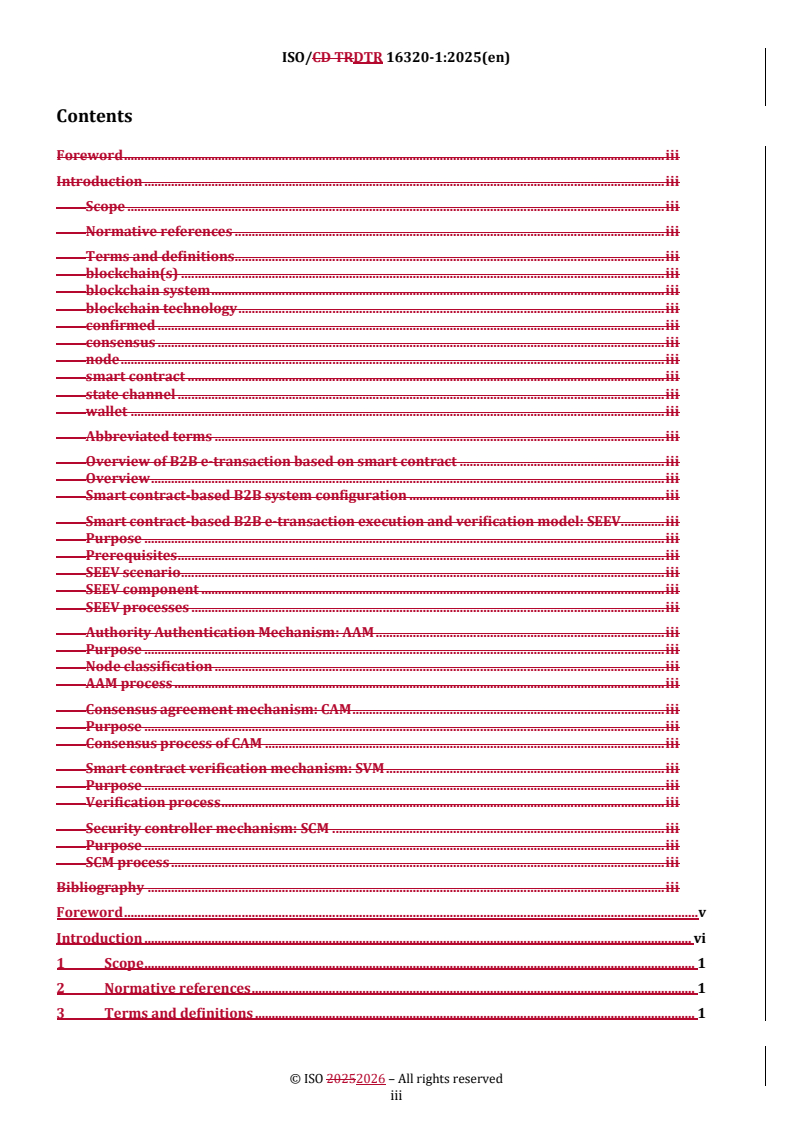
Contents Page
Foreword .iv
Introduction .v
1 Scope . 1
2 Normative references . 1
3 Terms and definitions . 1
4 Abbreviated terms . 2
5 Overview of B2B e-transaction based on smart contract . 3
5.1 Overview .3
5.2 Smart contract-based B2B system configuration .4
6 Smart contract-based B2B e-transaction execution and verification model: SEEV . 4
6.1 Purpose .4
6.2 Prerequisites .5
6.3 SEEV scenario .5
6.4 SEEV component .6
6.5 SEEV processes .7
7 Authority authentication mechanism: AAM . 8
7.1 Purpose .8
7.2 Node classification .8
7.3 AAM process .8
8 Consensus agreement mechanism: CAM .10
8.1 Purpose .10
8.2 Consensus process of CAM .10
9 Smart contract verification mechanism: SVM .12
9.1 Purpose . 12
9.2 Verification process . 13
10 Security controller mechanism: SCM .13
10.1 Purpose . 13
10.2 SCM process .14
Bibliography . 17
iii
Foreword
ISO (the International Organization for Standardization) is a worldwide federation of national standards
bodies (ISO member bodies). The work of preparing International Standards is normally carried out through
ISO technical committees. Each member body interested in a subject for which a technical committee
has been established has the right to be represented on that committee. International organizations,
governmental and non-governmental, in liaison with ISO, also take part in the work. ISO collaborates closely
with the International Electrotechnical Commission (IEC) on all matters of electrotechnical standardization.
The procedures used to develop this document and those intended for its further maintenance are described
in the ISO/IEC Directives, Part 1. In particular, the different approval criteria needed for the different types
of ISO document should be noted. This document was drafted in accordance with the editorial rules of the
ISO/IEC Directives, Part 2 (see www.iso.org/directives).
ISO draws attention to the possibility that the implementation of this document may involve the use of (a)
patent(s). ISO takes no position concerning the evidence, validity or applicability of any claimed patent
rights in respect thereof. As of the date of publication of this document, ISO had not received notice of (a)
patent(s) which may be required to implement this document. However, implementers are cautioned that
this may not represent the latest information, which may be obtained from the patent database available at
www.iso.org/patents. ISO shall not be held responsible for identifying any or all such patent rights.
Any trade name used in this document is information given for the convenience of users and does not
constitute an endorsement.
For an explanation of the voluntary nature of standards, the meaning of ISO specific terms and expressions
related to conformity assessment, as well as information about ISO's adherence to the World Trade
Organization (WTO) principles in the Technical Barriers to Trade (TBT), see www.iso.org/iso/foreword.html.
This document was prepared by Technical Committee ISO/TC 154, Processes, data elements and documents in
commerce, industry and administration.
A list of all parts in the ISO 16320 series can be found on the ISO website.
Any feedback or questions on this document shall be directed to the user’s national standards body. A
complete listing of these bodies can be found at www.iso.org/members.html.
iv
Introduction
Blockchain technology is influencing the evolution of data processing paradigms due to its tamper-evident
and immutable characteristics, particularly in contexts where data integrity and trust are essential. Various
industries—such as finance, manufacturing, logistics, public services, commerce, and healthcare—are
exploring blockchain as a foundational technology for enhancing reliability and transparency in information
processing.
One of the core applications of blockchain is the smart contract. A smart contract can be defined as a
software-based mechanism that encodes the terms agreed upon by transacting parties, embeds them
within an electronic contract structure, and facilitates automatic execution when predefined conditions
are met. Smart contracts are increasingly regarded as a potential solution for automating agreements in
decentralized or trustless environments. Smart contract-based transactions offer a number of potential
advantages, including:
— automated transaction execution based on predefined conditions, which can streamline business
processes and improve processing speed;
— reduced reliance on intermediaries, which can help mitigate risks such as fraud or manipulation, while
enabling transparency through preserved transaction records;
— lowered transaction costs due to the use of online platforms for counterpart discovery, contract
negotiation, and finalization.
Since the late 2010s, smart contracts have been investigated for a range of use cases, including asset transfers,
inheritance, gifting, and product purchases. In many of these applications, transactions can involve personal
or sensitive data that can potentially identify the transacting parties. Due to the open and distributed nature
of blockchain networks, there are concerns that such data can be exposed during consensus processes or
through the traceability of public keys. Additionally, the use of open-source blockchain software introduces
potential risks related to security vulnerabilities, including contract tampering or misuse of privileges.
Because blockchain data is immutable, errors in deployed smart contracts are also difficult to correct
retroactively.
In the context of B2B (Business-to-Business) electronic transactions, interest in smart contract-based
solutions has been growing. However, these systems differ significantly from conventional B2B approaches,
which often rely on peer-to-peer connections or centralized intermediaries. Smart contract-based B2B
transactions are characterized by the use of distributed consensus mechanisms and cryptographically
secured data structures. As such, differences can arise in several key areas, including:
— partner discovery and authentication;
— collaborative business processes;
— activity-level transaction management;
— transactional data exchange and document formats;
— security and data integrity assurance;
— validation procedures;
— legal responsibilities and liability considerations.
To support B2B electronic transactions using smart contracts, certain aspects are typically considered
during system design and analysis. These can include: defining the contractual terms; specifying the criteria
for transaction completion; establishing the transaction processing procedures; identifying the relevant
technical agreements; clarifying the roles and responsibilities of transacting parties; and ensuring the
reliability and consistency of the exchanged data.
This document provides a reference model intended to support the conceptualization and analysis of smart
contract-based B2B electronic transactions. The reference model identifies core components involved in
v
such transactions and describes considerations related to their roles and interactions. The smart contract–
based B2B transaction validation model, the validation process as well as the required data are presented at
a high level in Figure 1.
Figure 1 — Overview of the entire model
vi
FINAL DRAFT Technical Report ISO/DTR 16320-1:2026(en)
Processes and data in e-commerce — Smart contract-based
B2B electronic transaction execution and verification —
Part 1:
Reference model
1 Scope
This document provides a reference model intended to support the analysis and design of B2B electronic
transactions utilizing smart contracts. The model identifies and defines five core components that constitute
the foundational elements for such transactions, as follows:
— authentication and responsibility of transaction parties;
— transaction procedure and execution;
— transaction consensus mechanism;
— transaction verification mechanism;
— security controls.
2 Normative references
There are no normative references in this document.
3 Terms and definitions
For the purposes of this document, the following terms and definitions apply.
ISO and IEC maintain terminological databases for use in standardization at the following addresses:
— IEC Electropedia: available at http:// www .electropedia .org/
— ISO Online browsing platform: available at https:// www .iso .org/ obp
3.1
blockchain(s)
distributed ledger with confirmed blocks organized in an append-only, sequential chain using cryptographic
links
[1]
[SOURCE: ISO 22739:2024 , 3.6]
3.2
blockchain system
system that implements a blockchain
Note 1 to entry: A blockchain system is a type of DLT system.
[1]
[SOURCE: ISO 22739:2024 , 3.7]
3.3
blockchain technology
technology that enables the operation and use of blockchain
3.4
confirmed
accepted by consensus for inclusion in a distributed ledger
[1]
[SOURCE: ISO 22739:2024 , 3.8]
3.5
consensus
agreement among DLT nodes that a transaction is validated and that the distributed ledger contains a
consistent set and ordering of validated transactions
Note 1 to entry: Consensus does not necessarily mean that all nodes agree.
[1]
[SOURCE: ISO 22739:2024 , 3.11]
3.6
node
elementary component from which a data structure is built
[1]
[SOURCE: ISO 22739:2024 , 3.50]
3.7
smart contract
computer program stored in a DLT system wherein the outcome of any execution of the program is recorded
on the distributed ledger
Note 1 to entry: A smart contract can represent terms in a contract in law and create a legally enforceable obligation
under the legislation of an applicable jurisdiction.
[1]
[SOURCE: ISO 22739:2024 , 3.72]
3.8
state channel
channel through which transaction partners can send and receive data privately for transaction negotiation,
and the hash value of the negotiation is recorded on the block chain
3.9
wallet
application used to generate, manage, store or use private and public keys
Note 1 to entry: A wallet can be implemented as a software or hardware module.
[1]
[SOURCE: ISO 22739:2024 , 3.84]
4 Abbreviated terms
This document uses the following abbreviated terms:
AAM authority authentication mechanism
CAM consensus agreement mechanism
DLT distributed ledger technology
SC smart contract
SCM security controller mechanism
SVM smart contract verification mechanism
SEEV smart contract-based B2B e-transaction execution and verification model
5 Overview of B2B e-transaction based on smart contract
5.1 Overview
A smart contract is a form of program code that operates on blockchain networks. It is intended to automate
the execution of contractual terms between parties by enabling conditions and outcomes to be handled
in a secure, traceable manner without the involvement of traditional intermediaries. Smart contracts are
deployed on a blockchain and executed in a decentralized environment, where the code determines the
logic and flow of the contract based on predefined rules. Smart contracts generally exhibit the following
characteristics:
— Automated execution: Smart contracts are designed to trigger execution automatically when specific
predefined conditions are satisfied.
— Integrity and trustworthiness: Once deployed, smart contracts are stored on the blockchain in an
immutable form. The execution is typically resistant to external tampering, contributing to the perceived
trust and integrity of the transaction process.
— Decentralized processing: As smart contracts are executed across nodes in a blockchain network,
the need for central intermediaries can be reduced. This decentralization can potentially streamline
processes and reduce transaction-related overhead.
— Transparency: In public and permissionless blockchain environments, smart contract data can be visible
and verifiable by all participants, contributing to transparency. However, in private or permissioned
blockchain settings, access to smart contract data is typically restricted to authorized entities, and
visibility can be limited.
Applying smart contracts in a B2B (Business-to-Business) context offers several advantages that enhance
the efficient management and reinforcement of transactions and contracts between business partners,
without the need for intermediaries or complex procedures. Here are the key benefits of implementing
smart contracts in a B2B environment:
— Efficiency and automation: Smart contracts automate transactions when contract conditions are met,
reducing manual processes. This minimizes human errors and delays, enhancing the management of
business processes.
— Decentralized transactions: Smart contracts facilitate direct transactions between parties without
intermediaries, reducing transaction costs and time.
— Trust and security: Smart contracts are stored on a blockchain, making alterations difficult and preserving
integrity. This increases trust in transactions and provides protection against fraud or tampering.
— Real-time monitoring: Smart contracts enable real-time monitoring of transaction status and conditions.
This allows for easy tracking of transaction progress and timely interventions.
— Immutable records: Smart contract transactions recorded on the blockchain are immutable, providing
preserved records that can serve as objective evidence in case of disputes.
— Swift payments and settlements: Automated payment and settlement processes through smart contracts
enable fast and accurate financial transactions.
— Real-time transparency: Smart contracts provide real-time transparency, allowing all stakeholders to
monitor transaction details and progress.
— Streamlined complex contract management: Simplified management and auditing of complex contracts
can improve operational efficiency.
The advantages of smart contracts in a B2B environment facilitate secure, rapid transactions between
business partners while enhancing the efficiency and transparency of business processes.
5.2 Smart contract-based B2B system configuration
This document explains the components necessary for constructing a smart contract-based B2B system,
as well as the components and roles of those components. The use of blockchain by smart contracts to
[2]
ensure data reliability is outlined in ISO/TR 23455 . Therefore, this document does not explain the basic
components that make up blockchain and smart contracts. Instead, it focuses on the business processes
required for B2B transactions, electronic transaction methods, collaboration, and models for the execution
and verification of B2B transactions. These aspects are represented through several B2B components, which
are modelled within this document. The conceptual architecture of the smart contract-based B2B system is
illustrated in Figure 2, which can be referred to for better understanding of the overall structure.
Figure 2 — B2B system based on smart contract
6 Smart contract-based B2B e-transaction execution and verification model: SEEV
6.1 Purpose
To ensure the validity and completeness of smart contract-based B2B transactions, SEEV contains necessary
components, roles of each component, the processing procedures of components, requirements, and
prerequisites and post conditions. The conceptual structure of SEEV is illustrated in Figure 3. A description
of each item is as follows:
— component: presents essential components for B2B transaction processing based on smart contract;
— component role: describes the duties and roles performed by each component;
— component processing procedure: describes the processing procedures necessary to perform the duties
and roles of each component;
— requirement: describes necessary requirements for each component to perform its mission and role;
— prerequisite/postconditions: describes the conditions that each component specifies before transaction
processing and the conditions specified after transaction processing.
Figure 3 — Conceptual structure of SEEV
6.2 Prerequisites
To ensure the validity, integrity and completeness of smart contract-based B2B electronic transactions,
the following considerations can be taken into account in the design and implementation of a transaction
framework such as SEEV:
— A mechanism is in place to authenticate the identities of the parties involved in a smart contract.
— Smart contracts are created based on mutual agreement between the involved parties.
— The transaction procedures aligned with the contract terms are explicitly defined within the smart
contract.
— The business process activities and the transactions within those activities are described in the contract
logic.
— The deployed smart contract ensures its own integrity and reliability through cryptographic and
procedural safeguards.
— Mechanisms are available to allow the contract to be invalidated or amended by mutual agreement in the
case of errors or inconsistencies.
— A distributed consensus mechanism involving multiple nodes is used to confirm and approve transactions.
— Transaction initiation and termination conditions, as well as internal triggers for sequential steps, are
clearly specified within the smart contract.
— For automated execution, smart contracts can access external data from trusted and secure sources.
— The messaging protocol used for executing the contract supports security and reliability features such
as delivery assurance and message integrity.
— Confidential or sensitive information generated or handled by the smart contract can be encrypted and
stored securely on the blockchain.
— To support legal verifiability, external mechanisms such as third-party verification, certification, or
endorsement can be incorporated in addition to the internal controls of the smart contract.
6.3 SEEV scenario
To support B2B transactions utilizing smart contracts, a general sequence of activities can be considered.
These activities assume the existence of a B2B transaction environment—such as a digital marketplace
or platform—enabling interaction between business entities. The following high-level steps illustrate a
conceptual flow and can vary depending on specific implementation or use case context:
— Participant registration: Business entities and authorized users register on the B2B transaction platform
to initiate participation in B2B transactions.
— Identity and credential management: Entities or users undergo identity verification and are issued the
necessary credentials, such as digital wallet addresses or cryptographic keys.
— Permission assignment: Appropriate permissions or roles (e.g. buyer, seller, third-party advisor) are
granted to participants to enable B2B interactions on the platform.
— Transaction preparation: Participants provide transaction-related data such as product/service
offerings, contractual terms, and pricing information.
— Data recording on blockchain: Transaction data can be recorded on a blockchain for transparency,
traceability or automation purposes.
— Negotiation and agreement formation: Trading partners engage in negotiation and reach agreement on
transaction terms.
— Smart contract generation: Based on the agreed terms, a smart contract is generated that specifies the
transaction logic, conditions and data.
— Validation and expert review: The smart contract can be validated technically and, where applicable,
legally reviewed by relevant experts.
— Approval and finalization: All parties approve the contract terms, and digital signatures can be applied
to confirm consent.
— Sensitive data handling: If applicable, sensitive or personal data included in the contract are encrypted
and managed according to policy.
— Smart contract deployment: The final smart contract is deployed on the blockchain.
— Execution of contract: The smart contract is triggered and executed according to predefined logic,
automating the agreed-upon transaction process.
6.4 SEEV component
The SEEV is composed of the following components, and its overall components and workflow are illustrated
in Figure 4:
— Authority authentication mechanism (AAM): A certification mechanism for identifying participants, end
users or verifiers.
— Consensus agreement mechanism (CAM): A consensus mechanism to support the negotiation of the
contents of a smart contract and to ensure that the digital contract is guaranteed its legal status.
— Smart contract verification mechanism (SVM): A smart contract verification mechanism that ensures
the validity of smart contract and verifies transactions.
— Security controller mechanism (SCM): An information protection mechanism that protects the data
contained in
...
ISO/TC 154
ISO/CD TR 16320-1(en)
Secretariat: SAC
Date: 2025-12-22
Processes and data in e-commerce — Smart contract-based B2B
electronic transaction execution and verification —
Part 1:
Reference model
VVVVoooottttiiiing bng bng bng beeeegigigiginsnsnsns o o o on:n:n:n: 202 202 202 2026666----01010101----01010101
VoVoVoVotintintintingggg t t t tererererminminminminatatatateseseses o o o onnnn::::
ISO/CD TRDTR 16320-1:2025(en)
All rights reserved. Unless otherwise specified, or required in the context of its implementation, no part of this publication
may be reproduced or utilized otherwise in any form or by any means, electronic or mechanical, including photocopying,
or posting on the internet or an intranet, without prior written permission. Permission can be requested from either ISO
at the address below or ISO’s member body in the country of the requester.
ISO copyright office
CP 401 • Ch. de Blandonnet 8
CH-1214 Vernier, Geneva
Phone: + 41 22 749 01 11
E-mail: copyright@iso.org
Website: www.iso.org
Published in Switzerland
ii
ISO/CD TRDTR 16320-1:2025(en)
Contents
Foreword . iii
Introduction . iii
Scope . iii
Normative references . iii
Terms and definitions . iii
blockchain(s) . iii
blockchain system . iii
blockchain technology . iii
confirmed . iii
consensus . iii
node . iii
smart contract . iii
state channel . iii
wallet . iii
Abbreviated terms . iii
Overview of B2B e-transaction based on smart contract . iii
Overview . iii
Smart contract-based B2B system configuration . iii
Smart contract-based B2B e-transaction execution and verification model: SEEV . iii
Purpose . iii
Prerequisites . iii
SEEV scenario . iii
SEEV component . iii
SEEV processes . iii
Authority Authentication Mechanism: AAM . iii
Purpose . iii
Node classification . iii
AAM process . iii
Consensus agreement mechanism: CAM . iii
Purpose . iii
Consensus process of CAM . iii
Smart contract verification mechanism: SVM . iii
Purpose . iii
Verification process . iii
Security controller mechanism: SCM . iii
Purpose . iii
SCM process . iii
Bibliography . iii
Foreword . v
Introduction . vi
1 Scope . 1
2 Normative references . 1
3 Terms and definitions . 1
iii
ISO/CD TRDTR 16320-1:2025(en)
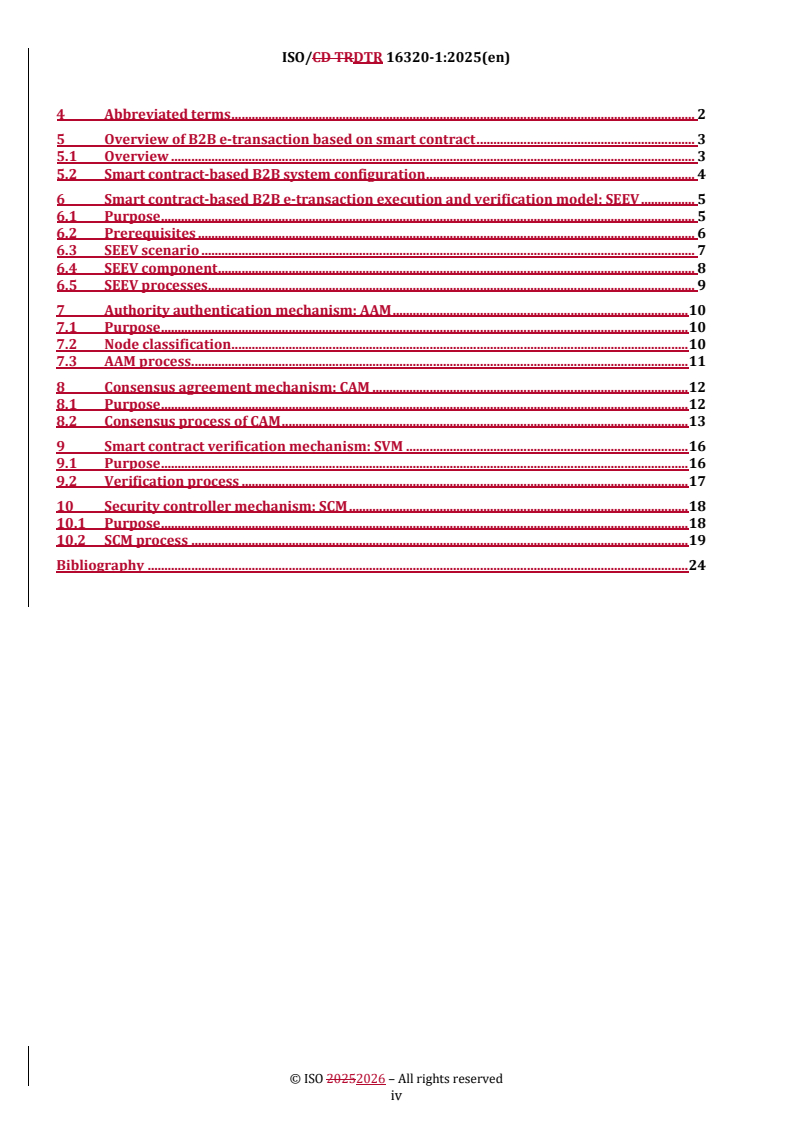
4 Abbreviated terms . 2
5 Overview of B2B e-transaction based on smart contract . 3
5.1 Overview . 3
5.2 Smart contract-based B2B system configuration . 4
6 Smart contract-based B2B e-transaction execution and verification model: SEEV . 5
6.1 Purpose . 5
6.2 Prerequisites . 6
6.3 SEEV scenario . 7
6.4 SEEV component . 8
6.5 SEEV processes . 9
7 Authority authentication mechanism: AAM . 10
7.1 Purpose . 10
7.2 Node classification . 10
7.3 AAM process . 11
8 Consensus agreement mechanism: CAM . 12
8.1 Purpose . 12
8.2 Consensus process of CAM . 13
9 Smart contract verification mechanism: SVM . 16
9.1 Purpose . 16
9.2 Verification process . 17
10 Security controller mechanism: SCM . 18
10.1 Purpose . 18
10.2 SCM process . 19
Bibliography . 24
iv
ISO/CD TRDTR 16320-1:2025(en)
Foreword
ISO (the International Organization for Standardization) is a worldwide federation of national standards
bodies (ISO member bodies). The work of preparing International Standards is normally carried out through
ISO technical committees. Each member body interested in a subject for which a technical committee has been
established has the right to be represented on that committee. International organizations, governmental and
non-governmental, in liaison with ISO, also take part in the work. ISO collaborates closely with the
International Electrotechnical Commission (IEC) on all matters of electrotechnical standardization.
The procedures used to develop this document and those intended for its further maintenance are described
in the ISO/IEC Directives, Part 1Part 1. In particular, the different approval criteria needed for the different
types of ISO documentsdocument should be noted. This document was drafted in accordance with the editorial
rules of the ISO/IEC DirectivesIEC Directives, Part 2Part 2 (see www.iso.org/directives).
Attention is drawnISO draws attention to the possibility that some of the elementsimplementation of this
document may beinvolve the subjectuse of (a) patent(s). ISO takes no position concerning the evidence,
validity or applicability of any claimed patent rights. in respect thereof. As of the date of publication of this
document, ISO had not received notice of (a) patent(s) which may be required to implement this document.
However, implementers are cautioned that this may not represent the latest information, which may be
obtained from the patent database available at www.iso.org/patents. ISO shall not be held responsible for
identifying any or all such patent rights. Details of any patent rights identified during the development of the
document will be in the Introduction and/or on the ISO list of patent declarations received (see
www.iso.org/patents).
Any trade name used in this document is information given for the convenience of users and does not
constitute an endorsement.
For an explanation onof the voluntary nature of standards, the meaning of ISO specific terms and expressions
related to conformity assessment, as well as information about ISO's adherence to the World Trade
Organization (WTO) principles in the Technical Barriers to Trade (TBT) see the following URL:
www.iso.org/iso/foreword.html), see www.iso.org/iso/foreword.html.
This document was prepared by Technical Committee ISO/TC 154, Processes, data elements and documents in
commerce, industry and administration.
A list of all parts in the ISO 16320 series can be found on the ISO website.
Any feedback or questions on this document shall be directed to the user’s national standards body. A
complete listing of these bodies can be found at www.iso.org/members.html.
v
ISO/CD TRDTR 16320-1:2025(en)
Introduction
Blockchain technology is influencing the evolution of data processing paradigms due to its tamper-evident
and immutable characteristics, particularly in contexts where data integrity and trust are essential. Various
industries—such as finance, manufacturing, logistics, public services, commerce, and healthcare—are
exploring blockchain as a foundational technology for enhancing reliability and transparency in information
processing.
One of the core applications of blockchain is the smart contract. A smart contract can be defined as a software-
based mechanism that encodes the terms agreed upon by transacting parties, embeds them within an
electronic contract structure, and facilitates automatic execution when predefined conditions are met. Smart
contracts are increasingly regarded as a potential solution for automating agreements in decentralized or
trustless environments. Smart contract-based transactions offer a number of potential advantages, including:
— Automatedautomated transaction execution based on predefined conditions, which can streamline
business processes and improve processing speed;
— Reducedreduced reliance on intermediaries, which can help mitigate risks such as fraud or manipulation,
while enabling transparency through preserved transaction records;
— Loweredlowered transaction costs due to the use of online platforms for counterpart discovery, contract
negotiation, and finalization.
Since the late 2010s, smart contracts have been investigated for a range of use cases, including asset transfers,
inheritance, gifting, and product purchases. In many of these applications, transactions can involve personal
or sensitive data that couldcan potentially identify the transacting parties. Due to the open and distributed
nature of blockchain networks, there are concerns that such data can be exposed during consensus processes
or through the traceability of public keys. Additionally, the use of open-source blockchain software introduces
potential risks related to security vulnerabilities, including contract tampering or misuse of privileges.
Because blockchain data is immutable, errors in deployed smart contracts are also difficult to correct
retroactively.
In the context of B2B (Business-to-Business) electronic transactions, interest in smart contract-based
solutions has been growing. However, these systems differ significantly from conventional B2B approaches,
which often rely on peer-to-peer connections or centralized intermediaries. Smart contract-based B2B
transactions are characterized by the use of distributed consensus mechanisms and cryptographically secured
data structures. As such, differences can arise in several key areas, including:
— Partnerpartner discovery and authentication;
— Collaborativecollaborative business processes;
— Activityactivity-level transaction management;
— Transactionaltransactional data exchange and document formats;
— Securitysecurity and data integrity assurance;
— Validationvalidation procedures;
— Legallegal responsibilities and liability considerations.
To support B2B electronic transactions using smart contracts, certain aspects are typically considered during
system design and analysis. These can include: defining the contractual terms; specifying the criteria for
transaction completion; establishing the transaction processing procedures; identifying the relevant technical
vi
ISO/CD TRDTR 16320-1:2025(en)
agreements; clarifying the roles and responsibilities of transacting parties; and ensuring the reliability and
consistency of the exchanged data.
This document provides a reference model intended to support the conceptualization and analysis of smart
contract-based B2B electronic transactions. The reference model identifies core components involved in such
transactions and describes considerations related to their roles and interactions. Additional details onThe
smart contract-–based e-B2B transaction processes,validation model, the validation process as well as the
required data structures and components applicable to smart contract-based B2B electronic transactions, will
beare presented at a high level in the subsequent parts of ISO 16320-1, as illustrated in figure 1.Figure 1.
Figure 1
The scope — Overview of the entire model
vii
ISO/CD TRDTR 16320-1:2025(en)
Processes and data in e-commerce — Smart contract-based B2B
electronic transaction execution and verification —
Part 1:
Reference model
1 Scope
This document provides a reference model intended to support the analysis and design of B2B electronic
transactions utilizing smart contracts. The model identifies and defines five core components that constitute
the foundational elements for such transactions, as follows:
— Authenticationauthentication and responsibility of transaction parties;
— Transactiontransaction procedure and execution;
— Transactiontransaction consensus mechanism;
— Transactiontransaction verification mechanism;
— Securitysecurity controls.
2 Normative references
There are no normative references in this document.
3 Terms and definitions
For the purposes of this document, the following terms and definitions apply.
ISO and IEC maintain terminological databases for use in standardization at the following addresses:
— — IEC Electropedia: available at http://www.electropedia.org/
— — ISO Online browsing platform: available at https://www.iso.org/obp
3.1
blockchain(s)
distributed ledger with confirmed blocks organized in an append-only, sequential chain using cryptographic
links
[SOURCE: ISO 22739 ,, 3.6]
3.2
blockchain system
system that implements a blockchain
Note 1 to entry: A blockchain system is a type of DLT system.
[SOURCE: ISO 22739 ,, 3.7]
ISO/CD TRDTR 16320-1:2025(en)
3.3
blockchain technology
technology that enables the operation and use of blockchain
3.4
confirmed
accepted by consensus for inclusion in a distributed ledger
[SOURCE: ISO 22739 ,, 3.8]
3.13.5
consensus
agreement among DLT nodes that a transaction is validated and that the distributed ledger contains a
consistent set and ordering of validated transactions
Note 1 to entry: Consensus does not necessarily mean that all nodes agree.
[SOURCE: ISO 22739 ,, 3.11]
3.23.6
node
elementary component from which a data structure is built
,, 3.50]
[SOURCE: ISO 22739
3.33.7
smart contract
computer program stored in a DLT system wherein the outcome of any execution of the program is recorded
on the distributed ledger
Note 1 to entry: A smart contract can represent terms in a contract in law and create a legally enforceable obligation
under the legislation of an applicable jurisdiction.
[SOURCE: ISO 22739 ,, 3.72]
3.8
state channel
A channel through which transaction partners can send and receive data privately for transaction negotiation,
and the hash value of the negotiation is recorded on the block chain
3.9
wallet
application used to generate, manage, store or use private and public keys
Note 1 to entry: A wallet can be implemented as a software or hardware module.
[SOURCE: ISO 22739 ,, 3.84]
4 Abbreviated terms
This document uses the following abbreviated terms:
AAM Authority Authentication Mechanismauthority authentication mechanism
ISO/CD TRDTR 16320-1:2025(en)
CAM Consensus Agreement Mechanismconsensus agreement mechanism
DLT Distributeddistributed ledger technology
SC Smart Contractsmart contract
SCM Security Controller Mechanismsecurity controller mechanism
SVM Smart Contract Verification Mechanismsmart contract verification mechanism
SEEV Smartsmart contract-based B2B e-Transaction Executiontransaction execution and
Verification Modelverification model
5 Overview of B2B e-transaction based on smart contract
5.1 Overview
A smart contract is a form of program code that operates on blockchain networks. It is intended to automate
the execution of contractual terms between parties by enabling conditions and outcomes to be handled in a
secure, traceable manner without the involvement of traditional intermediaries. Smart contracts are deployed
on a blockchain and executed in a decentralized environment, where the code determines the logic and flow
of the contract based on predefined rules. Smart contracts generally exhibit the following characteristics:
— Automated execution: Smart contracts are designed to trigger execution automatically when specific
predefined conditions are satisfied.
— Integrity and trustworthiness: Once deployed, smart contracts are stored on the blockchain in an
immutable form. The execution is typically resistant to external tampering, contributing to the perceived
trust and integrity of the transaction process.
— Decentralized processing: As smart contracts are executed across nodes in a blockchain network, the need
for central intermediaries can be reduced. This decentralization can potentially streamline processes and
reduce transaction-related overhead.
— Transparency: In public and permissionless blockchain environments, smart contract data can be visible
and verifiable by all participants, contributing to transparency. However, in private or permissioned
blockchain settings, access to smart contract data is typically restricted to authorized entities, and
visibility can be limited.
Applying smart contracts in a B2B (Business-to-Business) context offers several advantages that enhance the
efficient management and reinforcement of transactions and contracts between business partners, without
the need for intermediaries or complex procedures. Here are the key benefits of implementing smart contracts
in a B2B environment:
— Efficiency and automation: Smart contracts automate transactions when contract conditions are met,
reducing manual processes. This minimizes human errors and delays, enhancing the management of
business processes.
— Decentralized transactions: Smart contracts facilitate direct transactions between parties without
intermediaries, reducing transaction costs and time.
— Trust and security: Smart contracts are stored on a blockchain, making alterations difficult and preserving
integrity. This increases trust in transactions and provides protection against fraud or tampering.
ISO/CD TRDTR 16320-1:2025(en)
— Real-time monitoring: Smart contracts enable real-time monitoring of transaction status and conditions.
This allows for easy tracking of transaction progress and timely interventions.
— Immutable records: Smart contract transactions recorded on the blockchain are immutable, providing
preserved records that can serve as objective evidence in case of disputes.
— Swift payments and settlements: Automated payment and settlement processes through smart contracts
enable fast and accurate financial transactions.
— realReal-time transparency: Smart contracts provide real-time transparency, allowing all stakeholders to
monitor transaction details and progress.
— Streamlined complex contract management: Simplified management and auditing of complex contracts
can improve operational efficiency.
The advantages of smart contracts in a B2B environment facilitate secure, rapid transactions between
business partners while enhancing the efficiency and transparency of business processes.
5.2 Smart contract-based B2B system configuration
This document explains the components necessary for constructing a smart contract-based B2B system, as
well as the components and roles of those components. The use of blockchain by smart contracts to ensure
[2]
data reliability is outlined in ISO/TR 23455:2019 (ISO/TR 23455:2019 ).ISO/TR 23455. Therefore, this
document does not explain the basic components that make up blockchain and smart contracts. Instead, it
focuses on the business processes required for B2B transactions, electronic transaction methods,
collaboration, and models for the execution and verification of B2B transactions. These aspects are
represented through several B2B components, which are modelled within this document. The conceptual
architecture of the smart contract-based B2B system is illustrated in figure 2, which mayFigure 2, which can
be referred to for better understanding of the overall structure.
ISO/CD TRDTR 16320-1:2025(en)
Figure 2
— B2B system based on smart contract
6 Smart contract-based B2B e-transaction execution and verification model: SEEV
6.1 Purpose
To ensure the validity and completeness of smart contract-based B2B transactions, SEEV contains necessary
components, roles of each component, the processing procedures of components, requirements, and
prerequisites and post conditions. The conceptual structure of SEEV is illustrated in figure 3.Figure 3. A
description of each item is as follows:
ISO/CD TRDTR 16320-1:2025(en)
— Componentcomponent: presents essential components for B2B transaction processing based on smart
contract;
— Componentcomponent role: describes the duties and roles performed by each component;
— Componentcomponent processing procedure: describes the processing procedures necessary to perform
the duties and roles of each component;
— Requirementrequirement: describes necessary requirements for each component to perform its mission
and role;
— Prerequisite/Postconditionsprerequisite/postconditions: describes the conditions that each component
specifies before transaction processing and the conditions specified after transaction processing.
Figure 3
— Conceptual structure of SEEV
6.2 Prerequisites
To ensure the validity, integrity, and completeness of smart contract-based B2B electronic transactions, the
following considerations can be taken into account in the design and implementation of a transaction
framework such as SEEV:
ISO/CD TRDTR 16320-1:2025(en)
— A mechanism is in place to authenticate the identities of the parties involved in a smart contract.
— Smart contracts are created based on mutual agreement between the involved parties.
— The transaction procedures aligned with the contract terms are explicitly defined within the smart
contract.
— The business process activities and the transactions within those activities are described in the contract
logic.
— The deployed smart contract ensures its own integrity and reliability through cryptographic and
procedural safeguards.
— Mechanisms are available to allow the contract to be invalidated or amended by mutual agreement in the
case of errors or inconsistencies.
— A distributed consensus mechanism involving multiple nodes is used to confirm and approve transactions.
— Transaction initiation and termination conditions, as well as internal triggers for sequential steps, are
clearly specified within the smart contract.
— For automated execution, smart contracts can access external data from trusted and secure sources.
— The messaging protocol used for executing the contract supports security and reliability features such as
delivery assurance and message integrity.
— Confidential or sensitive information generated or handled by the smart contract can be encrypted and
stored securely on the blockchain.
— To support legal verifiability, external mechanisms such as third-party verification, certification, or
endorsement can be incorporated in addition to the internal controls of the smart contract.
6.3 SEEV scenario
To support B2B transactions utilizing smart contracts, a general sequence of activities can be considered.
These activities assume the existence of a B2B transaction environment—such as a digital marketplace or
platform—enabling interaction between business entities. The following high-level steps illustrate a
conceptual flow and can vary depending on specific implementation or use case context:
— Participant registration: Business entities and authorized users register on the B2B transaction platform
to initiate participation in B2B transactions.
— Identity and credential management: Entities or users undergo identity verification and are issued the
necessary credentials, such as digital wallet addresses or cryptographic keys.
— Permission assignment: Appropriate permissions or roles (e.g.,. buyer, seller, third-party advisor) are
granted to participants to enable B2B interactions on the platform.
— Transaction preparation: Participants provide transaction-related data such as product/service offerings,
contractual terms, and pricing info
...
Questions, Comments and Discussion
Ask us and Technical Secretary will try to provide an answer. You can facilitate discussion about the standard in here.
Loading comments...