

ISO 9735-11:2022
(Main)Electronic data interchange for administration, commerce and transport (EDIFACT) — Application level syntax rules (Syntax version number: 4, Syntax release number: 1) — Part 11: Version 3 compatible profile for Version 4 of ISO 9735
General Information
- Abstract
This document specifies the profiling rules of ISO 9735-1 to ISO 9735-9 that allow users of version 3 (ISO 9735:1988 and ISO 9735:1988/Amd.1:1992: Syntax version number: 3) to migrate to version 4 (ISO 9735:1998: Syntax version number: 4) with a minimum effort and cost.
- Status
- Published
- Publication Date
- 23-Mar-2022
- Technical Committee
- ISO/TC 154 - Processes, data elements and documents in commerce, industry and administration
- Drafting Committee
- ISO/TC 154/JWG 1 - Joint syntax working group (with UN/ECE)
- Current Stage
- 6060 - International Standard published
- Start Date
- 24-Mar-2022
- Due Date
- 02-Mar-2023
- Completion Date
- 24-Mar-2022
Buy Documents
ISO 9735-11:2022 - Electronic data interchange for administration, commerce and transport (EDIFACT) — Application level syntax rules (Syntax version number: 4, Syntax release number: 1) — Part 11: Version 3 compatible profile for Version 4 of ISO 9735 Released:3/24/2022
Overview
ISO 9735-11:2022 defines a Version 3 compatible profile for Version 4 of ISO 9735 (EDIFACT). Its purpose is to provide profiling rules that let organizations migrate from EDIFACT syntax version 3 (ISO 9735:1988 / Amd.1:1992) to syntax version 4 (ISO 9735:1998) with minimum effort and cost. The document scopes the syntax restrictions, conformance requirements and implementation guidance needed to preserve backward compatibility while adopting the newer syntax release.
Key topics and technical requirements
- Profiling rules: Defines which parts of ISO 9735-1 to ISO 9735-9 are restricted or allowed to remain compatible with version 3. Rules are numbered (Rule 1 to Rule 15) and specify allowed/forbidden features.
- Conformance identifiers: Mandates using Syntax version number = “4” (data element 0002) and Syntax release number = “01” (data element 0076) in the UNB interchange header for conformant interchanges.
- Syntax restrictions (notable rules):
- Rule 1: Repeating data elements (the repetition service character) are not allowed.
- Rule 2: Dependency notes (message/segment/composite dependency constructs) are not allowed.
- Rule 3: UNB, UNG and UNH segments are modified - follow Annex A implementation rules.
- Rule 4: Only character sets UNOA–UNOF are allowed; UNOW is permissible only with partner agreement and restrictions.
- Rule 5: New version‑4 service segments UGH/UGT are not allowed.
- Rules 6–15: Restrict version‑4-only features (certain batch messages, interactive EDI messages, advanced security, AUTACK, KEYMAN, associated data, confidentiality) - these are not permitted in the compatibility profile.
- Annex A (normative): Lists permissible service segments (UNA, UNB, etc.) and detailed implementation rules to ensure compatibility with version 3 service segment usage.
Applications and users
Who benefits:
- EDI implementers and integrators planning an EDIFACT migration from version 3 to version 4.
- IT teams and trading partners seeking interoperability while minimizing rework and cost.
- Legal, compliance, and operations teams that require controlled adoption (e.g., where advanced security features are deferred). Practical uses:
- Establishing interchange agreements that reference the compatibility profile.
- Updating EDI translators and gateways to emit Syntax version “4” while honoring version‑3 restrictions.
- Phased rollouts where advanced version‑4 capabilities (interactive messaging, security services) are adopted later.
Related standards
- ISO 9735-1 to ISO 9735-9 (syntax rules and parts referenced)
- ISO 9735-10 (syntax service directories) - conformance to ISO 9735-1, -2 and -10 is required when using this profile.
Keywords: ISO 9735-11:2022, EDIFACT, electronic data interchange, syntax rules, Version 3 compatible profile, EDIFACT migration, UNB, UNA, service segments, conformance.
Relations
- Effective Date
- 26-Nov-2021
- Effective Date
- 26-Nov-2021
Buy Documents
ISO 9735-11:2022 - Electronic data interchange for administration, commerce and transport (EDIFACT) — Application level syntax rules (Syntax version number: 4, Syntax release number: 1) — Part 11: Version 3 compatible profile for Version 4 of ISO 9735 Released:3/24/2022
Get Certified
Connect with accredited certification bodies for this standard

BSI Group
BSI (British Standards Institution) is the business standards company that helps organizations make excellence a habit.

NYCE
Mexican standards and certification body.
Sponsored listings
Frequently Asked Questions
ISO 9735-11:2022 is a standard published by the International Organization for Standardization (ISO). Its full title is "Electronic data interchange for administration, commerce and transport (EDIFACT) — Application level syntax rules (Syntax version number: 4, Syntax release number: 1) — Part 11: Version 3 compatible profile for Version 4 of ISO 9735". This standard covers: This document specifies the profiling rules of ISO 9735-1 to ISO 9735-9 that allow users of version 3 (ISO 9735:1988 and ISO 9735:1988/Amd.1:1992: Syntax version number: 3) to migrate to version 4 (ISO 9735:1998: Syntax version number: 4) with a minimum effort and cost.
This document specifies the profiling rules of ISO 9735-1 to ISO 9735-9 that allow users of version 3 (ISO 9735:1988 and ISO 9735:1988/Amd.1:1992: Syntax version number: 3) to migrate to version 4 (ISO 9735:1998: Syntax version number: 4) with a minimum effort and cost.
ISO 9735-11:2022 is classified under the following ICS (International Classification for Standards) categories: 35.240.63 - IT applications in trade. The ICS classification helps identify the subject area and facilitates finding related standards.
ISO 9735-11:2022 has the following relationships with other standards: It is inter standard links to ISO 9735:1988, ISO 9735:1988/Amd 1:1992. Understanding these relationships helps ensure you are using the most current and applicable version of the standard.
ISO 9735-11:2022 is available in PDF format for immediate download after purchase. The document can be added to your cart and obtained through the secure checkout process. Digital delivery ensures instant access to the complete standard document.
Standards Content (Sample)
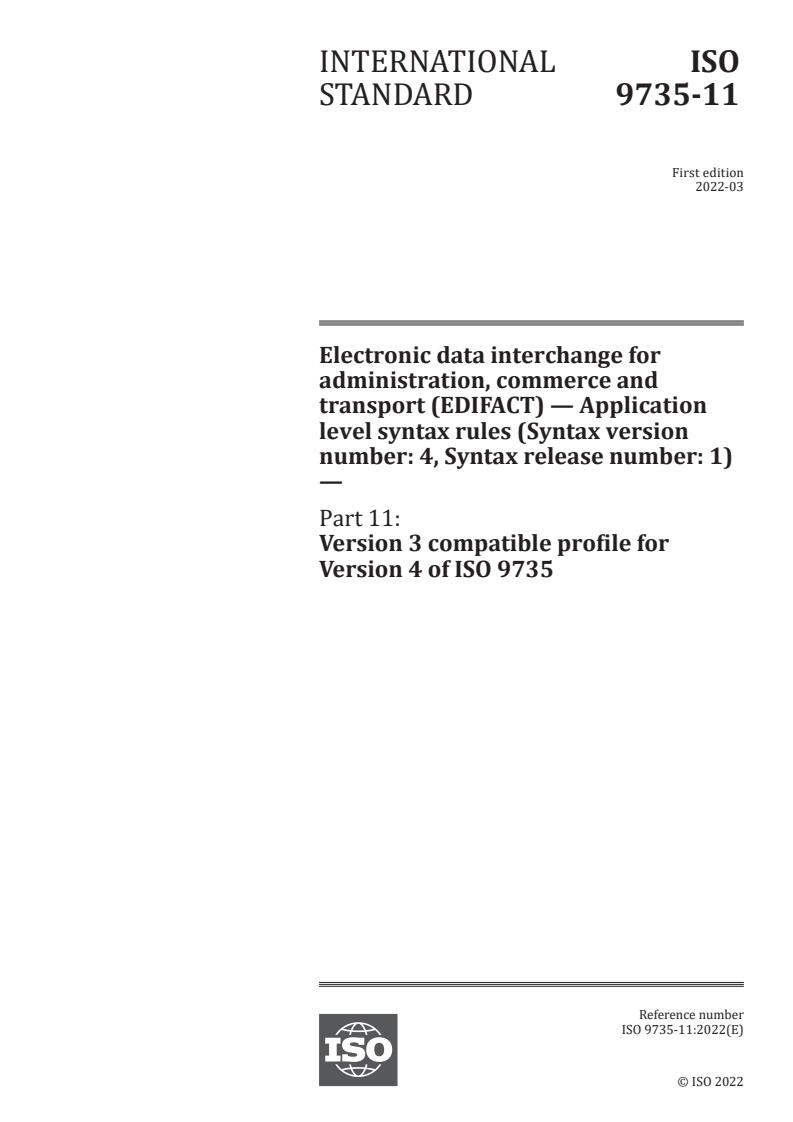
INTERNATIONAL ISO
STANDARD 9735-11
First edition
2022-03
Electronic data interchange for
administration, commerce and
transport (EDIFACT) — Application
level syntax rules (Syntax version
number: 4, Syntax release number: 1)
—
Part 11:
Version 3 compatible profile for
Version 4 of ISO 9735
Reference number
© ISO 2022
All rights reserved. Unless otherwise specified, or required in the context of its implementation, no part of this publication may
be reproduced or utilized otherwise in any form or by any means, electronic or mechanical, including photocopying, or posting on
the internet or an intranet, without prior written permission. Permission can be requested from either ISO at the address below
or ISO’s member body in the country of the requester.
ISO copyright office
CP 401 • Ch. de Blandonnet 8
CH-1214 Vernier, Geneva
Phone: +41 22 749 01 11
Email: copyright@iso.org
Website: www.iso.org
Published in Switzerland
ii
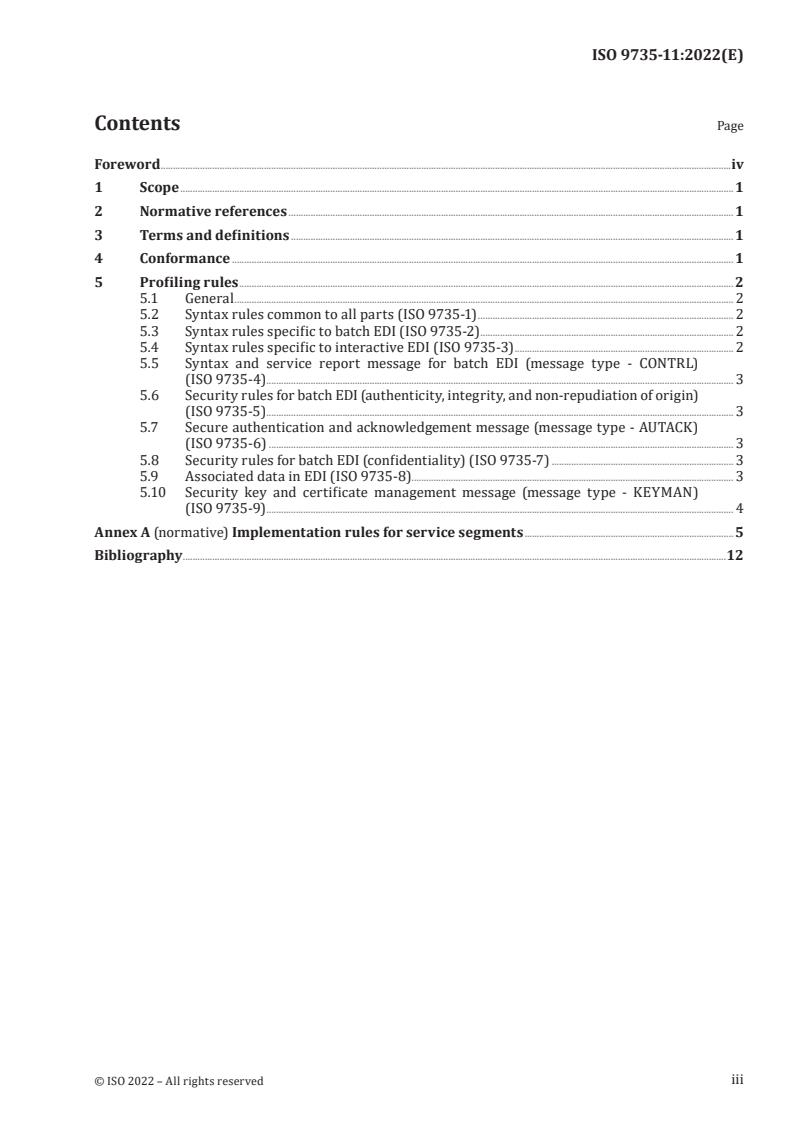
Contents Page
Foreword .iv
1 Scope . 1
2 Normative references . 1
3 Terms and definitions . 1
4 Conformance . 1
5 Profiling rules . 2
5.1 General . 2
5.2 Syntax rules common to all parts (ISO 9735-1) . 2
5.3 Syntax rules specific to batch EDI (ISO 9735-2) . 2
5.4 Syntax rules specific to interactive EDI (ISO 9735-3) . 2
5.5 Syntax and service report message for batch EDI (message type - CONTRL)
(ISO 9735-4). 3
5.6 Security rules for batch EDI (authenticity, integrity, and non-repudiation of origin)
(ISO 9735-5) . . 3
5.7 Secure authentication and acknowledgement message (message type - AUTACK)
(ISO 9735-6) . 3
5.8 Security rules for batch EDI (confidentiality) (ISO 9735-7) . 3
5.9 Associated data in EDI (ISO 9735-8). 3
5.10 Security key and certificate management message (message type - KEYMAN)
(ISO 9735-9) . 4
Annex A (normative) Implementation rules for service segments . 5
Bibliography .12
iii
Foreword
ISO (the International Organization for Standardization) is a worldwide federation of national standards
bodies (ISO member bodies). The work of preparing International Standards is normally carried out
through ISO technical committees. Each member body interested in a subject for which a technical
committee has been established has the right to be represented on that committee. International
organizations, governmental and non-governmental, in liaison with ISO, also take part in the work.
ISO collaborates closely with the International Electrotechnical Commission (IEC) on all matters of
electrotechnical standardization.
The procedures used to develop this document and those intended for its further maintenance are
described in the ISO/IEC Directives, Part 1. In particular, the different approval criteria needed for the
different types of ISO documents should be noted. This document was drafted in accordance with the
editorial rules of the ISO/IEC Directives, Part 2 (see www.iso.org/directives).
Attention is drawn to the possibility that some of the elements of this document may be the subject of
patent rights. ISO shall not be held responsible for identifying any or all such patent rights. Details of
any patent rights identified during the development of the document will be in the Introduction and/or
on the ISO list of patent declarations received (see www.iso.org/patents).
Any trade name used in this document is information given for the convenience of users and does not
constitute an endorsement.
For an explanation of the voluntary nature of standards, the meaning of ISO specific terms and
expressions related to conformity assessment, as well as information about ISO's adherence to
the World Trade Organization (WTO) principles in the Technical Barriers to Trade (TBT), see
www.iso.org/iso/foreword.html.
This document was prepared by Technical Committee ISO/TC 154, Processes, data elements and
documents in commerce, industry and administration.
This first edition of ISO 9735-11, together with ISO 9735-1 to ISO 9735-9, cancels and replaces
ISO 9735:1988, which has been technically revised. It also incorporates the Amendment
ISO 9735:1988/Amd.1:1992.
A list of all parts in the ISO 9735 series can be found on the ISO website.
Any feedback or questions on this document should be directed to the user’s national standards body. A
complete listing of these bodies can be found at www.iso.org/members.html.
iv
INTERNATIONAL STANDARD ISO 9735-11:2022(E)
Electronic data interchange for administration, commerce
and transport (EDIFACT) — Application level syntax rules
(Syntax version number: 4, Syntax release number: 1) —
Part 11:
Version 3 compatible profile for Version 4 of ISO 9735
1 Scope
This document specifies the profiling rules of ISO 9735-1 to ISO 9735-9 that allow users of version 3
(ISO 9735:1988 and ISO 9735:1988/Amd.1:1992: Syntax version number: 3) to migrate to version 4
(ISO 9735:1998: Syntax version number: 4) with a minimum effort and cost.
2 Normative references
The following documents are referred to in the text in such a way that some or all of their content
constitutes requirements of this document. For dated references, only the edition cited applies. For
undated references, the latest edition of the referenced document (including any amendments) applies.
ISO 9735-1, Electronic data interchange for administration, commerce and transport (EDIFACT) —
Application level syntax rules (Syntax version number: 4, Syntax release number: 1) — Part 1: Syntax rules
common to all parts
ISO 9735-2, Electronic data interchange for administration, commerce and transport (EDIFACT) —
Application level syntax rules (Syntax version number: 4, Syntax release number: 1) — Part 2: Syntax rules
specific to batch EDI
ISO 9735-10, Electronic data interchange for administration, commerce and transport (EDIFACT) —
Application level syntax rules (Syntax version number: 4, Syntax release number: 1) — Part 10: Syntax
service directories
3 Terms and definitions
For the purposes of this document, the terms and definitions given in ISO 9735-1 apply.
ISO and IEC maintain terminology databases for use in standardization at the following addresses:
— ISO Online browsing platform: available at https:// www .iso .org/ obp
— IEC Electropedia: available at https:// www .electropedia .org/
4 Conformance
This document shall use a version number of “4” in the mandatory data element 0002 (Syntax version
number) and shall use a release number of "01" in the conditional data element 0076 (Syntax release
number), each of which appear in the segment UNB (Interchange header).
Conformance to a standard means that all of its requirements, including all options, are supported. If
some options are not supported, any claim of conformance shall include a statement which identifies
those options to which conformance is claimed.
Data that is interchanged is in conformance if the structure and representation of the data conforms
to the syntax rules specified in this document. Devices supporting this document are in conformance
when they can create and/or interpret the data structured and represented in conformance with this
document.
Conformance to this document shall include conformance to ISO 9735-1, ISO 9735-2 and ISO 9735-10
taking into account the restrictions defined in Clause 5.
When identified in this document, provisions defined in related standards shall form part of the
conformance criteria.
5 Profiling rules
5.1 General
The profiling rules shall be applied to be conformant with this document.
This clause is based on ISO 9735-1 to ISO 9735-9 and defines where applicable the required structure
for each part of the ISO 9735 series, the introduction and where the rules are applicable. The rules shall
be followed.
5.2 Syntax rules common to all parts (ISO 9735-1)
The syntax rules common to all parts specify common syntax rules for the formatting of batch and
interactive messages to be interchanged between computer application systems. It includes the
definitions and service directories for the ISO 9735 series. The basic rules from syntax rules common to
all parts are unchanged except the extended character sets, dependency notes and element repetition
in version 4.
Rule 1: Repeating data elements are not allowed for this profile, i.e. the use of an asterisk (*) service
character as defined in ISO 9735-1.
Rule 2: Dependency notes are not allowed for this profile, i.e. the use of the message specification, the
segment specification and the composite data element specification as defined in ISO 9735-1.
Rule 3: The UNB, UNG and UNH are changed – the rules provided in Annex A shall be followed for these
segments.
Rule 4: Only character sets UNOA to UNOF are allowed for this profile. UNOW is permissible with
restrictions – see Annex A.
Rule 5: Segments UGH and UGT are added in version 4 and are not allowed for this profile.
5.3 Syntax rules specific to batch EDI (ISO 9735-2)
The syntax rules specific to batch EDI specify syntax rules specifically for the formatting of batch
messages to be interchanged between computer application systems. There are no substantial changes
in the syntax rules specific to batch EDI, i.e. not restrictions with regards to ISO 9735-2 exist for this
profile.
Rule 6: Batch messages that rely on syntax version 4 are not allowed for this profile, e.g. the use of
PAYDUC, Payroll deductions advice message.
5.4 Syntax rules specific to interactive EDI (ISO 9735-3)
The syntax rules specific to interactive EDI specify syntax rules specific for the transfer of synchronous
messages to be interchanged between computer application systems and are only possible with the full
version 4.
Rule 7: Syntax rules specific to interactive EDI are not used in version 3 and hence not allowed for this
profile.
Rule 8: Syntax rules specific to interactive EDI are only possible with the full version 4. The interactive
messages that are AVLREQ, AVLRSP, IHCLME, PASREQ, PASRSP, RESREQ, RESRSP, SKDREQ, SKDUPD,
TIQREQ, TIQRSP, TSDUPD, TUPREQ and TUPRSP are consequently not allowed for this profile.
5.5 Syntax and service report message for batch EDI (message type - CONTRL)
(ISO 9735-4)
The syntax and service report message for batch EDI are the rules used in the syntax and service report
message for batch EDI. It is not used in version 3; but the message type CONTRL exists in version 3.
Rule 9: The syntax and service report message for batch EDI are not used in version 3 and hence not
allowed for this profile.
Rule 10: The message type CONTRL exists in version 3 and is applicable for this profile.
5.6 Security rules for batch EDI (authenticity, integrity, and non-repudiation of origin)
(ISO 9735-5)
The batch security rules and guidelines may be required in legal environments; but since they are
introduced only with version 4, they shall not be used in combination with version 3 applications.
Rule 11: Security rules for batch EDI (authenticity, integrity and non-repudiation of origin) are only
possible with the full version 4.
5.7 Secure authentication and acknowledgement message (message type - AUTACK)
(ISO 9735-6)
The authentication and acknowledgement message for EDIFACT security defines the secure
authentication and acknowledgement message AUTACK; but since it is added in version 4, it shall not be
used in combination with version 3 applications.
Rule 12: Secure authentication and acknowledgement message (message type - AUTACK) is added and
only possible with the full version 4.
5.8 Security rules for batch EDI (confidentiality) (ISO 9735-7)
The rules for batch EDI security provide an optional capability of applying confidentiality to an EDIFACT
structure, i.e. message, package, group or interchange. Since it is added in version 4, it shall not be used
in combination with version 3 applications.
Rule 13: Security rules for batch EDI (confidentiality) are only possible with the full version 4.
5.9 Associated data in EDI (ISO 9735-8)
The associated data in EDI specifies syntax rules for associated data in EDI to be interchanged between
computer application systems. It provide
...