

ISO 5054-1:2023
(Main)Specification for an enterprise canonical model — Part 1: Architecture
General Information
- Abstract
This document specifies the architecture of an enterprise canonical model. It defines the abstract model, conceptual model and physical model. This document is applicable to organizations implementing an enterprise-wide interoperability capability. Some implementers can find it useful in more targeted applications (e.g. departmental interoperability, projects).
- Status
- Published
- Publication Date
- 22-Feb-2023
- Technical Committee
- ISO/TC 154 - Processes, data elements and documents in commerce, industry and administration
- Drafting Committee
- ISO/TC 154/WG 7 - Digital business
- Current Stage
- 6060 - International Standard published
- Start Date
- 23-Feb-2023
- Due Date
- 04-May-2023
- Completion Date
- 23-Feb-2023

Overview
ISO 5054-1:2023 - Specification for an enterprise canonical model, Part 1: Architecture - defines the architectural foundation for an enterprise canonical model to support system-to-system interoperability. The standard formalizes three model layers - abstract, conceptual, and physical - and prescribes a canonical message architecture that organizations can use to create a single semantic “source of truth” for enterprise application integration.
Key topics and technical requirements
- Architectural layers: Clear separation of the abstract model, conceptual model, and physical model to guide design and implementation of canonical data and message definitions.
- Message architectures: Defines an abstract message meta-model and two realizations:
- BOD (Business Object Document) message architecture - maps ApplicationArea and DataArea to message header and body; uses nouns and verbs to express business semantics.
- RESTful web message architecture - aligns canonical messages with REST/HTTP patterns and JSON/XML serializations (informative guidance on JSON Schema/OpenAPI mappings).
- Core information constructs: Definitions for BOD, BOD instance/BODID, noun, verb, component, field, data type, data area, application area, and scenario (UML sequence + textual business process).
- Naming and profiles: Guidance on naming conventions and the concept of profiles (semantic subsets of nouns/messages) and how they map to schema formats (JSON Schema, XSD).
- Security considerations: Cybersecurity is positioned as essential but handled at the implementation/risk-management level - the standard references risk frameworks (e.g., NIST) as complementary guidance.
- Normative stance: ISO 5054-1:2023 focuses on architecture; it contains no normative references but links to related standards and industry specifications (OAGIS, JSON Schema, OpenAPI, ISO 15000-5, ISO/IEC 11179, etc.).
Practical applications and who uses it
- Enterprise architects & integration architects: to design an enterprise-wide canonical model that reduces point-to-point mapping costs and simplifies vendor interoperability.
- API developers & system integrators: to implement message contracts (BODs or RESTful APIs) with consistent nouns/verbs and schema mappings (JSON/XSD/OpenAPI).
- Solution vendors & ERP integrators: to support out-of-the-box compatibility across purchasing, order management, finance, CRM, and logistics.
- Business intelligence/reporting teams: to normalize and aggregate data across applications using a consistent vocabulary for analytics.
- Security and risk teams: to incorporate canonical message semantics into cybersecurity risk assessment and continuous monitoring workflows.
Related standards and references
- OAGIS (Open Applications Group Integration Specification)
- ISO 15000-5 (conceptual data model)
- ISO/IEC 11404, ISO/IEC 11179, JSON Schema, OpenAPI Specification, NIST Cybersecurity Framework
Keywords: ISO 5054-1:2023, enterprise canonical model, architecture, BOD, OAGIS, interoperability, RESTful message architecture, JSON Schema, OpenAPI, enterprise integration.
Get Certified
Connect with accredited certification bodies for this standard

BSI Group
BSI (British Standards Institution) is the business standards company that helps organizations make excellence a habit.

NYCE
Mexican standards and certification body.
Sponsored listings
Frequently Asked Questions
ISO 5054-1:2023 is a standard published by the International Organization for Standardization (ISO). Its full title is "Specification for an enterprise canonical model — Part 1: Architecture". This standard covers: This document specifies the architecture of an enterprise canonical model. It defines the abstract model, conceptual model and physical model. This document is applicable to organizations implementing an enterprise-wide interoperability capability. Some implementers can find it useful in more targeted applications (e.g. departmental interoperability, projects).
This document specifies the architecture of an enterprise canonical model. It defines the abstract model, conceptual model and physical model. This document is applicable to organizations implementing an enterprise-wide interoperability capability. Some implementers can find it useful in more targeted applications (e.g. departmental interoperability, projects).
ISO 5054-1:2023 is classified under the following ICS (International Classification for Standards) categories: 35.240.63 - IT applications in trade. The ICS classification helps identify the subject area and facilitates finding related standards.
ISO 5054-1:2023 is available in PDF format for immediate download after purchase. The document can be added to your cart and obtained through the secure checkout process. Digital delivery ensures instant access to the complete standard document.
Standards Content (Sample)
INTERNATIONAL ISO
STANDARD 5054-1
First edition
2023-02
Specification for an enterprise
canonical model —
Part 1:
Architecture
Reference number
© ISO 2023
All rights reserved. Unless otherwise specified, or required in the context of its implementation, no part of this publication may
be reproduced or utilized otherwise in any form or by any means, electronic or mechanical, including photocopying, or posting on
the internet or an intranet, without prior written permission. Permission can be requested from either ISO at the address below
or ISO’s member body in the country of the requester.
ISO copyright office
CP 401 • Ch. de Blandonnet 8
CH-1214 Vernier, Geneva
Phone: +41 22 749 01 11
Email: copyright@iso.org
Website: www.iso.org
Published in Switzerland
ii
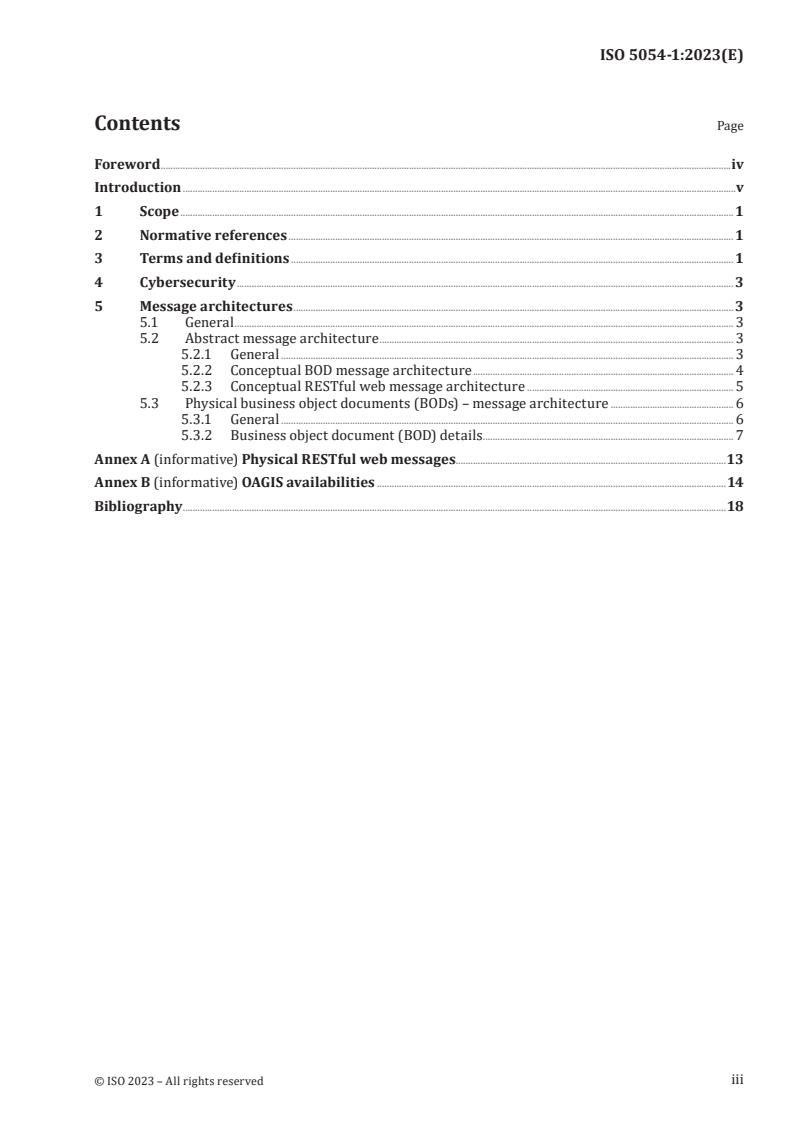
Contents Page
Foreword .iv
Introduction .v
1 Scope .1
2 Normative references .1
3 Terms and definitions .1
4 Cybersecurity . 3
5 Message architectures .3
5.1 General . 3
5.2 Abstract message architecture . 3
5.2.1 General . 3
5.2.2 Conceptual BOD message architecture . 4
5.2.3 Conceptual RESTful web message architecture . 5
5.3 Physical business object documents (BODs) – message architecture . 6
5.3.1 General . 6
5.3.2 Business object document (BOD) details . . 7
Annex A (informative) Physical RESTful web messages .13
Annex B (informative) OAGIS availabilities .14
Bibliography .18
iii
Foreword
ISO (the International Organization for Standardization) is a worldwide federation of national standards
bodies (ISO member bodies). The work of preparing International Standards is normally carried out
through ISO technical committees. Each member body interested in a subject for which a technical
committee has been established has the right to be represented on that committee. International
organizations, governmental and non-governmental, in liaison with ISO, also take part in the work.
ISO collaborates closely with the International Electrotechnical Commission (IEC) on all matters of
electrotechnical standardization.
The procedures used to develop this document and those intended for its further maintenance are
described in the ISO/IEC Directives, Part 1. In particular, the different approval criteria needed for the
different types of ISO documents should be noted. This document was drafted in accordance with the
editorial rules of the ISO/IEC Directives, Part 2 (see www.iso.org/directives).
Attention is drawn to the possibility that some of the elements of this document may be the subject of
patent rights. ISO shall not be held responsible for identifying any or all such patent rights. Details of
any patent rights identified during the development of the document will be in the Introduction and/or
on the ISO list of patent declarations received (see www.iso.org/patents).
Any trade name used in this document is information given for the convenience of users and does not
constitute an endorsement.
For an explanation of the voluntary nature of standards, the meaning of ISO specific terms and
expressions related to conformity assessment, as well as information about ISO's adherence to
the World Trade Organization (WTO) principles in the Technical Barriers to Trade (TBT), see
www.iso.org/iso/foreword.html.
This document was prepared by Technical Committee ISO/TC 154, Processes, data elements and
documents in commerce, industry and administration.
A list of all parts in the ISO 5054 series can be found on the ISO website.
Any feedback or questions on this document should be directed to the user’s national standards body. A
complete listing of these bodies can be found at www.iso.org/members.html.
iv
Introduction
This document focuses on the need for interoperability at the business process level and the benefits
for companies of being able to mix and match different vendor solutions to address their requirements.
When companies want to purchase business applications from multiple vendors, they have the
difficult task of getting the business applications to work together without the benefit of controlling
the integration of those business applications. Additionally, customers are struggling with the larger
task of integrating all of their systems into a coherent information technology infrastructure to support
their business.
By defining integration standards as an enterprise canonical model, application integration can be
optimized for all, instead of having different costly point-to-point solutions between each business
applications, businesses and software vendors benefit.
The definition of the enterprise canonical model is a “single source of truth” for a semantic language
all enterprise applications can speak, for commerce worldwide, for enterprise applications such as
enterprise resource planning (ERP), purchasing, order management, finance, customer management,
quality data, and more. The long-term scope is to enable all current and future enterprise application
integration in a syntax-neutral manner to keep pace with rapidly changing technology landscape and
resource skillsets. Other applications of canonical model include business intelligence and reporting,
to normalize and aggregate business data across applications to provide a consistent vocabulary to
generate business insights (see Annex B).
The enterprise canonical model reflects many thousands of person hours contributed by the Open
1)
Applications Group (OAGi) member companies.
The contributors represent the people who are building, testing, and implementing their business
applications in thousands of companies worldwide.
It is anticipated that future parts of this standard will:
— Provide specification of a physical data model that underlies the model-based approach to data
exchange specification. The data model is an adoption of the ISO 15000-5 standard conceptual
model, as is implemented in open-source application named Score.
— Discuss the content, including the actual nouns and messages (business object documents - BOD),
of the standard. The document contains a discussion of the notion of business context, including its
definition and use to specify precisely profiles (i.e. subsets of) nouns. A list of integration scenarios
is provided, which are the basis for determining detailed business processes that are essential for
the definition of business context. Each scenario is provided with links to specific BODs appearing
in the scenarios. Additionally, list of all nouns, which make up the standard, is provided. Finally,
differing delivery approaches for (including canonical, standalone, and database) and alternative
[1]
formats (JSON Schema, XSD, etc.) are described.
— Describe the platform aspect of the standard whereby the user can create his or her own noun
or message (BOD). The purpose of the platform package is for its content to be reused by other
organizations. The submission describes the library of core component and fields that may be used
to create new messages.
[2][3]
— Describe the serialization of ‘profiles’ into XML schema definition. Also, the submission
describes mappings from the BIE profiles to XML schema.
— Describe the serialization of semantic ‘profiles’ into Javascript Serialized Object Notation (JSON)
schema Draft 4, and Open API Specification 3.0 schema object representation. JSON syntax has been
increasingly popular with business application and API developers ever since the introduction of
mobile and cloud-based technologies due to its more compact payload size for specific instances.
Combined with the Representational State Transfer (REST) architectural style, JSON syntax is
1) https://oagi.org/
v
currently what development resources expect to use for modern application integration and what
students are learning in college and vocational schools.
Much of OAGi member research has suggested a hybrid approach for REST JSON, taking the ‘best
of’ various existing and historical efforts to standardize metadata definitions for REST include
[4]
OData, JSON Schema and Open API Specification. The OAGi RESTful Web API Specification
[20]
describes this hybrid of OData’s URI Conventions, JSON Schema Draft 4 (as published by the
Internet Engineering Task Force - IETF) which influenced ‘Swagger 2.0’, vendor specific approaches
[5]
such as OpenAPI, and ultimately, the Open API Specification 3.0.
Mappings from the BIE profiles to JSON schema are provided, as well as best practices to
[6][7]
incorporate in request/response (HTTP GET) and synchronous one-way (HTTP POST, PUT,
PATCH, DELETE) methods.
vi
INTERNATIONAL STANDARD ISO 5054-1:2023(E)
Specification for an enterprise canonical model —
Part 1:
Architecture
1 Scope
This document specifies the architecture of an enterprise canonical model. It defines the abstract
model, conceptual model and physical model.
This document is applicable to organizations implementing an enterprise-wide interoperability
capability. Some implementers can find it useful in more targeted applications (e.g. departmental
interoperability, projects).
2 Normative references
There are no normative references in this document.
3 Terms and definitions
For the purposes of this document, the following terms and definitions apply.
ISO and IEC maintain terminology databases for use in standardization at the following addresses:
— ISO Online browsing platform: available at https:// www .iso .org/ obp
— IEC Electropedia: available at https:// www .electropedia .org/
3.1
application area
structure that conveys information required by senders, receivers and a messaging infrastructure to
effectively identify, annotate, transport, route and correlate BOD instances
EXAMPLE Message instance id, sender id and correlation id.
3.2
business object document
BOD
message that conforms to the BOD architecture
3.3
BOD architecture
specification that defines the common data structure and behaviour definition for all OAGIS messages
Note 1 to entry: OAGIS stands for Open Applications Group Integration Specification.
3.4
BODID
unique identifier (UUID) of the message instance
Note 1 to entry: For UUID, see Reference [8].
3.5
BOD instance
message instance of a BOD (3.2)
3.6
BOD definition
definition of a BOD (3.2) expressed in a specific format (JSON schema or XML schema definition)
Note 1 to entry: For JSON schema, see Reference [9].
3.7
component
data structure composed of substructures and fields (3.10)
Note 1 to entry: See the definition of "core component" in ISO 15000-5.
3.8
data area
component that carries the business-semantic payload being communicated by the BOD (3.2)
3.9
data type
set of distinct values, characterized by properties of those values, and by operations on those values
Note 1 to entry: A data type can be date, time, decimal, numeric, etc.
[SOURCE: ISO/IEC 11404:2007, 3.12, modified — The term has been changed from "datatype" to "data
type"; Note 1 to entry has been added.]”
3.10
field
lowest level of data elements
Note 1 to entry: These elements contain the data values.
3.11
naming convention
set of rules to build a name
[11] [12]
Note 1 to entry: Naming conventions are specified for example in ISO/IEC 11179-5 and ISO 15000-5 .
3.12
noun
component (3.7) that specifies the business-specific data being communicated (e.g. purchase order,
sales order, quote, route, and shipment)
Note 1 to entry: Nouns are contained within the data area of a BOD (3.2).
3.13
receiver
final receiving system of the BOD instance (3.5)
3.14
scenario
graphical (using UML sequence diagrams) and textual description of a business process
3.15
sender
application that created a BOD instance (3.5)
3.16
signature
digital signature for a BOD instance (3.5)
Note 1 to entry: See Reference [13].
3.17
verb
component (3.7) that specifies the behaviour associated with the noun (3.12)
4 Cybersecurity
Cybersecurity is critical to information-system design, implementation and operation. Cybersecurity
is therefore applicable to systems that build upon the concepts described in this document. However,
the concepts described in the ISO 5054 series are at an abstraction level that does not require security
considerations. That said, the following brief statement about related work can serve as a preview of
cybersecurity-related concepts.
Cybersecurity issues are solved by risk management frameworks. The purpose of risk management is
[14]
to keep risk at an acceptable level. According to the NIST cybersecurity framework, “understanding
the business context, the resources that support critical functions, and the related cybersecurity risks
enable an organization to focus and prioritize its efforts, consistent with its risk management strategy
and business needs.” A key part of risk management is risk assessment. OAGi is working with NIST
to explore the development of a business process management framework to be integrated with an
information technology (IT) risk assessment approach to support risk assessment automation and help
organizations identify their related cybersecurity risks. To this purpose, a next-generation approach
and a prototype tool is in development that implements this approach to conduct IT risk assessment
continuously and automatically.
5 Message architectures
5.1 General
To achieve interoperability between disparate systems, companies and value chains, there should be
a canonical message architecture that provides a common meaning and approach to interoperable
business processes and communication.
Messages built upon such a messaging architecture are then used for defining system interactions that
establish common processes to enable interoperability. These interactions or scenarios provide a step-
by-step guide that is used to perform specific business tasks. Complex scenarios created by assembling
basic scenarios with additional messaging steps can then be created to fulfil business functions.
5.2 Abstract message architecture
5.2.1 General
OAGIS (Open Applications Group Integration Specification) supports different realizations of an abstract
message architecture (or meta model) shown in Figure 1.
Figure 1 — Abstract message architecture
A Message is a definition (or specification) of conveyance of information from a sender to a receiver;
it may include a MessageHeader, a MessageVerb and a MessageBody. The MessageHeader contains
information about the message instance being sent, such as its creation datetime, its origin and
destination, message and correlation identifiers, etc. The MessageVerb indicates the action or behaviour
to be performed by the message receiver. The MessageBody contains the business data being managed
by the message and may contain metadata related to the MessageBody instance, such as the number of
records included. There are two types of Messages: RequestMessage and ResponseMessage. In addition
to the message properties already described, a RequestMessage may have RequestParameters, such as
selection and filter criteria.
Subclauses 5.2.2 and 5.2.3 show how OAGIS realizes this generalized message architecture.
5.2.2 Conceptual BOD message architecture
Figure 2 shows the first realization of the abstract message architecture. This realization is known as
the BOD message architecture.
The business object document (BOD) realizes the message. The BOD ApplicationArea and DataArea
realize the MessageHeader and MessageBody, respectively. Only the noun or component of the DataArea
realizes the MessageBody. The verb of the BOD DataArea realizes the MessageVerb. The BOD request
verbs also realize any RequestParameters of the MessageRequest. Similarly, BOD response verbs realize
any ResponseParameters of the MessageResponse.
Figure 2 — BOD message architecture
5.2.3 Conceptual RESTful web message architecture
Figure 3 shows the second realization of the abstract message architecture. This realization is known
as the RESTful web message architecture. A RESTful web API, as defined herein, is an application
programming interface (API) that is offered by a service exposed on the World Wide Web and conforms
to the REST (representational entity state transfer) architectural style; it uses the web’s primary
[15]
transfer protocol, the Hypertext Transfer Protocol (HTTP) as the application communication
protocol. Generally, an API comprises a set of named operations where each operation includes a request
message and an optional response message. RESTful web API operations leverage the HTTP-Message to
[16]
define their request and response messages (see Annex A). This HTTP-Message architecture serves
as the basis for the RESTful web message architecture.
Figure 3 — RESTful web message architecture
The HTTP-Message realizes the message. The HTTP-MessageHeader and HTTP-MessageBody realize the
MessageHeader and MessageBody, respectively. The OAGIS noun and/or component are included in
the HTTP-MessageBody. The HTTP-StartLine represents both the RequestLine of the HTTP-Request-
Message and the StatusLine of the HTTP-ResponseMessage. The RequestLine includes the HTTP version
number, the HTTP method and URI. The StatusLine includes the HTTP version number, the response
status code and the response status description. The HTTP-StartLine (i.e. the RequestLine) for the
HTTP-RequestMessage realizes the RequestParameters of the MessageRequest. ResponseParameters,
such as pagination results, are realized by components.
5.3 Physical business object documents (BODs) – message architecture
5.3.1 General
The BOD architecture defines a “master pattern” for all BOD-based messages. BODs themselves are the
“specific business document masters” that define the range of possibilities that are agreed to be needed
for a specific business message. The actual creation of the specific “instances” that are exchanged in
scenarios is then governed by the needs of a specific interaction or exchange partner requirements.
A BOD that fulfils a “single step” in a scenario or process shall contain a wide range of possible business
data that can be exchanged. By definition, BODs definitions are significantly larger than the “instance”
messages that are exchanged.
The resulting instance exchange occurs between software applications that can exist within and across
divisions and companies as well as between and across supply and value chains. The instance may be
embedded within several transport protocols to complete a full exchange step.
A BOD shall also be able to communicate application and operational specifics such as any special
conditions, errors, application requirements or status with the expected receiving system.
[12][17]
The BODs may be expressed in W3C XML schema (XSD) or JSON schema, both of which represent
the OAGIS enterprise canonical model. This data model was modelled using ISO 15000-5 which
describes and specifies the core component solution as a methodology for developing a common set of
semantic building blocks that represent the general types of business data and provides for the creation
of new business vocabularies and restructuring of existing business vocabularies.
The BOD message architecture is independent of any communication mechanism. It can be used with
simple transport protocols such as HTTP, FTP, and SMTP as well as more developed transport protocols
such as RESTful web services, SOAP-based web services, AS1, AS2, AS3, AS4 ebMS and RNIF.
5.3.2 Business object document (BOD) details
5.3.2.1 General
The BOD message architecture may be depicted as shown in Figure 4.
The BOD architecture includes the following attributes as a part of every BOD.
— ReleaseID is used to identify the release that the BOD belongs. For the BODs from OAGIS 10.0 and
later, the value of this attribute is “10.0”. The release ID is a required attribute of the BOD.
— VersionID is used to identify the version of the business object document. Each BOD has its own
revision number to specifically identify the level of that BOD, not just the release ID of specification
it is associated. The specific BOD version number is documented in each BOD documentation
document. The outermost element name no longer includes the version number; it is instead now
carried as an attribute of the BOD. The versionID attribute is an optional attribute.
— The systemEnvironmentCode is used to identify whether this BOD is being sent as a result of a
“test” or as “production” level integration. Often as new systems are brought online, testing shall
be performed in a production environment to ensure complete integration. This attribute allows
the integrator to flag test messages as such. The systemEnvironmentCode attribute is an optional
attribute.
— The languageCode attribute indicates the default language of the data being carried in the BOD
message. It is possible to override this BOD level default for fields that will possibly need to carry
multi-lingual information. Examples of this are notes and description.
It also performs two functions: the business data exchange and application interaction; a BOD consists
of two separate sub-sections. The application-level communications (special conditions, errors, etc.)
section is the application area.
Figure 4 — BOD architecture
5.3.2.2 Application area
ApplicationArea includes the following (see Figure 5).
— Sender provides the identification of the application that created this instance of the BOD. It indicates
the logical location of the application and/or database server, the application, and the task that was
used to crea
...