


ISO 25964-1:2011
(Main)Information and documentation — Thesauri and interoperability with other vocabularies — Part 1: Thesauri for information retrieval
Information and documentation — Thesauri and interoperability with other vocabularies — Part 1: Thesauri for information retrieval
ISO 25964-1:2011 gives recommendations for the development and maintenance of thesauri intended for information retrieval applications. It is applicable to vocabularies used for retrieving information about all types of information resources, irrespective of the media used (text, sound, still or moving image, physical object or multimedia) including knowledge bases and portals, bibliographic databases, text, museum or multimedia collections, and the items within them. ISO 25964-1:2011 also provides a data model and recommended format for the import and export of thesaurus data. ISO 25964-1:2011 is applicable to monolingual and multilingual thesauri. ISO 25964-1:2011 is not applicable to the preparation of back-of-the-book indexes, although many of its recommendations could be useful for that purpose. ISO 25964-1:2011 is not applicable to the databases or software used directly in search or indexing applications, but does anticipate the needs of such applications among its recommendations for thesaurus management.
Information et documentation — Thésaurus et interopérabilité avec d'autres vocabulaires — Partie 1: Thésaurus pour la recherche documentaire
Informatika in dokumentacija - Tezavri in interoperabilnost z drugimi slovarji - 1. del: Tezavri za pridobivanje informacij
Ta del standarda ISO 25964 podaja priporočila za razvoj in vzdrževanje tezavrov, namenjenih aplikacijam za pridobivanje informacij. Velja za slovarje, ki se uporabljajo za pridobivanje informacij iz vseh vrst informacijskih virov ne glede na uporabljeni medij (besedilo, zvok, nepremične ali dinamične slike, fizični objekti, večpredstavnostne vsebine), vključno z bazami znanja in portali, bibliografskimi podatkovnimi zbirkami, besedilnimi, muzejskimi ali večpredstavnostnimi zbirkami in predmeti v njih. Ta del standarda ISO 25964 zagotavlja tudi podatkovni model in priporočeni format za uvoz in izvoz podatkov iz tezavra. Ta del standarda ISO 25964 se uporablja za enojezikovne in večjezikovne tezavre. Ta del standarda ISO 25964 se ne uporablja za pripravo kazal na koncu knjig, čeprav bi bila številna priporočila zanje uporabna. Ta del standarda ISO 25964 ne velja za podatkovne baze ali programsko opremo, ki se uporablja neposredno pri aplikacijah za iskanje ali indeksiranje, vendar predvideva potrebe takih aplikacij v priporočilih za upravljanje s tezavrom.
General Information
- Status
- Published
- Publication Date
- 07-Aug-2011
- Technical Committee
- ISO/TC 46/SC 9 - Identification and description
- Drafting Committee
- ISO/TC 46/SC 9 - Identification and description
- Current Stage
- 9092 - International Standard to be revised
- Start Date
- 27-Feb-2023
- Completion Date
- 12-Feb-2026
Relations
- Effective Date
- 20-Jun-2009
- Effective Date
- 20-Jun-2009
Overview
ISO 25964-1:2011 - Information and documentation: Thesauri and interoperability with other vocabularies - Part 1: Thesauri for information retrieval - provides international recommendations for developing, maintaining and exchanging thesauri used in information retrieval. It applies to monolingual and multilingual thesauri across all media (text, audio, images, physical objects, multimedia), and to systems such as bibliographic databases, knowledge bases, portals, museum collections and digital repositories. The standard also defines a data model and recommended exchange format (see Annex B XML Schema) to support import/export and interoperability.
Key topics and technical requirements
- Thesaurus design and objectives: guidance on vocabulary control, concept definition, scope notes and paradigmatic vs. syntagmatic relationships.
- Terms and form: rules for preferred and non-preferred terms, grammatical form, capitalization, punctuation, singular/plural choices and disambiguation.
- Complex concepts and compound terms: criteria for admitting, splitting or retaining multi-word concepts and consistency rules.
- Equivalence and cross-language mapping: treatment of synonyms, quasi-synonyms and degrees of equivalence across languages for multilingual thesauri.
- Concept relationships: hierarchical (broader/narrower), associative and customized relationships for navigation and retrieval.
- Facet analysis and presentation: recommendations for organizing facets, display styles and multilingual layout considerations (character encoding, language tags).
- Thesaurus management and software: planning, construction, maintenance, updating, editorial safeguards, housekeeping tools and size/character limits for management systems.
- Data model and exchange: a formal data model plus recommended exchange formats and protocols to enable import/export and integration with other systems.
- Integration with applications: interoperability requirements for indexing, searching and content management systems to enable consistent indexing and better retrieval.
Practical applications and target users
Who benefits:
- Librarians and cataloguers
- Information architects and knowledge managers
- Metadata specialists and digital curators (museums, archives)
- Developers of search, indexing and content management systems
- Standards implementers and interoperability engineers
Practical benefits:
- Improves retrieval precision and recall by enforcing controlled vocabulary and consistent indexing practices.
- Enables multilingual search and cross-language discovery through defined equivalence mechanisms.
- Facilitates system integration using the standard’s data model and exchange formats (XML Schema) for thesaurus import/export.
- Supports sustainable maintenance via recommended processes for updates, editorial workflows and software features.
Related standards
- ISO 25964 (general) - Part 2 (interoperability with other vocabularies) addresses mappings with classification schemes, authority lists and ontologies.
- ISO 25964-1 supersedes earlier thesaurus standards (ISO 2788:1986 and ISO 5964:1985).
Using ISO 25964-1:2011 helps organizations create interoperable, maintainable thesauri that integrate with modern information retrieval systems and support consistent, multilingual discovery.





Frequently Asked Questions
ISO 25964-1:2011 is a standard published by the International Organization for Standardization (ISO). Its full title is "Information and documentation — Thesauri and interoperability with other vocabularies — Part 1: Thesauri for information retrieval". This standard covers: ISO 25964-1:2011 gives recommendations for the development and maintenance of thesauri intended for information retrieval applications. It is applicable to vocabularies used for retrieving information about all types of information resources, irrespective of the media used (text, sound, still or moving image, physical object or multimedia) including knowledge bases and portals, bibliographic databases, text, museum or multimedia collections, and the items within them. ISO 25964-1:2011 also provides a data model and recommended format for the import and export of thesaurus data. ISO 25964-1:2011 is applicable to monolingual and multilingual thesauri. ISO 25964-1:2011 is not applicable to the preparation of back-of-the-book indexes, although many of its recommendations could be useful for that purpose. ISO 25964-1:2011 is not applicable to the databases or software used directly in search or indexing applications, but does anticipate the needs of such applications among its recommendations for thesaurus management.
ISO 25964-1:2011 gives recommendations for the development and maintenance of thesauri intended for information retrieval applications. It is applicable to vocabularies used for retrieving information about all types of information resources, irrespective of the media used (text, sound, still or moving image, physical object or multimedia) including knowledge bases and portals, bibliographic databases, text, museum or multimedia collections, and the items within them. ISO 25964-1:2011 also provides a data model and recommended format for the import and export of thesaurus data. ISO 25964-1:2011 is applicable to monolingual and multilingual thesauri. ISO 25964-1:2011 is not applicable to the preparation of back-of-the-book indexes, although many of its recommendations could be useful for that purpose. ISO 25964-1:2011 is not applicable to the databases or software used directly in search or indexing applications, but does anticipate the needs of such applications among its recommendations for thesaurus management.
ISO 25964-1:2011 is classified under the following ICS (International Classification for Standards) categories: 01.140.20 - Information sciences. The ICS classification helps identify the subject area and facilitates finding related standards.
ISO 25964-1:2011 has the following relationships with other standards: It is inter standard links to ISO 5964:1985, ISO 2788:1986. Understanding these relationships helps ensure you are using the most current and applicable version of the standard.
ISO 25964-1:2011 is available in PDF format for immediate download after purchase. The document can be added to your cart and obtained through the secure checkout process. Digital delivery ensures instant access to the complete standard document.
Standards Content (Sample)
SLOVENSKI STANDARD
01-julij-2013
Informatika in dokumentacija - Tezavri in interoperabilnost z drugimi slovarji - 1.
del: Tezavri za pridobivanje informacij
Information and documentation -- Thesauri and interoperability with other vocabularies --
Part 1: Thesauri for information retrieval
Information et documentation -- Thésaurus et interopérabilité avec d'autres vocabulaires
-- Partie 1: Thésaurus pour la recherche documentaire
Ta slovenski standard je istoveten z: ISO 25964-1:2011
ICS:
01.140.20 Informacijske vede Information sciences
2003-01.Slovenski inštitut za standardizacijo. Razmnoževanje celote ali delov tega standarda ni dovoljeno.
INTERNATIONAL ISO
STANDARD 25964-1
First edition
2011-08-15
Information and documentation —
Thesauri and interoperability with other
vocabularies —
Part 1:
Thesauri for information retrieval
Information et documentation — Thésaurus et interopérabilité avec
d'autres vocabulaires —
Partie 1: Thésaurus pour la recherche documentaire
Reference number
©
ISO 2011
© ISO 2011
All rights reserved. Unless otherwise specified, no part of this publication may be reproduced or utilized in any form or by any means,
electronic or mechanical, including photocopying and microfilm, without permission in writing from either ISO at the address below or
ISO's member body in the country of the requester.
ISO copyright office
Case postale 56 • CH-1211 Geneva 20
Tel. + 41 22 749 01 11
Fax + 41 22 749 09 47
E-mail copyright@iso.org
Web www.iso.org
Published in Switzerland
ii © ISO 2011 – All rights reserved
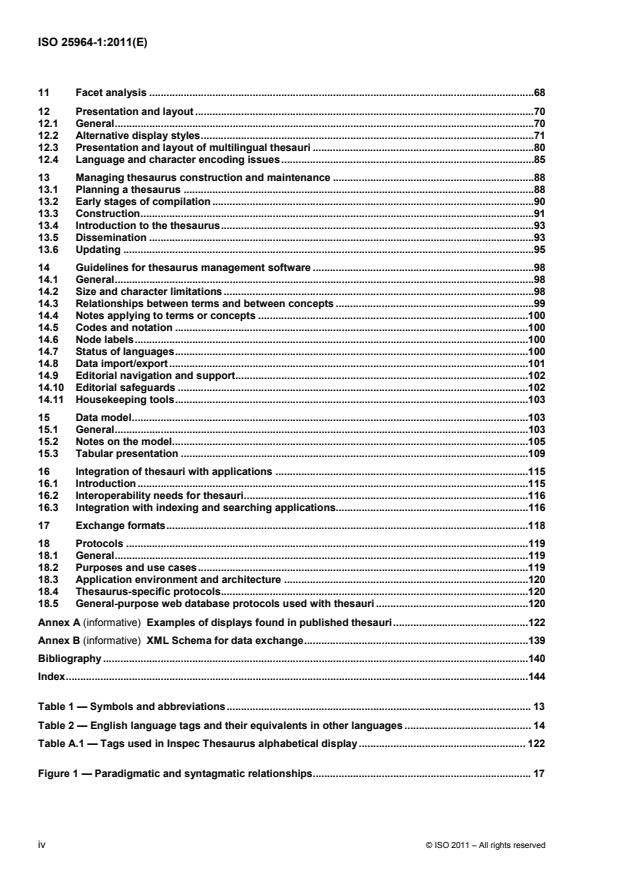
Contents Page
Foreword .v
Introduction.vi
1 Scope.1
2 Terms and definitions .1
3 Symbols, abbreviated terms and other conventions.12
4 Thesaurus overview and objectives.15
4.1 Overall objective.15
4.2 Vocabulary control and its purpose .16
4.3 Paradigmatic versus syntagmatic relationships.16
4.4 Types of paradigmatic relationship.17
5 Concepts and their scope in a thesaurus.18
5.1 Conceptual basis.18
5.2 Scope notes .20
5.3 Reciprocal scope notes .21
6 Thesaurus terms.21
6.1 Form of terms .21
6.2 Clarification and disambiguation of thesaurus terms .21
6.3 Grammatical form of terms.23
6.4 Capitalization, punctuation and special characters .26
6.5 Singular or plural forms.27
6.6 Selection of the preferred form.30
7 Complex concepts.37
7.1 General .37
7.2 The nature of compound terms .38
7.3 Deciding whether or not to admit a complex concept.39
7.4 How to split a complex concept.43
7.5 Retention of constituent concepts .43
7.6 Consistency in the treatment of complex concepts .44
7.7 Order of words in multi-word terms .44
8 The equivalence relationship, in a monolingual context .44
8.1 General .44
8.2 Synonyms.45
8.3 Quasi-synonyms.48
8.4 Specific terms subsumed in a broader concept .48
8.5 Representation of complex concepts by a combination of terms .49
9 Equivalence across languages .50
9.1 General .50
9.2 Degrees of equivalence .51
9.3 Typical problems and solutions .52
9.4 Representation of cross-language equivalence between preferred terms .57
9.5 Cross-language equivalence between non-preferred terms.57
10 Relationships between concepts.57
10.1 Introduction.57
10.2 The hierarchical relationship .58
10.3 The associative relationship .63
10.4 Customized relationships.67
11 Facet analysis .68
12 Presentation and layout .70
12.1 General.70
12.2 Alternative display styles.71
12.3 Presentation and layout of multilingual thesauri .80
12.4 Language and character encoding issues.85
13 Managing thesaurus construction and maintenance .88
13.1 Planning a thesaurus .88
13.2 Early stages of compilation.90
13.3 Construction.91
13.4 Introduction to the thesaurus.93
13.5 Dissemination .93
13.6 Updating .95
14 Guidelines for thesaurus management software .98
14.1 General.98
14.2 Size and character limitations.98
14.3 Relationships between terms and between concepts .99
14.4 Notes applying to terms or concepts .100
14.5 Codes and notation .100
14.6 Node labels.100
14.7 Status of languages.100
14.8 Data import/export.101
14.9 Editorial navigation and support.102
14.10 Editorial safeguards .102
14.11 Housekeeping tools.103
15 Data model.103
15.1 General.103
15.2 Notes on the model.105
15.3 Tabular presentation .109
16 Integration of thesauri with applications .115
16.1 Introduction.115
16.2 Interoperability needs for thesauri.116
16.3 Integration with indexing and searching applications.116
17 Exchange formats.118
18 Protocols .119
18.1 General.119
18.2 Purposes and use cases.119
18.3 Application environment and architecture .120
18.4 Thesaurus-specific protocols.120
18.5 General-purpose web database protocols used with thesauri .120
Annex A (informative) Examples of displays found in published thesauri.122
Annex B (informative) XML Schema for data exchange.139
Bibliography .140
Index.144
Table 1 — Symbols and abbreviations. 13
Table 2 — English language tags and their equivalents in other languages . 14
Table A.1 — Tags used in Inspec Thesaurus alphabetical display. 122
Figure 1 — Paradigmatic and syntagmatic relationships. 17
iv © ISO 2011 – All rights reserved
Foreword
ISO (the International Organization for Standardization) is a worldwide federation of national standards bodies
(ISO member bodies). The work of preparing International Standards is normally carried out through ISO
technical committees. Each member body interested in a subject for which a technical committee has been
established has the right to be represented on that committee. International organizations, governmental and
non-governmental, in liaison with ISO, also take part in the work. ISO collaborates closely with the
International Electrotechnical Commission (IEC) on all matters of electrotechnical standardization.
International Standards are drafted in accordance with the rules given in the ISO/IEC Directives, Part 2.
The main task of technical committees is to prepare International Standards. Draft International Standards
adopted by the technical committees are circulated to the member bodies for voting. Publication as an
International Standard requires approval by at least 75 % of the member bodies casting a vote.
Attention is drawn to the possibility that some of the elements of this document may be the subject of patent
rights. ISO shall not be held responsible for identifying any or all such patent rights.
ISO 25964-1 was prepared by Technical Committee ISO/TC 46, Information and documentation,
Subcommittee SC 9, Identification and description.
This first edition of ISO 25964-1 cancels and replaces ISO 2788:1986 and ISO 5964:1985, which have been
merged and technically revised. Clauses 1 to 13 of this part of ISO 25964 correspond broadly to the content of
ISO 2788:1986 and ISO 5964:1985. The remaining clauses cover new material.
ISO 25964 consists of the following parts, under the general title Information and documentation — Thesauri
and interoperability with other vocabularies:
⎯ Part 1: Thesauri for information retrieval
The following parts are under preparation:
⎯ Part 2: Interoperability with other vocabularies
This part of ISO 25964 covers the development and maintenance of thesauri, both monolingual and
multilingual, including formats and protocols for data exchange.
ISO 25964-2 will cover interoperability between different thesauri and with other types of structured
vocabulary, such as classification schemes, name authority lists, ontologies, etc., not previously covered in
any International Standard.
Introduction
Today's thesauri are mostly electronic tools, having moved on from the paper-based era when thesaurus
standards were first developed. They are built and maintained with the support of software and need to
integrate with other software, such as search engines and content management systems. (For example, data
from the thesaurus database might need to be presented in combination with the number of postings found by
a search application.) Whereas in the past thesauri were designed for information professionals trained in
indexing and searching, today there is a demand for vocabularies that untrained users will find to be intuitive,
and for vocabularies that enable inferencing by machines.
ISO 25964 makes the transition that is needed in order to be compatible with the world of electronic
information management. However, this part of ISO 25964 retains the assumption that human intellect is
usually involved in the selection of indexing terms and in the selection of search terms. If both the indexer and
the searcher are guided to choose the same term for the same concept, then relevant documents will be
retrieved. This is the main principle underlying thesaurus design, even though a thesaurus may also be
applied in situations where computers make the choices.
Efficient exchange of data is a vital component of thesaurus management and exploitation. This part of
ISO 25964 therefore includes recommendations for exchange formats and protocols. Adoption of these will
facilitate interoperability between thesaurus management systems and other computer applications, such as
indexing and retrieval systems, that will utilize the data.
This part of ISO 25964 covers development and maintenance of thesauri rather than how to use them in
indexing. Where multilingual issues and examples are addressed, efforts have been made to cover as wide a
selection of languages as possible, consistent with clarity and comprehensibility.
Thesauri are typically used in post-coordinate retrieval systems, but may also be applied to hierarchical
directories, pre-coordinate indexes and classification systems. Increasingly, thesaurus applications need to
mesh with others, such as automatic categorization schemes, free-text search systems, etc. ISO 25964-2 will
address additional types of structured vocabulary (such as classification schemes, name authority lists,
ontologies, etc.) and give recommendations to enable interoperation of the vocabularies at all stages of the
information storage and retrieval process.
vi © ISO 2011 – All rights reserved
INTERNATIONAL STANDARD ISO 25964-1:2011(E)
Information and documentation — Thesauri and interoperability
with other vocabularies —
Part 1:
Thesauri for information retrieval
1 Scope
This part of ISO 25964 gives recommendations for the development and maintenance of thesauri intended for
information retrieval applications. It is applicable to vocabularies used for retrieving information from all types
of information resources, irrespective of the media used (text, sound, still or moving image, physical object or
multimedia) including knowledge bases and portals, bibliographic databases, text, museum or multimedia
collections, and the items within them.
This part of ISO 25964 also provides a data model and recommended format for the import and export of
thesaurus data.
This part of ISO 25964 is applicable to monolingual and multilingual thesauri.
This part of ISO 25964 is not applicable to the preparation of back-of-the-book indexes, although many of its
recommendations could be useful for that purpose.
This part of ISO 25964 is not applicable to the databases or software used directly in search or indexing
applications, but does anticipate the needs of such applications among its recommendations for thesaurus
management.
2 Terms and definitions
For the purposes of this document, the following terms and definitions apply.
2.1
array
group of sibling concepts (2.52)
EXAMPLE
In the following, the sibling concepts outerwear and underwear form an array within the concept “clothing”.
clothing
outerwear
overcoats
underwear
2.2
associative relationship
relationship between a pair of concepts (2.11) that are not related hierarchically but share a strong semantic
connection
2.3
broader term
preferred term (2.45) representing a concept (2.11) that is broader than the one in question
NOTE The scope of the narrower concept falls completely within the scope of the broader. The relationship between
the two is commonly indicated with the tag BT. For more explanation see 10.2.1.
2.4
characteristic of division
attribute by which a concept (2.11) can be subdivided into an array (2.1) of narrower concepts (2.11), each
having a distinct value of that attribute
cf. facet analysis (2.21), node label (2.38)
EXAMPLE
In the following, age group is the characteristic of division applied to the concept of people:
people
(people by age group)
children
youths
adults
2.5
classification
classifying
activity involving the components of grouping similar or related things together; separating dissimilar or
unrelated things; and arranging the resulting groups in a logical and helpful sequence
2.6
classification scheme
schedule (2.49) of concepts (2.11) and pre-coordinated combinations of concepts (2.11), arranged by
classification (2.5)
NOTE A classification scheme often also includes an index.
2.7
coined term
new term (2.61) created to express a concept (2.11) for which no suitable term (2.61) exists in the required
language
NOTE For a further explanation and examples, see 6.6.5 and 9.3.3.3
2.8
compound equivalence
relationship or mapping in which one term (2.61) or concept (2.11) in one context is represented by two or
more terms (2.61) or concepts (2.11) in another
2 © ISO 2011 – All rights reserved
2.9
compound term
term (2.61) that can be split morphologically into separate components
EXAMPLE
In English:
“copper mines” can be split into “copper” and “mines”; “lawnmowers” can be split into “lawns” and “mowers”
In French:
“mine de cuivre” can be split into “mine” and “cuivre”; “biodiversité” can be split into "biologie" and "diversité"
NOTE Compound terms can be multi-word terms, or can consist of only one word.
2.10
computer application
computer program or set of programs that provides high-level processing related to a specific user need
NOTE In ISO 25964, a computer application is sometimes referred to as an application.
2.11
concept
unit of thought
NOTE Concepts can often be expressed in a variety of different ways. They exist in the mind as abstract entities
independent of terms used to express them. They range from the very simple, e.g. “child”, to the very complex, e.g. “child
protection legislation”.
2.12
controlled vocabulary
prescribed list of terms (2.61), headings or codes, each representing a concept (2.11)
NOTE Controlled vocabularies are designed for applications in which it is useful to identify each concept with one
consistent label, for example when classifying documents, indexing them and/or searching them. Thesauri, subject
heading schemes and name authority lists are examples of controlled vocabularies.
2.13
cross-language equivalence
equivalence relationship (2.18) between terms (2.61) representing the same concept (2.11) in different
languages
2.14
data model
abstract model that describes how data is represented and used
NOTE The data model in this part of ISO 25964 provides a generic definition of thesaurus structure and semantics. It
can be used as the basis for defining a database model or an exchange format for thesauri.
2.15
document
any resource that can be classified or indexed in order that the data or information in it can be retrieved
NOTE This definition refers not only to written and printed materials in paper or microform versions (for example,
conventional books, journals, diagrams, maps), but also to non-printed media such as machine-readable and digitized
records, Internet and intranet resources, films, sound recordings, people and organizations as knowledge resources,
buildings, sites, monuments, three-dimensional objects or realia; and to collections of such items or parts of such items.
2.16
entry term
lead-in term
term (2.61) provided in a controlled vocabulary (2.12), not for direct use in metadata (2.33), but for the
purpose of guiding the user to another term (2.61) that can be used as a category label, subject heading or
preferred term (2.45)
NOTE Entry terms occurring in a thesaurus are generally known as non-preferred terms.
2.17
equivalence mapping
mapping that states that the concept (2.11) in the target vocabulary is considered identical in scope to the
concept (2.11) in the source vocabulary
cf. equivalence relationship (2.18)
2.18
equivalence relationship
relationship between two terms (2.61) in a thesaurus (2.62) that both represent the same concept (2.11)
NOTE In ordinary discourse, terms that are quasi-synonyms may represent slightly different concepts. After inclusion
in the thesaurus, however, the equivalence relationship clarifies that both are regarded as representing the same concept.
When two or more such terms are in the same language within a monolingual or multilingual thesaurus, one of them is
designated a preferred term and the other(s) non-preferred term(s); when two or more such terms are in the different
languages of a multilingual thesaurus, each of them may be a preferred term in its own language respectively, and the
relationship is known as cross-language equivalence.
2.19
exchange format
machine-readable format for representing information that is intended to facilitate exchange of the information
between different applications
NOTE The exchange format for a thesaurus often uses a markup language based on a standard such as XML
[63][64][65][66]
(Extensible Markup Language) , and is based on a data model for thesauri. While the data model provides a
generic description of thesaurus structure and semantics, the exchange format expresses this in a formal language for the
purpose of exchanging thesauri.
2.20
facet
grouping of concepts (2.11) of the same inherent category
EXAMPLE 1 Animals, mice, daffodils and bacteria could all be members of a living organisms facet.
EXAMPLE 2 Digging, writing and cooking could all be members of an actions facet.
EXAMPLE 3 Paris, the United Kingdom and the Alps could all be members of a places facet.
NOTE Examples of high-level categories that can be used for grouping concepts into facets are: objects, materials,
agents, actions, places and times.
cf. node label (2.38)
2.21
facet analysis
analysis of subject areas into constituent concepts (2.11) grouped into facets (2.20), and the subdivision of
concepts (2.11) into narrower concepts (2.11) by specified characteristics of division
4 © ISO 2011 – All rights reserved
2.22
facet indicator
notational device that indicates the start of a new facet (2.20) within a synthesized compound notation (2.40)
NOTE Examples of facet indicators are the 0 in the Dewey Decimal Classification, and parentheses and quotation
symbols in the Universal Decimal Classification. In the past, the term facet indicator has been used as synonymous with
node label but that usage is deprecated by ISO 25964, to avoid confusion.
2.23
hierarchical relationship
relationship between a pair of concepts (2.11) of which one has a scope falling completely within the scope of
the other
cf. broader term (2.3), narrower term (2.37)
NOTE Several different types of hierarchical relationship exist. For a further explanation, see 10.2.
2.24
homograph
one of two or more words that are written in the same way, but have different meanings
EXAMPLES
In English:
The word "bank" could refer to a financial institution or the side of a river.
In French:
The word “avocat” could refer to a lawyer or to a fruit.
NOTE Homographs are sometimes referred to as homonyms, although the latter term applies more broadly, as it
also includes pairs of terms such as "weights" and "waits" in English or "mer" and "mère" in French, which sound the same
although they are spelt differently.
2.25
identifier
set of symbols, usually alphanumeric, designating a concept (2.11) or a term (2.61) or another entity for
purposes of unique identification within a determined context or resource, especially in a computer system or
network
NOTE A notation is sometimes used as an identifier.
2.26
index term
term (2.61) assigned to a document (2.15) in the process of indexing (2.27)
NOTE Sometimes index terms are referred to as indexing terms, as keywords or as tags, but the latter terms have
other meanings too. Preferred terms from a thesaurus are very often used as index terms.
2.27
indexing
intellectual analysis of the subject matter of a document (2.15) to identify the concepts (2.11) represented in
it, and allocation of the corresponding index terms (2.26) to allow the information to be retrieved
NOTE The term "subject indexing" is often used for this concept, but as ISO 25964 does not deal with the indexing of
other elements such as authors or dates, "indexing" is sufficient. Indexing can be carried out by human users or by
automated agents.
2.28
information retrieval
all the techniques and processes used to identify documents (2.15) relevant to an information need, from a
collection or network of information resources
NOTE Selection and inclusion of items in the collection are included in this definition; likewise browsing and other
forms of information seeking.
2.29
interoperability
ability of two or more systems or components to exchange information and to use the information that has
been exchanged
NOTE Vocabularies can support interoperability by including relations to other vocabularies, by presenting data in
standard formats and by using systems that support common computer protocols.
2.30
loan term
term (2.61) borrowed from another language that has become accepted in the borrowing language
EXAMPLES
"glasnost" is a Russian term that has become accepted in English
"gourmet" is a French term that has become accepted in English
2.31
markup
annotations or other type of encoding embedded in text, in conformity with a markup language (2.32)
2.32
markup language
set of encoding conventions that can be used to provide instructions for the interpretation of a text, by the use
of annotations embedded in the text itself
NOTE The interpretation often concerns issues such as content, structure or rendering of the text. Widely used
[59]
examples include HTML (Hypertext Markup Language) , which is largely concerned with presentation, and XML
[63][64][65][66]
(Extensible Markup Language) , which addresses the structure of text.
2.33
metadata
data that identify attributes of a document (2.15) typically used to support functions such as location,
discovery, documentation, evaluation and/or selection
NOTE Preferred terms or notations selected during the indexing process are commonly applied as metadata values.
2.34
monohierarchical structure
hierarchical arrangement of concepts (2.11), in a thesaurus (2.62) or classification scheme (2.6), in which
each concept (2.11) can have only one broader concept (2.11) at the level immediately above
cf. polyhierarchical structure (2.42)
EXAMPLE In a monohierarchical structure, the concept of pianos cannot be listed under keyboard instruments as
well as under stringed instruments; a choice has to be made of one of these concepts to determine its placing.
6 © ISO 2011 – All rights reserved
2.35
multilingual thesaurus
thesaurus (2.62) in which terms (2.61) and relational structures are available in two or more natural
languages
2.36
multi-word term
term (2.61) consisting of more than one word
cf. compound term (2.9)
EXAMPLE
cost benefit analysis
2.37
narrower term
preferred term (2.45) representing a concept (2.11) that is narrower than the one in question
NOTE The scope of the narrower concept falls completely within the scope of the broader concept. The relationship
between the two is commonly indicated with the tag NT. For more explanation see 10.2.1.
2.38
node label
label inserted into a hierarchical or classified display to show how the terms (2.61) have been arranged
NOTE A node label is neither a preferred term nor a non-preferred term. It contains one of two different types of
information:
a) the name of a facet to which following terms belong; or
b) the attribute or characteristic of division by which an array of sibling concepts has been sorted or grouped.
See examples in Clause 11.
2.39
non-preferred term
non-descriptor
term (2.61) that is not assigned to documents (2.15) but is provided as an entry point in a thesaurus (2.62)
or index
cf. entry term (2.16)
EXAMPLE
hounds
USE dogs
NOTE In this example, "hounds" is a non-preferred term, while "dogs" is the preferred term that should be used in its
place.
2.40
notation
class code
class number
classmark
set of symbols representing a concept (2.11) in a structured vocabulary (2.56), especially a classification
scheme (2.6)
EXAMPLES
Notation Source vocabulary Concept
07.04.4 ILO Thesaurus fishery policy and development
622.342 2 Dewey Decimal Classification gold mining
373.3.016:51 Universal Decimal Classification mathematics curriculum in primary schools
SBS XEJ B Bliss Bibliographic Classification endangered species law
H40-H42 International Statistical Classification of glaucoma
Diseases and Related Health Problems
NOTE Notation is sometimes used to sort and/or locate concepts in a predetermined systematic order and, optionally,
to display how the components of complex concepts have been structured and grouped. A notation can provide the link
between alphabetical and systematic lists in a thesaurus. In the context of classification schemes, "concepts" are often
known as "subjects", especially when they are complex, as in the examples above.
2.41
paradigmatic relationship
a priori relationship
relationship between concepts (2.11) that is inherent in the concepts (2.11) themselves
NOTE Such relationships are shown in a structured vocabulary, independently of any indexed document. For a more
complete discussion of paradigmatic and syntagmatic relationships, see 4.3.
2.42
polyhierarchical structure
hierarchical arrangement of concepts (2.11), in a thesaurus (2.62) or classification scheme (2.6), in which
each concept (2.11) can have more than one broader concept (2.11)
cf. monohierarchical structure (2.34)
EXAMPLE
In a polyhierarchical structure, organs (musical instruments) could be listed under keyboard instruments as well as
under wind instruments.
NOTE In a polyhierarchical structure, a single concept can occur in more than one place in the hierarchical structure
of the thesaurus. Its attributes and relationships, and specifically its narrower and related terms, are the same wherever it
occurs.
8 © ISO 2011 – All rights reserved
2.43
post-coordination
combination of preferred terms (2.45) of a controlled vocabulary (2.12) at the time of searching
cf. pre-coordination (2.44)
EXAMPLE
The post-coordinated search expression "microwaves AND radiation" can be used to retrieve documents on
microwave radiation, when these have been indexed under the separate terms “microwaves” and “radiation” rather
than a compound term.
2.44
pre-coordination
combination of concepts (2.11), classes or terms (2.61) of a controlled vocabulary (2.12) at the time of its
construction or at the time of using it for indexing (2.27) or classification (2.5)
cf. post-coordination (2.43)
EXAMPLE 1
The class "general theory", when placed within the broader class "music", refers only to the pre-coordinated subject
"theory of music" and not to theory in general.
EXAMPLE 2
The pre-coordinated string "cardboard − recycling" might appear in a subject heading scheme or, if not enumerated
there, might be synthesized by an indexer when needed for a particular document.
2.45
preferred term
descriptor
term (2.61) used to represent a concept (2.11) when indexing (2.27)
cf. non-preferred term (2.39)
NOTE A preferred term is usually a noun or noun phrase.
2.46
protocol
convention that defines the syntax, semantics and synchronization of the communication process between
two computers in order to enable a particular service
2.47
quasi-synonym
near-synonym
one of two or more terms (2.61) whose meanings are generally regarded as different in ordinary usage but
which may be treated as labels for the same concept (2.11), in a given controlled vocabulary (2.12)
EXAMPLES
diseases, disorders
earthquakes, earth tremors
2.48
related term
preferred term (2.45) representing a concept (2.11) that has an associative relationship (2.2) with the one
in question
NOTE The relationship between related terms is commonly indicated with the tag RT. For a further explanation,
see 10.3.
2.49
schedule
terms (2.61), notations (2.40), captions, cross-references and scope notes (2.50) set out to exhibit the
content and structure of a structured vocabulary (2.56)
2.50
scope note
note that defines or clarifies the semantic boundaries of a concept (2.11) as it is used in the structured
vocabulary (2.56)
NOTE A term used to label a concept can have several meanings in normal usage. A scope note is used to restrict
the concept to only one of those meanings, and where necessary refers to other concepts that are included or excluded
from the scope of the concept being clarified.
2.51
search term
term (2.61) forming all or part of a search query
NOTE In the context of ISO 25964, search terms are usually drawn from a controlled vocabulary.
2.52
sibling concept
one of two or more concepts (2.11) with the same immediate broader concept (2.11), each of these being
represented by a preferred term (2.45)
EXAMPLE
In the following, outerwear and underwear are preferred terms representing sibling concepts in the same array:
clothing
outerwear
overcoats
underwear
2.53
sibling term
one of two or more preferred terms (2.45) with the same immediate broader term (2.3)
EXAMPLE
In the following, chairs and tables are sibling terms in the same array, while no siblings are shown for “furniture”,
“armchairs” or “dining tables”:
furniture
chairs
armchairs
tables
dining tables
10 © ISO 2011 – All rights reserved
2.54
source language
language serving as a starting point in translation or in a search for term (2.61) equivalents
2.55
specificity
capability of a structured vocabulary (2.56) to express a subject in depth and in detail
NOTE For a further explanation, see the discussion of specificity in 8.4 and other places.
2.56
structured vocabulary
organized set of terms (2.61), headings or codes representing concepts (2.11) and their inter-relationships,
which can be used to support information retrieval (2.28)
NOTE A structured vocabulary can also be used for other purposes. In the context of information retrieval, the
vocabulary needs to be accompanied by rules for how to apply the terms. Various types of structured vocabulary will be
addressed in ISO 25964-2, including classification schemes, subject heading schemes, etc.
2.57
subject heading scheme
subject heading language
subject heading list
SHL
structured vocabulary (2.56) comprising terms (2.61) available for subject indexing (2.27), plus rules for
combining them into pre-coordinated strings of terms (2.61) where necessary
2.58
synonym
one of two or more terms (2.61) denoting the same concept (2.11)
EXAMPLES
In English:
guarantees, warranties
heart attack, myocardial infarction
HIV, human immunodeficiency virus
In French:
schiste, phyllade
VIH, virus de l'immunodéficience humaine
crise cardiaque, infarctus du myocarde
NOTE Abbreviations and their full forms can be treated as synonyms.
2.59
syntagmatic relationship
a posteriori relationship
relationship between concepts (2.11) that exists only because they occur together in a document (2.15)
being indexed
NOTE Such relationships are not generally valid in contexts other than the document being indexed, and therefore
they do not form part of the structure of a thesaurus. For a more complete discussion of syntagmatic and paradigmatic
relationships, see 4.3.
2.60
target language
language providing a translation or an equivalent for a term (2.61) existing in a source language (2.54)
2.61
term
word or phrase used to label a concept (2.11)
EXAMPLES
schools
school uniform
costs of schooling
teaching
NOTE Thesaurus terms can be either preferred terms or non-preferred terms.
2.62
thesaurus
controlle
...
INTERNATIONAL ISO
STANDARD 25964-1
First edition
2011-08-15
Information and documentation —
Thesauri and interoperability with other
vocabularies —
Part 1:
Thesauri for information retrieval
Information et documentation — Thésaurus et interopérabilité avec
d'autres vocabulaires —
Partie 1: Thésaurus pour la recherche documentaire
Reference number
©
ISO 2011
© ISO 2011
All rights reserved. Unless otherwise specified, no part of this publication may be reproduced or utilized in any form or by any means,
electronic or mechanical, including photocopying and microfilm, without permission in writing from either ISO at the address below or
ISO's member body in the country of the requester.
ISO copyright office
Case postale 56 • CH-1211 Geneva 20
Tel. + 41 22 749 01 11
Fax + 41 22 749 09 47
E-mail copyright@iso.org
Web www.iso.org
Published in Switzerland
ii © ISO 2011 – All rights reserved
Contents Page
Foreword .v
Introduction.vi
1 Scope.1
2 Terms and definitions .1
3 Symbols, abbreviated terms and other conventions.12
4 Thesaurus overview and objectives.15
4.1 Overall objective.15
4.2 Vocabulary control and its purpose .16
4.3 Paradigmatic versus syntagmatic relationships.16
4.4 Types of paradigmatic relationship.17
5 Concepts and their scope in a thesaurus.18
5.1 Conceptual basis.18
5.2 Scope notes .20
5.3 Reciprocal scope notes .21
6 Thesaurus terms.21
6.1 Form of terms .21
6.2 Clarification and disambiguation of thesaurus terms .21
6.3 Grammatical form of terms.23
6.4 Capitalization, punctuation and special characters .26
6.5 Singular or plural forms.27
6.6 Selection of the preferred form.30
7 Complex concepts.37
7.1 General .37
7.2 The nature of compound terms .38
7.3 Deciding whether or not to admit a complex concept.39
7.4 How to split a complex concept.43
7.5 Retention of constituent concepts .43
7.6 Consistency in the treatment of complex concepts .44
7.7 Order of words in multi-word terms .44
8 The equivalence relationship, in a monolingual context .44
8.1 General .44
8.2 Synonyms.45
8.3 Quasi-synonyms.48
8.4 Specific terms subsumed in a broader concept .48
8.5 Representation of complex concepts by a combination of terms .49
9 Equivalence across languages .50
9.1 General .50
9.2 Degrees of equivalence .51
9.3 Typical problems and solutions .52
9.4 Representation of cross-language equivalence between preferred terms .57
9.5 Cross-language equivalence between non-preferred terms.57
10 Relationships between concepts.57
10.1 Introduction.57
10.2 The hierarchical relationship .58
10.3 The associative relationship .63
10.4 Customized relationships.67
11 Facet analysis .68
12 Presentation and layout .70
12.1 General.70
12.2 Alternative display styles.71
12.3 Presentation and layout of multilingual thesauri .80
12.4 Language and character encoding issues.85
13 Managing thesaurus construction and maintenance .88
13.1 Planning a thesaurus .88
13.2 Early stages of compilation.90
13.3 Construction.91
13.4 Introduction to the thesaurus.93
13.5 Dissemination .93
13.6 Updating .95
14 Guidelines for thesaurus management software .98
14.1 General.98
14.2 Size and character limitations.98
14.3 Relationships between terms and between concepts .99
14.4 Notes applying to terms or concepts .100
14.5 Codes and notation .100
14.6 Node labels.100
14.7 Status of languages.100
14.8 Data import/export.101
14.9 Editorial navigation and support.102
14.10 Editorial safeguards .102
14.11 Housekeeping tools.103
15 Data model.103
15.1 General.103
15.2 Notes on the model.105
15.3 Tabular presentation .109
16 Integration of thesauri with applications .115
16.1 Introduction.115
16.2 Interoperability needs for thesauri.116
16.3 Integration with indexing and searching applications.116
17 Exchange formats.118
18 Protocols .119
18.1 General.119
18.2 Purposes and use cases.119
18.3 Application environment and architecture .120
18.4 Thesaurus-specific protocols.120
18.5 General-purpose web database protocols used with thesauri .120
Annex A (informative) Examples of displays found in published thesauri.122
Annex B (informative) XML Schema for data exchange.139
Bibliography .140
Index.144
Table 1 — Symbols and abbreviations. 13
Table 2 — English language tags and their equivalents in other languages . 14
Table A.1 — Tags used in Inspec Thesaurus alphabetical display. 122
Figure 1 — Paradigmatic and syntagmatic relationships. 17
iv © ISO 2011 – All rights reserved
Foreword
ISO (the International Organization for Standardization) is a worldwide federation of national standards bodies
(ISO member bodies). The work of preparing International Standards is normally carried out through ISO
technical committees. Each member body interested in a subject for which a technical committee has been
established has the right to be represented on that committee. International organizations, governmental and
non-governmental, in liaison with ISO, also take part in the work. ISO collaborates closely with the
International Electrotechnical Commission (IEC) on all matters of electrotechnical standardization.
International Standards are drafted in accordance with the rules given in the ISO/IEC Directives, Part 2.
The main task of technical committees is to prepare International Standards. Draft International Standards
adopted by the technical committees are circulated to the member bodies for voting. Publication as an
International Standard requires approval by at least 75 % of the member bodies casting a vote.
Attention is drawn to the possibility that some of the elements of this document may be the subject of patent
rights. ISO shall not be held responsible for identifying any or all such patent rights.
ISO 25964-1 was prepared by Technical Committee ISO/TC 46, Information and documentation,
Subcommittee SC 9, Identification and description.
This first edition of ISO 25964-1 cancels and replaces ISO 2788:1986 and ISO 5964:1985, which have been
merged and technically revised. Clauses 1 to 13 of this part of ISO 25964 correspond broadly to the content of
ISO 2788:1986 and ISO 5964:1985. The remaining clauses cover new material.
ISO 25964 consists of the following parts, under the general title Information and documentation — Thesauri
and interoperability with other vocabularies:
⎯ Part 1: Thesauri for information retrieval
The following parts are under preparation:
⎯ Part 2: Interoperability with other vocabularies
This part of ISO 25964 covers the development and maintenance of thesauri, both monolingual and
multilingual, including formats and protocols for data exchange.
ISO 25964-2 will cover interoperability between different thesauri and with other types of structured
vocabulary, such as classification schemes, name authority lists, ontologies, etc., not previously covered in
any International Standard.
Introduction
Today's thesauri are mostly electronic tools, having moved on from the paper-based era when thesaurus
standards were first developed. They are built and maintained with the support of software and need to
integrate with other software, such as search engines and content management systems. (For example, data
from the thesaurus database might need to be presented in combination with the number of postings found by
a search application.) Whereas in the past thesauri were designed for information professionals trained in
indexing and searching, today there is a demand for vocabularies that untrained users will find to be intuitive,
and for vocabularies that enable inferencing by machines.
ISO 25964 makes the transition that is needed in order to be compatible with the world of electronic
information management. However, this part of ISO 25964 retains the assumption that human intellect is
usually involved in the selection of indexing terms and in the selection of search terms. If both the indexer and
the searcher are guided to choose the same term for the same concept, then relevant documents will be
retrieved. This is the main principle underlying thesaurus design, even though a thesaurus may also be
applied in situations where computers make the choices.
Efficient exchange of data is a vital component of thesaurus management and exploitation. This part of
ISO 25964 therefore includes recommendations for exchange formats and protocols. Adoption of these will
facilitate interoperability between thesaurus management systems and other computer applications, such as
indexing and retrieval systems, that will utilize the data.
This part of ISO 25964 covers development and maintenance of thesauri rather than how to use them in
indexing. Where multilingual issues and examples are addressed, efforts have been made to cover as wide a
selection of languages as possible, consistent with clarity and comprehensibility.
Thesauri are typically used in post-coordinate retrieval systems, but may also be applied to hierarchical
directories, pre-coordinate indexes and classification systems. Increasingly, thesaurus applications need to
mesh with others, such as automatic categorization schemes, free-text search systems, etc. ISO 25964-2 will
address additional types of structured vocabulary (such as classification schemes, name authority lists,
ontologies, etc.) and give recommendations to enable interoperation of the vocabularies at all stages of the
information storage and retrieval process.
vi © ISO 2011 – All rights reserved
INTERNATIONAL STANDARD ISO 25964-1:2011(E)
Information and documentation — Thesauri and interoperability
with other vocabularies —
Part 1:
Thesauri for information retrieval
1 Scope
This part of ISO 25964 gives recommendations for the development and maintenance of thesauri intended for
information retrieval applications. It is applicable to vocabularies used for retrieving information from all types
of information resources, irrespective of the media used (text, sound, still or moving image, physical object or
multimedia) including knowledge bases and portals, bibliographic databases, text, museum or multimedia
collections, and the items within them.
This part of ISO 25964 also provides a data model and recommended format for the import and export of
thesaurus data.
This part of ISO 25964 is applicable to monolingual and multilingual thesauri.
This part of ISO 25964 is not applicable to the preparation of back-of-the-book indexes, although many of its
recommendations could be useful for that purpose.
This part of ISO 25964 is not applicable to the databases or software used directly in search or indexing
applications, but does anticipate the needs of such applications among its recommendations for thesaurus
management.
2 Terms and definitions
For the purposes of this document, the following terms and definitions apply.
2.1
array
group of sibling concepts (2.52)
EXAMPLE
In the following, the sibling concepts outerwear and underwear form an array within the concept “clothing”.
clothing
outerwear
overcoats
underwear
2.2
associative relationship
relationship between a pair of concepts (2.11) that are not related hierarchically but share a strong semantic
connection
2.3
broader term
preferred term (2.45) representing a concept (2.11) that is broader than the one in question
NOTE The scope of the narrower concept falls completely within the scope of the broader. The relationship between
the two is commonly indicated with the tag BT. For more explanation see 10.2.1.
2.4
characteristic of division
attribute by which a concept (2.11) can be subdivided into an array (2.1) of narrower concepts (2.11), each
having a distinct value of that attribute
cf. facet analysis (2.21), node label (2.38)
EXAMPLE
In the following, age group is the characteristic of division applied to the concept of people:
people
(people by age group)
children
youths
adults
2.5
classification
classifying
activity involving the components of grouping similar or related things together; separating dissimilar or
unrelated things; and arranging the resulting groups in a logical and helpful sequence
2.6
classification scheme
schedule (2.49) of concepts (2.11) and pre-coordinated combinations of concepts (2.11), arranged by
classification (2.5)
NOTE A classification scheme often also includes an index.
2.7
coined term
new term (2.61) created to express a concept (2.11) for which no suitable term (2.61) exists in the required
language
NOTE For a further explanation and examples, see 6.6.5 and 9.3.3.3
2.8
compound equivalence
relationship or mapping in which one term (2.61) or concept (2.11) in one context is represented by two or
more terms (2.61) or concepts (2.11) in another
2 © ISO 2011 – All rights reserved
2.9
compound term
term (2.61) that can be split morphologically into separate components
EXAMPLE
In English:
“copper mines” can be split into “copper” and “mines”; “lawnmowers” can be split into “lawns” and “mowers”
In French:
“mine de cuivre” can be split into “mine” and “cuivre”; “biodiversité” can be split into "biologie" and "diversité"
NOTE Compound terms can be multi-word terms, or can consist of only one word.
2.10
computer application
computer program or set of programs that provides high-level processing related to a specific user need
NOTE In ISO 25964, a computer application is sometimes referred to as an application.
2.11
concept
unit of thought
NOTE Concepts can often be expressed in a variety of different ways. They exist in the mind as abstract entities
independent of terms used to express them. They range from the very simple, e.g. “child”, to the very complex, e.g. “child
protection legislation”.
2.12
controlled vocabulary
prescribed list of terms (2.61), headings or codes, each representing a concept (2.11)
NOTE Controlled vocabularies are designed for applications in which it is useful to identify each concept with one
consistent label, for example when classifying documents, indexing them and/or searching them. Thesauri, subject
heading schemes and name authority lists are examples of controlled vocabularies.
2.13
cross-language equivalence
equivalence relationship (2.18) between terms (2.61) representing the same concept (2.11) in different
languages
2.14
data model
abstract model that describes how data is represented and used
NOTE The data model in this part of ISO 25964 provides a generic definition of thesaurus structure and semantics. It
can be used as the basis for defining a database model or an exchange format for thesauri.
2.15
document
any resource that can be classified or indexed in order that the data or information in it can be retrieved
NOTE This definition refers not only to written and printed materials in paper or microform versions (for example,
conventional books, journals, diagrams, maps), but also to non-printed media such as machine-readable and digitized
records, Internet and intranet resources, films, sound recordings, people and organizations as knowledge resources,
buildings, sites, monuments, three-dimensional objects or realia; and to collections of such items or parts of such items.
2.16
entry term
lead-in term
term (2.61) provided in a controlled vocabulary (2.12), not for direct use in metadata (2.33), but for the
purpose of guiding the user to another term (2.61) that can be used as a category label, subject heading or
preferred term (2.45)
NOTE Entry terms occurring in a thesaurus are generally known as non-preferred terms.
2.17
equivalence mapping
mapping that states that the concept (2.11) in the target vocabulary is considered identical in scope to the
concept (2.11) in the source vocabulary
cf. equivalence relationship (2.18)
2.18
equivalence relationship
relationship between two terms (2.61) in a thesaurus (2.62) that both represent the same concept (2.11)
NOTE In ordinary discourse, terms that are quasi-synonyms may represent slightly different concepts. After inclusion
in the thesaurus, however, the equivalence relationship clarifies that both are regarded as representing the same concept.
When two or more such terms are in the same language within a monolingual or multilingual thesaurus, one of them is
designated a preferred term and the other(s) non-preferred term(s); when two or more such terms are in the different
languages of a multilingual thesaurus, each of them may be a preferred term in its own language respectively, and the
relationship is known as cross-language equivalence.
2.19
exchange format
machine-readable format for representing information that is intended to facilitate exchange of the information
between different applications
NOTE The exchange format for a thesaurus often uses a markup language based on a standard such as XML
[63][64][65][66]
(Extensible Markup Language) , and is based on a data model for thesauri. While the data model provides a
generic description of thesaurus structure and semantics, the exchange format expresses this in a formal language for the
purpose of exchanging thesauri.
2.20
facet
grouping of concepts (2.11) of the same inherent category
EXAMPLE 1 Animals, mice, daffodils and bacteria could all be members of a living organisms facet.
EXAMPLE 2 Digging, writing and cooking could all be members of an actions facet.
EXAMPLE 3 Paris, the United Kingdom and the Alps could all be members of a places facet.
NOTE Examples of high-level categories that can be used for grouping concepts into facets are: objects, materials,
agents, actions, places and times.
cf. node label (2.38)
2.21
facet analysis
analysis of subject areas into constituent concepts (2.11) grouped into facets (2.20), and the subdivision of
concepts (2.11) into narrower concepts (2.11) by specified characteristics of division
4 © ISO 2011 – All rights reserved
2.22
facet indicator
notational device that indicates the start of a new facet (2.20) within a synthesized compound notation (2.40)
NOTE Examples of facet indicators are the 0 in the Dewey Decimal Classification, and parentheses and quotation
symbols in the Universal Decimal Classification. In the past, the term facet indicator has been used as synonymous with
node label but that usage is deprecated by ISO 25964, to avoid confusion.
2.23
hierarchical relationship
relationship between a pair of concepts (2.11) of which one has a scope falling completely within the scope of
the other
cf. broader term (2.3), narrower term (2.37)
NOTE Several different types of hierarchical relationship exist. For a further explanation, see 10.2.
2.24
homograph
one of two or more words that are written in the same way, but have different meanings
EXAMPLES
In English:
The word "bank" could refer to a financial institution or the side of a river.
In French:
The word “avocat” could refer to a lawyer or to a fruit.
NOTE Homographs are sometimes referred to as homonyms, although the latter term applies more broadly, as it
also includes pairs of terms such as "weights" and "waits" in English or "mer" and "mère" in French, which sound the same
although they are spelt differently.
2.25
identifier
set of symbols, usually alphanumeric, designating a concept (2.11) or a term (2.61) or another entity for
purposes of unique identification within a determined context or resource, especially in a computer system or
network
NOTE A notation is sometimes used as an identifier.
2.26
index term
term (2.61) assigned to a document (2.15) in the process of indexing (2.27)
NOTE Sometimes index terms are referred to as indexing terms, as keywords or as tags, but the latter terms have
other meanings too. Preferred terms from a thesaurus are very often used as index terms.
2.27
indexing
intellectual analysis of the subject matter of a document (2.15) to identify the concepts (2.11) represented in
it, and allocation of the corresponding index terms (2.26) to allow the information to be retrieved
NOTE The term "subject indexing" is often used for this concept, but as ISO 25964 does not deal with the indexing of
other elements such as authors or dates, "indexing" is sufficient. Indexing can be carried out by human users or by
automated agents.
2.28
information retrieval
all the techniques and processes used to identify documents (2.15) relevant to an information need, from a
collection or network of information resources
NOTE Selection and inclusion of items in the collection are included in this definition; likewise browsing and other
forms of information seeking.
2.29
interoperability
ability of two or more systems or components to exchange information and to use the information that has
been exchanged
NOTE Vocabularies can support interoperability by including relations to other vocabularies, by presenting data in
standard formats and by using systems that support common computer protocols.
2.30
loan term
term (2.61) borrowed from another language that has become accepted in the borrowing language
EXAMPLES
"glasnost" is a Russian term that has become accepted in English
"gourmet" is a French term that has become accepted in English
2.31
markup
annotations or other type of encoding embedded in text, in conformity with a markup language (2.32)
2.32
markup language
set of encoding conventions that can be used to provide instructions for the interpretation of a text, by the use
of annotations embedded in the text itself
NOTE The interpretation often concerns issues such as content, structure or rendering of the text. Widely used
[59]
examples include HTML (Hypertext Markup Language) , which is largely concerned with presentation, and XML
[63][64][65][66]
(Extensible Markup Language) , which addresses the structure of text.
2.33
metadata
data that identify attributes of a document (2.15) typically used to support functions such as location,
discovery, documentation, evaluation and/or selection
NOTE Preferred terms or notations selected during the indexing process are commonly applied as metadata values.
2.34
monohierarchical structure
hierarchical arrangement of concepts (2.11), in a thesaurus (2.62) or classification scheme (2.6), in which
each concept (2.11) can have only one broader concept (2.11) at the level immediately above
cf. polyhierarchical structure (2.42)
EXAMPLE In a monohierarchical structure, the concept of pianos cannot be listed under keyboard instruments as
well as under stringed instruments; a choice has to be made of one of these concepts to determine its placing.
6 © ISO 2011 – All rights reserved
2.35
multilingual thesaurus
thesaurus (2.62) in which terms (2.61) and relational structures are available in two or more natural
languages
2.36
multi-word term
term (2.61) consisting of more than one word
cf. compound term (2.9)
EXAMPLE
cost benefit analysis
2.37
narrower term
preferred term (2.45) representing a concept (2.11) that is narrower than the one in question
NOTE The scope of the narrower concept falls completely within the scope of the broader concept. The relationship
between the two is commonly indicated with the tag NT. For more explanation see 10.2.1.
2.38
node label
label inserted into a hierarchical or classified display to show how the terms (2.61) have been arranged
NOTE A node label is neither a preferred term nor a non-preferred term. It contains one of two different types of
information:
a) the name of a facet to which following terms belong; or
b) the attribute or characteristic of division by which an array of sibling concepts has been sorted or grouped.
See examples in Clause 11.
2.39
non-preferred term
non-descriptor
term (2.61) that is not assigned to documents (2.15) but is provided as an entry point in a thesaurus (2.62)
or index
cf. entry term (2.16)
EXAMPLE
hounds
USE dogs
NOTE In this example, "hounds" is a non-preferred term, while "dogs" is the preferred term that should be used in its
place.
2.40
notation
class code
class number
classmark
set of symbols representing a concept (2.11) in a structured vocabulary (2.56), especially a classification
scheme (2.6)
EXAMPLES
Notation Source vocabulary Concept
07.04.4 ILO Thesaurus fishery policy and development
622.342 2 Dewey Decimal Classification gold mining
373.3.016:51 Universal Decimal Classification mathematics curriculum in primary schools
SBS XEJ B Bliss Bibliographic Classification endangered species law
H40-H42 International Statistical Classification of glaucoma
Diseases and Related Health Problems
NOTE Notation is sometimes used to sort and/or locate concepts in a predetermined systematic order and, optionally,
to display how the components of complex concepts have been structured and grouped. A notation can provide the link
between alphabetical and systematic lists in a thesaurus. In the context of classification schemes, "concepts" are often
known as "subjects", especially when they are complex, as in the examples above.
2.41
paradigmatic relationship
a priori relationship
relationship between concepts (2.11) that is inherent in the concepts (2.11) themselves
NOTE Such relationships are shown in a structured vocabulary, independently of any indexed document. For a more
complete discussion of paradigmatic and syntagmatic relationships, see 4.3.
2.42
polyhierarchical structure
hierarchical arrangement of concepts (2.11), in a thesaurus (2.62) or classification scheme (2.6), in which
each concept (2.11) can have more than one broader concept (2.11)
cf. monohierarchical structure (2.34)
EXAMPLE
In a polyhierarchical structure, organs (musical instruments) could be listed under keyboard instruments as well as
under wind instruments.
NOTE In a polyhierarchical structure, a single concept can occur in more than one place in the hierarchical structure
of the thesaurus. Its attributes and relationships, and specifically its narrower and related terms, are the same wherever it
occurs.
8 © ISO 2011 – All rights reserved
2.43
post-coordination
combination of preferred terms (2.45) of a controlled vocabulary (2.12) at the time of searching
cf. pre-coordination (2.44)
EXAMPLE
The post-coordinated search expression "microwaves AND radiation" can be used to retrieve documents on
microwave radiation, when these have been indexed under the separate terms “microwaves” and “radiation” rather
than a compound term.
2.44
pre-coordination
combination of concepts (2.11), classes or terms (2.61) of a controlled vocabulary (2.12) at the time of its
construction or at the time of using it for indexing (2.27) or classification (2.5)
cf. post-coordination (2.43)
EXAMPLE 1
The class "general theory", when placed within the broader class "music", refers only to the pre-coordinated subject
"theory of music" and not to theory in general.
EXAMPLE 2
The pre-coordinated string "cardboard − recycling" might appear in a subject heading scheme or, if not enumerated
there, might be synthesized by an indexer when needed for a particular document.
2.45
preferred term
descriptor
term (2.61) used to represent a concept (2.11) when indexing (2.27)
cf. non-preferred term (2.39)
NOTE A preferred term is usually a noun or noun phrase.
2.46
protocol
convention that defines the syntax, semantics and synchronization of the communication process between
two computers in order to enable a particular service
2.47
quasi-synonym
near-synonym
one of two or more terms (2.61) whose meanings are generally regarded as different in ordinary usage but
which may be treated as labels for the same concept (2.11), in a given controlled vocabulary (2.12)
EXAMPLES
diseases, disorders
earthquakes, earth tremors
2.48
related term
preferred term (2.45) representing a concept (2.11) that has an associative relationship (2.2) with the one
in question
NOTE The relationship between related terms is commonly indicated with the tag RT. For a further explanation,
see 10.3.
2.49
schedule
terms (2.61), notations (2.40), captions, cross-references and scope notes (2.50) set out to exhibit the
content and structure of a structured vocabulary (2.56)
2.50
scope note
note that defines or clarifies the semantic boundaries of a concept (2.11) as it is used in the structured
vocabulary (2.56)
NOTE A term used to label a concept can have several meanings in normal usage. A scope note is used to restrict
the concept to only one of those meanings, and where necessary refers to other concepts that are included or excluded
from the scope of the concept being clarified.
2.51
search term
term (2.61) forming all or part of a search query
NOTE In the context of ISO 25964, search terms are usually drawn from a controlled vocabulary.
2.52
sibling concept
one of two or more concepts (2.11) with the same immediate broader concept (2.11), each of these being
represented by a preferred term (2.45)
EXAMPLE
In the following, outerwear and underwear are preferred terms representing sibling concepts in the same array:
clothing
outerwear
overcoats
underwear
2.53
sibling term
one of two or more preferred terms (2.45) with the same immediate broader term (2.3)
EXAMPLE
In the following, chairs and tables are sibling terms in the same array, while no siblings are shown for “furniture”,
“armchairs” or “dining tables”:
furniture
chairs
armchairs
tables
dining tables
10 © ISO 2011 – All rights reserved
2.54
source language
language serving as a starting point in translation or in a search for term (2.61) equivalents
2.55
specificity
capability of a structured vocabulary (2.56) to express a subject in depth and in detail
NOTE For a further explanation, see the discussion of specificity in 8.4 and other places.
2.56
structured vocabulary
organized set of terms (2.61), headings or codes representing concepts (2.11) and their inter-relationships,
which can be used to support information retrieval (2.28)
NOTE A structured vocabulary can also be used for other purposes. In the context of information retrieval, the
vocabulary needs to be accompanied by rules for how to apply the terms. Various types of structured vocabulary will be
addressed in ISO 25964-2, including classification schemes, subject heading schemes, etc.
2.57
subject heading scheme
subject heading language
subject heading list
SHL
structured vocabulary (2.56) comprising terms (2.61) available for subject indexing (2.27), plus rules for
combining them into pre-coordinated strings of terms (2.61) where necessary
2.58
synonym
one of two or more terms (2.61) denoting the same concept (2.11)
EXAMPLES
In English:
guarantees, warranties
heart attack, myocardial infarction
HIV, human immunodeficiency virus
In French:
schiste, phyllade
VIH, virus de l'immunodéficience humaine
crise cardiaque, infarctus du myocarde
NOTE Abbreviations and their full forms can be treated as synonyms.
2.59
syntagmatic relationship
a posteriori relationship
relationship between concepts (2.11) that exists only because they occur together in a document (2.15)
being indexed
NOTE Such relationships are not generally valid in contexts other than the document being indexed, and therefore
they do not form part of the structure of a thesaurus. For a more complete discussion of syntagmatic and paradigmatic
relationships, see 4.3.
2.60
target language
language providing a translation or an equivalent for a term (2.61) existing in a source language (2.54)
2.61
term
word or phrase used to label a concept (2.11)
EXAMPLES
schools
school uniform
costs of schooling
teaching
NOTE Thesaurus terms can be either preferred terms or non-preferred terms.
2.62
thesaurus
controlled (2.12) and structured vocabulary (2.56) in which concepts (2.11) are represented by terms
(2.61), organized so that relationships between concepts (2.11) are made explicit, and preferred terms
(2.45) are accompanied by lead-in entries for synonyms (2.58) or quasi-synonyms (2.47)
NOTE The purpose of a thesaurus is to guide both the indexer and the searcher to select the same preferred term or
combination of preferred terms to represent a given subject. For this reason a thesaurus is optimized for human
navigability and terminological coverage of a domain.
2.63
top term
preferred term (2.45) representing a concept (2.11) that has no broader concept (2.11) in the thesaurus
(2.62)
2.64
vocabulary control
management of a vocabulary in order to disambiguate and constrain the form of the terms (2.61) and limit the
number of concepts (2.11) and terms (2.61) available for indexing (2.27)
NOTE Control is achieved by distinguishing between homographs, so that each one has just one meaning, and by
picking out from a set of synonyms or quasi-synonyms, the one which is to be preferred for use in indexing. The purpose
of these restrictions is to increase the likelihood of indexers and searchers choosing the same term to label a particular
concept.
3 Symbols,
...
Questions, Comments and Discussion
Ask us and Technical Secretary will try to provide an answer. You can facilitate discussion about the standard in here.
Loading comments...