


ISO/IEC 10165-2:1992
(Main)Information technology — Open Systems Interconnection — Structure of management information: Definition of management information
Information technology — Open Systems Interconnection — Structure of management information: Definition of management information
Defines the managed object classes, attribute types, name bindings, packages, specific attributes, action types, parameter types and notification types documented in accordance with CCITT Rev. X.722 / ISO/IEC 10165-4 and specifies compliance requirements placed on other CCITT Recommendations / International Standards that make use of these definitions. Is applicable to the development of OSI managed object class specifications and provides generic definitions that support OSI systems management functions.
Technologies de l'information — Interconnexion de systèmes ouverts — Structure des informations de gestion: Définition des informations de gestion
General Information
- Status
- Published
- Publication Date
- 04-Nov-1992
- Technical Committee
- ISO/IEC JTC 1 - Information technology
- Drafting Committee
- ISO/IEC JTC 1 - Information technology
- Current Stage
- 9093 - International Standard confirmed
- Start Date
- 31-Dec-2007
- Completion Date
- 12-Feb-2026
Relations
- Effective Date
- 09-Feb-2026
- Effective Date
- 06-Jun-2022
- Effective Date
- 15-Apr-2008
Overview
ISO/IEC 10165-2:1992 - "Information technology - Open Systems Interconnection - Structure of management information: Definition of management information" defines the core building blocks used to describe managed information in OSI systems management. The standard specifies managed object classes, attribute and parameter types, name bindings, packages, action types and notification types, and sets out the compliance requirements other CCITT/ISO standards must meet when reusing these definitions. It is intended to support the development of OSI managed object class specifications and to provide generic definitions for OSI systems management functions.
Key topics and technical requirements
- Managed object classes: Formal definitions for common records and objects (examples in the standard include Alarm record, Event log record, Log record, Object creation/deletion records, Security alarm report, State change, System and Top objects).
- Name bindings and identifiers: Rules for naming managed objects and identifiers used across OSI management information.
- Packages: Standardized packages such as attribute identifier lists, availability status, scheduling (daily/weekly), correlated notifications and external scheduler constructs.
- Generic attribute types: Core types defined include Counter, Gauge, Threshold (with counter-threshold and gauge-threshold variants) and related semantics.
- Specific attribute & action types: Named types used for naming (e.g., Discriminator Id, Log Id, System Id), event/state attributes and relationship/state descriptors.
- Notification types: Predefined notifications for management events, such as attribute-value change, communications/environmental/equipment alarms, integrity/operational/physical violations, processing errors, quality-of-service alarms, relationship changes, state changes and time-domain violations.
- Conformance & compliance: Requirements and rules specifying how other standards and specifications must align when they incorporate these managed information definitions.
- Supporting material: Annexes and lists (e.g., counter examples) to facilitate implementation and consistent interpretation.
Applications and who uses it
ISO/IEC 10165-2 is used by:
- Network and systems management architects designing OSI-based management information models.
- Standards developers and working groups that produce OSI managed object class specifications or reuse CCITT/ISO management definitions.
- Vendors of network management systems, telecommunications equipment and software implementing standardized managed objects and notifications.
- Conformance test laboratories and auditors validating that implementations follow OSI management information definitions.
Practical benefits include consistent managed object semantics, improved interoperability across OSI-compliant management systems, reusable attribute/notification definitions, and clearer conformance criteria.
Related standards
- CCITT Rev. X.722 (paired with ISO/IEC 10165-4) - referenced for management information structure and usage.
- Other OSI management standards and ISO/IEC documents that define or reuse managed object classes and management protocols.
Keywords: ISO/IEC 10165-2:1992, OSI management, managed object classes, attribute types, notification types, X.722, structure of management information, conformance.
Get Certified
Connect with accredited certification bodies for this standard

BSI Group
BSI (British Standards Institution) is the business standards company that helps organizations make excellence a habit.

NYCE
Mexican standards and certification body.
Sponsored listings
Frequently Asked Questions
ISO/IEC 10165-2:1992 is a standard published by the International Organization for Standardization (ISO). Its full title is "Information technology — Open Systems Interconnection — Structure of management information: Definition of management information". This standard covers: Defines the managed object classes, attribute types, name bindings, packages, specific attributes, action types, parameter types and notification types documented in accordance with CCITT Rev. X.722 / ISO/IEC 10165-4 and specifies compliance requirements placed on other CCITT Recommendations / International Standards that make use of these definitions. Is applicable to the development of OSI managed object class specifications and provides generic definitions that support OSI systems management functions.
Defines the managed object classes, attribute types, name bindings, packages, specific attributes, action types, parameter types and notification types documented in accordance with CCITT Rev. X.722 / ISO/IEC 10165-4 and specifies compliance requirements placed on other CCITT Recommendations / International Standards that make use of these definitions. Is applicable to the development of OSI managed object class specifications and provides generic definitions that support OSI systems management functions.
ISO/IEC 10165-2:1992 is classified under the following ICS (International Classification for Standards) categories: 35.100.70 - Application layer. The ICS classification helps identify the subject area and facilitates finding related standards.
ISO/IEC 10165-2:1992 has the following relationships with other standards: It is inter standard links to EN ISO 11073-10201:2005, ISO/IEC 10165-2:1992/Cor 3:1999; is excused to ISO/IEC 10165-2:1992/Cor 3:1999. Understanding these relationships helps ensure you are using the most current and applicable version of the standard.
ISO/IEC 10165-2:1992 is available in PDF format for immediate download after purchase. The document can be added to your cart and obtained through the secure checkout process. Digital delivery ensures instant access to the complete standard document.
Standards Content (Sample)
INTERNATIONAL
lSQ/IEC
STANDARD
10165-2
First edition
1992-I o-1 5
Information technology - Open Systems
Interconnection - Structure of
management information: Definition of
management information
Technologies de I ‘information - Interconnexion de systemes ouverts -
Structure des informations de gestion: Dbfinition des informations de
ges tion
P--P
-
* -
_
-
E
g
p
f
E
g
I
=
s
Reference number
r=L
i
=
S
C
-
- @ -
-- ISO/lEC 10165-2:1992(E)
- - - -
ISO/IEC 101652 : 1992 (E)
Page
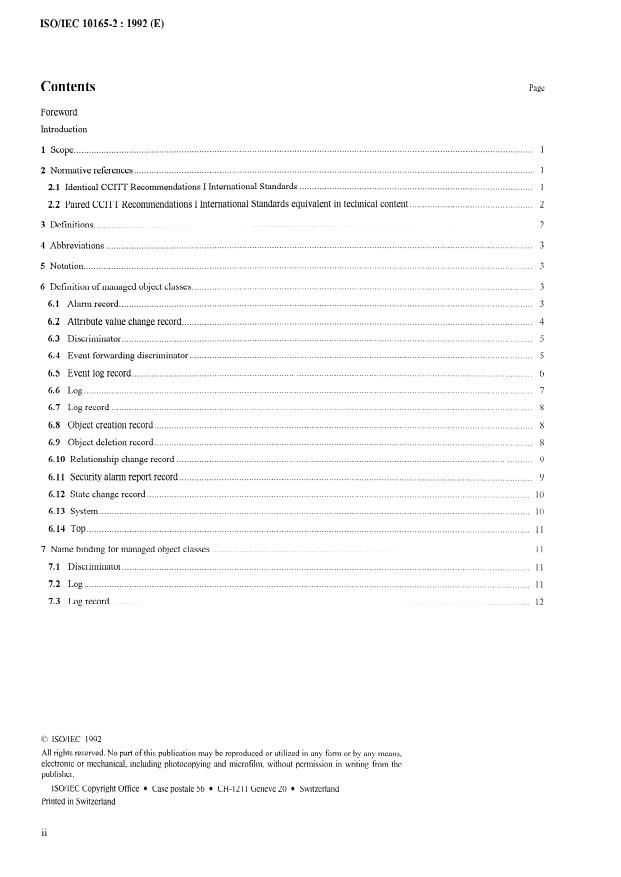
Contents
Foreword
Introduction
. . . . . . . . . . . . . . . . . . . . . . . . . . . . . . . . . . . . . . . . . . . . . . . . . . . . . . . . . . . . . . . . . . . . . . . . . . . . . . . . . . . . . . . . . . . . . . . . . . . . . . . . . . . . . . . . . . . . . . . . . 1
1 Scope
. . . . . . . . . . . . . . . . . . . . . . . . . . . . . . . . . . . . . . . . . . . . . . . . . . . . . . . . . . . . . . . . . . . . . . . . . . . . . . . . . . . . . . . . . . . . . . . . . . . . . . . . . . . . . . . . . . . . . . . . . . . . . . . . . . . . . . . . . . . . . . . . . . . . . . . . . . . . . 1
2 Normative references
2.1 Identical CCITT Recommendations I International Standards . . . . . . . . . . . . . . . . . . . . . . . . . . . . . . . . . . . . . . . . . . . . . . . . . . . . . . . . . . . . . . . . . . . . . . . . . . . . . . . . . . . . . . . . . . . . . 1
Paired CCITT Recommendations I International Standards equivalent in technical content. . . . . . . . . . . . . . . . . . . . . . . . . . . . . . . . . . . . . . . . , . . . . . . . 2
2.2
. . . . . . . . . . . . . . . . . . . . . . . . . . . . . . . . . . . . . . . . . . . . . . . . . . . . . . . . . . . . . . . . . . . . . . . . . . . . . . . . . . . . . . . . . . . . . . . . . . . . . . . . . . . . . . . . . . . . . . . . . 2
3 Definitions . . . . . . . . . . . . . . . . . . . . . . . . . . . . . . . . . . . . . . . . . . . . . . . . . . .
. . . . . . . . . . . . . . . . . . . . . . . . . . . . . . . . . . . . . . . . . . . . . . . . . . . . . . . . . . . . . . . . . . . . . . . . . . . . . . . . . . . . . . . . . . . . . . . . . . . . . . . . . . . . . . . . . . . . . . . . . 3
4 Abbreviations . . . . . . . . . . . . . . . . . . . . . . . . . . . . . . . . . . . . . . . . . . . . . . . . .
. . . . . . . . . . . . . . . . . . . . . . . . . . . . . . . . . . . . . . . . . . . . . . . . . . . . . . . . . . . . . . . . . . . . . . . . . . . . . . . . . . . . . . . . . . . . . . . . . . . . . . . . . . . . . . . . . . . . . . . . . 3
5 Notation . . . . . . . . . . . . . . . . . . . . . . . . . . . . . . . . . . . . . . . . . . . . . . . . . . . . . . .
6 Definition of managed object classes. . . . . . . . . . . . . . “. . . . . . . . . . . . . . . . . . . . . . . . . . . . . . . . . . . . . . . . . . . . . . . . . . . . . . . . . . . . . . . . . . . . . . . . . . . . . . . . . . . . . . . . . . . . . . . . . . . . . . . . . . . , . . . . . . . . . . . .
L
6.1 Alarm record .
Attribute value change record . 4
6.2
6.3 Discriminator .
Event forwarding discrinlinator .
6.4
Event log record . . . 6
6.5
6.6 Log .
Log record . . 8
6.7
6.8 Object creation record .
s
.................................................................................................................. 8
6.9 Object deletion record .
..........
Relationship change record . 9
6.10
6.11 Security alarm report record .
State change record . 10
6.12
6.13 System . 10
6.14 Top .
7 Name binding for managed object classes . 1 1
L
7.1 Discriminator . 1 1
7.2 Log. .
7.3 Log record .
63 ISOAEC 1992
All rights reserved. No part of this publication may be reproduced or utilized in any form or by any IWXI~S,
electronic or mechanical, including photocopying and microfilm, without permission in writing from the
publisher.
lSO/lEC Copyright Office l Case postalc 56 l CH-12 11 Gen~vc 20 l Switzerland
Printed in Switzerland
ii
ISO/IEC 101652 : 1992 (E)
........................... ................................................................................................................................. 12
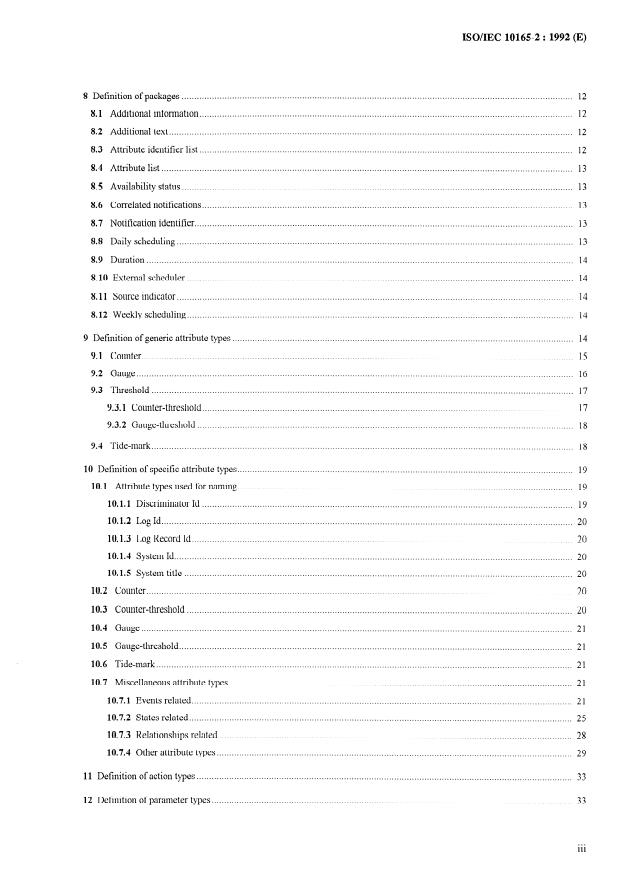
8 Definition of packages
8.1 Additional infomlation .
8.2 Additional text . .
Attribute identifier list
8.3 .
8.4 Attribute list . . . 13
8.5 Availability status .
8.6 Correlated notifications .
8.7 Notification identifier .
8.8 Daily scheduling .
Duration
8.9 .
8.10 External scheduler .
Source indicator .
8.11
8.12 Weekly scheduling .
9 Definition of generic attribute types . 14
9.1 Counter . . 15
9.2 Gauge .
9.3 Threshold
........................................................................................................................................................................
9.3.1 Counter-threshold .
9.3.2 Gauge-threshold .
9.4 Tide-xnark .
10 Definition of specific attribute types. . 19
10.1 Attribute types used for naming 19
......................................................................................................................................
10.1.1 Discriminator Id .
10.1.2 Log Id. .
...................................................................................................................................................... 20
10.1.3 Log Record Id.
Systexn Id 20
10.1.4 .
10.1.5 Systeni title .
10.2 Counter .
10.3 Counter-threshold
..........................................................................................................................................................
10.4 Gauge. .
10.5 Gauge-threshold 2 1
.............................................................................................................................................................
2 1
10.6 Tide-xnark .
10.7 Miscellaneous attribute types .
.
10.7.1 Events related. .
States related . 25
10.7.2 .
10.7.3 Relationships related 28
.............................................................................................................................................
10.7.4 Other attribute types . . 29
11 Definition of action types .
12 Definition of paranleter types . 33
. . .
ISO/IEC 101652 : 1992 (E)
.............................................................................................................................................. 34
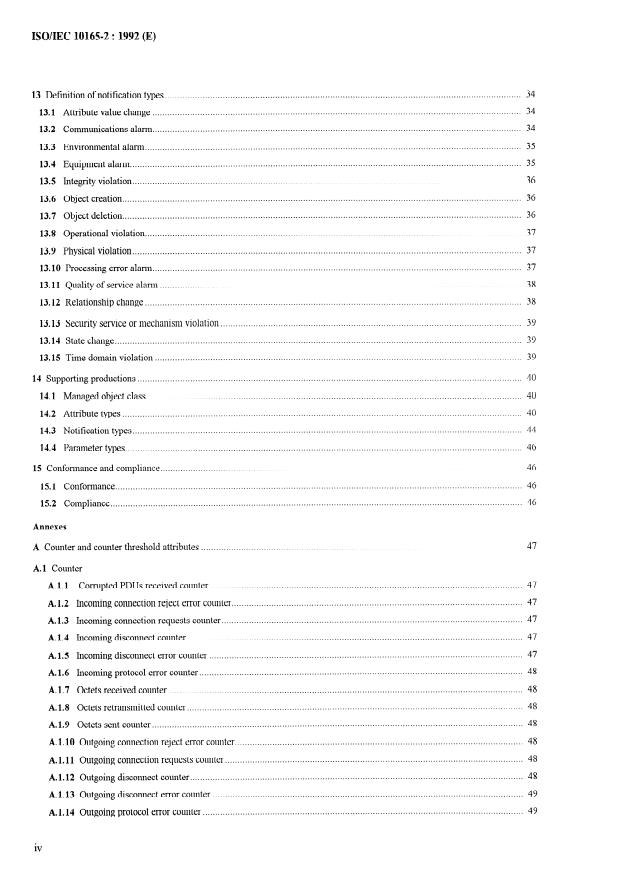
13 Definition of notification types
13.1 Attribute value change . 34
................................................................................................................................................... 34
13.2 Communications alaml
................................................................. ..................................................................................... 35
13.3 Environmental alarm
........................... .............................................................................................. 35
13.4 Equipment alaml .
............................................................................................................................ ............................... 36
13.5 Integrity violation
................................................................ 36
13.6 Object creation .
....................................................................................... ........................................................................ 36
13.7 Object deletion
13.8 Operational violation . .
............................................................................................................................. .............................. 37
13.9 Physical violation
................................................................................................................................................... 37
13.10 Processing error alarm
.................................................................................................................. 38
13.11 Quality of service alarm .
................................... 38
13.12 Relationship change .
................................... ..................................................................................... 39
13.13 Security service or niechanisnl violation
.............................. .......................................... .......................................................................................... 39
13.14 State change
.................................................................................................................................................. 39
13.15 Time domain violation
....... ............................................... ....... ......................................................... 40
14 Supporting productions .
..................................................................................................................................................... 40
14.1 Managed object class
........................................................................................... 40
14.2 Attribute types . .
........................................................................................................................................................... 44
14.3 Notification types
.............................................................................................................................................................. 46
14.4 Parameter types
................................................................... ............................................................................ 46
15 Conformance and compliance.
............................. 46
15.1 Confomiance .
........................................................................................... ......................................................................... 46
15.2 Compliance
Annexes
........................................................... ..................................................................... 47
A Counter and counter threshold attributes
A. 1 Counter
............................................................................................................................. 47
A. 1.1 Corrupted PDUs received counter
....................................................................................... ............................. 47
A. 1.2 Incoming connection reject error counter
...................................................................... .................................................. 47
A. 1.3 Incoming connection requests counter
...................................................................................................................................... 47
A. 1.4 Incoming disconnect counter
........................................................................................ ..................................... 47
A. 1.5 Incoming disconnect error counter
................................................................................................................................. 48
A. 1.6 Incoming protocol error counter
........................................................................................ ..................................................... 48
A. 1.7 Octets received counter
...................................................................................................................................... 48
A. 1.8 Octets retransmitted counter
.................................................................................................................................................... 48
A.l.9 Octets sent counter
................................................................................................................... 48
A. 1.10 Outgoing connection reject error counter
....................................................................................................................... 48
A. 1.11 Outgoing connection requests counter
..................................................................................................................................... 48
A. 1.12 Outgoing disconnect counter
........................................................................... ................................................. 49
A. 1.13 Outgoing disconnect error counter
................................................................................................................................
A. 1.14 Outgoing protocol error counter
iv
ISOlIEC 101652 : 1992 (E)
. . . . .~. 49
A. 1.15 PDUs received counter
. . . . . . . . . . . . . . . . . . . . . . . . . . . . . . . . . . . . . . . . . . . . . .~. 49
A. 1.16 PDUs retransmitted error counter
A.1.17 PDUs sent counter . . . . . . . . . . . . . . . . . . . . . . . . . . . . . . . . . . . . . . . . . . . . . . . . . . . . . . . . . . . . . . . . . . . . . . . . . . . . . . . . . . . . . . . . . . . . . . . . . . . . . . . . . . . . . . . . . . . . . . . . .
A.2 Counter-threshold . . . . . . . . . . . . . . . . . . . . . . . . . . . . . . . . . . . . . . . . . . . . . . . . . . . . . . . . . . . . . . . . . . . . . . . . . . . . . . . . . . . . . . . . . . . . . . . . . . . . . . . . . . . . . . . . . . . . . . . . .
Corrupted PDUs received threshold .
A.2.1
................................................................................................................. 50
A.2.2 Incoming connection reject error threshold
Incoming connection requests threshold .
A.2.3
.......................................................................................................................... 50
A.2.4 Incoming disconnect error threshold
Incoming protocol error threshold .
A.2.5
A.2.6 Octets received threshold .
Octets retransmitted threshold .
A.2.7
.................................................................................. ............................... 50
A.2.8 Octets sent threshold .
Outgoing connection reject error threshold .
A.2.9
....................................................................................................................
A.2.10 Outgoing connection requests threshold
.......................................................................................................................... 50
A.2.11 Outgoing disconnect error threshold
A.2.12 Outgoing protocol error threshold .
..........................................................................................................................................
A.2.13 PDUs received threshold
A.2.14 PDUs retransmitted error threshold .
.................................................................................................................................................
A.2.15 PDUs sent threshold
Index of managed object classes . . . . . . . . . . . . . . . . . . . . . . . . . . . . . . . . . . . . . . . . . . . . . . . . . . . . . . . . . . . . . . . . . . . . . . . . . . . . . . . . . . . . . . . . . . . . . . . . . . . . . . . . . . . . . . . . . . . . . . . . . . . . . . . . . . . . . . . . . . . . .
B
............................... ....................................................................................................................................
C Index of packages
II Index of generic and specific attribute types . . . . . . . . . . . . . . . . . . . . . . . . . . . . . . . . . . . . . . . . . . . . . . . . . . . . . . . . . . . . . . . . . . . . . . . . . . . . . . . . . . . . . . . . . . . . . . . . . . . . . . . . . . . . . . . . . . . . . . . . . . .
. . . . . . . . . . . . . . . . . . . . . . . . . . . . . . . . . . . . . . . . . . . . . . . . . . . . . . . . . . . . . . . . . . . . . . . . . . . . . . . . . . . . . . . . . . . . . . . . . . . . . . . . . . . . . . . . . . . . . . . . .
E Index of notification types
........................................................................................... 58
F Management information used in systems management functions
.................................................................................................................
G Syntax imported from Directory, ACSE and CMIP
ISO/IEC 101652 : 1992 (E)
Foreword
IS0 (the International Organization for Standardization) and IEC (the International
Electrotechnical Commission) foml the specialized system for worldwide standardization.
National bodies that are members of IS0 or IEC participate in the development of
International Standards through technical committees established by the respective
organization to deal with particular fields of technical activity. IS0 and IEC technical
committees collaborate in fields of mutual interest. Other intemational organizations,
govemnlental and non-govemmental, in liaison with IS0 and IEC, also take part in the
work.
In the field of information technology, IS0 and IEC have established a joint technical
committee, ISOLEC JTC 1. Draft International Standards adopted by the joint technical
committee are circulated to national bodies for voting. Publication as an International
Standard requires approval by at least 75 % of the national bodies casting a vote.
International Standard ISO/IEC 10165-2 was prepared by Joint Technical Committee
ISO/IEC JTC I, 1nfimzation technology, in collaboration with CCITT. The identical text is
published as CCITT Recommendation X.72 1.
ISOAEC 10165 consists of the following parts under the general title Infomlatio~z teclr-
nolop - Open Systenls Iuterconnectiori - Structurv ofnlcrrlagenlelit iufomlation:
- Part I : Management infomlation nrodel
- Part 2: Definition of managenlent infomlation
- Part 4: Guidelines for the definition of nlanaged objects
- Part 5 : Generic ntanagenlent irlfomration
tatioli collfomlauce
- Part 6: Reqlrirenlents and guidelines for inlplcnrejl statenieitt
profomlas associated with nlanagenleut i~~fom~atiorl
Annex A forms an integral part of this part of ISO/IEC 10165. Annexes B, C, D, E, F and
G are for information only.
vi
ISO/IEC 101652 : 1992 (E)
Introduction
ISO/IEC 10165 is a multipart standard developed according to IS0 7498 and ISO/IEC 7498-4. ISO/EC 10165 is related to the
following International Standards:
-
ISOIIEC 9595: 1990, Infomiatioll techology - Open Systenls Interconnection - Conrnion nianagenzent iilfomlation service
definition;
- ISOIIEC 9596: 1990, hfomlation technology - Open Systenw Interconnection - @onmon nranagenle~lt infomlation protocol;
- ISO/IEC 10040: 1992, Infomiation teclinoloey - Open Systems Interconnection - Systems management overview;
-
ISOAEX 10064: I 992, hfomla tion technology - Open Systems Interconnection - Systems A4anagenzen t.
vii
This page intentionally left blank
ISO/IEC 10165-2: 1992 (E)
INTERNATIONAL STANDARD
CCITT RECOMMENDATION
INFORMATION TECHNOLOGY - OPEN SYSTEMS INTERCONNECTION -
STRUCTURE OF MANAGEMENT INFORMATION: DEFINITION OF MANAGEMENT
INFORMATION
1 Scope
This Recommendation I International Standard
-
defines the managed object classes, attribute types, name bindings, packages, specific attributes, action
types, parameter types and notification types documented in accordance with CCITT Rec. X.722 I
ISO/IEC 101654;
-
specifies compliance requirements placed on other CCITT Recommendations I International Standards
that make use of these definitions.
This Recommendation I International Standard is applicable to the development of OS1 managed object class
specifications and provides generic definitions that support OS1 systems management functions. These definitions may
also be used in other Recommendations I International Standards specifying object classes, attributes, notifications and
action types.
Normative references
The following CCITT Recommendations I International Standards contain provisions which, through reference in this
text, constitute provisions of this Recommendation I International Standard. At the time of publication, the editions
indicated were valid. All Recommendations and Standards are subject to revision, and parties to agreements based on
this Recommendation I International Standard are encouraged to investigate the possibility of applying the most recent
editions of the RecommendationslStandards listed below. Members of IEC and IS0 maintain registers of currently
valid International Standards. The CCITT Secretariat maintains a list of the currently valid CCITT Recommendations.
21 . Identical CCITT Recommendations1 International Standards
- CCITT Recommendation X.720 (1992) I ISO/IEC 10165-l : 1992, Information technology - Open
Systems Interconnection - Structure of management information: Management information model.
- CCITT Recommendation X.722 (1992) I ISO/IEC 10165-4 : 1992, Information technology - Open
Systems Interconnection - Structure of management information: Guidelines for definition of managed
objet ts.
- CCITT Recommendation X.730 (1992) I ISO/IEC 10164-l : 1992, Information technology - Open
Systems Interconnection - Systems Management: Object management function.
- CCITT Recommendation X.731 (1992) I ISO/IEC 10164-2 : 1992, Information technology - Open
System Interconnection - Systems Management: State management function.
-
CCITT Recommendation X.732 (1992) I ISO/IEC 10164-3 : 1992, Information technology - Open
- Systems Management: Attributes for representing relationships.
Systems Interconnection
-
CCITT Recommendation X.733 (1992) I ISO/IEC 10164-4 : 1992, Information technology - Open
Systems Interconnection - Systems Management: Alarm reportingfinction.
CCITT Rec. X.721 (1992 E) 1
ISO/IEC 101652 : 1992 (E)
-
CCITT Recommendation X.734’) I ISO/IEC 10164-5 : 1992, Information techndogy - open Systems
Interconnection - Systems Management Event report management function.
-
CCITT Recommendation X.735’) I ISO/IEC 10164-6 : 1992, Information technology - Open Systems
Interconnection - Systems Management: Log control function.
-
CCITT Recommendation X.736 (1992) I ISO/IEC 10164-7 : 1992, Information technology - Open
Systems Interconnection r Systems Management: Security alarm reportiragfinctiog.
, * ”
22 . Paired CCITT Recommendations1 International Standards equivalent in technical content
-
CCITT Recommendation X.200 (1988), Reference model of Open Systems Interconnection for CCKT
applications.
IS0 7498 : 1984, Information processing systems - Open Systems Interconnection - Basic Reference
Model.
-
CCITT Recommendation X.208 (1988), Specification of abstract syntax notation one (ASN.1).
ISO/IEC 8824: 1990, Information technology - Open Systems Interconnection - Specification of Abstract
Syntax Notation One (ASN.1).
-
CCITT Recommendation X.501 (1988), The Directory - Models.
ISO/IEC 9594-2 : 1990 Information technology - Open Systems Interconnection - The Directory - Part
2: The Models.
-
CCITT Recommendation X.7 10 (1991), Common management information service definition for CCITT
applications.
ISO/IEC 9595 : 1991, Information technology - Open Systems Interconnection - Common management
information service definition.
-
CCITT Recommendation X.7 11 (199 l), Common management information protocol specification for
CCITT applications.
ISO/IEC 9596-l: 1991, Information technology - Open Systems Interconnection - Common management
information protocol specification - Part I: Specification.
3 Definitions
For the purposes of this Recommendation I International Standard the following definitions apply.
31 . Event report management function definitions
This Recommendation I International Standard makes use ,of the following terms defined in CCITT Rec. X.734 I
ISO/IEC 10164-5:
discriminator; 8 .
event forwarding discriminator;
b)
potential event report,
C)
Management information model definitions
32 .
This Recommendation I International Standard makes use of the following terms defined in CCITT Rec. X.720 I
ISO/IEC 10165-l:
a) Attribute type;
b) Distinguished name;
Relative distinguished name.
C>
l) Presently at state of draft Recommendation.
CCITT Rec. X.721 (1992 E)
ISO/IEC 101652 : 1992 (E)
4 Abbreviations
ASN.l Abstract Syntax Notation One
CMIS Common Management Information Service
CMIP Common Management Information Protocol
EFD Event Forwarding Discriminator
Identifier
Id
PDU Protocol Data Unit
RDN Relative Distinguished Name
5 Notation
Attribute types and specific attributes are defined in this Recommendation I International Standard using the templates,
defined in CCITI’ Rec. X.722 I ISO/IEC 10165-4.
The behavioural aspects of the specific attributes described here shall be incorporated into the definition of the
managed object class importing these specific attributes.
6 Definition of managed object classes
This Recommendation I International Standard defines Managed Object classes which are referenced by the System
Management Functions of CCITT Recs. in X.730 - X.736 I ISO/IEC 10164 parts 1 to 7, or which are intended to be
used as superclasses for the purpose of inheritance in the definition of Managed Object classes in other standards. The
syntax of the attributes referenced in the templates are defined in clause 13.
61 . Alarm record
The alarmRecord managed object class is used to define the information stored in the log as a result of receiving
alarm notifications or alarm reports. The semantics of the managed object class, namely its attributes and behaviour
are derived from the Alarm notification described in CCITT Rec. X.733 I ISO/IEC 10164-4.
alarmRecord MANAGED OBJECT CL-ASS
DERIVED FROM eventLogRecord;
CHARACTERIZED BY
-- The appropriate object identifier values for the eventType attribute, inherited from eventLogRecord
--
managed object class are communicationAlarm, qualityofServiceAlarm, processingErrorAlarm,
--
equipmentAlarm and environmentalAlarm --
alarmRecordPackage PACKAGE
BEHAVIOUR
alarmRecordBehaviour BEHAVIOUR
DEFINED AS “This managed object is used to represent logged information that resulted from alarm
notifications or event reports”;;
ATTRIBUTES
probablecause GET,
perceivedseverity GET;;;
CONDITIONAL PACKAGES
specificProblemsPackage PACKAGE
ATTRIBUTES
specificProblems GET;
REGISTERED AS(smi2Package 1); PRESENT IF “the Specific problems parameter is present in the alarm
notification or event report corresponding to the instance of alarm record”,
backedUpStatusPackage PACKAGE
ATTRIBUTES
backedUpStatus GET;
REGISTERED AS(smi2Package 2); PRESENT IF “the backedUpStatus attribute has a value TRUE and the
Backed up status parameter is present in the alarm notification or event report corresponding to the instance
of alarm record”,
CCITT Rec. X.721 (1992 E)
ISO/IEC 101652 : 1992 (E)
backUpObjectPackage PACKAGE
ATTRIBUTES
backUpObject GET;
REGISTERED AS(smi2Package 3); PRESENT IF “Backup object parameter is present in the alarm notification
or event report corresponding to the instance of alarm record”,
trendlndicationpackage PACKAGE
ATTRIBUTES
trendindication GET;
REGISTERED AS(smi2Package 4); PRESENT IF “the Trend indication parameter is present in the alarm
notification or event report corresponding to the instance of alarm record”,
thresholdlnfoPackage PACKAGE
ATTRIBUTES
thresholdlnfo
GET;
REGISTERED AS(smi2Package 5); PRESENT IF “the value for probablecause attribute is thresholdCrossed”,
StateChangeDefinitionPackage PACKAGE
ATTRIBUTES
StateChangeDefinition GET;
REGISTERED AS(smi2Package 6); PRESENT IF “there is a state transition for the states defined in State
Management Function, corresponding to the alarm type specified in the alarm record”,
monitoredAttributesPackage PACKAGE
ATTRIBUTES
monitoredAttributes GET;
REGISTERED AS(smi2Package 7); PRESENT IF “the monitoredAttributes parameter is present in the alarm
notification or event report corresponding to the instance of alarm record”,
proposedRepairActionsPackage PACKAGE
ATTRIBUTES
proposedRepairActions GET;
REGISTERED AS(smi2Package 8); PRESENT IF “the proposedRepairActions parameter is present in the
alarm notification or event report corresponding to the instance of alarm record”;
REGISTERED AS (smi2MObjectClass I};
62 . Attribute value change record
The attributeValueChangeRecord managed object class is used to define the information stored in the log as a result
of receiving attribute value change notifications or attribute value change event reports. The semantics of the managed
object class, namely its attributes and behaviour are derived from the Attribute Value Change notification described in
CCITT Rec. X.730 I ISO/IEC 101644.
attributeValueChangeRecord MANAGED OBJECT CLASS
DERIVED FROM eventLogRecord;
CHARACTERIZED BY
-- The appropriate object identifier values for the eventType attribute, inherited from eventLogRecord
--
managed object class, is attributevaluechange
attributeValueChangeRecordPackage PACKAGE
BEHAVIOUR
attributeValueChangeRecordBehaviour BEHAVIOUR
DEFINED AS “This managed object is used to represent logged information that resulted from attribute value
change notifications or event reports”;;
ATTRIBUTES
attributeValueChangeDefinition GET;;;
CONDITIONAL PACKAGES
sourcelndicatorPackage PRESENT IF “the sourcelndicator parameter is present in the
attributeValueChange notification or event report corresponding to the instance of attribute value change
record”,
PRESENT IF “the attributeldentifierList parameter is present in the
attributeldentifierListPackage
attributevaluechange notification or event report corresponding to the instance of attribute value change
record”;
CCITT Rec. X.721 (1992 E)
ISO/IEC 101652 : 1992 (E)
REGISTERED AS (smi2MObjectClass 2);
63 . Discriminator
The discriminator managed object class is used to define the criteria for controlling management services. The
semantics of the managed object class, namely its attributes and behaviour are described in CCITT Rec. X.734 I
ISO/IEC 10164-5.
discriminator MANAGED OBJECT CLASS
DERIVED FROM top;
CHARACTERIZED BY
PACKAGE
discriminatorpackage
BEHAVIOUR
BEHAVIOUR
discriminatorBehaviour
DEFINED AS “This managed object is used to represent the criteria for controlling management services.“;;
ATTRIBUTES
discriminatorld GET,
discriminatorConstruct
REPLACE-WITH-DEFAULT
DEFAULT VALUE Attribute-ASNI Module.defauItDiscriminatorConstruct GET-REPLACE,
administrativestate GET-REPLACE,
operationalstate GET;
NOTIFICATIONS
statechange,
attributeValueChange,
objectcreation,
ObjectDeletion;;;
-- the above events are defined in CCITT Rec. X.731 1 ISO/IEC10164- 2, CCITT Rec. X.730 1 ISO/IEC10164-1
CONDITIONAL PACKAGES
availabilityStatusPackage PRESENT IF “any of the scheduling packages, ( duration, weekly scheduling,
external) are present”,
duration PRESENT IF “the discriminator function is scheduled to start at a specified time and stop at
either a specified time or function continuously “,
PRESENT IF “both the weekly scheduling package and external scheduler packages
dailyscheduling
are not present in an instance and daily scheduling is supported by that instance”,
weeklyScheduling PRESENT IF “both the daily scheduling package and external scheduler packages are not
present in an instance and weekly scheduling is supported by that instance“,
externalScheduler PRESENT IF “both the daily scheduling package and weekly scheduling packages are not
present in an instance and external scheduling is supported by that instance”;
--
see CCITT Rec. X.734 j ISO/IEC 10164-5 for the description of this managed object class.
REGISTERED AS (smi2MObjectClass 3);
64 . Event forwarding discriminator
The eventForwardingDiscriminator managed object class is used to define the conditions that shall be satisfied by
potential event reports before the event report is forwarded to a particular destination.This managed object class is a
subclass of discriminator managed object class. The semantics of the managed object class, namely its attributes,
management operations and behaviour, are described in CCITT Rec. X. 734 I ISO/IEC 10164-5.
eventForwardingDiscriminator MANAGED OBJECT CLASS
DERIVED FROM discriminator;
CHARACTERIZED BY
--
The value for the administrative state if not specified at initiation defaults to the value unlocked.
efdpackage PACKAGE
BEHAVIOUR
BEHAVIOUR
eventForwardingDiscriminatorBehaviour
CCITT Rec. X.721 (1992 E)
ISO/IEC 101652 : 1992 (E)
DEFINED AS “This managed object is used to represent the criteria that shall be satisfied by potential event
reports before the event report is forwarded to a particular destination.“;;
ATTRIBUTES
destination GET-REPLACE;;;
-- discriminatorConstruct attribute is defined using the attributes of a potential event report object
-- described in CCITT Rec. X.734 j ISO/IEC 10164-5.
CONDITIONAL PACKAGES
PACKAGE
backUpDestinationListPackage
ATTRIBUTES
activeDestination GET,
GET-REPLACE;
backUpDestinationList
REGISTERED AS(smi2Package 9} ; PRESENT IF “the event forwarding discriminator is required to provide a
backup for the destination”,
modepackage PACKAGE
ATTRIBUTES
confirmedMode GET;
REGISTERED AS(smi2Package 10); PRESENT IF “the event forwarding discriminator permits mode for
reporting events to be specified by the managing system”;
REGISTERED AS (smi2MObjectClass 4);
65 . Event log record
define the information
The eventLogRecord managed object class is used to stored in the log as a result of receiving
notifications or event reports. This is a superclass from which records for speci fit event types are derived.
eventLogRecord MANAGED OBJECT CLASS
DERIVED FROM logRecord;
CHARACTERIZED BY
eventLogRecordPackage PACKAGE
BEHAVIOUR .
eventLogRecordBehaviour BEHAVIOUR
DEFINED AS “This managed object represents the information stored in the log as a result of receiving
notifications or incoming event reports.“;;
ATTRIBUTES
managedObjectClass GET,
managedObjectInstance GET,
eventType GET;;;
CONDITIONAL PACKAGES
eventTimePackage PACKAGE
ATTRIBUTES
eventTime
GET;
REGISTERED AS(smi2Package 1 I}; PRESENT IF “the event time parameter was present in the received
event report”,
notificationIdentifierPackage PRESENT IF “the notification Identifier parameter is present in the
notification or event report c
...
Questions, Comments and Discussion
Ask us and Technical Secretary will try to provide an answer. You can facilitate discussion about the standard in here.
Loading comments...