

ISO/TR 24679-4:2017
(Main)Fire safety engineering — Performance of structures in fire — Part 4: Example of a fifteen-storey steel-framed office building
General Information
- Abstract
ISO/TR 24679-4:2017 provides a fire engineering application relative to the fire resistance assessment of a fifteen-storey steel framed building following the methodology given in ISO 24679-1. This document describes the adopted process which follows the same step by step procedure as that provided in ISO 24679-1. The annexes of this document present the detailed assessment results obtained for the most severe fire scenarios on the basis of the outcome of this specific fire safety engineering procedure for the building. The fire safety engineering applied in this example to the office building with respect to its fire resistance considers specific design fire scenarios as well as the corresponding fire development. It takes into account fully-developed compartment fires. In realistic situations, activation of fire suppression systems and/or intervention of fire brigade are expected, but their beneficial effects are not taken into account. It should be noted that these severe fire scenarios have been selected for fire resistance purposes. Global structural behaviour is not explicitly considered, but implicitly included in the calculation formulae. Since the building of the example is located in a seismic region, principal structural elements are rigidly connected to each other. Load redistribution from heated elements to cold surrounding elements exists, but it's not taken into account in the design calculations. By this approach, design is conservative, while the process of safety checking is greatly simplified and clear. As a result, all the calculations were carried out by explicit algebraic formulae.
- Status
- Published
- Publication Date
- 22-Aug-2017
- Technical Committee
- ISO/TC 92/SC 4 - Fire safety engineering
- Drafting Committee
- ISO/TC 92/SC 4/WG 12 - Structures in fires
- Current Stage
- 9092 - International Standard to be revised
- Start Date
- 02-Nov-2023
- Completion Date
- 29-Aug-2026
Buy Documents




ISO/TR 24679-4:2017 - Fire safety engineering -- Performance of structures in fire


ISO/TR 24679-4:2017 - Fire safety engineering — Performance of structures in fire — Part 4: Example of a fifteen-storey steel-framed office building/23/2017
Overview - ISO/TR 24679-4:2017 (Fire safety engineering, Part 4)
ISO/TR 24679-4:2017 is a technical report that illustrates the application of ISO 24679-1 by presenting a worked example: a fire resistance assessment of a fifteen‑storey steel‑framed office building. The report walks through the step‑by‑step fire safety engineering process for structural performance in fire, documents adopted assumptions, and provides detailed assessment results (annexes) for severe design fire scenarios. Calculations are performed using explicit algebraic formulae and are intentionally conservative: fully‑developed compartment fires are considered while beneficial effects of suppression systems or fire brigade intervention are excluded.
Key technical topics and requirements
- Scope and methodology: Implements the ISO 24679-1 procedure for quantifying structural performance in fire, preserving its step numbering and approach.
- Design fire scenarios: Selection and characterisation of severe compartment fires (fully‑developed), including design heat release and equivalent fire duration concepts.
- Thermal and mechanical response: Assessment of steel columns, beams and other elements - maximum steel temperatures, critical temperatures, and limiting temperatures for buckling, bending and joint failure.
- Conservative modelling assumptions: No load redistribution from heated to cold elements, and no credit taken for active suppression or fire brigade intervention. Principal structural elements are rigidly connected (seismic region).
- Practical calculations: All checks and verifications performed with explicit algebraic formulae; annexes provide detailed numerical results and parameters (building geometry, fuel loads, fire temperatures, critical temperatures).
- Referenced terminology and principles: Aligned with ISO 13943 (vocabulary), ISO 23932 (general fire safety engineering principles), and fire curve standards (e.g. ISO 834 series for fire resistance).
Practical applications and users
Who will use this document:
- Fire safety engineers and structural engineers conducting performance‑based fire resistance assessments of steel structures.
- Building designers and consultants developing conservative fire protection thicknesses and detailing for multi‑storey steel office buildings.
- Code officials and reviewers who need a documented example aligned with ISO 24679‑1 methodology.
- Researchers and educators using a real‑world case study (15‑storey, 8 236 m2, 68.5 m height) to train on fire engineering practice.
How it’s used:
- As a worked example for applying ISO 24679‑1 steps (scope, objectives, trial design, design fires, thermal/mechanical response, assessment, documentation).
- To derive conservative fire protection thicknesses and to verify element temperatures against critical limits for fire resistance purposes.
- For comparative studies, teaching, and development of performance‑based fire safety strategies.
Related standards
- ISO 24679-1 - Methodology for performance of structures in fire (primary reference).
- ISO 13943 - Fire safety - Vocabulary.
- ISO 23932 - Fire safety engineering - General principles.
- ISO 834 series - Standard fire resistance time–temperature curves (reference for equivalent fire duration).
Keywords: ISO/TR 24679-4, fire safety engineering, performance of structures in fire, fifteen‑storey steel framed building, fire resistance assessment, design fire scenarios, critical temperature, structural fire protection.
Relations
- Effective Date
- 06-Jun-2022
Buy Documents
ISO/TR 24679-4:2017 - Fire safety engineering -- Performance of structures in fire
ISO/TR 24679-4:2017 - Fire safety engineering — Performance of structures in fire — Part 4: Example of a fifteen-storey steel-framed office building/23/2017
Get Certified
Connect with accredited certification bodies for this standard

CIS Institut d.o.o.
Personal Protective Equipment (PPE) certification body. Notified Body NB-2890 for EU Regulation 2016/425 PPE.

Kiwa BDA Testing
Building and construction product certification.
Kmetijski inštitut Slovenije
Agricultural Institute of Slovenia. Soil testing, plant health, agricultural product analysis.
Sponsored listings
Frequently Asked Questions
ISO/TR 24679-4:2017 is a technical report published by the International Organization for Standardization (ISO). Its full title is "Fire safety engineering — Performance of structures in fire — Part 4: Example of a fifteen-storey steel-framed office building". This standard covers: ISO/TR 24679-4:2017 provides a fire engineering application relative to the fire resistance assessment of a fifteen-storey steel framed building following the methodology given in ISO 24679-1. This document describes the adopted process which follows the same step by step procedure as that provided in ISO 24679-1. The annexes of this document present the detailed assessment results obtained for the most severe fire scenarios on the basis of the outcome of this specific fire safety engineering procedure for the building. The fire safety engineering applied in this example to the office building with respect to its fire resistance considers specific design fire scenarios as well as the corresponding fire development. It takes into account fully-developed compartment fires. In realistic situations, activation of fire suppression systems and/or intervention of fire brigade are expected, but their beneficial effects are not taken into account. It should be noted that these severe fire scenarios have been selected for fire resistance purposes. Global structural behaviour is not explicitly considered, but implicitly included in the calculation formulae. Since the building of the example is located in a seismic region, principal structural elements are rigidly connected to each other. Load redistribution from heated elements to cold surrounding elements exists, but it's not taken into account in the design calculations. By this approach, design is conservative, while the process of safety checking is greatly simplified and clear. As a result, all the calculations were carried out by explicit algebraic formulae.
ISO/TR 24679-4:2017 provides a fire engineering application relative to the fire resistance assessment of a fifteen-storey steel framed building following the methodology given in ISO 24679-1. This document describes the adopted process which follows the same step by step procedure as that provided in ISO 24679-1. The annexes of this document present the detailed assessment results obtained for the most severe fire scenarios on the basis of the outcome of this specific fire safety engineering procedure for the building. The fire safety engineering applied in this example to the office building with respect to its fire resistance considers specific design fire scenarios as well as the corresponding fire development. It takes into account fully-developed compartment fires. In realistic situations, activation of fire suppression systems and/or intervention of fire brigade are expected, but their beneficial effects are not taken into account. It should be noted that these severe fire scenarios have been selected for fire resistance purposes. Global structural behaviour is not explicitly considered, but implicitly included in the calculation formulae. Since the building of the example is located in a seismic region, principal structural elements are rigidly connected to each other. Load redistribution from heated elements to cold surrounding elements exists, but it's not taken into account in the design calculations. By this approach, design is conservative, while the process of safety checking is greatly simplified and clear. As a result, all the calculations were carried out by explicit algebraic formulae.
ISO/TR 24679-4:2017 is classified under the following ICS (International Classification for Standards) categories: 13.220.01 - Protection against fire in general. The ICS classification helps identify the subject area and facilitates finding related standards.
ISO/TR 24679-4:2017 has the following relationships with other standards: It is inter standard links to ISO/TR 24679-4. Understanding these relationships helps ensure you are using the most current and applicable version of the standard.
ISO/TR 24679-4:2017 is available in PDF format for immediate download after purchase. The document can be added to your cart and obtained through the secure checkout process. Digital delivery ensures instant access to the complete standard document.
Standards Content (Sample)
TECHNICAL ISO/TR
REPORT 24679-4
First edition
2017-08
Fire safety engineering —
Performance of structures in fire —
Part 4:
Example of a fifteen-storey steel-
framed office building
Ingénierie de la sécurité incendie — Performance des structures en
situation d'incendie —
Partie 4: Exemple d'un immeuble de bureaux en structure acier de
quinze étages
Reference number
©
ISO 2017
© ISO 2017, Published in Switzerland
All rights reserved. Unless otherwise specified, no part of this publication may be reproduced or utilized otherwise in any form
or by any means, electronic or mechanical, including photocopying, or posting on the internet or an intranet, without prior
written permission. Permission can be requested from either ISO at the address below or ISO’s member body in the country of
the requester.
ISO copyright office
Ch. de Blandonnet 8 • CP 401
CH-1214 Vernier, Geneva, Switzerland
Tel. +41 22 749 01 11
Fax +41 22 749 09 47
copyright@iso.org
www.iso.org
ii © ISO 2017 – All rights reserved
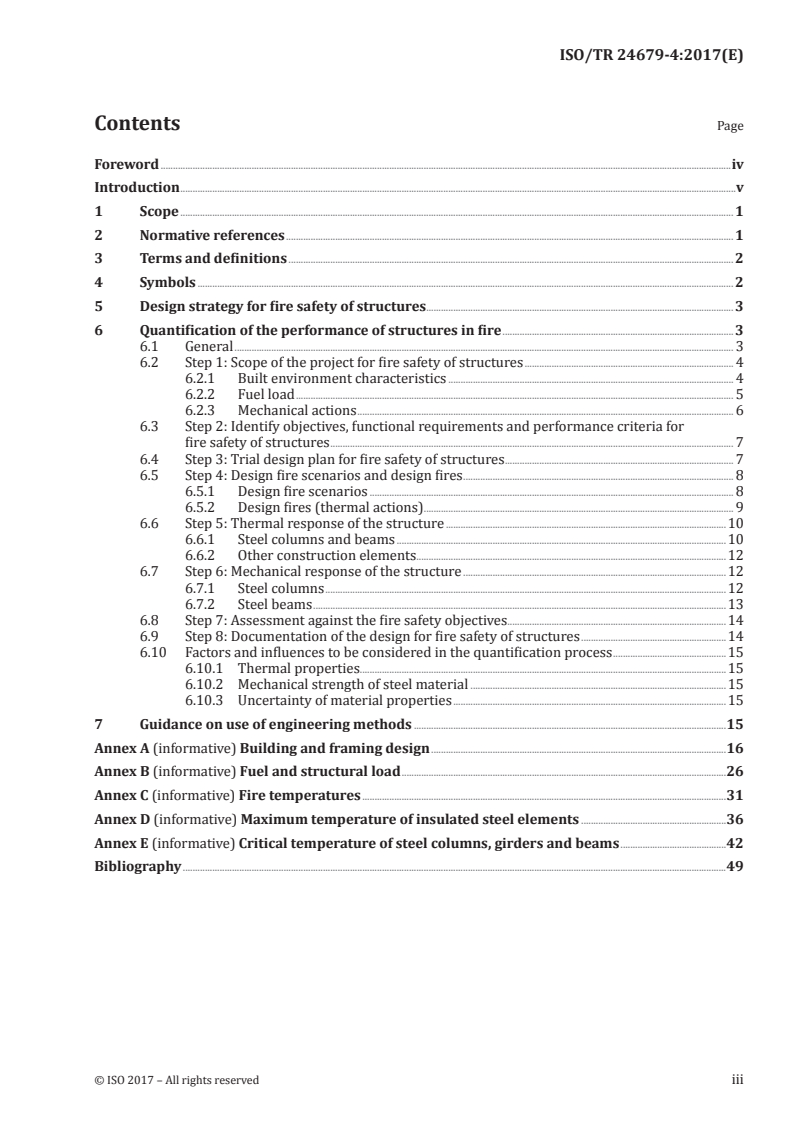
Contents Page
Foreword .iv
Introduction .v
1 Scope . 1
2 Normative references . 1
3 Terms and definitions . 2
4 Symbols . 2
5 Design strategy for fire safety of structures . 3
6 Quantification of the performance of structures in fire . 3
6.1 General . 3
6.2 Step 1: Scope of the project for fire safety of structures . 4
6.2.1 Built environment characteristics . 4
6.2.2 Fuel load . 5
6.2.3 Mechanical actions . 6
6.3 Step 2: Identify objectives, functional requirements and performance criteria for
fire safety of structures . 7
6.4 Step 3: Trial design plan for fire safety of structures . 7
6.5 Step 4: Design fire scenarios and design fires . 8
6.5.1 Design fire scenarios . 8
6.5.2 Design fires (thermal actions) . 9
6.6 Step 5: Thermal response of the structure .10
6.6.1 Steel columns and beams .10
6.6.2 Other construction elements . .12
6.7 Step 6: Mechanical response of the structure .12
6.7.1 Steel columns .12
6.7.2 Steel beams .13
6.8 Step 7: Assessment against the fire safety objectives .14
6.9 Step 8: Documentation of the design for fire safety of structures .14
6.10 Factors and influences to be considered in the quantification process .15
6.10.1 Thermal properties.15
6.10.2 Mechanical strength of steel material .15
6.10.3 Uncertainty of material properties .15
7 Guidance on use of engineering methods .15
Annex A (informative) Building and framing design .16
Annex B (informative) Fuel and structural load .26
Annex C (informative) Fire temperatures .31
Annex D (informative) Maximum temperature of insulated steel elements .36
Annex E (informative) Critical temperature of steel columns, girders and beams .42
Bibliography .49
Foreword
ISO (the International Organization for Standardization) is a worldwide federation of national standards
bodies (ISO member bodies). The work of preparing International Standards is normally carried out
through ISO technical committees. Each member body interested in a subject for which a technical
committee has been established has the right to be represented on that committee. International
organizations, governmental and non-governmental, in liaison with ISO, also take part in the work.
ISO collaborates closely with the International Electrotechnical Commission (IEC) on all matters of
electrotechnical standardization.
The procedures used to develop this document and those intended for its further maintenance are
described in the ISO/IEC Directives, Part 1. In particular the different approval criteria needed for the
different types of ISO documents should be noted. This document was drafted in accordance with the
editorial rules of the ISO/IEC Directives, Part 2 (see www.iso.org/directives).
Attention is drawn to the possibility that some of the elements of this document may be the subject of
patent rights. ISO shall not be held responsible for identifying any or all such patent rights. Details of
any patent rights identified during the development of the document will be in the Introduction and/or
on the ISO list of patent declarations received (see www.iso.org/patents).
Any trade name used in this document is information given for the convenience of users and does not
constitute an endorsement.
For an explanation on the voluntary nature of standards, the meaning of ISO specific terms and
expressions related to conformity assessment, as well as information about ISO's adherence to the
World Trade Organization (WTO) principles in the Technical Barriers to Trade (TBT) see the following
URL: www.iso.org/iso/foreword.html.
This document was prepared by Technical Committee ISO/TC 92, Fire safety, Subcommittee SC 4, Fire
safety engineering.
iv © ISO 2017 – All rights reserved
Introduction
This document is an example of the application of ISO 24679-1, prepared in the format of ISO 24679-1. It
includes only those subclauses of ISO 24679-1 that describe the steps of the methodology for assessing
the performance of structures in fire. It preserves the numbering of subclauses in ISO 24679-1 and so
omits numbered subclauses for which there is no text or information relevant to this example.
This example is intended to illustrate the implementation of the steps of the fire resistance assessment,
as defined in ISO 24679-1. Only steps that are considered to be relevant to this example are well-detailed
in this document. The technical contents are based on the performance based verification methods for
fire resistance in the Building Standards Law of Japan, but were slightly modified for simplicity and
compatibility with ISO 24679-1.
TECHNICAL REPORT ISO/TR 24679-4:2017(E)
Fire safety engineering — Performance of structures in
fire —
Part 4:
Example of a fifteen-storey steel-framed office building
1 Scope
This document provides a fire engineering application relative to the fire resistance assessment of a
fifteen-storey steel framed building following the methodology given in ISO 24679-1. This document
describes the adopted process which follows the same step by step procedure as that provided in
ISO 24679-1. The annexes of this document present the detailed assessment results obtained for the
most severe fire scenarios on the basis of the outcome of this specific fire safety engineering procedure
for the building.
The fire safety engineering applied in this example to the office building with respect to its fire
resistance considers specific design fire scenarios as well as the corresponding fire development.
It takes into account fully-developed compartment fires. In realistic situations, activation of fire
suppression systems and/or intervention of fire brigade are expected, but their beneficial effects are
not taken into account. It should be noted that these severe fire scenarios have been selected for fire
resistance purposes.
Global structural behaviour is not explicitly considered, but implicitly included in the calculation
formulae. Since the building of the example is located in a seismic region, principal structural elements
are rigidly connected to each other. Load redistribution from heated elements to cold surrounding
elements exists, but it's not taken into account in the design calculations. By this approach, design is
conservative, while the process of safety checking is greatly simplified and clear. As a result, all the
calculations were carried out by explicit algebraic formulae.
2 Normative references
The following documents are referred to in the text in such a way that some or all of their content
constitutes requirements of this document. For dated references, only the edition cited applies. For
undated references, the latest edition of the referenced document (including any amendments) applies.
ISO 13943, Fire safety — Vocabulary
ISO 23932, Fire safety engineering — General principles
3 Terms and definitions
For the purposes of this document, the terms and definitions given in ISO 13943 and ISO 23932 and the
following apply.
ISO and IEC maintain terminological databases for use in standardization at the following addresses:
— IEC Electropedia: available at http://www.electropedia.org/
— ISO Online browsing platform: available at http://www.iso.org/obp
3.1
design heat release of a room
amount of heat to be released in a room including movable fire load, fixed fire load and heat transferred
from adjacent rooms
Note 1 to entry: It is expressed in MJ.
3.2
equivalent fire duration time
duration of heating by a standard fire as specified in ISO 834-1 that gives equivalent thermal effect on
structural elements with a real fire
Note 1 to entry: It is expressed in min.
3.3
fixed fuel load density
heat of combustion of materials fixed to room, such as interior finish materials, equipment and so on,
per unit floor area of fire room
Note 1 to entry: It is expressed in MJ/m .
3.4
heat penetration factor
ratio of heat penetrated from adjacent rooms to the room in consideration
Note 1 to entry: It is dimensionless.
3.5
movable fuel load density
heat of combustion of movable room contents such as furniture, commodities and so on per unit floor
area of fire room
Note 1 to entry: It is expressed in MJ/m .
3.6
total heat release of a room
amount of heat possible to be released in a room including movable and fixed fire load
Note 1 to entry: It is expressed in MJ.
4 Symbols
For the purposes of this document, the following symbols are used.
A room floor area (m )
r
A surface area of interior lining material (m )
f
f heat penetration factor
a
2 © ISO 2017 – All rights reserved
f nominal yield strength of steel at normal temperature (MPa)
y
G permanent load
K kinematic load
q movable fire load density (MJ/m )
l
Q heat of combustion of interior lining materials per unit area (MJ/m )
f
Q design heat release of a room (MJ)
r
Q live or variable load
t time (min)
t approved fire resistance time of a construction element (min)
A
t fire duration time (min)
f
t equivalent fire duration as replaced with a fire as specified in ISO 834-1 (min)
eq
T limiting temperature for overall buckling (°C)
B
T limiting temperature for bending failure of a beam (°C)
Bcr
T critical temperature of steel element (°C)
cr
T limiting temperature for excessive deformation (°C)
DP
T limiting temperature for joint failure (°C)
JT
T limiting temperature for local buckling (°C)
LB
T maximum steel temperature under design fire action (°C)
s.max
T fire temperature in a room (K)
f
T initial temperature (K)
1/6
α fire temperature rise coefficient (K/min )
5 Design strategy for fire safety of structures
The built environment of this example is a medium-rise office building. Due to its use, the building is
separated into multiple compartments by floors and walls to accommodate tenant office functions. As
the combustible contents are distributed densely, fire is likely to spread over whole compartment. As a
result, a fully-developed compartment fire is expected in each room of the building.
The structural elements are composed of steel and are protected against fire. To prevent failure of the
structural elements and joints, the thickness of fire protection had been defined in order to limit their
temperatures below their critical temperatures during the fully-developed fire in each compartment.
6 Quantification of the performance of structures in fire
6.1 General
The various steps of the design process considered in the conducted fire safety engineering study are
detailed in 6.2 to 6.9.
6.2 Step 1: Scope of the project for fire safety of structures
6.2.1 Built environment characteristics
The built environment is a steel framed 15-storey office building. The gross floor area is 8 236 m and
the building height is 68,5 m. See Annex A for building drawings. According to the regulations, the
[10]
building must be constructed by fire-resistive constructions. In the prescriptive code, columns must
be three hours fire-rated construction on the first floor, two hours on the second to eleventh floors
and one hour on the floors above. The building is separated horizontally by compartment floors at all
levels. Vertical shafts such as stairs, elevators and service shaft are surrounded by one hour-rated fire
resistance walls.
The floor plan is shown in Figure 1. The office area is split into two rooms, XX01 and XX02. Symbol XX
denotes floor number. For example, 1502 denotes room number 2 on floor 15. The two office rooms are
separated by an EI60 wall as determined by ISO 834-8. In addition, the office area is divided into two
rooms by a non-fire-rated wall made of regular gypsum board. The doors between office rooms and
corridor are fire-rated E60 to prevent fire spread between office area and corridor.
The building structure is a rigid moment-resistant steel frame. Specification of members such as
columns, beams and floor slabs are listed in Annex A. The columns, beams and girders are protected
against fire by a 25 mm sprayed rock wool cementitious mixture.
— Span of primary beams: 13,6 m;
— Span of secondary beams: 6,4 m;
— Spacing of columns: 6,4 m in direction of primary beams and 13,6 m in direction of secondary beams.
The applied load of design on the floors is taken as follows:
— live load: 2,9 kN/m (based on building code requirement);
— self-weight of floor: 3,65 kN/m .
In this document, only the results of construction elements in office rooms number: 201, 202, 1501
and 1502 are demonstrated.
The external walls are fire-rated for more than one hour. However, windows are not fire-resistant. The
floors are composite constructions of concrete slabs and steel beams. The composite slabs are made of
normal weight concrete and profiled steel sheets with reinforcing bars.
4 © ISO 2017 – All rights reserved
Key
1 fire-rated partition wall (EI60)
2 non-fire-rated partition wall
3 fire door (E60)
NOTE All the exterior walls are fire-rated (EI60).
Figure 1 — Typical floor plan
6.2.2 Fuel load
As the building is used as office space, a significant amount of combustibles is expected. The design fuel
load of a room, Q , is calculated as the sum of the following components.
r
1) Movable fuel load based on the use of the room, A q .
r l
2 [10]
The movable fire load density for an office area is 560 MJ/m based on the building code. The results
are shown in Table 1.
2) Fixed fuel load based on the type of interior finish materials, ΣA Q .
f f
The heat of combustion of interior finish materials are accounted as fixed fire loads. The details of
calculation are shown in B.5.2. The results are summarized in Table 1.
3) Heat penetrated from adjacent rooms, Σf (A q + ΣA Q ).
a r l f f
As the walls between the office areas XX01 and the office areas XX02 are not fire-rated, there is a risk
for fire to spread between the rooms. A part of combustion heat in an adjacent room may affect the
structural elements in the other room. To account for this “mutual heating” effect, it was assumed that
15 % of heat of combustion (design rule in Japan) may penetrate to adjacent rooms separated by non-
fire-rated walls. The calculated results are shown in Table 2.
Table 1 — Fuel load of rooms XX01 and XX02 (XX = 2nd and 15th floors)
Movable fuel
Movable fuel Fixed fuel load Total fuel
load density Floor area
Floors Room No. Usage load A q ΣA Q load of room
r l f f
q A (m )
l r
(MJ) (MJ) (MJ)
(MJ/m )
201,
office 560 87,5 49 000 7 649 56 649
2 to 15 202,
office 560 275 154 000 22 397 176 397
corridor pathway 32 125 4 000 13 722 17 722
Table 2 — Design heat release of a room considering heat penetration from adjacent rooms
Heat penetration
Total fuel load of Penetrated heat Design fuel
Floor Room Adjacent rooms coefficient
adjacent rooms (MJ) (MJ) load (MJ)
f (-)
a
201 202,1502 176 397 0,15 26 460
83 108
Corridor 17 722 0,0 0,0
2 to 15
202 201,1501 56 649 0,15 8 497
184 894
Corridor 17 722 0,0 0,0
6.2.3 Mechanical actions
The mechanical actions in fire situation are determined in accordance with the building code.
Permanent and movable vertical loads are considered, while no horizontal actions are considered such
[10]
as seismic and wind actions. As a result, the load combination is :
1,0G + 1,0Q (1)
where G is sum of all the permanent loads, i.e. self-weight of the building and Q for the variable loads
representing the contents of the building. No snow load was considered in this document as the building
is located in non-snow region.
As the building is located in seismic region, the following load combination is applied for seismic
resistance design:
1,0G + 1,0Q + 1,0K (2)
where K is the (horizontal) kinetic action. Common for buildings in Japan, the cross-sectional dimensions
are governed by seismic design. As a result, the load ratios of structural elements are relatively small
during normal use such as in the case of non-seismic and non-windy conditions. Details are described
in Step 3.
6 © ISO 2017 – All rights reserved
6.3 Step 2: Identify objectives, functional requirements and performance criteria for
fire safety of structures
As the building is used by multiple occupants, the building must not collapse during egress, firefighting
and rescue. In addition, as the building is located in an urban area, the building must not collapse
during the whole process of fire and subsequent cooling period to prevent fire spread to urban scale.
[10]
As a result, stability during whole process of fire is necessary. To fulfil this objective, the functional
requirement is to have no failure of the building construction elements during the whole process of fire,
including the cooling phase. Consequently, the following performance criteria, in terms of stability of
the structure, are considered on an element by element basis.
— The temperature of the steel columns does not exceed the minimum of the critical temperatures for
overall buckling, local buckling, excessive deformation and joint failures.
— The temperature of the steel beams and girders does not exceed the limit for bending failure and
joint failure. Shear failure does not precede the bending failure.
— Floor construction does not exceed the limit for mechanical failures, typically bending failure.
In addition, the following performance criteria are considered in terms of fire containment.
— Fire compartment walls and floor constructions do not transmit excessive heat that may ignite
combustibles in opposite side (insulation criterion).
— Fire compartment walls and floor constructions do not penetrate flame and/or hot gases that causes
fire spread beyond them (integrity criterion).
6.4 Step 3: Trial design plan for fire safety of structures
Preliminary designs, at room temperature, were carried out to determine the dimensions of the
structural members. As the building is located in a seismic region, the members are designed against
seismic actions as described by Formula (2).
The floor and beam plan is shown in Figure 2. The frame consists of simple 2 × 4 bays. The trial design
of principal construction elements is listed in Table 3. On the second floor, all the elements are made
of relatively thick large cross-sectioned steel sections in order to withstand the large seismic actions.
For the fire combination, large vertical loads are applied to second floor columns. On the 15th floor, the
elements are made of relatively thin and small sections but the applied loads in the fire combination are
also small compared with the second floor elements. Further details are shown in Annex A.
[11]
Columns and girders are made of SN 490 steel with a yield strength of 325 MPa. Secondary beams
[12]
are made of a SS 400 steel with a yield strength of 235 MPa. Columns are made of a box-sectioned
tube. Beams and girders are made of H-sectioned elements. To prevent excessive temperature rise, the
elements are insulated with a sprayed rock wool cementitious material of a thickness of 25 mm.
The floor slab is made of composite structure of profiled steel plate and concrete. The thickness of
concrete varies from 80 mm to 155 mm. The diameter of the reinforcing bars is 13 mm. The concrete
cover of reinforcing bars from the bottom side of the slab is 20 mm. Reinforcing wire mesh with 6 mm
diameter and spaced 100 mm, is located at 30 mm from the top side of the slab. The compressive
strength of concrete is 21 MPa.
Key
a
Columns, girders and beams are not insulated.
b
All other columns, girders and beams are insulated by 25 mm thick sprayed rock wool.
Figure 2 — Floor and beam plan
Table 3 — Summary of structural members
Floor levels 2nd floor 15th floor
C1 box-600 × 40 box-600 × 22
Column (four sides exposed)
C2 box-600 × 45 box-600 × 22
SN 490 steel, f = 325 MPa
y
C3 box-500 × 36 box-500 × 19
G1 H-900 × 350 × 16 × 25 H-700 × 300 × 14 × 25
Primary beam (three sides exposed)
G2 H-900 × 300 × 16 × 25 H-700 × 250 × 14 × 22
SN 490, f = 325 MPa
y
G3 H-900 × 300 × 16 × 25 H-700 × 250 × 14 × 22
b1 H-350 × 175 × 7 × 11
Secondary beam (three sides exposed),
SS400, f = 235 MPa
y
b2 H-450 × 200 × 9 × 14
Steel decking 1,2 mm
Composite slab, concrete strength: 21 MPa
Concrete thickness minimum 80 mm, maximum 155 mm
NOTE See Annex A for details.
6.5 Step 4: Design fire scenarios and design fires
6.5.1 Design fire scenarios
It is assumed that each room can be an origin of fire. A compartment fire is assumed to grow and decay
until the burnout of the combustible materials in the rooms under investigation. No effect of active
suppression, such as sprinkler and/or manual intervention, is considered. Only one compartment fire is
considered at a time, but the fire may spread to adjacent rooms via non-fire-rated partition walls.
8 © ISO 2017 – All rights reserved
All unprotected openings are assumed to be broken and accounted for the ventilation calculations.
Protected openings, such as fire-rated doors, are assumed to be closed and not accounted for in the
ventilation calculations.
A nominal localized fire with a constant heat release rate of 3 MW for 20 min, is considered in addition
to the fully-developed compartment fire. However, calculations for the localized fire are not included
in this document because the heat impact of a fully-developed fire is more severe than that of localized
fires in this case.
A nominal exterior fire is assumed to occur in the neighbour of the building. The standard fire
temperature as specified in ISO 834-1 for 60 min is assumed as the nominal fire for exterior heating.
6.5.2 Design fires (thermal actions)
A fully-developed compartment fire was considered. It is assumed that all the combustibles burn at
a constant rate. The heat release rates of office rooms are shown in Figure 3. The time-temperature
curves are calculated using Formula (3), an algebraic equation assuming a uniform temperature in a
fire room:
16/
Tt=+α Tt,(0≤≤t ) (3)
ff0
1/6
where the fire temperature rise coefficient α (K/min ) and fire duration t (min) are calculated in
f
accordance with the room geometry, window opening size and burning rate of the fuel. Calculation
details are provided in Annex C. The results are shown in Figure 4. As the window areas are fairly large
and fuel and air ratio is close to stoichiometric, fire burns severely but the duration is short. The fire
temperatures are considerably higher than the standard fire temperature as specified in ISO 834-1. The
equivalent fire duration time was calculated to be 59,9 min in both fires for rooms XX01 and XX02 as
shown in Table 4.
Key
Y heat release rate (MW)
X time (min)
Figure 3 — Heat release rates of office rooms, XX01 and XX02
Key
Y fire room temperature (°C)
X time (min)
1 equivalent to a fire as specified in ISO 834-1 (59,9 min)
Figure 4 — Fire room temperatures of office rooms, XX01 and XX02
Table 4 — Calculation results of fire room temperatures and equivalent fire duration time
Fire temperature rise Equivalent fire
Fire duration time
Room coefficient α duration time
t (min)
f
1/6
(K/min ) t (min)
eq
XX01 715 30,9 59,9
XX02 658 35,0 59,9
NOTE The equivalent fire duration of both fires happened to coincide in this specific example. In
general, the value is expected to change from room to room.
6.6 Step 5: Thermal response of the structure
6.6.1 Steel columns and beams
The above thermal actions are applied to the corresponding structural members to calculate their
temperatures as functions of time. Heat transfer analyses were carried out by algebraic calculation
formulae over time to the calculated temperature rise in the steel beams and columns. The formula
takes into account the section factors of the steel members and the applied insulation. The calculation
details are described in Annex D. The calculation results of column temperatures are shown in Figure 5
and Table 5. Due to the differences in thickness, the maximum temperature is higher in 15th floor
compared with the 2nd floor. The maximum beam temperatures are shown in Figure 6 and Table 6.
10 © ISO 2017 – All rights reserved
Key
Y maximum steel temperature (°C)
X heating duration (min)
Figure 5 — Maximum temperature of steel girders and columns as functions of heating
duration
Table 5 — Maximum temperature of steel columns, T
s,max
Room No. Column Maximum temperature (°C)
1501 C1, C2 194
1502 C1, C2 194
C1 98
C2 85
C1 98
C2 85
Key
Y maximum steel temperature (°C)
X heating duration (min)
Figure 6 — Maximum temperature of steel girders and beams as functions of heating duration
Table 6 — Maximum temperature of steel beams, T
s,max
Room No. Beam Maximum temperature (°C)
G1 310
1502, 1502 G3 339
b1 514
G1 298
201, 202 G3 306
b1 514
6.6.2 Other construction elements
In cases of floors and walls, no explicit calculations were made, but the equivalent fire duration was
compared with the approved fire resistance time of the elements. The results are shown in 6.8.
6.7 Step 6: Mechanical response of the structure
6.7.1 Steel columns
The critical temperature of the steel columns is calculated by considering overall buckling, local
[3]
buckling, excessive thermal deformation and joint failure. The critical temperature of a steel column
is then determined as the minimum of the calculated critical temperatures, as shown in Formula (4):
TT=min,TT,,T (4)
{}
cr BLBDPJT
Details of calculation are shown in Annex E. Calculated critical temperatures are shown in Table 7.
For most cases, critical temperature is determined by limiting temperature for joint failure. In some
cases, critical temperature is determined by local buckling. The limiting temperature for excessive
deformation was not applied to this study as the building is not large.
Table 7 — Critical temperature of steel columns
Limiting temperatures (°C) for
Critical
Room Position Symbol temperature, T
cr
Overall buckling, Local buckling, Joint failure,
( C)
T T T
B LB JT
X5-Y1 C1 694 692 550
X4-Y1 C1 687 684 550
1501 550
X5-Y2 C2 690 687 550
X4-Y2 C2 679 673 550
X4-Y1 C1 687 684 550
X3-Y1 C1 687 684 550
X2-Y1 C1 687 684 550
X1-Y1 C1 694 692 550
1502 550
X4-Y2 C2 679 673 550
X3-Y2 C2 679 673 550
X2-Y2 C2 679 673 550
X1-Y2 C2 690 687 550
X5-Y1 C1 656 646 550
X4-Y1 C1 607 592 550
201 550
X5-Y2 C2 634 621 550
X4-Y2 C2 557 542 542
12 © ISO 2017 – All rights reserved
Table 7 (continued)
Limiting temperatures (°C) for
Critical
Room Position Symbol temperature, T
Overall buckling, Local buckling, Joint failure, cr
( C)
T T T
B LB JT
X4-Y1 C1 607 592 550
X3-Y1 C1 607 592 550
X2-Y1 C1 607 592 550
X1-Y1 C1 656 646 550
202 550
X4-Y2 C2 557 542 542
X3-Y2 C2 557 542 542
X2-Y2 C2 557 542 542
X1-Y2 C2 634 621 550
6.7.2 Steel beams
The critical temperature of steel beams is calculated by considering bending, excessive thermal
[3]
deformation and joint failure. The critical temperature of a steel beam is determined as the minimum
of the calculated critical temperatures, as shown in Formula (5):
TT=min,TT, (5)
{}
cr BcrDPJT
Details of calculation are shown in Annex E. The calculated critical temperatures are shown in Table 8.
For most cases, critical temperature is governed by the limiting temperature for joint failure. The
critical temperature for excessive deformation was not applied to this study since the structural beams
of the building are not extremely long.
Table 8 — Critical temperature of steel beam
Limiting temperatures (°C) for
Critical temperature,
Room Position Symbol
T (°C)
Bending failure, T (°C) Joint failure, T (°C) cr
Bcr JT
X4 G1 623 550
X5 G1 633 550
1501 Y1 G3 690 550 550
Y2 G3 693 550
— b1 587 550
X1 G1 612 550
X2 G1 623 550
X3 G1 623 550
1502 550
Y1 G3 690 550
Y2 G3 693 550
b1 b1 587 550
X4 G1 663 550
X5 G1 662 550
201 Y1 G3 694 550 550
Y2 G3 697 550
— b1 616 550
Table 8 (continued)
Limiting temperatures (°C) for
Critical temperature,
Room Position Symbol
T (°C)
Bending failure, T (°C) Joint failure, T (°C) cr
Bcr JT
X1 G1 654 550
X2 G1 663 550
X3 G1 663 550
202 550
Y1 G3 694 550
Y2 G3 697 550
b1 b1 616 550
6.8 Step 7: Assessment against the fire safety objectives
For the steel elements, the maximum temperatures in Tables 5 and 6 are checked if they are lower than
the critical temperatures in Tables 7 and 8. In this document, all the elements meet the criteria. See
Formula (6):
T ≤ T (6)
s,max cr
In case of floors and walls, approved fire resistance time, t , is compared with equivalent fire duration,
A
t , as shown in Formula (7):
eq
t ≤ t (7)
eq A
In this document, the equivalent fire duration is 60 min both in XX01 and XX02 rooms. Thus, the wall
and floors are one-hour fire-rated as per ISO 834, or longer.
6.9 Step 8: Documentation of the design for fire safety of structures
This document is prepared for the implementation of ISO 24679-1. Therefore, the procedure of the
document has been followed.
a) Interested and affected parties include the owner of the building, tenants of office area and
neighbouring bodies.
b) Scope of the project: The built environment is a 15-storey office building made of steel frame.
c) Objectives, functional requirements and performance criteria for fire safety of structures were
defined according to the occupancy of the building, the properties of the structure, as well as the
existing requirements of national codes and standards. The following are the main objectives.
— The building does not collapse during egress, firefighting and rescue. In addition, as the building
is located in urban area, the building does not collapse during the whole process of fire and the
subsequent cooling period to prevent fire spread to urban scale.
— The functional requirement is to have no failure of the building construction elements during
the whole process of fire, including their cooling phases.
d) Trial design plan for fire safety of structures: The building frame is made of steel elements insulated
by sprayed rock wool cementitious material.
e) Design fire scenarios and design fires: In this document, fully-developed fire in each compartment
was considered. The thermal impact of other fires such as localized fires are covered by fully-
developed fires.
f) Assessment methods: Algebraic formulae were used for fire behaviour, thermal response of
insulated steel elements and critical temperatures of structural elements. The formulae were
developed for general design of non-industrial buildings, thus applicable to this building.
14 © ISO 2017 – All rights reserved
g) Data sources: The sources for the data that were used in the assessment of this building were taken
from ISO and/or corresponding national standards, fire tests, or widely recognized literature
resources.
h) Evaluation of the results of the assessment: The calculation results satisfied the limitation of
maximum temperatures and/or fire resistance time as discussed in 6.8.
i) Summary and conclusions: According to the performance verification method for fire resistance,
this document building satisfies the objective of fire resistance and functional requirements.
6.10 Factors and influences to be considered in the quantification process
6.10.1 Thermal properties
The effective values of the thermal properties of the insulation material were set to the mean value of
existing fire test data on the thermal response of steel members. The thermal resistance factor, R, was
determined by fitting the formula to the fire test data. The details of the calculation formula are shown
in Annex D.
6.10.2 Mechanical strength of steel material
The effective yield strength of the steel material was set by a collection of data of tensile tests at high
[10]
temperatures .
6.10.3 Uncertainty of material properties
[6]
The scatter of thermal property is fairly small in case of this material. See Reference. The effective
yield strength of the steel material is set at the lower bound of the existing data by subtracting three
[10]
times of standard deviation from mean values at each temperature .
7 Guidance on use of engineering methods
This clause is not relevant in this example.
Annex A
(informative)
Building and framing design
A.1 Terms and definitions used in this annex
For the purposes of this annex, the terms and definitions given in the main text apply.
A.2 Normative references
The normative references in the main text apply.
A.3 Building façade
Building façades are shown in Figures A.1 and A.2. Exterior walls are made of lightweight concrete
panel. Windows are made of ordinary float glass. Details on vertical section around window and
spandrel are shown in Figure A.3.
16 © ISO 2017 – All rights reserved
Key
1 PC panel
Figure A.1 — South facade
Key
1 PC panel
Figure A.2 — North facade
18 © ISO 2017 – All rights reserved
Key
1 blind box steel plate, t = 1,6
2 aluminium sash
3 steel plate, t = 1,6
4 plaster board
5 sprayed rock wool cementitious insulation, 25 mm
6 office
Figure A.3 — Details of vertical section around window
A.4 Construction of wall and floor assemblies
A.4.1 Partition wall between office area and corridor
The construction of the wall assembly is shown in Figure A.4. Double layers of fire resistant gypsum
wall boards are equipped to both sides of studs. The construction is rated to 60 min of integrity and
insulation as determined by ISO 834-8.
Key
1 type X gypsum board: 12 mm × 2
2 stud: C-3.2 × 100 × 50 × 20
Figure A.4 — Construction of partition wall (60 min of integrity and insulation)
A.4.2 Partition wall between two office rooms
The construction of the wall assembly is shown in Figure A.5. A single layer of regular gypsum wall
board is equipped to both sides of studs. The construction may have an inherent level of fire resistance
but it is not fire-rated.
Key
1 regular gypsum board: 12 mm
2 stud: C-3.2 × 100 × 50 × 20
Figure A.5 — Construction of non-fire-rated partition wall
A.4.3 Exterior wall
The construction of the exterior wall assembly is shown in Figure A.6. A precast lightweight concrete
panel is used. The thickness is 180 mm. As the thickness is more than 100 mm, the wall is deemed to be
fire resistant for more than two hours of integrity and insulation.
20 © ISO 2017 – All rights reserved
Key
1 precast lightweight concrete panel
Figure A.6 — Construction of exterior wall (with more than 120 min of integrity and insulation)
A.4.4 Floor slab
The construction of the floor slab assembly is shown in Figure A.7. The slab is made of composite
construction of normal weight concrete and profiled steel plate. To assure bending capacity during a
fire, reinforcing bars of 13 mm diameter are located at 20 mm distance from the bottom of the slab. The
thickness of the concrete slab is 80 mm to 155 mm. The slab is a 60-min fire-rated construction.
Key
1 concrete, F = 21 MPa
c
2 wire mesh, ϕ 6, @100
3 reinforcing bar, ϕ 13
4 steel plate, 1,2 mm
Figure A.7 — Construction of floor (60 min of load bearing, integrity and insulation)
A.5 Building Frame
A.5.1 Framing Elevation
The framing elevation is shown in Figures A.8 and A.9.
Figure A.8 — Framing elevation at plane Y1
22 © ISO 2017 – All rights reserved
Figure A.9 — Framing elevation at plane Y2
A.5.2 List of sections
The list of columns, girders and beams are shown in Tables A.1, A.2 and A.3. As shown in Table A.1,
all the columns are box sectioned. The outer side of column remains the same at all stories but the
plate thickness is increased at lower stories in order to support the increased static loads as well as to
withstand seismic actions. As shown in Table A.2, all the girders are H-sectioned. The width and height
of the girders are increased at lower floors. For beams, sectional shape remains the same throughout all
the floors as shown in Table A.3.
Table A.1 — List of column sections
Floors C1 C2 C3
R
15 box-600 × 22 box-600 × 22 box-500 × 19
11 box-600 × 25 box-600 × 28 box-500 × 22
8 box-600 × 32 box-600 × 36 box-500 × 25
5 box-600 × 36 box-600 × 40 box-500 × 32
2 box-600 × 40 box-600 × 45 box-500 × 36
Notation: box-(outer diameter) × (thickness of steel plate).
Table A.2 — List of girder sections
Floors G1 G2 G3
R H- H- H-
15 700 × 300 × 14 700 × 250 × 14 700 × 250 × 14
14 × 25 × 22 × 22
13 H- H- H-
...
TECHNICAL ISO/TR
REPORT 24679-4
First edition
2017-08
Fire safety engineering —
Performance of structures in fire —
Part 4:
Example of a fifteen-storey steel-
framed office building
Ingénierie de la sécurité incendie — Performance des structures en
situation d'incendie —
Partie 4: Exemple d'un immeuble de bureaux en structure acier de
quinze étages
Reference number
©
ISO 2017
© ISO 2017, Published in Switzerland
All rights reserved. Unless otherwise specified, no part of this publication may be reproduced or utilized otherwise in any form
or by any means, electronic or mechanical, including photocopying, or posting on the internet or an intranet, without prior
written permission. Permission can be requested from either ISO at the address below or ISO’s member body in the country of
the requester.
ISO copyright office
Ch. de Blandonnet 8 • CP 401
CH-1214 Vernier, Geneva, Switzerland
Tel. +41 22 749 01 11
Fax +41 22 749 09 47
copyright@iso.org
www.iso.org
ii © ISO 2017 – All rights reserved
Contents Page
Foreword .iv
Introduction .v
1 Scope . 1
2 Normative references . 1
3 Terms and definitions . 2
4 Symbols . 2
5 Design strategy for fire safety of structures . 3
6 Quantification of the performance of structures in fire . 3
6.1 General . 3
6.2 Step 1: Scope of the project for fire safety of structures . 4
6.2.1 Built environment characteristics . 4
6.2.2 Fuel load . 5
6.2.3 Mechanical actions . 6
6.3 Step 2: Identify objectives, functional requirements and performance criteria for
fire safety of structures . 7
6.4 Step 3: Trial design plan for fire safety of structures . 7
6.5 Step 4: Design fire scenarios and design fires . 8
6.5.1 Design fire scenarios . 8
6.5.2 Design fires (thermal actions) . 9
6.6 Step 5: Thermal response of the structure .10
6.6.1 Steel columns and beams .10
6.6.2 Other construction elements . .12
6.7 Step 6: Mechanical response of the structure .12
6.7.1 Steel columns .12
6.7.2 Steel beams .13
6.8 Step 7: Assessment against the fire safety objectives .14
6.9 Step 8: Documentation of the design for fire safety of structures .14
6.10 Factors and influences to be considered in the quantification process .15
6.10.1 Thermal properties.15
6.10.2 Mechanical strength of steel material .15
6.10.3 Uncertainty of material properties .15
7 Guidance on use of engineering methods .15
Annex A (informative) Building and framing design .16
Annex B (informative) Fuel and structural load .26
Annex C (informative) Fire temperatures .31
Annex D (informative) Maximum temperature of insulated steel elements .36
Annex E (informative) Critical temperature of steel columns, girders and beams .42
Bibliography .49
Foreword
ISO (the International Organization for Standardization) is a worldwide federation of national standards
bodies (ISO member bodies). The work of preparing International Standards is normally carried out
through ISO technical committees. Each member body interested in a subject for which a technical
committee has been established has the right to be represented on that committee. International
organizations, governmental and non-governmental, in liaison with ISO, also take part in the work.
ISO collaborates closely with the International Electrotechnical Commission (IEC) on all matters of
electrotechnical standardization.
The procedures used to develop this document and those intended for its further maintenance are
described in the ISO/IEC Directives, Part 1. In particular the different approval criteria needed for the
different types of ISO documents should be noted. This document was drafted in accordance with the
editorial rules of the ISO/IEC Directives, Part 2 (see www.iso.org/directives).
Attention is drawn to the possibility that some of the elements of this document may be the subject of
patent rights. ISO shall not be held responsible for identifying any or all such patent rights. Details of
any patent rights identified during the development of the document will be in the Introduction and/or
on the ISO list of patent declarations received (see www.iso.org/patents).
Any trade name used in this document is information given for the convenience of users and does not
constitute an endorsement.
For an explanation on the voluntary nature of standards, the meaning of ISO specific terms and
expressions related to conformity assessment, as well as information about ISO's adherence to the
World Trade Organization (WTO) principles in the Technical Barriers to Trade (TBT) see the following
URL: www.iso.org/iso/foreword.html.
This document was prepared by Technical Committee ISO/TC 92, Fire safety, Subcommittee SC 4, Fire
safety engineering.
iv © ISO 2017 – All rights reserved
Introduction
This document is an example of the application of ISO 24679-1, prepared in the format of ISO 24679-1. It
includes only those subclauses of ISO 24679-1 that describe the steps of the methodology for assessing
the performance of structures in fire. It preserves the numbering of subclauses in ISO 24679-1 and so
omits numbered subclauses for which there is no text or information relevant to this example.
This example is intended to illustrate the implementation of the steps of the fire resistance assessment,
as defined in ISO 24679-1. Only steps that are considered to be relevant to this example are well-detailed
in this document. The technical contents are based on the performance based verification methods for
fire resistance in the Building Standards Law of Japan, but were slightly modified for simplicity and
compatibility with ISO 24679-1.
TECHNICAL REPORT ISO/TR 24679-4:2017(E)
Fire safety engineering — Performance of structures in
fire —
Part 4:
Example of a fifteen-storey steel-framed office building
1 Scope
This document provides a fire engineering application relative to the fire resistance assessment of a
fifteen-storey steel framed building following the methodology given in ISO 24679-1. This document
describes the adopted process which follows the same step by step procedure as that provided in
ISO 24679-1. The annexes of this document present the detailed assessment results obtained for the
most severe fire scenarios on the basis of the outcome of this specific fire safety engineering procedure
for the building.
The fire safety engineering applied in this example to the office building with respect to its fire
resistance considers specific design fire scenarios as well as the corresponding fire development.
It takes into account fully-developed compartment fires. In realistic situations, activation of fire
suppression systems and/or intervention of fire brigade are expected, but their beneficial effects are
not taken into account. It should be noted that these severe fire scenarios have been selected for fire
resistance purposes.
Global structural behaviour is not explicitly considered, but implicitly included in the calculation
formulae. Since the building of the example is located in a seismic region, principal structural elements
are rigidly connected to each other. Load redistribution from heated elements to cold surrounding
elements exists, but it's not taken into account in the design calculations. By this approach, design is
conservative, while the process of safety checking is greatly simplified and clear. As a result, all the
calculations were carried out by explicit algebraic formulae.
2 Normative references
The following documents are referred to in the text in such a way that some or all of their content
constitutes requirements of this document. For dated references, only the edition cited applies. For
undated references, the latest edition of the referenced document (including any amendments) applies.
ISO 13943, Fire safety — Vocabulary
ISO 23932, Fire safety engineering — General principles
3 Terms and definitions
For the purposes of this document, the terms and definitions given in ISO 13943 and ISO 23932 and the
following apply.
ISO and IEC maintain terminological databases for use in standardization at the following addresses:
— IEC Electropedia: available at http://www.electropedia.org/
— ISO Online browsing platform: available at http://www.iso.org/obp
3.1
design heat release of a room
amount of heat to be released in a room including movable fire load, fixed fire load and heat transferred
from adjacent rooms
Note 1 to entry: It is expressed in MJ.
3.2
equivalent fire duration time
duration of heating by a standard fire as specified in ISO 834-1 that gives equivalent thermal effect on
structural elements with a real fire
Note 1 to entry: It is expressed in min.
3.3
fixed fuel load density
heat of combustion of materials fixed to room, such as interior finish materials, equipment and so on,
per unit floor area of fire room
Note 1 to entry: It is expressed in MJ/m .
3.4
heat penetration factor
ratio of heat penetrated from adjacent rooms to the room in consideration
Note 1 to entry: It is dimensionless.
3.5
movable fuel load density
heat of combustion of movable room contents such as furniture, commodities and so on per unit floor
area of fire room
Note 1 to entry: It is expressed in MJ/m .
3.6
total heat release of a room
amount of heat possible to be released in a room including movable and fixed fire load
Note 1 to entry: It is expressed in MJ.
4 Symbols
For the purposes of this document, the following symbols are used.
A room floor area (m )
r
A surface area of interior lining material (m )
f
f heat penetration factor
a
2 © ISO 2017 – All rights reserved
f nominal yield strength of steel at normal temperature (MPa)
y
G permanent load
K kinematic load
q movable fire load density (MJ/m )
l
Q heat of combustion of interior lining materials per unit area (MJ/m )
f
Q design heat release of a room (MJ)
r
Q live or variable load
t time (min)
t approved fire resistance time of a construction element (min)
A
t fire duration time (min)
f
t equivalent fire duration as replaced with a fire as specified in ISO 834-1 (min)
eq
T limiting temperature for overall buckling (°C)
B
T limiting temperature for bending failure of a beam (°C)
Bcr
T critical temperature of steel element (°C)
cr
T limiting temperature for excessive deformation (°C)
DP
T limiting temperature for joint failure (°C)
JT
T limiting temperature for local buckling (°C)
LB
T maximum steel temperature under design fire action (°C)
s.max
T fire temperature in a room (K)
f
T initial temperature (K)
1/6
α fire temperature rise coefficient (K/min )
5 Design strategy for fire safety of structures
The built environment of this example is a medium-rise office building. Due to its use, the building is
separated into multiple compartments by floors and walls to accommodate tenant office functions. As
the combustible contents are distributed densely, fire is likely to spread over whole compartment. As a
result, a fully-developed compartment fire is expected in each room of the building.
The structural elements are composed of steel and are protected against fire. To prevent failure of the
structural elements and joints, the thickness of fire protection had been defined in order to limit their
temperatures below their critical temperatures during the fully-developed fire in each compartment.
6 Quantification of the performance of structures in fire
6.1 General
The various steps of the design process considered in the conducted fire safety engineering study are
detailed in 6.2 to 6.9.
6.2 Step 1: Scope of the project for fire safety of structures
6.2.1 Built environment characteristics
The built environment is a steel framed 15-storey office building. The gross floor area is 8 236 m and
the building height is 68,5 m. See Annex A for building drawings. According to the regulations, the
[10]
building must be constructed by fire-resistive constructions. In the prescriptive code, columns must
be three hours fire-rated construction on the first floor, two hours on the second to eleventh floors
and one hour on the floors above. The building is separated horizontally by compartment floors at all
levels. Vertical shafts such as stairs, elevators and service shaft are surrounded by one hour-rated fire
resistance walls.
The floor plan is shown in Figure 1. The office area is split into two rooms, XX01 and XX02. Symbol XX
denotes floor number. For example, 1502 denotes room number 2 on floor 15. The two office rooms are
separated by an EI60 wall as determined by ISO 834-8. In addition, the office area is divided into two
rooms by a non-fire-rated wall made of regular gypsum board. The doors between office rooms and
corridor are fire-rated E60 to prevent fire spread between office area and corridor.
The building structure is a rigid moment-resistant steel frame. Specification of members such as
columns, beams and floor slabs are listed in Annex A. The columns, beams and girders are protected
against fire by a 25 mm sprayed rock wool cementitious mixture.
— Span of primary beams: 13,6 m;
— Span of secondary beams: 6,4 m;
— Spacing of columns: 6,4 m in direction of primary beams and 13,6 m in direction of secondary beams.
The applied load of design on the floors is taken as follows:
— live load: 2,9 kN/m (based on building code requirement);
— self-weight of floor: 3,65 kN/m .
In this document, only the results of construction elements in office rooms number: 201, 202, 1501
and 1502 are demonstrated.
The external walls are fire-rated for more than one hour. However, windows are not fire-resistant. The
floors are composite constructions of concrete slabs and steel beams. The composite slabs are made of
normal weight concrete and profiled steel sheets with reinforcing bars.
4 © ISO 2017 – All rights reserved
Key
1 fire-rated partition wall (EI60)
2 non-fire-rated partition wall
3 fire door (E60)
NOTE All the exterior walls are fire-rated (EI60).
Figure 1 — Typical floor plan
6.2.2 Fuel load
As the building is used as office space, a significant amount of combustibles is expected. The design fuel
load of a room, Q , is calculated as the sum of the following components.
r
1) Movable fuel load based on the use of the room, A q .
r l
2 [10]
The movable fire load density for an office area is 560 MJ/m based on the building code. The results
are shown in Table 1.
2) Fixed fuel load based on the type of interior finish materials, ΣA Q .
f f
The heat of combustion of interior finish materials are accounted as fixed fire loads. The details of
calculation are shown in B.5.2. The results are summarized in Table 1.
3) Heat penetrated from adjacent rooms, Σf (A q + ΣA Q ).
a r l f f
As the walls between the office areas XX01 and the office areas XX02 are not fire-rated, there is a risk
for fire to spread between the rooms. A part of combustion heat in an adjacent room may affect the
structural elements in the other room. To account for this “mutual heating” effect, it was assumed that
15 % of heat of combustion (design rule in Japan) may penetrate to adjacent rooms separated by non-
fire-rated walls. The calculated results are shown in Table 2.
Table 1 — Fuel load of rooms XX01 and XX02 (XX = 2nd and 15th floors)
Movable fuel
Movable fuel Fixed fuel load Total fuel
load density Floor area
Floors Room No. Usage load A q ΣA Q load of room
r l f f
q A (m )
l r
(MJ) (MJ) (MJ)
(MJ/m )
201,
office 560 87,5 49 000 7 649 56 649
2 to 15 202,
office 560 275 154 000 22 397 176 397
corridor pathway 32 125 4 000 13 722 17 722
Table 2 — Design heat release of a room considering heat penetration from adjacent rooms
Heat penetration
Total fuel load of Penetrated heat Design fuel
Floor Room Adjacent rooms coefficient
adjacent rooms (MJ) (MJ) load (MJ)
f (-)
a
201 202,1502 176 397 0,15 26 460
83 108
Corridor 17 722 0,0 0,0
2 to 15
202 201,1501 56 649 0,15 8 497
184 894
Corridor 17 722 0,0 0,0
6.2.3 Mechanical actions
The mechanical actions in fire situation are determined in accordance with the building code.
Permanent and movable vertical loads are considered, while no horizontal actions are considered such
[10]
as seismic and wind actions. As a result, the load combination is :
1,0G + 1,0Q (1)
where G is sum of all the permanent loads, i.e. self-weight of the building and Q for the variable loads
representing the contents of the building. No snow load was considered in this document as the building
is located in non-snow region.
As the building is located in seismic region, the following load combination is applied for seismic
resistance design:
1,0G + 1,0Q + 1,0K (2)
where K is the (horizontal) kinetic action. Common for buildings in Japan, the cross-sectional dimensions
are governed by seismic design. As a result, the load ratios of structural elements are relatively small
during normal use such as in the case of non-seismic and non-windy conditions. Details are described
in Step 3.
6 © ISO 2017 – All rights reserved
6.3 Step 2: Identify objectives, functional requirements and performance criteria for
fire safety of structures
As the building is used by multiple occupants, the building must not collapse during egress, firefighting
and rescue. In addition, as the building is located in an urban area, the building must not collapse
during the whole process of fire and subsequent cooling period to prevent fire spread to urban scale.
[10]
As a result, stability during whole process of fire is necessary. To fulfil this objective, the functional
requirement is to have no failure of the building construction elements during the whole process of fire,
including the cooling phase. Consequently, the following performance criteria, in terms of stability of
the structure, are considered on an element by element basis.
— The temperature of the steel columns does not exceed the minimum of the critical temperatures for
overall buckling, local buckling, excessive deformation and joint failures.
— The temperature of the steel beams and girders does not exceed the limit for bending failure and
joint failure. Shear failure does not precede the bending failure.
— Floor construction does not exceed the limit for mechanical failures, typically bending failure.
In addition, the following performance criteria are considered in terms of fire containment.
— Fire compartment walls and floor constructions do not transmit excessive heat that may ignite
combustibles in opposite side (insulation criterion).
— Fire compartment walls and floor constructions do not penetrate flame and/or hot gases that causes
fire spread beyond them (integrity criterion).
6.4 Step 3: Trial design plan for fire safety of structures
Preliminary designs, at room temperature, were carried out to determine the dimensions of the
structural members. As the building is located in a seismic region, the members are designed against
seismic actions as described by Formula (2).
The floor and beam plan is shown in Figure 2. The frame consists of simple 2 × 4 bays. The trial design
of principal construction elements is listed in Table 3. On the second floor, all the elements are made
of relatively thick large cross-sectioned steel sections in order to withstand the large seismic actions.
For the fire combination, large vertical loads are applied to second floor columns. On the 15th floor, the
elements are made of relatively thin and small sections but the applied loads in the fire combination are
also small compared with the second floor elements. Further details are shown in Annex A.
[11]
Columns and girders are made of SN 490 steel with a yield strength of 325 MPa. Secondary beams
[12]
are made of a SS 400 steel with a yield strength of 235 MPa. Columns are made of a box-sectioned
tube. Beams and girders are made of H-sectioned elements. To prevent excessive temperature rise, the
elements are insulated with a sprayed rock wool cementitious material of a thickness of 25 mm.
The floor slab is made of composite structure of profiled steel plate and concrete. The thickness of
concrete varies from 80 mm to 155 mm. The diameter of the reinforcing bars is 13 mm. The concrete
cover of reinforcing bars from the bottom side of the slab is 20 mm. Reinforcing wire mesh with 6 mm
diameter and spaced 100 mm, is located at 30 mm from the top side of the slab. The compressive
strength of concrete is 21 MPa.
Key
a
Columns, girders and beams are not insulated.
b
All other columns, girders and beams are insulated by 25 mm thick sprayed rock wool.
Figure 2 — Floor and beam plan
Table 3 — Summary of structural members
Floor levels 2nd floor 15th floor
C1 box-600 × 40 box-600 × 22
Column (four sides exposed)
C2 box-600 × 45 box-600 × 22
SN 490 steel, f = 325 MPa
y
C3 box-500 × 36 box-500 × 19
G1 H-900 × 350 × 16 × 25 H-700 × 300 × 14 × 25
Primary beam (three sides exposed)
G2 H-900 × 300 × 16 × 25 H-700 × 250 × 14 × 22
SN 490, f = 325 MPa
y
G3 H-900 × 300 × 16 × 25 H-700 × 250 × 14 × 22
b1 H-350 × 175 × 7 × 11
Secondary beam (three sides exposed),
SS400, f = 235 MPa
y
b2 H-450 × 200 × 9 × 14
Steel decking 1,2 mm
Composite slab, concrete strength: 21 MPa
Concrete thickness minimum 80 mm, maximum 155 mm
NOTE See Annex A for details.
6.5 Step 4: Design fire scenarios and design fires
6.5.1 Design fire scenarios
It is assumed that each room can be an origin of fire. A compartment fire is assumed to grow and decay
until the burnout of the combustible materials in the rooms under investigation. No effect of active
suppression, such as sprinkler and/or manual intervention, is considered. Only one compartment fire is
considered at a time, but the fire may spread to adjacent rooms via non-fire-rated partition walls.
8 © ISO 2017 – All rights reserved
All unprotected openings are assumed to be broken and accounted for the ventilation calculations.
Protected openings, such as fire-rated doors, are assumed to be closed and not accounted for in the
ventilation calculations.
A nominal localized fire with a constant heat release rate of 3 MW for 20 min, is considered in addition
to the fully-developed compartment fire. However, calculations for the localized fire are not included
in this document because the heat impact of a fully-developed fire is more severe than that of localized
fires in this case.
A nominal exterior fire is assumed to occur in the neighbour of the building. The standard fire
temperature as specified in ISO 834-1 for 60 min is assumed as the nominal fire for exterior heating.
6.5.2 Design fires (thermal actions)
A fully-developed compartment fire was considered. It is assumed that all the combustibles burn at
a constant rate. The heat release rates of office rooms are shown in Figure 3. The time-temperature
curves are calculated using Formula (3), an algebraic equation assuming a uniform temperature in a
fire room:
16/
Tt=+α Tt,(0≤≤t ) (3)
ff0
1/6
where the fire temperature rise coefficient α (K/min ) and fire duration t (min) are calculated in
f
accordance with the room geometry, window opening size and burning rate of the fuel. Calculation
details are provided in Annex C. The results are shown in Figure 4. As the window areas are fairly large
and fuel and air ratio is close to stoichiometric, fire burns severely but the duration is short. The fire
temperatures are considerably higher than the standard fire temperature as specified in ISO 834-1. The
equivalent fire duration time was calculated to be 59,9 min in both fires for rooms XX01 and XX02 as
shown in Table 4.
Key
Y heat release rate (MW)
X time (min)
Figure 3 — Heat release rates of office rooms, XX01 and XX02
Key
Y fire room temperature (°C)
X time (min)
1 equivalent to a fire as specified in ISO 834-1 (59,9 min)
Figure 4 — Fire room temperatures of office rooms, XX01 and XX02
Table 4 — Calculation results of fire room temperatures and equivalent fire duration time
Fire temperature rise Equivalent fire
Fire duration time
Room coefficient α duration time
t (min)
f
1/6
(K/min ) t (min)
eq
XX01 715 30,9 59,9
XX02 658 35,0 59,9
NOTE The equivalent fire duration of both fires happened to coincide in this specific example. In
general, the value is expected to change from room to room.
6.6 Step 5: Thermal response of the structure
6.6.1 Steel columns and beams
The above thermal actions are applied to the corresponding structural members to calculate their
temperatures as functions of time. Heat transfer analyses were carried out by algebraic calculation
formulae over time to the calculated temperature rise in the steel beams and columns. The formula
takes into account the section factors of the steel members and the applied insulation. The calculation
details are described in Annex D. The calculation results of column temperatures are shown in Figure 5
and Table 5. Due to the differences in thickness, the maximum temperature is higher in 15th floor
compared with the 2nd floor. The maximum beam temperatures are shown in Figure 6 and Table 6.
10 © ISO 2017 – All rights reserved
Key
Y maximum steel temperature (°C)
X heating duration (min)
Figure 5 — Maximum temperature of steel girders and columns as functions of heating
duration
Table 5 — Maximum temperature of steel columns, T
s,max
Room No. Column Maximum temperature (°C)
1501 C1, C2 194
1502 C1, C2 194
C1 98
C2 85
C1 98
C2 85
Key
Y maximum steel temperature (°C)
X heating duration (min)
Figure 6 — Maximum temperature of steel girders and beams as functions of heating duration
Table 6 — Maximum temperature of steel beams, T
s,max
Room No. Beam Maximum temperature (°C)
G1 310
1502, 1502 G3 339
b1 514
G1 298
201, 202 G3 306
b1 514
6.6.2 Other construction elements
In cases of floors and walls, no explicit calculations were made, but the equivalent fire duration was
compared with the approved fire resistance time of the elements. The results are shown in 6.8.
6.7 Step 6: Mechanical response of the structure
6.7.1 Steel columns
The critical temperature of the steel columns is calculated by considering overall buckling, local
[3]
buckling, excessive thermal deformation and joint failure. The critical temperature of a steel column
is then determined as the minimum of the calculated critical temperatures, as shown in Formula (4):
TT=min,TT,,T (4)
{}
cr BLBDPJT
Details of calculation are shown in Annex E. Calculated critical temperatures are shown in Table 7.
For most cases, critical temperature is determined by limiting temperature for joint failure. In some
cases, critical temperature is determined by local buckling. The limiting temperature for excessive
deformation was not applied to this study as the building is not large.
Table 7 — Critical temperature of steel columns
Limiting temperatures (°C) for
Critical
Room Position Symbol temperature, T
cr
Overall buckling, Local buckling, Joint failure,
( C)
T T T
B LB JT
X5-Y1 C1 694 692 550
X4-Y1 C1 687 684 550
1501 550
X5-Y2 C2 690 687 550
X4-Y2 C2 679 673 550
X4-Y1 C1 687 684 550
X3-Y1 C1 687 684 550
X2-Y1 C1 687 684 550
X1-Y1 C1 694 692 550
1502 550
X4-Y2 C2 679 673 550
X3-Y2 C2 679 673 550
X2-Y2 C2 679 673 550
X1-Y2 C2 690 687 550
X5-Y1 C1 656 646 550
X4-Y1 C1 607 592 550
201 550
X5-Y2 C2 634 621 550
X4-Y2 C2 557 542 542
12 © ISO 2017 – All rights reserved
Table 7 (continued)
Limiting temperatures (°C) for
Critical
Room Position Symbol temperature, T
Overall buckling, Local buckling, Joint failure, cr
( C)
T T T
B LB JT
X4-Y1 C1 607 592 550
X3-Y1 C1 607 592 550
X2-Y1 C1 607 592 550
X1-Y1 C1 656 646 550
202 550
X4-Y2 C2 557 542 542
X3-Y2 C2 557 542 542
X2-Y2 C2 557 542 542
X1-Y2 C2 634 621 550
6.7.2 Steel beams
The critical temperature of steel beams is calculated by considering bending, excessive thermal
[3]
deformation and joint failure. The critical temperature of a steel beam is determined as the minimum
of the calculated critical temperatures, as shown in Formula (5):
TT=min,TT, (5)
{}
cr BcrDPJT
Details of calculation are shown in Annex E. The calculated critical temperatures are shown in Table 8.
For most cases, critical temperature is governed by the limiting temperature for joint failure. The
critical temperature for excessive deformation was not applied to this study since the structural beams
of the building are not extremely long.
Table 8 — Critical temperature of steel beam
Limiting temperatures (°C) for
Critical temperature,
Room Position Symbol
T (°C)
Bending failure, T (°C) Joint failure, T (°C) cr
Bcr JT
X4 G1 623 550
X5 G1 633 550
1501 Y1 G3 690 550 550
Y2 G3 693 550
— b1 587 550
X1 G1 612 550
X2 G1 623 550
X3 G1 623 550
1502 550
Y1 G3 690 550
Y2 G3 693 550
b1 b1 587 550
X4 G1 663 550
X5 G1 662 550
201 Y1 G3 694 550 550
Y2 G3 697 550
— b1 616 550
Table 8 (continued)
Limiting temperatures (°C) for
Critical temperature,
Room Position Symbol
T (°C)
Bending failure, T (°C) Joint failure, T (°C) cr
Bcr JT
X1 G1 654 550
X2 G1 663 550
X3 G1 663 550
202 550
Y1 G3 694 550
Y2 G3 697 550
b1 b1 616 550
6.8 Step 7: Assessment against the fire safety objectives
For the steel elements, the maximum temperatures in Tables 5 and 6 are checked if they are lower than
the critical temperatures in Tables 7 and 8. In this document, all the elements meet the criteria. See
Formula (6):
T ≤ T (6)
s,max cr
In case of floors and walls, approved fire resistance time, t , is compared with equivalent fire duration,
A
t , as shown in Formula (7):
eq
t ≤ t (7)
eq A
In this document, the equivalent fire duration is 60 min both in XX01 and XX02 rooms. Thus, the wall
and floors are one-hour fire-rated as per ISO 834, or longer.
6.9 Step 8: Documentation of the design for fire safety of structures
This document is prepared for the implementation of ISO 24679-1. Therefore, the procedure of the
document has been followed.
a) Interested and affected parties include the owner of the building, tenants of office area and
neighbouring bodies.
b) Scope of the project: The built environment is a 15-storey office building made of steel frame.
c) Objectives, functional requirements and performance criteria for fire safety of structures were
defined according to the occupancy of the building, the properties of the structure, as well as the
existing requirements of national codes and standards. The following are the main objectives.
— The building does not collapse during egress, firefighting and rescue. In addition, as the building
is located in urban area, the building does not collapse during the whole process of fire and the
subsequent cooling period to prevent fire spread to urban scale.
— The functional requirement is to have no failure of the building construction elements during
the whole process of fire, including their cooling phases.
d) Trial design plan for fire safety of structures: The building frame is made of steel elements insulated
by sprayed rock wool cementitious material.
e) Design fire scenarios and design fires: In this document, fully-developed fire in each compartment
was considered. The thermal impact of other fires such as localized fires are covered by fully-
developed fires.
f) Assessment methods: Algebraic formulae were used for fire behaviour, thermal response of
insulated steel elements and critical temperatures of structural elements. The formulae were
developed for general design of non-industrial buildings, thus applicable to this building.
14 © ISO 2017 – All rights reserved
g) Data sources: The sources for the data that were used in the assessment of this building were taken
from ISO and/or corresponding national standards, fire tests, or widely recognized literature
resources.
h) Evaluation of the results of the assessment: The calculation results satisfied the limitation of
maximum temperatures and/or fire resistance time as discussed in 6.8.
i) Summary and conclusions: According to the performance verification method for fire resistance,
this document building satisfies the objective of fire resistance and functional requirements.
6.10 Factors and influences to be considered in the quantification process
6.10.1 Thermal properties
The effective values of the thermal properties of the insulation material were set to the mean value of
existing fire test data on the thermal response of steel members. The thermal resistance factor, R, was
determined by fitting the formula to the fire test data. The details of the calculation formula are shown
in Annex D.
6.10.2 Mechanical strength of steel material
The effective yield strength of the steel material was set by a collection of data of tensile tests at high
[10]
temperatures .
6.10.3 Uncertainty of material properties
[6]
The scatter of thermal property is fairly small in case of this material. See Reference. The effective
yield strength of the steel material is set at the lower bound of the existing data by subtracting three
[10]
times of standard deviation from mean values at each temperature .
7 Guidance on use of engineering methods
This clause is not relevant in this example.
Annex A
(informative)
Building and framing design
A.1 Terms and definitions used in this annex
For the purposes of this annex, the terms and definitions given in the main text apply.
A.2 Normative references
The normative references in the main text apply.
A.3 Building façade
Building façades are shown in Figures A.1 and A.2. Exterior walls are made of lightweight concrete
panel. Windows are made of ordinary float glass. Details on vertical section around window and
spandrel are shown in Figure A.3.
16 © ISO 2017 – All rights reserved
Key
1 PC panel
Figure A.1 — South facade
Key
1 PC panel
Figure A.2 — North facade
18 © ISO 2017 – All rights reserved
Key
1 blind box steel plate, t = 1,6
2 aluminium sash
3 steel plate, t = 1,6
4 plaster board
5 sprayed rock wool cementitious insulation, 25 mm
6 office
Figure A.3 — Details of vertical section around window
A.4 Construction of wall and floor assemblies
A.4.1 Partition wall between office area and corridor
The construction of the wall assembly is shown in Figure A.4. Double layers of fire resistant gypsum
wall boards are equipped to both sides of studs. The construction is rated to 60 min of integrity and
insulation as determined by ISO 834-8.
Key
1 type X gypsum board: 12 mm × 2
2 stud: C-3.2 × 100 × 50 × 20
Figure A.4 — Construction of partition wall (60 min of integrity and insulation)
A.4.2 Partition wall between two office rooms
The construction of the wall assembly is shown in Figure A.5. A single layer of regular gypsum wall
board is equipped to both sides of studs. The construction may have an inherent level of fire resistance
but it is not fire-rated.
Key
1 regular gypsum board: 12 mm
2 stud: C-3.2 × 100 × 50 × 20
Figure A.5 — Construction of non-fire-rated partition wall
A.4.3 Exterior wall
The construction of the exterior wall assembly is shown in Figure A.6. A precast lightweight concrete
panel is used. The thickness is 180 mm. As the thickness is more than 100 mm, the wall is deemed to be
fire resistant for more than two hours of integrity and insulation.
20 © ISO 2017 – All rights reserved
Key
1 precast lightweight concrete panel
Figure A.6 — Construction of exterior wall (with more than 120 min of integrity and insulation)
A.4.4 Floor slab
The construction of the floor slab assembly is shown in Figure A.7. The slab is made of composite
construction of normal weight concrete and profiled steel plate. To assure bending capacity during a
fire, reinforcing bars of 13 mm diameter are located at 20 mm distance from the bottom of the slab. The
thickness of the concrete slab is 80 mm to 155 mm. The slab is a 60-min fire-rated construction.
Key
1 concrete, F = 21 MPa
c
2 wire mesh, ϕ 6, @100
3 reinforcing bar, ϕ 13
4 steel plate, 1,2 mm
Figure A.7 — Construction of floor (60 min of load bearing, integrity and insulation)
A.5 Building Frame
A.5.1 Framing Elevation
The framing elevation is shown in Figures A.8 and A.9.
Figure A.8 — Framing elevation at plane Y1
22 © ISO 2017 – All rights reserved
Figure A.9 — Framing elevation at plane Y2
A.5.2 List of sections
The list of columns, girders and beams are shown in Tables A.1, A.2 and A.3. As shown in Table A.1,
all the columns are box sectioned. The outer side of column remains the same at all stories but the
plate thickness is increased at lower stories in order to support the increased static loads as well as to
withstand seismic actions. As shown in Table A.2, all the girders are H-sectioned. The width and height
of the girders are increased at lower floors. For beams, sectional shape remains the same throughout all
the floors as shown in Table A.3.
Table A.1 — List of column sections
Floors C1 C2 C3
R
15 box-600 × 22 box-600 × 22 box-500 × 19
11 box-600 × 25 box-600 × 28 box-500 × 22
8 box-600 × 32 box-600 × 36 box-500 × 25
5 box-600 × 36 box-600 × 40 box-500 × 32
2 box-600 × 40 box-600 × 45 box-500 × 36
Notation: box-(outer diameter) × (thickness of steel plate).
Table A.2 — List of girder sections
Floors G1 G2 G3
R H- H- H-
15 700 × 300 × 14 700 × 250 × 14 700 × 250 × 14
14 × 25 × 22 × 22
13 H- H- H-
...