


ISO/TS 22600-2:2006
(Main)Health informatics — Privilege management and access control — Part 2: Formal models
Health informatics — Privilege management and access control — Part 2: Formal models
ISO/TS 22600-2:2006 is intended to support the needs of healthcare information sharing across unaffiliated providers of healthcare, healthcare organizations, health insurance companies, their patients, staff members and trading partners. It is also intended to support inquiries from both individuals and application systems. ISO/TS 22600-2:2006 supports collaboration between several authorization managers that may operate over organizational and policy borders. ISO/TS 22600-2:2006 introduces the underlying paradigm of formal high level models for architectural components based on ISO/IEC 10746. In that context, the Domain Model, the Document Model, the Policy Model, the Role Model, the Authorization Model, the Delegation Model, the Control Model and the Access Control Model are introduced.
Informatique de santé — Gestion de privilèges et contrôle d'accès — Partie 2: Modèles formels
General Information
- Status
- Withdrawn
- Publication Date
- 23-Jul-2006
- Withdrawal Date
- 23-Jul-2006
- Technical Committee
- ISO/TC 215 - Health informatics
- Drafting Committee
- ISO/TC 215/WG 4 - Security, Safety and Privacy
- Current Stage
- 9599 - Withdrawal of International Standard
- Start Date
- 22-Sep-2014
- Completion Date
- 12-Feb-2026
Relations
- Effective Date
- 25-Aug-2012
Get Certified
Connect with accredited certification bodies for this standard

BSI Group
BSI (British Standards Institution) is the business standards company that helps organizations make excellence a habit.

NYCE
Mexican standards and certification body.
Sponsored listings
Frequently Asked Questions
ISO/TS 22600-2:2006 is a technical specification published by the International Organization for Standardization (ISO). Its full title is "Health informatics — Privilege management and access control — Part 2: Formal models". This standard covers: ISO/TS 22600-2:2006 is intended to support the needs of healthcare information sharing across unaffiliated providers of healthcare, healthcare organizations, health insurance companies, their patients, staff members and trading partners. It is also intended to support inquiries from both individuals and application systems. ISO/TS 22600-2:2006 supports collaboration between several authorization managers that may operate over organizational and policy borders. ISO/TS 22600-2:2006 introduces the underlying paradigm of formal high level models for architectural components based on ISO/IEC 10746. In that context, the Domain Model, the Document Model, the Policy Model, the Role Model, the Authorization Model, the Delegation Model, the Control Model and the Access Control Model are introduced.
ISO/TS 22600-2:2006 is intended to support the needs of healthcare information sharing across unaffiliated providers of healthcare, healthcare organizations, health insurance companies, their patients, staff members and trading partners. It is also intended to support inquiries from both individuals and application systems. ISO/TS 22600-2:2006 supports collaboration between several authorization managers that may operate over organizational and policy borders. ISO/TS 22600-2:2006 introduces the underlying paradigm of formal high level models for architectural components based on ISO/IEC 10746. In that context, the Domain Model, the Document Model, the Policy Model, the Role Model, the Authorization Model, the Delegation Model, the Control Model and the Access Control Model are introduced.
ISO/TS 22600-2:2006 is classified under the following ICS (International Classification for Standards) categories: 35.240.80 - IT applications in health care technology. The ICS classification helps identify the subject area and facilitates finding related standards.
ISO/TS 22600-2:2006 has the following relationships with other standards: It is inter standard links to ISO 22600-2:2014. Understanding these relationships helps ensure you are using the most current and applicable version of the standard.
ISO/TS 22600-2:2006 is available in PDF format for immediate download after purchase. The document can be added to your cart and obtained through the secure checkout process. Digital delivery ensures instant access to the complete standard document.
Standards Content (Sample)
TECHNICAL ISO/TS
SPECIFICATION 22600-2
First edition
2006-08-01
Health informatics — Privilege
management and access control —
Part 2:
Formal models
Informatique de santé — Gestion de privilèges et contrôle d'accès —
Partie 2: Modèles formels
Reference number
©
ISO 2006
PDF disclaimer
This PDF file may contain embedded typefaces. In accordance with Adobe's licensing policy, this file may be printed or viewed but
shall not be edited unless the typefaces which are embedded are licensed to and installed on the computer performing the editing. In
downloading this file, parties accept therein the responsibility of not infringing Adobe's licensing policy. The ISO Central Secretariat
accepts no liability in this area.
Adobe is a trademark of Adobe Systems Incorporated.
Details of the software products used to create this PDF file can be found in the General Info relative to the file; the PDF-creation
parameters were optimized for printing. Every care has been taken to ensure that the file is suitable for use by ISO member bodies. In
the unlikely event that a problem relating to it is found, please inform the Central Secretariat at the address given below.
© ISO 2006
All rights reserved. Unless otherwise specified, no part of this publication may be reproduced or utilized in any form or by any means,
electronic or mechanical, including photocopying and microfilm, without permission in writing from either ISO at the address below or
ISO's member body in the country of the requester.
ISO copyright office
Case postale 56 • CH-1211 Geneva 20
Tel. + 41 22 749 01 11
Fax + 41 22 749 09 47
E-mail copyright@iso.org
Web www.iso.org
Published in Switzerland
ii © ISO 2006 – All rights reserved
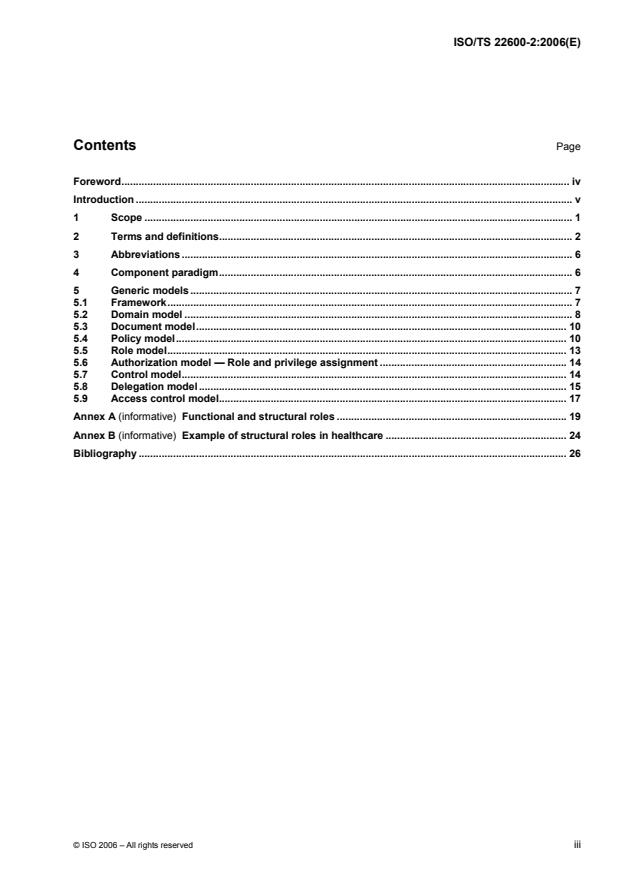
Contents Page
Foreword. iv
Introduction . v
1 Scope . 1
2 Terms and definitions. 2
3 Abbreviations . 6
4 Component paradigm. 6
5 Generic models . 7
5.1 Framework. 7
5.2 Domain model . 8
5.3 Document model. 10
5.4 Policy model. 10
5.5 Role model. 13
5.6 Authorization model — Role and privilege assignment . 14
5.7 Control model. 14
5.8 Delegation model. 15
5.9 Access control model. 17
Annex A (informative) Functional and structural roles . 19
Annex B (informative) Example of structural roles in healthcare . 24
Bibliography . 26
Foreword
ISO (the International Organization for Standardization) is a worldwide federation of national standards bodies
(ISO member bodies). The work of preparing International Standards is normally carried out through ISO
technical committees. Each member body interested in a subject for which a technical committee has been
established has the right to be represented on that committee. International organizations, governmental and
non-governmental, in liaison with ISO, also take part in the work. ISO collaborates closely with the
International Electrotechnical Commission (IEC) on all matters of electrotechnical standardization.
International Standards are drafted in accordance with the rules given in the ISO/IEC Directives, Part 2.
The main task of technical committees is to prepare International Standards. Draft International Standards
adopted by the technical committees are circulated to the member bodies for voting. Publication as an
International Standard requires approval by at least 75 % of the member bodies casting a vote.
In other circumstances, particularly when there is an urgent market requirement for such documents, a
technical committee may decide to publish other types of normative document:
— an ISO Publicly Available Specification (ISO/PAS) represents an agreement between technical experts in
an ISO working group and is accepted for publication if it is approved by more than 50 % of the members
of the parent committee casting a vote;
— an ISO Technical Specification (ISO/TS) represents an agreement between the members of a technical
committee and is accepted for publication if it is approved by 2/3 of the members of the committee casting
a vote.
An ISO/PAS or ISO/TS is reviewed after three years in order to decide whether it will be confirmed for a
further three years, revised to become an International Standard, or withdrawn. If the ISO/PAS or ISO/TS is
confirmed, it is reviewed again after a further three years, at which time it must either be transformed into an
International Standard or be withdrawn.
Attention is drawn to the possibility that some of the elements of this document may be the subject of patent
rights. ISO shall not be held responsible for identifying any or all such patent rights.
ISO/TS 22600-2 was prepared by Technical Committee ISO/TC 215, Health informatics.
ISO/TS 22600 consists of the following parts, under the general title Health informatics — Privilege
management and access control:
⎯ Part 1: Overview and policy management
⎯ Part 2: Formal models
iv © ISO 2006 – All rights reserved
Introduction
A common situation today is that hospitals are supported by several vendors providing different applications,
who are not able to communicate authentication and authorization since each has its own way of handling
these functions. To achieve an integrated scenario one has to spend a huge amount of money to get users
and organizational information mapped before starting communication. Resources are required for
development and maintenance of security functions that grow exponentially with the number of applications.
If, on the other hand, one looks on authorization from the health care organization's point of view, we need a
flexible bridging model due to the fact that organizations change continuously. Units close down, open and
merge.
The situation becomes even more complex when communications across security policy domain boundaries
are necessary. The policy differences between these domains then have to be bridged through policy
agreements between the parties.
Another complexity is found in roles when it comes to users. A user can adopt different roles related to
different periods of time and even have two or more roles simultaneously. For example, a user may work as a
nurse for two months and as a midwife for the next two or have both roles within the same time period.
Moreover, different responsibilities can be identified in the healthcare organization depending on the role and
activities of the users. Moving from country to country or from one healthcare centre to another, different types
or levels of authorization may be applied to similar types of user, both for execution of particular functions and
for access to the information.
Another most important issue today is how to improve the quality of care by using IT, without infringing the
privacy of the patient. To allow physicians to have more adequate information about the patient you need to
have something like a ‘virtual electronic health care record’ which makes it possible to keep track of all the
activities belonging to one patient regardless of where and by whom they have been documented. With such
an approach we need to have a generic model or specific agreement between the parties for authorization.
Besides the needs for support of a diversity of roles and responsibilities, which are typical in any type of large
organization, additional critical aspects can be identified such as ethical and legal aspects in the healthcare
scenario due to the particular type of information that is managed.
The need for restrictive authorization is already high today but is going to dramatically increase over the next
two years. The reason is the increase of exchange of information between applications in order to fulfil the
physicians’ demands on having access to more and more patient-related information to ensure the quality and
efficiency of patient treatment.
The situation, with respect to health care and its communication and application security services has
changed during the last decade. Reasons are, for example:
⎯ moving from mainframe based proprietary legacy systems to distributed systems running in local
environments;
⎯ more data are stored in information systems and are therefore also more valuable to the users;
⎯ patients are more ambulant and in need of their medical information at different locations.
From this it follows that advanced security is required in communication and use of health information due to
the sensitivity of person-related information and its corresponding personal and social impact. Those security
services concern both communication and application security. Regarding communication security services,
such as authentication, integrity, confidentiality, availability, accountability (including traceability and
non-repudiation), control of access to entities as well as notary’s services, it is authentication that is of crucial
importance for most of the other services. This is also true for application security such as access control to
data and functions of applications running at the aforementioned entity, integrity, confidentiality, availability,
accountability, audibility and the notary’s services.
The implementation of this Technical Specification will be very complex since the involved parties will already
have systems in operation and will not be willing to update their system immediately to newer versions or new
systems. It is therefore very important that a policy agreement is written between the parties, which states that
they intend to progress towards this standard when any change in the systems is intended.
The policy agreement shall also contain defined differences in the security systems and agreed solutions on
how to overcome the differences. For example, the authentication service, rights and duties of a requesting
party at the responding site have to be managed according to the agreed policy written down in the
agreement. For that reason, information and service requester, as well as information and service provider on
the one hand, and information and services requested and provided on the other hand, have to be grouped
and classified properly. Based on that classification, claimant mechanisms, target sensitivity mechanisms and
policy specification and management mechanisms, can be implemented. Once all parties have underwritten
the policy agreement the communication and information exchange can start with the existing systems if the
parties do not see any risks. If there are risks which are of such importance that they have to be eliminated
before the information exchange starts they shall also be recorded in the policy agreement together with an
action plan for how these risks shall be removed. The policy agreement shall also contain a time plan for this
work and an agreement on how it shall be financed.
The documentation process is very important and provides the platform for the policy agreement.
⎯ Part 1: Overview and policy management, describes the scenarios and the critical parameters in cross
border information exchange. It also gives examples of necessary documentation methods as the basis
for the policy agreement.
⎯ Part 2: Formal models, describes and explains, in a more detailed manner, the architectures and
underlying models for the privileges and privilege management, which are necessary for secure
information sharing plus examples of policy agreement templates.
Privilege management and access control address security services required for communication and
distributed use of health information. This document introduces principles and specifies services needed for
managing privileges and access control. Cryptographic protocols are out of the scope of this document.
This part of ISO/TS 22600 is strongly related to other corresponding International Standards such as
ISO/TS 17090 and ISO/TS 21091. It is also related to work in progress on a future Technical Specification,
ISO/TS 21298.
This part of ISO/TS 22600 is meant to be read in conjunction with its complete set of associated standards.
The distributed architecture of shared care information systems is increasingly based on networks. Due to
their user friendliness, the use of standardized user interfaces, tools and protocols, and therefore their
platform independence, the number of really open information systems based on corporate networks, virtual
private networks has been rapidly growing during the last couple of years.
ISO/TS 22600 shall define privilege management and access control services required for communication and
use of distributed health information over domain and security borders. The document introduces principles
and specifies services needed for managing privileges and access control. It specifies the necessary
component based concepts and is intended to support their technical implementation. It will not specify the
use of these concepts in particular clinical process pathways.
vi © ISO 2006 – All rights reserved
TECHNICAL SPECIFICATION ISO/TS 22600-2:2006(E)
Health informatics — Privilege management and access
control —
Part 2:
Formal models
1 Scope
This part of ISO/TS 22600 is intended to support the needs of healthcare information sharing across
unaffiliated providers of healthcare, healthcare organizations, health insurance companies, their patients, staff
members and trading partners. It is also intended to support inquiries from both individuals and application
systems.
ISO/TS 22600 defines methods for managing authorization and access control to data and/or functions. It
accommodates policy bridging. It is based on a conceptual model where local authorization servers and cross-
border directory and policy repository services can assist access control in various applications (software
components). The policy repository provides information on rules for access to various application functions
based on roles and other attributes. The directory service enables identification of the individual user. The
granted access will be based on four aspects:
⎯ the authenticated identification of the user;
⎯ the rules for access connected with a specific information object;
⎯ the rules regarding authorization attributes linked to the user provided by the authorization manager;
⎯ the functions of the specific application.
This part of ISO/TS 22600 should be used in a perspective ranging from a local situation to a regional or
national one. One of the key points in these perspectives is to have organizational criteria combined with
authorization profiles agreed upon from both the requesting and delivering side in a written policy agreement.
This part of ISO/TS 22600 supports collaboration between several authorization managers that may operate
over organizational and policy borders.
The collaboration is defined in a policy agreement, signed by all involved organizations, and constitutes the
basic platform for the operation.
A documentation format is proposed, as a platform for the policy agreement, which makes it possible to obtain
comparable documentation from all parties involved in the information exchange of information.
This part of ISO/TS 22600 excludes platform-specific and implementation details. It does not specify technical
communication security services and protocols that have been established in other standards,
e.g. ENV 13608. It also excludes authentication techniques.
This part of ISO/TS 22600 introduces the underlying paradigm of formal high level models for architectural
components based on ISO/IEC 10746. In that context, the Domain Model, the Document Model, the Policy
Model, the Role Model, the Authorization Model, the Delegation Model, the Control Model and the Access
Control Model are introduced.
The specifications are provided using the meta-languages Unified Modelling Language (UML) and Extensible
Markup Language (XML). Additional diagrams are used for explaining the principles. The attributes used have
been referenced to the HL7 Reference Information Model and the HL7 datatype definitions.
2 Terms and definitions
For the purposes of this document, the following terms and definitions apply.
2.1
access control
means of ensuring that the resources of a data processing system can be accessed only by authorized
entities in authorized ways
[ISO/IEC 2382-8, definition 08.04.01]
2.2
accountability
property that ensures that the actions of an entity may be traced uniquely to the entity
[ISO 7498-2, definition 3.3.3]
2.3
attribute authority
AA
authority that assigns privileges by issuing attribute certificates
2.4
attribute certificate
data structure, digitally signed by an attribute authority, which binds some attribute values with identification
about its holder
2.5
authentication
process of reliably identifying security subjects by securely associating an identifier and its authenticator
NOTE See also data origin authentication and peer entity authentication.
2.6
authority
entity that is responsible for the issuance of certificates
NOTE Two types are defined in this part of ISO/TS 22600: certification authority that issues public-key certificates
and attribute authority that issues attribute certificates.
2.7
authorization
process of granting rights, which includes the granting of access rights
2.8
availability
property of being accessible and useable upon demand by an authorized entity
[ISO 7498-2, definition 3.3.17]
2.9
certificate validation
process of ensuring that a certificate was valid at a given time, including possibly the construction and
processing of a certification path, and ensuring that all certificates in that path were valid (i.e. were not expired
or revoked) at that given time
2 © ISO 2006 – All rights reserved
2.10
certification authority
CA
authority trusted by one or more relying parties to create and assign certificates
[ISO/IEC 9594-8, definition 3.3.17]
NOTE 1 Optionally the certification authority may create the relying parties' keys.
NOTE 2 Authority in the CA term does not imply any government authorization only that it is trusted. Certificate issuer
may be a better term but CA is used very broadly.
2.11
certification path
ordered sequence of certificates of objects in the DIT which, together with the public key of the initial object in
the path, can be processed to obtain that of the final object in the path
2.12
confidentiality
property that information is not made available or disclosed to unauthorized individuals, entities or processes
[ISO 7498-2, definition 3.3.16]
2.13
credential
prerequisite for the entitlement of, or the eligibility for, a role
2.14
delegation
conveyance of privilege from one entity that holds such privilege, to another entity
2.15
delegation path
ordered sequence of certificates which, together with authentication of a privilege asserter's identity, can be
processed to verify the authenticity of a privilege asserter's privilege
2.16
environmental variables
aspects of policy required for an authorization decision, which are not contained within static structures, but
are available through some local means to a privilege verifier (e.g. time of day or current account balance)
2.17
identification
performance of tests to enable a data processing system to recognize entities
2.18
identifier
piece of information used to claim an identity, before a potential corroboration by a corresponding
authenticator
[ENV 13608-1]
2.19
integrity
property that information is not altered in any way, deliberately or accidentally
2.20
key
sequence of symbols that controls the operations of encipherment and decipherment
[ISO 7498-2, definition 3.3.32]
2.21
non-repudiation
service that provides proof of the integrity and origin of data (both in an unforgeable relationship) which can be
verified by any party
2.22
policy
set of legal, political, organizational, functional and technical obligations for communication and cooperation
2.23
policy agreement
written agreement where all involved parties commit themselves to a specified set of policies
2.24
principal
actor able to realize specific scenarios (user, organization, system, device, application, component, object)
2.25
private key
key that is used with an asymmetric cryptographic algorithm and whose possession is restricted (usually to
only one entity)
[ISO/IEC 10181-1, definition 3.3.10]
2.26
privilege
capacity assigned to an entity by an authority according to the entity’s attribute
2.27
privilege asserter
privilege holder using their attribute certificate or public-key certificate to assert privilege
2.28
privilege management infrastructure
PMI
infrastructure able to support the management of privileges in support of a comprehensive authorization
service and in relationship with a Public Key Infrastructure
2.29
privilege policy
policy that outlines conditions for privilege verifiers to provide/perform sensitive services to/for qualified
privilege asserters
NOTE Privilege policy relates attributes associated with the service as well as attributes associated with privilege
asserters.
2.30
privilege verifier
entity verifying certificates against a privilege policy
2.31
public key
key that is used with an asymmetric cryptographic algorithm and that can be made publicly available
[ISO/IEC 10181-1, definition 3.3.11]
4 © ISO 2006 – All rights reserved
2.32
public key certificate
PKC
certificate that binds an identity and a public key
NOTE The identity may be used to support identity-based access control decisions after the client proves that they
have access to the private key that corresponds to the public key contained in the PKC.
2.33
role
set of competences and/or performances which is associated with a task
2.34
role assignment certificate
certificate that contains the role attribute, assigning one or more roles to the certificate holder
2.35
role certificate
certificate that assigns privileges to a role rather than directly to individuals
NOTE Individuals assigned to that role, through an attribute certificate or public-key certificate with a subject directory
attributes extension containing that assignment, are indirectly assigned the privileges contained in the role certificate.
2.36
role specification certificate
certificate that contains the assignment of privileges to a role
2.37
sensitivity
characteristic of a resource that implies its value or importance
2.38
security
combination of availability, confidentiality, integrity and accountability
[ENV 13608-1]
2.39
security policy
plan or course of action adopted for providing computer security
2.40
security service
service, provided by a layer of communicating open systems, which ensures adequate security of the systems
or of data transfers
[ISO 7498-2, definition 3.3.51]
2.41
source of authority
SOA
attribute authority (2.3) that a privilege verifier for a particular resource trusts as the ultimate authority to
assign a set of privileges
2.42
target
resource being accessed by a claimant
NOTE Its sensitivity is modelled in this document as a collection of attributes, represented as either ASN.1 attributes
or XML elements.
2.43
trust
quality by which an entity can be said to “trust” a second entity when it (the first entity) makes the assumption
that the second entity will behave exactly as the first entity expects
NOTE This trust may apply only for some specific function. The key role of trust in this framework is to describe the
relationship between an authenticating entity and an authority; an entity should be certain that it can trust the authority to
create only valid and reliable certificates.
3 Abbreviations
AA Attribute Authority
PKC Public Key Certificate
UML Unified Modelling Language
XML eXtensible Markup Language
4 Component paradigm
The framework for a future-proof health information system architecture is based on the generic component
model developed in the mid-nineties (e.g. references [1], [2], [3]). Basis of that architecture are a reference
information model (RIM) and agreed vocabularies enabling interoperability. Referenced to them,
domain-specific constraint models will be specified which represent domain-specific knowledge concepts,
considering both structural and functional knowledge. The corresponding components have to be established
according to all views of the reference model in ISO 10746-1 on open distributed processing (RM-ODP), i.e.
enterprise view, information view, computational view, engineering view and technology view. A view focuses
consideration on one aspect abstracting from all others. The different domain concepts and their view
representation is not the task of programmers but of domain experts. For that reason, they will use appropriate
expression means such as specific graphical representation (e.g. UML diagrams) or sometimes even verbal
templates expressed in XML.
The components can be aggregated to higher level of composition. Contrary to the ISO definition of primitives
and composition, in the generic component model at least four levels of composition/decomposition have
been defined (see Figure 1).
Figure 1 — Generic component model
6 © ISO 2006 – All rights reserved
The aggregation is performed according to content- or process-related knowledge expressed by
logics/algorithms/operations or rules/workflows/procedures/relationships. So, the aggregation of the building
blocks “constraint models” is controlled by the aforementioned mechanisms or by the communicating or co-
operating principal’s behaviour. The specification is completely provided at meta-level. Different vocabularies
as well as tooling environment and functionality are harmonized by meta-languages like XML Metadata
[4]
Interchange (XMI) .
5 Generic models
5.1 Framework
Privilege management and authorization may be based on roles that individual actors or groups of individual
actors play. Actors interacting with system components are called principals, which can be a human user, a
system, a device, an application, a component or even an object.
In order to obtain the above described structure and functionality there are a number of models, mechanisms,
processes, objects, etc. needed, which must be considered.
Regarding privilege management and access control management, two basic class types must be dealt with:
⎯ entities:
⎯ documents;
⎯ principals;
⎯ policies;
⎯ roles;
⎯ acts:
⎯ policy management;
⎯ principal management;
⎯ privilege management;
⎯ authentication;
⎯ authorization;
⎯ access control management;
⎯ audit.
The following models will be considered in more detail:
⎯ domain model;
⎯ document model;
⎯ policy model;
⎯ role model;
⎯ authorization model;
⎯ control model;
⎯ delegation model;
⎯ access control model.
All specifications in this framework will be kept open, platform-independent, portable and scalable. Therefore,
the models provided are described at meta-model level and at the model level keeping the instance level out
of consideration. For expressing systems in such a way, specific languages and meta-languages are used
such as UML and XML including means for transfer from one vocabulary to another one.
This specification is defined using UML constructs, UML specifications, UML profiles and all different diagrams.
Regarding XML, several specifications within the XML standard set will be used.
All models being used establish specific kinds of constraints forming constraint models. This concerns all
conceivable services or views on systems. A model is a simplified view at the reality according to special
concepts. The language to be used for graphical models is UML and MOF. The language for verbal models is
the XML standard set.
It is expected that many documents will be expressed using XML. The structure for such a document is
defined in a document type definition (DTD) or an XML schema instance. A privilege policy may act directly on
the XML elements (e.g. by comparing attributes in an authorization certificate to elements in the document).
5.2 Domain model
To keep (complex) information systems that support shared care manageable and operating, principal-related
components of the system are grouped by common organizational, logical and technical properties into
domains. Following OMG’s (Object Management Group) definition, this could be done for common policies
(policy domains), for common environments (environment domains) or common technology (technology
domains). Any kind of interoperability internal to a domain is called an intradomain communication and co-
operation, whereas interoperability between domains is called an interdomain communication and co-
operation. For example, communication could be realized between departments of a hospital internally to the
domain hospital (intradomain communication), but externally to the domain of a special department
(interdomain communication). Regarding security requirements, security policy domains are of special interest.
A domain is characterized by a domain identifier, a domain name, a domain authority, a domain qualifier. The
[5]
provided data type definition resembles the HL7 Version 3 Data type Definition .
Table 1 — Security policy domain attributes
Attribute Type Remarks
domain_identifier SET SET of ISO ObjectIdentifier
domain_name BAG Bag of EntityName
domain_authority_ID OID ISO ObjectIdentifier
domain_authority_name ST String
domain_qualifier CS CodedSimpleValue
Security policy domain class inherits attributes from domain class, plus the attributes: policy identifier and
policy name.
A policy describes the legal framework including rules and regulations, the organizational and administrative
framework, functionalities, claims and objectives, the principals involved, agreements, rights, duties and
penalties defined as well as the technological solution implemented for collecting, recording, processing and
communicating data in information systems. For describing policies, methods such as policy templates or
formal policy modelling might be deployed.
8 © ISO 2006 – All rights reserved
Domains are specified generically in this part of ISO/TS 22600, and their definition in practice can be flexible.
A domain might consist of sub-domains (which will inherit and might specialize policies from the parent
domain). The smallest-scale domain might be an individual workplace or a specific component within an
information system. Domains can be extended into super-domains, by chaining a set of distinct domains and
forming a common larger-scale domain for communication and co-operation.
This co-operation between domains requires the definition of a common set of policies that applies to all of the
collaborating domains. It must be derived from all of the relevant domain-specific policies across all of those
domains. These common policies are derived (negotiated) through a process known as policy bridging
(see Figure 2). The eventual agreed policies need to be documented and signed by all of the domain
authorities (see ISO/TS 22600-1:2006, Annex A). Ideally this whole process will be capable of electronic
representation and negotiation, to permit real-time electronic collaboration to take place within a (pre-agreed)
permitted and regulated framework. The policy negotiation or verification would then take place at every
service interaction.
Figure 2 — Policy bridging
This collaboration will introduce the need for components between the principals. Middleware concepts are
being introduced increasingly into the new(er) healthcare information systems. Middleware components can
enable interoperability through direct invocation (middleware communication services) or chained invocation
(including middleware application services). The latter is characterized by different models of delegation
(see 5.8).
Such an architecture can be represented by chains of different domains as shown in Figure 3.
Figure 3 — Domain concept with middleware services
From the security point of view, a domain that ensures intradomain communication according to its own policy,
is commonly considered to have need of protection only at its boundary, to external domains with their specific
policies (or even the policy-free domain of the Internet). This is done by, e.g. firewalls, proxy servers, etc.
Regarding the external environment, a domain is therefore often considered closed. The internal domain is
mistakenly assumed to be secure, often neglecting internal threats and attacks which are among the majority
of all security attacks.
Regarding the specific requirements and conditions of healthcare, the underlying security model must
consider the whole spectre of security services and mechanisms, which can be accomplished by secure micro
domains.
5.3 Document model
Processes, entities, roles, etc. must be documented and signed expressing the particular relations between
entities and processes. The combination of processes and relations leads to multiple signatures (e.g. in the
case of delegation).
This part of ISO/TS 22600 uses the cryptographic message syntax to support multiple signatures on a
document. Each signature is computed over the document content and optionally a set of signed attributes
specific to the particular signature. These attributes may include time stamps, signature purpose and other
information.
5.4 Policy model
A security policy is the complex of legal, ethical, social, organizational, psychological, functional and technical
implications for assuring trustworthiness of health information systems. A policy is the formulation of the
concept of requirements and conditions for trustworthy creation, storage, processing and use of sensitive
information. A policy can be expressed:
⎯ verbally unstructured;
⎯ structured using schemata or templates;
⎯ formally modelled.
For interoperability reasons, a policy must be formulated and encoded in a way that enables its correct
interpretation and practice. Therefore, policies have to be constrained regarding syntax, semantics,
vocabulary and operation of policy documents, also called policy statements or policy agreements
(agreements between the partners involved).
To reliably refer to a specific policy, the policy instance must be uniquely named and identified via a unique
policy ID. The same is true for all the policy elements such as domain, targets, operations and their policies,
which also have to be named and uniquely identified. In summary, a policy is characterized by a policy
identifier, a policy name, a policy authority, a domain identifier, a domain name, a target list, target identifier,
target name, target object, operations allowed and related policies.
For readability reasons, domain-related attributes have been included in Table 2 even if policy inherits from
domain. The provided data type definition resembles the HL7 Version 3 Data type Definition.
Health information systems such as the EHR should at minimum have a policy for patients to control access to
their health information, a policy with common access rules by the organization, policies defined by laws and
regulations, and one policy per structural role as well as one policy per functional role.
Every creation, access or modification to an EHR component must be covered by one or more policies. The
reference model of the EHR extract includes a policy ID attribute within the record component class to permit
references to such policies to be made at any level of granularity within the EHR hierarchy. The policies that
apply specifically to an EHR may be included within the EHR extract, eventually including any bridged policies.
10 © ISO 2006 – All rights reserved
As any other component, also policy components can be composed or decomposed according to the generic
component model. Using H7 Version 3 data type definitions, the policy class can be specialized into basic
policy, meta policy and composite policy (see Figure 4), which have been verbally explained in detail in
Table 3 and Table 4 respectively. See reference [6].
Table 2 — Basic security policy attributes
Attribute Type Remarks
policy_identifier SET Set of InstanceIdentifier
policy_name CS CodedSimpleValue
policy_authority_ID OID ISO ObjectIdentifier
policy_authority-name ST String
domain_identifier SET Set of ISO ObjectIdentifier
domain_name BAG Bag of EntityName
target_list LIST List of INT
target_ID SET Set of InstanceIdentifier
target_name EN EntityName
target_object II InstanceIdentifier
operation_code CE CodedWithEqivalents
policies CD ConceptDescription
Figure 4 — Policy base-class diagram
The specializations of the composite policy abstract class are interrelated in a complex way, which has been
indicated in outlines as simple association.
Table 3 — Basic policy types
Basic policy type Purpose Content
Authorization policies define permitted actions subject (except in roles), target, action
Obligation policies are event-triggered and define actions subject (except in roles), action, event
to be performed by manager agents
Refrain policies define actions the subjects must refrain subject (except in roles), action
from performing
Delegation policies define what authorizations can be
delegated to whom
Table 4 — Composite policy types
Composite policy type Purpose
Groups define a scope for related policies to which a set of constraints can apply
Roles define a group of policies (authorization, obligation and refrain policies) (for
details on roles see 5.5 plus Annex A)
Relationships define a group of policies pertaining to the interactions between a set of roles
Another way for policy decomposition has been provided by the OMG’s security services specification
distinguishing between the following policies:
⎯ invocation access policy implementing access control policy for objects;
⎯ invocation audit policy controlling event type and criteria for audit;
⎯ secure invocation policy specifying security policies associated with security associations and message
protection.
Regarding requirements for different object types:
⎯ invocation delegation policy;
⎯ application access policy;
⎯ application audit policy;
⎯ non-repudiation policy
have been defined.
One common way to express constraints is the specification of user defined schemata such as XML schemata.
This schema should be standardized for the interoperability purposes mentioned above.
Figure 5 presents a simple XML instance for a security policy statement.
Policies must be managed and stored in standardized trustworthy policy repositories.
12 © ISO 2006 – All rights reserved
Figure 5 — Policy template example
5.5 Role model
For managing relationships between the entities mediated by an activity, two different roles must be defined:
organizational roles at the entity’s side and functional roles at the act’s side.
To facilitate the deployment of ISO/TS 22600, functional and structural roles are presented in Annex A.
Figure 6 — The generic role concept
5.6 Authorization model — Role and privilege assignment
Credentialling, privileging and authorization are performed by connecting roles to policies.
Roles provide a means of indirectly assigning privileges to individuals. Individuals are issued role assignment
certificates assigning one or more roles to them by role attributes. Privileges are assigned to a role by role
specification certificates, rather than to individuals. The indirect assignment enables the privileges assigned to
a role to be updated without impacting the certificates that assign roles to individuals. Role assignment
certificates may be attribute certificates or public-key certificates. Role specification certificates cannot be
public-key certificates, but must be attribute certificates. If role specification certificates are not used, the
assignment of privileges to a role may be done through other means (e.g. may be locally configured at a
privilege verifier).
The following scenarios are all possible:
⎯ any number of roles can be defined by any attribute authority (AA);
⎯ the role itself and the members of a role can be defined and administered separately, by different AAs;
this implies that roles may be local within a domain, e.g. on an organizational, regional or national level;
⎯ role membership, just as any other privilege, may be delegated;
⎯ roles and membership may be assigned any suitable lifetime.
If the role assignment certificate is an attribute certificate, the role attribute is contained in the attributes
comp
...
Questions, Comments and Discussion
Ask us and Technical Secretary will try to provide an answer. You can facilitate discussion about the standard in here.
Loading comments...