

ISO 16905:2015
(Main)Resilient floor coverings — Specification for rubber floor covering — Tile/Plank
General Information
- Abstract
ISO 16908:2015 specifies the characteristics of rubber floor tile/planks. ISO 16908:2015 includes a classification system based on intensity of use, which shows where resilient floor coverings should provide satisfactory service. ISO 16908:2015 specifies rubber floor tile/planks for applications involving the use of normal footwear and does not cover applications where special footwear, such as spiked shoes, may be involved.
- Status
- Published
- Publication Date
- 28-Sep-2015
- Technical Committee
- ISO/TC 219 - Floor coverings
- Drafting Committee
- ISO/TC 219/WG 2 - Resilient floor coverings
- Current Stage
- 9060 - Close of review
- Completion Date
- 04-Jun-2031
Overview
ISO 16905:2015 - Resilient floor coverings - Specification for rubber floor covering - Tile/Plank specifies the required characteristics, tolerances and classification for rubber floor tiles and planks. It defines product categories, test methods and minimum performance levels for use with normal footwear (it does not cover special footwear such as spiked shoes). Note: the correct document reference is ISO 16905:2015 (some sources may mistype this as ISO 16908).
Key topics and technical requirements
- Product categories - Three categories (A, B, C): homogeneous, heterogeneous and decorative-layer constructions. Categories determine layer structure and minimum wear-layer thickness.
- Classification by intensity of use - Uses a system (aligned with ISO 10874) to indicate suitability for domestic, commercial and light industrial traffic.
- Dimensional tolerances - Tile/plank side length, edge straightness and squareness limits (ISO 24342); overall thickness tolerances (ISO 24346).
- Mechanical properties and durability
- Flexibility: mandated mandrel diameters for no cracking (ISO 24344).
- Residual indentation: maximum permitted permanent deformation after static loading (ISO 24343-1).
- Abrasion resistance: requirements using ISO 4649 or ASTM D3389 (Taber-style test) and EN 663 pattern depth criteria.
- Dimensional stability - Limits after heat exposure (ISO 23999).
- Marking, labelling and packaging - Product and pack must be labeled with the standard number (ISO 16905:2015), manufacturer, product name, colour/pattern, batch and class symbols.
- Optional properties (application-specific) - Colour fastness, resistance to stains/chemicals, reaction to fire, smoke density, electrical resistance and cigarette resistance (referenced standards in Annex A).
Applications and who uses this standard
ISO 16905:2015 is intended for:
- Flooring manufacturers developing rubber tile/plank products and production quality control.
- Test laboratories performing conformity and performance testing.
- Architects, specifiers and consultants selecting appropriate resilient flooring for spaces based on traffic intensity.
- Facilities managers and procurement teams who need performance-based selection criteria for domestic, commercial or light industrial facilities.
- Installers and distributors requiring specification, marking and packaging guidance.
Practical applications include schools, hospitals, retail, offices and light industrial areas where normal footwear is used and consistent durability, dimensional stability and safety are required.
Related standards
Normative and informative references cited by ISO 16905:2015 include:
- ISO 4649, ISO 7619-1, ISO 10874, ISO 23999, ISO 24342, ISO 24343-1, ISO 24344, ISO 24346
- ASTM D3389, EN 663
- Annex A references: ISO 105‑B02, ISO 26987, ISO 11925‑2, ASTM E662, ASTM F1515, EN 1081, EN 1399, EN 1815
Keywords: ISO 16905:2015, rubber floor coverings, rubber floor tile, rubber floor plank, flooring standards, abrasion resistance, dimensional stability, residual indentation.
Relations
- Effective Date
- 09-Feb-2026
Frequently Asked Questions
ISO 16905:2015 is a standard published by the International Organization for Standardization (ISO). Its full title is "Resilient floor coverings — Specification for rubber floor covering — Tile/Plank". This standard covers: ISO 16908:2015 specifies the characteristics of rubber floor tile/planks. ISO 16908:2015 includes a classification system based on intensity of use, which shows where resilient floor coverings should provide satisfactory service. ISO 16908:2015 specifies rubber floor tile/planks for applications involving the use of normal footwear and does not cover applications where special footwear, such as spiked shoes, may be involved.
ISO 16908:2015 specifies the characteristics of rubber floor tile/planks. ISO 16908:2015 includes a classification system based on intensity of use, which shows where resilient floor coverings should provide satisfactory service. ISO 16908:2015 specifies rubber floor tile/planks for applications involving the use of normal footwear and does not cover applications where special footwear, such as spiked shoes, may be involved.
ISO 16905:2015 is classified under the following ICS (International Classification for Standards) categories: 97.150 - Floor coverings. The ICS classification helps identify the subject area and facilitates finding related standards.
ISO 16905:2015 has the following relationships with other standards: It is inter standard links to EN ISO 20326:2018. Understanding these relationships helps ensure you are using the most current and applicable version of the standard.
ISO 16905:2015 is available in PDF format for immediate download after purchase. The document can be added to your cart and obtained through the secure checkout process. Digital delivery ensures instant access to the complete standard document.
Standards Content (Sample)
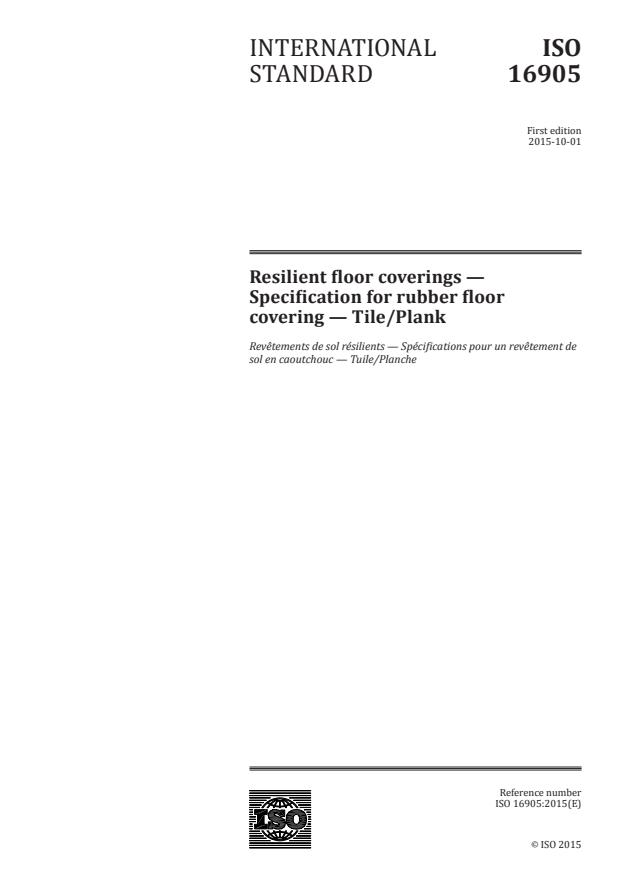
INTERNATIONAL ISO
STANDARD 16905
First edition
2015-10-01
Resilient floor coverings —
Specification for rubber floor
covering — Tile/Plank
Revêtements de sol résilients — Spécifications pour un revêtement de
sol en caoutchouc — Tuile/Planche
Reference number
©
ISO 2015
© ISO 2015, Published in Switzerland
All rights reserved. Unless otherwise specified, no part of this publication may be reproduced or utilized otherwise in any form
or by any means, electronic or mechanical, including photocopying, or posting on the internet or an intranet, without prior
written permission. Permission can be requested from either ISO at the address below or ISO’s member body in the country of
the requester.
ISO copyright office
Ch. de Blandonnet 8 • CP 401
CH-1214 Vernier, Geneva, Switzerland
Tel. +41 22 749 01 11
Fax +41 22 749 09 47
copyright@iso.org
www.iso.org
ii © ISO 2015 – All rights reserved
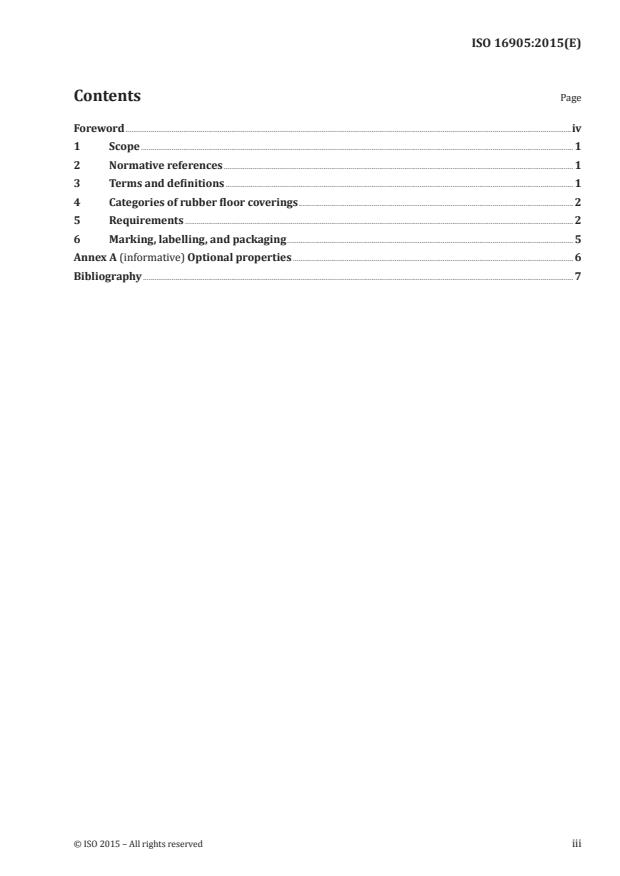
Contents Page
Foreword .iv
1 Scope . 1
2 Normative references . 1
3 Terms and definitions . 1
4 Categories of rubber floor coverings . 2
5 Requirements . 2
6 Marking, labelling, and packaging . 5
Annex A (informative) Optional properties . 6
Bibliography . 7
Foreword
ISO (the International Organization for Standardization) is a worldwide federation of national standards
bodies (ISO member bodies). The work of preparing International Standards is normally carried out
through ISO technical committees. Each member body interested in a subject for which a technical
committee has been established has the right to be represented on that committee. International
organizations, governmental and non-governmental, in liaison with ISO, also take part in the work.
ISO collaborates closely with the International Electrotechnical Commission (IEC) on all matters of
electrotechnical standardization.
The procedures used to develop this document and those intended for its further maintenance are
described in the ISO/IEC Directives, Part 1. In particular the different approval criteria needed for the
different types of ISO documents should be noted. This document was drafted in accordance with the
editorial rules of the ISO/IEC Directives, Part 2 (see www.iso.org/directives).
Attention is drawn to the possibility that some of the elements of this document may be the subject of
patent rights. ISO shall not be held responsible for identifying any or all such patent rights. Details of
any patent rights identified during the development of the document will be in the Introduction and/or
on the ISO list of patent declarations received (see www.iso.org/patents).
Any trade name used in this document is information given for the convenience of users and does not
constitute an endorsement.
For an explanation on the meaning of ISO specific terms and expressions related to conformity
assessment, as well as information about ISO’s adherence to the WTO principles in the Technical
Barriers to Trade (TBT) see the following URL: Foreword - Supplementary information.
The committee responsible for this document is ISO/TC 219, Floor coverings.
iv © ISO 2015 – All rights reserved
INTERNATIONAL STANDARD ISO 16905:2015(E)
Resilient floor coverings — Specification for rubber floor
covering — Tile/Plank
1 Scope
This International Standard specifies the characteristics of rubber floor tile/planks.
This International Standard includes a classification system based on intensity of use, which shows
where resilient floor coverings should provide satisfactory service.
This International Standard specifies rubber floor tile/planks for applications involving the use of normal
footwear and does not cover applications where special footwear, such as spiked shoes, may be involved.
2 Normative references
The following documents, in whole or in part, are normatively referenced in this document and are
indispensable for its application. For dated references, only the edition cited applies. For undated
references, the latest edition of the referenced document (including any amendments) applies.
ISO 4649-1, Rubber, vulcanized or thermoplastic — Determination of abrasion resistance using a rotating
cylindrical drum device
1)
ISO 4918, Resilient, textile and laminate floor coverings — Castor chair test
ISO 7619-1, Rubber, vulcanized or thermoplastic — Determination of indentation hardness — Part 1:
Durometer method (Shore hardness)
ISO 10874, Resilient, textile and laminate floor coverings — Classification
ISO 23999, Resilient floor coverings — Determination of dimensional stability and curling after
exposure to heat
ISO 24342, Resilient and textile floor-coverings — Determination of side length, edge straightness and
squareness of tiles
ISO 24343-1, Resilient and laminate floor coverings — Determination of indentation and residual
indentation — Part 1: Residual indentation
ISO 24344, Resilient floor coverings — Determination of flexibility and deflection
ISO 24346, Resilient floor coverings — Determination of overall thickness
ASTM D3389, Standard Test Method for Coated Fabrics Abrasion Resistance (Rotary Platform Abrader)
EN 663, Resilient floor coverings — Determination of conventional pattern depth
3 Terms and definitions
For the purposes of this document, the following terms and definitions apply.
3.1
rubber materials
polymeric binder in the rubber (3.2) floor covering satisfying the definition of rubber in ASTM D1566,
and having been vulcanized such that it became thermoset (3.3) as defined in ASTM D883
1) To be published. (Revision of ISO 4918:2009)
3.2
rubber
material that is capable of recovering from large deformations quickly and forcibly, and can be, or
already is, modified to a state in which it is ess
...