

ISO/IEC 10741-1:1995/Amd 1:1996
(Amendment)Information technology — User system interfaces — Dialogue interaction — Part 1: Cursor control for text editing — Amendment 1: Macro cursor control
General Information
- Abstract
Replaces the wording of some clauses and subclauses of ISO/IEC 10741-1:1995 and adds some new definitions and clauses and subclauses.
- Status
- Published
- Publication Date
- 25-Dec-1996
- Technical Committee
- ISO/IEC JTC 1/SC 35 - User interfaces
- Drafting Committee
- ISO/IEC JTC 1/SC 35 - User interfaces
- Current Stage
- 6060 - International Standard published
- Start Date
- 26-Dec-1996
- Completion Date
- 29-Aug-2026
Overview
ISO/IEC 10741-1:1995/Amd 1:1996 is an amendment to the international standard ISO/IEC 10741-1:1995, focusing on user system interfaces and dialogue interaction specifically related to cursor control for text editing. This amendment introduces the concept of macro cursor control, enhancing cursor navigation capabilities by allowing movement beyond single increments, such as jumping by words, lines, paragraphs, or pages.
The standard updates definitions, replaces certain clauses from the original 1995 edition, and adds new mandatory and optional functions for macro cursor control. These enhancements improve the efficiency and usability of text editing applications, especially for Latin-based languages.
Key Topics
Macro Cursor Control
Defines the ability to move the cursor more than one increment (e.g., a character) at a time-supporting faster navigation within text documents.Mandatory Macro Functions
Essential cursor movements that must be implemented by applications claiming conformance:- Next word
- Previous word
- Beginning of line
- End of line
- Beginning of document
- End of document
Optional Macro Functions
Additional recommended movements to enhance user experience, often found in advanced text editors:- Next paragraph
- Previous paragraph
- Next text (screenful or frame)
- Previous text
- Next page
- Previous page
Activation and Input Devices
Specifies that macro cursor functions may be controlled via keyboard keys or analogous input devices, with recommended key combinations based on ISO/IEC 9995 and ISO/IEC 99957 for symbol consistency.New Definitions Introduced
- Frame: The visible text area bounded by the screen or application window.
- Macro Cursor Control: User capability to jump the cursor by more than one increment.
- Page: A logical part of a document presented as a unit, defined by the application.
Applications
The amendment enhances the development of text editing and word processing software, making cursor navigation more intuitive and aligned with user expectations for document editing tasks. It is particularly valuable for:
- Software developers designing user interfaces for text editors and document processing tools.
- User experience designers aiming to streamline text navigation through standardized cursor behavior.
- Hardware manufacturers creating keyboards and input devices that support consistent macro cursor commands.
- Localization engineers ensuring cursor control works effectively across languages that use Latin scripts.
- Any application requiring efficient document navigation and editing capabilities, such as content management systems, programming environments, and digital publishing platforms.
Related Standards
- ISO/IEC 9995 – Keyboard layouts for text and data processing, providing guidance on key positioning relevant to macro cursor keys.
- ISO/IEC 99957 – Guidelines on symbols used on keyboards and devices for consistent user interaction.
- ISO/IEC 10741 (Base Standard) – Original text editing cursor control standard that this amendment updates.
- Other standards under ISO/IEC JTC 1/SC 18 related to document processing and communication interfaces.
Keywords: macro cursor control, ISO/IEC 10741-1, text editing, user system interface, dialogue interaction, cursor navigation, keyboard shortcuts, document processing, text editor standards, information technology standardization
Relations
- Effective Date
- 06-Jun-2022
- Effective Date
- 15-Apr-2008
Get Certified
Connect with accredited certification bodies for this standard

BSI Group
BSI (British Standards Institution) is the business standards company that helps organizations make excellence a habit.

NYCE
Mexican standards and certification body.
Sponsored listings
Frequently Asked Questions
ISO/IEC 10741-1:1995/Amd 1:1996 is a standard published by the International Organization for Standardization (ISO). Its full title is "Information technology — User system interfaces — Dialogue interaction — Part 1: Cursor control for text editing — Amendment 1: Macro cursor control". This standard covers: Replaces the wording of some clauses and subclauses of ISO/IEC 10741-1:1995 and adds some new definitions and clauses and subclauses.
Replaces the wording of some clauses and subclauses of ISO/IEC 10741-1:1995 and adds some new definitions and clauses and subclauses.
ISO/IEC 10741-1:1995/Amd 1:1996 is classified under the following ICS (International Classification for Standards) categories: 35.240.20 - IT applications in office work. The ICS classification helps identify the subject area and facilitates finding related standards.
ISO/IEC 10741-1:1995/Amd 1:1996 has the following relationships with other standards: It is inter standard links to ISO/IEC 10741-1:1995; is excused to ISO/IEC 10741-1:1995. Understanding these relationships helps ensure you are using the most current and applicable version of the standard.
ISO/IEC 10741-1:1995/Amd 1:1996 is available in PDF format for immediate download after purchase. The document can be added to your cart and obtained through the secure checkout process. Digital delivery ensures instant access to the complete standard document.
Standards Content (Sample)
lSO/lEC
INTERNATIONAL
10741-I
STANDARD
First edition
1995-l l-01
AMENDMENT 1
1996-l 2-l 5
Information technology - User system
interfaces - Dialogue interaction -
Part I:
Cursor control for text editing
AMENDMENT 1: Macro cursor control
Technologies de I’informa tion - interfaces de s ys t&mes de I’u tilisa teur -
Interaction par le dialogue -
Partie 1: Commande du curseur pour kdition de texte
AMENDEMENT 7: Commande du ((Macro curseur))
Reference number
ISO/lEC 10741-I :I 995/Amd.l :I 996(E)
lSO/IEC 1074%1:1995/Amd.l:1996(E)
Foreword
IS0 (the International Organization for Standardization) and IEC (the Inter-
national Electrotechnical Commission) form the specialized system for
worldwide standardization. National bodies that are members of IS0 or
IEC participate in the development of International Standards through
technical committees established by the respective organization to deal
with particular fields of technical activity. IS0 and IEC technical com-
mittees collaborate in fields of mutual interest. Other international organiz-
ations, governmental and non-governmental, in liaison with IS0 and IEC,
also take part in the work.
In the field of information technology, IS0 and IEC have established a joint
technical committee, lSO/IEC JTC 1. Draft International Standards adopted
by the joint technical committee are circulated to national bodies for
voting. Publication as an International Standard requires approval by at
least 75 % of the national bodies casting a vote.
Amendment 1 to International Standard lSO/IEC 10741-I :I 995 was
prepared by Joint Technical Committee ISO/IEC JTC 1, Information tech-
nology, Subcommittee 18, Document processing and related communi-
cation.
0 ISO/lEC 1996
All rights reserved. Unless otherwise specified, no part of this publication may be repro-
duced or utilized in any form or by any means, electronic or mechanical, including photo-
copying and microfilm, without permission in writing from the publisher.
lSO/IEC Copyright Office l Case postale 56 l CH-1211 Geneve 20 l Switzerland
Printed in Switzerland
ii
8 lSO/IEC lSO/IEC 10741-1:1995/Amd.l:1996(E)
Information technology - User system interfaces - Dialogue
interaction -
Part 1:
Cursor control for text editing
AMENDMENT 1: Macro cursor control
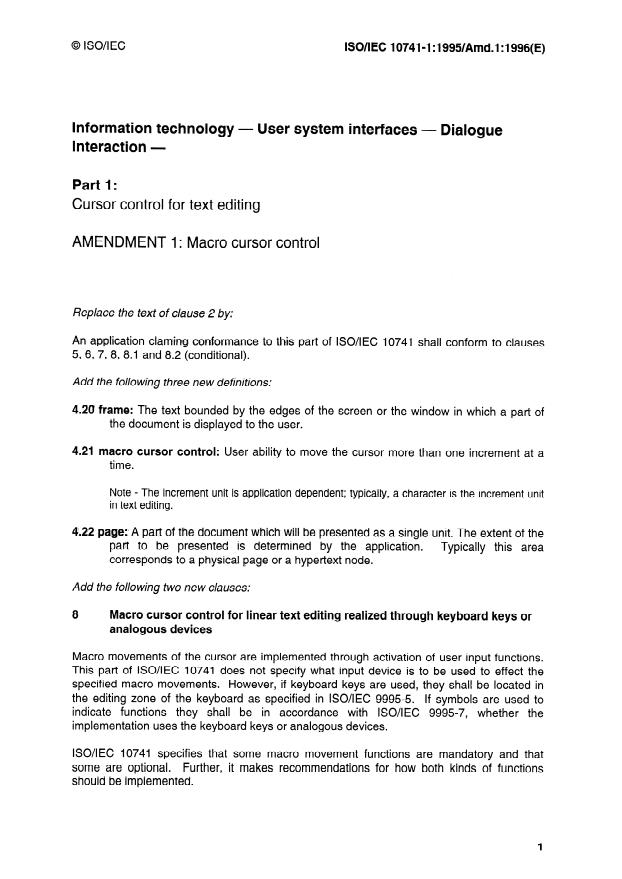
Replace the text of clause 2 by:
An appI:ication clami ’ng conformance to this part of ISO/IEC 10741 shall conform to clauses
5, 6, 7, 8, 8.1 and 8.2 (conditional).
Add the following three new definitions:
4.20 frame: The text bounded by the edges of the screen or the window in which a part of
the document is displayed to the user.
4.21 macro cursor control: User ability to move the cursor more than one increment at a
time.
Note - The increment unit is application dependent; typically, a character is the increment unit
in text editing.
4.22 page: A part of the docume+nt which will be presented as a single unit. The extent of the
part to be presented is determined by the application. Typically this area
corresponds to a physical page or a hypertext node.
Add the following two new clauses:
Macro cursor control for linear text editing realized through keyboard keys or
analogous devices
Macro movements of the cursor are implemented through activation of user input functions.
This part of ISO/IEC 10741 does not specify what input device is to be used to effect the
However, if keyboard keys are used, they shall be located in
specified macro movements.
the editing zone of the keyboard as specified in lSO/IEC 99955. If symbols are used to
indicate functions they shall be in accordance with ISO/IEC 99957, whether the
implementation uses the keyboard keys or analogous devices.
ISO/IEC 10741 specifies that some macro movement functions are mandatory and that
Further, it makes recommendations for how both kinds of functions
some are optional.
should be implemented.
0 ISO/IEC
lSO/IEC 10741-l :1995/Amd.l :1996(E)
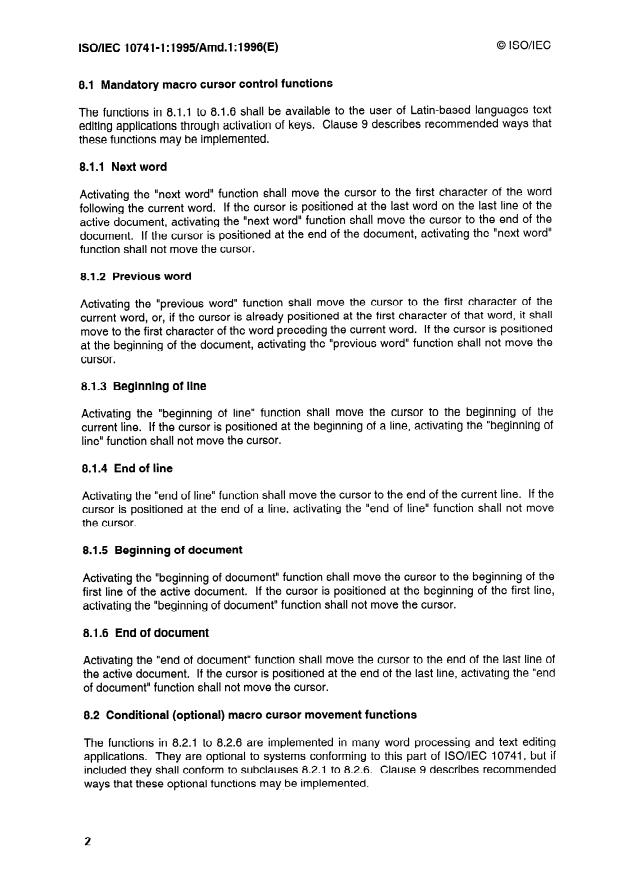
8.1 Mandatory macro cursor control functions
The functions in 8.1 .l to 8.1.6 shall be available to the user of Latin-based languages text
editing applications through activation of keys. Clause 9 describes recommended ways that
these functions may be implemented.
8.1.1 Next word
Activating the “next word” function shall move the cursor to the first character of the word
If the cursor is positioned at the last word on the last line of the
following the current word.
active document, activating the “next word” function shall move the cursor to the end of the
document. If the cursor is positioned at the end of the document, activating the “next word”
function shall not move the cursor.
8.1.2 Previous word
Activating the “previous word” function shall move the cursor to the first character of the
current word, or, if the cursor is already positioned at the first character of that word, it shall
move to the first character of the word preceding the current word. If the cursor is positioned
at the beginning of the document, activating the “previous word” function shall not move the
cursor.
8.1.3 Beginning of line
Activating the “beginning of line” function shall move the cursor to the beginning of the
current line. If the cursor is positioned at the beginning of a line, activating the “beginning of
line” function shall not move the cursor.
8.1.4 End of line
If the
Activating the “end of line” function shall move the cursor to the end of the current line.
cursor is positioned at the end of a line, activating the “end of line” function shall not move
the cursor.
8.1.5 Beginning of document
Activating the “beginning of document” function shall move the cursor to the beginning of the
first line of the active document. If the cursor is positioned at the beginning of the first line,
activating the “beginning of document” function shall not move the cursor.
8.1.6 End of document
Activating the “end of document” function shall move the cursor to the end of the last line of
the active document. If the cursor is positioned at the end of
...