


ISO/IEC TR 23091-4:2020
(Main)Information technology — Coding-independent code points — Part 4: Usage of video signal type code points
Information technology — Coding-independent code points — Part 4: Usage of video signal type code points
This document describes common industry representation practices for the usage of video signal type code points, as these properties are conveyed across video content production and distribution carriage systems.
Technologies de l'information — Titre manque — Partie 4: Titre manque
General Information
- Status
- Withdrawn
- Publication Date
- 25-May-2020
- Withdrawal Date
- 25-May-2020
- Current Stage
- 9599 - Withdrawal of International Standard
- Start Date
- 24-May-2021
- Completion Date
- 14-Feb-2026
Relations
- Effective Date
- 18-Apr-2021
- Effective Date
- 23-Apr-2020
Buy Documents

ISO/IEC TR 23091-4:2020 - Information technology — Coding-independent code points — Part 4: Usage of video signal type code points Released:5/26/2020

ISO/IEC TR 23091-4:2020 - Information technology — Coding-independent code points — Part 4: Usage of video signal type code points Released:5/26/2020
Get Certified
Connect with accredited certification bodies for this standard

BSI Group
BSI (British Standards Institution) is the business standards company that helps organizations make excellence a habit.

NYCE
Mexican standards and certification body.
Sponsored listings
Frequently Asked Questions
ISO/IEC TR 23091-4:2020 is a technical report published by the International Organization for Standardization (ISO). Its full title is "Information technology — Coding-independent code points — Part 4: Usage of video signal type code points". This standard covers: This document describes common industry representation practices for the usage of video signal type code points, as these properties are conveyed across video content production and distribution carriage systems.
This document describes common industry representation practices for the usage of video signal type code points, as these properties are conveyed across video content production and distribution carriage systems.
ISO/IEC TR 23091-4:2020 is classified under the following ICS (International Classification for Standards) categories: 35.040.40 - Coding of audio, video, multimedia and hypermedia information. The ICS classification helps identify the subject area and facilitates finding related standards.
ISO/IEC TR 23091-4:2020 has the following relationships with other standards: It is inter standard links to ISO/IEC TR 23091-4:2021, ISO/IEC TR 23091-4:2019. Understanding these relationships helps ensure you are using the most current and applicable version of the standard.
ISO/IEC TR 23091-4:2020 is available in PDF format for immediate download after purchase. The document can be added to your cart and obtained through the secure checkout process. Digital delivery ensures instant access to the complete standard document.
Standards Content (Sample)
TECHNICAL ISO/IEC TR
REPORT 23091-4
Second edition
2020-05
Information technology — Coding-
independent code points —
Part 4:
Usage of video signal type code points
Reference number
©
ISO/IEC 2020
© ISO/IEC 2020
All rights reserved. Unless otherwise specified, or required in the context of its implementation, no part of this publication may
be reproduced or utilized otherwise in any form or by any means, electronic or mechanical, including photocopying, or posting
on the internet or an intranet, without prior written permission. Permission can be requested from either ISO at the address
below or ISO’s member body in the country of the requester.
ISO copyright office
CP 401 • Ch. de Blandonnet 8
CH-1214 Vernier, Geneva
Phone: +41 22 749 01 11
Fax: +41 22 749 09 47
Email: copyright@iso.org
Website: www.iso.org
Published in Switzerland
ii © ISO/IEC 2020 – All rights reserved
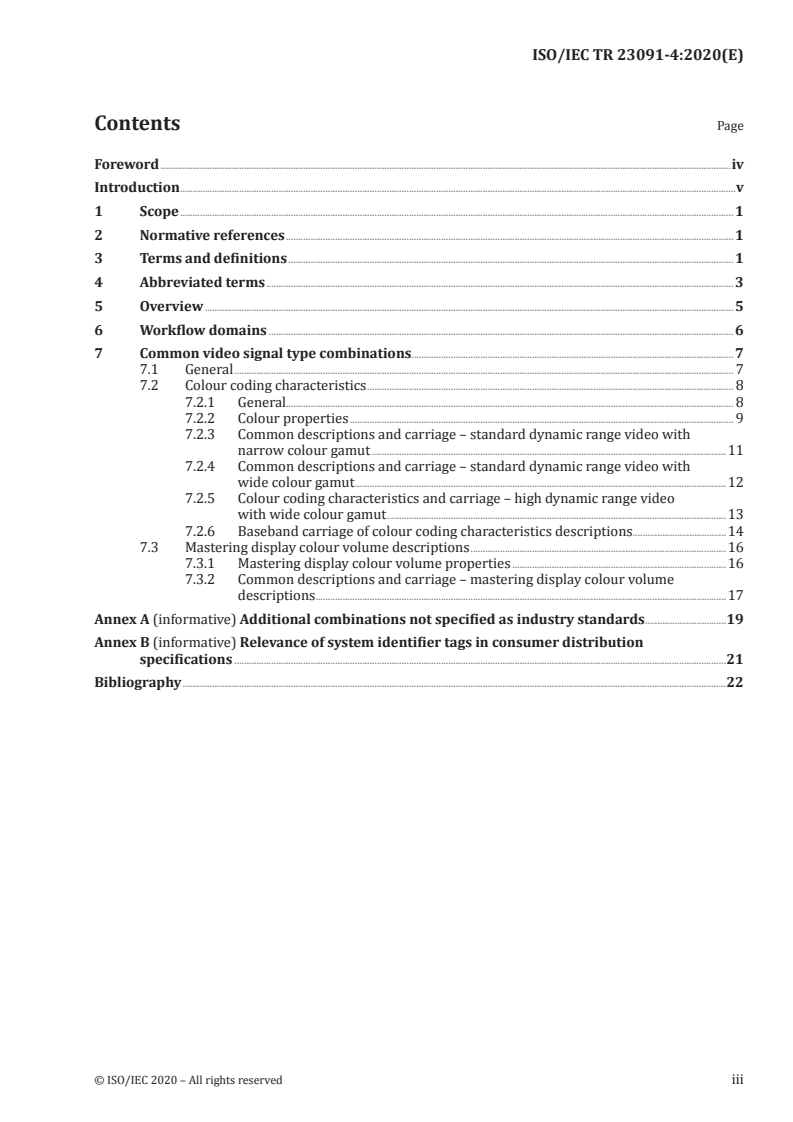
Contents Page
Foreword .iv
Introduction .v
1 Scope . 1
2 Normative references . 1
3 Terms and definitions . 1
4 Abbreviated terms . 3
5 Overview . 5
6 Workflow domains . 6
7 Common video signal type combinations. 7
7.1 General . 7
7.2 Colour coding characteristics . 8
7.2.1 General. 8
7.2.2 Colour properties . 9
7.2.3 Common descriptions and carriage – standard dynamic range video with
narrow colour gamut .11
7.2.4 Common descriptions and carriage – standard dynamic range video with
wide colour gamut .12
7.2.5 Colour coding characteristics and carriage – high dynamic range video
with wide colour gamut .13
7.2.6 Baseband carriage of colour coding characteristics descriptions .14
7.3 Mastering display colour volume descriptions .16
7.3.1 Mastering display colour volume properties .16
7.3.2 Common descriptions and carriage – mastering display colour volume
descriptions . .17
Annex A (informative) Additional combinations not specified as industry standards .19
Annex B (informative) Relevance of system identifier tags in consumer distribution
specifications .21
Bibliography .22
© ISO/IEC 2020 – All rights reserved iii
Foreword
ISO (the International Organization for Standardization) and IEC (the International Electrotechnical
Commission) form the specialized system for worldwide standardization. National bodies that
are members of ISO or IEC participate in the development of International Standards through
technical committees established by the respective organization to deal with particular fields of
technical activity. ISO and IEC technical committees collaborate in fields of mutual interest. Other
international organizations, governmental and non-governmental, in liaison with ISO and IEC, also
take part in the work.
The procedures used to develop this document and those intended for its further maintenance are
described in the ISO/IEC Directives, Part 1. In particular, the different approval criteria needed for
the different types of document should be noted. This document was drafted in accordance with the
editorial rules of the ISO/IEC Directives, Part 2 (see www .iso .org/ directives).
Attention is drawn to the possibility that some of the elements of this document may be the subject
of patent rights. ISO and IEC shall not be held responsible for identifying any or all such patent
rights. Details of any patent rights identified during the development of the document will be in the
Introduction and/or on the ISO list of patent declarations received (see www .iso .org/ patents) or the IEC
list of patent declarations received (see http:// patents .iec .ch).
Any trade name used in this document is information given for the convenience of users and does not
constitute an endorsement.
For an explanation of the voluntary nature of standards, the meaning of ISO specific terms and
expressions related to conformity assessment, as well as information about ISO's adherence to the
World Trade Organization (WTO) principles in the Technical Barriers to Trade (TBT), see www .iso .org/
iso/ foreword .html.
This document was prepared by ISO/IEC JTC 1, Information technology, Subcommittee SC 29, Coding
of audio, picture, multimedia and hypermedia information in collaboration with ITU-T. The technically
identical text is published as ITU-T Series H Supplement 19 (10/2019).
This second edition cancels and replaces the first edition (ISO/IEC TR 23091-4:2019), which has been
technically revised.
The main changes compared to the previous edition are as follows:
— Tables are added to describe the carriage of these combinations in baseband transmission formats.
— For high dynamic range and wide colour gamut usage, an additional combination describing usage
of the IC C colour representation of Rec. ITU-R BT.2100 and content mastering with a mastering
T P
display having 4000 cd/m peak brightness is described.
— Two new informative annexes are added. Annex A describes commonly used video property
combinations that are not specified in industry standards. Annex B indicates the relevance of the
system identifier tags in consumer distribution specifications.
— Additional general refinements are also included to improve readability and clarity and improve the
use of terminology.
A list of all parts in the ISO/IEC 23091 series can be found on the ISO website.
Any feedback or questions on this document should be directed to the user’s national standards body. A
complete listing of these bodies can be found at www .iso .org/ members .html.
iv © ISO/IEC 2020 – All rights reserved
Introduction
This document discusses video signal property description code points and their combinations that
are widely used in production and video content workflows. Video properties and values are usually
expressed in "metadata" that can exist across production and distribution workflows. Knowledge of
these properties and their combinations has value as content is processed in the end-to-end production-
to-distribution workflow chain.
The combinations of all possible expressible video properties as code point values could hypothetically
result in hundreds or thousands of permutations; but many of those combinations are rarely or
never used in practice. For example, it is highly unlikely that perceptual quantization (PQ) transfer
characteristics function specified in Rec. ITU-R BT.2100 would be combined with the colour primaries
specified in Rec. ITU-R BT.601. Only a small subset of the possible combinations is used in practice.
This document is written to provide information to help the producers of various content processing
tools to avoid processing mistakes that can cause video quality degradation due to having incorrect
assumptions made about video property combinations. There are only a few limited sets of video
property combinations that are widely used in present-day video production and distribution equipment
chains. This document describes these limited sets of combinations that are currently widely used
and describes how the associated signal type metadata is carried to aid in the automation of content
workflows across various domains of capture, production, and distribution. Lastly, this document aims
to help its readers, especially toolset developers, to repurpose tools to work properly across several
domains (e.g., capture, production, production distribution, and service distribution) where similar
video conversion functions (e.g., chroma subsampling or colour space conversions) may be performed.
© ISO/IEC 2020 – All rights reserved v
TECHNICAL REPORT ISO/IEC TR 23091-4:2020(E)
Information technology — Coding-independent code
points —
Part 4:
Usage of video signal type code points
1 Scope
This document describes common industry representation practices for the usage of video signal type
code points, as these properties are conveyed across video content production and distribution carriage
systems.
2 Normative references
The following documents are referred to in the text in such a way that some or all of their content
constitutes requirements of this document. For dated references, only the edition cited applies. For
undated references, the latest edition of the referenced document (including any amendments) applies.
Rec. ITU-T H.264 | ISO/IEC 14496-10, Information technology — Coding of audio-visual objects — Part 10:
Advanced video coding
Rec. ITU-T H.265 | ISO/IEC 23008-2, Information technology — High efficiency coding and media delivery
in heterogeneous environments — High efficiency video coding
Rec. ITU-T H.273 | ISO/IEC 23091-2, Information technology — Coding-independent code points —
Part 2: Video
3 Terms and definitions
For the purposes of this document, the terms and definitions in Rec. ITU-T H.265 | ISO/IEC 23008-2,
Rec. ITU-T H.264 | ISO/IEC 14496-10 and Rec. ITU-T H.273 | ISO/IEC 23091-2 and the following apply.
ISO ad IEC maintain terminological databases for use in standardization at the following addresses:
— ISO Online browsing platform: available at http:// www .iso .org/ obp
— IEC Electropedia: available at http:// www .electropedia .org
3.1
3G-SDI
serial digital interface with a transport capacity of 2.970 Gbit/s and 2.970/1.001 Gbit/s for transporting
uncompressed digital video signals
3.2
6G-SDI
serial digital interface with a transport capacity of 5.94 Gbit/s and 5.94/1.001 Gbit/s for transporting
uncompressed digital video signals
3.3
10G-SDI
serial digital interface with a transport capacity of 10.692 Gbit/s for transporting uncompressed digital
video signals
© ISO/IEC 2020 – All rights reserved 1
3.4
12G-SDI
serial digital interface with a transport capacity of 11.88 Gbit/s and 11.88/1.001 Gbit/s for transporting
uncompressed digital video signals
3.5
colour coding characteristics
combination of colour gamut, colour primaries, dynamic range, transfer function, colour representation,
video range, and chroma sample location
3.6
colour volume
space of all colours and intensities that a device or signal can reproduce or convey
3.7
creative intent
desired vision of the content creator (e.g., a director, cinematographer, videographer, editor or colourist)
who adjusts and approves the appearance of rendered content in the production process
3.8
dual-link SDI
two parallel serial digital interfaces for transporting uncompressed video signals
3.9
electro-optical transfer function
EOTF
function to map a non-linear video signal to display linear light
3.10
full range
range in a fixed-point (integer) representation that spans the full range of values that could be expressed
with that bit depth
3.11
HD-SDI
serial digital interface for transporting uncompressed digital HD video signals
3.12
inverse electro-optical transfer function
inverse EOTF
function that is the inverse of an EOTF (3.9)
3.13
inverse opto-electrical transfer function
inverse OETF
function that is the inverse of an OETF (3.15)
3.14
narrow range
range in a fixed-point (integer) representation that does not span the full range of values that could be
expressed with that bit depth
Note 1 to entry: Narrow range is, in some applications, referred to by synonyms such as: “limited range”, “video
range”, “legal range”, “SMPTE range” or “standard range”.
3.15
opto-electrical transfer function
OETF
function to map relative scene linear light to a non-linear video signal
2 © ISO/IEC 2020 – All rights reserved
3.16
opto-optical transfer function
OOTF
function to map relative scene linear light to display linear light
3.17
quad-link SDI
four parallel serial digital interfaces for transporting uncompressed video signals
3.18
random access point access unit
RAPAU
access unit in a video bitstream containing an intra-coded picture with the property that all pictures
following the intra-coded picture in output order can be correctly decoded without using any
information preceding it in the bitstream
3.19
SDI
serial digital interface for transporting uncompressed video signals
3.20
SD-SDI
signal digital interface for transporting uncompressed digital SD video signals
3.21
transfer function
function among any of the following: EOTF (3.9), inverse EOTF (3.12), OETF (3.15), inverse OETF (3.13),
OOTF (3.16), or inverse OOTF
3.22
U-SDI
multilink (up to 24 links) serial digital interface with a transport capacity of 10.692 Gbit/s per link for
transporting uncompressed digital video signals
4 Abbreviated terms
2K informally used to refer to an HD resolution (1920 × 1080 for television or 2048 × 1080
for film)
4K informally used to refer a UHD resolution (3840 × 2160 for television or 4096 × 2160 for film)
8K informally used to refer to a UHD resolution (7680 × 4320 or 8192 × 4320)
AVC advanced video coding (Rec. ITU-T H.264 | ISO/IEC 14496-10)
CICP coding-independent code points (Rec. ITU-T H.273 | ISO/IEC 23091-2)
EOTF electro-optical transfer function
GBR green, blue and red component colour system in linear light domain; same as RGB, although
emphasizing that the green component is handled as the primary colour component by
some technical elements of the video coding technology
NOTE The colour representation does not indicate the media component order in a coded
representation. For example, GBR represents the same component colour system as RGB.
© ISO/IEC 2020 – All rights reserved 3
G′B′R′ green, blue and red component colour system in a non-linear domain associated with a
transfer function which maps the linear light domain to a more perceptually uniform
domain; same as R′G′B′, although emphasizing that the green component is handled as the
primary colour component by some technical elements of the video coding technology
NOTE The colour representation does not indicate the media component order in a coded
representation. For example, G′B′R′ represents the same component colour system as R′G′B′.
HD high definition
HDR high dynamic range
HEVC high efficiency video coding (Rec. ITU-T H.265 | ISO/IEC 23008-2)
HLG hybrid log-gamma (as defined in Rec. ITU-R BT.2100)
HVS human visual system
IC C constant intensity signal format (as defined in Rec. ITU-R BT.2100)
T P
LCD liquid crystal display
LED light-emitting diode
LUT look-up table
MDCV mastering display colour volume
MXF material exchange format (as defined in SMPTE ST 377-1)
N/A not applicable
N/R not required
NCG narrow colour gamut (typically as per Rec. ITU-R BT.709)
NCL non-constant luminance
OETF opto-electrical transfer function
OOTF opto-optical transfer function
OLED organic light-emitting diode
PQ perceptual quantizer (as defined in Rec. ITU-R BT.2100)
QP quantization parameter
RAPAU random access point access unit
RGB red, green and blue component colour system in linear light domain
NOTE The colour representation does not indicate the media component order in a coded
representation. For example, RGB represents the same component colour system as GBR.
R′G′B′ red, green and blue component colour system in a non-linear domain associated with a trans-
fer function which maps the linear light domain to a more perceptually uniform domain
NOTE The colour representation does not indicate the media component order in a coded
representation. For example, R′G′B′ represents the same component colour system as G′B′R′.
SD standard definition
4 © ISO/IEC 2020 – All rights reserved
SDR standard dynamic range
SEI supplemental enhancement information
UHD ultra-high definition
UL universal label (as defined in SMPTE ST 377-1)
VUI video usability information (a sequence-level syntax structure in HEVC and AVC bit-
streams)
WCG wide colour gamut (a gamut substantially wider than the gamut conveyed by Rec. ITU-R
BT.709, e.g., as per Rec. ITU-R BT.2020 or Rec. ITU-R BT.2100)
XYZ CIE 1931 colour space (wherein Y corresponds to the luminance signal)
Y′CbCr luma (Y′), chroma blue (Cb) and chroma red (Cr) colour representation defined by a matrix
transformation relationship to an R′G′B′ colour system
NOTE A Y′CbCr representation is commonly used for video/image distribution as a way
of encoding RGB information. Such a representation is also commonly expressed as YCbCr,
Y′C C , or Y′C′ C′ , and can also be known as YUV in some documents. The relationship
B R B R
between Y′CbCr and R′G′B′ considered in this document is defined by matrix coefficients
specified in Rec. ITU-R BT.601, Rec. ITU-R BT.709, Rec. ITU-R BT.2020 or Rec. ITU-R
BT.2100. Unlike the CIE-Y component in the linear-light XYZ representation, the non-linear,
approximately perceptual uniform Y′ might not be representing true luminance, regardless
of the transfer function.
5 Overview
This document discusses video signal property description code points and their combinations that
are widely used in production and video content workflows. Video properties and values are usually
expressed in "metadata" that can exist across production and distribution workflows. Knowledge of
these properties and their combinations has value as content is processed in the end-to-end production-
to-distribution workflow chain.
The combinations of all possible expressible video properties as code point values could hypothetically
result in hundreds or thousands of permutations; but many of those combinations are rarely or never
used in practice. For example, it is highly unlikely that the perceptual quantization (PQ) transfer
characteristics function specified in Rec. ITU-R BT.2100 would be combined with the colour primaries
specified in Rec. ITU-R BT.601. Only a small subset of the possible combinations is used in practice.
This document is written to provide information to help the producers of various content processing
tools to avoid processing mistakes that can cause video quality degradation due to having incorrect
assumptions made about video property combinations. There are only a few limited sets of video
property combinations that are widely used in present-day video production and distribution equipment
chains. This document describes these limited sets of combinations that are currently widely used
and describes how the associated signal type metadata is carried to aid in the automation of content
workflows across various domains of capture, production, and distribution. Lastly, this document aims
to help its readers, especially toolset developers, to repurpose tools to work properly across several
domains (e.g., capture, production, production distribution, and service distribution) where similar
video conversion functions (e.g., chroma subsampling or colour space conversions) may be performed.
The coding-independent code points (CICP) specification for video (Rec. ITU-T H.273 | ISO/IEC 23091-2)
defines code points and fields that identify properties of video signals. These code points are defined
independently from how these properties are carried in a coded video-layer bitstream such as an HEVC
or AVC bitstream, which could differ depending on bitstream format. The compressed representation
is sometimes considered to be a temporary, compacted state for distribution or delivery of the video
© ISO/IEC 2020 – All rights reserved 5
signal, while the reconstructed video signal output from a video decoder may be interpreted as having
the same meaning as a video signal immediately prior to compression in the encoder.
Subclauses 7.2 and 7.3 define system identifier tags for combinations of the described commonly used
values of such video signal property combinations that apply across signal domains. In addition, these
subclauses also identify how the video property values are carried in the signal processing workflow.
Subclause 7.3 defines system identifier tags for commonly used values for mastering display colour
volume descriptions. Annex A defines system identifier tags used for additional combinations that
are not specified as industry standards. Annex B defines system identifier tags that are used in some
existing consumer distribution formats.
6 Workflow domains
Figure 1 illustrates workflow domains (capture, production, production distribution, and service
distribution) in which video content may exist, be edited, or be converted. Typical content workflows
across these domains are either theatrical/scripted (episodic) TV or live events. There are many similar
video processing functions that can be performed in each domain and often these functions may be
repeated in the next successive domain.
Figure 1 — Video workflows through different carriage domains
In the capture domain, content is created through sensors on cameras converting optical signals into a
digital format. Content is retained at its highest informational format, although some conversions may
be performed to reduce transport bandwidth demands.
In the interface to the production domain, content undergoes further processing transformations such
as non-linear transformations, chroma subsampling (e.g., 4:4:4 to 4:2:2), colour representation changes
(e.g., RGB to Y′CbCr NCL) and bit depth reduction (e.g., 16 bits per sample to 10 bits per sample). For
theatrical/scripted TV workflows entering in the production domain, content can be augmented with
computer-generated imagery sources, overlaid with graphics, and colour graded using a mastering
display. For live event workflows, there is always a real-time constraint, which limits content
6 © ISO/IEC 2020 – All rights reserved
processing to real-time operations. After the colour grading, both static and dynamic metadata may
be generated that are to be attached to the content workflow. However, for live events, the generation
of highly customized metadata may not be practical and metadata may need to be generated further
downstream by automated content analysis approaches.
In the production distribution domain, some additional processing is done to the content to further
reduce transport bandwidth demands. This may include some sample-wise processing transformations
(chroma subsampling and bit depth) and compression (e.g., using HEVC or AVC) but mostly employing
spatial compression techniques.
For 4:2:0 chroma subsampling operations, it is important to make known the relative location alignment
of the initial subsampling location processing of the content to avoid unnecessary quality degradation
upon further content processing. For the purposes of this document, this property is described in
terms of the ChromaLocType variable as defined in HEVC, which further corresponds with the value
of the syntax elements chroma_sample_loc_type_top_field and chroma_sample_loc_type_bottom_field
in HEVC and AVC. For NCG material, the usual alignment corresponds to ChromaLocType equal to 0
(vertically interstitial). For wide colour gamut (WCG) material, the usual alignment corresponds to
ChromaLocType equal to 2 (co-sited).
At the service distribution domain, the content version in the workflow is in final form, though the
presentation of it may have some additional overlay graphics. Content processing at this interface
continues to reduce signal information to address transport bandwidth distribution demands while
still maximizing perceptual optimizations to retain content video quality. Operations reduce the
content to a compressed representation of 4:2:0 Y′CbCr 8 or 10 bit video using HEVC or AVC for the
compression representation. Alternatively, MPEG-2 (Rec. ITU-T H.262 | ISO/IEC 13818-2) can be used as
a compressed representation for 4:2:0 Y′CbCr 8 bit video content. This content workflow then finishes
with the content being distributed to the customer through broadcast, multicast, or unicast approaches
and then being presented for viewing.
Many of the content processing operations may employ multiple third-party content processing
tools. Currently most of such tools are designed and operate within a specific domain with general
assumptions of how content was handled in the preceding domain. Tools may also have further
constraints depending on the content resolutions (e.g., HD or UHD). Some applications restrict the
utilized colour volume to be smaller than what can be expressed in a Rec. ITU-R BT.2020 or Rec. ITU-R
BT.2100 container, such as the smaller P3D65 colour gamut (as specified in SMPTE ST 2113) and
intensity range of common mastering or reference displays used in content production and delivery
presentations. The approved colour volume, which may be smaller than the container volume, is often
indicated with SMPTE ST 2086 metadata. Over time, it is expected that WCG and/or high dynamic range
(HDR) applications will evolve to use more of the available container colour volume.
7 Common video signal type combinations
7.1 General
This clause enumerates common combinations of video properties and values that are currently
used within the content industry. Common methods of conveying video property information are
also described for the capture, production, production distribution, and service distribution carriage
domains.
System identifier tags are provided in this document to succinctly identify each commonly used
combination. Such system identifier tags may be used as out of band metadata for conversion tools,
and by production/distribution teams, to identify the workflow path needed to process and distribute
content.
Content conversion tools need the locations and values of stream properties and metadata values
associated with the corresponding system identifier. In some cases, the information to identify and
locate video properties of the stream information are described in a specific coded video stream
specification.
© ISO/IEC 2020 – All rights reserved 7
For example, SMPTE MXF structured streams indicate parameters and values through universal label
(UL) structures located in MXF headers. An MXF UL structure is a 16-byte structure comprised of a UL
header [4 bytes-"0"] (per SMPTE ST 298), a UL designator [4 bytes-"0"] (per SMPTE ST 336), and an
item designator [8 bytes-"000"] (per SMPTE ST 335, SMPTE ST 395, and SMPTE ST 2003). SMPTE MXF
sub-tables provide these 16-byte labels in addition to any values associated with the label.
As another example, HEVC or AVC bitstreams indicate parameters and values through video usability
information (VUI) and supplemental enhancement information (SEI) constructs at the sequence
parameter set level.
7.2 Colour coding characteristics
7.2.1 General
Colour coding characteristics can describe combinations of video properties that are needed to
convert between colour volumes. Such conversions may include changes in bit depth, changes in colour
subsampling, non-linear optimizations and may also include transformations based on carriage and
bit rate restrictions. SD, HD, and UHD material are typically associated with certain colour coding
characteristics properties as indicated in Table 1, but this information can be carried in different places
or may be inferred depending on the storage or streaming format.
Table 1 — SD, HD, and UHD video colour coding characteristics properties
Colour Light Container space properties
Gamut Prima- Dynamic Transfer Colour Integer 4:2:0 chroma sample loca-
Tag
ries range function repre- code level tion alignment
sent scaling (ChromaLocType)
ation
Vertically interstitial
BT601_525 Y′CbCr Narrow
(ChromaLocType = 0)
BT.601
Vertically interstitial
BT601_625 Y′CbCr Narrow
HD
(ChromaLocType = 0)
or NCG
Vertically interstitial
SD BT709_YCC Y′CbCr Narrow
(ChromaLocType = 0)
BT.709
SDR BT.709
BT709_RGB R′G′B′ Narrow N/A
FR709_RGB R′G′B′ Full N/A
Co-sited
BT2020_YCC_NCL Y′CbCr Narrow
(ChromaLocType = 2)
BT.2020
BT2020_RGB R′G′B′ Narrow N/A
FR2020_RGB R′G′B′ Full N/A
Co-sited
BT2100_PQ_YCC Y′CbCr Narrow
(ChromaLocType = 2)
UHD WCG
BT2100_PQ_ PQ Co-sited
IC C Narrow
T P
ICTCP (ChromaLocType = 2)
BT2100_PQ_RGB BT.2100 HDR R′G′B′ Narrow N/A
Co-sited
BT2100_HLG_YCC Y′CbCr Narrow
(ChromaLocType = 2)
HLG
BT2100_HLG_
R′G′B′ Narrow N/A
RGB
In this document, as in various industry groups such as UltraHD Forum, EBU, and DVB, UHD applications
are considered as those having at least one major property greater than HD (Rec. ITU-R BT.709), such
as colour gamut, resolution, dynamic range, or frame rate (e.g., 1080p60 HDR WCG is considered UHD
herein).
Carriage formats for colour properties in each domain (capture, production, production distribution,
and service distribution) contain the same payload but in different wrappers. In the capture and
production domains, the colour coding characteristics information can be carried in an MXF wrapper
8 © ISO/IEC 2020 – All rights reserved
using a generic picture essence descriptor as specified by SMPTE ST 2067-21: 2016, Annex C. Colour
coding characteristics information in the distribution domain can be carried within the video stream
as syntax information in the selected video format such as HEVC, AVC, or MPEG-2 through VUI or
equivalent syntax. The full and narrow range scaling video property is not carried explicitly in all
technologies and may need to be taken implicitly or through a system identifier. In common practice,
Y′CbCr colour representation uses narrow range scaled levels.
In Table 2, the type of baseband carriage of video signals over serial digital interfaces are listed, dependent
on data rate limitations of the interface which are specified by the resolution of the video signal.
Table 2 — Source format data (resolution) carriage over broadband SDI connections
a
Standard Source format data (resolution)
SD HD UHD
720 × 720 × 1280 × 1920 × 2048 × 3840 × 4096 × 7680 ×
480 576 720 1080 1080 2160 2160 4320
ST 259M (SD-SDI) √ √
BT.656M (SD-SDI) √ √
ST 292-1 (HD-SDI) √ √ √
BT.1120-9 (HD-SDI) √
ST 372-1 (Dual link HD-SDI) √ √
ST 425-1 (3G-SDI) √ √
BT.1120-9 (Dual link HD-SDI/3G-SDI) √
ST 425-5 (Quad link 3G-SDI) √ √
ST 2081-10 (6G-SDI) √ √ √ √
ST 2082-10 (12G-SDI) √ √
ST 2082-12 (Quad link 12G-SDI) √ √ √
ST 2036-3 (Single/multi-link 10G-SDI) √ √
BT.2077-2 (U-SDI) √ √
a
Cells with check marks (√) indicate “used combinations”. Cells without check marks indicate “not used combinations”.
7.2.2 Colour properties
For colour coding characteristics, the video properties described in Table 2 ordinarily apply. Remarks
on common usage are included in Table 3.
Table 3 — Video colour description properties and their common usage
Carriage parameter names Colloquial names Common usage
SDR video uses a Rec. ITU-R BT.709 colour
representation. WCG video may restrict colour
ColourPrimaries [CICP]
to the P3D65 gamut (SMPTE ST 2113) but in
Colour space,
colour_primaries [HEVC or AVC] a Rec. ITU-R BT.2020 colour space container.
colour gamut
HDR over time is expected to exhibit a more
colour primaries [MXF]
complete coverage of the Rec. ITU-R BT.2020
colour representation.
HDR video uses either PQ or HLG. SDR video
TransferCharacteristics [CICP]
Transfer curves, typically uses the transfer characteristics
transfer_characteristics [HEVC or AVC] log curves, for Rec. ITU-R BT.709, assuming the display
gamma curves characteristics corresponding to Rec. ITU-R
transfer characteristic [MXF]
BT.1886.
© ISO/IEC 2020 – All rights reserved 9
Table 3 (continued)
Carriage parameter names Colloquial names Common usage
Specifies the encoding equations to convert
RGB image components to the corresponding
MatrixCoefficients [CICP]
Colour representa- representation format. For R′G′B′ representa-
matrix_coeffs [HEVC]
tion, GBR, NCL, YCC, tions, no matrix applies, which is typically
IC C , YUV, Y′UV, indicated by the value 0. (The colour rep-
matrix_coefficients [AVC] T P
R′G′B′ resentation notation does not indicate the
coding equations [MXF]
media component order in a coded rep-
resentation.)
Full range,
VideoFullRangeFlag [CICP]
narrow range,
headroom, footroom, Y′CbCr colour representations ordinarily use
video_full_range_flag [HEVC or AVC]
legal range, narrow range scaling for video.
N/A [MXF] SMPTE range, QE.1,
QE.2
Indicates the horizontal and vertical positions
of chroma samples (Cb, Cr, C , C ) with respect
T P
to luma samples with subsample position accu-
ChromaLocType [HEVC] racy. The alignment is typically horizontally
co-sited with even-numbered columns of luma
chroma_sample_loc_type_top_field and
4:2:0 subsampled samples (indexed starting from 0). For SD and
chroma_sample_loc_type_bottom_field
chroma location type HD video, the alignment is typically vertically
[AVC or HEVC]
interstitial between rows of luma samples
N/A [CICP or MXF] (ChromaLocType = 0). For UHD video, the
alignment is typically vertically co-sited with
even-numbered rows of luma samples (Chrom-
aLocType = 0).
Table 4 indicates the code values for each property that are widely used for video content production
and distribution systems.
Table 4 — Code point values widely used for colour coding characteristics properties
HEVC property Code point Meaning
value
1 Rec. ITU-R BT.709 primaries
5 Rec. ITU-R BT.601 625-line systems primaries
6 Rec. ITU-R BT.601 525-line systems primaries
colour_primaries
Rec. ITU-R BT.2020 and Rec. ITU-R BT.2100 primaries
(share the same code point since their values are identical)
12 SMPTE ST 2113 and SMPTE EG 432-1 (P3D65)
Rec. ITU-R BT.709, Rec. ITU-R BT.601, Rec. ITU-R BT.2020, and
Rec. ITU-R BT.2100 transfer characteristics
1, 6, 14, 15
(functionally equivalent values)
transfer_characteristics
16 Rec. ITU-R BT.2100 PQ
18 Rec. ITU-R BT.2100 HLG
0 R′G′B′ (identity matrix applied to primaries after transfer function)
1 Y′CbCr for Rec. ITU-R BT.709 primaries
5 Y′CbCr for Rec. ITU-R BT.601 625-line primaries
matrix_coeffs
6 Y′CbCr for Rec. ITU-R BT.601 525-line primaries
9 Y′CbCr for Rec. ITU-R BT.2020 and Rec. ITU-R BT.2100 primaries
14 IC C for Rec. ITU-R BT.2100
T P
10 © ISO/IEC 2020 – All rights reserved
Table 4 (continued)
HEVC property Code point Meaning
value
0 Vertically interstitial, horizontally co-sited
ChromaLocType 1 Vertically interstitial, horizontally interstitial
2 Vertically co-sited, horizontally co-sited
7.2.3 Common descriptions and carriage – standard dynamic range video with narrow
colour gamut
This colour volume describes standard dynamic range (SDR) video with narrow colour gamut (NCG),
which includes the majority of the production and distribution workflows currently used in the
industry. There are several combinations of values of video properties that are used for this colour
volume. Table 5 describes these combinations. There are several one-way operations that can be
performed for this colour volume including bit depth reductions, colour sampling reductions, and full-
to-narrow range scaling operations.
The following system identifier tags are described herein, as defined in Table 5:
— BT709_YCC;
— BT709_RGB;
— BT601_525;
— BT601_625.
Table 5 — SDR NCG colour coding characteristics descriptions
System identifier BT709_YCC BT709_RGB BT601_525 BT601_625
Colour primaries BT.709 BT.709 BT.601 BT.601
Colour Transfer
BT.709 BT.709 BT.709 BT.709
properties characteristics
Colour representation Y′CbCr R′G′B′ Y′CbCr Y′CbCr
Full/narrow range Narrow Narrow Narrow Narrow
Other
4:2:0 chroma sample
Interstitial N/A Interstitial Interstitial
location alignment
ColourPrimaries 1 1 6 5
CICP
TransferCharacteristics 1 1 6 6
parameters
Rec. ITU-T H.273 |
MatrixCoefficients 1 0 6 5
ISO/IEC 23091-2
VideoFullRangeFlag 0 0 0 0
u r n: s mp t e : u l : 0 6 u r n: s mp t e : u l : 0 6
u r n: s mp t e : u l : 0 6 . 0 E . 2B . 3 4 . 0 4 . 01 . 01 .0 E . 2B . 3 4 .0 4 .01 .0 E . 2B . 3 4 .0 4 .01
Colour primaries
.0 6 .0 4 .01 .01 .01 .03 .03 .0 0 .0 0 .01 .0 6 .0 4 .01 .01 .01 .0 6 .0 4 .01 .01
.01 .03 .01 .0 0 .0 0 .01 .03 .02 .0 0 .0 0
Transfer characteristic u r n : s mp t e : u l : 0 6 .0 E . 2B . 3 4 .0 4 .01 .01 .01 .0 4 .01 .01 .01 .01 .02 .0 0 .0 0
SMPTE MXF u r n: s mp t e : u l : 0 6
parameters .0 E . 2B . 3 4 .0 4 .01 .01 u r n: s mp t e : u l : 0 6 . 0 E . 2B . 3 4 . 0 4 . 01 . 01
Coding equations N/R
SMPTE ST 2067-21 .01 .0 4 .01 .01 .01 .02 .01 .0 4 .01 .01 .01 .02 .01 .0 0 .0 0
.02 .0 0 .0 0
Inferred (indicated in black reference level, white reference level,
Full/narrow level range
colour range)
4:2:0 chroma sample Inferred (Chrom- Inferred (Chro- Inferred (Chro-
N/A
location alignment aLoc Type = 0) maLoc Type = 0) maLoc Type = 0)
© ISO/IEC 2020 – All rights reserved 11
Particular aspects of the usage described in Table 5 are clarified as follows:
— Rec. ITU-R BT.601 colour volumes are used for SD material only.
— The transfer characteristics indicator values of 1, 6, 14, and 15 are functionally the same. Blu-ray
BD-ROM 3.1 ("4K") and the DVB UHD specifications list use of the transfer characteristics value
of 14 for SDR WCG (Rec. ITU-R BT.2020) video. ATSC specifications list the use of the transfer
characteristics value of 1 for SDR NCG (Rec. ITU-R BT.709) video.
— Matrix coefficients indicator values of 5 and 6 are functionally the same.
— The indicated chroma sample location alignment is only applicable for 4:2:0 chroma sampling.
ChromaLocType (the generic label used in this document for the HEVC and AVC bitstream syntax
elements: chroma_sample_loc_type_top_field and chroma_sample_loc_type_bottom_field), listed in
Tables 1 and 3, indicates the 4:2:0 chroma sample position alignment. The ITU-R program signal
exchange series Recommendations (Rec. ITU-R BT.601, Rec. ITU-R BT.709, Rec. ITU-R BT.2020, Rec.
ITU-R BT.2100) specify 4:2:2 and 4:4:4 chroma samples to be co-sited with luma.
7.2.4 Common descriptions and carriage – standard dynamic range video with wide colour
gamut
This colour coding characteristics information describes SDR video with WCG, which is typically
identified by the combination of the colour primary video property with the identified matrix
coefficients. In some cases, the same colour property may be described with two different values
depending on the colour primary container used. It is important for tools to process video according to
the colour volume it is operating in, to ensure that the conversion is consistent.
The following system identifier tags are described, as defined in Table 6:
— BT2020_YCC_NCL;
— BT2020_RGB.
Table 6 — SDR WCG common colour coding characteristics descriptions
a
System identifier BT2020_YCC_NCL BT2020_RGB
Colour primaries BT.2020 BT.2020
Colour properties Transfer characteristics BT.2020 BT.2020
Colour representation Y′CbCr R′G′B′
Full/narrow range Narrow Narrow
Other
4:2:0 chroma sample location
Co-sited N/A
alignment
ColourPrimaries 9 9
CICP parameters
TransferCharacteristics 14 14
Rec. ITU-T H.273 |
MatrixCoefficients 9 0
ISO/IEC 23091-2
VideoFullRangeFlag 0 0
a
Most Y′CbCr colour formats are of the type known as NCL, so this is not mentioned in the tag names for most formats. However, Rec.
ITU-R BT.2020 has both an NCL format and an alternative Y′CbCr format, so NCL is mentioned explicitly in this tag name to distinguish
between the two.
12 © ISO/IEC 2020 – All rights reserved
Table 6 (continued)
a
System identifier BT2020_YCC_NCL BT2020_RGB
u r n : s mp t e : u l : 0 6 .0 E . 2B . 3 4 .0 4 .01 .01 .0D .0 4 .01
Colour primaries
.01 .01 .03 .0 4 .0 0 .0 0
u r n : s mp t e : u l : 0 6 .0 E . 2B . 3 4 .0 4 .01 .01 .0 E .0 4 .01
Transfer characteristic
.01 .01 .01 .09 .0 0 .0 0
u r n: s mp t e : u l : 0 6 . 0 E . 2B
SMPTE MXF parameters
Coding equations . 3 4 .0 4 .01 .01 .0D .0 4 .01 N/R
SMPTE ST 2067-21
.01 .01 .02 .0 6 .0 0 .0 0
Inferred (indicated in black reference level,
Full/narrow level range
white reference level, colour range)
4:2:0 chroma sample location Inferred (ChromaLoc-
N/A
alignment Type = 2)
a
Most Y′CbCr colour formats are of the type known as NCL, so this is not mentioned in the tag names for most formats. However, Rec.
ITU-R BT.2020 has both an NCL format and an alternative Y′CbCr format, so NCL is mentioned explicitly in this tag name to distingu
...
TECHNICAL ISO/IEC TR
REPORT 23091-4
Second edition
2020-05
Information technology — Coding-
independent code points —
Part 4:
Usage of video signal type code points
Reference number
©
ISO/IEC 2020
© ISO/IEC 2020
All rights reserved. Unless otherwise specified, or required in the context of its implementation, no part of this publication may
be reproduced or utilized otherwise in any form or by any means, electronic or mechanical, including photocopying, or posting
on the internet or an intranet, without prior written permission. Permission can be requested from either ISO at the address
below or ISO’s member body in the country of the requester.
ISO copyright office
CP 401 • Ch. de Blandonnet 8
CH-1214 Vernier, Geneva
Phone: +41 22 749 01 11
Fax: +41 22 749 09 47
Email: copyright@iso.org
Website: www.iso.org
Published in Switzerland
ii © ISO/IEC 2020 – All rights reserved
Contents Page
Foreword .iv
Introduction .v
1 Scope . 1
2 Normative references . 1
3 Terms and definitions . 1
4 Abbreviated terms . 3
5 Overview . 5
6 Workflow domains . 6
7 Common video signal type combinations. 7
7.1 General . 7
7.2 Colour coding characteristics . 8
7.2.1 General. 8
7.2.2 Colour properties . 9
7.2.3 Common descriptions and carriage – standard dynamic range video with
narrow colour gamut .11
7.2.4 Common descriptions and carriage – standard dynamic range video with
wide colour gamut .12
7.2.5 Colour coding characteristics and carriage – high dynamic range video
with wide colour gamut .13
7.2.6 Baseband carriage of colour coding characteristics descriptions .14
7.3 Mastering display colour volume descriptions .16
7.3.1 Mastering display colour volume properties .16
7.3.2 Common descriptions and carriage – mastering display colour volume
descriptions . .17
Annex A (informative) Additional combinations not specified as industry standards .19
Annex B (informative) Relevance of system identifier tags in consumer distribution
specifications .21
Bibliography .22
© ISO/IEC 2020 – All rights reserved iii
Foreword
ISO (the International Organization for Standardization) and IEC (the International Electrotechnical
Commission) form the specialized system for worldwide standardization. National bodies that
are members of ISO or IEC participate in the development of International Standards through
technical committees established by the respective organization to deal with particular fields of
technical activity. ISO and IEC technical committees collaborate in fields of mutual interest. Other
international organizations, governmental and non-governmental, in liaison with ISO and IEC, also
take part in the work.
The procedures used to develop this document and those intended for its further maintenance are
described in the ISO/IEC Directives, Part 1. In particular, the different approval criteria needed for
the different types of document should be noted. This document was drafted in accordance with the
editorial rules of the ISO/IEC Directives, Part 2 (see www .iso .org/ directives).
Attention is drawn to the possibility that some of the elements of this document may be the subject
of patent rights. ISO and IEC shall not be held responsible for identifying any or all such patent
rights. Details of any patent rights identified during the development of the document will be in the
Introduction and/or on the ISO list of patent declarations received (see www .iso .org/ patents) or the IEC
list of patent declarations received (see http:// patents .iec .ch).
Any trade name used in this document is information given for the convenience of users and does not
constitute an endorsement.
For an explanation of the voluntary nature of standards, the meaning of ISO specific terms and
expressions related to conformity assessment, as well as information about ISO's adherence to the
World Trade Organization (WTO) principles in the Technical Barriers to Trade (TBT), see www .iso .org/
iso/ foreword .html.
This document was prepared by ISO/IEC JTC 1, Information technology, Subcommittee SC 29, Coding
of audio, picture, multimedia and hypermedia information in collaboration with ITU-T. The technically
identical text is published as ITU-T Series H Supplement 19 (10/2019).
This second edition cancels and replaces the first edition (ISO/IEC TR 23091-4:2019), which has been
technically revised.
The main changes compared to the previous edition are as follows:
— Tables are added to describe the carriage of these combinations in baseband transmission formats.
— For high dynamic range and wide colour gamut usage, an additional combination describing usage
of the IC C colour representation of Rec. ITU-R BT.2100 and content mastering with a mastering
T P
display having 4000 cd/m peak brightness is described.
— Two new informative annexes are added. Annex A describes commonly used video property
combinations that are not specified in industry standards. Annex B indicates the relevance of the
system identifier tags in consumer distribution specifications.
— Additional general refinements are also included to improve readability and clarity and improve the
use of terminology.
A list of all parts in the ISO/IEC 23091 series can be found on the ISO website.
Any feedback or questions on this document should be directed to the user’s national standards body. A
complete listing of these bodies can be found at www .iso .org/ members .html.
iv © ISO/IEC 2020 – All rights reserved
Introduction
This document discusses video signal property description code points and their combinations that
are widely used in production and video content workflows. Video properties and values are usually
expressed in "metadata" that can exist across production and distribution workflows. Knowledge of
these properties and their combinations has value as content is processed in the end-to-end production-
to-distribution workflow chain.
The combinations of all possible expressible video properties as code point values could hypothetically
result in hundreds or thousands of permutations; but many of those combinations are rarely or
never used in practice. For example, it is highly unlikely that perceptual quantization (PQ) transfer
characteristics function specified in Rec. ITU-R BT.2100 would be combined with the colour primaries
specified in Rec. ITU-R BT.601. Only a small subset of the possible combinations is used in practice.
This document is written to provide information to help the producers of various content processing
tools to avoid processing mistakes that can cause video quality degradation due to having incorrect
assumptions made about video property combinations. There are only a few limited sets of video
property combinations that are widely used in present-day video production and distribution equipment
chains. This document describes these limited sets of combinations that are currently widely used
and describes how the associated signal type metadata is carried to aid in the automation of content
workflows across various domains of capture, production, and distribution. Lastly, this document aims
to help its readers, especially toolset developers, to repurpose tools to work properly across several
domains (e.g., capture, production, production distribution, and service distribution) where similar
video conversion functions (e.g., chroma subsampling or colour space conversions) may be performed.
© ISO/IEC 2020 – All rights reserved v
TECHNICAL REPORT ISO/IEC TR 23091-4:2020(E)
Information technology — Coding-independent code
points —
Part 4:
Usage of video signal type code points
1 Scope
This document describes common industry representation practices for the usage of video signal type
code points, as these properties are conveyed across video content production and distribution carriage
systems.
2 Normative references
The following documents are referred to in the text in such a way that some or all of their content
constitutes requirements of this document. For dated references, only the edition cited applies. For
undated references, the latest edition of the referenced document (including any amendments) applies.
Rec. ITU-T H.264 | ISO/IEC 14496-10, Information technology — Coding of audio-visual objects — Part 10:
Advanced video coding
Rec. ITU-T H.265 | ISO/IEC 23008-2, Information technology — High efficiency coding and media delivery
in heterogeneous environments — High efficiency video coding
Rec. ITU-T H.273 | ISO/IEC 23091-2, Information technology — Coding-independent code points —
Part 2: Video
3 Terms and definitions
For the purposes of this document, the terms and definitions in Rec. ITU-T H.265 | ISO/IEC 23008-2,
Rec. ITU-T H.264 | ISO/IEC 14496-10 and Rec. ITU-T H.273 | ISO/IEC 23091-2 and the following apply.
ISO ad IEC maintain terminological databases for use in standardization at the following addresses:
— ISO Online browsing platform: available at http:// www .iso .org/ obp
— IEC Electropedia: available at http:// www .electropedia .org
3.1
3G-SDI
serial digital interface with a transport capacity of 2.970 Gbit/s and 2.970/1.001 Gbit/s for transporting
uncompressed digital video signals
3.2
6G-SDI
serial digital interface with a transport capacity of 5.94 Gbit/s and 5.94/1.001 Gbit/s for transporting
uncompressed digital video signals
3.3
10G-SDI
serial digital interface with a transport capacity of 10.692 Gbit/s for transporting uncompressed digital
video signals
© ISO/IEC 2020 – All rights reserved 1
3.4
12G-SDI
serial digital interface with a transport capacity of 11.88 Gbit/s and 11.88/1.001 Gbit/s for transporting
uncompressed digital video signals
3.5
colour coding characteristics
combination of colour gamut, colour primaries, dynamic range, transfer function, colour representation,
video range, and chroma sample location
3.6
colour volume
space of all colours and intensities that a device or signal can reproduce or convey
3.7
creative intent
desired vision of the content creator (e.g., a director, cinematographer, videographer, editor or colourist)
who adjusts and approves the appearance of rendered content in the production process
3.8
dual-link SDI
two parallel serial digital interfaces for transporting uncompressed video signals
3.9
electro-optical transfer function
EOTF
function to map a non-linear video signal to display linear light
3.10
full range
range in a fixed-point (integer) representation that spans the full range of values that could be expressed
with that bit depth
3.11
HD-SDI
serial digital interface for transporting uncompressed digital HD video signals
3.12
inverse electro-optical transfer function
inverse EOTF
function that is the inverse of an EOTF (3.9)
3.13
inverse opto-electrical transfer function
inverse OETF
function that is the inverse of an OETF (3.15)
3.14
narrow range
range in a fixed-point (integer) representation that does not span the full range of values that could be
expressed with that bit depth
Note 1 to entry: Narrow range is, in some applications, referred to by synonyms such as: “limited range”, “video
range”, “legal range”, “SMPTE range” or “standard range”.
3.15
opto-electrical transfer function
OETF
function to map relative scene linear light to a non-linear video signal
2 © ISO/IEC 2020 – All rights reserved
3.16
opto-optical transfer function
OOTF
function to map relative scene linear light to display linear light
3.17
quad-link SDI
four parallel serial digital interfaces for transporting uncompressed video signals
3.18
random access point access unit
RAPAU
access unit in a video bitstream containing an intra-coded picture with the property that all pictures
following the intra-coded picture in output order can be correctly decoded without using any
information preceding it in the bitstream
3.19
SDI
serial digital interface for transporting uncompressed video signals
3.20
SD-SDI
signal digital interface for transporting uncompressed digital SD video signals
3.21
transfer function
function among any of the following: EOTF (3.9), inverse EOTF (3.12), OETF (3.15), inverse OETF (3.13),
OOTF (3.16), or inverse OOTF
3.22
U-SDI
multilink (up to 24 links) serial digital interface with a transport capacity of 10.692 Gbit/s per link for
transporting uncompressed digital video signals
4 Abbreviated terms
2K informally used to refer to an HD resolution (1920 × 1080 for television or 2048 × 1080
for film)
4K informally used to refer a UHD resolution (3840 × 2160 for television or 4096 × 2160 for film)
8K informally used to refer to a UHD resolution (7680 × 4320 or 8192 × 4320)
AVC advanced video coding (Rec. ITU-T H.264 | ISO/IEC 14496-10)
CICP coding-independent code points (Rec. ITU-T H.273 | ISO/IEC 23091-2)
EOTF electro-optical transfer function
GBR green, blue and red component colour system in linear light domain; same as RGB, although
emphasizing that the green component is handled as the primary colour component by
some technical elements of the video coding technology
NOTE The colour representation does not indicate the media component order in a coded
representation. For example, GBR represents the same component colour system as RGB.
© ISO/IEC 2020 – All rights reserved 3
G′B′R′ green, blue and red component colour system in a non-linear domain associated with a
transfer function which maps the linear light domain to a more perceptually uniform
domain; same as R′G′B′, although emphasizing that the green component is handled as the
primary colour component by some technical elements of the video coding technology
NOTE The colour representation does not indicate the media component order in a coded
representation. For example, G′B′R′ represents the same component colour system as R′G′B′.
HD high definition
HDR high dynamic range
HEVC high efficiency video coding (Rec. ITU-T H.265 | ISO/IEC 23008-2)
HLG hybrid log-gamma (as defined in Rec. ITU-R BT.2100)
HVS human visual system
IC C constant intensity signal format (as defined in Rec. ITU-R BT.2100)
T P
LCD liquid crystal display
LED light-emitting diode
LUT look-up table
MDCV mastering display colour volume
MXF material exchange format (as defined in SMPTE ST 377-1)
N/A not applicable
N/R not required
NCG narrow colour gamut (typically as per Rec. ITU-R BT.709)
NCL non-constant luminance
OETF opto-electrical transfer function
OOTF opto-optical transfer function
OLED organic light-emitting diode
PQ perceptual quantizer (as defined in Rec. ITU-R BT.2100)
QP quantization parameter
RAPAU random access point access unit
RGB red, green and blue component colour system in linear light domain
NOTE The colour representation does not indicate the media component order in a coded
representation. For example, RGB represents the same component colour system as GBR.
R′G′B′ red, green and blue component colour system in a non-linear domain associated with a trans-
fer function which maps the linear light domain to a more perceptually uniform domain
NOTE The colour representation does not indicate the media component order in a coded
representation. For example, R′G′B′ represents the same component colour system as G′B′R′.
SD standard definition
4 © ISO/IEC 2020 – All rights reserved
SDR standard dynamic range
SEI supplemental enhancement information
UHD ultra-high definition
UL universal label (as defined in SMPTE ST 377-1)
VUI video usability information (a sequence-level syntax structure in HEVC and AVC bit-
streams)
WCG wide colour gamut (a gamut substantially wider than the gamut conveyed by Rec. ITU-R
BT.709, e.g., as per Rec. ITU-R BT.2020 or Rec. ITU-R BT.2100)
XYZ CIE 1931 colour space (wherein Y corresponds to the luminance signal)
Y′CbCr luma (Y′), chroma blue (Cb) and chroma red (Cr) colour representation defined by a matrix
transformation relationship to an R′G′B′ colour system
NOTE A Y′CbCr representation is commonly used for video/image distribution as a way
of encoding RGB information. Such a representation is also commonly expressed as YCbCr,
Y′C C , or Y′C′ C′ , and can also be known as YUV in some documents. The relationship
B R B R
between Y′CbCr and R′G′B′ considered in this document is defined by matrix coefficients
specified in Rec. ITU-R BT.601, Rec. ITU-R BT.709, Rec. ITU-R BT.2020 or Rec. ITU-R
BT.2100. Unlike the CIE-Y component in the linear-light XYZ representation, the non-linear,
approximately perceptual uniform Y′ might not be representing true luminance, regardless
of the transfer function.
5 Overview
This document discusses video signal property description code points and their combinations that
are widely used in production and video content workflows. Video properties and values are usually
expressed in "metadata" that can exist across production and distribution workflows. Knowledge of
these properties and their combinations has value as content is processed in the end-to-end production-
to-distribution workflow chain.
The combinations of all possible expressible video properties as code point values could hypothetically
result in hundreds or thousands of permutations; but many of those combinations are rarely or never
used in practice. For example, it is highly unlikely that the perceptual quantization (PQ) transfer
characteristics function specified in Rec. ITU-R BT.2100 would be combined with the colour primaries
specified in Rec. ITU-R BT.601. Only a small subset of the possible combinations is used in practice.
This document is written to provide information to help the producers of various content processing
tools to avoid processing mistakes that can cause video quality degradation due to having incorrect
assumptions made about video property combinations. There are only a few limited sets of video
property combinations that are widely used in present-day video production and distribution equipment
chains. This document describes these limited sets of combinations that are currently widely used
and describes how the associated signal type metadata is carried to aid in the automation of content
workflows across various domains of capture, production, and distribution. Lastly, this document aims
to help its readers, especially toolset developers, to repurpose tools to work properly across several
domains (e.g., capture, production, production distribution, and service distribution) where similar
video conversion functions (e.g., chroma subsampling or colour space conversions) may be performed.
The coding-independent code points (CICP) specification for video (Rec. ITU-T H.273 | ISO/IEC 23091-2)
defines code points and fields that identify properties of video signals. These code points are defined
independently from how these properties are carried in a coded video-layer bitstream such as an HEVC
or AVC bitstream, which could differ depending on bitstream format. The compressed representation
is sometimes considered to be a temporary, compacted state for distribution or delivery of the video
© ISO/IEC 2020 – All rights reserved 5
signal, while the reconstructed video signal output from a video decoder may be interpreted as having
the same meaning as a video signal immediately prior to compression in the encoder.
Subclauses 7.2 and 7.3 define system identifier tags for combinations of the described commonly used
values of such video signal property combinations that apply across signal domains. In addition, these
subclauses also identify how the video property values are carried in the signal processing workflow.
Subclause 7.3 defines system identifier tags for commonly used values for mastering display colour
volume descriptions. Annex A defines system identifier tags used for additional combinations that
are not specified as industry standards. Annex B defines system identifier tags that are used in some
existing consumer distribution formats.
6 Workflow domains
Figure 1 illustrates workflow domains (capture, production, production distribution, and service
distribution) in which video content may exist, be edited, or be converted. Typical content workflows
across these domains are either theatrical/scripted (episodic) TV or live events. There are many similar
video processing functions that can be performed in each domain and often these functions may be
repeated in the next successive domain.
Figure 1 — Video workflows through different carriage domains
In the capture domain, content is created through sensors on cameras converting optical signals into a
digital format. Content is retained at its highest informational format, although some conversions may
be performed to reduce transport bandwidth demands.
In the interface to the production domain, content undergoes further processing transformations such
as non-linear transformations, chroma subsampling (e.g., 4:4:4 to 4:2:2), colour representation changes
(e.g., RGB to Y′CbCr NCL) and bit depth reduction (e.g., 16 bits per sample to 10 bits per sample). For
theatrical/scripted TV workflows entering in the production domain, content can be augmented with
computer-generated imagery sources, overlaid with graphics, and colour graded using a mastering
display. For live event workflows, there is always a real-time constraint, which limits content
6 © ISO/IEC 2020 – All rights reserved
processing to real-time operations. After the colour grading, both static and dynamic metadata may
be generated that are to be attached to the content workflow. However, for live events, the generation
of highly customized metadata may not be practical and metadata may need to be generated further
downstream by automated content analysis approaches.
In the production distribution domain, some additional processing is done to the content to further
reduce transport bandwidth demands. This may include some sample-wise processing transformations
(chroma subsampling and bit depth) and compression (e.g., using HEVC or AVC) but mostly employing
spatial compression techniques.
For 4:2:0 chroma subsampling operations, it is important to make known the relative location alignment
of the initial subsampling location processing of the content to avoid unnecessary quality degradation
upon further content processing. For the purposes of this document, this property is described in
terms of the ChromaLocType variable as defined in HEVC, which further corresponds with the value
of the syntax elements chroma_sample_loc_type_top_field and chroma_sample_loc_type_bottom_field
in HEVC and AVC. For NCG material, the usual alignment corresponds to ChromaLocType equal to 0
(vertically interstitial). For wide colour gamut (WCG) material, the usual alignment corresponds to
ChromaLocType equal to 2 (co-sited).
At the service distribution domain, the content version in the workflow is in final form, though the
presentation of it may have some additional overlay graphics. Content processing at this interface
continues to reduce signal information to address transport bandwidth distribution demands while
still maximizing perceptual optimizations to retain content video quality. Operations reduce the
content to a compressed representation of 4:2:0 Y′CbCr 8 or 10 bit video using HEVC or AVC for the
compression representation. Alternatively, MPEG-2 (Rec. ITU-T H.262 | ISO/IEC 13818-2) can be used as
a compressed representation for 4:2:0 Y′CbCr 8 bit video content. This content workflow then finishes
with the content being distributed to the customer through broadcast, multicast, or unicast approaches
and then being presented for viewing.
Many of the content processing operations may employ multiple third-party content processing
tools. Currently most of such tools are designed and operate within a specific domain with general
assumptions of how content was handled in the preceding domain. Tools may also have further
constraints depending on the content resolutions (e.g., HD or UHD). Some applications restrict the
utilized colour volume to be smaller than what can be expressed in a Rec. ITU-R BT.2020 or Rec. ITU-R
BT.2100 container, such as the smaller P3D65 colour gamut (as specified in SMPTE ST 2113) and
intensity range of common mastering or reference displays used in content production and delivery
presentations. The approved colour volume, which may be smaller than the container volume, is often
indicated with SMPTE ST 2086 metadata. Over time, it is expected that WCG and/or high dynamic range
(HDR) applications will evolve to use more of the available container colour volume.
7 Common video signal type combinations
7.1 General
This clause enumerates common combinations of video properties and values that are currently
used within the content industry. Common methods of conveying video property information are
also described for the capture, production, production distribution, and service distribution carriage
domains.
System identifier tags are provided in this document to succinctly identify each commonly used
combination. Such system identifier tags may be used as out of band metadata for conversion tools,
and by production/distribution teams, to identify the workflow path needed to process and distribute
content.
Content conversion tools need the locations and values of stream properties and metadata values
associated with the corresponding system identifier. In some cases, the information to identify and
locate video properties of the stream information are described in a specific coded video stream
specification.
© ISO/IEC 2020 – All rights reserved 7
For example, SMPTE MXF structured streams indicate parameters and values through universal label
(UL) structures located in MXF headers. An MXF UL structure is a 16-byte structure comprised of a UL
header [4 bytes-"0"] (per SMPTE ST 298), a UL designator [4 bytes-"0"] (per SMPTE ST 336), and an
item designator [8 bytes-"000"] (per SMPTE ST 335, SMPTE ST 395, and SMPTE ST 2003). SMPTE MXF
sub-tables provide these 16-byte labels in addition to any values associated with the label.
As another example, HEVC or AVC bitstreams indicate parameters and values through video usability
information (VUI) and supplemental enhancement information (SEI) constructs at the sequence
parameter set level.
7.2 Colour coding characteristics
7.2.1 General
Colour coding characteristics can describe combinations of video properties that are needed to
convert between colour volumes. Such conversions may include changes in bit depth, changes in colour
subsampling, non-linear optimizations and may also include transformations based on carriage and
bit rate restrictions. SD, HD, and UHD material are typically associated with certain colour coding
characteristics properties as indicated in Table 1, but this information can be carried in different places
or may be inferred depending on the storage or streaming format.
Table 1 — SD, HD, and UHD video colour coding characteristics properties
Colour Light Container space properties
Gamut Prima- Dynamic Transfer Colour Integer 4:2:0 chroma sample loca-
Tag
ries range function repre- code level tion alignment
sent scaling (ChromaLocType)
ation
Vertically interstitial
BT601_525 Y′CbCr Narrow
(ChromaLocType = 0)
BT.601
Vertically interstitial
BT601_625 Y′CbCr Narrow
HD
(ChromaLocType = 0)
or NCG
Vertically interstitial
SD BT709_YCC Y′CbCr Narrow
(ChromaLocType = 0)
BT.709
SDR BT.709
BT709_RGB R′G′B′ Narrow N/A
FR709_RGB R′G′B′ Full N/A
Co-sited
BT2020_YCC_NCL Y′CbCr Narrow
(ChromaLocType = 2)
BT.2020
BT2020_RGB R′G′B′ Narrow N/A
FR2020_RGB R′G′B′ Full N/A
Co-sited
BT2100_PQ_YCC Y′CbCr Narrow
(ChromaLocType = 2)
UHD WCG
BT2100_PQ_ PQ Co-sited
IC C Narrow
T P
ICTCP (ChromaLocType = 2)
BT2100_PQ_RGB BT.2100 HDR R′G′B′ Narrow N/A
Co-sited
BT2100_HLG_YCC Y′CbCr Narrow
(ChromaLocType = 2)
HLG
BT2100_HLG_
R′G′B′ Narrow N/A
RGB
In this document, as in various industry groups such as UltraHD Forum, EBU, and DVB, UHD applications
are considered as those having at least one major property greater than HD (Rec. ITU-R BT.709), such
as colour gamut, resolution, dynamic range, or frame rate (e.g., 1080p60 HDR WCG is considered UHD
herein).
Carriage formats for colour properties in each domain (capture, production, production distribution,
and service distribution) contain the same payload but in different wrappers. In the capture and
production domains, the colour coding characteristics information can be carried in an MXF wrapper
8 © ISO/IEC 2020 – All rights reserved
using a generic picture essence descriptor as specified by SMPTE ST 2067-21: 2016, Annex C. Colour
coding characteristics information in the distribution domain can be carried within the video stream
as syntax information in the selected video format such as HEVC, AVC, or MPEG-2 through VUI or
equivalent syntax. The full and narrow range scaling video property is not carried explicitly in all
technologies and may need to be taken implicitly or through a system identifier. In common practice,
Y′CbCr colour representation uses narrow range scaled levels.
In Table 2, the type of baseband carriage of video signals over serial digital interfaces are listed, dependent
on data rate limitations of the interface which are specified by the resolution of the video signal.
Table 2 — Source format data (resolution) carriage over broadband SDI connections
a
Standard Source format data (resolution)
SD HD UHD
720 × 720 × 1280 × 1920 × 2048 × 3840 × 4096 × 7680 ×
480 576 720 1080 1080 2160 2160 4320
ST 259M (SD-SDI) √ √
BT.656M (SD-SDI) √ √
ST 292-1 (HD-SDI) √ √ √
BT.1120-9 (HD-SDI) √
ST 372-1 (Dual link HD-SDI) √ √
ST 425-1 (3G-SDI) √ √
BT.1120-9 (Dual link HD-SDI/3G-SDI) √
ST 425-5 (Quad link 3G-SDI) √ √
ST 2081-10 (6G-SDI) √ √ √ √
ST 2082-10 (12G-SDI) √ √
ST 2082-12 (Quad link 12G-SDI) √ √ √
ST 2036-3 (Single/multi-link 10G-SDI) √ √
BT.2077-2 (U-SDI) √ √
a
Cells with check marks (√) indicate “used combinations”. Cells without check marks indicate “not used combinations”.
7.2.2 Colour properties
For colour coding characteristics, the video properties described in Table 2 ordinarily apply. Remarks
on common usage are included in Table 3.
Table 3 — Video colour description properties and their common usage
Carriage parameter names Colloquial names Common usage
SDR video uses a Rec. ITU-R BT.709 colour
representation. WCG video may restrict colour
ColourPrimaries [CICP]
to the P3D65 gamut (SMPTE ST 2113) but in
Colour space,
colour_primaries [HEVC or AVC] a Rec. ITU-R BT.2020 colour space container.
colour gamut
HDR over time is expected to exhibit a more
colour primaries [MXF]
complete coverage of the Rec. ITU-R BT.2020
colour representation.
HDR video uses either PQ or HLG. SDR video
TransferCharacteristics [CICP]
Transfer curves, typically uses the transfer characteristics
transfer_characteristics [HEVC or AVC] log curves, for Rec. ITU-R BT.709, assuming the display
gamma curves characteristics corresponding to Rec. ITU-R
transfer characteristic [MXF]
BT.1886.
© ISO/IEC 2020 – All rights reserved 9
Table 3 (continued)
Carriage parameter names Colloquial names Common usage
Specifies the encoding equations to convert
RGB image components to the corresponding
MatrixCoefficients [CICP]
Colour representa- representation format. For R′G′B′ representa-
matrix_coeffs [HEVC]
tion, GBR, NCL, YCC, tions, no matrix applies, which is typically
IC C , YUV, Y′UV, indicated by the value 0. (The colour rep-
matrix_coefficients [AVC] T P
R′G′B′ resentation notation does not indicate the
coding equations [MXF]
media component order in a coded rep-
resentation.)
Full range,
VideoFullRangeFlag [CICP]
narrow range,
headroom, footroom, Y′CbCr colour representations ordinarily use
video_full_range_flag [HEVC or AVC]
legal range, narrow range scaling for video.
N/A [MXF] SMPTE range, QE.1,
QE.2
Indicates the horizontal and vertical positions
of chroma samples (Cb, Cr, C , C ) with respect
T P
to luma samples with subsample position accu-
ChromaLocType [HEVC] racy. The alignment is typically horizontally
co-sited with even-numbered columns of luma
chroma_sample_loc_type_top_field and
4:2:0 subsampled samples (indexed starting from 0). For SD and
chroma_sample_loc_type_bottom_field
chroma location type HD video, the alignment is typically vertically
[AVC or HEVC]
interstitial between rows of luma samples
N/A [CICP or MXF] (ChromaLocType = 0). For UHD video, the
alignment is typically vertically co-sited with
even-numbered rows of luma samples (Chrom-
aLocType = 0).
Table 4 indicates the code values for each property that are widely used for video content production
and distribution systems.
Table 4 — Code point values widely used for colour coding characteristics properties
HEVC property Code point Meaning
value
1 Rec. ITU-R BT.709 primaries
5 Rec. ITU-R BT.601 625-line systems primaries
6 Rec. ITU-R BT.601 525-line systems primaries
colour_primaries
Rec. ITU-R BT.2020 and Rec. ITU-R BT.2100 primaries
(share the same code point since their values are identical)
12 SMPTE ST 2113 and SMPTE EG 432-1 (P3D65)
Rec. ITU-R BT.709, Rec. ITU-R BT.601, Rec. ITU-R BT.2020, and
Rec. ITU-R BT.2100 transfer characteristics
1, 6, 14, 15
(functionally equivalent values)
transfer_characteristics
16 Rec. ITU-R BT.2100 PQ
18 Rec. ITU-R BT.2100 HLG
0 R′G′B′ (identity matrix applied to primaries after transfer function)
1 Y′CbCr for Rec. ITU-R BT.709 primaries
5 Y′CbCr for Rec. ITU-R BT.601 625-line primaries
matrix_coeffs
6 Y′CbCr for Rec. ITU-R BT.601 525-line primaries
9 Y′CbCr for Rec. ITU-R BT.2020 and Rec. ITU-R BT.2100 primaries
14 IC C for Rec. ITU-R BT.2100
T P
10 © ISO/IEC 2020 – All rights reserved
Table 4 (continued)
HEVC property Code point Meaning
value
0 Vertically interstitial, horizontally co-sited
ChromaLocType 1 Vertically interstitial, horizontally interstitial
2 Vertically co-sited, horizontally co-sited
7.2.3 Common descriptions and carriage – standard dynamic range video with narrow
colour gamut
This colour volume describes standard dynamic range (SDR) video with narrow colour gamut (NCG),
which includes the majority of the production and distribution workflows currently used in the
industry. There are several combinations of values of video properties that are used for this colour
volume. Table 5 describes these combinations. There are several one-way operations that can be
performed for this colour volume including bit depth reductions, colour sampling reductions, and full-
to-narrow range scaling operations.
The following system identifier tags are described herein, as defined in Table 5:
— BT709_YCC;
— BT709_RGB;
— BT601_525;
— BT601_625.
Table 5 — SDR NCG colour coding characteristics descriptions
System identifier BT709_YCC BT709_RGB BT601_525 BT601_625
Colour primaries BT.709 BT.709 BT.601 BT.601
Colour Transfer
BT.709 BT.709 BT.709 BT.709
properties characteristics
Colour representation Y′CbCr R′G′B′ Y′CbCr Y′CbCr
Full/narrow range Narrow Narrow Narrow Narrow
Other
4:2:0 chroma sample
Interstitial N/A Interstitial Interstitial
location alignment
ColourPrimaries 1 1 6 5
CICP
TransferCharacteristics 1 1 6 6
parameters
Rec. ITU-T H.273 |
MatrixCoefficients 1 0 6 5
ISO/IEC 23091-2
VideoFullRangeFlag 0 0 0 0
u r n: s mp t e : u l : 0 6 u r n: s mp t e : u l : 0 6
u r n: s mp t e : u l : 0 6 . 0 E . 2B . 3 4 . 0 4 . 01 . 01 .0 E . 2B . 3 4 .0 4 .01 .0 E . 2B . 3 4 .0 4 .01
Colour primaries
.0 6 .0 4 .01 .01 .01 .03 .03 .0 0 .0 0 .01 .0 6 .0 4 .01 .01 .01 .0 6 .0 4 .01 .01
.01 .03 .01 .0 0 .0 0 .01 .03 .02 .0 0 .0 0
Transfer characteristic u r n : s mp t e : u l : 0 6 .0 E . 2B . 3 4 .0 4 .01 .01 .01 .0 4 .01 .01 .01 .01 .02 .0 0 .0 0
SMPTE MXF u r n: s mp t e : u l : 0 6
parameters .0 E . 2B . 3 4 .0 4 .01 .01 u r n: s mp t e : u l : 0 6 . 0 E . 2B . 3 4 . 0 4 . 01 . 01
Coding equations N/R
SMPTE ST 2067-21 .01 .0 4 .01 .01 .01 .02 .01 .0 4 .01 .01 .01 .02 .01 .0 0 .0 0
.02 .0 0 .0 0
Inferred (indicated in black reference level, white reference level,
Full/narrow level range
colour range)
4:2:0 chroma sample Inferred (Chrom- Inferred (Chro- Inferred (Chro-
N/A
location alignment aLoc Type = 0) maLoc Type = 0) maLoc Type = 0)
© ISO/IEC 2020 – All rights reserved 11
Particular aspects of the usage described in Table 5 are clarified as follows:
— Rec. ITU-R BT.601 colour volumes are used for SD material only.
— The transfer characteristics indicator values of 1, 6, 14, and 15 are functionally the same. Blu-ray
BD-ROM 3.1 ("4K") and the DVB UHD specifications list use of the transfer characteristics value
of 14 for SDR WCG (Rec. ITU-R BT.2020) video. ATSC specifications list the use of the transfer
characteristics value of 1 for SDR NCG (Rec. ITU-R BT.709) video.
— Matrix coefficients indicator values of 5 and 6 are functionally the same.
— The indicated chroma sample location alignment is only applicable for 4:2:0 chroma sampling.
ChromaLocType (the generic label used in this document for the HEVC and AVC bitstream syntax
elements: chroma_sample_loc_type_top_field and chroma_sample_loc_type_bottom_field), listed in
Tables 1 and 3, indicates the 4:2:0 chroma sample position alignment. The ITU-R program signal
exchange series Recommendations (Rec. ITU-R BT.601, Rec. ITU-R BT.709, Rec. ITU-R BT.2020, Rec.
ITU-R BT.2100) specify 4:2:2 and 4:4:4 chroma samples to be co-sited with luma.
7.2.4 Common descriptions and carriage – standard dynamic range video with wide colour
gamut
This colour coding characteristics information describes SDR video with WCG, which is typically
identified by the combination of the colour primary video property with the identified matrix
coefficients. In some cases, the same colour property may be described with two different values
depending on the colour primary container used. It is important for tools to process video according to
the colour volume it is operating in, to ensure that the conversion is consistent.
The following system identifier tags are described, as defined in Table 6:
— BT2020_YCC_NCL;
— BT2020_RGB.
Table 6 — SDR WCG common colour coding characteristics descriptions
a
System identifier BT2020_YCC_NCL BT2020_RGB
Colour primaries BT.2020 BT.2020
Colour properties Transfer characteristics BT.2020 BT.2020
Colour representation Y′CbCr R′G′B′
Full/narrow range Narrow Narrow
Other
4:2:0 chroma sample location
Co-sited N/A
alignment
ColourPrimaries 9 9
CICP parameters
TransferCharacteristics 14 14
Rec. ITU-T H.273 |
MatrixCoefficients 9 0
ISO/IEC 23091-2
VideoFullRangeFlag 0 0
a
Most Y′CbCr colour formats are of the type known as NCL, so this is not mentioned in the tag names for most formats. However, Rec.
ITU-R BT.2020 has both an NCL format and an alternative Y′CbCr format, so NCL is mentioned explicitly in this tag name to distinguish
between the two.
12 © ISO/IEC 2020 – All rights reserved
Table 6 (continued)
a
System identifier BT2020_YCC_NCL BT2020_RGB
u r n : s mp t e : u l : 0 6 .0 E . 2B . 3 4 .0 4 .01 .01 .0D .0 4 .01
Colour primaries
.01 .01 .03 .0 4 .0 0 .0 0
u r n : s mp t e : u l : 0 6 .0 E . 2B . 3 4 .0 4 .01 .01 .0 E .0 4 .01
Transfer characteristic
.01 .01 .01 .09 .0 0 .0 0
u r n: s mp t e : u l : 0 6 . 0 E . 2B
SMPTE MXF parameters
Coding equations . 3 4 .0 4 .01 .01 .0D .0 4 .01 N/R
SMPTE ST 2067-21
.01 .01 .02 .0 6 .0 0 .0 0
Inferred (indicated in black reference level,
Full/narrow level range
white reference level, colour range)
4:2:0 chroma sample location Inferred (ChromaLoc-
N/A
alignment Type = 2)
a
Most Y′CbCr colour formats are of the type known as NCL, so this is not mentioned in the tag names for most formats. However, Rec.
ITU-R BT.2020 has both an NCL format and an alternative Y′CbCr format, so NCL is mentioned explicitly in this tag name to distingu
...
Questions, Comments and Discussion
Ask us and Technical Secretary will try to provide an answer. You can facilitate discussion about the standard in here.
Loading comments...