


ISO 11443:2014
(Main)Plastics — Determination of the fluidity of plastics using capillary and slit-die rheometers
Plastics — Determination of the fluidity of plastics using capillary and slit-die rheometers
ISO 11443:2014 specifies methods for determining the fluidity of plastics melts subjected to shear stresses at rates and temperatures approximating to those arising in plastics processing. Testing plastics melts in accordance with these methods is necessary since the fluidity of plastics melts is generally not dependent solely on temperature, but also on other parameters, in particular shear rate and shear stress. The methods described in ISO 11443:2014 are useful for determining melt viscosities from 10 Pa∙s to 107 Pa∙s, depending on the measurement range of the pressure and/or force transducer and the mechanical and physical characteristics of the rheometer. The shear rates occurring in extrusion rheometers range from 1 s-1 to 106 s-1. Elongational effects at the die entrance cause extrudate swelling at the die exit. Methods for assessing extrudate swelling have also been included. The rheological techniques described are not limited to the characterization of wall-adhering thermoplastics melts only; for example, thermoplastics exhibiting "slip" effects and thermosetting plastics can be included. However, the methods used for determining the shear rate and shear viscosity are invalid for materials which are not wall-adhering. Nevertheless, ISO 11443:2014 can be used to characterize the rheological behaviour of such fluids for a given geometry.
Plastiques — Détermination de la fluidité au moyen de rhéomètres équipés d'une filière capillaire ou plate
General Information
- Status
- Withdrawn
- Publication Date
- 17-Mar-2014
- Withdrawal Date
- 17-Mar-2014
- Technical Committee
- ISO/TC 61/SC 5 - Physical-chemical properties
- Drafting Committee
- ISO/TC 61/SC 5/WG 9 - Rheology
- Current Stage
- 9599 - Withdrawal of International Standard
- Start Date
- 26-Feb-2021
- Completion Date
- 12-Feb-2026
Relations
- Effective Date
- 10-Feb-2026
- Effective Date
- 23-Apr-2020
- Effective Date
- 26-Oct-2013


Get Certified
Connect with accredited certification bodies for this standard

Smithers Quality Assessments
US management systems and product certification.

DIN CERTCO
DIN Group product certification.
Sponsored listings
Frequently Asked Questions
ISO 11443:2014 is a standard published by the International Organization for Standardization (ISO). Its full title is "Plastics — Determination of the fluidity of plastics using capillary and slit-die rheometers". This standard covers: ISO 11443:2014 specifies methods for determining the fluidity of plastics melts subjected to shear stresses at rates and temperatures approximating to those arising in plastics processing. Testing plastics melts in accordance with these methods is necessary since the fluidity of plastics melts is generally not dependent solely on temperature, but also on other parameters, in particular shear rate and shear stress. The methods described in ISO 11443:2014 are useful for determining melt viscosities from 10 Pa∙s to 107 Pa∙s, depending on the measurement range of the pressure and/or force transducer and the mechanical and physical characteristics of the rheometer. The shear rates occurring in extrusion rheometers range from 1 s-1 to 106 s-1. Elongational effects at the die entrance cause extrudate swelling at the die exit. Methods for assessing extrudate swelling have also been included. The rheological techniques described are not limited to the characterization of wall-adhering thermoplastics melts only; for example, thermoplastics exhibiting "slip" effects and thermosetting plastics can be included. However, the methods used for determining the shear rate and shear viscosity are invalid for materials which are not wall-adhering. Nevertheless, ISO 11443:2014 can be used to characterize the rheological behaviour of such fluids for a given geometry.
ISO 11443:2014 specifies methods for determining the fluidity of plastics melts subjected to shear stresses at rates and temperatures approximating to those arising in plastics processing. Testing plastics melts in accordance with these methods is necessary since the fluidity of plastics melts is generally not dependent solely on temperature, but also on other parameters, in particular shear rate and shear stress. The methods described in ISO 11443:2014 are useful for determining melt viscosities from 10 Pa∙s to 107 Pa∙s, depending on the measurement range of the pressure and/or force transducer and the mechanical and physical characteristics of the rheometer. The shear rates occurring in extrusion rheometers range from 1 s-1 to 106 s-1. Elongational effects at the die entrance cause extrudate swelling at the die exit. Methods for assessing extrudate swelling have also been included. The rheological techniques described are not limited to the characterization of wall-adhering thermoplastics melts only; for example, thermoplastics exhibiting "slip" effects and thermosetting plastics can be included. However, the methods used for determining the shear rate and shear viscosity are invalid for materials which are not wall-adhering. Nevertheless, ISO 11443:2014 can be used to characterize the rheological behaviour of such fluids for a given geometry.
ISO 11443:2014 is classified under the following ICS (International Classification for Standards) categories: 83.080.01 - Plastics in general. The ICS classification helps identify the subject area and facilitates finding related standards.
ISO 11443:2014 has the following relationships with other standards: It is inter standard links to EN IEC 62788-5-1:2020, ISO 11443:2021, ISO 11443:2005. Understanding these relationships helps ensure you are using the most current and applicable version of the standard.
ISO 11443:2014 is available in PDF format for immediate download after purchase. The document can be added to your cart and obtained through the secure checkout process. Digital delivery ensures instant access to the complete standard document.
Standards Content (Sample)
INTERNATIONAL ISO
STANDARD 11443
Third edition
2014-04-01
Plastics — Determination of the
fluidity of plastics using capillary and
slit-die rheometers
Plastiques — Détermination de la fluidité au moyen de rhéomètres
équipés d’une filière capillaire ou plate
Reference number
©
ISO 2014
© ISO 2014
All rights reserved. Unless otherwise specified, no part of this publication may be reproduced or utilized otherwise in any form
or by any means, electronic or mechanical, including photocopying, or posting on the internet or an intranet, without prior
written permission. Permission can be requested from either ISO at the address below or ISO’s member body in the country of
the requester.
ISO copyright office
Case postale 56 • CH-1211 Geneva 20
Tel. + 41 22 749 01 11
Fax + 41 22 749 09 47
E-mail copyright@iso.org
Web www.iso.org
Published in Switzerland
ii © ISO 2014 – All rights reserved
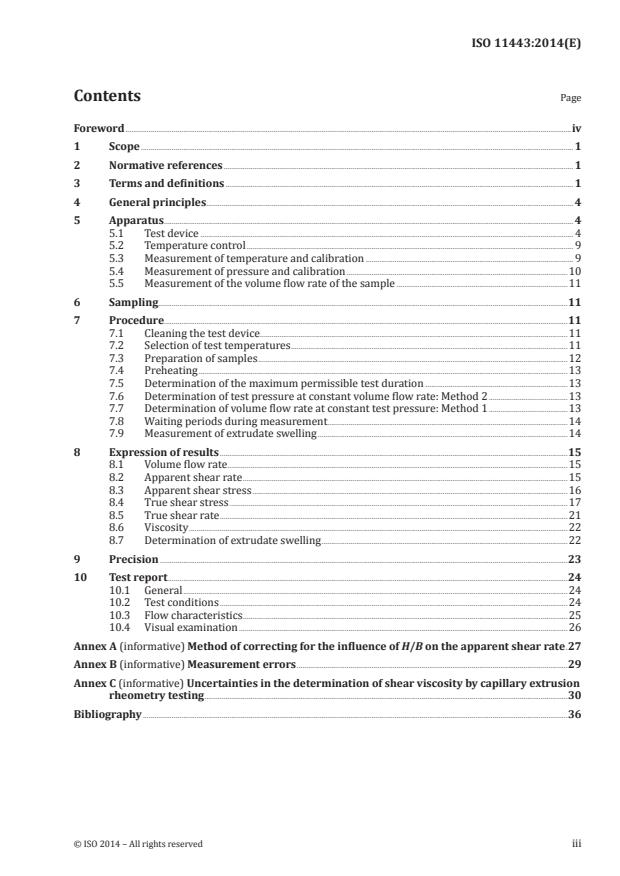
Contents Page
Foreword .iv
1 Scope . 1
2 Normative references . 1
3 Terms and definitions . 1
4 General principles . 4
5 Apparatus . 4
5.1 Test device . 4
5.2 Temperature control . 9
5.3 Measurement of temperature and calibration . 9
5.4 Measurement of pressure and calibration .10
5.5 Measurement of the volume flow rate of the sample .11
6 Sampling .11
7 Procedure.11
7.1 Cleaning the test device .11
7.2 Selection of test temperatures .11
7.3 Preparation of samples .12
7.4 Preheating .13
7.5 Determination of the maximum permissible test duration .13
7.6 Determination of test pressure at constant volume flow rate: Method 2 .13
7.7 Determination of volume flow rate at constant test pressure: Method 1 .13
7.8 Waiting periods during measurement.14
7.9 Measurement of extrudate swelling .14
8 Expression of results .15
8.1 Volume flow rate .15
8.2 Apparent shear rate .15
8.3 Apparent shear stress .16
8.4 True shear stress .17
8.5 True shear rate .21
8.6 Viscosity .22
8.7 Determination of extrudate swelling .22
9 Precision .23
10 Test report .24
10.1 General .24
10.2 Test conditions .24
10.3 Flow characteristics .25
10.4 Visual examination .26
Annex A (informative) Method of correcting for the influence of H/B on the apparent shear rate .27
Annex B (informative) Measurement errors .29
Annex C (informative) Uncertainties in the determination of shear viscosity by capillary extrusion
rheometry testing .30
Bibliography .36
Foreword
ISO (the International Organization for Standardization) is a worldwide federation of national standards
bodies (ISO member bodies). The work of preparing International Standards is normally carried out
through ISO technical committees. Each member body interested in a subject for which a technical
committee has been established has the right to be represented on that committee. International
organizations, governmental and non-governmental, in liaison with ISO, also take part in the work.
ISO collaborates closely with the International Electrotechnical Commission (IEC) on all matters of
electrotechnical standardization.
The procedures used to develop this document and those intended for its further maintenance are
described in the ISO/IEC Directives, Part 1. In particular the different approval criteria needed for the
different types of ISO documents should be noted. This document was drafted in accordance with the
editorial rules of the ISO/IEC Directives, Part 2 (see www.iso.org/directives).
Attention is drawn to the possibility that some of the elements of this document may be the subject of
patent rights. ISO shall not be held responsible for identifying any or all such patent rights. Details of
any patent rights identified during the development of the document will be in the Introduction and/or
on the ISO list of patent declarations received (see www.iso.org/patents).
Any trade name used in this document is information given for the convenience of users and does not
constitute an endorsement.
For an explanation on the meaning of ISO specific terms and expressions related to conformity
assessment, as well as information about ISO’s adherence to the WTO principles in the Technical Barriers
to Trade (TBT) see the following URL: Foreword - Supplementary information
The committee responsible for this document is ISO/TC 61, Plastics, Subcommittee SC 5, Physical-
chemical properties.
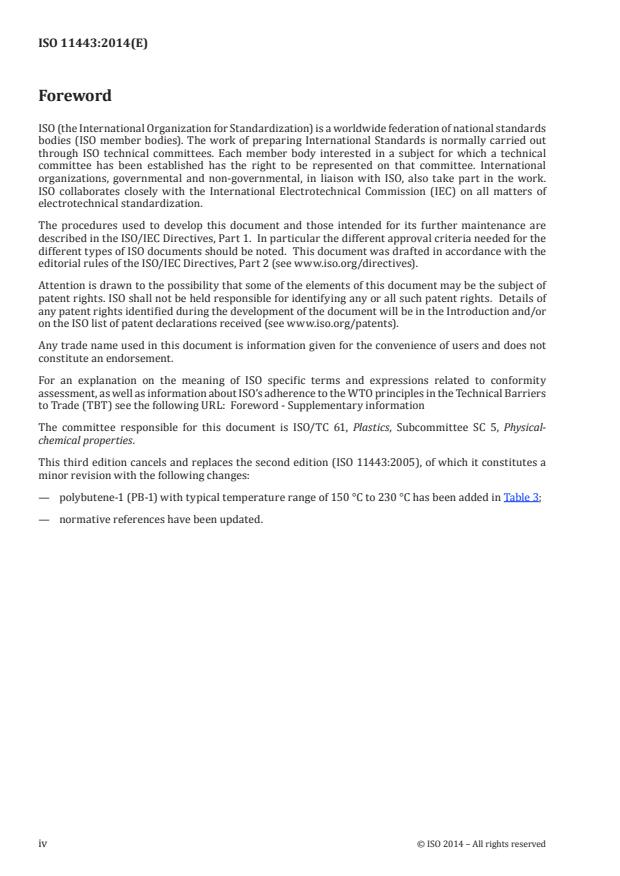
This third edition cancels and replaces the second edition (ISO 11443:2005), of which it constitutes a
minor revision with the following changes:
— polybutene-1 (PB-1) with typical temperature range of 150 °C to 230 °C has been added in Table 3;
— normative references have been updated.
iv © ISO 2014 – All rights reserved
INTERNATIONAL STANDARD ISO 11443:2014(E)
Plastics — Determination of the fluidity of plastics using
capillary and slit-die rheometers
1 Scope
This International Standard specifies methods for determining the fluidity of plastics melts subjected
to shear stresses at rates and temperatures approximating to those arising in plastics processing.
Testing plastics melts in accordance with these methods is necessary since the fluidity of plastics melts
is generally not dependent solely on temperature, but also on other parameters, in particular shear rate
and shear stress.
The methods described in this International Standard are useful for determining melt viscosities from
10 Pa∙s to 10 Pa∙s, depending on the measurement range of the pressure and/or force transducer and
the mechanical and physical characteristics of the rheometer. The shear rates occurring in extrusion
−1 6 −1
rheometers range from 1 s to 10 s .
Elongational effects at the die entrance cause extrudate swelling at the die exit. Methods for assessing
extrudate swelling have also been included.
The rheological techniques described are not limited to the characterization of wall-adhering
[1][2]
thermoplastics melts only; for example, thermoplastics exhibiting “slip” effects and thermosetting
plastics can be included. However, the methods used for determining the shear rate and shear viscosity
are invalid for materials which are not wall-adhering. Nevertheless, this International Standard can be
used to characterize the rheological behaviour of such fluids for a given geometry.
2 Normative references
The following documents, in whole or in part, are normatively referenced in this document and are
indispensable for its application. For dated references, only the edition cited applies. For undated
references, the latest edition of the referenced document (including any amendments) applies.
ISO 1133-1, Plastics — Determination of the melt mass-flow rate (MFR) and melt volume-flow rate (MVR) of
thermoplastics — Part 1: Standard method
ISO 1133-2, Plastics — Determination of the melt mass-flow rate (MFR) and melt volume-flow rate (MVR)
of thermoplastics — Part 2: Method for materials sensitive to time-temperature history and/or moisture
ISO 4287, Geometrical Product Specifications (GPS) — Surface texture: Profile method — Terms, definitions
and surface texture parameters
ISO 6507-1, Metallic materials — Vickers hardness test — Part 1: Test method
ISO 11403-2, Plastics — Acquisition and presentation of comparable multipoint data — Part 2: Thermal and
processing properties
3 Terms and definitions
For the purposes of this document, the following terms and definitions apply.
3.1
Newtonian fluid
fluid for which the viscosity is independent of the shear rate and of time
3.2
non-Newtonian fluid
fluid for which the viscosity varies with the shear rate and/or with time
Note 1 to entry: For the purposes of this International Standard, this definition refers to fluids for which the
viscosity varies only with the shear rate.
3.3
apparent shear stress
τ
ap
fictive shear stress to which the melt in contact with the die wall is subjected, expressed in pascals (Pa)
Note 1 to entry: It is calculated as the product of test pressure and the ratio of die cross-sectional area to die wall
area.
3.4
apparent shear rate
γ
ap
fictive shear rate that the melt at the wall would experience at the observed volume flow rate if its
−1
behaviour were Newtonian, expressed in reciprocal seconds (s )
3.5
true shear stress
τ
actual shear stress to which the melt in contact with the die wall is subjected, expressed in pascals (Pa)
Note 1 to entry: It is estimated from the test pressure p by applying corrections for entrance and exit pressure
losses, or is directly determined from the melt-pressure gradient in the channel.
Note 2 to entry: For the purposes of notation, the absence of a subscript is used to denote true values.
3.6
true shear rate
γ
shear rate obtained from the apparent shear rate γ by taking into account the deviations from
ap
Newtonian behaviour by appropriate correction algorithms (see Note to 8.2.2), expressed in reciprocal
−1
seconds (s )
Note 1 to entry: For the purposes of notation, the absence of a subscript is used to denote true values.
3.7
viscosity
η
viscosity in steady shear, defined as the ratio τγ/ of true shear stress τ to true shear rate γ , expressed
in pascal seconds (Pa∙s)
3.8
apparent viscosity
η
ap
ratio τγ/ of apparent shear stress τ to apparent shear rate γ , expressed in pascal seconds (Pa∙s)
ap
ap ap
3.9
Bagley corrected apparent viscosity
η
apB
ratio τγ/ of true shear stress τ to apparent shear rate γ , expressed in pascal seconds (Pa∙s)
ap ap
2 © ISO 2014 – All rights reserved
3.10
Rabinowitsch corrected apparent viscosity
η
apR
ratio τγ/ of apparent shear stress τ to true shear rate γ , expressed in pascal seconds (Pa∙s)
ap
ap
Note 1 to entry: This term is appropriate for use when testing with a single die of large length-to-diameter aspect
ratio for which entrance effects are negligible.
3.11
volume flow rate
Q
volume of melt flowing through the die per unit time, expressed in cubic millimetres per second (mm /s)
3.12
swell ratio at room temperature
S
a
ratio of the diameter of the extrudate to the diameter of the capillary die, both measured at room
temperature
3.13
swell ratio at the test temperature
S
T
ratio of the diameter of the extrudate to the diameter of the capillary die, both measured at the test
temperature
3.14
percent swell at room temperature
s
a
difference between the diameter of the extruded strand and the diameter of the capillary die, expressed
as a percentage of the diameter of the capillary die, both measured at room temperature
3.15
percent swell at the test temperature
s
T
difference between the diameter of the extruded strand and the diameter of the capillary die, expressed
as a percentage of the diameter of the capillary die, both measured at the test temperature
Note 1 to entry: Equivalent slit-die extrudate swell terms can be derived based on the thickness of slit-die
extrudate with reference to the slit-die thickness.
3.16
preheating time
time interval between completion of charging of the barrel and the beginning of measurement
3.17
dwell time
time interval between the completion of charging of the barrel and the end of measurements
Note 1 to entry: In certain special cases, it can be necessary to note the dwell time at the end of each measurement
where more than one measurement per barrel filling is made.
3.18
extrusion time
time corresponding to the period of measurement for a given shear rate
3.19
critical shear stress
value of the shear stresses at the die wall at which any of the following occur:
— a discontinuity in the curve plotting shear stress against flow rate or shear rate;
— roughness (or waving) of the extrudate as it leaves the die
Note 1 to entry: It is expressed in pascals (Pa).
3.20
critical shear rate
−1
shear rate corresponding to the critical shear stress, expressed in reciprocal seconds (s )
4 General principles
The plastics melt is forced through a capillary or slit die of known dimensions. Two principal methods
can be used: for a specified constant test pressure p, the volume flow rate Q is measured (method 1), or
for a specified constant volume flow rate Q, the test pressure p is measured (method 2). These methods
can be used with capillary dies (method A) and slit dies (method B). For full designation of the test
method options, see Table 1.
Table 1 — Designation of test methods
Preset parameter
Die cross sec-
Volume flow
tion
Test pressure, p
rate, Q
Circular
A1 A2
(capillary die)
Rectangular
B1 B2
(slit die)
Measurements can be made using a range of values of the preset parameter (either applied test pressure
in method 1, or volume flow rate in method 2).
If a slit die with pressure transducers positioned along its length and also upstream of the die entry is
used, then entrance and exit pressure drop values can be determined. If capillary dies of the same radius
but of varying lengths are used, then the sum of the entrance and exit pressure drops can be determined.
A slit die with pressure transducers positioned along its length is particularly suited for automated
measurements using online computer evaluation.
Recommended values for capillary die dimensions and for flow rates and temperatures to be used in
testing are presented either in the relevant clauses below or in ISO 11403-2.
NOTE In using a slit die, either the aspect ratio H/B between the thickness H and the width B of the slit is small
or else a correction for H/B (see Annex A) is necessary. In the latter case, the calculated quantities are dependent
on assumptions made in deriving the correction formulae used, notably that elastic effects are irrelevant.
5 Apparatus
5.1 Test device
5.1.1 General
The test device shall consist of a heatable barrel, the bore of which is closed at the bottom end by an
interchangeable capillary or slit die. The test pressure shall be exerted on the melt contained in this
barrel by a piston, screw, or by the use of gas pressure. Figures 1 and 2 show typical examples; other
dimensions are permitted.
5.1.2 Rheometer barrel
The barrel shall consist of a material resistant to wear and corrosion up to the maximum temperature
of the heating system.
4 © ISO 2014 – All rights reserved
The barrel can have a lateral bore for the insertion of a melt-pressure transducer close to the die entrance.
The permissible deviations in the mean bore diameter throughout the length of the barrel shall be less
than ±0,007 mm.
The barrel shall be manufactured using techniques and materials that produce a Vickers hardness
preferably of at least 800 HV 30 (see ISO 6507-1 and Note 1) and a surface roughness of less than
R = 0,25 µm (average arithmetic discrepancy, see ISO 4287).
a
NOTE 1 For temperatures up to 400 °C, nitrided steel has been found suitable. Materials of hardness values
lower than that specified but of sufficient corrosion and abrasion resistance have been found to be acceptable for
construction of the barrel and dies.
NOTE 2 An increase in barrel-bore diameter increases the number of measurements that can be made with a
single barrel filling and increases the shear rate range of the instrument. Disadvantages of using a larger barrel-
bore diameter are that larger sample masses are required and that the time necessary to reach temperature
equilibrium throughout the sample is greater. The barrel-bore diameters of commercially available rheometers
lie in the range between 6,35 mm and 25 mm.
5.1.3 Capillary dies (method A)
5.1.3.1 The entire length of the capillary die wall shall be machined to an accuracy of ±0,007 mm for the
diameter (D) and ±0,025 mm for the length (L) (see Figure 1).
The capillary shall be manufactured using techniques and materials that produce a Vickers hardness
preferably of at least 800 HV 30 (see ISO 6507-1 and Note 1 to 5.1.2) and a surface roughness of less than
R = 0,25 µm (average arithmetic discrepancy, see ISO 4287).
a
The capillary opening shall show no visible machining marks nor perceptible eccentricity.
NOTE 1 Diameters of capillary dies typically used lie in the range between 0,5 mm and 2 mm, with various
lengths to obtain the desired L/D ratios. For testing of filled materials, larger diameters might be required.
NOTE 2 Hardened steel, tungsten carbide, stellite, and hardened stainless steel are the most common die
materials.
NOTE 3 The precision with which capillary dimensions can be measured is dependent upon both the capillary
radius and the capillary length. With capillaries of diameter smaller than 1,25 mm, the specified precision
(±0,007 mm) is difficult to obtain. Due to the extreme sensitivity of flow data to capillary dimensions, it is
important that the capillary dimensions, and the precision with which the dimensions are measured, are known
and reported. This also applies to the dimensions (thickness, width, and length) of slit dies (see 5.1.4).
Dimensions in millimetres
Key
1 applied force or constant velocity 7 capillary die
2 thermal insulation 8 die-retaining nut
3 piston 9 optical sensor
4 barrel 10 temperature-controlled air chamber
5 heating coil 11 thermometer
6 pressure transducer 12 inlet angle
Figure 1 — Typical example of an extrusion rheometer used with a capillary die
6 © ISO 2014 – All rights reserved
Dimensions in millimetres
Key
1 piston 3 die 5 channel P = pressure transducers
i
2 barrel 4 exchangeable part 6 electrical heater T = thermometers
i
Figure 2 — Typical example of an extrusion rheometer used with a slit die
5.1.3.2 To determine the apparent shear rate γ and the apparent shear stress τ with one capillary
ap
ap
die, the ratio L/D of the length L to the diameter D of the capillary die shall be at least 16 and its inlet angle
shall be 180°, unless otherwise specified by the referring International Standard. Only data obtained with
capillaries of the same inlet angle (±1°), length (±0,025 mm), and diameter (±0,007 mm) shall be
compared. The inlet angle is defined in Figure 1.
It is recommended that a die of length either 16 mm or 20 mm, diameter of 1 mm, and entry angle of
180° be used (see Note 1). Options for the die diameter of 0,5 mm, 2 mm, or 4 mm are permitted when
the recommended value is not appropriate, for example for heavily filled materials. For dies of diameter
other than 1 mm, the recommended ratio of length to diameter (L/D) shall be the same, where possible,
as that of the 1-mm-diameter die used in that instrument.
NOTE 1 Die lengths of 16 mm and 20 mm are most commonly used, the choice often being dependent on, and
limited by, the design of the instrument.
NOTE 2 For a given value of the apparent shear rate, the effect of shear heating of the melt is reduced by use of
smaller diameter capillary dies.
5.1.3.3 To determine the true shear rate γ and the true shear stress τ, capillary dies of the same
diameter (±0,007 mm) and inlet angle (±1°) and having at least two different L/D ratios selected from the
recommended series L/D = 0,25 to 1, 5, 10, 16, 20, 30, and 40 (see also 8.4.2) are required, provided the
following conditions are met.
The use of only two dies, of the same diameter (±0,007 mm) and inlet angle (±1°), of L/D ≤ 5 and L/D ≥ 16 is
permitted where the test conditions are such that the resultant Bagley plot is not significantly nonlinear,
i.e. these conditions having been established in advance for each class of sample, by using additional dies
(see 8.4). When using only two dies, the difference in the L/D ratios of the two dies shall be at least 15.
It is recommended that, when using only two dies to determine shear viscosity corrected for entrance
pressure drop effects, a short die of length-to-diameter (L/D) ratio in the range 0,25 to 1, and a long die
of length-to-diameter (L/D) ratio in the range 16 to 20, both dies having a diameter of 1 mm and an entry
angle of 180°, be used. Options for the die diameter, of 0,5 mm, 2 mm, or 4 mm, shall be permitted when
the recommended value of 1 mm is not appropriate, for example for heavily filled materials. For dies of
diameter other than 1 mm, the recommended ratios of length to diameter (L/D) shall be the same as that
specified for the 1-mm-diameter dies.
NOTE The procedure for correction for entrance pressure drop effects (see 8.4) is based on an extrapolation
of data to a die length of zero, rather than by making the approximation that the short die yields the entrance
pressure drop value.
5.1.4 Slit dies (method B)
5.1.4.1 The entire length of the slit die shall be machined to an accuracy of ±0,007 mm for the
thickness, ±0,01 mm for the width, and ±0,025 mm for the length. As applicable, the distance between the
centres of the pressure transducers and the exit plane shall be determined to ±0,05 mm. (See Note 3 to
5.1.3.1.)
The die shall be manufactured using techniques and materials that produce a Vickers hardness
preferably of at least 800 HV 30 (see ISO 6507-1 and Note 1 to 5.1.2) and a surface roughness of less than
R = 0,25 µm (average arithmetic discrepancy, see ISO 4287.)
a
NOTE For slit die materials, see Note 1 to 5.1.2 and Note 2 to 5.1.3.1.
5.1.4.2 To determine the apparent shear rate γ and the apparent shear stress τ , unless otherwise
ap
ap
specified by the referring International Standard, the slit die shall have a ratio H/B of the thickness H to
the width B of at most 0,1 and shall have an inlet angle of 180°. Only data obtained with slit dies of the
8 © ISO 2014 – All rights reserved
same inlet angle (±1°), thickness (±0,007 mm), width (±0,01 mm), and length (±0,025 mm) shall be
compared.
5.1.4.3 To determine the true values of shear rate γ and shear stress τ, slit dies conforming to the
specification given in 5.1.4.1 and 5.1.4.2 can be used in exactly the same way as capillary dies, i.e. using
the Bagley correction method modified accordingly (see 8.4). Alternatively, a slit die with pressure
transducers positioned along the length of its channel can be used to determine true shear stress values.
5.1.5 Piston
If a piston is used, its diameter shall be 0,040 mm ± 0,005 mm smaller than the barrel-bore diameter. It
can be equipped with split or whole sealing rings in order to reduce melt backflow past the land of the
piston. The hardness of the piston shall be less than that of the barrel, but not less than 375 HV 30 (see
ISO 6507-1).
5.2 Temperature control
For all temperatures that can be set, the barrel temperature control shall be designed such that, within
the range of the capillary die or slit die, as applicable, and the permissible filling height of the barrel, the
temperature differences and variations measured at the wall do not exceed those given in Table 2 for
the duration of the test.
Table 2 — Maximum allowable temperature differences as a function of distance and as a
function of time
Temperature difference
from the set tempera- Temperature variation
Test temperature, θ
a
ture as a function of as a function of time
°C
a
distance °C
°C
≤200 ±1,0 ±0,5
200 < θ ≤ 300 ±1,5 ±1,0
>300 ±2,0 ±1,5
a
For all positions within the range of the capillary die or slit die, as applicable, and the
permissible filling height of the barrel, for the duration of the test.
The test device shall be designed so that the test temperature can be set in steps of 1 °C or less.
5.3 Measurement of temperature and calibration
5.3.1 Test temperature
5.3.1.1 Method A: Capillary dies
When capillary dies are used, the test temperature shall be either the temperature of the melt in the
barrel near the capillary inlet or, if this is not possible, the temperature of the barrel wall near the
capillary inlet. It is preferable that the test temperature is measured at a position not more than 10 mm
above the capillary inlet. (See also 5.3.2.)
5.3.1.2 Method B: Slit dies
When slit dies are used, the die wall temperature shall be measured and taken as the test temperature.
This temperature shall be equal to the test temperature measured in the barrel to within the distance-
related and time-related temperature tolerances given in Table 2. (See also 5.3.1.1 and 5.3.2.)
5.3.2 Measurement of test temperature
The tip of the temperature-measuring device shall be either in contact with the melt or, if this is not
possible, in contact with the metal of the barrel or die wall not more than 1,5 mm from the melt channel.
Thermally conductive fluids can be used in the thermometer well to improve conduction. Thermometers,
preferably thermocouples or platinum resistance sensors, can be placed as shown in Figure 1 and
Figure 2.
5.3.3 Temperature calibration
The temperature-measuring device used during the test shall read to within 0,1 °C and be calibrated
by means of a standard thermometer, with error limits of ±0,1 °C, while complying with the depth of
immersion prescribed for the thermometer concerned. For this purpose, the barrel can be filled to the
top with a low-viscosity melt.
No liquids that can contaminate the die or barrel or influence the ensuing measurements, e.g. silicone
oil, shall be used as heat transfer media during calibration.
5.4 Measurement of pressure and calibration
5.4.1 Test pressure
The test pressure shall be the pressure drop in the melt, measured as the difference between the pressure
in the melt before the capillary-die or slit-die inlet and the pressure at the die exit, as applicable. If possible,
the test pressure shall be measured by a melt-pressure transducer located near the entrance of the die,
in which case the distance from the pressure transducer to the die entry face shall be kept constant for
all tests and should preferably be not more than 20 mm (see Note). Otherwise, the test pressure shall be
determined by the force exerted on the melt, e.g. by the piston, that force being measured by a load cell
above the piston (see B.1).
NOTE It is important that the distance from the die entry face to the pressure transducer is kept constant for
all tests as this will otherwise affect the pressure drop measured. The use of pressure transducers at a distance
equivalent to that of the barrel diameter from the die entry face can reduce fluctuations in the pressure being
measured that can arise due to recirculating flow above the die entry.
If testing is to be carried out by extruding to a channel or vessel pressurized to a pressure above
atmospheric pressure, then the pressure at the die exit shall also be measured, preferably using a
pressure transducer located immediately below the exit of the die.
The force- or pressure-measuring devices shall be operated in the range between 1 % and 95 % of their
nominal capacity.
5.4.2 Pressure drop along the length of the slit die
When using slit dies, the pressure profile along the length of the die shall be measured by flush-mounted
melt-pressure transducers positioned along the die wall.
Alternatively, when slit dies not equipped with melt-pressure transducers are used, the sum of entrance
and exit pressure losses can be taken into account by employing the Bagley correction modified for slit
dies (see 8.4.3).
5.4.3 Calibration
External hydraulic test equipment can be used for the calibration of melt-pressure transducers. Load
cells shall be calibrated in accordance with manufacturer’s specifications. The maximum permissible
error in the reading of the melt-pressure transducers or load cells shall be both less than or equal to 1 %
of the full scale value and less than or equal to 5 % of the absolute value. The calibration of melt-pressure
transducers should preferably be performed at the test temperature.
10 © ISO 2014 – All rights reserved
5.5 Measurement of the volume flow rate of the sample
The volume flow rate shall be determined either from the feed rate of the piston or by weighing the mass
of the sample extruded during a measured period of time.
If weighing is performed, the conversion to the volume flow rate shall be made by using the density of
the melt at the prevailing test temperature, the influence of the hydrostatic pressure on the density
being ignored.
The volume flow rate shall be determined to within 1 %.
It is recommended that, for purposes of providing comparable data, the apparent shear rates and hence
flow rates used for testing are such that data at the true shear rates specified in ISO 11403-2 can be
determined by interpolation. The apparent shear rates should be set at equispaced intervals, when
plotted logarithmically, and there should be at least two data points per decade of apparent shear rate.
NOTE The specified maximum permissible error for determining the volume flow rate via the feed rate of
the piston can only be conformed to if, inter alia, the leakage rate between the piston and barrel is sufficiently
small. Experience indicates that this can be achieved if the clearance between piston and barrel does not exceed
0,045 mm (see 5.1.5).
6 Sampling
From the material to be tested, a representative sample shall be taken for use as the test sample. The
number of determinations per single barrel filling depends on the moulding material under test and
shall therefore be agreed upon between the interested parties. The temperature during test sample
preparation shall be less than that during the subsequent test.
7 Procedure
7.1 Cleaning the test device
Before each measurement, ensure that the barrel, transducer bores, where applicable, piston, and
capillary or slit die are free of adherent foreign matter. Make a visual examination to check for cleanliness.
If solvents are used for cleaning, ensure that no contamination of the barrel, piston, and capillary or slit
die has occurred that might influence the test result.
NOTE For the purpose of cleaning, circular brushes made of a copper/zinc alloy (brass) and linen cloths have
proved satisfactory. However, the use of copper-containing materials can accelerate degradation of the polymer
when testing polyethylene and polypropylene. Cleaning can also be performed by cautious burning out. Using
graphite on threads facilitates unlocking after the test.
WARNING — The operating conditions chosen can entail partial decomposition of the material
under test, or cause it to release dangerous volatile substances. The users of this International
Standard shall make themselves aware of possible risks, shall prevent or minimize such risks as
appropriate, and shall provide appropriate means of protection.
7.2 Selection of test temperatures
It is recommended that, for the purpose of providing data for comparison or for modelling, data at three
temperatures be obtained (see ISO 11403-2). For any given material type, one of the temperatures used
should preferably be the same as that specified in the appropriate material designation or specification
standard for use in melt flow rate testing (see ISO 1133-1 and ISO 1133-2). For the other two temperatures,
it is recommended that a temperature interval of 20 °C be used (see Notes 1 and 2). Both of the additional
temperatures can be either higher or lower than the recommended temperature as used for the melt
flow rate test (see ISO 1133-1 and ISO 1133-2), or one higher and one lower. However, other values can
be used and can be preferable to use, depending on the specific grade of material and the application for
which the data are required.
NOTE 1 From an analysis of CAMPUS databases, the average interval in temperature used to measure shear
viscosity ranged from 10 °C to 30 °C and was dependent on the material grade.
NOTE 2 Typical test temperatures for several materials are given in Table 3. These are listed for information
only. The most useful data are generally obtained at the temperatures used for processing the material. The shear
stresses and shear rates applied are also intended to closely approximate those observed in the actual processing.
Table 3 — Typical test temperatures
Temperature
Material
°C
Polyacetal 190 to 220
Polyacrylate 140 to 300
Polybutene-1 (PB-1) 150 to 230
Acrylonitrile-butadiene-styrene (ABS) 200 to 280
Cellulose esters 190
Polyamide PA66 250 to 300
Polyamide (not PA66) 190 to 300
Poly(chlorotrifluoroethylene) 265
Polyethylene and ethylene copolymers and terpolymers 150 to 250
Polycarbonate 260 to 300
Polypropylene 190 to 260
Polystyrene and styrene copolymers 180 to 280
Poly(vinyl chloride) 170 to 210
Poly(butylene terephthalate) 245 to 270
Poly(ethylene terephthalate) 275 to 300
PMMA and copolymers 180 to 300
Poly(vinylidene fluoride) 195 to 240
Poly(vinylidene chloride) 150 to 170
Ethylene-vinyl alcohol copolymer 190 to 230
Polyetheretherketone 340 to 380
Polyethersulfone 360
7.3 Preparation of samples
In cases where the fluidity of the melt depends on one or more factors, such as the residual monomer
content, gas inclusions, and/or moisture, apply pretreatment or conditioning procedures in accordance
with the referring International Standard and/or the relevant material standard, as applicable.
NOTE Examples of materials that can require special preparation regimes include poly(ethylene
terephthalate), poly(butylene terephthalate), and polycarbonate.
Allow the assembled apparatus to reach thermal equilibrium at the test temperature before applying
the final torque on the die (where applicable), then start charging (see Warning in 7.1).
To avoid air inclusions, introduce the sample into the barrel in separate small quantities, performing
intermediate compactions by means of a piston. Fill the barrel to within approximately 12,5 mm of the
top. Accomplish charging in not more than 2 min.
12 © ISO 2014 – All rights reserved
7.4 Preheating
Immediately after charging the barrel, start the preheat timer. Either extrude a small portion of the
barrel charge at a constant pressure (method 1) or apply a constant volume flow rate until a positive
load or pressure is obtained (method 2). Then stop the extrusion or volume flow until a preheat time of
at least 5 min, unless otherwise specified by the referring International Standard, is completed. Check
that the preheat time used is sufficient to obtain thermal equilibrium of the test sample throughout the
volume of the barrel, for each material to be tested, either by ensuring that on increasing the preheat
time, the measured quantity (volume flow rate or test pressure, as applicable) at constant test conditions
does not change by more than ±5 %, or by inserting a thermometer into the sample in the barrel and
ensuring that, within the specified preheat time, the sample temperature is equal to the specified test
temperature within the tolerance for the distance-related temperature difference given in Table 2. Then
extrude a small quantity of the substance under test, stop the piston, wait for 1 min, and perform the
measurement.
7.5 Determination of the maximum permissible test duration
To check that degradation or other processes are not affecting measurements, carry out a repeat
measurement towards the end of the test on the same barrel charge, using the same conditions as were
used at the beginning of the test. Compare values obtained at the start and end of the test. A difference
in values is indicative of degradation or other processes affecting measurements.
Alternatively, for each sample and each test temperature, determine by testing, employing several
different preheating times prior to the actual tests, the maximum permissible test duration which
corresponds to the time span, from the end of charging of the barrel, within which the measured
quantity (volume flow rate or test pressure, as applicable) at constant test conditions does not change
by more than ±5 % (see also 7.4.)
If determination at all of the required values of test pressure or volume flow rate is not possible within
the maximum permissible test duration of a single test, then make measurements stage by stage, using
several barrel fillings of the same sample (see Note 1 to 7.8).
NOTE For materials that are unstable, in order to minimize the effect of changes on the measurements, it
is recommended that testing be carried out using a decreasing speed profile. The degree of compaction of the
sample can also influence its stability.
7.6 Determination of test pressure at constant volume flow rate: Method 2
If the test pressure necessary to maintain a given volume flow rate is to be determined (see also 5.4.1
and 7.8), use either of the following methods (see Table 1):
— method A2, using capillary dies;
— method B2, using slit dies.
7.7 Determination of volume flow rate at constant test pressure: Method 1
If, as an alternative to 7.6, the volume flow rate for a given test pressure drop is required (see also 7.8),
use either of the following methods (see Table 1):
— method A1, using capillary dies;
— method B1, using slit dies.
7.8 Waiting periods during measurement
At each measurement, wait until the test pressure (method A2 or B2) or the volume flow rate (method A1
or B1) has become constant (e.g. to ±3 %) over a given time period (e.g. 15 s).
NOTE 1 With a single barrel filling, it is generally possible to determine several pairs of values f
...
Questions, Comments and Discussion
Ask us and Technical Secretary will try to provide an answer. You can facilitate discussion about the standard in here.
Loading comments...