

ISO/IEC 23009-5:2017/Amd 1:2020
(Amendment)Information technology — Dynamic adaptive streaming over HTTP (DASH) — Part 5: Server and network assisted DASH (SAND) — Amendment 1: Improvements on SAND messages
General Information
- Abstract
- Status
- Published
- Publication Date
- 24-Feb-2020
- Current Stage
- 6060 - International Standard published
- Start Date
- 25-Feb-2020
- Due Date
- 07-Nov-2020
- Completion Date
- 25-Feb-2020
Buy Documents

ISO/IEC 23009-5:2017/Amd 1:2020 - Information technology — Dynamic adaptive streaming over HTTP (DASH) — Part 5: Server and network assisted DASH (SAND) — Amendment 1: Improvements on SAND messages Released:2/25/2020
Overview
ISO/IEC 23009-5:2017/Amd 1:2020 is an international standard amendment focused on enhancing Server and Network Assisted Dynamic Adaptive Streaming over HTTP (DASH), commonly referred to as SAND. This amendment introduces improvements to SAND messages, which play a critical role in enabling efficient and adaptive media streaming by facilitating better communication between servers, network components, and DASH clients. The update strengthens the capabilities of network-assisted streaming to optimize bandwidth allocation and streaming quality in dynamic network environments.
Key Topics
Improvements on SAND Messages
The amendment revises the structure and parameters of SAND messages to better support server and network communication with DASH clients. Key enhancements include updated message formats that improve clarity and interoperability:- Introduction of the AnticipatedRequests parameter for prioritizing upcoming client requests.
- Clarification on the use of
supportedMessageandmessageSetUriattributes, allowing clients to declare support for multiple message types simultaneously.
Message Structure Enhancements
Adjustments to XML schema definitions for SAND messages, such as theDaneCapabilitiesTypeandSANDMessageType, provide a more flexible and extensible message structure. For example:messageIdattribute handling is modified to be optional, enhancing message validation.- The addition of complex types to define message capabilities improves precision in client-server negotiation.
Bandwidth Allocation Algorithms
The amendment outlines refined algorithms for bandwidth allocation using theallocate_at_most()function. This allows network-assisted DASH implementations to:- Assign the minimum bandwidth necessary for a client's highest feasible operation point.
- Potentially allocate additional bandwidth up to the available limit for improved streaming performance.
- Empower network elements to dynamically optimize resource distribution based on current network conditions.
Applications
ISO/IEC 23009-5:2017/Amd 1:2020 is essential for organizations developing or implementing adaptive streaming solutions within telecommunications, content delivery networks (CDNs), and multimedia service providers. Practical applications include:
Adaptive Video Streaming Platforms
Enhancing video quality adaptation by leveraging server and network assistance, reducing buffering and improving user experience.Telecommunications Network Optimization
Enabling network operators to manage bandwidth distribution efficiently among multiple DASH clients to meet service level agreements (SLAs).Multimedia Content Delivery
Supporting scalable and efficient streaming of live and on-demand content over HTTP with dynamic adjustment to network variations.Standard-Compliant DASH Player Development
Assisting developers of DASH clients and players to implement compliant message handling and bandwidth adaptation for improved interoperability.
Related Standards
ISO/IEC 23009 Series (DASH Standards)
Consists of multiple parts detailing adaptive streaming fundamentals, segmentation, and payload formats.ISO/IEC 23009-1
Defines the core components of Dynamic Adaptive Streaming over HTTP, providing the foundation for the SAND extensions.ISO/IEC 23009-2, -3, -4
Address other aspects of DASH streaming such as segment formats, server and network assistance, and session control.
Adhering to ISO/IEC 23009-5:2017/Amd 1:2020 ensures compliance with globally recognized best practices for adaptive streaming, enabling high-quality multimedia delivery optimized for modern network infrastructures.
Keywords: ISO/IEC 23009-5 amendment, dynamic adaptive streaming, DASH, server and network assisted DASH (SAND), SAND messages, bandwidth allocation, HTTP streaming, multimedia streaming standards, network optimization, adaptive video streaming.
Relations
- Effective Date
- 12-Aug-2023
- Effective Date
- 14-Oct-2020
Buy Documents
ISO/IEC 23009-5:2017/Amd 1:2020 - Information technology — Dynamic adaptive streaming over HTTP (DASH) — Part 5: Server and network assisted DASH (SAND) — Amendment 1: Improvements on SAND messages Released:2/25/2020
Get Certified
Connect with accredited certification bodies for this standard

BSI Group
BSI (British Standards Institution) is the business standards company that helps organizations make excellence a habit.

NYCE
Mexican standards and certification body.
Sponsored listings
Frequently Asked Questions
ISO/IEC 23009-5:2017/Amd 1:2020 is a standard published by the International Organization for Standardization (ISO). Its full title is "Information technology — Dynamic adaptive streaming over HTTP (DASH) — Part 5: Server and network assisted DASH (SAND) — Amendment 1: Improvements on SAND messages". This standard covers: Information technology — Dynamic adaptive streaming over HTTP (DASH) — Part 5: Server and network assisted DASH (SAND) — Amendment 1: Improvements on SAND messages
Information technology — Dynamic adaptive streaming over HTTP (DASH) — Part 5: Server and network assisted DASH (SAND) — Amendment 1: Improvements on SAND messages
ISO/IEC 23009-5:2017/Amd 1:2020 is classified under the following ICS (International Classification for Standards) categories: 35.040.40 - Coding of audio, video, multimedia and hypermedia information. The ICS classification helps identify the subject area and facilitates finding related standards.
ISO/IEC 23009-5:2017/Amd 1:2020 has the following relationships with other standards: It is inter standard links to ISO 12628:2022/Amd 1:2025, ISO/IEC 23009-5:2017. Understanding these relationships helps ensure you are using the most current and applicable version of the standard.
ISO/IEC 23009-5:2017/Amd 1:2020 is available in PDF format for immediate download after purchase. The document can be added to your cart and obtained through the secure checkout process. Digital delivery ensures instant access to the complete standard document.
Standards Content (Sample)
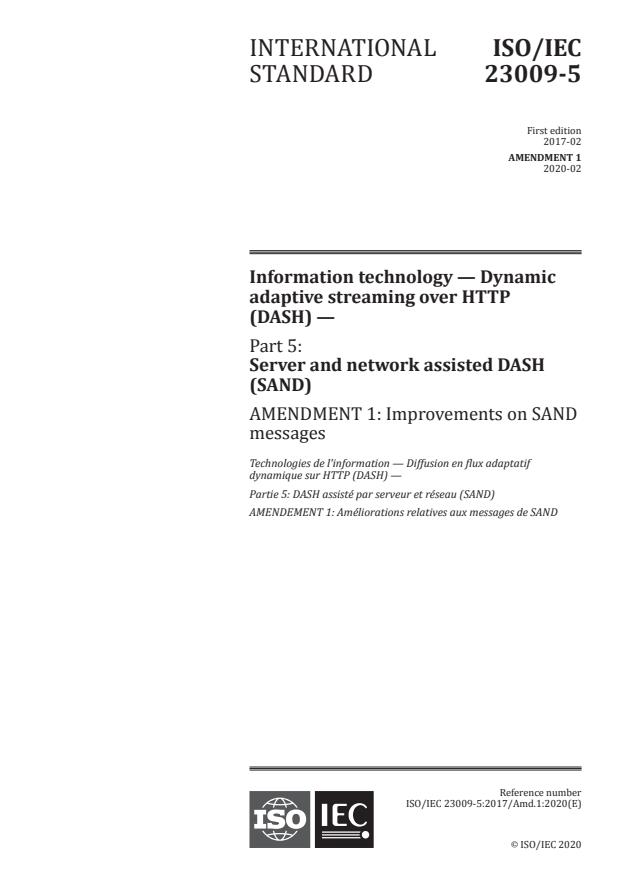
INTERNATIONAL ISO/IEC
STANDARD 23009-5
First edition
2017-02
AMENDMENT 1
2020-02
Information technology — Dynamic
adaptive streaming over HTTP
(DASH) —
Part 5:
Server and network assisted DASH
(SAND)
AMENDMENT 1: Improvements on SAND
messages
Technologies de l'information — Diffusion en flux adaptatif
dynamique sur HTTP (DASH) —
Partie 5: DASH assisté par serveur et réseau (SAND)
AMENDEMENT 1: Améliorations relatives aux messages de SAND
Reference number
ISO/IEC 23009-5:2017/Amd.1:2020(E)
©
ISO/IEC 2020
ISO/IEC 23009-5:2017/Amd.1:2020(E)
© ISO/IEC 2020
All rights reserved. Unless otherwise specified, or required in the context of its implementation, no part of this publication may
be reproduced or utilized otherwise in any form or by any means, electronic or mechanical, including photocopying, or posting
on the internet or an intranet, without prior written permission. Permission can be requested from either ISO at the address
below or ISO’s member body in the country of the requester.
ISO copyright office
CP 401 • Ch. de Blandonnet 8
CH-1214 Vernier, Geneva
Phone: +41 22 749 01 11
Fax: +41 22 749 09 47
Email: copyright@iso.org
Website: www.iso.org
Published in Switzerland
ii © ISO/IEC 2020 – All rights reserved
ISO/IEC 23009-5:2017/Amd.1:2020(E)
Foreword
ISO (the International Organization for Standardization) and IEC (the International Electrotechnical
Commission) form the specialized system for worldwide standardization. National bodies that
are members of ISO or IEC participate in the development of International Standards through
technical committees established by the respective organization to deal with particular fields of
technical activity. ISO and IEC technical committees collaborate in fields of mutual interest. Other
international organizations, governmental and non-governmental, in liaison with ISO and IEC, also
take part in the work.
The procedures used to develop this document and those intended for its further maintenance are
described in the ISO/IEC Directives, Part 1. In particular, the different approval criteria needed for
the different types of document should be noted. This document was drafted in accordance with the
editorial rules of the ISO/IEC Directives, Part 2 (see www .iso .org/ directives).
Attention is drawn to the possibility that some of the elements of this document may be the subject
of patent rights. ISO and IEC shall not be held responsible for identifying any or all such patent
rights. Details of any patent rights identified during the development of the document will be in the
Introduction and/or on the ISO list of patent declarations received (see www .iso .org/ patents) or the IEC
list of patent declarations received (see http:// patents .iec .ch).
Any trade name used in this document is information given for the convenience of users and does not
constitute an endorsement.
For an explanation of the voluntary nature of standards, the meaning of ISO specific terms and
expressions related to conformity assessment, as well as information about ISO's adherence to the
World Trade Organization (WTO) principles in the Technical Barriers to Trade (TBT) see www .iso .org/
iso/ foreword .html.
This document was prepared by Joint Technical Committee ISO/IEC JTC 1, Information technology,
Subcommittee SC 29, Coding of audio, picture, multimedia and hypermedia information.
A list of all parts in the ISO/IEC 23009 series can be found on the ISO website.
Any feedback or questions on this document should be directed to the user’s national standards body. A
complete listing of these bodies can be found at www .iso .org/ members .html.
© ISO/IEC 2020 – All rights reserved iii
ISO/IEC 23009-5:2017/Amd.1:2020(E)
Information technology —
...