

ISO/IEC 19795-4:2008
(Main)Information technology — Biometric performance testing and reporting — Part 4: Interoperability performance testing
General Information
- Abstract
ISO/IEC 19795-4:2008 prescribes methods for technology and scenario evaluations of multi-supplier biometric systems that use biometric data conforming to biometric data interchange format standards. It specifies requirements needed to assess performance available from samples formatted according to a standard interchange format (SIF), performance available when samples formatted according to a SIF are exchanged, performance available from samples formatted according to a SIF, relative to proprietary data formats, SIF interoperability by quantifying cross-product performance relative to single-product performance, performance available from multi-sample and multimodal data formatted according to one or more SIFs, and performance interoperability of biometric capture devices. In addition, ISO/IEC 19795-4:2008 includes procedures for establishing an interoperable set of implementations, defines procedures for testing interoperability with previously established sets of implementations, and gives testing procedures for the measurement of interoperable performance. It does not establish a conformance test for biometric data interchange formats, or provide test procedures for online data collection.
- Status
- Published
- Publication Date
- 28-May-2008
- Technical Committee
- ISO/IEC JTC 1/SC 37 - Biometrics
- Drafting Committee
- ISO/IEC JTC 1/SC 37/WG 5 - Biometric testing and reporting
- Current Stage
- 9060 - Close of review
- Completion Date
- 02-Sep-2030

Overview
ISO/IEC 19795-4:2008 defines methods for biometric interoperability performance testing of multi‑supplier systems that use biometric data formatted according to biometric data interchange formats (SIFs). The standard prescribes procedures to evaluate how well products interoperate when exchanging standardized biometric samples, how standardized formats compare with proprietary formats, and how multi‑sample and multimodal data affect cross‑product performance. It also provides test procedures for capture device interoperability and for establishing and re‑testing interoperable sets of implementations. Note: the standard does not itself define conformance tests for interchange formats nor test online data collection.
Key topics and requirements
- Interoperability testing scope: technology and scenario evaluations for multi‑vendor systems using standardized biometric data.
- Performance metrics and figures of merit: definitions and statistical methods to measure recognition performance, component failure, and uncertainty.
- Interoperability matrices: cross‑product performance matrices to quantify cross‑generator and cross‑comparator behavior and to identify interoperable combinations.
- Test planning and execution: sample acquisition requirements, corpus sizing, sequestering of data, and procedures for preventing and detecting gaming.
- Sufficiency testing: methods to compare performance with SIF‑formatted samples versus proprietary formats and to judge whether SIFs deliver adequate operational performance.
- Component and device interoperability: testing capture devices, multimodal systems, modular components, and handling of optional encodings and encapsulation.
- Statistical and reporting rules: variance estimation, uncertainty measurement, fixed operating‑point analysis, and structured reporting of results.
Applications and who should use it
ISO/IEC 19795-4 is designed for:
- Biometric vendors and integrators evaluating cross‑product compatibility.
- Independent test laboratories and certification bodies that measure interoperable performance.
- Government and enterprise procurement teams requiring interoperability evidence for multi‑vendor deployments.
- System architects and R&D teams designing multimodal or multi‑sample solutions and capture devices.
- Standards developers and researchers studying interoperability impacts on biometric recognition.
Practical uses include interoperability acceptance testing for national ID programs, verifying that sensors and template generators interchange data correctly, and comparing standardized interchange formats to proprietary encodings for deployment risk assessment.
Related standards
- ISO/IEC 19795 family (biometric performance testing and reporting)
- Biometric data interchange format standards (e.g., ISO/IEC 19794 series) - relevant for sample encoding and SIF compliance
Keywords: ISO/IEC 19795-4, biometric interoperability, biometric performance testing, biometric data interchange format, SIF, interoperability matrix, capture device interoperability.
Relations
- Effective Date
- 02-Sep-2026
- Effective Date
- 01-Jul-2026
Get Certified
Connect with accredited certification bodies for this standard

BSI Group
BSI (British Standards Institution) is the business standards company that helps organizations make excellence a habit.

NYCE
Mexican standards and certification body.
Sponsored listings
Frequently Asked Questions
ISO/IEC 19795-4:2008 is a standard published by the International Organization for Standardization (ISO). Its full title is "Information technology — Biometric performance testing and reporting — Part 4: Interoperability performance testing". This standard covers: ISO/IEC 19795-4:2008 prescribes methods for technology and scenario evaluations of multi-supplier biometric systems that use biometric data conforming to biometric data interchange format standards. It specifies requirements needed to assess performance available from samples formatted according to a standard interchange format (SIF), performance available when samples formatted according to a SIF are exchanged, performance available from samples formatted according to a SIF, relative to proprietary data formats, SIF interoperability by quantifying cross-product performance relative to single-product performance, performance available from multi-sample and multimodal data formatted according to one or more SIFs, and performance interoperability of biometric capture devices. In addition, ISO/IEC 19795-4:2008 includes procedures for establishing an interoperable set of implementations, defines procedures for testing interoperability with previously established sets of implementations, and gives testing procedures for the measurement of interoperable performance. It does not establish a conformance test for biometric data interchange formats, or provide test procedures for online data collection.
ISO/IEC 19795-4:2008 prescribes methods for technology and scenario evaluations of multi-supplier biometric systems that use biometric data conforming to biometric data interchange format standards. It specifies requirements needed to assess performance available from samples formatted according to a standard interchange format (SIF), performance available when samples formatted according to a SIF are exchanged, performance available from samples formatted according to a SIF, relative to proprietary data formats, SIF interoperability by quantifying cross-product performance relative to single-product performance, performance available from multi-sample and multimodal data formatted according to one or more SIFs, and performance interoperability of biometric capture devices. In addition, ISO/IEC 19795-4:2008 includes procedures for establishing an interoperable set of implementations, defines procedures for testing interoperability with previously established sets of implementations, and gives testing procedures for the measurement of interoperable performance. It does not establish a conformance test for biometric data interchange formats, or provide test procedures for online data collection.
ISO/IEC 19795-4:2008 is classified under the following ICS (International Classification for Standards) categories: 35.040 - Information coding; 35.240.15 - Identification cards. Chip cards. Biometrics. The ICS classification helps identify the subject area and facilitates finding related standards.
ISO/IEC 19795-4:2008 has the following relationships with other standards: It is inter standard links to CEN/TS 18212-3:2026, CEN/TS 18212-5:2026. Understanding these relationships helps ensure you are using the most current and applicable version of the standard.
ISO/IEC 19795-4:2008 is available in PDF format for immediate download after purchase. The document can be added to your cart and obtained through the secure checkout process. Digital delivery ensures instant access to the complete standard document.
Standards Content (Sample)
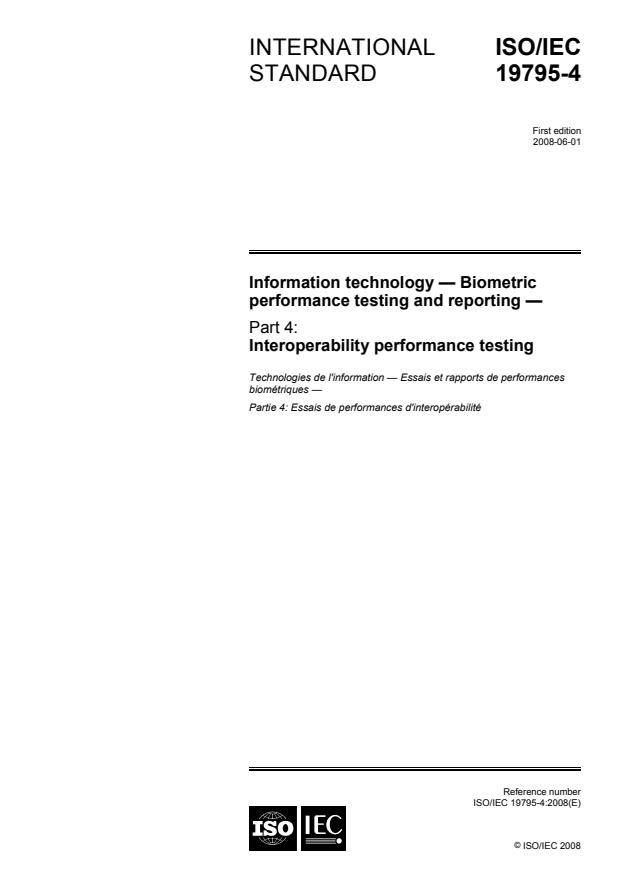
INTERNATIONAL ISO/IEC
STANDARD 19795-4
First edition
2008-06-01
Information technology — Biometric
performance testing and reporting —
Part 4:
Interoperability performance testing
Technologies de l'information — Essais et rapports de performances
biométriques —
Partie 4: Essais de performances d'interopérabilité
Reference number
©
ISO/IEC 2008
PDF disclaimer
This PDF file may contain embedded typefaces. In accordance with Adobe's licensing policy, this file may be printed or viewed but
shall not be edited unless the typefaces which are embedded are licensed to and installed on the computer performing the editing. In
downloading this file, parties accept therein the responsibility of not infringing Adobe's licensing policy. The ISO Central Secretariat
accepts no liability in this area.
Adobe is a trademark of Adobe Systems Incorporated.
Details of the software products used to create this PDF file can be found in the General Info relative to the file; the PDF-creation
parameters were optimized for printing. Every care has been taken to ensure that the file is suitable for use by ISO member bodies. In
the unlikely event that a problem relating to it is found, please inform the Central Secretariat at the address given below.
© ISO/IEC 2008
All rights reserved. Unless otherwise specified, no part of this publication may be reproduced or utilized in any form or by any means,
electronic or mechanical, including photocopying and microfilm, without permission in writing from either ISO at the address below or
ISO's member body in the country of the requester.
ISO copyright office
Case postale 56 • CH-1211 Geneva 20
Tel. + 41 22 749 01 11
Fax + 41 22 749 09 47
E-mail copyright@iso.org
Web www.iso.org
Published in Switzerland
ii © ISO/IEC 2008 – All rights reserved
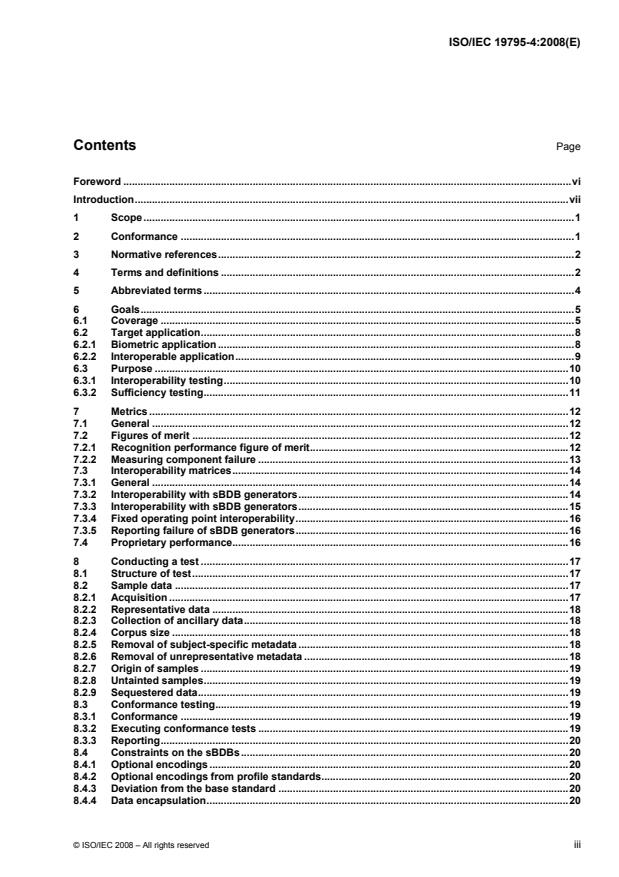
Contents Page
Foreword .vi
Introduction.vii
1 Scope.1
2 Conformance .1
3 Normative references.2
4 Terms and definitions .2
5 Abbreviated terms .4
6 Goals.5
6.1 Coverage .5
6.2 Target application.8
6.2.1 Biometric application.8
6.2.2 Interoperable application.9
6.3 Purpose .10
6.3.1 Interoperability testing.10
6.3.2 Sufficiency testing.11
7 Metrics .12
7.1 General .12
7.2 Figures of merit .12
7.2.1 Recognition performance figure of merit.12
7.2.2 Measuring component failure .13
7.3 Interoperability matrices.14
7.3.1 General .14
7.3.2 Interoperability with sBDB generators.14
7.3.3 Interoperability with sBDB generators.15
7.3.4 Fixed operating point interoperability.16
7.3.5 Reporting failure of sBDB generators.16
7.4 Proprietary performance.16
8 Conducting a test .17
8.1 Structure of test.17
8.2 Sample data .17
8.2.1 Acquisition .17
8.2.2 Representative data .18
8.2.3 Collection of ancillary data.18
8.2.4 Corpus size .18
8.2.5 Removal of subject-specific metadata .18
8.2.6 Removal of unrepresentative metadata .18
8.2.7 Origin of samples .19
8.2.8 Untainted samples.19
8.2.9 Sequestered data.19
8.3 Conformance testing.19
8.3.1 Conformance .19
8.3.2 Executing conformance tests .19
8.3.3 Reporting.20
8.4 Constraints on the sBDBs.20
8.4.1 Optional encodings .20
8.4.2 Optional encodings from profile standards.20
8.4.3 Deviation from the base standard .20
8.4.4 Data encapsulation.20
© ISO/IEC 2008 – All rights reserved iii
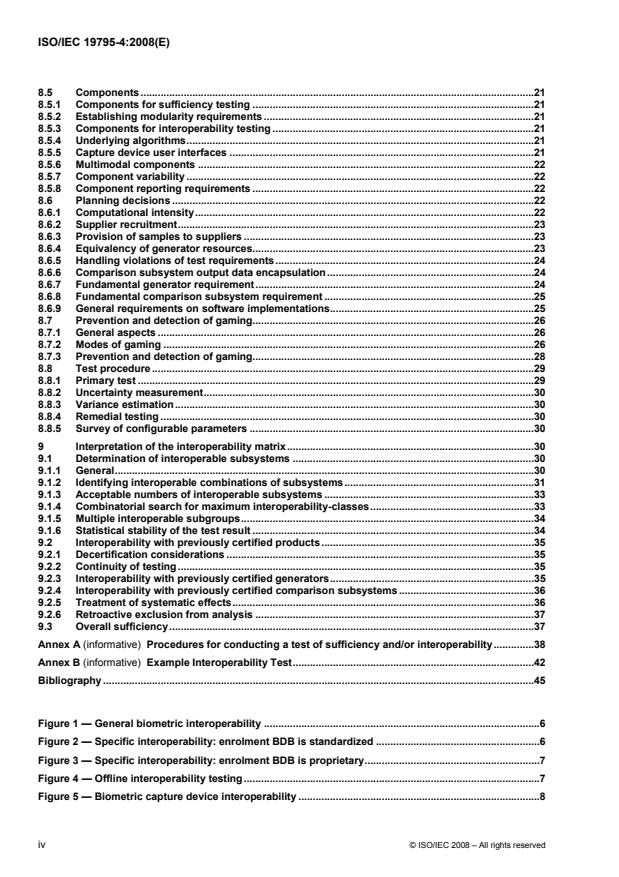
8.5 Components.21
8.5.1 Components for sufficiency testing .21
8.5.2 Establishing modularity requirements .21
8.5.3 Components for interoperability testing .21
8.5.4 Underlying algorithms.21
8.5.5 Capture device user interfaces .21
8.5.6 Multimodal components .22
8.5.7 Component variability .22
8.5.8 Component reporting requirements .22
8.6 Planning decisions .22
8.6.1 Computational intensity.22
8.6.2 Supplier recruitment.23
8.6.3 Provision of samples to suppliers .23
8.6.4 Equivalency of generator resources.23
8.6.5 Handling violations of test requirements.24
8.6.6 Comparison subsystem output data encapsulation.24
8.6.7 Fundamental generator requirement.24
8.6.8 Fundamental comparison subsystem requirement .25
8.6.9 General requirements on software implementations.25
8.7 Prevention and detection of gaming.26
8.7.1 General aspects .26
8.7.2 Modes of gaming .26
8.7.3 Prevention and detection of gaming.28
8.8 Test procedure.29
8.8.1 Primary test .29
8.8.2 Uncertainty measurement.30
8.8.3 Variance estimation.30
8.8.4 Remedial testing .30
8.8.5 Survey of configurable parameters .30
9 Interpretation of the interoperability matrix.30
9.1 Determination of interoperable subsystems .30
9.1.1 General.30
9.1.2 Identifying interoperable combinations of subsystems.31
9.1.3 Acceptable numbers of interoperable subsystems .33
9.1.4 Combinatorial search for maximum interoperability-classes.33
9.1.5 Multiple interoperable subgroups.34
9.1.6 Statistical stability of the test result .34
9.2 Interoperability with previously certified products.35
9.2.1 Decertification considerations .35
9.2.2 Continuity of testing.35
9.2.3 Interoperability with previously certified generators.35
9.2.4 Interoperability with previously certified comparison subsystems.36
9.2.5 Treatment of systematic effects.36
9.2.6 Retroactive exclusion from analysis .37
9.3 Overall sufficiency.37
Annex A (informative) Procedures for conducting a test of sufficiency and/or interoperability.38
Annex B (informative) Example Interoperability Test.42
Bibliography .45
Figure 1 — General biometric interoperability .6
Figure 2 — Specific interoperability: enrolment BDB is standardized .6
Figure 3 — Specific interoperability: enrolment BDB is proprietary.7
Figure 4 — Offline interoperability testing.7
Figure 5 — Biometric capture device interoperability .8
iv © ISO/IEC 2008 – All rights reserved
Figure 6 — Cells of an example interoperability space.10
Figure 7 — Sufficiency testing: proprietary vs. standard interchange formats .12
Figure 8 — Cross-generator performance matrix .15
Figure 9 — Example performance matrix .15
Figure 10 — Proprietary performance matrix.16
Table 1 – Conformity with ISO/IEC 19795-2 .1
Table 2 – Sample size adjustment of error rate requirement.31
Table 3 – Confidence levels of the standard Normal distribution.32
Table A.1 – Interoperability test procedure, phase 1: planning.38
Table A.2 – Interoperability test procedure, phase 2: setup.39
Table A.3 – Interoperability test procedure, phase 3: sBDB and pBDB generation.39
Table A.4 – Interoperability test procedure, phase 4: verification .40
Table A.5 – Interoperability test procedure, phase 5: identification .40
Table A.6 – Interoperability test procedure, phase 6: reporting.41
Table A.7 – Interoperability test procedure, phase 7: variance estimation.41
© ISO/IEC 2008 – All rights reserved v
Foreword
ISO (the International Organization for Standardization) and IEC (the International Electrotechnical
Commission) form the specialized system for worldwide standardization. National bodies that are members of
ISO or IEC participate in the development of International Standards through technical committees
established by the respective organization to deal with particular fields of technical activity. ISO and IEC
technical committees collaborate in fields of mutual interest. Other international organizations, governmental
and non-governmental, in liaison with ISO and IEC, also take part in the work. In the field of information
technology, ISO and IEC have established a joint technical committee, ISO/IEC JTC 1.
International Standards are drafted in accordance with the rules given in the ISO/IEC Directives, Part 2.
The main task of the joint technical committee is to prepare International Standards. Draft International
Standards adopted by the joint technical committee are circulated to national bodies for voting. Publication as
an International Standard requires approval by at least 75 % of the national bodies casting a vote.
Attention is drawn to the possibility that some of the elements of this document may be the subject of patent
rights. ISO and IEC shall not be held responsible for identifying any or all such patent rights.
ISO/IEC 19795-4 was prepared by Joint Technical Committee ISO/IEC JTC 1, Information technology,
Subcommittee SC 37, Biometrics.
ISO/IEC 19795 consists of the following parts, under the general title Information technology — Biometric
performance testing and reporting:
⎯ Part 1: Principles and framework
⎯ Part 2: Testing methodologies for technology and scenario evaluation
⎯ Part 3: Modality-specific testing [Technical Report]
⎯ Part 4: Interoperability performance testing
Part 6: Testing methodologies for operational evaluation is under preparation.
vi © ISO/IEC 2008 – All rights reserved
Introduction
The multi-part biometric data interchange format standard, ISO/IEC 19794, has been developed to foster
interoperable exchange of biometric data. By defining open containers for image, signal and feature data, and
constraining some of the properties of the samples, the standards enhance interoperability by requiring
implementers to be able to handle a restricted set of all possible biometric samples. Examples of this are the
template standards of ISO/IEC 19794-2 and ISO/IEC 19794-8 which embed compact processed data from
fingerprint images. Only samples of the same format type (several of which can be defined in the same part of
ISO/IEC 19794) are intended to be interchangeable.
One common assertion prior to SC 37's formulation of data interchange standards was that proprietary
templates offer greater recognition performance than any likely standard on the grounds that the proprietary
instances are the product of processes that embed considerable, private, intellectual property. The question of
whether the emerging standards are sufficient then arises: that is, do they code data (feature, image, etc.)
representations that allow matching with accuracy comparable to that available from the proprietary solutions?
A second issue, interoperability, arises in those applications where standardized data are generated and
matched by different institutions and systems. If a company’s feature extraction subsystem processes
acquired samples to produce ISO/IEC 19794-x compliant instances, then can other companies' comparison
subsystems attain performance comparable with that obtained from the originator's own comparison
subsystem? A further question is then whether a third company can successfully recognize enrolment and
user samples from two different sources.
This part of ISO/IEC 19795 defines tests to specifically address absolute performance, sufficiency, and
interoperability available from biometric data formatted to comply with established standards, particularly
those developed in the various parts of ISO/IEC 19794. However, because this part of ISO/IEC 19795
references interchange formats generically, by referencing only their black box generation and use, it also
applies to other open standards. One consequence of this approach is that the success of a test is predicated
on the correctness and appropriateness of lower-level data elements and values, i.e. conformance to the
respective standards. Therefore, the approach here is to require conformance testing as an integral part of the
test. This is achieved by referencing formal published conformance tests or profiles of standards. For instance,
an interoperability test of the ISO/IEC 19794-5 face format might reference an application profile of its Token
image, which in turn might rely on ISO/IEC 15444-1 (JPEG 2000 core coding system).
This part of ISO/IEC 19795 conceives of the following three kinds of tests:
⎯ online: a scenario test in which a volunteer population enrols on suppliers' products and
subsequently uses suppliers' verification or identification implementations to make genuine and
impostor attempts;
⎯ offline: a technology test in which an archived corpus of captured samples, not necessarily collected
with any intent to simulate the operational conditions of a particular application, is used as input to
suppliers' enrolment, verification or identification products to make genuine and impostor attempts;
⎯ hybrid: a test in which the sample corpus is collected online under conditions which attempt to
simulate the operational conditions of a particular application, and is then processed offline.
In each case, an interoperability test needs to embed multi-supplier generation, exchange, and comparison of
samples of the standard interchange format. Online collection from a live population is appropriate when the
biometric capture device, and/or the subject interaction with the biometric capture device, is considered to
have a material effect on the interoperable performance of the intended application. An offline test is
appropriate when a representative corpus of samples is already available (for example passport photographs
to be converted into Token instances of ISO/IEC 19794-5). An offline test may be appropriate when the
collection of representative data is neither practical nor necessary to determine the interoperable performance
of specific subsystems, such as feature extraction and/or comparison.
© ISO/IEC 2008 – All rights reserved vii
In all cases, an interoperability test must enrol subjects on one or more products and verify or identify on one
or more others. This should involve subjects making transactions as themselves (genuine trials) and as one or
more other people (impostor trials). If a large enough population is available, a disjoint impostor population
can be used. Since online tests can become onerous on the test population when many products and
impostor attempts are needed, hybrid and offline testing allow execution of many zero-effort impostor attempts.
In an interoperability performance test, J generators of standardized biometric data blocks (BDBs) are applied
to the samples assembled as part of a hybrid or offline test. By applying K comparison subsystems to the
standard BDBs, up to KJ verification or identification trials are conducted, each following ISO/IEC 19795-2.
The BDB may be an image or signal, or a standardized template. Optional encodings allowed by the standard
interchange format should be fully specified. This might be achieved by normatively referencing one of the
ISO/IEC 24713-x profiles. If the format in question is an image, a subsequent internal (usually proprietary)
template would be used, but its existence here is subsumed by the notion of a black-box comparison of two
instances of the given format.
The test advanced by this part of ISO/IEC 19795 demarcates the generic aspects of interoperability from the
meaning associated with each particular biometric format of ISO/IEC 19794-x.
viii © ISO/IEC 2008 – All rights reserved
INTERNATIONAL STANDARD ISO/IEC 19795-4:2008(E)
Information technology — Biometric performance testing and
reporting —
Part 4:
Interoperability performance testing
1 Scope
This part of ISO/IEC 19795 prescribes methods for technology and scenario evaluations of multi-supplier
biometric systems that use biometric data conforming to biometric data interchange format standards.
It specifies requirements needed to assess
⎯ performance available from samples formatted according to a standard interchange format (SIF),
⎯ performance available when samples formatted according to a SIF are exchanged,
⎯ performance available from samples formatted according to a SIF, relative to proprietary data formats,
⎯ SIF interoperability, by quantifying cross-product performance relative to single-product performance,
⎯ performance available from multi-sample and multimodal data formatted according to one or more SIFs,
and
⎯ performance interoperability of biometric capture devices.
In addition, this part of ISO/IEC 19795
⎯ includes procedures for establishing an interoperable set of implementations,
⎯ defines procedures for testing interoperability with previously established sets of implementations, and
⎯ gives testing procedures for the measurement of interoperable performance.
It does not
⎯ establish a conformance test for biometric data interchange formats, or
⎯ provide test procedures for online data collection.
2 Conformance
An interoperability performance test conforms to this part of ISO/IEC 19795 if it satisfies the requirements
specified in Clauses 6, 7, 8 and 9 of this part of ISO/IEC 19795 and the requirements specified in the clauses
of ISO/IEC 19795-2 referenced in Table 1.
Table 1 — Conformity with ISO/IEC 19795-2
Structure of ISO/IEC 19795-4 test ISO/IEC 19795-2 conformance
Online (8.2.1.3) Clause 7 (Scenario evaluation)
Hybrid (8.2.1.4) Clause 6 and Clause 7
Offline (8.2.1.2) Clause 6 (Technology evaluation)
© ISO/IEC 2008 – All rights reserved 1
3 Normative references
The following referenced documents are indispensable for the application of this document. For dated
references, only the edition cited applies. For undated references, the latest edition of the referenced
document (including any amendments) applies.
ISO/IEC 19795-1, Information technology — Biometric performance testing and reporting — Part 1: Principles
and framework
ISO/IEC 19795-2, Information technology — Biometric performance testing and reporting — Part 2: Testing
methodologies for technology and scenario evaluation
4 Terms and definitions
For the purposes of this document, the terms and definitions given in ISO/IEC 19795-1, ISO/IEC 19795-2 and
the following apply.
4.1
basic interoperability
ability of a supplier's generator to create BDBs that can be processed by other suppliers' comparison
subsystems, and the ability of a supplier's comparison subsystem to process BDBs from other suppliers'
generators
4.2
biometric capture device
BCD
device that collects a signal from a biometric characteristic and converts it to a biometric sample
NOTE A device can be any piece of hardware, and supporting software and firmware.
4.3
biometric data block
BDB
block of data with a defined format that contains one or more biometric samples or biometric templates
4.4
captured biometric data block
cBDB
block of universally understood, possibly standardized, image or signal data produced by a biometric capture
device
NOTE A cBDB is, by definition, an sBDB. It is used in Figures 1 to 5 to indicate the minimal unprocessed output of a
biometric capture device.
EXAMPLE Greyscale raster image from a fingerprint scanner.
4.5
comparison subsystem
subsystem capable of comparing standardized or proprietary biometric data blocks
NOTE 1 When a test of an image-level SIF is conducted, a verification comparison subsystem will compare two images
(usually by internally producing, then comparing, two proprietary and non-interoperable templates). Because each of the
input samples will be used again, it will be more computationally efficient for the proprietary templates to persist within the
comparison function. This part of ISO/IEC 19795 ignores the internal operation of each supplier's test software, but a
throughput computation may need to break out rates for "first" comparisons and "second" (i.e. already stored template)
comparisons.
NOTE 2 The definition should not be construed to exclude systems that legitimately perform more than a single one-to-
one comparison in order to verify. Certain cohort normalization techniques, for example, perform additional internal
2 © ISO/IEC 2008 – All rights reserved
comparisons intended to improve performance. But such a comparison subsystem remains a black box that accepts two
instances to produce a comparison score.
4.6
failure to acquire rate
FTA
proportion of recognition samples for which a generator fails to produce an instance suitable for comparison
NOTE In cases where a single sample is used for each subject, the sample-failure rate is the same as the attempt-
failure rate and this definition agrees with, but is a special case of, the definitions given in ISO/IEC 19795-1 and
ISO/IEC 19795-2.
4.7
failure to enrol rate
FTE
proportion of enrolment samples for which a generator fails to produce an instance suitable for comparison
NOTE In cases where a single sample is used for each subject, the sample-failure rate is the same as the person-
failure rate and this definition agrees with, but is a special case of, the definitions given in ISO/IEC 19795-1 and
ISO/IEC 19795-2.
4.8
generator
subsystem capable of producing a standardized or proprietary biometric data block
NOTE 1 Under this definition, a biometric capture device might constitute a generator.
NOTE 2 The subsystem may be implemented in software and/or hardware.
NOTE 3 Referring to ISO/IEC 19785-1 (CBEFF data element specification), a generator would transform a source BDB
to a target BDB.
4.9
interoperable performance
performance associated with the use of generator and comparison subsystems from different suppliers
4.10
native performance
performance associated with the use of generator and comparison subsystems from a single supplier
4.11
performance interoperability
measure of the adequacy of interoperable performance
NOTE Performance interoperability expresses the ability of biometric subsystems from different suppliers to generate
and compare samples, and to either meet an absolute level of performance or constrain error rates within some relative
(i.e. non-absolute) bound.
4.12
proprietary format
PF
format defined in a privately controlled biometric data format specification
4.13
proprietary biometric data block
pBDB
biometric data block conforming to a proprietary format
4.14
proprietary performance
performance associated with the use of proprietary generator/comparison subsystems
© ISO/IEC 2008 – All rights reserved 3
4.15
standardized biometric data block
sBDB
block of data with a standard interchange format that contains one or more biometric samples or biometric
templates
NOTE This part of ISO/IEC 19795 conceives of a biometric sample as a set of one or more instances of acquired
biometric data. This definition therefore includes multi-sample and multimodal data. While none of the parts of
ISO/IEC 19794 defines multimodal containers, many of them allow multiple instances. The inclusion of multi-sample and
multimodal data is supported by the view of generators and comparison subsystems as black boxes in this part of
ISO/IEC 19795.
EXAMPLE 1 An sBDB could be a fingerprint minutiae template conforming to ISO/IEC 19794-2.
EXAMPLE 2 Three ISO/IEC 19794-5 Token face images produced from a person on three separate occasions.
EXAMPLE 3 An ISO/IEC 19794-6 iris image and an ISO/IEC 19794-11 hand geometry image wrapped together in a
complex ISO/IEC 19785-1 CBEFF structure.
4.16
standard interchange format
SIF
format defined in a part of ISO/IEC 19794 or in any other publicly available biometric data format specification
4.17
sufficiency
measure of the adequacy of native performance using a standard interchange format
NOTE 1 Sufficiency may be assessed relative to proprietary performance, or against a specified performance level, e.g.
"the standard interchange format is sufficient to achieve an EER below 2%" or "the standard interchange format is
sufficient to achieve an EER at most 1,5 times that of proprietary performance".
NOTE 2 Sufficiency aims to quantify whether the interchange standard unambiguously embeds sufficient information to
attain performance comparable with that available from existing proprietary formats.
NOTE 3 Sufficiency of a standard interchange format is dependent on the intended application. A data interchange
format that is sufficient for high quality images, or for a 1% equal error rate, may be insufficient for low quality images, or
for a more stringent accuracy requirement. Nevertheless, any finding of a lack of sufficiency does however indicate the SIF
was either incapable of marking up the same data as the proprietary instance or, at least, was not exploited to maximum
effect.
4.18
supplier
researcher, commercial entity, organization or institution providing a biometric capture device, generator or
comparison subsystem
5 Abbreviated terms
For the purposes of this document, the following abbreviations apply.
⎯ API application programming interface
⎯ BCD biometric capture device
⎯ BDB biometric data block
⎯ CBEFF Common Biometric Exchange Formats Framework (i.e. ISO/IEC 19785)
⎯ SIF standardized interchange format
⎯ cBDB captured biometric data block
⎯ sBDB standardized biometric data block
4 © ISO/IEC 2008 – All rights reserved
⎯ PF proprietary format
⎯ pBDB proprietary biometric data block
⎯ FAR false accept rate
⎯ FRR false reject rate
⎯ FMR false match rate
⎯ FNMR false non-match rate
⎯ FTA failure to acquire rate
⎯ FTE failure to enrol rate
⎯ FNIR false negative identification rate
⎯ FPIR false positive identification rate
⎯ GFAR generalized false accept rate
⎯ GFRR generalized false reject rate
NOTE 1 In a fingerprint template interoperability test, the reader may find benefit in mentally replacing the sBDB
acronym with the term "standard template instance". The term is used here to allow this part of ISO/IEC 19795 to refer
generically to standardized signals, images and templates.
NOTE 2 The quantities FAR, FRR, FMR, FNMR, FTA, FTE, FNIR and FPIR are defined in Clause 4 of
ISO/IEC 19795-1:2006. The quantities GFAR and GFRR are also addressed there, in 8.3.4.
6 Goals
6.1 Coverage
The test plan and test report shall document the specific aspects of interoperability that are being investigated.
The test report shall include the numbers of suppliers who provided the various components essential to the
target interoperability application. A test shall assess sufficiency or interoperability or both. The test plan and
test report shall relate its goals to the following overview.
EXAMPLE Six suppliers provided ISO/IEC 19794-5 Token image generators. Each supplier teamed with a supplier
of the ISO/IEC 15444 (JPEG 2000) compression format. Four generators employed supplier A's compressor while the
other two used supplier B's. In all cases, captured face images were acquired using the biometric capture device from
supplier X. These were stored without any compression. Products from the six suppliers were used generate Token
instances represented enrolment samples. Comparison subsystems from the same six suppliers were used to compare
Token images from each generator with captured images representing authentication samples.
© ISO/IEC 2008 – All rights reserved 5
Enrolment: Acquisition and BDB Generation Verification or Identification: Acquisition and BDB Generation
Enrolment sBDB Comparison sBDB Auth BCD
cBDB sBDB sBDB cBDB
BCD 1 1
Generator 1 Subsystem 1 Generator 1
Score
Enrolment sBDB Comparison sBDB Auth BCD
cBDB sBDB sBDB cBDB
BCD 2 2
Generator 2 Subsystem 2 Generator 2
Score
... ...
... ... ...
Enrolment Auth BCD
sBDB Comparison sBDB
cBDB sBDB sBDB cBDB
BCD N M
Generator I Subsystem K Generator J
Score
Device or Component Data Element Phase or Operation
NOTE 1 The sBDB references in this Figure may be replaced by pBDB with the exception that a data format
interoperability test will not involve pBDBs in both the enrolment and verification/identification phases. The crossed arrows,
which depict interchange, would not be appropriate when pBDBs are generated.
NOTE 2 For identification systems the term "Score" here would more appropriately be replaced by "Candidate List".
NOTE 3 As discussed in clause 7.2.2, each device or component (shown in the mid-grey boxes above, and in the
remaining figures) will, in general, have an associated failure-to-process rate.
NOTE 4 This and subsequent figures depict biometric capture devices as generating captured sBDBs (typically
unprocessed images) which can be interoperably accepted by all generators. Figure 2 and it's note depict variations on
this configuration in which the BCD and the generator are combined with only internal non-standardized data flow.
Figure 1 — General biometric interoperability
Figure 1 depicts the general biometric interoperability problem: different biometric capture devices are used to
acquire data that is enrolled in sBDB format by each of I generators for later use in K comparison subsystems.
This data is compared with verification or identification data gathered on M biometric capture devices and
converted to sBDB form by J generators.
Enrolment: Acquisition and sBDB Generation Verification or Identification: Acquisition and sBDB Generation
Paired BCD
BCD 1 sBDB Comparison
and pBDB
cBDB sBDB pBDB
Generator 1 Subsystem 1
Generator 1
Score
Paired BCD
BCD 2 sBDB Comparison
and pBDB
cBDB sBDB pBDB
Generator 2 Subsystem 2
Generator 2
Score
... ...
...
...
Paired BCD and
BCD N sBDB Comparison
pBDB Generator
cBDB sBDB pBDB
Subsystem K
Generator I
M
Score
Device or Component Data Element Phase or Operation
NOTE In some applications, biometric capture devices and generators will be paired. This may arise because there is
no need to retain captured samples. A biometric capture device supplier might team with more than one generator supplier,
or vice versa. There may be a performance benefit inherent in the BDB generator being tailored to the biometric capture
device (rather than having to deal with all possible biometric capture devices).
Figure 2 — Specific interoperability: enrolment BDB is standardized
6 © ISO/IEC 2008 – All rights reserved
Some special cases of Figure 1 are described in the following list.
⎯ A common commercial case is depicted in Figure 2: The verification or identification product produces a
pBDB which is compared to an enrolled sBDB. Such is the case with an identity credential storing sBDBs
for off-card verification (see [1] as an example of such a test).
⎯ The reverse of this situation (a pBDB is enrolled and later compared with a sBDB) is also possible in, for
example, a match-on-card application. This is depicted in Figure 3.
⎯ When an offline test is conducted (see, for example, [2]), or when data collection has been done
separately, Figure 4 may be appropriate. Note that one but not both of the enrolment and verification
BDBs may be pBDBs.
⎯ When the effect of the biometric capture device on performance is of interest (see, for example, [3]) a
single BDB generator and comparison subsystem may be appropriate, as shown in Figure 5. Although a
biometric capture device interoperability evaluation of this kind does not necessarily involve exchange of
sBDBs it is consistent with the definition of performance interoperability in clause 4.12, and is notable
because it quantifies biometric capture device performance in terms of recognition error rates rather than
its imaging properties.
Enrolment: Acquisition and sBDB Generation Verification or Identification: Acquisition and sBDB Generation
Paired BCD and
BCD 1
pBDB Comparison
sBDB Generator
cBDB pBDB sBDB
Generator 1 Subsystem 1
Score
Paired BCD and
BCD 2
pBDB Comparison
sBDB Generator
cBDB pBDB sBDB
Generator 2 Subsystem 2
Score
...
... ... ...
Paired BCD and
BCD N
pBDB Comparison
sBDB Generator
cBDB pBDB sBDB
Generator I Subsystem K
M
Score
Device or Component Data Element Phase or Operation
Figure 3 — Specific interoperability: enrolment BDB is proprietary
Enrolment: Acquisition and sBDB Generation Verification or Identification: Acquisition and sBDB Generation
sBDB Compar
...