

ISO 9917-1:2025
(Main)Dentistry — Water-based cements — Part 1: Acid-base cements
General Information
- Abstract
This document specifies requirements and test methods for acid-base, dental cements intended for permanent cementation, lining and restoration. This document is not intended to address resin-modified water-based cements. This document is applicable to both hand-mixed and encapsulated cements for mechanical mixing. This document specifies limits for each of the properties according to whether the cement is intended for use as a luting agent, base or liner, restorative material or pit and fissure sealing cement.
- Status
- Published
- Publication Date
- 26-May-2025
- Technical Committee
- ISO/TC 106/SC 1 - Filling and restorative materials
- Drafting Committee
- ISO/TC 106/SC 1/WG 10 - Dental luting cements, bases and liners
- Current Stage
- 6060 - International Standard published
- Start Date
- 27-May-2025
- Due Date
- 16-Feb-2025
- Completion Date
- 27-May-2025
Buy Documents
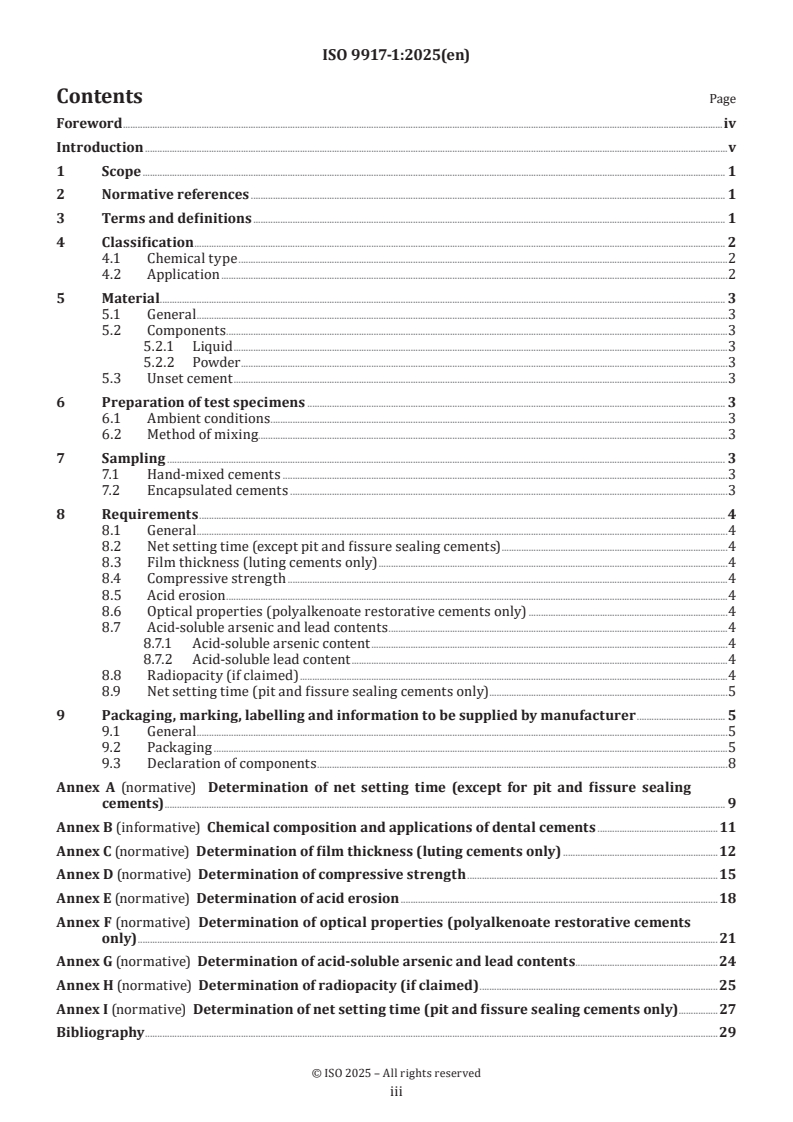

ISO 9917-1:2025 - Dentistry — Water-based cements — Part 1: Acid-base cements Released:27. 05. 2025

ISO 9917-1:2025 - Dentistry — Water-based cements — Part 1: Acid-base cements Released:10/8/2025

ISO 9917-1:2025 - Médecine bucco-dentaire — Ciments a base d’eau — Partie 1: Ciments acido-basiques Released:27. 05. 2025
Overview
ISO 9917-1:2025 - Dentistry - Water‑based cements - Part 1: Acid‑base cements specifies requirements and test methods for acid‑base, water‑based dental cements used for permanent cementation, lining and restoration. The third edition applies to both hand‑mixed and encapsulated cements intended for mechanical mixing and excludes resin‑modified water‑based and non‑acid‑base materials (e.g., calcium silicate–based cements). It defines limits and test procedures according to the intended application: luting agent, base/liner, restorative material or pit and fissure sealing cement.
Key topics and technical requirements
ISO 9917-1:2025 covers material, classification, testing and information that manufacturers and test labs must provide. Major technical topics include:
- Classification by chemical type (e.g., zinc phosphate, zinc polycarboxylate, glass polyalkenoate) and by application (luting, base/liner, restorative, pit & fissure sealing).
- Material requirements for powder and liquid components and for the unset mixed cement (homogeneity, absence of deposits).
- Test methods and limits for properties such as:
- Net setting time (separate methods for general use and pit & fissure sealing)
- Film thickness (for luting cements)
- Compressive strength
- Acid erosion
- Optical properties (polyalkenoate restorative cements)
- Acid‑soluble arsenic and lead contents
- Radiopacity (if the manufacturer claims it)
- Sampling, preparation and ambient conditions for test specimens (23 ±1 °C; 50 ±10 % RH) and specified mixing procedures.
- Packaging, marking and labelling requirements, including a declaration of components and information the manufacturer must supply.
Normative annexes (A–I) provide step‑by‑step test procedures for all referenced measurements (e.g., net setting time, film thickness, radiopacity).
Applications and users
Who uses ISO 9917-1:2025:
- Dental product manufacturers - to design, test and certify acid‑base cements for specific clinical uses.
- Test laboratories and quality control teams - to perform standardized measurements and compliance testing.
- Regulatory bodies and conformity assessors - to evaluate product safety, labelling and performance claims.
- Dental researchers and R&D - for comparative testing and material development.
- Procurement and clinicians - to understand performance claims (e.g., setting time, compressive strength, radiopacity) when selecting cements.
Related standards
- ISO 10993‑1 and ISO 7405 (biological/toxicological assessment recommendations)
- ISO 13116 (radiopacity test method adopted)
- ISO 1942 (dentistry vocabulary)
- Other ISO 9917 series parts for complementary guidance
Using ISO 9917-1:2025 helps ensure consistent, testable performance of acid‑base dental cements and supports regulatory compliance, product claims and clinical reliability.
Relations
- Effective Date
- 12-Feb-2026
- Effective Date
- 06-Jun-2022
- Effective Date
- 16-Jun-2018
Buy Documents
ISO 9917-1:2025 - Dentistry — Water-based cements — Part 1: Acid-base cements Released:27. 05. 2025
ISO 9917-1:2025 - Dentistry — Water-based cements — Part 1: Acid-base cements Released:10/8/2025
ISO 9917-1:2025 - Médecine bucco-dentaire — Ciments a base d’eau — Partie 1: Ciments acido-basiques Released:27. 05. 2025
Get Certified
Connect with accredited certification bodies for this standard

BSI Group
BSI (British Standards Institution) is the business standards company that helps organizations make excellence a habit.

TÜV Rheinland
TÜV Rheinland is a leading international provider of technical services.

TÜV SÜD
TÜV SÜD is a trusted partner of choice for safety, security and sustainability solutions.
Sponsored listings
Frequently Asked Questions
ISO 9917-1:2025 is a standard published by the International Organization for Standardization (ISO). Its full title is "Dentistry — Water-based cements — Part 1: Acid-base cements". This standard covers: This document specifies requirements and test methods for acid-base, dental cements intended for permanent cementation, lining and restoration. This document is not intended to address resin-modified water-based cements. This document is applicable to both hand-mixed and encapsulated cements for mechanical mixing. This document specifies limits for each of the properties according to whether the cement is intended for use as a luting agent, base or liner, restorative material or pit and fissure sealing cement.
This document specifies requirements and test methods for acid-base, dental cements intended for permanent cementation, lining and restoration. This document is not intended to address resin-modified water-based cements. This document is applicable to both hand-mixed and encapsulated cements for mechanical mixing. This document specifies limits for each of the properties according to whether the cement is intended for use as a luting agent, base or liner, restorative material or pit and fissure sealing cement.
ISO 9917-1:2025 is classified under the following ICS (International Classification for Standards) categories: 11.060.10 - Dental materials. The ICS classification helps identify the subject area and facilitates finding related standards.
ISO 9917-1:2025 has the following relationships with other standards: It is inter standard links to EN ISO 9917-1:2025, ISO 18743:2015, ISO 9917-1:2007. Understanding these relationships helps ensure you are using the most current and applicable version of the standard.
ISO 9917-1:2025 is available in PDF format for immediate download after purchase. The document can be added to your cart and obtained through the secure checkout process. Digital delivery ensures instant access to the complete standard document.
Standards Content (Sample)
International
Standard
ISO 9917-1
Third edition
Dentistry — Water-based
2025-05
cements —
Part 1:
Acid-base cements
Médecine bucco-dentaire — Ciments à base d’eau —
Partie 1: Ciments acido-basiques
Reference number
© ISO 2025
All rights reserved. Unless otherwise specified, or required in the context of its implementation, no part of this publication may
be reproduced or utilized otherwise in any form or by any means, electronic or mechanical, including photocopying, or posting on
the internet or an intranet, without prior written permission. Permission can be requested from either ISO at the address below
or ISO’s member body in the country of the requester.
ISO copyright office
CP 401 • Ch. de Blandonnet 8
CH-1214 Vernier, Geneva
Phone: +41 22 749 01 11
Email: copyright@iso.org
Website: www.iso.org
Published in Switzerland
ii
Contents Page
Foreword .iv
Introduction .v
1 Scope . 1
2 Normative references . 1
3 Terms and definitions . 1
4 Classification . 2
4.1 Chemical type .2
4.2 Application .2
5 Material. 3
5.1 General .3
5.2 Components .3
5.2.1 Liquid .3
5.2.2 Powder .3
5.3 Unset cement .3
6 Preparation of test specimens . 3
6.1 Ambient conditions.3
6.2 Method of mixing.3
7 Sampling . 3
7.1 Hand-mixed cements .3
7.2 Encapsulated cements .3
8 Requirements . 4
8.1 General .4
8.2 Net setting time (except pit and fissure sealing cements) .4
8.3 Film thickness (luting cements only) .4
8.4 Compressive strength .4
8.5 Acid erosion .4
8.6 Optical properties (polyalkenoate restorative cements only) .4
8.7 Acid-soluble arsenic and lead contents .4
8.7.1 Acid-soluble arsenic content .4
8.7.2 Acid-soluble lead content .4
8.8 Radiopacity (if claimed) .4
8.9 Net setting time (pit and fissure sealing cements only) .5
9 Packaging, marking, labelling and information to be supplied by manufacturer . 5
9.1 General .5
9.2 Packaging .5
9.3 Declaration of components .8
Annex A (normative) Determination of net setting time (except for pit and fissure sealing
cements) . 9
Annex B (informative) Chemical composition and applications of dental cements .11
Annex C (normative) Determination of film thickness (luting cements only) .12
Annex D (normative) Determination of compressive strength .15
Annex E (normative) Determination of acid erosion .18
Annex F (normative) Determination of optical properties (polyalkenoate restorative cements
only) .21
Annex G (normative) Determination of acid-soluble arsenic and lead contents .24
Annex H (normative) Determination of radiopacity (if claimed) .25
Annex I (normative) Determination of net setting time (pit and fissure sealing cements only) .27
Bibliography .29
iii
Foreword
ISO (the International Organization for Standardization) is a worldwide federation of national standards
bodies (ISO member bodies). The work of preparing International Standards is normally carried out through
ISO technical committees. Each member body interested in a subject for which a technical committee
has been established has the right to be represented on that committee. International organizations,
governmental and non-governmental, in liaison with ISO, also take part in the work. ISO collaborates closely
with the International Electrotechnical Commission (IEC) on all matters of electrotechnical standardization.
The procedures used to develop this document and those intended for its further maintenance are described
in the ISO/IEC Directives, Part 1. In particular, the different approval criteria needed for the different types
of ISO documents should be noted. This document was drafted in accordance with the editorial rules of the
ISO/IEC Directives, Part 2 (see www.iso.org/directives).
ISO draws attention to the possibility that the implementation of this document may involve the use of (a)
patent(s). ISO takes no position concerning the evidence, validity or applicability of any claimed patent
rights in respect thereof. As of the date of publication of this document, ISO had not received notice of (a)
patent(s) which may be required to implement this document. However, implementers are cautioned that
this may not represent the latest information, which may be obtained from the patent database available at
www.iso.org/patents. ISO shall not be held responsible for identifying any or all such patent rights.
Any trade name used in this document is information given for the convenience of users and does not
constitute an endorsement.
For an explanation of the voluntary nature of standards, the meaning of ISO specific terms and expressions
related to conformity assessment, as well as information about ISO's adherence to the World Trade
Organization (WTO) principles in the Technical Barriers to Trade (TBT), see www.iso.org/iso/foreword.html.
This document was prepared by Technical Committee ISO/TC 106, Dentistry, Subcommittee SC 1, Filling and
restorative materials, in collaboration with the European Committee for Standardization (CEN) Technical
Committee CEN/TC 55, Dentistry, in accordance with the Agreement on technical cooperation between ISO
and CEN (Vienna Agreement).
This third edition cancels and replaces the second edition (ISO 9917-1:2007), which has been technically
revised.
The main changes are as follows:
— change of the title;
— inclusion of pit and fissure sealing cements in the scope;
— adoption of ISO 13116 test method for radiopacity;
— adoption of table-type formatting of requirements of marking and information;
— addition of declaration of components;
— addition of Annex I.
A list of all parts of the ISO 9917 series can be found on the ISO website.
Any feedback or questions on this document should be directed to the user’s national standards body. A
complete listing of these bodies can be found at www.iso.org/members.html.
iv
Introduction
This document specifies the requirements and test methods for cements in which setting is achieved by an
acid-base reaction.
This document does not include specific qualitative and quantitative requirements for ensuring the absence
of biological hazards. It is recommended that reference be made to ISO 10993-1 and ISO 7405 when assessing
possible biological or toxicological hazards.
v
International Standard ISO 9917-1:2025(en)
Dentistry — Water-based cements —
Part 1:
Acid-base cements
1 Scope
This document specifies requirements and test methods for acid-base, dental cements intended for permanent
cementation, lining and restoration. This document is not intended to address resin-modified water-based
cements. This document is applicable to both hand-mixed and encapsulated cements for mechanical mixing.
This document specifies limits for each of the properties according to whether the cement is intended for
use as a luting agent, base or liner, restorative material or pit and fissure sealing cement.
2 Normative references
The following documents are referred to in the text in such a way that some or all of their content constitutes
requirements of this document. For dated references, only the edition cited applies. For undated references,
the latest edition of the referenced document (including any amendments) applies.
ISO 1942, Dentistry — Vocabulary
1)
ISO 2590, General method for the determination of arsenic — Silver diethyldithiocarbamate photometric method
ISO 3696, Water for analytical laboratory use — Specification and test methods
ISO 7491, Dental materials — Determination of colour stability
ISO 8601-1, Date and time — Representations for information interchange — Part 1: Basic rules
ISO 13116, Dentistry — Test method for determining radio-opacity of materials
ISO 15223-1, Medical devices — Symbols to be used with information to be supplied by the manufacturer — Part
1: General requirements
ISO 20417, Medical devices — Information to be supplied by the manufacturer
3 Terms and definitions
For the purposes of this document, the terms and definitions given in ISO 1942 and the following apply.
ISO and IEC maintain terminology databases for use in standardization at the following addresses:
— ISO Online browsing platform: available at https:// www .iso .org/ obp
— IEC Electropedia: available at https:// www .electropedia .org/
1) Withdrawn.
3.1
mixing time
time measured from first contact between the components of a material, required to achieve a homogeneous
mixture of the components when they have been stored, proportioned and mixed according to the
manufacturer’s instructions
[SOURCE: ISO 1942:2020, 3.3.1.36]
3.2
working time
period of time measured from the commencement of mixing the components of a material or otherwise
activating the chemistry of the material and ending before the material has developed properties that
prevent it from being manipulated as required to achieve its purpose in a subsequent procedure or in its
intended end function
[SOURCE: ISO 1942:2020, 3.3.3.22]
3.3
net setting time
period of time from the end of mixing until the material has set according to the criteria and conditions
specified in Annex A and Annex I
Note 1 to entry: For the purposes of this document, in view of the wide variation in mixing times of cements, the net
setting time is determined from the end of mixing.
3.4
encapsulated cements
acid-base cements packaged as a unit dose whose packaging includes the powder and the liquid for mixing at
the time of use by some mechanical means other than hand apportioning
Note 1 to entry: The alternative to an encapsulated cement is a hand-mixed cement.
4 Classification
4.1 Chemical type
For the purposes of this document, acid-base cements shall be classified on the basis of their chemical
composition as follows:
a) zinc phosphate cements, see Clause B.1;
b) zinc polycarboxylate cements, see Clause B.2;
c) glass polyalkenoate cements, see Clause B.3.
Acid-base reaction setting, water-based cements other than those listed above can fall within the scope of
this document. A manufacturer shall specify whether their product shall conform to the specifications for
list items a), b) or c) and 4.2.
NOTE Materials that do not involve an acid-base reaction (e.g., “calcium silicate-based cement”) are not covered
by this document.
4.2 Application
For the purposes of this document, the applications of water-based cements shall be classified as follows:
a) luting agent;
b) bases or liner;
c) restorative material;
d) pit and fissure sealing cement.
5 Material
5.1 General
The cement shall consist of a powder and liquid which, when mixed in accordance with the manufacturer’s
instructions, shall conform to requirements in this clause and Clause 8.
5.2 Components
5.2.1 Liquid
For non-encapsulated cements, visually inspect the liquid. It shall be free from deposits or filaments on the
inside of its container. There shall be no visible signs of gelation, i.e. no formation of insoluble or solid matter.
5.2.2 Powder
For non-encapsulated cements, visually inspect the powder. It shall be free from extraneous material. If the
powder is coloured, the pigment shall be uniformly dispersed throughout the powder.
5.3 Unset cement
The cement shall be mixed in accordance with Clause 6, and then visually inspected. It shall be homogeneous
and of a smooth consistency.
6 Preparation of test specimens
6.1 Ambient conditions
Specimens shall be prepared at (23 ± 1) °C and a relative humidity of (50 ± 10) %.
6.2 Method of mixing
The cement shall be prepared in accordance with the manufacturer’s instructions. Sufficient cement shall
be mixed to ensure that the preparation of each specimen is completed from one mix. A fresh mix shall be
prepared for each specimen.
NOTE For encapsulated cements, more than one capsule simultaneously mixed can be required for certain
specimens.
7 Sampling
7.1 Hand-mixed cements
A sample drawn from one batch shall provide sufficient material to complete all the prescribed tests and any
necessary repeats.
NOTE Approximately 50 g of powder can be necessary to complete the tests.
7.2 Encapsulated cements
The test sample shall comprise a retail package of enough capsules from one batch to complete all the tests
and any necessary repeats.
8 Requirements
8.1 General
Calibrate all critical apparatus in accordance with the general requirements for the competence of testing
and calibration laboratories; see ISO/IEC 17025.
8.2 Net setting time (except pit and fissure sealing cements)
Net setting time shall be determined in accordance with Annex A and in accordance with the relevant
requirements specified in Table 1.
8.3 Film thickness (luting cements only)
Film thickness shall be determined in accordance with Annex C and in accordance with the relevant
requirements specified in Table 1.
8.4 Compressive strength
Compressive strength shall be determined in accordance with Annex D and in accordance with the relevant
requirements specified in Table 1.
8.5 Acid erosion
Acid erosion shall be determined in accordance with Annex E and in accordance with the relevant
requirements specified in Table 1.
8.6 Optical properties (polyalkenoate restorative cements only)
Opacity and colour shall be determined in accordance with Annex F and shall meet the following
requirements:
a) The opacity of the set restorative cements shall be within the limits specified in Table 1, unless the
restorative cement is designated as opaque by the manufacturer (see Table 2, item 13).
b) The colour of the set cement shall match the manufacturer’s shade guide. If the manufacturer does not
provide a shade guide, the manufacturer shall nominate a commercially available shade guide that shall
be used in assessing conformity with this requirement (see Table 2, item 12).
8.7 Acid-soluble arsenic and lead contents
8.7.1 Acid-soluble arsenic content
Acid-soluble arsenic content shall be determined in accordance with Annex G and in accordance with the
relevant requirements specified in Table 1.
8.7.2 Acid-soluble lead content
Acid-soluble lead content shall be determined in accordance with Annex G and in accordance with the
relevant requirements specified in Table 1.
8.8 Radiopacity (if claimed)
When the manufacturer describes the material as being radio-opaque (see Table 2, item 14), the radiopacity
shall be determined in accordance with Clause H.5, list item a) and shall be at least equivalent to that for the
same thickness of aluminium. When the manufacturer claims a greater radiopacity (see Table 2, item 15),
the measured value shall not be less than the value claimed when determined in accordance with Clause H.5,
list item b).
8.9 Net setting time (pit and fissure sealing cements only)
Net setting time shall be determined in accordance with Annex I and in accordance with the relevant
requirements specified in Table 1.
Table 1 — Requirements for acid-base cements
Film Com- Acid Acid-sol- Acid-sol-
Net setting
thick- pressive ero- uble As uble Pb
Opacity
time
ness strength sion content content
C
Application Chemical type
0,70
µm minutes MPa mm mg/kg mg/kg
max. min. max. min. max. min. max. max. max.
Zinc phosphate 25 2,5 8 50 0,30 ― ― 2 100
Luting Zinc polycarboxylate 25 2,5 8 50 0,40 ― ― 2 100
a
Glass polyalkenoate 25 1,5 8 50 0,17 ― ― ― 100
Zinc phosphate ― 2,0 6 50 0,30 ― ― 2 100
Base/lining Zinc polycarboxylate ― 2,0 6 50 0,40 ― ― 2 100
a
Glass polyalkenoate ― 1,5 6 50 0,17 ― ― ― 100
a
Restoration Glass polyalkenoate ― 1,5 6 100 0,17 0,35 0,90 ― 100
Pit and fissure ― 1,5 6 50 0,17 ― ― ―
a
Glass polyalkenoate 5
sealing
a
Synonymous with “glass-ionomer”.
9 Packaging, marking, labelling and information to be supplied by manufacturer
9.1 General
Information shall be clearly marked on the outermost packaging or containers (for multi-dose packs), as
indicated in Table 2 and conform to ISO 20417.
Visually inspect to verify the requirements in Table 2.
NOTE 1 Additional information to that specified in Table 2 can be supplied at the discretion of the manufacturer or
as required by regulation.
NOTE 2 Table 2 contains optional items and serves as a guide to the manufacturer as to the type of information
which can be useful to clinicians.
9.2 Packaging
a) The cements shall be supplied in containers or capsules that afford adequate protection and have no
adverse effect on the quality of the contents.
b) For the purposes of this document, a container or capsule shall be considered to be the immediate
packaging of the cements.
c) The outermost packaging contains the material, the instructions for use and any proportioning or
mixing devices that are supplied for the material.
d) An outer pack may also be used to present the containers or capsules as a single unit.
Table 2 — Requirements for marking and instructions for use
Outer
pack of
Outer- Manufacturer’s
capsule(s) Capsule
Items of marking and instructions for use most pack- instructions for
/ multiple (single dose)
aging use
dose con-
tainer
The trade name, type and application of the ce-
1 M M NA M
ment
Either the manufacturer’s name or trademark, or
2 M M OPT M
both.
3 The manufacturer’s name and contact details M OPT NA M
The manufacturer’s internet address (URL), if one
exists, is optional. However, where instructions
for use are provided on a medium other than
paper, the manufacturer should ensure the user
4 OPT OPT NA OPT
has information on how to: view the instructions
for use; access the correct version of the instruc-
tions for use; and obtain a paper version of the
instructions for use.
5 The recommended conditions of storage M OPT NA M
6 The manufacturer’s batch or lot number M M OPT NA
The expiry date, expressed in accordance with ISO
8601-1, for the material if stored under the manu-
facturer’s recommended conditions
7 M M OPT NA
Graphical symbols in accordance with ISO 15223-
1, if applicable, to avoid confusion of sizes or kits
8 The chemical type of the cement (see 4.1) M OPT OPT M
9 The clinical application (see 4.2) OPT OPT NA M
If the product is an encapsulated type, the number
10 M M NA NA
c
of capsules in the outer pack
The minimum net mass, in g, of the powder or
11 the minimum net volume, in ml, of the liquid as OPT M OPT OPT
appropriate
M
The shade of the powder according to
12 OPT M OPT (shade guide or
the manufacturer’s nominated shade guide
designation of it)
a
13 Whether the cement is designated as opaque M M OPT M
14 Whether the cement is designated as radio-opaque OPT OPT OPT M
If a specific claim on the extent of radiopacity
15 is made, the equivalent thickness of aluminium OPT OPT NA M
claimed for 1 mm thickness of the cement (see 8.8)
Key
M mandatory
OPT optional
NA not applicable
a
Opaque designation can be included in the shade.
b
For hand-mixed cements only.
c
For encapsulated cements only.
TTabablele 2 2 ((ccoonnttiinnueuedd))
Outer
pack of
Outer- Manufacturer’s
capsule(s) Capsule
Items of marking and instructions for use most pack- instructions for
/ multiple (single dose)
aging use
dose con-
tainer
The recommended powder-to-liquid ratio, ex-
pressed as a mass-to-mass ratio for the recom-
mended temperature range, and an indication of
how the user may achieve this ratio
16 OPT OPT NA M
[for test purposes, the powder-to-liquid ratio on
a mass-to-mass basis to a precision of 0,01 g at
(23 ± 2) °C and a relative humidity of (50 ± 10) %
b
shall be included]
The rate of incorporation of the powder into the
17 OPT OPT NA M
b
liquid
18 The mixing time (see 3.1) OPT OPT NA M
The type of the mixing slab and spatula and their
19 OPT OPT NA M
b
condition
The method of bringing about physical contact
20 OPT OPT NA M
c
between the powder and liquid
The type of mechanical mixing device and the
21 OPT OPT NA M
c
mixing time to be employed
22 The working time (see 3.2) OPT OPT NA M
23 The net setting time (see 3.3) OPT OPT NA M
If appropriate, a statement recommending that a
24 liner should be placed between the cement and the NA NA NA OPT
dentine
The minimum deliverable volume, in ml, of mixed
25 OPT OPT NA M
c
cement in one capsule
If appropriate, the minimum time at which finish-
26 OPT OPT NA OPT
ing of a restorative may be commenced
If appropriate, the recommended method of finish-
27 OPT OPT NA OPT
ing of a restorative
If appropriate, a statement indicating that the
surface of the restorative shall be coated with a
28 OPT OPT NA OPT
protective coating and guidance on the type of
coating to be used
When necessary, special indications or warnings
in respect of properties like toxicity, hazard, flam-
29 OPT OPT OPT M
mability or tissue irritancy, for both patient and
operator
30 Date of issue of the instructions NA NA NA M
Key
M mandatory
OPT optional
NA not applicable
a
Opaque designation can be included in the shade.
b
For hand-mixed cements only.
c
For encapsulated cements only.
9.3 Declaration of components
The manufacturer shall provide, either in the instructions for use or by means of a safety data sheet, the
composition and information on components present in the material ≥ 1 % by mass (irrespective of hazard
potential) and any ingredient that is classified as a carcinogen, mutagen or reproductive toxicant (CMR)
present in the material ≥ 0,1 % by mass.
The list shall include a chemical name or its common abbreviation, if available (e.g. bis-GMA, HEMA,
TEGDMA). The Chemical Abstracts Service registry number (CAS number) may be used.
Either the mass percentage range for each listed component or a listing in the order of mass from the highest
to the lowest concentration shall be provided.
NOTE CMR is defined in authoritative lists. See examples in References [4], [5], [6] and [7].
The manufacturer may include additional information at their discretion.
Annex A
(normative)
Determination of net setting time (except for pit and fissure sealing
cements)
A.1 Apparatus
A.1.1 Cabinet, capable of being maintained at (37 ± 1) °C and a relative humidity of at least 90 %.
A.1.2 Indentor, of mass (400 ± 5) g, with a needle that has a flat end of diameter (1,0 ± 0,1) mm which is
plane and perpendicular to the long axis of the needle.
A.1.3 Metal mould, similar to that shown in Figure A.1. Internal corners may be square or round.
A.1.4 Metal block, of minimum dimensions 8 mm × 75 mm × 100 mm positioned within the cabinet and
maintained at (37 ± 1) °C.
A.1.5 Aluminium foil.
A.1.6 Timer, accurate to 1 s.
A.1.7 Magnifier, capable of ×2 magnification.
Dimensions in millimetres
Tolerance on dimensions:
Thickness: ±0,15
Length: ±1,0
Figure A.1 — Mould for preparation of specimens for determination of net setting time
A.2 Procedure
A.2.1 Preliminary measurement of approximate net setting time
1) Condition the metal block (A.1.4) and indentor (A.1.2) to (37 ± 1) °C.
2) Place the mould (A.1.3), conditioned to (23 ± 1) °C, on the aluminium foil (A.1.5).
3) Mix the cement as required by the manufacturer’s instructions. When mixing is complete, start the
timer (A.1.6).
4) Fill the mould to a level surface with the mixed cement.
5) Sixty seconds after mixing is complete, place the assembly, comprising the mould, foil and cement, on
the block (A.1.4) in the cabinet (A.1.1), ensuring good contact between the mould, foil and block.
6) Ninety seconds after mixing is complete, carefully low
...
International
Standard
ISO 9917-1
Third edition
Dentistry — Water-based
2025-05
cements —
Corrected version
Part 1:
2025-10
Acid-base cements
Médecine bucco-dentaire — Ciments à base d’eau —
Partie 1: Ciments acido-basiques
Reference number
© ISO 2025
All rights reserved. Unless otherwise specified, or required in the context of its implementation, no part of this publication may
be reproduced or utilized otherwise in any form or by any means, electronic or mechanical, including photocopying, or posting on
the internet or an intranet, without prior written permission. Permission can be requested from either ISO at the address below
or ISO’s member body in the country of the requester.
ISO copyright office
CP 401 • Ch. de Blandonnet 8
CH-1214 Vernier, Geneva
Phone: +41 22 749 01 11
Email: copyright@iso.org
Website: www.iso.org
Published in Switzerland
ii
Contents Page
Foreword .iv
Introduction .v
1 Scope . 1
2 Normative references . 1
3 Terms and definitions . 1
4 Classification . 2
4.1 Chemical type .2
4.2 Application .2
5 Material. 3
5.1 General .3
5.2 Components .3
5.2.1 Liquid .3
5.2.2 Powder .3
5.3 Unset cement .3
6 Preparation of test specimens . 3
6.1 Ambient conditions.3
6.2 Method of mixing.3
7 Sampling . 3
7.1 Hand-mixed cements .3
7.2 Encapsulated cements .3
8 Requirements . 4
8.1 General .4
8.2 Net setting time (except pit and fissure sealing cements) .4
8.3 Film thickness (luting cements only) .4
8.4 Compressive strength .4
8.5 Acid erosion .4
8.6 Optical properties (polyalkenoate restorative cements only) .4
8.7 Acid-soluble arsenic and lead contents .4
8.7.1 Acid-soluble arsenic content .4
8.7.2 Acid-soluble lead content .4
8.8 Radiopacity (if claimed) .4
8.9 Net setting time (pit and fissure sealing cements only) .5
9 Packaging, marking, labelling and information to be supplied by manufacturer . 5
9.1 General .5
9.2 Packaging .5
9.3 Declaration of components .8
Annex A (normative) Determination of net setting time (except for pit and fissure sealing
cements) . 9
Annex B (informative) Chemical composition and applications of dental cements .11
Annex C (normative) Determination of film thickness (luting cements only) .12
Annex D (normative) Determination of compressive strength .15
Annex E (normative) Determination of acid erosion .18
Annex F (normative) Determination of optical properties (polyalkenoate restorative cements
only) .21
Annex G (normative) Determination of acid-soluble arsenic and lead contents .24
Annex H (normative) Determination of radiopacity (if claimed) .25
Annex I (normative) Determination of net setting time (pit and fissure sealing cements only) .27
iii
Foreword
ISO (the International Organization for Standardization) is a worldwide federation of national standards
bodies (ISO member bodies). The work of preparing International Standards is normally carried out through
ISO technical committees. Each member body interested in a subject for which a technical committee
has been established has the right to be represented on that committee. International organizations,
governmental and non-governmental, in liaison with ISO, also take part in the work. ISO collaborates closely
with the International Electrotechnical Commission (IEC) on all matters of electrotechnical standardization.
The procedures used to develop this document and those intended for its further maintenance are described
in the ISO/IEC Directives, Part 1. In particular, the different approval criteria needed for the different types
of ISO documents should be noted. This document was drafted in accordance with the editorial rules of the
ISO/IEC Directives, Part 2 (see www.iso.org/directives).
ISO draws attention to the possibility that the implementation of this document may involve the use of (a)
patent(s). ISO takes no position concerning the evidence, validity or applicability of any claimed patent
rights in respect thereof. As of the date of publication of this document, ISO had not received notice of (a)
patent(s) which may be required to implement this document. However, implementers are cautioned that
this may not represent the latest information, which may be obtained from the patent database available at
www.iso.org/patents. ISO shall not be held responsible for identifying any or all such patent rights.
Any trade name used in this document is information given for the convenience of users and does not
constitute an endorsement.
For an explanation of the voluntary nature of standards, the meaning of ISO specific terms and expressions
related to conformity assessment, as well as information about ISO's adherence to the World Trade
Organization (WTO) principles in the Technical Barriers to Trade (TBT), see www.iso.org/iso/foreword.html.
This document was prepared by Technical Committee ISO/TC 106, Dentistry, Subcommittee SC 1, Filling and
restorative materials, in collaboration with the European Committee for Standardization (CEN) Technical
Committee CEN/TC 55, Dentistry, in accordance with the Agreement on technical cooperation between ISO
and CEN (Vienna Agreement).
This third edition cancels and replaces the second edition (ISO 9917-1:2007), which has been technically
revised.
The main changes are as follows:
— change of the title;
— inclusion of pit and fissure sealing cements in the scope;
— adoption of ISO 13116 test method for radiopacity;
— adoption of table-type formatting of requirements of marking and information;
— addition of declaration of components;
— addition of Annex I.
A list of all parts of the ISO 9917 series can be found on the ISO website.
Any feedback or questions on this document should be directed to the user’s national standards body. A
complete listing of these bodies can be found at www.iso.org/members.html.
This corrected version of ISO 9917-1:2024 incorporates the following correction:
— the formula in Clause D.3 has been corrected.
iv
Introduction
This document specifies the requirements and test methods for cements in which setting is achieved by an
acid-base reaction.
This document does not include specific qualitative and quantitative requirements for ensuring the absence
of biological hazards. It is recommended that reference be made to ISO 10993-1 and ISO 7405 when assessing
possible biological or toxicological hazards.
v
International Standard ISO 9917-1:2025(en)
Dentistry — Water-based cements —
Part 1:
Acid-base cements
1 Scope
This document specifies requirements and test methods for acid-base, dental cements intended for permanent
cementation, lining and restoration. This document is not intended to address resin-modified water-based
cements. This document is applicable to both hand-mixed and encapsulated cements for mechanical mixing.
This document specifies limits for each of the properties according to whether the cement is intended for
use as a luting agent, base or liner, restorative material or pit and fissure sealing cement.
2 Normative references
The following documents are referred to in the text in such a way that some or all of their content constitutes
requirements of this document. For dated references, only the edition cited applies. For undated references,
the latest edition of the referenced document (including any amendments) applies.
ISO 1942, Dentistry — Vocabulary
1)
ISO 2590, General method for the determination of arsenic — Silver diethyldithiocarbamate photometric method
ISO 3696, Water for analytical laboratory use — Specification and test methods
ISO 7491, Dental materials — Determination of colour stability
ISO 8601-1, Date and time — Representations for information interchange — Part 1: Basic rules
ISO 13116, Dentistry — Test method for determining radio-opacity of materials
ISO 15223-1, Medical devices — Symbols to be used with information to be supplied by the manufacturer — Part
1: General requirements
ISO 20417, Medical devices — Information to be supplied by the manufacturer
3 Terms and definitions
For the purposes of this document, the terms and definitions given in ISO 1942 and the following apply.
ISO and IEC maintain terminology databases for use in standardization at the following addresses:
— ISO Online browsing platform: available at https:// www .iso .org/ obp
— IEC Electropedia: available at https:// www .electropedia .org/
1) Withdrawn.
3.1
mixing time
time measured from first contact between the components of a material, required to achieve a homogeneous
mixture of the components when they have been stored, proportioned and mixed according to the
manufacturer’s instructions
[SOURCE: ISO 1942:2020, 3.3.1.36]
3.2
working time
period of time measured from the commencement of mixing the components of a material or otherwise
activating the chemistry of the material and ending before the material has developed properties that
prevent it from being manipulated as required to achieve its purpose in a subsequent procedure or in its
intended end function
[SOURCE: ISO 1942:2020, 3.3.3.22]
3.3
net setting time
period of time from the end of mixing until the material has set according to the criteria and conditions
specified in Annex A and Annex I
Note 1 to entry: For the purposes of this document, in view of the wide variation in mixing times of cements, the net
setting time is determined from the end of mixing.
3.4
encapsulated cements
acid-base cements packaged as a unit dose whose packaging includes the powder and the liquid for mixing at
the time of use by some mechanical means other than hand apportioning
Note 1 to entry: The alternative to an encapsulated cement is a hand-mixed cement.
4 Classification
4.1 Chemical type
For the purposes of this document, acid-base cements shall be classified on the basis of their chemical
composition as follows:
a) zinc phosphate cements, see Clause B.1;
b) zinc polycarboxylate cements, see Clause B.2;
c) glass polyalkenoate cements, see Clause B.3.
Acid-base reaction setting, water-based cements other than those listed above can fall within the scope of
this document. A manufacturer shall specify whether their product shall conform to the specifications for
list items a), b) or c) and 4.2.
NOTE Materials that do not involve an acid-base reaction (e.g., “calcium silicate-based cement”) are not covered
by this document.
4.2 Application
For the purposes of this document, the applications of water-based cements shall be classified as follows:
a) luting agent;
b) bases or liner;
c) restorative material;
d) pit and fissure sealing cement.
5 Material
5.1 General
The cement shall consist of a powder and liquid which, when mixed in accordance with the manufacturer’s
instructions, shall conform to requirements in this clause and Clause 8.
5.2 Components
5.2.1 Liquid
For non-encapsulated cements, visually inspect the liquid. It shall be free from deposits or filaments on the
inside of its container. There shall be no visible signs of gelation, i.e. no formation of insoluble or solid matter.
5.2.2 Powder
For non-encapsulated cements, visually inspect the powder. It shall be free from extraneous material. If the
powder is coloured, the pigment shall be uniformly dispersed throughout the powder.
5.3 Unset cement
The cement shall be mixed in accordance with Clause 6, and then visually inspected. It shall be homogeneous
and of a smooth consistency.
6 Preparation of test specimens
6.1 Ambient conditions
Specimens shall be prepared at (23 ± 1) °C and a relative humidity of (50 ± 10) %.
6.2 Method of mixing
The cement shall be prepared in accordance with the manufacturer’s instructions. Sufficient cement shall
be mixed to ensure that the preparation of each specimen is completed from one mix. A fresh mix shall be
prepared for each specimen.
NOTE For encapsulated cements, more than one capsule simultaneously mixed can be required for certain
specimens.
7 Sampling
7.1 Hand-mixed cements
A sample drawn from one batch shall provide sufficient material to complete all the prescribed tests and any
necessary repeats.
NOTE Approximately 50 g of powder can be necessary to complete the tests.
7.2 Encapsulated cements
The test sample shall comprise a retail package of enough capsules from one batch to complete all the tests
and any necessary repeats.
8 Requirements
8.1 General
Calibrate all critical apparatus in accordance with the general requirements for the competence of testing
and calibration laboratories; see ISO/IEC 17025.
8.2 Net setting time (except pit and fissure sealing cements)
Net setting time shall be determined in accordance with Annex A and in accordance with the relevant
requirements specified in Table 1.
8.3 Film thickness (luting cements only)
Film thickness shall be determined in accordance with Annex C and in accordance with the relevant
requirements specified in Table 1.
8.4 Compressive strength
Compressive strength shall be determined in accordance with Annex D and in accordance with the relevant
requirements specified in Table 1.
8.5 Acid erosion
Acid erosion shall be determined in accordance with Annex E and in accordance with the relevant
requirements specified in Table 1.
8.6 Optical properties (polyalkenoate restorative cements only)
Opacity and colour shall be determined in accordance with Annex F and shall meet the following
requirements:
a) The opacity of the set restorative cements shall be within the limits specified in Table 1, unless the
restorative cement is designated as opaque by the manufacturer (see Table 2, item 13).
b) The colour of the set cement shall match the manufacturer’s shade guide. If the manufacturer does not
provide a shade guide, the manufacturer shall nominate a commercially available shade guide that shall
be used in assessing conformity with this requirement (see Table 2, item 12).
8.7 Acid-soluble arsenic and lead contents
8.7.1 Acid-soluble arsenic content
Acid-soluble arsenic content shall be determined in accordance with Annex G and in accordance with the
relevant requirements specified in Table 1.
8.7.2 Acid-soluble lead content
Acid-soluble lead content shall be determined in accordance with Annex G and in accordance with the
relevant requirements specified in Table 1.
8.8 Radiopacity (if claimed)
When the manufacturer describes the material as being radio-opaque (see Table 2, item 14), the radiopacity
shall be determined in accordance with Clause H.5, list item a) and shall be at least equivalent to that for the
same thickness of aluminium. When the manufacturer claims a greater radiopacity (see Table 2, item 15),
the measured value shall not be less than the value claimed when determined in accordance with Clause H.5,
list item b).
8.9 Net setting time (pit and fissure sealing cements only)
Net setting time shall be determined in accordance with Annex I and in accordance with the relevant
requirements specified in Table 1.
Table 1 — Requirements for acid-base cements
Film Com- Acid Acid-sol- Acid-sol-
Net setting
thick- pressive ero- uble As uble Pb
Opacity
time
ness strength sion content content
C
Application Chemical type
0,70
µm minutes MPa mm mg/kg mg/kg
max. min. max. min. max. min. max. max. max.
Zinc phosphate 25 2,5 8 50 0,30 ― ― 2 100
Luting Zinc polycarboxylate 25 2,5 8 50 0,40 ― ― 2 100
a
Glass polyalkenoate 25 1,5 8 50 0,17 ― ― ― 100
Zinc phosphate ― 2,0 6 50 0,30 ― ― 2 100
Base/lining Zinc polycarboxylate ― 2,0 6 50 0,40 ― ― 2 100
a
Glass polyalkenoate ― 1,5 6 50 0,17 ― ― ― 100
a
Restoration Glass polyalkenoate ― 1,5 6 100 0,17 0,35 0,90 ― 100
Pit and fissure ― 1,5 6 50 0,17 ― ― ―
a
Glass polyalkenoate 5
sealing
a
Synonymous with “glass-ionomer”.
9 Packaging, marking, labelling and information to be supplied by manufacturer
9.1 General
Information shall be clearly marked on the outermost packaging or containers (for multi-dose packs), as
indicated in Table 2 and conform to ISO 20417.
Visually inspect to verify the requirements in Table 2.
NOTE 1 Additional information to that specified in Table 2 can be supplied at the discretion of the manufacturer or
as required by regulation.
NOTE 2 Table 2 contains optional items and serves as a guide to the manufacturer as to the type of information
which can be useful to clinicians.
9.2 Packaging
a) The cements shall be supplied in containers or capsules that afford adequate protection and have no
adverse effect on the quality of the contents.
b) For the purposes of this document, a container or capsule shall be considered to be the immediate
packaging of the cements.
c) The outermost packaging contains the material, the instructions for use and any proportioning or
mixing devices that are supplied for the material.
d) An outer pack may also be used to present the containers or capsules as a single unit.
Table 2 — Requirements for marking and instructions for use
Outer
pack of
Outer- Manufacturer’s
capsule(s) Capsule
Items of marking and instructions for use most pack- instructions for
/ multiple (single dose)
aging use
dose con-
tainer
The trade name, type and application of the ce-
1 M M NA M
ment
Either the manufacturer’s name or trademark, or
2 M M OPT M
both.
3 The manufacturer’s name and contact details M OPT NA M
The manufacturer’s internet address (URL), if one
exists, is optional. However, where instructions
for use are provided on a medium other than
paper, the manufacturer should ensure the user
4 OPT OPT NA OPT
has information on how to: view the instructions
for use; access the correct version of the instruc-
tions for use; and obtain a paper version of the
instructions for use.
5 The recommended conditions of storage M OPT NA M
6 The manufacturer’s batch or lot number M M OPT NA
The expiry date, expressed in accordance with ISO
8601-1, for the material if stored under the manu-
facturer’s recommended conditions
7 M M OPT NA
Graphical symbols in accordance with ISO 15223-
1, if applicable, to avoid confusion of sizes or kits
8 The chemical type of the cement (see 4.1) M OPT OPT M
9 The clinical application (see 4.2) OPT OPT NA M
If the product is an encapsulated type, the number
10 M M NA NA
c
of capsules in the outer pack
The minimum net mass, in g, of the powder or
11 the minimum net volume, in ml, of the liquid as OPT M OPT OPT
appropriate
M
The shade of the powder according to
12 OPT M OPT (shade guide or
the manufacturer’s nominated shade guide
designation of it)
a
13 Whether the cement is designated as opaque M M OPT M
14 Whether the cement is designated as radio-opaque OPT OPT OPT M
If a specific claim on the extent of radiopacity
15 is made, the equivalent thickness of aluminium OPT OPT NA M
claimed for 1 mm thickness of the cement (see 8.8)
Key
M mandatory
OPT optional
NA not applicable
a
Opaque designation can be included in the shade.
b
For hand-mixed cements only.
c
For encapsulated cements only.
TTabablele 2 2 ((ccoonnttiinnueuedd))
Outer
pack of
Outer- Manufacturer’s
capsule(s) Capsule
Items of marking and instructions for use most pack- instructions for
/ multiple (single dose)
aging use
dose con-
tainer
The recommended powder-to-liquid ratio, ex-
pressed as a mass-to-mass ratio for the recom-
mended temperature range, and an indication of
how the user may achieve this ratio
16 OPT OPT NA M
[for test purposes, the powder-to-liquid ratio on
a mass-to-mass basis to a precision of 0,01 g at
(23 ± 2) °C and a relative humidity of (50 ± 10) %
b
shall be included]
The rate of incorporation of the powder into the
17 OPT OPT NA M
b
liquid
18 The mixing time (see 3.1) OPT OPT NA M
The type of the mixing slab and spatula and their
19 OPT OPT NA M
b
condition
The method of bringing about physical contact
20 OPT OPT NA M
c
between the powder and liquid
The type of mechanical mixing device and the
21 OPT OPT NA M
c
mixing time to be employed
22 The working time (see 3.2) OPT OPT NA M
23 The net setting time (see 3.3) OPT OPT NA M
If appropriate, a statement recommending that a
24 liner should be placed between the cement and the NA NA NA OPT
dentine
The minimum deliverable volume, in ml, of mixed
25 OPT OPT NA M
c
cement in one capsule
If appropriate, the minimum time at which finish-
26 OPT OPT NA OPT
ing of a restorative may be commenced
If appropriate, the recommended method of finish-
27 OPT OPT NA OPT
ing of a restorative
If appropriate, a statement indicating that the
surface of the restorative shall be coated with a
28 OPT OPT NA OPT
protective coating and guidance on the type of
coating to be used
When necessary, special indications or warnings
in respect of properties like toxicity, hazard, flam-
29 OPT OPT OPT M
mability or tissue irritancy, for both patient and
operator
30 Date of issue of the instructions NA NA NA M
Key
M mandatory
OPT optional
NA not applicable
a
Opaque designation can be included in the shade.
b
For hand-mixed cements only.
c
For encapsulated cements only.
9.3 Declaration of components
The manufacturer shall provide, either in the instructions for use or by means of a safety data sheet, the
composition and information on components present in the material ≥ 1 % by mass (irrespective of hazard
potential) and any ingredient that is classified as a carcinogen, mutagen or reproductive toxicant (CMR)
present in the material ≥ 0,1 % by mass.
The list shall include a chemical name or its common abbreviation, if available (e.g. bis-GMA, HEMA,
TEGDMA). The Chemical Abstracts Service registry number (CAS number) may be used.
Either the mass percentage range for each listed component or a listing in the order of mass from the highest
to the lowest concentration shall be provided.
NOTE CMR is defined in authoritative lists. See examples in References [4], [5], [6] and [7].
The manufacturer may include additional information at their discretion.
Annex A
(normative)
Determination of net setting time (except for pit and fissure sealing
cements)
A.1 Apparatus
A.1.1 Cabinet, capable of being maintained at (37 ± 1) °C and a relative humidity of at least 90 %.
A.1.2 Indentor, of mass (400 ± 5) g, with a needle that has a flat end of diameter (1,0 ± 0,1) mm which is
plane and perpendicular to the long axis of the needle.
A.1.3 Metal mould, similar to that shown in Figure A.1. Internal corners may be square or round.
A.1.4 Metal block, of minimum dimensions 8 mm × 75 mm × 100 mm positioned within the cabinet and
maintained at (37 ± 1) °C.
A.1.5 Aluminium foil.
A.1.6 Timer, accurate to 1 s.
A.1.7 Magnifier, capable of ×2 magnification.
Dimensions in millimetres
Tolerance on dimensions:
Thickness: ±0,15
Length: ±1,0
Figure A.1 — Mould for preparation of specimens for determination of net setting time
A.2 Procedure
A.2.1 Preliminary measurement of approximate net setting time
1) Condition the metal block (A.1.4) and indentor (A.1.2) to (37 ± 1) °C.
2) Place the mould (A.1.3), conditioned to (23 ± 1) °C, on the aluminium foil (A.1.5).
3) Mix the cement as required by the manufacturer’s instructions. When mixing is complete, start the
timer (A.1.6).
4) Fill the mould to a level surface with the mixed cement.
5) Sixty seconds after mixing is complete, place the assembly, comprising the mould, foil and cement, on
the block (A.1.4) in the cabinet (A.1.1), ensuring good contact between the mould, foil and block.
6) Ninety seconds after mixing is complete, carefully lower the indentor (A.1.2) vertically on to the
...
Norme
internationale
ISO 9917-1
Troisième édition
Médecine bucco-dentaire —
2025-05
Ciments à base d’eau —
Partie 1:
Ciments acido-basiques
Dentistry — Water-based cements —
Part 1: Acid-base cements
Numéro de référence
DOCUMENT PROTÉGÉ PAR COPYRIGHT
© ISO 2025
Tous droits réservés. Sauf prescription différente ou nécessité dans le contexte de sa mise en œuvre, aucune partie de cette
publication ne peut être reproduite ni utilisée sous quelque forme que ce soit et par aucun procédé, électronique ou mécanique,
y compris la photocopie, ou la diffusion sur l’internet ou sur un intranet, sans autorisation écrite préalable. Une autorisation peut
être demandée à l’ISO à l’adresse ci-après ou au comité membre de l’ISO dans le pays du demandeur.
ISO copyright office
Case postale 401 • Ch. de Blandonnet 8
CH-1214 Vernier, Genève
Tél.: +41 22 749 01 11
E-mail: copyright@iso.org
Web: www.iso.org
Publié en Suisse
ii
Sommaire Page
Avant-propos .v
Introduction .vi
1 Domaine d’application . 1
2 Références normatives . 1
3 Termes et définitions . 1
4 Classification . 2
4.1 Composition chimique .2
4.2 Application .2
5 Matériau . 3
5.1 Généralités .3
5.2 Composants .3
5.2.1 Liquide .3
5.2.2 Poudre .3
5.3 Ciment avant la prise.3
6 Préparation des éprouvettes . 3
6.1 Conditions ambiantes .3
6.2 Méthode de mélange .3
7 Échantillonnage . 3
7.1 Ciments mélangés manuellement .3
7.2 Ciments conditionnés en capsules .4
8 Exigences . 4
8.1 Généralités .4
8.2 Temps de prise net (à l’exception des ciments de scellement de puits et sillons) .4
8.3 Épaisseur du film (pour les ciments de scellement uniquement) .4
8.4 Résistance à la compression .4
8.5 Érosion acide .4
8.6 Propriétés optiques (pour les ciments de restauration au polyalkénoate uniquement) .4
8.7 Teneurs en plomb et en arsenic en milieu acide.4
8.7.1 Teneur en arsenic en milieu acide .4
8.7.2 Teneur en plomb en milieu acide.4
8.8 Radio-opacité (si déclarée) .5
8.9 Temps de prise net (ciments de scellement de puits et sillons uniquement) .5
9 Emballage, marquage étiquetage et informations à fournir par le fabricant . 5
9.1 Généralités .5
9.2 Emballage .6
9.3 Déclaration des composants .8
Annexe A (normative) Détermination du temps de prise net (sauf pour les ciments de scellement
de puits et sillons) . 9
Annexe B (informative) Compositions chimiques et applications des ciments dentaires .11
Annexe C (normative) Détermination de l’épaisseur du film (pour les ciments de scellement
uniquement) .12
Annexe D (normative) Détermination de la résistance à la compression .15
Annexe E (normative) Détermination de l’érosion acide .18
Annexe F (normative) Détermination des propriétés optiques (pour les ciments de restauration
au polyalkénoate uniquement).21
Annexe G (normative) Détermination des teneurs en plomb et en arsenic en milieu acide .24
Annexe H (normative) Détermination de la radio-opacité (si déclarée) .25
iii
Annexe I (normative) Détermination du temps de prise net (ciments de scellement de puits et
sillons uniquement) .27
Bibliographie .29
iv
Avant-propos
L’ISO (Organisation internationale de normalisation) est une fédération mondiale d’organismes nationaux
de normalisation (comités membres de l’ISO). L’élaboration des Normes internationales est en général
confiée aux comités techniques de l’ISO. Chaque comité membre intéressé par une étude a le droit de faire
partie du comité technique créé à cet effet. Les organisations internationales, gouvernementales et non
gouvernementales, en liaison avec l’ISO participent également aux travaux. L’ISO collabore étroitement avec
la Commission électrotechnique internationale (IEC) en ce qui concerne la normalisation électrotechnique.
Les procédures utilisées pour élaborer le présent document et celles destinées à sa mise à jour sont
décrites dans les Directives ISO/IEC, Partie 1. Il convient, en particulier de prendre note des différents
critères d’approbation requis pour les différents types de documents ISO. Le présent document
a été rédigé conformément aux règles de rédaction données dans les Directives ISO/IEC, Partie 2
(voir www.iso.org/directives).
L’ISO attire l’attention sur le fait que la mise en application du présent document peut entraîner l’utilisation
d’un ou de plusieurs brevets. L’ISO ne prend pas position quant à la preuve, à la validité et à l’applicabilité de tout
droit de propriété revendiqué à cet égard. À la date de publication du présent document, l’ISO n’avait pas reçu
notification qu’un ou plusieurs brevets pouvaient être nécessaires à sa mise en application. Toutefois, il y a lieu
d’avertir les responsables de la mise en application du présent document que des informations plus récentes
sont susceptibles de figurer dans la base de données de brevets, disponible à l’adresse www.iso.org/brevets.
L’ISO ne saurait être tenue pour responsable de ne pas avoir identifié de tels droits de brevet.
Les appellations commerciales éventuellement mentionnées dans le présent document sont données pour
information, par souci de commodité, à l’intention des utilisateurs et ne sauraient constituer un engagement.
Pour une explication de la nature volontaire des normes, la signification des termes et expressions
spécifiques de l’ISO liés à l’évaluation de la conformité, ou pour toute information au sujet de l’adhésion de
l’ISO aux principes de l’Organisation mondiale du commerce (OMC) concernant les obstacles techniques au
commerce (OTC), voir www.iso.org/avant-propos.
Le présent document a été élaboré par le comité ISO/TC 106, Médecine bucco-dentaire, sous-comité SC 1,
Produits pour obturation et restauration, en collaboration avec le comité technique CEN/TC 55, Médecine bucco-
dentaire, du Comité européen de normalisation (CEN), conformément à l’Accord de coopération technique
entre l’ISO et le CEN (Accord de Vienne).
Cette troisième édition annule et remplace la deuxième édition (ISO 9917-1:2007), qui a fait l’objet d’une
révision technique.
Les principales modifications sont les suivantes:
— modification du titre;
— inclusion des ciments de scellement de puits et sillons dans le domaine d’application;
— adoption de la méthode d'essai de l'ISO 13116 pour la radio-opacité;
— adoption d’une présentation sous forme de tableau pour les exigences en matière de marquage et
d’information;
— ajout de la déclaration des composants.
— ajout de l'Annexe I.
Une liste de toutes les parties de la série ISO 9917 se trouve sur le site Web de l’ISO.
Il convient que l’utilisateur adresse tout retour d’information ou toute question concernant le présent
document à l’organisme national de normalisation de son pays. Une liste exhaustive desdits organismes se
trouve à l’adresse www.iso.org/fr/members.html.
v
Introduction
Le présent document spécifie les exigences et les méthodes d’essai relatives aux ciments dont la prise est
obtenue par une réaction acido-basique.
Aucune exigence qualitative et quantitative spécifique garantissant l’absence de risques biologiques n’est
incluse dans le présent document. Il est recommandé que, pour l’évaluation des éventuels risques biologiques
ou toxicologiques, référence soit faite à l’ISO 10993-1 et à l’ISO 7405.
vi
Norme internationale ISO 9917-1:2025(fr)
Médecine bucco-dentaire — Ciments à base d’eau —
Partie 1:
Ciments acido-basiques
1 Domaine d’application
Le présent document spécifie les exigences et les méthodes d’essai relatives aux ciments dentaires acido-
basiques destinés à être utilisés pour scellement, fond de cavité et restauration permanents. Le présent
document ne couvre pas les ciments à base d’eau modifiés par addition de résine. Le présent document est
applicable à la fois aux ciments mélangés manuellement et aux ciments conditionnés en capsules destinés
au mélange mécanique. Le présent document spécifie les limites pour chacune des propriétés selon que
le ciment est destiné à être utilisé comme agent de scellement, ciment pour base ou produit pour fond de
cavité, matériau de restauration ou ciment de scellement de puits et sillons.
2 Références normatives
Les documents suivants sont cités dans le texte de sorte qu’ils constituent, pour tout ou partie de leur
contenu, des exigences du présent document. Pour les références datées, seule l’édition citée s’applique. Pour
les références non datées, la dernière édition du document de référence s’applique (y compris les éventuels
amendements).
ISO 1942, Médecine bucco-dentaire — Vocabulaire
ISO 2590, Méthode générale de dosage de l’arsenic — Méthode photométrique au diéthyldithiocarbamate
1)
d’argent
ISO 3696, Eau pour laboratoire à usage analytique — Spécification et méthodes d'essai
ISO 7491, Produits dentaires — Détermination de la stabilité de couleur
ISO 8601-1, Date et heure — Représentations pour l'échange d'information — Partie 1: Règles de base
ISO 13116, Médecine bucco-dentaire — Méthodes de détermination de la radio opacité des matériaux
ISO 15223-1, Dispositifs médicaux — Symboles à utiliser avec les informations à fournir par le fabricant —
Partie 1: Exigences générales
ISO 20417, Dispositifs médicaux — Informations à fournir par le fabricant
3 Termes et définitions
Pour les besoins du présent document, les termes et les définitions de l’ISO 1942 ainsi que les suivants
s’appliquent.
L’ISO et l’IEC tiennent à jour des bases de données terminologiques destinées à être utilisées en normalisation,
consultables aux adresses suivantes:
— ISO Online browsing platform: disponible à l’adresse https:// www .iso .org/ obp
— IEC Electropedia: disponible à l’adresse https:// www .electropedia .org/
1) Annulée.
3.1
temps de mélange
temps mesurée à partir du premier contact entre les composants d’un produit et le moment où l’on obtient
un mélange homogène des composants lorsqu’ils ont été stockés, proportionnés et mélangés conformément
aux instructions du fabricant
[SOURCE: ISO 1942:2020, 3.3.1.36]
3.2
temps de travail
temps mesuré entre le début du mélange des composants d’un produit ou de l’activation des substances
chimiques du produit, et le moment où le produit a développé des propriétés qui l’empêchent d’être manipulé
comme requis pour atteindre son aptitude à l’emploi dans les techniques subséquentes ou dans sa fonction
finale prévue
[SOURCE: ISO 1942:2020, 3.3.3.22]
3.3
temps de prise net
temps allant de la fin du mélange jusqu’à ce que le produit ait pris selon les critères et les conditions spécifiés
dans l’Annexe A et l’Annexe I
Note 1 à l'article: Pour les besoins du présent document, étant donné la variation importante des temps de mélange
des ciments, le temps de prise net est déterminé à partir de la fin du mélange.
3.4
ciments conditionnés en capsules
ciments acido-basiques conditionnés en dose unitaire dont l’emballage comprend la poudre et le liquide qui
sont mélangés au moment de l’utilisation par des moyens mécaniques autres qu’un dosage manuel
Note 1 à l'article: L’alternative aux ciments conditionnés en capsules est le ciment mélangé à la main.
4 Classification
4.1 Composition chimique
Pour les besoins du présent document, les ciments acido-basiques doivent être classés en fonction de leur
composition chimique de la manière suivante:
a) ciment au phosphate de zinc, voir Article B.1;
b) ciment au polycarboxylate de zinc, voir Article B.2;
c) ciment au polyalkénoate de verre, voir Article B.3.
Des ciments à base d’eau et à prise activée par réaction acido-basique autres que ceux énumérés ci-dessus
peuvent entrer dans le domaine d’application du présent document. Un fabricant doit spécifier si son produit
doit être conforme aux spécifications des points a), b) ou c) de la liste ci-dessus et en 4.2.
NOTE Les matériaux qui n’impliquent pas de réaction acido-basique (par exemple, le «ciment à base de silicate de
calcium ») ne sont pas couverts par le présent document.
4.2 Application
Pour les besoins du présent document, les applications des ciments à base d’eau doivent être classées de la
manière suivante:
a) agent de scellement;
b) ciment pour base ou produit pour fond de cavité;
c) matériau de restauration;
d) ciment de scellement de puits et sillons.
5 Matériau
5.1 Généralités
Le ciment doit être composé d’une poudre et d’un liquide qui, lorsqu’ils sont mélangés selon les instructions
du fabricant, doivent être conformes aux exigences du présent article et de l’Article 8.
5.2 Composants
5.2.1 Liquide
Pour les ciments non conditionnés en capsules, le liquide doit être soumis à une inspection visuelle. Les
parois internes du récipient qui le contient doivent être exemptes de dépôts ou de filaments. Il ne doit y avoir
aucun signe visible de gélification, c’est-à-dire aucune formation de matière insoluble ou solide.
5.2.2 Poudre
Pour les ciments non conditionnés en capsules, la poudre doit être soumise à une inspection visuelle. Celle-
ci doit être exempte de substances étrangères. Si elle est colorée, le pigment doit être uniformément réparti
dans la poudre.
5.3 Ciment avant la prise
Le ciment doit être mélangé conformément à l’Article 6, puis être soumis à une inspection visuelle. Il doit
être homogène et de consistance lisse.
6 Préparation des éprouvettes
6.1 Conditions ambiantes
Les éprouvettes doivent être préparées à (23 ± 1) °C et à une humidité relative de (50 ± 10) %.
6.2 Méthode de mélange
Le ciment doit être préparé conformément aux instructions du fabricant. Une quantité suffisante de ciment
doit être mélangée pour garantir que la préparation de chaque éprouvette est effectuée à partir d’un seul
mélange. Un mélange frais doit être préparé pour chaque éprouvette.
NOTE Pour les ciments conditionnés en capsules, il peut s’avérer nécessaire, pour certaines éprouvettes,
d’utiliser plusieurs capsules mélangées simultanément.
7 Échantillonnage
7.1 Ciments mélangés manuellement
Un échantillon prélevé dans un lot doit fournir suffisamment de produit pour effectuer tous les essais
spécifiés et les répétitions éventuellement nécessaires.
NOTE Une quantité d’environ 50 g de poudre peut être nécessaire pour réaliser les essais.
7.2 Ciments conditionnés en capsules
L’échantillon d’essai doit comprendre un conditionnement de vente au détail contenant suffisamment de
capsules provenant d’un même lot pour réaliser tous les essais et les répétitions éventuellement nécessaires.
8 Exigences
8.1 Généralités
Étalonner tous les appareils critiques conformément aux exigences générales relatives à la compétence des
laboratoires d’étalonnages et d’essais; voir l’ISO/IEC 17025.
8.2 Temps de prise net (à l’exception des ciments de scellement de puits et sillons)
Le temps net de prise doit être déterminé conformément à l’Annexe A et aux exigences correspondantes
spécifiées dans le Tableau 1.
8.3 Épaisseur du film (pour les ciments de scellement uniquement)
L’épaisseur du film doit être déterminée conformément à l’Annexe C et aux exigences correspondantes
spécifiées dans le Tableau 1.
8.4 Résistance à la compression
La résistance à la compression doit être déterminée conformément à l’Annexe D et aux exigences
correspondantes spécifiées dans le Tableau 1.
8.5 Érosion acide
L’érosion acide doit être déterminée conformément à l’Annexe E et aux exigences correspondantes spécifiées
dans le Tableau 1.
8.6 Propriétés optiques (pour les ciments de restauration au polyalkénoate uniquement)
L’opacité et la couleur doivent être déterminées conformément à l’Annexe F et doivent satisfaire aux
exigences ci-dessous.
a) L’opacité des ciments de restauration qui ont pris doit être comprise dans les limites spécifiées dans le
Tableau 1, à moins que le ciment ne soit indiqué comme étant opaque par le fabricant (voir Tableau 2,
point 13).
b) La couleur du ciment qui a pris doit correspondre au nuancier du fabricant. Si le fabricant ne fournit pas
de nuancier, le fabricant doit indiquer un nuancier disponible dans le commerce qui doit être utilisé pour
l’évaluation de la conformité à cette exigence (voir Tableau 2, point 12).
8.7 Teneurs en plomb et en arsenic en milieu acide
8.7.1 Teneur en arsenic en milieu acide
La teneur en arsenic en milieu acide doit être déterminée conformément à l’Annexe G et aux exigences
correspondantes spécifiées dans le Tableau 1.
8.7.2 Teneur en plomb en milieu acide
La teneur en plomb en milieu acide doit être déterminée conformément à l’Annexe G et aux exigences
correspondantes spécifiées dans le Tableau 1.
8.8 Radio-opacité (si déclarée)
Lorsque le fabricant décrit le matériau comme étant radio-opaque (voir Tableau 2, point 14), la radio-opacité
doit être déterminée conformément à l'Article H.5, point a) et doit être au moins équivalente à celle de la
même épaisseur d’aluminium. Lorsque le fabricant déclare une radio-opacité supérieure (voir Tableau 2,
point 15), la valeur mesurée ne doit pas être inférieure à la valeur déclarée lorsqu’elle est déterminée
conformément à l’Article H.5, point b).
8.9 Temps de prise net (ciments de scellement de puits et sillons uniquement)
Le temps net de prise doit être déterminé conformément à l’Annexe I et aux exigences correspondantes
spécifiées dans le Tableau 1.
Tableau 1 — Exigences relatives aux ciments acido-basiques
Teneur
Teneur
Résis- en
Éro- en arse-
Épaisseur Temps de tance à la plomb
sion nic en
Opacité
du film prise net compres- en
Composition
acide milieu
C
Application
sion 0,70 milieu
chimique
acide
acide
µm minutes MPa mm mg/kg mg/kg
max. min. max. min. max. min. max. max. max.
Phosphate de
25 2,5 8 50 0,30 ― ― 2 100
zinc
Polycarboxylate
Scellement 25 2,5 8 50 0,40 ― ― 2 100
de zinc
Polyalkénoate
25 1,5 8 50 0,17 ― ― ― 100
a
de verre
Phosphate de
― 2,0 6 50 0,30 ― ― 2 100
zinc
Base/fond de Polycarboxylate
― 2,0 6 50 0,40 ― ― 2 100
cavité de zinc
Polyalkénoate
― 1,5 6 50 0,17 ― ― ― 100
a
de verre
Polyalkénoate
Restauration ― 1,5 6 100 0,17 0,35 0,90 ― 100
a
de verre
Scellement ― 1,5 6 50 0,17 ― ― ―
Polyalkénoate
de puits et 5
a
de verre
sillons
a
Synonyme de «verre ionomère».
9 Emballage, marquage étiquetage et informations à fournir par le fabricant
9.1 Généralités
Les informations doivent être clairement marquées sur l’emballage ou les conteneurs extérieurs (pour les
emballages multidoses), comme indiqué dans le Tableau 2 et conformes à l’ISO 20417.
Inspecter visuellement pour vérifier les exigences du Tableau 2.
NOTE 1 Des informations supplémentaires à celles spécifiées dans le Tableau 2 peuvent être fournies à la discrétion
du fabricant ou conformément à la réglementation.
NOTE 2 Le Tableau 2 contient des éléments facultatifs et sert de guide au fabricant quant au type d’informations
pouvant être utiles pour les cliniciens.
9.2 Emballage
a) Les ciments doivent être fournis dans des conteneurs ou des capsules offrant une protection adéquate
et n’ayant aucun effet négatif sur la qualité du contenu.
b) Pour les besoins du présent document, un conteneur ou une capsule doivent être considérés comme
l’emballage primaire des ciments.
c) L’emballage extérieur contient le matériau, le mode d’emploi et tout dispositif de dosage ou de mélange
fourni pour le matériau.
d) Un emballage externe peut également être utilisé pour présenter les conteneurs ou les capsules sous la
forme d’une seule unité.
Tableau 2 — Exigences relatives au marquage et aux instructions d’utilisation
Emballage ex-
terne de la ou Capsule Instructions
Éléments de marquage et instructions d’utilisa- Emballage
des capsules / (dose uni- d’utilisation du
tion extérieur
conteneur à taire) fabricant
doses multiples
L’appellation commerciale, la composition et
1 A A NA A
l’application du ciment
Le nom, la marque commerciale du fabricant ou
2 A A OPT A
les deux
3 Le nom et les coordonnées du fabricant A OPT NA A
L’adresse Internet (URL) du fabricant, si elle
existe, est facultative. Toutefois, lorsque le mode
d’emploi est fourni sur un support autre que
le papier, il convient que le fabricant s’assure
4 OPT OPT NA OPT
que l’utilisateur dispose d’informations sur la
manière de consulter le mode d’emploi, d’accéder
à la version correcte du mode d’emploi et d’obte-
nir une version papier du mode d’emploi.
5 Les conditions de stockage recommandées A OPT NA A
6 Le numéro de lot du fabricant A A OPT NA
La date de péremption, exprimée conformément
à l’ISO 8601-1, du matériau s’il est stocké dans les
conditions recommandées par le fabricant
7 A A OPT NA
Les symboles graphiques conformes à
l’ISO 15223-1, le cas échéant, pour éviter toute
confusion entre les tailles ou les kits
8 La composition chimique du ciment (voir 4.1) A OPT OPT A
9 L’application clinique (voir 4.2) OPT OPT NA A
Si le produit est conditionné en capsules, le
10 A A NA NA
c
nombre de capsules dans l’emballage externe
La masse nette minimale de poudre, en g, ou le
11 volume net minimal de liquide, en ml, suivant le OPT A OPT OPT
cas
Légende
A applicable
OPT optionnel
NA non applicable
a
La désignation opaque peut être incluse dans la teinte.
b
Pour les ciments mélangés manuellement uniquement.
c
Pour les ciments conditionnés en capsules uniquement.
TTabableleaauu 2 2 ((ssuuiitte)e)
Emballage ex-
terne de la ou Capsule Instructions
Éléments de marquage et instructions d’utilisa- Emballage
des capsules / (dose uni- d’utilisation du
tion extérieur
conteneur à taire) fabricant
doses multiples
A
La teinte de la poudre conformément au nuancier
(nuancier ou
12 OPT A OPT
indiqué par le fabricant
désignation de
celui-ci)
a
13 Si le ciment est désigné comme étant opaque A A OPT A
Si le ciment est désigné comme étant radio-
14 OPT OPT OPT A
opaque
Si une déclaration spécifique est faite concernant
le degré de radio-opacité, l’épaisseur équivalente
15 OPT OPT NA A
d’aluminium déclarée pour une épaisseur de
1 mm du ciment (voir 8.8)
La proportion poudre/liquide recommandée,
exprimée sous forme de rapport massique pour
la plage de températures recommandée, et
indication de la manière dont l’utilisateur peut
16 obtenir cette proportion [pour les besoins des OPT OPT NA A
essais, la proportion poudre/liquide sur la base
du rapport massique avec une exactitude de
0,01 g à (23 ± 2) °C et à une humidité relative de
b
(50 ± 10) % doit être incluse]
La vitesse d’incorporation de la poudre dans le
17 OPT OPT NA A
b
liquide
18 Le temps de mélange (voir 3.1) OPT OPT NA A
Type de bloc de malaxage et de spatule ainsi que
19 OPT OPT NA A
b
leur état
La méthode adoptée pour établir un contact phy-
20 OPT OPT NA A
c
sique entre la poudre et le liquide
Le type de dispositif de mélange mécanique et
21 OPT OPT NA A
c
temps de mélange à appliquer
22 Le temps de travail (voir 3.2) OPT OPT NA A
23 Le temps de prise net (voir 3.3) OPT OPT NA A
Si nécessaire, une mention recommandant
24 d’interposer un produit pour fond de cavité entre NA NA NA OPT
le ciment et la dentine
Le volume minimal, en ml, de ciment mélangé
25 OPT OPT NA A
c
obtenu à partir d’une capsule
Le cas échéant, la durée minimale après laquelle
26 la finition d’un ciment de restauration peut être OPT OPT NA OPT
commencée
Le cas échéant, la méthode de finition recom-
27 OPT OPT NA OPT
mandée d’un ciment de restauration
Légende
A applicable
OPT optionnel
NA non applicable
a
La désignation opaque peut être incluse dans la teinte.
b
Pour les ciments mélangés manuellement uniquement.
c
Pour les ciments conditionnés en capsules uniquement.
TTabableleaauu 2 2 ((ssuuiitte)e)
Emballage ex-
terne de la ou Capsule Instructions
Éléments de marquage et instructions d’utilisa- Emballage
des capsules / (dose uni- d’utilisation du
tion extérieur
conteneur à taire) fabricant
doses multiples
Si nécessaire, une mention indiquant qu’un ver-
nis doit être appliqué sur la surface du ciment de
28 OPT OPT NA OPT
restauration et des recommandations relatives
au type de vernis à utiliser
Le cas échéant, des indications ou avertisse-
ments particuliers sur les propriétés telles que
29 la toxicité, les dangers, l’inflammabilité ou l’irri- OPT OPT OPT A
tation des tissus, pour le patient comme pour
l’opérateur
30 La date de publication du mode d’emploi NA NA NA A
Légende
A applicable
OPT optionnel
NA non applicable
a
La désignation opaque peut être incluse dans la teinte.
b
Pour les ciments mélangés manuellement uniquement.
c
Pour les ciments conditionnés en capsules uniquement.
9.3 Déclaration des composants
Le fabricant doit fournir, soit dans les instructions d’utilisation, soit à l’aide d’une fiche de données de sécurité,
la composition et des informations sur les composants présents dans le produit dans une proportion ≥ 1 %
en masse (indépendamment du potentiel de danger) ainsi que sur tout ingrédient classé comme cancérigène,
mutagène ou reprotoxique (CMR) présent dans le produit dans une proportion ≥ 0,1 % en masse.
La liste doit comprendre un nom chimique ou son abréviation courante, le cas échéant (par exemple, bis-
GMA, HEMA, TEGDMA). Le numéro de registre du Chemical Abstract Service (numéro CAS) peut être utilisé.
La gamme de masse, en pourcentage, pour chaque composant énuméré, ou une liste par ordre de masse, de
la plus haute à la plus faible concentration, doit être fournie.
NOTE Le CMR est défini dans les listes officielles. Voir exemples en Références [4], [5], [6] et [7].
À sa discrétion, le fabricant peut également inclure d’autres informations.
Annexe A
(normative)
Détermination du temps de prise net (sauf pour les ciments de
scellement de puits et sillons)
A.1 Appareillage
A.1.1 Enceinte, pouvant être maintenue à (37 ± 1) °C et à une humidité relative d’au moins 90 %.
A.1.2 Pénétrateur, d’une masse de (400 ± 5) g, avec une aiguille dotée d’une pointe plate de diamètre
(1,0 ± 0,1) mm, plane et perpendiculaire au grand axe de l’aiguille.
A.1.3 Moule métallique, semblable à celui représenté à la Figure A.1. Les coins intérieurs peuvent être
carrés ou arrondis.
A.1.4 Bloc métallique, de dimensions minimales 8 mm × 75 mm × 100 mm, placé dans l’enceinte et
maintenu à (37 ± 1) °C.
A.1.5 Feuille d’aluminium.
A.1.6 Chronomètre, d’une exactitude de 1 s.
A.1.7 Loupe, avec un grossissement × 2.
Dimensions exprimées en millimètres
Tolérance dimensionnelles:
Épaisseur: ± 0,15
Longueur: ± 1,0
Figure A.1 — Moule pour la préparation des éprouvettes en vue de la détermination du temps de
prise net
A.2 Mode opératoire
A.2.1 Mesurage préliminaire du temps de prise net approximatif
1) Conditionner le bloc métallique (A.1.4) et le pénétrateur (A.1.2) à (37 ± 1) °C.
2) Placer le moule (A.1.3), conditionné à (23 ± 1) °C, sur la feuille d’aluminium (A.1.5).
3) Mélanger le ciment conformément aux instructions du fabricant. Lorsque le mélange est terminé,
démarrer le chronomètre (A.1.6).
4) Remplir le moule à ras bord de ciment mélangé.
5) 60 s après la fin du mélange, placer l’ensemble comprenant le moule, la feuille et le ciment sur le bloc
(A.1.4) dans l’enceinte (A.1.1), en veillant au bon contact entre le moule, la feuille et le bloc.
6) 90 s après la fin du mélange, abaisser avec précaution le pénétrateur (A.1.2) verticalement sur la surface
du ciment dans l’enceinte et l’y laisser 5 s.
7) Relever le pénétrateur et inspecter la marque avec la loupe (A.1.7). Observer si la marque est un cercle
complet. Si la pénétration ne forme pas un cercle complet, le temps de prise net approximatif a été
déterminé. Si la pénétration forme un cercle complet, fermer l’enceinte et poursuivre. Nettoyer l’aiguille,
si nécessaire.
8) Répéter les pénétrations dans l’enceinte toutes les 30 s jusqu’à ce que l’aiguille cesse de produire
une marque circulaire complète dans le ciment lorsqu’elle est observée avec un grossissement × 2.
Si nécessaire, nettoyer l’aiguille entre les pénétrations.
9) Relever le temps de prise net approximatif comme le laps de temps écoulé entre la fin du mélange et le
moment où l’aiguille cesse de produire une marque circulaire complète dans le ciment.
A.2.2 Détermination du temps de prise net
1) Répéter les étapes A.2.1, 1) à 5) avec un nouvel échantillon et démarrer le chronomètre.
2) 30 s avant le temps de prise net approximatif déterminé en A.2.1, 9), abaisser avec précaution le
pénétrateur (A.1.2) verticalement sur la surface du ciment dans l’enceinte et l’y laisser 5 s.
3) Relever le pénétrateur et inspecter la marque avec la loupe (A.1.7). Observer si la marque est un cercle
complet. Si la pénétration ne forme pas un cercle complet, le temps de prise net a été déterminé. Si la
pénétration forme un cercle complet, fermer l’enceinte et poursuivre. Nettoyer l’aiguille, si nécessaire.
4) Répéter les pénétrations dans l’enceinte toutes les 10 s jusqu’à ce que l’aiguille cesse de produire
une marque circulaire complète dans le ciment lorsqu’elle est observée avec un grossissement × 2.
Si nécessaire, nettoyer l’aiguille entre les pénétrations.
5) Relever le temps de prise net comme le laps de temps écoulé entre la fin du mélange et le moment où
l’aiguille cesse de produire une marque circulaire complète dans le ciment.
6) Répéter les étapes A.2.2, 1) à 5) avec des échantillons de ciment frais deux fois de plus.
7) Relever la moyenne de ces trois essais du temps de prise net à 10 s près.
A.3 Traitement des résultats
Noter les résultats des trois essais. Pour que les ciments satisfassent aux exigences indiquées en 8.2,
chaque résultat doit se situer dans la plage spécifiée dans le Tableau 1.
Annexe B
(informative)
Compositions chimiques et applications des ciments dentaires
B.1 Ciments au phosphate de zinc
Les ciments au phosphate de zinc sont issus de la réaction entre un oxyde pulvérulent (dont le principal
composant est l’oxyde de zinc) et une solution aqueuse d’acide phosphorique pouvant contenir d’autres
ions métalliques. Ils peuvent être utilisés pour sceller des appareils dentaires à des structures dentaires
dures ou à d’autres appareillages. Ils peuvent également servir de base pour les matériaux de restauration
permanente ou temporaire.
B.2 Ciments au polycarboxylate de zinc
Les ciments au polycarboxylate de zinc sont issus de la réaction entre de l’oxyde de zinc et des solutions
aqueuses d’acide polyacrylique ou de composés polycarboxyliques similaires, ou entre des poudres d’oxyde
de zinc/acide polycarboxylique mélangées avec de l’eau. Ils peuvent être utilisés pour sceller des appareils
dentaires à des structures dentaires dures ou à d’autres appareillages. Ils peuvent également servir de base
pour les matériaux de restauration permanente ou temporaire.
B.3 Ciments au polyalkénoate de verre
Les ciments au polyalkénoate de verre (ionomère de verre) sont issus de la réaction entre une poudre
d’aluminosilicate de verre et une solution aqueuse d’un acide polyalkénoïque ou entre un mélange de poudre
d’acide polyalkénoïque et d’aluminosilicate de verre avec de l’eau ou une solution aqueuse d’acide tartrique.
Ces ciments sont utilisés pour la restauration esthétique des dents, ou comme bases ou produits pour fond
de cavité pour d’autres types de restaurations. Ils peuvent être utilisés pour sceller des appareils dentaires
à des structures dentaires dures ou à d’autres appareillages. Ce type de ciment comprend également les
ciments au polyalkénoate de verre dans lesquels un verre d’aluminosilicate et un métal ont été fondus
ensemble ou mélangés et qui sont destinés à la restauration des dents.
Annexe C
(normative)
Détermination de l’épaisseur du film (pour les ciments de scellement
uniquement)
C.1 Appareillage
C.1.1 Deux plaques de verre optiquement planes carrées ou circulaires, dont l’aire de la surface de
contact est de (200 ± 25) mm . L’épaisseur de chaque plaque doit être uniforme et ne pas être inférieure à 5 mm.
C.1.2 Dispositif de mise en charge, du type de celui représenté à la Figure C.1, ou tout autre dispositif
équivalent permettant d’appliquer verticalement une force de (150 ± 2) N à l’éprouvette sur la plaque de
verre supérieure.
Le plateau fixé à la partie inférieure de la tige qui supporte la charge doit être horizontal et parallèle à la
base. La charge doit être appliquée régulièrement de manière qu’aucun mouvement de rotation n’en résulte.
La plaque doit être plate, parallèle au plan et perpendiculaire à l’axe de la charge. Toute plaque usée doit être
remplacée.
C.1.3 Micromètre ou instrument de mesure équivalent, dont les graduations sont inférieures ou
égales à 2 µm.
Légende
1 éprouvette
2 plaques de verre
3 plateau
4 plaque
Figure C.1 — Dispositif de mise en charge utilisé pour déterminer l’épaisseur du film
C.2 Mode opératoire
Mesurer et relever avec une précision de 1 µm l’épaisseur combinée des deux plaques de verre optiquement
planes (C.1.1) posées l’une sur l’autre Désigner cette valeur de mesure A. Retirer la plaque supérieure et
placer (0,10 ± 0,05) ml de ciment mélangé au centre de la plaque inférieure. Placer le tout au centre sous
le dispositif de mise en charge (C.1.2) sur la plaque inférieure. Replacer la seconde plaque de verre sur le
ciment de sorte que celui-ci se trouve en son centre, dans la même orientation que lors du premier mesurage.
10 s avant la fin du temps de travail déclaré par le fabricant, appliquer la charge avec précaution afin de
générer une force de (150 ± 2) N verticalement et au centre de l’éprouvette par l’intermédiaire de la plaque
supérieure. Vérifier que le ciment a rempli l’espace entre les deux plaques de verre. Au bout d’au moins 10 min
après l’application de la charge, retirer les plaques du dispositif de mise en charge et mesurer l’épaisseur
totale des deux plaques de verre ainsi que du film de ciment. Désigner cette valeur de mesure B.
Enregistrer la différence d’épaisseur des plaques avec et sans le film de ciment (lecture B – lecture A) comme
épaisseur du film. Répéter l’essai quatre fois.
C.3 Traitement des résultats
Au moins quatre des cinq résultats obtenus doivent être inférieurs à 25 µm pour que le ciment satisfasse à
l’exigence spécifiée en 8.3 et dans le Tableau 1. Si seulement deux résultats ou moins sont inférieurs à 25 µm,
le ciment doit être considéré comme non conforme à l’exigence. Si trois des résultats sont inférieurs à 25 µm,
cinq éprouvettes supplémentaires doivent être soumises à essai. Pour satisfaire à l’exigence spécifiée en
8.3 et dans le Tableau 1, la totalité des éprouvettes de la seconde série doit permettre d’obtenir un résultat
inférieur à 25 µm.
Annexe D
(normative)
Détermination de la résistance à la compression
D.1 Appareillage
D.1.1 Enceinte, pouvant être maintenue à (37 ± 1) °C et à une humidité relative d’au moins 90 %.
D.1.2 Moule fendu et plaques, tels que représentés à la Figure D.1. Le moule doit avoir des dimensions
internes de (6,0 ± 0,1) mm de hauteur et de (4,0 ± 0,1) mm de diamètre. Le moule et les plaques doivent
être en acier inoxydable ou en tout autre matériau qui n’est pas détérioré par le ciment. Pour les essais des
ciments à base de polyacide, les plaques doivent être recouvertes avec des feuilles d’acétate pour empêcher
l’adhérence.
D.1.3 Vis de serrage, telles que représentées à la Figure D.1 ou équivalentes.
D.1.4 Micromètre ou instrument de mesure équivalent, d’une résolution supérieure ou égale à 2 µm.
D.1.5 Appareil d’essai mécanique, capable de fonctionner en compression à une vitesse de traverse
de (0,75 ± 0,30) mm/min ou à un taux de charge de (50 ± 16) N/min. Les plaques de compression doivent
être plates, parallèles
...