

ISO 5182:2016
(Main)Resistance welding — Materials for electrodes and ancillary equipment
General Information
- Abstract
ISO 5182:2016 specifies the characteristics of materials for resistance welding electrodes and ancillary equipment which are used for carrying current and transmitting force to the work.
- Status
- Published
- Publication Date
- 20-Jul-2016
- Technical Committee
- ISO/TC 44/SC 6 - Resistance welding and allied mechanical joining
- Drafting Committee
- ISO/TC 44/SC 6 - Resistance welding and allied mechanical joining
- Current Stage
- 9093 - International Standard confirmed
- Start Date
- 10-Dec-2021
- Completion Date
- 29-Aug-2026
Buy Documents
ISO 5182:2016 - Resistance welding -- Materials for electrodes and ancillary equipment
ISO 5182:2016 - Resistance welding — Materials for electrodes and ancillary equipment/21/2016
ISO 5182:2016 - Soudage par résistance -- Matériaux pour électrodes et équipements annexes
ISO 5182:2016 - Soudage par résistance — Matériaux pour électrodes et équipements annexes/21/2016
Overview - ISO 5182:2016 (Resistance welding electrode materials)
ISO 5182:2016 specifies the required characteristics of materials for resistance welding electrodes and ancillary equipment used to carry current and transmit force to the work. The standard classifies electrode materials, defines minimum mechanical and electrical properties, gives test methods (hardness, conductivity, softening temperature), and provides a designation system and typical applications. ISO 5182 is intended for manufacturers, purchasers and users of welding electrodes and resistance‑welding equipment.
Key topics and technical requirements
- Material classification: Three groups are defined:
- Group A - Copper and copper alloys (several types for different strength/conductivity balances)
- Group B - Sintered/refractory materials (e.g., Cu/W, Cu/WC, Mo, W, W/Ag)
- Group C - Dispersion‑strengthened copper (DSC) alloys
- Property limits and composition: Table 3 (in the standard) lists nominal alloying elements, available forms, Vickers hardness (HV30) minimums, electrical conductivity (MS/m and % IACS) and softening temperatures for each material grade.
- Test methods:
- Vickers hardness per ISO 6507‑1 (300 N load referenced in the standard).
- Electrical conductivity measurement using eddy‑current method per ASTM E1004, or other mutually agreed methods.
- Softening temperature defined as the maximum temperature which, if held for 2 h, reduces hardness by no more than 15% - testing procedure to be agreed between supplier and purchaser if not standardized.
- Designation: Materials are designated by standard number, group, type and material number (example: ISO 5182:20XX – A 2/1).
- Safety note: Alloys containing beryllium require precautions (dust/fume inhalation) during dry grinding, polishing or welding.
Applications - Who uses ISO 5182
- Electrode and tooling manufacturers specifying material grades for spot, seam, projection, flash and butt resistance welding.
- Automotive and appliance OEMs and contract welders selecting electrodes for coated steels, aluminium, stainless and high‑strength steels.
- Welding equipment designers and maintenance engineers who need material property data (hardness, conductivity, softening temperature) for current‑carrying parts, holders, wheels and shafts.
- Practical benefits: consistent material selection, predictable electrode life, improved weld quality and interchangeability of parts.
Related standards and references
- ISO 6507‑1 - Vickers hardness test method
- ASTM E1004 - Eddy‑current method for electrical conductivity
- Prepared by ISO/TC 44/SC 6 (Resistance welding)
Keywords: ISO 5182, resistance welding, electrode materials, welding electrodes, electrical conductivity, Vickers hardness, softening temperature, ASTM E1004.
Relations
- Effective Date
- 25-Aug-2026
- Effective Date
- 25-Aug-2026
- Effective Date
- 25-Aug-2026
- Effective Date
- 25-Aug-2026
- Effective Date
- 25-Aug-2026
- Referred By
EN ISO 5829:2021 - Resistance spot welding - Electrode adaptors, female taper 1:10 (ISO 5829:1984) - Effective Date
- 25-Aug-2026
- Effective Date
- 25-Aug-2026
- Consolidates
EN ISO 5182:2016 - Resistance welding - Materials for electrodes and ancillary equipment (ISO 5182:2016) - Effective Date
- 12-Feb-2026
- Effective Date
- 06-Jun-2022
- Effective Date
- 06-Jun-2022
- Effective Date
- 30-Aug-2014
Buy Documents
ISO 5182:2016 - Resistance welding -- Materials for electrodes and ancillary equipment
ISO 5182:2016 - Resistance welding — Materials for electrodes and ancillary equipment/21/2016
ISO 5182:2016 - Soudage par résistance -- Matériaux pour électrodes et équipements annexes
ISO 5182:2016 - Soudage par résistance — Matériaux pour électrodes et équipements annexes/21/2016
Get Certified
Connect with accredited certification bodies for this standard

DVS-ZERT GmbH
German welding certification society.
CARES (UK Certification Authority for Reinforcing Steels)
UK certification for reinforcing steels and construction.
EWF/IIW (European/International Welding Federation)
International welding personnel certification.
Sponsored listings
Frequently Asked Questions
ISO 5182:2016 is a standard published by the International Organization for Standardization (ISO). Its full title is "Resistance welding — Materials for electrodes and ancillary equipment". This standard covers: ISO 5182:2016 specifies the characteristics of materials for resistance welding electrodes and ancillary equipment which are used for carrying current and transmitting force to the work.
ISO 5182:2016 specifies the characteristics of materials for resistance welding electrodes and ancillary equipment which are used for carrying current and transmitting force to the work.
ISO 5182:2016 is classified under the following ICS (International Classification for Standards) categories: 25.160.20 - Welding consumables. The ICS classification helps identify the subject area and facilitates finding related standards.
ISO 5182:2016 has the following relationships with other standards: It is inter standard links to EN ISO 20168:2021, EN ISO 18278-1:2022, EN ISO 18595:2021, EN ISO 5821:2025, EN ISO 18278-3:2017, EN ISO 5829:2021, EN ISO 5830:2021, EN ISO 5182:2016, ISO 17107:2011, ISO 11127-3:2020, ISO 5182:2008. Understanding these relationships helps ensure you are using the most current and applicable version of the standard.
ISO 5182:2016 is available in PDF format for immediate download after purchase. The document can be added to your cart and obtained through the secure checkout process. Digital delivery ensures instant access to the complete standard document.
Standards Content (Sample)
INTERNATIONAL ISO
STANDARD 5182
Fourth edition
2016-08-01
Resistance welding — Materials for
electrodes and ancillary equipment
Soudage par résistance — Matériaux pour électrodes et
équipements annexes
Reference number
©
ISO 2016
© ISO 2016, Published in Switzerland
All rights reserved. Unless otherwise specified, no part of this publication may be reproduced or utilized otherwise in any form
or by any means, electronic or mechanical, including photocopying, or posting on the internet or an intranet, without prior
written permission. Permission can be requested from either ISO at the address below or ISO’s member body in the country of
the requester.
ISO copyright office
Ch. de Blandonnet 8 • CP 401
CH-1214 Vernier, Geneva, Switzerland
Tel. +41 22 749 01 11
Fax +41 22 749 09 47
copyright@iso.org
www.iso.org
ii © ISO 2016 – All rights reserved
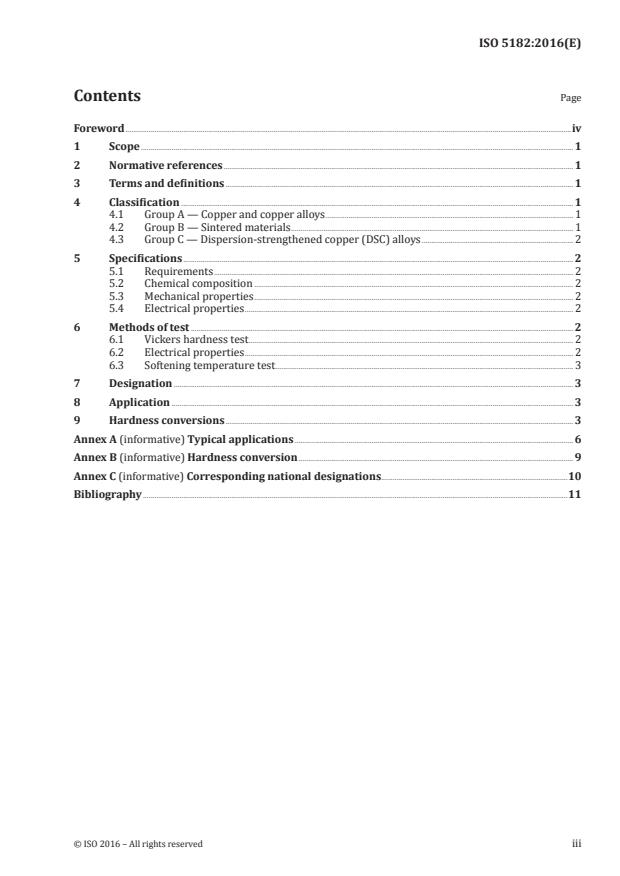
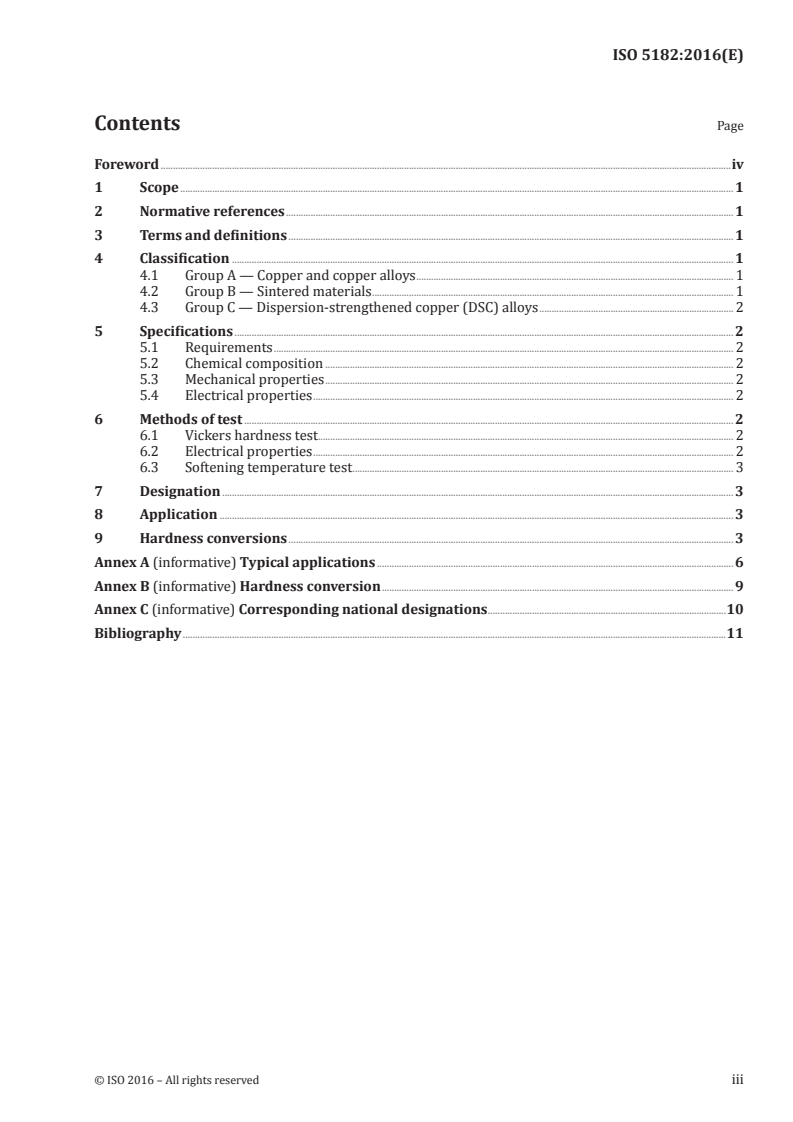
Contents Page
Foreword .iv
1 Scope . 1
2 Normative references . 1
3 Terms and definitions . 1
4 Classification . 1
4.1 Group A — Copper and copper alloys . 1
4.2 Group B — Sintered materials . 1
4.3 Group C — Dispersion-strengthened copper (DSC) alloys . 2
5 Specifications . 2
5.1 Requirements . 2
5.2 Chemical composition . 2
5.3 Mechanical properties . 2
5.4 Electrical properties . 2
6 Methods of test . 2
6.1 Vickers hardness test. 2
6.2 Electrical properties . 2
6.3 Softening temperature test . 3
7 Designation . 3
8 Application . 3
9 Hardness conversions . 3
Annex A (informative) Typical applications . 6
Annex B (informative) Hardness conversion . 9
Annex C (informative) Corresponding national designations .10
Bibliography .11
Foreword
ISO (the International Organization for Standardization) is a worldwide federation of national standards
bodies (ISO member bodies). The work of preparing International Standards is normally carried out
through ISO technical committees. Each member body interested in a subject for which a technical
committee has been established has the right to be represented on that committee. International
organizations, governmental and non-governmental, in liaison with ISO, also take part in the work.
ISO collaborates closely with the International Electrotechnical Commission (IEC) on all matters of
electrotechnical standardization.
The procedures used to develop this document and those intended for its further maintenance are
described in the ISO/IEC Directives, Part 1. In particular the different approval criteria needed for the
different types of ISO documents should be noted. This document was drafted in accordance with the
editorial rules of the ISO/IEC Directives, Part 2 (see www.iso.org/directives).
Attention is drawn to the possibility that some of the elements of this document may be the subject of
patent rights. ISO shall not be held responsible for identifying any or all such patent rights. Details of
any patent rights identified during the development of the document will be in the Introduction and/or
on the ISO list of patent declarations received (see www.iso.org/patents).
Any trade name used in this document is information given for the convenience of users and does not
constitute an endorsement.
For an explanation on the meaning of ISO specific terms and expressions related to conformity assessment,
as well as information about ISO’s adherence to the World Trade Organization (WTO) principles in the
Technical Barriers to Trade (TBT) see the following URL: www.iso.org/iso/foreword.html.
The committee responsible for this document is ISO/TC 44, Welding and allied processes, Subcommittee
SC 6, Resistance welding and allied mechanical joining.
This fourth edition cancels and replaces the third edition (ISO 5182:2008), which has been technically
revised.
Requests for official interpretations of any aspect of this International Standard should be directed to
the Secretariat of ISO/TC 44 via your national standards body. A complete listing of these bodies can be
found at www.iso.org.
iv © ISO 2016 – All rights reserved
INTERNATIONAL STANDARD ISO 5182:2016(E)
Resistance welding — Materials for electrodes and
ancillary equipment
1 Scope
This International Standard specifies the characteristics of materials for resistance welding electrodes
and ancillary equipment which are used for carrying current and transmitting force to the work.
2 Normative references
The following documents, in whole or in part, are normatively referenced in this document and are
indispensable for its application. For dated references, only the edition cited applies. For undated
references, the latest edition of the referenced document (including any amendments) applies.
ISO 6507-1, Metallic materials — Vickers hardness test — Part 1: Test method
ASTM E1004, Standard practice for determining electrical conductivity using the electromagnetic (eddy-
current) method
3 Terms and definitions
For the purposes of this document, the following terms and definitions apply.
3.1
softening temperature
maximum temperature that, if maintained for 2 h, will result in a reduction in ambient temperature
hardness of a maximum of 15 % of the “as received” value
4 Classification
4.1 Group A — Copper and copper alloys
This group defines four types of material in accordance with Table 1.
Table 1 — Group A — Classification of copper and copper alloys
Type Description
Non-heat-treatable alloys of high conductivity and medium hardness, the wrought forms of
which are given their strengths by cold working during manufacture.
Alloys which are harder than type 1 and in which the mechanical properties have been devel-
2 oped by heat treatment during manufacture or by a combination of heat treatment and cold
working.
Heat-treated alloys which have superior mechanical properties to type 2 but a lower electrical
conductivity than either type 1 or type 2.
Alloys having certain specialised properties which may, in some cases, be obtained either by
4 cold working or by heat treatment. Alloys of this type are not necessarily interchangeable with
each other.
4.2 Group B — Sintered materials
This group comprises six types of material based upon the constituents used in accordance with Table 2.
Table 2 — Group B — Classification of sintered materials
Type Description
10 and 11 Sintered products of copper and tungsten.
12 Sintered product of copper and tungsten carbide.
13 Sintered and worked product of molybdenum.
14 Sintered and worked product of tungsten.
15 Sintered product of tungsten and silver.
4.3 Group C — Dispersion-strengthened copper (DSC) alloys
This group comprises two types of materials (see Table 3):
— C 20/1, C 20/2 and C 20/3, manufactured by internal oxidation;
— C 20/4, C 20/5 and C 20/6, manufactured by ball milling or mechanical alloying.
5 Specifications
5.1 Requirements
The materials shall comply with Table 3.
5.2 Chemical composition
The chemical compositions are given in Table 3.
5.3 Mechanical properties
The material hardness shall not be less than as given in Table 3.
NOTE When these materials are used for resistance welding equipment, the required properties are
different from those of materials used for general purposes.
5.4 Electrical properties
The electrical conductivity, given in mega-Siemens per metre (MS/m) or as a percentage of the
conductivity of the International Annealed Copper Standard (IACS), of materials shall be not less than
those given in Table 3.
6 Methods of test
6.1 Vickers hardness test
The Vickers hardness test shall be carried out with a 300 N load in accordance with ISO 6507-1.
6.2 Electrical properties
The electrical properties shall be measured in accordance with ASTM E1004. When it is not possible
to use this method, the test shall be carried out as agreed between the suppliers, the purchaser, and a
mutually acceptable arbitrator.
NOTE Electrical conductivity, when evaluated with eddy-current instruments, is usually expressed as a
percentage of the conductivity of the International Annealed Copper Standard (IACS).
2 © ISO 2016 – All rights reserved
6.3 Softening temperature test
Hardness and conductivity tests normally guarantee the quality of the material and allow verification
of the softening temperature. The softening temperature test is not normally carried out on each batch
of material.
Pending
...
INTERNATIONAL ISO
STANDARD 5182
Fourth edition
2016-08-01
Resistance welding — Materials for
electrodes and ancillary equipment
Soudage par résistance — Matériaux pour électrodes et
équipements annexes
Reference number
©
ISO 2016
© ISO 2016, Published in Switzerland
All rights reserved. Unless otherwise specified, no part of this publication may be reproduced or utilized otherwise in any form
or by any means, electronic or mechanical, including photocopying, or posting on the internet or an intranet, without prior
written permission. Permission can be requested from either ISO at the address below or ISO’s member body in the country of
the requester.
ISO copyright office
Ch. de Blandonnet 8 • CP 401
CH-1214 Vernier, Geneva, Switzerland
Tel. +41 22 749 01 11
Fax +41 22 749 09 47
copyright@iso.org
www.iso.org
ii © ISO 2016 – All rights reserved
Contents Page
Foreword .iv
1 Scope . 1
2 Normative references . 1
3 Terms and definitions . 1
4 Classification . 1
4.1 Group A — Copper and copper alloys . 1
4.2 Group B — Sintered materials . 1
4.3 Group C — Dispersion-strengthened copper (DSC) alloys . 2
5 Specifications . 2
5.1 Requirements . 2
5.2 Chemical composition . 2
5.3 Mechanical properties . 2
5.4 Electrical properties . 2
6 Methods of test . 2
6.1 Vickers hardness test. 2
6.2 Electrical properties . 2
6.3 Softening temperature test . 3
7 Designation . 3
8 Application . 3
9 Hardness conversions . 3
Annex A (informative) Typical applications . 6
Annex B (informative) Hardness conversion . 9
Annex C (informative) Corresponding national designations .10
Bibliography .11
Foreword
ISO (the International Organization for Standardization) is a worldwide federation of national standards
bodies (ISO member bodies). The work of preparing International Standards is normally carried out
through ISO technical committees. Each member body interested in a subject for which a technical
committee has been established has the right to be represented on that committee. International
organizations, governmental and non-governmental, in liaison with ISO, also take part in the work.
ISO collaborates closely with the International Electrotechnical Commission (IEC) on all matters of
electrotechnical standardization.
The procedures used to develop this document and those intended for its further maintenance are
described in the ISO/IEC Directives, Part 1. In particular the different approval criteria needed for the
different types of ISO documents should be noted. This document was drafted in accordance with the
editorial rules of the ISO/IEC Directives, Part 2 (see www.iso.org/directives).
Attention is drawn to the possibility that some of the elements of this document may be the subject of
patent rights. ISO shall not be held responsible for identifying any or all such patent rights. Details of
any patent rights identified during the development of the document will be in the Introduction and/or
on the ISO list of patent declarations received (see www.iso.org/patents).
Any trade name used in this document is information given for the convenience of users and does not
constitute an endorsement.
For an explanation on the meaning of ISO specific terms and expressions related to conformity assessment,
as well as information about ISO’s adherence to the World Trade Organization (WTO) principles in the
Technical Barriers to Trade (TBT) see the following URL: www.iso.org/iso/foreword.html.
The committee responsible for this document is ISO/TC 44, Welding and allied processes, Subcommittee
SC 6, Resistance welding and allied mechanical joining.
This fourth edition cancels and replaces the third edition (ISO 5182:2008), which has been technically
revised.
Requests for official interpretations of any aspect of this International Standard should be directed to
the Secretariat of ISO/TC 44 via your national standards body. A complete listing of these bodies can be
found at www.iso.org.
iv © ISO 2016 – All rights reserved
INTERNATIONAL STANDARD ISO 5182:2016(E)
Resistance welding — Materials for electrodes and
ancillary equipment
1 Scope
This International Standard specifies the characteristics of materials for resistance welding electrodes
and ancillary equipment which are used for carrying current and transmitting force to the work.
2 Normative references
The following documents, in whole or in part, are normatively referenced in this document and are
indispensable for its application. For dated references, only the edition cited applies. For undated
references, the latest edition of the referenced document (including any amendments) applies.
ISO 6507-1, Metallic materials — Vickers hardness test — Part 1: Test method
ASTM E1004, Standard practice for determining electrical conductivity using the electromagnetic (eddy-
current) method
3 Terms and definitions
For the purposes of this document, the following terms and definitions apply.
3.1
softening temperature
maximum temperature that, if maintained for 2 h, will result in a reduction in ambient temperature
hardness of a maximum of 15 % of the “as received” value
4 Classification
4.1 Group A — Copper and copper alloys
This group defines four types of material in accordance with Table 1.
Table 1 — Group A — Classification of copper and copper alloys
Type Description
Non-heat-treatable alloys of high conductivity and medium hardness, the wrought forms of
which are given their strengths by cold working during manufacture.
Alloys which are harder than type 1 and in which the mechanical properties have been devel-
2 oped by heat treatment during manufacture or by a combination of heat treatment and cold
working.
Heat-treated alloys which have superior mechanical properties to type 2 but a lower electrical
conductivity than either type 1 or type 2.
Alloys having certain specialised properties which may, in some cases, be obtained either by
4 cold working or by heat treatment. Alloys of this type are not necessarily interchangeable with
each other.
4.2 Group B — Sintered materials
This group comprises six types of material based upon the constituents used in accordance with Table 2.
Table 2 — Group B — Classification of sintered materials
Type Description
10 and 11 Sintered products of copper and tungsten.
12 Sintered product of copper and tungsten carbide.
13 Sintered and worked product of molybdenum.
14 Sintered and worked product of tungsten.
15 Sintered product of tungsten and silver.
4.3 Group C — Dispersion-strengthened copper (DSC) alloys
This group comprises two types of materials (see Table 3):
— C 20/1, C 20/2 and C 20/3, manufactured by internal oxidation;
— C 20/4, C 20/5 and C 20/6, manufactured by ball milling or mechanical alloying.
5 Specifications
5.1 Requirements
The materials shall comply with Table 3.
5.2 Chemical composition
The chemical compositions are given in Table 3.
5.3 Mechanical properties
The material hardness shall not be less than as given in Table 3.
NOTE When these materials are used for resistance welding equipment, the required properties are
different from those of materials used for general purposes.
5.4 Electrical properties
The electrical conductivity, given in mega-Siemens per metre (MS/m) or as a percentage of the
conductivity of the International Annealed Copper Standard (IACS), of materials shall be not less than
those given in Table 3.
6 Methods of test
6.1 Vickers hardness test
The Vickers hardness test shall be carried out with a 300 N load in accordance with ISO 6507-1.
6.2 Electrical properties
The electrical properties shall be measured in accordance with ASTM E1004. When it is not possible
to use this method, the test shall be carried out as agreed between the suppliers, the purchaser, and a
mutually acceptable arbitrator.
NOTE Electrical conductivity, when evaluated with eddy-current instruments, is usually expressed as a
percentage of the conductivity of the International Annealed Copper Standard (IACS).
2 © ISO 2016 – All rights reserved
6.3 Softening temperature test
Hardness and conductivity tests normally guarantee the quality of the material and allow verification
of the softening temperature. The softening temperature test is not normally carried out on each batch
of material.
Pending
...
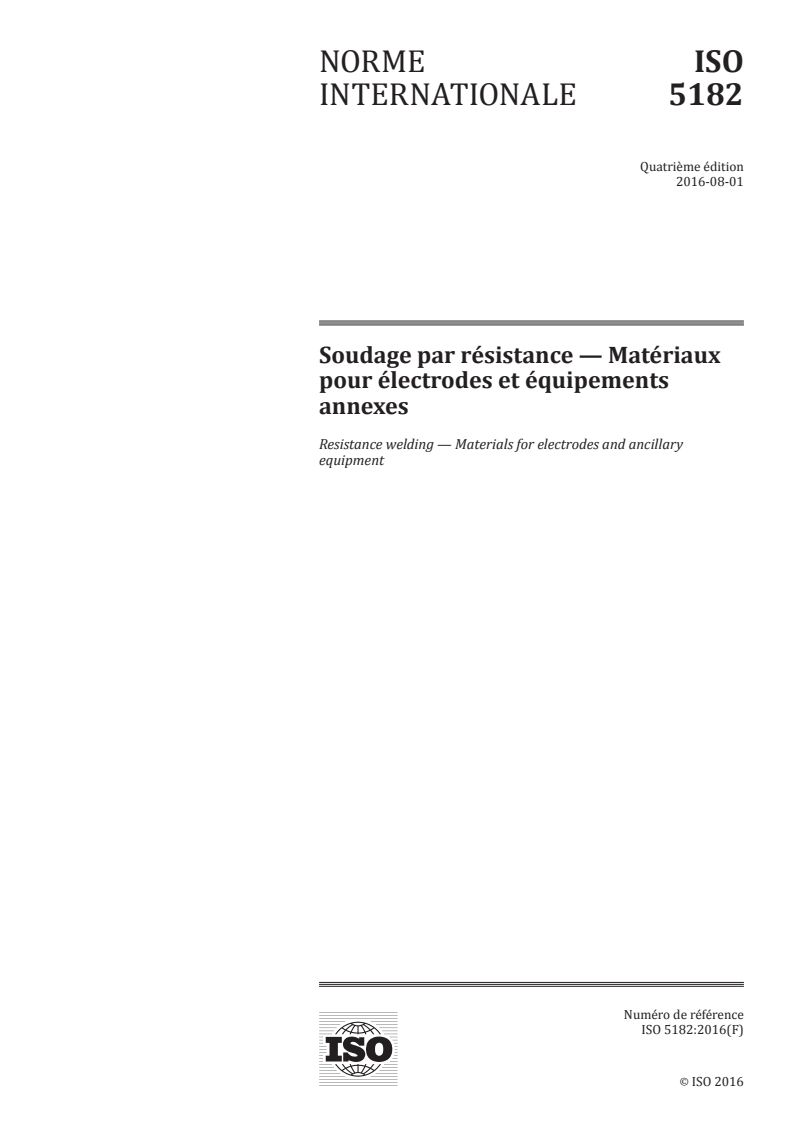
NORME ISO
INTERNATIONALE 5182
Quatrième édition
2016-08-01
Soudage par résistance — Matériaux
pour électrodes et équipements
annexes
Resistance welding — Materials for electrodes and ancillary
equipment
Numéro de référence
©
ISO 2016
DOCUMENT PROTÉGÉ PAR COPYRIGHT
© ISO 2016, Publié en Suisse
Droits de reproduction réservés. Sauf indication contraire, aucune partie de cette publication ne peut être reproduite ni utilisée
sous quelque forme que ce soit et par aucun procédé, électronique ou mécanique, y compris la photocopie, l’affichage sur
l’internet ou sur un Intranet, sans autorisation écrite préalable. Les demandes d’autorisation peuvent être adressées à l’ISO à
l’adresse ci-après ou au comité membre de l’ISO dans le pays du demandeur.
ISO copyright office
Ch. de Blandonnet 8 • CP 401
CH-1214 Vernier, Geneva, Switzerland
Tel. +41 22 749 01 11
Fax +41 22 749 09 47
copyright@iso.org
www.iso.org
ii © ISO 2016 – Tous droits réservés
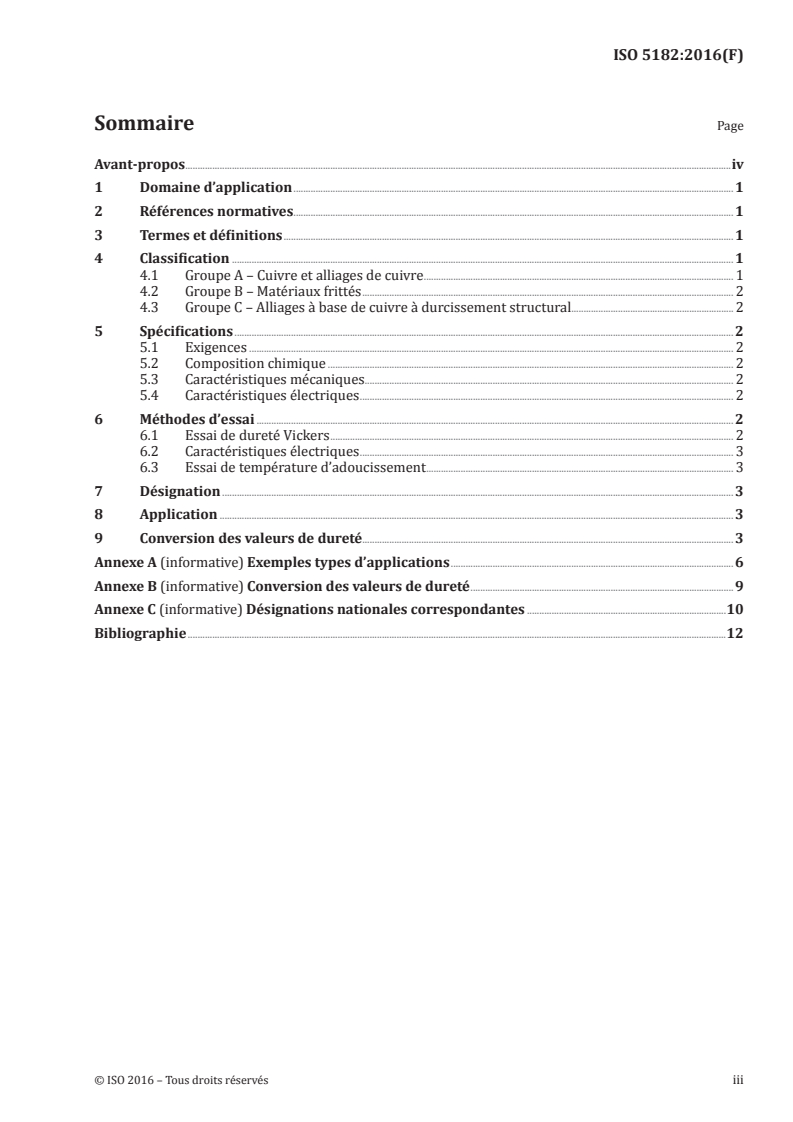
Sommaire Page
Avant-propos .iv
1 Domaine d’application . 1
2 Références normatives . 1
3 Termes et définitions . 1
4 Classification . 1
4.1 Groupe A – Cuivre et alliages de cuivre . 1
4.2 Groupe B – Matériaux frittés . 2
4.3 Groupe C – Alliages à base de cuivre à durcissement structural. 2
5 Spécifications . 2
5.1 Exigences . 2
5.2 Composition chimique . 2
5.3 Caractéristiques mécaniques . 2
5.4 Caractéristiques électriques . 2
6 Méthodes d’essai . 2
6.1 Essai de dureté Vickers . 2
6.2 Caractéristiques électriques . 3
6.3 Essai de température d’adoucissement . 3
7 Désignation . 3
8 Application . 3
9 Conversion des valeurs de dureté. 3
Annexe A (informative) Exemples types d’applications . 6
Annexe B (informative) Conversion des valeurs de dureté . 9
Annexe C (informative) Désignations nationales correspondantes .10
Bibliographie .12
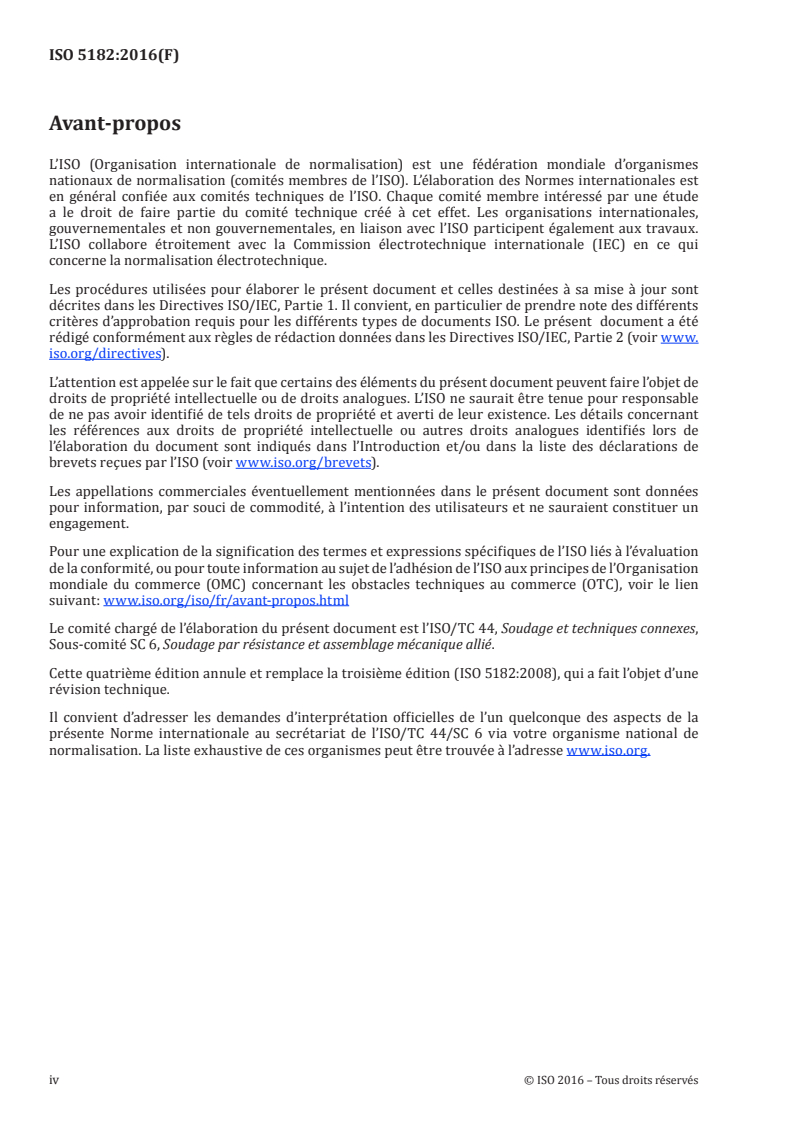
Avant-propos
L’ISO (Organisation internationale de normalisation) est une fédération mondiale d’organismes
nationaux de normalisation (comités membres de l’ISO). L’élaboration des Normes internationales est
en général confiée aux comités techniques de l’ISO. Chaque comité membre intéressé par une étude
a le droit de faire partie du comité technique créé à cet effet. Les organisations internationales,
gouvernementales et non gouvernementales, en liaison avec l’ISO participent également aux travaux.
L’ISO collabore étroitement avec la Commission électrotechnique internationale (IEC) en ce qui
concerne la normalisation électrotechnique.
Les procédures utilisées pour élaborer le présent document et celles destinées à sa mise à jour sont
décrites dans les Directives ISO/IEC, Partie 1. Il convient, en particulier de prendre note des différents
critères d’approbation requis pour les différents types de documents ISO. Le présent document a été
rédigé conformément aux règles de rédaction données dans les Directives ISO/IEC, Partie 2 (voir www.
iso.org/directives).
L’attention est appelée sur le fait que certains des éléments du présent document peuvent faire l’objet de
droits de propriété intellectuelle ou de droits analogues. L’ISO ne saurait être tenue pour responsable
de ne pas avoir identifié de tels droits de propriété et averti de leur existence. Les détails concernant
les références aux droits de propriété intellectuelle ou autres droits analogues identifiés lors de
l’élaboration du document sont indiqués dans l’Introduction et/ou dans la liste des déclarations de
brevets reçues par l’ISO (voir www.iso.org/brevets).
Les appellations commerciales éventuellement mentionnées dans le présent document sont données
pour information, par souci de commodité, à l’intention des utilisateurs et ne sauraient constituer un
engagement.
Pour une explication de la signification des termes et expressions spécifiques de l’ISO liés à l’évaluation
de la conformité, ou pour toute information au sujet de l’adhésion de l’ISO aux principes de l’Organisation
mondiale du commerce (OMC) concernant les obstacles techniques au commerce (OTC), voir le lien
suivant: www.iso.org/iso/fr/avant-propos.html
Le comité chargé de l’élaboration du présent document est l’ISO/TC 44, Soudage et techniques connexes,
Sous-comité SC 6, Soudage par résistance et assemblage mécanique allié.
Cette quatrième édition annule et remplace la troisième édition (ISO 5182:2008), qui a fait l’objet d’une
révision technique.
Il convient d’adresser les demandes d’interprétation officielles de l’un quelconque des aspects de la
présente Norme internationale au secrétariat de l’ISO/TC 44/SC 6 via votre organisme national de
normalisation. La liste exhaustive de ces organismes peut être trouvée à l’adresse www.iso.org.
iv © ISO 2016 – Tous droits réservés
NORME INTERNATIONALE ISO 5182:2016(F)
Soudage par résistance — Matériaux pour électrodes et
équipements annexes
1 Domaine d’application
La présente Norme internationale spécifie les caractéristiques des matériaux pour électrodes de
soudage par résistance et équipements annexes utilisés pour le transport du courant et la transmission
de l’effort de soudage.
2 Références normatives
Les documents suivants, en tout ou partie, sont référencés de façon normative dans le présent document
et sont indispensables à son application. Pour les références datées, seule l’édition citée s’applique.
Pour les références non datées, la dernière édition du document de référence s’applique (y compris les
éventuels amendements).
ISO 6507-1, Matériaux métalliques — Essai de dureté Vickers — Partie 1: Méthode d’essai
ASTM E1004, Standard practice for determining electrical conductivity using the electromagnetic (eddy-
current) method
3 Termes et définitions
Pour les besoins du présent document, les termes et définitions suivants s’appliquent.
3.1
température d’adoucissement
valeur maximale de température qui, lorsqu’elle est maintenue durant 2 h, provoque une réduction
maximale de 15 % de la valeur de dureté “de livraison” du matériau à la température ambiante
4 Classification
4.1 Groupe A – Cuivre et alliages de cuivre
Ce groupe définit quatre types de matériaux conformément au Tableau 1.
Tableau 1 — Groupe A — Classification du cuivre et alliages de cuivre
Type Description
Alliages ne pouvant pas subir de traitement thermique, à conductivité élevée et de dureté moyenne,
dont les formes corroyées acquièrent leur résistance par écrouissage lors de la mise en œuvre.
Alliages de dureté supérieure à celle du type 1, dont les caractéristiques mécaniques sont obte-
2 nues par un traitement thermique pendant la mise en œuvre ou par la combinaison d’un traite-
ment thermique et d’un écrouissage.
Alliages traités thermiquement, dont les caractéristiques mécaniques sont supérieures à celles
du type 2, mais dont la conductivité électrique est inférieure à celle du type 1 ou celle du type 2.
Alliages possédant certaines propriétés spéciales obtenues dans certains cas soit par écrouis-
4 sage, soit par traitement thermique. Les alliages de ce type ne sont pas forcément interchan-
geables.
4.2 Groupe B – Matériaux frittés
Ce groupe comprend six types de matériaux suivant les constituants employés conformément au
Tableau 2.
Tableau 2 — Groupe A — Classification des matériaux frittés
Type Description
10 et 11 Produits frittés à base de cuivre et de tungstène.
12 Produit fritté à base de cuivre et de carbure de tungstène.
13 Produit fritté et écroui à base de molybdène.
14 Produit fritté et écroui à base de tungstène.
15 Produit fritté à base de tungstène et d’argent.
4.3 Groupe C – Alliages à base de cuivre à durcissement structural
Ce groupe comprend deux types de matériaux (voir Tableau 3):
— C 20/1, C 20/2 et C 20/3, mis en œuvre par oxydation interne;
— C 20/4, C 20/5 et C 20/6, mis en œuvre par broyage à billes ou alliage mécanique.
5 Spécifications
5.1 Exigences
Les matériaux doivent être en conformité avec le Tableau 3.
5.2 Composition chimique
Les compositions chimiques sont indiquées dans le Tableau 3.
5.3 Caractéristiques mécaniques
La dureté du matériau ne doit pas être inférieure aux valeurs indiquées dans le Tableau 3.
NOTE Lorsque ces matériaux sont utilisés pour le matériel de soudage par résistance, les caractéristiques
requises sont différentes de celles des matériaux d’usage général.
5.4 Caractéristiques électriques
La conductivité électrique des matériaux, donnée en mégasiemens par mètre (MS/m), ou en pourcentage
de la conductivité IACS (International Annealed Copper Standard), ne doit pas être inférieure à la valeur
indiquée dans le Tableau 3.
6 Méthodes d’essai
6.1 Essai de dureté Vickers
L’essai de dureté Vickers doit être effectué avec une charge de 300 N, conformément à l’ISO 6507-1.
2 © ISO 2016 – Tous droits réservés
6.2 Caractéristiques électriques
Les caractéristiques électriques doivent être mesurées conformément à l’ASTM E1004. Lorsqu’il n’est
pas possible d’utiliser cette méthode, l’essai doit être effectué suivant des modalités à convenir entre le
fournisseur, l’acheteur et un arbitre agréé par les parties.
NOTE La conductivité électrique, lorsqu’elle est évaluée avec des appareils de mesure à courant de Foucault,
est usuellement exprimée sous la forme d’un pourcentage de la conductivité IACS (International Annealed Copper
Standard).
6.3 Essai de température d’adoucissement
Les essais de dureté et de conductivité garantissent normalement la qualité du matériau et permettent
de vérifier la température d’adoucissement. L’essai relatif à la température d’adoucissement n’est
normalement pas effectué sur chaque lot de matériau.
En attendant la mise au point d’une méthode d’essai standard de température d’adoucissement, l’essai
ne peut être réalisé que dans des conditions faisant l’objet d’un accord entre le fournisseur et l’acheteur.
7 Désignation
Les matériaux doivent être désignés par leur groupe, leur type et leur numéro (voir Tableau 3).
EXEMPLE 1 CuCr1 est désigné:
où
ISO 5182 est la référence de la présente Norme internationale;
A est le groupe du matériau (voir Article 4);
2 est le type de matériau (voir Article 4);
1 est le nombre du matériau CuCr1 (voir Tableau 3).
EXEMPLE 2 W75Cu est désigné:
où
ISO 5182 est la référence de la présente Norme internationale;
B
...
NORME ISO
INTERNATIONALE 5182
Quatrième édition
2016-08-01
Soudage par résistance — Matériaux
pour électrodes et équipements
annexes
Resistance welding — Materials for electrodes and ancillary
equipment
Numéro de référence
©
ISO 2016
DOCUMENT PROTÉGÉ PAR COPYRIGHT
© ISO 2016, Publié en Suisse
Droits de reproduction réservés. Sauf indication contraire, aucune partie de cette publication ne peut être reproduite ni utilisée
sous quelque forme que ce soit et par aucun procédé, électronique ou mécanique, y compris la photocopie, l’affichage sur
l’internet ou sur un Intranet, sans autorisation écrite préalable. Les demandes d’autorisation peuvent être adressées à l’ISO à
l’adresse ci-après ou au comité membre de l’ISO dans le pays du demandeur.
ISO copyright office
Ch. de Blandonnet 8 • CP 401
CH-1214 Vernier, Geneva, Switzerland
Tel. +41 22 749 01 11
Fax +41 22 749 09 47
copyright@iso.org
www.iso.org
ii © ISO 2016 – Tous droits réservés
Sommaire Page
Avant-propos .iv
1 Domaine d’application . 1
2 Références normatives . 1
3 Termes et définitions . 1
4 Classification . 1
4.1 Groupe A – Cuivre et alliages de cuivre . 1
4.2 Groupe B – Matériaux frittés . 2
4.3 Groupe C – Alliages à base de cuivre à durcissement structural. 2
5 Spécifications . 2
5.1 Exigences . 2
5.2 Composition chimique . 2
5.3 Caractéristiques mécaniques . 2
5.4 Caractéristiques électriques . 2
6 Méthodes d’essai . 2
6.1 Essai de dureté Vickers . 2
6.2 Caractéristiques électriques . 3
6.3 Essai de température d’adoucissement . 3
7 Désignation . 3
8 Application . 3
9 Conversion des valeurs de dureté. 3
Annexe A (informative) Exemples types d’applications . 6
Annexe B (informative) Conversion des valeurs de dureté . 9
Annexe C (informative) Désignations nationales correspondantes .10
Bibliographie .12
Avant-propos
L’ISO (Organisation internationale de normalisation) est une fédération mondiale d’organismes
nationaux de normalisation (comités membres de l’ISO). L’élaboration des Normes internationales est
en général confiée aux comités techniques de l’ISO. Chaque comité membre intéressé par une étude
a le droit de faire partie du comité technique créé à cet effet. Les organisations internationales,
gouvernementales et non gouvernementales, en liaison avec l’ISO participent également aux travaux.
L’ISO collabore étroitement avec la Commission électrotechnique internationale (IEC) en ce qui
concerne la normalisation électrotechnique.
Les procédures utilisées pour élaborer le présent document et celles destinées à sa mise à jour sont
décrites dans les Directives ISO/IEC, Partie 1. Il convient, en particulier de prendre note des différents
critères d’approbation requis pour les différents types de documents ISO. Le présent document a été
rédigé conformément aux règles de rédaction données dans les Directives ISO/IEC, Partie 2 (voir www.
iso.org/directives).
L’attention est appelée sur le fait que certains des éléments du présent document peuvent faire l’objet de
droits de propriété intellectuelle ou de droits analogues. L’ISO ne saurait être tenue pour responsable
de ne pas avoir identifié de tels droits de propriété et averti de leur existence. Les détails concernant
les références aux droits de propriété intellectuelle ou autres droits analogues identifiés lors de
l’élaboration du document sont indiqués dans l’Introduction et/ou dans la liste des déclarations de
brevets reçues par l’ISO (voir www.iso.org/brevets).
Les appellations commerciales éventuellement mentionnées dans le présent document sont données
pour information, par souci de commodité, à l’intention des utilisateurs et ne sauraient constituer un
engagement.
Pour une explication de la signification des termes et expressions spécifiques de l’ISO liés à l’évaluation
de la conformité, ou pour toute information au sujet de l’adhésion de l’ISO aux principes de l’Organisation
mondiale du commerce (OMC) concernant les obstacles techniques au commerce (OTC), voir le lien
suivant: www.iso.org/iso/fr/avant-propos.html
Le comité chargé de l’élaboration du présent document est l’ISO/TC 44, Soudage et techniques connexes,
Sous-comité SC 6, Soudage par résistance et assemblage mécanique allié.
Cette quatrième édition annule et remplace la troisième édition (ISO 5182:2008), qui a fait l’objet d’une
révision technique.
Il convient d’adresser les demandes d’interprétation officielles de l’un quelconque des aspects de la
présente Norme internationale au secrétariat de l’ISO/TC 44/SC 6 via votre organisme national de
normalisation. La liste exhaustive de ces organismes peut être trouvée à l’adresse www.iso.org.
iv © ISO 2016 – Tous droits réservés
NORME INTERNATIONALE ISO 5182:2016(F)
Soudage par résistance — Matériaux pour électrodes et
équipements annexes
1 Domaine d’application
La présente Norme internationale spécifie les caractéristiques des matériaux pour électrodes de
soudage par résistance et équipements annexes utilisés pour le transport du courant et la transmission
de l’effort de soudage.
2 Références normatives
Les documents suivants, en tout ou partie, sont référencés de façon normative dans le présent document
et sont indispensables à son application. Pour les références datées, seule l’édition citée s’applique.
Pour les références non datées, la dernière édition du document de référence s’applique (y compris les
éventuels amendements).
ISO 6507-1, Matériaux métalliques — Essai de dureté Vickers — Partie 1: Méthode d’essai
ASTM E1004, Standard practice for determining electrical conductivity using the electromagnetic (eddy-
current) method
3 Termes et définitions
Pour les besoins du présent document, les termes et définitions suivants s’appliquent.
3.1
température d’adoucissement
valeur maximale de température qui, lorsqu’elle est maintenue durant 2 h, provoque une réduction
maximale de 15 % de la valeur de dureté “de livraison” du matériau à la température ambiante
4 Classification
4.1 Groupe A – Cuivre et alliages de cuivre
Ce groupe définit quatre types de matériaux conformément au Tableau 1.
Tableau 1 — Groupe A — Classification du cuivre et alliages de cuivre
Type Description
Alliages ne pouvant pas subir de traitement thermique, à conductivité élevée et de dureté moyenne,
dont les formes corroyées acquièrent leur résistance par écrouissage lors de la mise en œuvre.
Alliages de dureté supérieure à celle du type 1, dont les caractéristiques mécaniques sont obte-
2 nues par un traitement thermique pendant la mise en œuvre ou par la combinaison d’un traite-
ment thermique et d’un écrouissage.
Alliages traités thermiquement, dont les caractéristiques mécaniques sont supérieures à celles
du type 2, mais dont la conductivité électrique est inférieure à celle du type 1 ou celle du type 2.
Alliages possédant certaines propriétés spéciales obtenues dans certains cas soit par écrouis-
4 sage, soit par traitement thermique. Les alliages de ce type ne sont pas forcément interchan-
geables.
4.2 Groupe B – Matériaux frittés
Ce groupe comprend six types de matériaux suivant les constituants employés conformément au
Tableau 2.
Tableau 2 — Groupe A — Classification des matériaux frittés
Type Description
10 et 11 Produits frittés à base de cuivre et de tungstène.
12 Produit fritté à base de cuivre et de carbure de tungstène.
13 Produit fritté et écroui à base de molybdène.
14 Produit fritté et écroui à base de tungstène.
15 Produit fritté à base de tungstène et d’argent.
4.3 Groupe C – Alliages à base de cuivre à durcissement structural
Ce groupe comprend deux types de matériaux (voir Tableau 3):
— C 20/1, C 20/2 et C 20/3, mis en œuvre par oxydation interne;
— C 20/4, C 20/5 et C 20/6, mis en œuvre par broyage à billes ou alliage mécanique.
5 Spécifications
5.1 Exigences
Les matériaux doivent être en conformité avec le Tableau 3.
5.2 Composition chimique
Les compositions chimiques sont indiquées dans le Tableau 3.
5.3 Caractéristiques mécaniques
La dureté du matériau ne doit pas être inférieure aux valeurs indiquées dans le Tableau 3.
NOTE Lorsque ces matériaux sont utilisés pour le matériel de soudage par résistance, les caractéristiques
requises sont différentes de celles des matériaux d’usage général.
5.4 Caractéristiques électriques
La conductivité électrique des matériaux, donnée en mégasiemens par mètre (MS/m), ou en pourcentage
de la conductivité IACS (International Annealed Copper Standard), ne doit pas être inférieure à la valeur
indiquée dans le Tableau 3.
6 Méthodes d’essai
6.1 Essai de dureté Vickers
L’essai de dureté Vickers doit être effectué avec une charge de 300 N, conformément à l’ISO 6507-1.
2 © ISO 2016 – Tous droits réservés
6.2 Caractéristiques électriques
Les caractéristiques électriques doivent être mesurées conformément à l’ASTM E1004. Lorsqu’il n’est
pas possible d’utiliser cette méthode, l’essai doit être effectué suivant des modalités à convenir entre le
fournisseur, l’acheteur et un arbitre agréé par les parties.
NOTE La conductivité électrique, lorsqu’elle est évaluée avec des appareils de mesure à courant de Foucault,
est usuellement exprimée sous la forme d’un pourcentage de la conductivité IACS (International Annealed Copper
Standard).
6.3 Essai de température d’adoucissement
Les essais de dureté et de conductivité garantissent normalement la qualité du matériau et permettent
de vérifier la température d’adoucissement. L’essai relatif à la température d’adoucissement n’est
normalement pas effectué sur chaque lot de matériau.
En attendant la mise au point d’une méthode d’essai standard de température d’adoucissement, l’essai
ne peut être réalisé que dans des conditions faisant l’objet d’un accord entre le fournisseur et l’acheteur.
7 Désignation
Les matériaux doivent être désignés par leur groupe, leur type et leur numéro (voir Tableau 3).
EXEMPLE 1 CuCr1 est désigné:
où
ISO 5182 est la référence de la présente Norme internationale;
A est le groupe du matériau (voir Article 4);
2 est le type de matériau (voir Article 4);
1 est le nombre du matériau CuCr1 (voir Tableau 3).
EXEMPLE 2 W75Cu est désigné:
où
ISO 5182 est la référence de la présente Norme internationale;
B
...