

ISO 92:1976
(Main)Textile machinery and accessories — Spinning machinery — Definition of side (left or right)
General Information
- Abstract
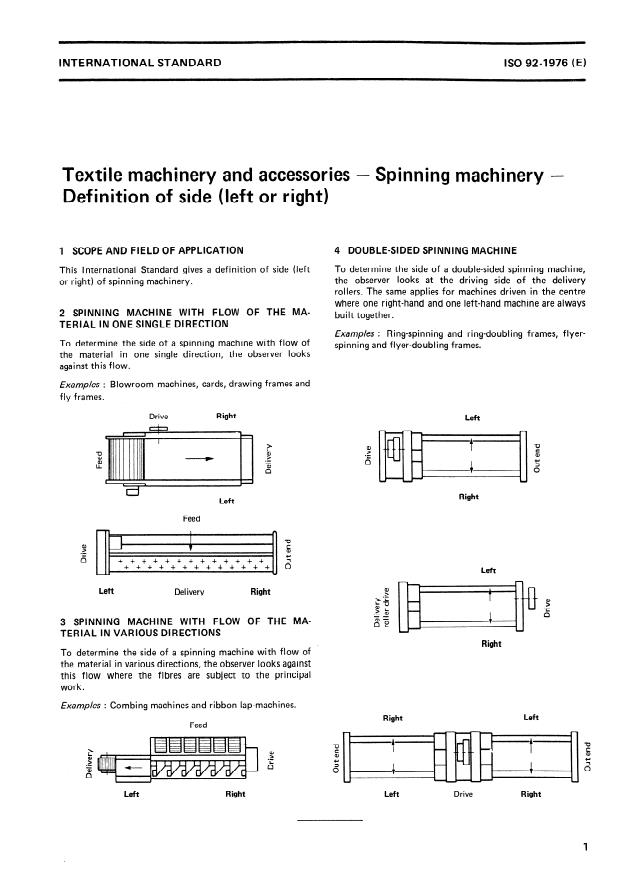
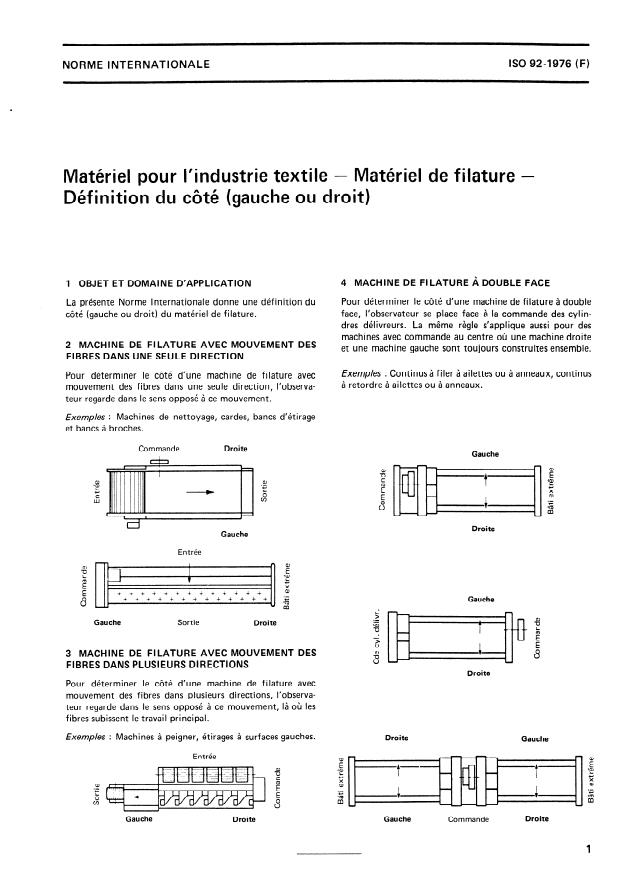
To determine the side of a spinning machine with flow of the material in one single direction, the observer looks against this flow. Examples: Blowroom machines, cards, crawing frames and fly frames. Definitions of the side of a spinning machine with flow of the material in various directions and of a double-sided spinning machine are given in detail.
- Status
- Published
- Publication Date
- 31-Dec-1975
- Current Stage
- 9093 - International Standard confirmed
- Start Date
- 13-Dec-2023
- Completion Date
- 29-Aug-2026
Buy Documents

ISO 92:1976 - Textile machinery and accessories — Spinning machinery — Definition of side (left or right) Released:1/1/1976
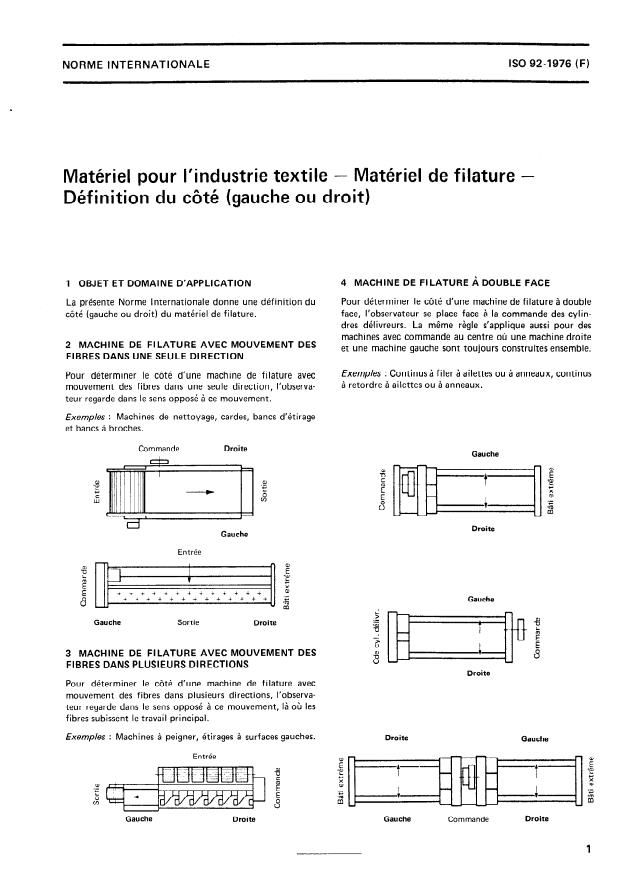

ISO 92:1976 - Matériel pour l'industrie textile — Matériel de filature — Définition du côté (gauche ou droit) Released:1/1/1976

ISO 92:1976 - Matériel pour l'industrie textile — Matériel de filature — Définition du côté (gauche ou droit) Released:1/1/1976
Overview
ISO 92:1976 specifies a clear, uniform method for defining the side (left or right) of spinning machinery used in textile production. Published by ISO/TC 72 in 1976, this short International Standard establishes how an observer should determine whether a spinning machine or spinning frame is described as left- or right‑handed, based on the direction and location of material flow and the driving side.
Key topics
- Scope and purpose
- Defines left/right orientation for spinning machinery and accessories.
- Applies to machines with material flow in a single direction, in various directions, and to double-sided machines.
- Determination rules
- For machines with material flow in a single direction, the observer determines left/right by looking against the flow of material.
- Examples given: blowroom machines, cards, drawing frames, fly frames, ring-spinning and ring-doubling frames, flyer-spinning and flyer-doubling frames.
- For machines with material flow in various directions, the observer looks against the flow where the fibres are subject to the principal work.
- Examples given: combing machines and ribbon lap machines.
- For double-sided spinning machines, the observer looks at the driving side of the delivery rollers. The same rule applies to centre-driven assemblies where a right-hand and left-hand machine are combined.
- For machines with material flow in a single direction, the observer determines left/right by looking against the flow of material.
- Clear terminology
- Establishes consistent descriptors such as “right side,” “left side,” “drive,” “feed,” and “delivery” to reduce ambiguity in documentation and communication.
Applications
- Practical use in design, manufacture and installation of textile machinery and spinning frames.
- Useful for:
- machine manufacturers and OEMs preparing drawings and part lists,
- mill engineers and installation teams aligning machinery on the shop floor,
- maintenance and service documentation to avoid orientation errors,
- procurement and spare-parts catalogues specifying left/right components,
- standards committees and technical writers ensuring consistent terminology.
- Benefits include fewer assembly mistakes, clearer technical documentation, and improved interoperability across suppliers and mills.
Related standards
- ISO 92:1976 replaces the earlier ISO Recommendation R 92-1959 and was prepared by ISO/TC 72 (textile machinery). For machine-specific dimensions or safety requirements, consult other ISO standards relevant to particular spinning equipment types.
Keywords: ISO 92:1976, textile machinery, spinning machinery, spinning frames, orientation, left side, right side, spinning orientation, spinning machine standards.
Buy Documents
ISO 92:1976 - Textile machinery and accessories — Spinning machinery — Definition of side (left or right) Released:1/1/1976
ISO 92:1976 - Matériel pour l'industrie textile — Matériel de filature — Définition du côté (gauche ou droit) Released:1/1/1976
ISO 92:1976 - Matériel pour l'industrie textile — Matériel de filature — Définition du côté (gauche ou droit) Released:1/1/1976
Get Certified
Connect with accredited certification bodies for this standard

Control Union Certifications
Global certification for agriculture and sustainability.

Hohenstein Institut
Textile testing and certification.

Bureau Veritas Bangladesh
Bureau Veritas certification services in Bangladesh.
Sponsored listings
Frequently Asked Questions
ISO 92:1976 is a standard published by the International Organization for Standardization (ISO). Its full title is "Textile machinery and accessories — Spinning machinery — Definition of side (left or right)". This standard covers: To determine the side of a spinning machine with flow of the material in one single direction, the observer looks against this flow. Examples: Blowroom machines, cards, crawing frames and fly frames. Definitions of the side of a spinning machine with flow of the material in various directions and of a double-sided spinning machine are given in detail.
To determine the side of a spinning machine with flow of the material in one single direction, the observer looks against this flow. Examples: Blowroom machines, cards, crawing frames and fly frames. Definitions of the side of a spinning machine with flow of the material in various directions and of a double-sided spinning machine are given in detail.
ISO 92:1976 is classified under the following ICS (International Classification for Standards) categories: 59.120.10 - Spinning, twisting and texturing machines. The ICS classification helps identify the subject area and facilitates finding related standards.
ISO 92:1976 is available in PDF format for immediate download after purchase. The document can be added to your cart and obtained through the secure checkout process. Digital delivery ensures instant access to the complete standard document.
Standards Content (Sample)
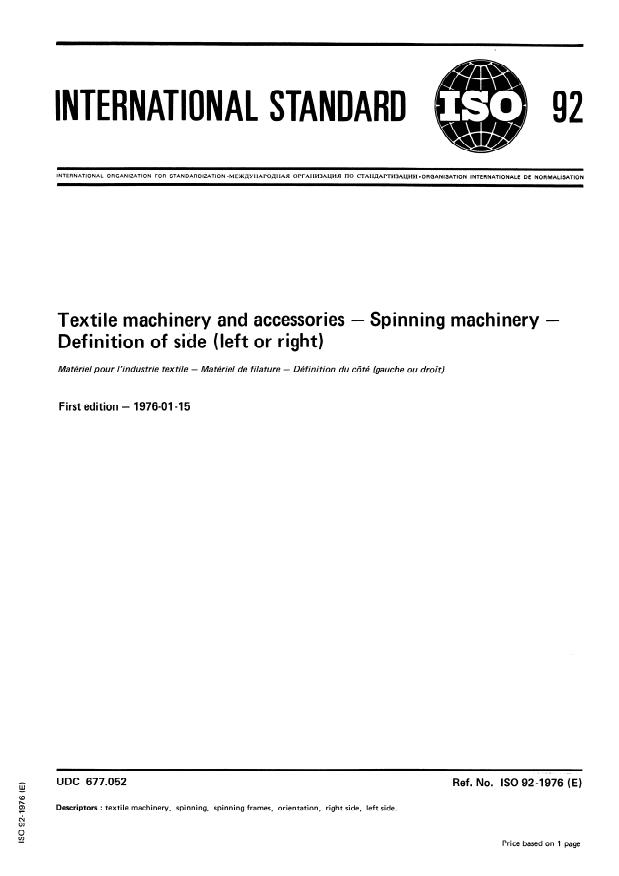
INTERNATIONAL STANDARD
INTERNATIONAL ORGANIZATION FOR STANDARDIZATION l MEXAYHAPOAHAJl OPrAHM3ALWiJl l-f0 CTAHAAPTM3AI.JMW l ORGANIZATION INTERNATIONALE DE NORMALISATION
Textile machinery and accessories - Spinning machinery -
Definition of side (left or right)
Ma tkriel pour l’industrie textile - Ma tkriel de fila ture - Definition du c6te’ (gauche ou droit)
First edition - 1976-01-15
UDC 677.052
Ref. No. IS0 92-1976 (E)
iii
-
Descriptors : textile machinery, spinning, spinning frames, orientation, right side, left side.
Price based on 1 page
FOREWORD
IS0 (the International Organization for Standardization) is a worldwide federation
of national standards institutes (IS0 Member Bodies). The work of developing
International Standards is carried out through IS0 Technical Committees. Every
Member Body interested in a subject for which a Technical Committee has been set
up has the right to be represented on that Committee. International organizations,
governmental and non-governmental, in liaison with ISO, also take part in the work.
Draft International Standards adopted by the Technical Committees are circulated
to the Member Bodies for approval before their acceptance as International
Standards by the IS0 Council.
Prior to 1972, the results of the work of the Technical Committees were published
as IS0 Recommendations; these documents are now in the process of being
transformed into International Standards. As part of this process, Technical
Committee ISO/TC 72 has reviewed IS0 Recommendation R 92 and found it
technically suitable for transformation. International Standard IS0 92 therefore
replaces IS0 Recommendation R 92-1959 to which it is technically identical.
IS0 Reco m mendation R 92 was ved by the Member Bodies of the following
aPPr0
countries
Spain
Austria Hungary
Belgium India Sweden
Bulgaria Ireland Switzerland
Canada Japan Turkey
Denm
...
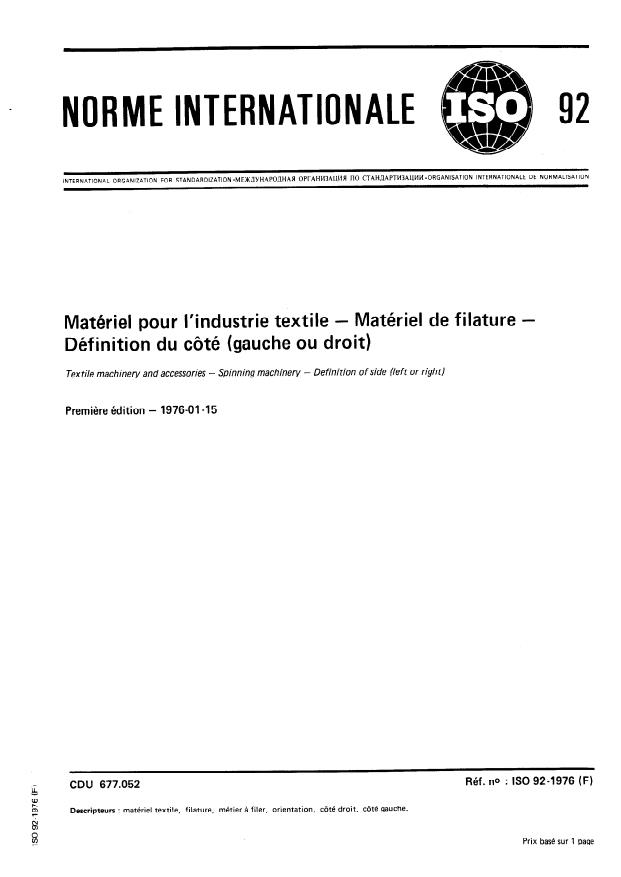
NORME INTERNATIONALE
INTERNATIONAL ORGANIZATION FOR STANDARDIZATION .MEXH(AYHAPOAHAA OPI-AHM3AWII Il0 CTAHLIAPTM3AUMM *ORGANISATION INTERNATIONALE DE NORMALtSATION
Matériel pour l’industrie textile - Matériel de filature -
Définition du côté (gauche ou droit)
Textile machinery and accessories - Spinning machinery - Definition of side (left or right)
Première édition - 1976-01-15
Réf. no : ISO 92-1976 (F)
CDU 677.052
: matériel textile, filature, métier à filer, orientation, côté droit, côté gauche.
Descripteurs
Prix basé sur 1 page
AVANT-PROPOS
L’ISO (Organisation Internationale de Normalisation) est une fédération mondiale
d’organismes nationaux de normalisation (Comités Membres ISO). L’élaboration de
Normes Internationales est confiée aux Comités Techniques ISO. Chaque Comité
Membre intéressé par une étude a le droit de faire partie du Comité Technique
correspondant. Les organisations internationales, gouvernementales et non
gouvernementales, en liaison avec I’ISO, participent également aux travaux.
Les Projets de Normes Internationales adoptés par les Comités Techniques sont
soumis aux Comités Membres pour approbation, avant leur acceptation comme
Normes Internationales par le Conseil de I’ISO.
Avant 1972, les résultats des travaux des Comités Techniques étaient publiés
comme Recommandations ISO; maintenant, ces documents sont en cours de
transformation en Normes Internationales. Compte tenu de cette procédure, le
Comité Technique ISO/TC 72 a examiné la Recommandation ISO/R 92 et est d’avis
qu’elle peut, du point de vue technique, être transformée en Norme Internationale.
La présente Norme Internationale remplace donc la Recommandation
ISO/R 92-1959 à laquelle elle est techniquement identique.
La Recommandation lSO/R 92 avait été approuvée par les Comités Membres des
pays suivants :
Allemagne Grèce Roumanie
Autriche Hongrie Royaume-Uni
Belgique Inde Suède
Bulgarie Irlande Suisse
Canada Japon Turquie
Danemark Pakistan U.R.S.S.
Espagne Pays-Bas U.S.A.
France Pologne
Aucun Comité Membre n’avait désapprouvé la Re
...
NORME INTERNATIONALE
INTERNATIONAL ORGANIZATION FOR STANDARDIZATION .MEXH(AYHAPOAHAA OPI-AHM3AWII Il0 CTAHLIAPTM3AUMM *ORGANISATION INTERNATIONALE DE NORMALtSATION
Matériel pour l’industrie textile - Matériel de filature -
Définition du côté (gauche ou droit)
Textile machinery and accessories - Spinning machinery - Definition of side (left or right)
Première édition - 1976-01-15
Réf. no : ISO 92-1976 (F)
CDU 677.052
: matériel textile, filature, métier à filer, orientation, côté droit, côté gauche.
Descripteurs
Prix basé sur 1 page
AVANT-PROPOS
L’ISO (Organisation Internationale de Normalisation) est une fédération mondiale
d’organismes nationaux de normalisation (Comités Membres ISO). L’élaboration de
Normes Internationales est confiée aux Comités Techniques ISO. Chaque Comité
Membre intéressé par une étude a le droit de faire partie du Comité Technique
correspondant. Les organisations internationales, gouvernementales et non
gouvernementales, en liaison avec I’ISO, participent également aux travaux.
Les Projets de Normes Internationales adoptés par les Comités Techniques sont
soumis aux Comités Membres pour approbation, avant leur acceptation comme
Normes Internationales par le Conseil de I’ISO.
Avant 1972, les résultats des travaux des Comités Techniques étaient publiés
comme Recommandations ISO; maintenant, ces documents sont en cours de
transformation en Normes Internationales. Compte tenu de cette procédure, le
Comité Technique ISO/TC 72 a examiné la Recommandation ISO/R 92 et est d’avis
qu’elle peut, du point de vue technique, être transformée en Norme Internationale.
La présente Norme Internationale remplace donc la Recommandation
ISO/R 92-1959 à laquelle elle est techniquement identique.
La Recommandation lSO/R 92 avait été approuvée par les Comités Membres des
pays suivants :
Allemagne Grèce Roumanie
Autriche Hongrie Royaume-Uni
Belgique Inde Suède
Bulgarie Irlande Suisse
Canada Japon Turquie
Danemark Pakistan U.R.S.S.
Espagne Pays-Bas U.S.A.
France Pologne
Aucun Comité Membre n’avait désapprouvé la Re
...